1. Introduction
As global climate risks intensify and net-zero commitments expand worldwide, accelerating the energy transition has become a major task for both policymakers and firms [
1,
2]. In response to this challenge, China, the world’s largest emerging economy and energy consumer, has announced its ambitious “dual-carbon” goals: peaking carbon emissions by 2030 and achieving carbon neutrality by 2060. Achieving these goals requires a fundamental transformation of the country’s energy system and production structure.
To operationalise these goals, China has implemented a series of market-based environmental regulations. Among them, the carbon emission trading rights (CETR) pilot policy stands out as a flagship instrument [
3]. Launched in stages across selected cities and provinces from 2013 onward, the CETR policy assigns a scarcity value to carbon emissions and allows firms to trade emission allowances. This staggered rollout creates quasi-natural experimental variation, making it an ideal setting for causal inference. As reviewed by Weng and Xu [
4], China’s carbon trading market has evolved from regional pilots toward a national system, providing valuable experience for understanding how market-based mechanisms influence firm behaviour.
A central question in environmental economics is whether such market-based regulations harm or benefit firm performance. The conventional cost-based view argues that stricter environmental rules raise operating costs, crowd out productive investment and depress productivity in the short run [
5]. In contrast, the Porter hypothesis posits that well-designed environmental regulations can stimulate innovation, improve resource allocation and generate offsetting productivity gains [
6].
Empirical studies on carbon pricing largely support the innovation-inducing effect. International evidence shows that the EU Emissions Trading System stimulated low-carbon innovation without crowding out other patenting activities [
7], and that carbon price signals shape the direction of technical change [
8]. China-focused studies have also grown rapidly. A broader strand of this literature reports that CETR pilots raise firm-level total factor productivity (TFP), improve carbon efficiency and generate spatial spillovers in green productivity [
9,
10,
11,
12]. More specifically, Zhou and Wang [
13] find that the CETR scheme promotes green technology innovation in China from a new structural economics perspective, with effects varying by market conditions and industrial characteristics. Wei, Zhu and Tan [
14] provide evidence from China’s thermal power enterprises, showing that emission trading can enhance technological innovation and competitiveness under appropriate regulatory design. Bai et al. [
15] examine the impact of China’s carbon market pilots on TFP and report a positive but conditional effect, suggesting that market-driven environmental regulation can be a “blessing” rather than a “curse” when combined with sufficient absorptive capacity. More directly relevant to the present study, Zhang et al. [
16] find that carbon emissions trading policy can promote the development of New Quality Productive Forces (NQPF) in manufacturing enterprises, a finding that closely aligns with the core inquiry of this study.
Despite these valuable insights, most existing studies evaluate environmental policies using partial or isolated indicators—patent counts, energy efficiency, or conventional TFP. These metrics capture only incremental adjustments rather than holistic, systemic enterprise upgrading. Surviving the energy transition requires more than green innovation; it demands a comprehensive transformation of a firm’s technological capabilities, resource allocation, production organisation and digitalisation. Moreover, the energy transition is not driven by carbon pricing alone. Complementary tools such as renewable energy deployment, energy storage, digital infrastructure and smart production systems also play crucial roles. For instance, recent research on second-life battery applications shows that integrating storage-related innovations can improve the efficiency and profitability of renewable-energy systems, highlighting the need to consider carbon markets as part of a wider policy mix [
17].
To fill this gap in measuring systemic enterprise upgrading, this study introduces the concept of NQPF as a multidimensional measure of systemic enterprise upgrading. Originating from the Chinese policy context but relevant to broader energy transition research, NQPF captures improvements in production factor quality, technological innovation, green development, production organisation and data utilisation in an integrated manner [
18,
19,
20]. Unlike single-dimensional indicators, NQPF allows us to assess whether carbon trading induces not just compliance behaviour but a genuine, systemic transformation of firms’ production systems.
Two main channels through which CETR may affect NQPF are identified in this study. First, by assigning tradable value to emission allowances and sending positive signals to capital markets, the policy may ease financing constraints and provide long-term capital for upgrading. Second, compliance with carbon markets requires precise emissions monitoring and reporting, which may accelerate corporate digital transformation—a key enabler of modern production systems. Moreover, the policy effect may vary with firm ownership and managerial characteristics, as non-state-owned firms face tighter budget constraints, and managers with different backgrounds have different strategic orientations.
Using panel data on China’s A-share listed companies from 2011 to 2023, this study employs a staggered multi-period difference-in-differences (DID) design to estimate the association between CETR pilots and enterprise NQPF. This study makes three contributions. First, it shifts the focus from single-dimensional outcomes to systemic enterprise upgrading. Second, it provides a transparent operationalisation of the NQPF index for international audiences. Third, it identifies financing constraints and digital transformation as key channels, while documenting governance-related heterogeneity.
The remainder of the paper is organised as follows.
Section 2 explains the concept of NQPF, including its substantive and permeable dimensions.
Section 3 presents the theoretical framework and develops the research hypotheses.
Section 4 describes the data, variables and empirical strategy, including the construction of the NQPF index.
Section 5 reports the empirical results and robustness checks.
Section 6 concludes with a discussion of policy implications and limitations.
2. Concept of NQPF
Single-dimensional metrics like patent counts or conventional TFP cannot fully capture how enterprises transform during the energy transition. To fill this gap, this study uses the NQPF index. This section outlines the concept and theoretical basis of NQPF; detailed indicators, data sources and construction steps are given in
Section 4.
NQPF first appeared in Chinese policy discussions in late 2023 as a description of an advanced, innovation-driven productivity paradigm [
21]. Unlike traditional growth models that depend heavily on extensive resource inputs, NQPF is defined by high technology, high efficiency and high quality [
22]. It also fits well with the global consensus on sustainable development and the digital economy.
In the context of energy transition and carbon markets, NQPF offers a broad measure of enterprise upgrading. Meeting strict environmental regulations such as the CETR policy forces firms not only to develop green technologies but also to raise the quality of their workforce, digitalise production, and improve organisational structures—a shift toward dynamic capabilities and systemic innovation [
23,
24].
To operationalise NQPF at the firm level, this study draws on the theoretical framework of modern political economy. At the firm level, NQPF naturally comprises two complementary categories: substantive elements and permeable elements. These correspond, respectively, to the physical inputs of production and the catalytic factors that reshape them.
Substantive elements refer to the tangible, physical and human carriers of production—labour, capital and land—upgraded into: (i) new quality labour force (highly educated, R&D-oriented personnel); (ii) new quality means of production (digital technologies and smart equipment); and (iii) new quality subjects of production (cleaner materials and lower environmental footprint).
Permeable elements are intangible, catalytic forces—technological knowledge, data, and organisational management [
25,
26]. They permeate and interact with substantive elements, generating exponential productivity gains. This category covers new technology R&D, innovation output, modern production organisation, and data elements. For instance, data (a permeable factor) can improve how digital equipment (a substantive factor) is deployed, fundamentally changing traditional production functions [
27]. This interaction between the two categories is what sets NQPF apart from conventional productivity indicators.
3. Theoretical Framework and Hypotheses
Drawing on the literature reviewed above, four testable hypotheses are proposed regarding how the emissions trading scheme (ETS) may be associated with enterprise productivity transformation during the energy transition. First, the CETR pilot policy pushes firms to optimise resource allocation, stimulate green innovation and modernise production, thereby directly cultivating NQPF [
28]. Second, by assigning a scarcity value to carbon emission rights and signalling green transition capabilities, the policy may ease financing constraints and improve firms’ access to resources for systemic upgrading [
29,
30]. Third, the strict compliance and monitoring demands of the carbon market may accelerate corporate digital transformation, thereby laying part of the technological groundwork for productivity change [
31,
32,
33]. Finally, because governance structures and managerial characteristics shape a firm’s strategic flexibility and market sensitivity, the impact of the CETR policy on NQPF is likely to differ significantly across enterprise types [
34].
3.1. Emissions Trading Scheme and Enterprise Productivity Transformation
In the context of the global energy transition, the ETS acts as a key market-based driver of micro-level enterprise upgrading [
3,
4]. According to the Porter hypothesis [
6], well-designed environmental regulations like China’s CETR pilot do not merely impose compliance costs; they fundamentally reshape firm incentives [
5,
6]. By internalizing the environmental costs of carbon emissions, the CETR policy pushes firms away from traditional high-energy, high-emission growth models [
7,
8]. To survive and stay competitive during the energy transition, enterprises cannot rely on short-term, end-of-pipe emission reductions alone. Instead, they must undertake a systemic and holistic productivity transformation [
9,
11]. This transformation involves adopting higher-quality production factors, spurring deep green technological innovation, and modernizing production organization—all elements that the NQPF metric captures comprehensively [
28]. Thus, carbon trading serves as an important external force, pushing firms to cultivate NQPF to achieve high-quality development in a decarbonized economy [
35].
H1. The CETR pilot policy significantly promotes the development of enterprise NQPF, effectively driving enterprise productivity transformation.
3.2. Financing Conditions as a Resource Channel
Enterprise upgrading often requires sustained investment in technology, equipment, intangible assets, and organizational restructuring [
29]. Firms facing tighter financing constraints may find it more difficult to undertake such long-cycle investments [
30]. Carbon trading may improve financing conditions in at least two ways. First, emission allowances may strengthen firms’ balance-sheet flexibility by creating tradable carbon-related assets [
36]. Second, active participation in a regulated carbon market may send a positive signal regarding firms’ transition capacity and environmental compliance, thereby improving access to external financing. If so, CETR pilots may be associated with lower financing constraints, which would be consistent with a resource-based channel linking carbon trading and enterprise upgrading [
37].
H2. The CETR pilot policy is associated with lower financing constraints.
3.3. Digital Transformation as a Technology Channel
Operating under a carbon trading regime requires more accurate emissions monitoring, reporting, and verification. These requirements may accelerate firms’ adoption of digital technologies, such as data platforms, cloud systems, industrial internet tools, and intelligent monitoring systems [
32,
33]. Once introduced for carbon management, such technologies can spill over into broader production and organizational processes, improving information processing, coordination, and resource allocation. If this reasoning holds, CETR pilots should be associated with stronger corporate digital transformation, which would be consistent with a technology-based channel linking carbon trading and enterprise upgrading [
38,
39].
H3. The CETR pilot policy is positively associated with corporate digital transformation.
3.4. Heterogeneity in Ownership and Managerial Characteristics
The capacity and incentive for enterprise productivity transformation under the CETR policy are not uniform; they depend heavily on firm-specific governance and operational contexts [
34]. First, compared to state-owned enterprises (SOEs), non-SOEs typically face tighter budget constraints and are more sensitive to market-based cost signals. As a result, non-SOEs have a stronger incentive to cultivate NQPF quickly to offset carbon compliance costs and survive the energy transition. Second, managerial characteristics play a crucial role in strategic decision-making [
33]. Senior managers without financial backgrounds often focus more on long-term operational upgrading, real-economy technological innovation, and industrial development (rather than short-term financial arbitrage), making them more likely to drive systemic productivity transformation. Finally, managers who do not hold concurrent positions in shareholder units tend to have greater operational independence; their interests align more closely with the long-term sustainable development and upgrading of the firm itself, rather than with the immediate financial interests of the parent company.
H4. The positive effect of the CETR pilot policy on enterprise NQPF and productivity transformation is stronger for non-state-owned enterprises, for firms whose senior managers lack financial backgrounds, and for firms whose senior managers do not concurrently hold positions in shareholder units.
This unified framework links market-based environmental regulation, capital access, digital technology, and governance structures into a coherent system, providing testable predictions for how the emissions trading scheme drives enterprise productivity transformation during the energy transition.
4. Materials and Methods
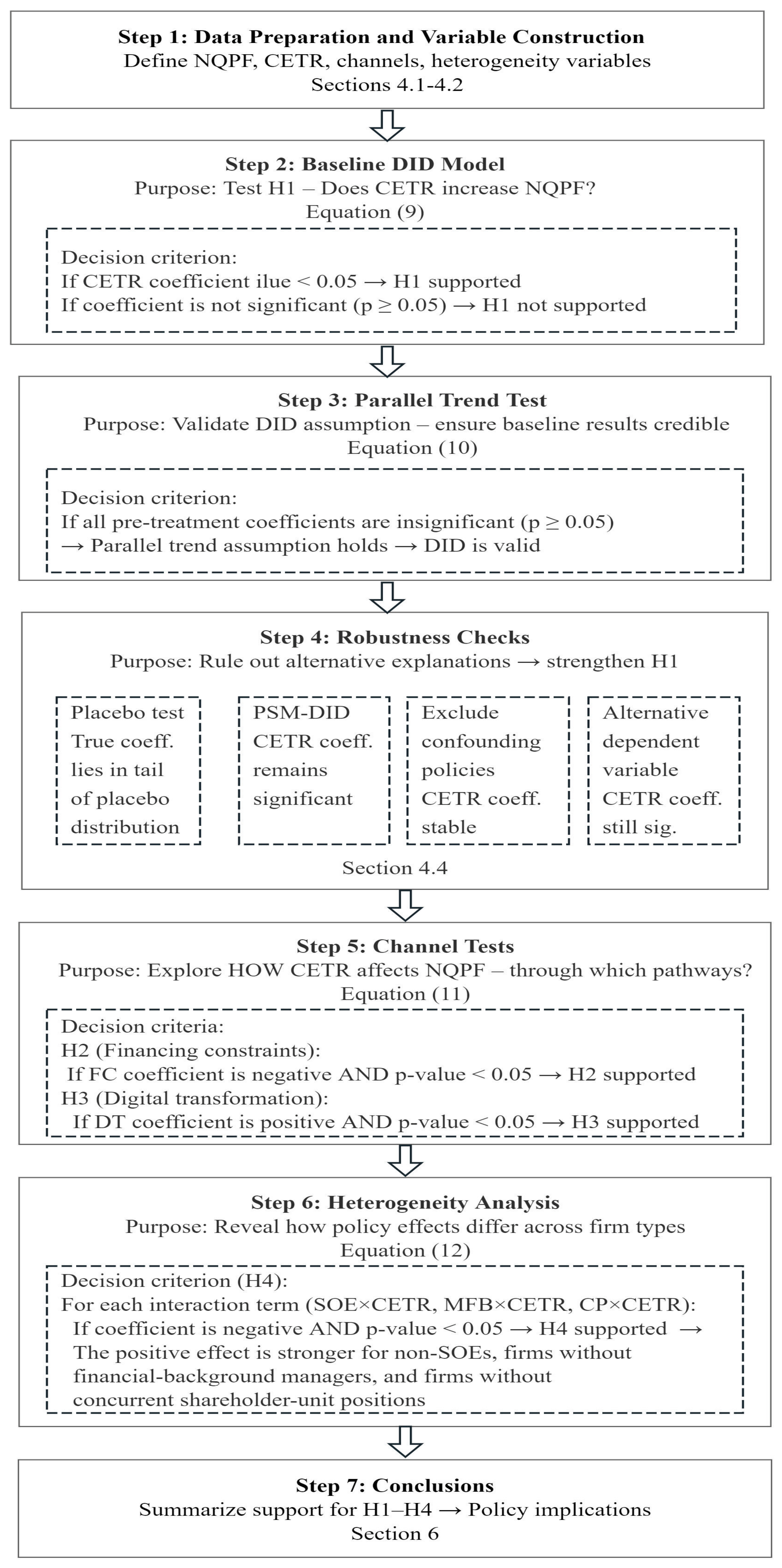
This section describes the empirical strategy employed to test the four hypotheses proposed in
Section 3. The analysis proceeds in seven steps, as summarised in
Figure 1. First, the data are screened and the main variables are constructed, including the dependent variable
NQPF (using the entropy weight method), the independent variable
CETR, channel variables (financing constraints
FC and digital transformation
DT), and heterogeneity variables (
SOE,
MFB,
CP). Second, a staggered DID model with two-way fixed effects is estimated to test H1—whether
CETR positively affects
NQPF. Third, a parallel trend test is conducted to validate the DID assumption. Fourth, a series of robustness checks (placebo test, PSM-DID, excluding confounding policies, and alternative dependent variable) are performed to rule out alternative explanations. Fifth, channel tests examine H2 and H3—whether
CETR influences
NQPF through easing financing constraints and accelerating digital transformation. Sixth, interaction models test H4—whether the policy effect varies by ownership, managerial financial background, and concurrent positions in shareholder units. Seventh, the conclusions summarise the findings and draw policy implications.
All hypotheses are tested using regression models with firm-clustered standard errors. The
p-values for coefficients are obtained from two-tailed
t-tests. A hypothesis is considered supported if the coefficient meets the expected sign and is statistically significant at the 5% level (
p < 0.05). The analytical framework in
Figure 1 illustrates the logical flow of the empirical strategy.
4.1. Data and Sample
This study empirically evaluates the net effect of the CETR pilot policy on enterprise productivity transformation. The policy was rolled out in three batches starting in 2013, 2014, and December 2016. Because there is a notable time lag between policy enactment and meaningful responses from firms, for pilot cities where the scheme launched in November or December, the effective policy year is defined as the following calendar year.
China’s A-share listed companies on the Shanghai and Shenzhen stock exchanges from 2011 to 2023 are selected as the initial research sample. To ensure data validity and robust empirical results, the sample is screened as follows: (1) financial enterprises are excluded because their accounting standards, capital structures, and regulatory environments differ substantially from those of non-financial firms; (2) observations of firms under special treatment owing to financial distress, abnormal operations, or delisting risk are removed; and (3) all continuous variables are winsorized at the 1st and 99th percentiles to reduce the influence of extreme outliers on statistical inference.
Information on the specific implementation dates and the list of pilot cities is manually compiled from the official website of the National Development and Reform Commission [
40]. For pilot programmes launched late in the calendar year, the effective treatment year is set to the following year to reflect the expected timing of firm response. All other micro-level financial and corporate governance data come from the China Stock Market & Accounting Research (CSMAR) database.
4.2. Description of Variables
4.2.1. Dependent Variable: NQPF (NQPF)
The dependent variable in this study is the enterprise-level NQPF index, obtained from the CSMAR NQPF Research Database. The database provides a pre-defined three-level indicator system based on the theoretical framework of substantive and permeable elements described in
Section 2.
Table 1 presents the complete structure of the enterprise NQPF index, including all second-level and third-level indicators.
The following points clarify the measurement of selected third-level indicators that are not self-explanatory from the table alone. First, digital technology investment is calculated as the proportion of intangible assets related to digital technologies (e.g., software, databases, digital platforms) to total assets. Second, the enterprise total pollution equivalent aggregates emissions of major pollutants, including chemical oxygen demand and sulphur dioxide, into a standardised metric following China’s environmental protection standards. Third, word frequency measures for production digitalisation, organisational digitalisation and data elements are derived from textual analysis of corporate annual reports, counting occurrences of predefined keywords (see the keywords listed in
Table 1).
The NQPF index is computed purely from firm-level characteristics and is not mathematically derived from the CETR policy variable. Because the third-level indicators have different units and scales, the entropy weight method (EWM) is employed to assign weights objectively. The EWM determines weights based on the information entropy (variance) of each indicator, thereby avoiding subjective bias. The procedure consists of five steps.
The entropy weight method is an objective weighting technique commonly used for composite indicators. Its logic is as follows. For a given indicator, if its values vary little across firms (i.e., low information entropy), it provides little useful information for distinguishing firms and thus should receive a small weight. Conversely, if the values vary widely (high information entropy), the indicator is more informative and should receive a larger weight. The method calculates information entropy for each indicator, then defines redundancy (utility value) as 1−entropy, and finally derives weights by normalising the redundancy values. This process ensures that weights are determined purely by the data, without subjective judgement.
Because the data span multiple years, entropy is calculated separately for each year to reflect year-specific variation. Let denote the information entropy of indicator j in year t; similarly, let be the redundancy, and the weight. The final composite index for firm I in year t is , where is the normalised value of indicator j. To keep the weight structure consistent over time for panel analysis, the CSMAR database applies a “benchmark-locked” procedure: weights are calibrated using the full historical sample and then fixed for subsequent updates. In the notation below, for brevity we omit the time subscript on weights after the calibration.
Step 1: Normalisation. Raw metrics are normalised to a scale from 0 to 1. For positive indicators, where higher values indicate stronger NQPF such as the R&D personnel ratio, the normalisation is:
For negative indicators, where lower values are better, such as total pollution equivalents, the normalisation is:
In these equations, is the value of indicator j for firm i in year t, and and are the maximum and minimum values of indicator j across the sample. To account for data updates and panel dynamics, the maximum and minimum values are calculated using a rolling five-year window.
Step 2: Proportion calculation. For each year
t, the proportion
of firm
i’s normalised value to the sum of all firms’ values for indicator
j in that year is calculated as:
where
is the number of firms in year
t.
Step 3: Information entropy. The information entropy
for indicator
j is computed as:
where
is the number of firms in year
t.
Step 4: Information redundancy and weight. The information redundancy, also called utility value,
is:
The objective weight
for each indicator is then derived by normalising the redundancy values:
where
n is the number of indicators.
Step 5: Composite index. Finally, the composite Enterprise NQPF Index is calculated using a linear weighting function:
After this calculation, the weights are fixed at their calibration-year values to maintain consistency across the panel. This final composite score, , provides a robust, multi-dimensional measure of a firm’s systemic upgrading. It is used as the primary dependent variable to evaluate the impact of the CETR policy in the subsequent empirical analysis.
4.2.2. Independent Variable: CETR
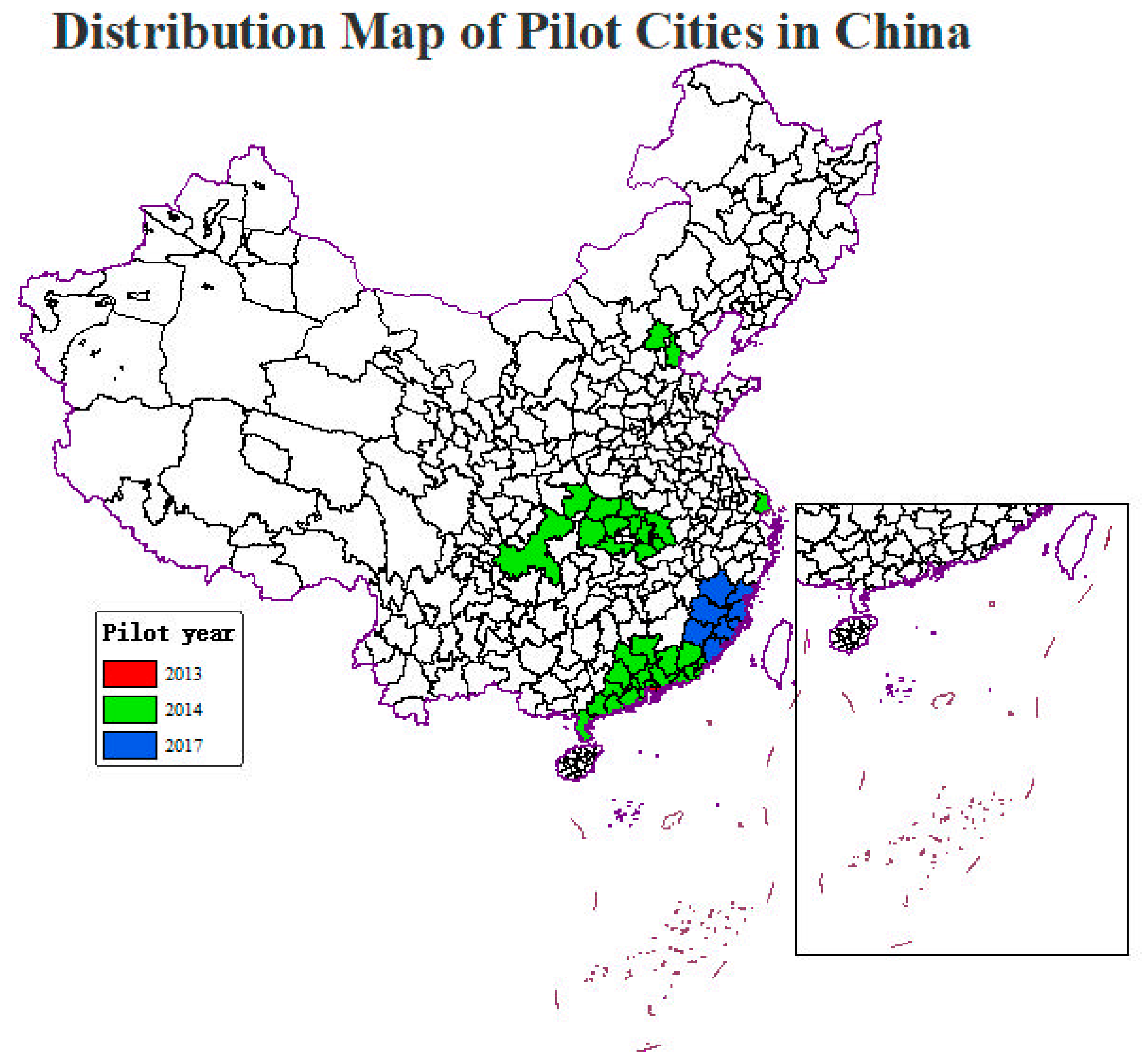
The key independent variable is the carbon emission trading rights pilot policy (CETR). The staggered implementation of the CETR pilots provides the quasi-natural experimental setting for this study. Based on the actual rollout schedule and the effective timing used in the empirical analysis, the policy year is coded at the city level.
Based on this coding rule, the treatment variable
is defined as follows:
where
equals 1 if firm
i is registered in a CETR pilot city, and 0 otherwise.
equals 1 if year
t is greater than or equal to the effective treatment year of the corresponding pilot city, and 0 otherwise. Therefore,
equals 1 for firms located in pilot cities after the effective treatment year, and 0 otherwise.
The treatment timing follows the empirical coding shown in
Figure 2. This city-level policy coding allows the analysis to match firms with CETR exposure according to their registered city, while controlling for city-level economic conditions such as per capita GDP.
4.2.3. Control Variables
To reduce bias from omitted variables, eight control variables are included across three dimensions—firm characteristics, corporate governance, and regional macroeconomic conditions—drawing on the research frameworks of Zheng et al. [
35]. At the firm characteristic and financial level, return on equity (
ROE) is used to measure profitability, firm age (
Age) to reflect operational maturity, financial leverage (
Lev) to control for financial risk, and Tobin’s Q (
TobinQ) to proxy for firm value. At the corporate governance level, the shareholding ratio of the largest shareholder (
Top1) is included to capture ownership concentration, and board size (
Boardsize) and CEO duality (
Dual) are included to reflect internal governance effectiveness. At the macroeconomic level, gross domestic product (
GDP) is used to control for regional economic development differences.
4.2.4. Channel Variables
The two channels introduced in
Section 1—namely, the relaxation of financing constraints and the acceleration of digital transformation—are empirically tested using the following variables. These channels correspond to the formal hypotheses H2 and H3 developed in
Section 3, but the measurement definitions here follow directly from the conceptual discussion in the introduction.
Financing Constraints (
FC). Following Hadlock and Pierce [
30], the SA index is employed as a proxy for financing constraints. The index is calculated as:
, where
is the natural logarithm of total assets, and
is the number of years since the firm’s establishment. A higher value of the SA index indicates tighter financing constraints. The SA index is preferred over alternative measures because it relies less on endogenous firm characteristics such as cash flow and leverage.
Corporate Digital Transformation (
DT). Following Wu et al. [
33], corporate digital transformation is measured by the frequency of digital-related keywords appearing in firms’ annual reports. The raw keyword count is scaled by the total word count of each report to account for variations in report length.
4.2.5. Heterogeneity Variables
Three firm-level heterogeneity variables are defined. First, state ownership (SOE) is a dummy variable equal to 1 if the ultimate controlling shareholder is a central or local government entity, and 0 otherwise. Second, managerial financial background (MFB) is a dummy variable equal to 1 if any member of the top management team (including the CEO, CFO, and board directors) has prior work experience in financial institutions (e.g., banks, securities firms, insurance companies, or investment funds), and 0 otherwise. Third, concurrent position in shareholder unit (CP) is a dummy variable equal to 1 if a senior manager (CEO or board chairman) concurrently holds a position in the firm’s shareholder unit (e.g., as a representative of the parent company), and 0 otherwise.
Detailed definitions and measurement methods for each variable are presented in
Table 2.
4.3. Empirical Model
To estimate the association between the CETR pilot policy and enterprise
NQPF, the following staggered DID model with two-way fixed effects is specified. It is important to emphasise that this is a statistical regression model for hypothesis testing, not a definitional formula for
NQPF. The dependent variable
is constructed independently from firm-level indicators using the entropy weight method described in
Section 4.2.1. The independent variable
is defined in Equation (8) as
. The coefficient
β captures the average change in
NQPF associated with the policy, controlling for other factors.
The model takes the following form:
In Equation (9), the dependent variable represents the level of NQPF for firm i in year t. The independent variable is the policy treatment dummy, taking the value of 1 if the city where firm i is located has implemented the carbon trading pilot policy in that year, and 0 otherwise. The coefficient β captures the net effect of the policy on enterprise productivity transformation, which is the main parameter of interest in this study. denotes the set of control variables described above. The model also includes firm fixed effects () to control for time-invariant, unobservable firm characteristics, and year fixed effects () to absorb macroeconomic shocks and nationwide regulatory trends that affect all firms. Including these two-way fixed effects helps mitigate endogeneity bias from omitted variables. Finally, is the stochastic error term.
4.4. Identification Strategy and Robustness Approaches
To ensure the credibility of the DID estimates, several supplementary identification strategies and robustness checks are employed. The detailed procedures are described below, while the corresponding results are presented in
Section 5.
4.4.1. Parallel Trend Testing Procedure
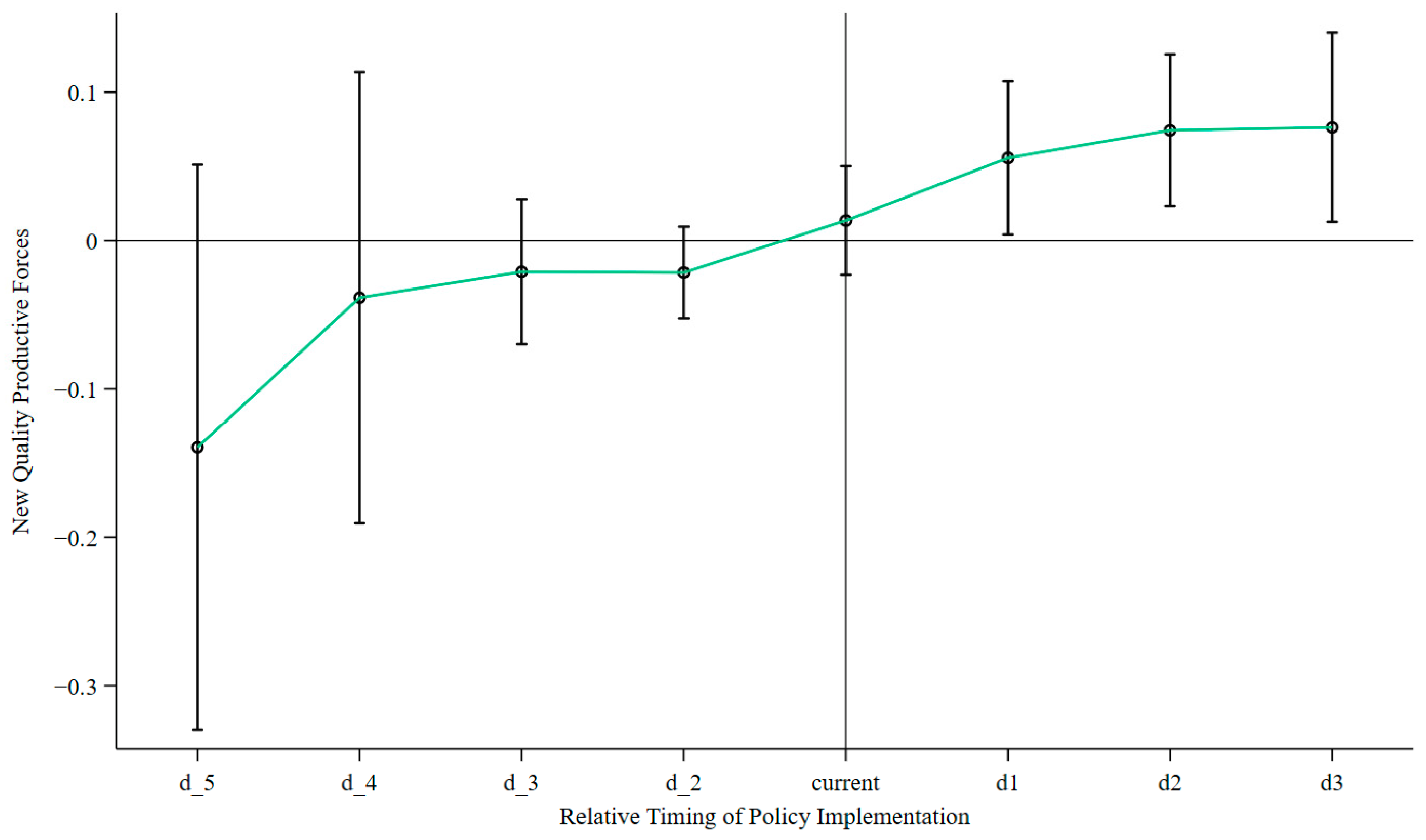
A valid DID design requires that treatment and control groups follow parallel trends in the absence of the policy. To test this assumption and to trace the dynamic effect of the CETR policy, an event-study model is estimated:
where
is a set of event-time indicators equal to 1 if firm
i is in the
k-th year relative to the effective treatment year. The year immediately before the policy shock (
k = −1) is omitted as the benchmark period. The coefficients
measure the difference between treated and control firms in each event year relative to the benchmark year. The parallel trend assumption is supported if the pre-treatment coefficients are statistically indistinguishable from zero.
4.4.2. Placebo Test with Randomised Pilot Cities and Timing
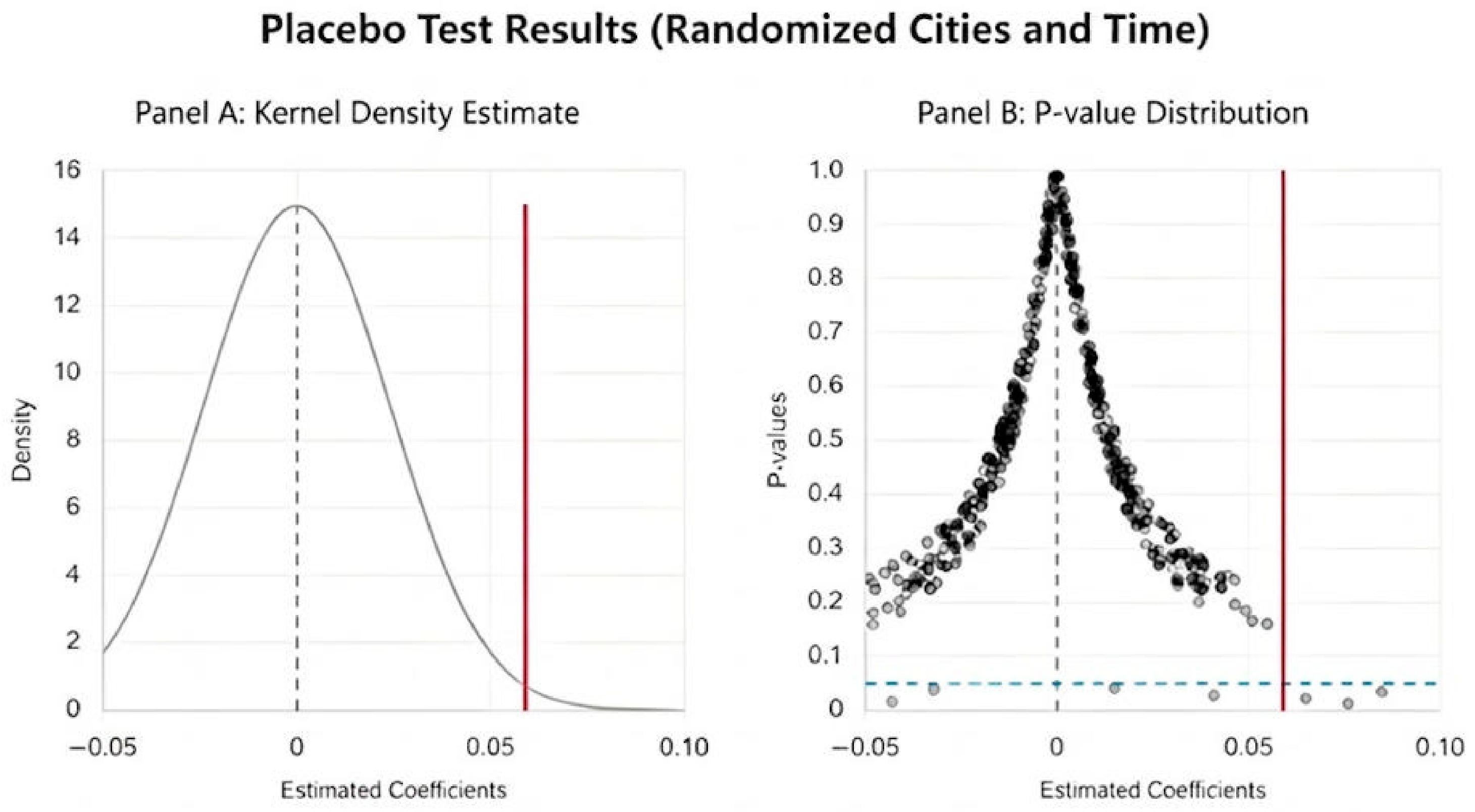
To address concerns that unobserved time-varying factors or non-random pilot assignment might bias the estimates, a placebo test is conducted by jointly randomising both pilot cities and policy implementation years. In each simulation, a group of placebo pilot cities is randomly selected from the full set of sample cities, with the number of placebo cities equal to that of actual treated cities. The actual policy years are then randomly reshuffled and assigned to these placebo cities. A pseudo-CETR variable is constructed based on the randomised city–year treatment status, and the baseline DID model is re-estimated. This procedure is repeated 500 times to obtain the empirical distribution of placebo coefficients. If the true baseline coefficient lies in the tail of the placebo distribution, it suggests that the estimated effect is not driven by random chance or omitted confounders.
4.4.3. Propensity Score Matching with DID (PSM-DID)
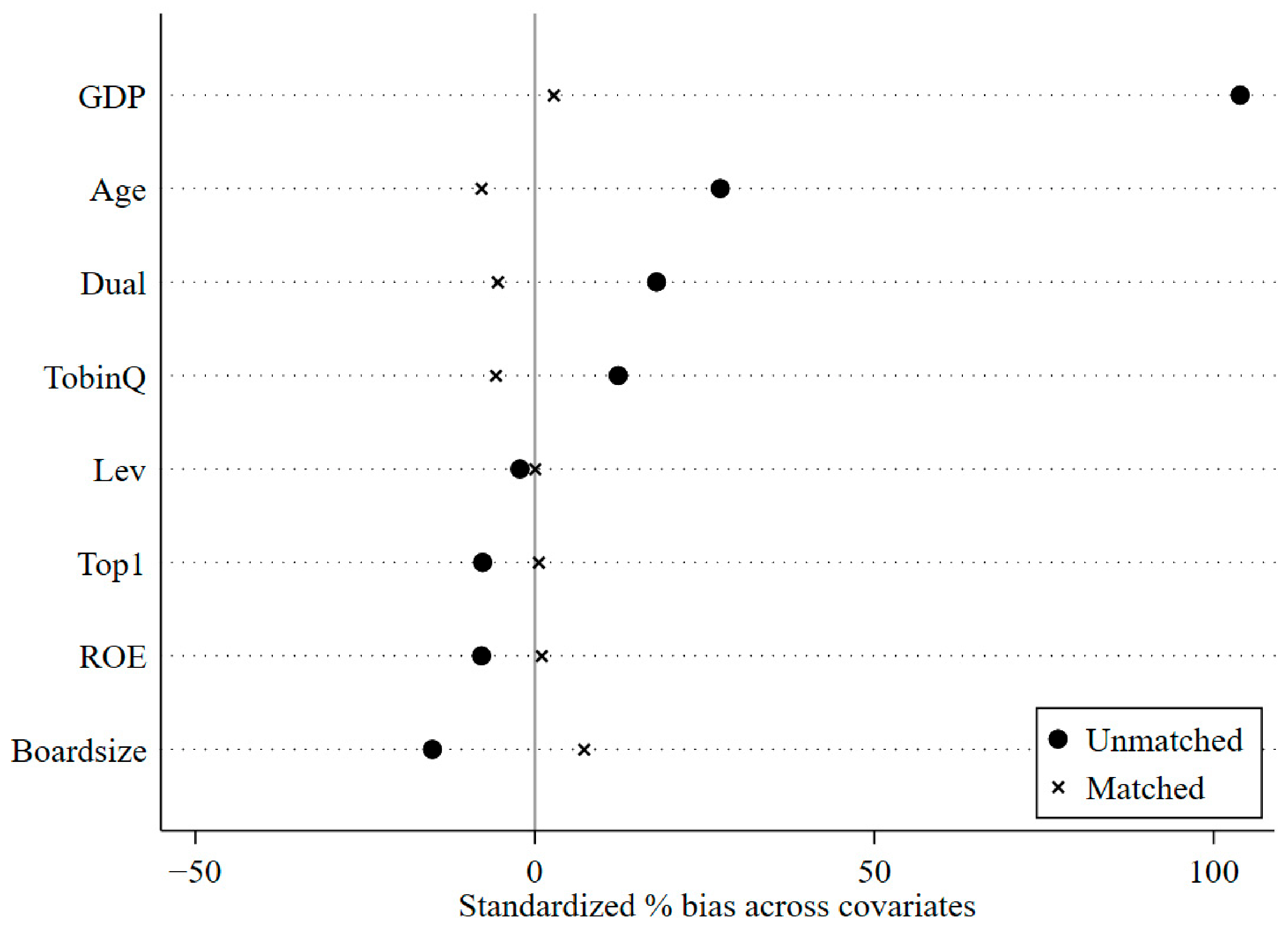
To mitigate selection bias arising from non-random pilot assignment, a PSM-DID approach is implemented. First, a Logit model is estimated using the control variables as covariates to calculate each firm’s propensity score for being selected into a pilot city. Second, within the common support region (the overlapping range of propensity scores between treated and control observations), 1:2 nearest-neighbour matching is applied to find comparable control firms for each treated firm. Third, a balance test is performed to check the covariate balance before and after matching. Finally, the DID model is re-estimated on the matched sample.
4.4.4. Controlling for Concurrent Policies
During the sample period, the Chinese government implemented other environmental regulations that may confound the CETR effect. Two representative concurrent policies are explicitly controlled for: The Air Pollution Prevention and Control Action Plan (APPCAP) and the Low-Carbon City Pilot Policy (LCCP). Dummy variables for these policies are constructed and added to the baseline regression one by one, as well as simultaneously, to isolate the net effect of CETR.
4.4.5. Alternative Dependent Variable Measurement
To check whether the baseline results are driven by firm-level idiosyncratic shocks or measurement errors, the original dependent variable is replaced with industry–year and city–year mean values of enterprise NQPF. These aggregated measures help to assess whether the CETR policy generates spillover effects beyond individual firms.
4.5. Models for Channel and Heterogeneity Analysis
4.5.1. Channel Test Model
To examine whether CETR pilots are associated with changes in financing constraints and digital transformation in directions consistent with the proposed resource and technology channels, the following specification is estimated for each channel variable:
where
denotes either
or corporate digital transformation
. The coefficient
β captures the association between the CETR policy and the channel variable. A significant negative coefficient for
or a positive coefficient for
provides channel-consistent evidence.
4.5.2. Heterogeneity Interaction Model
To test whether the effect of CETR differs across firm types, an interaction model is estimated:
where
denotes the heterogeneity variable of interest:
SOE,
MFB, or
CP. The coefficient
captures the differential association between
CETR and
NQPF for firms with the given characteristic. A significantly negative
indicates that the positive effect of
CETR on
NQPF is weaker for firms with
.
5. Empirical Results
This section presents the empirical findings of the study. The core objective is to examine whether the CETR pilot policy is associated with higher enterprise NQPF, and whether this association operates through the proposed channels of financing constraints and digital transformation, with heterogeneity across firm types. The results are organised as follows.
Section 5.1 reports descriptive statistics.
Section 5.2 presents the baseline DID estimates of the policy effect on NQPF.
Section 5.3 provides event-study evidence on parallel trends and dynamic effects.
Section 5.4 reports a battery of robustness checks, including placebo tests, PSM-DID, exclusion of confounding policies, and alternative dependent variable measurements.
Section 5.5 presents channel test results for financing constraints and digital transformation.
Section 5.6 reports heterogeneity analyses by ownership, managerial financial background, and concurrent positions in shareholder units.
5.1. Summary Statistics
Table 3 presents descriptive statistics for the main variables, based on 28,367 firm-year observations. The mean value of
NQPF is 0.029, with a standard deviation of 0.863 and a median of −0.311, indicating a right-skewed distribution. This suggests that while a small group of pioneering firms has achieved a high level of productivity transformation, many firms are still in the early stages. The mean of
CETR is 0.410, meaning that about 41% of the observations fall under the carbon trading policy, reflecting a relatively balanced treatment-control split. The control variables show typical characteristics of China’s A-share listed firms, with reasonable variation across the sample.
5.2. Baseline Regression Results
Table 4 reports the baseline DID estimates. Column (1) includes only firm and year fixed effects, while Column (2) adds the full set of control variables. In the full specification, the coefficient on CETR is 0.059 and statistically significant at the 5% level, supporting Hypothesis H1 that the CETR pilot policy is positively associated with enterprise NQPF.
In economic terms, given the standard deviation of NQPF (0.863), an increase of 0.059 units represents roughly a 6.8% standard deviation improvement in enterprise productivity. This finding is broadly consistent with the Porter hypothesis, which posits that well-designed environmental regulation can stimulate firm upgrading through market-based incentives. By internalising external environmental costs into corporate decision-making, the CETR policy may weaken firms’ reliance on high-pollution and high-energy-consumption growth models, while encouraging greater investment in technology upgrading, digital transformation, and factor reallocation. Consequently, this market-based environmental regulation acts as a catalyst, transforming compliance pressure into a driver of high-quality development. The observed positive association between CETR and NQPF at the micro level thus aligns with the broader dual-carbon transition agenda.
5.3. Parallel Trend Test and Dynamic Effects
Figure 3 plots the event-study coefficients estimated from Equation (10). Before the CETR policy shock, all estimated coefficients are statistically insignificant and show no systematic trend, confirming the parallel trend assumption. The coefficient in the implementation year (
k = 0) is positive but not significant, which is expected because enterprise upgrading—including adjusting investment plans, reorganising production processes, improving environmental management, and adopting digital tools—requires time to materialise. In the post-treatment periods (k ≥ 1), however, the coefficients turn positive and gradually increase, becoming statistically significant from the first year onward. This pattern indicates a sustained positive effect of the CETR policy on
NQPF, rather than a short-lived shock. Importantly, the absence of positive and rising pre-treatment coefficients rules out the possibility that the baseline result is driven by pre-existing differences between treatment and control groups. Overall, the event-study evidence supports the validity of the DID design and confirms that the estimated effect captures the dynamic response of firms to the CETR policy.
5.4. Robustness Checks
5.4.1. Placebo Test
To address concerns about unobserved confounders or non-random policy assignment, a placebo test is conducted by jointly randomising pilot cities and policy implementation years (see
Section 4.4.2 for details).
Figure 4 reports the results from 500 simulations. Panel A presents the kernel density distribution of the estimated placebo coefficients, which is centred around zero and follows a normal distribution. Panel B plots the corresponding
p-values against the placebo coefficients; most simulated estimates cluster around zero with comparatively large
p-values, while only a small number approach the 5% significance threshold. By contrast, the true baseline coefficient of 0.059 lies in the right tail of the simulated distribution, clearly separated from the bulk of the placebo estimates. Taken together, these results confirm that the main finding is unlikely to be driven by random chance, arbitrary policy timing, or omitted factors, providing further support for the robustness of the DID estimates.
5.4.2. PSM-DID Analysis
To further address concerns about non-random pilot assignment, a PSM-DID approach is implemented, as described in
Section 4.4.3. A balance test is then performed to check the matching quality, as shown in
Figure 5.
Figure 5 plots the standardised bias of covariates before and after matching. The clear decline in post-matching bias indicates that the matched treatment and control groups are more comparable in observable characteristics. Finally, the DID model is re-estimated on the matched sample.
Column (3) in
Table 4 reports the PSM-DID estimates. The CETR coefficient remains positive and statistically significant. The close similarity between the PSM-DID estimate and the baseline DID estimate suggests that the main finding is unlikely to be driven by observable selection into pilot status. This confirms that after mitigating self-selection bias and inter-group heterogeneity, the conclusion that the CETR pilot policy significantly improves enterprise
NQPF holds up well.
5.4.3. Excluding Confounding Policies
Table 5 reports the results after controlling for two concurrent environmental policies: the APPCAP and the LCCP. Column (1) adds only the APPCAP dummy, Column (2) adds only the LCCP dummy, and Column (3) includes both policy dummies simultaneously. Even after accounting for these overlapping regulations, the CETR coefficient remains stable and statistically significant across all three specifications, with values of 0.059, 0.056, and 0.055 respectively. This indicates that the positive effect of the carbon trading pilot on enterprise NQPF is independent of other concurrent environmental policies, further supporting the view that the observed policy effect genuinely originates from the carbon trading mechanism itself.
5.4.4. Alternative Variable Measurement
To reduce concerns about firm-level idiosyncratic shocks, the dependent variable is replaced with industry–year and city–year mean
NQPF values (see
Section 4.4.5). As shown in
Table 6, the
CETR coefficient is 0.029 when industry–year means are used (Columns 1–2) and increases to 0.096 when city–year means are used (Columns 3–4); both estimates are significant at the 1% level. This finding has two implications. First, it confirms that the baseline results are not driven by extreme firm-level observations and are statistically reliable. Second, it highlights that the benefits of the CETR pilot policy are broad-based: the policy’s influence extends beyond individual firms, generating positive spillover effects that lift NQPF across entire industries and pilot cities.
5.5. Channel Test Analysis
The theoretical framework proposes two channels through which
CETR may affect NQPF: the easing of financing constraints (H2) and the acceleration of digital transformation (H3). To test these channels, the channel test model (Equation (11)) is estimated, and the results are reported in
Table 7.
Financing constraints are measured using the SA index proposed by Hadlock and Pierce [
30]; a higher value indicates tighter constraints. Column (1) of
Table 7 shows that the coefficient of
CETR on the
FC is −0.019, significant at the 1% level. This indicates that CETR pilots are associated with lower financing constraints, supporting H2. The result is consistent with the proposed resource channel. By giving emission allowances asset-like properties and sending positive signals regarding firms’ environmental compliance and transition capacity, carbon trading improves firms’ financing environment. Improved financing conditions, in turn, support long-cycle investments in technology upgrading, digital systems, and organisational transformation—all of which are essential for cultivating
NQPF. Thus, the CETR policy promotes enterprise upgrading partly through the relaxation of financing constraints.
Corporate digital transformation is measured using annual-report keyword frequencies related to digital technologies and applications, following Wu et al. [
33]. Column (2) of
Table 7 shows that the coefficient of
CETR on
DT is 0.102, significant at the 1% level. This supports H3 and is consistent with the proposed technology channel. The stringent monitoring, reporting, and verification requirements of the carbon market push firms to adopt digital tools such as data platforms, cloud systems, and intelligent monitoring systems. Once introduced for carbon management, these digital technologies spill over to broader production and organisational processes, improving information processing, coordination, and resource allocation. In this way, CETR pilots accelerate corporate digital transformation, which in turn drives the systemic upgrading captured by NQPF.
Taken together, the channel test results provide evidence that CETR influences enterprise NQPF through two distinct pathways: by relaxing financing constraints and by accelerating digital transformation. These findings are consistent with the resource-based and technology-based mechanisms outlined in the theoretical framework.
5.6. Heterogeneity Analysis
The average policy effect may mask important variation across firm types.
Table 8 reports the interaction model results from Equation (12). The dependent variable is
NQPF.
Column (1): Ownership heterogeneity. The interaction term SOE × CETR is −0.195 and statistically significant, indicating that the positive effect of CETR on NQPF is substantially stronger for non-SOEs than for SOEs. This asymmetry is consistent with explanations based on soft budget constraints and multi-task agency theory. Non-SOEs face fierce market competition and hard budget constraints, making them highly sensitive to carbon price changes and compliance costs. This pressure pushes them toward radical innovation to survive the energy transition. Moreover, their flexible decision-making allows rapid resource reallocation for digital transformation and technology upgrading. In contrast, SOEs often have multiple objectives, such as maintaining employment and ensuring social stability. These non-economic burdens, together with rigid management structures and soft budget constraints, weaken their urgency to respond to carbon pricing through genuine technological change. Consequently, the CETR policy effect is more pronounced among non-SOEs.
Column (2): Managerial financial background. The interaction term MFB × CETR is −0.050 and statistically significant, implying that firms whose top managers have financial backgrounds exhibit a weaker policy effect. This finding supports the managerial myopia argument and the concern that corporate financialisation may crowd out real innovation. Executives with financial backgrounds are skilled at capital operations and arbitrage. When faced with carbon compliance pressure, they tend to favour short-term financial hedging—such as purchasing emission allowances or trading carbon derivatives—to meet compliance quickly. By contrast, executives with industrial or engineering backgrounds focus on the real economy. They are more likely to address emissions at the source through long-term R&D and equipment upgrades. These long-cycle investments in core technology are precisely what drive NQPF. Therefore, firms whose management teams lack financial backgrounds are better positioned to translate the CETR policy into systemic productivity transformation.
Column (3): Concurrent positions in shareholder units. The interaction term CP × CETR is −0.172 and statistically significant, indicating that firms with more independent governance—specifically, those whose senior managers do not concurrently hold positions in shareholder units—show stronger NQPF growth under the CETR policy. This finding is consistent with a risk-aversion explanation rooted in wealth under-diversification. Traditional agency theory sometimes argues that concurrency aligns manager and shareholder interests. However, developing NQPF requires highly uncertain, disruptive innovation. For executives whose personal wealth and career are deeply tied to the firm because they are also shareholders, the downside risk of failed technological transformation often looms larger than the upside potential, leading them to preserve the status quo. Professional managers without such concurrent positions are more driven by market reputation and performance incentives. They are more willing to embrace environmental policies and drive structural change as a way to signal their capability, thereby helping to raise NQPF.
Overall, these findings support H4: the positive effect of CETR on NQPF is stronger for non-SOEs, for firms whose senior managers lack financial backgrounds, and for firms whose senior managers do not concurrently hold positions in shareholder units. The results highlight the importance of ownership structure and managerial characteristics in shaping firms’ responses to market-based environmental regulation.
6. Discussion and Conclusions
6.1. Conclusions
In the context of the global energy transition, this study investigates whether and how market-based environmental regulations drive systemic enterprise productivity transformation. Using panel data on China’s A-share listed firms from 2011 to 2023 and a staggered multi-period DID framework, the analysis evaluates the impact of the CETR pilot policy on enterprise NQPF.
The empirical results provide strong support for H1: the CETR policy is positively associated with enterprise NQPF, with a coefficient of 0.059 (significant at the 5% level). This finding suggests that carbon trading can act as a catalyst for high-quality, innovation-driven development rather than merely imposing compliance costs. The result remains robust across a series of empirical checks, including parallel trend tests, placebo tests, PSM-DID, controls for concurrent environmental policies, and alternative dependent variable measurements.
The channel tests offer supportive evidence for the dual “resources–technology” pathway outlined in H2 and H3. Consistent with H2, CETR pilots are associated with lower financing constraints (coefficient = −0.019, p < 0.01). This finding aligns with the resource-based view: by giving emission allowances asset-like properties and sending positive signals to capital markets, carbon trading improves firms’ access to long-term capital for systemic upgrading. Consistent with H3, CETR pilots are also associated with stronger corporate digital transformation (coefficient = 0.102, p < 0.01). This supports the technology-based channel: the stringent monitoring and reporting requirements of the carbon market accelerate the adoption of digital tools, which then spill over to broader production and organisational processes, thereby enabling NQPF improvement.
The heterogeneity analyses further clarify the boundary conditions of these effects, fully supporting H4. The positive effect of CETR on NQPF is significantly stronger for non-state-owned enterprises than for SOEs (interaction term SOE × CETR = −0.195, p < 0.01), reflecting tighter budget constraints and higher market sensitivity among non-SOEs. At the governance level, the policy effect is weaker for firms whose senior managers have financial backgrounds (MFB × CETR = −0.050, p < 0.05), consistent with the managerial myopia argument that financial expertise may encourage short-term trading rather than long-term real investment. Moreover, firms whose senior managers do not concurrently hold positions in shareholder units exhibit stronger NQPF growth under the policy (CP × CETR = −0.172, p < 0.01), supporting a risk-aversion explanation: independent managers are more willing to undertake uncertain, long-cycle innovation. Together, these findings indicate that ownership structure and managerial characteristics are important moderators of policy effectiveness.
In summary, the CETR pilot policy promotes enterprise NQPF through the relaxation of financing constraints and the acceleration of digital transformation, with effects varying across ownership and governance contexts. These conclusions are consistent with the Porter hypothesis and extend it by identifying specific resource- and technology-based mechanisms.
6.2. Policy Implications
Based on these empirical insights, several actionable policy recommendations are offered.
First, policymakers should continue expanding and deepening the carbon emission trading market. More accurate and credible carbon pricing strengthens the market’s role in resource allocation and in encouraging firms to innovate. At the same time, governments should strengthen the link between carbon markets and green finance, lowering the threshold for green credit to help firms overcome financing bottlenecks during the energy transition.
Second, accelerating the development of public digital infrastructure is important. A solid digital foundation reduces the cost of corporate digital transformation, making it easier to integrate data elements into traditional production processes and meet the compliance and monitoring demands of the ETS.
Third, at the micro-governance level, firms should be encouraged to optimise their top management team structures. To avoid the pitfalls of managerial myopia and excessive financialisation, boards should place greater emphasis on hiring executives with industrial, engineering, or technology backgrounds. Keeping managerial roles independent from shareholder units can also reduce risk aversion, aligning executive incentives with the firm’s long-term sustainable upgrading rather than the short-term financial interests of the parent company.
6.3. Limitations and Future Research
Several limitations point to directions for future research.
First, although the NQPF index provides a comprehensive and multidimensional measure of enterprise productivity transformation, it remains a composite metric developed within a specific institutional and data context. The construction process of the CSMAR-based NQPF index has been clarified in detail, including its substantive and permeable dimensions, indicator normalisation, and weighting procedure. Nevertheless, the index is shaped by the Chinese data environment, and its international comparability remains limited. Future research could decompose the NQPF index into finer subdimensions or incorporate more internationally standardised measures of systemic productivity to enable cross-country comparisons.
Second, while the DID design, event-study results, placebo tests, PSM-DID analysis, and controls for concurrent environmental policies strengthen the credibility of the empirical findings, unobservable time-varying factors cannot be completely ruled out. The results should therefore be interpreted as robust quasi-experimental evidence rather than as eliminating all possible sources of endogeneity. Relatedly, the analyses of financing constraints and digital transformation are two-step channel tests rather than strict causal mediation analysis. Future work could use more granular data on carbon transactions, financing contracts, emissions-monitoring systems, and digital investment to identify these mechanisms more directly.
Third, the sample is limited to China’s A-share listed firms. Non-listed small- and medium-sized enterprises, which often face tighter financing constraints and larger technological barriers, are not covered. Moreover, although the interaction models formally test heterogeneous effects across ownership and managerial characteristics, unobserved governance features may still shape firms’ differential responses to carbon trading. Future research should expand the data scope to determine whether the patterns documented here also hold for a wider range of economic entities and governance settings.
Fourth, this study mainly evaluates the regional CETR pilots. As China’s unified national carbon market expands, future studies could examine the dynamic and long-term effects of a fully integrated national ETS on enterprise upgrading. Comparative studies across emerging and developed economies—for example, comparing China’s ETS with the EU ETS—would enrich the understanding of how different institutional environments shape the effectiveness of energy transition policies.