Spatial Differentiation and Service-Driven Mechanisms of County-Level Tourism Efficiency in Fujian Province, China

Abstract
1. Introduction
2. Theoretical Basis
2.1. Definition of the Concept of Tourism Efficiency
2.2. The Service-Driven Spatial System for County-Level Tourism
2.3. Research Progress and Limitations
3. Materials and Methods
3.1. Study Area
3.2. Data Sources
3.3. Indicator System Construction
3.3.1. Input Indicator
3.3.2. Output Indicator
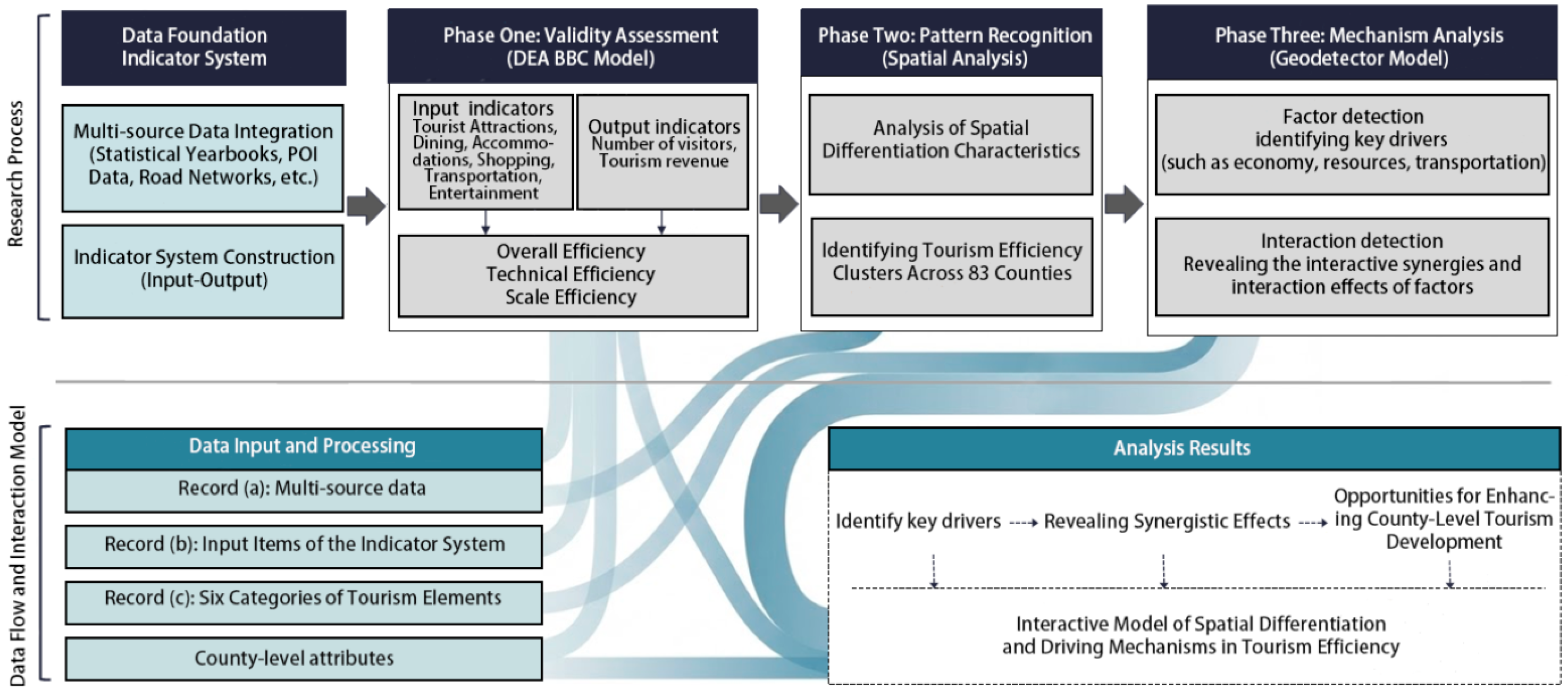
3.4. Study Methodology
3.4.1. Data Envelopment Analysis
3.4.2. Geographical Detector Model
4. Results
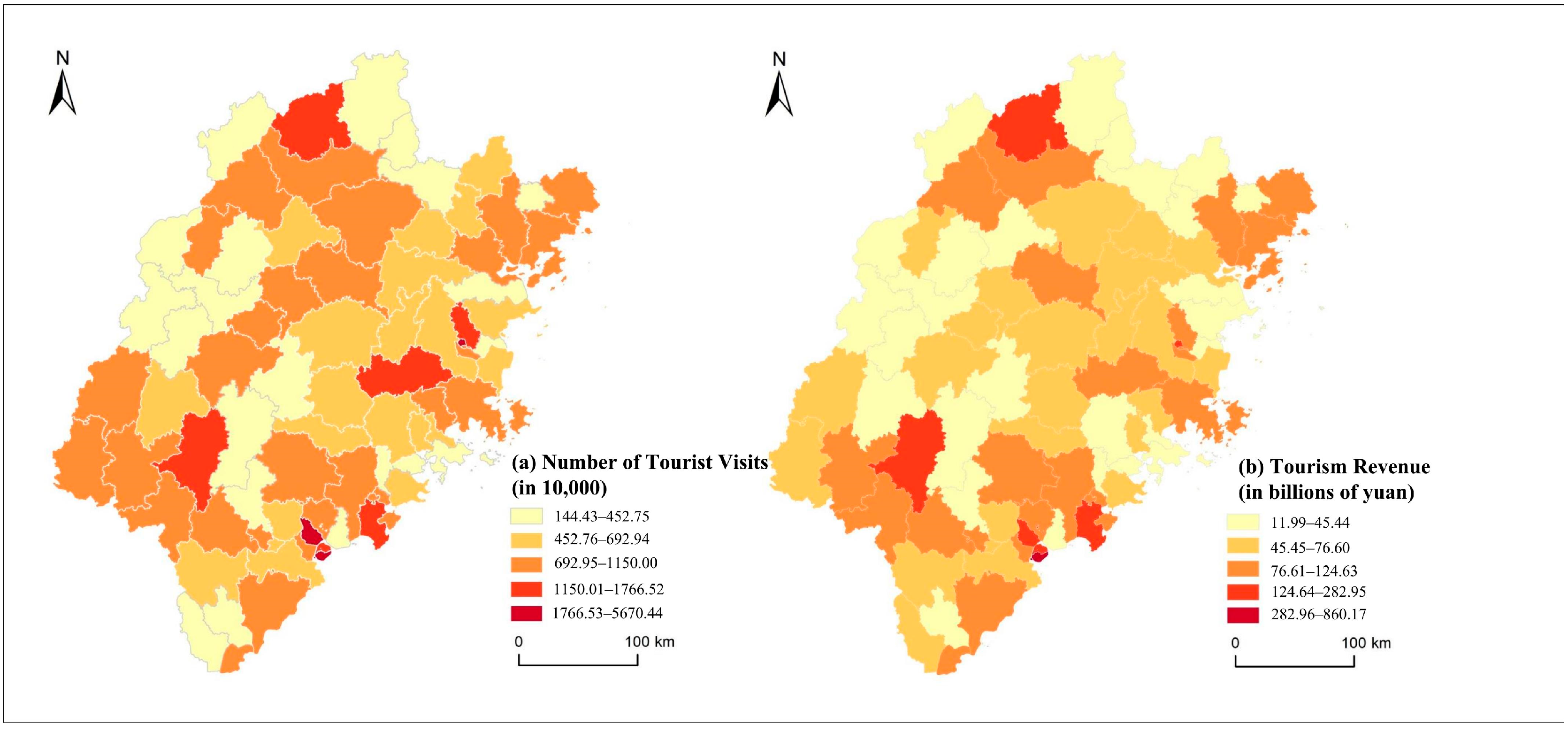
4.1. County-Level Tourism Economy Development in Fujian Province
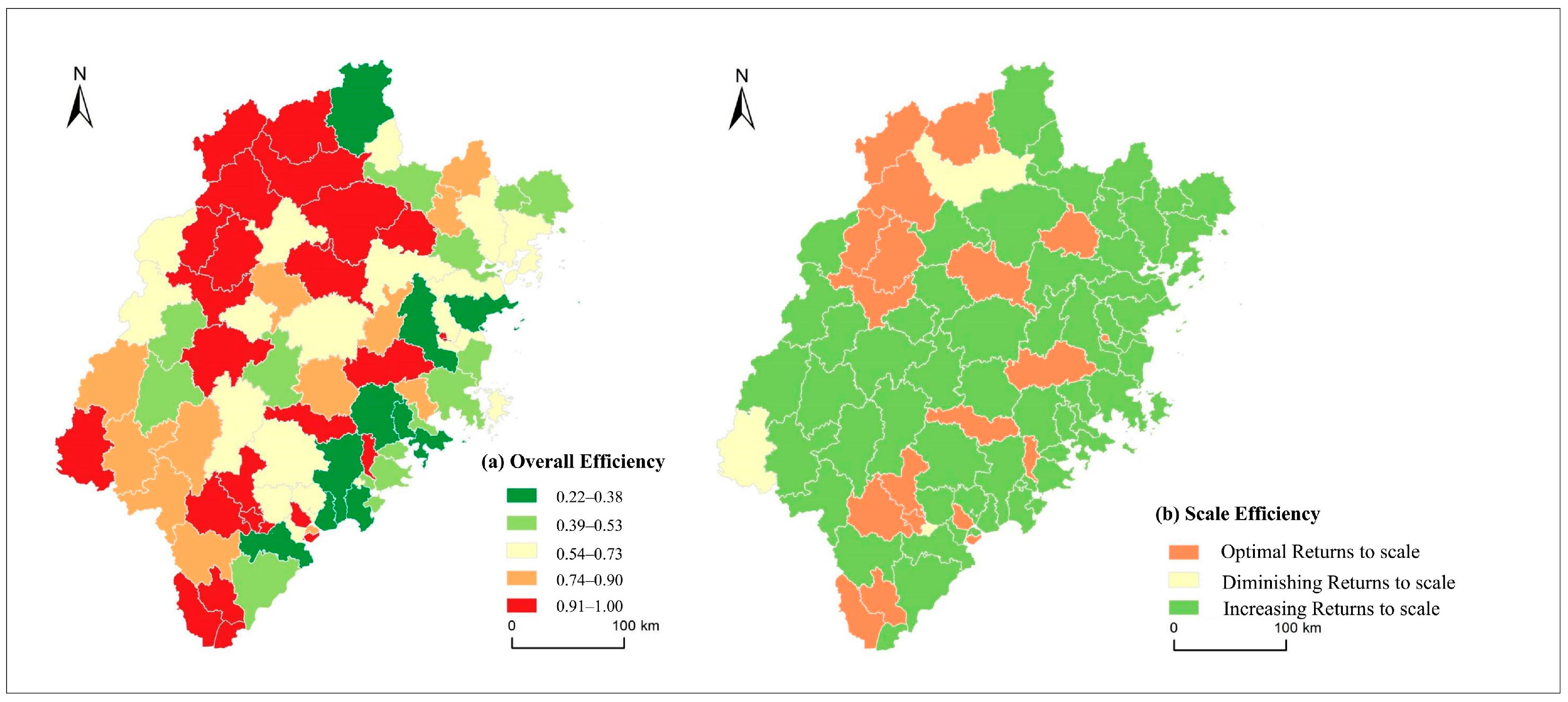
4.2. County-Level Tourism Efficiency and Scale Performance in Fujian Province
Robustness Test
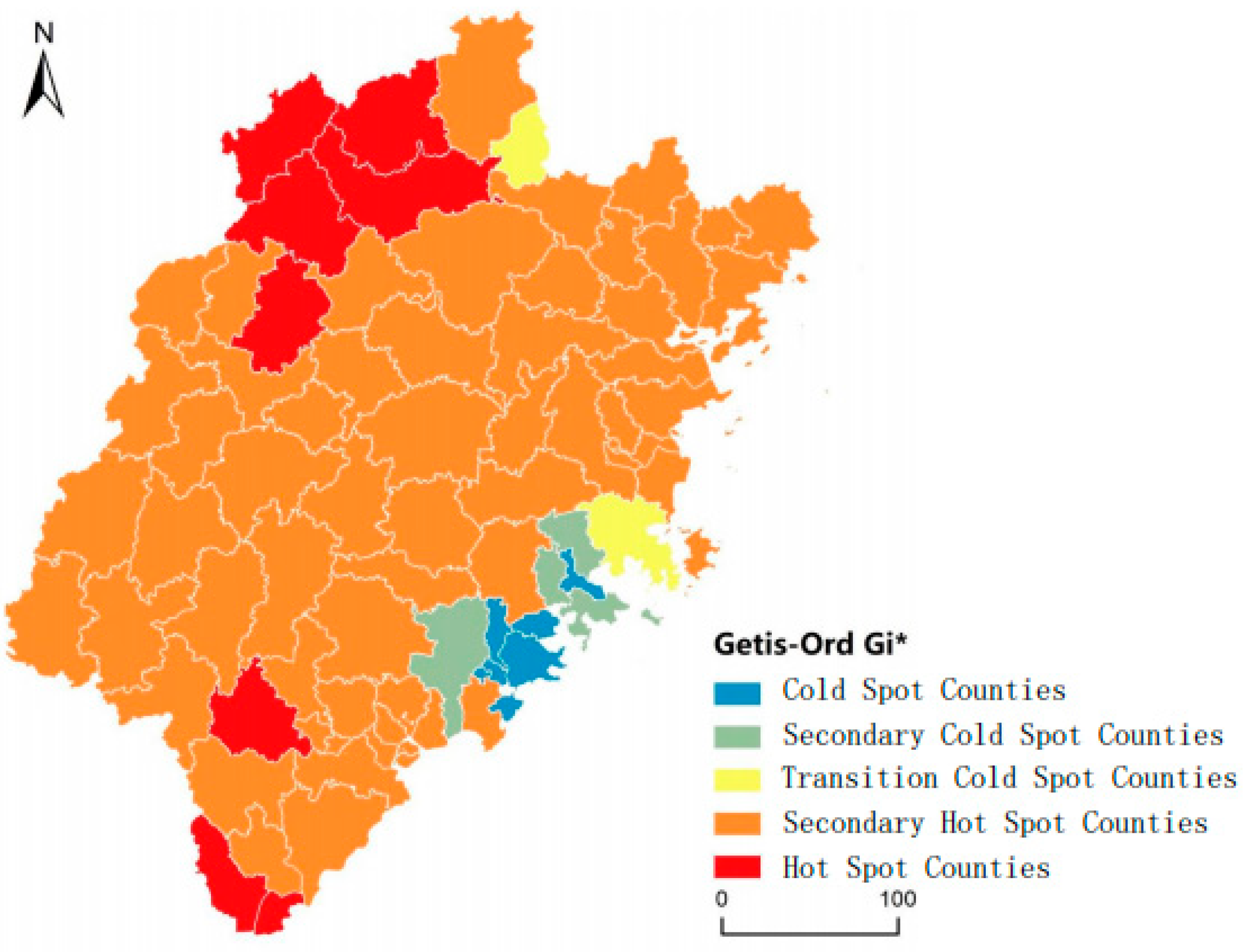
4.3. Spatial Differentiation of County-Level Tourism Efficiency in Fujian Province
4.4. Driving Mechanisms of County-Level Tourism Efficiency in Fujian Province
4.4.1. Detection of Driving Factors
4.4.2. Interaction Effects Among Driving Factors
4.4.3. Mechanism Interpretation
5. Discussion
6. Conclusions
6.1. Main Research Outcomes
6.2. Limitations and Future Research
Author Contributions
Funding
Institutional Review Board Statement
Informed Consent Statement
Data Availability Statement
Conflicts of Interest
References
- Li, M.; Fan, Y.; Guo, C.; Li, X. Tourism Prosperity and High-Quality Economic Development. Int. Rev. Econ. Financ. 2025, 101, 104246. [Google Scholar] [CrossRef]
- Gu, D.; Xu, D.; Yu, F.; Hou, B. Spatiotemporal Evolution and Mechanisms of Tourism Efficiency and Its Decomposition: Evidence from 63 Counties in Zhejiang, China. PLoS ONE 2024, 19, e0297522. [Google Scholar] [CrossRef]
- Liu, L.; Luo, J. The Spatio-Temporal Evolution and Influencing Factors of the Coupling Coordination Degree between Tourism Supply and Demand in the Yangtze River Economic Belt. Comput. Urban Sci. 2024, 4, 42. [Google Scholar] [CrossRef]
- Sánchez-Sánchez, F.J.; Sánchez-Sánchez, A.M. Evaluating the Efficiency and Determinants of Mass Tourism in Spain: A Tourist Area Perspective. Port. Econ. J. 2022, 23, 111–145. [Google Scholar] [CrossRef]
- Di Matteo, D.; Ferrara, A.R. Are Authenticity Labels Effective for Local Tourism Efficiency? A Regression Discontinuity Design Approach. J. Cult. Econ. 2025, 49, 747–775. [Google Scholar] [CrossRef]
- Yin, Y. Efficiency Evaluation and Enhancement Path of Sports Tourism in the Chengdu-Chongqing Economic Circle: An Empirical Study Based on the DEA-Tobit Model. Acad. J. Bus. Manag. 2025, 7, 41–48. [Google Scholar] [CrossRef]
- Flegl, M.; Lozano, C.; Matulova, M.; Cerón-Monroy, H. Investigating Tourism Efficiency of Beach Touristic Centers in Mexico: Application of Dynamic Two-Stage DEA Model and Fuzzy Time Series Forecasting. Cent. Eur. J. Oper. Res. 2025, 34, 323–347. [Google Scholar] [CrossRef]
- Graziano, T.; Ruggiero, L. From Periphery to Growth Pole (and Back Again?): Late Industrialism, Smart Strategies and Tourism in South-Eastern Sicily. Reg. Stud. Reg. Sci. 2023, 10, 89–105. [Google Scholar] [CrossRef]
- Liao, Z.; Zhang, L.; Wang, X.; Liang, S. Structural Characteristics and Influencing Factors of a Spatial Correlation Network for Tourism Environmental Efficiency in China. Sci. Rep. 2024, 14, 2658. [Google Scholar] [CrossRef]
- Yang, C.; Xia, Y.; Lam, J.F.I.; Chen, H.; Chen, H. Analyzing the Tour‘ism Efficiency and Its Influencing Factors of China’s Coastal Provinces. PLoS ONE 2024, 19, e0299772. [Google Scholar] [CrossRef]
- Lu, F.; Ren, H.; Zhai, X. Spatio-Temporal Evolution and Influencing Factors of Culture and Tourism Integration Efficiency in Shandong Province, China under High-Quality Development. PLoS ONE 2022, 17, e0277063. [Google Scholar] [CrossRef]
- Wu, Y.; Xu, A.; Wang, C.; Shi, Y. Spatial and Temporal Evolution and Influencing Factors of Tourism Eco-Efficiency in Fujian Province under the Target of Carbon Peak. Sci. Rep. 2023, 13, 23074. [Google Scholar] [CrossRef] [PubMed]
- Kabil, M.; AbdAlmoity, E.A.; Csobán, K.; Dávid, L.D. Tourism Centres Efficiency as Spatial Unites for Applying Blue Economy Approach: A Case Study of the Southern Red Sea Region, Egypt. PLoS ONE 2022, 17, e0268047. [Google Scholar] [CrossRef]
- Ibarrondo-Dávila, M.P.; Vela-Victoria, J.; Campos-Alba, C.M.; Pérez-López, G. Efficiency Differences in the Tourist Accommodation Sector in Spain According to the Type of Establishment: A Metafrontier Analysis. Rev. Contab. 2025, 28, 329–338. [Google Scholar] [CrossRef]
- Fernández-Macho, J.; González, P.; Virto, J. How Specialized Are Coastal Tourism Destinations in Europe? J. Destin. Mark. Manag. 2024, 31, 100856. [Google Scholar] [CrossRef]
- Puertas Medina, R.M.; Martín Martín, J.M.; Guaita Martínez, J.M.; Serdeira Azevedo, P. Analysis of the Role of Innovation and Efficiency in Coastal Destinations Affected by Tourism Seasonality. J. Innov. Knowl. 2022, 7, 100163. [Google Scholar] [CrossRef]
- Pervan, M.; Babic, P. Evaluation of Efficiency and Its Determinants in Croatian Hotel Industry. Int. J. Econ. Stat. 2021, 9, 108–115. [Google Scholar] [CrossRef]
- Kishimbo, L.J.; Mnzava, B.E.; Patel, G. Efficiency of Hotels Using Data Envelopment Analysis in Dar Es Salaam, Tanzania. Commun. Appl. Nonlinear Anal. 2025, 32, 590–603. [Google Scholar] [CrossRef]
- Shen, W.; Chen, Y.; Cao, W.; Yu, R.; Cheng, J. Coupling and Interaction Mechanism between Green Urbanization and Tourism Competitiveness Based an Empirical Study in the Yellow River Basin of China. Sci. Rep. 2024, 14, 13167. [Google Scholar] [CrossRef]
- Huang, X.; Liu, J. Beyond Skyline and Borders: Unraveling the Evolution and Drivers of Tourism Green Development Efficiency in the Beijing–Tianjin–Hebei Urban Agglomeration, China. J. Geogr. Sci. 2024, 34, 1761–1796. [Google Scholar] [CrossRef]
- Wu, Y.; Jia, Z.; Yu, T. Tourism and Green Development: Analysis of Linear and Non-Linear Effects. Int. J. Environ. Res. Public Health 2022, 19, 15907. [Google Scholar] [CrossRef]
- Chen, Q.; Chen, W.; Wu, D.; Zheng, L.; Li, J. Spatiotemporal Evolution and Influencing Factors of Tourism Development Efficiency in the Yangtze River Economic Belt, China. J. Clean. Prod. 2022, 379, 134722. [Google Scholar] [CrossRef]
- Zhang, H.; Duan, Y.; Wang, H.; Han, Z.; Wang, H. An Empirical Analysis of Tourism Eco-Efficiency in Ecological Protection Priority Areas Based on the DPSIR-SBM Model: A Case Study of the Yellow River Basin, China. Ecol. Inform. 2022, 70, 101720. [Google Scholar] [CrossRef]
- Güney, G.; Topçuoğlu, Ö.; Bozkurt, E. Tourism Efficiency: Bootstrap-Data Envelopment and Tobit Panel Data Analysis. J. Tour. Gastron. Stud. 2023, 11, 2171–2186. [Google Scholar] [CrossRef]
- Zhao, J.; Pan, J.; Tan, L. Sustainable Evaluation of Ecotourism in the Yangtze River Delta Urban Agglomeration: A System Coordination Perspective. Sustain. Oper. Comput. 2025, 6, 57–70. [Google Scholar] [CrossRef]
- Zhang, X.; Wu, S. Efficiency Evaluation and Spatio-Temporal Differentiation Analysis of Tourism Industry in Cities Along the Beijing Hangzhou Grand Canal Based on Three-Stage DEA. Sage Open 2024, 14, 21582440241300557. [Google Scholar] [CrossRef]
- Guo, Y.; Cao, Z. A Study on the Tourism Efficiency of Tourism Destination Based on DEA Model: A Case of Ten Cities in Shaanxi Province. PLoS ONE 2024, 19, e0296660. [Google Scholar] [CrossRef] [PubMed]
- Liao, Z.; Wang, L. Spatial Differentiation and Influencing Factors of Red Tourism Resources Transformation Efficiency in China Based on RMP-IO Analysis. Sci. Rep. 2024, 14, 10761. [Google Scholar] [CrossRef]

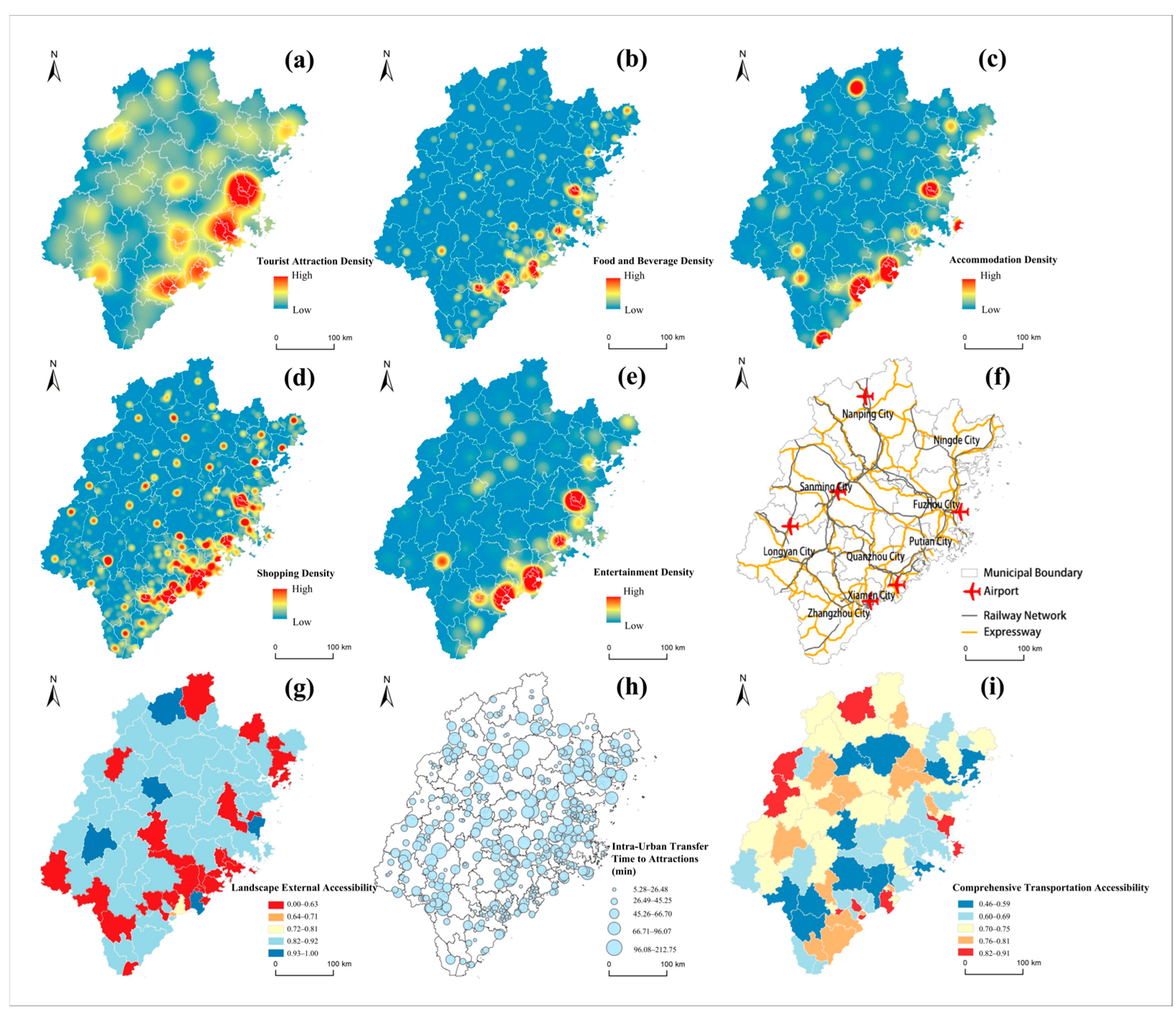



| Target Layer | Primary Indicator | Secondary Indicators | Data Source |
|---|---|---|---|
| Input factors | Tourist Attraction | Number of 2A-rated or higher scenic spots (PCs) | Official Website of the Fujian Provincial Department of Culture and Tourism, Open Map Data |
| Catering Support | Density of Food and Beverage Establishments (Restaurants, Inns, Food Courts, Dessert Shops, etc.) (PCs·km2) | ||
| Housing Guarantee | Density of accommodation facilities such as hotels, inns, and homestays (PCs·km2) | ||
| Shopping Facilities | Density of physical commercial establishments such as shopping malls, supermarkets, convenience stores, specialty stores, shopping centers, and wholesale markets (PCs·km2) | ||
| Entertainment Services | Density of entertainment venues such as KTVs, theaters, nightclubs, internet cafes, and campgrounds (PCs·km2) | ||
| Transportation System | The comprehensive accessibility of a tourism attraction is determined by evaluating both external accessibility and intra-area transfer accessibility. | Open Street Map | |
| Factors of production | Tourism Attraction | Number of Tourist Visits (in 10,000) | Statistical Bulletin on National Economic and Social Development Statistical Yearbook |
| Tourism Economic Output | Tourism Revenue (in billions of yuan) |
| Variable | Sample Size | Minimum Value | Maximum Value | Mean | Standard Deviation | Median |
|---|---|---|---|---|---|---|
| Number of Tourist Visits (million) | 83 | 1.44 | 56.70 | 8.30 | 7.14 | 6.93 |
| Tourist Revenue (billion yuan) | 83 | 1.20 | 86.02 | 8.33 | 9.96 | 6.11 |
| Ranking | County-Level | Number of Tourist Visits (in Ten Thousand) | Percentage (%) |
|---|---|---|---|
| 1 | Siming District | 5670.44 | 8.24% |
| 2 | Gulou District | 2905.21 | 4.22% |
| 3 | Jimei District | 2841.67 | 4.13% |
| 4 | Huli District | 1766.52 | 2.57% |
| 5 | Xinluo District | 1616.43 | 2.35% |
| 6 | Yongtai County | 1525.50 | 2.22% |
| 7 | Jinjiang City | 1400.00 | 2.03% |
| 8 | Wuyishan City | 1368.14 | 1.99% |
| 9 | Jin’an District | 1344.00 | 1.95% |
| 10 | Xiangcheng District | 1150.00 | 1.67% |
| Total | 21,587.91 | 31.37% | |
| Ranking | County-Level | Tourism Revenue (in Billions of Yuan) | Percentage (%) |
|---|---|---|---|
| 1 | Siming District | 860.17 | 12.45% |
| 2 | Huli District | 282.95 | 4.10% |
| 3 | Gulou District | 239.34 | 3.46% |
| 4 | Wuyishan City | 201.80 | 2.92% |
| 5 | Jinjiang City | 190.00 | 2.75% |
| 6 | Xinluo District | 185.47 | 2.69% |
| 7 | Jimei District | 184.70 | 2.67% |
| 8 | Zhangpu County | 124.63 | 1.80% |
| 9 | Xiangcheng District | 117.00 | 1.69% |
| 10 | Yanping District | 115.46 | 1.67% |
| Total | 2501.52 | 36.20% | |
| Tourism Attractions Level | Frequency Distribution | Percentage (%) |
|---|---|---|
| 2A | 88 | 17.74 |
| 3A | 272 | 54.84 |
| 4A | 125 | 25.20 |
| 5A | 11 | 2.22 |
| Total | 496 | 100 |
| Benefit Dimension | Minimum Value | Maximum Value | Mean | Standard Deviation | Coefficient of Variation |
|---|---|---|---|---|---|
| Overall efficiency | 0.220 | 1 | 0.708 | 0.246 | 0.347 |
| Technical efficiency | 0.605 | 1 | 0.873 | 0.127 | 0.146 |
| Scale efficiency | 0.307 | 1 | 0.795 | 0.202 | 0.254 |
| Driving Factors | Tourist Attraction | Food-and-Beverage Support | Accommodation Capacity | Transport Systems | Shopping Facilities | Entertainment Services |
|---|---|---|---|---|---|---|
| q-value | 0.107 | 0.160 | 0.082 | 0.015 | 0.147 | 0.159 |
| p-value | 0.000 | 0.000 | 0.000 | 0.000 | 0.000 | 0.000 |
| Interaction Item | Interaction | Sum of Single-Factor Effects | Interaction Type |
|---|---|---|---|
| tourist attraction ∩ food-and-beverage support | 0.181 | 0.267 | Dual-factor enhancement |
| tourist attraction ∩ accommodation capacity | 0.147 | 0.189 | Dual-factor enhancement |
| tourist attraction ∩ transport systems | 0.194 | 0.122 | Nonlinear Enhancement |
| tourist attraction ∩ shopping facilities | 0.170 | 0.254 | Dual-factor enhancement |
| tourist attraction ∩ entertainment services | 0.178 | 0.266 | Dual-factor enhancement |
| food-and-beverage support ∩ accommodation capacity | 0.180 | 0.242 | Dual-factor enhancement |
| food-and-beverage support ∩ transport systems | 0.237 | 0.175 | Nonlinear Enhancement |
| food-and-beverage support ∩shopping facilities | 0.168 | 0.307 | Dual-factor enhancement |
| food-and-beverage support ∩ entertainment services | 0.169 | 0.319 | Dual-factor enhancement |
| accommodation capacity ∩ transport systems | 0.187 | 0.097 | Nonlinear Enhancement |
| accommodation capacity ∩ shopping facilities | 0.162 | 0.229 | Dual-factor enhancement |
| accommodation capacity ∩ entertainment services | 0.178 | 0.241 | Dual-factor enhancement |
| transport systems ∩ shopping facilities | 0.222 | 0.162 | Nonlinear Enhancement |
| transport systems ∩ entertainment services | 0.242 | 0.174 | Nonlinear Enhancement |
| shopping facilities ∩ entertainment services | 0.170 | 0.306 | Dual-factor enhancement |
Disclaimer/Publisher’s Note: The statements, opinions and data contained in all publications are solely those of the individual author(s) and contributor(s) and not of MDPI and/or the editor(s). MDPI and/or the editor(s) disclaim responsibility for any injury to people or property resulting from any ideas, methods, instructions or products referred to in the content. |
© 2026 by the authors. Licensee MDPI, Basel, Switzerland. This article is an open access article distributed under the terms and conditions of the Creative Commons Attribution (CC BY) license.
Share and Cite
Li, K.; Miao, J.; Zhang, W.; Huang, R.; Wan, T. Spatial Differentiation and Service-Driven Mechanisms of County-Level Tourism Efficiency in Fujian Province, China. Sustainability 2026, 18, 5709. https://doi.org/10.3390/su18115709
Li K, Miao J, Zhang W, Huang R, Wan T. Spatial Differentiation and Service-Driven Mechanisms of County-Level Tourism Efficiency in Fujian Province, China. Sustainability. 2026; 18(11):5709. https://doi.org/10.3390/su18115709
Chicago/Turabian StyleLi, Kangkang, Jiyu Miao, Wenhui Zhang, Runyuan Huang, and Tianyue Wan. 2026. "Spatial Differentiation and Service-Driven Mechanisms of County-Level Tourism Efficiency in Fujian Province, China" Sustainability 18, no. 11: 5709. https://doi.org/10.3390/su18115709
APA StyleLi, K., Miao, J., Zhang, W., Huang, R., & Wan, T. (2026). Spatial Differentiation and Service-Driven Mechanisms of County-Level Tourism Efficiency in Fujian Province, China. Sustainability, 18(11), 5709. https://doi.org/10.3390/su18115709