Article

Distribution Evolution and Coupling Characteristics of Human Settlements in Southwest China’s Mountainous Areas Based on “Production–Living–Ecological Space”: Xiushan County, Chongqing


School of Architecture and Environmental Art, Sichuan Fine Arts Institute, Chongqing 401331, China
*
Author to whom correspondence should be addressed.
Sustainability 2026, 18(11), 5711; https://doi.org/10.3390/su18115711
Submission received: 28 February 2026 / Revised: 24 April 2026 / Accepted: 28 April 2026 / Published: 4 June 2026

Abstract

The sustainable development of human settlements in mountainous Southwest China hinges on the coordinated evolution of their production–living–ecological spaces (PLES). This study investigated the distribution evolution and coupling characteristics of the PLESs within the human settlements of Xiushan Tujia and Miao Autonomous County, Chongqing. Utilizing land use data from 1990 to 2020, GIS spatial analysis, a coupling coordination degree model, and the Geodetector method were employed to systematically investigate PLES’ spatial patterns, evolutionary characteristics, and underlying mechanisms. The results reveal the following: (1) The PLES structure underwent a distinct phased and heterogeneous distribution evolution, shaped by socioeconomic development and ecological conservation policies. (2) Primarily driven by the dual forces of economic and policy factors, the transformation between ecological and production spaces was predominant, followed by that between production and living spaces. (3) The coupling coordination degree (CCD) improved from extreme imbalance toward near coordination, exhibiting a zoned structure characterized by high levels in the central core and low levels in peripheral mountainous areas. (4) Socioeconomic factors generally have greater explanatory power than natural factors do in terms of driving PLES changes. The interaction effects between any two drivers are stronger than the individual effects, with economic growth and population agglomeration being the core restructuring forces and transportation accessibility a key catalyst. The distribution evolution of PLES and the coupling approach to PLES at the human settlements scale are deciphered, providing a scientific foundation for coordinating spatial conflicts, optimizing territorial spatial planning, and implementing differentiated governance strategies in ecologically sensitive mountainous regions.

1. Introduction

As the composite carriers of agrarian civilization and regional culture, traditional villages embody the dynamic equilibrium of human–land relations and regional adaptive wisdom within the human settlement system through production–living–ecological spaces (PLES) [1]. They also represent a frontier for multidisciplinary research spanning refined territorial governance and landscape architecture. However, under the dual pressures of globalization and rapid urbanization and with rapid socioeconomic development, more than one third of the world’s natural land has undergone significant changes [2,3,4]. The PLES of traditional villages now face multiple challenges, including functional imbalance, morphological fragmentation, cultural discontinuity, and changes in climate and the environment [5], necessitating urgent systematic evaluation and optimized regulation.
Changes in land cover and land use types profoundly impact climate and the environment, thereby affecting human production and daily life [6,7]. Therefore, studying the transformation of production–living–ecological spaces serves to provide a scientific basis for balancing economic development with environmental protection [8]. Land use change has become a key focus of global change research [9]. In recent years, based on land use transformation, scholars have extensively researched the sustainable development of traditional villages, focusing on functional coordination mechanisms, spatial layout optimization, cultural inheritance strategies, ecological restoration techniques, and multidisciplinary integration approaches. With respect to PLES, the form, structure, and function of rural spatial systems continuously evolve under the influence of changing interaction patterns and intensities between nature and humanity [10]. Rapid industrialization and urbanization spur swift socioeconomic development, leading to significant transformations in land use patterns and spatial layouts; one primary manifestation of structural land use change is the reconfiguration and recombination of territorial assets within PLES [11]. Countries or regions such as the European Union typically base their zoning models on evaluations grounded in regional spatial characteristics [12]. Meanwhile, Chinese research encompasses diverse zoning systems, with a comprehensive functional zoning indicator system for territorial space constructed from the perspective of the PLES framework, which serves as a crucial basis for territorial spatial planning [13]. In China’s territorial spatial development, the implementation of the Western Development Strategy has spurred rapid urban–rural socioeconomic growth in provinces such as Chongqing. However, the region’s unique natural conditions and intensified human activities exert immense pressure on its ecological environment [14]. Enhanced land resource exploitation further exposes the ecological fragility of human settlements, precipitating multiple ecological and environmental challenges [11]. In the development of traditional agriculture and villages, rural areas have often been positioned primarily as passive providers of services to cities, and this positioning neglects the exploration and harnessing of their multifunctional potential [15].
Existing research remains insufficient for systematically analyzing the coupling mechanisms of PLES in local areas, making it difficult to support the achievement of holistic conservation objectives encompassing function, form, and culture in villages. Studies on the human settlements of mountainous traditional villages often fail to fully integrate regional characteristics such as landscape fragility and ethnic cultural diversity, resulting in discrepancies between existing conservation strategies and ecological synergy objectives [16]. Furthermore, current research on the evolution of PLES predominantly remains at the macro scale, lacking microdynamic analyses of spatial evolution processes and their driving mechanisms within specific regions over extended time series. This limitation hinders a deep understanding of their evolutionary patterns.
As a key region in southwestern China where traditional mountain villages are densely distributed, Chongqing exhibits rich regional differentiation in the spatial forms of its villages across diverse landform units, including plains, hills, and mountains [17]. The traditional villages of Xiushan County, situated within the ecologically sensitive Wuling Mountain area, possess typical dual “ecological-cultural” sensitivity. Spatially, they manifest a distribution pattern characterized by “mountain mosaics and ethnic enclaves”, where the cultural traditions of ethnic groups such as the Tujia and Miao are deeply intertwined with the karst ecosystem, forming a unique human–land relationship system [18,19]. However, against the backdrop of rapid urbanization and tourism development, local PLES face a series of pressing issues, including intensified functional conflicts and ecological landscape fragmentation [20]. Against this backdrop, this paper employs PLES theory as its foundational framework, integrating GIS spatial analysis, landscape pattern indices [21], CCD models, and geographic detectors. This study aims to provide scientific evidence for regional land use optimization and sustainable village development while offering theoretical support for preserving traditional villages and implementing Rural Revitalization strategies in the mountainous regions of Southwest China.

2. Current Status of Traditional Villages in Xiushan County, Chongqing

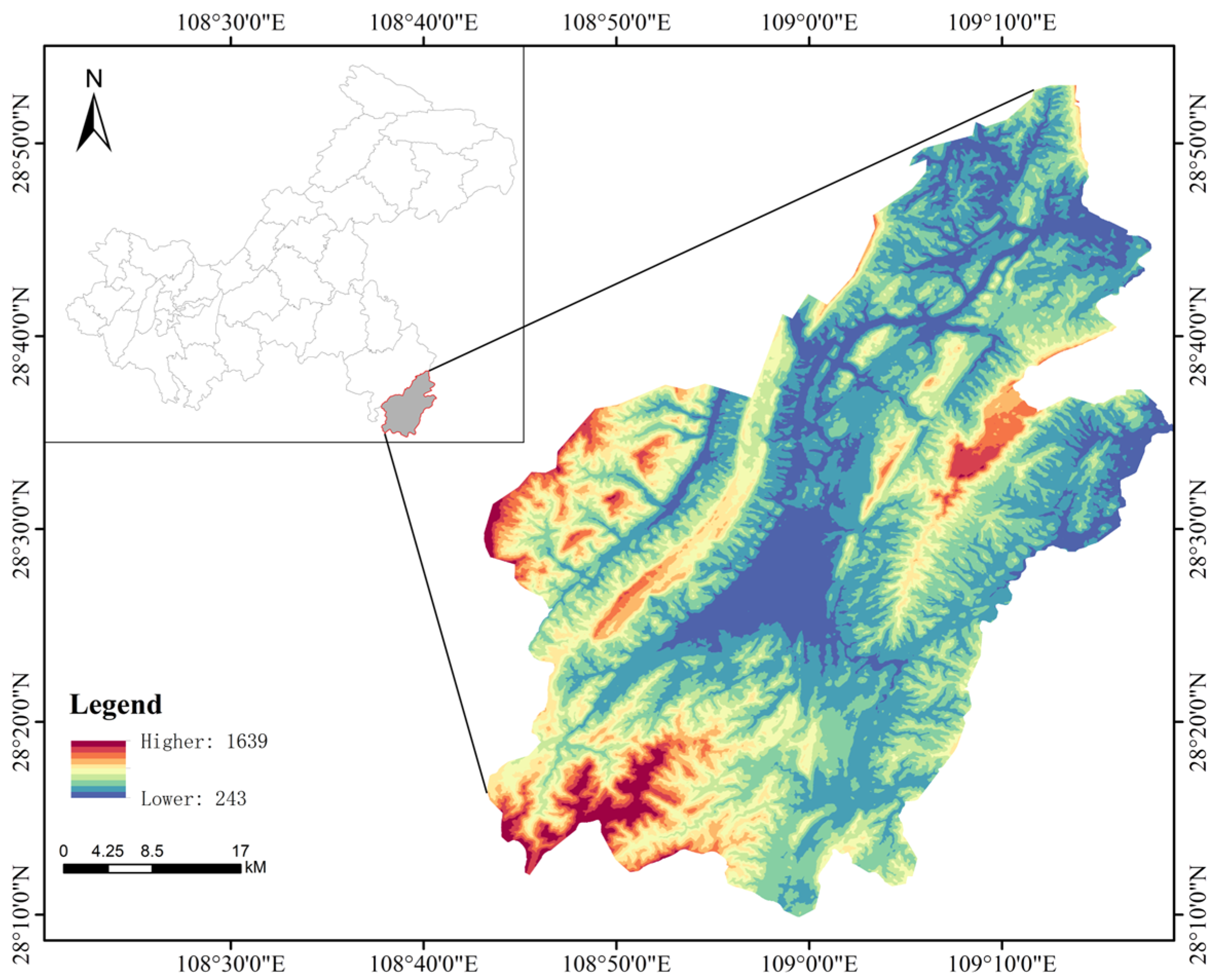
Situated in the southeastern part of Chongqing (Figure 1), Xiushan County is nestled within the heart of the Wuling Mountain Range (Figure 1). It lies at the ecological and cultural transition zone where the borders of Chongqing, Hunan, and Guizhou Provinces converge. This unique geographical position renders its traditional village system an ideal case for examining the spatial coevolution of PLES within the mountainous ethnic regions of Southwest China.
By 2025, 25 villages in Xiushan County have been designated as ‘Traditional Villages of China’, and there are over 30 further settlements of conservation value that have not yet been formally included on the protection list. (compiled by the authors). These settlements constitute a multitiered, multitype system of traditional villages.
Xiushan County possesses relatively limited high-quality arable land resources, which is a natural constraint that profoundly shaped the logic of village siting. To ensure agricultural productivity, numerous settlements clustered along the transitional zones between mountainous terrain and flat plains or on hillside terraces, forming a distinctive vertical distribution pattern. Concurrently, as a significant branch of the ancient Sichuan Salt Road, Xiushan County historically hosted a series of villages primarily driven by commercial functions. These settlements typically featured a spatial form centered on trading venues and arranged linearly along commercial routes. With shifts in transport routes and innovations in transportation modes, these former trading stations gradually fell into disuse. Most transitioned functionally toward agricultural villages, retaining the spatial traces of their historical purpose.
The spatial distribution and morphological characteristics of traditional villages in Xiushan County result from the combined influence of specific natural geographical conditions and prolonged human–land interactions. Viewed holistically, these settlements demonstrate adaptive responses to mountainous terrain, resource constraints, and historical functional evolution, revealing systematic regional spatial wisdom. Consequently, the traditional village system of Xiushan County represents a composite human–geographical specimen shaped by agricultural production, commercial activity, and ecological adaptation. It holds significant research value and exemplary significance for understanding the evolutionary patterns of human–land relationships within China’s southwestern mountainous regions.

3. Methodology and Data Sources

3.1. Methodology

This study employs a multi-tiered research approach to systematically analyze the spatiotemporal evolution and coupling mechanisms of the PLES within traditional villages of Xiushan County.

3.1.1. Research Methodology and Model Application

(1)
Land Use Type Aggregation Method
This method classifies land use data based on the Classification Standard: GB/T 21010-2017 [22,23] and the classifications provided in Table 1.
(2)
PLES Transition Matrix
A transition matrix quantifies the extent of changes in land use structure and function. It is a method of arranging areas of land use change in a matrix format, clearly illustrating the dynamic shifts of various land types into other types between the beginning and end of the study period. Its mathematical expression is:
S i j = S 11 S 12 S 1 n S 21 S 22 S 2 n S n 1 S n 2 S n n
In the equation, S represents land area; n represents the number of land use types; i and j represent the land use types at the beginning and end of the study period, respectively [24].
(3)
PLES Dynamic Degree Model
The land use dynamic index is a measure of dynamic changes in land use types; it reflects changes in the extent of a particular land use type within a study area over a specific time period. Its mathematical expression is:
K = U b U a U a × 1 T × 100 %
In the equation, K represents the magnitude of change for a given land use type during the study period; Ua and Ub represent the areas of that land use type at the beginning and end of the study period, respectively; and T represents the duration of the study period [25].
(4)
Shannon Entropy Index
To overcome the limitations of traditional land-use classifications, which focus on a single dominant function, and to accurately capture the composite PLES characteristics commonly found in traditional mountain villages, this study introduces the Shannon entropy index to quantitatively measure the degree of land-use mixing. The core of this method lies in characterizing the diversity and balance of spatial functions by calculating the probability distribution of different functional components within a specific neighborhood. Its mathematical expression is as follows:
H = i P i ln ( P i )
In the formula, H represents the Shannon entropy, using to measure the degree of mixing in the PLES; i refers to the total number of land use function types (in this study, i is set to 3, namely production, living, and ecological); Pi denotes the proportion of the i-th land use function within a specific window (121 pixels). The physical meaning of this formula is that when a single function exists within a window, Pi equals 1, and the entropy value is 0, representing the purest spatial function; conversely, the more uniformly the three functions are distributed spatially, the higher the entropy value, indicating a higher degree of composite land use and more pronounced functional mixing characteristics in that area [26].
(5)
Coupling coordination model
Coupling refers to the phenomenon in which two (or more) systems or forms of motion influence one another through mutual interaction. The coupling degree reflects the extent of influence between the PLES functions; the stronger the coupling, the greater the intensity of interaction among the three. However, this interaction does not reflect the level of coordination between two systems; therefore, the degree of coordination is introduced to reflect the level of mutual cooperation and positive interaction between them.
Coupling degree (C):
C = P j × L j × E j ( P j × L j × E j ) 3 1 3
Comprehensive Evaluation Index (T):
T = α P + β L + γ E
Coordination Degree (D):
D = C × T
In the formula, C refers to the coupling degree of the PLES functions in territorial space. D represents the degree of coordinated development of the PLES. T is the overall evaluation index, in which α, β, and γ are undetermined coefficients and α + β + γ = 1. Based on the principle that the PLES spaces are equally important to human society, this paper sets α = β = γ = 1/3 [27]. Given the ecological sensitivity of the study area, which is located within the Wuling Mountains, and Chongqing’s strategic zoning, the coupling degree was calculated using the average of expert scoring and the Entropy Weighted Method (EWM), yielding results that align with both objective and subjective criteria [28,29,30].
(6)
Geodetector
Using the factor detection and interaction detection models of the Geodetector, this study analyzes the dominant factors influencing the degree of synergy in the PLES functional systems of urban and rural spaces. Specifically, factor detection primarily examines the significance of driving factors and dependent variables, while interaction detector is primarily used to determine whether the interaction between two variables enhances or weakens the explanatory power for the dependent variable. The calculation formula is as follows:
q = 1 1 N σ 2 h = 1 L N h σ h 2
In the equation, t h e   p r o d u c t   o f   N   a n d   σ 2 represent the total number of samples in the study area multiplied by the total sample variance. L represents the number of hierarchical levels of synergy in the PLES functions of urban and rural territorial space, i.e., the number of categories or subdivisions. Nh and σ h 2 represent the number of sample units and the variance at the h-th level (h = 1, 2, …, L). Additionally, 0 ≤ q ≤ 1; when q = 0, it indicates that the factor has no effect on the synergy of the PLES functional system. The closer q is to 1, the stronger the influence of the factor [31].

3.1.2. Division of the Research Period

Based on four phases of land use data (1990, 2000, 2010, and 2020) and key junctures in China’s macrolevel development strategies and Xiushan County’s local policies, the study period is divided into three distinct phases for comparative analysis:
(1)
Urbanization Initiation Phase (1990–2000): This phase corresponds to the period of initial economic development and the commencement of urbanization following the reform and opening-up.
(2)
Ecological Policy Adjustment Period (2000–2010): This period is marked by the national Grain-for-Green Program and strengthened ecological conservation policies.
(3)
Accelerated New Urbanization Period (2010–2020): This period coincides with the deepening implementation of the New Urbanization Strategy and Rural Revitalization policies.
This division aims to investigate the differing dominant processes and driving forces behind the evolution of the PLES pattern under varying socioeconomic contexts.

3.1.3. Development of the PLES Classification System

In this study, a conversion relationship between land use types and PLES functions (Table 1) was established on the basis of China’s Land Use Status Classification Standard (GB/T 21010-2017) and guided by the dominant functional principles outlined in the Xiushan County Territorial Space Ecological Conservation and Restoration Plan (2021–2035) [32,33,34].

3.2. Data Sources

This study covers the entire territory of Xiushan County. By integrating multi-source spatiotemporal data, it systematically analyzes the evolution, functional assessment, and driving mechanisms of the PLES from 1990 to 2020. The land-use raster data used in this study were sourced from the RESDC, ASTERGDEM, and WebMap datasets. All data were checked and projected into a unified geographic coordinate system using ArcGIS software (ArcMap 10.8). The specific data used are as follows.
(1)
Land Use Type Aggregation Method
This method primarily utilizes 30 m resolution land cover grids for the years 1990, 2000, 2010, and 2020 provided by the Resource and Environmental Science and Data Center (RESDC, https://www.resdc.cn/) of the Chinese Academy of Sciences. Based on the national standard “Classification of Current Land Use” and the dominant functional orientation of the study area (Table 1), standardized spatial units are established to support subsequent dynamic calculations.
(2)
PLES Dynamics Model
This model uses PLES raster data—generated by consolidating land use data via ArcGIS software—to calculate the total area change and the average annual rate of change for each land use type over a specific time period. It effectively identifies the rates of spatial expansion or contraction at different stages of development, relying entirely on temporal comparisons of baseline land use data without the need to incorporate external data.
(3)
PLES Transition Matrix
This study utilized the spatial overlay analysis capabilities of the ArcGIS platform to construct a transition matrix using land use data from 1990, 2000, 2010, and 2020. By comparing the attribute values of spatial raster attribute values at different time points, the study quantified the inflow sources and outflow destinations for each land use type, thereby revealing the process of structural evolution.
(4)
Shannon Entropy Index
In this study, the model utilizes 30 m resolution land cover raster data from the RESDC for the years 1990, 2000, 2010, and 2020 to provide spatialized and classified geospatial data for Shannon entropy calculations, thereby reflecting the diversity and spatial heterogeneity of land use.
(5)
Coupling coordination model
The data required for this model is primarily sourced from the Xiushan Statistical Yearbook 2023 and the RESDC. Xiushan Statistical Yearbook 2023 compiles socioeconomic data for Xiushan County prior to 2023 and includes the 1990–2020 data used in the main text. Specifically, it includes indicators required for the evaluation of production space (e.g., grain output, per capita output value of agriculture, animal husbandry, and fisheries, and output value of the secondary and tertiary industries per unit of land), indicators required for the evaluation of living space (e.g., urban and rural per capita disposable income), and indicators related to the evaluation of ecological space (e.g., forest coverage and grassland coverage).
(6)
Geodetector
To investigate the driving mechanisms behind spatial differentiation, a model was tailored to the characteristics of the southwestern mountainous region based on the “nature-socioeconomic” dual-driver theory [35]. This model uses the spatial distribution or functional evaluation results of PLES as the dependent variable, with natural environmental and socioeconomic factors as independent variables. Specifically, the natural factor data (i.e., average elevation, slope, and terrain ruggedness) were sourced from the ASTERGDEM dataset provided by the Geospatial Data Cloud Platform (https://www.gscloud.cn/). Climate and soil factors (i.e., annual average precipitation, annual average temperature, soil type) and locational factors (i.e., distance from water bodies) were sourced from the Resource and Environmental Science Data Center (RESDC) of the Chinese Academy of Sciences and the National Geographic Information Resource Catalog Service System (WebMap, https://www.webmap.cn/). Socioeconomic drivers (i.e., spatial distribution of GDP and population) are sourced from RESDC; locational and transportation factors (i.e., distance from urban centers, distance from major transportation corridors, and road network density) are derived from WebMap and RESDC’s basic geographic and urban location data.

4. Analysis of the Spatiotemporal Patterns and Coupling Relationships in the PLES in Xiushan County

To systematically explain the evolutionary patterns of human–land systems within the mountainous regions of Southwest China, this study utilizes land use data from 1990, 2000, 2010, and 2020. Employing a comprehensive methodology that integrates GIS spatial analysis, dynamic degree models, transition matrices, and the CCD, this study examines the distribution patterns, evolutionary processes, transformation pathways, and systemic coordination characteristics of the PLES in Xiushan County from a “pattern–process–mechanism” perspective.

4.1. The Spatiotemporal Framework and Evolutionary Stages of PLES

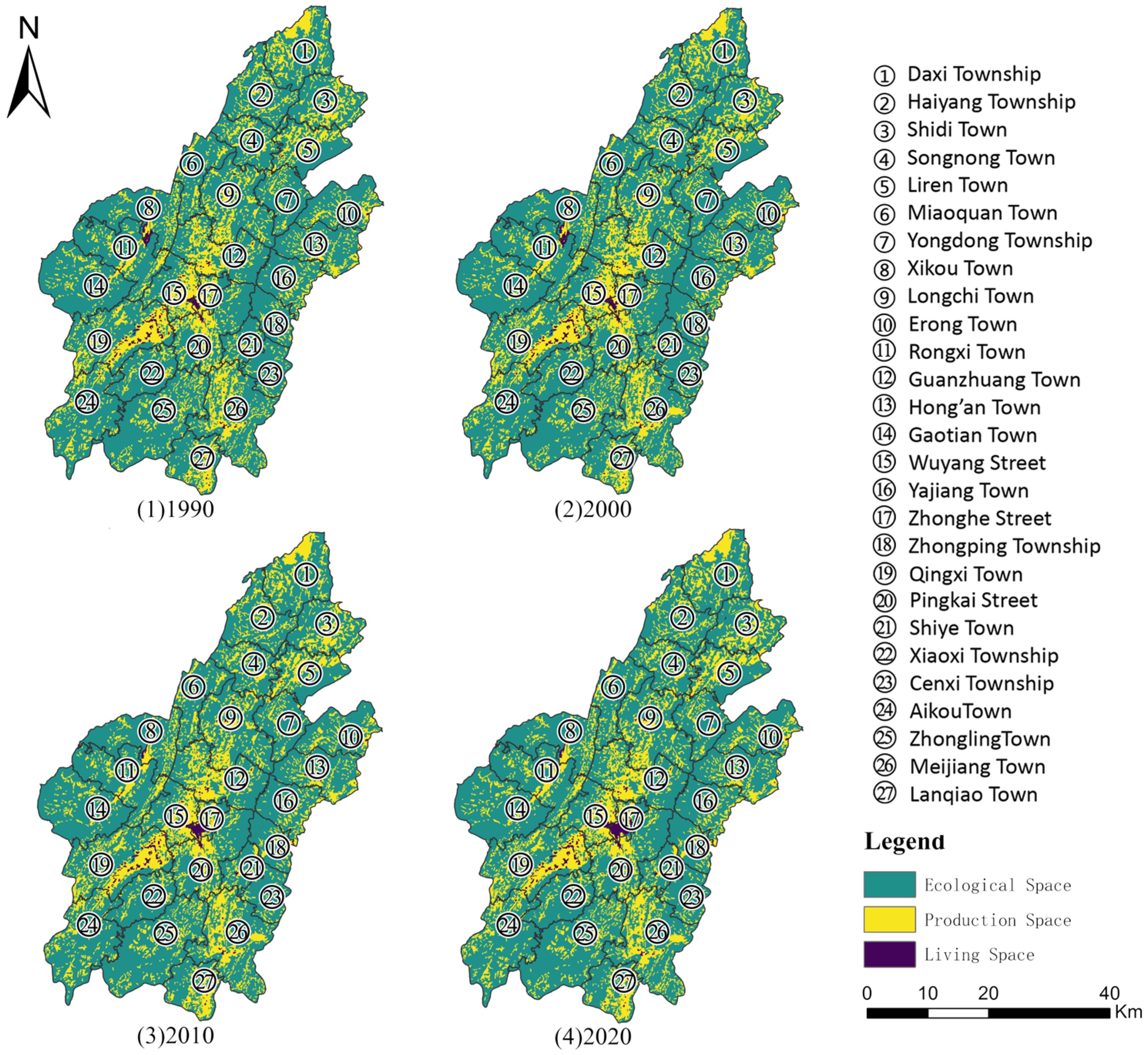
Based on four-phase land use data and dynamic analysis combined with regional development strategies and policy intervention points, this study divides the evolution of Xiushan County’s PLES into three distinct phases. It systematically reveals the spatiotemporal evolution and driving mechanisms of this transformation (Figure 2).

4.1.1. Stable Development Period (1990–2000): Ecological Baseline Stability and Low-Intensity Disturbance

During this phase, Xiushan County’s economic development was at a relatively low level, with traditional agriculture serving as the mainstay. Urbanization was still in its initial stages, and human activities had a limited impact on natural systems. The spatial PLES pattern remained generally stable, though early signs of disturbance had begun to emerge by the end of this phase.
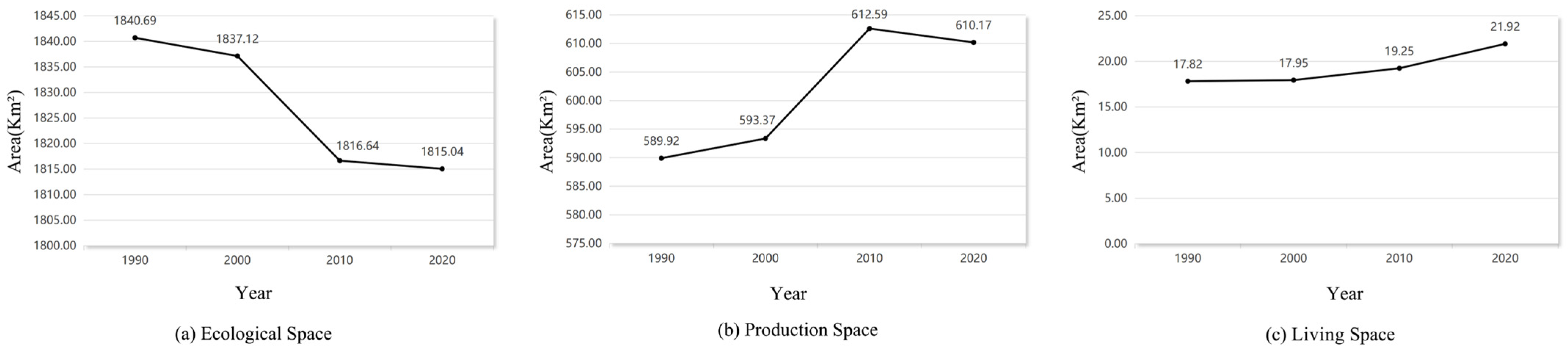
Ecological spaces have consistently accounted for the majority of the region’s total area (1840.69 km2 in 1990, representing 75.18%), and are widely distributed across the northern alpine forest areas, southern riverine wetlands, and western nature reserves. By 2000, while the overall area remained stable (1837.12 km2 in 2000, accounting for 75.03%), slight fragmentation occurred in some local areas due to agricultural expansion and infrastructure development. Production spaces are concentrated in river valleys with flat terrain and fertile soil, such as the areas along the Meijiang River, and their overall scale has remained stable (589.92 km2 in 1990 and 593.37 km2 in 2000). With the onset of urbanization, parts of the production spaces near the urban periphery have begun to be encroached upon by living spaces, which is leading to localized adjustments in the spatial structure. In contrast to production spaces, living spaces expanded only modestly. In the early stages, they were highly concentrated in the core areas of county towns, where convenient transportation and well-developed infrastructure attracted large populations, resulting in a compact and densely distributed layout. As the migration of rural populations to towns accelerated, settlements began to emerge on the outskirts of county towns, and the living spaces showed initial signs of expansion (increasing from 17.82 km2 to 17.95 km2).

4.1.2. Policy Adjustment Period (2000–2010): Urban Expansion and Ecological Macro Protection

With the continued implementation of China’s policies on the conversion of farmland to forests and ecological conservation and compensation, the PLES has entered a phase of policy-driven structural adjustment, with ecological conservation and urbanization jointly driving the restructuring of the spatial pattern.
Under the macrolevel guidance of national policies, Xiushan County has established an ecological security framework comprising “Three Mountains, Three Covers, and Four Rivers” (i.e., three mountains: Jiao Ziding Mountain, Taiyang Mountain, and Qiyao Mountain; three covers: Chuanhe Cover, Pingyang Cover, and Mutong Cover; and four rivers: Meijiang River, Qingshui River, Rongxi River, and Hong’an River). The key areas and boundaries for ecological protection have been clearly defined. Under strict land-use controls, the use of ecological space has been restricted (with a relative reduction of 20.48 km2), which has led to relative stability. Through initiatives such as the Grain-for-Green Program and the protection of natural forests, the overall ecological security framework across the county has been integrated and strengthened. Notably, the grassland areas have decreased while the forest areas have increased, and ecosystem service functions have gradually improved. The area of production space has grown significantly (increasing from 593.37 km2 to 612.59 km2, an overall increase of 3.23%), with rapid spatial expansion. The focus of production space has shifted toward townships in the southeast, and development priorities are no longer confined to the central area, reflecting the synergistic advancement of agricultural structural adjustment and ecological conservation. In contrast, the increase in living space was the most pronounced, with the area expanding relatively rapidly (from 17.95 km2 to 19.25 km2, an overall increase of 7.24%). This expansion has manifested as the continuous outward spread of the county’s built-up area and the significant development of settlements along transportation corridors, forming a “center-axis” diffusion pattern.

4.1.3. Coordinated Development Phase (2010–2020): Multidimensional Drivers and Systemic Synergistic Evolution

Under the combined influence of China’s new urbanization strategy and rural revitalization policies, the evolution of PLES exhibits high intensity and multidimensional characteristics, with systemic conflicts coexisting alongside coordination mechanisms, and spatial development gradually shifting toward the improvement of quality, efficiency and functional synergy.
Ecological spaces are facing pressure from encroachment by residential and production areas, and the level of fragmentation is intensifying. However, through the implementation of systems such as the ecological protection red line and land-use controls, the overall structure has remained stable, while the peripheral areas are being consolidated and utilized (resulting in a relative decrease of 1.60 km2 in area), leading to a further increase in the value of ecosystem services. Production space has also been constrained, showing an overall downward trend in area (decreasing from 612.59 km2 to 610.17 km2), as it is gradually being occupied by ecological and residential spaces, reflecting the shift in development orientation toward intensive land use and the transition to eco-friendly agriculture. Only living space has maintained a sustained expansion trend (increasing from 19.25 km2 to 21.92 km2), with the built-up areas of county towns expanding outward and the living spaces in key towns and central towns developing significantly. At the same time, the policy of “consolidating and merging” rural settlements has led to a decrease in the density of living space clusters, which is a reflection of the continued advancement of population aggregation and urban–rural integration, resulting in a more intensive spatial layout.

4.2. Transformation Characteristics and Dynamic Degree Analysis of PLES in Xiushan County

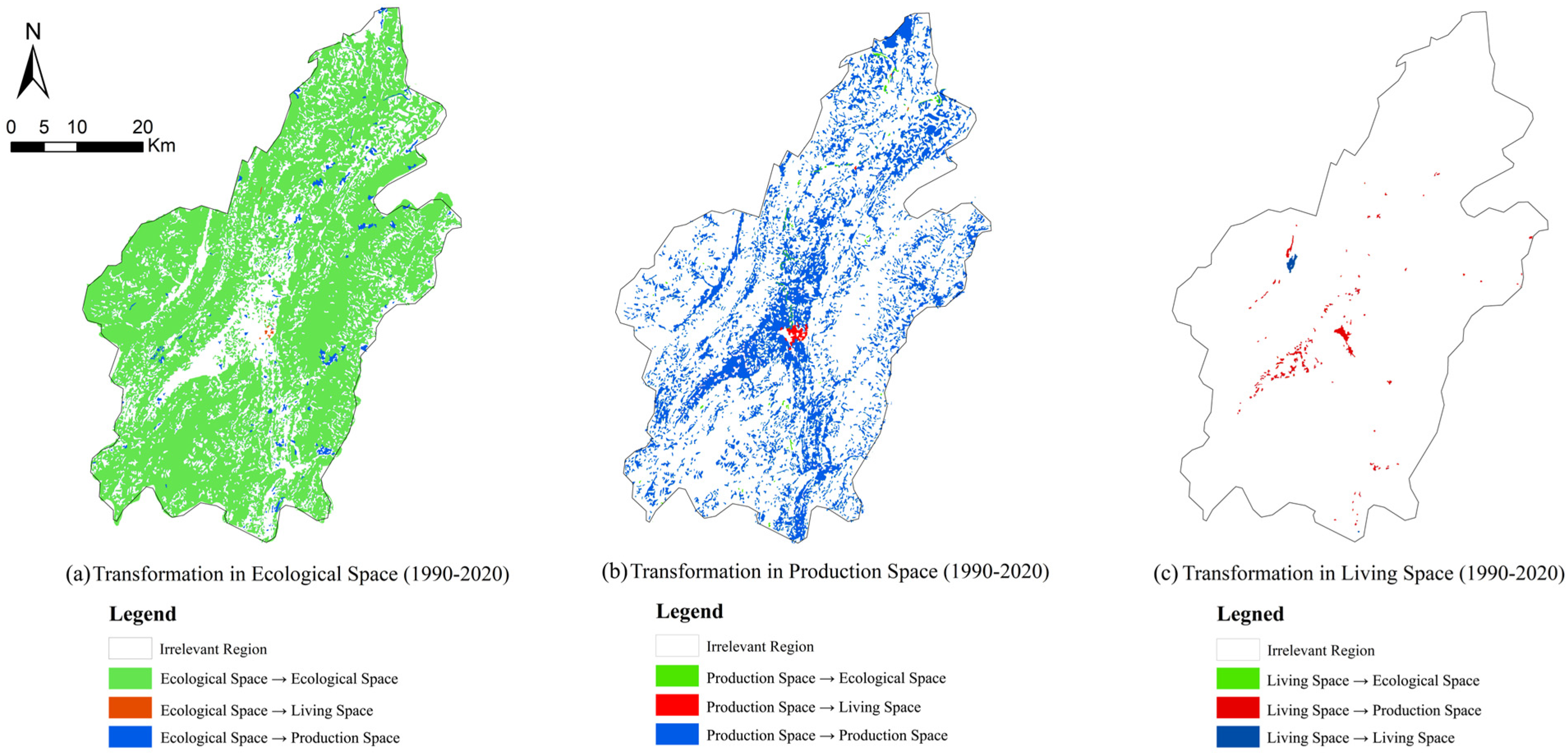
Based on four sets of land use data covering the period from 1990 to 2020, this study employes the PLES functional classification system (Table 1) and utilizes spatial transfer matrices and dynamic degree models to systematically identify the structural evolution pathways, transformation intensity, and regional differentiation characteristics of the PLES in Xiushan County. The results indicate that, driven by both socioeconomic development and ecological conservation policies, three have been significant mutual conversions among the three types of spaces in Xiushan County (Figure 3). Furthermore, the intensity of evolution across these three spatial types (Figure 4) exhibits characteristics of phased progression, regional differentiation, and spatiotemporal heterogeneity.

4.2.1. Transformation Characteristics and Dynamic Degree Changes of Ecological Space

In terms of transformation characteristics, ecological space declined steadily over the study period, with the overall stability gradually increasing. Between 1990 and 2020, the total area decreased by 1.39%, which reflects the dynamic equilibrium process of ecological land use under human disturbance and policy intervention. Ecological space loss was minimal between 1990 and 2000, with a net reduction of 3.57 km2 (Table 2). This land was primarily converted to production space, indicating a significant pressure on ecological land from agricultural expansion and infrastructure development. Following 2002, with the deepening implementation of policies such as the Grain-for-Green Programme and natural forest conservation, ecological space gradually recovered. Between 2000 and 2010, the net reduction was 20.48 km2, showing a relatively noticeable deceleration in rate, though the absolute reduction remained modest. Between 2010 and 2020, the reduction was merely 1.6 km2, marking a significant slowdown in the rate of decline, which indicates that ecological conservation policies are gradually taking effect.
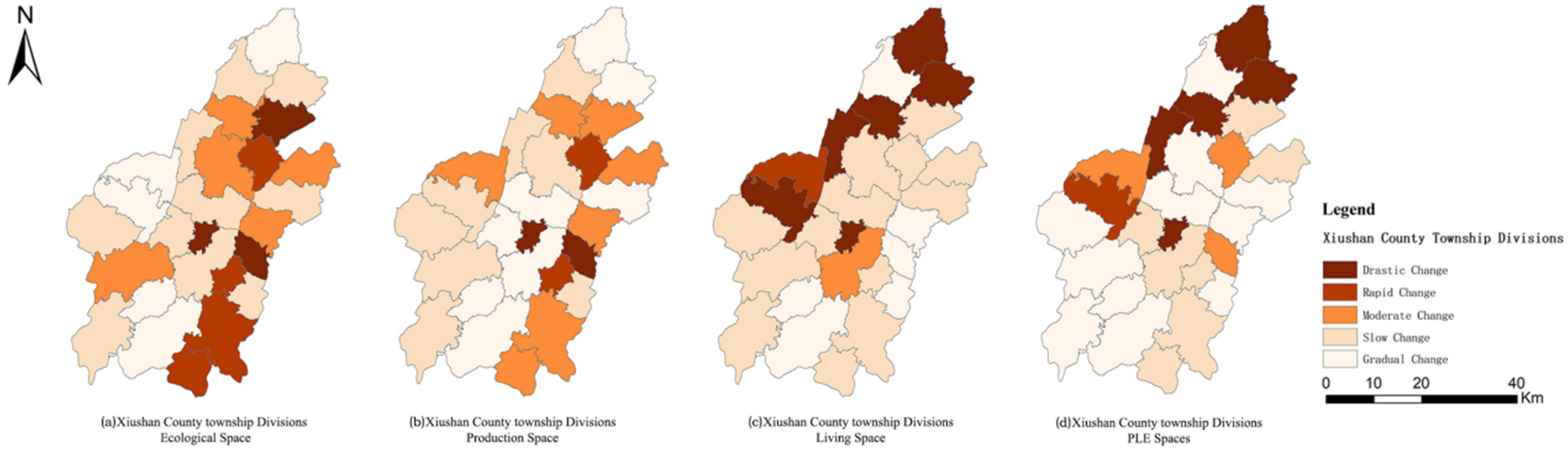
In terms of dynamic degree changes, the overall dynamic degree changes of ecological space remained relatively stable, with the “slow-change type” accounting for the largest proportion (37.04%) and the “rapid-change type” accounting for the smallest proportion (11.11%) (as shown in Figure 5a). The transformation trajectory of ecological space has distinct restorative characteristics. When the period between 1990 and 2020 is divided into 10-year intervals, the ecological space conversion rate was 0.19%, 1.11%, and 0.09%. This shows a transformation trajectory of an initial increase followed by a decrease, which fully reflects the spatial regulatory effects of ecological conservation policies. From a spatial pattern perspective (as shown in Figure 6), the areas undergoing positive changes are primarily distributed in the northern alpine forest regions and southern ecological conservation zones, with the ecological space dynamism of some sub-districts in excess of 0.1%. This slight change is primarily attributable to the implementation of the Grain-for-Green Program and the measures undertaken to consolidate villages and towns, which have restricted the conversion of green spaces and maintained the stability of the region’s ecosystem services. In contrast, those areas undergoing negative changes are concentrated around urban centers and along transportation corridors, reflecting the ongoing pressure on ecological space exerted by urbanization.
Thus, the ecological space in Xiushan County is predominantly distributed across ecologically sensitive areas such as mountainous terrain, forested land, and water source protection zones, constrained by both topographical slope and elevation, as well as ecological redline boundaries. Despite significant encroachment by production and residential areas in earlier periods, robust policy interventions subsequently facilitated structural recovery. Ecosystem stability has progressively enhanced, establishing this area as a vital ecological security barrier for the region.

4.2.2. Transformation Characteristics and Dynamic Degree Changes of Production Space

In terms of transformation characteristics, the evolution of the production space followed a pattern of “high stability-rapid growth-gradual adjustment,” which reflects the profound influence of regional economic development and land use policies. From 1990 to 2020, the area increased by as much as 3.43%, indicating a pronounced pattern of spatial restructuring (Table 3). The specific changes show that the period from 1990 to 2000 was a phase of slow growth (0.58% increase); the 2000–2010 period was a phase of rapid expansion (growth rate of 3.24%), which was characterized by the development of the secondary sector and the emergence of the tertiary sector, with a corresponding expansion of the relative production space; and the 2010 to 2020 period underwent a structural decline (growth rate of −0.4%), indicating that the expansion of production space was becoming more rational, primarily due to the gradual withdrawal of inefficient agricultural land under the guidance of ecological restoration policies.
When referring to dynamic degree changes, the overall dynamism of production spaces has remained relatively low, with the “slow-change” type dominating at nearly 50%, while the “fast” and “rapid” change types account for only 3.70% (Figure 5b). Notably, the production spaces in most regions exhibit negative dynamism, indicating that their transformation into living and ecological spaces has become a widespread phenomenon. Among the three types of spatial conversion, this evolutionary trajectory is the most pronounced. When analyzed in 10-year intervals, the conversion rate of production space increases from 0.58% to 3.24% during the 20-year period ranging from 1990 to 2010. However, between 2010 and 2020, a structural decline occurred, with the conversion rate dropping to −0.4%, which reflects a significant shift in land use from scale expansion to quality improvement. From the perspective of spatial patterns (as shown in Figure 4), the regions with relatively moderate changes are primarily concentrated in river valleys and gently sloping agricultural areas in central and southern China, and they show the overall characteristics of gradual contraction and functional restructuring. Particularly in key implementation areas in which farmland is being converted to forests and grasslands per policy, the absolute value of production space dynamics has reached its peak, with a large amount of original agricultural production space being converted into ecological space.
As a consequence, the evolution of production space clearly reflects Xiushan County’s transition from extensive to ecologically friendly agriculture. Early expansion was scale-driven, while structural optimization and efficiency gains were achieved in later policy-guided phases, demonstrating a profound shift in land use from quantitative growth to qualitative enhancement.

4.2.3. Transformation Characteristics and Dynamic Degree Changes of Living Space

In terms of transformation characteristics, living space exhibited a sustained and rapid expansion throughout the study period. From 1990 to 2020, the area increased by as much as 23.01%, clearly reflecting the reshaping effect of urbanization on spatial structure (Table 3). Specific changes show that the period from 1990 to 2000 was a period of steady growth (growth rate of 0.73%); the period from 2000 to 2010 marked a phase of accelerated expansion (growth rate of 7.24%); and the period from 2010 to 2020 saw a phase of rapid expansion (growth rate of 13.87%), reaching the peak growth rate of the study period. This is closely related to the rapid advancement of urbanization and the continuous expansion of rural settlements that occurred during this period.
In terms of dynamic degree changes, the average dynamism of living spaces was significantly higher than that of the other two types of spaces. As with the other two types of spaces, the predominant change type was “slow-changing” (accounting for 55.56%), while “medium-changing” and “rapid-changing” types had the lowest proportions (7.41%) (Figure 5c). The continuous expansion of living space represents another important dimension of spatial transformation. During the study period, the period of 1990–2000 exhibited characteristics of the early stages of urbanization, with the overall growth rate of the living space conversion rate reaching 0.73% (Table 2), which was primarily driven by production space. From 2000 to 2010, the growth rate of residential space conversion reached 7.24%, which was primarily driven by rapid urban development during the urbanization process and housing construction activities in rural areas influenced by the economic spillover effects of towns. Together, these factors constituted the core drivers of the continuous expansion of residential space. The period of 2010 to 2020 saw the most dramatic changes, with the growth rate of residential space conversion rising to 13.87% (Table 2). From a spatial pattern perspective (as shown in Figure 4), highly active residential areas are concentrated in the developed areas of county towns, along major transportation corridors, and around key towns, forming a typical “point-axis” expansion pattern. Among these, the dynamism of some streets exceeded 2%, clearly reflecting the intense expansion of residential space during the rapid advancement of urbanization.
Therefore, the sustained expansion of living space primarily stemmed from the conversion of productive land, with an extremely low proportion originating from ecological space. This indicates that expansion continues to be dominated by the occupation of agricultural production areas, keeping the level of risk regarding the direct encroachment on ecological space relatively manageable. At the policy level, the increase in urban and rural construction land and the relaxation of rural housing construction regulations served as key drivers of the continuous expansion of living space. This reflects the profound interaction between human settlement demands and land supply during the urbanization process.

4.2.4. The Overall PLES Transformation Characteristics and Dynamic Degree Changes

In general, the mutual conversion between ecological and production spaces constitutes the primary driver of territorial spatial pattern evolution, followed by transformations between production and living spaces. Direct conversions between living and ecological spaces occur least frequently, reflecting path dependencies and policy constraints in the transformation of different functional spaces. Spatially, production space changes have been concentrated in areas with gentle topography and convenient transport links and closely tied to regional economic development. Living space transformations have been highly concentrated within urban catchment areas, as they are significantly influenced by transport networks and policy direction. Ecological space changes, however, have been constrained by both natural conditions and policy boundaries, exhibiting pronounced ecological sensitivity. In terms of driving forces, the transformation of the three spatial domains in Xiushan County exhibits a dual-engine characteristic of its economic-policy: the initial phase was dominated by economic development, which drove the rapid expansion of production and living spaces; the later phase saw the gradual strengthening of ecological conservation policies, which guided spatial structure optimization and ecological function restoration. This shift in the driving mechanism reflects a significant transformation in regional development, moving from the pursuit of economic growth to an emphasis on sustainable development, providing important practical reference for the spatial optimization of traditional villages in the mountainous regions of Southwest China.
The comprehensive dynamic degrees of the PLES in Xiushan County reflects the overall intensity and level of activity of the system. Spatially, high and moderately high values were concentrated in Xiushan County’s central area and northern townships, forming a distinct north–south divergence pattern. Specifically, these regions exhibited a concentric diffusion structure that radiates outward from the county seat, reflecting a pronounced spatial restructuring. The reason for this is that the central and northern areas not only boast dense populations and higher economic development levels but are also key implementation zones for policies such as the Grain-for-Green Programme and village consolidation. In contrast, medium-low and low-value zones are predominantly concentrated in the southwestern and eastern marginal mountainous regions. These areas face multiple natural and policy constraints: terrain slopes generally exceed 25 degrees, elevations often surpass 800 m, extensive ecological conservation red lines are delineated, and infrastructure development and industrial growth lag behind. Collectively, these factors limit the intensity and frequency of spatial transformation. Particularly in the eastern mountains, ecological conservation policies exert more pronounced constraints, suppressing spatial transformation intensity. Their comprehensive dynamic indices are generally lower than those in the central regions, rendering them spatial transformation “cold spots” across the county.
The underlying mechanisms of comprehensive dynamic spatial differentiation can be attributed to the synergistic interaction of a “dual-drive” model in which economic and policy Factors are combined. Economic development directly drives the expansion of living spaces and the restructuring of production spaces through population agglomeration, industrial upgrading, and infrastructure development. At the same time, ecological conservation policies guide the restoration of ecological spaces and the reversal of low-efficiency land use through measures such as the conversion of farmland to forests, ecological restoration, and spatial controls. The interaction between these two forces exhibits distinct characteristics across different regions: in core economic development zones, economic drivers dominate; in ecologically sensitive areas, policy regulation plays a more significant role; and in urban–rural transition zones, the two are engaged in a complex dynamic of interplay. This mechanism that underlies spatial heterogeneity ultimately shapes the overall pattern and development trajectory of the dynamic evolution of the PLES in Xiushan County.

4.2.5. Shannon Entropy Index Analysis of PLES

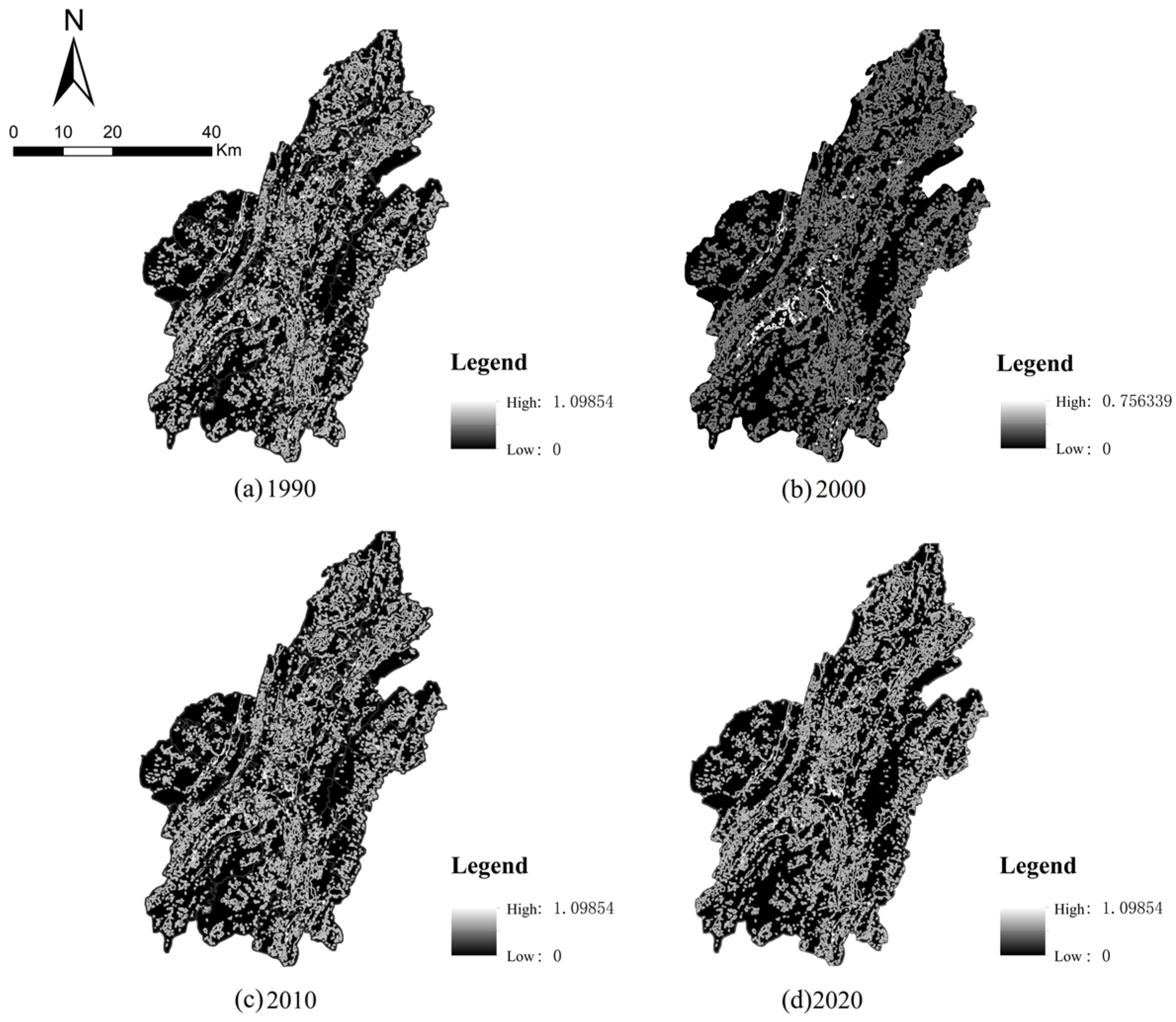
Based on the ArcGIS platform and the use of the Shannon entropy index to assess the evolution of the PLES landscape pattern during the period from 1990 to 2020 (Figure 5), the results show that spatial heterogeneity in the study area exhibits phased fluctuation characteristics.
First, the regional Shannon entropy values were high in 1990, peaking at 1.09854. This reflects the fact that most areas had high Shannon entropy values, indicating that land use types were diverse and evenly distributed at that time, and that the landscape ecological pattern was highly complex and heterogenous. By 2000, the peak entropy value had plummeted to 0.756339, with most areas exhibiting medium-to-low entropy values. This marked a drastic restructuring of the ecological landscape pattern, as the rapid expansion of production and residential spaces led to severe fragmentation in certain areas, which resulted in a significant decrease in landscape fragmentation and a marked weakening of spatial heterogeneity. From 2010 to 2020, the Shannon entropy values rebounded markedly in most regions, with the peak values rising again. This change reflects the increased intensity levels of human activities during this period, which drove the shift in land use from homogeneity to mixed use. The expansion of urban–rural transition zones and the enhancement of functional complexity drove the regional landscape pattern to once again exhibit a highly complex and diverse evolutionary trend.
Overall, Xiushan County shows a trend toward more complex land use patterns, which reflects its adaptation to urbanization transition. The strengthening of government planning and regulation has prompted the PLES to move away from the uniformity resulting from rapid expansion and toward a higher level of orderly development.

4.3. Xiushan County’s PLES Coupling Coordination Index

To systematically evaluate the intensity of the interactions and overall coordinated development level among the PLES subsystems in Xiushan County, this paper draws on the work of several scholars [36,37,38] to determine the indicator layer of the functional PLES evaluation system (Table 4), which was constructed on the basis of highly reliable data. The entropy weight method was used to determine the weighting of each indicator, and the CCD model was applied to conduct quantitative measurements and spatiotemporal analyses of the coupling coordination degree across four temporal phases.

4.3.1. Temporal Evolutionary Characteristics

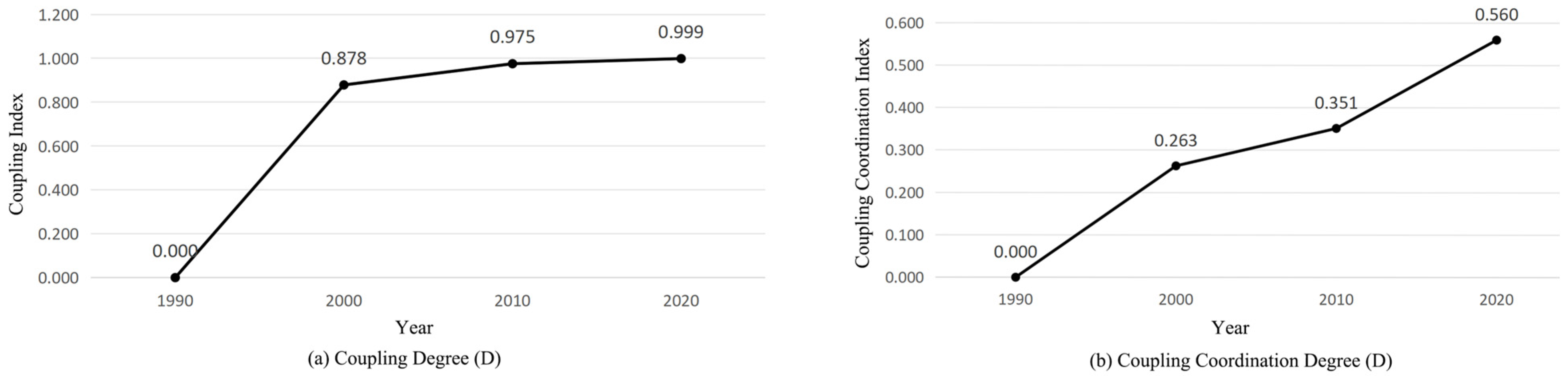
Between 1990 and 2020, the overall coupling coordination level of the PLES in Xiushan County exhibited a steady upward trend, although it remained at a medium-to-low coordination stage. Based on the coupling coordination values and their evolutionary characteristics, this period can be divided into four distinct phases.
The first phase was the period of extreme dysfunction (1990). The system exhibited extremely low overall coupling coordination. During this phase, ecological spatial functions dominated absolutely, whereas production and living spatial functions were virtually absent. The subsystems lacked effective interaction, leaving the system in a state of complete imbalance.
The second phase was low-level coordination (2000). System coupling significantly improved to 0.878 (Figure 7a), indicating markedly enhanced interactions between subsystems. However, the coupling coordination index remained at 0.263 (Figure 7b), still within the moderately imbalanced stage. This finding reflects that while subsystem development had commenced, overall functional levels remained low, and the foundation for coordinated development was fragile.
The third phase was coordination enhancement (2010). Coupling coordination rose to 0.351, approaching the coordination threshold (0.4). During this period, system coupling steadily increased to 0.975. Ecological spatial functions partially recovered through policy interventions, fostering preliminary positive interactions between systems and initiating the establishment of coordinated development mechanisms.
The last phase was the coordination bottleneck period (2020). Coupling coordination increased to 0.560, with system coupling reaching 0.999, although the growth rates slowed. This phase was characterized by the sustained rapid enhancement of living spatial functions, in contrast to the relative lag in the improvement in ecological spatial functions. Ecological constraints hindered further advancement in overall system coordination.
The coupling coordination of the PLES functions of Xiushan County profoundly reflects the evolution of regional development policies and human–land relations. From 1990 to 2000, rapid rural economic growth prioritized production functions, leading to encroachment on ecological spaces and weakened ecological functions. Although the coupling degree of the PLES system shifted from conflict to adaptation, the coordination levels remained extremely low. From 2000 to 2010, guided by integrated urban–rural development principles and policies such as the Grain-for-Green Program, ecological functions were restored. The PLES system entered a period of coordinated coupling, with significantly enhanced coupling coordination. From 2010 to 2020, guided by the “Ecological Civilization Construction” strategy, the system sought to advance toward a phase of orderly coordination and positive resonance through measures such as territorial spatial planning and ecological compensation. However, the rapid development of living spaces coupled with lagging ecological conservation efforts resulted in the PLES spatial system of Xiushan County facing coordination bottlenecks by 2020.

4.3.2. Coupling and Coordination Relationship Between the Two Subsystems

To further explain the coordination status among subsystems, this study analyzed the pairwise coupling degrees (Figure 8) and coupling coordination levels (Figure 9) for three pairs: the “living–ecological”, “production–ecological”, and “production–living” systems. As both the production and living spatial functional scores were zero in 1990, rendering analysis unfeasible, the analysis commenced from 2000 onward.
The coupling coordination degree of the living–ecological system stood at merely 0.555 in 2020 (barely imbalanced), consistently ranking lowest among all pairwise relationships (Figure 9b). This finding reveals the persistent and significant pressure exerted on the ecological environment by the rapid improvement in residents’ living standards and the associated spatial expansion, representing the primary shortfall in the system’s coordinated development.
The coordination level of the production–ecological system lies between that of the other two pairs, with its trajectory reflecting the dynamic interplay between productive activities and ecological conservation (Figure 9a). As ecological policies strengthened, the overall relationship showed an improving trend, rising to 0.564 (barely coordinated) by 2020.
The coupling coordination of the production–living system steadily improved from 0.248 (moderately imbalanced) in 2000 to 0.561 (barely coordinated) in 2020. This transformation indicates the formation of a deeply mutually reinforcing virtuous cycle between regional economic growth and improvements in residents’ living standards (Figure 9c).
In general, the pairwise coupling coordination relationships among the subsystems exhibited differentiated development patterns during the study period. The production–living system achieved a positive transition from imbalance to coordination, forming a mutually reinforcing pattern. The production–ecological system generally showed gradual improvement, maintaining a state of dynamic equilibrium. Meanwhile, the coordination level of the living–ecological system reached its lowest point by the end of the study period. This system will become the critical bottleneck constraining overall coordinated development, highlighting the prominent contradiction between the expansion of residents’ living space and ecological conservation. This represents the core challenge that must be urgently addressed to optimize the functions of the PLES and to promote sustainable urban–rural development.

5. Driving Factors in the Evolution of the PLES Pattern in Xiushan County

To systematically explain the underlying mechanisms governing the evolution of Xiushan County’s PLES pattern, this study employs the Geodetector model to conduct a quantitative analysis of the constructed dual-driver indicator system for “natural–socioeconomic” factors. Through single-factor detection and interaction detection, the independent influence intensity of each driver and the synergistic mechanisms among them were identified, thereby comprehensively explaining the driving patterns of pattern evolution.

5.1. Single-Factor Detection Results

The Geodetector results of factor detection indicate that all 13 selected driving factors passed the significance test (p = 0), demonstrating their statistically significant influence on the evolution of the PLES pattern in Xiushan County from 1990 to 2020. In terms of average explanatory power, socioeconomic factors (0.083) surpassed natural environmental factors (0.068), revealing that socioeconomic activities constitute the core driving force behind spatial pattern transformation, while natural environmental elements form the foundational constraints on spatial development and utilization.

5.1.1. Natural Environmental Factors

The independent explanatory power (q value) of natural environmental factors is ranked as follows: annual mean temperature > altitude > annual mean precipitation > terrain undulation > slope gradient > distance to water systems > soil type.
As the natural factor with the strongest explanatory power, the annual mean temperature (q = 0.148) directly determines regional vegetation types and ecological suitability, thereby constraining the distribution boundaries of ecological spaces and agricultural production potential. Altitude (q = 0.116) serves as a foundational element that shapes vertical land use differentiation, clearly delineating low-altitude river valley zones suitable for cultivation and construction from high-altitude mountainous ecological conservation areas. Annual precipitation (q = 0.084) influences soil moisture and crop productivity through hydrological conditions, thereby regulating the carrying capacity of production spaces.
Topographical undulation (q = 0.058) and slope gradient (q = 0.044) jointly determine engineering costs and cultivation feasibility: areas with low undulation and gentle slopes are more readily converted for productive or residential use, whereas highly undulating and steeply sloped areas predominantly retain natural vegetation and ecological functions. The distance from water systems (q = 0.016) and the soil type (q = 0.013) exhibit weaker independent influences at the county scale. However, at the micro level, they exert significant guiding effects on agricultural irrigation, settlement location, and land ecological quality.
Notably, when interacting with climatic or socioeconomic factors, topographical constraints on spatial suitability are often amplified. These interactions warrant particular attention in subsequent analyses.

5.1.2. Socioeconomic Factors

The independent explanatory power of socioeconomic factors is ranked as follows: spatial distribution of GDP > spatial distribution of the population > road network density > distance from motorways > distance from county-level or higher roads > distance from railways. The characteristics of these factors are as follows (Figure 10).
(1)
The Core Drivers of the Economy and Population
As the most influential driver, the spatial distribution of GDP (q = 0.202) constitutes the fundamental impetus propelling the expansion of living spaces, guiding the capitalization of land resources, and triggering the functional restructuring of production spaces. The spatial distribution of the population (q = 0.124) directly reflects the spatial heterogeneity of human activity intensity. Population agglomerations generate strong demands for housing and infrastructure, directly driving the rapid sprawl of living spaces.
(2)
The Catalytic Effect of Transport Networks
Road network density (q = 0.057) characterizes partial connectivity and economic vitality within regions, directly facilitating the connectivity and expansion of living spaces. Factors such as the distance from major transport arteries (motorways, county-level or higher roads, railways)—with q values ranging from 0.036 to 0.041—significantly influence the layout efficiency and development orientation of production and living spaces by reducing transport costs and enhancing locational advantages.
Overall, Xiushan County’s PLES pattern shows a “prominent economic–demographic drivers within a climate–topography framework” evolution. The combined influence of socioeconomic and natural factors jointly determines the evolutionary trajectory. Socioeconomic factors dominate spatial transformation in the short term, whereas land use changes—involving multiple sources and complex processes—directly manifest the evolution of the PLES. Population, policy, and economic factors are the primary drivers of this evolution. Natural factors establish the underlying logic of the evolutionary pattern over the long term, constituting a crucial determinant of macrolevel spatial configuration.

5.2. Interaction Detection Results

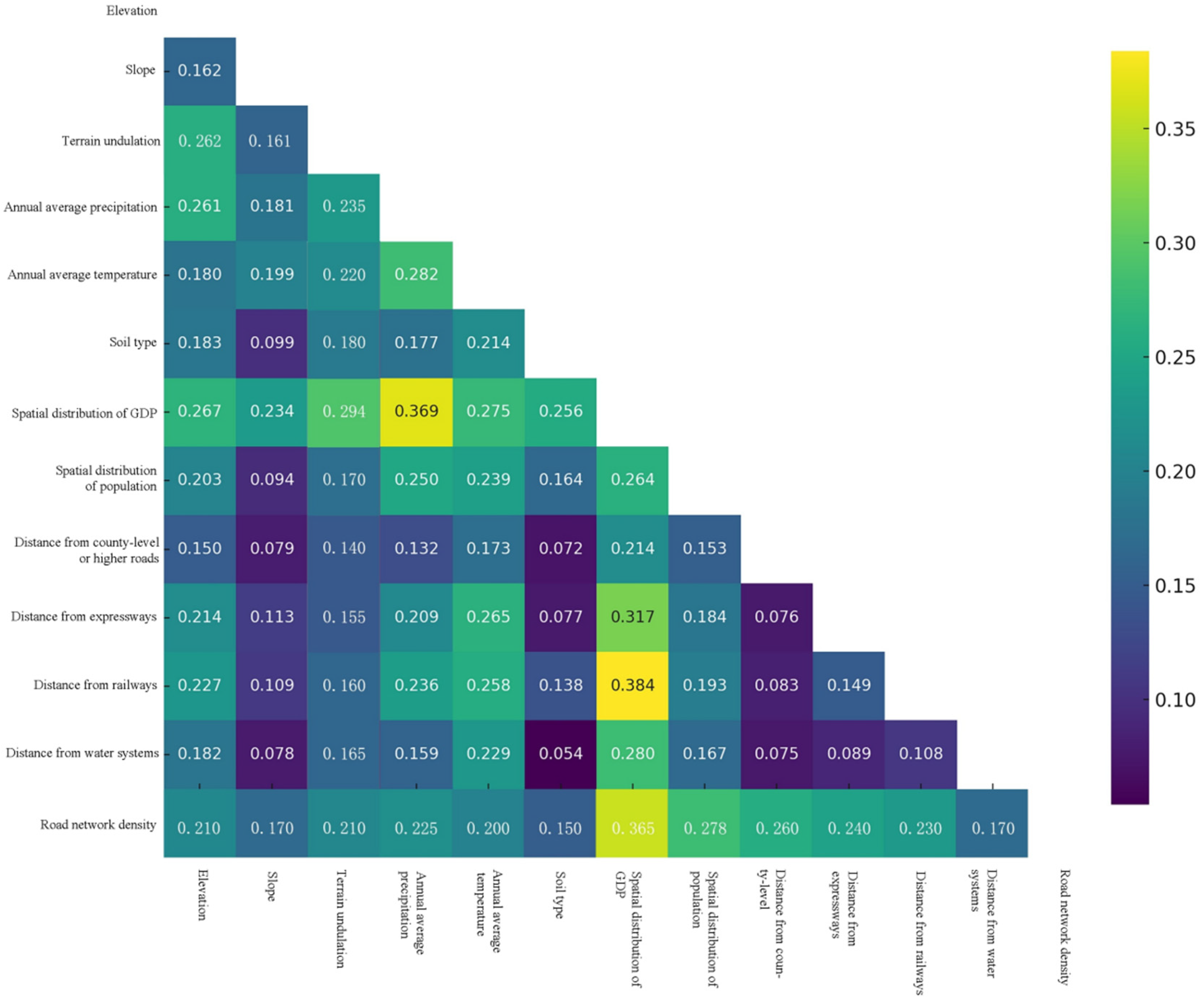
Interaction detection aims to reveal the composite effects of multifactor coupling on the evolution of the PLES. The results indicate that the explanatory power (q value) of the interactions between any two factors exceeds their independent explanatory power, with all interactions exhibiting either dual-factor enhancement or nonlinear enhancement. This finding demonstrates that the evolution of the PLES in Xiushan County results from the complex synergistic and nonlinear interactions of multiple driving factors (Table 5).
(1)
Synergistic Effects of Socioeconomic Factors and Transport Location
The most pronounced interaction effect was observed between the spatial distribution of GDP and the distance from railways (q = 0.384), highlighting that the convergence of economic growth hubs with strategic transport corridors exerts the strongest propulsive effect on the expansion of living and production spaces. Moreover, strong synergistic effects were observed between the spatial distribution of GDP and the annual average precipitation (q = 0.369), as well as between the spatial distribution of GDP and the distance to expressways (q = 0.317). These findings confirm that superior rainfall resources or efficient transport networks significantly increase the spatial clustering and expansion efficiency of economic activities.
(2)
Limitations of interactions between natural factors
Pure interactions between natural factors, such as the soil type and distance from water systems (q = 0.054) or slope and the distance from county-level or higher roads (q = 0.079), exhibit relatively weak effects. This finding indicates that in the absence of external socioeconomic drivers, the intrinsic combination of natural baseline conditions has a limited influence on the evolution of macrospatial patterns.
(3)
Key Interactions in Human–Land Relations
The interaction between slope and the spatial distribution of the population (q = 0.094) reveals a pivotal aspect of human–land relations: in low-slope areas, population aggregation and settlement development are more feasible, thereby propelling the expansion of living spaces.
(4)
The Impact of Local Macro-Policy Factors
First, during the implementation of the Grain-for-Green Programme, the maintenance of ecological space was influenced by ecological compensation policies. To establish a spatial pattern for ecological space, it is necessary to not only set the overarching direction of the Grain-for-Green Programme but also to provide long-term support through specific maintenance policies [39].
The correlation coefficients between GDP and road network density in the Geodetector are high, and along with their interactive enhancement effects, they reflect Xiushan County’s development trajectory since the initial launch of the Western Development Strategy in 2000. Between 2000 and 2010, leveraging the Western Development Strategy, the government guided the aggregation of capital and population through the phase of industrial park development. This administratively driven industrial clustering directly reshaped the spatial pattern of GDP and drove the expansion of construction land. Improved logistics channels reduced transportation costs, enabling a shift in the focus of local governance toward transportation infrastructure. Through these interactions, the dominance of economic factors over land use was further reinforced.
The interaction between natural factors (i.e., altitude and slope) and population distribution reveals how local communities respond to ecological policies. In ecologically fragile high-altitude areas, the delineation of ecological red lines and urban development boundaries has forcibly guided population concentration away from high-altitude, steep-slope regions and toward Xiushan’s urban center and key towns. Consequently, natural factors are no longer merely environmental backdrops; rather, through an interaction with macro-level population policies, they have become a key force driving the conversion of land use from farmland to forest land in high-altitude regions.
Overall, the spatial pattern evolution of Xiushan County’s PLES is governed by a composite driving system characterized by the primacy of socioeconomic development and the foundational constraints of the natural environment. Within this system, economic growth and population concentration constitute the core drivers of spatial restructuring; the transport network exerts a crucial catalytic effect on this process by enhancing the mobility of factors and locational advantages. In contrast, natural environmental factors, particularly climate and topography, collectively form a foundational framework of constraints. By defining thresholds for ecological suitability and engineering feasibility, they shape the long-term potential and fundamental patterns of spatial development.

6. Conclusions and Discussion

6.1. Conclusions

In this study, which is based on four phases of land use data from 1990 to 2020, a comprehensive methodology that integrates GIS spatial analysis, dynamic degree models, transition matrices, coupling coordination models, and geographic detectors is employed. It systematically examines the spatiotemporal evolutionary patterns, coupling characteristics, and driving mechanisms of the PLES within traditional villages in Xiushan County, Chongqing, China, from a “pattern–process–mechanism” perspective. This study reveals four key findings.
First, the PLES structure exhibits distinct phased and heterogeneous evolutionary patterns. During the study period, production spaces followed a “high-level stability–rapid expansion–gradual retrenchment” trajectory, while living spaces expanded continuously. Ecological spaces, however, exhibited a pattern of steady decline. Second, the spatial transformation pathway was driven by dual economic–policy engines. The mutual conversion between ecological and production spaces constitutes the primary driver of territorial spatial evolution, followed by transformations between production and living spaces. Third, system coupling coordination steadily improved but faced bottlenecks in harmonious development. Coupling coordination progressed from extreme imbalance to barely coordinated status, forming a zoned spatial structure characterized by high levels in central core areas and low levels in peripheral mountainous regions. Notably, the living–ecological system exhibited the lowest final coordination level and smallest increase, highlighting the acute contradiction between expanding residential spaces and ecological conservation. Finally, spatial evolution was predominantly driven by the “economic–policy” composite system, with significant factor interactions. The socioeconomic factors exhibit greater explanatory power overall than natural factors do, while natural environmental elements form the foundational framework of constraints for spatial development and utilization. Interaction detection further reveals that the explanatory power of any two interacting factors exceeds that of individual factors, generally exhibiting dual-factor enhancement or nonlinear amplification.

6.2. Discussion

The research proposes the following concrete spatial governance recommendations, aiming to translate the research findings into actionable planning pathways.

6.2.1. Macrolevel Strategy: Integrating the Tripartite Spatial Coupling Mechanism into Regional Development Policy Formulation

This research confirms that the spatial evolution in Xiushan County is influenced by a dual-driver system comprising economic development and policy intervention. Consequently, strengthening the strategic guiding role of territorial spatial planning and refining its regulatory constraint mechanisms are paramount. When the core functional zones for production, living and ecological spaces are delineated and the urban development boundaries, permanent basic farmland, and ecological conservation red lines are optimized, the key driving factors identified in this study should be fully incorporated. These include natural constraints such as elevation and slope [40], as well as socioeconomic drivers such as road network density [41] and the distribution of regional GDP [42,43]. This approach will facilitate a shift in spatial control standards from qualitative guidance to quantitative and refined decision-making.
Concurrently, cross-departmental coordination across policy domains—including finance, transport, agriculture, and ecological conservation—must be strengthened. By leveraging the synergistic effects among drivers, transport infrastructure planning can be integrated with ecological corridor restoration projects, or rural revitalization industries can be strategically located to avoid highly ecologically sensitive areas. Such top-level design coordination helps steer regional development models from functional conflict toward systemic coordination at the strategic level. This systematically advances the restructuring of the relationship between production, living and ecological spaces from mutual competition to functional synergy.

6.2.2. Mesolevel Planning: Establishing a Zoned Governance Framework Based on Spatial Differentiation Patterns

The “core–periphery” spatial structure identified necessitates abandoning standardized planning approaches in favor of precision-targeted regional governance strategies. For high-intensity core zones, such as central county areas and major transport corridors, the planning priorities should shift from extensive expansion to intensive upgrading and structural optimization. High-quality agricultural production spaces in river valleys must be rigorously protected, while urban and rural settlements should be guided toward compact, intensive development. The active exploration of mixed-use land models is essential for fostering the organic integration of production, living, and ecological functions [44]. In peripheral mountainous areas with a low intensity of spatial change, the slow pace of transformation reflects dual constraints imposed by natural geography and ecological conservation policies.
Governance in such areas should focus on strategic safeguarding and adaptive revitalization. While reinforcing the rigid constraints of ecological protection red lines [45], proactive exploration is needed to establish market-based compensation mechanisms grounded in the value of ecological products. Appropriate authorization should be granted for culturally distinctive local franchise projects, thereby transforming rich ecological and cultural resources into endogenous drivers for community sustainability.

6.2.3. Microlevel Interventions: Implementing Community-Centered Design That Targets Critical Systemic Deficiencies

This study unequivocally demonstrates that severe imbalances between the living and ecological subsystems constitute the primary bottleneck constraining regional coordination. Consequently, within fundamental human settlement units such as traditional villages, planning interventions must transcend conventional land use controls, shifting toward functional design centered on the needs of residents and ecological restoration. Specific measures include scientifically delineating and strictly managing ecological buffer zones and green infrastructure networks [46] around residential clusters to effectively contain the encroachment of built-up areas on the surrounding ecological fabric.
Concurrently, targeted renewal should be encouraged for underutilized or vacant built spaces within villages, guided by the integration of ecological functions. Examples include converting such areas into agricultural land, rain gardens, or communal cultural courtyards. These interventions directly restore degraded ecological functions while simultaneously enhancing village living standards. They represent the most direct and effective pathway for resolving the conflict between expanding living spaces and ecological conservation, thereby strengthening community identity and ecological resilience [47].

6.3. Limitations and Future Research

Although this study revealed the evolutionary patterns and driving mechanisms of the PLES in Xiushan County via a multimodel integrated system, certain limitations remain, which also point the way forward for future research.

6.3.1. Limitations

First, this research simplified the treatment for defining spatial functions. The classification system for PLES based on dominant land use functions, while operationally robust and data accessible, fails to fully capture the composite production–living–ecological composite functional spaces (PLES-CFSs) prevalent in traditional mountain villages. Examples include terraced fields that combine agricultural production with ecological landscape value and ethnic courtyards that serve both residential and artisanal production functions. This single-dominant-function categorization may lead to an incomplete understanding of spatial functional complexity and cultural connotations, thereby somewhat undermining the outcomes of spatial function evaluation.
Second, the analysis of driving mechanisms remains focused on macrostructural factors. While geographic detectors effectively identified the explanatory power and interactions of natural and socioeconomic factors, the model itself struggles to reveal the specific processes and feedback mechanisms through which drivers influence spatial evolution. For instance, policy factors such as ecological compensation and rural revitalization demonstration projects are predominantly treated as contextual descriptions, with insufficient spatial characterization and quantitative research. Concurrently, studies lack microlevel investigations into the decision-making behaviors of local residents and administrators and fail to link top-down spatial governance with bottom-up stakeholder responses. This limitation constrains the analysis of deeper mechanisms underlying human–land interactions.
Finally, the integration of cultural dimensions within spatial evaluations requires further refinement. As an ethnic minority settlement, Xiushan County possesses distinctive cultural elements, such as the ecological ethics and settlement wisdom of the Tujia and Miao peoples, which constitute intrinsic drivers that shape the spatial forms and evolutionary trajectories of traditional villages. Although this study emphasized cultural significance in its background, cultural functions were not explicitly or quantitatively incorporated into the functional evaluation indicator system. Consequently, interpretations of the coupling relationships within the PLES have leaned heavily toward material functions, while discussions of the synergistic evolution of ecology and culture remain somewhat inadequate.

6.3.2. Future Directions

Future studies may develop identification methods for composite functional spaces. The integration of high-resolution remote sensing imagery, field sensor data, and participatory geographic information systems is recommended. Such an integration would establish a multidimensional indicator system that is capable of quantifying the degree of functional mixing and spatial overlay relationships among production, living, and ecological functions. This approach will more accurately depict the actual functional composition of typical composite spaces, such as terraced farming systems and ethnic settlements, thereby enhancing regional adaptability and the explanatory power of spatial function assessments.
Additionally, future research could integrate mechanism analysis from macrolevel drivers to microlevel subject behavior. Building upon existing macrolevel quantitative models such as geographic detectors, diverse methodologies, including agent-based modeling, in-depth interviews, and questionnaire surveys, may be introduced. These methods focus on revealing how policy regulation and market signals influence choices regarding land use behavior among key decision-making agents such as households, cooperatives, and enterprises. Research that incorporates such methods could deepen the understanding of the “macrolevel drivers–agent decision-making–microlevel spatial utilization” transmission pathway, providing more robust evidence for understanding the social mechanisms underpinning spatial evolution.
Furthermore, future studies could systematically integrate cultural dimensions into the evaluation framework for PLES functions. To address the limitation of the insufficient quantification of cultural functions, future research should explore the integration of elements such as the spatial distribution of cultural heritage, indicators of ecosystem cultural services, and local ecological knowledge into a comprehensive evaluation system for PLES. This approach will facilitate a more in-depth analysis of the unique “ecological–cultural” coevolutionary logic in China’s southwestern mountainous regions. It will not only provide planning guidance for regional sustainable development that balances material and immaterial values but also offer valuable empirical case studies for the conservation and development of high-altitude canyon-type cultural landscapes worldwide.

Author Contributions

Conceptualization, J.R. and X.K.; methodology, Q.Y. and Z.S.; software, Z.S., Q.Y., C.L. and Y.Z.; validation, J.R. and X.K.; formal analysis, J.R. and X.K.; resources, Z.S. and Q.Y.; data curation, J.R.; writing—review and editing, J.R., X.K., Z.S. and S.D.; supervision, J.R.; project administration, J.R.; funding acquisition, J.R. and X.K. All authors have read and agreed to the published version of the manuscript.

Funding

This research was funded by Chongqing Municipal Social Science Planning Fund: Research on Structural Imbalances and Modern Reshaping of the Cultural Ecology in Traditional Villages of Chongqing Region (NO. 2024PY79), Chongqing Municipal Education Commission Humanities and Social Sciences Fund: Application Research on Revitalizing Chongqing Rural Art Based on Spatial Narrative Theory (NO. 24SKGH205), Chongqing Municipal Art Science Planning Fund: Design Research on Rural Spatial Gene Restoration and Nostalgia Preservation: A Case Study of Chongqing Region (NO. 2025QN01), Sichuan Fine Arts Institute Research Start-up Project: Practical Exploration of Integrating Chongqing’s Red Culture into Art-Based Ideological and Political Education (NO. 22BSQD008).

Institutional Review Board Statement

Not applicable.

Informed Consent Statement

Not applicable.

Data Availability Statement

The data presented in this study are available on request from the corresponding author.

Conflicts of Interest

The authors declare no conflicts of interest.

References

  1. Dou, Y.D.; Ye, W.Y.; Li, B.H.; Liu, P.L. Tourism Adaptability of Traditional Village Based on Living-Production-Ecological Spaces: A Case Study of Zhangguying Village. Econ. Geogr. 2022, 42, 215–224. [Google Scholar] [CrossRef]
  2. Ramankutty, N.; Foley, J.A.; Olejniczak, N.J. People on the land: Changes in global population and croplands during the 20th century. AMBIO A J. Hum. Environ. 2002, 31, 251–257. [Google Scholar] [CrossRef]
  3. Ellis, E.C.; Klein Goldewijk, K.; Siebert, S.; Lightman, D.; Ramankutty, N. Anthropogenic transformation of the biomes, 1700 to 2000. Glob. Ecol. Biogeogr. 2010, 19, 589–606. [Google Scholar] [CrossRef]
  4. Ellis, E.C. Anthropogenic transformation of the terrestrial biosphere. Philos. Trans. R. Soc. A Math. Phys. Eng. Sci. 2011, 369, 1010–1035. [Google Scholar] [CrossRef]
  5. Pielke, R.A.; Pitman, A.; Niyogi, D.; Mahmood, R.; McAlpine, C.; Hossain, F.; Goldewijk, K.K.; Nair, U.; Betts, R.; Fall, S.; et al. Land use/land cover changes and climate: Modeling analysis and observational evidence. Wiley Interdiscip. Rev. Clim. Change 2011, 2, 828–850. [Google Scholar] [CrossRef]
  6. Pitman, A.J.; Arneth, A.; Ganzeveld, L. Regionalizing global climate models. Int. J. Climatol. 2012, 32, 321–337. [Google Scholar] [CrossRef]
  7. Ge, Q.; Zhang, X.; Zheng, J. Simulated effects of vegetation increase/decrease on temperature changes from 1982 to 2000 across the Eastern China. Int. J. Climatol. 2014, 34, 187–196. [Google Scholar] [CrossRef]
  8. Alqurashi, A.F.; Kumar, L. An assessment of the impact of urbanization and land use changes in the fast-growing cities of Saudi Arabia. Geocarto Int. 2019, 34, 78–97. [Google Scholar] [CrossRef]
  9. Pielke, R.A., Sr. Land use and climate change. Science 2005, 310, 1625–1626. [Google Scholar] [CrossRef]
  10. Wang, J.; Sun, Q.; Zou, L. Spatial-temporal evolution and driving mechanism of rural production-living-ecological space in pingtan islands, China. Habitat Int. 2023, 137, 14. [Google Scholar] [CrossRef]
  11. Ren, L.; Wang, X.; Jiang, W.; Ren, M.; Yin, L.; Zhang, X.; Zhang, B. Exploring Impact and Driving Forces of Land Use Transformation on Ecological Environment in Urban Agglomeration from the Perspective of Production-Living-Ecological Spatial Synergy. Sustainability 2025, 17, 8235. [Google Scholar] [CrossRef]
  12. Liberati, M.R.; Rittenhouse, C.D.; Vokoun, J.C. Addressing ecological, economic, and social tradeoffs of refuge expansion in constrained landscapes. Landsc. Ecol. 2019, 34, 627–647. [Google Scholar] [CrossRef]
  13. Jin, G.; Deng, X.Z.; Zhang, Q.; Wang, Z.Q.; Li, Z.H. Comprehensive function zoning of national land space for Wuhan metropolitan region. Geogr. Res. 2017, 36, 541–552. [Google Scholar] [CrossRef]
  14. Cao, Y.; Zhang, M.; Zhang, Z.; Liu, L.; Gao, Y.; Zhang, X.; Chen, H.; Kang, Z.; Liu, X.; Zhang, Y. The impact of land-use change on the ecological environment quality from the perspective of production-living-ecological space: A case study of the northern slope of Tianshan Mountains. Ecol. Inform. 2024, 83, 102795. [Google Scholar] [CrossRef]
  15. Xing, D.; Cai, T.; Li, X.; Dong, S.; Hu, H.; Lei, Y.; Cao, Y.; Wu, R. The Process, Mechanism, and Effects of Rural “Production-Living-Ecological” Functions Transformation: A Case Study of Caiwu Village in Yuanyang County, China. Land 2025, 14, 1891. [Google Scholar] [CrossRef]
  16. Huang, T.N.; Zhang, Y.N. Transformation of land use function and response of eco-environment based on “production-life-ecology space”: A case study of resource-rich area in western Guangxi. Acta Ecol. Sin. 2021, 41, 348–359. [Google Scholar] [CrossRef]
  17. Wang, L.; Xiong, C.S.; Tian, Y.; Zhou, B.X. Spatial heterogeneity in functional evaluation, spatio-temporal evolution andzoning schemes of production-living-ecological space in China. Trans. Chin. Soc. Agric. Eng. 2024, 40, 265–275. [Google Scholar] [CrossRef]
  18. Luo, Q.; Zhang, W.; Shao, J.A.; Guo, Y. Optimization of permanent basic farmland delineation at county scale in Wuling Mountain Area. Chin. J. Agric. Resour. Reg. Plan. 2021, 42, 48–57. [Google Scholar] [CrossRef]
  19. Zhang, W.M.; Zhang, M. Vanishing and Conservation: Reflections on the Conservation of Minzu Village, Xiushan County, One of China’s First Batch of Traditional Chinese Villages. Socia. Sci. Hunan 2017, 2, 7. [Google Scholar]
  20. Izakovičová, Z.; Petrovič, F.; Pauditšová, E. The Impacts of Urbanisation on Landscape and Environment: The Case of Slovakia. Sustainability 2022, 14, 60. [Google Scholar] [CrossRef]
  21. O’Neill, R.V.; Krummel, J.R.; Gardner, R.H.; Sugihara, G.; Jackson, B.; DeAngelis, D.L.; Milne, B.T.; Turner, M.G.; Zygmunt, B.; Christensen, S.W.; et al. Indices of landscape pattern. Landsc. Ecol. 1988, 1, 153–162. [Google Scholar] [CrossRef]
  22. Xu, X.; Liu, J.; Zhang, S.; Li, R.; Yan, C.; Wu, S. China Multi-Period Land Use and Land Cover Remote Sensing Monitoring Dataset (CNLUCC). In China Resources and Environmental Science Data Center Data Registration and Publishing System; Chinese Academy of Sciences: Beijing, China, 2018. [Google Scholar] [CrossRef]
  23. GB/T 21010-2017; Current Land Use Classification. General Administration of Quality Supervision, Inspection and Quarantine of the People’s Republic of China: Beijing, China; Standardization Administration of China: Beijing, China, 2017.
  24. Hong, J.X.; Xu, S.Y.; Liu, Y.T.; Zhang, Y.J. Research on the evolution and optimization path of the “production-living-ecological” spatial pattern of national parks from the perspective of national spatial planning. Taking Qilian Mountain National Park as an example. Resour. Dev. Mark. 2025, 41, 692–707. [Google Scholar] [CrossRef]
  25. Ling, Z.Y.; Li, Y.S.; Jiang, W.G.; Liao, C.M.; Ling, Y.R. Dynamic Change Characteristics of “Production-living-ecological Spaces” of Urban Agglomeration Interlaced with Mountains, Rivers and Sea: A Case Study of the Beibu Gulf Urban Agglomeration in Guangxi. Econ. Geogr. 2022, 42, 18–24. [Google Scholar] [CrossRef]
  26. Qi, Y.; Ji, L.; Liu, T. Measuring mixed land use in rural areas: A functional perspective. J. Rural Stud. 2026, 124, 104110. [Google Scholar]
  27. Li, J.; Sun, W.; Li, M.; Meng, L. Coupling coordination degree of production, living and ecological spaces and its influencing factors in the Yellow River Basin. J. Clean. Prod. 2021, 298, 126803. [Google Scholar] [CrossRef]
  28. Nasiri, Z.; Sadeghi, S.H.; Moosavi, V. Coupling multi-coordination degree among land-use/land-cover, ecosystem service value, and socio-economic status in the Shazand watershed, Markazi Province, Iran. Environ. Dev. Sustain. 2025, 1–33. [Google Scholar] [CrossRef]
  29. Yang, S.; Zheng, X.Z.; Zhao, G.P. Spatial ecological effects of ecological-production-living spaces in the Guanzhong Plain Urban Agglomeration and influencing factors. J. Arid Land Resour. Environ. 2023, 37, 26–36. [Google Scholar] [CrossRef]
  30. Goodchild, M.F.; Haining, R.P. GIS and spatial data analysis: Converging perspectives. Pap. Reg. Sci. 2004, 83, 363–385. [Google Scholar] [CrossRef]
  31. Chongqing Municipal Bureau of Planning and Natural Resources. Chongqing Municipal Territorial Spatial Master Plan (2021–2035). Available online: https://www.cqrd.gov.cn/site/article/1211321319112593408/web/content_1211321319112593408.html (accessed on 31 January 2026).
  32. The Ministry of Finance and the Ministry of Housing and Urban-Rural Development Have Jointly Organised a Demonstration Initiative for the Concentrated and Contiguous Conservation and Utilisation of Traditional Villages. Available online: https://jsz.mof.gov.cn/zhengcefagui/202203/t20220307_3792973.htm (accessed on 31 January 2026).
  33. Guidance on Strengthening the Protection and Development of Traditional Villages. Available online: http://www.law-lib.com/law/law_view.asp?id=405407 (accessed on 31 January 2026).
  34. Li, G.D.; Fang, C.L. Quantitative function identification and analysis of urban ecological-production-living spaces. Acta Geogr. Sin. 2016, 71, 49–65. [Google Scholar] [CrossRef]
  35. Wan, D.; Tan, Y.; Wang, Z.Y.; Li, C.B.; Chen, C. Pattern evolution and driving factors of production-living-ecological space in Dongting Lake eco-economic zone. Sci. Technol. Eng. 2024, 24, 9558–9568. [Google Scholar] [CrossRef]
  36. Yuan, S.F.; Wu, M.H.; Yang, L.X.; Zhu, C.M.; Huang, J.Y.; Zhang, Y. Spatiotemporal evolution, regional disparities, and driving mechanisms for the synergistic effects of production-living-ecological functions in urban-rural land spaces in Zhejiang Province of China. Trans. Chin. Soc. Agric. Eng. 2025, 41, 295–305. [Google Scholar] [CrossRef]
  37. Zhang, Z.H.; Wang, C.P.; Wang, Y.M. Evaluation of “Three-Life Spaces” efficiency for town-level territorial spatial planning. J. Northwest Univ. (Nat. Sci. Ed.) 2025, 55, 740–758. [Google Scholar]
  38. Pang, L.; Zhou, X.; Wei, L.G. Function evaluation and coupling coordination analysis of “productive-living-ecological” land space in Guangxi Zhuang Autonomous Region during 2009–2018. Bull. Soil Water Conserv. 2021, 41, 237–244. [Google Scholar]
  39. Yu, Y.H. Study on farmers’ attitudes toward the Grain for Green after the ending of governmental subsidy: A case of Wanzhou District in Chongqing. Resour. Environ. Yangtze Basin 2014, 23, 774–780. [Google Scholar]
  40. Saunders, S.C.; Mislivets, M.R.; Chen, J.; Cleland, D.T. Effects of roads on landscape structure within nested ecological units of the Northern Great Lakes Region, USA. Biol. Conserv. 2002, 103, 209–225. [Google Scholar] [CrossRef]
  41. Gu, X.; Wang, H.; Lyu, J.; Zhang, M.; Ge, Q. Exploring the impacts of topography on characteristics of urban road network: A global empirical analysis. Cities 2025, 160, 105848. [Google Scholar] [CrossRef]
  42. Ahmed, S.E.; Souza, C.M., Jr.; Riberio, J.; Ewers, R.M. Temporal patterns of road network development in the Brazilian Amazon. Reg. Environ. Change 2013, 13, 927–937. [Google Scholar] [CrossRef]
  43. Hu, X.; Wu, C.; Wang, J.; Qiu, R. Identification of spatial variation in road network and its driving patterns: Economy and population. Reg. Sci. Urban Econ. 2018, 71, 37–45. [Google Scholar] [CrossRef]
  44. Crosas, C.; Gómez-Escoda, E.; Villavieja, E. Interplay between land use planning and functional mix dimensions: An assemblage approach for metropolitan Barcelona. Sustainability 2024, 16, 7734. [Google Scholar] [CrossRef]
  45. He, P.; Gao, J.; Zhang, W.; Rao, S.; Zou, C.; Du, J.; Liu, W. China integrating conservation areas into red lines for stricter and unified management. Land Use Policy 2018, 71, 245–248. [Google Scholar] [CrossRef]
  46. Hou, W.; Liu, J.; Walz, U. Optimization of green infrastructure networks in the perspectives of enhancing structural connectivity and multifunctionality in an urban megaregion. J. Environ. Manag. 2023, 348, 119084. [Google Scholar] [CrossRef] [PubMed]
  47. Lin, P.S.S. Building resilience through ecosystem restoration and community participation: Post-disaster recovery in coastal island communities. Int. J. Disaster Risk Reduct. 2019, 39, 101249. [Google Scholar] [CrossRef]
Figure 1. Overview of the Study Area.
Sustainability 18 05711 g001
Figure 2. Evolution of the PLES Pattern in Xiushan County (1990–2020).
Sustainability 18 05711 g002
Figure 3. Changes in the spatial extents of the PLES in Xiushan County (1990–2020).
Sustainability 18 05711 g003
Figure 4. Spatial Distribution of the PLES Area Changes in Xiushan County (1990–2020).
Sustainability 18 05711 g004
Figure 5. Dynamic degree of the PLES in Xiushan County (1990–2020).
Sustainability 18 05711 g005
Figure 6. Spatio-temporal evolution of the Shannon diversity index in Xiushan County (1990–2020).
Sustainability 18 05711 g006
Figure 7. Coupling Degree and Coupling Coordination Degree of the PLES in Xiushan County (1990–2020).
Sustainability 18 05711 g007
Figure 8. Pairwise coupling degrees among the PLES (1990–2020).
Sustainability 18 05711 g008
Figure 9. Pairwise coupling coordination degrees among the PLES (1990–2020).
Sustainability 18 05711 g009
Figure 10. Detection Results of the Interactions among Key Drivers Shaping the Evolution of PLES Patterns.
Sustainability 18 05711 g010
Table 1. Conversion Relationships between Land Use Types and PLES Functions.
PLESLand Use Categories
Ecological spaceWoodlands, grasslands, water bodies, wetlands, nature reserves/ecological conservation land, bare rock, peatlands
Production spaceArable land, orchard land, protected horticulture land, industrial and mining land, transport and associated development land, agricultural ancillary land
Living spaceUrban land use, rural settlements, public service and residential support land use, and certain infrastructure service land use
Table 2. Spatial Land Use Relationship Matrix of Xiushan County (1990–2020).
2000
Intra-period Change Rate/% Ecological SpacesProduction SpacesLiving SpacesTotal Outward Conversion (1990)
1990Ecological Spaces−0.19%Area/km2-3.6830.0003.683
Conversion-in Rate/%-99.93%0.00%-
Conversion-out Rate/%-100.00%0.00%-
Production Spaces0.58%Area/km20.120-0.1240.244
Conversion-in Rate/%99.25%-100.00%-
Conversion-out Rate/%49.08%-50.92%-
Living Spaces0.68%Area/km20.0010.003-0.004
Conversion-in Rate/%0.75%0.07%--
Conversion-out Rate/%25.00%75.00%--
Total Inward Conversion (2000)/km20.1213.6850.124-
Intra-period Conversion/km23.5623.4420.121-
2010
Intra-period Change Rate/% Ecological SpacesProduction SpacesLiving SpacesTotal Outward Conversion (2000)
2000Ecological Spaces−1.11%Area/km2-33.0240.36333.387
Conversion-in Rate/%-93.10%9.56%-
Conversion-out Rate/%-98.91%1.09%-
Production Spaces3.24%Area/km212.822-3.43716.259
Conversion-in Rate/%99.57%-90.44%-
Conversion-out Rate/%78.86%-21.14%-
Living Spaces7.25%Area/km20.0552.446-2.500
Conversion-in Rate/%0.43%6.90%--
Conversion-out Rate/%2.19%97.81%--
Total Inward Conversion (2010)/km212.87735.4693.800-
Intra-period Conversion/km220.51019.2101.300-
2020
Intra-period Change Rate/% Ecological SpacesProduction SpacesLiving SpacesTotal Outward Conversion (2010)
2010Ecological Spaces−0.09%Area/km2-38.2550.80239.057
Conversion-in Rate/%-97.46%21.00%-
Conversion-out Rate/%-97.95%2.05%-
Production Spaces−0.40%Area/km238.362-3.01641.377
Conversion-in Rate/%99.62%-79.00%-
Conversion-out Rate/%92.71%-7.29%-
Living Spaces13.90%Area/km20.1470.997-1.144
Conversion-in Rate/%0.38%2.54%--
Conversion-out Rate/%12.87%87.13%--
Total Inward Conversion (2020)/km238.50939.2523.817-
Intra-period Conversion/km20.5482.1262.673-
Table 3. Dynamic PLES changes in Xiushan County (1990–2020).
YearEcological Spaces (Area: km2; Change: Δkm2, %)Production Spaces (Area: km2; Change: Δkm2, %)Living Spaces (Area: km2; Change: Δkm2, %)
19901840.69589.9217.82
20001837.12 ↓593.37 ↑17.95 ↑
20101816.64 ↓612.59 ↑19.25 ↑
20201815.04 ↓610.17 ↓21.92 ↑
1990–20003.57, 0.19% ↓3.45, 0.58% ↑0.13, 0.73% ↑
2000–201020.48, 1.11% ↓19.22, 3.24% ↑1.3, 7.24% ↑
2010–20201.6, 0.09% ↓2.42, 0.40% ↓2.67, 13.87% ↑
1990–202025.65, 1.39% ↓20.25, 3.43% ↑4.1, 23.01% ↑
Note: “↑” indicates an increase in area, and “↓” indicates a reduction in area.
Table 4. The functional evaluation index system for the PLES in Xiushan County.
Target LayerIndicator LayerDescription and Calculation of the IndicatorInformation EntropyIndicator WeightingIndicator Attributes
Ecological SpacesForest CoverForest Area/Total Land Area0.09300.2529+
Grassland CoverGrassland Area/Total Land Area0.79050.0584+
Water Body RatioWater Area/Total Land Area0.79210.0580+
Production SpacesGrain Crop Production CapacityGrain Crop Yield/Grain Crop Planted Area0.78380.0603+
Per Capita Agricultural OutputTotal Output Value of Agriculture, Forestry, Animal Husbandry, and Fisheries/Population0.58270.1164+
Output Value of Secondary & Tertiary Industries per Unit AreaSecondary and Tertiary Industry Output Value/Urban Land Area0.46350.1496+
Living SpacesPer Capita Road LengthRoad Mileage in Operation/Total Population
(km/capita)
0.65570.0960+
Urban–Rural Per Capita Disposable IncomeStatistical Yearbook0.50070.1392+
Population DensityStatistical Yearbook0.75200.0692+
Note: “+” refers to a positive indicator.
Table 5. Geographical Survey Findings on the Driving Factors of the Evolutionary Pattern of the PLES in Xiushan County.
DimensionIndicatorqpExplanatory Power Ranking
Natural environmental factorsElevation0.1160.0004.000
Slope0.0440.0008.000
Terrain undulation0.0580.0006.000
Annual average precipitation0.0840.0005.000
Annual average temperature0.1480.0002.000
Soil type0.0130.00013.000
Distance from water systems0.0160.00012.000
Socioeconomic factorsSpatial distribution of GDP0.2020.0001.000
Spatial distribution of the population0.1240.0003.000
Distance from county-level or higher roads0.0370.00010.000
Distance from expressways0.0410.0009.000
Distance from railways0.0360.00011.000
Road network density0.0570.0007.000
Disclaimer/Publisher’s Note: The statements, opinions and data contained in all publications are solely those of the individual author(s) and contributor(s) and not of MDPI and/or the editor(s). MDPI and/or the editor(s) disclaim responsibility for any injury to people or property resulting from any ideas, methods, instructions or products referred to in the content.