Rural Industrial Integration and Economic Performance of Leading Agricultural Enterprises: Firm-Level Heterogeneity in Jiangxi, China


Abstract
1. Introduction
2. Theoretical Analysis and Research Hypotheses
2.1. The Logic Underlying the Relationship Between Rural Industrial Integration and the Economic Performance of Leading Agricultural Enterprises
2.2. Heterogeneity in the Association Between Rural Industrial Integration and Firm Economic Performance Across Different Firm Characteristics
3. Data Sources, Variable Descriptions, and Model Specification
3.1. Data Sources
3.2. Variable Descriptions
3.2.1. Dependent Variable
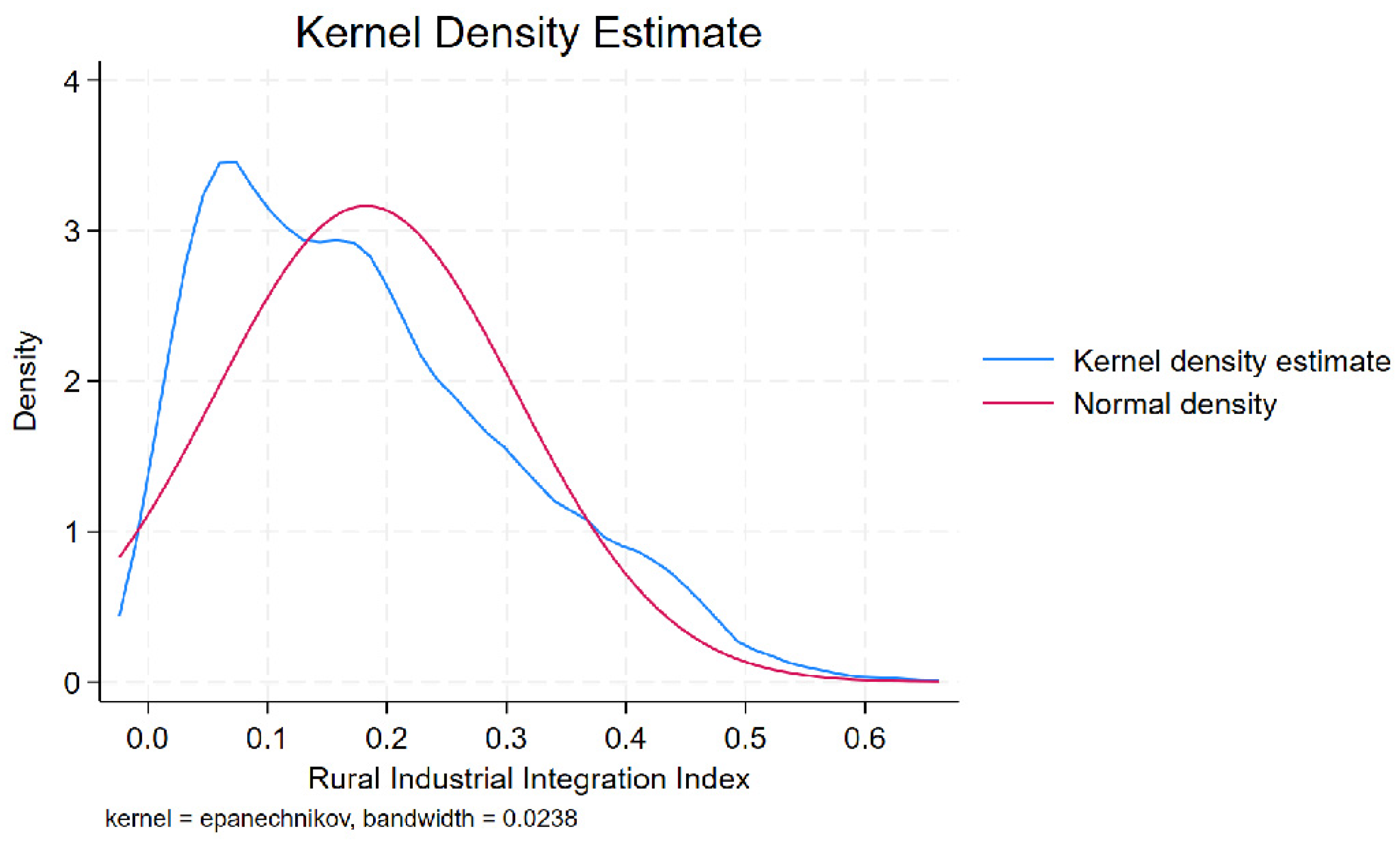
3.2.2. Core Independent Variable
- (1)
- Data standardization.For the j-th indicator , data standardization is performed as follows:
- (2)
- Calculate the proportion (weight) of the i-th sample under the j-th indicator.
- (3)
- Calculate the information entropy of the j-th indicator.
- (4)
- Calculate the coefficient of variation.
- (5)
- Calculate the weight of the j-th indicator.
- (6)
- Calculate the comprehensive score of the i-th sample.
3.2.3. Control Variables and Grouping Variables
3.3. Model Specification
4. Empirical Analysis
4.1. Descriptive Statistics
4.2. Baseline Regression Analysis
4.3. Robustness Checks
4.3.1. Alternative Model Estimation
4.3.2. Sample Substitution
4.3.3. Five-Percent Winsorization
4.3.4. Omitted Variable Bias Test
4.3.5. Mitigating Concerns of Reverse Causality
4.4. Heterogeneity Analysis
4.4.1. Heterogeneity by Firm Size
4.4.2. Heterogeneity by Debt Level
4.4.3. Heterogeneity by Firm Age
4.4.4. Heterogeneity by Fiscal Support
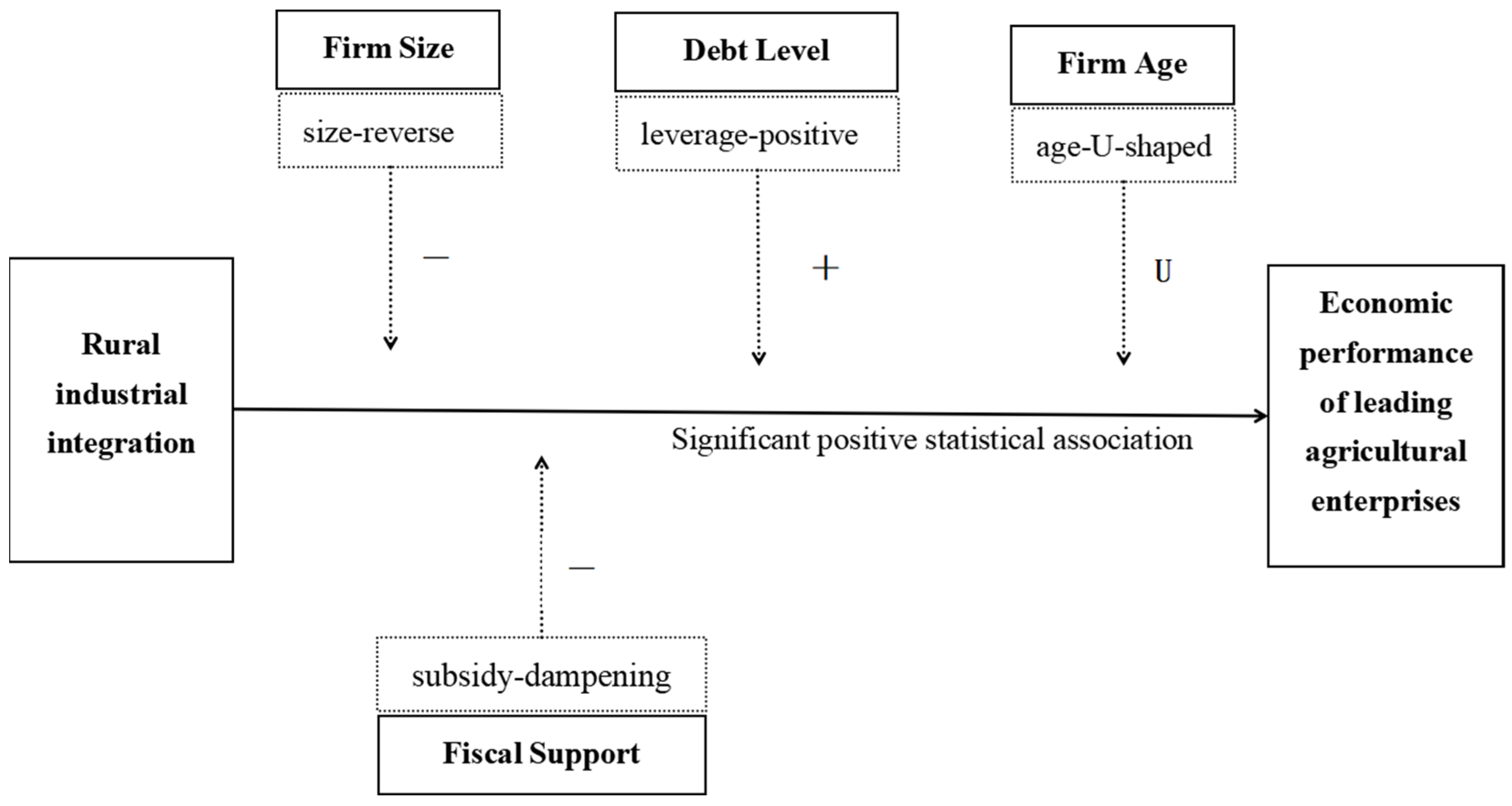
4.5. Summary of Empirical Findings
5. Discussion
5.1. The Heterogeneous Characteristics of the Integration–Performance Association
5.2. Theoretical Contributions and Practical Implications
5.3. Limitations and Future Research Directions
6. Conclusions
6.1. Research Conclusions
6.2. Policy Implications
6.2.1. Implement Differentiated Support Strategies to Enhance Policy Precision
6.2.2. Optimize the Allocation Efficiency of Fiscal Funds and Improve Supporting Systems and Long-Term Mechanisms
Author Contributions
Funding
Institutional Review Board Statement
Informed Consent Statement
Data Availability Statement
Conflicts of Interest
Abbreviations
| ALFP | Agricultural Leading Firms Program |
| SMEs | Small and Medium-sized Enterprises |
References
- Wang, J.; Peng, L.; Chen, J.; Deng, X. Impact of rural industrial integration on farmers’ income: Evidence from agricultural counties in China. J. Asian Econ. 2024, 93, 101761. [Google Scholar] [CrossRef]
- Fang, Y.; Yang, Y. Analysis of spatial effects and influencing factors of rural industrial integration in China. Sci. Rep. 2025, 15, 16790. [Google Scholar] [CrossRef]
- Zhou, X.; Han, M. Addressing global challenges: How does the integration of rural industries in China enhance agricultural resilience? PLoS ONE 2025, 20, e0327796. [Google Scholar]
- Schneider, M. Dragon head enterprises and the state of agribusiness in China. J. Agrar. Change 2017, 17, 3–21. [Google Scholar] [CrossRef]
- Jin, Q.; Dang, H.; Wang, H.; Zhang, Z. Exploring cooperative mechanisms in the Chinese agricultural value chain: A game model analysis based on leading enterprises and small farmers. Agriculture 2024, 14, 437. [Google Scholar] [CrossRef]
- Ye, F.; Qin, S.; Nisar, N.; Zhang, Q.; Tong, T.; Wang, L. Does rural industrial integration improve agricultural productivity? Implications for sustainable food production. Front. Sustain. Food Syst. 2023, 7, 1191024. [Google Scholar] [CrossRef]
- Jin, S.; Zhong, Z. Impact of digital inclusive finance on agricultural total factor productivity in Zhejiang Province from the perspective of integrated development of rural industries. PLoS ONE 2024, 19, e0298034. [Google Scholar]
- Zhou, J.; Chen, H.; Bai, Q.; Liu, L.; Li, G.; Shen, Q. Can the integration of rural industries help strengthen China’s agricultural economic resilience? Agriculture 2023, 13, 1813. [Google Scholar] [CrossRef]
- Chen, X.; Huang, Z.; Luo, C.; Hu, Z. Can agricultural industry integration reduce the rural-urban income gap? Evidence from county-level data in China. Land 2024, 13, 332. [Google Scholar]
- Qi, Z.; Wu, Z.; You, Y.; Zhan, X. Can rural industrial integration alleviate urban-rural income inequality? Empirical evidence from China. Land 2024, 14, 40. [Google Scholar]
- Zhang, Z.; Sun, C.; Wang, J. How can the digital economy promote the integration of rural industries? Taking China as an example. Agriculture 2023, 13, 2023. [Google Scholar] [CrossRef]
- Yan, M.; Cao, X. Digital economy development, rural land certification, and rural industrial integration. Sustainability 2024, 16, 4640. [Google Scholar] [CrossRef]
- Li, J.; Liu, H.; Chang, W.Y. Evaluating the effect of fiscal support for agriculture on three-industry integration in rural China. Agriculture 2024, 14, 912. [Google Scholar] [CrossRef]
- Huang, Y.; Zhao, J.; Yin, S. Does digital inclusive finance promote the integration of rural industries? Based on the mediating role of financial availability and agricultural digitization. PLoS ONE 2023, 18, e0291296. [Google Scholar] [CrossRef] [PubMed]
- Zhang, H.; Wu, D. The impact of transport infrastructure on rural industrial integration: Spatial spillover effects and spatio-temporal heterogeneity. Land 2022, 11, 1116. [Google Scholar] [CrossRef]
- Li, W.; Liu, C.; Yang, Q.; You, Y.; Zhuo, Z.; Zuo, X. Factors influencing farmers’ vertical collaboration in the agri-chain guided by leading enterprises: A study of the table grape industry in China. Agriculture 2023, 13, 1915. [Google Scholar] [CrossRef]
- Liu, C.; Li, W.; You, Y.; Yang, Q.; Li, M. Research on leading agricultural enterprises guiding farmers’ participation in pre-production quality and safety control: Evidence from the Yangtze River Delta Region of China. Front. Sustain. Food Syst. 2025, 9, 1615223. [Google Scholar] [CrossRef]
- Teng, Y.; Sun, Y.; Cheng, Q. Evolutionary decision-making behaviour among the government, leading enterprises and farmers: Based on the improvement of phaeozem quality in Northeast China. Syst. Res. Behav. Sci. 2024, 42, 1762–1784. [Google Scholar] [CrossRef]
- Zhou, X.; Hu, J.; Liu, W.; Fan, Y. Digital transformation and high-quality development in China’s leading agribusiness firms: A TOE-based configurational analysis. Agriculture 2026, 16, 304. [Google Scholar] [CrossRef]
- Yuan, Y.; Guo, X.; Shen, Y. Digitalization drives the green transformation of agriculture-related enterprises: A case study of A-share agriculture-related listed companies. Agriculture 2024, 14, 1308. [Google Scholar] [CrossRef]
- Wang, Z.; Bao, Q.; Bai, P.; Wang, F.; Arshad, M.U.; Lin, H. Research on the impact mechanism of forestry-related leading enterprises’ viability on corporate sustainable survival. Sustainability 2026, 18, 1958. [Google Scholar] [CrossRef]
- Gan, L.; Yoshifumi, T.; Hisako, N.; Mitsuyasu, Y. Policy incentives, ownership effects, and firm productivity—Evidence from China’s Agricultural Leading Firms Program. Econ. Anal. Policy 2022, 73, 845–859. [Google Scholar]
- Wang, T.; Ma, Y.; Luo, S. Spatial pattern and influencing factors of agricultural leading enterprises in Heilongjiang Province, China. Agriculture 2023, 13, 2061. [Google Scholar] [CrossRef]
- Liu, S.M.; Fan, Q.Q.; Jia, W. Mechanism explanation and path discussion of industrial integration promoting China’s agricultural economic growth. Issues Agric. Econ. 2024, 11, 104–112. (In Chinese) [Google Scholar]
- Xiao, W.D.; Du, Z.X. Rural primary, secondary and tertiary industry integration: Connotation explanation, development status and future ideas. J. Northwest AF Univ. (Soc. Sci. Ed.) 2019, 19, 120–129. (In Chinese) [Google Scholar]
- Jiang, C.Y. Developing digital economy to lead agricultural transformation and rural industrial integration. Econ. Rev. 2022, 8, 41–49. (In Chinese) [Google Scholar]
- Zhu, X.Y.; Yan, T.W. How does the efficiency of scientific and technological achievements transformation affect rural industrial integration development? Res. Dev. Manag. 2024, 36, 49–61. (In Chinese) [Google Scholar]
- Cao, Q.; Zhang, E.Y.; Liu, Z.F. Research on support policies for rural primary, secondary and tertiary industry integration promoting rural revitalization. Commer. Res. 2022, 4, 132–139. (In Chinese) [Google Scholar]
- Sun, Z.N.; Zhuang, J.C. Rural industrial integration from the perspective of modularization theory: Essential connotation and realization mechanism. Issues Agric. Econ. 2024, 9, 82–93. (In Chinese) [Google Scholar]
- Hu, Y.F.; Ding, Y.Q. The impact of government subsidies on industrial chain value addition in the context of rural industrial integration. Public Financ. Res. 2019, 11, 91–101. (In Chinese) [Google Scholar]
- Hu, S.H. Tax policies supporting rural industrial revitalization: Mechanism, implementation status and improvement suggestions. Tax. Res. 2022, 10, 49–53. (In Chinese) [Google Scholar]
- Chen, J.B. The impact of corporate political relations on technological innovation and economic performance: A theoretical and empirical study based on the moderating effect of firm size. Econ. Surv. 2020, 37, 134–140. (In Chinese) [Google Scholar]
- Dai, W.B.; Li, M.; Liu, X.; Wang, J.N. Digital transformation, green innovation and firm performance: An analysis based on MASEM. Sci. Sci. Manag. S. T. 2026, 47, 143–161. (In Chinese) [Google Scholar]
- Liu, M.Y.; Huang, S.J. Credit constraint intensity and rural enterprise performance: An empirical analysis based on generalized propensity score method. Chin. Rural Econ. 2019, 12, 105–123. (In Chinese) [Google Scholar]
- Wang, J.Y.; Liu, C. The differential impact of diversification on performance of agricultural listed companies: An empirical test based on different performance levels and life cycles. J. Hunan Agric. Univ. (Soc. Sci. Ed.) 2021, 22, 61–68. (In Chinese) [Google Scholar]
- Xu, J.B.; Li, R.X.; Peng, R.J. Government subsidies and financialization of entity enterprises: Inhibiting or promoting? Fisc. Sci. 2023, 1, 51–68. (In Chinese) [Google Scholar]
- Wu, Q.; Xu, T.; Liu, Y.; Liu, M.H. “Curse” or “gospel”: How government subsidies affect investment decisions of SRDI enterprises. J. Syst. Manag. 2025, 34, 753–765. (In Chinese) [Google Scholar]
- Tao, X.L.; Chen, Y.; Li, D.; Feng, X.Y. ESG performance, green technology innovation and firm performance. Sci. Technol. Prog. Policy 2025, 42, 87–97. (In Chinese) [Google Scholar]
- Zhou, T.; Chen, M.S. Endogenous innovation, exogenous expansion and firm performance: Evidence from agricultural enterprises from the perspective of equity networks. J. Southwest Univ. (Soc. Sci. Ed.) 2025, 51, 126–140+328. (In Chinese) [Google Scholar]
- Wang, D.X.; Du, Y.T.; Deng, L.Y. Opportunity or challenge: The impact of digital transformation on the operating performance of agricultural enterprises. Agric. Technol. Econ. 2025, 2, 129–144. (In Chinese) [Google Scholar]
- Li, X.L.; Ran, G.H. How does rural industrial integration development affect the urban-rural income gap: Based on the dual perspectives of rural economic growth and urbanization. Agric. Technol. Econ. 2019, 8, 17–28. (In Chinese) [Google Scholar]
- Zhao, X.; Shi, B.F.; Gai, Q.E.; Wu, B.; Zhao, M.J. Promoting revitalization through integration: The income-increasing effect of new agricultural business entities participating in industrial integration. J. Manag. World 2023, 39, 86–100. (In Chinese) [Google Scholar]
- Sun, D.Q.; Mei, Y.Q.; Yang, X.Y. Can modern agricultural park construction promote rural industrial integration? Empirical evidence from 8325 agricultural parks in China. China Rural Surv. 2024, 3, 39–61. (In Chinese) [Google Scholar]
- Zhang, A.L.; Pan, M.M.; Liu, B. An empirical study of urban agglomerations and firm supply chain efficiency from the perspective of economic structural potential. Nankai Econ. Stud. 2023, 5, 133–150. (In Chinese) [Google Scholar]
- Xie, Y.; Xie, J.Y.; Xia, B. The enabling mechanism of distributed innovation on the high-quality development of Chinese science and technology enterprises: A perspective based on opportunity theory. Sci. Technol. Manag. Res. 2025, 45, 198–206. (In Chinese) [Google Scholar]
- Jin, S.R.; Tang, S.Y.; Ren, Z.J. Can digital transformation improve the total factor productivity of agricultural enterprises? Reform 2024, 2, 131–148. (In Chinese) [Google Scholar]
- Oster, E. Unobservable selection and coefficient stability: Theory and evidence. J. Bus. Econ. Stat. 2019, 37, 187–204. [Google Scholar] [CrossRef]
- ISO 9001:2015; Quality Management Systems—Requirements. International Organization for Standardization: Geneva, Switzerland, 2015.
- Hausman, J.A. Specification tests in econometrics. Econometrica 1978, 46, 1251–1271. [Google Scholar] [CrossRef]


| Primary Indicator | Secondary Indicator | Variable Measurement and Definition | Value Range |
|---|---|---|---|
| Rural industrial integration | Industrial Chain Extension (X1) | 1. Whether the firm involves primary industry (agricultural product planting); 0 = No; 1 = Yes 2. Whether the firm involves secondary industry (agricultural product processing); 0 = No; 1 = Yes 3. Whether the firm involves tertiary industry (agricultural product sales); 0 = No; 1 = Yes (Each firm involves at least one industry, so the starting value is 1) | 1–3 |
| Multi-functional Expansion (X2) | 1. Whether the firm involves production function; 0 = No; 1 = Yes (All firms involve production function, so the starting value is 1) 2. Whether the firm involves living function (leisure agriculture, rural tourism firms); 0 = No; 1 = Yes 3. Whether the firm involves ecological function (firms adopting green production technologies or obtaining green product certification); 0 = No; 1 = Yes | 1–3 | |
| New Technology Penetration (X3) | 1. Whether the firm has established an R&D institution; 0 = No; 1 = Yes 2. Whether the firm has R&D personnel; 0 = No; 1 = Yes 3. Whether the firm has invested in R&D funds; 0 = No; 1 = Yes | 0–3 | |
| Benefit Linkage Mechanism (X4) | 1. Whether the firm links with and drives agricultural industrialization consortia; 0 = No; 1 = Yes 2. Whether the firm links with and drives family farms; 0 = No; 1 = Yes 3. Whether the firm links with and drives farmer cooperatives; 0 = No; 1 = Yes | 0–3 |
| Variable Name | Definition and Value Assignment |
|---|---|
| Economic performance | Return on assets (ROA) = after-tax profit/total assets |
| Rural industrial integration | Entropy value of the four core dimensions: value chain extension, multi-functionality expansion, technology penetration, and benefit linkage |
| Firm size | Number of employees |
| Ownership type | Ownership type: 0 = state-owned; 1 = non-state-owned |
| Debt level | Debt-to-asset ratio (%) |
| Firm age | Firm age = survey year − year of establishment |
| Quality management capacity | Whether the firm has passed ISO 9001 [48] or other quality certification: 0 = no; 1 = yes |
| Fiscal support | Total amount of fiscal subsidy funds received (10,000 RMB) |
| Regional economic development level | Gross domestic product (GDP) at the prefecture-level city level (100 million RMB) |
| Variable Type | Variable Name | Obs. | Mean | Std. Dev. | Min | Max |
|---|---|---|---|---|---|---|
| Dependent Variable | Economic performance | 2463 | 0.088 | 0.071 | −0.612 | 0.879 |
| Independent Variable | Rural industrial integration | 2463 | 0.183 | 0.126 | 0 | 0.638 |
| Control Variables | Ownership type | 2463 | 0.958 | 0.201 | 0 | 1 |
| Quality management capacity | 2463 | 0.476 | 0.5 | 0 | 1 | |
| Regional economic development level | 2463 | 6646.34 | 1442.231 | 1102.31 | 7324.46 | |
| Grouping Variables | Firm size | 2463 | 375.642 | 1304.312 | 10 | 30,000 |
| Debt level | 2463 | 26.581 | 15.782 | 0 | 148.41 | |
| Firm age | 2463 | 12.613 | 5.895 | 1 | 39 | |
| Fiscal support | 2463 | 139.978 | 524.631 | 0 | 12,126.94 |
| Economic Performance | (1) | (2) | (3) | (4) |
|---|---|---|---|---|
| Rural industrial integration | 0.036 *** (0.013) | 0.039 *** (0.013) | 0.042 *** (0.013) | 0.042 *** (0.013) |
| Ownership type | / | 0.031 *** (0.008) | 0.029 *** (0.007) | 0.030 *** (0.007) |
| Quality management capacity | / | / | −0.007 *** (0.003) | −0.008 *** (0.003) |
| Regional economic development level | / | / | / | 0.003 (0.004) |
| Year 2022 | −0.005 *** (0.001) | −0.005 *** (0.001) | −0.005 *** (0.001) | −0.006 *** (0.001) |
| Year 2023 | −0.011 *** (0.002) | −0.011 *** (0.002) | −0.011 *** (0.002) | −0.011 *** (0.002) |
| Constant | 0.082 *** (0.003) | 0.052 *** (0.008) | 0.056 *** (0.008) | 0.028 (0.034) |
| N | 2463 | 2463 | 2463 | 2463 |
| Overall R2 | 0.014 | 0.028 | 0.036 | 0.037 |
| Variable | (1) | (2) | (3) | (4) | (5) |
|---|---|---|---|---|---|
| Rural industrial integration | 0.042 *** (0.013) | 0.044 *** (0.012) | 0.040 *** (0.014) | 0.041 *** (0.011) | 0.041 *** (0.012) |
| Controls | Yes | Yes | Yes | Yes | Yes |
| Year FE | Yes | Yes | Yes | Yes | Yes |
| Observations | 2463 | 2463 | 1642 | 2463 | 1642 |
| R2/Overall R2 | 0.037 | 0.038 | 0.033 | 0.039 | 0.033 |
| Model | Core EV Coefficient | N | R2 |
|---|---|---|---|
| Parsimonious Model (3 controls) | 0.042 *** (0.013) | 2463 | 0.037 |
| Full Model (7 controls) | 0.035 *** (0.013) | 2463 | 0.090 |
| Variable | Low Group | Medium Group | High Group |
|---|---|---|---|
| Firm size | 0.089 *** (0.020) | 0.050 ** (0.023) | −0.014 (0.022) |
| N | 841 | 802 | 820 |
| Debt level | 0.001 (0.022) | 0.060 *** (0.019) | 0.055 *** (0.019) |
| N | 821 | 822 | 820 |
| Firm age | 0.051 ** (0.020) | 0.008 (0.022) | 0.060 *** (0.021) |
| N | 899 | 776 | 788 |
| Fiscal support | 0.092 *** (0.024) | 0.037 ** (0.019) | 0.032 * (0.017) |
| N | 841 | 801 | 821 |
| Analysis Category (Corresponding Section) | Research Content | Key Findings | Statistical Result |
|---|---|---|---|
| Main effect (Section 4.2) | Relationship between rural industrial integration and firm economic performance | Positive association | Statistically significant |
| Robustness check (Section 4.3.1, Section 4.3.2, Section 4.3.3 and Section 4.3.4) | Sensitivity to model specification | Finding remains robust | Supported |
| Sensitivity to sample period | Finding remains robust | Supported | |
| Sensitivity to extreme values | Finding remains robust | Supported | |
| Omitted Variable Bias Test | Finding remains robust | Supported | |
| Endogeneity mitigation (Section 4.3.5) | Mitigating Concerns of Reverse Causality | Concerns of reverse causality are partially mitigated | Statistically significant |
| Heterogeneity analysis (Section 4.4.1, Section 4.4.2, Section 4.4.3 and Section 4.4.4) | Moderating effect of firm size | Size-reverse effect (smaller firms benefit more) | Statistically significant |
| Moderating effect of debt level | Leverage-positive effect (moderately to highly leveraged firms benefit more) | Statistically significant | |
| Moderating effect of firm age | Age-U-shaped effect (benefits decline then rise over the firm life cycle) | Statistically significant | |
| Moderating effect of fiscal subsidy | Subsidy-dampening effect (excessive subsidies weaken the positive association) | Statistically significant |
Disclaimer/Publisher’s Note: The statements, opinions and data contained in all publications are solely those of the individual author(s) and contributor(s) and not of MDPI and/or the editor(s). MDPI and/or the editor(s) disclaim responsibility for any injury to people or property resulting from any ideas, methods, instructions or products referred to in the content. |
© 2026 by the authors. Licensee MDPI, Basel, Switzerland. This article is an open access article distributed under the terms and conditions of the Creative Commons Attribution (CC BY) license.
Share and Cite
Zhou, J.; Zhu, S. Rural Industrial Integration and Economic Performance of Leading Agricultural Enterprises: Firm-Level Heterogeneity in Jiangxi, China. Sustainability 2026, 18, 5678. https://doi.org/10.3390/su18115678
Zhou J, Zhu S. Rural Industrial Integration and Economic Performance of Leading Agricultural Enterprises: Firm-Level Heterogeneity in Jiangxi, China. Sustainability. 2026; 18(11):5678. https://doi.org/10.3390/su18115678
Chicago/Turabian StyleZhou, Jian, and Shubin Zhu. 2026. "Rural Industrial Integration and Economic Performance of Leading Agricultural Enterprises: Firm-Level Heterogeneity in Jiangxi, China" Sustainability 18, no. 11: 5678. https://doi.org/10.3390/su18115678
APA StyleZhou, J., & Zhu, S. (2026). Rural Industrial Integration and Economic Performance of Leading Agricultural Enterprises: Firm-Level Heterogeneity in Jiangxi, China. Sustainability, 18(11), 5678. https://doi.org/10.3390/su18115678