Preliminary Investigation on Ceramic Waste Aggregate in Fly Ash-Based Geopolymer Concrete


Abstract
1. Introduction
- To preliminarily investigate the incorporation of ceramic waste as coarse aggregate in fly ash-based geopolymer concrete.
- To formulate and prepare CWAGPC with varying levels of ceramic waste coarse aggregate replacement.
- To evaluate the influence of ceramic waste aggregates on the workability and early-age compressive strength behavior of CWAGPC.
- To examine the effect of different ceramic waste aggregate replacement levels on the overall mix performance.
- To discuss the potential sustainability implications associated with the utilization of ceramic waste aggregates in geopolymer concrete.
2. Materials and Methods
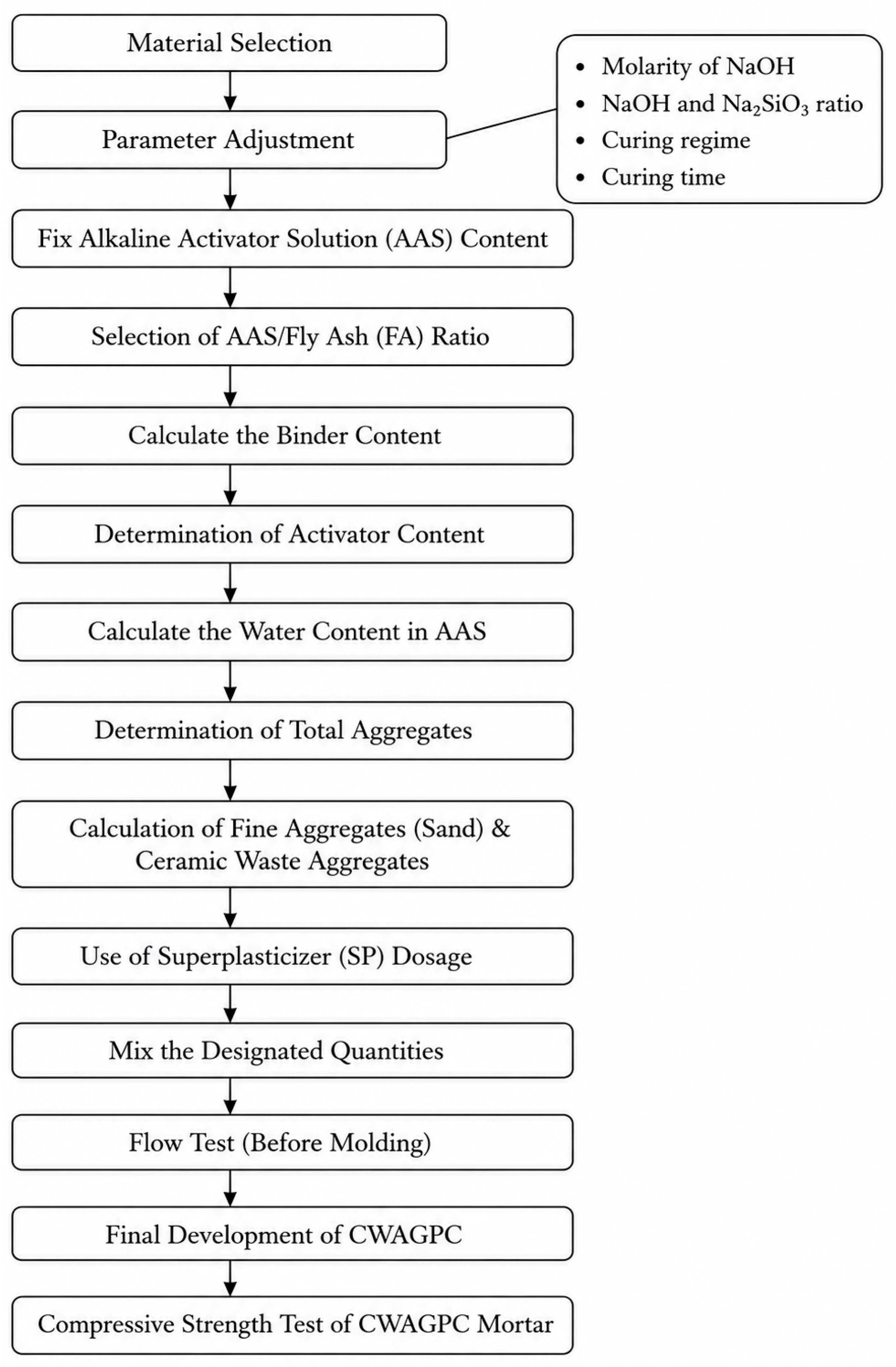
2.1. Calculation of Materials
2.1.1. Fixing the Alkaline Activator Solution (AAS) Content

2.1.2. Selection of Alkaline Activator Solution to Fly Ash Ratio (AAS/FA)
2.1.3. Calculation of Binder Content
2.1.4. Determination of Activators Content
= Mass of (R × NaOH + NaOH)
= Mass of NaOH (R + 1)
= 200/(1.5 + 1)
= 80 kg/m3
2.1.5. Calculation of Water Content in the AAS and the Water/GPC Solid Ratio
= MNaOH (1 − S NaOH) = 80 (1 − 0.455) = 43.6 kg/m3
= 80 − 43.6 = 36.4 kg/m3
= MNa2SiO3 (1 − S Na2SiO3) = 120 (1 − 0.36) = 76.8 kg/m3
= 120 − 76.8 = 43.2 kg/m3
= 120.4/(500 + 36.4 + 43.2) = 0.21
2.1.6. Determination of Total Aggregates
- GB = specific gravity of fly ash (2.2)
- G NaOH = specific gravity of NaOH solution (1.451)
- G Na2SiO3 = specific gravity of Na2SiO3 solution (1.35)
- Entrapped air (Va) is assumed as 2%.
2.1.7. Use of Superplasticizer (SP) Dosage
2.1.8. Summary of the Calculation

| Material | AAS | AAS/Fly Ash Ratio | Fly Ash | NaOH Solution | Na2SiO3 Solution | Total Water in AAS | Water/GPC/ Solid Ratio | Fine Aggregates | Coarse Aggregates | Super- Plasticizer |
|---|---|---|---|---|---|---|---|---|---|---|
| Quantity (kg/m3) | 200 | 0.4 | 500 | 80 Water: 43.6 Solid: 36.4 | 120 Water: 76.8 Solid: 43.2 | 120.4 | 0.21 | 320 | 1315 | 5 |
| Mixing Type | Fly Ash (Kg) | AAS Solution (Kg) | Fine Aggregates (Sand) (Kg) | Coarse Aggregates | Super- Plasticizer (Kg) | Extra Water Added for Workability Adjustment (Kg) | Remarks (Varying Percentage of Coarse Aggregates for Distinct Mixing Type) | |
|---|---|---|---|---|---|---|---|---|
| Natural Aggregates (NA) (Kg) | Ceramic Waste Aggregates (CW) (Kg) | |||||||
| A | 4.5 | 1.8 | 2.88 | 11.90 | 0 | 0.045 | 0.69 | NA—100% CW—0% |
| B | 4.5 | 1.8 | 2.88 | 9.60 | 2.4 | 0.045 | 0.69 | NA—80% CW—20% |
| C | 4.5 | 1.8 | 2.88 | 7.2 | 4.8 | 0.045 | 0.69 | NA—60% CW—40% |
| D | 4.5 | 1.8 | 2.88 | 4.8 | 7.2 | 0.045 | 0.69 | NA—40% CW—60% |
| E | 4.5 | 1.8 | 2.88 | 0 | 11.90 | 0.045 | 0.69 | NA—0% CW—100% |
2.2. Materials
2.2.1. Fly Ash
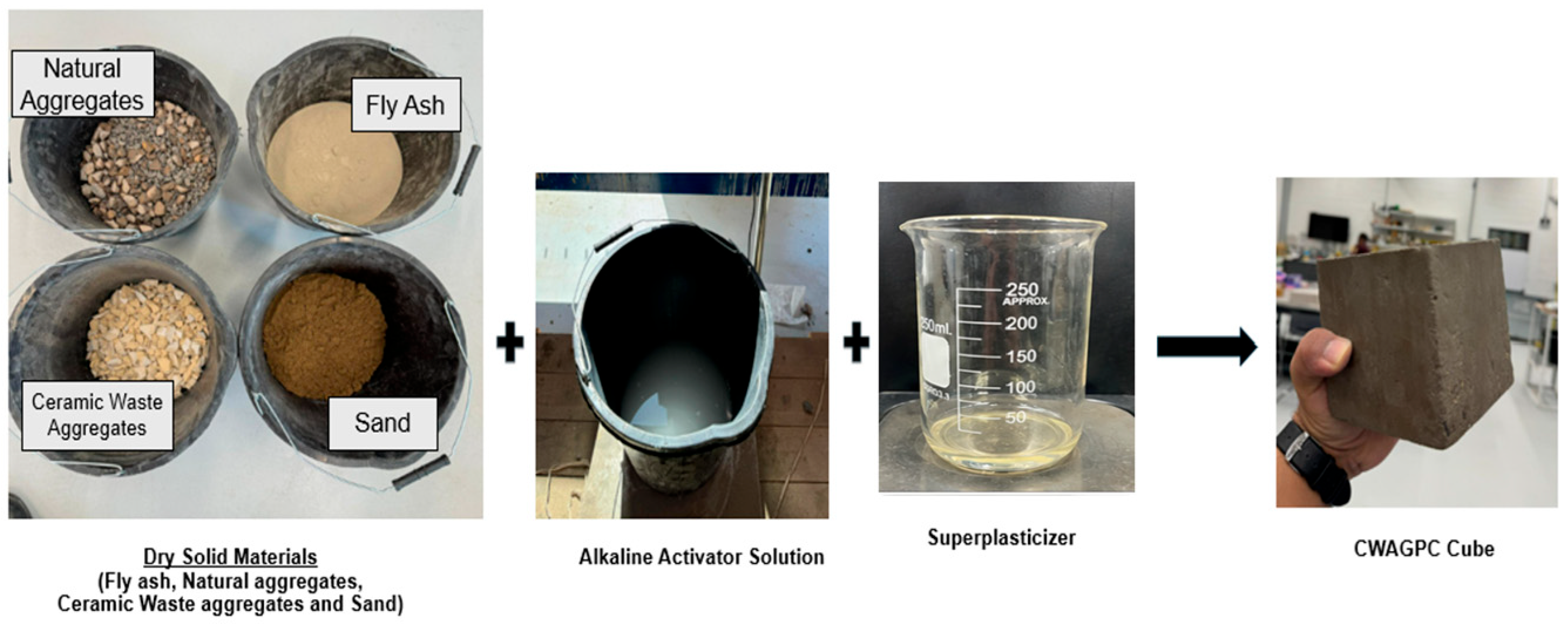
2.2.2. Alkaline Activator Solution
2.2.3. Aggregates
2.2.4. Superplasticizer
2.3. Laboratory Work
2.3.1. Mixing


2.3.2. Casting and Curing
2.4. Experimental Program
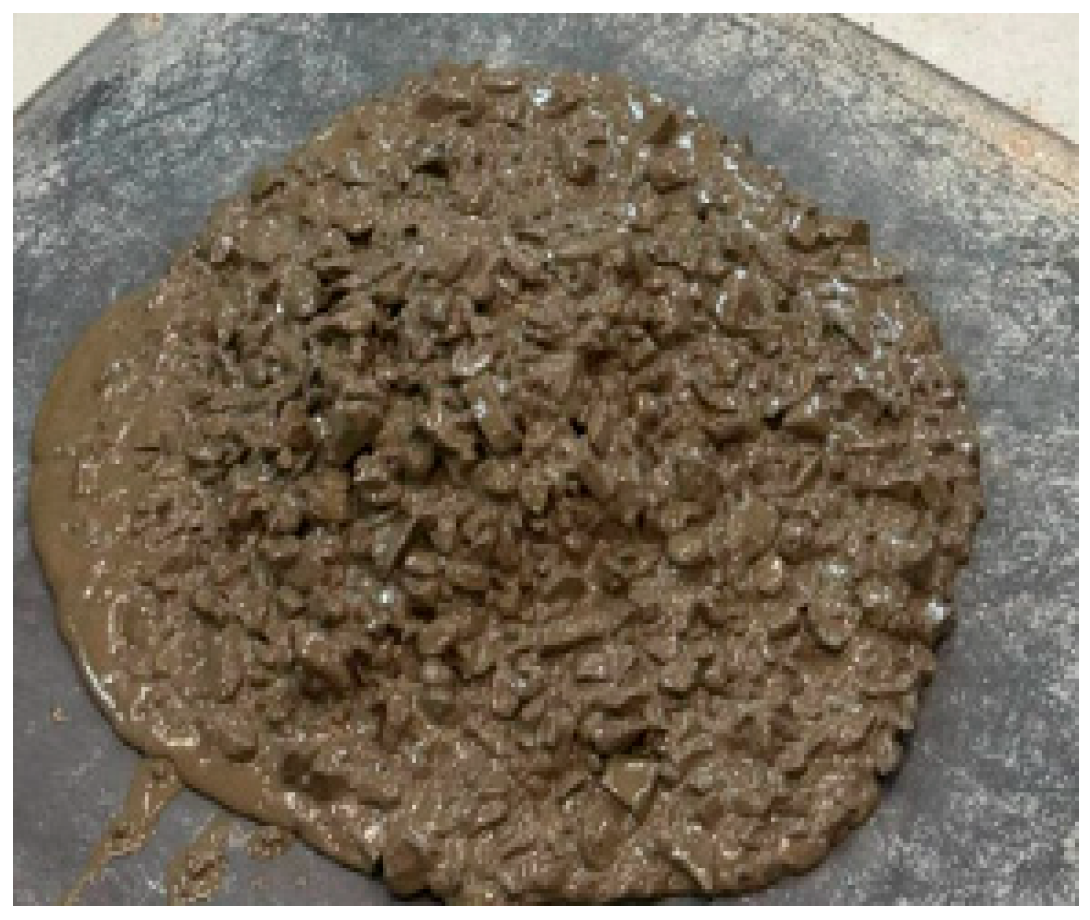
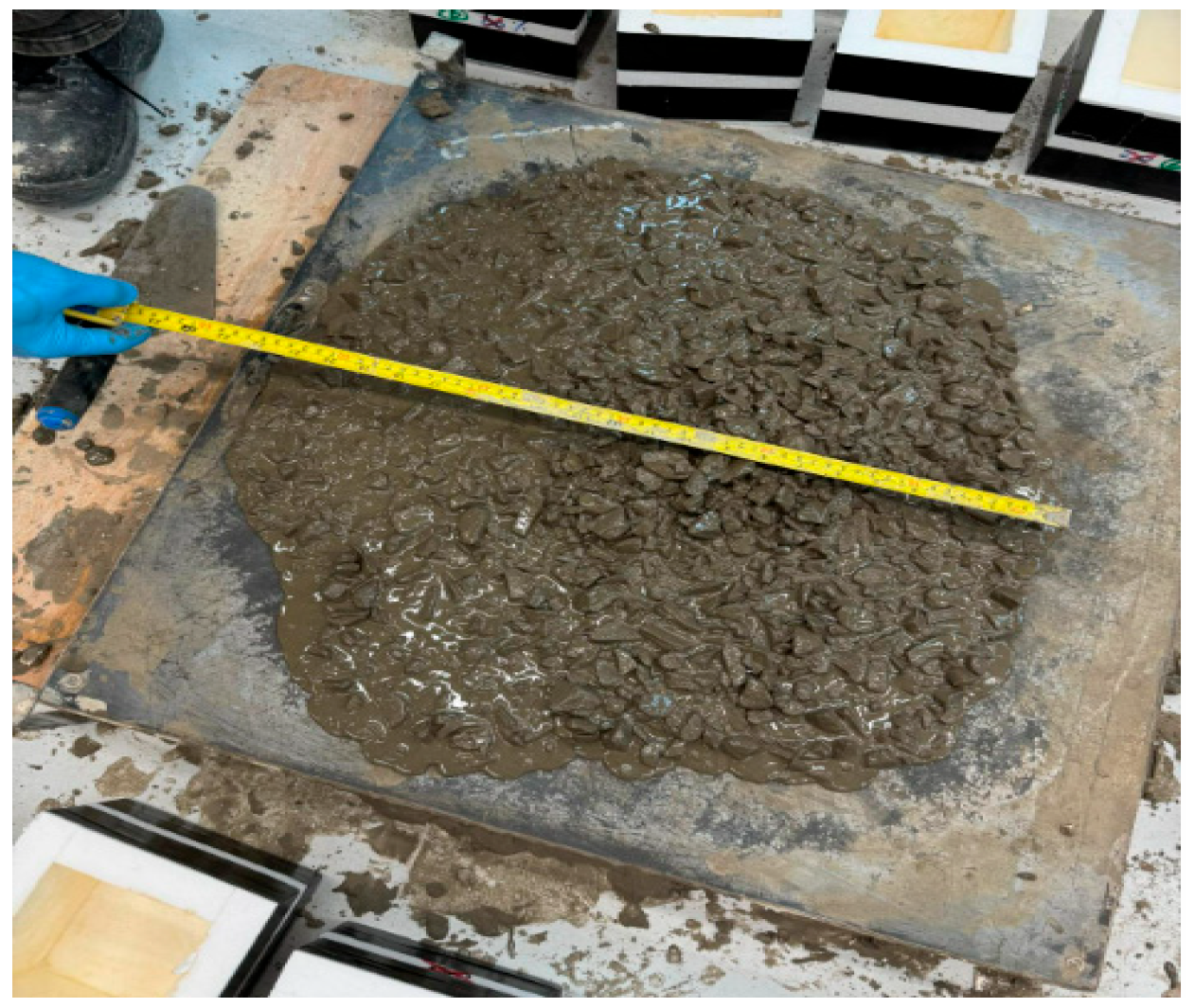
2.4.1. Workability Test
2.4.2. Compressive Strength Test
3. Experimental Results and Discussion
3.1. Workability
3.2. Compressive Strength
3.2.1. Contributing Factors to the Discrepancy and Low Strength in Control Mix A (Conventional GPC)
Absence of Heat Curing and Use of Water Curing
Excess Water Content
Material Variability
3.2.2. Factors Influencing the Strength of the CWAGPC Mixes
Influence of Aggregate Type and Mix Proportions
Curing Age
Curing Temperature
3.3. Implications and Sustainability Potential
4. Conclusions
- (1)
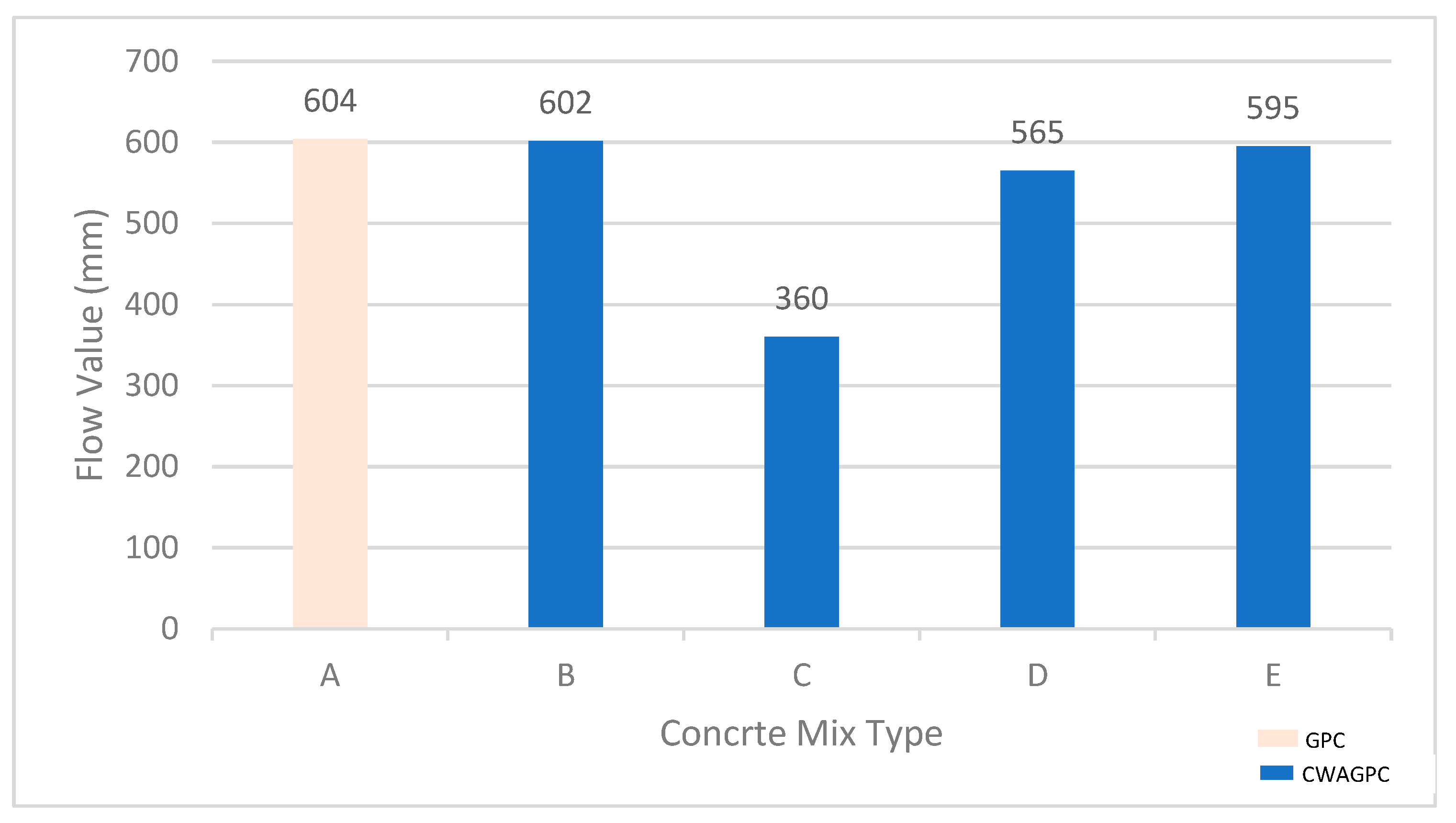
- Both the conventional GPC and CWAGPC mixtures exhibited a generally acceptable workability behavior under the adopted mix proportions and testing conditions. The control GPC mix (Mix A) achieved a flow value of 604 mm, while the CWAGPC mixtures exhibited flow values ranging between 360 mm and 602 mm. Most mixtures remained within the acceptable flow range (340–620 mm) specified in BS EN 12350-5. However, Mix C (40% ceramic waste aggregate replacement) demonstrated comparatively lower flowability (360 mm), which may have been influenced by aggregate-related variability and mixture behavior under the adopted experimental conditions.
- (2)
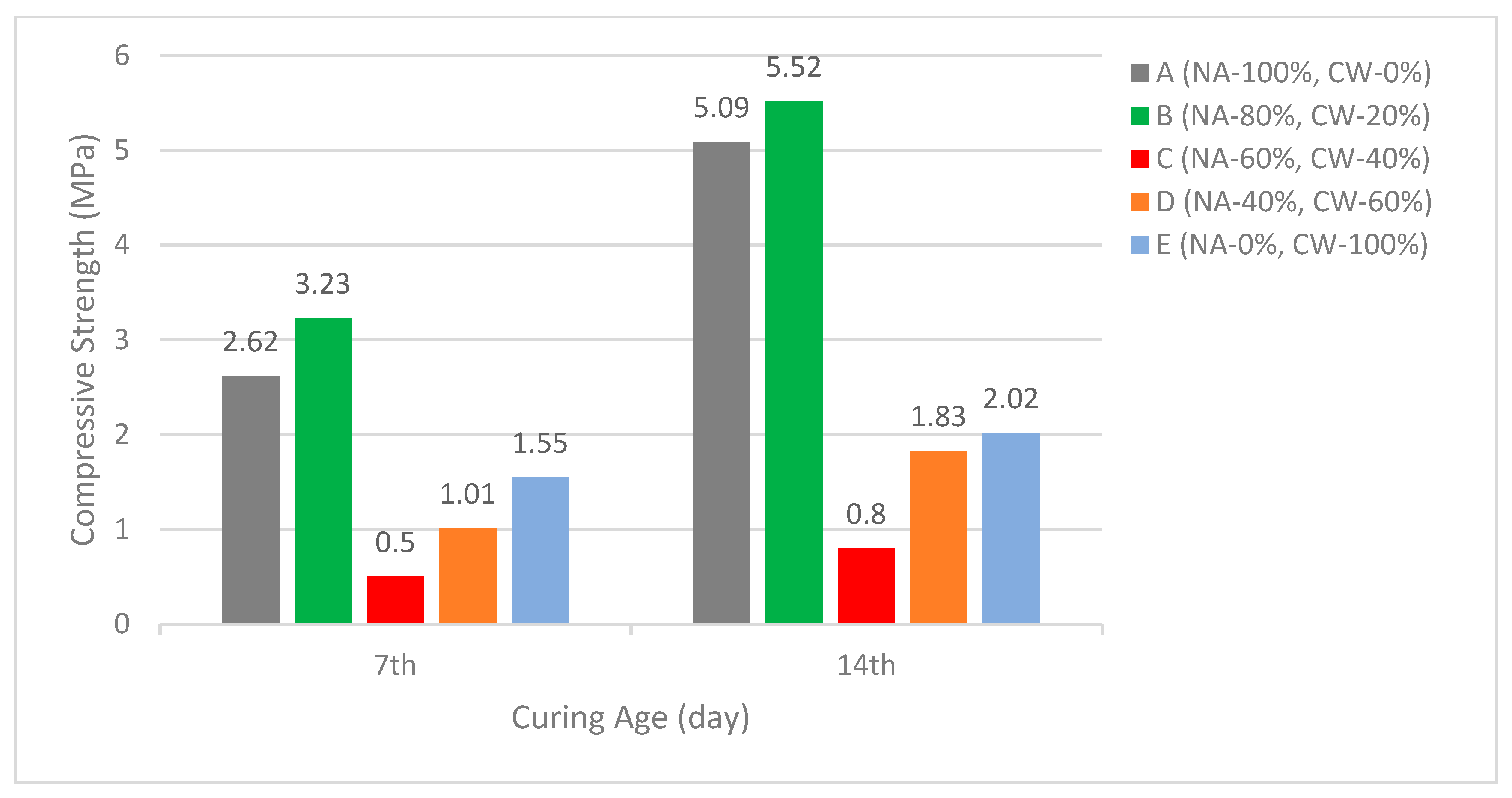
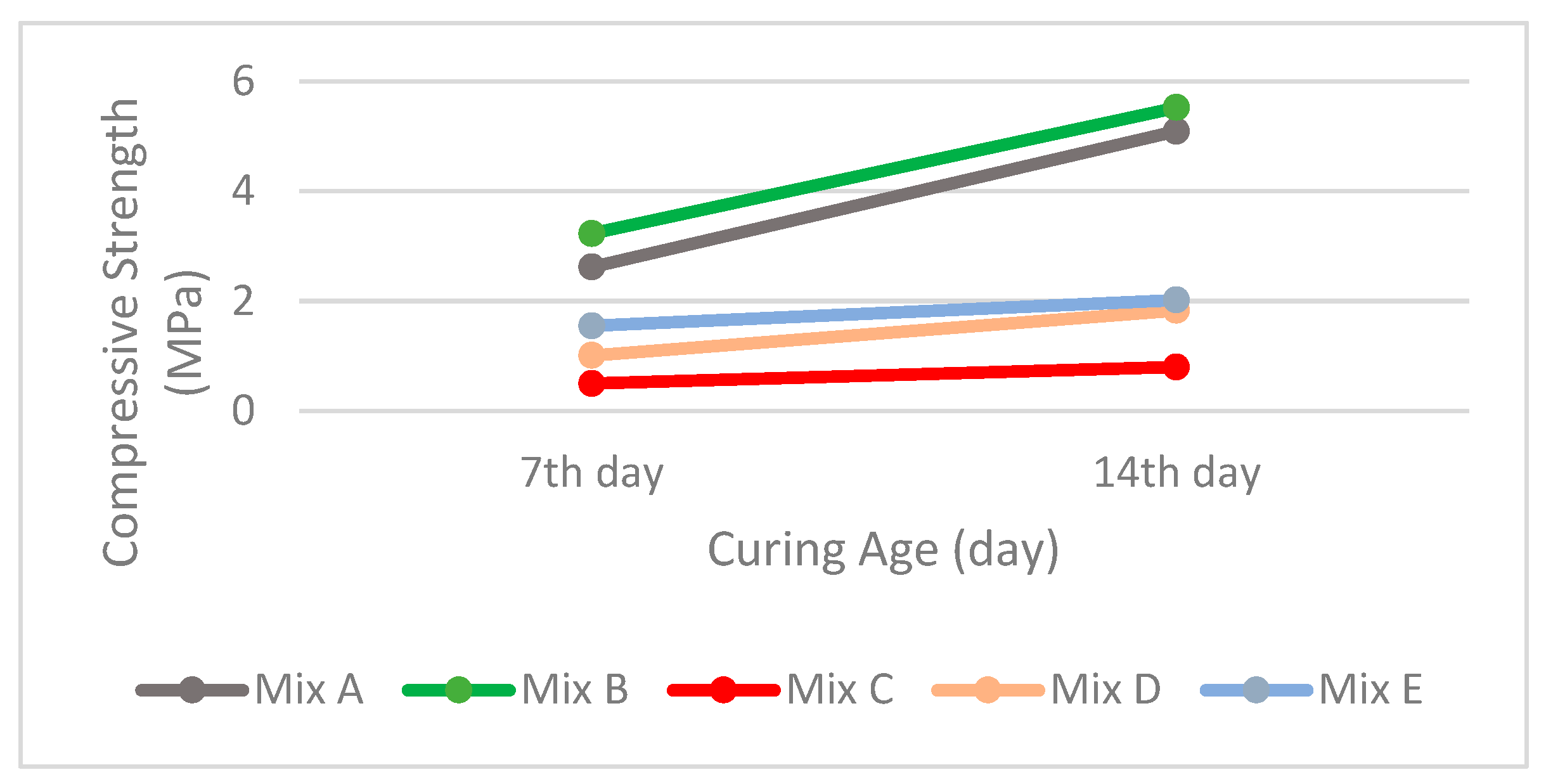
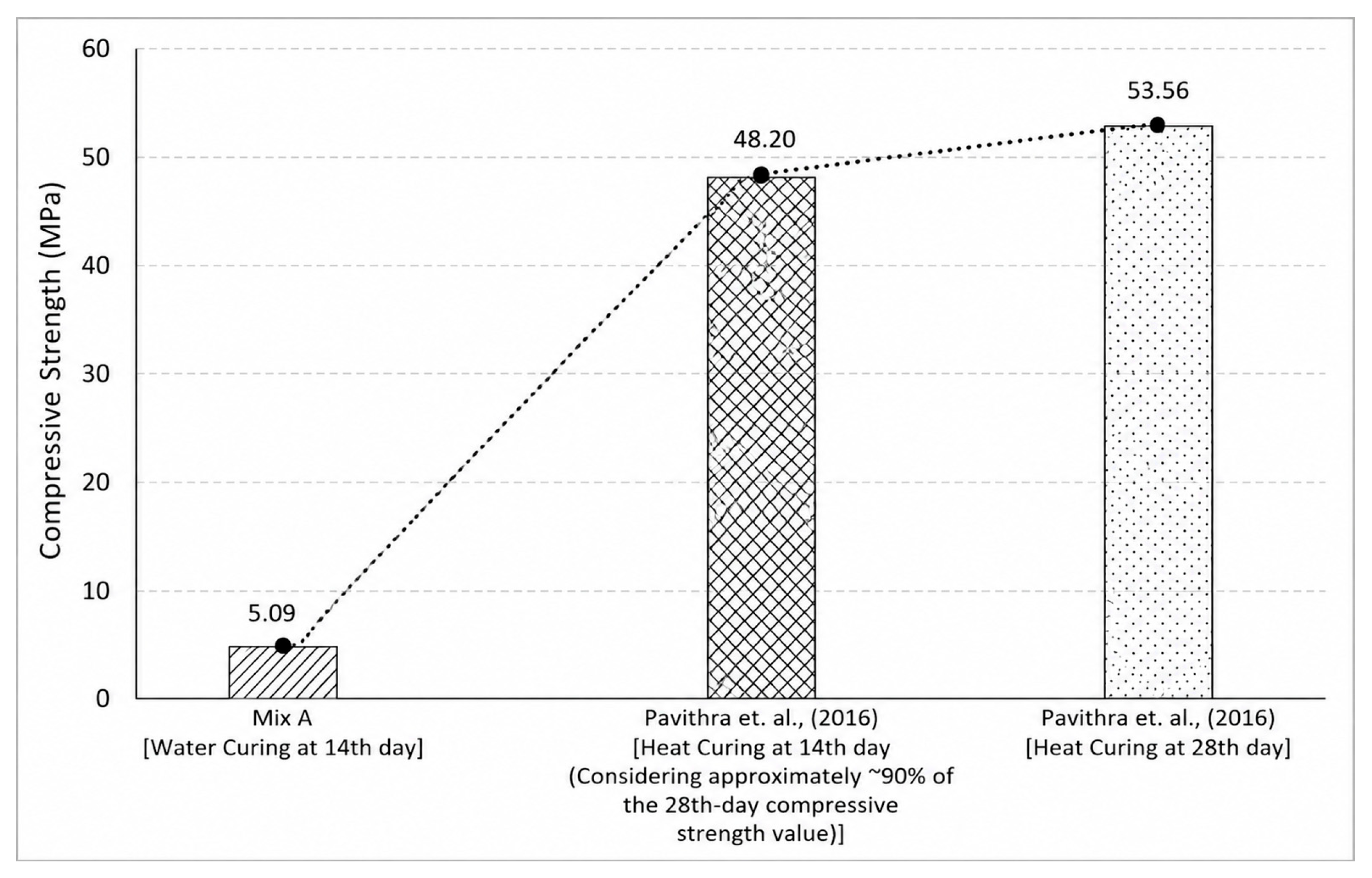
- The compressive strength results under water-curing conditions demonstrated variable performance among the investigated mixtures. At 14 days, the 20% ceramic waste aggregate replacement mixture (Mix B) achieved the best compressive strength value (5.52 MPa), slightly exceeding the control GPC mixture (5.09 MPa) under the limited mixture tested within the scope of this preliminary investigation. By contrast, higher ceramic waste replacement levels (40–100%) resulted in substantially lower compressive strength values ranging between 0.80 MPa and 2.02 MPa.
- (3)
- Although the compressive strength increased with the curing time for all investigated mixtures, the overall strength development remained comparatively low under the adopted water-curing regime during the investigated testing period. The comparatively reduced early-age development observed in this study may be associated with several interacting factors, including the adopted water-curing regime, absence of heat curing, incorporation of additional water for workability adjustment, material variability, and the heterogeneous characteristics of the ceramic waste aggregates. Nevertheless, the observed increase in strength between 7 and 14 days suggests that continued curing may contribute to further strength development over longer curing durations, although this was not evaluated within the scope of the present preliminary investigation.
- (4)
- Among the limited mixtures investigated in this preliminary study, the 20% ceramic waste aggregate replacement mixture demonstrated a comparatively better compressive strength performance relative to the other tested CWAGPC mixtures under the adopted experimental conditions. However, the present findings are insufficient to establish an optimum replacement level or to support a structural engineering application of the investigated mixtures in their current form without substantial optimization of mix design and curing conditions. Based on the comparatively low compressive strength values obtained, the investigated CWAGPC mixtures may presently be more appropriate for low-strength or non-structural applications rather than structural concrete applications.
- (5)
- The present work should therefore be interpreted as a preliminary experimental investigation into the incorporation of ceramic waste aggregates in fly ash-based geopolymer concrete under water-curing conditions. Additional research involving optimized geopolymer mix design approaches, heat-curing evaluation, long-term strength development, durability assessment, detailed material characterization, microstructural analysis, statistical validation, and environmental performance evaluation is required before the broader engineering applicability of CWAGPC can be established.
5. Recommendations
- (1)
- Future studies should investigate the performance of CWAGPC under alternative curing regimes, particularly heat curing and controlled ambient curing, to evaluate their influence on geopolymerization efficiency, long-term strength development, and durability performance.
- (2)
- Further optimization of the geopolymer mix design parameters is recommended, including adjustment of the alkaline activator concentration, water–geopolymer–solid ratio, alkaline activator–binder ratio, aggregate proportioning, and superplasticizer dosage to improve both the fresh and hardened concrete performance.
- (3)
- Long-term mechanical performance evaluation is recommended, including 28-day and later-age compressive strength assessments, together with flexural strength, splitting tensile strength, modulus of elasticity, shrinkage, density, and water absorption measurements.
- (4)
- Detailed material characterization should be conducted in future studies, including X-ray fluorescence (XRF), scanning electron microscopy (SEM), aggregate porosity analyses, water absorption measurements, and interfacial transition zone (ITZ) evaluations to better understand the interaction between ceramic waste aggregates and the geopolymer matrix.
- (5)
- Future investigations should include statistical validation of the experimental results through repeated testing, standard deviation analysis, and larger specimen sample sizes to improve reliability and interpretation of the observed performance trends.
- (6)
- The influence of aggregate grading, particle shape, ceramic surface texture, and compaction behavior on the fresh and hardened properties of CWAGPC should be systematically evaluated using controlled aggregate processing methods.
- (7)
- Durability-related performance, including permeability, freeze–thaw resistance, sulfate resistance, chemical resistance, and long-term environmental exposure behavior, should be investigated before the broader engineering application of CWAGPC can be considered.
- (8)
- Further research should investigate whether optimized curing conditions, improved mix design approaches, and enhanced material characterization can improve the mechanical performance of CWAGPC toward potential future structural engineering applications
6. Limitations of the Research
- (1)
- The adopted mix proportioning approach was based on a previously reported heat-cured fly ash-based geopolymer concrete methodology [75], whereas the present investigation evaluated the mixtures under a water-curing regime. Redesign and optimization of the geopolymer mix specifically for water curing were beyond the scope of this preliminary investigation.
- (2)
- Heat-cured control mixtures and heat-cured CWAGPC mixtures were not included in the experimental program. Consequently, the influence of heat curing on CWAGPC performance was not experimentally evaluated within this study.
- (3)
- Detailed material characterization, including X-ray fluorescence (XRF), scanning electron microscopy (SEM), aggregate porosity analysis, density measurements, water absorption characterization, and interfacial transition zone (ITZ) analysis, were not conducted within the scope of this preliminary investigation.
- (4)
- Ceramic waste aggregates were manually crushed and processed, which may have introduced variability in particle shape, grading, fines content, and surface texture. In addition, combined aggregate grading verification for each replacement level was not experimentally evaluated.
- (5)
- The experimental investigation focused primarily on workability and early-age compressive strength behavior under the adopted curing conditions. Long-term strength development, durability performance, shrinkage, permeability, flexural strength, splitting tensile strength, modulus of elasticity, density, and environmental exposure behavior were not evaluated.
- (6)
- Statistical analysis of the experimental results was limited to reporting the average values obtained from the tested specimens. Standard deviation, coefficient of variation, and statistical significance analysis were not included within the scope of this study.
- (7)
- The workability assessment was based on single flow table measurements for each mix condition, and variability associated with repeated testing was not experimentally evaluated.
- (8)
- The comparatively low compressive strength observed across all investigated mixtures may have been influenced by several interacting factors, including the adopted water-curing regime, additional water incorporated for workability adjustment, material variability, possible compaction limitations, and the heterogeneous characteristics of the ceramic waste aggregates. However, the individual contribution of each parameter could not be isolated within the scope of this preliminary investigation.
- (9)
- Interpretations regarding the influence of aggregate porosity, angularity, particle packing, water absorption behavior, and aggregate–matrix interaction were presented as observational interpretations and hypotheses based on visual observation and the supporting literature discussion, as detailed quantitative characterization was not performed.
- (10)
- The comparatively small difference in compressive strength observed between Mix B and the control mixture may fall within experimental variability. Therefore, conclusions regarding the potential performance improvement associated with 20% ceramic waste aggregate replacement should be interpreted cautiously within the limitations of this preliminary investigation.
- (11)
- The investigated CWAGPC mixtures exhibited comparatively low compressive strength values under the adopted experimental conditions and therefore cannot presently be considered suitable for structural concrete applications without substantial optimization and further validation.
Author Contributions
Funding
Institutional Review Board Statement
Informed Consent Statement
Data Availability Statement
Conflicts of Interest
Abbreviations
| GPC | Conventional geopolymer concrete |
| CWAGPC | Ceramic waste aggregate-based geopolymer concrete |
| NA | Natural aggregate |
| CW | Ceramic waste aggregate |
| AAS | Alkaline activator solution |
| FA | Fly ash |
| SP | Superplasticizer |
References
- Guedes, P. Building Materials. In The Macmillan Encyclopedia of Architecture and Technological Change; Palgrave Macmillan: London, UK, 1979; pp. 227–287. [Google Scholar] [CrossRef]
- Smarzewski, P.; Stolarski, A. Properties and Performance of Concrete Materials and Structures. Crystals 2022, 12, 1193. [Google Scholar] [CrossRef]
- Alqurashi, M. Data-Driven Insights into Concrete Flow and Strength: Advancing Smart Material Design Using Machine Learning Strategies. Buildings 2025, 15, 2244. [Google Scholar] [CrossRef]
- Aïtcin, P.-C. Cements of Yesterday and Today: Concrete of Tomorrow. Cem. Concr. Res. 2000, 30, 1349–1359. [Google Scholar] [CrossRef]
- Juenger, M.C.G.; Winnefeld, F.; Provis, J.L.; Ideker, J.H. Advances in Alternative Cementitious Binders. Cem. Concr. Res. 2011, 41, 1232–1243. [Google Scholar] [CrossRef]
- Mathew, A. Application of the Concrete Structural Materials. Int. J. Innov. Res. Comput. Sci. Technol. 2022, 10, 8. [Google Scholar]
- Brefo, J.A.; Yakin, Z. The Role of Fiber-Reinforced and Self-Healing Concrete in Enhancing U.S. Infrastructure Durability. Eng. Sci. Technol. J. 2025, 6, 216–229. [Google Scholar] [CrossRef]
- Petroche, D.M.; Yanguas-Gómez, A.J. The Environmental Profile of Clinker, Cement, and Concrete. Buildings 2022, 12, 311. [Google Scholar] [CrossRef]
- Gagg, C.R. Cement and Concrete as an Engineering Material: An Historic Appraisal and Case Study Analysis. Eng. Fail. Anal. 2014, 40, 114–140. [Google Scholar] [CrossRef]
- Pavlů, T.; Kočí, V.; Hájek, P. Environmental Assessment of Two Use Cycles of Recycled Aggregate Concrete. Sustainability 2019, 11, 6185. [Google Scholar] [CrossRef]
- Paknahad, C.; Tohidi, M.; Bahadori-Jahromi, A. Improving the Sustainability of Reinforced Concrete Structures Through the Adoption of Eco-Friendly Flooring Systems. Sustainability 2025, 17, 2915. [Google Scholar] [CrossRef]
- Scrivener, K.L.; John, V.M.; Gartner, E.M. Eco-Efficient Cements: Potential Economically Viable Solutions for a Low-CO2 Cement-Based Materials Industry. Cem. Concr. Res. 2018, 114, 2–26. [Google Scholar] [CrossRef]
- Habert, G.; d’Espinosé de Lacaillerie, J.B.; Roussel, N. An Environmental Evaluation of Geopolymer Based Concrete Production: Reviewing Current Research Trends. J. Clean. Prod. 2011, 19, 1229–1238. [Google Scholar] [CrossRef]
- Hardjito, D.; Rangan, B.V. Development and Properties of Low-Calcium Fly Ash-Based Geopolymer Concrete. In Research Report GC 1; Faculty of Engineering, Curtin University of Technology: Perth, Australia, 2005; Available online: https://www.geopolymer.org/wp-content/uploads/curtin-flyash-GP-concrete-report.pdf (accessed on 22 May 2026).
- Ginigaddara, T.; Devapura, P.; Vimonsatit, V.; Booy, M.; Mendis, P.; Satsangi, R. A Comprehensive Study of the Macro-Scale Performance of Graphene Oxide Enhanced Low Carbon Concrete. Constr. Mater. 2025, 5, 47. [Google Scholar] [CrossRef]
- Su, Q.; Latypov, R.; Chen, S.; Zhu, L.; Liu, L.; Guo, X.; Qian, C. Life Cycle Assessment and Environmental Load Management in the Cement Industry. Systems 2025, 13, 611. [Google Scholar] [CrossRef]
- Hendriks, C.A.; Worrell, E.; de Jager, D.; Blok, K.; Riemer, P. Emission Reduction of Greenhouse Gases from the Cement Industry. In Proceedings of the Greenhouse Gas Control Technologies Conference; IEA Greenhouse Gas R&D Programme: Cheltenham, UK, 2004; Available online: https://canadianwollastonite.com/wp-content/uploads/2018/02/Emission-Reduction-of-Greenhouse-Gasses-from-the-Cement-Industry.pdf (accessed on 22 May 2026).
- Duan, P.; Yan, C.; Zhou, W. Compressive Strength and Microstructure of Fly Ash-Based Geopolymer Blended with Silica Fume under Thermal Cycle. Cem. Concr. Compos. 2017, 78, 108–119. [Google Scholar] [CrossRef]
- Huntzinger, D.N.; Eatmon, T.D. A Life-Cycle Assessment of Portland Cement Manufacturing: Comparing the Traditional Process with Alternative Technologies. J. Clean. Prod. 2009, 17, 668–675. [Google Scholar] [CrossRef]
- Nazari, A.; Bagheri, A.; Riahi, S. Properties of Geopolymer with Seeded Fly Ash and Rice Husk Bark Ash. Mater. Sci. Eng. A 2011, 528, 7395–7401. [Google Scholar] [CrossRef]
- Shehata, N.; Mohamed, O.A.; Sayed, E.T.; Abdelkareem, M.A.; Olabi, A.G. Geopolymer Concrete as Green Building Materials: Recent Applications, Sustainable Development and Circular Economy Potentials. Sci. Total Environ. 2022, 836, 155577. [Google Scholar] [CrossRef]
- Khasawneh, M.A. Geopolymer Concrete in Construction Projects: A Review. Discov. Civ. Eng. 2025, 2, 124. [Google Scholar] [CrossRef]
- Davidovits, J. Geopolymers: Inorganic Polymeric New Materials. J. Therm. Anal. 1991, 37, 1633–1656. [Google Scholar] [CrossRef]
- Zhang, J.; Lu, N.; Geng, Y. Fly Ash and GGBS-Based Geopolymer Concrete: Mechanical Properties and Environmental Effects. Constr. Build. Mater. 2023, 378, 131168. [Google Scholar] [CrossRef]
- Mishra, J.; Nanda, B.; Patro, S.K.; Krishna, R.S. A Comprehensive Review on Compressive Strength and Microstructure Properties of GGBS-Based Geopolymer Binder Systems. Constr. Build. Mater. 2024, 417, 135242. [Google Scholar] [CrossRef]
- Colangelo, F.; Roviello, G.; Ricciotti, L.; Ferrándiz-Mas, V.; Messina, F.; Ferone, C.; Tarallo, O.; Cioffi, R.; Cheeseman, C.R. Mechanical and Thermal Properties of Lightweight Geopolymer Composites. Cem. Concr. Compos. 2018, 86, 266–272. [Google Scholar] [CrossRef]
- Zhang, Z.; Provis, J.L.; Reid, A.; Wang, H. Mechanical, Thermal Insulation, Thermal Resistance and Acoustic Absorption Properties of Geopolymer Foam Concrete. Cem. Concr. Compos. 2015, 62, 97–105. [Google Scholar] [CrossRef]
- Almutairi, A.L.; Tayeh, B.A.; Adesina, A.; Isleem, H.F.; Zeyad, A.M. Potential Applications of Geopolymer Concrete in Construction: A Review. Case Stud. Constr. Mater. 2021, 15, e00733. [Google Scholar] [CrossRef]
- Chowdhury, S.; Mohapatra, S.; Gaur, A.; Dwivedi, G.; Soni, A. Study of Various Properties of Geopolymer Concrete—A Review. Mater. Today Proc. 2021, 46, 5687–5695. [Google Scholar] [CrossRef]
- Davidovits, J. Geopolymer Chemistry and Applications, 4th ed.; Geopolymer Institute: Saint-Quentin, France, 2015; Available online: https://scholar.google.com/scholar?q=Davidovits%2C%20J.%2C%202015.%20Geopolymer%20Chemistry%20and%20Applications.%204-th%20edition.%20J.%20Davidovits.%E2%80%93Saint-Quentin%2C%20France (accessed on 22 May 2026).
- Duxson, P.; Fernández-Jiménez, A.; Provis, J.L.; Lukey, G.C.; Palomo, A.; van Deventer, J.S.J. Geopolymer Technology: The Current State of the Art. J. Mater. Sci. 2007, 42, 2917–2933. [Google Scholar] [CrossRef]
- Komnitsas, K.A. Potential of Geopolymer Technology towards Green Buildings and Sustainable Cities. Procedia Eng. 2011, 21, 1023–1032. [Google Scholar] [CrossRef]
- Palomo, A.; Grutzeck, M.W.; Blanco, M.T. Alkali-Activated Fly Ashes: A Cement for the Future. Cem. Concr. Res. 1999, 29, 1323–1329. [Google Scholar] [CrossRef]
- Xu, H.; Van Deventer, J.S.J. The Geopolymerisation of Alumino-Silicate Minerals. Int. J. Miner. Process. 2000, 59, 247–266. [Google Scholar] [CrossRef]
- Wallah, S.E.; Rangan, B.V. Low-Calcium Fly Ash-Based Geopolymer Concrete: Long-Term Properties; Curtin University of Technology: Perth, Australia, 2006; Available online: http://hdl.handle.net/20.500.11937/34322 (accessed on 22 May 2026).
- Chindaprasirt, P.; Chareerat, T.; Sirivivatnanon, V. Workability and Strength of Coarse High Calcium Fly Ash Geopolymer. Cem. Concr. Compos. 2007, 29, 224–229. [Google Scholar] [CrossRef]
- Alanazi, H. Effect of Aggregate Types on the Mechanical Properties of Traditional Concrete and Geopolymer Concrete. Crystals 2021, 11, 1110. [Google Scholar] [CrossRef]
- Silva, R.V.; de Brito, J.; Dhir, R.K. Properties and Composition of Recycled Aggregates from Construction and Demolition Waste Suitable for Concrete Production. Constr. Build. Mater. 2014, 65, 201–217. [Google Scholar] [CrossRef]
- Nath, P.; Sarker, P.K. Effect of GGBFS on Setting, Workability and Early Strength Properties of Fly Ash Geopolymer Concrete Cured in Ambient Condition. Constr. Build. Mater. 2014, 66, 163–171. [Google Scholar] [CrossRef]
- Li, C.; Sun, H.; Li, L. A Review: The Comparison between Alkali-Activated Slag (Si+Ca) and Metakaolin (Si+Al) Cements. Cem. Concr. Res. 2010, 40, 1341–1349. [Google Scholar] [CrossRef]
- Ma, C.-K.; Awang, A.Z.; Omar, W. Structural and Material Performance of Geopolymer Concrete: A Review. Constr. Build. Mater. 2018, 186, 90–102. [Google Scholar] [CrossRef]
- Singh, B.; Ishwarya, G.; Gupta, M.; Bhattacharyya, S.K. Geopolymer Concrete: A Review of Some Recent Developments. Constr. Build. Mater. 2015, 85, 78–90. [Google Scholar] [CrossRef]
- Karthik, S.; Mohan, K.S.R. A Taguchi Approach for Optimizing Design Mixture of Geopolymer Concrete Incorporating Fly Ash, Ground Granulated Blast Furnace Slag and Silica Fume. Crystals 2021, 11, 1279. [Google Scholar] [CrossRef]
- Bagheri, A. Development of Sustainable Geopolymer Concrete Activated by Boron Compounds. Ph.D. Thesis, Swinburne University of Technology, Melbourne, Australia, 2018. Available online: https://figshare.swinburne.edu.au/articles/thesis/Development_of_sustainable_geopolymer_concrete_activated_by_boron_compounds/26295934?file=47663275 (accessed on 22 May 2026).
- Malkawi, A.B. Effect of Aggregate on the Performance of Fly-Ash-Based Geopolymer Concrete. Buildings 2023, 13, 769. [Google Scholar] [CrossRef]
- Pham, T.-T.; Nguyen, N.-L.; Nguyen, T.-T.; Nguyen, T.-T.; Pham, T.-H. Effects of Superplasticizer and Water–Binder Ratio on Mechanical Properties of One-Part Alkali-Activated Geopolymer Concrete. Buildings 2023, 13, 1835. [Google Scholar] [CrossRef]
- Amini, I.N.; Ekaputri, J.J. The Effect of GGBFS and Additional Cement, Water, and Superplasticizer on the Mechanical Properties of Workable Geopolymer Concrete. In Proceedings of the Green Materials and Electronic Packaging Interconnect Technology Symposium (EPITS 2022); Mohd Salleh, M.A.A., Che Halin, D.S., Abdul Razak, K., Ramli, M.I.I., Eds.; Springer Proceedings in Physics; Springer: Singapore, 2023; Volume 289, pp. 387–401. [Google Scholar] [CrossRef]
- Kadhim, A.J.; Zinkaah, O.H. Mechanical Characteristics and Developing a Compressive Stress–Strain Model of Geopolymer Concrete. Innov. Infrastruct. Solut. 2024, 9, 286. [Google Scholar] [CrossRef]
- Olivia, M.; Nikraz, H. Properties of Fly Ash Geopolymer Concrete Designed by Taguchi Method. Mater. Des. 2012, 36, 191–198. [Google Scholar] [CrossRef]
- Alahmari, T.S.; Abdalla, T.A.; Rihan, M.A.M. Review of Recent Developments Regarding the Durability Performance of Eco-Friendly Geopolymer Concrete. Buildings 2023, 13, 3033. [Google Scholar] [CrossRef]
- Imtiaz, L.; Kashif-ur-Rehman, S.; Alaloul, W.S.; Nazir, K.; Javed, M.F.; Aslam, F.; Musarat, M.A. Life Cycle Impact Assessment of Recycled Aggregate Concrete, Geopolymer Concrete, and Recycled Aggregate-Based Geopolymer Concrete. Sustainability 2021, 13, 13515. [Google Scholar] [CrossRef]
- Juan, A.; Medina, C.; Guerra, M.I.; Morán, J.M.; Aguado, P.J.; Sánchez de Rojas, M.I.; Frías, M.; Rodríguez, O. Re-Use of Ceramic Wastes in Construction. In Ceramic Materials; IntechOpen: London, UK, 2010; pp. 197–199. Available online: https://www.researchgate.net/publication/221909437_Re-Use_of_Ceramic_Wastes_in_Construction (accessed on 22 May 2026).
- Ray, S.; Haque, M.; Sakib, M.N.; Mita, A.F.; Rahman, M.D.M.; Tanmoy, B.B. Use of Ceramic Wastes as Aggregates in Concrete Production: A Review. J. Build. Eng. 2021, 43, 102567. [Google Scholar] [CrossRef]
- Al-Fakih, A.; Odeh, A.; Mahamood, M.A.A.; Al-Shugaa, M.A.; Al-Osta, M.A.; Ahmad, S. Review of the Properties of Sustainable Cementitious Systems Incorporating Ceramic Waste. Buildings 2023, 13, 2105. [Google Scholar] [CrossRef]
- Elçi, H. Utilisation of Crushed Floor and Wall Tile Wastes as Aggregate in Concrete Production. J. Clean. Prod. 2016, 112, 742–752. [Google Scholar] [CrossRef]
- Higashiyama, H.; Yagishita, F.; Sano, M.; Takahashi, O. Compressive Strength and Resistance to Chloride Penetration of Mortars Using Ceramic Waste as Fine Aggregate. Constr. Build. Mater. 2012, 26, 96–101. [Google Scholar] [CrossRef]
- Correia, J.R.; de Brito, J.; Pereira, A.S. Effects on Concrete Durability of Using Recycled Ceramic Aggregates. Mater. Struct. 2006, 39, 169–177. [Google Scholar] [CrossRef]
- Senthamarai, R.M.; Manoharan, P.D. Concrete with Ceramic Waste Aggregate. Cem. Concr. Compos. 2005, 27, 910–913. [Google Scholar] [CrossRef]
- Pradeep, A.R.; Gowda, M.I.B. Experimental Studies on the Effect of Ceramic Fine Aggregate on the Partial Replacement of Sand as One of the Ingredients in Concrete. IOSR J. Mech. Civ. Eng. 2016, 13, 68–74. [Google Scholar] [CrossRef]
- Chi, J.M.; Huang, R.; Yang, C.C.; Chang, J.J. Effect of Aggregate Properties on the Strength and Stiffness of Lightweight Concrete. Cem. Concr. Compos. 2003, 25, 197–205. [Google Scholar] [CrossRef]
- Schneider, M.; Romer, M.; Tschudin, M.; Bolio, H. Sustainable Cement Production—Present and Future. Cem. Concr. Res. 2011, 41, 642–650. [Google Scholar] [CrossRef]
- Halicka, A.; Ogrodnik, P.; Zegardlo, B. Using Ceramic Sanitary Ware Waste as Concrete Aggregate. Constr. Build. Mater. 2013, 48, 295–305. [Google Scholar] [CrossRef]
- Medina, C.; Sánchez de Rojas, M.I.; Frías, M. Reuse of Sanitary Ceramic Wastes as Coarse Aggregate in Eco-Efficient Concretes. Cem. Concr. Compos. 2012, 34, 48–54. [Google Scholar] [CrossRef]
- Ay, N.; Ünal, M. The Use of Waste Ceramic Tile in Cement Production. Cem. Concr. Res. 2000, 30, 497–499. [Google Scholar] [CrossRef]
- Anderson, D.J.; Smith, S.T.; Au, F.T.K. Mechanical Properties of Concrete Utilising Waste Ceramic as Coarse Aggregate. Constr. Build. Mater. 2016, 117, 20–28. [Google Scholar] [CrossRef]
- Meena, R.V.; Jain, J.K.; Chouhan, H.S.; Beniwal, A.S. Use of Waste Ceramics to Produce Sustainable Concrete: A Review. Clean. Mater. 2022, 4, 100085. [Google Scholar] [CrossRef]
- Chavda, D.C.; Pitroda, J.R.; Vaghela, K. Experimental Study on Geopolymer Concrete Using Waste Ceramic Powder: A Review. Int. J. Res. Eng. Technol. 2022, 9, 395–402. [Google Scholar]
- Luhar, I.; Luhar, S.; Abdullah, M.M.A.B.; Nabiałek, M.; Sandu, A.V.; Szmidla, J.; Jurczyńska, A.; Razak, R.A.; Aziz, I.H.A.; Jamil, N.H.; et al. Assessment of the Suitability of Ceramic Waste in Geopolymer Composites: An Appraisal. Materials 2021, 14, 3279. [Google Scholar] [CrossRef]
- Kundariya, V.H.; Solanki, C.G. An Experimental Study on Geopolymer Concrete Using Ceramic Waste as a Fine Aggregate. Int. J. Sci. Res. Dev. 2018, 6, 1819–1822. [Google Scholar]
- Yanti, E.D.; Mubarok, L.; Subari; Erlangga, B.D.; Widyaningsih, E.; Jakah; Pratiwi, I.; Rinovian, A.; Nugroho, T.; Herbudiman, B. Utilization of Various Ceramic Waste as Fine Aggregate Replacement into Fly Ash-Based Geopolymer. Mater. Lett. 2024, 357, 135651. [Google Scholar] [CrossRef]
- Aly, S.T.; Kanaan, D.M.; El-Dieb, A.S.; Abu-Eishah, S.I. Properties of Ceramic Waste Powder-Based Geopolymer Concrete. In Proceedings of the International Congress on Polymers in Concrete (ICPIC 2018); Springer: Cham, Switzerland, 2018; pp. 429–435. [Google Scholar] [CrossRef]
- Allaoui, D.; Nadi, M.; Hattani, F.; Majdoubi, H.; Haddaji, Y.; Mansouri, S.; Oumam, M.; Hannache, H.; Manoun, B. Eco-Friendly Geopolymer Concrete Based on Metakaolin and Ceramics Sanitaryware Wastes. Ceram. Int. 2022, 48, 34793–34802. [Google Scholar] [CrossRef]
- Vignesh Prabu, V.; Velmurugan, S.; Deepak, O.P. Investigation of Geopolymer Concrete with Ceramic Waste as a Partial Replacement of Coarse Aggregate. In Advances in Materials Research; Kumaresan, G., Shanmugam, N.S., Dhinakaran, V., Eds.; Springer Proceedings in Materials; Springer: Singapore, 2021; Volume 5, pp. 607–613. [Google Scholar] [CrossRef]
- Keny, F.T.; Patrisia, Y. Geopolymer Concrete Using Ceramic Waste as a Substitute of Coarse Aggregates. PARENTAS J. Mahas. Pendidik. Teknol. Kejuruan 2018, 4. [Google Scholar]
- Pavithra, P.; Reddy, M.S.; Dinakar, P.; Rao, B.H.; Satpathy, B.K.; Mohanty, A.N. A Mix Design Procedure for Geopolymer Concrete with Fly Ash. J. Clean. Prod. 2016, 133, 117–125. [Google Scholar] [CrossRef]
- DIN 1045. Beton und Stahlbetonbau: Bemessung und Ausführung; Beton-Verlag GmbH: Köln, Germany, 1988; Available online: https://www.scribd.com/document/505946000/DIN-1045-88-Structural-use-of-concrete-design-and-construction (accessed on 22 May 2026).
- BS EN 12350-5:2019; Testing Fresh Concrete—Part 5: Flow Table Test. British Standards Institution BSI: London, UK, 2019. Available online: https://knowledge.bsigroup.com/products/testing-fresh-concrete-flow-table-test-2 (accessed on 22 May 2026).
- BS EN 12390-3:2019; Testing Hardened Concrete-Compressive Strength of Test Specimens. British Standards Institution BSI: London, UK, 2019. Available online: https://knowledge.bsigroup.com/products/testing-hardened-concrete-compressive-strength-of-test-specimens-1 (accessed on 22 May 2026).
- White, C.; Lees, J.M. Unified Fresh-State Concrete Field Testing via Digital Rheological Measurement. Constr. Build. Mater. 2025, 491, 142550. [Google Scholar] [CrossRef]
- Ivanov, G.; Hrischev, L.; Rostovsky, I. Study of the Consistency of Fresh Concrete by Slump Test and Flow Table Test—Focus on Lateral Pressure on Formwork. Eng. Sci. 2024, LXI, 27–42. [Google Scholar] [CrossRef]
- Valikala, G.; Rao, H.S.; Kumar, P.S.P. Influence of Ceramic Waste Aggregate Properties on Strength of Ceramic Waste Aggregate Concrete. Int. J. Res. Eng. Technol. 2015, 4, 15–24. [Google Scholar] [CrossRef]
- Puertas, F.; Martínez-Ramírez, S.; Alonso, S.; Vázquez, T. Alkali-Activated Fly Ash/Slag Cement: Strength Behaviour and Hydration Products. Cem. Concr. Res. 2000, 30, 1625–1632. [Google Scholar] [CrossRef]
- Patil, A.A.; Chore, H.S.; Dode, P.A. Effect of Curing Condition on Strength of Geopolymer Concrete. Adv. Concr. Constr. 2014, 2, 29–37. [Google Scholar] [CrossRef]
- Rabie, M.; Irshidat, M.R.; Al-Nuaimi, N. Ambient and Heat-Cured Geopolymer Composites: Mix Design Optimization and Life Cycle Assessment. Sustainability 2022, 14, 4942. [Google Scholar] [CrossRef]
- Rangan, B.V. Fly Ash-Based Geopolymer Concrete. In Proceedings of the International Workshop on Geopolymer Cement and Concrete; Allied Publishers Private Limited: Mumbai, India, 2010; pp. 68–106. Available online: https://scholar.google.com/scholar?hl=en&as_sdt=0%2C5&q=Rangan%2C+B.+V.+%282010%29.+Fly+ash-based+geopolymer+concrete.+In+Geopolymer%3A+Green+Chemistry+and+Sustainable+Development+Solutions+%28pp.+131-141%29.+Paris%3A+Institut+Geopolymere.&btnG= (accessed on 22 May 2026).
- Castillo, H.; Collado, H.; Droguett, T.; Sánchez, S.; Vesely, M.; Garrido, P.; Palma, S. Factors Affecting the Compressive Strength of Geopolymers: A Review. Minerals 2021, 11, 1317. [Google Scholar] [CrossRef]
- Utepov, Y.; Tulebekova, A.; Aldungarova, A.; Mkilima, T.; Zharassov, S.; Shakhmov, Z.; Bazarbayev, D.; Tolkynbayev, T.; Kaliyeva, Z. Investigating the Influence of Initial Water pH on Concrete Strength Gain Using a Sensors and Sclerometric Test Combination. Infrastructures 2022, 7, 159. [Google Scholar] [CrossRef]
- Jindal, B.B.; Alomayri, T.; Hasan, A.; Kaze, C.R. Geopolymer Concrete with Metakaolin for Sustainability: A Comprehensive Review on Raw Material’s Properties, Synthesis, Performance, and Potential Application. Environ. Sci. Pollut. Res. 2023, 30, 25299–25324. [Google Scholar] [CrossRef] [PubMed]
- Siyal, A.A.; Mohamed, R.M.S.R.; Shamsuddin, R.; Ridzuan, M.B. A Comprehensive Review of Synthesis Kinetics and Formation Mechanism of Geopolymers. RSC Adv. 2024, 14, 446–462. [Google Scholar] [CrossRef] [PubMed]
- Işıkdağ, B.; Mutlu, H.A. Durability of Non-Heat-Cured Geopolymer Mortars Containing Metakaolin and Ground Granulated Blast Furnace Slag. Minerals 2024, 14, 776. [Google Scholar] [CrossRef]
- Nurruddin, M.F.; Haruna, S.; Mohammed, B.S.; Sha’aban, I.G. Methods of curing geopolymer concrete: A review. Int. J. Adv. Appl. Sci. 2018, 5, 31–36. [Google Scholar] [CrossRef]
- Li, Z.; Li, S. Effects of wetting and drying on alkalinity and strength of fly ash/slag-activated materials. Constr. Build. Mater. 2020, 254, 119069. [Google Scholar] [CrossRef]
- Sun, Z.; Vollpracht, A. Leaching of monolithic geopolymer mortars. Cem. Concr. Res. 2020, 136, 106161. [Google Scholar] [CrossRef]
- Zhou, X.; Zhu, X.; Luo, H.; Zhou, X.; Zheng, Y.; Xie, J.; Zhang, Y. Preparation of high-strength artificial aggregate from alkali-activated yellow phosphorus slag and application in high-strength lightweight concrete. Constr. Build. Mater. 2026, 520, 146039. [Google Scholar] [CrossRef]


| Mix Type | Flow Diameter 1 (mm) | Flow Diameter 2 (mm) | Average Flow Diameter (mm) |
|---|---|---|---|
| A | 604 | 604 | 604 |
| B | 602 | 602 | 602 |
| C | 360 | 360 | 360 |
| D | 560 | 570 | 565 |
| E | 570 | 620 | 595 |
| Mix Type | Compressive Strength on 7th Day (MPa) | Compressive Strength on 14th Day (MPa) |
|---|---|---|
| A | 2.62 | 5.09 |
| B | 3.23 | 5.52 |
| C | 0.5 | 0.8 |
| D | 1.01 | 1.83 |
| E | 1.55 | 2.02 |
Disclaimer/Publisher’s Note: The statements, opinions and data contained in all publications are solely those of the individual author(s) and contributor(s) and not of MDPI and/or the editor(s). MDPI and/or the editor(s) disclaim responsibility for any injury to people or property resulting from any ideas, methods, instructions or products referred to in the content. |
© 2026 by the authors. Licensee MDPI, Basel, Switzerland. This article is an open access article distributed under the terms and conditions of the Creative Commons Attribution (CC BY) license.
Share and Cite
Nounu, G.; Abir, A.R.; Rajanayagam, H. Preliminary Investigation on Ceramic Waste Aggregate in Fly Ash-Based Geopolymer Concrete. Sustainability 2026, 18, 5668. https://doi.org/10.3390/su18115668
Nounu G, Abir AR, Rajanayagam H. Preliminary Investigation on Ceramic Waste Aggregate in Fly Ash-Based Geopolymer Concrete. Sustainability. 2026; 18(11):5668. https://doi.org/10.3390/su18115668
Chicago/Turabian StyleNounu, Ghassan, Asifur Rahman Abir, and Heshachanaa Rajanayagam. 2026. "Preliminary Investigation on Ceramic Waste Aggregate in Fly Ash-Based Geopolymer Concrete" Sustainability 18, no. 11: 5668. https://doi.org/10.3390/su18115668
APA StyleNounu, G., Abir, A. R., & Rajanayagam, H. (2026). Preliminary Investigation on Ceramic Waste Aggregate in Fly Ash-Based Geopolymer Concrete. Sustainability, 18(11), 5668. https://doi.org/10.3390/su18115668