1. Introduction
The challenges facing the contemporary global economy are becoming increasingly difficult to ignore. Scientific evidence suggests that the window for avoiding severe climate disruption and broader ecological breakdown is rapidly closing [
1,
2]. Although progress has been made in mitigating greenhouse gas emissions, the pace of change remains insufficient relative to the scale of the crisis. Moreover, political and institutional responses have largely focused on climate change, often overlooking the wider ecological crisis, including biodiversity loss, material overuse, and the transgression of planetary boundaries [
3]. Together, these developments point to a growing mismatch between the biophysical limits of the Earth system and the expansionary dynamics of the global economy.
Within business and management research, sustainability has accordingly emerged as a central concern, frequently described as a “megatrend of our time” [
4]. Across industries, firms increasingly acknowledge the importance of sustainability, and a discernible rhetorical shift has taken place in corporate communication and strategy [
5,
6].
However, substantive progress has been limited relative to this discursive transformation. This is reflected in the continued expansion of the global ecological deficit alongside the proliferation of sustainability reporting and corporate social responsibility (CSR) initiatives [
7,
8,
9]. Furthermore, many of the actual advances seen in some areas—in particular mitigating greenhouse gas emissions—are driven by intergovernmental agreements such as cap-and-trade and industrial policy rather than at the market level [
10,
11]. It is becoming increasingly uncertain whether these instruments will be scaled up. Rising geopolitical risks are negatively affecting the global sustainability agenda [
12], while comparatively ambitious sustainability policies previously pursued across parts of the Global North are being scaled back [
13,
14]. These developments are likely to shift responsibility back toward market actors, placing greater pressure on consumers and businesses [
15], reinvigorating debates on the incentives of business to leverage sustainability to build competitive advantage [
16,
17,
18,
19,
20]. While much of this literature emphasizes “win–win” opportunities—suggesting that firms can simultaneously improve environmental and social outcomes while enhancing profitability—such cases are often contingent on specific technological or organizational conditions, including innovative product offerings and energy-efficient solutions.
Building on this premise, research has explored how sustainability can be integrated into existing business models and scaled from niche markets to mass markets [
21,
22,
23,
24]. However, the optimistic perspective underpinning this research rests on a critical assumption: that there are sufficient strategic incentives for firms to adopt sustainability as a core dimension of their competitive strategy. This article questions that assumption. In line with previous critical management scholarship, it argues that much of the existing literature fails to adequately account for the structural constraints and competitive pressures that shape strategic decisions [
25,
26,
27,
28]. By focusing on cases of alignment between sustainability and profitability, there is a tendency to overlook the broader strategic context in which firms operate. Yet, considering that going green often involves cost premiums [
29,
30], this raises an important question: to what extent can cost-incurring sustainability transitions be reconciled with the strategic imperatives that often guide firm behavior?
To address this question, this article turns to the positioning perspective on competitive strategy, most prominently associated with Michael Porter [
31,
32,
33]. Despite the proliferation of alternative approaches, this framework remains highly influential in both academic research and managerial practice [
34], as it consists of “the two most important strategies in the strategic management literature”, namely differentiation and cost leadership [
35]. Thus, Porter’s framework is useful for discerning the policies and procedures that guide business decisions on how to compete in the marketplace, as well as for understanding the prospects for sustainable action when firms are expected to go beyond regulatory compliance [
35,
36]. Whereas prior work has considered the moderating and mediating effects of Porter’s generic strategies on various factorial relationships [
37,
38,
39], such studies often rely on self-reported assessments that may obscure the tensions arising from the competitive strategic considerations involved in sustainability integration. By contrast, this paper offers a critical analysis of the implications of implementing positioning strategies for integrating sustainability into the value chain, focusing on consumer-related characteristics pertaining to different market scopes, i.e., niche and mass markets. The analysis is guided by the following two research questions:
What strategic incentives for firms to pursue sustainability arise from the application of the positioning perspective on competitive advantage?
What are the implications of these incentives for the prospects of sustainability moving beyond niche markets into mass markets?
This article contributes to the literature in two main ways. First, it provides a systematic analysis of how a dominant framework of competitive strategy conditions the incentives for sustainability. By applying the positioning perspective to sustainability as the internalization of externalities, the paper highlights structural constraints that are often overlooked in more optimistic accounts of “win–win” opportunities. In doing so, it extends existing critical management scholarship by specifying the strategic mechanisms through which such constraints operate.
Second, the article develops a novel integrative perspective by explicitly linking the internal logic of the positioning framework to empirically grounded insights from research on consumer behavior. Rather than treating strategy and demand as separate domains, the paper demonstrates how key demand-side characteristics, particularly price sensitivity, consumer involvement, and information transparency, interact with strategic trade-offs to shape the feasibility of sustainability as a competitive dimension. This integrative approach allows for a more precise assessment of when and where sustainability can function as a source of competitive advantage.
Based on this synthesis, the article proposes a conceptual model that maps strategic incentives for sustainability across different market contexts. The model highlights that sustainability differentiation is most viable under conditions of high consumer involvement and high transparency, which are typically associated with niche markets. Consumer involvement refers broadly to how important a brand, product or service is to the consumer, including the degree of psychological identification, as well as the affective and emotional ties experienced by the consumer [
40]. Information transparency, on the other hand, refers to the extent to which firms disclose accessible, relevant, accurate, timely, and credible information regarding the social and environmental attributes of products and production processes [
41]. Mass markets generally distinguish themselves from niche markets on the basis of these characteristics, typically showing lower levels of involvement and limited transparency. Under these circumstances, sustainability is unlikely to function as an independent basis for competitive advantage when it entails additional costs and may instead give rise to symbolic or rhetorical practices such as greenwashing. Taken together, these contributions offer a more nuanced understanding of the limits of strategy-driven sustainability transitions. They suggest that, under prevailing market conditions, competitive strategy alone is unlikely to drive sustainability beyond niche segments without broader structural changes.
The remainder of the paper proceeds as follows. First, the article reviews the positioning perspective on competitive strategy and related literature. It then examines consumer demand characteristics relevant to sustainability. After the methods explanation, these strands are integrated into a conceptual framework to analyze strategic incentives across market contexts. Finally, conclusions are presented.
2. Literature Review
2.1. The Positioning Perspective: Trade-Offs as the Key to Competitive Advantage
In much of the mainstream literature, sustainability is translated into the minimization of the harmful effects of production and consumption on society and the environment or, more broadly, the improvement of firms’ “social and environmental performance” [
28]. From an economic perspective, such harmful effects are typically understood as market failures arising when costs are excluded from transactions between buyers and sellers. These are commonly referred to as negative externalities [
24]. Pollution provides a typical example, encompassing degraded air, water, and soil quality, as well as associated health consequences [
42].
A minimally sustainable business approach therefore requires the internalization of these externalities through preventive or compensatory measures. In recent research, this is often conceptualized as weak sustainability, which contrasts with strong sustainability, where environmental considerations are treated as non-instrumental [
43,
44]. Whereas weak sustainability is generally concerned with the efficient use of energy and materials, strong sustainability assumes broader cultural and social transformation toward sufficiency practices and a steady-state or post-growth economy [
1,
11,
45]. Given that the present paper is concerned with competitive strategy and the instrumental monetization of environmental costs, the scope of sustainability is limited to so-called weak sustainability. The implication is that if this limited form of sustainability lacks the necessary conditions to drive transformational change through competitive strategies in mainstream markets, then more radical and comprehensive conceptions of sustainability point to an even greater sustainability deficit.
Following the positioning perspective on competitive strategy, the internalization of negative externalities is evaluated in terms of its contribution to competitive advantage. One of the central contributions of the Porterian framework is the conceptualization of the value chain, through which competitive advantage is understood as emerging from the aggregate configuration of a firm’s activities. As Porter emphasizes, “overall advantage or disadvantage results from all a company’s activities, not only a few” [
33] (p. 63). Strategy, in this sense, involves creating a coherent “fit” among activities while eliminating those that do not contribute to customer-perceived value [
32,
33].
From this perspective, every strategic decision must be aligned with an overarching competitive position. The objective is to establish a unique and valuable position, achieved either through lower costs or through differentiation [
46]. This highlights the central link between the firm’s value proposition and its positioning, defined by the combination of competitive scope and competitive advantage [
47]. Activities that do not reinforce this position are not merely inefficient, but risk undermining the coherence of the strategy itself.
A key implication of this framework is that sustainability-related initiatives are not evaluated in isolation, but in relation to their contribution to the firm’s chosen competitive position. The internalization of externalities, insofar as it increases costs or alters value creation, must therefore be justified either through cost efficiencies or through enhanced differentiation that is recognized and valued by consumers. Absent such contributions, sustainability efforts are unlikely to be sustained within competitive markets.
2.2. The Three Generic Strategies
2.2.1. Trade-Offs on and Between Niche and Mass Markets
The framework of the three generic strategies assumes that any strategic contribution to competitive advantage must ultimately correspond to one of three positions: cost leadership, differentiation, or focus [
31,
32,
46]. While cost leadership and differentiation refer to distinct bases of competitive advantage, a focus strategy is defined by a narrow competitive scope. As such, it is not a standalone source of advantage but rather a segmentation strategy, which can be combined with either cost focus or differentiation focus.
Within this framework, differences between niche and mass markets become central to understanding the strategic conditions under which sustainability may emerge as a viable competitive dimension. A narrow scope allows firms to target more homogeneous consumer segments, facilitating closer alignment between the value offering and specific consumer preferences. In contrast, firms operating with a broad scope must accommodate a more heterogeneous customer base, limiting their ability to tailor offerings to particular preferences without risking the loss of other consumer groups [
32].
This distinction has important implications for both cost and differentiation strategies. In niche markets, firms may achieve advantages by concentrating on specific consumer needs that are not shared across the broader market. Large-scale competitors are often less capable of serving such specialized demands due to the diversity of preferences within their customer base [
46]. This creates opportunities for focused firms to either reduce costs through specialization or, more commonly, to differentiate their offerings and create unique value in ways that justify price premiums [
37,
38]. The limited size of niche markets is thus associated with consumers’ willingness to pay higher prices for products that more closely match their preferences.
Translated into the context of sustainability, this implies that a focus strategy enables firms to target consumers who are willing to pay a premium for products perceived as sustainable [
23]. Sustainability, in this setting, becomes a viable basis for differentiation because it aligns with the specific values of a narrowly defined segment.
By contrast, firms operating in mass markets aim to serve large and diverse consumer segments based on shared demand characteristics. While this broader scope can generate cost advantages associated with scale economies, it also constrains strategic flexibility [
37]. Firms cannot easily eliminate product attributes that are valued by some consumers within the segment, even if those attributes are irrelevant or undesirable to others [
32,
37]. As a result, the scope for both cost reduction and differentiation is shaped by the need to maintain broad appeal.
Moreover, strategies based on overall cost leadership tend to dominate mass markets characterized by price-sensitive consumers. However, Porter argues that only a limited number of firms can successfully sustain such a position within an industry [
32]. Firms unable to achieve cost leadership are therefore compelled to pursue differentiation, which typically requires the ability to command a price premium [
32,
37,
38].
A central tenet of the positioning perspective is that these strategic positions are mutually constraining. The creation of a unique and valuable market position requires trade-offs, as certain activities and strategic choices are inherently incompatible [
33]. Firms must therefore make deliberate decisions not only about what to do, but also about what not to do. Failure to commit to a clear strategic position risks leaving the firm “stuck in the middle,” with neither a cost advantage nor meaningful differentiation [
31,
46]. While there is some debate on this issue [
48], empirical research often supports this view, indicating that attempts to combine incompatible strategies—such as low cost and differentiation on the same dimension—can negatively affect firm performance [
49,
50]. These trade-offs are particularly consequential for sustainability. To the extent that sustainability entails additional costs—through the internalization of environmental and social externalities—it places pressure on firms’ cost structures. Within the logic of the three generic strategies, such cost increases must either be offset through efficiencies or justified through differentiation that allows firms to charge higher prices. As a result, the strategic viability of sustainability depends critically on how it aligns with the chosen competitive position and the characteristics of the targeted market.
2.2.2. Cost Advantage
A cost advantage arises when a firm performs value activities at lower cumulative cost than competitors [
51] (p. 97). Such strategies typically emphasize standardized, “no-frills” offerings targeting price-sensitive markets [
47,
51,
52]. However, excessive cost minimization may undermine competitiveness through operational or reputational risks, and even cost leaders must maintain acceptable alignment with customer preferences [
32,
52].
Cost advantage is inherently constrained by differentiation. Cost reduction decisions require judgments about which attributes can be removed without eroding perceived value [
47,
51]. Thus, firms must identify the minimum acceptable value configuration relative to competitors, reflecting a trade-off between efficiency and functionality [
32,
33,
51,
53]. While some efficiency improvements may reduce costs without compromising value, such gains are typically imitated. As they diffuse, further cost reductions tend to require sacrifices in differentiation, forcing explicit strategic trade-offs [
51].
From this perspective, competitive advantage derives not from cost minimization alone but from the configuration of activities that sustain both low cost and sufficient value [
33]. Even cost leaders therefore engage in a form of “low-cost differentiation,” preserving essential value while minimizing costs. For sustainability, the implication is direct. If the internalization of environmental and social externalities increases costs, it conflicts with cost leadership unless it is offset by efficiency gains. Where such offsets are unavailable, sustainability initiatives are unlikely to be sustained within cost-based strategies.
2.2.3. Trade-Offs and Cost Effectiveness
Differentiation strategies cannot ignore costs [
31,
32,
38,
54]. But whereas some suggest that cost control is not a key ingredient for firms that undertake differentiation strategies [
38,
54], a Porterian strategy requires generic cost effectiveness, involving the elimination of costs that do not contribute to perceived value. Apparent trade-offs between cost and quality may sometimes reflect inefficiencies, as improvements in operational effectiveness can simultaneously reduce costs and enhance value [
51]. However, this does not negate the underlying strategic logic of trade-offs. Activities such as quality control improve reliability and brand value but also increase costs, lead times, and organizational complexity. Their relevance is therefore contingent on their contribution to competitive advantage.
This logic extends directly to sustainability-related activities. Credible claims regarding environmental or social performance require monitoring and verification (e.g., audits, certification schemes), which function as quality controls. As such, they are subject to the same cost–benefit evaluation. Where these activities increase costs without enabling cost savings or supporting price premiums, firms have limited incentives to adopt them. This helps explain persistent gaps between formal commitments and actual practices, such as ongoing labor issues in global supply chains [
55,
56]. While stricter auditing could improve compliance, it would also raise costs both directly and indirectly [
57]. The resulting trade-off is therefore strategic rather than purely ethical: firms must balance cost efficiency against enhanced social and environmental performance. By contrast, sustainability initiatives that align with cost reduction (e.g., energy efficiency) diffuse more readily because they avoid this tension. Overall, sustainability activities resembling quality control are adopted insofar as they support competitive positioning. Where they impose additional costs without compensating benefits, incentives for adoption remain weak.
2.2.4. Cost Drivers and Other Cost Factors
To assess a firm’s cost position relative to competitors, Porter argues that the focus must be on the underlying value activities and the structural factors, so-called cost drivers, that shape their cost behavior [
51]. These include scale, capacity utilization, and technology. Furthermore, it is crucial that competitive advantage depends on relative cost positions rather than absolute ones. For instance, economies of scale are often assumed to reduce unit costs by spreading fixed costs over larger output. Porter, however, emphasizes that scale advantages primarily reflect efficiency gains in performing activities at higher volumes [
51]. While such efficiencies may lower costs for sustainability-oriented products, they do not necessarily eliminate cost disadvantages relative to conventional alternatives that do not internalize externalities. As a result, scaling sustainable production may intensify competition within sustainability segments without closing the gap to mainstream markets [
22,
32].
Technology can, under certain conditions, align cost reduction with sustainability improvements. Innovations in materials or processes may reduce both environmental impact and production costs [
20], and technological costs often decline over time relative to increasingly scarce natural resources [
22]. A key example is solar panels, whose cost-effectiveness has improved remarkably during the last two decades, enabling firms in some industries to compete successfully on both sustainability and cost. Nevertheless, this article focuses on forms of substantive sustainability that require fuller internalization of environmental and social externalities. While eco-efficiency and circular innovations can generate cost savings under certain conditions, sustainability initiatives in many cases imply additional costs associated with cleaner inputs, responsible sourcing, certification systems, organizational restructuring, stakeholder engagement, and long-term investments whose financial returns may be uncertain or delayed. From a strategic perspective, this reflects the fundamental logic of trade-offs central to competitive strategy [
33], namely that firms cannot simultaneously optimize all strategic dimensions without tension. Accordingly, the argument advanced here is not that sustainability necessarily precludes efficiency gains, but rather that deeper sustainability commitments may create cost pressures that challenge the pursuit of low-cost competitive strategies.
In this context, sustainability advances only confer competitive advantage if they are not easily imitated. Otherwise, they shift the productivity frontier without improving any firm’s relative position [
33]. Moreover, structural factors such as entry barriers and incumbent advantages, stemming from scale, resource access, or long-term contractual arrangements, may allow established firms to sustain cost advantages despite technological change [
32]. These conditions may further constrain the strategic impact of sustainability innovations.
In this context, the most strategically relevant cost driver is discretionary choice, i.e., the deliberate trade-offs firms make between cost and differentiation [
51] (p. 80). Sustainability, insofar as it entails the internalization of externalities, typically enters the value chain as such a discretionary cost. Its adoption therefore depends on whether it can be integrated into a defensible competitive position.
Consistent with this logic, sustainability-related initiatives as stand-alone factors rarely yield sustained competitive advantage. As McWilliams, Siegel and Wright note, corporate social responsibility activities are often transparent and easily imitated, limiting their ability to generate abnormal returns [
42]. Spillovers and knowledge diffusion are common and further weaken firms’ ability to appropriate the benefits of sustainability innovations. Accordingly, the positioning perspective favors sustainability strategies that can be contained, differentiated, and protected from imitation, which is difficult to achieve in most markets.
2.2.5. Differentiation and Price Premiums
As noted above, cost and differentiation are closely connected in this setting. Porter considered cost to be “of vital importance to differentiation strategies because a differentiator must maintain cost proximity to competitors. Unless the resulting price premium exceeds the cost of differentiating, a differentiator will fail to achieve superior performance” [
51] (p. 61). Thus, as indicated, differentiation is perceived as “usually costly” [
51] (p. 127), and requires a more than proportional increase in buyer value to justify the price premium [
52] (p. 131). In other words, uniqueness, or differentiation, is not something that in and of itself is valuable. Rather, “[a] good test of the value of uniqueness”, Porter asserts, “is whether a firm can command and sustain a price premium in selling to well-informed buyers” [
51] (p. 160). The argument says that unless the right balance between the price premium and the level of differentiation is created, and the resulting value is signaled to the identified segment whose demands it corresponds to, the strategy is at risk of failing. More specifically, differentiation presumes understanding “existing and potential sources” of this uniqueness, their costs, and how they affect the buyer. Consequently, Porter argues, the cost of activities that do not contribute to differentiation must be reduced, and the potential ones that do need to be tested against erosion or imitation [
51] (p. 162). Success may depend on how well a company knows the targeted segment, to ensure that each “discrete product variety” contributes to the value that consumers perceive [
51] (p. 237). These include the price level, features (such as associations with different production processes and suppliers), packaging, technology or design, performance, etc., of the product [
51] (p. 240). As the competitive scope becomes narrower, allowing companies to focus on more specific needs shared within smaller segments of the market, they suffer the loss of competitive factors offered by a broad scope [
47,
58], which explains the price premium requirement.
2.3. Competitive Advantage and Sustainability Demand
When environmental and social sustainability are interpreted as product attributes within the framework of the three generic strategies, the central question becomes how such attributes affect the firm’s value offering considering strategic trade-offs, and how they correspond to consumers’ perceived value across different market contexts. The viability of sustainability as a competitive dimension is therefore contingent on demand-side conditions, including consumers’ willingness to pay, their preferences, and their ability to evaluate sustainability claims.
2.3.1. The Cost and Price of Sustainability Products
Differentiation based on substantive sustainability efforts entails the internalization of negative externalities. From a market perspective, this aligns with the “polluter pays principle” [
59], which requires firms to bear the costs of environmental harm through preventive or compensatory measures [
23]. Similarly, minimizing social externalities involves ensuring safe working conditions, fair wages, and broader stakeholder welfare [
60,
61].
However, the internalization of such externalities typically increases production costs. Conventional products often benefit from a “decisive cost advantage” precisely because these costs remain externalized [
22] (p. 218). As a result, sustainability-oriented products tend to be more expensive [
30,
62,
63,
64]. This cost differential reflects not only current environmental impacts but also the broader depletion of ecological systems and future scarcity.
Research suggests that, all else equal, consumers would prefer a sustainable product over an otherwise identical conventional alternative [
65,
66]. This implies an intrinsic value attached to sustainability and, potentially, an underlying mass demand. If sustainability did not involve additional costs, this would point to a large, unmet market opportunity.
However, the persistence of limited adoption suggests that this condition does not hold in practice. If sustainability initiatives were cost-neutral, competitive dynamics could eliminate any price premium and drive widespread diffusion into mass markets. Instead, the continued existence of premiums alongside the prevalence of greenwashing indicates that sustainability generally entails additional costs and corresponding trade-offs.
From a positioning perspective, the key issue is therefore whether the perceived value of sustainability enables a price premium sufficient to offset these costs. Since price affects demand [
31,
67], such premiums tend to confine sustainability-oriented products to niche segments. The strategic challenge is thus not the existence of demand per se, but its strength relative to price.
2.3.2. Consumer Preferences
Empirical research suggests that many consumers express a willingness to pay a premium for sustainable products [
68]. However, this stated preference is subject to several limitations. First, there is little evidence that demand for premium-priced sustainable offerings is increasing significantly [
69,
70]. Second, a well-documented attitude–behavior gap indicates that consumers often fail to act on their stated preferences [
71,
72,
73]. Consumers use defense mechanisms such as neutralization to balance social norms related to sustainability with transactional relationships [
74]. They also engage in self-licensing, permitting themselves to engage in non-sustainable consumption [
75]. Third, skepticism toward corporate sustainability claims further dampens purchasing behavior [
76,
77]. Many more factors play into the dynamic gap between actions and espoused values, and these generally increase in less engaging and socially integrated contexts.
At the same time, the performance of sustainability varies across product categories. Evidence suggests that sustainability is most effective when it complements other valued attributes. For example, in the organic food sector, health considerations are often the primary driver of purchase decisions [
78], while in the case of shade-grown coffee, willingness to pay premiums has been linked to perceived taste quality [
79]. In such cases, the costs associated with environmental improvements are embedded within broader differentiation strategies that consumers already value.
Conversely, where sustainability comes at the expense of core product performance—such as reduced effectiveness in green detergents—it tends to fail [
73]. This reinforces the argument that sustainability rarely functions as a standalone source of competitive advantage. Instead, it is most viable when it reinforces, rather than substitutes, other dimensions of value.
From a positioning perspective, successful sustainability differentiation requires that consumers perceive a direct and non-substitutable benefit linked to sustainability itself. Only then can the internalization of externalities be translated into perceived value. Moreover, for sustainability to extend beyond niche markets, products must maintain cost proximity to conventional alternatives, which is often difficult.
2.3.3. Perception-Based Value and Imperfect Information
A key challenge for sustainability differentiation lies in the fact that value is perception-based rather than objective. Consumers evaluate products based on perceived value, which may diverge significantly from actual production conditions [
47,
80]. By contrast, the internalization of externalities requires accurate information about production processes, although such information is typically complex, opaque, and difficult for consumers to verify.
As a result, consumers rely on signals, such as branding, advertising, and eco-labels, to infer sustainability attributes [
47]. Firms actively shape these perceptions through communication strategies, which often emphasize positive aspects without necessarily providing comprehensive or verifiable information [
81,
82]. Even when claims are not false, they may still be misleading through selective emphasis.
Third-party certifications and eco-labels are intended to reduce information asymmetries. However, their effectiveness remains contested. While some studies suggest that labels can influence consumer choice, their impact on actual environmental outcomes is less clear [
83,
84,
85]. Low consumer understanding, inconsistent standards, and limited transparency further undermine their credibility [
86]. As consumers often lack awareness of specifics around various eco-labels, their function as a signaling mechanism for sustainability is eroded [
87]. Overall, these conditions contribute to widespread confusion and skepticism. When consumers are uncertain about the meaning or credibility of sustainability claims, their willingness to pay a premium declines [
88]. Even when premiums are accepted, they may be motivated more by symbolic or emotional considerations than by confidence in actual impact [
69,
89].
For firms, this creates a strategic dilemma. Communicating sustainability too aggressively may be perceived as opportunistic, while insufficient communication may raise suspicion [
90]. At the same time, sustainability claims expose firms to increased scrutiny [
22,
91]. Despite these risks, the prevalence of greenwashing consisting of weak or exaggerated claims is pervasive [
92,
93,
94]. From a positioning perspective, this suggests that perceived value does not increase proportionally with actual sustainability performance. If the perceived benefits of sustainability do not exceed the costs incurred, firms lack incentives to pursue substantive differentiation. Under such conditions, greenwashing may emerge as a lower-cost alternative, exploiting information asymmetries while avoiding the costs of genuine sustainability efforts [
76,
95].
2.3.4. Mass Versus Niche Market Characteristics
The preceding discussion highlights three key factors shaping demand for sustainability: price sensitivity, consumer involvement, and access to information. These factors vary systematically between mass and niche markets, with important implications for the strategic viability of sustainability differentiation.
Mass markets are typically characterized by high price sensitivity and strong cost-based competition [
67,
96]. Affordability is a primary criterion, and offerings tend toward standardized, no-frills products [
46,
97]. Under such conditions, sustainability differentiation faces significant constraints, as any cost increase must be tightly controlled to maintain competitiveness.
In addition, mass-market consumption is generally associated with low consumer involvement, which is characterized by limited interest, emotional engagement, or perceived risk in purchase decisions [
40]. Low involvement reduces both the willingness to pay price premiums and the motivation to engage in information search. As a result, consumers are less likely to recognize or value intangible attributes such as sustainability.
By contrast, niche markets are typically characterized by higher levels of consumer involvement [
98]. Consumers in these segments are more willing to invest time and effort in evaluating products and are more likely to seek out information [
40,
99,
100]. This facilitates the perception of intangible attributes and supports the acceptance of price premiums [
101,
102]. Ethical products, such as fairtrade goods, are often associated with such high-involvement decision processes.
The level of consumer involvement has been associated with varying preferences for information transparency. In this paper, information transparency refers to the extent to which firms disclose accessible, relevant, accurate, timely, and credible information regarding the social and environmental attributes of products and production processes [
41]. Transparency differs from mere information availability in that it concerns not only the quantity of information disclosed, but also its comprehensibility, reliability, and usability in consumer decision-making. It also differs from traceability and verifiability, which refer more specifically to the ability to track or independently confirm claims through certification systems or supply-chain documentation.
Studies show that some apparel consumers prefer simplified brand messages rather than detailed sustainability disclosures, including an aversion to third-party certifications that may increase the cognitive load of purchase decisions [
41,
103]. While transparency may theoretically reduce information asymmetry and opportunistic behavior, high levels of disclosure can also generate “market noise” under conditions of uncertainty [
103]. This is consistent with the notion that high-involvement purchase decisions require investment of time and cognitive effort that enables consumers to benefit from more transparent information environments. Under these conditions, improved access to credible information can strengthen the link between sustainability attributes and perceived value. Even though information remains imperfect in niche markets, and supply chain complexity can limit transparency [
104,
105], the overall characteristics of mass markets—high price sensitivity, low involvement, and limited information processing—create structural barriers to sustainability differentiation. In contrast, niche markets provide more favorable conditions, as consumers are both more willing and more able to recognize and reward sustainability attributes. This divergence lies at the heart of the challenge of scaling sustainability beyond niche segments.
Whereas niche and mass markets generally differ in terms of consumer involvement, price sensitivity, and information transparency [
67,
96], these categories are not static. Markets may evolve from niche to mass segments over time as consumer norms, technologies, and institutional conditions change. However, such transformations are often facilitated by factors that are not intrinsic to differentiation positioning itself, including technological developments that improve efficiency and reduce production costs and market prices. The transition of electric vehicles from a niche to a mass-market category, for example, has depended not only on sustainability-oriented differentiation, but also on battery innovation, access to critical minerals, institutional support, and public subsidies. These qualifications are important because competitive strategy alone does not determine the emergence or scaling of sustainability-oriented markets.
3. Methods
This study adopts a conceptual research design based on a narrative literature review. A narrative review is appropriate when the objective is theory development and conceptual synthesis rather than the exhaustive aggregation of empirical findings associated with systematic review methodologies. Accordingly, the purpose of the review is to interpret and synthesize theoretical perspectives relevant to the relationship between competitive strategy and sustainability outcomes, with particular emphasis on how market conditions shape the strategic viability of sustainability differentiation.
The selection of literature was guided by purposeful sampling based on theoretical relevance to the study’s analytical focus. Literature searches were conducted using open academic databases, including but not limited to Google Scholar, Scopus, and Web of Science. Peer-reviewed academic publications were specifically targeted, although some additional sources were included. Rather than attempting comprehensive coverage of all sustainability-related research, the review focused on literature addressing competitive positioning, sustainability differentiation, consumer involvement, information asymmetry, and transparency in market contexts.
The analysis is grounded primarily in the positioning perspective in strategic management, particularly Porter’s emphasis on trade-offs, cost structures, and differentiation as sources of competitive advantage. The conceptual synthesis proceeds from the assumption that sustainability can only function as a viable differentiation strategy if consumers are both willing and able to recognize and value sustainability-related product attributes. On this basis, consumer involvement and information transparency are treated as the key analytical dimensions of the framework. Consumer involvement influences the extent to which consumers invest time and cognitive effort in evaluating sustainability attributes, while information transparency affects consumers’ ability to access, interpret, and verify such information under conditions of information asymmetry. Together, these dimensions clearly shape the strategic conditions under which sustainability differentiation can generate competitive advantage across different market contexts. Other consumer behavioral factors, including trust, social identity, and cultural resources, are recognized as important but are not treated as central analytical dimensions, as they are considered less directly related to competitive scope and differentiation strategy across market contexts.
The framework was developed through a theoretical synthesis of literature in strategic management, sustainability marketing, and consumer behavior. The objective of the synthesis was not to provide a comprehensive model of sustainability transitions, but rather to identify theoretical mechanisms directly relevant to the compatibility between sustainability and competitive positioning strategies in mainstream and niche markets. To maintain analytical focus, broader determinants of sustainability transitions, such as macroeconomic conditions, cultural change, or technological innovation, are only discussed where they directly influence competitive positioning and market conditions.
4. Discussion
Building on the literature review, this section develops a conceptual framework linking competitive strategy and sustainability outcomes. Integrating the positioning perspective with insights from consumer behavior research, the framework is structured around the dimensions of consumer involvement and transparency. It is subsequently used to analyze firms’ strategic incentives and the conditions under which substantive sustainability efforts or greenwashing are likely to emerge.
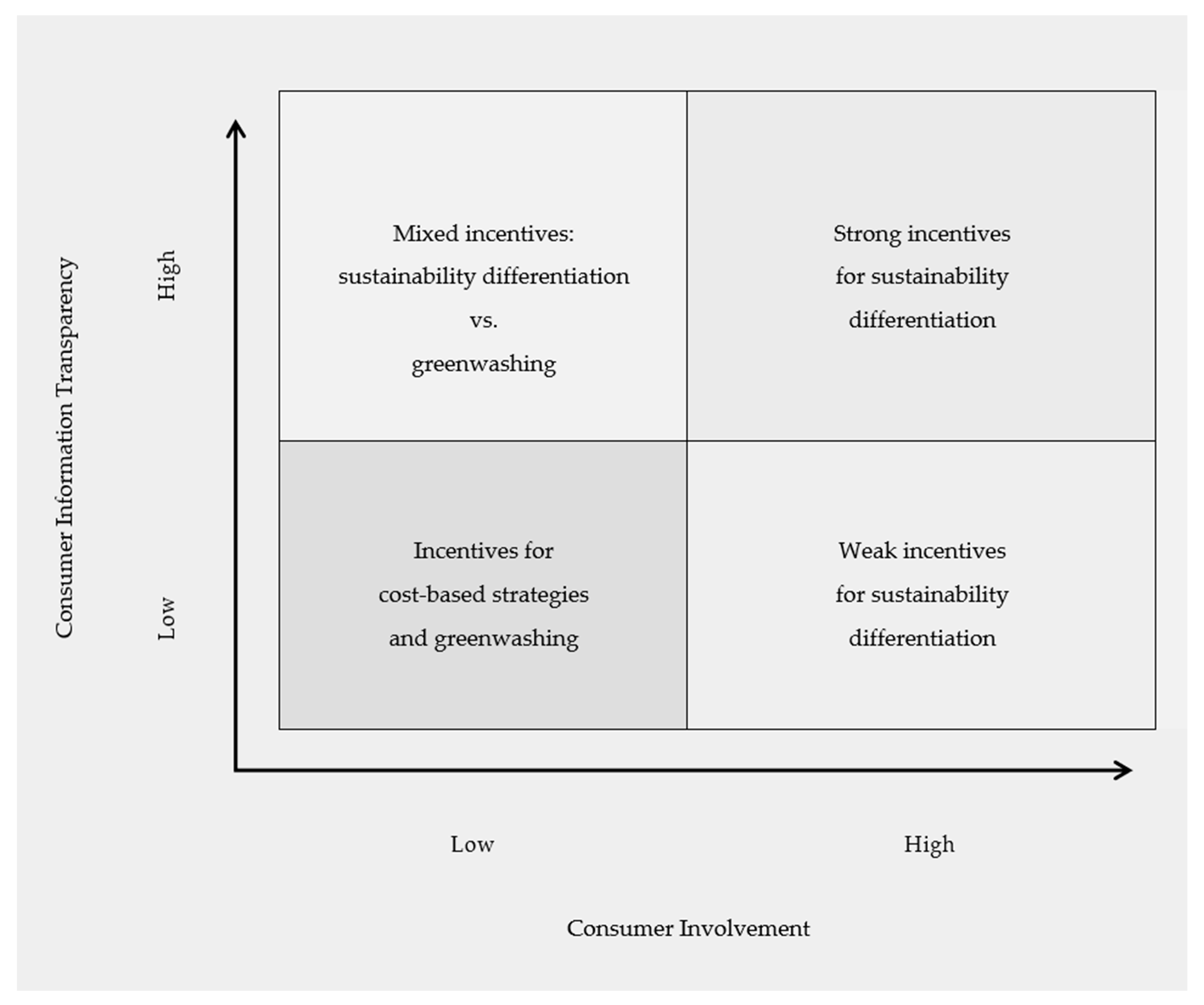
The model conceptualizes strategic incentives for sustainability as a function of two demand-side conditions: consumer involvement and information transparency (see
Figure 1). Consumer involvement reflects the degree to which consumers are motivated to consider sustainability attributes in their purchase decisions, while information transparency captures their ability to access, process, verify and make use of such attributes. Together, these dimensions reflect four distinct market contexts.
A basic assumption of the model is that sustainability differentiation entails additional costs. It therefore excludes cases where sustainability improvements reduce costs (e.g., energy efficiency) or are bundled with other value-creating attributes that justify a premium (e.g., organic products consumed for their perceived positive health effects). While green innovations serve a crucial function in sustainability transitions, they do not capture the central competitive trade-off examined here: whether sustainability can function as an independent basis for competitive advantage, as opposed to the more proactive measures to generate green innovations in response to broader sustainability concerns [
39].
When consumer involvement is low, the prospects for sustainability differentiation diminish. Consumers are unlikely to accept price premiums for attributes they do not actively value, encouraging firms to compete based on cost or more tangible product characteristics. Under these conditions, sustainability is unlikely to emerge as a primary competitive dimension.
If low involvement is combined with low transparency, firms face strong incentives to prioritize a cost focus as consumers neither demand nor effectively evaluate sustainability attributes. Incentives for greenwashing increase because even limited investments in sustainability communication may capture baseline demand for sustainable products at conventional prices. In such contexts, sustainability claims can function less as verifiable attributes and more as symbolic assurances. This creates a situation in which consumers may tolerate ambiguity—if not to feel virtuous, then at least to avoid a negative self-image. At the same time, widespread and vague claims risk reinforcing confusion in the market, further weakening sustainability as a meaningful competitive factor.
As transparency increases, however, these incentives are attenuated, as misleading claims become easier to detect. Yet even under conditions of high transparency, low consumer motivation reduces willingness to pay, favoring cost-based competition [
68].
When consumer involvement is high, but transparency remains low, firms face ambiguous strategic incentives. On the one hand, signaling strategies—including greenwashing—may successfully capture value by aligning with consumer preferences without incurring the full costs of sustainability improvements. On the other hand, such strategies carry substantial reputational risks, as exposure can erode trust among highly engaged consumers. Importantly, even highly involved consumers often face significant information constraints due to complex supply chains and limited traceability. As a result, firms face a choice between investing in credible sustainability differentiation, while risking that consumers cannot verify and thus undervalue it, or relying on signaling strategies that may be indistinguishable from genuine efforts.
When both involvement and transparency are high, incentives for substantive sustainability differentiation become clear. These conditions are typically associated with niche or focused market segments, where consumers are willing to invest time and pay price premiums for products aligned with their sustainability preferences. In such contexts, transparency becomes a competitive asset, enabling firms to build trust and distinguish themselves from competitors engaging in superficial claims. Consequently, sustainability can function as a meaningful basis for competitive advantage, while greenwashing becomes less viable.
Despite these favorable conditions, most consumption occurs in mass markets characterized by low involvement and limited transparency. The complexity of global supply chains and the cognitive demands placed on consumers constrain even highly motivated individuals. As a result, sustainability rarely operates as a decisive competitive factor in these markets. Even when consumers express pro-sustainability attitudes, their purchasing behavior is shaped by price sensitivity, limited attention, and uncertainty about the actual impact of their choices.
5. Conclusions, Limitations and Future Research
This analysis has examined two central questions: (1) the strategic incentives for integrating sustainability within a Porterian framework of competitive advantage, and (2) the implications for the diffusion of sustainability beyond niche markets. The analysis suggests that such incentives are highly contingent on consumer involvement and information transparency and vary significantly across market contexts. In mass markets, where both dimensions are typically low, sustainability struggles to function as an independent competitive factor when it entails additional costs.
While the application and outcomes of the generic strategies vary between industries and geographical contexts [
106,
107], the aim here has been to isolate the incentives for substantial sustainability integration within this strategic logic. This does not preclude the possibility of hybrid strategies, where firms combine sustainability differentiation with competition on other attributes [
48]. Indeed, empirical research suggests that sustainability is often most effective as a supportive rather than central dimension of the value proposition. However, in mass markets, the same conditions that weaken sustainability as a primary competitive factor also risk reducing such supportive roles to superficial implementations. This incentive structure aligns with the prevalence of greenwashing practices, where firms exaggerate, obscure, or misrepresent their sustainability efforts.
Importantly, even in contexts characterized by higher consumer involvement, the effectiveness of sustainability as a competitive dimension remains constrained by limited transparency. Consumers who actively seek information are often unable to verify claims, not only due to the complexity of global supply chains but also because firms themselves frequently lack full insight into their upstream activities [
104,
105]. This persistent opacity sustains ambiguity in the market and allows signaling strategies to compete with substantive sustainability efforts. As transparency increases, however, incentives to engage in greenwashing are attenuated, as misleading claims become easier to detect [
87].
Overall, the analysis indicates that relying on competitive strategy alone is insufficient to drive a broad sustainability transition. The implications of applying Porter’s framework suggest that sustainability—even in the narrow sense of internalizing externalities—does not function effectively as a competitive factor in mass markets as long as it incurs substantial costs. Thus, if “the limits of corporate rationality determine the limits of corporate social responsibility” [
25] (p. 86), then the potential for strategy-driven transformational change appears limited under current conditions. Other important factors that determine corporate strategies include reputational risks, such that companies that receive negative publicity for greenwashing may be punished by consumers. However, such publicity often depends on egregious or shocking levels of negligence rather than industry-wide omissions. This analysis has instead focused on the overall competitive strategies that often guide business conduct to understand strategic incentives based on a logic of trade-offs, rarely dealt with in empirical research on self-reported sustainability practices.
Regulatory frameworks can nevertheless alter the strategic incentives associated with sustainability by reshaping firms’ cost structures and competitive conditions. Public policy, carbon pricing, disclosure mandates, certification standards, and due diligence requirements may reduce the competitive disadvantages associated with sustainability investments by increasing the costs of environmentally harmful practices or generating consistent standards for sustainability expectations across firms. In this sense, institutional pressures may partially compensate for the limitations of market-based differentiation strategies by changing the underlying conditions of competition [
108,
109].
At the same time, the analysis highlights a more systemic limitation: where sustainability dimensions remain difficult to measure, are weakly regulated, or lack credible verification, firms face limited pressure to pursue substantive change. Under these conditions, cost-based competition tends to dominate while greenwashing and incremental “business-as-usual” adaptations remain the rational response from a competitive strategy perspective. The prevalence of such practices suggests that market mechanisms, in the absence of strong institutional constraints, may accommodate symbolic compliance rather than genuine improvements.
One solution to the prevailing transparency limitations that has been proposed is the use of digital technologies to improve traceability and information sharing across supply chains. Blockchain technologies, AI-assisted auditing systems, and digital monitoring tools may indeed strengthen transparency by improving the traceability and verifiability of sustainability-related claims across industries [
109,
110]. However, such technologies—similar to other forms of sustainability reporting [
111]—face important limitations, including implementation costs, uneven institutional capacity, fragmented standards, and the persistence of informational complexity [
110,
112].
Prior research offers a less critical perspective on competitive strategy, suggesting that differentiation strategy can function as a moderator of the relation between green innovation and firm performance to boost profitability [
39]. However, studies that rely on self-reporting and assumptions about innovation effects on cost structures do not disentangle the incentives of genuine green differentiation from less costly stylized greening efforts. While this article offers a conceptual analysis of the strategic incentives of differentiation, future studies that are able to disentangle these effects and validate them empirically are urgently needed.
Taken together, these findings indicate that competitive strategies are unlikely to drive sustainability transitions into mass markets on their own. Instead, they risk reinforcing selective and uneven progress, particularly in areas subject to scrutiny, while leaving less visible impacts largely unaddressed. Strengthening transparency, standardization, and regulatory enforcement therefore appears critical to counteract the structural incentives that otherwise enable inaction or misleading claims about sustainability. Without such conditions, sustainability is likely to remain fragmented, with substantive advances overshadowed by the persistence of practices that fall short of transformative change.
This argument is limited to the positioning perspective on strategy, which nevertheless remains highly influential. But alternative strategic frameworks may also help businesses pursue competitive advantage, including the resource-based view and dynamic capabilities perspectives. Managers concerned with positioning their work within one of the generic strategies should therefore also consider the possibilities of leveraging internal resources, organizational learning, and innovation capabilities to serve consumer markets more efficiently. Dynamic capabilities may encourage firms operating in mass markets to use sustainability-oriented niche markets as innovation laboratories for solutions that can later be scaled up for broader markets as technologies mature, costs decline, and institutional support develops.
Another limitation that managers should consider is the relationship between competitive strategy and other key factors such as innovation strategies and legitimacy, but also key distribution channels [
113], which is left out of this analysis in favor of a strict focus on the implications of competitive strategy for sustainability work. Research suggesting that businesses build collective identity and legitimacy for emerging markets framed as sustainable stands in contrast to the competitive strategy perspective [
114].
While firms may engage in sustainable business practices for a variety of reasons beyond strategic positioning, including political image management, mitigation of political risks, and principal–agent dynamics such as executives seeking to enhance their personal social image [
54], policy makers and politicians should nevertheless remain attentive to the constraints managers face when firms apply generic competitive strategies more strictly. In the end, this paper strengthens the notion that sustainability transitions depend on broader regulatory and institutional support [
108,
109,
115,
116], rather than treating sustainability as a competitive advantage.