1. Introduction
Large inland waterway and maritime infrastructure projects are increasingly delivered in an environment shaped by disruption propagation, schedule volatility, and multi-dimensional sustainability pressure. Empirical and review studies on ports and maritime transport show that climate extremes, natural hazards, geopolitical frictions, and logistics failures can interrupt waterborne networks, prolong recovery, and trigger cascading delay and cost-overrun effects across connected supply chains [
1,
2]. At the same time, decarbonization requirements, stakeholder scrutiny, and ESG-oriented governance expectations are reshaping how infrastructure owners assess procurement and logistics choices [
3,
4]. For large navigation works such as the Pinglu Canal, this means that marine-grade material supply security, logistics resilience, dredged-material resourceization, and environmental and social responsibility must be considered jointly rather than sequentially.
Recent research has generated important building blocks for this agenda. In supplier management, disruption-aware studies have moved beyond purely static evaluation and have incorporated resilient supplier selection, order allocation, and multi-tier sourcing considerations [
5,
6,
7]. Recent post-pandemic supply-chain studies further emphasize that resilience strategies such as redundancy, diversification, agility, circular-economy practices, and green technologies should be jointly considered in sustainable supply-chain planning [
8]. In parallel, sustainable and resilient closed-loop supply-chain studies have developed multi-objective network formulations that integrate forward and reverse flows, carbon considerations, uncertainty, and selected social criteria [
9,
10,
11,
12,
13]. Recent reviews further note that sustainable supply-chain network design is becoming more comprehensive, yet social metrics and domain-specific logistics structures remain unevenly represented [
14], while dredged-sediment and port-maintenance studies highlight the need for quantifiable circularity and sustainability indicators in maritime operations [
15].
Despite these advances, three research gaps remain at this intersection: (Gap 1) Existing resilient supplier selection studies mainly focus on supplier scoring, ranking, or order allocation under disruption risk, but they rarely co-model these decisions with hub location, reverse logistics, and resourceization equipment configuration in maritime infrastructure networks [
16]. (Gap 2) Most resilient or sustainable closed-loop supply-chain studies address manufacturing, consumer returns, municipal waste, or generic recycling systems, whereas far less attention has been paid to the bidirectional coupling of marine-grade material forward supply and dredged-material reverse recovery in inland waterway construction [
9,
11,
12,
13]. (Gap 3) ESG-oriented supply-chain and maritime studies often treat ESG as an external constraint, an assessment lens, or an ex post benchmarking device rather than endogenizing carbon emissions and social externality penalties as optimization objectives of the same status as cost; consequently, the mechanism through which apparently low-cost configurations may accumulate ecological debt remains insufficiently explained [
15].
This study does not merely combine resilient supplier selection, closed-loop logistics, ESG indicators, and NSGA-II. Instead, it develops a maritime, infrastructure-oriented, tri-objective, closed-loop supply-chain optimization framework for inland waterway navigation hubs. The framework jointly determines resilient supplier selection, transshipment/resourceization hub activation, resourceization equipment deployment, forward material-flow allocation, and reverse dredged-material-flow allocation. Dynamic resilience is operationalized at the network-configuration level by embedding supplier choice, transfer structure, and recovery capacity into the design variables rather than treating resilience as a post hoc label. The environmental dimension is endogenized through a carbon-emission objective; the social dimension is captured through dredged-material resourceization benefits and disposal-related social externality penalties; and the governance/managerial dimension is expressed through transparent supplier–hub–equipment–flow configuration outputs and Pareto-based decision support. Methodologically, the contribution of the study lies in model construction and decision framing rather than in proposing a new evolutionary algorithm. Compared with exact or decomposition-based approaches used in several structured closed-loop settings, NSGA-II is adopted here as a suitable multi-objective solver for a larger mixed-discrete design problem, and its applicability is evaluated later through convergence, diversity, and benchmark comparisons rather than assumed a priori.
Accordingly, this paper makes three specific contributions. First, it proposes a maritime, infrastructure-oriented, closed-loop supply-chain network model that jointly represents marine-grade, material forward supply and dredged-material reverse resourceization. Second, it develops an ESG-endogenous tri-objective formulation in which economic cost, carbon emissions, and social benefit/ecological-debt penalty are optimized within one integrated framework. Third, through the Pinglu Canal case, it produces interpretable Pareto solutions and explicit supplier–hub–equipment–flow configurations that can support project owners in making cost–carbon–social trade-off decisions, rather than only reporting objective-function values.
The remainder of the paper is organized as follows.
Section 2 reviews resilient supplier selection, ESG-oriented closed-loop supply chains, and maritime infrastructure supply-chain optimization.
Section 3 presents the model.
Section 4 introduces the solution method and validation.
Section 5 presents the Pinglu Canal case study.
Section 6 discusses the results, comparisons, sensitivity analysis, managerial implications, and limitations.
Section 7 concludes the paper.
2. Literature Review
2.1. Resilient Supplier Selection and Disruption-Aware Supply Networks
The resilient supplier selection literature has moved from static score-based evaluation toward disruption-aware sourcing models that combine supplier choice with order allocation and risk control. Representative studies formulate resilient supplier selection as an integrated procurement decision under uncertain capacity, delivery, and disruption conditions, often using mixed-integer, stochastic, or fuzzy multi-objective models rather than isolated ranking tools [
7,
16]. This stream also increasingly incorporates proactive and reactive resilience strategies such as multiple sourcing, supplier fortification, third-party logistics support, and CVaR-based downside-risk management to balance expected cost, environmental performance, and disruption exposure [
17].
Methodologically, these models make resilience more quantifiable by connecting sourcing decisions to disruption scenarios, risk measures, and response strategies. For example, Hosseini et al. optimize supplier selection and order allocation under disruption risks [
5]; Mohammed et al. integrate green and resilient criteria in a multi-tier supplier-order allocation problem [
7]; and Taghavi et al. extend the sourcing problem toward vehicle routing, production scheduling, and CVaR-sensitive responses [
16,
17]. However, the dominant unit of analysis remains the upstream sourcing portfolio. Even when routing or scheduling is added, the decision scope rarely extends to maritime infrastructure hub location, reverse recovery, equipment deployment, or bidirectional flow design.
This limitation matters for large inland waterway construction projects because resilience is not only a property of supplier scores; it is also a property of how suppliers, hubs, equipment, and recovery flows are jointly configured under disruption. Existing resilient supplier-selection studies provide important building blocks, but they do not model supplier resilience as one component of an integrated closed-loop infrastructure network in which forward marine-grade material supply and reverse dredged-material recovery affect each other structurally. The present study therefore treats resilient supplier selection as a network-configuration decision embedded in a broader infrastructure supply-chain optimization framework, rather than as a standalone supplier-evaluation problem.
2.2. ESG-Oriented Closed-Loop Supply Chains and Waste Resourceization
A second stream concerns ESG-oriented and sustainable closed-loop supply chains (CLSCs), where forward and reverse flows are optimized simultaneously under economic, environmental, and occasionally social criteria. Recent CLSC models include carbon policies, uncertain demand, stochastic recovery, multi-objective design, and sustainability-driven customer behavior, thereby extending conventional cost-centered network design toward more explicit triple-bottom-line formulations [
9,
10,
11,
12,
13]. Disruption-aware variants further use robust, stochastic, or fuzzy approaches to quantify the value of backup suppliers, multiple sourcing, information sharing, or lateral resupply in resilient CLSC structures [
18,
19]. Reverse logistics network design has also been applied to crisis-related waste management. For example, Shadkam [
20] developed a cuckoo-optimization-based reverse logistics network for COVID-19 waste management, demonstrating the relevance of metaheuristic network design in waste recovery and treatment systems.
Yet the empirical focus of this literature is still concentrated in manufacturing, product-return, municipal-waste, food, apparel, and consumer-recovery systems. In parallel, the dredged-material and port-circularity literature has shown that beneficial reuse, treatment pathways, and regulatory feasibility are essential for turning sediments from a disposal burden into a construction resource [
15,
21,
22,
23]. Recent port-maintenance work further stresses that circularity, sustainability, and smartness must be made quantifiable in order to support multi-stakeholder trade-off decisions in maintenance dredging and nautical accessibility management [
4]. These contributions are highly relevant, but most of them remain at the levels of material characterization, treatment, policy, or generic circularity assessment rather than strategic supply-chain network configuration.
For the present study, the key implication is that ESG should not be reduced to a single exogenous constraint or an ex post score. Instead, the environmental dimension needs to be internalized through a carbon-emission objective; the social dimension needs to be represented through dredged-material resourceization benefits and disposal-related externality or ecological-debt penalties; and the governance or managerial dimension needs to be expressed through transparent Pareto-based decision outputs that show which suppliers, hubs, equipment sets, and flows are selected. Existing CLSC and dredged-material studies illuminate each piece separately, but they rarely connect marine-grade material forward supply, dredged-material reverse recovery, and equipment configuration inside one endogenous ESG optimization structure for inland waterway construction.
2.3. Optimization Models for Maritime Infrastructure and Closed-Loop Logistics Networks
A third stream concerns optimization models for maritime logistics and infrastructure-related networks. Across the broader supply-chain design literature, exact MILP formulations, robust optimization, stochastic programming, epsilon-constraint methods, decomposition algorithms, and metaheuristics are used to manage trade-offs among cost, emissions, resilience, and service performance [
9,
10,
18]. In maritime and hinterland settings, however, the modeled decisions are typically narrower: some studies focus on seaport-dry port configuration with multimodal transport and carbon emissions [
24], some on port supply-chain emission-control technologies [
25], some on inland waterway tug scheduling and green routing [
26], and others on stochastic or bi-objective dry-port network design under uncertain demand and resilience criteria [
27,
28].
These studies show that maritime optimization is already methodologically rich, but the dominant problem contexts remain port operations, emission-control technology, routing, dry-port layout, or container-network planning. They seldom address construction projects involving large inland waterway navigation hubs where supplier selection, transshipment/resourceization hub activation, equipment deployment, forward material allocation, and reverse dredged-material allocation must be determined simultaneously. The gap is therefore not a lack of optimization tools per se; it is the absence of a scenario-specific formulation that translates maritime infrastructure construction and dredged-material circularity into an integrated strategic network-design problem.
This distinction is also important for positioning the solution method. Robust and stochastic programming approaches make uncertainty explicit and are powerful when the scenario structure and tractable exact formulations can be maintained, as illustrated by [
10,
18,
28]. Exact and epsilon-constraint methods can provide strong benchmark quality in more structured multi-objective CLSC settings [
9]. By contrast, evolutionary approaches such as NSGA-II, MOPSO, or hybrid genetic algorithms are often adopted when the decision space becomes larger, more mixed-discrete, and more strongly conflicted across objectives [
27,
28]. Accordingly, this paper does not claim a new NSGA-II algorithm. Its methodological contribution lies in the maritime infrastructure-oriented model framework, while NSGA-II is adopted as a suitable solver whose applicability should be judged later through convergence, diversity, hypervolume, and benchmark comparisons.
2.4. Research Gaps and Positioning of This Study
The reviewed studies point to three specific gaps:
Gap 1. Existing resilient supplier selection studies mainly focus on supplier evaluation, ranking, portfolio selection, or order allocation, but rarely integrate supplier resilience with hub location, reverse resourceization logistics, and equipment deployment in maritime infrastructure projects [
5,
7,
16].
Gap 2. Existing sustainable or ESG-oriented CLSC models usually focus on general manufacturing or product-recovery systems, while dredged-material management in inland waterway construction has not been sufficiently modeled as a closed-loop decision process that couples marine-grade material forward supply with reverse recovery and resourceization capacity [
9,
11,
19,
21,
22].
Gap 3. Existing ESG-oriented models often treat ESG as an external constraint, a post hoc evaluation layer, or a single environmental indicator. They rarely place cost, carbon emissions, and social externality or ecological debt in the same endogenous optimization framework, which limits their ability to explain why low-cost configurations may still generate unsustainable disposal outcomes [
3,
4,
13,
23].
Therefore, this study extends prior research by constructing a maritime infrastructure-oriented, tri-objective CLSC optimization model that jointly determines resilient supplier selection, transshipment/resourceization hub activation, equipment deployment, and bidirectional material-flow allocation under endogenous ESG objectives. The positioning of this study relative to the reviewed literature is summarized in
Table 1.
3. Construction Project: Supply-Chain Network Optimization Model
This section formulates a planning-stage closed-loop supply-chain network for construction of an inland waterway navigation hub. The purpose of the baseline model is not to reproduce every operational uncertainty at once, but to reveal the structural trade-offs among supplier choice, hub activation, equipment deployment, bidirectional material flows, cost, carbon emissions, and disposal-related social impacts.
3.1. Problem Description and Decision Scope
The modeled system is a maritime infrastructure-oriented, closed-loop network in which marine-grade materials move forward from prequalified resilient suppliers to transshipment/resourceization hubs and then to navigation-hub construction sites, while dredged materials and engineering spoils move in reverse from construction sites back to equipped hubs for treatment and reuse. Within this setting, the model jointly determines: (1) resilient supplier selection; (2) supplier-to-hub assignment; (3) hub activation; (4) hub-to-site service relationships; (5) resourceization equipment deployment; (6) forward material-flow allocation from suppliers to hubs; (7) forward material-flow allocation from hubs to sites; and (8) reverse dredged-material quantities returned and treated at each hub.
The phrase “known parameters” is used here in a planning-stage sense rather than as an ontological claim that all information is perfectly observable. In practical project planning, candidate coordinates are obtained from engineering layout documents, supplier qualification records, field investigations, and GIS/geocoding; material-demand and capacity parameters are derived from engineering bills, construction schedules, and planning documents; and baseline cost or emission coefficients are calibrated from engineering reports, public factor databases, or literature benchmarks. When commercial sensitivity exists, raw case data are anonymized or normalized before being entered into the model. Accordingly, these inputs are treated as available at the planning stage after engineering survey and data preprocessing, not as immutable real-world constants.
Dynamic resilience is operationalized at this stage through the configuration logic of the network rather than through a fully stochastic disruption process. More specifically, resilience enters the model through prequalified resilient suppliers, resilience-adjusted procurement parameters, supplier-capacity limits, and the joint choice of suppliers, hubs, equipment, and flows. This allows the model to compare structurally different supplier–hub–equipment–flow configurations, while leaving scenario-based disruption probabilities and recovery trajectories for later robustness extensions.
3.2. Model Formulation
3.2.1. Assumptions
The assumptions are as follows:
Assumption 1. Planning-stage deterministic baseline. The model adopts deterministic baseline parameters for distances, capacities, demand, cost coefficients, and emission coefficients in order to analyze the structural trade-offs embedded in supplier–hub–equipment–flow configuration. Demand fluctuation, fuel price variation, weather disruption, and supplier failure probability can be incorporated in stochastic or robust extensions when a richer uncertainty representation is required.
Assumption 2. Prequalified resilient suppliers. Candidate suppliers belong to a prequalified supplier pool. In this baseline formulation, supplier resilience is operationalized through prequalification, capacity reliability, emergency supply capability, disruption-resistance evaluation, and the resilience-adjusted procurement factor rather than through a full stochastic disruption process.
Assumption 3. Baseline single-hub service. Each construction site is served by one hub in the baseline formulation. This assumption supports construction responsibility allocation, material traceability, quality control, and coordination simplicity under centralized project management. For redundancy-oriented planning, the condition can be relaxed to , where denotes the maximum number of hubs allowed to serve site .
Assumption 4. Average transportation cost and emission coefficients. The parameters and are average baseline coefficients used for planning-stage, network-level trade-off analysis. In practical projects, transportation cost and freight emissions vary with transport mode, fuel type, payload, loading rate, and route conditions. When such information is available in greater detail, the transport terms can be extended to mode-specific coefficients such as , , , and .
Assumption 5. Resourceization equipment deployment. Resourceization equipment can only be installed at opened hubs, and spoil treatment is activated only when the corresponding equipment is deployed. When equipment-specific planning capacities are available, additional throughput constraints can be incorporated directly into the model.
3.2.2. Notation
The notation used in the baseline formulation is summarized in
Table 2.
3.2.3. Objective Functions
The model adopts a tri-objective structure consisting of economic cost minimization, carbon-emission minimization, and net social-benefit maximization. The three objectives correspond to the economic, environmental, and social dimensions of the planning problem, while governance-oriented decision support is reflected through transparent Pareto solution outputs describing suppliers, hubs, equipment deployment, and material-flow allocation.
- (1)
Economic Cost Minimization
The third term in Equation (3) represents the reverse transportation cost associated with dredged materials and engineering spoils generated from delivered construction materials and returned to treatment hubs.
The procurement factor is treated as a planning parameter that may be calibrated from supplier resilience evaluation and procurement discount information. Its role is to connect resilience-oriented prequalification with procurement cost rather than to introduce an additional optimized state variable.
- (2)
Carbon emission minimization
The transport-emission structure follows the same forward and reverse freight logic as the transportation-cost term. The coefficient is interpreted as an average loaded-distance freight emission factor, and the processing term captures emissions generated during spoil treatment and resourceization.
- (3)
Social benefit and ecological-debt penalty
The social objective distinguishes beneficial reuse from disposal-related externalities. Beneficially reused dredged material contributes positive social value through reduced environmental burden and improved resource circulation, whereas untreated or finally disposed spoil imposes increasingly negative externalities once local environmental absorption and ecological capacity are exceeded. The parameters
,
,
,
, and
are project-specific planning parameters. They can be calibrated using environmental impact assessment results, local ecological-capacity standards, local policy thresholds, expert elicitation, and sensitivity analysis.
In this formulation, ecological debt arises when cumulative social impact becomes negative. The indicator measures the non-negative magnitude of that negative impact, while preserves continuity at and through the cumulative piecewise construction.
3.2.4. Constraints
The baseline equations are defined as follows.
Equation (15) satisfies site-level material demand. Equations (16) and (17) connect site assignment with hub flow balance. Equations (18) and (19) enforce supplier-capacity and supplier-assignment consistency, while Equation (20) links hub-level throughput to hub activation. Equation (21) limits the number of opened hubs, and Equation (22) links equipment deployment to hub opening. Equation (23) defines the baseline single-hub service condition, whereas a redundancy-oriented extension can adopt . Equations (24) and (25) restrict service and supplier assignment to activated hubs. Equation (26) defines reverse-treated quantities using delivered-material volumes and spoil-generation ratios, and Equation (27) activates treatment quantities only at hubs where resourceization equipment is installed.
3.2.5. Decision Outputs and Managerial Interpretability
The model produces not only objective-function values but also executable configuration decisions. These outputs include selected resilient suppliers , opened hubs , installed resourceization equipment , hub-site service assignments , forward flows and , reverse dredged-material flows and treated quantities , and objective values . These outputs allow each Pareto solution to be interpreted as an executable supplier–hub–equipment–flow.
4. Solution Method and Algorithm Validation
4.1. Solution Framework and Hybrid Encoding
The proposed optimization problem is a tri-objective mixed-discrete network-configuration problem that simultaneously involves supplier selection, hub activation, equipment deployment, hub-site assignment, forward material-flow allocation, and reverse dredged-material-flow allocation. The solution framework therefore combines discrete structural decisions with continuous flow-allocation decisions in a unified search process.
A hybrid chromosome is adopted. Part A contains binary configuration genes for supplier-hub assignment , hub-site assignment , hub activation , and equipment deployment . Part B contains flow-allocation genes for forward supplier-to-hub quantities and hub-to-site quantities . The reverse treated quantity is decoded as an auxiliary variable from the delivered-material quantities and spoil-generation ratios, rather than being sampled as an independent random gene.
4.2. Constraint Handling and Feasibility Repair
Feasibility is maintained through a problem-specific repair mechanism. First, if a construction site is assigned to a hub, the corresponding hub is activated. Second, resourceization equipment deployment is restricted to opened hubs. Third, each construction site is assigned to exactly one hub in the baseline setting. Fourth, flow-allocation genes are adjusted so that material demand is satisfied. Fifth, supplier-to-hub quantities are clipped or redistributed when supplier capacity is exceeded. Sixth, hub inflows and outflows are adjusted when hub storage or handling capacity is exceeded. Seventh, reverse-treated quantities are decoded from delivered materials and spoil-generation ratios in order to preserve reverse-flow consistency. When an individual cannot be fully repaired within these rules, a constraint-violation penalty is appended, and the solution is ranked after feasible individuals during survival selection.
4.3. NSGA-II Procedure
The detailed NSGA-II procedure used in this study is presented in Algorithm 1.
| Algorithm 1. NSGA-II for Maritime Infrastructure Closed-Loop Supply Chain Optimization |
| Require: Model parameters, constraint set Ω, population size N, maximum generations Gmax, crossover probability pc, mutation probability pm |
| Ensure: Non-dominated Pareto solution archive A |
| 1 Initialize population P0 with N hybrid chromosomes representing supplier selection, hub activation, equipment deployment, service assignment, and material-flow allocation |
| 2 Repair infeasible individuals in P0 according to Ω |
| 3 Evaluate objective functions (f1, f2, f3) for all individuals in P0 |
| 4 Initialize external archive A0 with non-dominated feasible solutions in P0 |
| 5 for g = 0 to Gmax - 1 do |
| 6 Perform fast non-dominated sorting on Pg |
| 7 Compute crowding distance for individuals in each front |
| 8 {Parent selection} |
| 9 Select parents by binary tournament selection based on non-dominated rank and crowding distance |
| 10 {Hybrid variation} |
| 11 Apply type-specific crossover with probability pc: |
| 12 arithmetic/intermediate crossover for flow-allocation genes |
| 13 uniform crossover for binary configuration genes |
| 14 Apply type-specific mutation with probability pm: |
| 15 polynomial or integer mutation for flow-allocation genes |
| 16 bit-flip mutation for binary configuration genes |
| 17 Obtain offspring population Qg |
| 18 {Constraint handling} |
| 19 Repair infeasible offspring with respect to demand satisfaction, supplier capacity, hub capacity, service assignment, equipment-deployment logic, and reverse-flow consistency |
| 20 Apply constraint-violation penalties to individuals that cannot be repaired |
| 21 Evaluate objective functions (f1, f2, f3) for all individuals in Qg |
| 22 {Elitist replacement} |
| 23 Merge parent and offspring populations: Rg = Pg ∪ Qg |
| 24 Perform fast non-dominated sorting on Rg |
| 25 Select the best N individuals to form Pg + 1 based on lower rank and larger crowding distance |
| 26 Update archive Ag + 1 using non-dominated feasible solutions from Ag ∪ Pg + 1 |
| 27 end for |
| 28 return Final non-dominated archive AGmax |
The procedure combines fast non-dominated sorting, crowding-distance preservation, a hybrid chromosome, feasibility repair, and an external archive of non-dominated feasible solutions. In this study, NSGA-II functions as a solver for the proposed model rather than as the source of methodological novelty.
4.4. Parameter Calibration
The algorithm parameters are calibrated through a structured parameter-screening experiment over candidate combinations of population size
, maximum generations
, crossover probability pc, and mutation probability pm. The calibration criteria include hypervolume, spacing, number of non-dominated solutions, and runtime under a common computational budget and repeated independent runs. The final parameter setting is selected from the set of configurations that provide a stable balance between solution quality and computational effort. The detailed numerical results are reported in
Table 3.
As shown in
Table 3, increasing the population size or the maximum number of generations improves the hypervolume and spacing indicators, but the improvement becomes marginal when compared with the additional computational cost. Configuration C2 is therefore selected as the final setting because it provides a stable approximation quality while maintaining moderate runtime. This setting is also consistent with the scale of the case study model and yields approximately 14 non-dominated configurations, which is sufficient for subsequent managerial trade-off analysis.
4.5. Convergence and Diversity Evaluation
Algorithm validation is conducted by combining convergence and diversity indicators. Hypervolume (HV) is used to evaluate the joint convergence and coverage quality of the approximation set, with larger values indicating better performance. Generational Distance (GD) or Inverted Generational Distance (IGD) is used to measure the distance from the approximation set to a reference front. The spacing metric (SP) evaluates distribution uniformity across non-dominated solutions, with smaller values indicating more even spacing. The number of non-dominated solutions (NDS) measures the quantity of retained efficient configurations, and runtime captures computational effort. When an analytical Pareto front is unavailable, the reference front can be constructed from the combined non-dominated set generated by all benchmark algorithms. The resulting indicators are summarized in
Table 4.
Table 4 reports the convergence, diversity, and computational-effort indicators obtained under the same computational budget. NSGA-II achieves the highest HV, the lowest IGD, and the lowest SP among the compared algorithms, indicating a relatively better balance between convergence and distribution uniformity. MOEA/D also provides competitive approximation quality, whereas MOPSO has a slightly shorter runtime but weaker diversity. The weighted-sum baseline is computationally efficient but produces fewer non-dominated solutions and a less diverse Pareto approximation, which is expected because scalarization tends to miss non-convex regions of the Pareto front.
4.6. Benchmark Algorithm Comparison
Benchmark comparison is conducted to evaluate whether the adopted solver provides a stable and sufficiently diverse Pareto approximation for the proposed model. The comparison is performed under the same objective functions, the same constraint system, and the same computational budget. The benchmark set may include NSGA-II, MOPSO, MOEA/D, and a weighted-sum baseline. The comparison indicators include HV, GD or IGD, spacing, NDS, and runtime, together with statistics over repeated independent runs.
4.7. Computational Complexity and Implementation Settings
For M objective functions and population size N, the fast non-dominated sorting procedure of NSGA-II has time complexity . In the present study, . The overall computational cost also depends on the evaluation of repair rules, demand-balancing operations, supplier and hub capacity checks, and reverse-flow decoding over the supplier, hub, site, material, and spoil-category sets. The algorithm is implemented in MATLAB R2024a.
5. Case Study: Data, Parameterization, and Scenario Design
5.1. Case Background: Pinglu Canal Navigation-Hub Project
The Pinglu Canal project is selected as a representative inland waterway infrastructure case because it combines large-scale material procurement, cross-regional logistics coordination, and dredged-material management. The case focuses on the Madao, Qishi, and Qingnian navigation hubs, which represent major construction nodes with both forward material demand and reverse spoil/resourceization requirements.
These three construction nodes require marine-grade cement and rebar while also generating dredged materials and engineering spoils during excavation and navigation-channel works. The case therefore provides a representative planning scenario for evaluating the proposed model in a setting where forward material security and reverse resourceization decisions must be considered jointly.
5.2. Data Sources and Preprocessing
The case dataset combines field investigations at Pinglu Canal construction sites, anonymized engineering technical documents, the qualified supplier database, construction demand schedules and engineering bills, GIS/geocoding-based spatial preprocessing, and planning-stage engineering estimates for cost, capacity, emissions, and resourceization parameters.
Supplier, hub, and site coordinates were geocoded and cross-checked against engineering layout documents. Capacity, demand, and cost records were cleaned for missing entries, aggregated to the planning period, and standardized into consistent units before model input. Commercially sensitive supplier names and procurement records were anonymized, whereas the spatial coordinates required for network optimization were retained.
5.3. Spatial Network Configuration
The initial screening pool contained 16 candidate enterprises. After excluding suppliers with incomplete spatial, capacity, or procurement records, 12 suppliers were retained for optimization, including 6 marine-grade cement suppliers and 6 marine-grade rebar suppliers. Together with five candidate transshipment/resourceization hubs and three construction sites, these retained nodes define the spatial network used in the baseline case.
All monetary values are reported in CNY. For international readability, approximate USD equivalents are calculated using a planning-stage conversion factor of 1 USD = 7.20 CNY; this conversion should be confirmed against the final submission-date exchange assumption. Coordinates are reported because spatial relationships are needed to construct the distance matrix and hub-allocation structure.
Table 5 presents the marine-grade cement suppliers,
Table 6 presents the marine-grade rebar suppliers, and
Table 7 summarizes the candidate transshipment and resourceization hubs.
5.4. Demand, Capacity, and Resourceization Data
Table 8 reports the site-level material demand and derived dredged-material quantities for the three navigation-hub construction sites. Cement and rebar demand values are aggregated from engineering bills and construction schedules at the planning stage.
For each site , the dredged-material or engineering-spoil quantity is estimated by , where is the average generation ratio. Under this setting, the derived spoil quantities are 4000 t for Madao, 2500 t for Qishi, and 1500 t for Qingnian, which are consistent with the total delivered material demand at each site.
5.5. Environmental and Social Parameterization
Table 9 summarizes the baseline economic, environmental, and social parameters used in the case study. The carbon emission factor is expressed as
in the baseline setting, consistent with a loaded-distance representation of freight activity. The unit recycling/treatment cost, equipment installation cost, storage capacities, and recycling benefit are treated as planning-stage engineering estimates and are further examined through sensitivity analysis.
The social-benefit parameters , , , , and are project-specific scenario parameters rather than universally transferable constants. They represent the restoration-benefit interval, the moderate externality interval, and the severe ecological-penalty interval and are calibrated from environmental impact assessment requirements, local environmental management expectations, expert elicitation, and scenario-based threshold testing.
5.6. Scenario Design and Validation Protocol
To prepare the subsequent results analysis, a structured scenario set is designed around the baseline network and the most uncertainty-sensitive parameters. The baseline case adopts single-hub service, average transportation cost and emission coefficients, and a final disposal rate nu = 0.5. Additional scenarios perturb transportation cost, carbon intensity, disposal policy, and social-penalty thresholds, whereas a multi-hub redundancy setting is retained as an optional extension for robustness-oriented planning.
5.7. Data Reliability, Anonymization, and Limitations
Data reliability is supported through several checks. Spatial coordinates were cross-verified through GIS/geocoding procedures, demand and capacity values were checked against planning documents and engineering bills, and cost, emission, and social parameters were treated as planning-stage estimates rather than immutable constants. Scenario analysis is therefore used as the main mechanism for testing parameter robustness.
Although some engineering and procurement records cannot be fully disclosed because of commercial sensitivity, the reported parameters are sufficient to reproduce the network structure, demand scale, and baseline optimization logic. Supplier identifiers are anonymized using codes, detailed contract prices are not fully reported, and some project-specific thresholds remain planning estimates. Future work can incorporate dynamic monitoring data, stochastic demand, real freight records, and multi-source disruption observations to refine the case representation.
6. Results, Comparison, and Discussion
6.1. Overview of Pareto Solutions
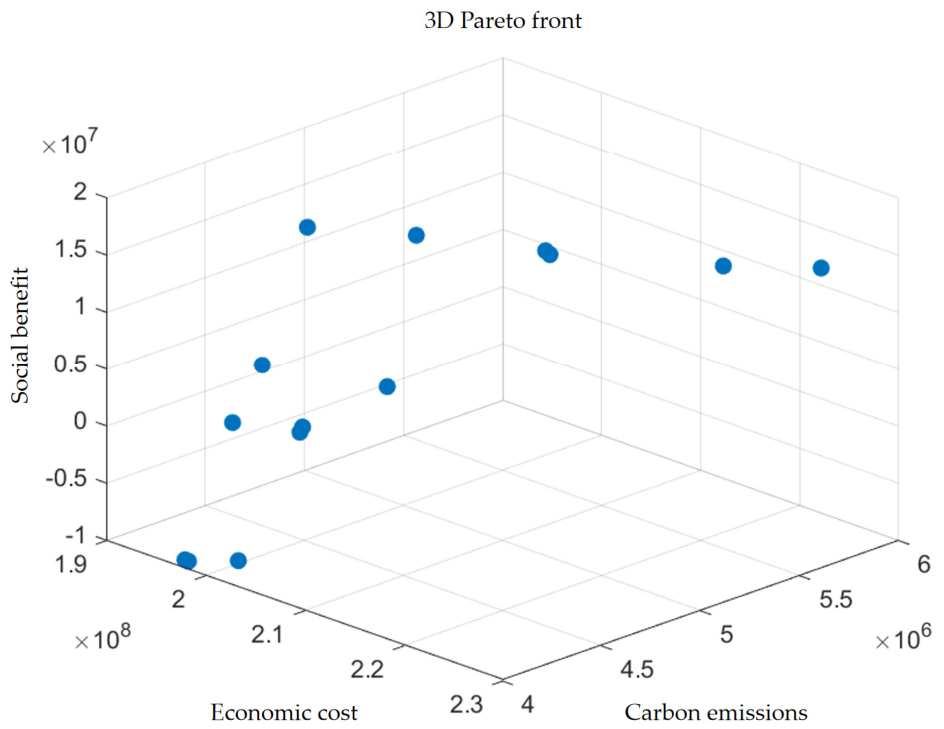
Under the baseline scenario, the proposed model yields 14 non-dominated solutions. These solutions represent executable supplier–hub–equipment–flow configurations associated with different economic, environmental, and social priorities rather than abstract objective vectors alone. Across the Pareto set, economic cost ranges from 197.000 million CNY (27.361 million USD) to 229.4793 million CNY (31.872 million USD), carbon emissions range from 4061 to 5634.43 t CO2e, and social benefit ranges from −10.040 million CNY (−1.394 million USD) to 15.9376 million CNY (2.214 million USD).
Figure 1 and
Table 10 show that the lowest-cost and lowest-emission decision region coincides with negative social benefit, whereas the highest social-benefit region requires stronger reverse-logistics activity and resourceization equipment deployment. Positive social benefit emerges only after the network activates at least one equipment-supported resourceization path.
6.2. Representative Pareto Configurations and Decision Outputs
The audited Pareto solutions can be interpreted not only through their objective values but also through their underlying structural decision patterns. Since detailed supplier identities and exact contractual flow quantities are anonymized, this section discusses representative configurations at the structural level. The main distinction among the solutions lies in whether the network remains in a disposal-dominated mode or activates the minimum effective resourceization conditions required to shift the system from ecological debt to positive social value.
The lowest-cost solution P14 and the lowest-emission solution P6 represent two extreme efficiency-oriented configurations. Both maintain compact supplier participation and cost- or emission-oriented allocation patterns, but neither configuration generates positive social benefit. This indicates that minimizing financial expenditure or transport-related emissions alone is insufficient when dredged-material externalities are not effectively internalized.
A transition pattern appears in the low-cost region around 197.3–197.8 million CNY. Solutions such as P12 and P11 show that a small increase in economic cost can move the system from ecological debt to positive social value. More importantly, P7 achieves a near-saturated social benefit of 15.9375 million CNY at a cost of only 197.7467 million CNY. This suggests that the key managerial issue is not maximizing total investment, but identifying the minimum effective activation of resourceization pathways.
By contrast, P2 represents the upper-bound social-benefit configuration. Although it achieves the highest social benefit, its economic cost and carbon emissions are substantially higher than those of P7, while the additional social benefit is almost negligible. Therefore, P2 is more suitable as a reference upper-bound configuration rather than as the preferred compromise solution.
6.3. Convergence Behavior and Objective Stabilization
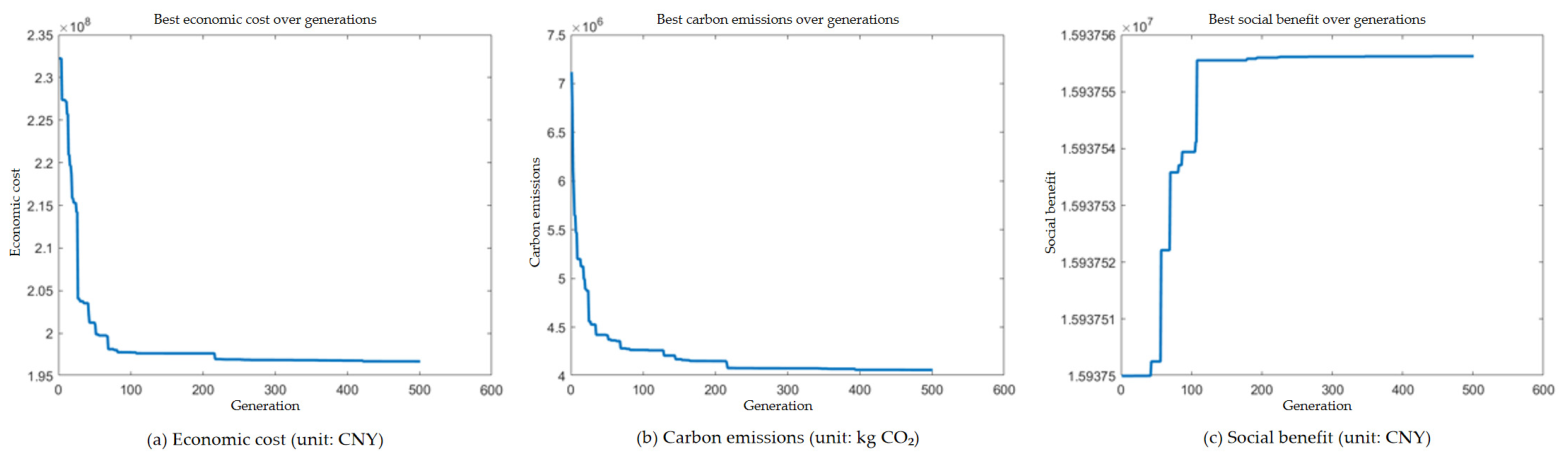
Figure 2 presents the convergence trajectories of the three objective functions over 500 generations. The curves record the best economic cost, the best carbon-emission value, and the best social-benefit value obtained during the evolutionary search. These trajectories provide evidence that the adopted NSGA-II solver reaches a stable search region before the termination generation.
As shown in
Figure 2a, the best economic-cost value decreases rapidly during the early generations and then gradually stabilizes. The final value approaches approximately 1.967 × 10
8 CNY, which is consistent with the audited lowest-economic-cost solution P14 reported in
Table 9. This indicates that the algorithm quickly identifies cost-efficient network configurations and then performs local refinement during the later search stage.
Figure 2b shows a similar convergence pattern for carbon emissions. The best carbon-emission value declines sharply at the beginning of the search and stabilizes at approximately 4.061 × 10
6 kg CO
2e. This value corresponds to about 4061 t CO
2e, which is consistent with the audited lowest-carbon-emission solution P6. The convergence pattern suggests that emission-efficient configurations can be found within the same evolutionary search process, although they do not necessarily correspond to socially preferred solutions.
Figure 2c shows that the best social-benefit value increases in a stepwise manner and reaches a stable plateau close to 1.593756 × 10
7 CNY. This value is consistent with the near-saturated social-benefit level observed in several Pareto solutions in
Table 9. The stepwise improvement indicates that social benefit is not improved continuously through marginal cost increases. Instead, it rises sharply once key resourceization-related conditions are activated, which is consistent with the low-cost ESG transition pattern identified in the audited Pareto results.
Overall, the convergence trajectories confirm that the search process can identify representative solutions for all three objectives: the lowest-cost solution P14, the lowest-emission solution P6, and the near-saturated social-benefit configurations represented by P7 and P2. However, the separate convergence of individual objective values does not imply that a single solution optimizes all objectives simultaneously. Therefore, the convergence curves should be interpreted together with the Pareto trade-off analysis in
Figure 3 and the representative solutions in
Table 10.
6.4. Algorithm Validation and Benchmark Comparison
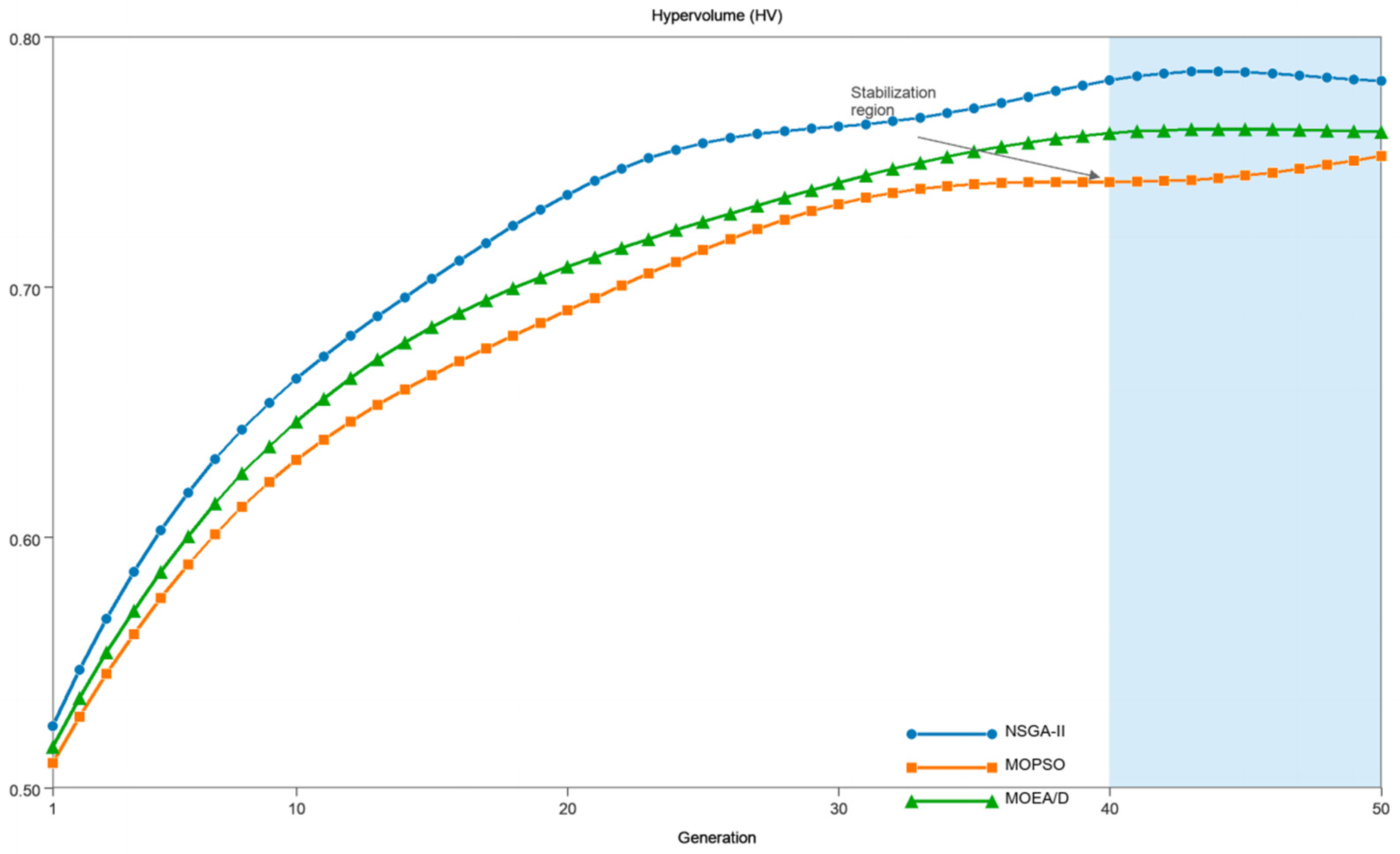
A preliminary algorithm-comparison summary is reported in
Table 4 and
Figure 3 under the validation protocol described in
Section 4, with a generation budget of Gmax = 50. The purpose of this summary is to examine whether the adopted solver can provide a stable and sufficiently diverse approximation set for the proposed problem class rather than to claim solver novelty.
Within this validation design, NSGA-II remains an appropriate solver for the maritime infrastructure-oriented ESG-endogenous model because it maintains competitive front coverage and spacing while preserving interpretable non-dominated solutions. The substantive contribution of the study remains the network model and its decision outputs.
6.5. Sensitivity Analysis and Threshold Identification
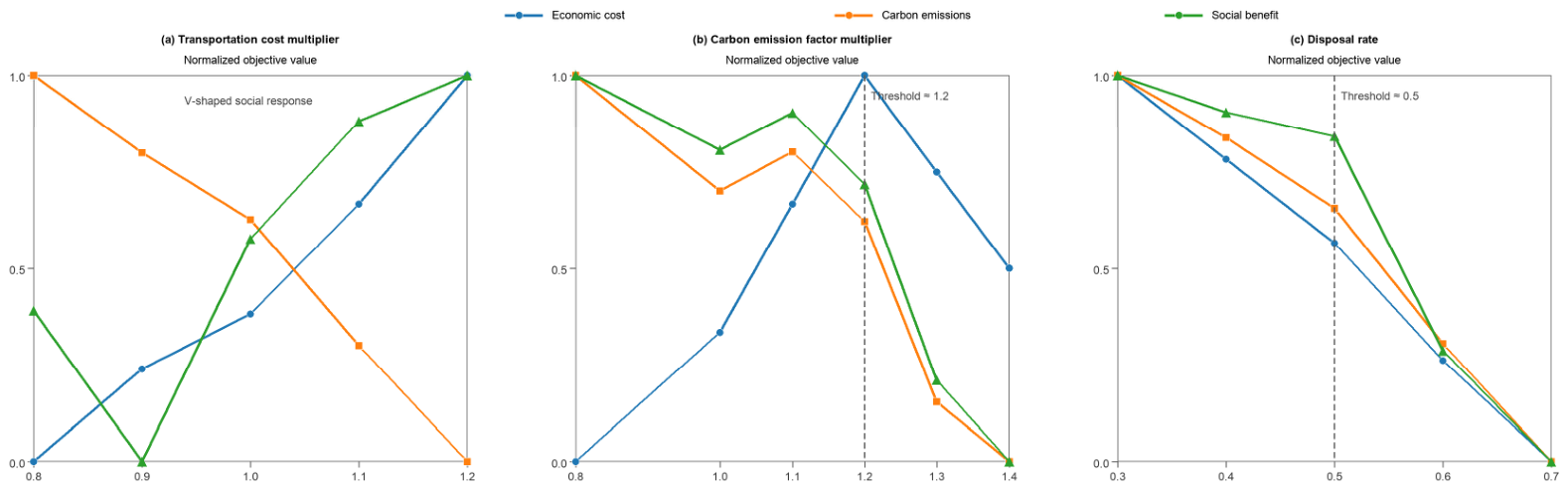
The scenario-based sensitivity patterns follow the design specified in
Section 5.6. When the transportation cost coefficient increases, economic cost rises while carbon emissions decline slightly because the network localizes allocation decisions. The social-benefit trajectory follows a V-shaped pattern, indicating that moderate freight-rate pressure may initially suppress resourceization before stronger localization restores positive social performance.
A second threshold appears in the carbon-intensity scenario. Around an emission-factor multiplier of approximately 1.2, the network shifts from a mainly cost-driven logic to a more emission-driven logic. Beyond this point, carbon emissions decrease more strongly, but social benefit weakens because long-distance reverse logistics and treatment intensity are reduced.
The disposal-rate scenario identifies an especially important control point. Once the final disposal rate approaches approximately
, the social-benefit trajectory moves toward ecological debt. This result is consistent with the audited Pareto set, which shows that the system can remain near a social-benefit plateau only after key resourceization conditions are activated. The normalized sensitivity patterns under the three scenario groups are summarized in
Figure 4.
6.6. Discussion: Comparative Insights, Managerial Implications, and Limitations
The audited results refine the interpretation of sustainable and resilient closed-loop supply-chain optimization in maritime infrastructure projects. Existing closed-loop supply-chain studies commonly demonstrate the value of integrating cost, carbon emissions, and reverse logistics into a unified optimization framework. However, the Pinglu Canal results reveal a more specific mechanism: the lowest-cost and lowest-emission configurations may still generate negative social benefit when dredged-material externalities are not effectively internalized. More importantly, the Pareto set identifies a narrow low-cost transition region in which a small increase in economic expenditure can shift the system from ecological debt to near-saturated social benefit.
This finding extends prior studies on resilient and sustainable closed-loop supply chains by showing that the key managerial issue is not simply whether resourceization is technically feasible or whether total investment should be increased. Instead, the critical decision is to identify the minimum effective activation of resourceization pathways. In the audited results, P14 and P6 represent cost- and emission-efficient endpoint configurations, but both retain negative social benefit. By contrast, P7 achieves near-saturated social benefit at a substantially lower cost and carbon level than the social-benefit upper-bound solution P2. Therefore, P2 should be interpreted as an upper-bound reference rather than as the preferred compromise.
For the Pinglu Canal project, three managerial implications can be derived. First, purely cost-minimizing or emission-minimizing solutions should not be selected as final ESG-oriented configurations, because they may preserve ecological debt. Second, the low-cost transition region around 197.3–197.8 million CNY should be treated as the main negotiation and planning interval, since it captures the point at which limited additional investment can activate positive social value. Third, project managers should monitor social-benefit plateaus and resourceization-trigger conditions rather than simply maximizing total spending. Once the system reaches the near-saturated social-benefit level, additional expenditure and carbon emissions may provide only marginal social improvement.
These findings should also be interpreted with several limitations. Some procurement and engineering data are anonymized because of commercial sensitivity, and several parameters are planning-stage estimates. The baseline model remains deterministic and does not fully capture fuel-price fluctuations, weather disruptions, demand uncertainty, or supplier-failure probabilities. In addition, the average carbon-emission coefficient simplifies heterogeneity in transport mode, fuel type, loading rate, and route conditions. The social-benefit thresholds are project-specific and should be recalibrated before the framework is transferred to other infrastructure projects. Future studies can strengthen the empirical precision of the results by incorporating real-time operational data, repeated algorithmic runs, multi-hub redundancy scenarios, and stochastic or robust optimization extensions.
7. Limitations
The proposed framework is formulated as a planning-stage deterministic baseline. This setting is appropriate for identifying structural trade-offs among supplier selection, hub activation, equipment deployment, and bidirectional material-flow allocation. However, it does not explicitly represent fuel-price fluctuations, weather-related disruptions, demand uncertainty, supplier-failure probabilities, or emergency replenishment processes. Future research can extend the framework through stochastic programming, robust optimization, and scenario-based disruption modeling.
The baseline model assumes that each construction site is served by one hub, which supports responsibility allocation, material traceability, quality control, and coordination simplicity. In practice, however, multi-hub service and multi-source supply may improve redundancy and disruption resistance. A direct extension is to relax the single-hub condition into a bounded redundancy form, , where denotes the maximum number of hubs allowed to serve site .
The transportation cost coefficient and the carbon-emission factor are treated as average baseline coefficients. This treatment keeps the model tractable and highlights network-level structural trade-offs. Nevertheless, real freight costs and emissions vary with transport mode, fuel type, payload, loading rate, route condition, and waterway accessibility. Future extensions can introduce mode- and route-specific coefficients, such as such as , , , and .
The social-benefit parameters , , , , and are project-specific planning parameters. They are used to distinguish the beneficial reuse interval, the moderate externality interval, and the severe ecological-penalty interval. These parameters should not be interpreted as universally transferable constants. When the framework is applied to other infrastructure projects, they need to be recalibrated using environmental impact assessment results, local ecological-capacity standards, expert elicitation, regional policy requirements, and, where available, empirical environmental monitoring data.
Some supplier identities, contractual prices, and engineering documents are anonymized because of commercial sensitivity. The reported data are sufficient to reproduce the network structure, demand scale, and baseline optimization logic, but more detailed operational records would improve empirical precision. Future research can incorporate decoded flow-level outputs, real freight records, repeated computational experiments, and real-time monitoring data to further validate algorithmic stability and operational applicability. These limitations do not invalidate the proposed framework, but they define the conditions under which the current results should be interpreted and extended.
8. Conclusions
This study developed an ESG-endogenous closed-loop supply-chain optimization framework for construction of an inland waterway navigation hub. The framework jointly considers resilient supplier selection, transshipment and resourceization hub activation, equipment deployment, forward material-flow allocation, and reverse dredged-material-flow allocation. By integrating economic cost, carbon emissions, and social benefit into a tri-objective formulation, the model provides a decision-support tool for evaluating cost–carbon–social trade-offs in large-scale maritime infrastructure projects.
The Pinglu Canal case was used to examine the proposed framework. The audited Pareto set contains 14 non-dominated solutions, which reveal different configuration patterns under cost-oriented, emission-oriented, and ESG-oriented preferences. NSGA-II was adopted as a suitable multi-objective solver, while the main contribution of this study lies in the integrated modeling framework and the interpretation of executable supplier–hub–equipment–flow configurations.
The audited results show that the most important managerial insight is not a simple cost-social-benefit trade-off, but a low-cost ESG transition mechanism. The lowest-economic-cost solution P14 records 196.697 million CNY, 4062.500 t CO2e, and −10.040 million CNY of social benefit, whereas the lowest-carbon-emission solution P6 records 197.074 million CNY, 4061.333 t CO2e, and the same negative social benefit. By contrast, P7 achieves a near-saturated social benefit of 15.9375 million CNY with an economic cost of 197.7467 million CNY and carbon emissions of 4628.097 t CO2e. Although P2 attains the formal upper-bound social benefit, its cost and emissions are substantially higher, while the additional social benefit over P7 is negligible. Therefore, P7 can be treated as the recommended low-cost ESG transition solution for practical planning.
For the Pinglu Canal project, the results suggest that purely cost-minimizing or emission-minimizing configurations should not be selected as final ESG-oriented plans. Instead, decision-makers should focus on the low-cost transition region around 197.3–197.8 million CNY, where limited additional investment can shift the system from ecological debt to near-saturated social benefit. The key planning task is to identify the minimum effective activation of resourceization pathways, rather than to maximize total expenditure. Monitoring the final disposal rate, carbon-emission intensity, and social-benefit plateau can help managers adjust the network before negative externalities dominate.
Future research can extend the framework in several directions. First, stochastic and robust optimization can be introduced to represent demand uncertainty, weather disruptions, fuel-price volatility, and supplier failures. Second, multi-hub redundancy and multi-source supply can be tested to strengthen resilience modeling. Third, mode-specific transport cost and emission coefficients can be incorporated to improve environmental accuracy. Finally, real-time operational data, refined environmental monitoring, decoded flow-level outputs, and repeated algorithmic validation can be used to improve empirical robustness and support broader application to other maritime infrastructure projects.