Digital Platforms, Structural Barriers and Gender Inclusion: A Systemic Model for the South African Construction Industry

 ,
,  ,
,  ,
,  and
and
Abstract
1. Introduction
2. Literature Review
2.1. Strengthening Pathways into Employment
2.2. Digital Equity-Enabling Platforms in the Construction Industry
3. Methodology
4. Results
4.1. Descriptive Statistics
4.2. Inferential Statistics: Digital Adoption, Gender Parity, and Career Predictors
4.2.1. Digital Tool Adoption Across Professions
4.2.2. Mastery of Core Digital Tools
4.2.3. Predicting Professional Career Growth
4.3. Factor Analysis: Digital Inclusivity and Structural Barriers
4.3.1. Digital Tools and Inclusivity Framework
4.3.2. Institutional Gender Equity Index
4.4. The Three-Pillar Architecture of Gender Equity
5. Discussion
6. Conclusions
Author Contributions
Funding
Institutional Review Board Statement
Informed Consent Statement
Data Availability Statement
Acknowledgments
Conflicts of Interest
Appendix A
- 1.
- What Is Your Gender?
| 1. Male | 2. Female | 3. Prefer not to say | 4. other |
- 2.
- How Old Are You (Years)?
| 1. Below 25 years | 2. 26–35 | 3. 36–45 | 4. 46–55 | 5. 55–65 | 6. Over 65 years |
- 3.
- What Is Your Profession?
| 1. Architect | 2. Quantity Surveyor | 5. Engineer | 4. City Planner | 5. Land Surveyor | 6. Construction Manager |
| Other, please specify | |||||
- 4.
- Are You Working For?
| 1. Developer | 2. Contractor | 3. Subcontractor | 4. Consultant | 5. Government | 6. Educational Institution |
| Other, please specify | |||||
- 5.
- Indicate Your Highest Level Of Education?
| 1. Diploma/Certificate | 2. Bachelor’s Degree | 3. Honors Degree | 4. Master’s Degree | 5. PhD |
| Other, please specify | ||||
- 6.
- Please indicate which professional body you are registered with.
| 1. None |
| 2. Association of South African Quantity Surveyors |
| 3. Engineering Council of South Africa |
| 4. Association of Construction Project Managers |
| 5. South African Council for the Project and Construction Management Professions |
| 6. South African Institute of Architects |
| 7. Other, please specify |
- 7.
- Please indicate the number of years of experience you have in the construction industry.
| 1. Less than 5years | 2. 6–10 years | 3. 11–15 years | 4. 16–20 years | 5. Over 21 years |
- 8.
- Please indicate the services your company provides in the construction industry (tick all applicable services).
| 1. General Civil Engineering (roads, bridges, major sewage/drainage, etc.) | 2. Buildings | 3. Design | 4. Government Regulatory Body | 5. Professional Body | 6. Educational Institution |
| Other, please specify | |||||
- 9.
- Please indicate the size of your company in terms of the number of employees.
| 1. Micro enterprise | Fewer than 10 employees |
| 2. Small enterprise | 10 to 49 employees |
| 3. Medium-sized enterprise | 50 to 249 employees |
| 4. Large enterprise | 250 or more employees |
- 10.
- For how long has your company (Institution) been in the construction business since its registration?
| please specify |
- 11.
- Please state your current position in the organization
| 1. Technical officer | 2. Middle-level manager | 3. Director level |
| Other, please specify | ||
- 12.
- On a scale of 1 to 5 (1: very low and 5: very high), what is your perceived level of mastery of the digital tool(s) you often use in your profession? Please rate your mastery as your ability to use the tool independently and effectively to complete work-related tasks (Tick even if you only master one in each line).
| Options | 1 | 2 | 3 | 4 | 5 | |
| 3D Modeling, Data Integration, & Coordination | BIM (Building Information Modeling) (Revit, ArchiCAD, Tekla Structures, Civil 3D, Allplan, Vectorworks Architect) | |||||
| Structural Analysis & Design | Structural modeling and simulation (ETABS, SAP2000, STAAD.Pro, SAFE, Robot Structural Analysis) | |||||
| Project Management & Scheduling | Planning, scheduling, cost/resource control (Primavera P6, MS Project, Buildertrend, Asta Powerproject, CoConstruct, Procore) | |||||
| Construction Site Management | On-site coordination, reporting, inspections (PlanGrid, Fieldwire, Bluebeam Revu, BIM 360, Raken, Bridgit Bench) | |||||
| Design & Drafting | 2D/3D drawing and conceptual design (AutoCAD, SketchUp, Rhino 3D, BricsCAD) | |||||
| Quantity Takeoff & Estimating | Cost estimation, quantity calculation (CostX, Bluebeam Revu, WinQS, Planswift, Candy CCS, STACKCostX, Bluebeam Revu, WinQS, Planswift, Candy CCS, STACK) | |||||
| Accounting & Financial Management | Budgeting, accounting, financial reporting (Sage 300 CRE, QuickBooks, CMiC, Jonas Construction Software) | |||||
| Surveying, Mapping & GIS | Site measurement, topography, geolocation (Trimble Business Center, Leica Geo Office, DroneDeploy, ArcGIS, Civil 3D) | |||||
| Facility & Asset Management | Maintenance, operations, asset tracking (Archibus, Planon, FM:Systems, IBM Maximo, EcoDomus) | |||||
| Cloud Collaboration & Document Mgmt | Data sharing, cloud storage, model/document access (Autodesk Construction Cloud, Trimble Connect, Asite, Procore, Aconex) | |||||
| Sustainability & Energy Analysis | Energy modeling, carbon impact, LCA (IES VE, DesignBuilder, Sefaira, One Click LCA, Tally (Revit plugin)) | |||||
| Other, please specify | ||||||
- 13.
- Indicate On A Scale Of 1 To 5, Where 1 Is Not At All And 5 Is To A Very Large Extent, The Extent To Which The Following Digital Tools Facilitate inclusivity, Diversity, Equality, And Accessibility in The South African Construction Industry.
| Options | Extent of Influence | |||||
| Not At all | Some Extent | Moderate Extent | Large Extent | Very Large Extent | ||
| 1 | 2 | 3 | 4 | 5 | ||
| 3D Modeling, Data Integration, & Coordination | BIM (Building Information Modeling) (Revit, ArchiCAD, Tekla Structures, Civil 3D, Allplan, Vectorworks Architect) | |||||
| Structural Analysis & Design | Structural modeling and simulation (ETABS, SAP2000, STAAD.Pro, SAFE, Robot Structural Analysis) | |||||
| Project Management & Scheduling | Planning, scheduling, cost/resource control (Primavera P6, MS Project, Buildertrend, Asta Powerproject, CoConstruct, Procore) | |||||
| Construction Site Management | On-site coordination, reporting, inspections (PlanGrid, Fieldwire, Bluebeam Revu, BIM 360, Raken, Bridgit Bench) | |||||
| Design & DraftingDesign & Drafting | 2D/3D drawing and conceptual design (AutoCAD, SketchUp, Rhino 3D, BricsCAD) | |||||
| Quantity Takeoff & Estimating | Cost estimation, quantity calculation (CostX, Bluebeam Revu, WinQS, Planswift, Candy CCS, STACKCostX, Bluebeam Revu, WinQS, Planswift, Candy CCS, STACK) | |||||
| Accounting & Financial Management | Budgeting, accounting, financial reporting (Sage 300 CRE, QuickBooks, CMiC, Jonas Construction Software) | |||||
| Surveying, Mapping & GIS | Site measurement, topography, geolocation (Trimble Business Center, Leica Geo Office, DroneDeploy, ArcGIS, Civil 3D) | |||||
| Facility & Asset Management | Maintenance, operations, asset tracking (Archibus, Planon, FM:Systems, IBM Maximo, EcoDomus) | |||||
| Cloud Collaboration & Document Mgmt | Data sharing, cloud storage, model/document access (Autodesk Construction Cloud, Trimble Connect, Asite, Procore, Aconex) | |||||
| Sustainability & Energy Analysis | Energy modeling, carbon impact, LCA (IES VE, DesignBuilder, Sefaira, One Click LCA, Tally (Revit plugin)) | |||||
| Other please specify | ||||||
- 14.
- Please Indicate and Specify How You Acquired Your Top Five Construction-Related Digital Skills, If Applicable.
| Skill | Method of Skill Acquisition | |||
| 1. Formal Education | 2. On the Job | 3. Informally | 4. Self-taught | |
| 1. Skill 1 | ||||
| 2. Skill 2 | ||||
| 3. Skill 3 | ||||
| 4. Skill 4 | ||||
| 5. Skill 5 | ||||
- 15.
- For How Long Have You Been Using the Identified Digital Tools in Your Professional Service, If Applicable?
| Digital Tool | Utilization Period | ||||
| 1. Less than 5 Years | 2. 6–10 Years | 3. 11–15 Years | 3. 16–20 Years | 4. Over 21 Years | |
| 1. Digital Tool 1 | |||||
| 2. Digital Tool 2 | |||||
| 3. Digital Tool 3 | |||||
| 4. Digital Tool 4 | |||||
| 5. Digital Tool 5 | |||||
- 16.
- Kindly Indicate Whether Your Gender Was a Determining Factor in Learning and Mastering the Identified Digital Tool(S).
| Digital Tools | Options | |
| Yes | No | |
| 1. Digital Tool 1 | ||
| 2. Digital Tool 2 | ||
| 3. Digital Tool 3 | ||
| 4. Digital Tool 4 | ||
| 5. Digital Tool 5 | ||
- 17.
- Please Indicate the Extent to Which the Mastery of The Identified Digital Tool(S) Influences Your Professional Career Growth on A Scale Of 1 To 5. Where
- 1.
- Not At All—No Observable Impact.
- 2.
- Some Extent—Minor Improvements in Daily Tasks Or Recognition.
- 3.
- Moderate Extent—Enabling You to Take on New Responsibilities and Receive Positive Feedback;
- 4.
- Large Extent—Promotions, New Job Offers, Or Important Professional Recognition;
- 5.
- Very Large Extent—Major Career Advancements, Leadership Positions, Or A Significant Change in Career Trajectory.
| Digital Tools | Options | ||||
| 1 | 2 | 3 | 4 | 5 | |
| Not at All | Some Extent | Moderate Extent | Large Extent | Very Large Extent | |
| 1. Digital Tool 1 | |||||
| 2. Digital Tool 2 | |||||
| 3. Digital Tool 3 | |||||
| 4. Digital Tool 4 | |||||
| 5. Digital Tool 5 | |||||
- 18.
- In which line of construction-related services do you believe that mastery of the identified digital tools can influence women’s career growth in South Africa?
| Construction Services | Extent of Influence | ||||
| Not at All | Some Extent | Moderate Extent | Large Extent | Very Large Extent | |
| 1 | 2 | 3 | 4 | 5 | |
| Architecture | |||||
| Engineering | |||||
| Construction Management | |||||
| Project Management | |||||
| Interdisciplinary collaboration | |||||
| Precision and Error Detection | |||||
| Data Analysis | |||||
| Small-scale Projects | |||||
| Virtual Reality | |||||
| Construction Site Layout | |||||
| Construction Automation | |||||
| Facility Management (FM) | |||||
| Digital Representations for Stakeholders | |||||
| Eco-friendly Construction and Sustainability | |||||
| HVAC (Heating, Ventilation, and Air Conditioning) Management | |||||
| Land Surveying | |||||
| Quantity Surveying | |||||
| Energy Efficiency | |||||
| Resource Optimization | |||||
| Data-driven Decision-making | |||||
| Integration with Urban Systems | |||||
| Lifecycle Management | |||||
| Enhanced Indoor Environment | |||||
| Other Please Specify | |||||
- 19.
- How Would You Rate the Level Of girls’ And Women’s Segregation in Accessing the Construction Field in South Africa?
| 1 | 2 | 3 | 4 | 5 |
| Not Acceptable | Acceptable | Average/Fair | Good/Satisfactory | Very Good |
- 20.
- Kindly Indicate On A Scale Of 1–5 (Where 1 Is not At All, And 5 Is To A Very large Extent), The Extent To Which The Following Factors Attract, Promote Access To, And Retention Of Women In All Levels Of Education.
| Options | Extent of Influence | ||||
|---|---|---|---|---|---|
| Not at All | Some Extent | Moderate Extent | Large Extent | Very Large Extent | |
| 1 | 2 | 3 | 4 | 5 | |
| Preventing gender bias in student admissions | |||||
| Preventing gender bias in student financial aid | |||||
| Promoting retention of women in the construction-related field through gender-sensitive mentoring | |||||
| Promoting retention of women in the construction-related field through workshops | |||||
| Promoting retention of women in the construction-related field through networks | |||||
| Preventing gender-based discrimination at all levels of education, including Master’s and Ph.D. | |||||
| Preventing sexual harassment at all levels of education, including Master’s and Ph.D. | |||||
| Promoting gender equality in the international mobility of students. | |||||
| Promoting day care/childcare facilities for students, particularly in Higher Education Institutions that offer construction-related courses. | |||||
| Other please specify | |||||
- 21.
- Below Is a List of Factors That strengthen Women’s Pathway into Employment. Based on Your Experience and Knowledge, indicate on a Scale of 1 To 5 The Extent to Which the Identified Factors Strengthen Women’s Pathway into Employment in the South African Construction Industry.
| Factors Enhancing Women’s Access to Employment in the South African Construction Industry | Extent of Influence | ||||
| Not at All | Some Extent | Moderate Extent | Large Extent | Very Large Extent | |
| 1 | 2 | 3 | 4 | 5 | |
| Industry exposure | |||||
| Gender roles and work culture | |||||
| Glass ceiling | |||||
| Job satisfaction | |||||
| Maternity leave | |||||
| Caregiving support policies | |||||
| Equal pay legislation | |||||
| Gender equality policies | |||||
| Legislation and policies | |||||
| Mass and social media | |||||
| Gender balance requirements | |||||
| Manager interactions | |||||
| Peer interactions | |||||
| Women managers | |||||
| Mentorship | |||||
| Hiring strategies | |||||
| Flexible strategies | |||||
| Caregiver leave and reintegration | |||||
| Childcare support | |||||
| Assessment procedures and metrics | |||||
| Use of infrastructure and materials suited to women’s bodies | |||||
| Mechanism against gender-based violence | |||||
| Economic policy | |||||
| Workforce policy | |||||
| SDGs/international policies | |||||
| Management trust in recruiting women | |||||
| Flexible working hours | |||||
| Institution of programs for women’s health | |||||
| Other please specify | |||||
References
- Bailey, L.E.; Nyabola, N. Digital Equity as an Enabling Platform for Equality and Inclusion. In Pathfinders for Peaceful, Just, and Inclusive Societies; NYU Center on International Cooperation: New York, NY, USA, 2021; Available online: https://www.sdg16.plus/ (accessed on 18 April 2025).
- Stride, M.; Renukappa, S.; Suresh, S. Recovering from COVID: Responsible Management and Reshaping the Economy. Bus. Res. Q. 2021, 24, 233–240. [Google Scholar]
- UNESCO. Changing the Equation Securing STEM Futures for Women; UNESCO: Paris, France, 2024. [Google Scholar]
- Nieto, A.; Murzi, H.; Akanmu, A.; Yusuf, A.O.; Ball, S.; Saad, W.; Ofori-Boadu, A.N. Challenges and Opportunities to Address Diversity, Equity, and Inclusion within the Professional Construction Industry. In Proceedings of the 7th Annual Conference on Collaborative Network for Engineering and Computing Diversity, CoNECD 2024, Arlington, VA, USA, 25–27 February 2024. [Google Scholar] [CrossRef]
- Regona, M.; Yigitcanlar, T.; Hon, C.; Teo, M. Artificial intelligence and sustainable development goals: Systematic literature review of the construction industry. Sustain. Cities Soc. 2024, 108, 105499. [Google Scholar] [CrossRef]
- The Chartered Institute of Building. CIOB Artificial Intelligence (AI) Playbook 2024; The Chartered Institute of Building: Bracknell, UK, 2024. [Google Scholar]
- Ibrahim, K.; Okanlawon, T.T.; Oyewobi, L.O.; Badamasi, A.; Dodo, M.; Jimoh, R.A. Construction 4.0: Enhancing sustainable construction practices by evaluating digital twin barriers in the Nigerian AEC industry. Eng. Constr. Archit. Manag. 2024, 33, 258–283. [Google Scholar] [CrossRef]
- Hickey, P.J.; Cui, Q. Gender diversity in US construction industry leaders. J. Manag. Eng. 2020, 36, 04020069. [Google Scholar] [CrossRef]
- Oladinrin, O.; Windapo, A.; Alencastro, J.; Rana, M. Towards a Sustainable Construction Industry: A Fuzzy Synthetic Evaluation of Critical Barriers to Entry and the Retention of Women in the South African Construction Industry. Sustainability 2025, 17, 4500. [Google Scholar] [CrossRef]
- Windapo, A.O.; Emuze, F.; Pomponi, F. (Eds.) Proceedings of the Innovative Solutions for Affordable Housing Symposium; University of Cape Town: Cape Town, South Africa, 2025. [Google Scholar] [CrossRef]
- CIOB. Shortage Occupations in Construction: A Cross-Industry Research Report; CIOB: Bracknell, UK, 2019. [Google Scholar]
- Antoine, W. The Gender Gap in Science Education: Status and Trends; UNESCO: Paris, France, 2024. [Google Scholar]
- Ottmann, D.A. Our Common Gulf Cities: Agenda for equitable AEC industries for sustainable urban development. Archnet-IJAR Int. J. Archit. Res. 2024, 18, 672–690. [Google Scholar] [CrossRef]
- Carrasco, S.; Perez Lopez, I. Linking education and practice gaps for inclusive architecture in the AEC industry. Archnet-IJAR Int. J. Archit. Res. 2024, 19, 128–148. [Google Scholar] [CrossRef]
- Lewis, A.K.; Shan, Y. Influencing factors on recruitment and retention of women in construction education: A literature review. In Construction Research Congress 2020: Safety, Workforce, and Education; American Society of Civil Engineers: Reston, VA, USA, 2020. [Google Scholar]
- Kissi, E.; Aigbavboa, C.; Thwala, D.W. Emerging Debates in the Construction Industry; Routledge: London, UK, 2023. [Google Scholar] [CrossRef]
- Davis, F.D.; Granić, A. (Eds.) Revolution of TAM. In The Technology Acceptance Model; Springer: Cham, Switzerland, 2024; pp. 59–101. [Google Scholar] [CrossRef]
- Al Salaheen, M.; Alaloul, W.S.; Musarat, M.A.; Bin Johari, M.A.; Alzubi, K.M.; Alawag, A.M. Women career in construction industry after industrial revolution 4.0 norm. J. Open Innov. Technol. Mark. Complex. 2024, 10, 100277. [Google Scholar] [CrossRef]
- Watts, J.H. Leaders of men: Women ‘managing’ in construction. Work Employ. Soc. 2009, 23, 512–530. [Google Scholar] [CrossRef]
- CIOB (Chartered Institute of Building). Construction 5.0 Poses Challenges and Opportunities. 2024. Available online: https://www.ciob.org/blog/construction-50-poses-challenges-and-opportunities-for-construction-management (accessed on 18 April 2025).
- Omrany, H.; Al-Obaidi, K.M.; Ghaffarianhoseini, A.; Chang, R.D.; Park, C.; Rahimian, F. Digital twin technology for education, training and learning in construction industry: Implications for research and practice. Eng. Constr. Archit. Manag. 2025, 33, 1836–1870. [Google Scholar] [CrossRef]
- Mazurchenko, A.; Zelenka, M. Employees’ Digital Competency Development in the Construction and Automotive Industrial Sectors. Cent. Eur. Bus. Rev. 2022, 11, 41–63. [Google Scholar] [CrossRef]
- United Nations. Measuring Gender Equality in Science and Engineering. 2016. Available online: http://unesdoc.unesco.org/images/0024/002450/245006E.pdf (accessed on 18 April 2025).
- Almusaed, A.; Yitmen, I.; Almssad, A. Reviewing and Integrating AEC Practices into Industry 6.0: Strategies for Smart and Sustainable Future-Built Environments. Sustainability 2023, 15, 13464. [Google Scholar] [CrossRef]
- Saunders, M.N.K.; Lewis, P.; Thornhill, A. Understanding research philosophy and approaches to theory development. In Research Methods for Business Students; Pearson Education Limited: London, UK, 2018. [Google Scholar]
- Kothari, C. Research Methodology: Methods and Techniques; New Age International (P) Limited: New Delhi, India, 2004. [Google Scholar]
- Rehbinder, E. Do Personal Networks Affect the Success of Foreign Venture Performance?—An Empirical Analysis of Nordic Firms in Poland; Copenhagen Business School: Copenhagen, Denmark, 2011. [Google Scholar]
- Agumba, J.N. A Construction Health and Safety Performance Improvement Model for South African Small and Medium Enterprises. Ph.D. Thesis, University of Johannesburg, Johannesburg, South Africa, 2013. [Google Scholar]
- Musonda, I. Construction Health and Safety (H&S) Performance Improvement: A Client-Centred Model. Ph.D. Thesis, University of Johannesburg, Johannesburg, South Africa, 2012. [Google Scholar]
- Zallio, M.; Chivǎran, C.; Clarkson, P.J. Exploring Inclusion, Diversity, Equity, and Accessibility in the Built Environment: A Case Study. Buildings 2024, 14, 3018. [Google Scholar] [CrossRef]
- Bustamante-Mora, A.; Diéguez-Rebolledo, M.; Hormazábal, Y.; Millar, L.; Cadena, R. Challenges and Opportunities for Sustainable Engineering: Products, Services, Technologies, and Social Inclusivity with a Gender Approach. Sustainability 2024, 16, 1888. [Google Scholar] [CrossRef]
- Majid, M.A.; Kamarudin, S.S.; Ashaari, N.I.M.; Osman, N.A.; Wahab, A.Z.A.; Suhaimi, M.S.N.M. Prospects for Inclusive Employment in the Construction Industry for People with Disabilities Through Technological Advancement. J. Eng. Sci. Technol. 2023, 16–26. [Google Scholar]
- Lamola, M.; Pooe, D.; Munongo, S. Organisational innovation and gender diversity: Insights from the civil engineering industry. Acta Commer. 2024, 24, 12. [Google Scholar] [CrossRef]
- Mhlongo, S.; Mbatha, K.; Ramatsetse, B.; Dlamini, R. Challenges, opportunities, and prospects of adopting and using smart digital technologies in learning environments: An iterative review. Heliyon 2023, 9, e16348. [Google Scholar] [CrossRef] [PubMed]



| Construct | Variables |
|---|---|
| Digital Tool Mastery | |
| BIM proficiency | |
| Structural analysis and design | |
| Project management and scheduling | |
| Construction site management | |
| Design and drafting | |
| Quantity takeoff and estimating | |
| Accounting and financial management | |
| Surveying, mapping, and GIS | |
| Facility and asset management | |
| Cloud collaboration and document management | |
| Sustainability and energy analysis | |
| Digital Skill Acquisition | |
| Method of skill acquisition | |
| Duration of digital tool use | |
| Gender as a determining factor in learning | |
| Perceived Career Growth | |
| Influence of digital mastery on career growth | |
| Barriers to Women’s Participation | |
| Glass ceiling | |
| Gender roles and work culture | |
| Industry exposure | |
| Job satisfaction | |
| Maternity leave | |
| Caregiving support policies | |
| Policy and Legislative Frameworks | |
| Equal pay legislation | |
| Gender equality policies | |
| Legislation and policies (general) | |
| Economic policy | |
| Workforce policy | |
| SDGs/international policies | |
| Gender balance requirements | |
| Organizational Practice Career Development | |
| Manager interactions | |
| Peer interactions | |
| Women managers (role models) | |
| Mentorship | |
| Hiring strategies | |
| Flexible working hours | |
| Caregiver leave and reintegration | |
| Childcare support | |
| Assessment procedures and metrics | |
| Management trusts in recruiting women | |
| Health, Safety, and Well-being Supports | |
| Infrastructure suited to women’s bodies | |
| Mechanisms against gender-based violence | |
| Programs for women’s health | |
| Educational Pathway Factors | |
| Preventing gender bias in student admission | |
| Preventing gender bias in student financial aid | |
| Promoting retention via mentoring | |
| Promoting retention via workshops | |
| Promoting retention via networks | |
| Preventing discrimination at all levels (including MSc/PhD) | |
| Preventing sexual harassment at all levels | |
| Promoting gender equality in international mobility | |
| Childcare facilities | |
| Contextual and Demographic Variables | |
| The level of women’s segregation in accessing the construction field | |
| Gender, age, profession, employment type, education, professional registration, experience, company services, company size, current position |
| Nature of Investigation | Alternatives | Responses (%) | Frequency |
|---|---|---|---|
| Gender | Male | 73.83 | 79 |
| Female | 26.17 | 28 | |
| Prefer not to say | 0.00 | 0 | |
| Other | 0.00 | 0 | |
| Age (Years) | 18–24 | 0.93 | 1 |
| 25–34 | 8.41 | 9 | |
| 35–44 | 26.17 | 28 | |
| 45–54 | 30.84 | 33 | |
| 55–64 | 23.36 | 25 | |
| 65+ | 10.28 | 11 | |
| Profession | Architect | 1.83 | 2 |
| Quantity Surveyor | 2.75 | 3 | |
| Engineer | 15.60 | 17 | |
| City Planner | 0.92 | 1 | |
| Land Surveyor | 0.00 | 0 | |
| Construction Manager | 39.45 | 43 | |
| Other | 39.45 | 43 | |
| Employment Type | Developer | 0.93 | 1 |
| Contractor | 48.60 | 52 | |
| Subcontractor | 13.08 | 14 | |
| Consultant | 11.21 | 12 | |
| Government | 3.74 | 4 | |
| Educational Institution | 4.67 | 5 | |
| Other | 17.76 | 19 | |
| Education Level | Diploma/Certificate | 52.88 | 55 |
| Bachelor’s Degree | 8.65 | 9 | |
| Honors Degree | 12.50 | 13 | |
| Master’s Degree | 8.65 | 9 | |
| PhD | 3.85 | 4 | |
| Other | 13.46 | 14 | |
| Professional Body Registration | None of the above | 34.86 | 38 |
| ASAQS | 2.75 | 3 | |
| ECSA | 11.01 | 12 | |
| ACPM | 9.17 | 10 | |
| SACPCMP | 8.26 | 9 | |
| SAIA | 0.92 | 1 | |
| Other | 33.03 | 36 | |
| Experience in the Construction Industry | Less than 5 years | 14.29 | 15 |
| 6–10 years | 23.81 | 25 | |
| 11–15 years | 20.00 | 21 | |
| 16–20 years | 15.24 | 16 | |
| Over 21 years | 26.67 | 28 | |
| Services Provided by the Company | General Civil Engineering | 57.84 | 59 |
| Buildings | 64.71 | 66 | |
| Design | 14.71 | 15 | |
| Government Regulatory Body | 5.88 | 6 | |
| Professional Body | 4.90 | 5 | |
| Other | 15.69 | 16 | |
| Company Size (Employees) | Micro (<10) | 51.89 | 55 |
| Small (10–49) | 29.25 | 31 | |
| Medium (50–249) | 11.32 | 12 | |
| Large (250+) | 7.55 | 8 | |
| Current Position | Technical Officer | 2.91 | 3 |
| Middle-level Manager | 10.68 | 11 | |
| Director Level | 78.64 | 81 | |
| Other | 7.77 | 8 |
| Digital Tool Category | Specific Tools Examples | Statistical Test | Value | p-Value | Key Finding and Interpretation |
|---|---|---|---|---|---|
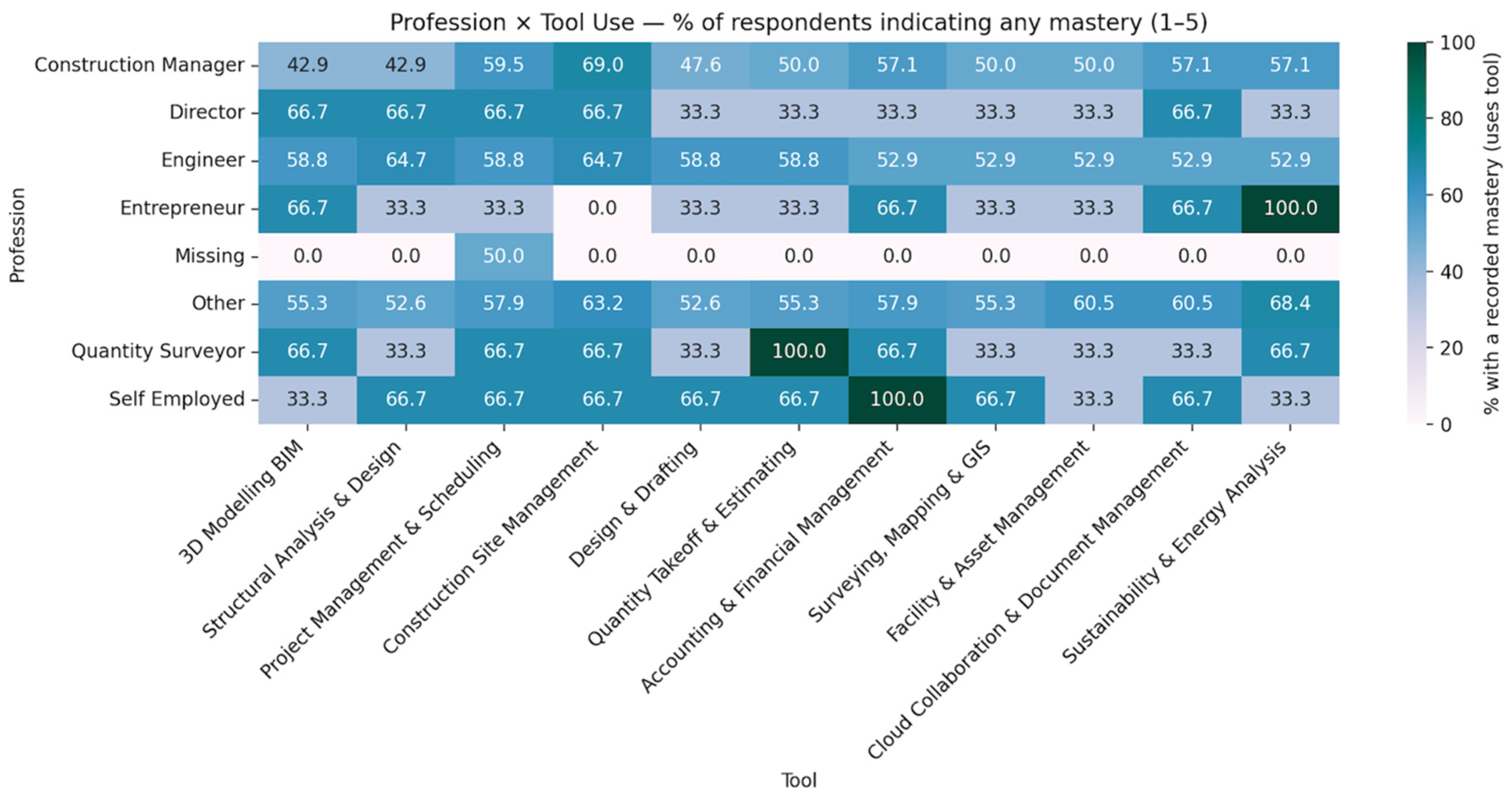
| Building Information Modeling (BIM) | Revit, ArchiCAD, Tekla, Civil 3D | Pearson Chi-Square | χ2 = 2.920 | 0.404 | No significant association. Gender is not a determinant of BIM mastery, indicating parity in this critical digital competency. |
| Structural Analysis and Design | ETABS, SAP2000, STAAD.Pro | Pearson Chi-Square | χ2 = 4.908 | 0.297 | No significant association. Women show comparable mastery in advanced engineering software, challenging stereotypes in a male-dominated discipline. |
| Project Management and Scheduling | MS Project, Primavera, Procore | Pearson Chi-Square | χ2 = 5.141 | 0.273 | No significant association. Competence in high-level project management tools is equivalent across genders. |
| Construction Site Management | Fieldwire, PlanGrid, Bluebeam | Pearson Chi-Square | χ2 = 3.056 | 0.549 | No significant association. Mastery of on-site digital coordination tools is not gender dependent. |
| Design and Drafting | AutoCAD, SketchUp, Rhino 3D | Pearson Chi-Square | χ2 = 7.150 | 0.128 | No significant association. No evidence of a gender gap in core design and drafting software proficiency. |
| Quantity and Financial Tools | CostX, Bluebeam, QuickBooks | Independent t-test | t = −0.615 | 0.540 | No significant difference. Women report similar levels of mastery in estimation and financial management tools. |
| Education vs. Company Size | N/A | Paired t-€test/Correlation | r = 0.015 | 0.873 | No significant correlation. Higher education does not guarantee a position in a larger firm, highlighting structural mobility barriers. |
| Predictor | B | Std. Error | Beta | t | p-Value |
|---|---|---|---|---|---|
| Model Summary | R2 = 0.068; Adj. R2 = −0.025 | F(10,100) = 0.734 | p = 0.691 | ||
| (Constant) | 3.028 | 0.558 | - | 5.423 | 0.000 |
| Gender | −0.248 | 0.250 | −0.099 | −0.992 | 0.324 |
| Education Level | 0.008 | 0.054 | 0.014 | 0.143 | 0.886 |
| Years of Experience | 0.012 | 0.022 | 0.054 | 0.548 | 0.585 |
| Design and Drafting Tools | 0.103 | 0.112 | 0.137 | 0.924 | 0.358 |
| Quantity Takeoff Tools | −0.057 | 0.131 | −0.068 | −0.433 | 0.666 |
| Accounting and Financial Tools | −0.184 | 0.113 | −0.214 | −1.635 | 0.105 |
| Surveying, Mapping, and GIS Tools | −0.024 | 0.115 | −0.033 | −0.212 | 0.833 |
| Facility and Asset Management Tools | 0.046 | 0.093 | 0.058 | 0.496 | 0.621 |
| Cloud Collaboration Tools | 0.072 | 0.086 | 0.096 | 0.836 | 0.405 |
| Sustainability and Energy Tools | 0.120 | 0.098 | 0.138 | 1.228 | 0.222 |
| Component/Factor | % of Variance Explained | Key Digital Tools (with Factor Loadings) | Interpretation and Role in Promoting IDEA |
|---|---|---|---|
| 1. Digital Operations and Organizational Inclusivity | 38.87% | Site Management Tools (0.755) Accounting and Finance Tools (0.720) Quantity Estimating Tools (0.683) Cloud Collaboration Tools (0.623) Sustainability Tools (0.608) | Promotes institutional fairness through transparency, standardized workflows, and reduced hierarchical gatekeeping, ensuring a level playing field and greater accountability. |
| 2. Technical and Analytical Empowerment | 13.09% | Structural Analysis Tools (0.762) GIS/Surveying Tools (0.731) Facility and Asset Management Tools (0.644) Design and Drafting Tools (0.492) | Fosters STEM participation and inclusion by equipping women with technical mastery in precision-driven domains, enabling influence over core design and analytical decisions. |
| 3. Integrative Project Leadership and Innovation | 10.88% | Project Management Tools (0.846) BIM Tools (0.640) Design and Drafting Tools (0.621) | Supports strategic leadership and cross-disciplinary coordination. Mastery here bridges the pathway to managerial roles and enhances project integration and innovation capacity. |
| Total Variance Explained | 62.84% |
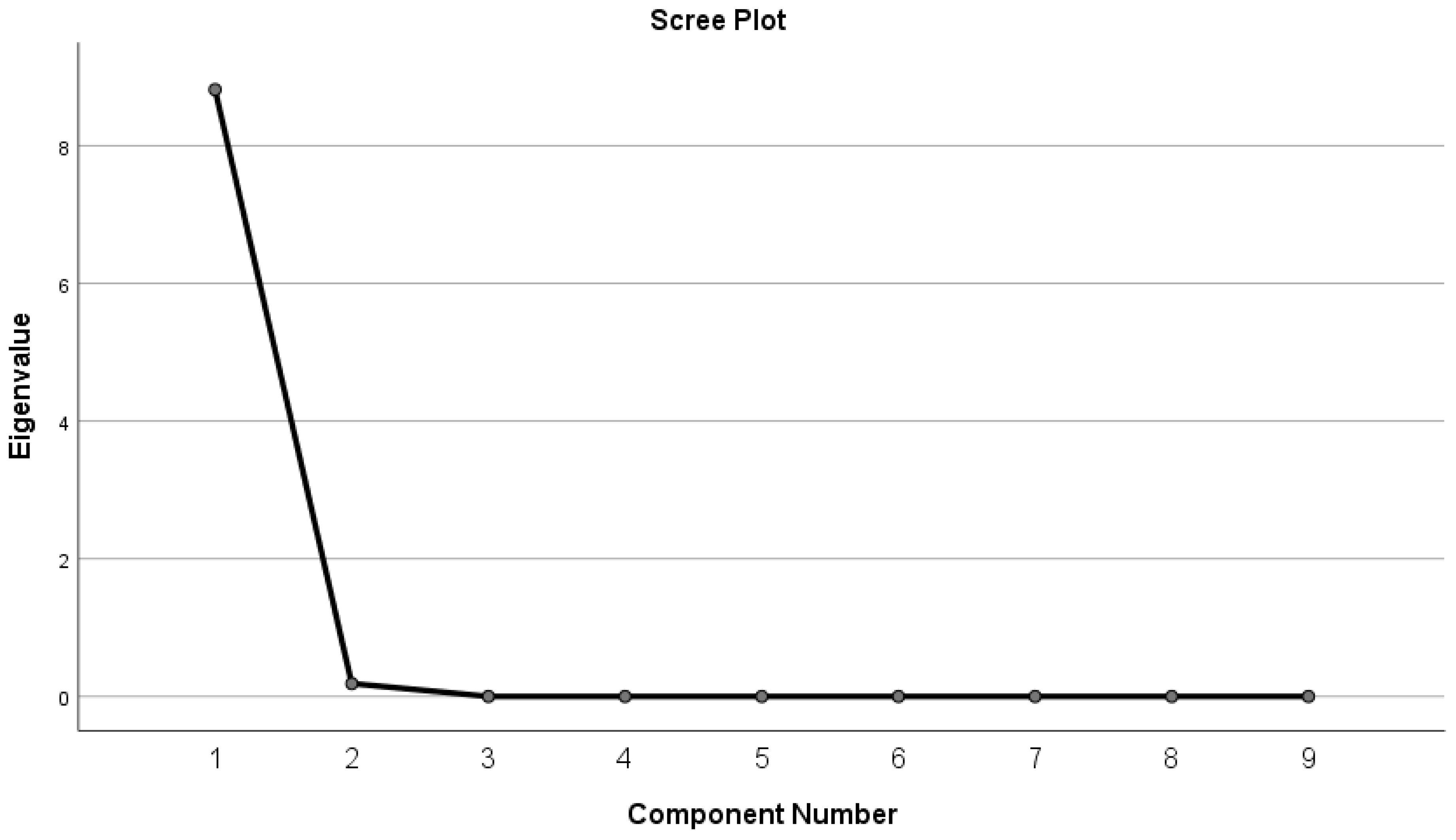
| Statistical Metric | Result | Interpretation |
|---|---|---|
| Total Variance Explained | 97.94% | An exceptionally high indicating that one overarching construct accounts for nearly all variance in responses. |
| Eigenvalue | 8.814 | Far exceeds the threshold of 1, confirming the strength and dominance of the extracted component. |
| Correlation Range | ~0.89 to 1.00 | Shows extremely high intercorrelations among variables, meaning they reflect the same core issue. |
| Component Loadings | 0.912 to 0.999 | Each variable contributes strongly and consistently to the composite factor. |
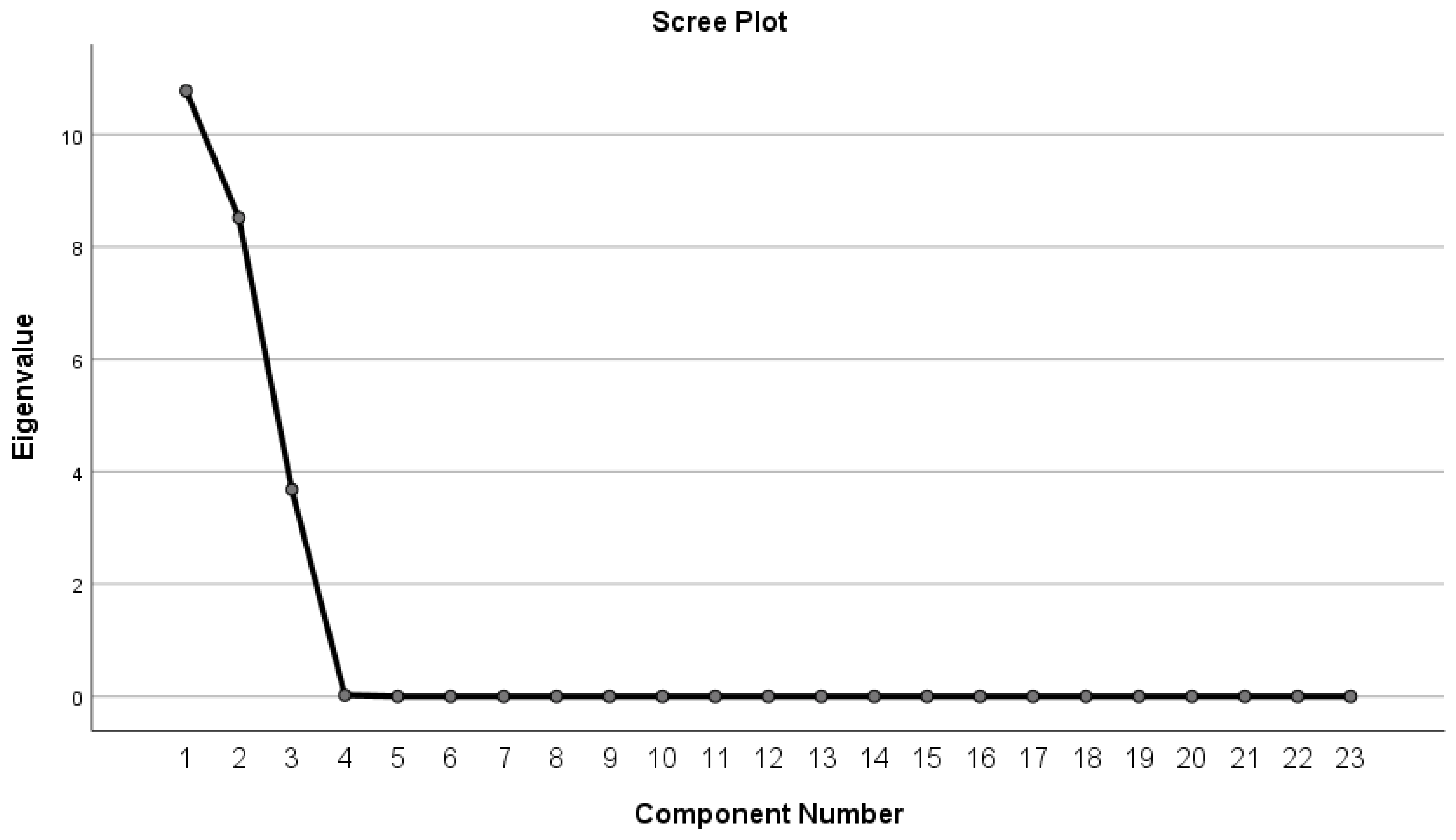
| Component/Pillar | % of Variance Explained | Key Contributing Factors (with Loadings) | Level of Intervention | Core Function |
|---|---|---|---|---|
| 1. Legislative and Structural Equality Frameworks | 46.85% | Caregiving support policies (0.990) Equal pay legislation (0.990) Gender equality policies (0.990) Women managers (0.990) Manager/Peer interactions (0.990) | Macro Level (Formal Architecture) | Establishes the foundation for inclusion through laws, institutional commitments, and visible leadership representation. |
| 2. Socioeconomic and Health Support Mechanisms | 37.04% | Programs for women’s health (0.986) Flexible working hours (0.986) Mechanisms vs. gender-based violence (0.986) Infrastructure suited to women’s bodies (0.974) | Meso Level (Enabling Environment) | Provides the practical supports that sustain participation, ensuring safety, well-being, and work–life integration. |
| 3. Organizational Practice and Career Development | 16.01% | Childcare support (0.965) Mentorship in employment (0.965) Hiring strategies (0.965) Caregivers leave and re-integration (0.965) | Micro Level (Operational Systems) | Implements daily practices that influence career progression, connecting institutional policy with lived workplace experience. |
Disclaimer/Publisher’s Note: The statements, opinions and data contained in all publications are solely those of the individual author(s) and contributor(s) and not of MDPI and/or the editor(s). MDPI and/or the editor(s) disclaim responsibility for any injury to people or property resulting from any ideas, methods, instructions or products referred to in the content. |
© 2026 by the authors. Licensee MDPI, Basel, Switzerland. This article is an open access article distributed under the terms and conditions of the Creative Commons Attribution (CC BY) license.
Share and Cite
Ngoy, K.S.; Windapo, A.; Oladinrin, O.T.; Alencastro, J.; Rana, M.Q. Digital Platforms, Structural Barriers and Gender Inclusion: A Systemic Model for the South African Construction Industry. Sustainability 2026, 18, 5655. https://doi.org/10.3390/su18115655
Ngoy KS, Windapo A, Oladinrin OT, Alencastro J, Rana MQ. Digital Platforms, Structural Barriers and Gender Inclusion: A Systemic Model for the South African Construction Industry. Sustainability. 2026; 18(11):5655. https://doi.org/10.3390/su18115655
Chicago/Turabian StyleNgoy, Kabemba Steve, Abimbola Windapo, Olugbenga Timo Oladinrin, João Alencastro, and Muhammad Qasim Rana. 2026. "Digital Platforms, Structural Barriers and Gender Inclusion: A Systemic Model for the South African Construction Industry" Sustainability 18, no. 11: 5655. https://doi.org/10.3390/su18115655
APA StyleNgoy, K. S., Windapo, A., Oladinrin, O. T., Alencastro, J., & Rana, M. Q. (2026). Digital Platforms, Structural Barriers and Gender Inclusion: A Systemic Model for the South African Construction Industry. Sustainability, 18(11), 5655. https://doi.org/10.3390/su18115655