Unlocking the Path to Sustainable Energy: An Analysis of Factors Influencing Renewable Energy Consumption in Malaysia


Abstract
1. Introduction
2. Literature Review
2.1. Theoretical Framework
2.2. Synthesis of Renewable Energy Determinants
2.2.1. Economic Growth and the Scale vs. Technique Debate
2.2.2. FDI and Trade: Pollution Halo vs. Haven Hypotheses
2.2.3. Urbanisation and Environmental Feedback
2.2.4. Trade Openness: From Market Integration to Green Spillovers
2.2.5. Energy Price Dynamics: The Substitution vs. Income Effect
3. Data and Methodology
3.1. Framework
3.2. Hypothesis Development
3.3. Data Description
3.4. Estimation of the Model
- lnREC = Renewable Energy Consumption (in natural logarithmic form);
- lnGDP = GDP per capita (in natural logarithmic form);
- lnFDI = Foreign Direct Investment Inflows (in natural logarithmic form);
- lnCO2 = CO2 Emission per capita (in natural logarithmic form);
- lnOP = Crude Oil Price (in natural logarithmic form);
- lnTO = Trade Openness (in natural logarithmic form);
- lnUG = Urbanisation (in natural logarithmic form);
- β0 = Constant/Intercept;
- β1, β2, β3, β4, β5, β6 = Parameters of the estimate;
- εt = Error term.
3.5. Empirical Model
3.5.1. Johansen and Juselius Multivariate Cointegration Test
3.5.2. Granger Causality Test Within Vector Error-Correction Modelling (VECM)
4. Result and Discussion
t-stat [7.6812] *** [−4.1228] *** [−6.3912] *** [−8.9790] *** [8.3149] *** [−10.1878] ***
5. Conclusions
Author Contributions
Funding
Institutional Review Board Statement
Informed Consent Statement
Data Availability Statement
Acknowledgments
Conflicts of Interest
References
- Calleja-Agius, J.; England, K.; Calleja, N. The Effect of Global Warming on Mortality. Early Hum. Dev. 2020, 155, 105222. [Google Scholar] [CrossRef]
- Solaun, K.; Cerdá, E. Climate Change Impacts on Renewable Energy Generation. A Review of Quantitative Projections. Renew. Sustain. Energy Rev. 2019, 116, 109415. [Google Scholar] [CrossRef]
- Shaari, M.S.; Lee, W.C.; Ridzuan, A.R.; Lau, E.; Masnan, F. The Impacts of Energy Consumption by Sector and Foreign Direct Investment on CO2 Emissions in Malaysia. Sustainability 2022, 14, 16028. [Google Scholar] [CrossRef]
- Shaari, M.S.; Abidin, N.Z.; Ridzuan, A.R.; Meo, M.S. THE IMPACTS OF RURAL POPULATION GROWTH, ENERGY USE AND ECONOMIC GROWTH ON CO2 EMISSIONS. Int. J. Energy Econ. Policy 2021, 11, 553–561. [Google Scholar] [CrossRef]
- Ridzuan, A.R.; Kumaran, V.V.; Fianto, B.A.; Shaari, M.S.; Esquivias, M.A.; Albani, A. Reinvestigating the Presence of Environmental Kuznets Curve in Malaysia: The Role of Foreign Direct Investment. Int. J. Energy Econ. Policy 2022, 12, 217–225. [Google Scholar] [CrossRef]
- Olabi, A.G.; Abdelkareem, M.A. Renewable Energy and Climate Change. Renew. Sustain. Energy Rev. 2022, 158, 112111. [Google Scholar] [CrossRef]
- Ergun, S.J.; Owusu, P.A.; Rivas, M.F. Determinants of Renewable Energy Consumption in Africa. Environ. Sci. Pollut. Res. 2019, 26, 15390–15405. [Google Scholar] [CrossRef]
- Kumaran, V.V.; Ridzuan, A.R.; Khan, F.U.; Abdullah, H.; Mohamad, Z.Z. An empirical analysis of factors affecting renewable energy consumption in association of southeast Asian nations-4 countries. Int. J. Energy Econ. Policy 2020, 10, 48–56. [Google Scholar] [CrossRef]
- Sayed, E.T.; Wilberforce, T.; Elsaid, K.; Rabaia, M.K.H.; Abdelkareem, M.A.; Chae, K.; Olabi, A.G. A Critical Review on Environmental Impacts of Renewable Energy Systems and Mitigation Strategies: Wind, Hydro, Biomass and Geothermal. Sci. Total Environ. 2020, 766, 144505. [Google Scholar] [CrossRef]
- Hirtenstein, A.; Abnett, K. Analysis-Iran War Energy Shock Sparks Global Push to Reduce Fossil Fuel Dependence. Investing.com. 2026. Available online: https://www.investing.com/news/commodities-news/analysisiran-war-energy-shock-sparks-global-push-to-reduce-fossil-fuel-dependence-4568732 (accessed on 27 May 2026).
- Energy Commission. Malaysia Energy Statistical Handbook 2023; No. 10–11; Energy Commission: Putrajaya, Malaysia, 2024. Available online: https://www.st.gov.my/sites/default/files/2026-02/Malaysia_Energy_Statistics_Handbook_2023.pdf (accessed on 20 March 2026).
- Soukiazis, E.; Proença, S.; Cerqueira, P.A. The Interconnections between Renewable Energy, Economic Development and Environmental Pollution: A Simultaneous Equation System Approach. Energy J. 2019, 40, 1–24. [Google Scholar] [CrossRef]
- Thombs, R.P. The Paradoxical Relationship between Renewable Energy and Economic Growth: A Cross-National Panel Study, 1990–2013. J. World-Syst. Res. 2017, 23, 540–564. [Google Scholar] [CrossRef]
- Shahbaz, M.; Sinha, A.; Raghutla, C.; Vo, X.V. Decomposing Scale and Technique Effects of Financial Development and Foreign Direct Investment on Renewable Energy Consumption. Energy 2021, 238, 121758. [Google Scholar] [CrossRef]
- Hoa, P.X.; Xuan, V.N.; Thu, N.T.P. Determinants of the Renewable Energy Consumption: The Case of Asian Countries. Heliyon 2023, 9, e22696. [Google Scholar] [CrossRef]
- Qamruzzaman, M. Nexus between Financial Development, Foreign Direct Investment, and Renewable Energy Consumption: Evidence from SSA. GSC Adv. Res. Rev. 2024, 18, 265–280. [Google Scholar] [CrossRef]
- Li, J.; Zhang, X.; Ali, S.; Khan, Z. Eco-Innovation and Energy Productivity: New Determinants of Renewable Energy Consumption. J. Environ. Manag. 2020, 271, 111028. [Google Scholar] [CrossRef] [PubMed]
- Oluoch, S.; Lal, P.; Susaeta, A. Investigating Factors Affecting Renewable Energy Consumption: A Panel Data Analysis in Sub Saharan Africa. Environ. Chall. 2021, 4, 100092. [Google Scholar] [CrossRef]
- Wang, J.; Hassan, M.S.; Alharthi, M.; Arshed, N.; Hanif, I.; Saeed, M.I. Inspecting non-linear behavior of aggregated and disaggregated renewable and non-renewable energy consumption on GDP per capita in Pakistan. Energy Strategy Rev. 2022, 39, 100772. [Google Scholar] [CrossRef]
- Wei, S.; Jiandong, W.; Saleem, H. The impact of renewable energy transition, green growth, green trade and green innovation on environmental quality: Evidence from top 10 green future countries. Front. Environ. Sci. 2023, 10, 1076859. [Google Scholar] [CrossRef]
- Apergis, N.; Pinar, M.; Unlu, E. How Do Foreign Direct Investment Flows Affect Carbon Emissions in BRICS Countries? Revisiting the Pollution Haven Hypothesis Using Bilateral FDI Flows from OECD to BRICS Countries. Environ. Sci. Pollut. Res. 2022, 30, 14680–14692. [Google Scholar] [CrossRef]
- Chen, C.; Pinar, M.; Stengos, T. Determinants of Renewable Energy Consumption: Importance of Democratic Institutions. Renew. Energy 2021, 179, 75–83. [Google Scholar] [CrossRef]
- Tiwari, A.K.; Nasreen, S.; Anwar, M.A. Impact of Equity Market Development on Renewable Energy Consumption: Do the Role of FDI, Trade Openness and Economic Growth Matter in Asian Economies? J. Clean. Prod. 2021, 334, 130244. [Google Scholar] [CrossRef]
- Yusoff, N.Y.M.; Ridzuan, A.R.; Soseco, T.; Wahjoedi; Narmaditya, B.S.; Ann, L.C. Comprehensive Outlook on Macroeconomic Determinants for Renewable Energy in Malaysia. Sustainability 2023, 15, 3891. [Google Scholar] [CrossRef]
- Nguyen, K.H.; Kakinaka, M. Renewable Energy Consumption, Carbon Emissions, and Development Stages: Some Evidence from Panel Cointegration Analysis. Renew. Energy 2018, 132, 1049–1057. [Google Scholar] [CrossRef]
- da Silva, P.P.; Cerqueira, P.A.; Ogbe, W. Determinants of Renewable Energy Growth in Sub-Saharan Africa: Evidence from Panel ARDL. Energy 2018, 156, 45–54. [Google Scholar] [CrossRef]
- Assi, A.F.; Isiksal, A.Z.; Türsoy, T. Renewable Energy Consumption, Financial Development, Environmental Pollution, and Innovations in the ASEAN+3 Group: Evidence from (P-ARDL) Model. Renew. Energy 2020, 165, 689–700. [Google Scholar] [CrossRef]
- Karacan, R.; Mukhtarov, S.; Barış, İ.; İşleyen, A.; Yardimci, M.E. The Impact of Oil Price on Transition toward Renewable Energy Consumption? Evidence from Russia. Energies 2021, 14, 2947. [Google Scholar] [CrossRef]
- Huang, Y.; Ahmad, M.; Ali, S. The impact of trade, environmental degradation and governance on renewable energy consumption: Evidence from selected ASEAN countries. Renew. Energy 2022, 197, 1144–1150. [Google Scholar] [CrossRef]
- Dingru, L.; Onifade, S.T.; Ramzan, M.; Al-Faryan, M.A.S. Environmental Perspectives on the Impacts of Trade and Natural Resources on Renewable Energy Utilization in Sub-Sahara Africa: Accounting for FDI, Income, and Urbanization Trends. Resour. Policy 2022, 80, 103204. [Google Scholar] [CrossRef]
- Balsalobre-Lorente, D.; Shahbaz, M.; Roubaud, D.; Farhani, S. How Economic Growth, Renewable Electricity and Natural Resources Contribute to CO2 Emissions? Energy Policy 2018, 113, 356–367. [Google Scholar] [CrossRef]
- Destek, M.A.; Sinha, A. Renewable, Non-Renewable Energy Consumption, Economic Growth, Trade Openness and Ecological Footprint: Evidence from Organisation for Economic Co-Operation and Development Countries. J. Clean. Prod. 2020, 242, 118537. [Google Scholar] [CrossRef]
- Zheng, X. Foreign Direct Investment and Carbon Emissions in Europe: Rethinking Environmental Sustainability Through Renewable Energy and Intellectual Capital. Appl. Ecol. Environ. Res. 2025, 23, 10121–10137. [Google Scholar] [CrossRef]
- Moise, M.L. Examining the Agriculture-Induced Environment Curve Hypothesis and Pollution Haven Hypothesis in Rwanda: The Role of Renewable Energy. Carbon Res. 2023, 2, 50. [Google Scholar] [CrossRef]
- Nabaweesi, J.; Kaawaase, T.K.; Buyinza, F.; Adaramola, M.S.; Namagembe, S.; Nkote, I.N. Urbanization and Modern Renewable Energy Consumption among East African Community (EAC) Countries: An Empirical Analysis. Int. J. Energy Sect. Manag. 2024, 18, 1378–1399. [Google Scholar] [CrossRef]
- Troster, V.; Shahbaz, M.; Uddin, G.S. Renewable Energy, Oil Prices, and Economic Activity: A Granger-Causality in Quantiles Analysis. Energy Econ. 2018, 70, 440–452. [Google Scholar] [CrossRef]
- Bloch, H.; Rafiq, S.; Salim, R. Economic Growth with Coal, Oil and Renewable Energy Consumption in China: Prospects for Fuel Substitution. eSpace 2014, 44, 104–115. [Google Scholar] [CrossRef]
- Mukhtarov, S.; Mikayilov, J.I.; Humbatova, S.; Muradov, V. Do High Oil Prices Obstruct the Transition to Renewable Energy Consumption? Sustainability 2020, 12, 4689. [Google Scholar] [CrossRef]
- Manni, U.H.; Mansur, D.D.K.H.M. Identifying the Drivers Responsible for Energy Security in Selected ASEAN Countries by Using Panel Data Analysis. Int. J. Energy Sect. Manag. 2023, 18, 658–682. [Google Scholar] [CrossRef]
- Ergun, S.J.; Rivas, M.F. Does Higher Income Lead to More Renewable Energy Consumption? Evidence from Emerging-Asian Countries. Heliyon 2023, 9, e13049. [Google Scholar] [CrossRef]
- Gözgör, G.; Mahalik, M.K.; Demir, E.; Padhan, H. The Impact of Economic Globalization on Renewable Energy in the OECD Countries. Energy Policy 2020, 139, 111365. [Google Scholar] [CrossRef]
- Olanrewaju, B.T.; Olubusoye, O.E.; Adenikinju, A.; Akintande, O.J. A Panel Data Analysis of Renewable Energy Consumption in Africa. Renew. Energy 2019, 140, 668–679. [Google Scholar] [CrossRef]
- Deniz, P. OIL PRICES AND RENEWABLE ENERGY: OIL DEPENDENT COUNTRIES. J. Res. Econ. 2019, 3, 139–150. [Google Scholar] [CrossRef]
- Zaghdoudi, T.; Tissaoui, K.; Maâloul, M.; Bahou, Y.; Kammoun, N. Asymmetric Connectedness between Oil Price, Coal and Renewable Energy Consumption in China: Evidence from Fourier NARDL Approach. Energy 2023, 285, 129416. [Google Scholar] [CrossRef]
- Zhou, D.; Siddik, A.B.; Guo, L.; Li, H. Dynamic Relationship among Climate Policy Uncertainty, Oil Price and Renewable Energy Consumption—Findings from TVP-SV-VAR Approach. Renew. Energy 2023, 204, 722–732. [Google Scholar] [CrossRef]
- Yahya, F.; Rafiq, M. Unraveling the Contemporary Drivers of Renewable Energy Consumption: Evidence from Regime Types. Environ. Prog. Sustain. Energy 2019, 38, 13178. [Google Scholar] [CrossRef]
- Akintande, O.J.; Olubusoye, O.E.; Adenikinju, A.F.; Olanrewaju, B.T. Modeling the determinants of renewable energy consumption: Evidence from the five most populous nations in Africa. Energy 2020, 206, 117992. [Google Scholar] [CrossRef]
- Perron, P. The Great Crash, the Oil Price Shock, and the Unit Root Hypothesis. Econometrica 1989, 57, 1361–1401. [Google Scholar] [CrossRef]
- Zivot, E.; Andrews, D.W.K. Further evidence on the great crash, the oil-price shock, and the unit-root hypothesis. J. Bus. Econ. Stat. 1992, 20, 25–44. [Google Scholar] [CrossRef]
- Shahbaz, M.; Loganathan, N.; Zeshan, M.; Zaman, K. Does Renewable Energy Consumption Add in Economic Growth? An Application of Auto-Regressive Distributed Lag Model in Pakistan. Renew. Sustain. Energy Rev. 2015, 44, 576–585. [Google Scholar] [CrossRef]
- Johansen, S.; Juselius, K. Maximum likelihood estimation and inference on cointegration—With applications to the demand for money. Oxf. Bull. Econ. Stat. 1990, 52, 169–210. [Google Scholar] [CrossRef]
- Malhotra, A. A Hybrid Econometric–Machine Learning Approach for Relative Importance Analysis: Prioritizing Food Policy. Eurasian Econ. Rev. 2021, 11, 549–581. [Google Scholar] [CrossRef]
- Stern, D.I.; Enflo, K. Causality between Energy and Output in the Long-Run. Energy Econ. 2013, 39, 135–146. [Google Scholar] [CrossRef]
- Pesaran, M.H.; Shin, Y.; Smith, R.J. Bounds Testing Approaches to the Analysis of Level Relationships. J. Appl. Econom. 2001, 16, 289–326. [Google Scholar] [CrossRef]
- Narayan, P.K. The Saving and Investment Nexus for China: Evidence from Cointegration Tests. Appl. Econ. 2005, 37, 1979–1990. [Google Scholar] [CrossRef]
- Raihan, A.; Tuspekova, A. Toward a Sustainable Environment: Nexus between Economic Growth, Renewable Energy Use, Forested Area, and Carbon Emissions in Malaysia. Resour. Conserv. Recycl. Adv. 2022, 15, 200096. [Google Scholar] [CrossRef]
- Kimura, K.; Iwata, T.; Yamamoto, K.; Murakami, T.; Phoumin, H. Investment Opportunities in Low-Carbon and Cutting-Edge Technology Deployment in Asia. RePEc:era:eriabk:2024-rpr-37; 2024; Available online: https://ideas.repec.org/b/era/eriabk/2024-rpr-37.html (accessed on 26 May 2024).
- Weber, M.; Pressburger, L.; Chau, L.W.; Khan, Z.; Waite, T.; Westphal, M.; Ling, G.H.T.; Ho, C.S.; Evans, M. Carbon Neutrality in Malaysia and Kuala Lumpur: Insights from Stakeholder-Driven Integrated Assessment Modeling. Front. Energy Res. 2024, 12, 1336045. [Google Scholar] [CrossRef]
- Chen, S.; Song, Y.; Gao, P. Environmental, Social, and Governance (ESG) Performance and Financial Outcomes: Analyzing the Impact of ESG on Financial Performance. J. Environ. Manag. 2023, 345, 118829. [Google Scholar] [CrossRef]
- Teoh, S.T. Tax Incentive for Green Initiatives in Malaysia. 2024. Available online: https://shinewingtyteoh.com/tax-incentive-green-initiatives-malaysia (accessed on 27 May 2024).
- Fernandez, M.I.; Go, Y.I.; Wong, M.L.D.; Früh, W. Malaysia’s Energy Transition and Readiness towards Attaining Net Zero: Review of the Potential, Constraints, and Enablers. Renew. Energy Focus 2024, 51, 100640. [Google Scholar] [CrossRef]
- Kaur, S. Sustainable Urbanisation Can Improve Climate Resilience in Malaysian Cities. NST Online. 2023. Available online: https://www.nst.com.my/property/2023/02/881781/sustainable-urbanisation-can-improve-climate-resilience-malaysian-cities (accessed on 26 May 2024).
- AQ Energy. Green Building Malaysia: The Ultimate Guide in 2024. 2024. Available online: https://aq.energy/blog/green-building-malaysia/ (accessed on 26 May 2024).


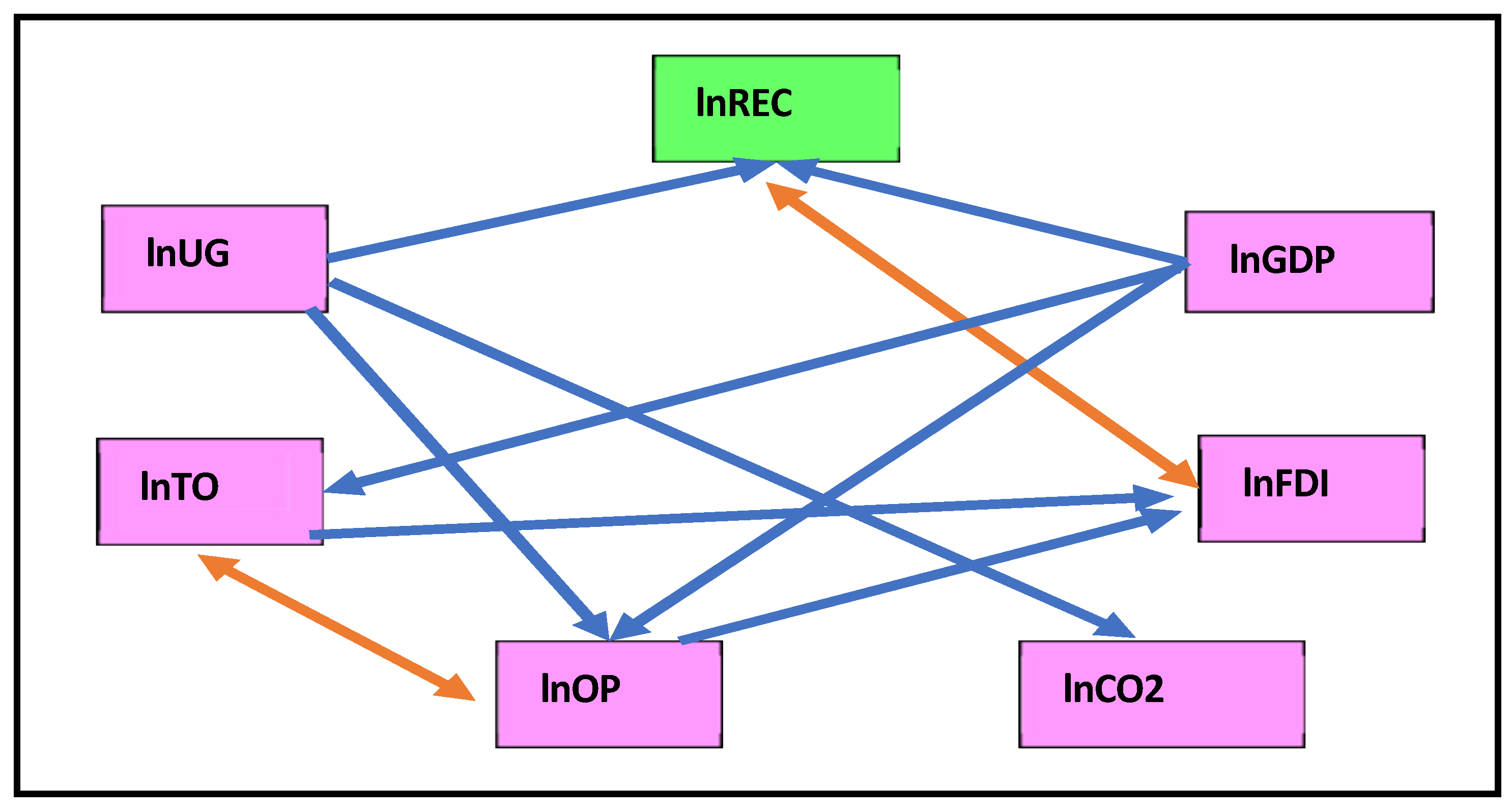
 represents one-way direction of Granger causality effect among the variables in the short run.
  represents two-way direction of Granger causality effect among the variables in the short run. Boxes in green colour is dependent variable (DV) and pink colour is independent variable (IV).
represents one-way direction of Granger causality effect among the variables in the short run. represents two-way direction of Granger causality effect among the variables in the short run. Boxes in green colour is dependent variable (DV) and pink colour is independent variable (IV).
represents two-way direction of Granger causality effect among the variables in the short run. Boxes in green colour is dependent variable (DV) and pink colour is independent variable (IV).
represents one-way direction of Granger causality effect among the variables in the short run. represents two-way direction of Granger causality effect among the variables in the short run. Boxes in green colour is dependent variable (DV) and pink colour is independent variable (IV).

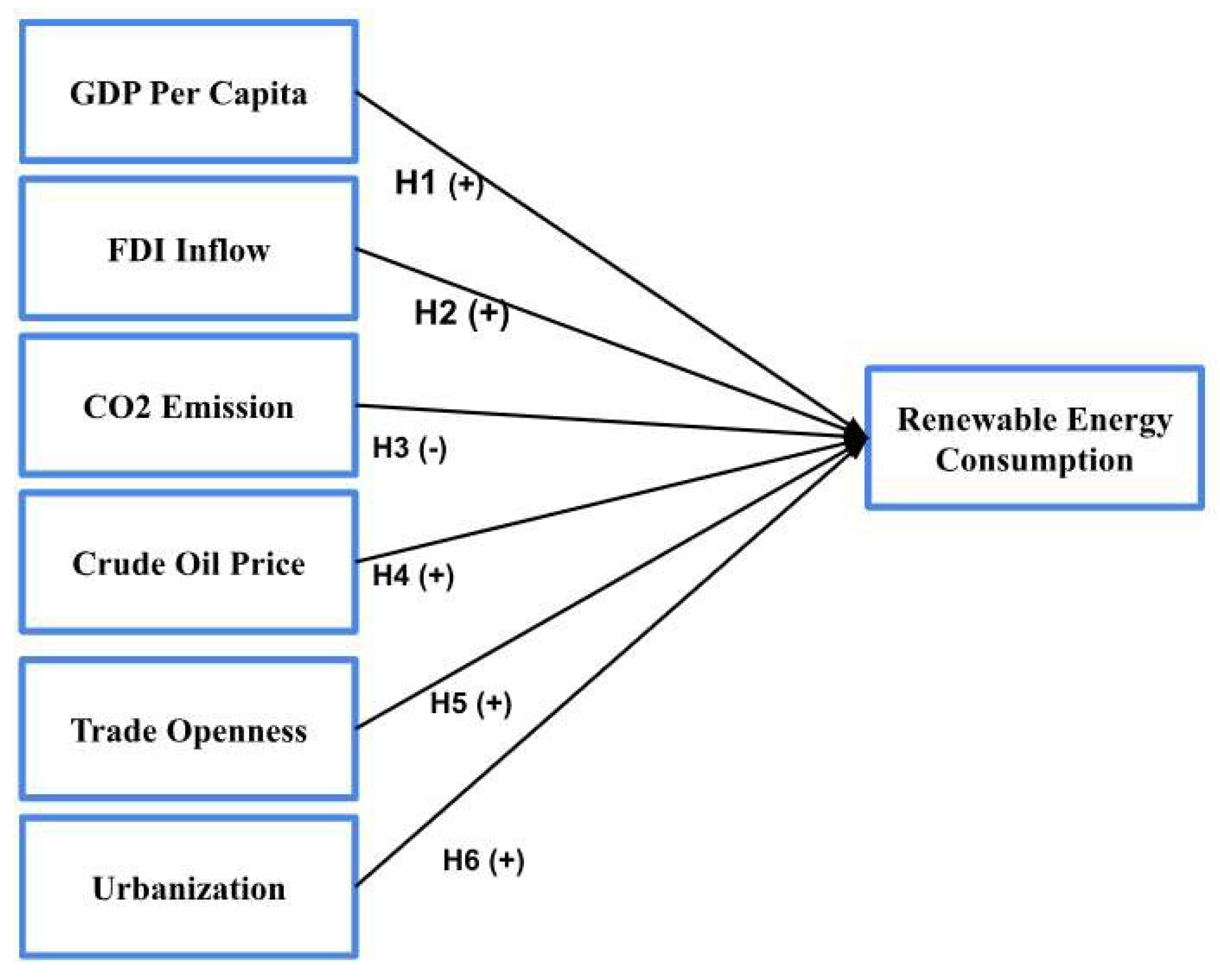
| Hypothesis | References |
|---|---|
| H1: Long-term GDP per capita and renewable energy consumption are positively correlated. | [15,17,18,22,26,27,39,40] |
| H2: Long-term FDI and renewable energy consumption are positively correlated. | [7,14,15,23,29,30,35] |
| H3: Long-term CO2 and renewable energy consumption are negatively correlated. | [18,24,26,28,38,39,41,42,43] |
| H4: Long-term Crude Oil and renewable energy consumption are positively correlated. | [22,41,43,44,45] |
| H5: Long-term Trade Openness and renewable energy consumption are positively correlated. | [8,22,23,24,30,35,43,46] |
| H6: Long-term Urbanisation and renewable energy consumption are positively correlated. | [8,24,35,47] |
| Variables | Abbreviation | Description | Source |
|---|---|---|---|
| Renewable Energy Consumption | REC | Primary renewable energy consumption is measured in terawatt-hours (TWh) | Our World In Data |
| Gross Domestic Product Per Capita | GDP | GDP per capita (current US$) | WDI |
| Foreign Direct Investment Inflows | FDI | Foreign direct investment, net inflows (BoP, current US$) | WDI |
| CO2 Emission | CO2 | CO2 emissions (metric tons per capita) | WDI |
| Crude Oil Price | OP | Crude oil prices (current US$ per barrel) | WDI |
| Trade Openness | TO | Trade (% of GDP) | WDI |
| Urbanisation | UG | Urban population growth (Population %) | WDI |
| Augmented Dickey–Fuller (ADF) Test | ||||
| Levels | First Difference | |||
| Intercept | Trend and Intercept | Intercept | Trend& Intercept | |
| lnREC | 0.2555 (0) | −1.8903 (0) | −5.5882 (1) *** | −5.6199 (1) *** |
| lnGDP | −2.5336 (1) | −2.7065 (0) | −5.4924 (0) *** | −5.8583 (0) *** |
| lnFDI | −2.3576 (1) | −3.1313 (4) | −7.7922 (1) *** | −7.7737 (1) *** |
| lnCO2 | −1.4019 (0) | −1.7342 (0) | −9.0266 (0) *** | −9.1181 (0) *** |
| lnOP | −1.5190 (4) | −2.8244 (0) | −6.5498 (0) *** | −6.6612 (0) *** |
| lnTO | −1.9679 (1) | −0.4522 (0) | −5.2737 (0) *** | −5.6884 (0) *** |
| lnUG | 1.8249 (1) | −0.3385 (0) | −5.0910 (0) *** | −6.0375 (0) *** |
| Kwiatkowski–Phillips–Schmidt–Shin (KPSS) Test | ||||
| Levels | First Difference | |||
| Intercept | Trend& Intercept | Intercept | Trend& Intercept | |
| lnREC | 0.8913 (5) *** | 0.1977 (1) ** | 0.1308 (4) | 0.0824 (5) |
| lnGDP | 0.9438 (5) *** | 0.1369 (5) * | 0.3332 (4) | 0.0773 (2) |
| lnFDI | 0.8779 (5) *** | 0.1275 (3) * | 0.1941 (15) | 0.0243 (1) |
| lnCO2 | 0.9454 (5) *** | 0.1853 (5) ** | 0.2176 (2) | 0.0658 (4) |
| lnOP | 0.7275 (5) ** | 0.1549 (1) ** | 0.2234 (0) | 0.0977 (1) |
| lnTO | 0.5288 (5) ** | 0.2233 (5) ** | 0.5360 (0) | 0.1113 (1) |
| lnUG | 0.7569 (5) *** | 0.2406 (5) *** | 0.3462 (20) | 0.0765 (1) |
| Variable | Levels | First Difference | Model | ||
|---|---|---|---|---|---|
| Breakpoint | t-Statistic | Breakpoint | t-Statistic | ||
| lnREC | 1995 | −2.9462 | 1988 | −6.5320 *** | Model C |
| lnGDP | 2014 | −3.1334 | 1998 | −7.2647 *** | Model C |
| lnFDI | 2000 | −4.0574 | 2009 | −10.7691 *** | Model C |
| lnCO2 | 1990 | −3.9157 | 1988 | −9.6590 *** | Model C |
| lnOP | 1973 | −3.3979 | 1974 | −7.7801 *** | Model C |
| lnTO | 2007 | −2.7833 | 2000 | −6.3227 *** | Model C |
| lnUG | 1984 | −2.1682 | 1992 | −8.5933 *** | Model C |
| Critical value | 10%: −4.82 | 5%: −5.08 | 1%: −5.57 | ||
| Trace Test: lnREC, lnGDP, lnFDI, lnCO2, lnOP, lnTO, lnUG (k = 2, r = 1) | |||
| H0 | H1 | λ-Trace | 95% CV |
| r = 0 | r ≥ 1 | 181.8353 ** | 125.6154 |
| r ≤ 1 | r ≥ 2 | 42.62581 | 47.85613 |
| r ≤ 2 | r ≥ 3 | 23.61112 | 29.79707 |
| r ≤ 3 | r ≥ 4 | 6.879682 | 15.49471 |
| Maximum Eigenvalue Test: lnREC, lnGDP, lnFDI, lnCO2, lnOP, lnTO, lnUG (k = 2, r = 1) | |||
| H0 | H1 | λ-Max | 95% CV |
| r = 0 | r = 1 | 52.05042 ** | 46.23142 |
| r ≤ 1 | r = 2 | 19.01469 | 27.58434 |
| r ≤ 2 | r = 3 | 16.73144 | 21.13162 |
| r ≤ 3 | r = 4 | 6.874316 | 14.26460 |
| Model | Computed F-Statistic | |||
|---|---|---|---|---|
| lnREC = f (lnGDP, lnFDI, lnCO2, lnOP, lnTO, lnUG) | 7.182 *** k = 6, n = 52 Structural break (1988) | |||
| Pesaran et al. (2001) [54] a | Narayan (2005) [55] b | |||
| Critical value | Lower bound value | Upper bound value | Lower bound value | Upper bound value |
| 1 percent | 3.15 | 4.43 | 3.656 | 5.331 |
| 5 percent | 2.45 | 3.61 | 2.726 | 4.057 |
| 10 percent | 2.12 | 3.23 | 2.309 | 3.507 |
| Dependent Variables | χ2-Statistic (p-Value) | ECTs | |||||||
|---|---|---|---|---|---|---|---|---|---|
| ∆LREC | ∆LGDP | ∆LFDI | ∆LCO2 | ∆LOP | ∆LTO | ∆LUG | Coefficient | t-Statistic | |
| ∆LREC | - | 2.904 (0.088) * | 4.169 (0.041) ** | 0.947 (0.330) | 0.099 (0.753) | 0.301 (0.583) | 3.714 (0.054) * | −0.150 | −1.723 ** |
| ∆LGDP | 0.008 (0.927) | - | 0.165 (0.685) | 0.702 (0.402) | 2.661 (0.103) | 0.184 (0.668) | 1.123 (0.289) | −0.111 | −1.858 ** |
| ∆LFDI | 2.787 (0.095) * | 1.405 (0.236) | - | 0.255 (0.613) | 3.820 (0.051) * | 2.784 (0.095) * | 0.103 (0.749) | −0.914 | −2.009 ** |
| ∆LCO2 | 0.050 (0.824) | 0.628 (0.428) | 0.235 (0.628) | - | 0.063 (0.801) | 0.118 (0.731) | 3.953 (0.047) ** | −0.041 | −1.084 |
| ∆LOP | 1.374 (0.241) | 8.344 (0.004) *** | 0.072 (0.789) | 0.914 (0.339) | - | 3.156 (0.076) * | 3.386 (0.066) * | −0.599 | −4.530 *** |
| ∆LTO | 1.166 (0.280) | 5.543 (0.019) ** | 0.666 (0.415) | 2.236 (0.135) | 7.776 (0.005) *** | - | 0.313 (0.576) | 0.018 | 0.565 |
| ∆LUG | 0.255 (0.614) | 0.650 (0.420) | 0.297 (0.586) | 0.418 (0.518) | 1.752 (0.186) | 2.102 (0.147) | - | 0.006 | 0.293 |
Disclaimer/Publisher’s Note: The statements, opinions and data contained in all publications are solely those of the individual author(s) and contributor(s) and not of MDPI and/or the editor(s). MDPI and/or the editor(s) disclaim responsibility for any injury to people or property resulting from any ideas, methods, instructions or products referred to in the content. |
© 2026 by the authors. Licensee MDPI, Basel, Switzerland. This article is an open access article distributed under the terms and conditions of the Creative Commons Attribution (CC BY) license.
Share and Cite
Goh, H.-H.; Chang, S.-H. Unlocking the Path to Sustainable Energy: An Analysis of Factors Influencing Renewable Energy Consumption in Malaysia. Sustainability 2026, 18, 5648. https://doi.org/10.3390/su18115648
Goh H-H, Chang S-H. Unlocking the Path to Sustainable Energy: An Analysis of Factors Influencing Renewable Energy Consumption in Malaysia. Sustainability. 2026; 18(11):5648. https://doi.org/10.3390/su18115648
Chicago/Turabian StyleGoh, Han-Hwa, and Shu-Hong Chang. 2026. "Unlocking the Path to Sustainable Energy: An Analysis of Factors Influencing Renewable Energy Consumption in Malaysia" Sustainability 18, no. 11: 5648. https://doi.org/10.3390/su18115648
APA StyleGoh, H.-H., & Chang, S.-H. (2026). Unlocking the Path to Sustainable Energy: An Analysis of Factors Influencing Renewable Energy Consumption in Malaysia. Sustainability, 18(11), 5648. https://doi.org/10.3390/su18115648