Article

Unlocking the Path to Sustainable Energy: An Analysis of Factors Influencing Renewable Energy Consumption in Malaysia


Faculty of Management, Multimedia University, Persiaran Multimedia, Cyberjaya 63100, Selangor Darul Ehsan, Malaysia
*
Author to whom correspondence should be addressed.
Sustainability 2026, 18(11), 5648; https://doi.org/10.3390/su18115648
Submission received: 18 April 2026 / Revised: 29 May 2026 / Accepted: 1 June 2026 / Published: 3 June 2026

Abstract

The paper seeks to determine whether renewable energy is a future pathway for society or rather a temporary stage leading towards sustainable sources of energy. It evaluates the factors that affect the use of renewable energy in Malaysia through modelling their long-term relationship and short-term causalities. Time-series data collected from 1970 to 2021 is used in the Johansen cointegration test and Vector Error Correction Model (VECM) to determine the association among renewable energy consumption, per capita GDP, foreign direct investments (FDI), carbon dioxide (CO2) emissions, oil prices, trade openness, and urbanisation. There is evidence of a strong positive long-term association between renewable energy consumption and per capita GDP. However, there is evidence of a negative long-term relationship between renewable energy and FDI, CO2 emissions, oil prices, and urbanisation. There is a positive relationship between renewable energy consumption and trade openness in the long term. In addition, short-term causality analysis shows the existence of a feedback loop between renewable energy consumption, economic growth, and FDI. Overall, the paper provides empirical evidence for the carbon-neutral target set by Malaysia in 2050.

1. Introduction

Tackling the pressing issue of global warming is of paramount importance because it directly affects the well-being of humanity. Global warming is responsible for the irreversible loss of crucial resources, the occurrence of droughts and floods, disruptions in ecosystems, and threats to human lives [1,2]. Despite its detrimental effects, many countries continue to heavily depend on fossil fuels and coal due to their cost-effectiveness [3,4,5]. Utilising natural resources including hydropower, sun, wind, bioenergy, waves, geothermal, and tide power, renewable energy [6], is considered by some experts to be a potent solution for curbing carbon emissions and mitigating environmental pollution [7,8].
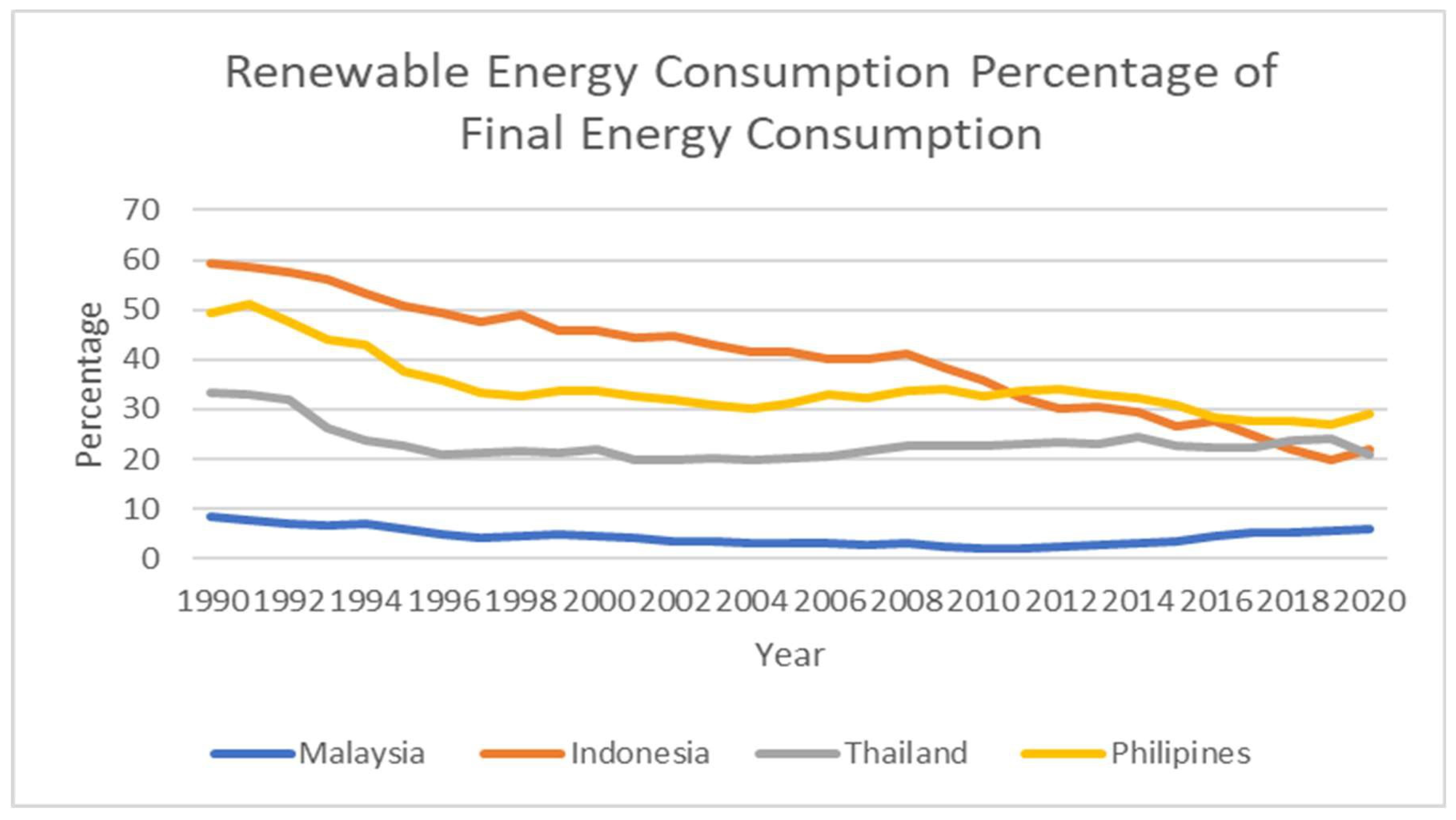
According to Figure 1, Malaysia has the lowest renewable energy consumption among the ASEAN-4 countries, which includes Indonesia, the Philippines, and Thailand. The comparison among these four developing nations, including Malaysia, is pertinent due to their geographical proximity and competitive nature. Specifically, these ASEAN-4 countries were selected because they represent the major emerging and relatively industrialised economies in Southeast Asia, characterised by comparable economic structures, energy demand patterns, trade integration, and industrial development trajectories. Malaysia experiences competition due to other countries around them that show greater per capita use of renewable energy. However, Malaysia’s per capita use of renewable energy stands at 5.84% compared to 28% for the Philippines, even after implementing various policies and incentives to increase renewable energy usage [8]. Malaysia encounters many challenges in shifting to renewable energy sources due to its heavy dependence on subsidised fossil fuels and relatively low renewable energy adoption compared to other ASEAN countries. Rapid urbanisation, industrial growth, and fossil-fuel-oriented foreign direct investments continue to increase energy demand while slowing the development of green energy infrastructure and technologies. While the Malaysian government’s objectives remain intact, the utilisation rate of renewable energy as part of the country’s energy mix remains unchanged at 7.24% between 2015 and 2018 [9].
Furthermore, Malaysia’s heavy reliance on foreign energy is a significant threat to its energy security and economic stability due to expectations of increased costs of energy globally—specifically crude oil, natural gas, and coal (U.S. Energy Information Administration). The threat is further complicated by recent geopolitical tensions in the Middle East, particularly involving Iran and disruptions around the Strait of Hormuz, which have intensified global energy market uncertainty and increased oil price volatility, thereby affecting energy security and renewable energy transition policies worldwide [10]. As illustrated by the figures found in [11], Malaysia’s dependency on foreign energy in 2019 was 100% for coal and coke, 55.2% for petroleum products, 38.1% for crude oil, 16.3% for piped natural gas, and 4% for liquefied natural gas (LNG). Therefore, developing renewable energy capacity is crucial in reducing Malaysia’s dependency on non-renewable energy sources.
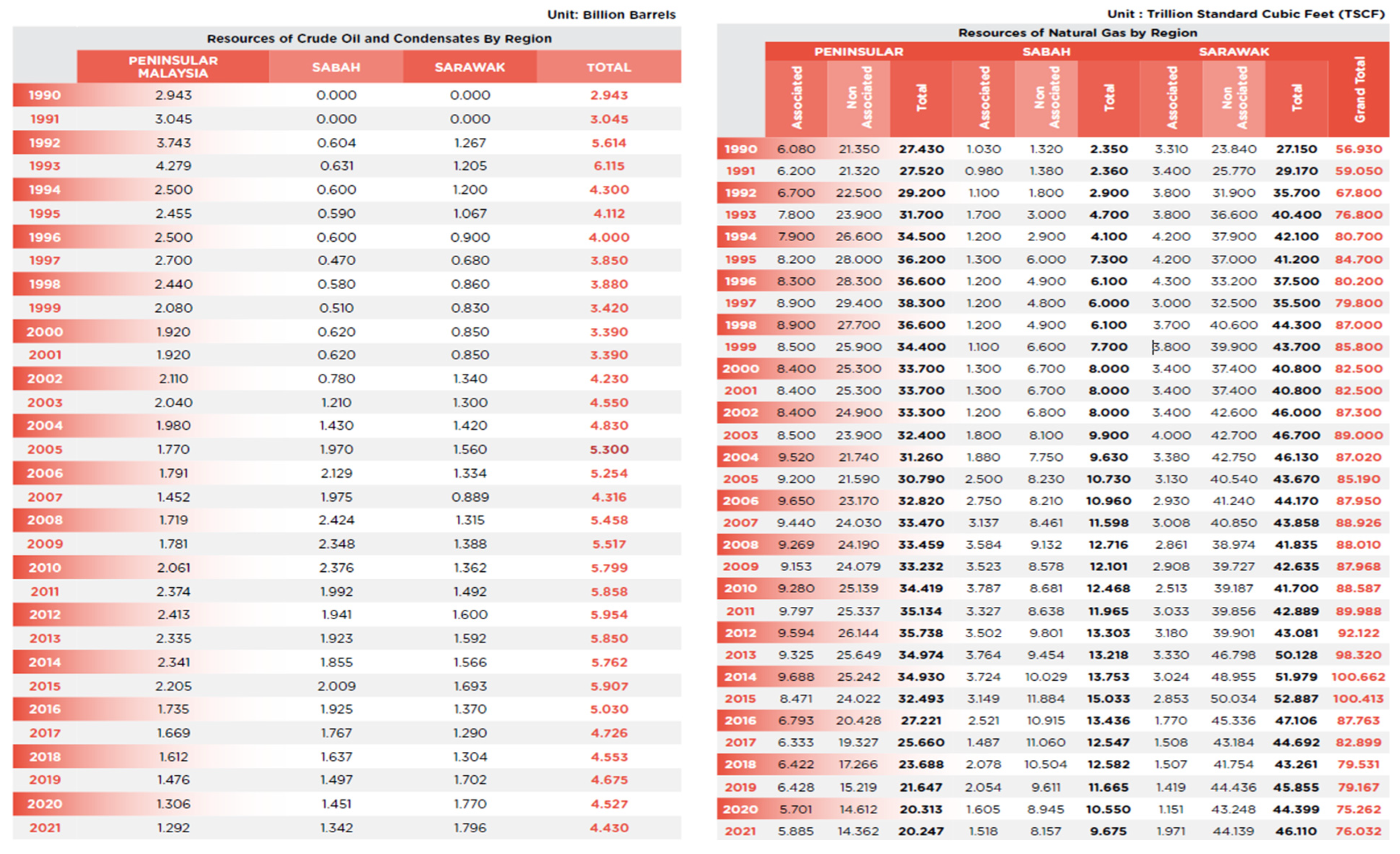
Figure 2 depicts the reserves of crude oil and natural gas. As can be seen from Figure 2, both reserves demonstrate a downward trend during the observed period. It should be noted that there is a short-term increase in the reserves of non-renewable energy sources, namely crude oil and natural gas, from 2018 to 2019. However, this temporary increase cannot offset the general depletion trend and, therefore, raises questions regarding energy security. The decrease in the reserves of crude oil (2015–2021) and natural gas (2014–2020), depicted in Figure 2, are critical indicators for encouraging Malaysia to think about renewable energy.
This study enhances the existing literature in multiple significant aspects. Empirically, it offers extensive long-term time-series evidence (1970–2021) about the factors influencing renewable energy use in Malaysia, rectifying discrepancies in previous research and presenting novel insights into energy transition dynamics within the ASEAN framework. Methodologically, the study utilises a Vector Error Correction Model (VECM) to concurrently identify long-term equilibrium linkages and short-term causal dynamics, facilitating a more robust and dynamic evaluation of the energy-growth nexus than traditional single-equation methods. The findings of the study theoretically disclose intricate and unconventional relationships, notably the adverse effects of foreign direct investment and the influence of structural factors like urbanisation and oil prices, thereby contesting the presumption that economic integration and growth inherently facilitate the adoption of renewable energy. Overall, the study offers policy-relevant evidence on how emerging economies, such as Malaysia, might strategically transition to renewable energy amidst present geopolitical threats and structural hurdles to attain long-term energy sustainability and carbon-neutrality goals.

2. Literature Review

2.1. Theoretical Framework

The adoption of renewable energy is often theorised through the lens of the Environmental Kuznets Curve (EKC) and Ecological Modernization Theory. The EKC hypothesis suggests an inverted U-shaped relationship where environmental degradation initially increases with economic growth but eventually declines as high-income nations transition toward cleaner production processes and sustainable practices [12,13]. This transition is driven by the “technique effect,” where technological advancements and structural shifts toward service-oriented economies promote resource efficiency [14]. Complementarily, Ecological Modernization Theory posits that economic development, technological progress, and institutional reforms can promote environmental sustainability through greater adoption of renewable energy [13]. In this study, the theory explains how factors such as GDP per capita, FDI, trade openness, urbanisation, CO2 emissions, and oil prices may influence Malaysia’s transition towards sustainable energy consumption.

2.2. Synthesis of Renewable Energy Determinants

2.2.1. Economic Growth and the Scale vs. Technique Debate

Existing literature reveals a tension between the “scale effect” (increased production leading to higher energy demand) and the “technique effect” (investment in green innovation). While studies in developed regions like Japan and Korea support the positive link between GDP and renewable energy consumption [15], the scale effect often dominates in developing regions where income constraints and cheap fossil fuels limit uptake [16]. The empirical findings have been inconsistent in terms of geographical location and methodology employed. Reference [17] noted that high income levels were associated with increased use of non-renewable energy in OECD countries through the CS-ARDL model for the period from 1990 to 2017. Likewise, Reference [18] discovered that income constraints limited renewable energy uptake among 23 Sub-Saharan African countries because fossil fuels were relatively cheaper than renewable energy. On the other hand, Reference [19] identified an inverted-U shape in Pakistan, which means that renewable energy consumption first decreases with economic growth and later increases with the importance of sustainability.

2.2.2. FDI and Trade: Pollution Halo vs. Haven Hypotheses

The role of Foreign Direct Investment and trade openness is characterised by two competing hypotheses. The Pollution Halo Hypothesis suggests that FDI promotes renewable energy use by facilitating technology transfer and providing access to international green capital [14,20]. Conversely, the Pollution Haven Hypothesis argues that countries with lax environmental regulations attract FDI into carbon-intensive sectors, effectively decreasing the deployment of renewable energy [21,22]. Reference [15] confirms the positive impact of renewable energy consumption on FDI because, in their opinion, foreign investments make it possible for investors to gain access to financial capital, innovations, and international markets. The same pattern was found by [23], who confirmed that the effect of FDI on renewable energy adoption is evident in 16 Asian countries, especially under circumstances when countries lack financial resources. On the contrary, in the study of [24], FDI leads to negative results in Malaysia due to the fact that the majority of funds received from foreign investors goes into fossil fuels industry.

2.2.3. Urbanisation and Environmental Feedback

The impact of urbanisation reflects a similar analytical divide. From an ecological modernisation perspective, urbanisation promotes efficiency through centralised energy systems and green infrastructure [8]. However, rapid urbanisation in developing contexts can create a “metabolic rift,” where the increasing demand for traditional energy sources outpaces the development of expensive renewable alternatives, leading to a negative correlation with renewable energy consumption [13,16]. The link between renewable energy usage and environmental quality with regard to CO2 emissions is ambiguous. According to [25], there exists a positive long-term connection between the two variables in developing and emerging economies, which shows the continuous use of fossil fuels at the early stage of development. On the other hand, References [26,27] found a negative correlation between the use of renewable energy and CO2 emissions in Sub-Saharan Africa and ASEAN+3 nations, respectively, highlighting the advantage of reducing emissions from renewable energy usage. Conversely, Reference [28] found no correlation in Russia, indicating that the environmental effect of renewable energy might be different depending on the specific energy system of individual nations. The impact of urbanisation on renewable energy use is still not well-defined. According to [8], there exists a positive correlation between renewable energy consumption and urbanisation, implying that urbanisation promotes the use of efficient and renewable forms of energy. However, according to [29,30], there exist negative correlations because urbanisation leads to an increase in energy demands, which are usually met using traditional energy sources since renewable energy sources are relatively expensive.

2.2.4. Trade Openness: From Market Integration to Green Spillovers

The impact of trade openness on renewable energy consumption is a product of three distinct mechanisms: the scale, composition, and technique effects [31]. Through the Technique Effect, trade acts as a conduit for technology transfer, allowing developing nations to leapfrog traditional carbon-intensive development by importing green expertise and high-efficiency equipment [32,33]. This supports the Pollution Halo Hypothesis, where trade-related knowledge transfer significantly reduces CO2 emissions and promotes renewable energy adoption [34]. However, the Scale Effect suggests that trade openness can lead to higher emissions if the resulting economic growth outpaces technological gains, particularly in developing nations where production remains fossil-fuel-dependent [31]. Ref. [35] proves that more trade openness encourages technology transfers and ensures better availability of renewable energy technologies; thus, it leads to an increase in renewable energy use among the East African Community. On the contrary, Reference [8] finds a negative impact of trade openness on the demand for renewable energy for the selected Asian economies like Indonesia, Malaysia, Philippines, and Thailand due to their dependence on pollution-inducing energy resources for industrial development.

2.2.5. Energy Price Dynamics: The Substitution vs. Income Effect

The relationship between oil prices and renewable energy consumption is defined by the analytical tension between substitution and income effects. Theoretically, a substitution effect is expected: as oil prices rise, the relative profitability and attractiveness of renewable alternatives increase, incentivising both public and private investment in green energy [22,36]. For example, empirical evidence from China indicates a high cross-price elasticity, where a rise in fossil fuel prices (coal and oil) significantly boosts renewable energy consumption [37]. Conversely, an income effect (or wealth effect) can lead to a negative relationship, particularly in oil-exporting nations like Russia, where higher oil prices may paradoxically slow the transition to renewables by reinforcing the economic dominance of the conventional energy sector [28,38]. Furthermore, in some contexts, oil price volatility creates market uncertainty that hampers long-term renewable energy investment, leading to statistically insignificant relationships in various emerging economies [22,38]. This suggests that the “green transition” is not merely a response to price signals but is moderated by a country’s relative position as an oil importer or exporter and its internal tax structures [36].

3. Data and Methodology

3.1. Framework

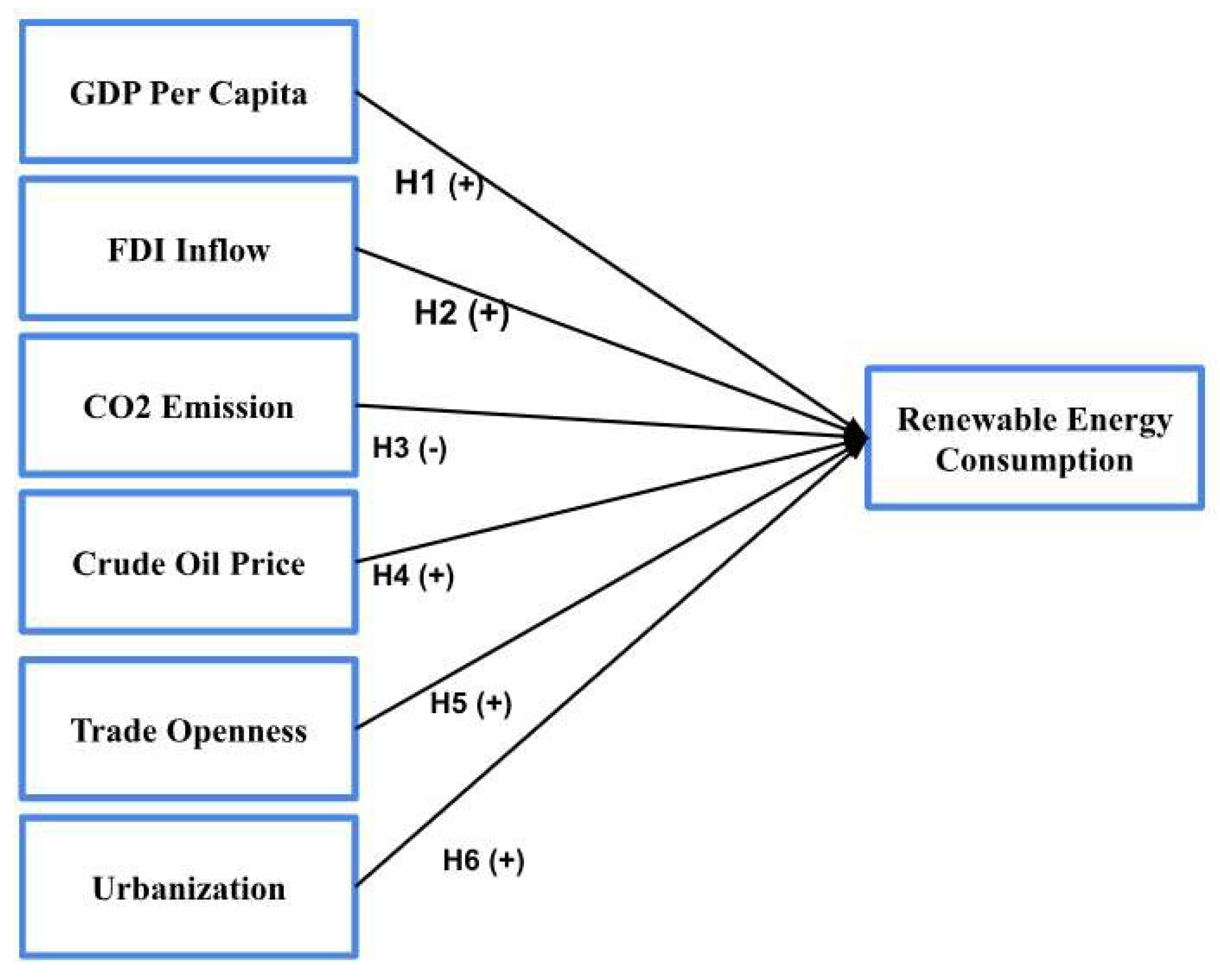
Figure 3 outlines the conceptual framework, identifying the key drivers of Malaysia’s renewable energy consumption. GDP per capita (H1), FDI inflow (H2), crude oil prices (H4), trade openness (H5), and urbanisation (H6) are identified as positive catalysts for the transition towards sustainable energy sources. Conversely, CO2 emissions (H3) are expected to negatively impact this transition. By evaluating these variables, the framework serves as a formal basis for testing the proposed hypotheses and examining how macroeconomic and environmental factors shape the transition to sustainable energy.

3.2. Hypothesis Development

Table 1 presents the hypotheses formulated for this study based on the existing literature regarding renewable energy consumption. These hypotheses examine the long-run relationships between renewable energy consumption and six key determinants. Together, they provide a robust framework for the empirical analysis, enabling a comprehensive assessment of the macroeconomic and environmental factors shaping the energy landscape.

3.3. Data Description

In this empirical research, we used secondary data which is time-series data to examine the relationship between GDP per Capita, FDI Inflows, CO2 Emission, Crude Oil Price, Trade Openness, Urbanisation between renewable energy consumption. As shown in the Table 2, the data is collected from World Development Indicators (WDI) and Our World In Data from Year 1970 to 2021 which is 52 years of annual data.

3.4. Estimation of the Model

lnRECt = β0 + β1lnGDPt + β2lnFDIt + β3lnCO2t + β4lnOPt + β5lnTOt + β6lnUGt + εt
where
  • lnREC = Renewable Energy Consumption (in natural logarithmic form);
  • lnGDP = GDP per capita (in natural logarithmic form);
  • lnFDI = Foreign Direct Investment Inflows (in natural logarithmic form);
  • lnCO2 = CO2 Emission per capita (in natural logarithmic form);
  • lnOP = Crude Oil Price (in natural logarithmic form);
  • lnTO = Trade Openness (in natural logarithmic form);
  • lnUG = Urbanisation (in natural logarithmic form);
  • β0 = Constant/Intercept;
  • β1, β2, β3, β4, β5, β6 = Parameters of the estimate;
  • εt = Error term.

3.5. Empirical Model

The renewable energy consumption (REC), GDP per capita (GDP), foreign direct investment (FDI), CO2 emission (CO2), crude oil price (OP), trade openness (TO), and urbanisation (UG) variables’ stationarity is evaluated using the Augmented Dickey–Fuller (ADF) and Kwiatkowski–Phillips–Schmidt–Shin (KPSS) unit root tests. It is essential for these variables to exhibit non-stationarity in levels and stationarity at first differences, denoted as I(1) or an integrated process of order one, as a prerequisite before proceeding with the Johansen and Juselius multivariate cointegration test. Cointegration exists when the variables are integrated of the same order and there is a stationary linear combination of them. However, conventional unit root tests such as ADF may yield biassed results in the presence of structural breaks because they assume a stable data-generating process [48]. To address this limitation, the [49] unit root test is employed, as it endogenously identifies a single structural break in the series. The test is conducted under three specifications: Model A permits a break in the intercept, Model B allows a break in the trend, and Model C allows breaks in both the intercept and trend. In addition, the Autoregressive Distributed Lag (ARDL) bounds testing approach is also applied to further examine the cointegration relationship among the variables, as it provides robust results in the presence of a structural break, mixed integration orders of I(0) and I(1), small sample sizes, and exogenous variables. Following [50], a dummy variable is incorporated into the ARDL model to capture a structural break, and the ARDL F-statistic is used to determine the existence of cointegration among the variables.

3.5.1. Johansen and Juselius Multivariate Cointegration Test

Ref. [51] multivariate cointegration test is utilised to examine whether there is a long-run relationship between the dependent variable (renewable energy consumption) and independent variables (GDP per capita, foreign direct investment, CO2 emission, crude oil price, trade openness, and urbanisation) using trace and maximum eigenvalue statistics.

3.5.2. Granger Causality Test Within Vector Error-Correction Modelling (VECM)

Upon establishing the cointegration of the variables, the Vector Error Correction Model (VECM) can be employed. Granger causality tests within the VECM framework are then used to study the causal relationships among the variables. It is important to note that these causal relationships reflect predictive precedence within the VECM framework rather than absolute economic causation, as the observed associations could be influenced by omitted institutional or market factors [52,53].
ln R E C t = a 1 + i = 1 k φ 1 i l n R E C t 1 i = 1 k θ 1 i ln G D P t 1 +   i = 1 k δ 1 i ln F D I t 1 + i = 1 k γ 1 i ln C O 2 t 1   + i = 1 k ω 1 i ln O P t 1 + i = 1 k β 1 i ln T O t 1       + i = 1 k ϑ 1 i ln U G t 1       + λ 1 ε t 1 + μ 1 t
ln G D P t = a 2 + i = 1 k φ 2 i l n R E C t 1 i = 1 k θ 2 i ln G D P t 1 +   i = 1 k δ 2 i ln F D I t 1 + i = 1 k γ 2 i ln C O 2 t 1   + i = 1 k ω 2 i ln O P t 1 + i = 1 k β 2 i ln T O t 1       + i = 1 k ϑ 2 i ln U G t 1       + λ 2 ε t 1 + μ 2 t
ln F D I t = a 3 + i = 1 k φ 3 i l n R E C t 1 i = 1 k θ 3 i ln G D P t 1 +   i = 1 k δ 3 i ln F D I t 1 + i = 1 k γ 3 i ln C O 2 t 1   + i = 1 k ω 3 i ln O P t 1 + i = 1 k β 3 i ln T O t 1       + i = 1 k ϑ 3 i ln U G t 1       + λ 3 ε t 1 + μ 3 t
ln C O 2 t = a 4 + i = 1 k φ 4 i l n R E C t 1 i = 1 k θ 4 i ln G D P t 1 +   i = 1 k δ 4 i ln F D I t 1 + i = 1 k γ 4 i ln C O 2 t 1   + i = 1 k ω 4 i ln O P t 1 + i = 1 k β 4 i ln T O t 1       + i = 1 k ϑ 4 i ln U G t 1       + λ 4 ε t 1 + μ 4 t
ln O P t = a 5 + i = 1 k φ 5 i l n R E C t 1 i = 1 k θ 5 i ln G D P t 1 +   i = 1 k δ 5 i ln F D I t 1 + i = 1 k γ 5 i ln C O 2 t 1   + i = 1 k ω 5 i ln O P t 1 + i = 1 k β 5 i ln T O t 1       + i = 1 k ϑ 5 i ln U G t 1       + λ 5 ε t 1 + μ 5 t
ln T O t = a 6 + i = 1 k φ 6 i l n R E C t 1 i = 1 k θ 6 i ln G D P t 1 +   i = 1 k δ 6 i ln F D I t 1 + i = 1 k γ 6 i ln C O 2 t 1   + i = 1 k ω 6 i ln O P t 1 + i = 1 k β 6 i ln T O t 1       + i = 1 k ϑ 6 i ln U G t 1       + λ 6 ε t 1 + μ 6 t
ln U G t = a 7 + i = 1 k φ 7 i l n R E C t 1 i = 1 k θ 7 i ln G D P t 1 +   i = 1 k δ 7 i ln F D I t 1 + i = 1 k γ 7 i ln C O 2 t 1   + i = 1 k ω 7 i ln O P t 1 + i = 1 k β 7 i ln T O t 1       + i = 1 k ϑ 7 i ln U G t 1       + λ 7 ε t 1 + μ 7 t
where lnRECt is the logarithmic form of renewable energy consumption in Malaysia at time t, lnGDPt is the logarithmic form of GDP per capita of Malaysia (a proxy of Malaysian economic growth) at time t, lnFDIt is the logarithmic form of foreign direct investment inflows of Malaysia at time t, lnCO2t is the logarithmic form of CO emission of Malaysia at time t, lnOPt is the logarithmic form of oil price at time t, lnTOt is the logarithmic form of trade openness of Malaysia at time t, lnUGt is the logarithmic form of urbanisation in Malaysia at time t, α is the intercept, φ, θ, δ, γ, ω, β and ϑ are the coefficients of the independent variables of the regression, λ is the error correction coefficient, εt−1 is the error correction term, and μ is an error term of the regression.

4. Result and Discussion

Based on the results shown in Table 3, both Augmented Dickey–Fuller (ADF) and Kwiatkowski–Phillips–Schmidt–Shin (KPSS) tests indicate that all the time-series variables employed in the study are non-stationary at their levels but stationary at their first difference, or I(1) variables. For additional checking on stationarity, the study employed Zivot–Andrews with a break in both intercept and trend (Model C) as an analysis method for a unit root test with a structural break. Table 4 concludes that the Zivot-Andrews unit root tests given the corresponding breakpoints do not change the results of the conventional unit root tests and signify that all the series were integrated at I(1). The structural break identified around 1988 may reflect Malaysia’s rapid industrialisation and export-oriented economic transition during the late 1980s. This period was characterised by expanding manufacturing activities, increasing energy demand, rising urbanisation, and greater environmental pressure, which likely contributed to structural changes in renewable energy consumption (lnREC) and CO2 emissions (lnCO2). Since all the time-series variables are integrated in the same order of 1, I(1), the study proceeds to analyse the cointegration between the variables using Johansen and Julius Cointegration Test. The ARDL bound-testing approach was also used to confirm the existence of cointegration among the model variables as a robustness check.
Table 5 presents the results of the Johansen–Juselius Cointegration test, indicating that there is only one cointegrated relationship between renewable energy consumption and its influencing variables, as evidenced by both Trace and Max-Eigen test statistics. Additionally, Table 6 reports the results of ARDL bounds test, which examines the existence of a long-run relationship among the variables while allowing for one endogenous structural breakpoint. With the computed F-Statistic of 7.182 and a structural breakpoint identified in 1988, the result rejects the null hypothesis of no cointegration at 1 percent level, suggesting strong evidence of a long-run equilibrium relationship between renewable energy consumption and the identified explanatory factors.
lnREC1t = −15.3476 + 2.7360lnGDPt − 0.2773lnFDIt − 3.8058lnCO2t − 1.2243lnOPt + 4.0522lnTOt − 4.9145lnUGt
t-stat      [7.6812] ***   [−4.1228] ***   [−6.3912] ***   [−8.9790] ***   [8.3149] ***   [−10.1878] ***
Note: Asterisks (***) denote significant at 1% level.
The long-run estimates presented in Equation (9) reveal statistically significant relationships at the 1% level between renewable energy consumption and its key determinants. GDP per capita exerts a positive effect on energy transition, where a 1% increase in economic growth leads to a 2.736% rise in renewable energy consumption. The result concurs with previous research studies by [15,17,22,24,26,27,30,39,41], which show that economic growth is a critical factor in increasing energy consumption and promoting investment in renewable energy. On the other hand, foreign direct investment has a negative and significant influence on renewable energy consumption because a 1% increment in FDI lowers the consumption by 0.2773%, confirming a “Pollution Haven” tendency. The trend is supported by previous studies by [25,26,27,39,56] as investors are often attracted by traditional energy sectors due to the lack of motivation to invest in renewable energy technologies. In addition, CO2 emissions have a negative impact on the renewable energy consumption because a 1% decline in the level of CO2 emissions is associated with a 3.8058% increase in renewable energy consumption, which shows that renewable energy has the potential to minimise environmental degradation. Crude oil prices also exert a negative and significant impact on renewable energy, with a 1% increment in oil prices decreasing renewable energy consumption by 1.2243%, in line with [28,38,43]. Such findings can possibly be explained by the existence of various government subsidies that decrease the incentive to switch from fossil fuels to renewable energy even when global prices rise. To facilitate future developments, a gradual removal of subsidies is necessary to allow the substitution effect to take hold, incentivising private sector investment in the 3.5 billion litre bioenergy capacity target set for 2050 [57].
Apart from this, another determinant that influences the renewable energy consumption positively is trade openness. Consistent with the studies of [22,35], when there is a 1% increase in trade openness, there is a 4.0522% increase in renewable energy consumption. Such an outcome can be attributed to the fact that trade enables individuals to access advanced renewable energy technologies and save on costs. The strong positive impact of trade openness (4.0522%) suggests that Malaysia’s future role in global value chains should focus on “green spillovers” [24]. Expanding trade agreements to specifically include zero-tariff regimes for renewable energy technologies (e.g., advanced solar photovoltaic (PV) and energy storage) will be vital for reducing the levelised cost of energy and achieving the 80% EV ratio target by 2050 [57]. At the same time, urbanisation remains a critical determinant with a negative impact, highlighting a critical “metabolic rift” where rapid urban growth outpaces green infrastructure [58]. With a 1% increase in urbanisation, renewable energy consumption is reduced by 4.9145% due to increased expenses and difficulties in implementing such technologies in cities that mainly depend on conventional energy sources.
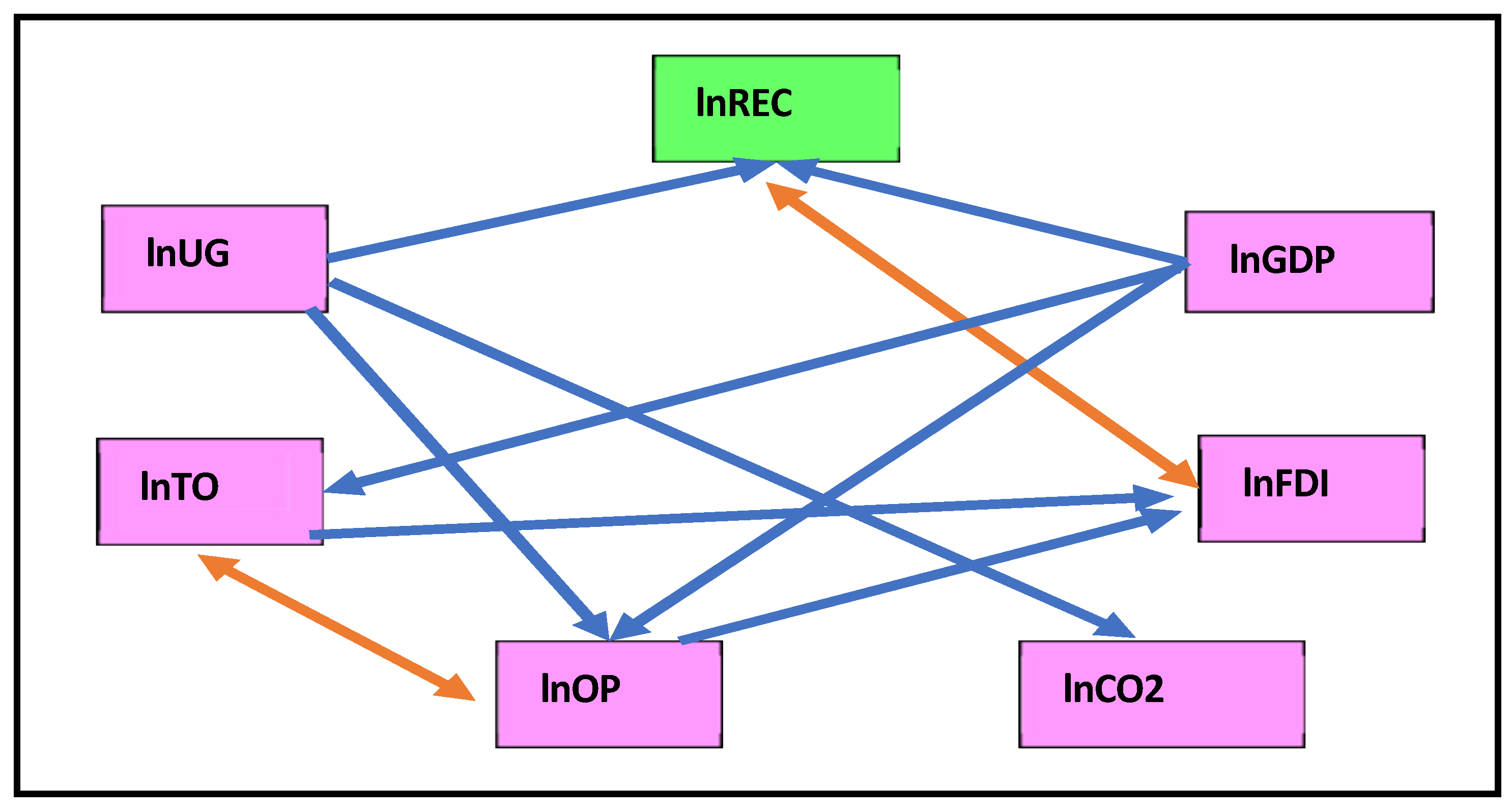
Further complementing the long-term perspective, Table 7 provides information on the Granger causality between the variables under investigation, thus providing some additional insight regarding their predictive precedence and dynamic interaction. According to the results presented in Figure 4, economic growth Granger-causes renewable energy consumption, trade openness, and oil prices, thus confirming its significant predictive formation for both energy demand and economic environment. Additionally, foreign direct investment Granger-causes renewable energy consumption, whereas crude oil prices and trade openness Granger-cause FDI inflows, suggesting interdependence between foreign capital flows and economic conditions. Moreover, urbanisation Granger-causes renewable energy consumption, CO2 emission, and oil prices. Mutual (bidirectional) causality exists between renewable energy consumption and FDI, as well as between trade openness and oil prices, thus proving the existence of short-term feedback mechanisms.
Bidirectional causality between renewable energy consumption and FDI implies that these two factors are interdependent. On the one hand, high levels of renewable energy consumption may attract foreign investors focused on environmental sustainability and Environmental, Social, and Governance principles [59]. On the other hand, FDI can stimulate the use of renewable energy through frameworks like Malaysia’s Renewable Energy Roadmap (MyRER), Green Investment Tax Allowance (GITA) and Green Income Tax Exemption (GITE) [60]. To meet the 2050 carbon-neutral target, future policy must leverage this bidirectional causality and redirect FDI from traditional energy investments towards high-tech green industries, such as hydrogen hubs and solar manufacturing [57]. This strategic alignment with the National Energy Transition Roadmap, which targets a 70% renewable energy capacity by 2050, repositions FDI as a primary catalyst for decarbonisation [57,61].
Unidirectional Granger-causal relationship from GDP per capita to renewable energy consumption indicates that economic expansion precedes increases in the share of renewable energy, which is consistent with the findings of [24,39]. Finally, causality between urbanisation and renewable energy consumption proves that urbanisation patterns affect energy preferences, albeit negatively in the long run. To achieve carbon neutrality by 2050, Malaysia must prioritise a shift toward low-carbon cities by integrating the Green Building Index and GreenRE standards into future urban planning [8,58,62,63]. Decoupling urban growth from fossil fuel dependency through these frameworks is essential; without such structural interventions, continued urbanisation will remain a primary obstacle to the national decarbonisation pathway [58,61].

5. Conclusions

This paper investigates the determinants of renewable energy consumption in Malaysia using a Vector Error Correction Model (VECM) to examine both long-run relationships and short-run causal dynamics. The results indicate that GDP per capita and renewable energy consumption have a positive long-run relationship, as well as short-run causality. In contrast, foreign direct investment (FDI) and renewable energy consumption are negatively related to each other in the long-run while exhibiting bidirectional short-run causality. In addition, while trade openness is found to have a significant positive long-run impact on renewable energy consumption, CO2 emissions and oil prices are found to have a negative long-run relationship. Lastly, the urbanisation variable demonstrates a negative long-run relationship and short-run causal effect on renewable energy consumption.
On the basis of the results of empirical analysis, the findings suggest potential pathways for Malaysia to align with its 2050 carbon-neutrality goals. Specifically, since FDI and renewable energy consumption have a bidirectional predictive short-run causality, the Malaysian government may develop an incentive mechanism to attract FDI in green technologies, as exemplified in 2023 through collaboration of YTL Power International and NVIDIA. Secondly, the importance of integrating renewable energy technologies in urban areas in Malaysia should be considered in line with Malaysia’s national standards of green buildings, for instance, the Green Building Index (GBI) and GreenRE, as the current negative long-run relationship between urbanisation and renewable consumption highlights a policy gap that must be addressed to ensure that urban growth does not undermine decarbonisation efforts. Thirdly, the influence of GDP per capita implies the need for economic growth as well as strong fiscal capacity. Consequently, efficient collection of taxes is crucial to support renewable energy generation. Fourthly, increased trade openness may allow for a smoother process of transferring technologies.
Despite its contributions, it would be necessary to mention a number of limitations associated with the study. In particular, the country-specific focus of the research in Malaysia may restrict the generalisability and robustness of the results. Additionally, there may be omitted variable bias as some of the factors have not been incorporated into the model (e.g., technological innovation and policy incentives), and the VECM relies on a linear assumption that might not hold true in reality. Therefore, further research in this area could benefit from incorporating more variables, applying non-linear models, and comparing results across countries to provide more comprehensive insights into the determinants of renewable energy consumption.

Author Contributions

Conceptualization and Methodology: H.-H.G. and S.-H.C.; Implementation of study and Formal investigation: H.-H.G. and S.-H.C.; Writing—original draft preparation: S.-H.C.; Validation, Formal Analysis and Visualisation: H.-H.G. and S.-H.C.; Writing—review and editing: H.-H.G. and S.-H.C.; Resources: S.-H.C., Supervision: H.-H.G. All authors have read and agreed to the published version of the manuscript.

Funding

This research received no external funding.

Institutional Review Board Statement

Not applicable.

Informed Consent Statement

Not applicable.

Data Availability Statement

The data employed in this study were obtained from publicly accessible international sources, including the World Bank World Development Indicators (WDI) (https://databank.worldbank.org/source/world-development-indicators, accessed on 25 May 2024) and Our World In Data (https://ourworldindata.org/, accessed on 20 May 2024). The processed datasets can be made available by the corresponding author upon reasonable request.

Acknowledgments

During the preparation of this manuscript, the authors used ChatGPT (OpenAI, version GPT 5.5) solely for language editing, clarity improvement, and minor grammatical refinement. The authors take full responsibility for the originality, analysis, interpretation, and academic integrity of the work. No AI tools were used to generate research data, statistical results, or scientific conclusions.

Conflicts of Interest

The authors declare no conflict of interest.

References

  1. Calleja-Agius, J.; England, K.; Calleja, N. The Effect of Global Warming on Mortality. Early Hum. Dev. 2020, 155, 105222. [Google Scholar] [CrossRef]
  2. Solaun, K.; Cerdá, E. Climate Change Impacts on Renewable Energy Generation. A Review of Quantitative Projections. Renew. Sustain. Energy Rev. 2019, 116, 109415. [Google Scholar] [CrossRef]
  3. Shaari, M.S.; Lee, W.C.; Ridzuan, A.R.; Lau, E.; Masnan, F. The Impacts of Energy Consumption by Sector and Foreign Direct Investment on CO2 Emissions in Malaysia. Sustainability 2022, 14, 16028. [Google Scholar] [CrossRef]
  4. Shaari, M.S.; Abidin, N.Z.; Ridzuan, A.R.; Meo, M.S. THE IMPACTS OF RURAL POPULATION GROWTH, ENERGY USE AND ECONOMIC GROWTH ON CO2 EMISSIONS. Int. J. Energy Econ. Policy 2021, 11, 553–561. [Google Scholar] [CrossRef]
  5. Ridzuan, A.R.; Kumaran, V.V.; Fianto, B.A.; Shaari, M.S.; Esquivias, M.A.; Albani, A. Reinvestigating the Presence of Environmental Kuznets Curve in Malaysia: The Role of Foreign Direct Investment. Int. J. Energy Econ. Policy 2022, 12, 217–225. [Google Scholar] [CrossRef]
  6. Olabi, A.G.; Abdelkareem, M.A. Renewable Energy and Climate Change. Renew. Sustain. Energy Rev. 2022, 158, 112111. [Google Scholar] [CrossRef]
  7. Ergun, S.J.; Owusu, P.A.; Rivas, M.F. Determinants of Renewable Energy Consumption in Africa. Environ. Sci. Pollut. Res. 2019, 26, 15390–15405. [Google Scholar] [CrossRef]
  8. Kumaran, V.V.; Ridzuan, A.R.; Khan, F.U.; Abdullah, H.; Mohamad, Z.Z. An empirical analysis of factors affecting renewable energy consumption in association of southeast Asian nations-4 countries. Int. J. Energy Econ. Policy 2020, 10, 48–56. [Google Scholar] [CrossRef]
  9. Sayed, E.T.; Wilberforce, T.; Elsaid, K.; Rabaia, M.K.H.; Abdelkareem, M.A.; Chae, K.; Olabi, A.G. A Critical Review on Environmental Impacts of Renewable Energy Systems and Mitigation Strategies: Wind, Hydro, Biomass and Geothermal. Sci. Total Environ. 2020, 766, 144505. [Google Scholar] [CrossRef]
  10. Hirtenstein, A.; Abnett, K. Analysis-Iran War Energy Shock Sparks Global Push to Reduce Fossil Fuel Dependence. Investing.com. 2026. Available online: https://www.investing.com/news/commodities-news/analysisiran-war-energy-shock-sparks-global-push-to-reduce-fossil-fuel-dependence-4568732 (accessed on 27 May 2026).
  11. Energy Commission. Malaysia Energy Statistical Handbook 2023; No. 10–11; Energy Commission: Putrajaya, Malaysia, 2024. Available online: https://www.st.gov.my/sites/default/files/2026-02/Malaysia_Energy_Statistics_Handbook_2023.pdf (accessed on 20 March 2026).
  12. Soukiazis, E.; Proença, S.; Cerqueira, P.A. The Interconnections between Renewable Energy, Economic Development and Environmental Pollution: A Simultaneous Equation System Approach. Energy J. 2019, 40, 1–24. [Google Scholar] [CrossRef]
  13. Thombs, R.P. The Paradoxical Relationship between Renewable Energy and Economic Growth: A Cross-National Panel Study, 1990–2013. J. World-Syst. Res. 2017, 23, 540–564. [Google Scholar] [CrossRef]
  14. Shahbaz, M.; Sinha, A.; Raghutla, C.; Vo, X.V. Decomposing Scale and Technique Effects of Financial Development and Foreign Direct Investment on Renewable Energy Consumption. Energy 2021, 238, 121758. [Google Scholar] [CrossRef]
  15. Hoa, P.X.; Xuan, V.N.; Thu, N.T.P. Determinants of the Renewable Energy Consumption: The Case of Asian Countries. Heliyon 2023, 9, e22696. [Google Scholar] [CrossRef]
  16. Qamruzzaman, M. Nexus between Financial Development, Foreign Direct Investment, and Renewable Energy Consumption: Evidence from SSA. GSC Adv. Res. Rev. 2024, 18, 265–280. [Google Scholar] [CrossRef]
  17. Li, J.; Zhang, X.; Ali, S.; Khan, Z. Eco-Innovation and Energy Productivity: New Determinants of Renewable Energy Consumption. J. Environ. Manag. 2020, 271, 111028. [Google Scholar] [CrossRef] [PubMed]
  18. Oluoch, S.; Lal, P.; Susaeta, A. Investigating Factors Affecting Renewable Energy Consumption: A Panel Data Analysis in Sub Saharan Africa. Environ. Chall. 2021, 4, 100092. [Google Scholar] [CrossRef]
  19. Wang, J.; Hassan, M.S.; Alharthi, M.; Arshed, N.; Hanif, I.; Saeed, M.I. Inspecting non-linear behavior of aggregated and disaggregated renewable and non-renewable energy consumption on GDP per capita in Pakistan. Energy Strategy Rev. 2022, 39, 100772. [Google Scholar] [CrossRef]
  20. Wei, S.; Jiandong, W.; Saleem, H. The impact of renewable energy transition, green growth, green trade and green innovation on environmental quality: Evidence from top 10 green future countries. Front. Environ. Sci. 2023, 10, 1076859. [Google Scholar] [CrossRef]
  21. Apergis, N.; Pinar, M.; Unlu, E. How Do Foreign Direct Investment Flows Affect Carbon Emissions in BRICS Countries? Revisiting the Pollution Haven Hypothesis Using Bilateral FDI Flows from OECD to BRICS Countries. Environ. Sci. Pollut. Res. 2022, 30, 14680–14692. [Google Scholar] [CrossRef]
  22. Chen, C.; Pinar, M.; Stengos, T. Determinants of Renewable Energy Consumption: Importance of Democratic Institutions. Renew. Energy 2021, 179, 75–83. [Google Scholar] [CrossRef]
  23. Tiwari, A.K.; Nasreen, S.; Anwar, M.A. Impact of Equity Market Development on Renewable Energy Consumption: Do the Role of FDI, Trade Openness and Economic Growth Matter in Asian Economies? J. Clean. Prod. 2021, 334, 130244. [Google Scholar] [CrossRef]
  24. Yusoff, N.Y.M.; Ridzuan, A.R.; Soseco, T.; Wahjoedi; Narmaditya, B.S.; Ann, L.C. Comprehensive Outlook on Macroeconomic Determinants for Renewable Energy in Malaysia. Sustainability 2023, 15, 3891. [Google Scholar] [CrossRef]
  25. Nguyen, K.H.; Kakinaka, M. Renewable Energy Consumption, Carbon Emissions, and Development Stages: Some Evidence from Panel Cointegration Analysis. Renew. Energy 2018, 132, 1049–1057. [Google Scholar] [CrossRef]
  26. da Silva, P.P.; Cerqueira, P.A.; Ogbe, W. Determinants of Renewable Energy Growth in Sub-Saharan Africa: Evidence from Panel ARDL. Energy 2018, 156, 45–54. [Google Scholar] [CrossRef]
  27. Assi, A.F.; Isiksal, A.Z.; Türsoy, T. Renewable Energy Consumption, Financial Development, Environmental Pollution, and Innovations in the ASEAN+3 Group: Evidence from (P-ARDL) Model. Renew. Energy 2020, 165, 689–700. [Google Scholar] [CrossRef]
  28. Karacan, R.; Mukhtarov, S.; Barış, İ.; İşleyen, A.; Yardimci, M.E. The Impact of Oil Price on Transition toward Renewable Energy Consumption? Evidence from Russia. Energies 2021, 14, 2947. [Google Scholar] [CrossRef]
  29. Huang, Y.; Ahmad, M.; Ali, S. The impact of trade, environmental degradation and governance on renewable energy consumption: Evidence from selected ASEAN countries. Renew. Energy 2022, 197, 1144–1150. [Google Scholar] [CrossRef]
  30. Dingru, L.; Onifade, S.T.; Ramzan, M.; Al-Faryan, M.A.S. Environmental Perspectives on the Impacts of Trade and Natural Resources on Renewable Energy Utilization in Sub-Sahara Africa: Accounting for FDI, Income, and Urbanization Trends. Resour. Policy 2022, 80, 103204. [Google Scholar] [CrossRef]
  31. Balsalobre-Lorente, D.; Shahbaz, M.; Roubaud, D.; Farhani, S. How Economic Growth, Renewable Electricity and Natural Resources Contribute to CO2 Emissions? Energy Policy 2018, 113, 356–367. [Google Scholar] [CrossRef]
  32. Destek, M.A.; Sinha, A. Renewable, Non-Renewable Energy Consumption, Economic Growth, Trade Openness and Ecological Footprint: Evidence from Organisation for Economic Co-Operation and Development Countries. J. Clean. Prod. 2020, 242, 118537. [Google Scholar] [CrossRef]
  33. Zheng, X. Foreign Direct Investment and Carbon Emissions in Europe: Rethinking Environmental Sustainability Through Renewable Energy and Intellectual Capital. Appl. Ecol. Environ. Res. 2025, 23, 10121–10137. [Google Scholar] [CrossRef]
  34. Moise, M.L. Examining the Agriculture-Induced Environment Curve Hypothesis and Pollution Haven Hypothesis in Rwanda: The Role of Renewable Energy. Carbon Res. 2023, 2, 50. [Google Scholar] [CrossRef]
  35. Nabaweesi, J.; Kaawaase, T.K.; Buyinza, F.; Adaramola, M.S.; Namagembe, S.; Nkote, I.N. Urbanization and Modern Renewable Energy Consumption among East African Community (EAC) Countries: An Empirical Analysis. Int. J. Energy Sect. Manag. 2024, 18, 1378–1399. [Google Scholar] [CrossRef]
  36. Troster, V.; Shahbaz, M.; Uddin, G.S. Renewable Energy, Oil Prices, and Economic Activity: A Granger-Causality in Quantiles Analysis. Energy Econ. 2018, 70, 440–452. [Google Scholar] [CrossRef]
  37. Bloch, H.; Rafiq, S.; Salim, R. Economic Growth with Coal, Oil and Renewable Energy Consumption in China: Prospects for Fuel Substitution. eSpace 2014, 44, 104–115. [Google Scholar] [CrossRef]
  38. Mukhtarov, S.; Mikayilov, J.I.; Humbatova, S.; Muradov, V. Do High Oil Prices Obstruct the Transition to Renewable Energy Consumption? Sustainability 2020, 12, 4689. [Google Scholar] [CrossRef]
  39. Manni, U.H.; Mansur, D.D.K.H.M. Identifying the Drivers Responsible for Energy Security in Selected ASEAN Countries by Using Panel Data Analysis. Int. J. Energy Sect. Manag. 2023, 18, 658–682. [Google Scholar] [CrossRef]
  40. Ergun, S.J.; Rivas, M.F. Does Higher Income Lead to More Renewable Energy Consumption? Evidence from Emerging-Asian Countries. Heliyon 2023, 9, e13049. [Google Scholar] [CrossRef]
  41. Gözgör, G.; Mahalik, M.K.; Demir, E.; Padhan, H. The Impact of Economic Globalization on Renewable Energy in the OECD Countries. Energy Policy 2020, 139, 111365. [Google Scholar] [CrossRef]
  42. Olanrewaju, B.T.; Olubusoye, O.E.; Adenikinju, A.; Akintande, O.J. A Panel Data Analysis of Renewable Energy Consumption in Africa. Renew. Energy 2019, 140, 668–679. [Google Scholar] [CrossRef]
  43. Deniz, P. OIL PRICES AND RENEWABLE ENERGY: OIL DEPENDENT COUNTRIES. J. Res. Econ. 2019, 3, 139–150. [Google Scholar] [CrossRef]
  44. Zaghdoudi, T.; Tissaoui, K.; Maâloul, M.; Bahou, Y.; Kammoun, N. Asymmetric Connectedness between Oil Price, Coal and Renewable Energy Consumption in China: Evidence from Fourier NARDL Approach. Energy 2023, 285, 129416. [Google Scholar] [CrossRef]
  45. Zhou, D.; Siddik, A.B.; Guo, L.; Li, H. Dynamic Relationship among Climate Policy Uncertainty, Oil Price and Renewable Energy Consumption—Findings from TVP-SV-VAR Approach. Renew. Energy 2023, 204, 722–732. [Google Scholar] [CrossRef]
  46. Yahya, F.; Rafiq, M. Unraveling the Contemporary Drivers of Renewable Energy Consumption: Evidence from Regime Types. Environ. Prog. Sustain. Energy 2019, 38, 13178. [Google Scholar] [CrossRef]
  47. Akintande, O.J.; Olubusoye, O.E.; Adenikinju, A.F.; Olanrewaju, B.T. Modeling the determinants of renewable energy consumption: Evidence from the five most populous nations in Africa. Energy 2020, 206, 117992. [Google Scholar] [CrossRef]
  48. Perron, P. The Great Crash, the Oil Price Shock, and the Unit Root Hypothesis. Econometrica 1989, 57, 1361–1401. [Google Scholar] [CrossRef]
  49. Zivot, E.; Andrews, D.W.K. Further evidence on the great crash, the oil-price shock, and the unit-root hypothesis. J. Bus. Econ. Stat. 1992, 20, 25–44. [Google Scholar] [CrossRef]
  50. Shahbaz, M.; Loganathan, N.; Zeshan, M.; Zaman, K. Does Renewable Energy Consumption Add in Economic Growth? An Application of Auto-Regressive Distributed Lag Model in Pakistan. Renew. Sustain. Energy Rev. 2015, 44, 576–585. [Google Scholar] [CrossRef]
  51. Johansen, S.; Juselius, K. Maximum likelihood estimation and inference on cointegration—With applications to the demand for money. Oxf. Bull. Econ. Stat. 1990, 52, 169–210. [Google Scholar] [CrossRef]
  52. Malhotra, A. A Hybrid Econometric–Machine Learning Approach for Relative Importance Analysis: Prioritizing Food Policy. Eurasian Econ. Rev. 2021, 11, 549–581. [Google Scholar] [CrossRef]
  53. Stern, D.I.; Enflo, K. Causality between Energy and Output in the Long-Run. Energy Econ. 2013, 39, 135–146. [Google Scholar] [CrossRef]
  54. Pesaran, M.H.; Shin, Y.; Smith, R.J. Bounds Testing Approaches to the Analysis of Level Relationships. J. Appl. Econom. 2001, 16, 289–326. [Google Scholar] [CrossRef]
  55. Narayan, P.K. The Saving and Investment Nexus for China: Evidence from Cointegration Tests. Appl. Econ. 2005, 37, 1979–1990. [Google Scholar] [CrossRef]
  56. Raihan, A.; Tuspekova, A. Toward a Sustainable Environment: Nexus between Economic Growth, Renewable Energy Use, Forested Area, and Carbon Emissions in Malaysia. Resour. Conserv. Recycl. Adv. 2022, 15, 200096. [Google Scholar] [CrossRef]
  57. Kimura, K.; Iwata, T.; Yamamoto, K.; Murakami, T.; Phoumin, H. Investment Opportunities in Low-Carbon and Cutting-Edge Technology Deployment in Asia. RePEc:era:eriabk:2024-rpr-37; 2024; Available online: https://ideas.repec.org/b/era/eriabk/2024-rpr-37.html (accessed on 26 May 2024).
  58. Weber, M.; Pressburger, L.; Chau, L.W.; Khan, Z.; Waite, T.; Westphal, M.; Ling, G.H.T.; Ho, C.S.; Evans, M. Carbon Neutrality in Malaysia and Kuala Lumpur: Insights from Stakeholder-Driven Integrated Assessment Modeling. Front. Energy Res. 2024, 12, 1336045. [Google Scholar] [CrossRef]
  59. Chen, S.; Song, Y.; Gao, P. Environmental, Social, and Governance (ESG) Performance and Financial Outcomes: Analyzing the Impact of ESG on Financial Performance. J. Environ. Manag. 2023, 345, 118829. [Google Scholar] [CrossRef]
  60. Teoh, S.T. Tax Incentive for Green Initiatives in Malaysia. 2024. Available online: https://shinewingtyteoh.com/tax-incentive-green-initiatives-malaysia (accessed on 27 May 2024).
  61. Fernandez, M.I.; Go, Y.I.; Wong, M.L.D.; Früh, W. Malaysia’s Energy Transition and Readiness towards Attaining Net Zero: Review of the Potential, Constraints, and Enablers. Renew. Energy Focus 2024, 51, 100640. [Google Scholar] [CrossRef]
  62. Kaur, S. Sustainable Urbanisation Can Improve Climate Resilience in Malaysian Cities. NST Online. 2023. Available online: https://www.nst.com.my/property/2023/02/881781/sustainable-urbanisation-can-improve-climate-resilience-malaysian-cities (accessed on 26 May 2024).
  63. AQ Energy. Green Building Malaysia: The Ultimate Guide in 2024. 2024. Available online: https://aq.energy/blog/green-building-malaysia/ (accessed on 26 May 2024).
Figure 1. Renewable Energy Consumption as Percentage of Final Energy Consumption Year 1990–2021. (Source: World Development Indicators (WDI), published by the World Bank).
Sustainability 18 05648 g001
Figure 2. Crude Oil and Natural Gas Reserve in Malaysia. (Source: Malaysia Energy Statistical Handbook 2023 pp. 9–10) [11].
Sustainability 18 05648 g002
Figure 3. Proposed conceptual framework of the study.
Sustainability 18 05648 g003
Figure 4. The Short-run Granger Causality Effect. Notes: Sustainability 18 05648 i001 represents one-way direction of Granger causality effect among the variables in the short run. Sustainability 18 05648 i002 represents two-way direction of Granger causality effect among the variables in the short run. Boxes in green colour is dependent variable (DV) and pink colour is independent variable (IV).

Sustainability 18 05648 g004
Table 1. Hypothesis Testing and Reference.
HypothesisReferences
H1: Long-term GDP per capita and renewable energy consumption are positively correlated.[15,17,18,22,26,27,39,40]
H2: Long-term FDI and renewable energy consumption are positively correlated.[7,14,15,23,29,30,35]
H3: Long-term CO2 and renewable energy consumption are negatively correlated.[18,24,26,28,38,39,41,42,43]
H4: Long-term Crude Oil and renewable energy consumption are positively correlated.[22,41,43,44,45]
H5: Long-term Trade Openness and renewable energy consumption are positively correlated.[8,22,23,24,30,35,43,46]
H6: Long-term Urbanisation and renewable energy consumption are positively correlated. [8,24,35,47]
Table 2. Data Sources.
VariablesAbbreviationDescriptionSource
Renewable Energy
Consumption
RECPrimary renewable energy consumption is measured in terawatt-hours (TWh)Our World In Data
Gross Domestic
Product Per Capita
GDPGDP per capita (current US$)WDI
Foreign Direct
Investment Inflows
FDIForeign direct investment, net
inflows (BoP, current US$)
WDI
CO2 EmissionCO2CO2 emissions (metric tons per
capita)
WDI
Crude Oil PriceOPCrude oil prices (current US$ per
barrel)
WDI
Trade OpennessTOTrade (% of GDP)WDI
UrbanisationUGUrban population growth
(Population %)
WDI
Table 3. Unit Root Test Results.
Augmented Dickey–Fuller (ADF) Test
LevelsFirst Difference
InterceptTrend and InterceptInterceptTrend& Intercept
lnREC0.2555 (0)−1.8903 (0)−5.5882 (1) ***−5.6199 (1) ***
lnGDP−2.5336 (1)−2.7065 (0)−5.4924 (0) ***−5.8583 (0) ***
lnFDI−2.3576 (1)−3.1313 (4)−7.7922 (1) ***−7.7737 (1) ***
lnCO2−1.4019 (0)−1.7342 (0)−9.0266 (0) ***−9.1181 (0) ***
lnOP−1.5190 (4)−2.8244 (0)−6.5498 (0) ***−6.6612 (0) ***
lnTO−1.9679 (1)−0.4522 (0)−5.2737 (0) ***−5.6884 (0) ***
lnUG1.8249 (1)−0.3385 (0)−5.0910 (0) ***−6.0375 (0) ***
Kwiatkowski–Phillips–Schmidt–Shin (KPSS) Test
LevelsFirst Difference
InterceptTrend& InterceptInterceptTrend& Intercept
lnREC0.8913 (5) ***0.1977 (1) **0.1308 (4)0.0824 (5)
lnGDP0.9438 (5) ***0.1369 (5) *0.3332 (4)0.0773 (2)
lnFDI0.8779 (5) ***0.1275 (3) *0.1941 (15)0.0243 (1)
lnCO20.9454 (5) ***0.1853 (5) **0.2176 (2)0.0658 (4)
lnOP0.7275 (5) **0.1549 (1) **0.2234 (0)0.0977 (1)
lnTO0.5288 (5) **0.2233 (5) **0.5360 (0)0.1113 (1)
lnUG0.7569 (5) ***0.2406 (5) ***0.3462 (20)0.0765 (1)
Notes: Asterisk (***), (**) and (*) denote significant at 1%, 5% and 10% levels, respectively.
Table 4. Zivot and Andrews Structural Break Unit Root Test Results.
VariableLevelsFirst DifferenceModel
Breakpointt-StatisticBreakpointt-Statistic
lnREC1995−2.94621988−6.5320 ***Model C
lnGDP2014−3.13341998−7.2647 ***Model C
lnFDI2000−4.05742009−10.7691 ***Model C
lnCO21990−3.91571988−9.6590 ***Model C
lnOP1973−3.39791974−7.7801 ***Model C
lnTO2007−2.78332000−6.3227 ***Model C
lnUG1984−2.16821992−8.5933 ***Model C
Critical value10%: −4.825%: −5.081%: −5.57
Note: Asterisk (***) signifies significant at 1% level.
Table 5. Johansen–Juselius Cointegration Test.
Trace Test: lnREC, lnGDP, lnFDI, lnCO2, lnOP, lnTO, lnUG (k = 2, r = 1)
H0H1λ-Trace95% CV
r = 0r ≥ 1181.8353 **125.6154
r ≤ 1r ≥ 242.6258147.85613
r ≤ 2r ≥ 323.6111229.79707
r ≤ 3r ≥ 46.87968215.49471
Maximum Eigenvalue Test: lnREC, lnGDP, lnFDI, lnCO2, lnOP, lnTO, lnUG (k = 2, r = 1)
H0H1λ-Max95% CV
r = 0r = 152.05042 **46.23142
r ≤ 1r = 219.0146927.58434
r ≤ 2r = 316.7314421.13162
r ≤ 3r = 46.87431614.26460
Notes: Asterisk (**) denotes significant at 5% level, k is the number of lag and r is the number of cointegration vector. The null hypothesis of r = 0 is rejected at 5% significant level against its alternative r = 1, However, the hypothesis of r < 1 cannot be rejected at the same level of significance.
Table 6. ARDL Bounds Test Results.
ModelComputed F-Statistic
lnREC = f (lnGDP, lnFDI, lnCO2, lnOP, lnTO, lnUG)7.182 ***
k = 6, n = 52
Structural break (1988)
Pesaran et al. (2001) [54] a Narayan (2005) [55] b
Critical valueLower bound valueUpper bound valueLower bound valueUpper bound value
1 percent3.154.433.6565.331
5 percent2.453.612.7264.057
10 percent2.123.232.3093.507
Notes: Asterisk (***) signifies significant at 1% level. a Critical values are referred to Pesaran et al. [54], Table CI (iii) Case III: unrestricted intercept and no trend, p. 300. b Critical values are referred to Narayan (2005) [55], Table Case III: unrestricted intercept and no trend, p. 10.
Table 7. Granger Causality Test based on Vector Error Correction Model (VECM).
Dependent Variablesχ2-Statistic
(p-Value)
ECTs
∆LREC∆LGDP∆LFDI∆LCO2∆LOP∆LTO∆LUGCoefficientt-Statistic
∆LREC-2.904
(0.088) *
4.169
(0.041) **
0.947
(0.330)
0.099
(0.753)
0.301
(0.583)
3.714
(0.054) *
−0.150−1.723 **
∆LGDP0.008
(0.927)
-0.165
(0.685)
0.702
(0.402)
2.661
(0.103)
0.184
(0.668)
1.123
(0.289)
−0.111−1.858 **
∆LFDI2.787 (0.095) *1.405
(0.236)
-0.255
(0.613)
3.820
(0.051) *
2.784
(0.095) *
0.103
(0.749)
−0.914−2.009 **
∆LCO20.050
(0.824)
0.628
(0.428)
0.235
(0.628)
-0.063
(0.801)
0.118
(0.731)
3.953
(0.047) **
−0.041−1.084
∆LOP1.374
(0.241)
8.344
(0.004) ***
0.072
(0.789)
0.914
(0.339)
-3.156
(0.076) *
3.386
(0.066) *
−0.599−4.530 ***
∆LTO1.166
(0.280)
5.543
(0.019) **
0.666
(0.415)
2.236
(0.135)
7.776
(0.005) ***
-0.313
(0.576)
0.0180.565
∆LUG0.255
(0.614)
0.650
(0.420)
0.297
(0.586)
0.418
(0.518)
1.752
(0.186)
2.102
(0.147)
-0.0060.293
Notes: Asterisk (***), (**) and (*) denote significant at 1%, 5% and 10% levels, respectively. ∆ is the first different operator.
Disclaimer/Publisher’s Note: The statements, opinions and data contained in all publications are solely those of the individual author(s) and contributor(s) and not of MDPI and/or the editor(s). MDPI and/or the editor(s) disclaim responsibility for any injury to people or property resulting from any ideas, methods, instructions or products referred to in the content.