Article

Forward Osmosis for Sustainable Brackish Water Desalination

by
Juan Taumaturgo Medina Collana
1,*,
Edgar Williams Villanueva Martinez
1,
Kevin Remigio Azorza Gillen
1,
Luis Américo Carrasco Venegas
1,
César Augusto Rodríguez Aburto
1,
César Augusto Santos Mejía
2,
Pablo Manuel Morcillo Valdivia
2,
Jorge Alberto Montaño Pisfil
2,
Rodolfo Paz Salazar
1 and
Fredy Andrés Taipe Castro
1
1
Centro de Investigación de Ingeniería de Procesos de Tratamiento de Aguas, Facultad de Ingeniería Química, Universidad Nacional del Callao, Bellavista, Callao 07011, Peru
2
Facultad de Ingenieria Electrica y Electronica, Universidad Nacional del Callao, Bellavista, Callao 07011, Peru
*
Author to whom correspondence should be addressed.
Sustainability 2026, 18(11), 5647; https://doi.org/10.3390/su18115647
Submission received: 28 January 2026 / Revised: 15 May 2026 / Accepted: 25 May 2026 / Published: 3 June 2026
(This article belongs to the Section Sustainable Chemical Engineering and Technology)

Abstract

The desalination of brackish and seawater has emerged as a critical strategy to address growing water scarcity in regions experiencing water stress, particularly within the context of sustainable water resource management. Among available technologies, forward osmosis (FO) has gained increasing attention due to its potential for lower energy consumption and reduced environmental impact compared to conventional desalination processes. In this study, commercial HFFO2 (Aquaporin Inside) membrane from FO was used. A complete factorial design with three factors was used: feed solution concentration (1.5 and 3 g/L NaCl), draw solution concentration (15, 25, and 35 g/L NaCl), and feed solution flow rate (600 and 1000 mL/min) on the percentage of recovery and water flux. Tests showed that as the feed concentration decreases from 3 to 1.5 g/L of NaCl, water recovery improves by 23.6%. The results revealed that increasing the concentration of the draw solution from 15 to 25 g/L of NaCl increased water recovery by 22.2%. However, for a concentration variation of 25 to 35 g/L, this increase is insignificant at 0.92%. The results showed that, with a concentration of 1.5 g/L of NaCl, a feed flow rate of 1000 mL/min, and a concentration of 25 g/L of NaCl as the draw solution, a higher water recovery rate (95.4839%) was achieved. Similarly, average water flux values of 2.18, 2.43, and 2.68 L m 2 h 1 were observed when using draw solutions of 15, 25, and 35 g/L of NaCl, respectively. In addition, increasing the FS flow rate slightly reduces water recovery (from 76.04% to 74.06%). Consequently, the forward osmosis process has proven to be effective, practical, viable, and environmentally friendly for water desalination, as well as being applicable to the treatment of wastewater with high electrical conductivity.

1. Introduction

The growing global water crisis, driven by population growth, climate change, and increasing industrial demands, has made water scarcity one of the most pressing challenges of the 21st century [1]. Water scarcity is a growing concern, especially in arid regions, where brackish groundwater is increasingly being used as a source of drinking water. However, the safe use of this resource requires desalination [2]. Various solutions have been proposed to address this challenge, including the desalination of brackish and seawater, as well as wastewater treatment [3]. Desalination technologies have emerged as critical solutions to meet the growing demand for water [4]. Conventional desalination techniques, including reverse osmosis (RO) [5], multi-effect evaporation, and electrodialysis (ED), consume a lot of energy and are unable to treat high salinity and scaling [6]. The RO, which applies hydraulic pressure greater than osmotic pressure across a semipermeable membrane, effectively removes salts but has drawbacks such as high energy consumption, clogging, scaling, membrane degradation, and costly maintenance [7]. The FO has been described as a promising membrane separation method with low energy demand and reduced fouling, making it attractive for sustainable water treatment [8]. Among the various approaches to desalination, FO has attracted considerable attention as a promising low-pollution technology that offers clear advantages over conventional methods. The FO process uses an osmotic pressure gradient instead of hydraulic pressure, which minimizes cake layer compaction and scale deposition on the membrane [9]. FO uses the osmotic pressure (OP) difference between the feed solution and the draw solution as the driving force for transporting water through a semipermeable membrane [10]. Desalination based on FO has recently gained worldwide attention because it operates at low pressure and temperature levels [11]. This low tendency to fouling allows for more robust long-term operation, especially when treating water with high loads of organic or inorganic contaminants [9]. In FO, a high-concentration solution, called the “draw solution,” is used to create an osmotic pressure gradient across a semipermeable membrane. This gradient causes water molecules to be transported from a less concentrated feed saline solution to a highly concentrated draw solution [12]. The FO process uses a semipermeable membrane and two solutions: a feed solution (FS) and a draw solution (DS), with different osmotic pressures. This difference in osmotic pressure is the driving force behind the transport of water between the feed solution (with low osmotic pressure) and the draw solution (with high osmotic pressure) in FO processes, while the semipermeable membrane hinders the movement of ions [13]. During this process, the feed solution becomes more concentrated while the draw solution is diluted. Recent studies have evaluated the effect of the flow rate of the feed solution and the extraction solution, as well as the concentration of the latter (2.5–7.7% by weight of NaCl) [14]. The results indicate that the water flow increases approximately linearly with an increase in flow rate and with the concentration difference between the two solutions. This behavior is attributed to the increase in the osmotic pressure. Previous studies have shown that increasing the concentration of MgCl2·6H2O from 0.5 to 3 M results in a substantial increase in the solution’s osmotic pressure, which rises from approximately 33 to 198 bar [15]. This increase in osmotic pressure intensifies the driving force across the membrane, thereby promoting a greater water flow in the direct osmosis process. Recent studies have shown that the relationship between the concentration of the extraction solution and the water flux is not strictly linear, and that the most pronounced increases in flux are observed in the range of relatively low concentrations, while at higher concentrations the rate of increase in flux tends to decrease or stabilize [16]. This behavior is primarily attributed to the increase in concentration polarization effects, particularly internal polarization within the membrane support structure, which reduces the effective osmotic gradient [17]. Previous studies have reported that, when the cross-flow rate is increased from 1 to 3 L/min, the water flow increases by approximately 10% to 25% under constant operating conditions. This increase is mainly attributed to the decrease in external concentration polarization on the feed solution side [18]. Despite their advantages, direct osmosis systems face several technical challenges, such as the development of effective draw solvents, membrane fouling, and the need for effective methods to separate fresh water from the draw solutions [19]. Future research should focus on optimizing system configurations and operating strategies to improve water recovery rates in FO systems. The water flux (Jw) in units (LMH) passing through a semipermeable membrane in an FO process can be calculated using Equation (1).
J W = L P π D S π F S = L P π
Here, LP is the water permeability coefficient (LMH bar−1) (L m−2 h−1 bar−1), πDS is the osmotic pressure of the draw solution at the membrane interface, and πFS is the osmotic pressure of the feed solution at the feed–membrane interface. The osmotic pressure difference between a highly concentrated DS and a lower concentration FS is the only driving force required for this process [20]. For highly diluted solutions, the osmotic pressure of a simple solution containing a non-electrolytic solute can be calculated using the Van’t Hoff equation (Equation (2)), which is analogous to the ideal gas law.
π = υ M R T
Here, π is the osmotic pressure, M is the molar concentration (mol L−1), Rg is the ideal gas constant (8.314 J K−1 mol−1), T is the absolute temperature in degrees Kelvin, and υ is the Van’t Hoff dissociation factor (υ = 2 for NaCl and υ = 3 for CaCl2). It should be noted that Van’t Hoff’s equation is only applicable to dilute, ideal solutions in which the ions are independent of one another. However, at higher ionic concentrations, the solution becomes non-ideal, as electrostatic interactions between ions increase, decreasing the activity coefficient of the ions and the osmotic pressure of the solution [21]. Therefore, in the case of non-ideal solutions, the overall osmotic pressure is determined by taking into account the activity of water, as expressed in Equation (3).
π = R T V ln a w
Here, V is the molar volume of water (in m3/mol), and aw is the water activity, calculated using the Pitzer equation for electrolyte solutions.
The FO is emerging as a promising alternative in the field of brackish water desalination, sparking growing interest in research. Its ability to operate at lower hydraulic pressure not only reduces energy requirements but also mitigates critical issues such as membrane fouling. These advantages position FO as a key technology for developing sustainable and efficient water treatment solutions, driving its study and application in scenarios where water scarcity is an urgent challenge. Recent studies also show that direct osmosis can be integrated with complementary recovery stages, such as nanofiltration (NF), electrodialysis (ED), reverse osmosis (RO), and membrane distillation (MD), to improve overall process performance and water recovery [22]. Previous research has shown that operating conditions have a significant influence on the performance of the direct osmosis (FO) process. In order to maximize system efficiency and assess its economic feasibility, it is essential to establish the optimal operating parameters for both the feed solution (FS) and the draw solution (DS), taking into account key variables such as flow rate, concentration, and temperature [23]. However, recent scientific literature shows that forward osmosis performance still depends heavily on membrane properties, choice of carrier solution, and recovery configuration, and that flux reduction and reverse solute transport remain significant limitations.
The objective of this study was to evaluate the performance of a direct osmosis module in terms of water recovery percentage, water flux, and reverse solute flux (migration of chloride ions from the extractant solution to the feed solution). To this end, a model sodium chloride solution with concentrations similar to those of brackish water was used as the feed solution. In addition, the effect of operating variables—including feed solution concentration, feed flow rate, and extractant solution concentration—on process performance was analyzed. In this context, the novelty of our work lies in providing a specific experimental evaluation of a forward osmosis module, focusing on how its operating parameters interact to influence its performance.

2. Materials and Methods

2.1. Reagents and Chemical Analysis

In all experiments, both the feed and draw solutes were sodium chloride; the solutions were prepared by dissolving the appropriate amount in deionized water obtained from a reverse osmosis module. The sodium chloride was of reagent grade (99.9%) were provided by the Merck company. Sodium chloride was selected due to its high solubility, high osmotic pressure, and low potential for fouling the membrane, which allows for reproducible experimental conditions [24]. However, real-world applications involve solutes such as Ca2+, Mg2+, SO42−, NO3, PO43−, and organic matter, which significantly influence clogging, scaling, adsorption, and selectivity. Consequently, results obtained with NaCl should be considered as a reference, and it is recommended that they be extended to multicomponent systems that more accurately replicate the characteristics of real-world waters. The conductivity of the feed and draw solutions was monitored using the ADWA (AD310) conductivity meter, instruments made in, Hungary and Romania, ADWA Instruments (Advanced Digital Water Analysis), and the chloride concentration was measured using the Mohr method.

2.2. Characteristics of the Forward Osmosis Membrane

In this study, a commercial HFFO2 (Aquaporin Inside) hollow fiber forward osmosis (FO) membrane, purchased from Sterlitech Corporation (Auburn, WA, USA) was used. The characteristics of the membrane are shown in Table 1. The values were obtained from the membrane manufacturer.

2.3. Design of Experiment

A factorial design was used that included three variables under study: draw solution concentration (comprising three levels), feed solution concentration (two levels), and feed recirculation flow rate change (two levels) in order to determine the most appropriate values for the parameters that have the greatest influence on water flux. The experiments were designed to run for 60 min. Minitab 19 statistical software was used for experimental design and the analysis of effects using Pareto charts. Previous studies have shown that the efficiency of the FO process depends on various influencing factors, such as the concentrations of the draw and feed solutions and the operating conditions [25]. Table 2 shows the factors and their respective experimental levels.
With the exception of concentrations, the other operating conditions, such as temperature, draw solution flow, and pressure of both streams, were not varied in this experiment.

2.4. Experimental Setup of Forward Osmosis

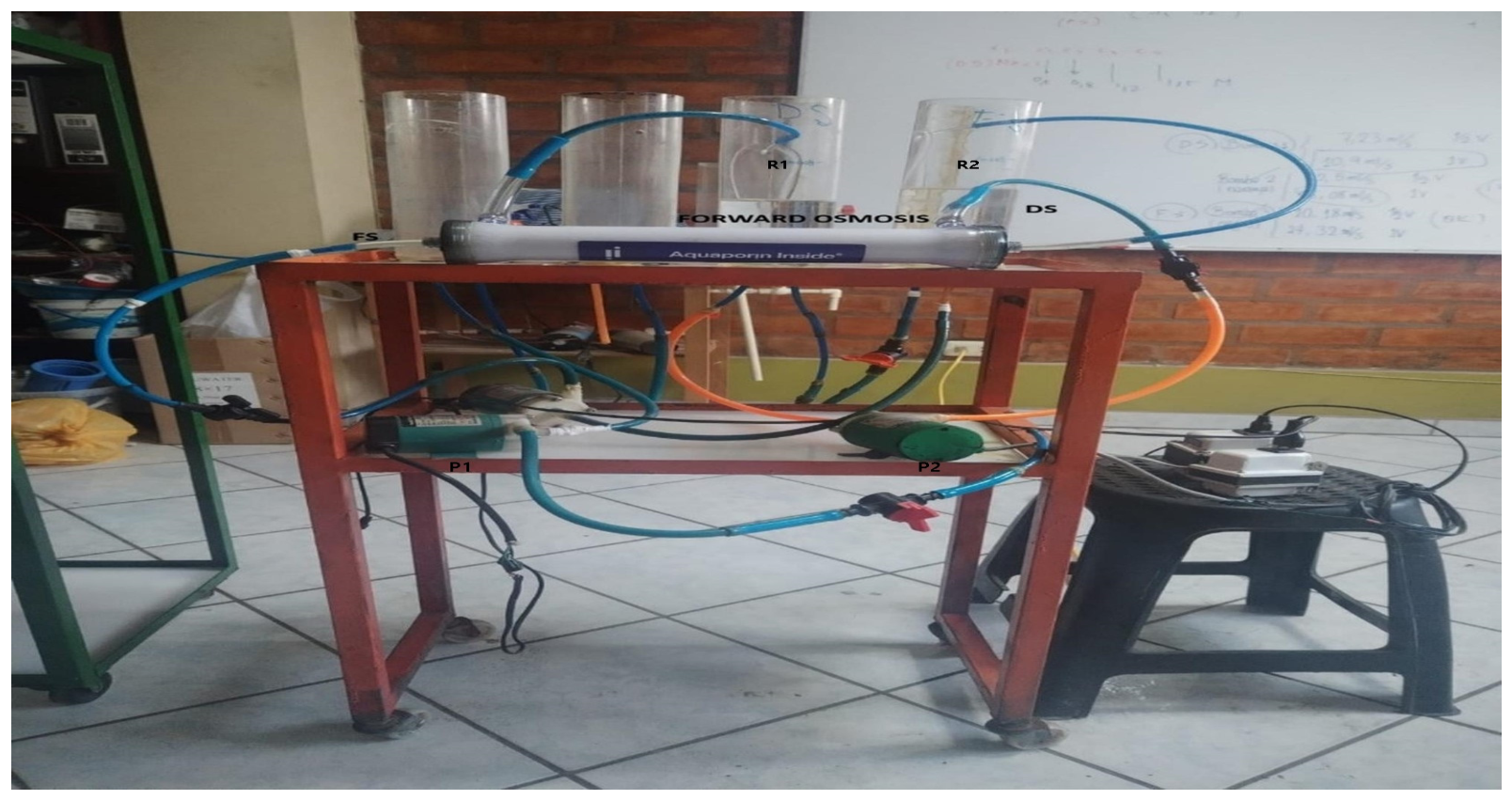
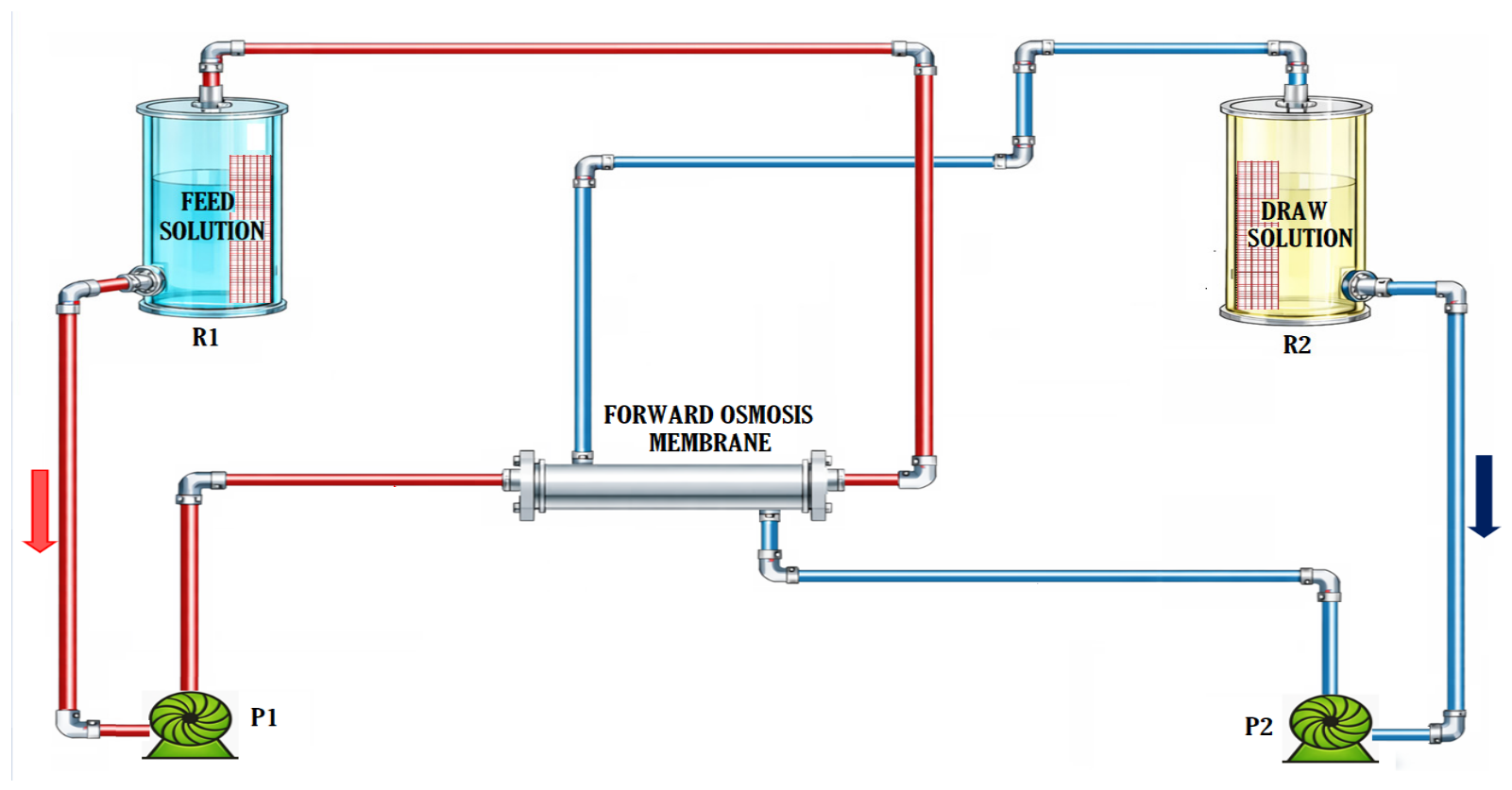
The experimental unit consists of two acrylic containers, each with an internal diameter of 2.5 cm and a height of 27 cm. Before starting the experiment, the membrane was rinsed with deionized water for 30 min on both the feed and draw sides at a flow rate of 1200 mL/min. For the recirculation of the feed and draw solutions, two 110-volt IWAKI Heart of Industry in Japan magnetic drive pumps (model MD6K) were used through flexible tubes, whose flow rates were controlled independently by gate valves. In order to evaluate changes in volume, graph paper has been placed in both containers, and the variation in the levels of the feed and draw solutions has been recorded over time to determine the permeate water flow. After each test, the solutions were drained from both reservoirs, and the membrane was rinsed with deionized water for 30 min before each test. The initial volume of the DS and FS was 6 L, and the FS and DS were recycled back into the same tanks. During the experiment (10–15 min), the conductivity and temperature of both the FS and DS were measured. In addition, the counter-current flow mode was chosen, with the solutions flowing in opposite directions. All experiments were carried out at room temperature (approximately 20 °C/293 K). Figure 1 and Figure 2 show a schematic diagram of the laboratory-scale equipment configuration.

2.5. Measurement Parameters and Calculations

The performance of the FO process was evaluated based on operational indicators, including volumetric water flow, water recovery, and reverse salt flow.

2.5.1. Water Flux

The permeate flow rate is the rate at which water passes through the membrane per unit area. The flow of water depends on the osmotic pressure difference (∆π) between the extraction solution and the feed solution. The water flux, J w (L m−2 h−1), through the membrane was calculated using Equation (4).
J w = V t 2 V   t 1 A m t = 1 A . V t
Here, J w is the water flux through the membrane (L m−2 h−1), V t 2 is the volume of the draw solution container at time t 2 (h), V t 1 is the volume at time t 1 (h), A is the membrane area (m2), Δ t is the operation time (h), and Δ V is the change in volume.

2.5.2. Water Recovery

The feedwater recovery rate in FO measures the proportion of incoming feedwater that is converted into permeate, typically expressed as a percentage. The water recovery ratio (VR) represents the percentage of water transferred from the feed solution to the draw solution and was calculated using Equation (5) [26].
V R = V F 0 V F t V F 0 × 100 %
Here, V F , 0 is the initial volume of the feed solution (L), and V F , t is the volume of the feed solution at time t (L).

2.5.3. Reverse Salt Flux

Defined as the migration of solutes (salts) from the extractant solution to the feed solution through the membrane, in the opposite direction of the water flow, due to osmotic diffusion, which results not only in a loss of solutes from the extractant solution but also in an increase in the concentration of solutes on the feed solution side. The reverse salt flux (JS) was calculated from Equation (6) [27].
J s = C t V t C 0 V 0 A m t
Here, J s is the reverse salt flux through the membrane (g m−2 h−1); C 0 and C t are the concentrations of chloride ions (Cl) in the solution at times 0 and t, in FS respectively, while V 0 and V t are the volumes of the FS at times 0 and t , and t is the experiment duration in hours.

3. Results and Discussion

Table 3 shows the results of the water recovery percentage for each test, according to the proposed experimental design. Water recovery ranges from 44.66% to 95.48%. Similarly, the results of the water flux are reported to be at levels of 1.34 to 3.36, respectively.
The descriptive statistical results for water recovery are shown in Table 4. The standard deviation is 17.21, and the mean is 75.06.

3.1. Effect of Operating Factors on Water Recovery

3.1.1. Effect of Feed Solution Concentration

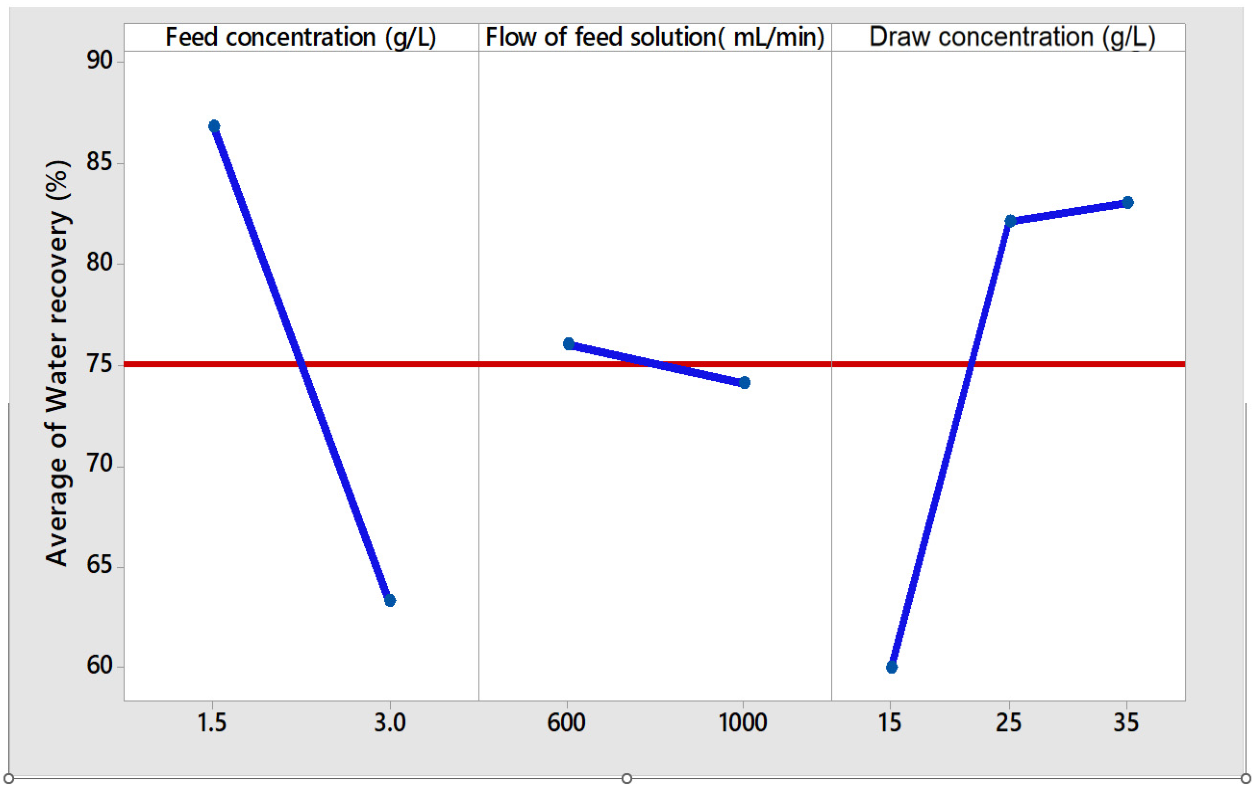
Figure 3 shows that the lower the concentration of the feed solution, the higher the percentage of water recovery in the FO module. At feed concentrations of 1.5 and 3 g/L, the average water recoveries were 86.82% and 63.25%. The reduction in salinity/concentration on the feed side (for a fixed, highly concentrated draw solution) is consistent with FO theory and several recent studies on FO, indicating that higher water recovery can be achieved with lower feed concentration [28]. Recent studies have indicated that a lower concentration of the feed solution (i.e., lower feed salinity) increases the driving osmotic pressure difference for a given draw solution, resulting in higher water recovery in the forward osmosis module [29]. In experimental studies on FO desalination of landfill leachate, water recovery rates of between 60% and 80% have been achieved. The authors note that higher recovery rates are achieved with less saline brine inputs compared to highly saline ones, which supports the idea that lower input concentrations promote greater water recovery [30]. Recent studies have revealed, after conducting experiments and FO simulations with NaCl feed, that as the feed becomes more concentrated during operation, the driving force and water flux decrease, limiting further water recovery [31]. Although FO is driven by the osmotic pressure difference (Δπ) between the draw and feed solutions, the flux is governed by the effective osmotic pressure difference at the membrane surface, not the bulk Δπ [32]. Recent FO studies show that a system with a smaller bulk Δπ can exhibit higher water flux when internal concentration polarization (ICP), external concentration polarization (ECP), or solute–membrane interactions severely reduce the effective Δπ in competing systems [33]. Thus, what appears to be an inconsistency (lower Δπ → higher flux) is actually explained by polarization phenomena and draw/solute physicochemical properties. Increasing DS concentration increases CP severity, and flux decline is dominated by ICP rather than Δπ enhancement [34].

3.1.2. Effect of Feed Flow

Figure 3 shows that a lower feed solution flow rate improves the water recovery percentage in the forward osmosis module. With feed flow rates of 600 and 1000 mL/min, the average water recoveries were 76.04 and 74.06%. It was observed that changes in feed flow rates did not have a significant influence. Previous studies have shown that increasing the feed flow rate improved the water flux by up to 2.5%, with a negligible impact; the feed had less effect than the draw solution flow [31]. Previous studies used Aquaporin hollow-fiber direct osmosis (HFFO.6) membranes, purchased from Aquaporin A/S in Denmark, in all experiments and recommended operating at lower flow rates to achieve higher water recovery [35]. Several studies have shown that increasing the feed cross-flow velocity enhances turbulence near the membrane surface, thereby reducing the concentration boundary layer thickness, improving solute mixing, and mitigating external concentration polarization (ECP) [36]. These effects lead to a higher instantaneous water flux. However, this enhancement persists only up to an optimal velocity threshold, beyond which further increases in flow rate do not yield performance improvements [37]. At this stage, ICP becomes the dominant limiting factor, and the influence of external hydrodynamic mixing diminishes significantly [38]. In some modules, flux increases significantly only at low flow rates; above a certain range, increases become minimal.

3.1.3. Effect of the Draw Solution Concentration

Figure 3 shows that a higher concentration level of the draw solution improves the water recovery percentage in the forward osmosis module. With draw solution concentrations of 15, 25, and 35 g/L, the average water recoveries were 59.9%, 82.14%, and 83.06%, respectively. Previous studies have reported that, for a 5 g/L NaCl feed solution, using a 35 g/L NaCl draw solution results in higher water recovery (~46–51%) [39]. Recent studies have employed NaCl as the draw solution and have observed changes in water flux as the NaCl concentration increases from 1 to 5 mol/L, quantifying how the NaCl concentration in the draw solution affects the performance of the FO module and the effective osmotic pressure, which is directly related to the achievable water recovery [40].
Recent studies show that, beyond an optimum concentration range, increasing the DS concentration can reduce effective osmotic pressure, water flow, and recovery due to intensified concentration polarization and solute reverse flow [14]. As DS salinity increases, solute accumulation within the porous support layer increases, reducing the effective concentration difference across the membrane [14]. Recent work confirms that ICP is the main limiting factor for FO performance, especially at high DS concentrations.

3.2. Pareto Analysis

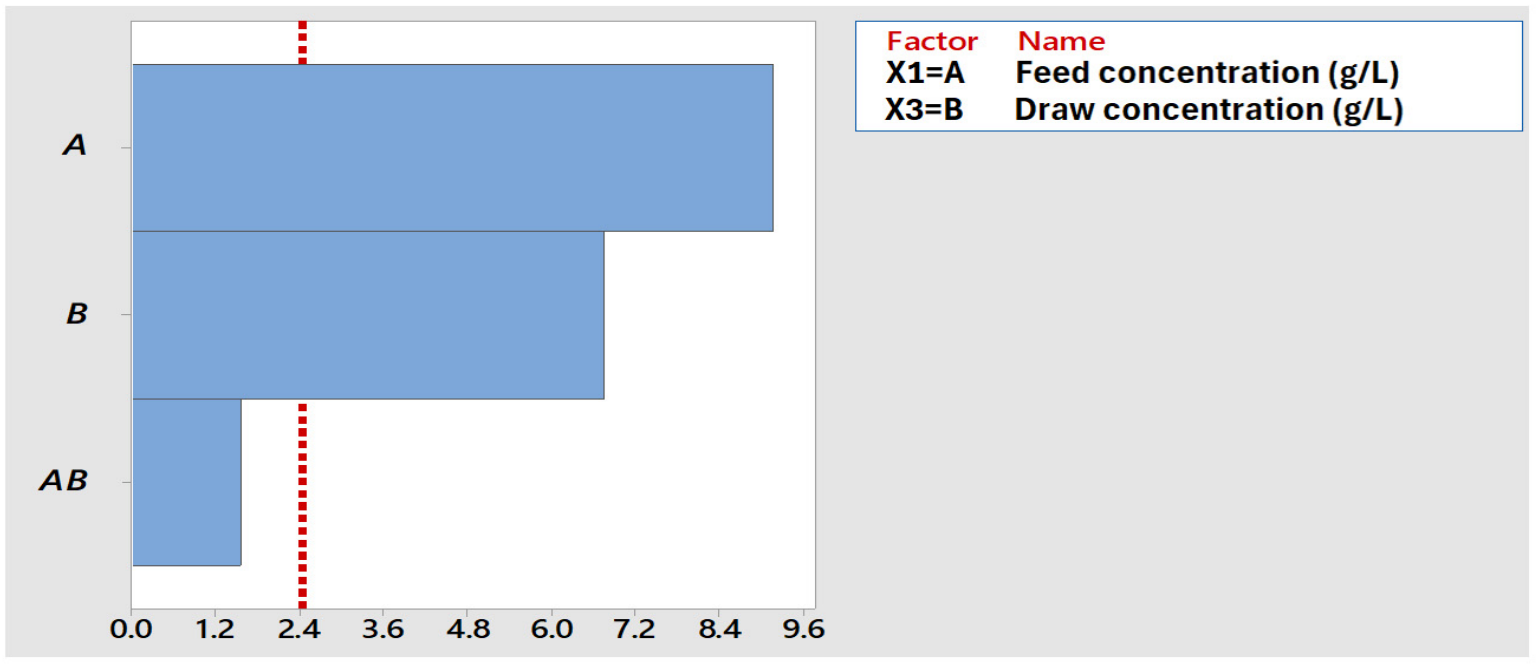
To assess the effect of the independent variables on the response variable (water flow recovery, %), Pareto chart analyses were performed at a 95% confidence level (p < 0.05), as shown in Figure 4. In this graph, factors and interactions are represented by horizontal bars, and those that exceed the reference line are considered statistically significant. As shown in Figure 4, factors A and B exceed the significance threshold (t = 2.4), indicating a statistically significant influence on the response. In contrast, the AB interaction term does not cross the reference line, suggesting that its effect is not significant. Among the evaluated variables, factor A (feed solution concentration) has the greatest impact on water flow recovery.

3.3. Effect of Draw Solution Concentration on Water Flux

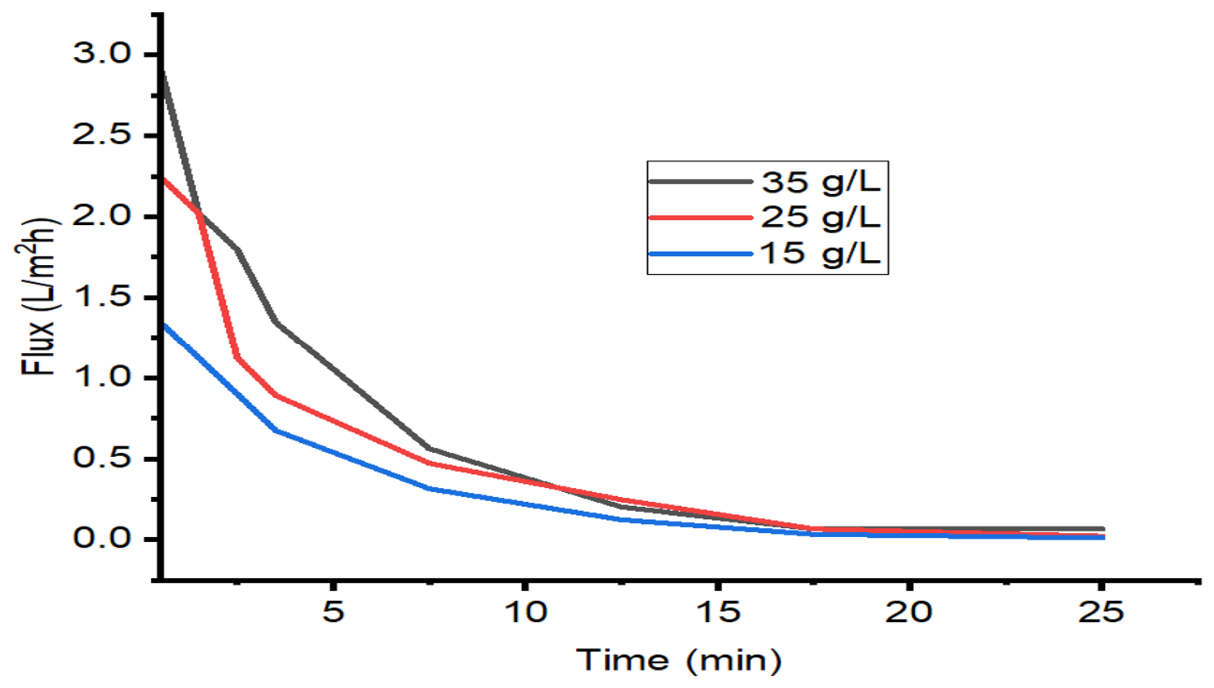
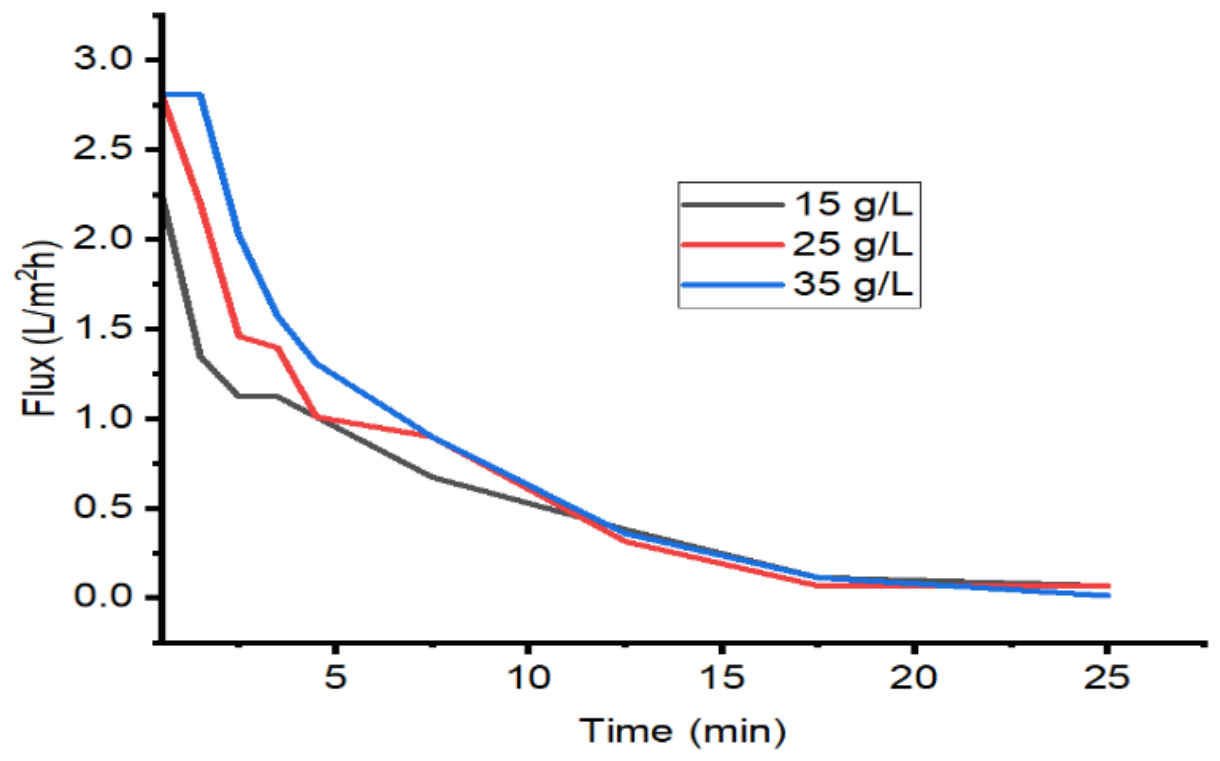
Figure 5 and Figure 6 show the effect of the concentrations used in the draw solution on changes in water flux as a function of forward osmosis treatment time. The results show that the concentration of the draw solution influences the water flux through the membrane as a function of time. Likewise, it can be seen that the flux increases as the concentration of the draw solution (NaCl) increases. In Figure 5, we observe that, 0.5 min after starting up the direct osmosis module, water flow rates of 2.8, 2.4, and 1.4 L/m2·h are achieved for draw solution concentrations of 35, 25, and 15 g/L NaCl and 3 g/L NaCl in the feed solution. Similarly, it is observed that, after 17 min of operation, a constant flow rate of 0.30 L/m2·h is reached, regardless of the initial concentration of the draw solution. Furthermore, it is observed that as operating time elapses, the water flow decreases because the extraction solution becomes diluted; consequently, the osmotic force weakens. Similarly, as the feed solution becomes more concentrated, the gradient decreases, the water flow rate reduces, and the process loses efficiency. Researchers have reported that water flux increases with higher NaCl concentrations, but internal concentration polarization (ICP) becomes stronger, reducing the effective driving force over time. The time-dependent decline in water flux is more pronounced at high NaCl concentrations (up to 2 M) due to ICP and reverse salt flux [41]. Recent studies have used NaCl as a draw solution; water flux increases with NaCl concentration (tested up to 1.5 mol/L) [42]. Other studies have investigated FO performance using 1 M and 2 M NaCl as draw solutions for saline water treatment, reporting that water flux increases with increasing NaCl concentration due to a higher osmotic driving force; the flux is measured over time and shows a decreasing trend due to concentration polarization, but the rate of decrease in flux over time is greater at high concentrations due to ICP, fouling, and reverse salt flux [43]. Studies have evaluated NaCl draw solutions (1–3 M) for the treatment of brackish water in FO. Water flux increases with NaCl concentration and is higher at elevated temperatures; time-dependent flux profiles show an initial peak followed by stabilization [44].

3.4. Changes in Solution Levels over the Course of Treatment

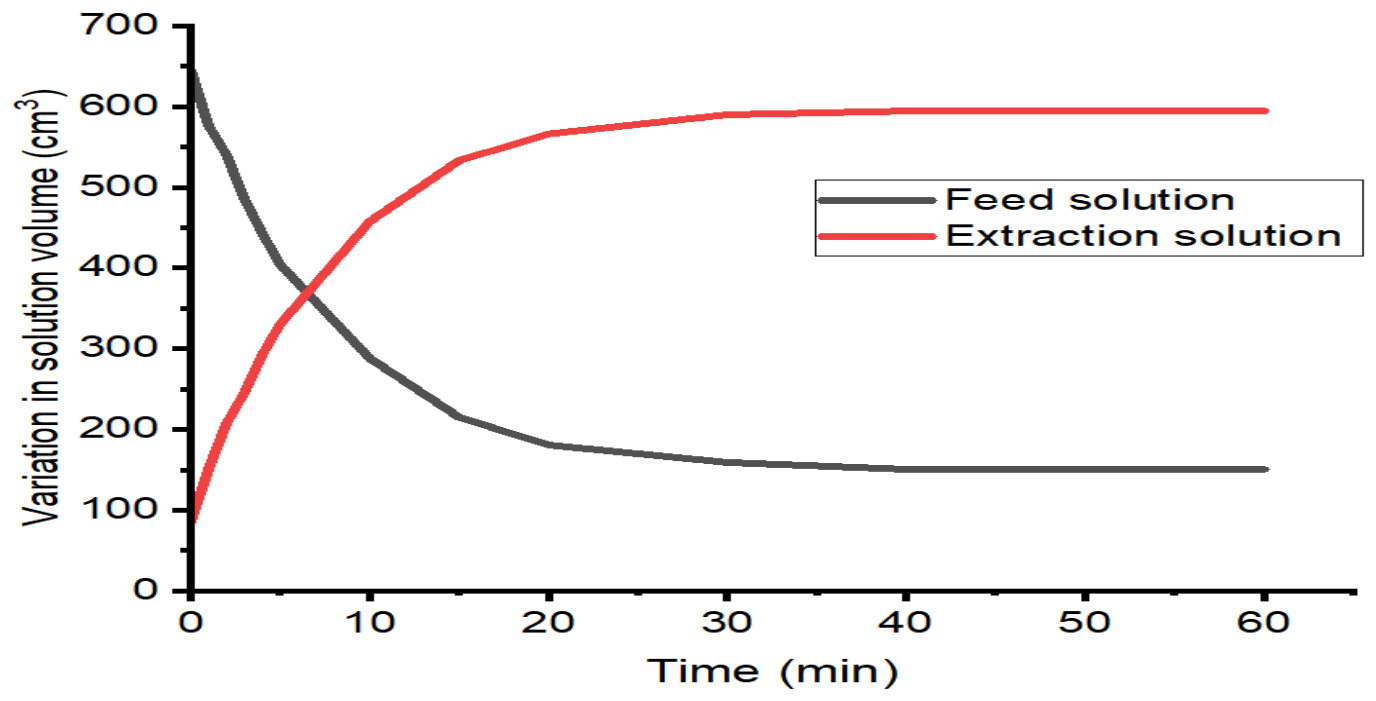
Figure 7 shows the changes in the levels (height) of the feed and draw solution during treatment. According to the results, the level of the feed solution decreases over time because water moves by osmosis toward the draw solution. Likewise, it can be observed that the level of the draw solution increases as the treatment progresses. In the first 5 min, water diffusion shows a linear correlation with the passage of time; then, between 5 and 10 min, the changes are more gradual. After 10 min, there is no further water diffusion.
Table 5 presents a comparison of the effect of NaCl concentration in the extractant solution on water flux in direct osmosis processes. The results show a positive relationship between NaCl concentration and increased water flux, attributed to the increase in the osmotic pressure gradient. However, this increase is not linear at high concentrations, where a decrease in flux efficiency is observed. This behavior is likely associated primarily with concentration polarization phenomena, which reduce the effective osmotic driving force across the membrane.

3.5. Reverse Solute Flow

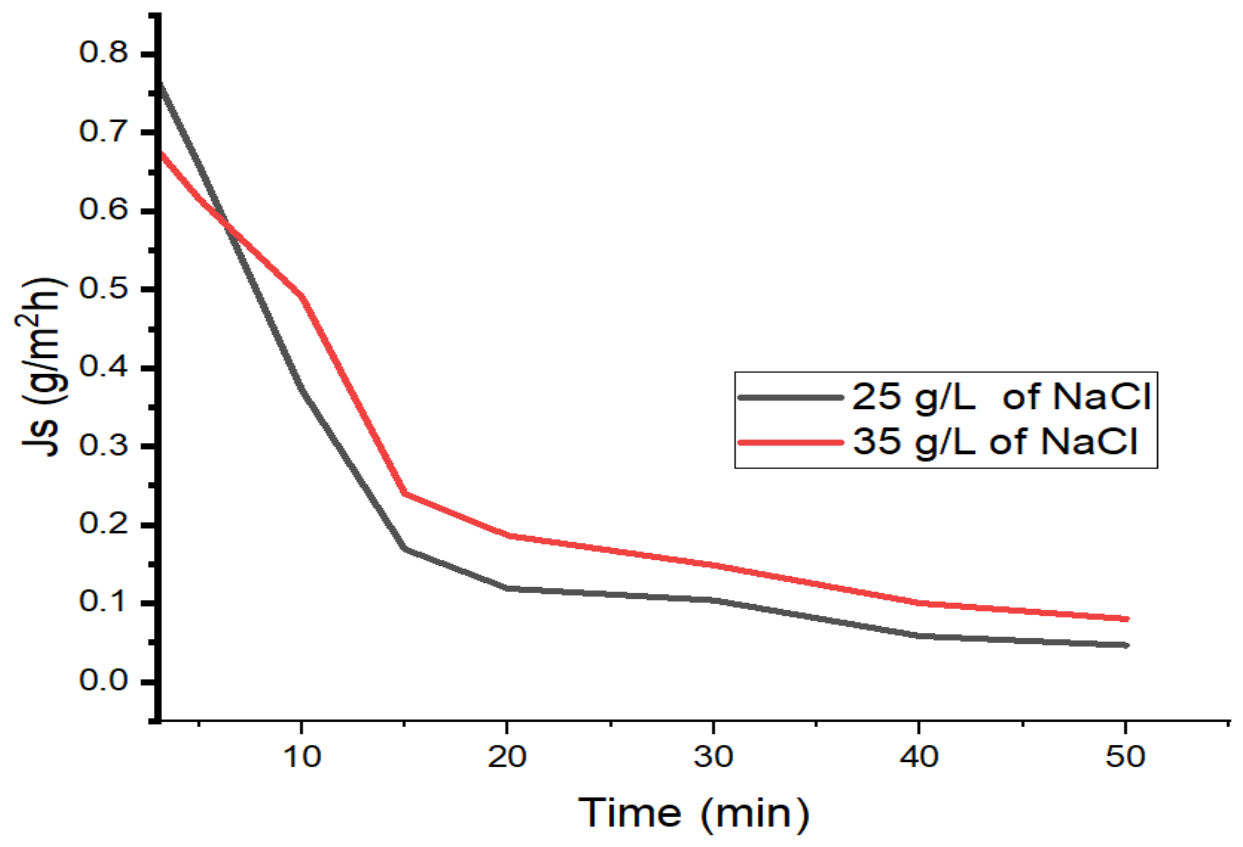
Figure 8 shows the reverse fluxes of salt (chloride) for experiments 2 and 3 (Table 1). It can be seen that, as the NaCl concentration increases from 25 to 35 g/L, the increase in the reverse flux of chloride ions is not significant. We also observed that the chloride ion flux was higher at the start of the process and then decreased as the treatment time progressed. The tests yielded average reverse chloride ion fluxes of 0.28 g/m2h (test 2) and 0.32 g/m2h (test 3) over the 50 min treatment period. When concentrations reach sufficiently high levels, the effects of concentration polarization and diffusion intensify, which can cause reverse ion leakage to increase and reduce the overall efficiency of the process [15]. Previous studies have shown that an increase in the NaCl concentration of the extraction solutions results in a nonlinear increase in the reverse salt flux (RSF) of chloride ions, with values ranging from approximately 10 g/m2h at 0.5 M to 55 g/m2h at 5 M [47]. A study conducted by Sayyad, which used synthetic effluents with chloride concentrations ranging from 4.88 to 5.07 g/L and NaCl solutions at 24 g/L and 38 g/L, revealed an increase in chloride concentration from 8.97% to 12.25% for NaCl concentrations of 24 g/L and 38 g/L, respectively [34]. This finding indicates a higher concentration of the extraction solution, which increased the driving force for water permeation but also intensified chloride back diffusion. Previous studies have shown that, as the concentration of NaCl increases, the reverse flow of chloride ions also tends to increase, due to the rise in the concentration gradient across the membrane. However, the exact magnitude depends on the membrane structure, hydrodynamics, and concentration polarization, so the relationship is not strictly linear in all systems [48]. Zhao et al. [49] have reported that a higher concentration of NaCl initially increases water flow due to the increased osmotic pressure difference. That same increase in concentration also tends to increase the reverse flow of salt, meaning that a greater number of chloride ions diffuse across the membrane.
Table 6 shows the reverse salt/solute flux reported in previous studies on FO membranes using NaCl as the draw solution.

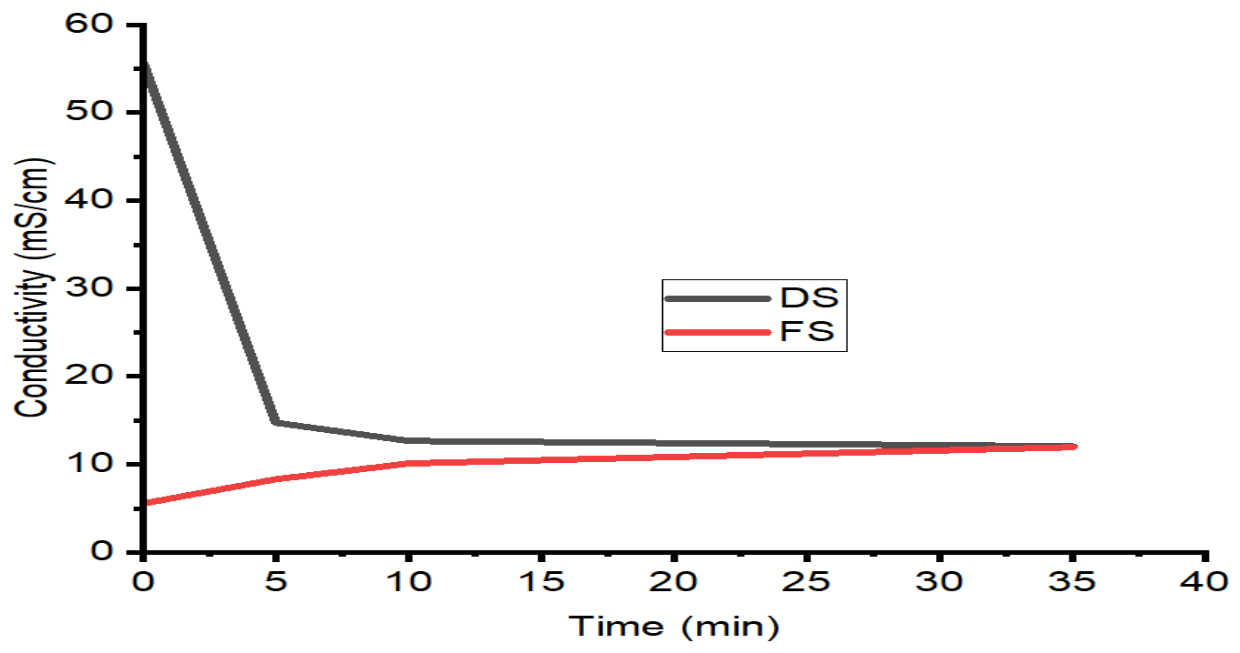
3.6. Changes in the Conductivity of Feed and Draw Solutions as a Function of Treatment Time

Figure 9 shows the changes in conductivity levels for the feed and draw solutions according to treatment time. In the first five minutes, the electrical conductivity of the feed and draw solutions shows the most pronounced changes in conductivity levels. This is due to the existence of a greater osmotic pressure difference (Δπ) during the initial intervals. Similarly, Figure 8 shows that the conductivity of the FO feed increased from 5.56 mS/cm to 11.96 mS/cm, while the conductivity of the draw solution decreased from 55.7 mS/cm to 12.05 mS/cm. Recent studies have reported that the conductivity of the draw solution decreases over time as it is diluted with incoming water, reducing its osmotic pressure and therefore the water flux [55]. Likewise, modeling studies and experimental data have reported that the feed conductivity increases while the draw solution conductivity decreases over the treatment time [56].

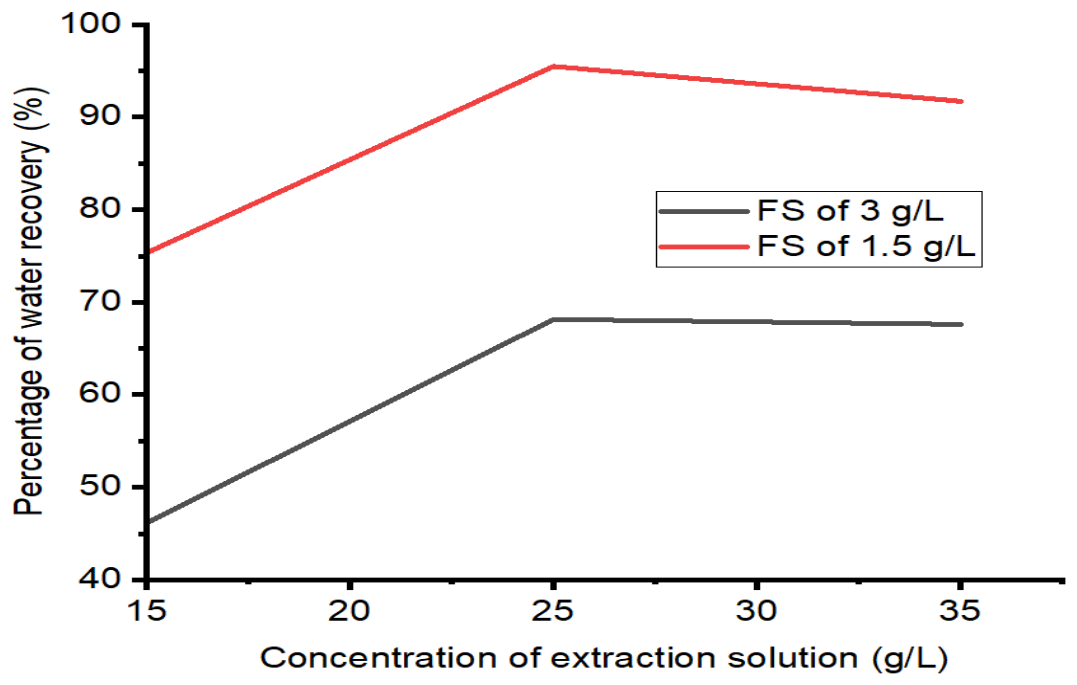
3.7. Effect of DS Concentration on Water Recovery

Figure 10 shows the effect of DS concentration on the percentage of water recovery. It can be seen that as the DS concentration increases from 15 to 25 g/L NaCl, a percentage between 75% and 95% is achieved, while for a 35 g/L solution, there was a slight decrease, maintaining a fixed FS concentration of 1.5 g/L. Likewise, for a feed concentration of 3 g/L, it can be seen that water recovery increases from 45% to 65% when the concentration of the draw solution is increased. However, for a DS concentration of 35 g/L, a slight decrease is observed.

4. Conclusions

This study analyzed the effects of feed solution concentration, draw solution concentration, and feed solution flow rate on water recovery percentage and water flux in the forward osmosis module. The results showed that recovery levels and water flux depend largely on the salinity of the draw solution (NaCl) and the feed concentration (NaCl). FO process trials revealed that draw solutions at concentrations of 15, 25, and 35 g/L NaCl showed very good water recovery performance. Using 25 g/L as DS with 1.5 g/L of NaCl as FS, a water recovery of 95.48% and a small salt flux of 5.1 g/m2·h were observed, while with 25 g/L as DS and an FS concentration of 3 g/L of NaCl, an average water recovery value of 69.22% was obtained. Similarly, for concentrations of 15 g/L and 35 g/L of DS with 1.5 g/L of FS, water recovery rates of 74.49% and 91% were achieved, respectively. Increasing the concentration of the draw solution improves water recovery in the FO module, while increasing the FS flow rate slightly reduces water recovery. The water flow rates achieved in this study are significantly lower than the value reported by the membrane manufacturer. This discrepancy strongly suggests that differences in the concentration of the carrier solute, temperature, transverse flow velocity, hydrodynamics, or membrane orientation could explain the lower observed flow.
For future work, the authors also recommend pilot-scale validation and hybrid integration, as FO still requires further evidence of scalability and membranes that are more resistant to ICP before it can be implemented on a large scale. The most relevant future research areas, according to the scientific literature, are reducing internal concentration polarization, testing wider operating ranges for feed and permeate concentrations, and adjusting flow rates to balance flow gains with pumping energy. Reviews also highlight membrane and substrate engineering, as well as hybrid systems, as the clearest paths to improving the performance of large-scale forward osmosis. Priority should be given to membrane substrate redesign, pilot-scale validation, and hybrid forward osmosis configurations to improve flux, energy efficiency, and scalability.

Author Contributions

Conceptualization, J.T.M.C.; methodology, J.T.M.C., E.W.V.M., K.R.A.G. and L.A.C.V.; software, C.A.R.A. and F.A.T.C.; validation, C.A.S.M. and R.P.S.; formal analysis, E.W.V.M.; investigation, J.T.M.C. and P.M.M.V.; resources, J.A.M.P. and L.A.C.V.; data curation, E.W.V.M.; writing—original draft preparation, J.T.M.C.; writing—review and editing, K.R.A.G. and J.T.M.C.; supervision, J.T.M.C. and J.A.M.P.; project administration, J.T.M.C.; funding acquisition, C.A.R.A. and C.A.S.M. All authors have read and agreed to the published version of the manuscript.

Funding

The study is partially funded by the National University of Callao through the Office of the Vice President for Research.

Data Availability Statement

The original contributions of this study are included in the article. Further information is available upon request from the corresponding author.

Acknowledgments

The authors would like to thank the Universidad Nacional del Callao de Lima (Peru), especially the Vice-Rector of Research of the UNAC, for funding the publication of this article.

Conflicts of Interest

The authors declare that they have no conflicts of interest.

References

  1. Huang, Z.; Yuan, X.; Liu, X. The key drivers for the changes in global water scarcity: Water withdrawal versus water availability. J. Hydrol. 2021, 601, 126658. [Google Scholar] [CrossRef]
  2. Musie, W.; Gonfa, G. Fresh water resource, scarcity, water salinity challenges and possible remedies: A review. Heliyon 2023, 9, e18685. [Google Scholar] [CrossRef] [PubMed]
  3. Lutchmiah, K.; Verliefde, A.R.D.; Roest, K.; Rietveld, L.C.; Cornelissen, E.R. Forward osmosis for application in wastewater treatment: A review. Water Res. 2014, 58, 179–197. [Google Scholar] [CrossRef] [PubMed]
  4. Sabour, S.M.J.S.; Ghorashi, B. A comprehensive review of major water desalination techniques and mineral extraction from saline water. Sep. Purif. Technol. 2024, 349, 127913. [Google Scholar] [CrossRef]
  5. Kim, Y.; Byun, J.; Park, K.; Park, Y.G. Comprehensive analysis of energy saving and high-quality permeate production strategies for a large-scale seawater reverse osmosis desalination plant with diverse process configurations and external resource utilization. Desalination 2024, 596, 118292. [Google Scholar] [CrossRef]
  6. Gonzalez-Vogel, A.; Moltedo, J.J.; Rojas, O.J. Desalination by pulsed electrodialysis reversal: Approaching fully closed-loop water systems in wood pulp mills. J. Environ. Manag. 2021, 298, 113518. [Google Scholar] [CrossRef]
  7. Philibert, M.; Villacorte, L.O.; Ekowati, Y.; Abushaban, A.; Salinas-Rodriguez, S.G. Fouling and scaling in reverse osmosis desalination plants: A critical review of membrane autopsies, feedwater quality guidelines and assessment methods. Desalination 2024, 592, 118188. [Google Scholar] [CrossRef]
  8. Giagnorio, M.; Casasso, A.; Tiraferri, A. Environmental sustainability of forward osmosis: The role of draw solute and its management. Environ. Int. 2021, 152, 106498. [Google Scholar] [CrossRef] [PubMed]
  9. Chun, Y.; Mulcahy, D.; Zou, L.; Kim, I.S. A short review of membrane fouling in forward osmosis processes. Membranes 2017, 7, 30. [Google Scholar] [CrossRef] [PubMed]
  10. Johnson, D.J.; Suwaileh, W.A.; Mohammed, A.W.; Hilal, N. Osmotic’s potential: An overview of draw solutes for forward osmosis. Desalination 2018, 434, 100–120. [Google Scholar] [CrossRef]
  11. Qasim, M.; Darwish, N.A.; Sarp, S.; Hilal, N. Water desalination by forward (direct) osmosis phenomenon: A comprehensive review. Desalination 2015, 374, 47–69. [Google Scholar] [CrossRef]
  12. Tangry, V.; Haddad, W.; Behboudi, A.; Zydney, A.L. The application of forward osmosis for producing highly concentrated biotherapeutics. J. Membr. Sci. 2025, 721, 123839. [Google Scholar] [CrossRef]
  13. Wang, Y.N.; Goh, K.; Li, X.; Setiawan, L.; Wang, R. Membranes and processes for forward osmosis-based desalination: Recent advances and future prospects. Desalination 2018, 434, 81–99. [Google Scholar] [CrossRef]
  14. Chaoui, I.; Ndiaye, I.; Eddouibi, J.; Abderafi, S.; Vaudreuil, S.; Bounahmidi, T. Experimental and theoretical parametric study of forward osmosis system using NH4HCO3 and NaCl draw solutes. Chem. Eng. Res. Des. 2022, 180, 402–413. [Google Scholar] [CrossRef]
  15. Ma, S.; Wu, X.; Fan, L.; Wang, Q.; Hu, Y.; Xie, Z. Effect of Different Draw Solutions on Concentration Polarization in a Forward Osmosis Process: Theoretical Modeling and Experimental Validation. Ind. Eng. Chem. Res. 2023, 62, 3672–3683. [Google Scholar] [CrossRef]
  16. Cifuentes-Cabezas, M.; Álvarez-Blanco, S.; Mendoza-Roca, J.A.; Vincent-Vela, M.C.; Gozálvez-Zafrilla, J.M. Theoretical Model for the Prediction of Water Flux during the Concentration of an Olive Mill Wastewater Model Solution by Means of Forward Osmosis. Membranes 2023, 13, 745. [Google Scholar] [CrossRef]
  17. Razavi, R.; Shakeri, A.; Salehi, H.; Das, A.; Ulbricht, M.; Jangizehi, A.; Seiffert, S. Mitigating internal concentration polarization in forward osmosis membranes via PSf-g-PHEMA amphiphilic graft copolymer-modified sublayer. J. Membr. Sci. 2026, 740, 124917. [Google Scholar] [CrossRef]
  18. Al-Sakaji, B.A.K.; Al-Asheh, S.; Maraqa, M.A. A Review on the Development of an Integer System Coupling Forward Osmosis Membrane and Ultrasound Waves for Water Desalination Processes. Polymers 2022, 14, 2710. [Google Scholar] [CrossRef]
  19. Alenezi, A.; Alabaiadly, Y. Emerging technologies in water desalination: A review and future outlook. Energy Nexus 2025, 17, 100373. [Google Scholar] [CrossRef]
  20. Mounir, M.; Gadallah, H.; Ali, H.M.; Souaya, E.R.; Azab, A.A. Ferric hydroacid & diamine complex as draw solute for forward osmosis (FO) desalination processes. Clean. Eng. Technol. 2021, 5, 100316. [Google Scholar] [CrossRef]
  21. Zavitsas, A.A. Properties of aqueous solutions. A treatise against osmotic and activity coefficients. J. Mol. Liq. 2022, 348, 118410. [Google Scholar] [CrossRef]
  22. Giagnorio, M.; Ricceri, F.; Tagliabue, M.; Zaninetta, L.; Tiraferri, A. Hybrid forward osmosis-nanofiltration for wastewater reuse: System design. Membranes 2019, 9, 61. [Google Scholar] [CrossRef] [PubMed]
  23. Chia, W.Y.; Khoo, K.S.; Chia, S.R.; Chew, K.W.; Yew, G.Y.; Ho, Y.-C.; Show, P.L.; Chen, W.-H. Factors affecting the performance of membrane osmotic processes for bioenergy development. Energies 2020, 13, 481. [Google Scholar] [CrossRef]
  24. Cath, T.Y.; Elimelech, M.; McCutcheon, J.R.; McGinnis, R.L.; Achilli, A.; Anastasio, D.; Brady, A.R.; Childress, A.E.; Farr, I.V.; Hancock, N.T.; et al. Standard Methodology for Evaluating Membrane Performance in Osmotically Driven Membrane Processes. Desalination 2013, 312, 31–38. [Google Scholar] [CrossRef]
  25. Kegl, T.; Korenak, J.; Bukšek, H.; Petrinić, I. Modeling and multi-objective optimization of forward osmosis process. Desalination 2024, 580, 117550. [Google Scholar] [CrossRef]
  26. Klimonda, A.; Kowalska, I. Concentrating esterquat-based surfactant wastewater via forward osmosis: A step toward reuse. Water Resour. Ind. 2025, 34, 100316. [Google Scholar] [CrossRef]
  27. Im, S.J.; Jeong, S.; Jang, A. Feasibility evaluation of element scale forward osmosis for direct connection with reverse osmosis. J. Membr. Sci. 2018, 549, 366–376. [Google Scholar] [CrossRef]
  28. Abounahia, N.; Ibrar, I.; Kazwini, T.; Altaee, A.; Samal, A.K.; Zaidi, S.J.; Hawari, A.H. Desalination by the forward osmosis: Advancement and challenges. Sci. Total. Environ. 2023, 886, 163901. [Google Scholar] [CrossRef]
  29. Jeon, J.; Kim, D.; Kim, S. Energy Efficient Forward Osmosis to Maximize Dewatering Rates. Membranes 2025, 15, 171. [Google Scholar] [CrossRef] [PubMed]
  30. Wang, J.; Liu, X. Forward osmosis technology for water treatment: Recent advances and future perspectives. J. Clean. Prod. 2021, 280, 124354. [Google Scholar] [CrossRef]
  31. Martin, J.; Kolliopoulos, G.; Papangelakis, V.G. Process water recovery via forward osmosis: Membrane and integrated process development. Water Sci. Technol. 2020, 81, 2291–2299. [Google Scholar] [CrossRef]
  32. Dey, K.; Rufuss, D.D.W. Efficient brine concentration of highly saline and hypersaline water using forward osmosis: A modeling study. Water Resour. Ind. 2026, 35, 100351. [Google Scholar] [CrossRef]
  33. Xiao, P.; Liu, L. A New Method for Quantitative Evaluation Concentration Polarization Under Different Conditions for the Forward Osmosis Process. Membranes 2025, 15, 223. [Google Scholar] [CrossRef]
  34. Sayyad, S.U. Forward Osmosis Process for Concentration of Treated Tannery Effluent. Nat. Environ. Pollut. Technol. 2025, 24, B4144. [Google Scholar] [CrossRef]
  35. Rufuss, D.D.W.; Hosseinipour, E.; Arulvel, S.; Davies, P.A. Complete parametric investigation of a forward osmosis process using sodium chloride draw solution. Desalination 2023, 547, 116218. [Google Scholar] [CrossRef]
  36. Damtie, M.M.; Woo, Y.C.; Kim, B.; Hailemariam, R.H.; Park, K.-D.; Shon, H.K.; Park, C.; Choi, J.-S. Removal of fluoride in membrane-based water and wastewater treatment technologies: Performance review. J. Environ. Manag. 2019, 251, 109524. [Google Scholar] [CrossRef]
  37. Seker, M.; Buyuksari, E.; Topcu, S.; Sesli, D.; Celebi, D.; Keskinler, B.; Aydiner, C. Effect of process parameters on flux for whey concentration with NH3/CO2 in forward osmosis. Food Bioprod. Process. 2017, 105, 64–76. [Google Scholar] [CrossRef]
  38. Ji, M.; Gao, X.; Wang, X.; Zhang, Y.; Jiang, J.; Gu, X. An ensemble synthesis strategy for fabrication of hollow fiber T-type zeolite membrane modules. J. Membr. Sci. 2018, 563, 460–469. [Google Scholar] [CrossRef]
  39. Ahmed, M. A study on the influence of feed and draw solution concentrations on the performance of the pilot-scale forward osmosis-membrane distillation system. Desalin. Water Treat. 2024, 317, 100225. [Google Scholar] [CrossRef]
  40. Yang, Y.; Sun, Y.; Song, X.; Yu, J. Forward osmosis for multi-effect distillation brine treatment: Performance and concentration polarization evaluation. Can. J. Chem. Eng. 2021, 99, S114–S125. [Google Scholar] [CrossRef]
  41. Yang, Y.J.; Chang, H.C.; Wang, M.Y.; Suen, S.Y. Preparation of Polyacrylonitrile-Based Immobilized Copper-Ion Affinity Membranes for Protein Adsorption. Membranes 2023, 13, 271. [Google Scholar] [CrossRef] [PubMed]
  42. Eddouibi, J.; Abderafi, S.; Vaudreuil, S.; Bounahmidi, T. Water desalination by forward osmosis: Dynamic performance assessment and experimental validation using MgCl2 and NaCl as draw solutes. Comput. Chem. Eng. 2021, 149, 107313. [Google Scholar] [CrossRef]
  43. Deshmukh, A.; Yip, N.Y.; Lin, S.; Elimelech, M. Desalination by forward osmosis: Identifying performance limiting parameters through module-scale modeling. J. Membr. Sci. 2015, 491, 159–167. [Google Scholar] [CrossRef]
  44. Akther, N.; Daer, S.; Hasan, S.W. Effect of flow rate, draw solution concentration and temperature on the performance of TFC FO membrane, and the potential use of ro reject brine as a draw solution in FO–RO hybrid systems. Desalin. Water Treat. 2018, 136, 65–71. [Google Scholar] [CrossRef]
  45. Sabry, R.; Ali, H.M.; Ali, S.S.; Gadallah, H. Superior forward osmosis cellulosic membrane for water desalination and brine concentration. Sci. Rep. 2025, 15, 16829. [Google Scholar] [CrossRef] [PubMed]
  46. Nguyen, H.T.; Nguyen, N.C.; Chen, S.-S.; Duong, H.C.; Nguyen, M.L.; Tran, C.-S.; Nguyen, P.-D. Exploration of a cost-effective draw solution based on mixing surfactant and sodium chloride for forward osmosis desalination process. Environ. Technol. Innov. 2023, 30, 103088. [Google Scholar] [CrossRef]
  47. Hosseinzadeh, A.; Altaee, A.; Ibrar, I.; Zhou, J.L. Modeling and optimization of reverse salt diffusion and water flux in forward osmosis by response surface methodology and artificial neural network. Chem. Eng. Process. Process. Intensif. 2025, 208, 110140. [Google Scholar] [CrossRef]
  48. Zhao, Y.; Duan, L.; Liu, X.; Song, Y. Influence of Membrane Fouling and Reverse Salt Flux on Membrane Impedance of Forward Osmosis Microbial Fuel Cell. Membranes 2022, 12, 1165. [Google Scholar] [CrossRef]
  49. Wibisono, Y.; Noviani, V.; Ramadhani, A.T.; Devianto, L.A.; Sulianto, A.A. Eco-friendly forward osmosis membrane manufacturing using dihydrolevoglucosenone. Results Eng. 2022, 16, 100712. [Google Scholar] [CrossRef]
  50. Jaafer, M.J.; Al-Najar, J.A.; Alsalhy, Q.F. Poly(phenyl sulfone) hollow fiber forward osmosis membrane for saline water desalination. Chem. Eng. Process. Process. Intensif. 2020, 157, 108119. [Google Scholar] [CrossRef]
  51. Islam, M.S.; Sultana, S.; McCutcheon, J.R.; Rahaman, M.S. Treatment of fracking wastewaters via forward osmosis: Evaluation of suitable organic draw solutions. Desalination 2019, 452, 149–158. [Google Scholar] [CrossRef]
  52. Amjad, M.; Gardy, J.; Hassanpour, A.; Wen, D. Novel draw solution for forward osmosis based solar desalination. Appl. Energy 2018, 230, 220–231. [Google Scholar] [CrossRef]
  53. Algburi, S.; Sabeeh, S.; Khater, D.; Hakami, H.; Islam, S.; Alkhawlani, Q. Electrostatic spray printed dual charge covalent organic framework graphene membranes for seawater desalination. Mater. Today Sustain. 2026, 33, 101277. [Google Scholar] [CrossRef]
  54. Blandin, G.; Ferrari, F.; Lesage, G.; Le-Clech, P.; Héran, M.; Martinez-Lladó, X. Forward osmosis as concentration process: Review of opportunities and challenges. Membranes 2020, 10, 284. [Google Scholar] [CrossRef] [PubMed]
  55. Goi, Y.K.; Li, M.; Liang, Y.Y. A comprehensive review on forward osmosis mass transfer and fouling: Mathematical modeling, mechanism, prediction and optimization. J. Water Process. Eng. 2025, 72, 107677. [Google Scholar] [CrossRef]
  56. Sitabule, E.N.; Buckley, C. Forward osmosis treatment of thermal evaporator brine stream. Water SA 2023, 49, 26–35. [Google Scholar] [CrossRef]
Figure 1. Photo of the direct osmosis test module includes, pump (P1, P2) and containers (R1, R2).
Sustainability 18 05647 g001
Figure 2. Schematic view of the forward osmosis system: (P1 and P2) pumps, (R1 and R2) solution containers, and (M) forward osmosis membrane.
Sustainability 18 05647 g002
Figure 3. Primary-effects plot for flux recovery (%).
Sustainability 18 05647 g003
Figure 4. Pareto chart of standardized effects.
Sustainability 18 05647 g004
Figure 5. Evolution of water flux according to treatment time, with a feed concentration of 3 g/L NaCl, a feed flow rate of 1000 mL/min, and draw solutions of 15, 25, and 35 g/L NaCl.
Sustainability 18 05647 g005
Figure 6. Effect of time on water flux using 15, 25 and 35 g/L of NaCl as draw solution, feed concentration of 1.5 g/L, and a feed flow rate of 1000 mL/min.
Sustainability 18 05647 g006
Figure 7. Change in the volume of feed and extraction solutions as a function of treatment time.
Sustainability 18 05647 g007
Figure 8. Evolution of backflow over time, using NaCl solutions at concentrations of 25 and 35 g/L.
Sustainability 18 05647 g008
Figure 9. Evolution of the conductivity of the FS and DS according to treatment time, with a feed concentration of 3 g/L, a feed flow rate of 600 mL/min, and draw solutions of 35 g/L.
Sustainability 18 05647 g009
Figure 10. Variation in the water recoveries with the different concentrations of DS and NaCl concentrations of FS at 1.5 and 3 g/L.
Sustainability 18 05647 g010
Table 1. Characteristics of the HFFO2 membrane.
ParameterUnitValues
Membrane aream22.3
Water fluxL m−2 h−111 ± 1.5 a
Specific reverse salt fluxg/L0.15 ± 0.05 b
Temperature°C5–30
pH-3–10
a: Test conditions: draw solution of 0.5 M NaCl (2.9%) versus deionized water, 25 °C, single-pass mode, counter-current flow, feed flow rate of 60 L h−1, draw flow rate of 25 L h−1, 0.2 bar. b: Test conditions: draw solution of 0.5 M NaCl (2.9%) versus deionized water, 25 °C, single-pass mode, counter-current flow, feed flow rate of 400 L h−1, draw flow rate of 200 L h−1, 0.2 bar.
Table 2. Parameters and levels for the experimental design.
FactorsNotationUnitsLevels
1Concentration of the feed solutionX1g/L1.53
2Feed flow rateX2mL/min6001000
3Concentration of the draw solutionX3g/L152535
Table 3. Matrix design and experimental results.
X1X2X3VR (%)Flux (L/m2 h)
11.56001573.66671.79
21.56002594.66672.46
31.56003590.29412.24
41.510001575.32472.243
51.510002595.48392.8
61.510003591.71432.8
736001544.66673.36
836002570.33332.24
936003582.66672.8
10310001546.12901.34
11310002568.12502.24
12310003567.61362.91
Table 4. Standard deviation of the response variables.
VariableNMeanDesv. Est.VarianceMinimumMedianMaximum
Water recovery (%)1275.0617.21296.1444.6774.5095.48
Water flux (L m−2 h−1)122.430.5430.2951.342.353.36
Table 5. Water flow as a function of NaCl concentrations in the extraction solution.
NaCl ConcentrationWater Flow (LMH)R
11, 2, 4 M The water flow increased from 3.98 to 5.62 L/min as the flow rate increased from 1 to 4 M[39]
20.5, 1, 1.5 MA higher concentration of NaCl in the solution increased water recovery and flow rate in the direct osmosis test.[35]
30.5, 1.0, 1.5 y 2.0 MWater flow increased with NaCl concentration, reaching 12.6 LMH at 2.0 M NaCl[35]
42.5 and 7.7% in weight of NaClIt was reported that the water flow increased with the concentration of the NaCl extraction solution, while a higher concentration also intensified concentration polarization and reduced the net gain in flow[45]
50.5–2 MWater flow increased significantly with increasing NaCl concentration, reaching 150.67 LMH at 2 M NaCl.[46]
R: references.
Table 6. Reverse solute flow as a function of NaCl concentration in the extraction solution.
NaCl ConcentrationRSF ValueR
11 M (≈58 g/L)2.55 g·m−2·h−1, measured by the accumulation of chloride[26]
21 M164.79–870.44 g·m−2·h−1, RSF extremely high due to defects in the membrane[50]
335.5 g/L1.56 g·m−2·h−1; measured by the accumulation of chloride[20]
41–3 MRSF values increase by between 67% and 80% as the concentration increases[51]
50.61 M0.15 mol·m−2·h−1[52]
61 M4.2 g·m−2·h−1[53]
71 M0.8 ± 0.1 g·m−2·h−1, high-flow membrane with low RSF[54]
R: references.
Disclaimer/Publisher’s Note: The statements, opinions and data contained in all publications are solely those of the individual author(s) and contributor(s) and not of MDPI and/or the editor(s). MDPI and/or the editor(s) disclaim responsibility for any injury to people or property resulting from any ideas, methods, instructions or products referred to in the content.