Article

The Impact of ESG Performance on the Financial Resilience of Manufacturing Enterprises


School of Economic and Management, Shaanxi University of Science and Technology, Xi’an 710021, China
*
Author to whom correspondence should be addressed.
Sustainability 2026, 18(11), 5634; https://doi.org/10.3390/su18115634
Submission received: 30 March 2026 / Revised: 28 May 2026 / Accepted: 28 May 2026 / Published: 2 June 2026
(This article belongs to the Section Sustainable Management)

Abstract

In the context of global market volatility and the pursuit of sustainable development, improving the financial resilience of manufacturing firms lays a critical foundation for high-quality development of the real economy. To explore the key channels through which ESG practices sustain financial stability amid external shocks, this study selects listed manufacturing enterprises in the Shanghai and Shenzhen A-share markets from 2015 to 2024 as the research sample based on the CSMAR database. It employs the entropy weight method to measure corporate financial resilience, uses a two-way fixed-effects model for benchmark regression, and conducts mechanism tests through mediation and moderation analyses to explore the underlying channels between ESG performance and financial resilience in manufacturing enterprises. The results indicate that improved ESG performance significantly enhances corporate financial resilience, and these findings remain robust after robustness tests and endogeneity treatments. ESG performance primarily enhances the financial resilience of manufacturing enterprises by alleviating financing constraints, increasing R&D investment intensity, and strengthening corporate environmental governance. Heterogeneity tests show that the positive impact of ESG performance on financial resilience is more pronounced in state-owned enterprises, manufacturing enterprises located in Central China, and those in the recession phase. Based on the above conclusions, this paper puts forward targeted suggestions for the government, manufacturing firms, and investors to promote ESG practices and boost financial resilience.

1. Introduction

As the global economy accelerates its green and low-carbon transition, sustainable development has become a core agenda for economic and social governance worldwide. Driven by the restructuring of global industrial chains and the advancement of China’s “dual carbon” goals, manufacturing enterprises are facing unprecedented transition pressure [1]. As a core pillar of China’s economic and social development, the manufacturing industry performs an irreplaceable role in technological innovation, employment generation, and safeguarding industrial chain stability. In recent years, frequent external shocks—including trade conflicts, volatile energy prices, and supply chain disruptions—have exposed the inherent fragility of manufacturing firms’ financial systems. Meanwhile, the ESG framework (environmental, social, and governance) has become mainstream globally. International regulators have advanced corporate transition through policy tools such as carbon border adjustment mechanisms and mandatory ESG disclosure, and capital markets have incorporated ESG ratings into their investment decision-making frameworks [2]. Therefore, exploring ways to enhance the financial resilience of listed manufacturing firms through ESG optimization, to effectively mitigate and address potential market risks and seize new development opportunities amid crises, has become a pressing practical issue that demands timely solutions.
In recent years, China’s government agencies, regulators, and industry associations have introduced a series of policies to encourage firms to strengthen ESG management and enhance their ability to address environmental and social risks. According to data released by China Securities Net in 2024, the total investment scale of China’s ESG funds reached 399.471 billion yuan, covering 425 products as of the end of June 2024. ESG funds have significantly outperformed non-ESG funds [3]. This indicates that ESG has become a critical instrument for enterprises to gain market recognition, maintain stable cash flow, and boost crisis resilience, thereby effectively improving corporate financial resilience.
Existing literature has identified a correlation between ESG performance and corporate financial resilience [4]. Sound ESG performance can send positive signals to the market [5], mitigate information asymmetry, and build corporate reputation. Furthermore, it can inspire employees, investors, and consumers, thereby easing financing constraints [6], stabilizing customer relationships, improving innovation efficiency, and ultimately maximizing corporate value [7]. For capital-intensive manufacturing firms with long industrial chains, ESG performance positively affects financial resilience through internal and external channels. Internally, strong ESG performance helps optimize corporate governance and risk assessment mechanisms, reduce managerial myopia [8], and encourage firms to sustainably increase R&D investment intensity. It also promotes green technological innovation (energy conservation, energy consumption reduction, and low-carbon processes), thereby enhancing product competitiveness, cost control capacity [9], and financial resilience. Externally, high ESG performance strengthens competitive advantages, helping firms maintain supply chain continuity and business stability amid market volatility and reduce financing costs. Firms with sound environmental practices can obtain tax incentives and subsidies, which help foster a positive brand reputation [10] and ultimately strengthen financial resilience. These effects are particularly pronounced in growing firms [11]. However, heightened environmental uncertainty weakens these positive effects. Amid frequent policy adjustments and supply chain disruptions, manufacturing firms tend to reduce long-term investments [12], which in turn diminishes the positive impact of ESG performance on financial resilience. The bulk of existing literature focuses on the unilateral effect of ESG performance on corporate value or financial performance [13], while neglecting firms’ dynamic risk-resistance and recovery capabilities. A small number of studies have addressed the concept of resilience, but they only examine macro-level factors such as government-enterprise relations and social capital [14,15], and fail to systematically explore the impact mechanism of ESG performance on corporate financial resilience. Thus, how China’s manufacturing industry can enhance financial resilience through ESG practices remains a key research gap in global research, which urgently needs further investigation in domestic academia.
Based on stakeholder theory, resource dependence theory, and other relevant theories, this paper explores the impact mechanism between ESG performance and the financial resilience of manufacturing enterprises. Using a sample of listed manufacturing enterprises in the Shanghai and Shenzhen A-share markets from 2015 to 2024, this study measures corporate financial resilience from two dimensions (resistance and recovery) via the entropy weight method, adopts a two-way fixed-effects model to examine the effect of ESG performance on financial resilience, and conducts mediation and moderation analyses to test the underlying mechanism. Ultimately, this study provides decision-making implications for manufacturing enterprises to build long-term risk-resistance capabilities through ESG practices, and holds important practical significance for advancing the high-quality development of the manufacturing industry.
This paper makes three marginal contributions: First, it incorporates an ESG perspective into the analytical framework for financial resilience in manufacturing firms, systematically elucidating its underlying mechanisms and providing theoretical references for related research. Second, it clarifies the mechanistic roles of financing constraints, R&D intensity, and environmental uncertainty in how ESG performance affects financial resilience, revealing several key pathways for enhancing financial resilience. Third, it analyzes heterogeneous impacts of ESG performance on corporate financial resilience, thereby extending the existing research framework.
The remainder of this paper is organized as follows: Section 2 reviews relevant literature and develops the hypotheses. Section 3 comprises the design of our models and specification of the variables. Section 4 outlines the empirical results. Section 5 presents the heterogeneity analysis. Section 6 discusses the research Contributions. Section 7 illustrates conclusions and the practical implications.

2. Literature Review and Research Hypotheses

2.1. Literature Review

2.1.1. Economic Effects of ESG

As a key indicator of corporate sustainable development, ESG performance has attracted extensive scholarly attention regarding its impact on firms’ economic performance in both academic research and practical contexts. Existing studies reveal that ESG performance may not only generate value-added effects on firm value but also impose potential costs.
Prior literature mainly focuses on the economic consequences of ESG. From the stakeholder perspective, ESG performance is regarded as an investment in reputation, customer satisfaction, and stakeholder management [16], which facilitates firm value and performance [17]. Moreover, sound ESG performance significantly reduces debt costs [18] and stock price crash risk [19], promotes corporate green innovation [20], improves innovation performance, and enhances earnings persistence [21]. In addition, high-quality ESG investment strengthens firms’ capacity to cope with external uncertainties by improving internal governance coordination and the efficiency of strategic resource reserves, thereby providing institutional and resource-based foundations for corporate financial resilience.
On the other hand, neoclassical economic theory suggests that the externalities and public-interest nature of ESG investment may prevent firms from fully internalizing its benefits. Excessive investment or formal implementation may reduce resource utilization efficiency and weaken financial performance and market confidence in the short term [22]. Taking multinational corporations in Latin American markets as research subjects, Demers, E. et al. found that substantial capital investment in ESG practices impairs financial performance. Similarly, based on China’s ESG development and firm characteristics [23], Sihui Li and Sulan Zheng argued that current ESG implementation in China raises corporate costs, lowers profits, and impedes firm growth [24]. Furthermore, several empirical studies have identified a non-linear relationship between ESG and financial performance. For instance, in the banking sector, ESG performance significantly lowers equity costs but exerts a limited effect on debt costs [25].

2.1.2. The Concept and Measurement of Corporate Financial Resilience

Holling (1973) [26] first introduced the concept of resilience, emphasising a system’s ability to recover from disturbances. Following the shocks of the financial crisis and the COVID-19 pandemic, scholars have increasingly turned their attention to the mechanisms by which firms withstand and recover from crises. Corporate financial resilience is not determined by a single factor; rather, it is a dynamic capability triggered by external shocks that requires the coordinated interaction of internal governance and financial strategies [27]. Enterprises with strong financial resilience can avoid falling into financial crisis and survive even when faced with extreme external shocks, while effectively addressing adversity and achieving recovery [28].
Regarding the determinants of corporate financial resilience, alignment between production and sales, reliable supply chain accessibility, adaptive management capabilities, regional dimensions, and government social support are decisive factors at the market level [29]; factors such as flexibility, risk identification, revenue, foreign exchange benefits, innovation in goods and services, company size, and the responsiveness of partners and beneficiaries are the primary factors at the organizational and managerial levels; the efficient utilization of organizational resources, stakeholder engagement, and organizational learning culture by employees are the main internal factors influencing financial resilience [30]. Existing research generally holds that financial resilience is a dynamic capability rather than a static state; specific measurement dimensions include adaptability, resilience and situational awareness [31,32], and it must be assessed comprehensively across economic, social and cultural dimension [33] to reflect an enterprise’s risk-resistance capacity and recovery efficiency in different scenarios.

2.2. Research Hypotheses

2.2.1. ESG Performance and Financial Resilience in Manufacturing Companies

Stakeholder theory suggests that actively assuming environmental and social responsibilities helps enhance corporate value. By assuming environmental and social responsibilities, companies can signal their trustworthiness to stakeholders, thereby reducing transaction costs between the firm and its stakeholders and enhancing the efficiency of stakeholder participation in value creation [34]. A company’s active adherence to ESG principles serves as a positive signal to financial institutions, investors and regulatory authorities, conveying a message of prudent management and long-term sustainability [35]. This helps the company gain greater trust in financing activities, broadens access to funding channels such as green loans and sustainable bonds [36], and reduces the cost of capital. Consequently, even when facing industry fluctuations, the company can still secure critical resources to support its R&D investments, thereby achieving financial recovery and growth through innovation. Based on the resource dependence theory, the ESG concept, as a cutting-edge development framework integrating environmental, social, and governance (ESG) dimensions, provides systematic guidance for the manufacturing industry to move towards sustainable transformation. It drives enterprises to balance the pursuit of economic benefits with the fulfillment of environmental responsibilities, optimization of social relations, and improvement of governance efficiency, which contributes to building a long-term, stable financial foundation [37].
Specifically, the mechanism through which ESG performance enhances the financial resilience of manufacturing enterprises manifests in two aspects. On the one hand, ESG practices require enterprises to systematically manage operational risks such as environmental compliance, workplace safety and supply chain ethics [38]. This compels manufacturing enterprises to proactively identify financial risks arising from policy shifts and technological changes, and to mitigate such impacts by adjusting production layouts and optimizing energy usage, thereby strengthening their financial defense capabilities. On the other hand, ESG performance can provide manufacturing enterprises with the resource support and strategic guidance needed to enhance their proactive adaptive capacity. For the capital-intensive manufacturing sector with long industrial chains, financial resilience is manifested not only in the defensive capability to maintain stable cash flow and ensure business continuity during crises, but also in the proactive adaptive capacity to leverage post-shock opportunities for technological upgrades and production restructuring, thereby restoring or even enhancing competitiveness. Based on the foregoing theoretical analysis, this paper proposes the following hypothesis:
H1: 
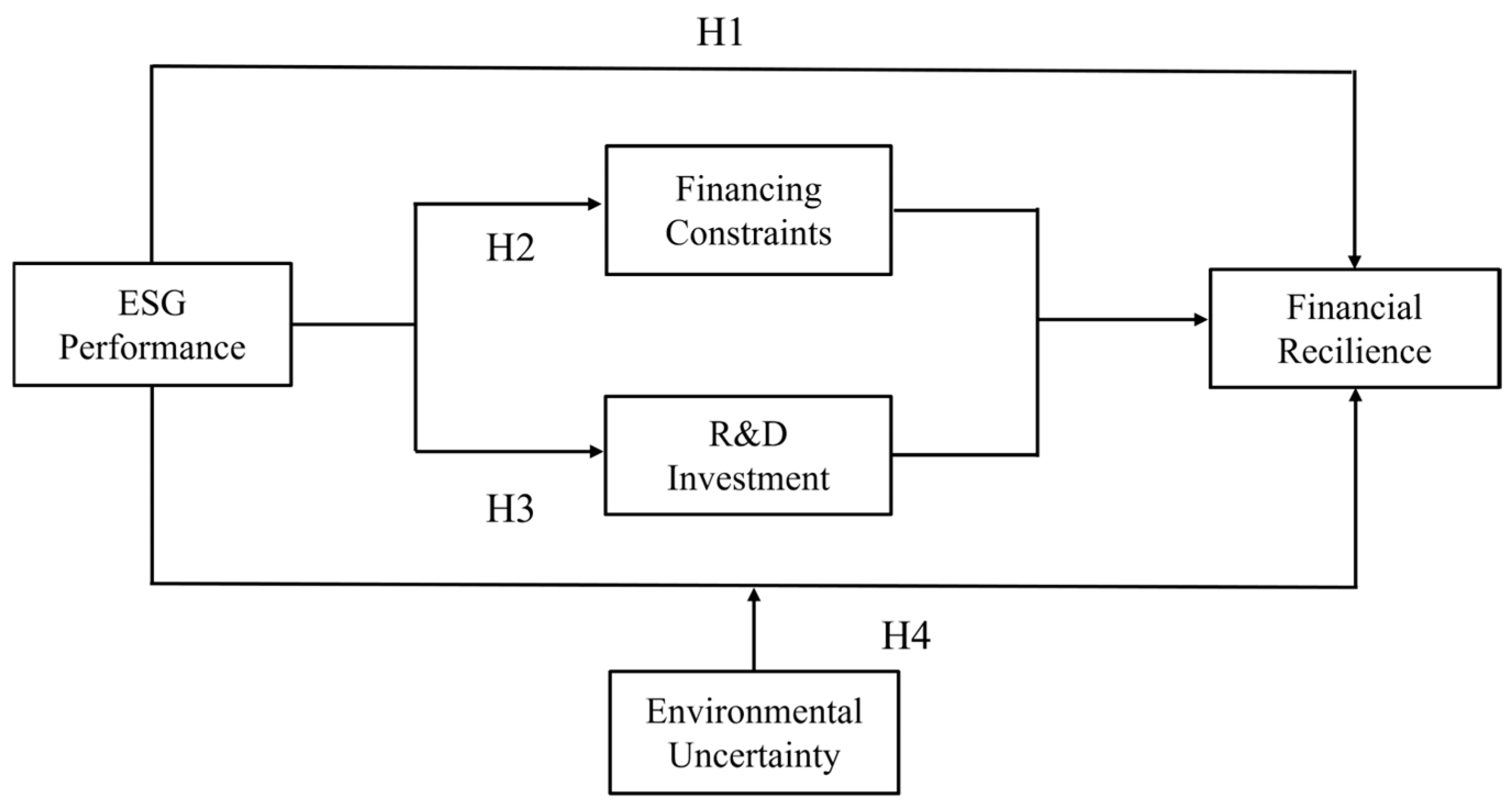
Sound ESG performance significantly enhances the financial resilience of manufacturing companies.

2.2.2. ESG Performance, Financing Constraints and Corporate Financial Resilience

Financing constraints are a pervasive challenge faced by firms in the contemporary economic context. When confronted with severe financing constraints, firms tend to adopt aggressive financing strategies, which induce sharp stock price fluctuations and increased uncertainty, and ultimately increase firm risk exposure. Based on the core tenet of information asymmetry theory, ESG performance serves as a form of high-quality non-financial information verifiable by external stakeholders. It helps optimize capital market perceptions of corporate operational conditions and risk levels, and mitigates information asymmetry between firms and capital providers such as financial institutions and creditors.
For the manufacturing sector characterized by strong asset specificity and long investment cycles, proactive environmental governance, labor rights protection and transparent corporate governance information can deliver reliable signals of sound operational practices and controllable risks to banks, bond investors and other stakeholders. Such firms can thereby gain easier credit approval and expand financing channels. With the improvement of China’s green financial system and the advancement of dual-carbon goals, financial institutions have gradually linked credit resource allocation for manufacturing enterprises to their ESG performance. Sound ESG performance enables manufacturing firms to better meet the eligibility criteria of policies such as green credit and transition finance, so as to obtain low-cost financing with favorable financing terms [39]. For manufacturing enterprises, financial resilience relies on maintaining adequate liquidity and reinvestment capacity before and after external shocks [40]. In the face of market demand volatility or technological transformation shocks, the financing advantages derived from sound ESG performance can ensure firms’ timely access to sufficient funds to sustain R&D investment, stabilize supply chains and adjust production capacity. In this way, enterprises can effectively buffer external shocks, achieve rapid recovery and seize corporate transformation opportunities. Based on the foregoing theoretical analysis, this paper proposes the following hypothesis:
H2: 
ESG performance enhances the financial resilience of manufacturing firms by alleviating financing constraints.

2.2.3. ESG Performance, R&D Investment Intensity and Corporate Financial Resilience

As the core driving force of corporate transformation and upgrading, R&D investment is directly linked to the cultivation of enterprises’ core competitiveness. Adequate and continuous R&D investment effectively helps firms break through development bottlenecks and lay a solid foundation for long-term stable operation. According to Schumpeter’s innovation theory, innovation serves as the source for enterprises to gain economic returns and sustain competitive advantages. It is crucial for firms to adapt to external changes and achieve resilient development in a volatile environment. ESG can generate innovation effects, boost corporate innovation enthusiasm, stimulate innovation vitality, and further enhance corporate financial resilience.
Currently, most enterprises are advancing toward green and intelligent transformation. Based on signaling theory, favorable ESG performance can convey explicit signals to the market about firms’ commitment to long-term sustainable development. Accordingly, enterprises are more likely to access targeted financial resources, including government green R&D subsidies and green credit [41], which provide direct financial support for increasing R&D investment intensity. In addition, the long-term perspective and transparency advocated in ESG governance can constrain managers’ short-sighted behaviors and reduce agency costs [42]. It encourages enterprises to allocate more resources to long-cycle, high-risk substantive R&D activities, so as to improve the quality and sustainability of R&D input. Active fulfillment of environmental and social responsibilities helps enterprises build an image of responsible innovators, attract high-end R&D talents and stabilize supply chain partnerships, thus establishing a solid intellectual foundation and collaborative network to support R&D activities.
For manufacturing enterprises, R&D intensity directly determines their capacity for technological iteration and product upgrading [43]. When exposed to external shocks, higher R&D intensity allows firms to rapidly reduce costs and improve efficiency through process innovation, or explore new markets via product innovation. This effectively cushions revenue fluctuations and builds inimitable long-term competitive strengths. Such innovation-driven adaptive and growth capacity represents the core manifestation of corporate financial. Based on the foregoing theoretical analysis, this paper proposes the following hypothesis:
H3: 
ESG performance enhances the financial resilience of manufacturing firms by increasing the intensity of R&D investment.

2.2.4. ESG Performance, Environmental Uncertainty and Corporate Financial Resilience

How firms cope with fluctuations in the economic environment has become a core research topic. Undoubtedly, as exogenous shocks, environmental variations profoundly influence the operational decisions of enterprises and external market investors, especially in the context of China’s unique institutional setting.
Environmental uncertainty refers to the extent to which changes in firms’ external environment cannot be accurately predicted, serving as an essential context for corporate decision-making. A high level of environmental uncertainty substantially affects firms’ strategic behaviors and resource allocation [44]. According to real options theory, when the external environment is highly uncertain, enterprises prefer to postpone or reduce irreversible long-term investments so as to maintain decision-making flexibility [45]. As a typical long-term strategic investment, ESG development features a long payback period and is exposed to numerous uncontrollable factors. Hence, such investment tends to be suspended or cut down by corporate management amid growing environmental uncertainty. Furthermore, intensified environmental uncertainty aggravates information asymmetry, making it difficult for external investors and creditors to accurately evaluate firms’ actual value and risks. This will tighten financing constraints and impair enterprises’ capacity to obtain adequate financial support for ESG-related practices.
It can be concluded that high environmental uncertainty restrains manufacturing firms’ willingness and capability to further advance ESG practices, and impedes the transmission mechanism through which ESG performance strengthens corporate financial resilience by optimizing resource allocation. Based on the foregoing theoretical analysis, this paper proposes the following hypothesis:
H4: 
Environmental uncertainty may weaken the positive impact of ESG performance on the financial resilience of manufacturing firms.
The proposed conceptual framework is presented in Figure 1.

3. Research Design

3.1. Sample Selection

This study selects A-share listed companies on the Shanghai and Shenzhen stock exchanges from 2015 to 2024 as the initial sample. In line with academic conventions and data processing standards, ST and *ST firms were excluded, as were observations with missing values for key variables. This results in a final valid sample of 22,146 observations. The primary data are sourced from the China Stock Market & Accounting Research (CSMAR) and Wind databases. To mitigate the potential influence of outliers on empirical results, all continuous variables are winsorized at the 1% level.

3.2. Variable Definition

3.2.1. Dependent Variable

Given substantial market noise in the capital market, this paper comprehensively measures corporate financial resilience (Score) following the research design of Hu et al. [46]. Corporate financial resilience is divided into two dimensions: resistance and recovery. Specifically, the standard deviation of monthly stock returns of individual firms is adopted to measure resistance [47], and three-year cumulative operating revenue growth is used to measure recovery. Finally, the entropy weight method is employed to construct the comprehensive corporate financial resilience index.

3.2.2. Independent Variable

ESG performance (ESG). At present, mainstream ESG rating institutions include Huazheng ESG, SynTao ESG and Wind ESG. Since the Huazheng ESG rating covers all A-share listed firms and follows internationally mainstream ESG rating frameworks, this paper follows the research approach of Wein et al. [48] and adopts the Huazheng ESG rating as the quantitative independent variable. The nine rating levels from C to AAA are assigned values ranging from 1 to 9, respectively.

3.2.3. Control Variables

This paper controls for firm-level factors affecting the financial resilience of manufacturing enterprises. Drawing on existing literature [49], we select firm size (Size), financial leverage (Lev), tangible assets ratio (Tang), return on total assets (ROA), operating revenue growth rate (Growth), firm age (Age), managerial ownership ratio (Ms), proportion of independent directors (Dire), and separation of cash flow rights and control rights (Sep) as control variables. Their specific measurement methods are presented in Table 1.

3.2.4. Mechanism Variables

This paper selects financing constraints (SA), R&D investment intensity (Pat), and environmental uncertainty (EU) to investigate the influence mechanism of ESG performance on the financial resilience of manufacturing enterprises. Financing constraints are measured using the SA index. Regarding R&D investment intensity, referring to the research of Kong et al. [50], we measure it as the natural logarithm of the number of utility model patent applications filed by the enterprise in the current year plus one. For environmental uncertainty, following the method of Xu [51], we measure environmental uncertainty (EU) by the volatility of GP.

3.3. Model Specification

3.3.1. Baseline Regression Model

This study constructs empirical models to investigate the impact of ESG performance on the financial resilience of manufacturing enterprises:
Scoreit = α0 + β0 Esgit + γ0 Controlsit + Indi + Yeart + εit
In Model (1), i and t represent individual firms and years, respectively; Scoreit represents the financial resilience of manufacturing firms; ESGit represents a firm’s ESG performance; Controlsit is the set of control variables; Indit represents industry fixed effects, with the manufacturing sector further subdivided in line with the industry classification standards of the CSMAR database; Yeart represents the time fixed effect; and εit represents the random error term.

3.3.2. Mechanism Testing Model

To examine the mechanism through which ESG performance influences the financial resilience of manufacturing firms, the following model has been constructed:
SAit = α1 + β1 Esgit + γ1 Controlsit + Indi + Yeart + εit
Scoreit = α1 + β1 Esgit + γ1 Controlsit + χ1 SAit + Indi + Yeart + εit
Patentit = α1 + β1 Esgit + γ1 Controlsit + Indi + Yeart + εit
Scoreit = α1 + β1 Esgit + γ1 Controlsit + χ1 Patentit + Indi + Yeart + εit
Scoreit = α1 + β1 Esgit + γ1 Controlsit + χ1 EUit + λ1 EUit * Esgit + Indi + Yeart + εit
In this context, SAit, Patentit, and EUit represent financing constraints, R&D investment intensity, and environmental uncertainty, respectively; Controlsit comprises the control variables; Indit and Yeart represent industry and year fixed effects, respectively; and εit represents the random error term.

4. Empirical Analysis

4.1. Descriptive Statistics

Table 2 reports the descriptive statistics of the main variables. The standard deviation of financial resilience for manufacturing firms is 0.0378, with the minimum and maximum values being 0.036 and 0.938, respectively, which indicates that the sample firms exhibit relatively small differences in financial resilience. The mean value is 0.0972, revealing that most manufacturing firms still have substantial room for improvement in financial resilience. Improving corporate financial resilience not only helps cope with internal and external risks but also promotes the sustainable development of the manufacturing industry, enhances industrial competitiveness, and facilitates high-quality economic development. In addition, the minimum and maximum values of manufacturing firms’ ESG ratings are 1.000 and 8.000, with a mean value of 3.992 and a standard deviation of 1.021. This indicates that manufacturing firms have an overall low ESG level with substantial imbalance, and their ESG performance is in urgent need of improvement.

4.2. Baseline Regression

The baseline regression results are shown in Table 3. After controlling for year and industry fixed effects, we analyze the impact of ESG performance on the financial resilience of manufacturing firms. Column (1) presents the regression results without control variables, where the coefficient of ESG performance is 0.0028 and is significant at the 1% level. After incorporating control variables in Column (2), the coefficient of ESG performance is 0.0016 and remains significant at the 1% level. The above results demonstrate that improving ESG performance significantly promotes the financial resilience of manufacturing firms, and hypothesis H1 is verified. A possible explanation is that superior corporate ESG performance reflects sound internal governance. Listed manufacturing firms with well-functioning internal governance generally exhibit higher financial resilience. Meanwhile, high ESG performance enables listed manufacturing firms to send positive external signals, improve external assessments, stimulate consumer demand and investor confidence, and further enhance corporate financial resilience externally.

4.3. Robustness Testing

4.3.1. Replacement of Dependent Variables

The baseline regression results are, to a certain extent, dependent on the measurement method adopted for the financial resilience of manufacturing firms. Referring to the approach of He (2019) [52], this paper uses earnings volatility (Vol) as the proxy variable for manufacturing firms’ financial resilience. Higher earnings volatility indicates a higher level of corporate financial risk-taking, which correspondingly implies lower financial resilience. In the robustness test, we re-run Model 1 by incorporating the alternative variable Vol. As presented in Column (1) of Table 4, the regression coefficient of ESG performance is significantly positive at the 1% level. This demonstrates that the core conclusion concerning the positive effect of ESG performance remains robust after changing the measurement method of the dependent variable.

4.3.2. Alternative Control Variables

We replace the control variable return on total assets (ROA) with return on equity (ROE). Meanwhile, the proportion of independent directors (Dire) is measured by the natural logarithm of board size (Board), and managerial ownership ratio (Ms) is replaced by institutional investor ownership ratio (INST). As shown in Column (2) of Table 4, the coefficient of ESG performance remains significantly positive at the 1% level after replacing control variables. This indicates that the research conclusions still hold after changing the measurement methods of variables.

4.3.3. Excluding Central Government-Administered Municipalities

Municipalities directly under China’s central government have prominent locational, policy and economic advantages, which effectively empower local manufacturing firms and lay a solid material foundation for them to practice ESG principles. To test the reliability of the empirical findings, this paper excludes manufacturing firms from four municipalities (Beijing, Tianjin, Shanghai and Chongqing) and conducts regression analysis on the remaining samples. As shown in Column (3) of Table 4, the regression coefficient of ESG performance is 0.0017 and is significant at the 1% level. This further confirms that the positive effect of ESG performance on financial resilience still holds after adjusting the sample scope.

4.3.4. Including Fixed Effects

To address potential omitted variable bias, we further add provincial fixed effects to the baseline year and industry fixed effects, so as to mitigate unobserved provincial-invariant factors that may affect the financial resilience of manufacturing firms. The regression results in Column (4) of Table 4 indicate that after controlling for provincial fixed effects, the coefficient of ESG performance remains significantly positive at the 1% level.

4.4. Endogeneity Test

4.4.1. Instrumental Variable Method

To mitigate potential reverse causality, this study adopts the instrumental variable (IV) approach. We take the average ESG performance of other listed firms in the same city, same year and same industry as the instrumental variable IV1. Referring to the method of Weng and Lai (2024) [53], the first-stage regression results are reported in Column (1) of Table 5. IV1 is significantly positively correlated with the ESG performance of manufacturing firms at the 1% level, meeting the relevance requirement. The second-stage estimation results in Column (2) of Table 5 show that after addressing endogeneity, manufacturing firms’ ESG performance remains significantly positively associated with financial resilience. This further verifies the robustness of the previous findings.

4.4.2. Propensity Score Matching

To mitigate the potential impact of sample selection bias on the research conclusions, this study conducts robustness tests using the propensity score matching (PSM) method. The sample firms are divided into the treatment group and the control group based on whether corporate ESG performance exceeds the sample mean. We select the same control variables as those in the baseline regression as matching variables, and calculate the propensity score of each observation via a Logit regression model. Based on the estimated propensity scores, we perform one-to-one nearest neighbor matching and re-estimate the regression model with matched samples. The regression results for the matched samples are reported in Column (3) of Table 5. The coefficient of ESG performance is significantly positive at the 1% level. The findings demonstrate that the baseline results remain robust after addressing sample selection bias via the PSM method.

4.4.3. Lagged One-Period Independent Variable

Considering the lagged effect of corporate ESG performance on financial resilience, we lag the explanatory variable ESG performance by one period and re-estimate Model (1). As shown in Column (4) of Table 5, the regression coefficient of one-period lagged ESG performance is 0.0011 and is significant at the 1% level. This indicates that the positive effect of ESG improvement on financial resilience for manufacturing firms is relatively persistent. After accounting for the lagged relationship between variables, the aforementioned baseline regression conclusions remain robust.

4.5. Mechanism Test

To further explore the channels through which the ESG performance of manufacturing firms influences their financial resilience, this paper draws on the research by Jiang (2022) [54] to establish the following model, focusing on the impact of the core independent variables on the mechanism variables:
Mit = α1 + β1 Esgit + γ1i Controlsit + Indi + Yeart + εit
In this context, Mit represents the institutional variables, namely the financing constraint (SAit), the intensity of R&D investment (Patentit), and environmental policy uncertainty (EUit); the remaining variables are defined in the same way as in the baseline regression model.

4.5.1. Financing Constraints

Superior ESG performance conveys positive market signals of corporate operational compliance, standardized governance and long-term sustainable development capability, which helps alleviate information asymmetry between firms and external capital providers. Reduced financing pressure not only creates a more favorable resource environment for firms but also encourages managers to transcend short-term financial goals and allocate more resources to sectors that boost long-term competitiveness. The optimization of this resource allocation pattern fundamentally strengthens firms’ adaptability and recovery capacity against external shocks, thereby improving their financial resilience. As shown in Column (1) of Table 6, the coefficient of corporate ESG performance on financing constraints (SA index) is significantly positive at the 1% level. This demonstrates that the ESG performance of manufacturing firms enhances corporate financial resilience by alleviating financing constraints, which verifies Hypothesis H2.

4.5.2. R&D Investment Intensity

Resource investment in innovation activities of manufacturing firms affects the process of establishing core competitiveness through technological accumulation to a certain extent. Higher R&D intensity not only promotes product upgrading and process improvement, thereby generating differentiated market advantages and superior cost control capabilities, but also reserves essential adaptive resources for firms to address industrial transformations and technological shocks. As presented in Column (2) of Table 6, the coefficient of manufacturing firms’ ESG performance on innovation output (Patent) is significantly positive at the 5% level. This indicates that firms with sound ESG performance possess stronger R&D and innovation capabilities, which help them seize market opportunities and enhance corporate financial resilience, thus verifying Hypothesis H3.

4.5.3. Environmental Uncertainty

Rising environmental uncertainty undermines the information foundation that firms rely on for strategic investment decisions and increases the difficulty of implementing operational and financial planning. Conventional organizational response mechanisms of firms may gradually fail, inhibiting their dynamic adjustment capacity, resource restructuring efficiency and willingness to engage in long-term innovation investment, and thus weakening their overall defensive resilience and adaptability in response to shocks. As presented in Column (3) of Table 6, EUm denotes the interaction term between environmental uncertainty (EU) and ESG performance. The regression coefficient of the core explanatory variable ESG is significantly positive at the 1% level, while the coefficient of the interaction term EUm is significantly negative at the 1% level. This indicates that environmental uncertainty weakens the positive effect of ESG performance on corporate financial resilience, which verifies Hypothesis H4.

5. Heterogeneity Analysis

5.1. Heterogeneity in Property Rights

Based on differences in the property rights structure of manufacturing firms, this paper further conducts a heterogeneity analysis on the relationship between ESG performance and financial resilience from the perspective of ownership type. The sample is divided into state-owned enterprises and non-state-owned enterprises for separate regressions, and the results are presented in Columns (1) and (2) of Table 7. In the SOE subsample, the regression coefficient of ESG performance on financial resilience is larger and more significant. While the coefficient for non-SOEs is positive, its significance level is relatively weak. This indicates that improvements in ESG performance exert a more prominent promotional effect on financial resilience among manufacturing SOEs. The potential reasons are summarized as follows. First, the manufacturing industry is typically asset-intensive, characterized by long cycles and strict regulation. Supported by scale advantages, resource integration capabilities and policy preferences, SOEs can implement ESG practices in a more systematic and sustainable way, thus effectively strengthening their long-term resilience in environmental protection, safety management and corporate governance. By comparison, non-state manufacturing firms possess flexible operational mechanisms but are relatively limited in long-term ESG investment and risk resistance capacity. Second, manufacturing SOEs usually undertake more responsibilities for national strategies and industrial security. Their ESG construction is generally integrated into overall strategic planning and performance evaluation systems. Accordingly, improved ESG performance can be better converted into overall organizational stability and resilience. Non-state firms, however, tend to prioritize short-term market and operational pressures, so the supportive effect of ESG on corporate financial resilience is relatively insignificant under such circumstances.

5.2. Regional Heterogeneity of Firms

Based on the sample of manufacturing firms, this paper conducts heterogeneity tests by dividing the sample into eastern, central and western regions from a geographical perspective [55]. The results are presented in Columns (3) to (5) of Table 7. The ESG coefficients are significantly positive at the 1% level in both the eastern and central regions. Specifically, the coefficient magnitude in the central region is higher than that in the eastern region, whereas the ESG coefficient in the western region is significant at the 10% level. This indicates that among manufacturing firms, the promotional effect of ESG performance on financial resilience is the most prominent in the central region. The potential reasons are summarized as follows. First, the central region is in a critical stage of industrial upgrading and undertaking industrial transfer. By improving ESG performance, manufacturing firms can more directly obtain policy dividends, enhance resource utilization efficiency and market reputation, thus exerting a significant marginal improvement effect on financial resilience. Second, the manufacturing industry in the eastern region is relatively developed with intense market competition. ESG practices were initiated early here, so the marginal promotional effect of ESG improvement on financial resilience tends to be relatively stable. Third, the western region has a relatively weak manufacturing foundation, and its industrial structure is dominated by resource-based industries and primary processing. Enterprises in this region face great overall transformation pressure. Accordingly, the supportive effect of improved ESG performance on financial resilience is statistically lagged and relatively weak, but still presents an initial positive influence.

5.3. Life Cycle Heterogeneity

Firms at different corporate life cycle stages exhibit significant differences in organizational structure, financial fundamentals, market positioning, and strategic objectives, which may affect the relationship between ESG performance and corporate financial resilience. This study employs the composite score method to measure corporate life cycle based on the scores of four variables: sales growth rate, retained earnings ratio, capital expenditure ratio, and firm age [56]. The sample of manufacturing firms is divided into three groups (growth, maturity, and decline stages) according to their composite scores in descending order, and separate regression analyses are conducted for each group. The results are presented in Columns (6) to (8) of Table 7. The regression coefficient of ESG performance is insignificant for manufacturing firms in the growth stage. For firms in the mature stage and the decline stage, the ESG coefficients are significantly positive at the 1% level, and the coefficient magnitude of the decline subsample is higher than that of the mature subsample. This indicates that the promotional effect of ESG performance on financial resilience is more prominent for manufacturing firms in the mature and decline stages, with the strongest effect intensity in the decline stage. The potential reasons are summarized as follows. Manufacturing firms in the mature stage have stable resources and comprehensive management systems, which allow them to systematically integrate ESG practices into operations, thereby effectively improving risk resistance capacity and market reputation and providing continuous support for financial resilience. Firms in the decline stage face severe operational pressures and transformation demands. At this stage, proactive ESG performance can deliver credible signals of standardized governance and sustainable transformation intentions to key stakeholders such as investors and regulatory authorities. This enables firms to acquire external support more efficiently, alleviate financing constraints, and even develop new green growth paths. As a result, the marginal rescue effect of ESG performance on financial resilience is particularly evident. Growth-stage firms have relatively limited resources and mainly focus on market expansion and scale growth. Investments in ESG construction can hardly be converted into significant resilience benefits in the short run.

6. Discussion

Although existing studies have explored the correlation between ESG performance and corporate financial resilience, most are confined to the macro level [14,15]. Research on potential mediating and moderating mechanisms remains insufficient [12], and systematic evidence regarding the manufacturing sector in emerging markets is particularly scarce. To fill this research gap, this study establishes an analytical framework incorporating internal resource allocation and external environmental impacts. Based on an empirical analysis of 22,146 listed manufacturing firms in China from 2015 to 2024, this study systematically investigates the influencing mechanisms of ESG performance on corporate financial resilience. The research findings are presented as follows.
Firstly, this study verifies that ESG performance exerts a significant positive effect on the financial resilience of manufacturing firms. This finding is consistent with the conclusions of Al Azizah et al. While their research examined all listed firms [4], this study focuses solely on manufacturing firms, which strengthens the general applicability of research on ESG economic effects across diverse industry contexts. Theoretically, unlike previous studies that argue ESG improves resilience via buffering mechanisms [10,35], the mechanism analysis reveals that internal resource allocation is equally crucial [9]. For Chinese manufacturing firms, the resilience growth driven by ESG stems not only from the ability to withstand external pressures [27], but also from the recovery capacity achieved through technological upgrading and production restructuring amid adverse shocks. This finding broadens the explanatory dimensions of the sources of corporate financial resilience.
Secondly, prior studies have shown that ESG practices help firms gain easier access to external financial resources, including government green R&D subsidies [39]. This study argues that ESG performance can exert a compensatory effect on invested resources. Manufacturing firms feature heavy asset investment and complex supply chains. From the perspective of Resource Dependence Theory, enterprises need to obtain extra resources to maintain daily operations and advance sustainable development. Active engagement in environmental protection and social responsibility contributes to building stable ties with governments, which in turn facilitates access to fiscal support [10,41]. The empirical analysis confirms that improved ESG performance effectively promotes R&D investment intensity in manufacturing firms. For such enterprises, R&D investment intensity directly governs their capability of technological iteration and product upgrading [43]. When exposed to external shocks, increased R&D investment enables firms to promote product renewal and process improvement, forming differentiated market competitiveness and achieving better cost control. The adaptive and growth capacity driven by R&D investment serves as a supplementary microscopic pathway for manufacturing firms to improve financial resilience.
The corporate life cycle has garnered widespread attention in recent academic research. Most extant studies divide life cycle stages using the comprehensive scoring method [56]. ESG performance generally exerts a positive promotional impact on corporate financial performance [7], while its influencing mechanisms and effect intensity differ substantially across various life cycle stages. This study focuses on manufacturing firms. Empirical results show that ESG plays a more prominent role in improving financial resilience in mature and declining stages, with the strongest effect detected in the declining stage. This finding differs from the conclusion of Gao et al. [11], who reported that the effect was most significant in the growth stage based on samples covering general industries. With heavy-asset characteristics and long investment payback cycles, manufacturing firms struggle to convert ESG investment in the growth stage into improved financial resilience in a short period. Mature enterprises can integrate ESG systems into daily operations, thereby steadily enhancing their financial resilience. In comparison, firms in the declining stage can convey confidence in transformation and obtain external resources via ESG practices, generating the most substantial marginal benefits and delivering timely support amid operational difficulties.

7. Conclusions

7.1. Research Findings

This paper selects Chinese manufacturing companies listed on the Shanghai and Shenzhen A-share markets from 2015 to 2024 as its sample. Using the Huazheng ESG rating to measure corporate ESG performance and employing a combination of theoretical and empirical methods, the study systematically explores the intrinsic link between the ESG performance of manufacturing enterprises and their financial resilience. The main findings of the study are as follows: First, improving ESG standards in manufacturing enterprises can significantly enhance their financial resilience, a finding that holds true even after undergoing various robustness and endogeneity tests. Second, a mechanism analysis indicates that ESG performance primarily enhances corporate financial resilience by alleviating financing constraints, increasing R&D investment, and strengthening environmental governance capabilities. Third, heterogeneity analysis reveals that the positive impact of ESG on financial resilience varies significantly across different enterprise types, regions, and life cycle stages. Specifically, the effect of ESG performance on enhancing financial resilience is more pronounced in state-owned enterprises, those located in central China, and manufacturing firms in the decline phase.

7.2. Practical Implications

Based on the findings of the above study, the following recommendations are made:
The government should establish an ESG policy support framework for the manufacturing sector, guiding enterprises to enhance their financial resilience by improving their ESG performance. Firstly, fiscal incentives should be strengthened by offering tiered tax incentives and green bond support to enterprises with excellent ESG ratings. Financial products such as “ESG Resilience Loans” should be developed to alleviate financing constraints, while interest rate concessions should be granted to enterprises making substantial investments in green supply chain transformation. Priority should be given to manufacturing enterprises in central China and those in the decline stage, thereby amplifying the positive impact of ESG performance on financial resilience. Secondly, an ESG evaluation and regulatory mechanism tailored to the manufacturing sector should be established. It should incorporate indicators, including supply chain carbon footprint, workplace safety investment ratio, and green technology R&D intensity. ESG ratings should be linked to corporate creditworthiness and project approvals to encourage enterprises to strengthen environmental governance and increase R&D investment. Thirdly, benchmark ESG resilience practices should be promoted by summarizing typical successful cases of state-owned enterprises, enterprises in central China, and those in the decline stage. Specialized training sessions classified by region and corporate life cycle should be organized to guide enterprises to internalize ESG principles as a long-term strategy and effectively translate research findings into practical actions.
Manufacturing enterprises should focus on integrating ESG principles deeply into internal governance and improve operational stability and risk resilience through internal and external coordination. Enterprises should first improve the quality of ESG disclosures and actively obtain financing support, including green loans and sustainable bonds. In particular, enterprises in central regions or those in the decline stage should actively take advantage of government incentive policies to alleviate financing constraints and obtain transformation funds. Second, enterprises should deeply integrate ESG governance with research and development (R&D) and innovation. This includes establishing dedicated ESG departments, prioritizing investment in green technologies such as energy conservation, emission reduction and low-carbon processes, and leveraging ESG signals to attract high-caliber talent and establish stable supply chain partnerships. In addition, enterprises should substantially increase R&D investment intensity and improve technological achievement transformation efficiency. Thirdly, environmental governance and risk management systems should be strengthened. Enterprises should incorporate indicators such as carbon footprint management and workplace safety into daily operations in line with the characteristics of their supply chains. Meanwhile, they should draw on the mature ESG practices of state-owned enterprises to optimize internal governance mechanisms and integrate ESG objectives into management performance evaluations, so as to effectively enhance financial resilience against external shocks.
The general public should actively play a role in supervision, support and collaboration to encourage manufacturing enterprises to translate ESG practices into robust financial resilience. Firstly, public supervision of ESG disclosures by manufacturing enterprises should be strengthened, with a focus on indicators such as investment in environmental governance, workplace safety and supply chain responsibility. Public pressure should be exerted through channels such as the media and public scrutiny to urge enterprises—particularly state-owned enterprises—to improve the quality of their ESG management. Secondly, the public should support ESG-leading enterprises through consumption and investment behavior by prioritizing the purchase of green-certified products and directing personal or institutional funds towards listed manufacturing companies that demonstrate strong ESG performance or are actively transitioning despite facing economic downturns. The public should also support green bonds to alleviate their financing constraints through market mechanisms. Thirdly, the public should actively participate in collaborative initiatives for green transition, supporting activities such as corporate environmental open days, community engagement meetings and the circular economy transformation of industrial parks, thereby fostering a win–win ecosystem for enterprises, society and the environment.

7.3. Limitations and Future Research Directions

This paper has several limitations that need to be addressed and further explored in subsequent research. First, this paper investigates the mediating effects of financing constraints and R&D investment intensity, as well as the moderating effect of environmental uncertainty. ESG performance may affect corporate financial resilience through other channels, and future research can explore these mechanisms from alternative perspectives. Second, our study focuses solely on the effect of aggregate ESG performance on financial resilience, and ESG performance is measured exclusively using the Huazheng ESG rating. In future research, scholars may refine the measurement of ESG performance by integrating multiple ESG rating frameworks or separately analyzing individual subdimensions, thereby delivering more comprehensive evaluations. Furthermore, constrained by data availability, this paper only covers a sample window from 2015 to 2024. Scholars could extend the sample window to yield more robust and generalizable findings. Third, the model examining how ESG performance affects financial resilience that is constructed in this paper is only validated among Chinese manufacturing firms. Future studies may attempt to extend empirical investigations to other industries, countries, or regions.

Author Contributions

Z.X. (Zhanlei Xing): conceptualization, supervision, methodology, resources, funding acquisition, writing—review and editing. Z.X. (Zhongjun Xie): conceptualization, methodology, software, data curation, writing—original draft preparation. All authors have read and agreed to the published version of the manuscript.

Funding

This study was supported by the 2025 Xi’an Municipal Science and Technology Programme Soft Science Research Project (Key), Grant Number 25RKYJ0001, granted to the Project Manager Zhanlei Xing. This study was supported by the Shaanxi Provincial Intellectual Property Policy Advisory Research Project, Grant Number YJ2026-11, granted to Project Manager Zhanlei Xing.

Institutional Review Board Statement

Not applicable.

Informed Consent Statement

Not applicable.

Data Availability Statement

Data can be sourced from the Wind Database, China Stock Market & Accounting Research (CSMAR) Database.

Conflicts of Interest

The authors declare no conflicts of interest.

References

  1. Shi, Y.; Yang, S. The impact of global value chains embeddedness on the carbon emission efficiency of manufacturing firms. Carbon Balance Manag. 2025, 20, 61. [Google Scholar] [CrossRef]
  2. Rose, A.; Liao, S.Y. Modeling Regional Economic Resilience to Disasters: A Computable General Equilibrium Analysis of Water Service Disruptions. J. Reg. Sci. 2005, 45, 75–112. [Google Scholar] [CrossRef]
  3. China Securities Network. Crafting a Solid Chapter for Green Finance: Public Funds Continuously Explore ESG Investment. Available online: https://www.cnstock.com/commonDetail/214565 (accessed on 13 July 2024).
  4. Al Azizah, U.S.; Haron, R. The sustainability imperative: Evaluating the effect of ESG on corporate financial performance before and after the pandemic. Discov. Sustain. 2025, 6, 529. [Google Scholar] [CrossRef]
  5. Chen, M.T.; Yang, D.P.; Zhang, W.Q.; Wang, Q.J. How does ESG disclosure improve stock liquidity for enterprises—Empirical evidence from China. Env. Impact Assess. Rev. 2023, 98, 106926. [Google Scholar]
  6. Zhang, L.; Huang, L.; Zhang, C.; Zhang, L. Impact of ESG performance and digital transformation on financing constraints in the Chinese capital market. Financ. Res. Lett. 2025, 86, 108674. [Google Scholar] [CrossRef]
  7. Xu, H.; Yang, J.; Liu, Y. ESG and customer stability: A perspective based on external and internal supervision and reputation mechanisms. Humanit. Soc. Sci. Commun. 2024, 1, 981. [Google Scholar] [CrossRef]
  8. Zhang, J.; Li, Y.; Xu, H.; Ding, Y. Can ESG ratings mitigate managerial myopia? Evidence from Chinese listed companies. Int. Rev. Financ. Anal. 2023, 90, 102878. [Google Scholar] [CrossRef]
  9. Casciello, R.; Santonastaso, R.; Prisco, M.; Martino, I. Green innovation and financial performance. The role of R&D investments and ESG disclosure. Corp. Soc. Responsib. Environ. Manag. 2024, 31, 5372–5390. [Google Scholar] [CrossRef]
  10. Bani Khaled, S.; Azevedo, G.; Oliveira, J. Environmental, social, and governance (ESG) factors and firm value: A systematic literature review of theories and empirical evidence. AMS Rev. 2025, 15, 1–33. [Google Scholar] [CrossRef]
  11. Gao, S.; Meng, F.C.; Wang, W.S.; Chen, W.X. Does ESG always improve corporate performance? Evidence from firm life cycle perspective. Front. Environ. Sci. 2023, 11, 1105077. [Google Scholar] [CrossRef]
  12. Sha, F.; Ding, C.; Zheng, X.; Wang, J.; Tao, Y. Weathering the policy Storm: How trade uncertainty shapes firm financial performance through innovation and operations. Int. Rev. Econ. Financ. 2025, 102, 104274. [Google Scholar] [CrossRef]
  13. Chen, S.; Song, Y.; Gao, P. Environmental, social, and governance (ESG) performance and financial outcomes: Analyzing the impact of ESG on financial performance. J. Environ. Manag. 2023, 345, 118829. [Google Scholar] [CrossRef]
  14. Chen, J.J.; Ding, H.Y.; Zhang, X.M. Does ESG performance affect customer relationship stability? Secur. Mark. Her. 2023, 3, 13–23. (In Chinese) [Google Scholar]
  15. Jha, A.; Cox, J. Corporate social responsibility and social capital. J. Bank. Financ. 2015, 60, 252–270. [Google Scholar] [CrossRef]
  16. Radhakrishnan, S.; Tsang, A.; Liu, R.A. Corporate Social Responsibility Framework for Accounting Research. Int. J. Account. 2018, 53, 274–294. [Google Scholar] [CrossRef]
  17. Yang, R.B.; Deng, C.T.; Hou, X.Z. Research on the Impact of ESG Performance on Corporate Financial Performance. J. Technol. Econ. 2023, 42, 124–134. (In Chinese) [Google Scholar]
  18. Apergis, N.; Poufinas, T.; Antonopoulos, A. ESG Scores and Cost of Debt. Energy Econ. 2022, 112, 106186. [Google Scholar] [CrossRef]
  19. Atan, R.; Alam, M.M.; Said, J.; Zamri, M. The Impacts of Environmental, Social, and Governance Factors on Firm Performance: Panel Study of Malaysian Companies. Manag. Environ. Qual. Int. J. 2018, 29, 182–194. [Google Scholar] [CrossRef]
  20. Wu, F.; Hu, H.; Lin, H.; Ren, X. Enterprise digital transformation and capital market performance: Empirical evidence from stock liquidity. Manag. World 2021, 37, 130–144. [Google Scholar]
  21. Wu, P.; Yang, K.; Jiang, J.S.; Wang, H.L. Does Corporate ESG Performance Affect Earnings Value Relevance? J. Financ. Econ. 2023, 49, 137–152+169. [Google Scholar]
  22. Wang, X.H.; Luan, X.Y.; Zhang, S.P. Corporate R&D Investment, ESG Performance and Market Value-The Moderating Effect of Enterprise Digital Level. Stud. Sci. Sci. 2023, 41, 896. [Google Scholar]
  23. Demers, E.; Hendrikse, J.; Joos, P.; Lev, B. ESG didn’t immunize stocks during the COVID-19 crisis, but investments in intangible assets did. J. Bus. Financ. Account. 2021, 48, 433–462. [Google Scholar] [CrossRef] [PubMed]
  24. Li, S.H.; Zheng, S.L. Does ESG Implementation Inhibit Corporate Growth? Econ. Probl. 2022, 12, 81–89. [Google Scholar]
  25. Azmi, W.; Hassan, M.K.; Houston, R.; Karim, M.S. ESG Activities and Banking Performance: International Evidence from Emerging Economies. J. Int. Financ. Mark. Inst. Money 2021, 70, 101277. [Google Scholar] [CrossRef]
  26. Holling, C.S. Resilience and Stability of Ecological Systems. Annu. Rev. Ecol. Syst. 1973, 11, 1–23. [Google Scholar] [CrossRef]
  27. Li, X.B.; Fung, A.; Fung, H.G.; Jin, H.M. Enhancing firm resilience: A dual focus on value creation and risk mitigation. Int. Rev. Financ. Anal. 2025, 106, 104562. [Google Scholar] [CrossRef]
  28. Steenblock, M.; Aepli, M.D.; Trübestein, M. Corporate Financial Resilience: Empirical Evidence from the United States; Springer: Berlin/Heidelberg, Germany, 2023. [Google Scholar]
  29. Hamid, F.S.; Loke, Y.J.; Chin, P.N. Determinants of financial resilience: Insights from an emerging economy. Soc. Econ. Dev. 2023, 25, 479–499. [Google Scholar] [CrossRef]
  30. Zahedi, J.; Salehi, M.; Moradi, M. Identifying and classifying the contributing factors to financial resilience. Foresight 2022, 24, 177–194. [Google Scholar] [CrossRef]
  31. Liu, Z.; Chen, J.K.; Xiao, J.J. Financial resilience: A scoping review, conceptual synthesis and theoretical framework. Int. J. Bank Mark. 2025, 43, 1541–1576. [Google Scholar] [CrossRef]
  32. Lee, A.V.; Vargo, J.; Seville, E. Developing a Tool to Measure and Compare Organizations’ Resilience Natural. Hazards Rev. 2013, 14, 29–41. [Google Scholar] [CrossRef]
  33. Jayasinghe, M.; Selvanathan, E.A.; Selvanathan, S. The Financial Resilience and Life Satisfaction Nexus of Indigenous Australians. Econ. Pap. 2020, 39, 336–352. [Google Scholar] [CrossRef]
  34. Freeman, R.E.; Evan, W. Corporate governance: A stakeholder interpretation. J. Behav. Econ. 1990, 19, 337–359. [Google Scholar] [CrossRef]
  35. Kramer, M.R.; Pfitzer, M.W. The essential link between ESG targets & financial performance. Harv. Bus. Rev. 2022, 100, 128–137. [Google Scholar]
  36. Goss, A.; Roberts, G.S. The impact of corporate social responsibility on the cost of bank loans. J. Bank. Financ. 2011, 35, 1794–1810. [Google Scholar] [CrossRef]
  37. Xing, H. The Principle of ‘Double Materiality’ in ESG Reporting. Law Sci. Mag. 2025, 46, 115–132. (In Chinese) [Google Scholar]
  38. Shi, Y.D.; Wang, H.M. Corporate Social Responsibility and Corporate Value: From the Perspective of ESG Risk Premium. Econ. Res. J. 2023, 58, 67–83. (In Chinese) [Google Scholar]
  39. Chen, X.S.; Liu, H. Institutional Investor Shareholding and Corporate ESG Performance. Financ. Forum 2023, 28, 58–68. (In Chinese) [Google Scholar]
  40. Ren, G.Q.; Zhao, M.J.; Li, J.C. How Does Reverse Mixed Ownership Reform Affect the Resilience of Private Enterprises? A Perspective Based on Director Relationship Networks. Financ. Econ. 2023, 5, 92–110. (In Chinese) [Google Scholar]
  41. Zhang, J.P.; Zhang, X. Research on the Impact of Environmental Governance on R&D Investment Intensity of Entity Enterprises. Sci. Decis. Making. 2024, 6, 16–31. (In Chinese) [Google Scholar]
  42. Kim, S.; Li, Z.C. Understanding the Impact of ESG Practices in Corporate Finance. Sustainability 2021, 13, 3746. [Google Scholar] [CrossRef]
  43. Wu, J.; Harrigan, K.R.; Ang, S.H.; Wu, Z. The impact of imitation strategy and R&D resources on incremental and radical innovation: Evidence from Chinese manufacturing firms. J. Technol. Transf. 2019, 44, 210–230. [Google Scholar]
  44. Wang, R.; Zhao, Y. Analysis of Strategic Change Methods and Performance of Enterprises in Uncertain Environments: Empirical Evidence Based on Technology Innovation Enterprises. Soft Sci. 2025, 39, 35–41. (In Chinese) [Google Scholar]
  45. Bloom, N. Fluctuations in uncertainty. J. Econ. Perspect. 2014, 28, 153–176. (In Chinese) [Google Scholar] [CrossRef]
  46. Hu, H.F.; Song, X.X.; Guo, X.F. Investor Protection System and Corporate Resilience: Influence and Mechanism. Econ. Manag. 2020, 42, 23–39. (In Chinese) [Google Scholar]
  47. Yan, S.J.; Lin, B. CEO Word-Deed Consistency and Stock Price Crash Risk: A Mechanism Test Based on Subsidiary Heads’ Bad News Hoarding. Account. Res. 2024, 2, 38–52. (In Chinese) [Google Scholar]
  48. Wei, Y.P.; Mao, Z.H.; Wang, H.Y. Research on the Impact of State-Owned Capital Participation on the ESG Performance of Private Enterprises. Chin. J. Manag. 2023, 20, 984–993. (In Chinese) [Google Scholar]
  49. Liu, Y. Environmental Protection ‘Fee to Tax’, Green Transformation and Corporate Financial Resilience: Also on the Moderating Effects of Climate Policy Uncertainty and Monetary Policy. Tax. Econ. 2025, 30, 59–69. (In Chinese) [Google Scholar]
  50. Kong, D.M.; Xu, M.L.; Kong, G.W. Internal Pay Gap and Innovation in Enterprises. Econ. Res. J. 2017, 52, 144–157. (In Chinese) [Google Scholar]
  51. Xu, Q. Uncertainty, Equity Incentive and Inefficient Investment. Account. Res. 2014, 3, 41–48+95. (In Chinese) [Google Scholar]
  52. He, Y.; Yu, W.L.; Yang, M.Z. CEO Composite Career Experience, Corporate Risk-Taking and Corporate Value. China Ind. Econ. 2019, 9, 155–173. (In Chinese) [Google Scholar]
  53. Weng, Z.J.; Lai, Z. Corporate ESG Performance and Stock Market Risk Prevention: A Path Analysis Based on Stock Price Synchronicity. Stat. Res. 2024, 8, 56–68. (In Chinese) [Google Scholar]
  54. Jiang, T. Mediating Effects and Moderating Effects in Causal Inference Empirical Research. China Ind. Econ. 2022, 5, 100–120. (In Chinese) [Google Scholar]
  55. Shen, X.B.; Chen, Y.; Lin, B.Q. The Impact of Technological Progress and Industrial Structure Distortion on China’s Energy Intensity. Econ. Res. J. 2021, 56, 157–173. (In Chinese) [Google Scholar]
  56. Liang, S.K.; Zhang, Y.; Wang, Y.C. Internal Pay Gap and Corporate Value: A New Exploration Based on Life Cycle Theory. J. Financ. Res. 2019, 4, 188–206. (In Chinese) [Google Scholar]
Figure 1. Research framework diagram.
Sustainability 18 05634 g001
Table 1. Definitions of key variables.
VariableNameSymbolDefinition
Dependent variableFinancial resilienceScoreCalculated by the entropy weight method
ResistanceResStandard deviation of firm monthly stock returns
RecoveryRecCumulative increase in sales revenue within three years
Independent variableESG performanceEsgHuazheng ESG Ratings assigned values from 1 (lowest, C) to 9 (highest, AAA) Annual Composite Score
Mechanism variablesFinancing constraintsSASA Index
R&D investment intensityPatentNatural logarithm of (total patent applications + 1)
Environmental uncertaintyEUGross profit volatility
Control variablesFirm sizeSizeNatural logarithm of total assets
Financial leverageLevTotal liabilities/Total assets
Proportion of fixed assetsTangNet fixed assets/Total assets
Return on total assetsROANet profit/Total assets
Revenue growth rateGrowth(Current Period Revenue—Previous Period Revenue)/Previous Period Revenue
Enterprise ageAgeNatural logarithm of the number of years the business has been in existence plus 1
Management shareholdingMsManagement shareholding/Total share capital
Proportion of independent directorsDireProportion of independent directors on the board
Separation of cash flow rights and control rightsSepProportion of control—Proportion of ownership
Table 2. Descriptive statistics for key variables.
VariableNMeanSt Dev.MinMax
Score22,1460.09720.03780.03600.938
Esg22,1463.9921.0211.0008.000
Size22,14622.081.32519.8724.42
Lev22,1460.4390.2270.1460.783
Tang22,1460.1790.1240.02320.523
ROA22,1460.04160.0657−0.2060.228
Growth22,1460.1650.255−0.2561.037
Age22,1462.9760.2122.4853.296
Ms22,14616.3520.23069.32
Dire22,14640.826.3793055.56
Sep22,1463.8365.742018.94
Table 3. Baseline regression results.
(1)(2)
ScoreScore
Esg0.0028 ***
(0.0003)
0.0016 ***
(0.0003)
Size 0.0057 ***
(0.0004)
Lev −0.0252 ***
(0.0019)
Tang −0.0216 ***
(0.0030)
ROA −0.0113 ***
(0.0036)
Growth 0.0068 ***
(0.0013)
Age 0.0014
(0.0014)
Ms 0.0001 ***
(0.0000)
Dire −0.0001
(0.0001)
Sep −0.0001 *
(0.0001)
_cons0.1325 ***
(0.0121)
0.0185
(0.0150)
YearYesYes
IndYesYes
N22,14622,146
Adj.R20.1920.211
Note: Robust t-statistics are in parentheses. *** p < 0.01; * p < 0.1.
Table 4. Robustness test results.
(1)(2)(3)(4)
VolScoreScoreScore
Esg0.0882 ***
(0.0278)
0.0017 ***
(0.0003)
0.0017 ***
(0.0003)
0.0016 ***
(0.0003)
ROE −0.0041 ***
(0.0019)
INST −0.0040 ***
(0.0009)
Board −0.0023 ***
(0.0007)
_cons5.8096 ***
(1.6008)
0.0246 *
(0.0149)
0.0163
(0.0153)
0.0228
(0.0152)
ControlsYesYesYesYes
YearYesYesYesYes
IndYesYesYesYes
ProvinceNoNoNoYes
N15,87822,14618,95622,146
Adj.R20.1780.2100.2150.214
Note: Robust t-statistics are in parentheses. *** p < 0.01; * p < 0.1.
Table 5. Endogeneity test results.
(1)(2)(3)(4)
EsgScoreScoreScore
IV10.0724 ***
(0.0222)
Esg 0.0260 *
(0.0140)
0.0012 ***
(0.0003)
L.Esg 0.0011 ***
(0.0004)
_cons−1.0924 ***
(0.3680)
−0.0064
(0.0202)
0.0600 ***
(0.0139)
0.0371 ***
(0.0088)
ControlsYesYesYesYes
YearYesYesYesYes
IndYesYesYesYes
N22,09022,09016,99118,528
Adj.R20.4150.4220.4460.258
Note: Robust t-statistics are in parentheses. *** p < 0.01; * p < 0.1.
Table 6. Regression results for mechanism testing.
Variable(1)(2)(3)
SAPatentScore
Esg0.0117 ***
(0.0019)
0.0003 **
(0.0001)
0.0014 ***
(0.0002)
EU 0.9627 ***
(0.0064)
EUm −0.0338 ***
(0.0054)
_cons−3.1553 ***
(0.0980)
0.0008
(0.0077)
−0.0866 ***
(0.0087)
ControlsYesYesYes
YearYesYesYes
IndYesYesYes
N22,14622,14622,128
Adj.R20.1630.2310.636
Note: Robust t-statistics are in parentheses. *** p < 0.01; ** p < 0.05.
Table 7. Results of the heterogeneity analysis.
Variable(1)
State-Owned Enterprise
(2)
Non-State-Owned Enterprises
(3)
Western Region
(4)
Eastern Region
(5)
Central Region
(6)
Growth Stage
(7)
Maturity Stage
(8)
Decline Stage
ScoreScoreScoreScoreScoreScoreScoreScore
Esg0.0022 ***
(0.0005)
0.0008 **
(0.0004)
0.0014 *
(0.0007)
0.0013 ***
(0.0004)
0.0028 ***
(0.0007)
0.0013
(0.0008)
0.0011 ***
(0.0004)
0.0020 ***
(0.0004)
_cons−0.0650 ***
(0.0190)
0.0821 ***
(0.0162)
0.0015 *
(0.0267)
0.0548 ***
(0.0160)
−0.0514 ***
(0.0229)
−0.0113
(0.0425)
0.0391
(0.0268)
−0.0057
(0.0192)
ControlsYesYesYesYesYesYesYesYes
YearYesYesYesYesYesYesYesYes
IndYesYesYesYesYesYesYesYes
N477617,366243516,1373454352410,7257709
Adj.R20.2050.2230.2090.2170.2100.1950.2250.247
Note: Robust t-statistics are in parentheses. *** p < 0.01; ** p < 0.05; * p < 0.1.
Disclaimer/Publisher’s Note: The statements, opinions and data contained in all publications are solely those of the individual author(s) and contributor(s) and not of MDPI and/or the editor(s). MDPI and/or the editor(s) disclaim responsibility for any injury to people or property resulting from any ideas, methods, instructions or products referred to in the content.