1. Introduction
Education is considered one of the fundamental determinants of development due to its role in enhancing individuals’ cognitive capacities and shaping the socioeconomic structure of society. Although significant progress has been achieved globally in expanding access to education, persistent educational inequalities are reported to constrain social mobility and reinforce the intergenerational transmission of poverty [
1]. In this context, inequality is regarded as a multidimensional phenomenon that extends beyond income distribution to include education, living conditions, and opportunity structures. In addition to the vertical inequality approach, which focuses on disparities among individuals, the horizontal inequality perspective, emphasizing differences between social groups and spatial units, has also gained increasing importance [
2].
The relationship between education and inequality is generally examined within the framework of the human capital approach. Investments in education are considered to contribute positively to economic growth, income generation, and poverty reduction, whereas income inequalities, regional development disparities, and inequalities in educational infrastructure may restrict access to educational opportunities [
3,
4,
5,
6,
7,
8]. Furthermore, rural areas are often characterized by more pronounced disadvantages in terms of access to education and educational quality, and these inequalities may persist over time [
9,
10].
Recent studies emphasize that education constitutes not only a driver of economic growth but also a fundamental component of social sustainability. The social sustainability perspective in education highlights issues such as equity, inclusiveness, social justice, and social belonging, while underscoring the critical role of education in achieving sustainable development goals [
11]. Similarly, within the framework of Education for Sustainable Development (ESD), geography education is considered to play a significant role in fostering spatial thinking, critical evaluation, and sustainability awareness [
12]. Nevertheless, the transformative capacity of education may be constrained by regional inequalities, insufficient institutional support, and disparities in access to education.
The literature further indicates that educational inequalities are not limited solely to access to education or educational outcomes, but also have long-term social, economic, and cognitive consequences throughout the life course. Recent studies increasingly approach gender inequalities in education as a multidimensional sustainability issue within the scope of SDG 4 (Quality Education), SDG 5 (Gender Equality), and SDG 10 (Reduced Inequalities). These studies suggest that improvements in educational attainment can contribute to reducing gender inequalities; however, cultural norms, institutional structures, and regional development disparities may significantly influence this process [
13,
14]. Furthermore, improvements in gender equality in education are reported to generate positive effects on women’s cognitive and social development [
15].
However, educational inequalities are not considered to arise solely from individual socioeconomic characteristics; they are also shaped by regional opportunity structures, governance mechanisms, and spatially unevenly distributed educational infrastructures [
16]. Despite educational reforms and infrastructure investments, disadvantages in terms of educational participation, educational quality, and institutional capacity are reported to persist, particularly in rural and less developed regions [
17,
18]. In addition, educational opportunities are closely associated with regional resources and spatial conditions, while rural–urban disparities and infrastructural inequalities are considered to have a substantial impact on educational achievement [
7,
8,
9]. Although educational investments are recognized as important drivers of economic growth, financial inclusion, and regional development, spatial inequalities may nevertheless persist over time [
10,
19,
20].
Studies focusing on the spatial dimension of educational inequalities demonstrate that educational opportunities are distributed unevenly across geographical space and that these disparities have important implications for sustainable development. Research conducted in developing countries reveals that regional heterogeneities in educational indicators are closely associated with factors such as poverty, urbanization, access to electricity, and school infrastructure [
21]. Furthermore, shared historical experiences, cultural norms, infrastructural conditions, and regional socioeconomic structures are reported to play a decisive role in the formation and reproduction of educational opportunities [
22].
Studies employing spatial analysis approaches demonstrate that educational inequalities cannot be adequately evaluated solely through national averages and that local dynamics play a critical role in shaping educational outcomes. Research utilizing Geographically Weighted Regression (GWR) and other spatial analysis techniques indicates that the effects of urbanization, electrification, class size, and various socioeconomic and demographic factors on educational outcomes vary considerably across regions [
23,
24]. Furthermore, different patterns of inequality may coexist within the same geographical system, while educational disadvantages may vary depending on local conditions [
25].
The international literature also emphasizes that educational inequalities are influenced not only by individual and household characteristics but also by the structural opportunities provided by regions. In particular, factors such as the level of urbanization, population density, and agglomeration economies are considered important determinants of individuals’ educational investment decisions, with individuals raised in urban areas being more likely to attain higher levels of education compared to those in rural regions [
26]. In addition, educational inequalities are argued to be reproduced through historical, spatial, and socioeconomic structures, resulting in persistent disparities in access to educational opportunities, particularly in disadvantaged regions [
27].
The literature also frequently emphasizes that educational outcomes are not spatially randomly distributed but instead exhibit distinct clustering patterns. Studies employing spatial autocorrelation techniques such as Moran’s I and Local Indicators of Spatial Association (LISA) demonstrate that clusters of low and high educational achievement are closely associated with socioeconomic factors [
28]. Similarly, despite overall improvements in educational development levels, regional disparities are reported to persist, highlighting the need for differentiated policy approaches that take regional heterogeneities into account in educational planning and policymaking [
1].
These findings further suggest that educational inequalities are associated not only with regional development disparities but also with gender-based social structures. Gender inequalities in education have undergone significant transformations in recent decades. Although women’s educational attainment has reached levels comparable to those of men in many countries, this improvement does not necessarily translate into equal outcomes in labor markets and social life [
29]. Increases in women’s educational attainment are considered to generate important demographic and social consequences; however, these processes are shaped by social norms, economic conditions, and institutional structures [
29,
30]. Particularly in developing countries, traditional gender roles, cultural norms, and inequalities in resource distribution continue to constrain girls’ access to education [
31,
32,
33]. Furthermore, despite increasing female participation in higher education, inequalities in academic and institutional representation are reported to persist [
34,
35].
Studies focusing on gender-based educational inequalities demonstrate that women’s educational opportunities are shaped by the intersection of regional, socioeconomic, and cultural factors. In particular, women’s access to educational opportunities is reported to be more limited in rural and disadvantaged regions, while variables such as caste, religion, household welfare, and parental education play a decisive role in educational processes [
36,
37]. The literature further emphasizes that educational inequalities are reproduced through cultural norms, gender roles, economic conditions, and institutional structures, and that inequalities in women’s access to education may become even more pronounced in regions characterized by strong rural–urban divides [
38,
39,
40,
41]. In addition, structural factors such as patriarchal norms, early marriages, transportation difficulties, insufficient institutional support, and rural disadvantages are considered to result in educational inequalities, particularly in marginalized regions [
42,
43,
44]. Furthermore, gender, geographical location, and socioeconomic disadvantages are argued to intersect, producing multilayered patterns of inequality [
45].
These multidimensional inequality structures are also clearly observable in the Turkish context. In Türkiye, educational inequalities are reported to be closely associated with regional development disparities, rural–urban divisions, and gender structures. In particular, significant differences in educational indicators are observed from western to eastern regions, while access to education, educational continuity, and learning outcomes remain more limited in rural and disadvantaged areas [
46]. Furthermore, regional development disparities are reported to persist in transitions to higher levels of education, with girls often occupying a more vulnerable position throughout educational processes [
47,
48].
Studies focusing on educational inequalities in Türkiye demonstrate that, despite significant improvements in the education sector in recent decades, regional and socioeconomic disparities continue to persist. In particular, the extension of compulsory education has been associated with increased intergenerational educational mobility and a partial reduction in gender disparities. Nevertheless, educational inequalities are reported to remain prevalent in economically disadvantaged regions and areas with large rural populations [
49]. Household income, parental education, rural–urban settlement differences, and levels of regional development are considered major determinants of educational opportunities, while girls in the Eastern and Southeastern Anatolia regions are reported to occupy a more disadvantaged position within educational processes [
47]. These findings suggest that educational expansion alone is insufficient to eliminate regional and social inequalities.
Policies aimed at promoting equality of opportunity in education in Türkiye have particularly focused on increasing access to education since the early 2000s. Initiatives such as free textbooks, conditional cash transfers, transported education programs, and various support schemes are considered to have contributed positively to educational participation. However, existing studies indicate that these policies have remained insufficient in fully eliminating regional and socioeconomic inequalities. In particular, poverty, school dropout rates, inequalities in teacher distribution, and differences in physical infrastructure are reported to contribute to the persistence of educational inequalities. Furthermore, educational policies are argued to have been shaped predominantly around the principle of “equality of access,” whereas needs-based and social justice-oriented approaches have remained comparatively limited [
50].
Studies employing the Education Gini and Theil indices reveal that, although certain reductions have occurred in within-region inequalities, disparities between regions continue to persist. In particular, higher levels of educational inequality are observed in the Eastern and Southeastern Anatolia regions, while differences in income distribution and educational expenditures are reported to significantly affect educational opportunities. These findings suggest that overall improvements in educational attainment do not automatically guarantee equal access to quality education and that the education system may continue to reproduce existing socioeconomic inequalities to a certain extent [
51].
Taken together, these evaluations indicate that educational inequalities cannot be understood solely as a matter of access to education, but rather as a multidimensional process shaped by regional, social, and spatial dynamics. The literature emphasizes that educational development does not necessarily lead to the elimination of inequalities. Although educational investments are considered to contribute significantly to economic growth, social mobility, and poverty reduction, educational opportunities remain unevenly distributed depending on spatial and socioeconomic conditions [
3,
4,
6]. Furthermore, despite quantitative improvements in educational indicators, rural–urban differences and regional development disparities continue to influence educational outcomes [
10,
16]. This situation demonstrates that educational development does not generate homogeneous outcomes across all social groups and regions.
Recent research further demonstrates that the overall increase in educational attainment has not completely eliminated inequalities. In particular, regional, rural–urban, and gender-based disparities continue to persist across many countries, especially in access to higher education and certain educational stages [
52,
53]. These findings indicate that educational development does not generate equal effects across different social groups and spatial units.
Studies focusing on regional convergence processes in educational indicators reveal that improvements observed at the aggregate level may conceal inequalities at lower spatial scales. In particular, inequalities in higher education tend to be more persistent, while educational inequalities do not emerge uniformly across all stages of education [
54,
55]. Factors such as socioeconomic conditions, rurality, and spatial accessibility may affect transitions from lower levels of education to higher education in different ways. This suggests that educational inequalities possess a stage-specific and spatially differentiated structure. Furthermore, the impacts of different educational levels on sustainable development are also reported to vary. Primary education is considered more influential in reducing inequalities, secondary education in promoting economic growth and social mobility, and higher education in fostering innovation and environmental sustainability [
56]. These findings indicate that educational inequalities should be evaluated not only through general indicators but also through different educational categories and their spatial patterns.
The literature further suggests that processes of educational expansion do not generate equal effects across different social groups. In some cases, increases in educational attainment may enable socioeconomically advantaged groups to expand their educational investments more rapidly, thereby reproducing existing inequalities [
57]. Similarly, quantitative expansion in education does not necessarily eliminate existing inequalities and may, in certain contexts, restructure regional and social disparities [
58].
Within this framework, the existing literature demonstrates that educational inequalities constitute multidimensional processes shaped by regional development disparities, gender structures, socioeconomic disadvantages, and spatial heterogeneities. However, a significant portion of the current literature focuses primarily on specific educational indicators or isolated dimensions of inequality, while spatial transformations in gender-based educational inequalities across different educational levels are addressed more limitedly, particularly from a temporal perspective [
47].
In this study, educational inequality is conceptualized as the unequal distribution of educational attainment across gender and spatial dimensions. In particular, the lower representation of women in certain educational categories compared to men, together with regional differences in educational indicators, suggests that access to educational opportunities and educational transformation processes do not occur equally across social and spatial contexts. In this respect, the study evaluates educational inequalities not only through individual differences, but also within the framework of regional development disparities, spatial opportunity structures, and gender dynamics.
This study aims to examine gender differences in educational attainment in Türkiye at the provincial level through spatial analysis methods and to reveal the temporal and geographical transformations in the educational structure across different educational categories. In this respect, the study seeks to contribute to discussions on sustainable development by addressing the spatial patterns associated with educational attainment levels and gender differences. Within this framework, the study focuses on the following research questions:
How did educational attainment levels and spatial patterns in the educational structure change across Turkish provinces between 2008 and 2024?
How do gender differences related to educational attainment vary across regions and educational categories?
Are spatial differences related to educational attainment in Türkiye converging over time, or are they becoming more pronounced?
How did the spatial clustering structures related to educational attainment evolve throughout the study period?
2. Materials and Methods
This section outlines the data sources, analytical scope, and methodological approach employed in the study.
2.1. Data and Study Area
The data used in this study were obtained from educational attainment statistics published by the Turkish Statistical Institute (TURKSTAT) [
59]. The study examines the spatial transformation of educational attainment and gender-based educational inequalities across the provinces of Türkiye between 2008 and 2024. Provincial-level educational attainment data were obtained separately for females and males for the years 2008, 2016, and 2024. The provincial scale was preferred because regional differences in educational levels and gender disparities were expected to be more visible at this level, thereby enabling a more effective examination of spatial clustering patterns.
The years 2008 and 2024 represent the earliest and most recent years for which comparable provincial-level data were available. The year 2016 was selected as an intermediate observation point in order to capture the temporal transformation of educational patterns over time. Although annual data were available for the intervening years, including all years in the analysis would have considerably increased the complexity of interpretation without substantially improving the identification of broader spatial trends.
Educational attainment categories originally consisted of multiple detailed groups. To improve interpretability and enable clearer spatial comparisons, related categories were combined into four broader educational levels:
- (1)
No schooling (illiterate population and literate individuals without formal schooling);
- (2)
Low educational attainment (primary school and elementary education);
- (3)
Medium educational attainment (middle school and high school);
- (4)
High educational attainment (vocational schools, undergraduate, master’s, and doctoral education).
In addition, an “unknown/unspecified” category was retained within the total population during ratio calculations. This category was not excluded from the analyses in order to avoid artificially inflating the proportions of the defined educational groups. Although the proportion of unspecified educational attainment was relatively higher in some eastern provinces in 2008, these values declined substantially in 2016 and 2024.
2.2. Educational Ratios and Gender Gap Calculation
Educational attainment ratios were calculated as the proportion of each educational category within the overall educational attainment distribution of each province. In order to evaluate gender-based educational inequalities, separate ratio calculations were also conducted for females and males. Accordingly, the proportion of each educational category was calculated separately within the total female educational attainment distribution and the total male educational attainment distribution for each province and year.
Gender gap values were calculated by subtracting the male educational ratio from the female educational ratio:
Positive gap values indicate female predominance, whereas negative gap values indicate male predominance. Therefore, the direction of the gap reflects whether women or men exhibit relatively higher proportions within a given educational category.
2.3. Spatial Autocorrelation Analysis
To examine the spatial distribution of educational attainment and gender-based differences in educational attainment, Global Moran’s I and Local Indicators of Spatial Association (LISA) analyses were conducted using GeoDa 1.22.0.21 software.
Spatial relationships between provinces were defined using a first-order Queen contiguity spatial weights matrix. Under this approach, provinces sharing either a common boundary or a common vertex were considered spatial neighbors.
Global Moran’s I statistics were used to evaluate the overall degree of spatial autocorrelation for each educational category and gender gap variable in 2008, 2016, and 2024. Positive Moran’s I values indicate spatial clustering of similar values, whereas values close to zero suggest spatial randomness. The statistical significance of Moran’s I and LISA statistics was evaluated using permutation tests based on 999 random permutations at the 95% confidence level.
LISA cluster maps were additionally used to identify local spatial clustering patterns and spatial outliers. High–high and low–low clusters represent provinces surrounded by neighboring provinces with similar values, while high–low and low–high clusters indicate local spatial outliers. Only statistically significant local clusters were considered in the interpretation of LISA results.
Since the gender gap variable includes both positive and negative values, the interpretation of LISA cluster categories in the gender gap analyses reflects the relative direction and magnitude of the gap values. Accordingly, low–low clusters correspond to the spatial concentration of stronger negative values associated with male predominance, whereas high–high clusters indicate relatively higher or more positive gap values.
The study adopts an exploratory spatial–temporal perspective aimed at identifying spatial patterns and regional differentiation rather than establishing causal relationships.
2.4. Convergence Analysis
To examine temporal changes in educational attainment, an initial level–change relationship approach was applied. Change values were calculated by subtracting 2008 educational ratios from the corresponding 2024 ratios:
Separate analyses were conducted for overall educational attainment levels as well as for female and male educational ratios individually.
The relationship between initial levels and subsequent change was evaluated using simple linear regression models:
A negative relationship between initial levels and subsequent change was interpreted as evidence of convergence, indicating that provinces with initially disadvantaged conditions experienced relatively faster improvements over time. Conversely, a positive relationship was interpreted as divergence, suggesting that provinces with initially advantageous conditions experienced stronger growth.
3. Results
3.1. Educational Structure and Its Transformation in Türkiye (2008–2024)
An examination of the distribution of educational attainment in Türkiye reveals a pronounced structural transformation over the period 2008–2024. The proportion of the population with no schooling declined substantially from 15.80% to 5.60%, while the share of individuals with low educational attainment decreased from 45.13% to 24.99%. In contrast, the proportion of individuals with medium-level education increased from 24.25% to 46.36%, and the share of those with higher education rose markedly from 7.28% to 22.40% (
Table 1).
These findings indicate a clear process of redistribution within the education system, characterized by a shift from lower to higher levels of educational attainment. The rise in medium-level education as the dominant category suggests that the structural center of the system has moved from lower to intermediate levels. At the same time, the significant increase in higher education points to an expansion in access to advanced levels of education.
The results further demonstrate that this transformation is not solely driven by the decline in lower educational levels, but also by the simultaneous expansion of medium and higher education categories. This pattern indicates a structural reconfiguration of the education system, characterized by an upward shift from lower to higher levels of attainment.
However, the spatial distribution of this transformation suggests that these changes have not occurred uniformly across the country. Provincial-level analyses reveal substantial regional variation both in initial conditions and in the magnitude of change over time. This indicates that the overall improvement in educational attainment has not been experienced at the same pace or in the same manner across all regions.
3.2. Spatial Patterns and Transformation of Educational Attainment
This section examines the spatial distribution and temporal transformation of educational attainment levels across Türkiye between 2008 and 2024. The analyses focus on changes across different educational categories, convergence and divergence tendencies, and the evolution of spatial clustering structures over time. In this context, both descriptive spatial patterns and spatial autocorrelation analyses are evaluated together in order to identify regional differentiation processes related to educational attainment.
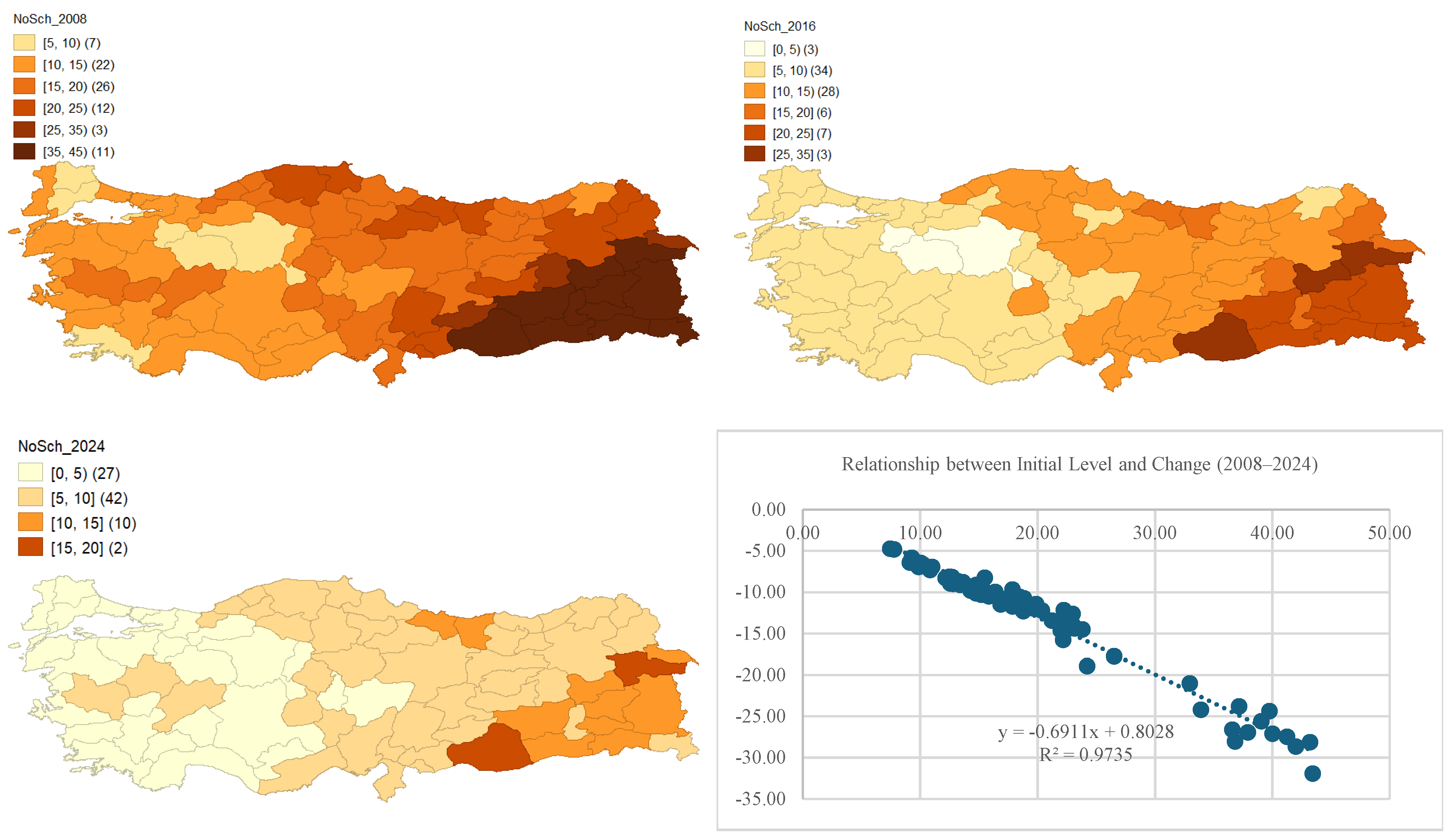
The findings indicate that no-schooling rates declined substantially across Türkiye during the 2008–2024 period. More pronounced reductions were observed, particularly in provinces of Eastern and Southeastern Anatolia, where initial levels were relatively high. The change analysis reveals a negative relationship between initial levels and subsequent decline (β = −0.6911; R
2 = 0.9735), indicating that provinces with higher starting values experienced larger declines over time and suggesting the presence of relative convergence tendencies (
Figure 1). By 2024, no-schooling rates had decreased to relatively low levels nationwide, with many provinces falling below the 5% threshold. Nevertheless, relatively higher levels continued to persist in Eastern and Southeastern Anatolia.
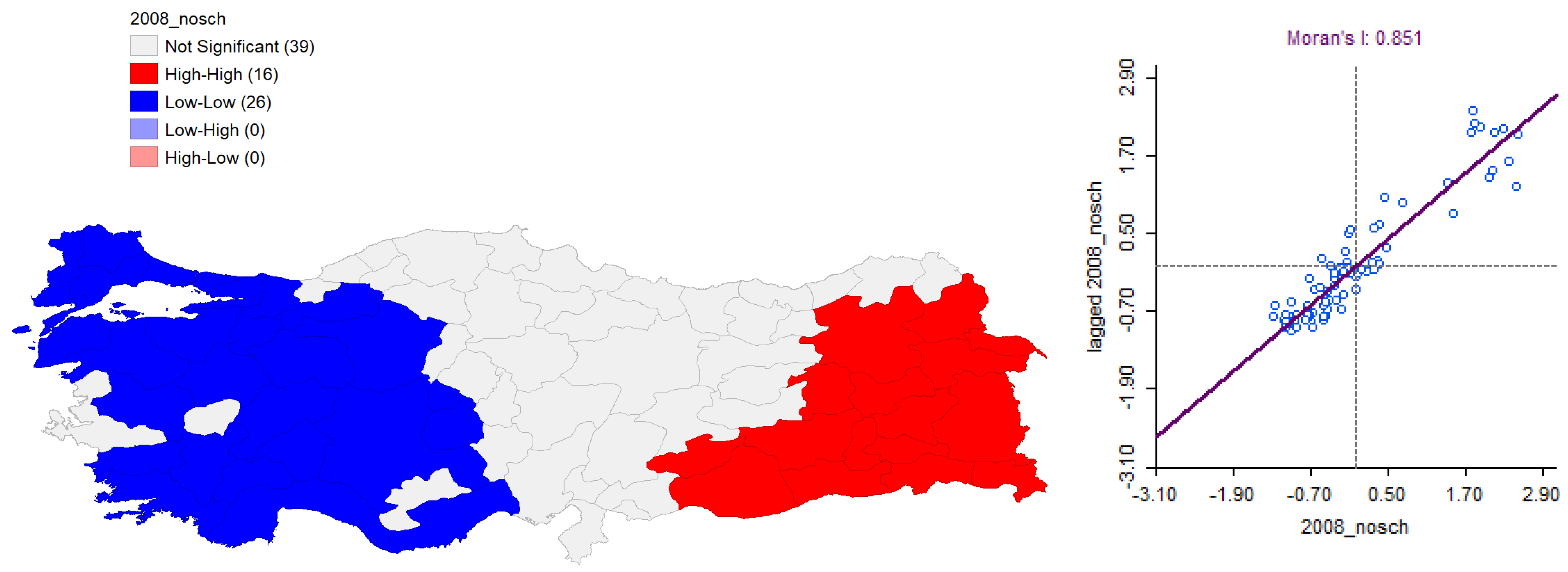
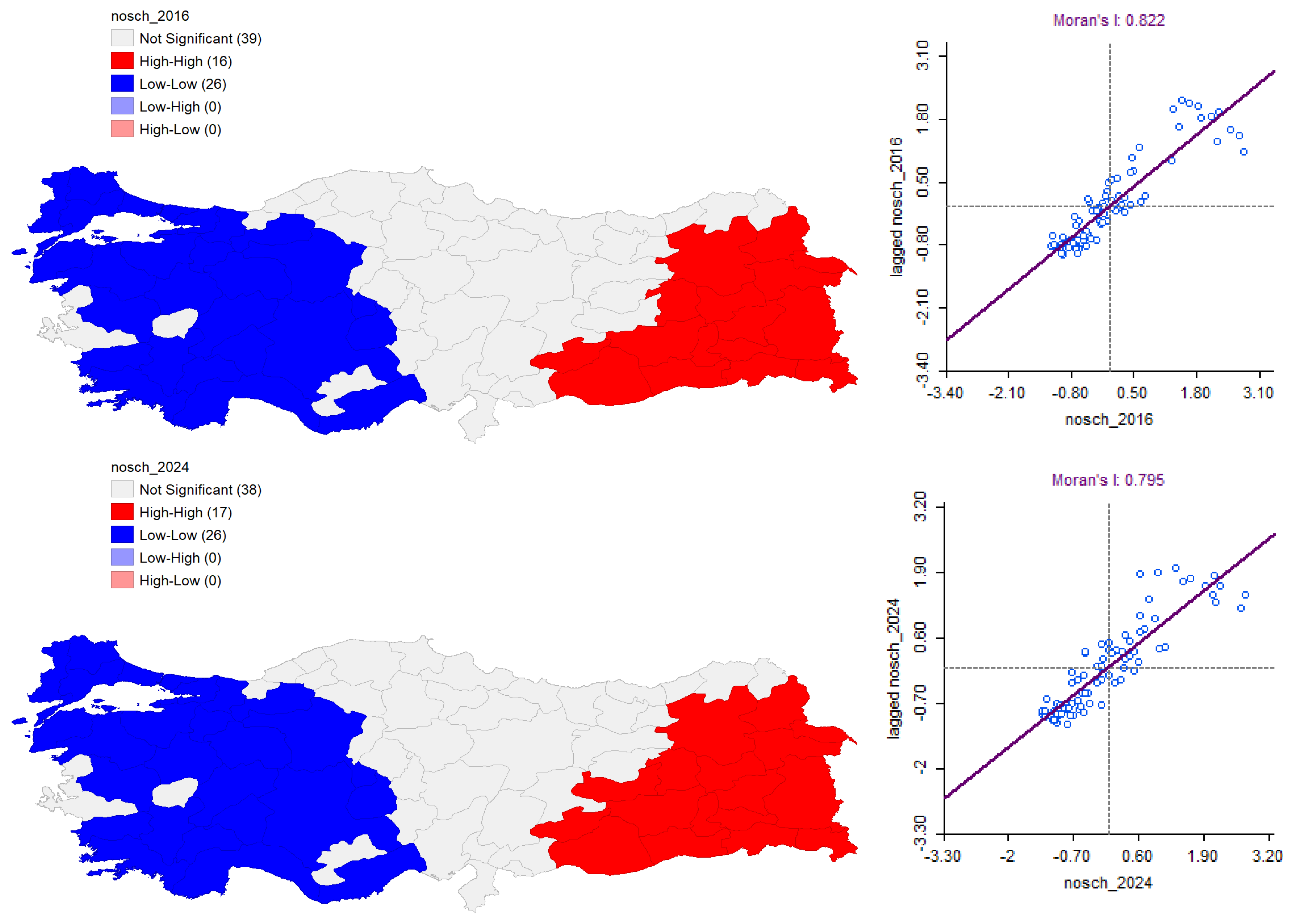
Nevertheless, spatial autocorrelation analyses indicate that the general spatial pattern was largely preserved despite the decline in no-schooling rates. Moran’s I values decreased gradually from 0.851 in 2008 to 0.822 in 2016 and 0.795 in 2024, suggesting a partial weakening of spatial dependence over time. However, the persistence of relatively high Moran’s I values indicates that spatial clustering continued throughout the study period (
Figure 2). Similarly, LISA cluster maps show that low no-schooling rates remained concentrated in Western Türkiye, whereas higher rates continued to cluster in Eastern and Southeastern Anatolia. In contrast, statistically significant clustering was not observed in the central parts of the country. These findings suggest that, although no-schooling rates declined over time, regional spatial disparities continued to persist.
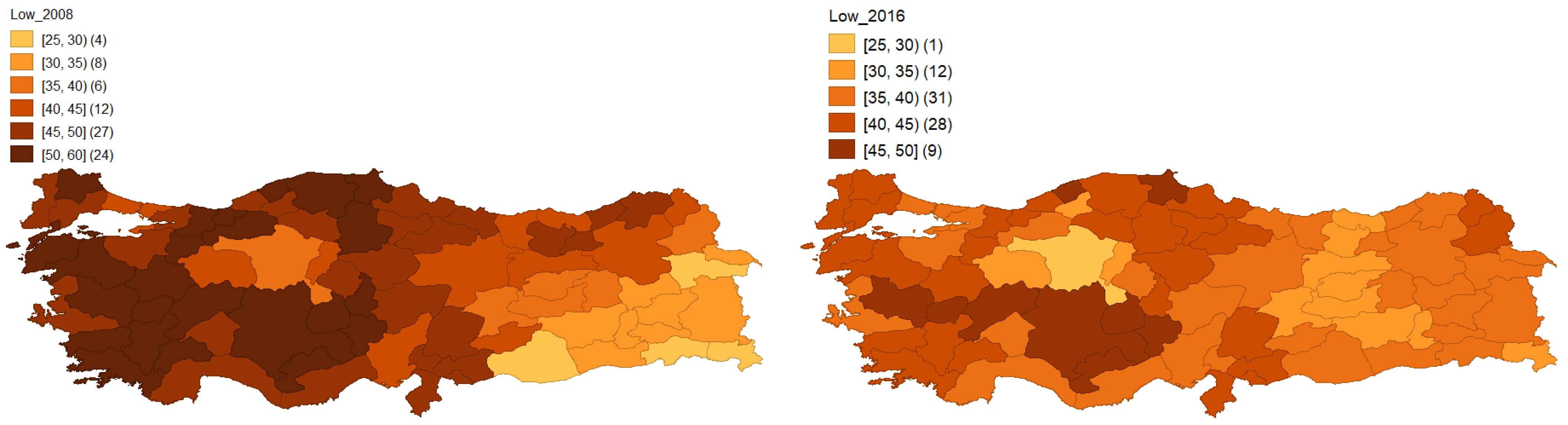
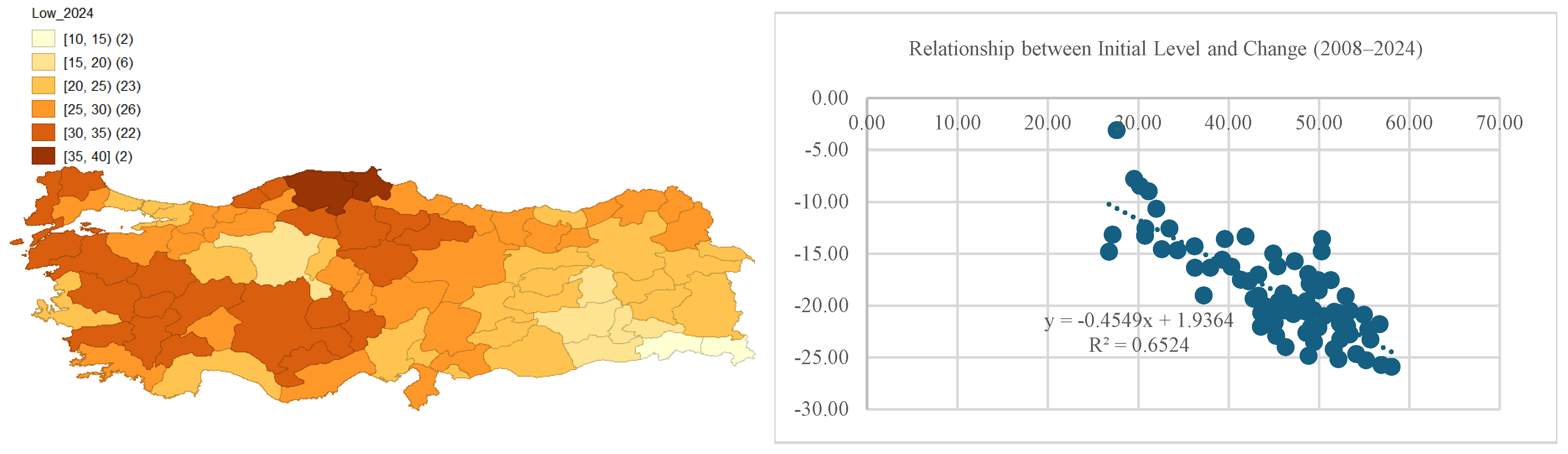
The findings indicate that the proportion of the population with low educational attainment declined considerably across Türkiye during the 2008–2024 period. More pronounced decreases were observed, particularly in parts of Western and Central Anatolia, where the initial levels were relatively high. The change analysis reveals a negative relationship between initial levels and subsequent decline (β = −0.4549; R
2 = 0.6524), indicating that provinces with higher starting values experienced larger reductions over time and suggesting the presence of relative convergence tendencies (
Figure 3). Nevertheless, although the proportion of the population with low educational attainment decreased nationwide by 2024, relatively higher levels continued to persist in some provinces, particularly in parts of Central and Northern Türkiye.
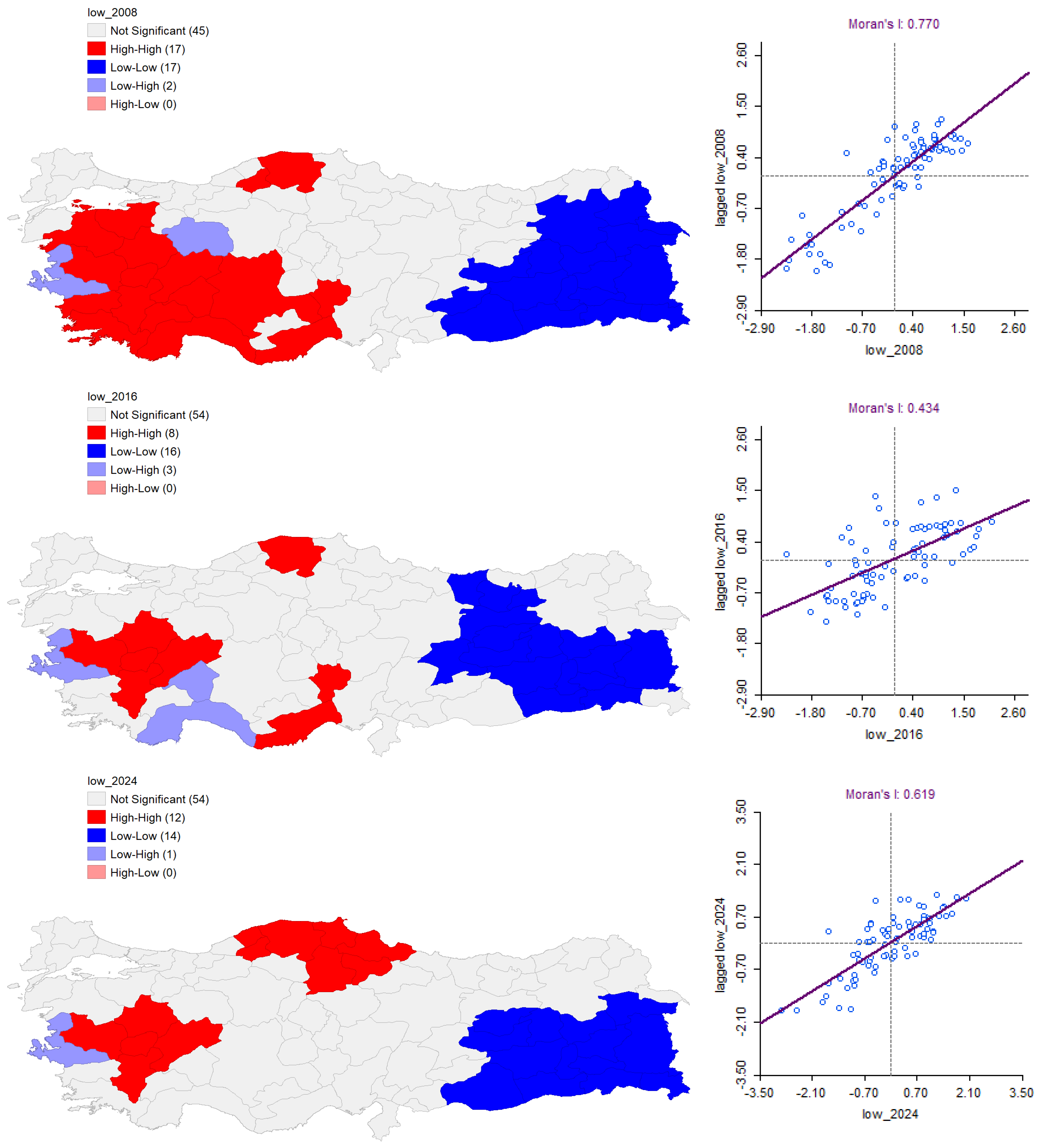
However, spatial autocorrelation analyses indicate that the overall spatial pattern of low educational attainment, although transformed over time, did not disappear completely. Moran’s I values declined from 0.770 in 2008 to 0.434 in 2016, before increasing again to 0.619 in 2024, suggesting that spatial dependence weakened during the intermediate period but remained evident throughout the study period (
Figure 4). Similarly, LISA cluster maps show that, particularly in 2008, high–high clusters of low educational attainment were concentrated in Western Türkiye, whereas low–low clusters were primarily located in Eastern and Southeastern Anatolia. In other words, low educational attainment rates were clustered at relatively higher levels in western regions and at lower levels in eastern regions. In subsequent years, these spatial patterns became more fragmented, although regional clustering structures continued to persist. These findings suggest that, although the proportion of the population with low educational attainment declined over time, spatial disparities continued to exist to a certain extent.
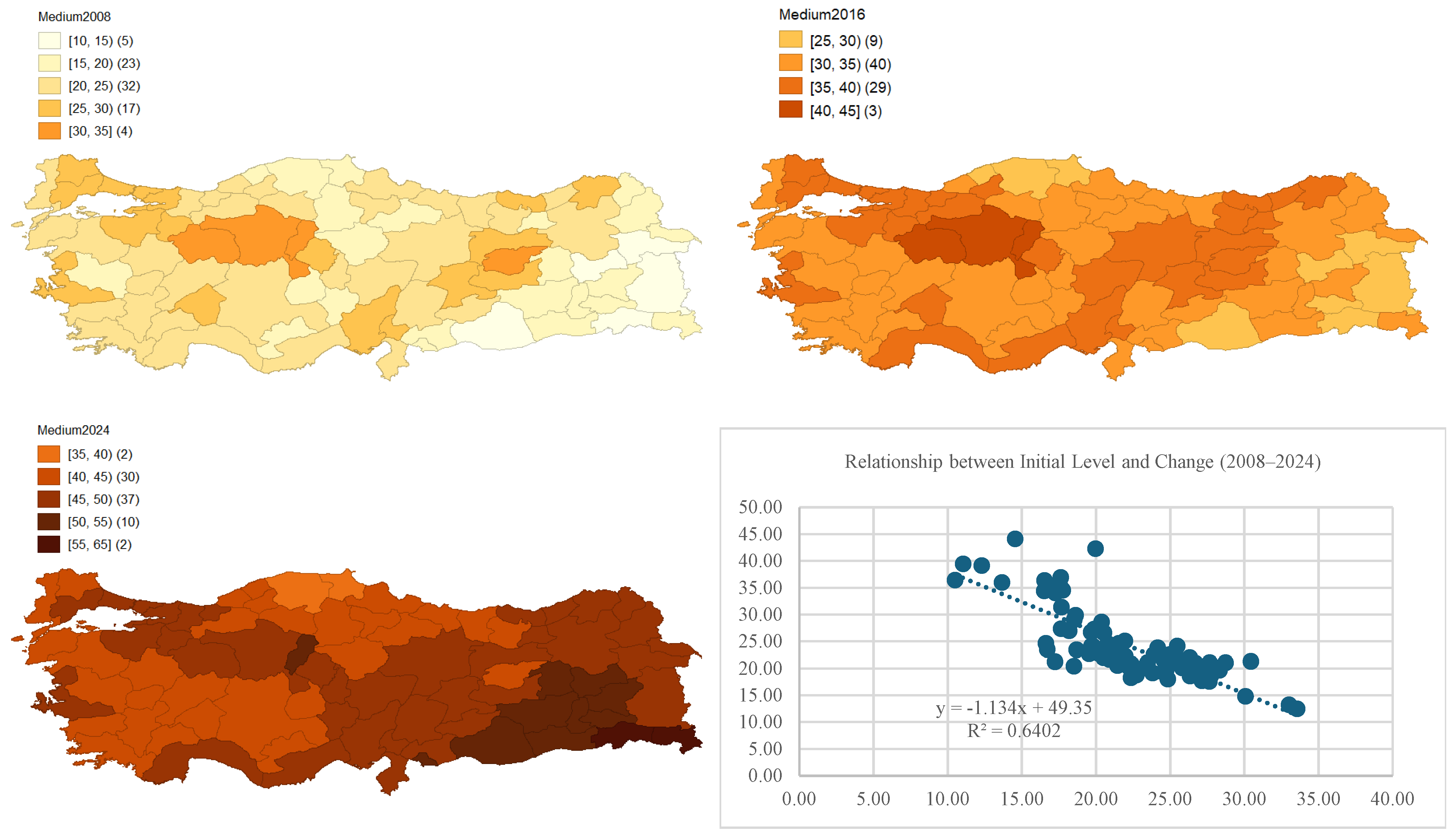
The findings indicate that the proportion of the population with medium educational attainment increased considerably across Türkiye during the 2008–2024 period. In 2008, medium educational attainment was generally characterized by relatively lower levels and a more limited spatial distribution. During this period, many provinces were concentrated within medium value ranges, while several provinces in Eastern and Southeastern Anatolia were located in lower value categories. By 2016, the proportion of the population with medium educational attainment had increased across a large part of the country, and higher value ranges became more widespread spatially. By 2024, medium educational attainment had reached relatively higher levels nationwide, while provincial values appeared to become more similar across regions. This pattern suggests not only an overall increase, but also the emergence of a relatively more spatially homogeneous structure over time. The results of the change analysis further reveal a negative relationship between initial levels and subsequent growth (β = −1.134; R
2 = 0.6402), indicating that provinces with lower initial levels experienced larger increases over time and suggesting an upward convergence tendency in medium educational attainment (
Figure 5).
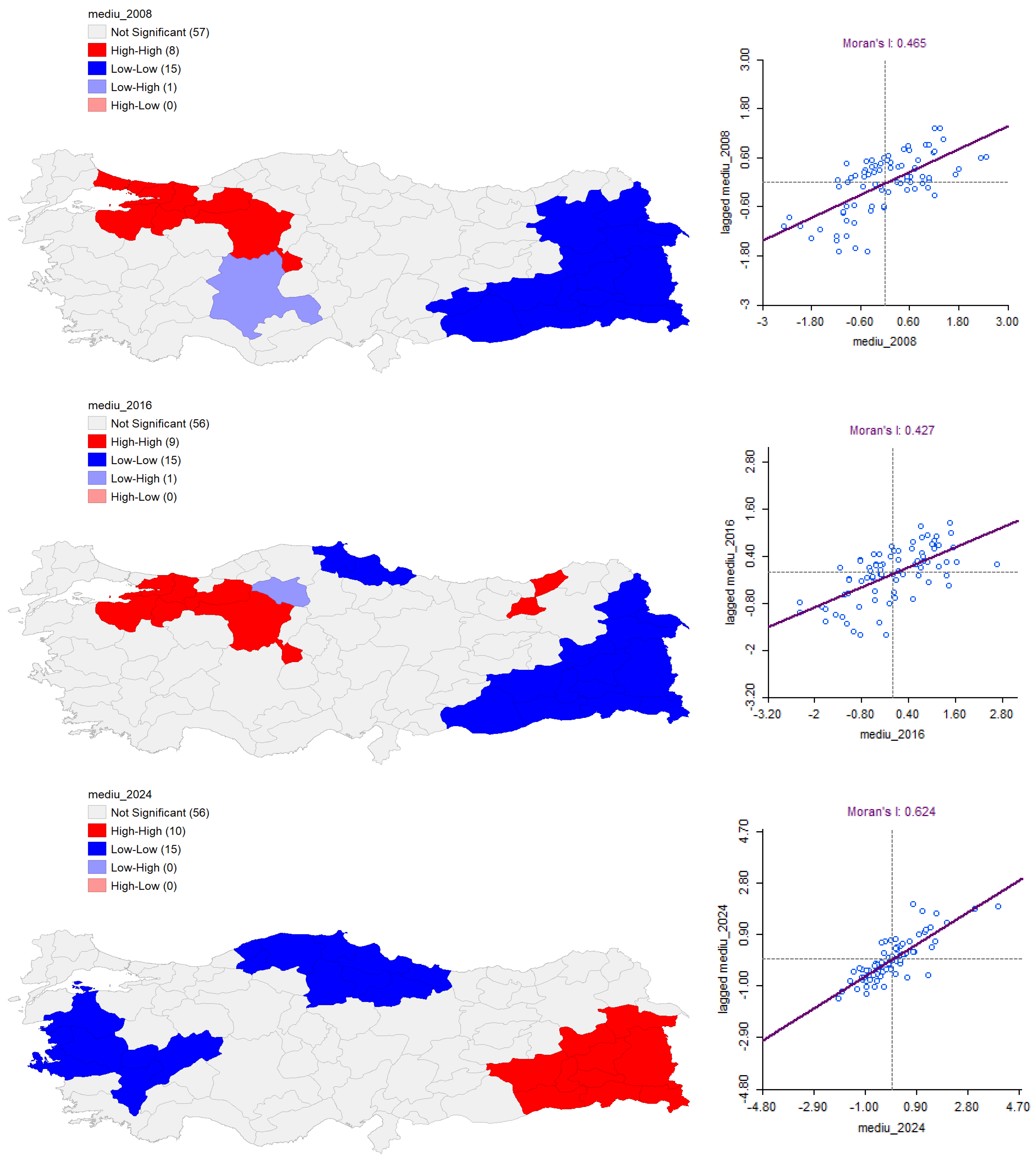
However, spatial autocorrelation analyses indicate that, although the spatial pattern of medium educational attainment transformed over time, spatial clustering tendencies did not disappear completely. Moran’s I values declined slightly from 0.465 in 2008 to 0.427 in 2016, but then increased to 0.624 in 2024. This suggests that spatial dependence weakened during the intermediate period but became more pronounced again in the later period (
Figure 6). Similarly, LISA cluster maps show that, in 2008, high–high clusters of medium educational attainment were mainly concentrated in parts of Western and Central Anatolia, whereas low–low clusters were strongly concentrated in Eastern and Southeastern Anatolia. In other words, medium educational attainment rates were spatially clustered at relatively higher levels in western regions and at lower levels in eastern regions. By 2016, high–high clusters became more fragmented and shifted spatially, while low–low clusters continued to persist in eastern regions. During the same period, an additional low–low cluster emerged in parts of the Black Sea region. By 2024, a noticeable spatial transformation in clustering patterns had occurred, and the east–west pattern observed in earlier periods had partially shifted. In this period, high–high clusters became concentrated in Eastern and Southeastern Anatolia, whereas low–low clusters became more visible in parts of Western Anatolia. These findings suggest that medium educational attainment became more widespread across the country over time. Nevertheless, although spatial patterns changed considerably, regional disparities and spatial dependence continued to persist to a certain extent.
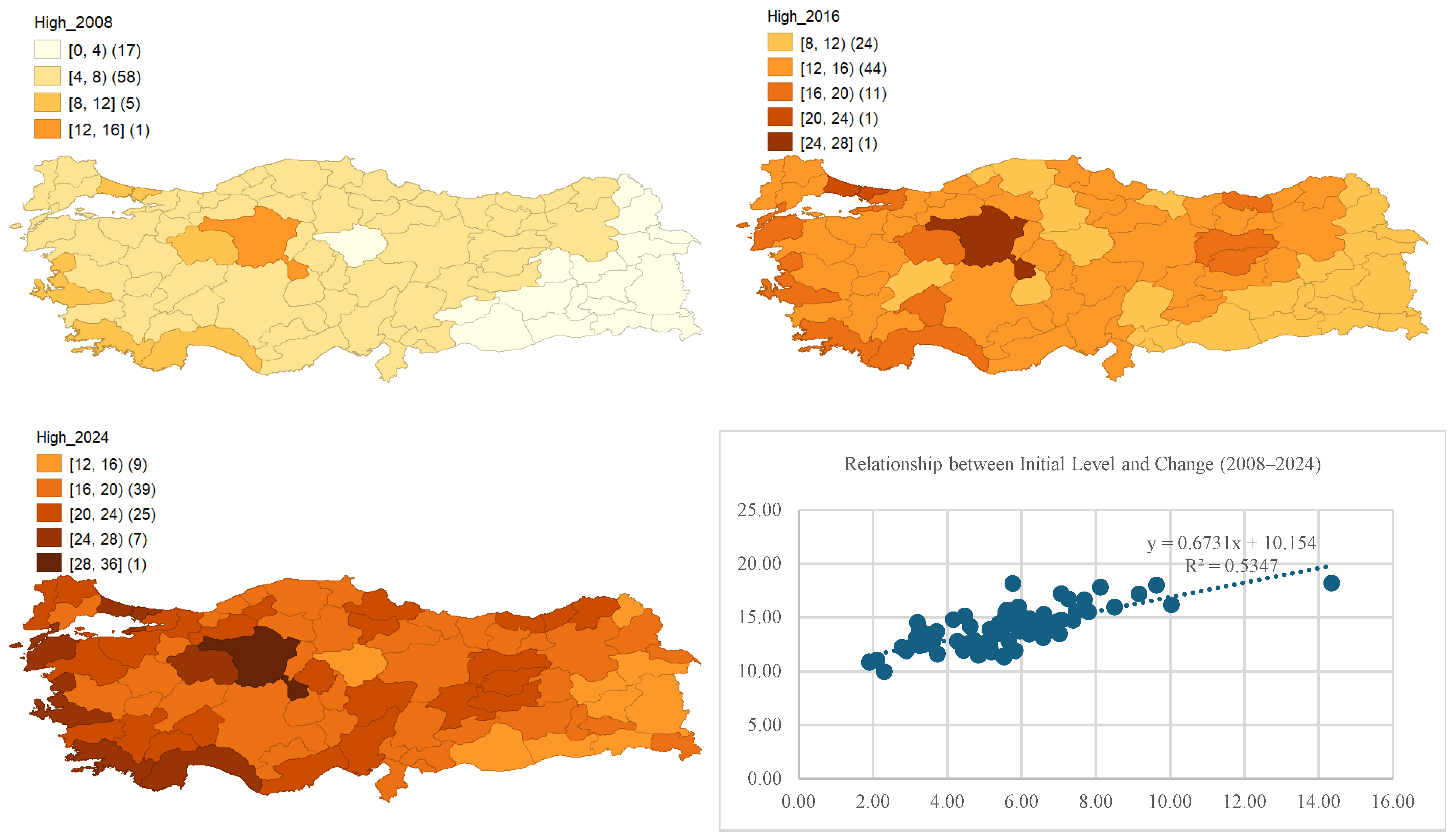
The findings indicate that the proportion of the population with high educational attainment increased considerably across Türkiye during the 2008–2024 period. In 2008, high educational attainment was generally characterized by relatively low levels and a limited spatial distribution. During this period, high educational attainment was concentrated at lower value ranges across most provinces, while many provinces in Eastern and Southeastern Anatolia remained at comparatively lower levels. By 2016, however, the proportion of the population with high educational attainment had increased nationwide and expanded across a broader spatial area. During this phase, higher value ranges began to emerge in certain regions. By 2024, high educational attainment had reached relatively higher levels across the country and had become more spatially widespread. Nevertheless, the persistence of comparatively lower levels in some regions suggests that spatial inequalities continued to exist to a certain extent. The results of the change analysis reveal a positive relationship between initial levels and subsequent growth (β = 0.6731; R
2 = 0.5347), indicating that provinces with higher initial levels experienced larger increases over time and suggesting the presence of a divergence tendency in high educational attainment (
Figure 7).
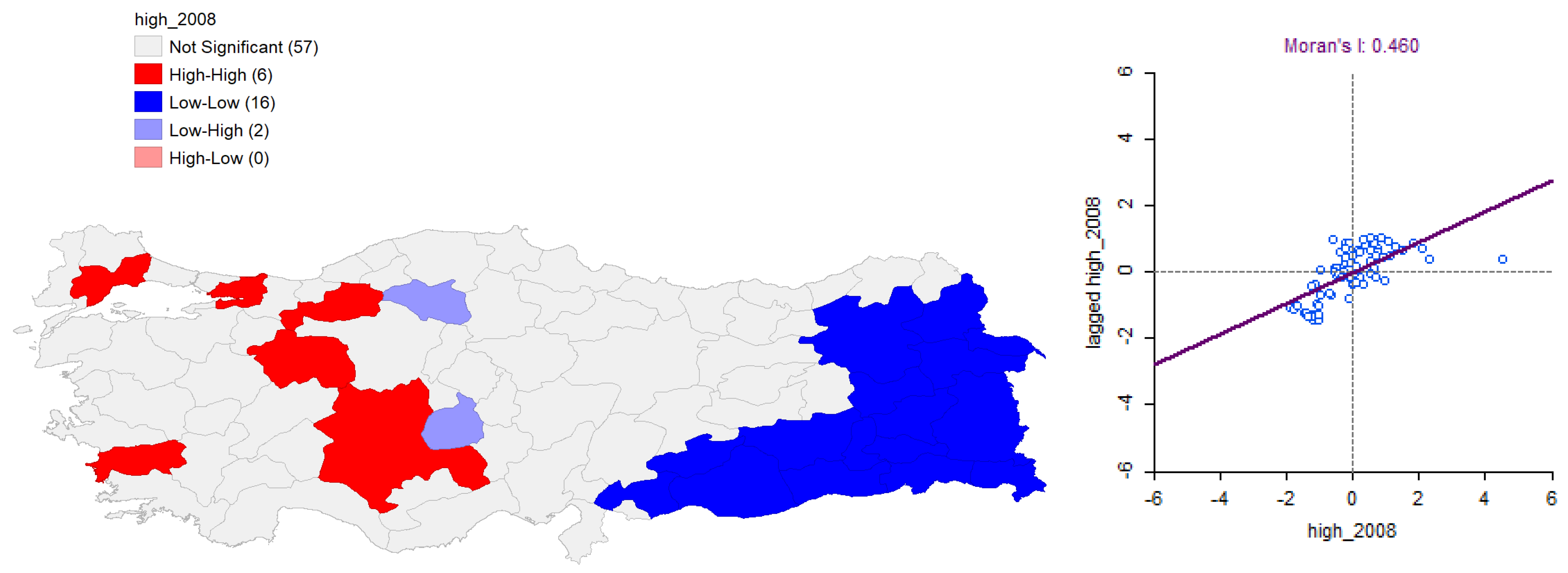
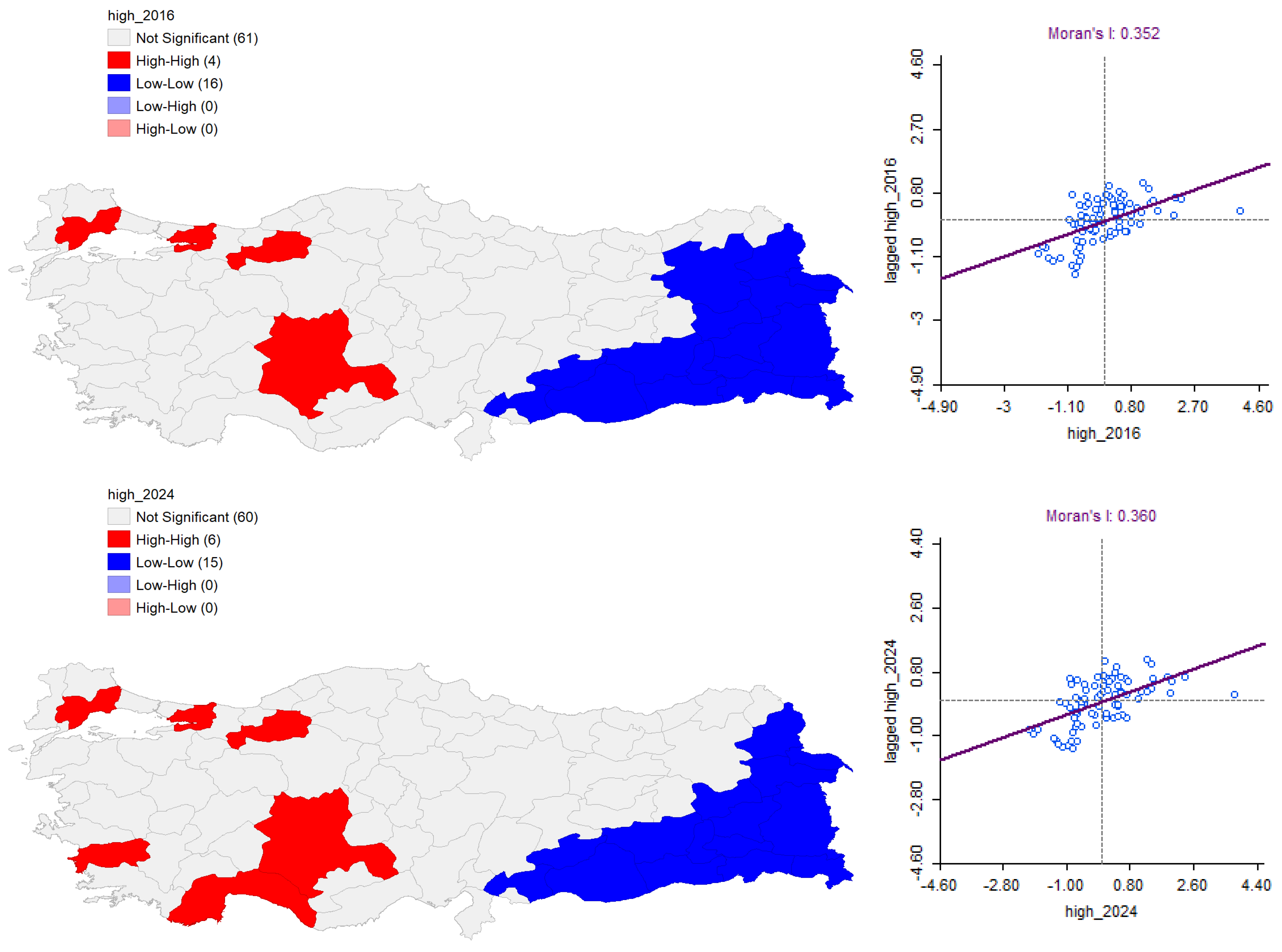
However, spatial autocorrelation analyses indicate that, although the spatial pattern of high educational attainment transformed over time, spatial clustering tendencies did not disappear completely. Moran’s I values declined from 0.460 in 2008 to 0.352 in 2016 and remained at a similar level of 0.360 in 2024. This suggests that spatial dependence weakened over time but continued to persist to a certain extent (
Figure 8). Similarly, LISA cluster maps show that, in 2008, high–high clusters of high educational attainment were mainly concentrated in parts of Central Anatolia, whereas low–low clusters were strongly concentrated in Eastern and Southeastern Anatolia. In other words, high educational attainment rates were spatially clustered at relatively higher levels in some central regions, while eastern regions were characterized by comparatively lower levels. By 2016, high–high clusters became more fragmented and their spatial continuity weakened. In contrast, low–low clusters largely persisted in eastern regions. By 2024, the high–high clustering pattern became more visible again, whereas low–low clusters continued to persist in eastern regions. These findings suggest that, although high educational attainment increased across the country over time, this transformation did not occur evenly across space. In particular, the persistence of spatial clustering patterns indicates that regional disparities in high educational attainment continued to exist over time.
3.3. Spatial and Temporal Patterns of Educational Gender Gaps
This section examines the spatial and temporal transformation of gender differences in educational attainment across Türkiye between 2008 and 2024. The analyses focus on how gender gaps vary across educational categories and regions, as well as how their spatial clustering structures evolved over time. In this context, both descriptive spatial distributions and spatial autocorrelation analyses are evaluated together in order to identify the regional dynamics associated with educational gender gaps.
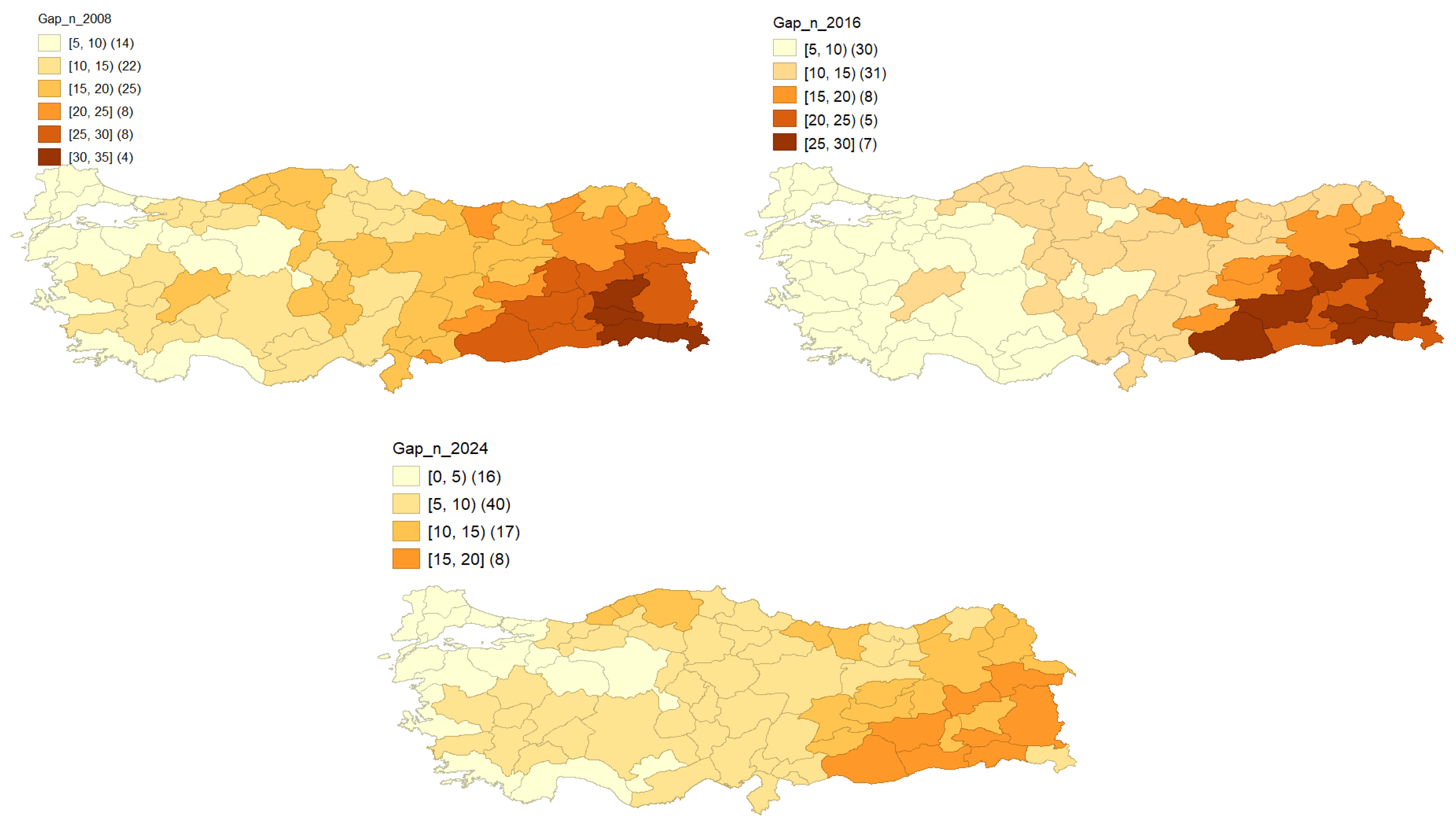
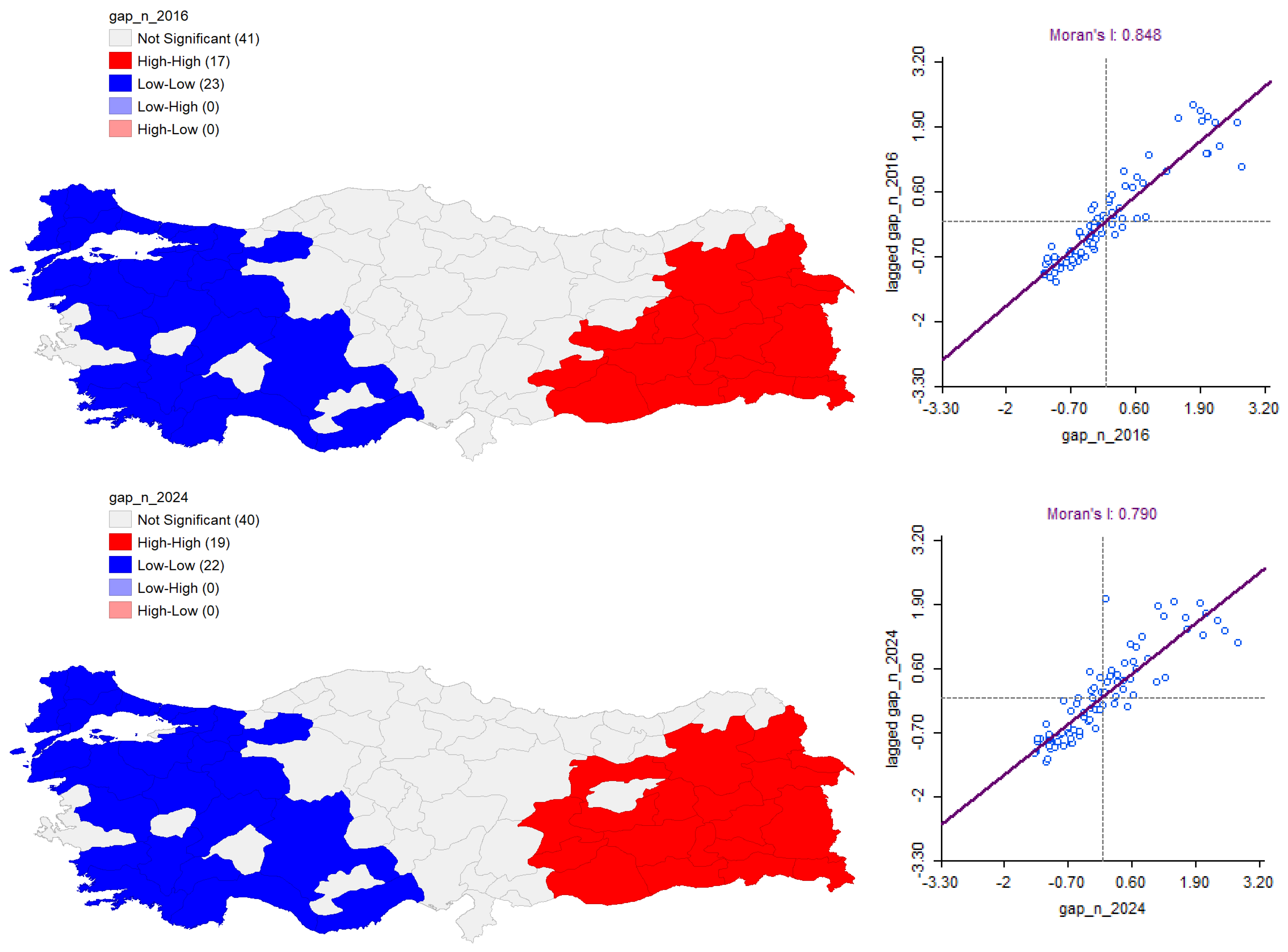
The findings indicate that the gender gap in no schooling declined considerably across Türkiye between 2008 and 2024, indicating a gradual reduction in gender disparities at the lowest level of educational attainment. Nevertheless, despite this overall decline, the spatial distribution of the gender gap continued to display a persistent regional pattern throughout the study period (
Figure 9 and
Figure 10).
In all three years, higher gender gap values were predominantly concentrated in Eastern and Southeastern Anatolia, where the proportion of women without formal schooling remained considerably higher than that of men. In contrast, relatively lower gender gap values were observed mainly in Western Türkiye and parts of the Mediterranean region. Although the magnitude of the gap decreased over time, the east–west spatial divide remained highly visible, suggesting that regional disparities in educational gender inequality continued to persist despite nationwide improvements.
Spatial autocorrelation analyses further support the existence of pronounced regional clustering patterns. Moran’s I values remained consistently high throughout the study period (0.871 in 2008, 0.848 in 2016, and 0.790 in 2024), indicating that provinces with similar gender gap levels tended to cluster spatially. LISA cluster maps likewise reveal persistent high–high clusters in Eastern and Southeastern Anatolia and low–low clusters in Western Türkiye. Meanwhile, many provinces located in Central Anatolia remained statistically insignificant, suggesting the presence of a transitional zone between the eastern high-gap and western low-gap regions.
Overall, the results suggest that although gender disparities in no schooling decreased considerably over time, the spatial structure of these inequalities remained relatively persistent. This finding indicates that improvements in educational access did not occur uniformly across Türkiye and that historically disadvantaged eastern regions continued to exhibit comparatively higher levels of gender inequality in education.
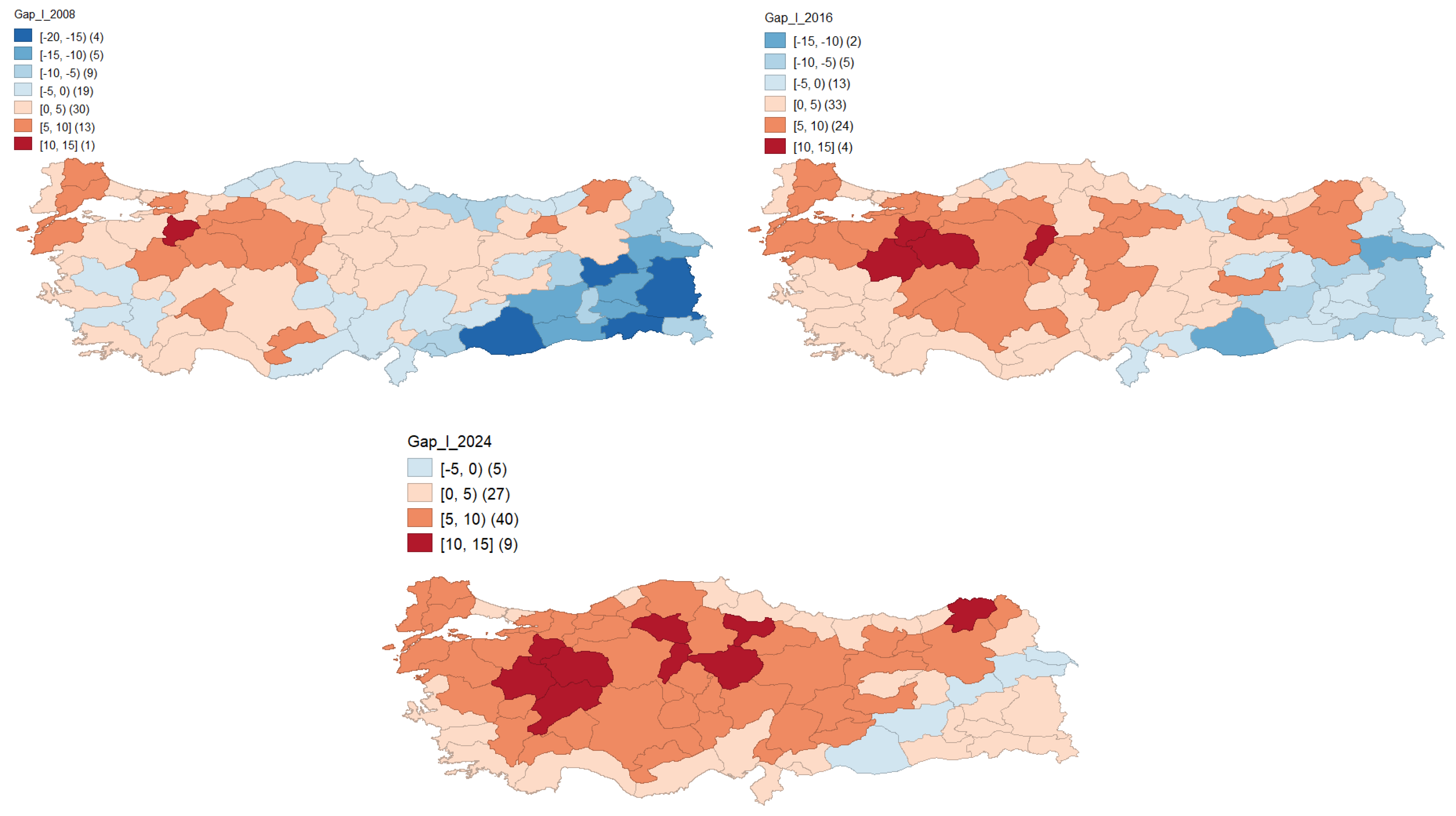
The findings reveal that the gender gap in low educational attainment displayed a more complex spatial pattern compared to the no-schooling category, as both female-dominated and male-dominated provinces were observed throughout the study period (
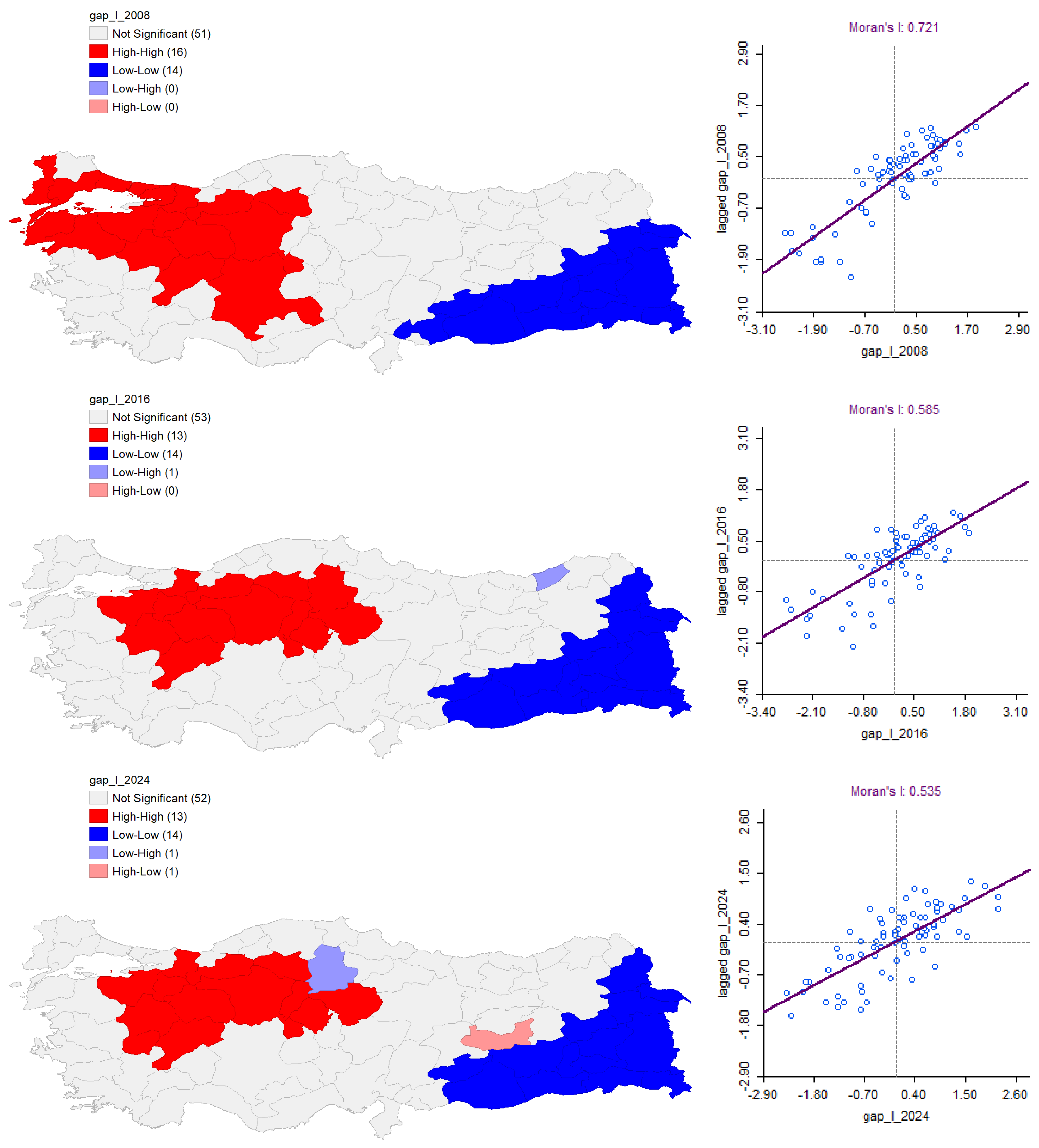
Figure 11 and
Figure 12). In 2008, a more pronounced male-dominated pattern was particularly evident in Eastern and Southeastern Anatolia, where negative gap values were concentrated at relatively higher levels. Smaller areas characterized by male-dominated patterns were also visible along parts of the Black Sea and Mediterranean coasts, although these were less pronounced than those observed in the eastern regions.
In contrast, provinces where women exhibited relatively higher proportions of low educational attainment were generally associated with lower-intensity values and were initially concentrated in limited parts of Central Anatolia. Over time, this female-dominated spatial pattern expanded. By 2016, female-dominated areas had become more spatially continuous across parts of Central Anatolia, while the intensity of male-dominated patterns in Eastern and Southeastern Anatolia weakened considerably. Although men continued to display relatively higher proportions in several eastern provinces, the magnitude of this difference declined substantially compared to 2008.
By 2024, provinces characterized by male-dominated patterns decreased further in both number and intensity. At the same time, female-dominated areas became relatively more widespread in some regions. Additionally, both the 2016 and 2024 maps reveal coastal zones along the Aegean and Mediterranean regions where women exhibited relatively higher proportions of low educational attainment, although the magnitude of the gap in these areas remained comparatively limited.
Spatial autocorrelation analyses indicate that the overall clustering structure became less pronounced over time. Moran’s I values declined from 0.721 in 2008 to 0.585 in 2016 and further to 0.535 in 2024, suggesting a gradual reduction in spatial dependence. Nevertheless, LISA cluster maps demonstrate that similar low–low and high–high clustering patterns persisted in broadly similar regions throughout the study period. In particular, eastern regions consistently formed low–low clusters, while parts of Central and Western Anatolia tended to exhibit high–high clustering patterns. This persistent east–west differentiation suggests that the spatial organization of gender disparities in low educational attainment continued despite the gradual weakening of clustering intensity.
The low–low clusters observed in Eastern and Southeastern Anatolia correspond to provinces where negative gender gap values were concentrated, indicating relatively higher proportions of men with low educational attainment in these regions. Accordingly, the blue low–low clusters in the LISA maps reflect the spatial concentration of male-dominated negative gap values rather than uniformly low levels of educational inequality.
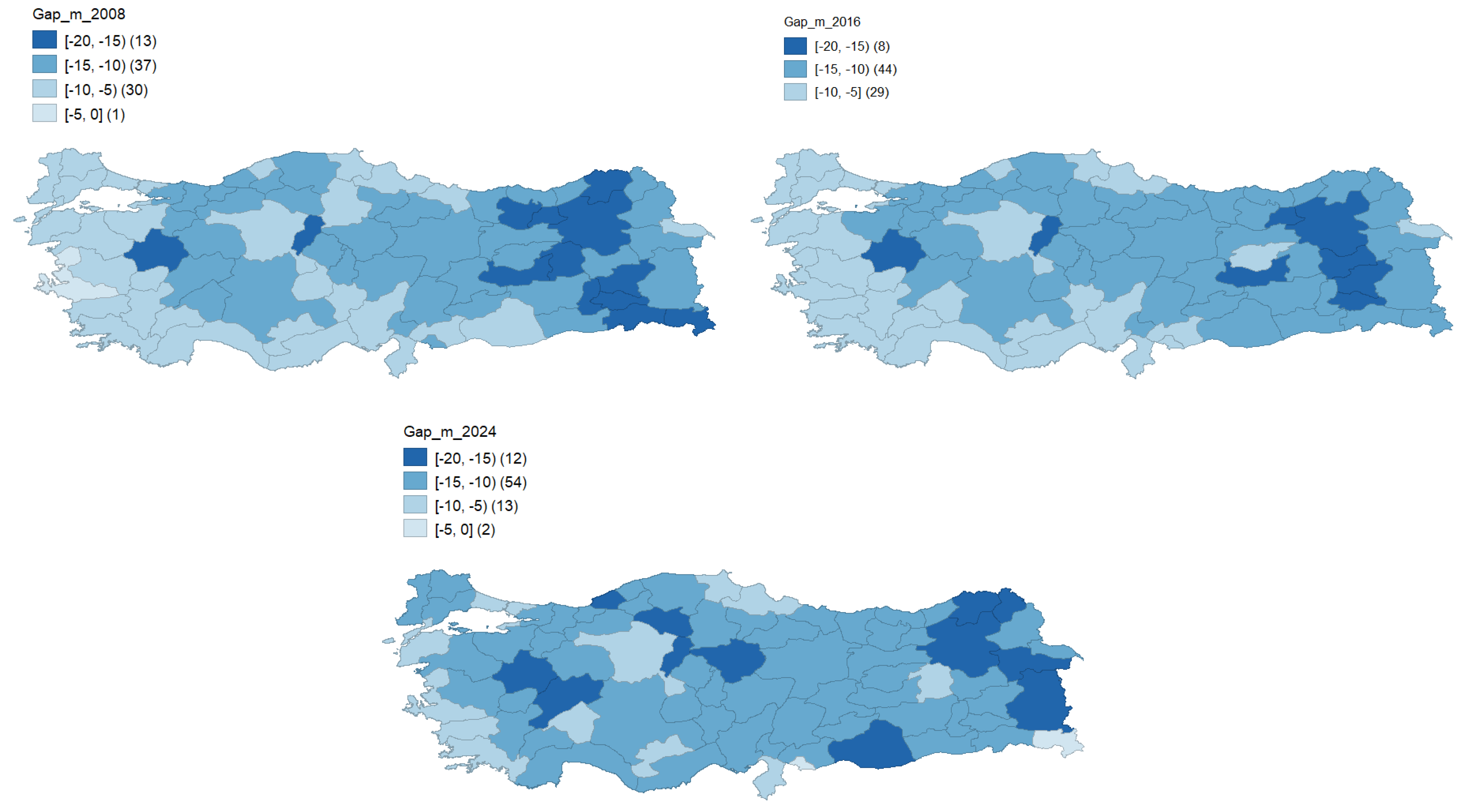
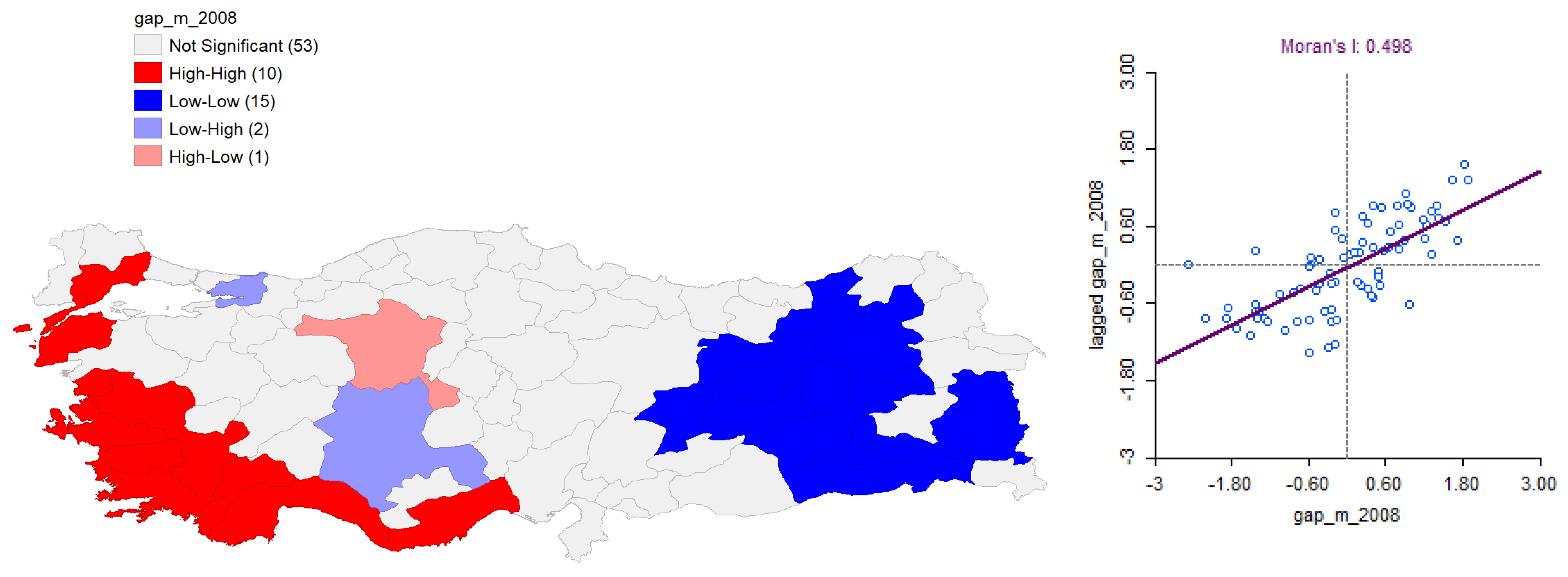
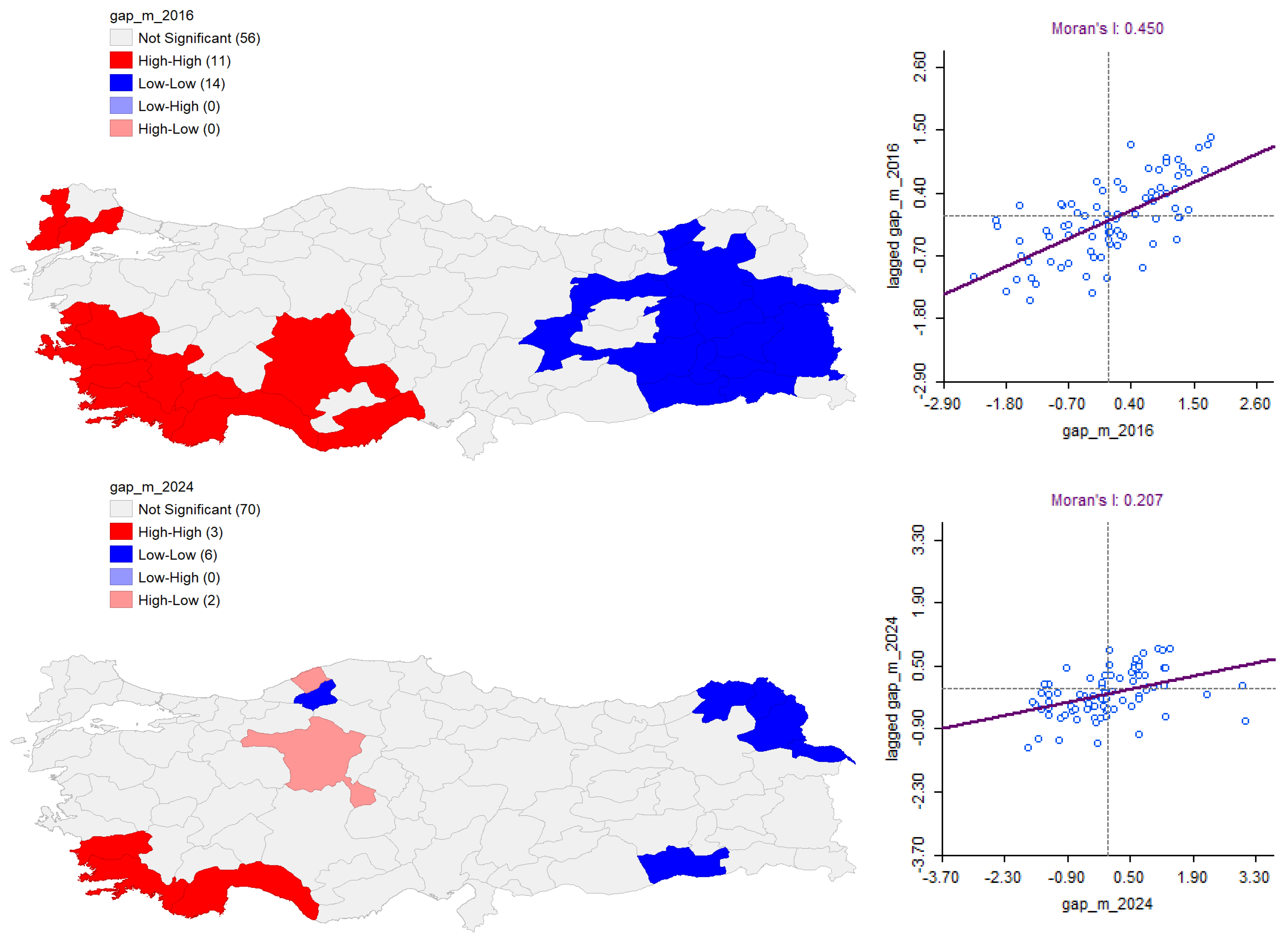
The spatial distribution of the gender gap in medium educational attainment reveals a different spatial pattern compared to the no-schooling and low-education categories (
Figure 13 and
Figure 14). In all three years, negative gap values dominated most provinces, indicating that men consistently exhibited higher proportions of medium educational attainment than women. However, although this pattern remained widespread, both the intensity and the spatial clustering structure of the gender gap changed over time.
In 2008, stronger negative values were particularly concentrated in Eastern and Southeastern Anatolia, while relatively weaker differences were observed along parts of the Aegean and Mediterranean coasts. This east–west contrast continued in 2016, although the intensity of the eastern concentration became relatively less pronounced. By 2024, the spatial distribution appeared more fragmented across many provinces, suggesting that medium-level educational gender disparities became less regionally concentrated over time. In many provinces, particularly outside the eastern regions, moderate negative values became more widespread over time.
The LISA cluster maps and Moran’s I statistics support this interpretation. Moran’s I values declined continuously from 0.498 in 2008 to 0.450 in 2016 and further to 0.207 in 2024, indicating a marked weakening of spatial autocorrelation over time. Compared to the previous educational categories, the 2024 Moran’s I coefficient suggests a relatively weaker spatial clustering structure, indicating that the geographical concentration of medium educational gender disparities became less regionally concentrated by the end of the study period.
Despite this weakening trend, certain regional patterns persisted. High–high clusters were mainly observed along parts of the Aegean and Mediterranean coasts, whereas low–low clusters remained concentrated in Eastern and Southeastern Anatolia. However, the number of clustered provinces decreased noticeably by 2024, and the spatial pattern became increasingly fragmented. The reduction in clustered provinces and the emergence of scattered local clusters suggest that the earlier large-scale regional structure gradually weakened over time.
The local spatial outliers identified in the LISA analysis further illustrate the spatial heterogeneity of this category. In 2008, two low–high clusters and one high–low cluster were identified. Among these, Ankara appeared as a high–low cluster, whereas Konya emerged as a low–high cluster. Interestingly, Ankara continued to display a high–low pattern in 2024, suggesting that some provinces maintained spatial characteristics that differed from those of their surrounding neighboring provinces despite broader regional changes over time.
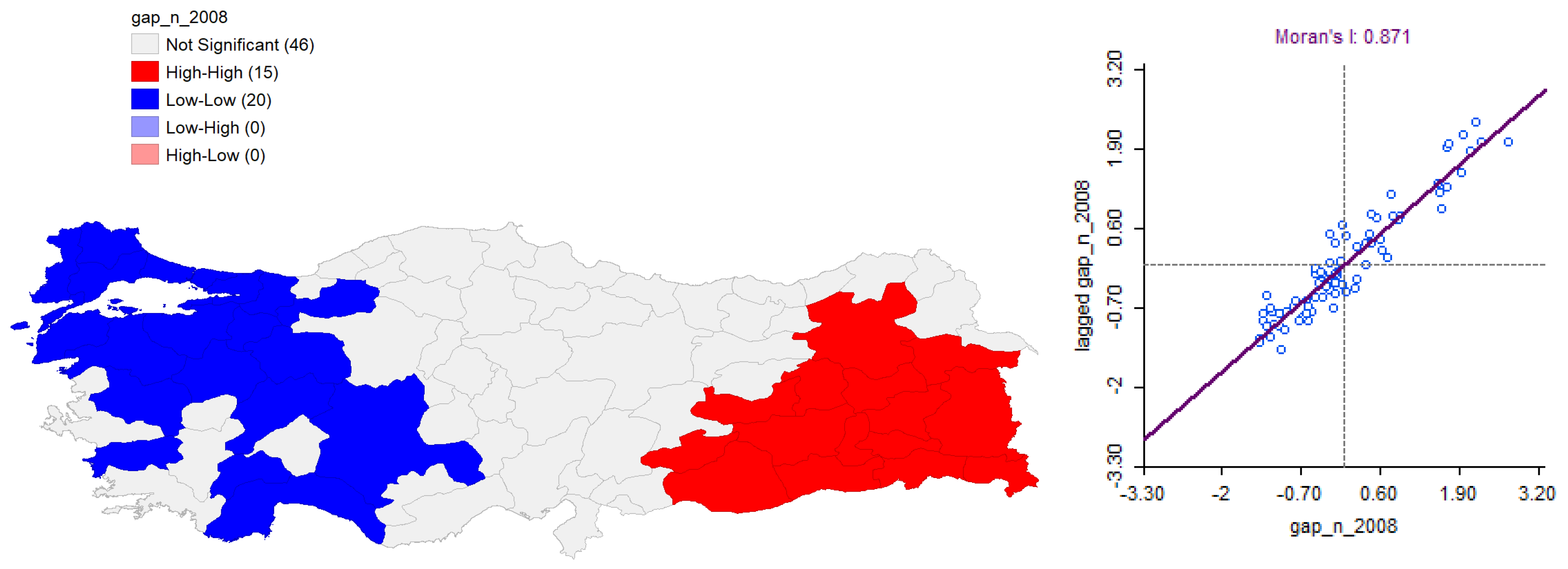
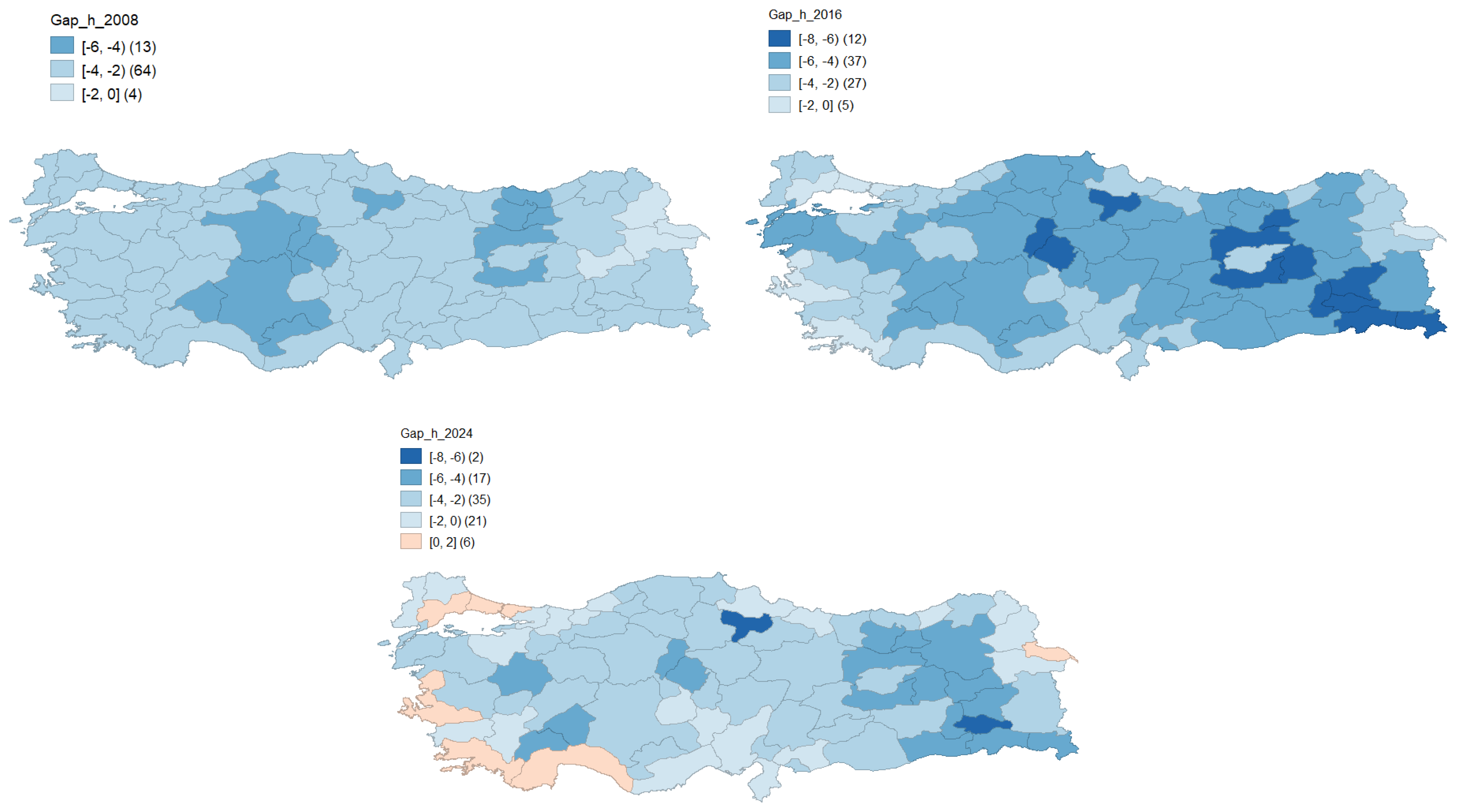
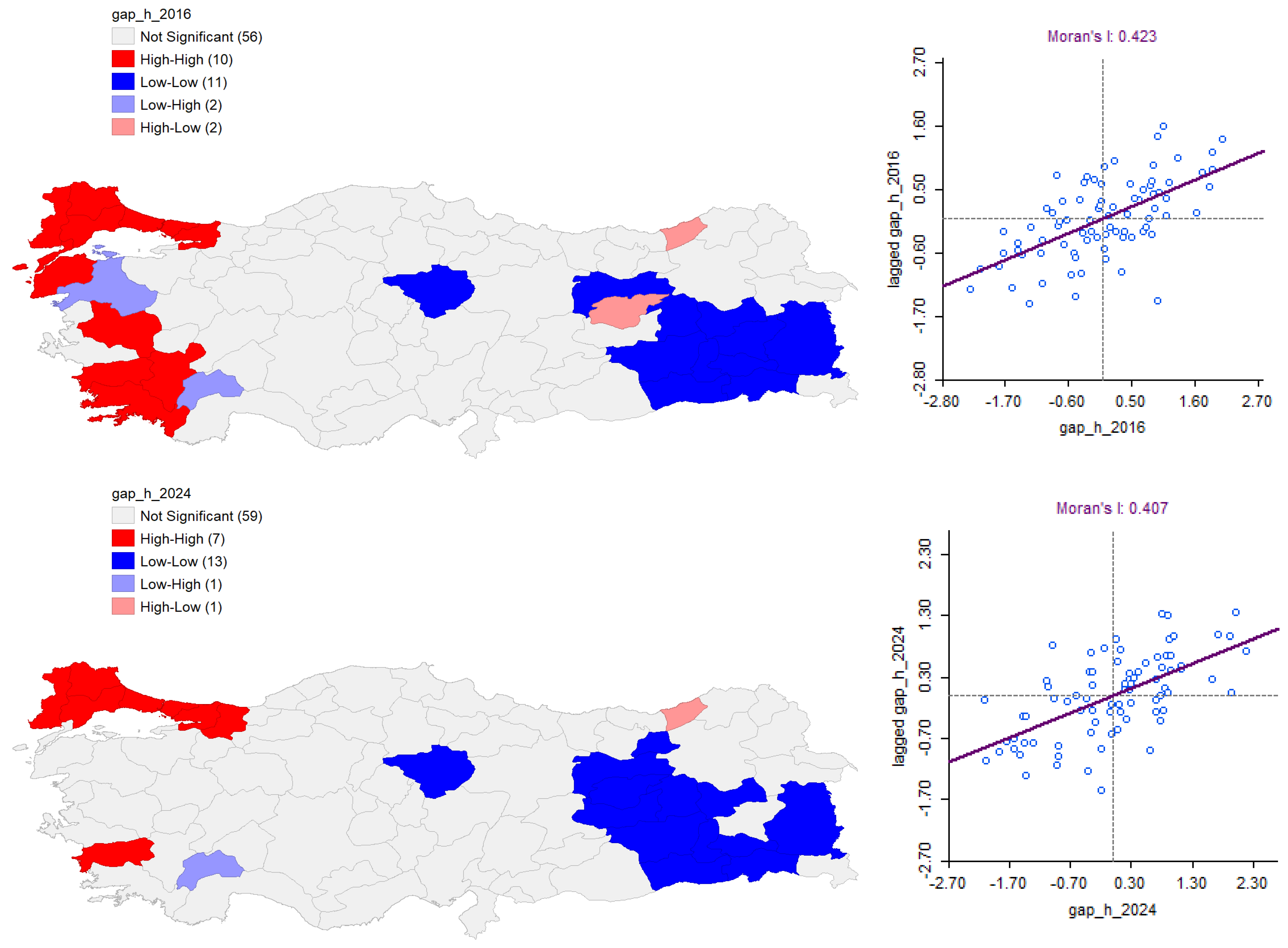
The spatial distribution of the gender gap in high educational attainment presents a more nuanced and less stable pattern compared to the other educational categories (
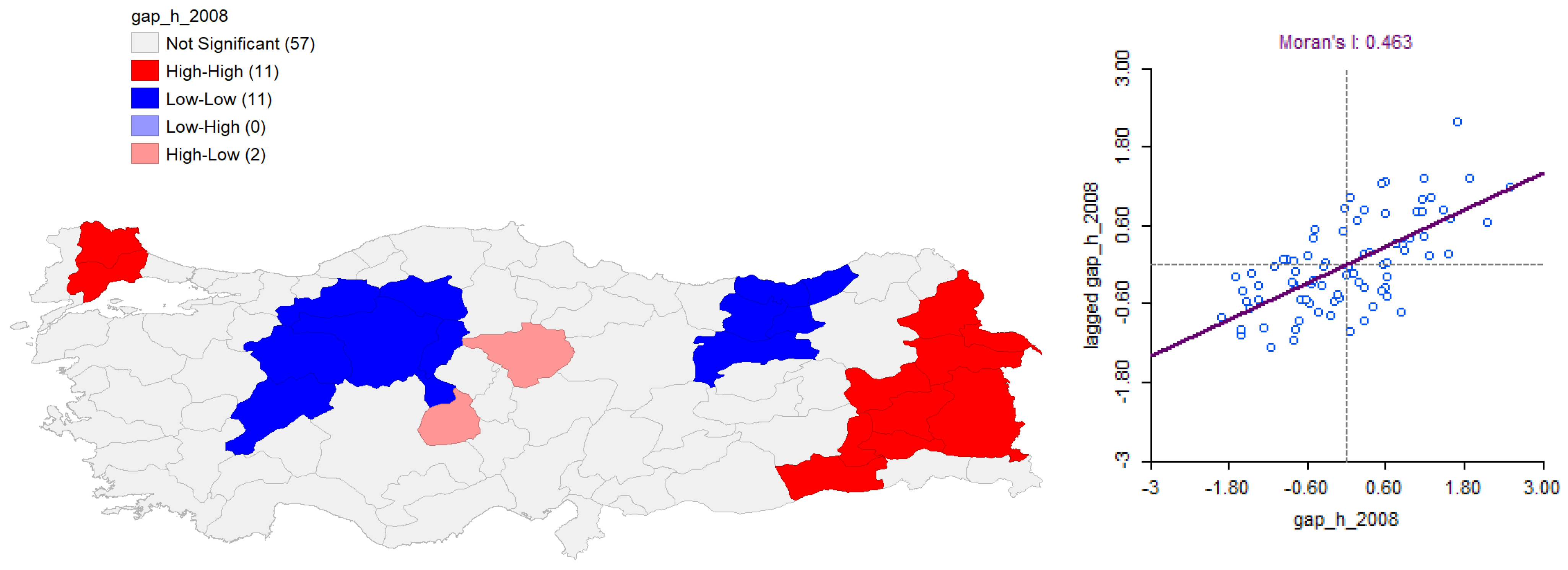
Figure 15 and
Figure 16). In 2008, the overall magnitude of the gender gap was relatively low across Türkiye, although negative values dominated most provinces, indicating relatively higher proportions of high educational attainment among men. Despite these relatively modest differences, certain regional concentrations were still observable. Higher gap values appeared particularly in parts of Central Anatolia and in the Eastern Black Sea region, together with its interior extensions, whereas some eastern provinces displayed comparatively lower gap values.
By 2016, the intensity of the gender gap became more pronounced across much of the country. Negative values became more widespread and stronger, suggesting that male predominance in high educational attainment increased spatially during this period. Particularly in some provinces of Eastern and Southeastern Anatolia, more evident clustering structures emerged, whereas relatively lower gap values became more visible along the western coastal regions. Compared to 2008, the spatial structure in 2016 appeared more regionally differentiated.
However, the 2024 distribution indicates a partial transformation of this structure. Although male predominance continued to characterize most provinces, the intensity of the gap declined in many areas. Moreover, a limited number of provinces began to display positive gap values, indicating localized cases in which women slightly surpassed men in high educational attainment. These female-dominated provinces did not generally exhibit very high gap magnitudes; nevertheless, their emergence is notable because such patterns were almost absent in earlier years.
Spatial autocorrelation analyses indicate that the clustering structure became moderately weaker over time. Moran’s I values declined from 0.463 in 2008 to 0.423 in 2016 and further to 0.407 in 2024. Although this decrease was more limited compared to the medium educational category, the results still suggest a gradual weakening of regional spatial dependence. The LISA cluster maps show that both high–high and low–low clusters persisted across specific regions throughout the study period; however, these clusters remained relatively fragmented and geographically discontinuous.
Since the gender gap variable includes both positive and negative values, the LISA cluster categories reflect the relative magnitude and direction of the gap values rather than the absolute intensity of inequality. Accordingly, the low–low clusters observed particularly in Eastern and Southeastern Anatolia correspond to the spatial concentration of more negative values associated with male predominance, whereas the high–high clusters observed mainly in western coastal regions represent areas with relatively higher or less negative gap values.
Unlike the no-schooling and low-education categories, the spatial organization of high educational attainment does not display a clear and consistent east–west divide. Instead, the pattern appears more heterogeneous and regionally fragmented. This suggests that the factors shaping gender disparities in high educational attainment are likely associated with more localized socioeconomic dynamics, such as urbanization, university concentration, labor market structure, and regional differences in access to higher educational opportunities. Consequently, the spatial pattern of the higher-education gender gap appears more complex and less regionally uniform than the patterns observed at lower educational levels.
3.4. Convergence Dynamics in Educational Attainment Across Gender and Levels
This section examines the relationship between initial levels and changes observed during the 2008–2024 period separately for female and male populations in order to evaluate temporal patterns in educational attainment. Negative slopes indicate that provinces with initially more disadvantaged conditions experienced larger improvements over time, suggesting a convergence tendency, whereas positive slopes indicate that provinces with initially more advantaged conditions experienced larger increases over time, pointing to a divergence tendency.
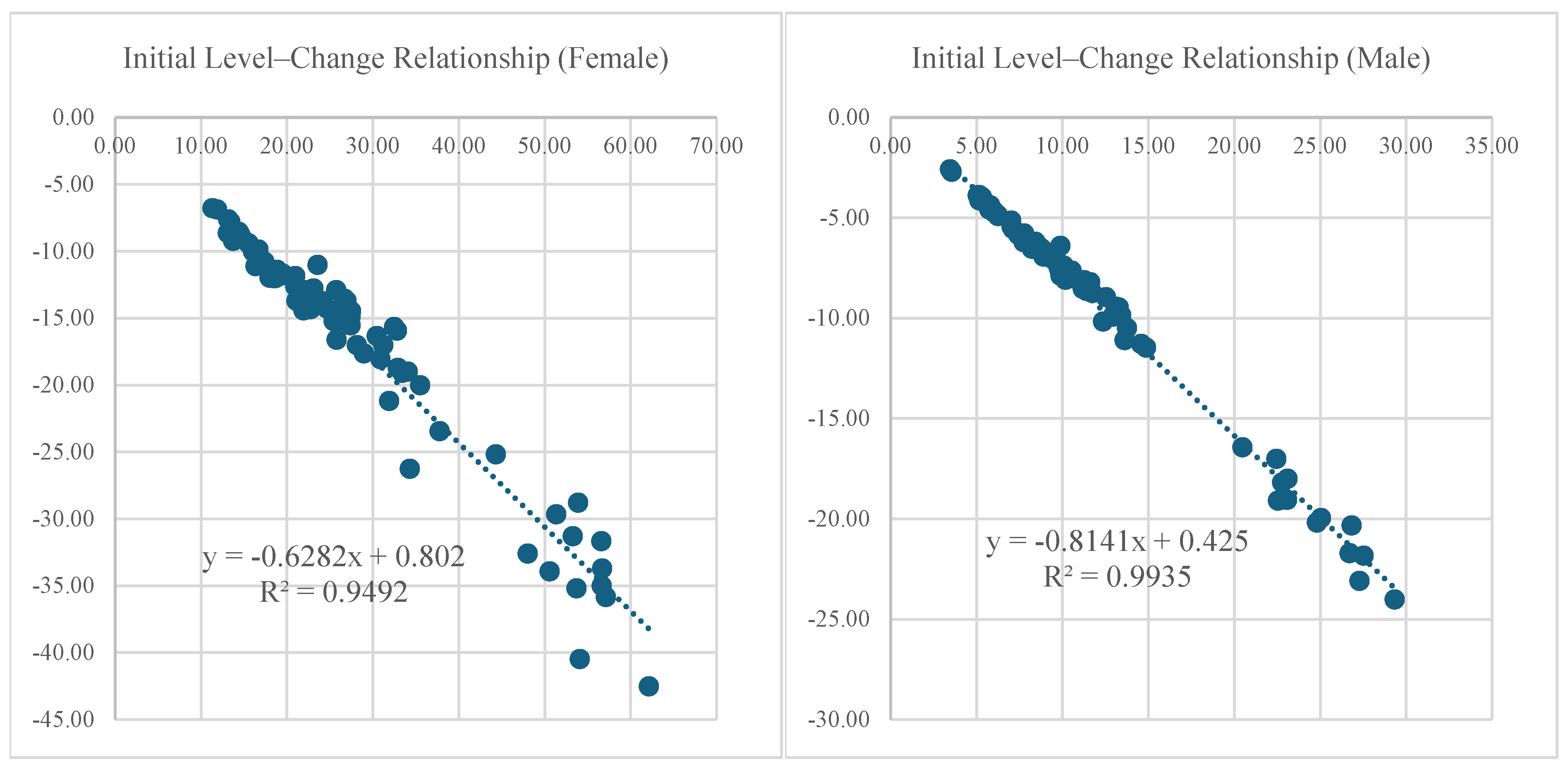
The relationship between initial levels and change in no-schooling rates reveals a negative association for both females and males (
Figure 17). The negative slope indicates that provinces with higher initial levels of no schooling experienced larger declines over time, suggesting a convergence tendency. The higher explanatory power observed for males (R
2 = 0.9935) suggests a more consistent pattern of change across provinces. A similar convergence tendency is also observed for females (R
2 = 0.9492).
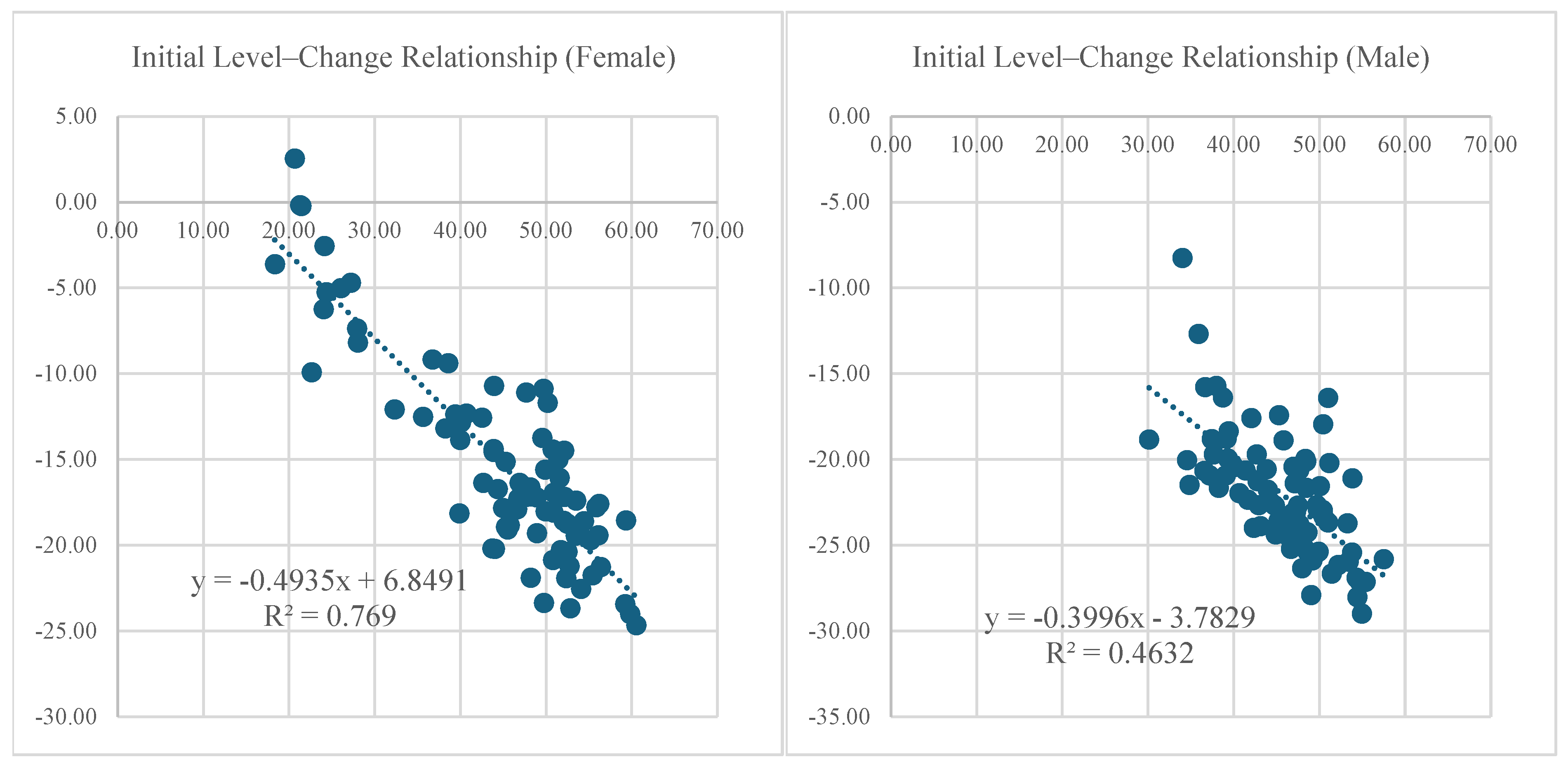
The relationship between initial levels and change in low educational attainment reveals a negative association for both females and males (
Figure 18). The negative slope indicates that provinces with higher initial levels of low educational attainment experienced larger declines over time, suggesting a convergence tendency. The higher explanatory power observed for females (R
2 = 0.769) suggests a more consistent pattern of change across provinces. In contrast, the lower explanatory power observed for males (R
2 = 0.4632) indicates that the pattern of change may vary more across provinces.
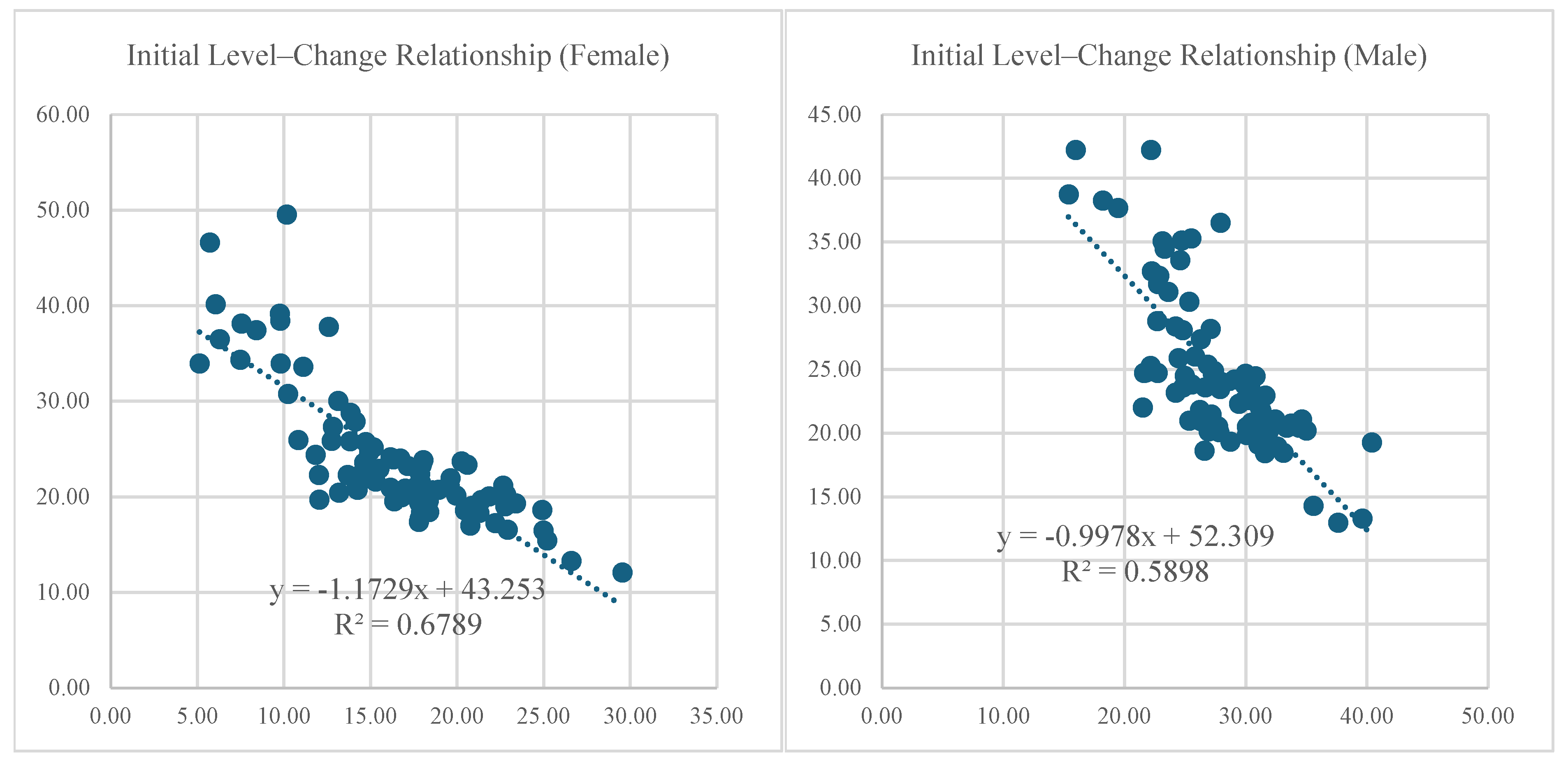
The relationship between initial levels and change in medium educational attainment reveals a negative association for both females and males (
Figure 19). The negative slope indicates that provinces with lower initial levels of medium educational attainment experienced larger increases over time, suggesting a convergence tendency. The higher explanatory power observed for females (R
2 = 0.6789) suggests a more consistent pattern of change across provinces. In contrast, the lower explanatory power observed for males (R
2 = 0.5898) indicates that the pattern of change may vary more across provinces.
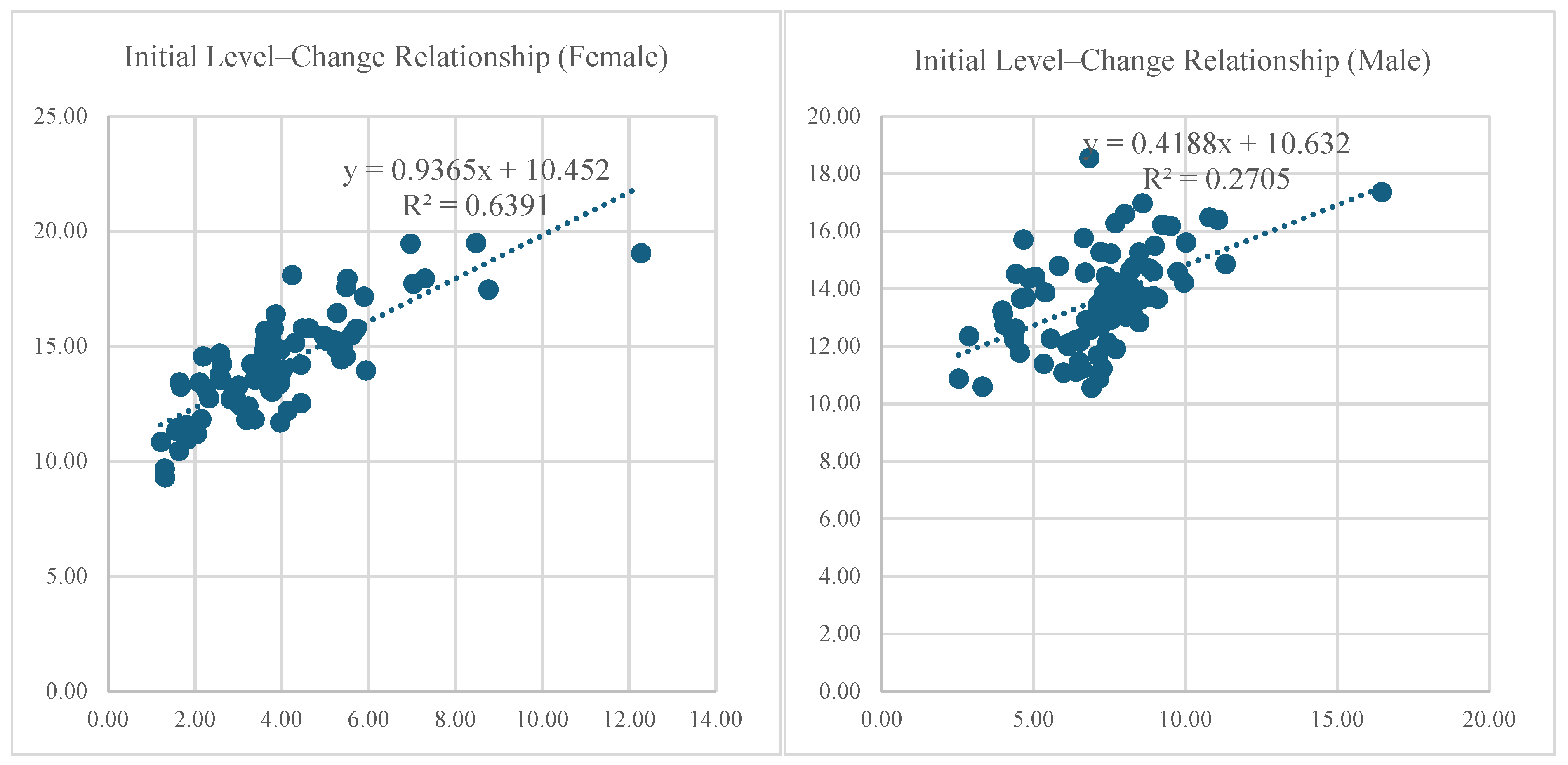
The relationship between initial levels and change in high educational attainment reveals a positive association for both females and males (
Figure 20). The positive slope indicates that provinces with higher initial levels of high educational attainment experienced larger increases over time, suggesting a divergence tendency. The higher explanatory power observed for females (R
2 = 0.6391) suggests a more consistent pattern of change across provinces. In contrast, the lower explanatory power observed for males (R
2 = 0.2705) indicates that the pattern of change may vary more across provinces.
Overall, the findings indicate that negative slopes dominate in no-schooling, low, and medium educational attainment categories for both female and male populations, suggesting a convergence tendency in these levels. In contrast, the positive slopes observed in high educational attainment point to a divergence tendency across provinces in this category. Differences in explanatory power also indicate that patterns of change may vary across educational levels and gender groups.
4. Discussion
The findings of this study suggest that, despite the overall improvement in educational attainment levels in Türkiye, spatial and gender-based inequalities have not been fully eliminated. Persistent spatial clustering observed particularly in the Eastern and Southeastern Anatolia regions in relation to no-schooling and low educational attainment indicates that educational inequalities continue to persist in certain regions. In contrast, the spatial differentiation observed at higher educational levels suggests that educational transformation processes may not have occurred in an equally and spatially homogeneous manner across the country.
While convergence tendencies are observed at some educational levels, spatial disparities appear to persist at others. In particular, although certain convergence trends emerge at lower educational levels, spatial divergence patterns continue to be evident at higher educational levels. By contrast, the broader spatial diffusion of medium educational attainment over time points to the emergence of a more balanced spatial pattern. These findings suggest that different stages of education may be associated with spatial and social processes in different ways.
Although significant improvements in educational indicators were observed across Türkiye during the study period, the persistence of spatial dependencies and regional disparities suggests that educational expansion alone may not be sufficient to fully eliminate inequalities. This finding is also consistent with the literature emphasizing that expansion processes within education systems may not produce similar outcomes across different regions and social groups.
The findings of the study further suggest that gender-based educational inequalities may exhibit varying spatial patterns across different educational levels. In the no-schooling category, the higher proportion of women compared to men, together with the persistence of pronounced clusters in Eastern and Southeastern Anatolia, indicates that female disadvantage may continue to persist in certain regions. Although an overall decline in gender disparities is observed over time, the continued presence of spatial patterns characterized by concentrated female disadvantage suggests that regional inequalities have not been fully eliminated. These findings also appear to be consistent with studies in the literature emphasizing that women’s access to education is closely associated with regional socioeconomic conditions, traditional social structures, and rural disadvantages.
At lower educational levels, gender-related spatial patterns appear to have changed considerably over time. While male-dominated spatial patterns were more pronounced during the initial period, areas in which women were more heavily represented became increasingly widespread over time. Nevertheless, the continued persistence of spatial clustering suggests that regional disparities have not been fully eliminated. This transformation may be associated not with women becoming absolutely advantaged, but rather with men transitioning more rapidly into medium and higher educational categories. The literature similarly emphasizes that educational expansion processes do not produce equal outcomes across social groups and that transitions between educational categories may differ by gender. In this respect, the findings appear to be consistent with the existing literature.
At the medium educational level, male-dominated spatial patterns appear to persist throughout all periods. However, the weakening of spatial clustering and the decline of pronounced regional patterns over time suggest that spatial polarization may have begun to diminish to some extent. This situation may be associated with the increasing tendency of the male population to move toward higher educational categories. Therefore, the transformation observed at the medium educational level suggests not that gender inequalities have been fully eliminated, but rather that they may have been reconfigured across educational categories. The literature also emphasizes that quantitative expansion within education systems does not always produce directly egalitarian outcomes and that forms of inequality may transform over time.
A different transformation appears to emerge at higher educational levels. In particular, the generally lower levels of higher educational attainment in 2008 may have contributed to the more limited spatial visibility of gender differences during the initial period. However, with the expansion of participation in higher education in subsequent years, regional differentiation appears to have become more visible. By 2024, the fact that women began to surpass men in certain regions suggests that women may have become more strongly integrated into the higher education system. This transformation may be associated with processes such as the nationwide expansion of access to higher education, the increase in university capacity, and the establishment of at least one university in each province. The literature similarly suggests that the regional expansion of access to higher education may have transformative effects, particularly on women’s educational participation. Nevertheless, the persistence of male-dominated spatial patterns in Eastern and Southeastern Anatolia suggests that regional inequalities may continue to exist to some extent even at higher educational levels.
Overall, the findings suggest that, despite improvements in educational attainment levels in Türkiye, spatial and social inequalities have not been fully eliminated. Educational transformation appears to reflect a dynamic process that is reshaped across educational categories and social groups, rather than a linear and homogeneous one. This suggests that general improvements in educational indicators may not produce similar outcomes across all regions and social groups. The growing emphasis in the literature on spatial justice and intersectional inequality perspectives likewise highlights the need to evaluate educational inequalities not only through national averages, but also within the framework of regional and social differences.
Convergence and divergence dynamics point to differentiated transformation processes across educational levels. The convergence tendencies observed at lower educational levels suggest that regions that were initially more disadvantaged experienced certain improvements over time. Nevertheless, this transformation does not appear to have occurred in the same way for women and men. In particular, the more homogeneous transformation process observed among women at low and medium educational levels may indicate a partial narrowing of gender disparities. In contrast, the divergence dynamics emerging at higher educational levels suggest that regions that were initially more advantaged achieved stronger gains over time. This situation indicates that, although certain improvements are observed in basic educational indicators, spatial inequalities at higher educational levels may not have been fully eliminated and may continue to be reproduced in some regions. The literature similarly emphasizes that educational expansion processes may not completely eliminate regional disparities, particularly at higher educational levels.
Overall, the findings suggest that educational expansion in Türkiye has not evolved in a fully homogeneous spatial manner. Although educational indicators generally improved over time and certain convergence tendencies emerged across several educational categories, spatial inequalities continue to persist across regions and educational levels. In particular, the divergence dynamics observed at higher educational levels suggest that educational transformation may continue to reproduce existing regional advantages in terms of human capital accumulation and educational opportunities. Similarly, although gender disparities appear to have declined in several categories, the persistence of spatially differentiated patterns indicates that gender-based educational inequalities have not been fully eliminated. These findings are broadly consistent with the literature emphasizing that educational expansion alone may not automatically ensure spatially balanced and socially inclusive development. In this respect, educational inequalities appear to extend beyond differences in educational indicators and may also be associated with the reproduction of social exclusion, poverty cycles, and regional disadvantages. As emphasized in the social sustainability literature, education should be considered not only as a mechanism that improves labor force quality, but also as a fundamental component supporting social cohesion, social resilience, and inclusive development. As highlighted within the sustainability literature, education constitutes one of the fundamental components of social sustainability; however, improvements in educational indicators do not necessarily eliminate regional and social inequalities in an equal manner.
The growing emphasis in the literature on spatial justice and intersectional inequality perspectives also highlights the need to evaluate educational inequalities not only through national averages, but also within the framework of regional and social differences. In this context, the findings of the study provide important implications for SDG-4 (Quality Education), SDG-5 (Gender Equality), and SDG-10 (Reduced Inequalities). As emphasized in the sustainability and education literature, sustainable development is associated not only with increasing access to education, but also with strengthening equality, inclusiveness, and spatial justice. Therefore, it appears important for educational policies to be developed from a spatially sensitive perspective that takes regional disparities into account and supports disadvantaged groups.
5. Conclusions
The findings of the study suggest that educational transformation in Türkiye should be evaluated not only through quantitative changes in educational indicators, but also in relation to human capital accumulation, regional development capacity, and spatial opportunity structures. Although significant improvements in educational attainment have been observed across the country, the persistence of regional inequalities indicates that educational expansion may not generate the same developmental outcomes in all regions. In particular, the continued spatial clustering observed in no-schooling and low educational attainment categories suggests that educational transformation processes do not evolve independently from regional development dynamics. This indicates that education should be considered not only as an individual achievement, but also as a fundamental component shaping regional economic development, labor force quality, and inclusive development processes.
Although the findings indicate significant improvements in women’s participation in the education system, this transformation does not appear to have occurred equally across educational categories. The continued overrepresentation of women in lower educational attainment levels suggests that gender-based inequalities have not been fully eliminated. In contrast, the increasing visibility of women in higher educational attainment categories in some regions suggests that women are becoming more strongly integrated into the higher education system. Nevertheless, monitoring future trends remains important for understanding the long-term implications of this transformation more clearly. These findings suggest that quality education should not be evaluated solely in terms of improvements in educational indicators, but also as a transformative mechanism that supports women’s more equal participation in social life, economic production, and decision-making processes. In this respect, educational policies should focus not only on increasing school enrollment rates, but also on strengthening women’s access to medium and high levels of education, reducing gender-based disadvantages, and promoting more equal participation of women in economic and social life through comprehensive and gender-sensitive policy approaches.
In this context, the study provides important implications particularly for SDG-4 (Quality Education), SDG-5 (Gender Equality), and SDG-10 (Reduced Inequalities). The findings suggest that standardized policy approaches may not produce the same outcomes across all regions and that educational policies should be developed through inclusive, equitable, and place-based strategies that take regional differences into account. Accordingly, achieving sustainable and inclusive development goals requires educational policies that focus not only on increasing access to education, but also on reducing spatial opportunity inequalities, strengthening human capital capacity, and supporting women’s equal participation in social and economic life through comprehensive policy frameworks.
Despite the important findings of the study, several limitations should also be acknowledged. First, the analysis is based on aggregated provincial-level data provided by TÜİK, which does not allow for the evaluation of educational inequalities at the individual level. Therefore, the findings should be interpreted within the framework of macro-level spatial patterns rather than individual educational trajectories. In addition, the persistence of no-schooling and low educational attainment levels in certain regions may partly be associated with demographic structures and generational effects. In particular, the continued concentration of older populations with historically more limited access to education in certain regions may contribute to the persistence of these spatial patterns. Considering the expansion of compulsory education policies in recent decades, some indicators may naturally continue to decline over time through demographic replacement processes.
Another limitation relates to the multidimensional nature of educational inequalities. Although the study primarily focuses on spatial and gender-based patterns, educational inequalities are also closely associated with broader socioeconomic factors such as income distribution, poverty, labor market conditions, and regional development disparities. Future research could therefore benefit from examining educational indicators together with variables such as income inequality, Gini coefficients, household welfare, and employment structures in order to develop a more comprehensive understanding of spatial educational inequalities. Furthermore, the use of district-level or individual-level datasets may contribute to a more detailed understanding of the mechanisms underlying regional educational disparities.