1. Introduction
The use of renewable energy sources, such as wind and solar photovoltaics (PVs), can reduce the emissions of carbon dioxide and other pollutants. Renewable energy sources are being increasingly integrated with the grid [
1]. The modern solar PV technology is a low-carbon energy alternative that is suitable for implementation in most of Asia and the Pacific. Several Asian countries, especially Thailand, are in an excellent position to use solar energy because of abundant solar radiation. In addition, the rapid expansion of the PV market (30–40%) owing to continual cost reductions has resulted in widespread deployment of rooftop solar photovoltaic (RSPV) systems [
2,
3]. Smaller layouts of rooftop solar PVs are possible for personal or mini-grid applications. This is especially important in developing countries, which have a larger demand for easily available, reasonably priced, and dependable energy sources. Self-consumption of PV power has become more cost-effective than grid electricity purchase in certain areas. Numerous industries in Thailand are striving to promote the use of renewable energy by using rooftop solar PVs.
Favorable regulations, advancing technology, lower costs, and fewer negative environmental effects have significantly enhanced RSPV generation in Thailand. In addition, the Ministry of Energy in Thailand is implementing further steps to increase the share of renewable energy in the country by tapping Thailand’s abundant solar potential. Likewise, several other countries are developing and implementing grid-connected RSPVs for industrial plants to reduce the electricity charge. Grid-connected RSPV implementation in Thailand is mostly at the distribution level of 400 V, but major technical difficulties remain unaddressed. These difficulties degrade power quality indices, including harmonics and voltage variations. Because renewable resources, such as RSPVs, have irregular supply, the variation in the incident energy from the renewable sources can produce a significant number of harmonics. Furthermore, harmonic distortions may also be created by power electronic devices and nonlinear loads such as variable speed drives (VSDs), which are widely utilized in industries.
The Metropolitan Electricity Authority (MEA) is a Thai state enterprise under the Ministry of Interior in Thailand that is responsible for providing power transmission and distribution systems of 12 and 24 kV. It has established the Standard for Harmonic Regulation for Business and Industrial Use (PRC–PQG–01/2011) [
4]. This standard was introduced for compliance with the harmonic, power factor (PF), voltage fluctuation, and rms voltage regulations by users connecting to the MEA’s grid to maintain the quality of power dispatch to consumers. These regulations also apply to power users utilizing rooftop solar PV to reduce the power consumption in a factory. Non-compliance with this standard will result in MEA disallowing the connection of the rooftop solar to the grid. Therefore, power users intending to install RSPV systems must ensure that the power quality and design of both the harmonics and PF comply with the MEA’s regulation. The individual harmonic current, individual harmonic voltage, and total harmonic voltage distortion (%THDv) should meet the grid codes in the MEA regulation. The individual harmonic currents at 24 kV are determined in accordance with the IEC Standard 61000-3-6:2008 [
5]. The individual harmonic voltage and %THDv at 24 kV are determined in accordance with the Engineering Recommendation G5/4 [
6]. The true PF must be higher than 0.85 lagging.
The liquefied natural gas (LNG) industrial plant analyzed in this study employs numerous VSDs at various locations in the LNG manufacturing unit. These drives have a wide range of power ratings, from a few kW to several hundred kW. The drawback of these drives is that they considerably amplify the harmonics of the fifth, seventh, and 11th orders. When an RSPV system is connected to the distribution network at 400 V, the intermittency and instability of solar energy cause additional power quality issues in the 24 kV grid connected to it. Power electronic interfaces used in solar PV systems produce harmonics, leading to the possibility of distortions in the voltage and current. When several RSPV systems are installed, the harmonic distortion introduced by the PV inverters connected to the grid increases significantly. The harmonic currents caused by the RSPV and VSDs implemented in the LNG industrial plant distort the bus voltage, affecting the functionality of other devices connected to the same bus. Hence, the rooftop solar PV system at the LNG industrial plant was not permitted to connect to the grid because of non-compliance with the MEA’s requirements related to harmonics.
Recent studies in the field of harmonic elimination have proposed the use of a shunt active power filter (APF) [
7,
8,
9,
10,
11,
12,
13,
14,
15]. In [
7], the performances of a solar PV-battery-integrated universal active power filter (PV-B-UAPF) in both grid-connected and islanded modes of operation were discussed. The performance of the PV-B-UAPF was evaluated using the SimPowerSystems toolbox available in MATLAB version r2024b. However, only the single-phase system was examined in the study, and the paper did not mention the elimination method for harmonic distortion. Mishra et al. [
8] presented a solar PV system integrated with a shunt active harmonic filter (SAHF) by using a proportional–integral (PI) controller or fuzzy logic. The performance of the PV-SAHF system was satisfactory. In [
9], a hybrid APF was developed by modifying the p-q theory control strategy of the APF using the MATLAB software. The above studies have modeled the APF using the MATLAB Simulink toolbox. This approach aimed to improve the dynamic response and accuracy of harmonic compensation. The shunt active power filter controlled using various control theories, such as fuzzy logic controller [
10], synchronous reference frame [
11], and decoupled double synchronous reference frame theory [
12], has also shown the ability to mitigate harmonics and improve power quality. In [
13], the results of the fuzzy logic controller were compared with those of the PI technique. The fuzzy logic controller could reduce the THDv to less than 5%. In [
14], an APF using a fuzzy hysteresis band current controller was presented. This method has lower harmonic current distortion and complies with the standard for harmonics in IEEE-519 [
15]. In [
16], the microgrid model with distributed generation (wind turbine and solar PV station) was assembled with the help of a laboratory bench. However, the harmonic elimination method was not mentioned. In [
17], another study aimed to use the decoupled double synchronous reference frame (DDSRF) theory in PV-based SAPF to mitigate harmonics at the point of common coupling (PCC). The study demonstrated significant THD reduction through MATLAB simulations. Overall, these studies highlight the potential of using APFs for harmonic mitigation and provide insight into the importance of advanced control strategies. However, the studies were limited to simulation models in ideal conditions without real-world scenario verification, which may affect the performance of the proposed APF. Additionally, APF may have limited capability in reactive power support and correcting the power factor.
Several researchers have attempted to address drawbacks in shunt active power filter systems [
18,
19,
20,
21]. In [
18], a neural network-based control algorithm was applied to a solar PV-integrated DSTATCOM for power quality enhancement. The study achieved satisfying performance under various disturbances in a laboratory. While experimental results confirmed its effectiveness, the study was limited to low-voltage implementation and controlled test conditions. Papers [
19,
20] proposed selective harmonic elimination (SHE) techniques, with [
19] providing a broad theoretical review of SHE methods and regulatory standards, and [
20] proposing a discrete SHE formulation with additional capability to suppress common-mode voltage. In [
21], a modified CCF-based SAPF with dead-band elimination was proposed, which aims to enhance harmonic and unbalance compensation in a three-phase three-wire system. The results were validated with both simulation and experimental setups, which achieved THD levels within IEEE-519 standards. Although these studies have yielded satisfactory results, they still require further consideration regarding cost and value for practical application.
Due to environmental concerns and support from government policies, the penetration level of PV systems in the power grid is expected to increase significantly. Therefore, researchers need to enhance the power quality of PV-integrated systems and address challenges such as harmonics, voltage instability, and overall system reliability. In [
22], a nonlinear harmonic observer (NHO) was employed to improve power quality in PV-integrated systems operating under nonideal grid conditions, such as voltage imbalance and harmonic distortion. In [
23], a novel, modified, third-harmonic-injected PWM strategy was introduced for voltage source converter (VSC)-based PV systems, which enhanced switch utilization, improved DC bus voltage usage, and reduced harmonic distortion. Paper [
24] proposed a novel system-level harmonic assessment method for power systems with high penetration of inverter-based resources (IBRs), using a U.K. case study to highlight potential resonance issues. In [
25], an innovative combination of atomic orbital search (AOS) and feedback artificial tree (FAT) control was proposed to optimize harmonic mitigation in grid-tied renewable systems, showing promising simulation results, although the method remains untested in real-world conditions. Paper [
26] provided a comprehensive review of power quality challenges due to harmonic-induced overheating in modern grids, emphasizing the importance of system-level power quality management and robust monitoring to prevent equipment degradation in inverter-dense networks, such as those with large-scale PV installations. From this review, it can be seen that specific aspects of PV-integrated networks require careful consideration to ensure grid stability, maintain power quality, and extend the lifespan of electrical infrastructure.
Thus, this paper aims to present a real case study demonstrating a technique for mitigating the current distortions caused by rooftop solar PV-integrated systems and VSDs at various locations in the 400 V system at the factory. The power user at this factory was required to secure the operations of the rooftop solar PV and eliminate harmonic distortions to maintain the power quality to meet the 24 kV MEA grid regulation. The power quality monitoring was performed by using the power quality analyzer, namely “Dranet HDPQ.” The modeling of both the rooftop solar PV and six-pulse VSDs was performed based on the analysis of the power quality measurement data. The APFs were modeled for harmonic elimination only. Four sets of LV APFs installed at different locations were analyzed both before and after harmonic mitigation. The harmonic results based on the respective APF rating scheme were validated for each location by using the simulation software PSCAD/EMTDC [
27,
28]. The objective of this study was to reduce the harmonic distortion by using the APF to comply with the MEA regulations and allow connection of the rooftop solar PV to the grid. The proposed technique can reduce the extent of harmonic distortion of the entire installation. It was decided to use three different APFs installed on each switchboard panel of the factory. The simulation results showed that the THDi was under 3% and THDv was less than 2.0%. The installation costs of the APF were analyzed for each location. At the same time, the field measurement results after APF installation were obtained using a power quality analyzer to measure harmonic distortion at each location and ensure compliance with MEA regulations. Furthermore, the study procedures and objectives were compared with previous studies to demonstrate the innovation and new knowledge gained from this work. The data are shown in
Table 1.
Although the introduction of alternative energy sources into the power system benefits energy conservation and environmental pollution reduction, it inevitably has negative consequences, such as decreased power quality. Many research studies propose methods to improve power quality, such as using filters to effectively reduce harmonics. However, effective methods must be based on practical assumptions. Therefore, cost is one of the key factors to consider. However, a review of the literature in
Table 1 reveals that most research focuses on effective methods for improving power system quality, but does not address cost. From the literature review mentioned above, it can be concluded that this research is novel and different as follows:
First part: Computer simulation to study the characteristics and quality of the electrical system. This method allows for precise and appropriate problem analysis and solutions.
Second part: After identifying problems, the study implements equipment to improve electrical system quality, such as filters and capacitor banks, in the actual electrical system. Most other research mentioned above focuses solely on simulation, lacking a comparison of simulation results with real-world testing. This research fills this gap by simulating the results and validating them through actual implementation.
- 2.
The literature review mentioned above revealed another interesting point: most research focuses primarily on analyzing engineering principles and problems. Feasibility and cost analysis are insufficient. This research applies engineering principles to solve the problem. Simultaneously, it also analyzes the investment costs, as the outcome of good research should be one that solves the problem and has practical applications.
- 3.
Finally, to confirm the results, a comparison is made with international standards such as AA and AB. The results confirm that this research can improve the quality of the electrical system by reducing harmonics below the international standards, which will benefit both the electrical system and electricity users.
Therefore, to ensure the conclusions are valuable for practical application, this study also takes into consideration cost. The study process is divided into three steps:
A computer simulation program is used to study the characteristics of the power system parameters. The advantage of this pre-simulation approach is that it allows for power system modifications without requiring manpower and capital investment, while still providing insight into the power system’s characteristics.
After a complete model is created, the next step is to construct a computer simulation model and conduct a study of the power system’s quality.
A cost estimate is conducted for the model to be used to improve the power system.
The simulation results provide readers with both effective methods for improving power system quality and the required investment, facilitating decision-making for further development in other power systems. Furthermore, the proposed approach supports sustainable industrial energy systems by enabling reliable integration of rooftop solar photovoltaic systems, improving energy utilization efficiency, reducing harmonic-related impacts on electrical equipment, and supporting stable operation of renewable energy-integrated power networks. Consequently, this research contributes to the development of sustainable and low-carbon industrial electrical infrastructure.
3. Power Quality Measurement Results
A power quality assessment is essential, as the equipment used by power users has become more sensitive and is interconnected with extensive networks and processes. The network power quality analyzer “Dranet HDPQ” is an excellent aid for weekly or monthly measurements [
37,
38]. The system data were measured under the condition of normal load and under the condition where the capacitor bank was disconnected and reconnected to the system. The data were acquired as snapshots.
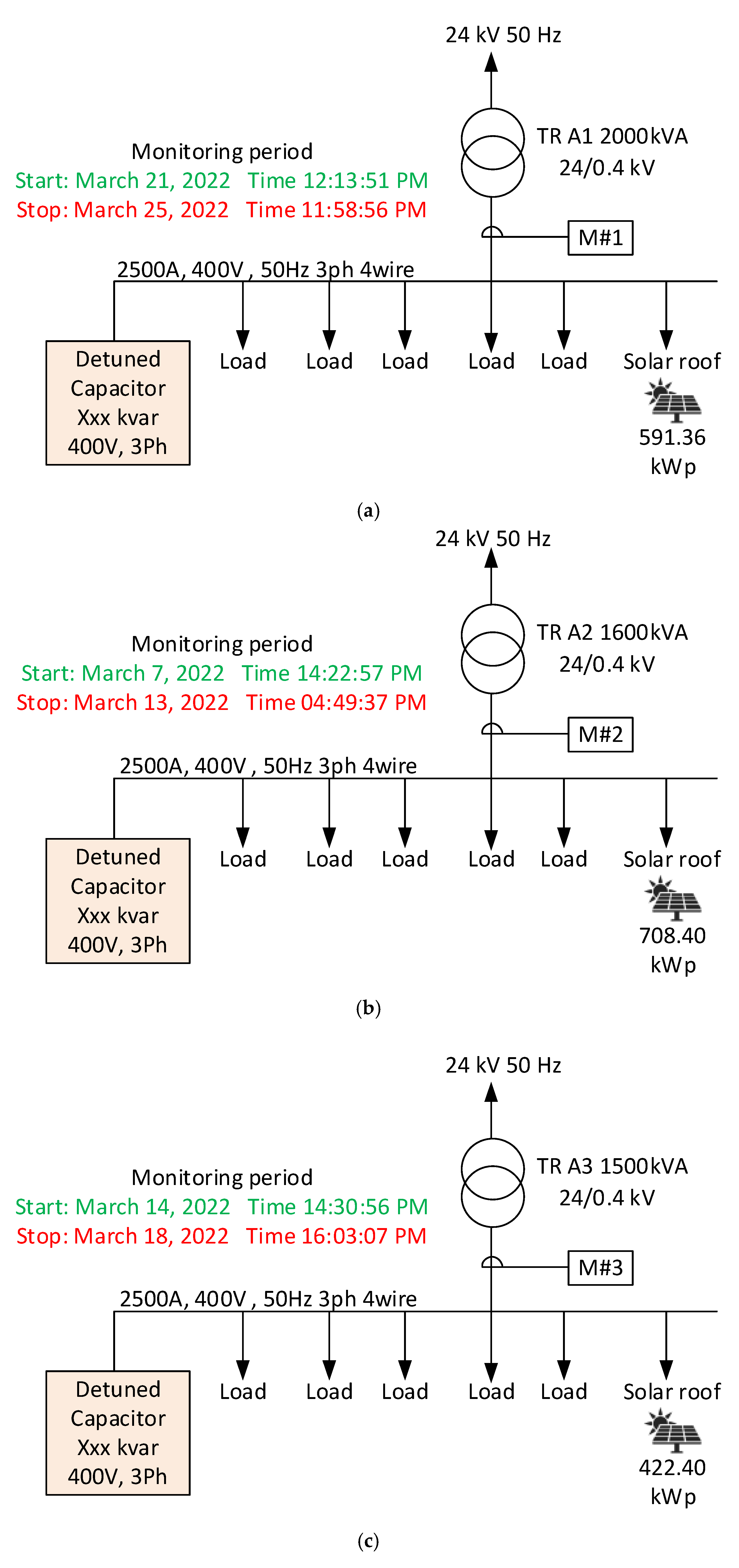
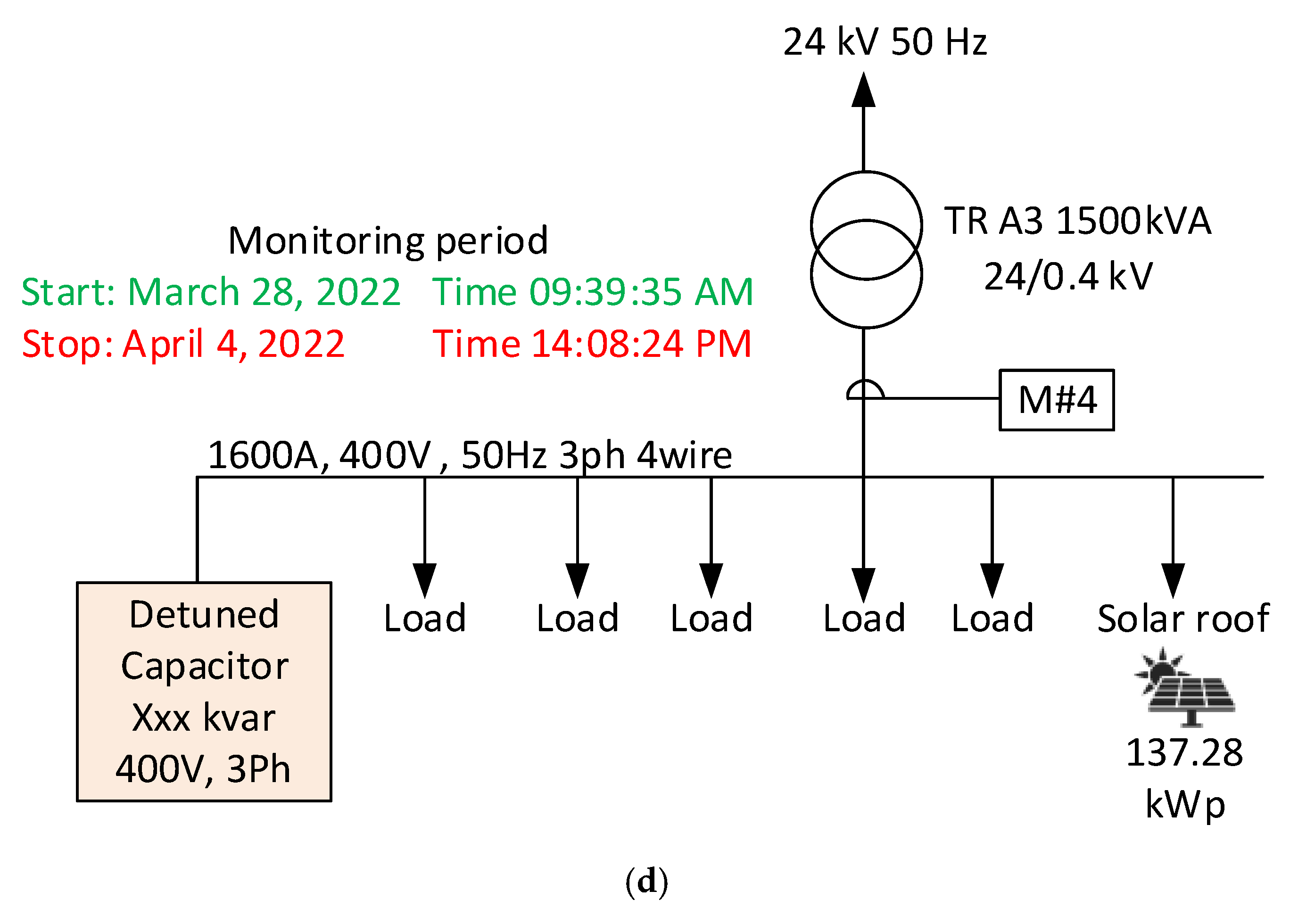
The solar PV rooftop system considered in this study was rated 591.36 kWp. The existing capacitor bank consisted of shunt capacitor banks of 850 kvar, 400 V, and 420 kvar, 400 V ratings with 6% detuned reactor. The measurements were conducted in the “On” state of the existing shunt capacitor banks. With the operating condition varying from MDB-1 to MDB-4, as illustrated in
Figure 4, the following data were collected:
- (1)
Power quantities and units;
- (2)
Odd-order harmonics;
- (3)
Harmonics of all orders.
3.1. Power Qualities
3.1.1. Variation in System from MDB-1 to MDB-4 with Existing Capacitor Bank
The electric parameter data are displayed in
Table 5. The parameters were measured under two conditions: the study system with and without the existing capacitor bank.
Under the condition of the existing capacitor bank, the case of measurement equipment was installed at MDB-1, and the transformer was 2000 kVA. The data can be recorded as follows: the phase apparent power in MDB-1 was approximately 530–567 kVA. In addition, the phase active power was approximately 445–490 kW, and the phase reactive power was approximately 285–299 kvar. The true PF was approximately 0.90 lagging. The maximum %THDv was approximately 2.268% at phase B, and the maximum total harmonic current distortion (%THDi) was approximately 8.835% at phase B. The displacement power factor (DPF) was higher than the true PF. This result indicates the occurrence of the harmonic current in the system. In addition, the voltage was increased by approximately 4% owing to the operation of the existing detuned capacitor bank.
Moreover, when the topology was changed to MDB-2 (the rating of the transformer was 1600 kVA), it was found that the phase apparent power was approximately 396–420 kVA. The phase active power was approximately 351–394 kW, whereas the phase reactive power was approximately 204–211 kvar. The true PF was approximately 0.90 lagging. The maximum values of %THDv and %THDi were approximately 2.527% and 16.50%, respectively, at phase A. The DPF was higher than the true PF, indicating a small harmonic current in the system. In addition, the voltage increased by approximately 3% owing to the operation of the existing detuned capacitor bank.
Similarly, in MDB-3 and MDB-4, even though the transformer ratings in both topologies were the same (1500 kVA), the phase apparent power differed, with the phase apparent power recorded in the case of MDB-3 being higher than the apparent power recorded in the case of MDB-4. Thus, this apparent power directly influences the active and reactive power. The PF recorded in the MDB-3 system (0.95 lagging) was lower than that in the MDB-4 system (0.99 lagging), which affected the maximum values of %THDv and %THDi. The data indicated the occurrence of a small harmonic current in the MDB-3 system, and the voltage increased by approximately 3% owing to the operation of the existing detuned capacitor bank. However, a harmonic current did not occur in the MDB-4 system. The voltage was increased by approximately 2% owing to the influence of the existing detuned capacitor bank, as in the previous condition.
3.1.2. Variation in System from MDB-1 to MDB-4 Without Existing Capacitor Bank
The behaviors of the power quantities without the existing capacitor bank were observed and analyzed based on the influence of the existing capacitor bank. The data from MBD-1 were used as the base data. The topology was varied from MBD-2 to MCB-4. The corresponding power quantity data are shown in
Table 5.
In the MDB-2 system, the three-phase apparent power was approximately 1012 kVA or 63% of the transformer rating of 1600 kVA. The three-phase active and reactive powers were approximately 916 kW and 620 kvar, respectively. The true PF was approximately 0.85 lagging. The PF was very low. The maximum values of %THDv and %THDi were approximately 4.543% and 22.72%, respectively, at phase A. The DPF was higher than the true PF, indicating the occurrence of a harmonic current in the system.
Further, the three-phase apparent power of the MDB-3 system was higher than that of the MDB-4 system even though the transformer rating was the same in both cases. The PFs of both systems were very low, specifically, 0.78 lagging and 0.85 lagging, respectively. The total harmonic distortions (THDs) of the voltage and current were also affected. The DPF was higher than the PF in the MDB-3 system. In contrast, no harmonic current occurred in the MDB-4 system. In addition, when comparing the data between the cases with and without the existing capacitor bank, we discovered two advantages of the system with the capacitor bank. First, it can increase the PF of the system. Second, it reduces the harmonic distortion.
To summarize the data in
Table 5, installing a capacitor bank in the system is helpful in improving the power quality of the system, which is determined by the voltage, current, power, PF, and harmonics. Installing a capacitor bank at any location in the system can reduce the system loss, thus improving the PF and increasing the output power while reducing the THD. This power quality improvement is attributed to the power triangle theory.
In conclusion, the values of power quality (P, Q, and S) and power factor depend on the load in each MDB, which is based on different production processes. However, MDB-1, MDB-2, and MDB-3 have a very high power consumption compared to MDB-4. Moreover, MDB-1 to MDB-3 are composed of nonlinear loads (variable speed drives). Although a rooftop solar is installed in all MDB cabinets, the impact of rooftop solar connection on power quality is very small when compared to the impact on power quality from VSD loads, which directly affects the harmonic current levels of both 400 V and 24 kV connected from the Metropolitan Electricity Authority. Therefore, solar cannot be connected because it does not meet the requirements of the Metropolitan Electricity Authority. On the other hand, when considering in terms of on/off existing shunt capacitor bank in each MDB, the C-bank can improve the power factor to more than 0.90 lagging; however, it was found that when the capacitor bank is detuned, the power factor decreased to below 0.90 lagging, and a harmonic current also expanded due to the detuned type of the capacitor bank. It could not support harmonic current in the system, resulting in a capacitor value change and leading to a resonance condition in the power system.
3.2. Odd-Order Harmonic
3.2.1. Variation from MDB-1 to MDB-4 with Existing Capacitor Bank
The installation of the capacitor bank improves the power quality, as explained above. Next, the issue of harmonics was considered. The data displayed in
Table 5 shows that the currents in the MDB-1, MDB-2, and MDB-3 systems were affected by the odd-number harmonics, which caused a high amplitude of the current. For example, the fifth-, seventh-, 11th-, and 13th-order currents were higher than those of the 3rd, 9th, 1seventh, and 19th orders. In contrast, the voltage was affected to a much lesser extent by the odd-order harmonic. Therefore, the THD of the voltage was lower than that of the current.
3.2.2. Variation in System from MDB-1 to MDB-4 with No Capacitor Bank
The influence of the odd-order harmonics in the system without the capacitor bank was investigated under the same study conditions. However, the removal of the capacitor bank caused the voltage in the MDB-1 system to fall below the threshold. Hence, only the systems from MDB-2 to MDB-4 were observed under the condition of no capacitor bank, and the data are displayed in
Table 5.
The table data show that the influence of the odd-order harmonic on the current was greater than that on the voltage. The fifth-, seventh-, and 11th-order harmonics were high whereas the 3rd-, 9th-, 13th-, 1seventh-, and 19th-order harmonics were low. Moreover, when compared with the data in
Table 5, the total voltage harmonic distortion (THDv) of the system without the capacitor bank showed greater fluctuation than the system with the capacitor bank installation. The %THDv of the system with the capacitor bank was approximately 2% whereas that of the system with no capacitor bank was approximately 2–5%.
In summary of the data displayed in
Table 5, switching the capacitor bank into the system causes the power factor to increase more than 0.90 lagging. However, the capacitor bank is designed as a detuned capacitor bank, so it not only increases the power factor but also reduces the harmonic current in the system.
On the one hand, the data in
Table 5 can be concluded as follows. The detuned capacitor bank at MDB-1 cannot be turned off because the system voltage at the MDB-1 cabinet is lower than normal. Thus, it may cause the protection device and the production process to stop working. Therefore, there was no harmonic value for MDB-1. However, when considering the MDB-2 to 4, it can be observed that when the c-bank is turned off, the power factor increases more than 0.90 and the harmonic current level in each MDB immediately increases, especially orders 5 and 7. To solve these issues, a reactor was applied, and the size was equal to 7% of the capacitance value, so a tuning point was 1/(sqrt(0.07) = 3.78 orders. When detuned, the size of the harmonic current order 5, 7 will decrease due to the system impedance at the 3.78 tuning point being the lowest. Then, the harmonic current orders 5 and 7 flow into the reactor. Conversely, when we turn off the detuned c-bank, the value of the harmonic current 5, 7 will immediately increase. Therefore, this system cannot turn off the capacitor bank because when off c-bank is off, it will cause harmonic of the system to be very high. It results in the voltage being lower than the usable voltage.
3.3. All Harmonic Orders
Normally, the power system encounters the problem of odd-order harmonics. However, in this study, all harmonics occurring in the power system were analyzed. The current standards require that all harmonic orders of voltage and current should be in line with the data displayed in
Table 3. Accordingly, all harmonics from the second to the 31st order were monitored, and the data are shown in
Table 6 and
Table 7.
In the data for MDB-1 displayed in
Table 6, the major harmonics are of the fifth and seventh orders. The harmonic voltage is lower than the limit specified in Recommendation G5/4. MDB-1 has numerous harmonics owing to the existing loads, especially the VSDs. The operation of the detuned capacitor bank can create a resonance effect in the system at the second and third orders. The existing detuned capacitor bank cannot be disconnected from the system to observe the results of the PF and individual harmonics owing to the risk of decreased power factor, leading to plant shutdown due to the undervoltage problem. The THD of voltage in the MDB-1 system was approximately 2.2%.
Similarly, the major harmonic orders in the MDB-2 system were the same as in the MDB-1 system (fifth and seventh). The operation of the detuned capacitor bank can create resonance effects of the second and third orders in the system.
The voltage harmonics of the MDB-3 and MDB-4 systems were considered next. Similar characteristics were observed: the harmonic voltage was lower than the limit specified in recommendation G5/4.
The %THDv value depends on the harmonic current occurring in the system. Therefore, voltage distortion affects the entire power system (including all other connected users). From the results in the table, we can observe that the %THDv magnitude in each MDB is similar and also less than 5.0%, which is in line with the specification. This shows that even though the magnitude of the harmonic current in each MDB is high, if the system impedance at each frequency is low, the harmonic voltage will eventually be low. Moreover, when considering each harmonic order, we find that the individual harmonic voltages at the fifth and seventh orders are higher than the others. This is due to the nonlinear load devices in the system, which are six-pulse VSDs. Therefore, when these devices operate, they will release harmonic currents of orders 5 and 7 to flow into the system, resulting in the harmonic voltage at orders 5 and 7 being higher than other orders.
However,
Table 7 shows that the harmonic currents of the fifth and seventh orders in the MDB-1 system were higher than the limit in recommendation G5/4. In addition, the harmonic currents of the fifth and seventh orders in the MDB-2 system were higher than the limit in the recommendation G5/4. A small harmonic current exists in MDB-2 owing to the existing loads, especially the VSDs. The operation of the detuned capacitor bank can create a resonance effect, and the harmonic currents of the fifth and seventh orders will decrease after the operation of the existing detuned capacitor bank.
In MDB-3, the harmonic currents of the fifth and seventh orders are higher than the limit in recommendation G5/4. A small harmonic current occurred owing to the existing loads, especially the VSDs. The operation of the existing detuned capacitor bank can decrease the fifth- and seventh-order harmonics, as in the MDB-2 system.
Simultaneously, the harmonic currents in MDB-3 and MDB-4 were examined. The harmonic currents of the fifth and seventh orders in the MDB-3 system were higher than the limit in G5/4. The detuned capacitor bank operation mitigated the resonance effect and harmonic current, as in the previous system.
In summary, the harmonic current flowing from MDB-4 will be the lowest because most of the MDB-4 loads are lighting and office equipment loads, causing harmonic currents, especially orders 5 and 7, to be less than those of other MDBs.
On the contrary, when considering MDB-1 to 3, most of them are VSD-type loads, so harmonic currents of orders 5 and 7 will occur. And if the harmonic current size of each MDB is very high, when flowing through the distribution transformer, it will cause the harmonic current value at 24 kV to be higher than the standard. However, the size of the harmonic current from the rooftop solar is very small when compared to the VSD-type load. Therefore, it is necessary to solve the problem of harmonics in the electrical system in order to be able to use the rooftop solar at a voltage level of 400 V in the electrical system that complies with the grid code requirements of MEA. In addition, when considering efficiency, it can be concluded that the application of APF at a voltage level of 400 V is more worthwhile than installing a Passive harmonic filter at a voltage level of 24 kV, both in terms of efficiency and investment budget.
Next, the emission mitigation effect was considered. The emission limits of voltage and current in the MDB-1 to MDB-4 systems were observed, and the results are displayed in
Table 8. The results showed that the voltage and current emission limits of orders 2 to 31 have the same value. Moreover, the THD of the voltage (THDv) in each case was approximately 5%. In conclusion, the various study systems were not affected by the limits.
4. PSCAD Simulation Results with Shunt APF Installation
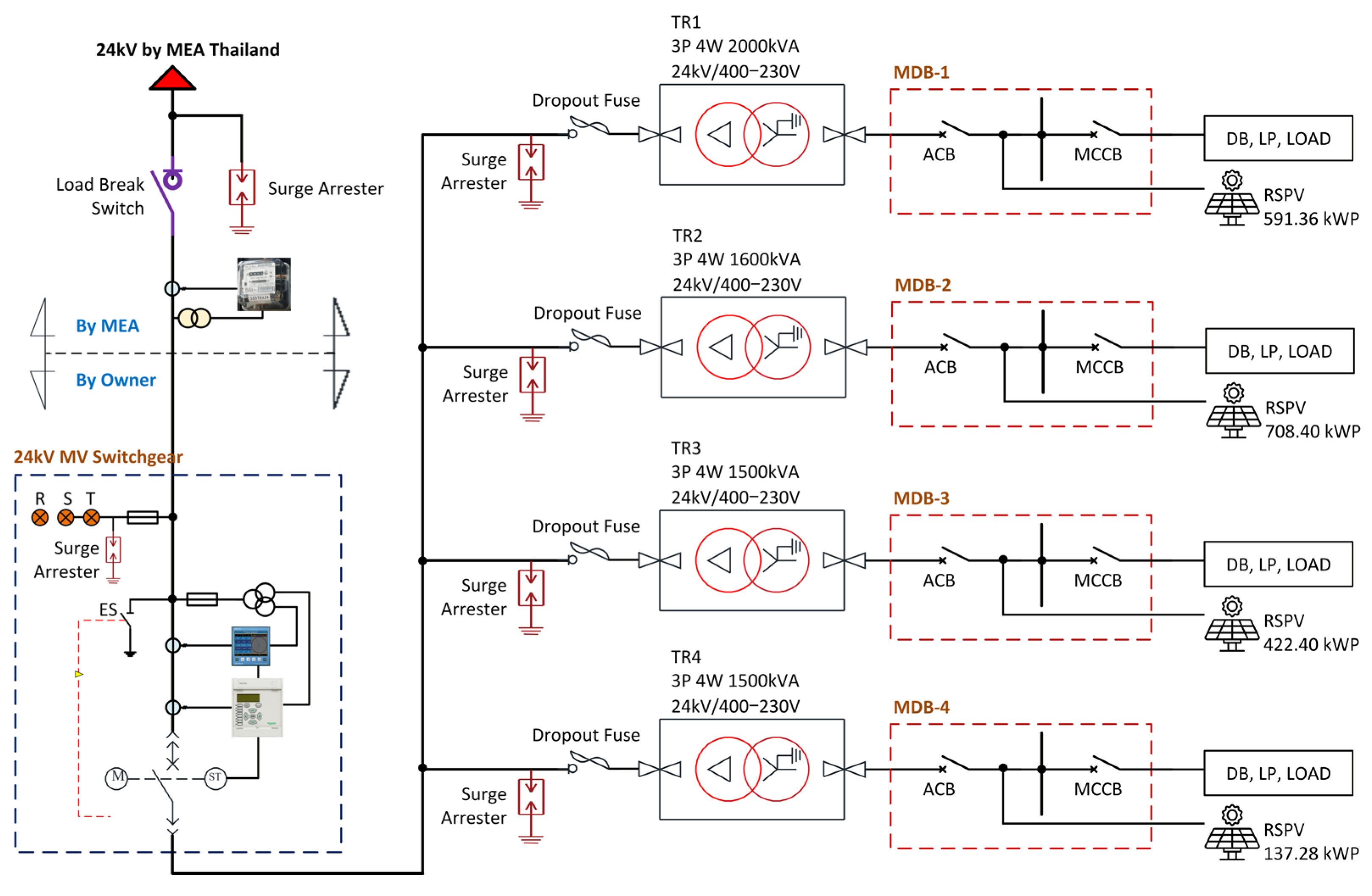
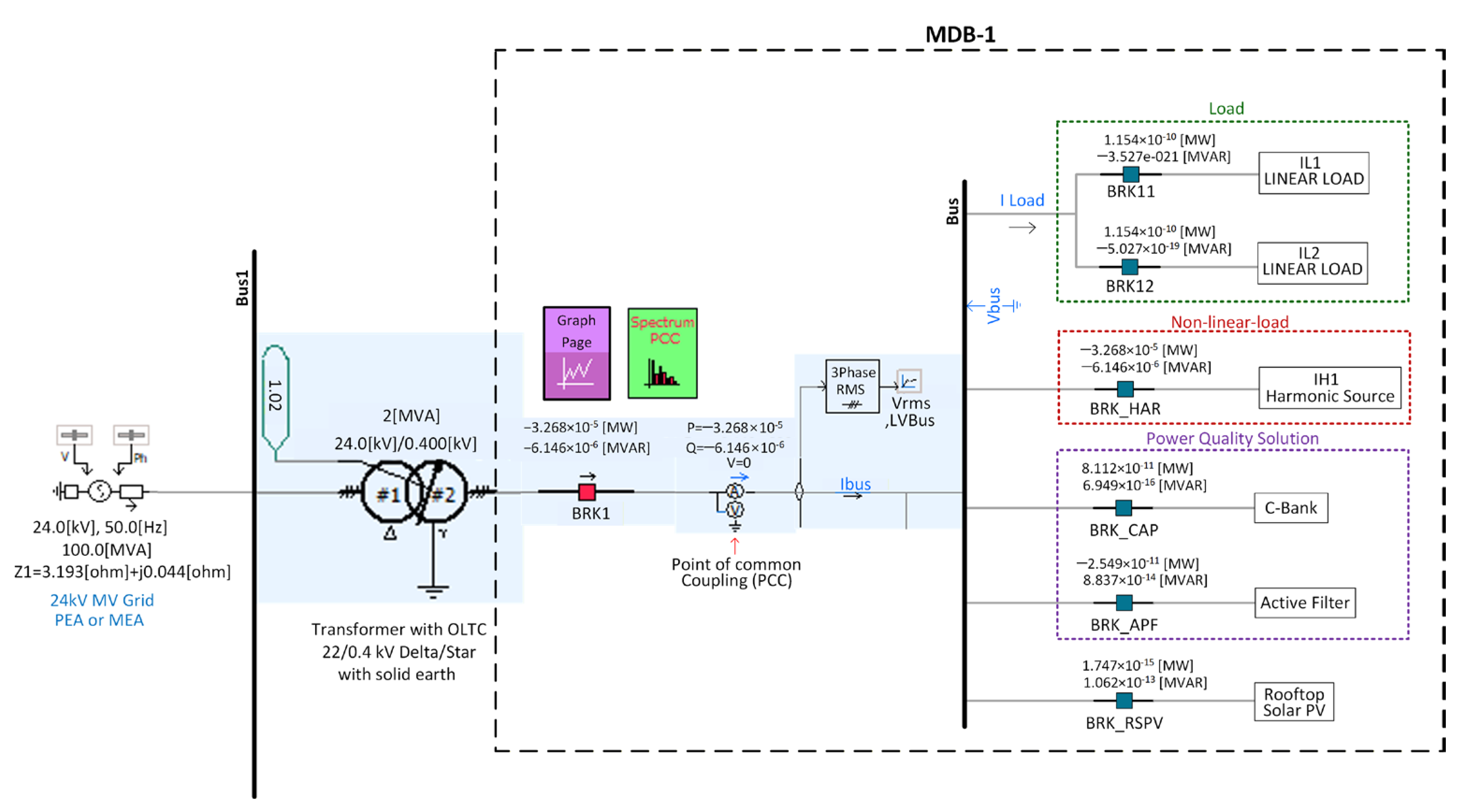
PSCAD/EMTDC in
Figure 5 was used to simulate the harmonic distortion created by the rooftop solar, six-pulse VSDs, and operation of the detuned capacitor bank. By operating the six-pulse VSDs simultaneously, we obtained the spectra of the fifth-, seventh-, 11th-, and 13th-order harmonics. The waveforms show a significant amount of harmonic current in the THD. In addition, the rooftop solar PV is an inverter that uses semiconductor devices to transform the DC power into a controlled AC power by using pulse width modulation (PWM) switching. However, all PWM methods inherently generate harmonics and noise in the high dv/dt and di/dt semiconductor switching transients. To reduce harmonic distortion, the APF was studied by connecting it in parallel with the distribution system and using it as a controlled current source to compensate for the harmonics in the supply current.
The VSD can be created by using the harmonic current source in PSCAD. The existing loads, including the VSDs, can be established by using the lump-load block diagram in the software. This component models the load characteristics as a function of the voltage magnitude and frequency, where the real and reactive powers of the load are considered separately using the well-known expressions in PSCAD. The data input for all loads is created by referring to the power quality measurement data. However, the harmonic amplification factor (HAF) should be considered in the power quality measurement data for each MDB, especially the existing VSD loads. In practice, the engineering design must consider the HAF when evaluating the size of the APF. The HAF is the ratio between the designed and measured THDi when operating under non-ideal network conditions. Hence, in this case, the HAF is 1.5. However, when the load is operating on an almost perfect network with %THDi at 40%, the HAF will be lower (approximately 1.2). When sizing a filter for a given harmonic component, we use the following formula:
where
h = harmonic number,
Ifilter,h = harmonic filter current requirement at the order h,
Imeasured = harmonic load current at the order h, which can be obtained from simulation or power quality measurement data,
Itarget = harmonic target at the order h.
Different HAFs can be applied depending on the conditions. When targeting a standard such as Engineering Recommendation ER G5/4, moderate HAF values can generally be used when a significant amount of harmonics is allowed to flow into the network in the case of the main harmonic components [
39]. In practice, we suggest 1.5 for VFDs, 1.1 for DC drives, and 1.3 for office building loads [
40,
41]. The existing shunt capacitor banks, both conventional and detuned, were incorporated through basic electrical calculations and modeling in [
42]. The RSPV system was implemented using the PSCAD model [
34]. By installing suitable APF equipment in parallel with the loads, the network quality can be restored for the frequencies that are filtered. When the nominal THDi between the filter and load is restored, the load operates at its designed rating. At the same time, the THDi upstream of the APF connection point is reduced to the level required by the power user or MEA regulations. The APF then functions as a correcting device, ensuring that the load is running at its nominal THDi while making it compatible with MEA utility requirements on the supply side. When the APFs harmonic pollution, the network characteristics are improved so that the load would behave more closely to its ideal design behavior.
4.1. Simulation Results When an Active Filter Is Installed in the Study System
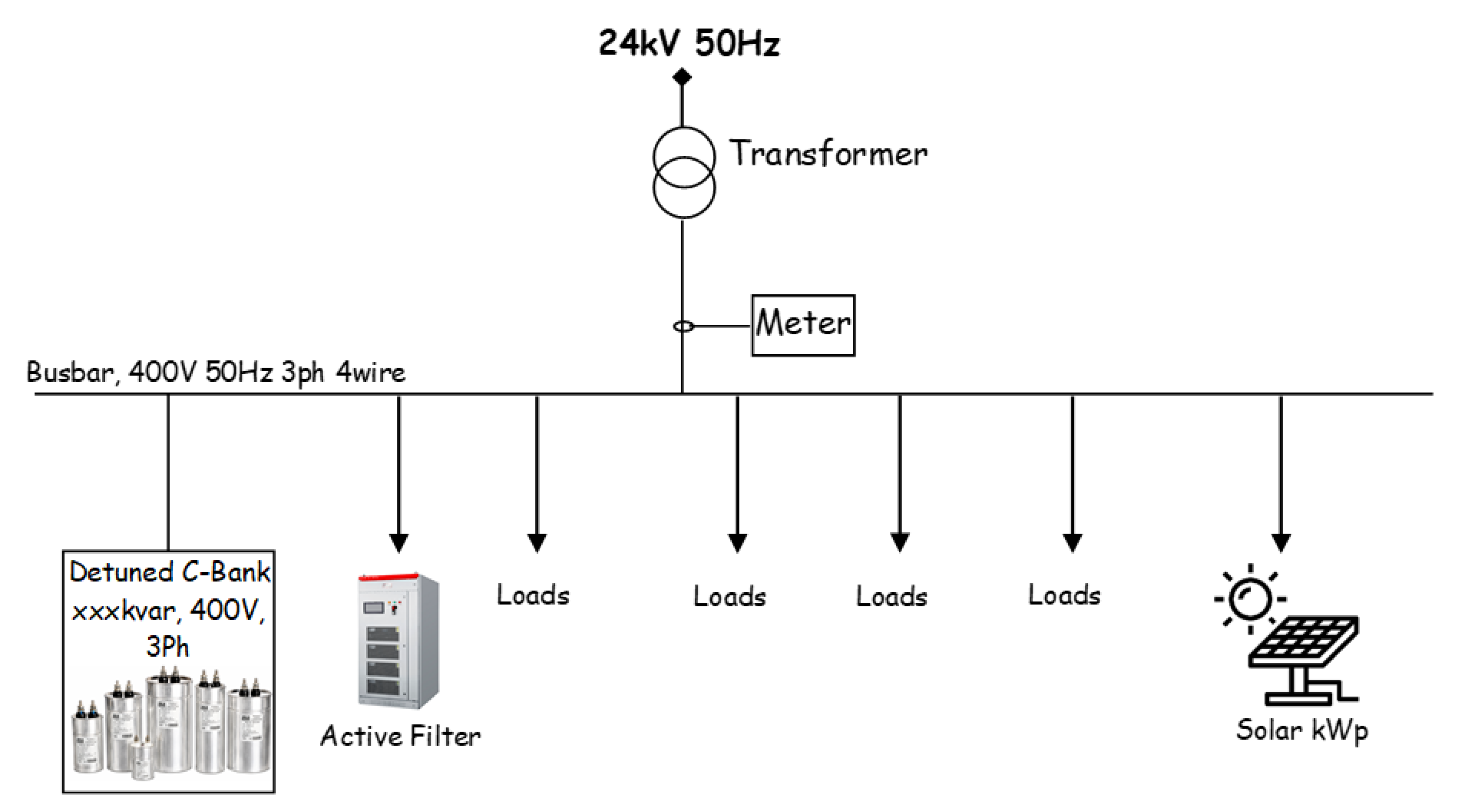
Four topologies, MDB-1 to MDB-4, were set as the study systems. However, owing to the drawback explained in the previous section, an active filter (AHF) was installed in the system, as shown in
Figure 6. The details of the active filter installed in each system are given below:
A 250 Arms active filter was installed in the MDB-1 system shown in
Figure 4a.
A 250 Arms active filter was installed in the MDB-2 system shown in
Figure 4b.
A 200 Arms active filter was installed in the MDB-3 system shown in
Figure 4c.
A 100 Arms active filter was installed in the MDB-4 system shown in
Figure 4d.
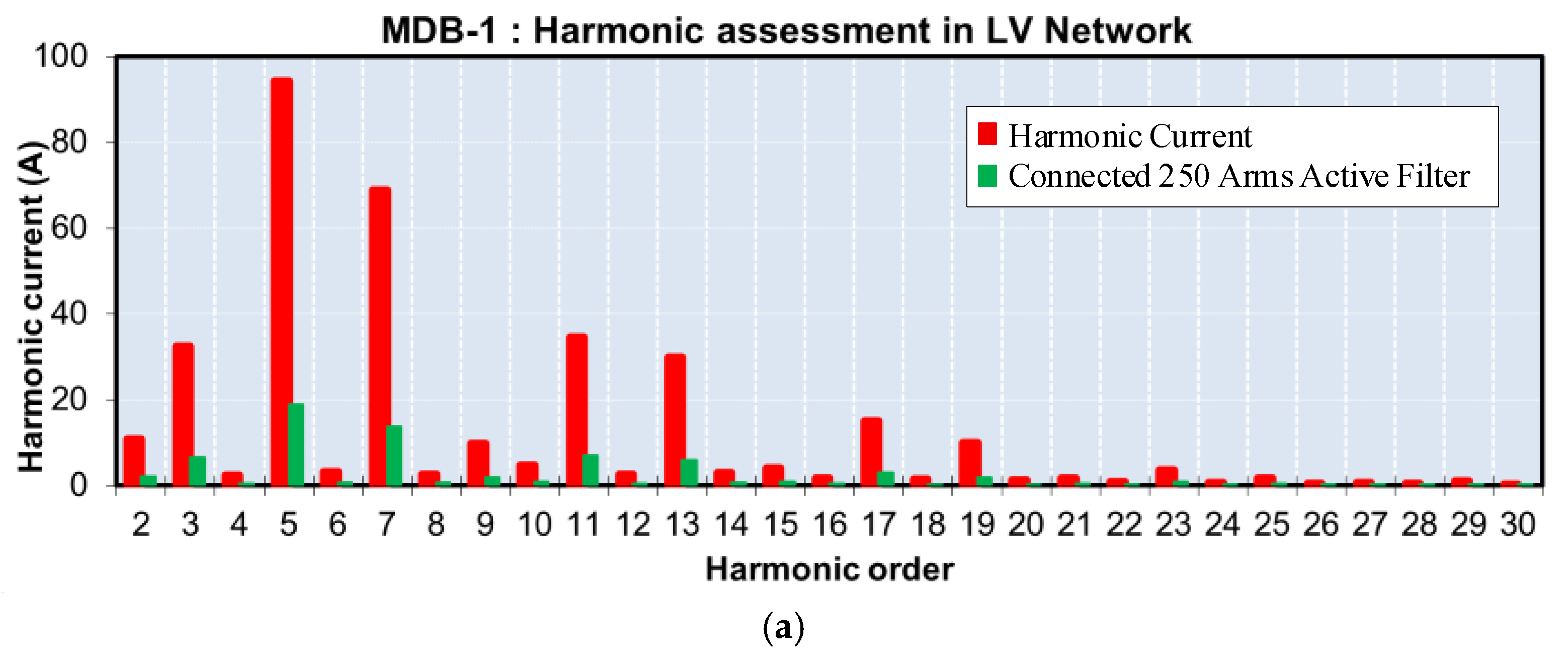
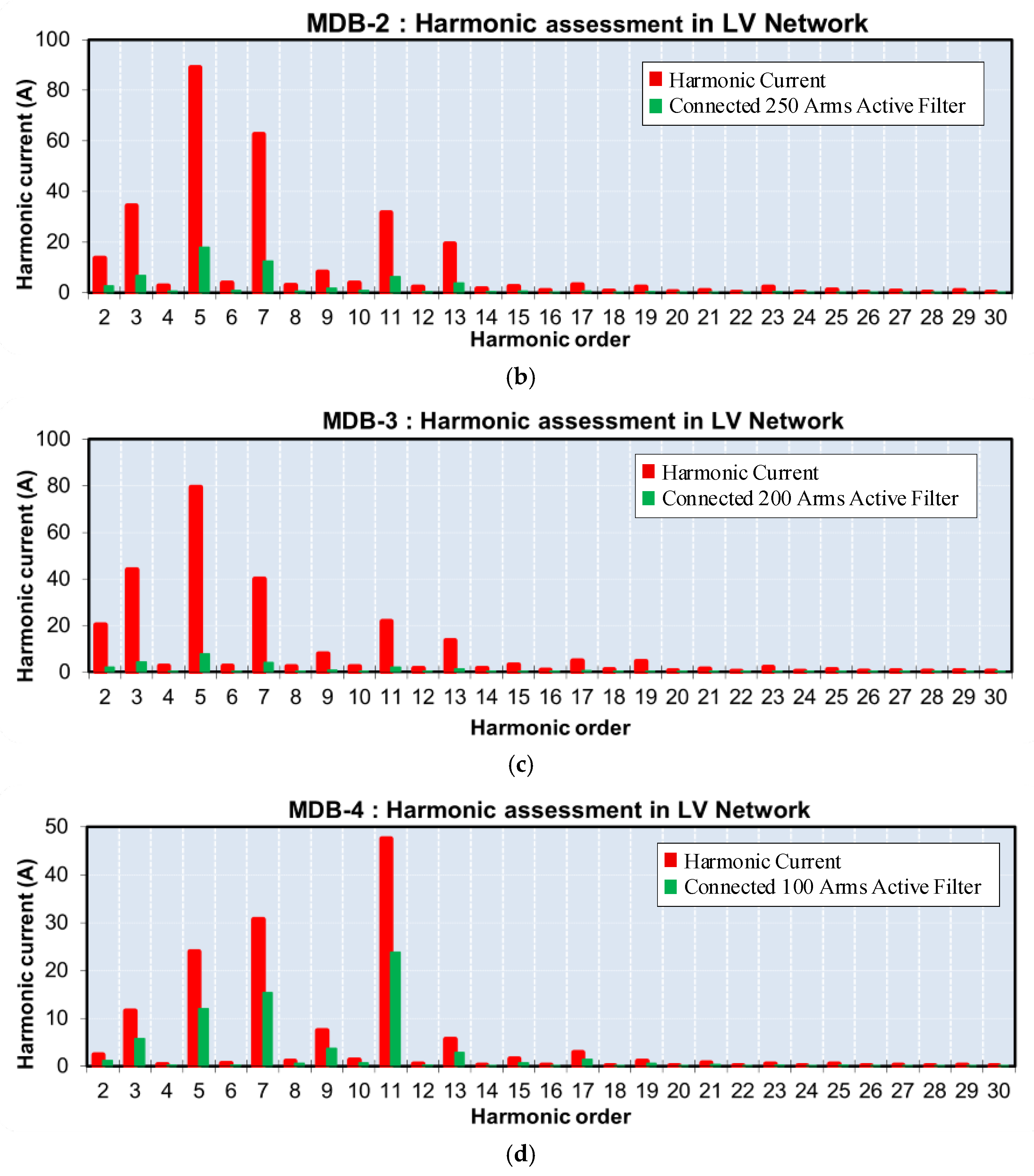
The results of installing the active filter are shown in
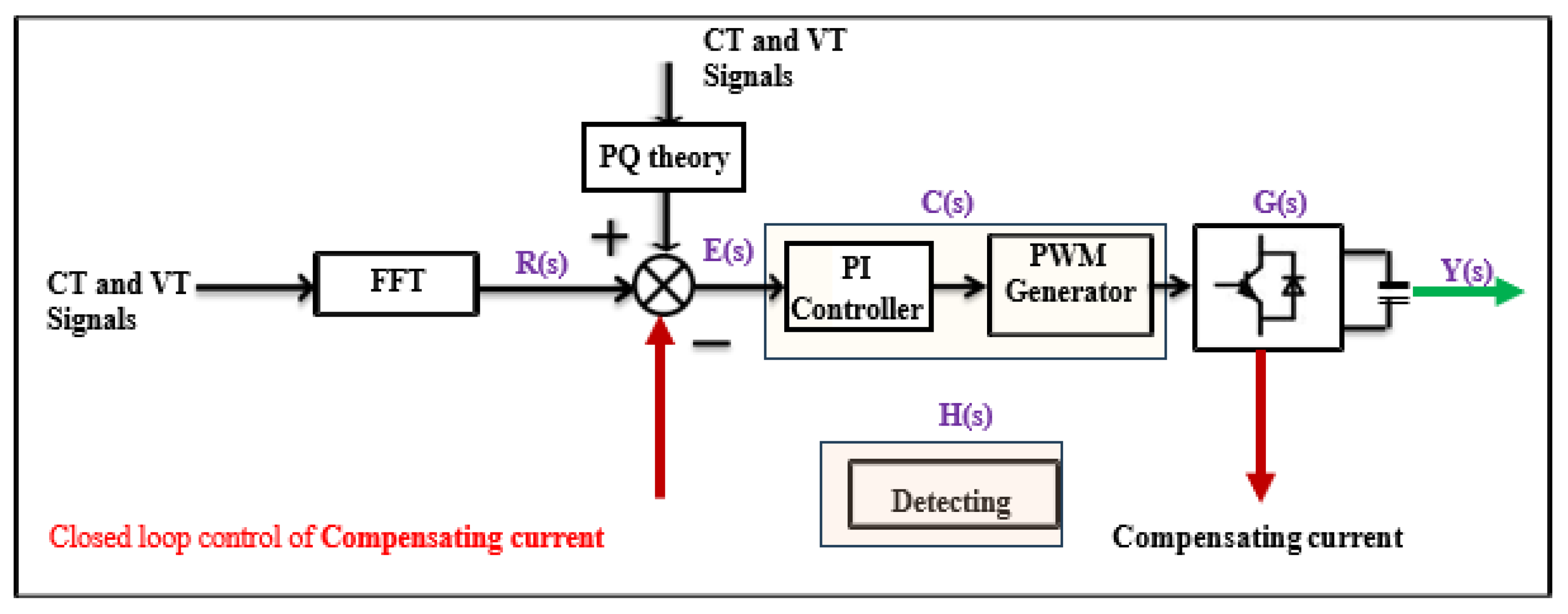
Figure 7. Moreover, the performances of the traditional MDB-x system and the system applied with the active filter were compared. The APF (active filter) was connected in parallel in the 400 V system in MDB-1 to MDB-4. The APF does not measure the harmonic current and actively generates a harmonic current spectrum in the opposite phase to that of the distorting harmonic current that was measured. The original harmonics were consequently canceled.
In
Figure 7a, the major harmonic orders—fifth, seventh, and 11th—were reduced to values lower than those specified in the Engineering recommendation G5/4 standard. The harmonic current signals can be eliminated by using the electronic devices, as described in
Section 2.3. The APFs play a crucial role in identifying the harmonic current signals at the MDB-01 power feeder, allowing for the discrimination of harmonic currents at different frequencies and compensation for the elimination of the opposing harmonic current that enters the system at the same frequency. The APF is installed parallel to the system and to the distribution at the point-of-common coupling (PCC) to reduce nonlinear loads. The 250 Arms APF can identify harmonic currents and equalize those currents by injecting a compensating current. Therefore, the current flow is nearly sinusoidal at 50 Hz power frequency after the APF operation. Similarly, in
Figure 7b, the harmonics of the MDB-2 system have the same characteristics as those in the MDB-1 system owing to the effects of the electronic devices.
In
Figure 7c,d, the characteristics of the harmonic current remain the same even when the topology of the study system and use of the active filter are varied. The harmonic current is eliminated by using electronic devices. The APFs can discriminate the harmonic currents at different frequencies and compensate for the opposing harmonic currents. In addition, the APF is installed in parallel to the system and to the distribution at the PCC to reduce the nonlinear loads.
4.2. Simulation Results with Combined Active Filters in the Study System
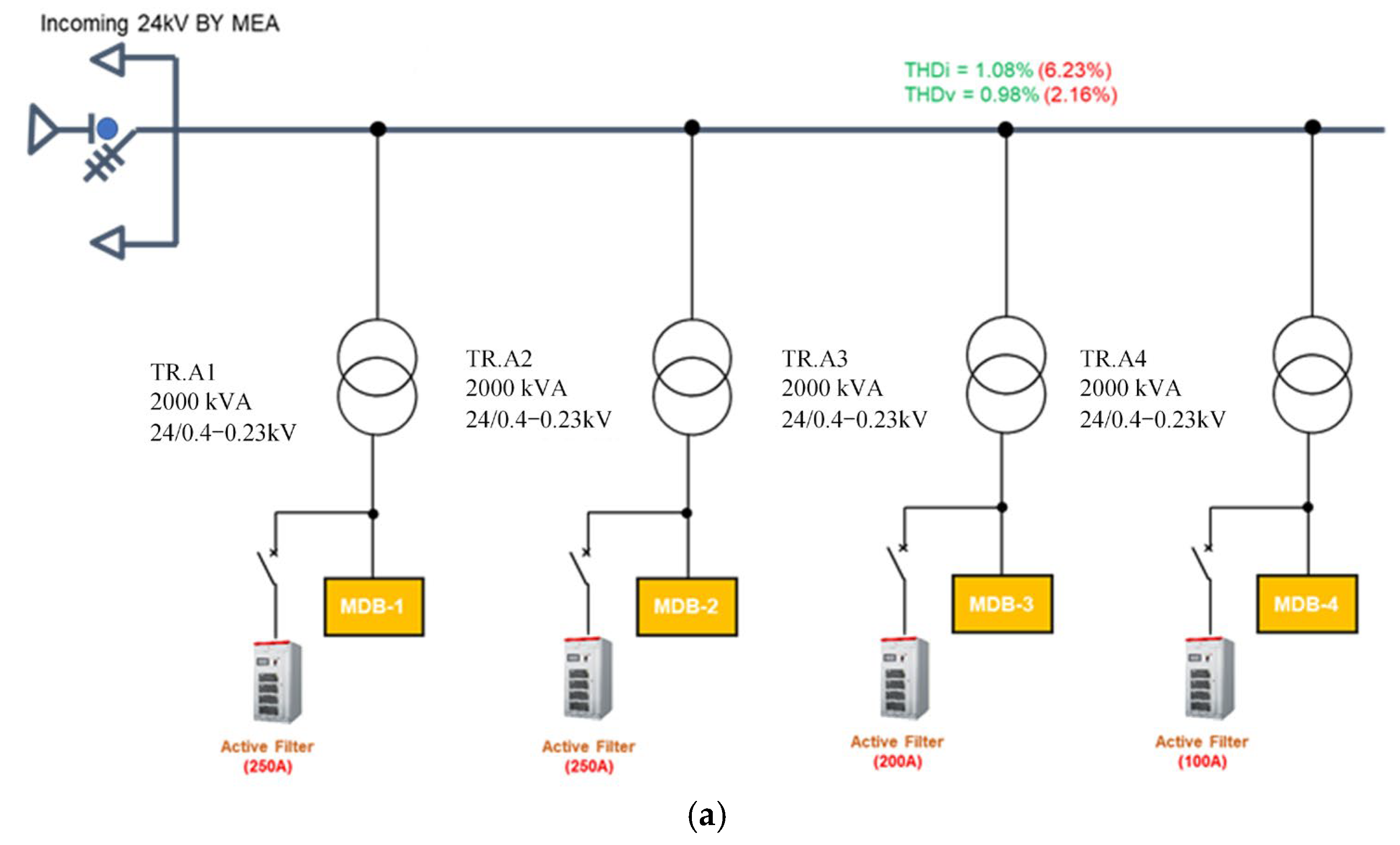
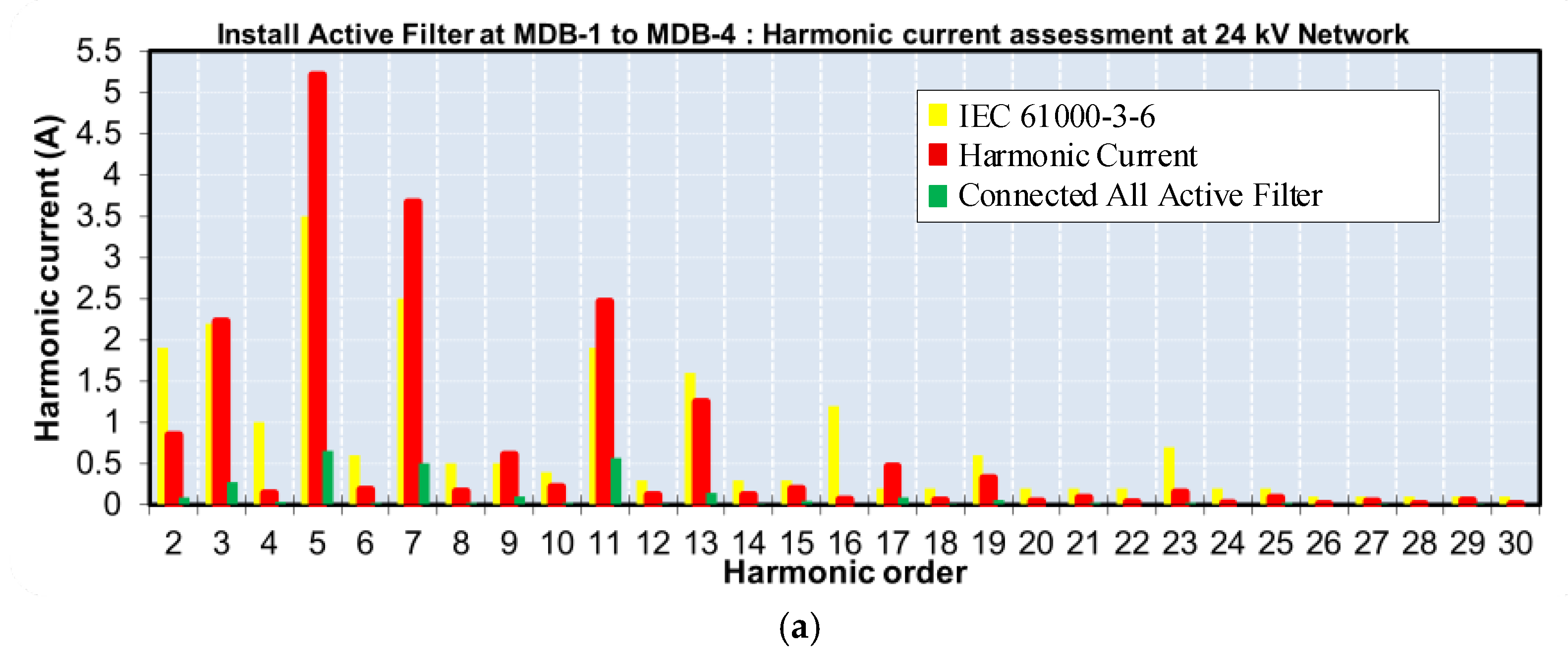
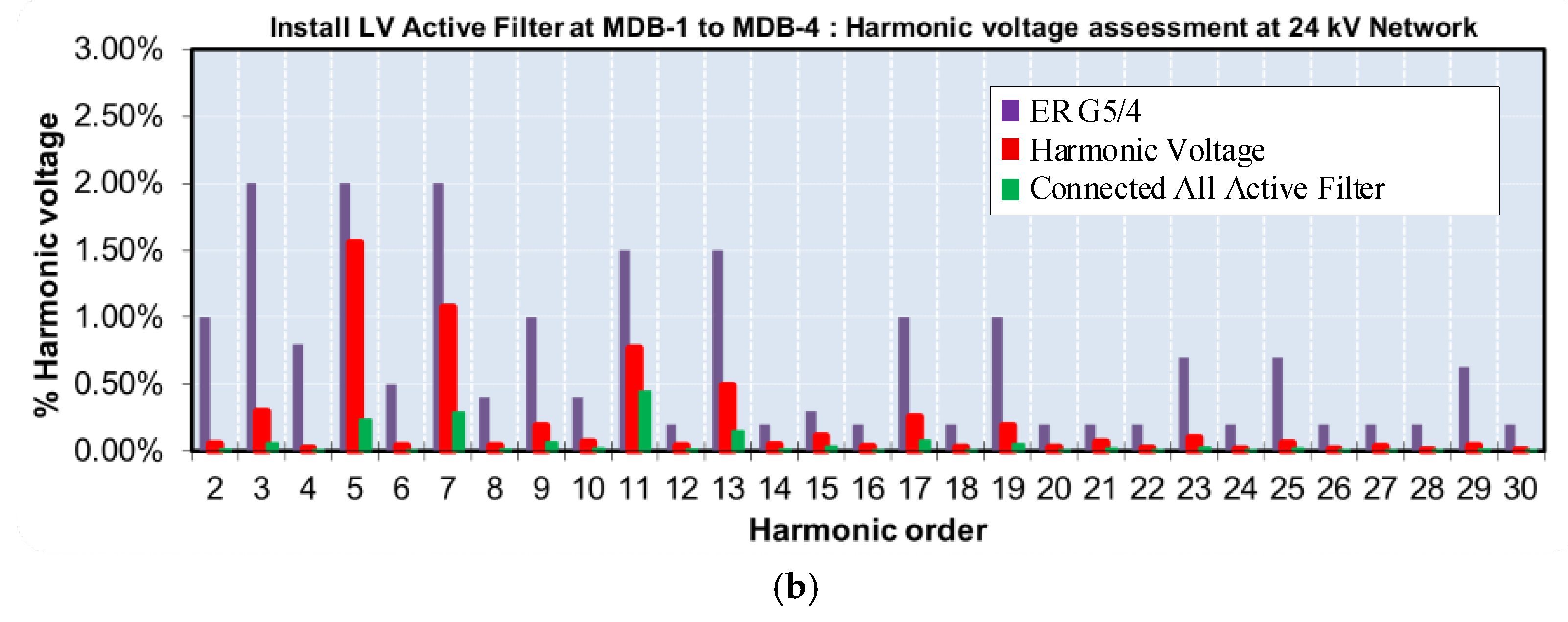
After observing the effects of APF installation at different locations, it was found that installing APFs at all locations from MDB-1 to MDB-4 helps reduce harmonics. Therefore, two conditions are discussed in this section. The first condition involves connecting APFs at all MDB panels, as shown in
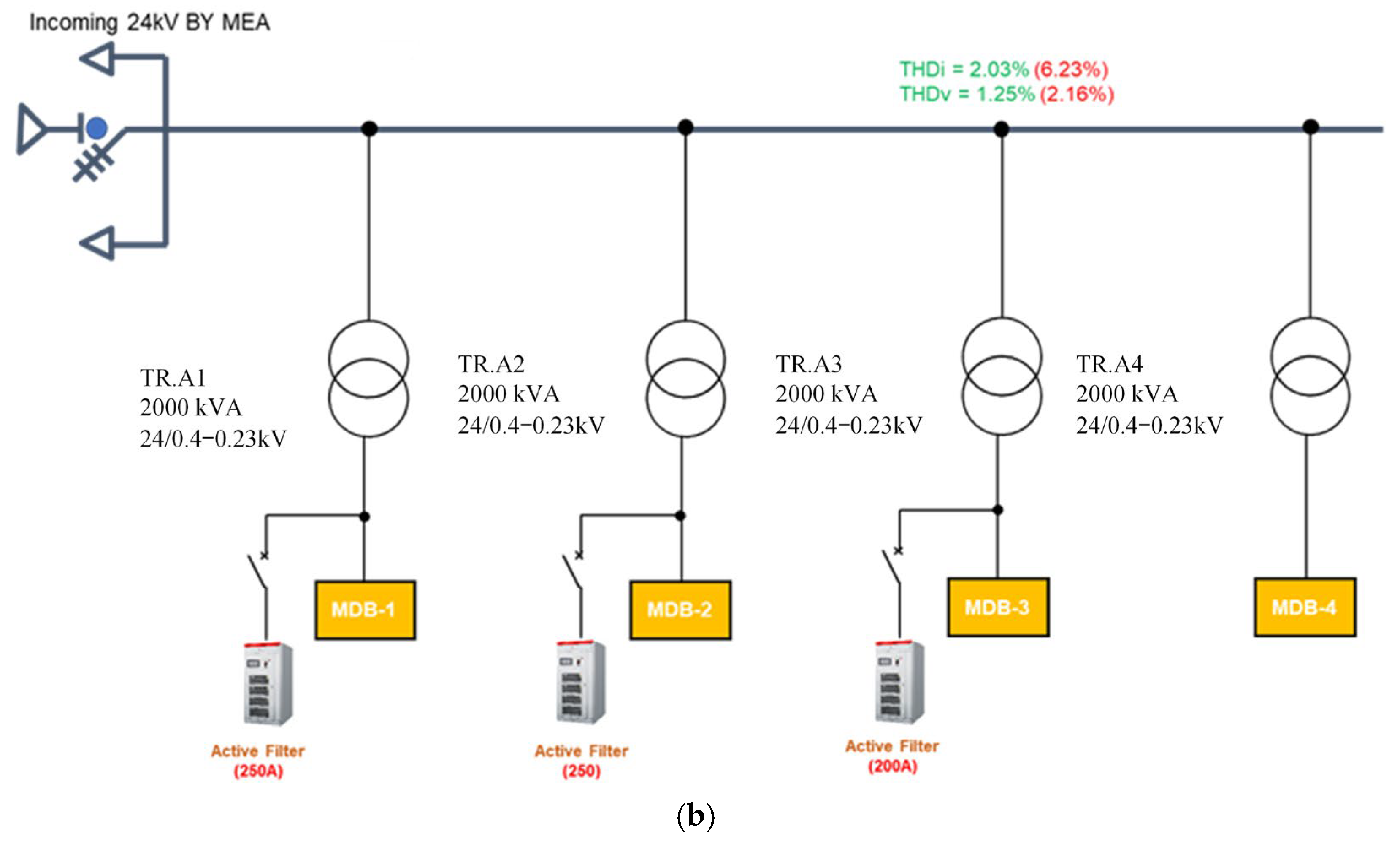
Figure 8a. The second condition involves connecting APFs only at MDB-1 to MDB-3, as shown in
Figure 8b. In the second case, no filter was installed at MDB-4 because, as shown in
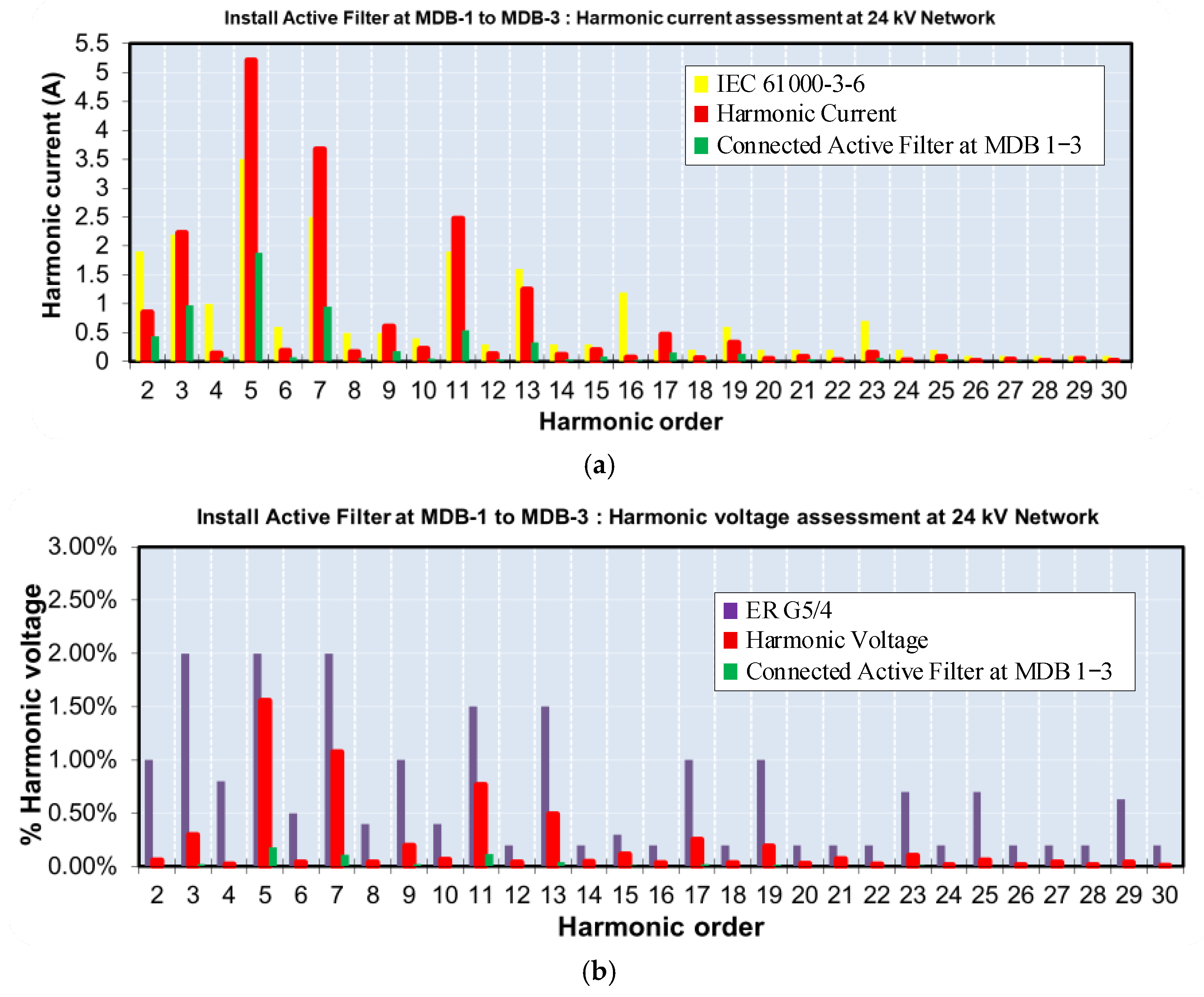
Figure 7, installing an APF at MDB-4 does not reduce harmonics as effectively as installing APFs at MDB-1 to MDB-3. Therefore, considering both harmonic reduction efficiency and investment cost, only the installation of APFs at MDB-1 to MDB-3 was investigated in this study. The result of the individual harmonic current spectrum after installation of the APF is displayed in
Figure 9 and
Figure 10.
First, all APFs were installed in parallel in the 400 V system. The MDB-1 and MDB-2 systems were connected with 250 A APFs, whereas the MDB-3 and MDB-4 systems were connected with 200 A and 100 A APFs, respectively. Thus, a total of 800 Arms APFs were connected in the system in the first condition.
In the arrangement displayed in
Figure 8a, the %THDv could be reduced from 2.16% to 1.0%, and the %THDi could be reduced from 6.23% to 1.04%. However, the %THDi was not examined because it might become high if the load has low power consumption. The individual harmonic current order satisfied the MEA regulation. The total harmonic voltage distortions at 24 kV were acceptable as per the MEA regulation.
The major orders of the harmonic current and voltage in
Figure 9 were fifth, seventh, and 11th in the 24 kV systems, which were reduced to a value lower than that in the Engineering recommendation IEC 61000-3-6 standard [
5]. The APFs play a crucial role in identifying the harmonic current signals at all MDB power feeders. The APF at 400 V was installed in parallel to the system and to the distribution at the PCC to reduce the nonlinear loads. The proposed inclusion of the 800 Arms APF can enable the identification of the harmonic current and equalization of those currents by injecting a compensating current. In addition, the individual harmonic voltage is lower than that specified in the Engineering Recommendation G5/4 standard. The %THDi was reduced from 6.23% to 1.08%. Moreover, the %THDv was reduced from 2.16% to 0.98%.
Second, the APF was connected to the system as in the first situation. However, the total APF capacity installed in parallel in the system was only 700 Arms. The APFs were connected only in MDB-1 to MDB-3. The simulation results of the system displayed in
Figure 8b show that the %THDv can be reduced from 4.65% to 1.0%. In addition, the %THDi is reduced from 7.94% to 1.04%. However, we did not focus on the %THDi because the value may become high under low power consumption. The total harmonic voltage distortions at 24 kV are acceptable as per the MEA regulation.
Figure 10 shows that the major harmonic orders of the harmonic current and voltage were lower than the Engineering recommendation IEC 61000-3-6 standard, as in the previous system. The APFs reduced the nonlinear loads. The proposed inclusion of the 700 Arms APF enables the identification of harmonic currents and equalizing of those currents by injecting a compensating current. In addition, the individual harmonic voltage is lower than the Engineering Recommendation G5/4 standard. The %THDi was reduced from 6.23% to 2.03%, and the %THDv was reduced from 2.16% to 1.25%.
In conclusion, the simulation results verified that installing both 800 Arms and 700 Arms APFs can mitigate the harmonic pollution. In addition, the 700 Arms APF is preferred over the 800 Arms APF owing to optimization considerations. Both simulation setups were applied to a real-world system. The performance results are described in the next section.
5. Performance of APF Application to a Real System
The simulation results in the previous section showed that the APF can reduce the harmonic orders. However, this needs to be practically verified.
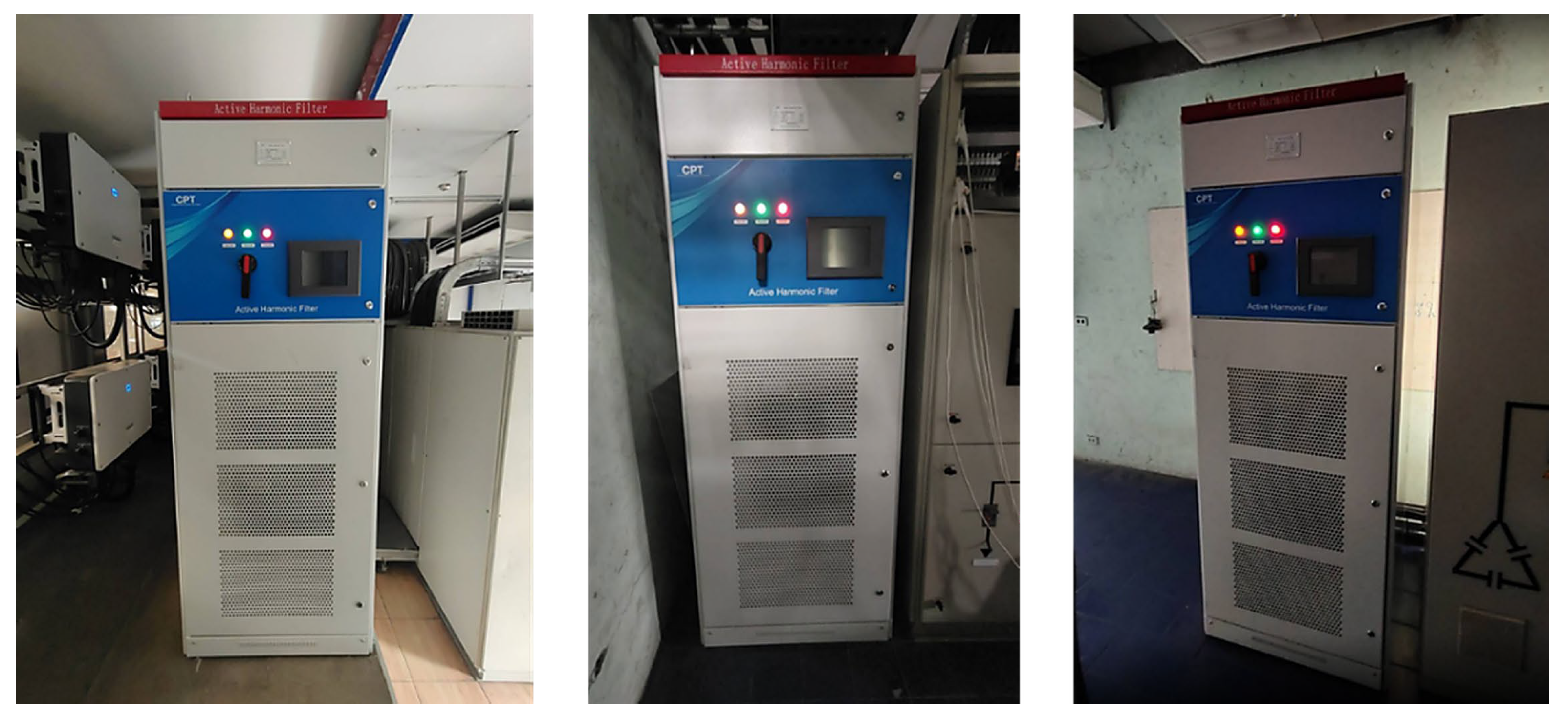
To verify whether the harmonic results of the 24 kV system meet the MEA regulation, three APF units were installed at various locations to mitigate the harmonic pollution, as displayed in
Figure 11. The experimental system was established based on the prototype in
Figure 8b. The experimental system was based on the concept that the 3 LV APFs always operate when the factory is normally operating and connected to the LV solar rooftop. The major orders of the harmonic current and voltage, that is, two to 31, were observed, and the results are displayed in
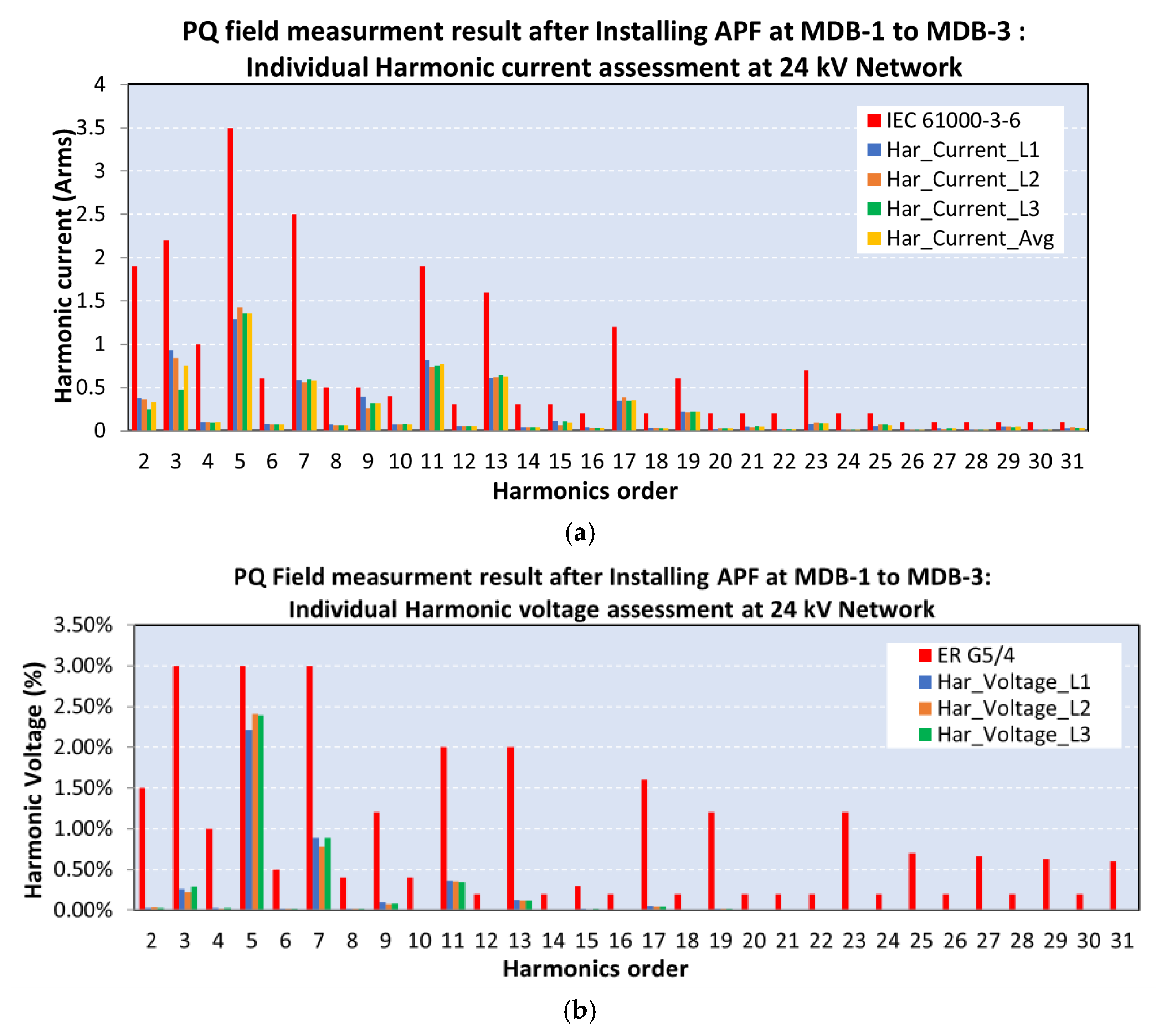
Figure 12.
The spectrum graph in
Figure 12 shows that when the APF was applied to the experimental system, the harmonic current at each order was lower than the threshold harmonic limit specified in the IEC 61000-3-6 standard. However, all harmonic spectra of the voltage satisfied the IEC 61000-3-6 standard. Moreover, the results of the harmonics recorded in the practical applications were compared with those observed in the simulation. The results of both the practical application and simulation concurred, thus validating the proposed approach of applying the APF to address the issue of harmonics.
In addition, the simulation results in
Figure 10 were compared with the experimental results in
Figure 12 to confirm the effectiveness of the proposed approach. Both cases considered the installation of 700 Arms of APFs in MDB-1 to MDB-3, and the condition that the harmonic value must not exceed the IEC 61000 3-6 standard.
First, regarding the harmonic current, the harmonic current limitations based on the IEC 6100 3-6 standard are displayed as red bar graphs in
Figure 10a and
Figure 12a. The simulation results displayed in
Figure 10a show that the odd harmonic currents of the orders 3, 5, 7, 9, 11, 13, and 17 were higher than the corresponding harmonic current limitation in the IEC standard. Therefore, 700 Arms APFs were installed in the system. The subsequent simulation results show that all the odd harmonic currents are below the IEC limitation. The experimental results in
Figure 12a concur with the simulation results that the installation of the APFs reduces not only the odd harmonic current but all orders of harmonic currents.
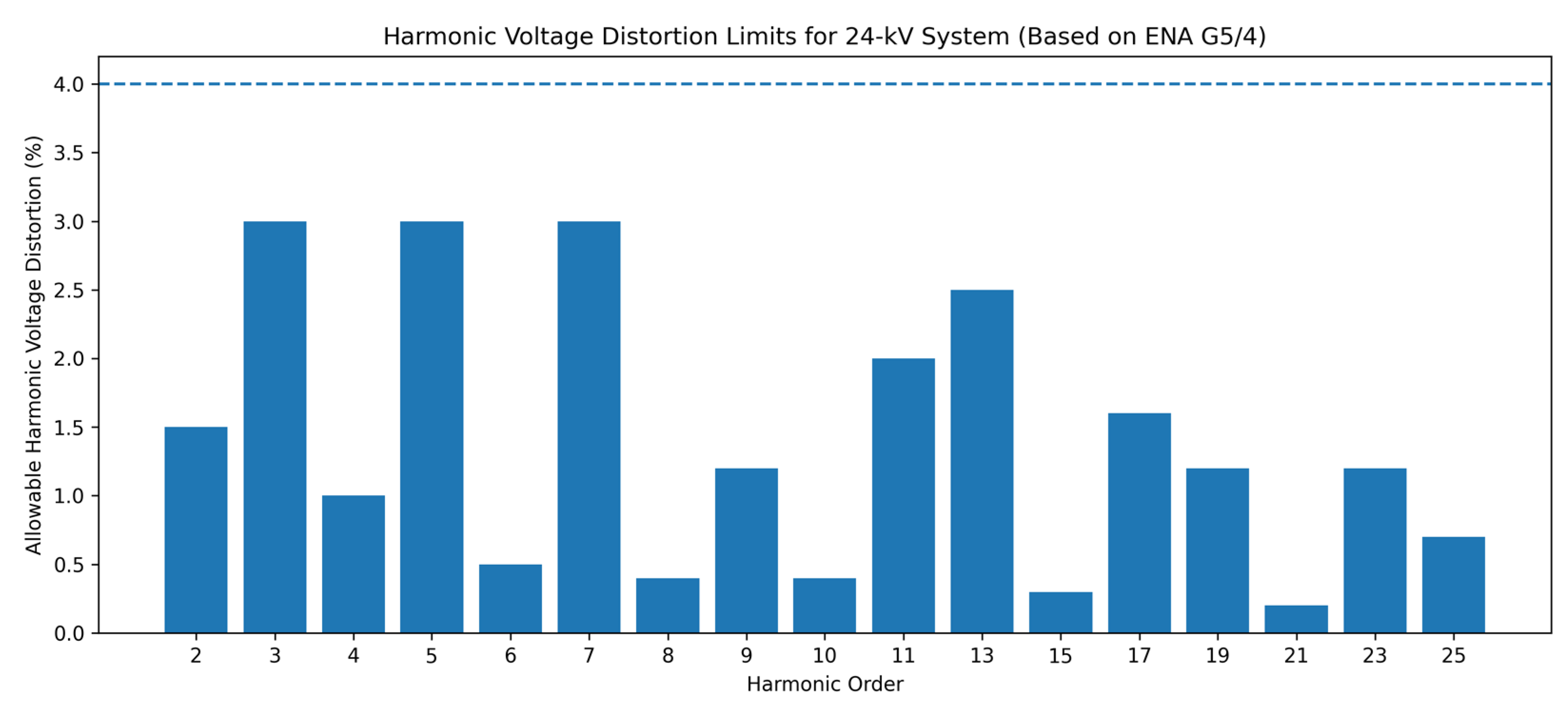
Next, we considered the harmonic voltage, which is required to be limited to the value specified in the ER G5/4 standard. The harmonic voltage limitations based on the ER G5/4 standard are displayed as red bar graphs in
Figure 10b and
Figure 12b. The simulation results show that the value of the fifth harmonic before the installation of the APFs is close to the standard value. However, after the installation, the value of the third harmonic, which is problematic, can be greatly reduced. The installation of APFs can reduce the harmonic value in the electrical system at every level. By comparing the harmonic value from the simulation with the harmonic value measured in the actual experiment, it was found that after the APFs were installed, the harmonic value measured in the actual experiment was lower than the simulation value. This is beneficial to the electrical system because the harmonic value creates stress on the electrical system and may damage the equipment. It may also disrupt the normal operation of the equipment and increase the operating cost.
The financial aspects of the presented system were comprehensively considered in this study. The costs of the system installed with 700 and 800 Arms APFs are shown in
Table 9. The total cost of the 700 Arms APF was clearly lower than that of the 800 Arms APF, that is, 110,000 USD and 128,800 USD, respectively. The price difference was attributed to the difference in the costs of the cable and APF, installation and testing costs, and operation and maintenance costs. Therefore, selecting an APF of suitable capacity not only solves the problem of harmonics but also reduces the investment costs.
6. Discussion
To ensure good performance of the grid-connected rooftop solar PV, the effects of installing the PV in the grid and an effective approach to decrease the problem caused by the integration of the PV with the grid and its components were analyzed. The PV inverter was designed to inject power into the grid.
In this study, the power quality results of the 24 kV system after the installation of the APFs in MDB-1, MDB-2, and MDB-3 met the MEA regulations. The voltage and current waveforms were distorted owing to the daily rooftop solar PV operation and load application (existing VSDs and capacitor bank). This resulted in high harmonic distortion in the 24 kV MEA grid. APF offers excellent filtering efficiency and the best accuracy for harmonic mitigation. It effectively controls the number of harmonic currents to be filtered to meet various standards and regulations related to the total THD and individual harmonic limits (e.g., G5/4 and IEC 6100-3-6).
According to the simulation results, when the PV inverter and all existing loads, especially the VSDs, are fully operational, the THD of the harmonic current is reduced from 6.23% to 2.03%. Furthermore, when three APFs are applied, the THD of the harmonic voltage is reduced to less than 2.0%. This means that the installation of the APFs allows PV rooftops of capacity lower than 100 kW to be installed at each location and connected to the system to deliver power to the MEA grid.
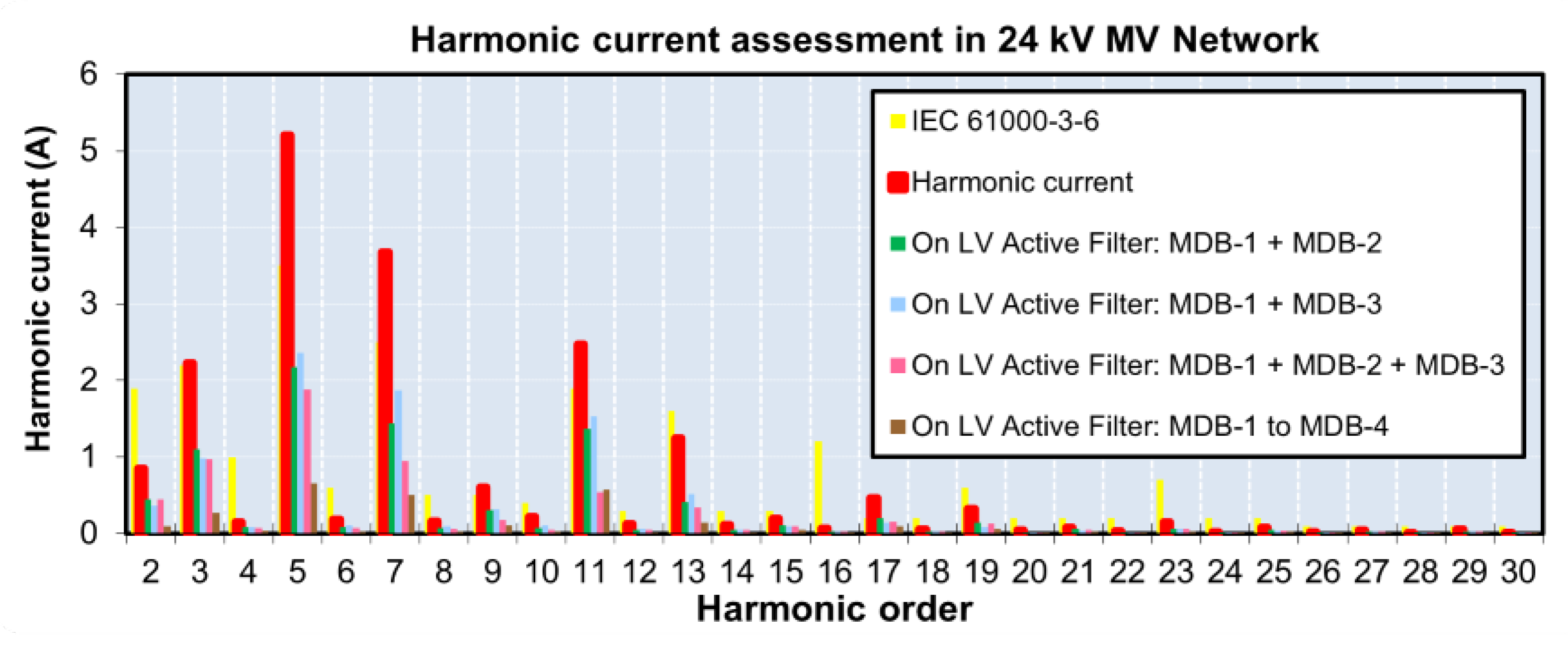
In addition, the performance of other systems comprising (1) APFs installed in MDB-1 and MDB-2, (2) APFs installed in MDB-1 and MDB-3, and (3) APFs installed in MDB-1 and MDB-4 were observed, and the results are shown in
Figure 13. The results show that the APF installations in MDB-1 to MDB-4 effectively reduced the harmonic currents. After the installation of APFs in both MDB-1 and MDB-2 or MDB-1 and MDB-3, the harmonic currents comply with the requirement as per the IEC 61000-3-6 standard. However, the owner also needs to consider the harmonic regulation of the 400 V system. Therefore, the APFs should be installed only in MDB-1, MDB-2, and MDB-3 and not in MDB-4. An APF for harmonic mitigation is not required in MDB-4, as only a small harmonic current of the 11th order occurs here. The installation of three sets of LV active filters is sufficient to eliminate the harmonic current by generating an equal and opposite harmonic to comply with the MEA regulation. Thus, the additional cost for installing the APF in MDB-4 can be avoided. The power user can realize cost savings of approximately 18,000 USD, as shown in
Table 9. However, the proposed methodology for AHF installation is designed with the plant configuration in mind. Thus, a significant increase in plant load size may affect the performance of the currently designed AHF. Additionally, if a future solar rooftop system is added, the AHF at the LV side may not be equipped to provide reactive power support, and other equipment, such as STATCOM, needs to be considered. Despite the limitations in flexibility for future plant changes, the application of the APF can provide substantial benefits, including reducing maloperation of plant equipment due to high harmonic distortion, reducing harmonic power loss, preventing excessive heating and failure of electrical power equipment, and improving the lifetime of electrical equipment, especially transformers and capacitor banks. Moreover, future research will explore other types of industrial power systems to provide greater diversity. In addition to analyzing the investment costs for improving power quality, we will also analyze the payback period, providing readers with data that can be further developed and applied in practice.
7. Conclusions
Currently, due to the increasing demand for electricity, the large and diverse loads connected to electrical systems directly affect power quality. Therefore, to analyze and solve this problem, this study was conducted on the 24 kV electrical system of the Metropolitan Electricity Authority (MEA). The MEA system was selected for this study because it supplies electricity to the capital city area, including Bangkok and its surrounding regions. These areas have a higher population density and, consequently, higher electricity consumption than the areas served by the Provincial Electricity Authority (PEA).
The electrical system investigated in this research receives 24 kV through a four-transformer circuit configuration. Each circuit consists of one transformer and one MDB connected to various loads and solar cell systems of different capacities. Power quality parameters, including current, voltage, power, power factor, and %THD, were analyzed. The results showed that the power quality of the studied system was not satisfactory. Therefore, the problem was addressed by installing filter devices to improve power quality. The locations of the installed filters and capacitor banks are shown in
Figure 5.
The results of installing the power quality improvement devices can be summarized as follows. The installation of these devices effectively reduced harmonics in the power system. In addition, the harmonics occurring in the power system before and after installation were compared using international standards such as AAD for analysis, as shown in
Figure 9 and
Figure 10. The results indicate that, without additional power quality improvement devices, the harmonic levels exceed international standard limits. However, after installation, the harmonic levels were significantly reduced.
Therefore, it can be concluded that power systems with large and diverse loads should incorporate power quality improvement devices, such as filters and capacitor banks. However, the size and installation location of these devices must be carefully analyzed for each specific system to achieve effective power quality improvement, high cost-effectiveness, efficient energy utilization, and long-term sustainable operation of the electrical power system.




 ,
,