Article

REpair-, REfurbish- and REmanufacture-Ability Assessment of c-Si PV Modules—Method Development

by
Anna Katharina Schnatmann
*,
Heike Wulf
,
Fabian Schoden
and
Eva Schwenzfeier-Hellkamp
Institute for Technical Energy Systems (ITES), Hochschule Bielefeld—University of Applied Sciences and Arts, 33619 Bielefeld, Germany
*
Author to whom correspondence should be addressed.
Sustainability 2026, 18(11), 5612; https://doi.org/10.3390/su18115612
Submission received: 5 May 2026 / Revised: 27 May 2026 / Accepted: 28 May 2026 / Published: 2 June 2026
(This article belongs to the Special Issue Advances in Solar Cells and Sustainable Photovoltaics)

Abstract

The development of resource-efficient products based on a comprehensive assessment of the R-principles is becoming increasingly important in the context of the Eco-Design Regulation. However, there is no basis for assessing c-Si photovoltaic modules in the context of REpair, REfurbish, and REmanufacture. The aim of this study is therefore to create an assessment basis including a definition framework and a selection of priority parts. The results are a basic functional and structural analysis, an initial catalog of criteria for a semi-quantitative assessment method, and a weighting of priority parts. It becomes clear that individual cells and connection components are particularly relevant for REpair and REfurbish. For REmanufacture, attention should be paid to the entirety of the cells, the frame, and the glass. Overall, a method is created that, in application, lays the foundation for a sustainable product design of photovoltaic modules improved for the circular economy and can be further optimized.

1. Introduction

In view of the growing challenges posed by the climate and resource crisis, resource-efficient approaches in product development are becoming increasingly relevant. The mainly linear structures of the current value chain result in a large amount of waste and are therefore very resource-intensive. This is illustrated, for example, by the Earth Overshoot Day. The resources that the earth can regenerate within a year were already exhausted on 24 July 2025 [1]. In addition, many processes in the value chain, such as manufacturing, are energy-intensive for a number of products. According to Haigh et al., 70% of global greenhouse gas emissions are caused by the extraction, transportation, processing, and use of materials [2]. A special product group are energy-related products (ErPs), products that consume energy or influence energy consumption processes [3]. These products require resources or have an impact on the environment during the use phase. In addition, this product group contains many valuable resources such as precious metals, rare earths, silicon, and lithium [4]. Photovoltaic (PV) modules are ErPs with great relevance for a resource-efficient world in the context of a regenerative power supply. The photovoltaic value chain is also characterized by linear structures and an energy- and resource-intensive production. However, the product design is special for the ErPs group as it does not consist of the typical electronic components on circuit boards.
One concept to counteract linear structures and their consequences is circular economy (CE). The aim is to create a closed loop economy that preserves the value of resources, parts and products and has a long-term positive impact on the environment [5]. In this context, the R-principles provide guidelines for implementation. The principles are assigned to the three phases of the value chain: design and production, use, and end of life. The use phase is particularly relevant for ErPs, as material recycling at the end of use cannot fully compensate for the energy and material requirements of the entire production chain [6]. The environmental impact therefore has to be reduced during the use phase. Additionally, the number of materials used and the energy required for the entire product group must be limited through a long service life. According to Kircher et al. [7], the R-principles in the use phase are REuse, REpair, REfurbish, REmanufacture and REpurpose. When the R-principles are explicitly referenced in the following, the letters RE are capitalized. The principle of REpurpose will not be considered further as it does not contribute to extending the service life of the product with the same function. The other principles result in the following product requirements: functional durability and reliability in combination with reusability, repairability and upgradeability.
However, when developing PV modules, the focus is on just some of these product characteristics. Durability is a top priority, whereas repairability and upgradability are not a key focus. Recent reports, such as the Report IEA-PVPS T13-37:2026 [8], show that repairs are often not economically viable in practice because the processes involved are too complex.
Current regulatory developments also support the relevance of the aspects under consideration. The European Union (EU) adopted the Eco-Design Directive for ErPs back in 2009 [3]. In the context of repairability, this includes the eco-design parameters ‘indicators of reusability and recyclability’ and ‘indicators of product lifetime’ (Eco-Design Directive Annex 1, 1.3. f.). Based on the directive, regulations have already been issued for the implementation of product-group-specific requirements for some of the product groups concerned. However, the scope of the requirements varies greatly. For the product group of smartphones and tablets, for example, ease of disassembly in terms of eco-design is already part of the regulation [9]. For washing machines and dryers, the focus of the requirements in the context of repairability is on the provision of spare parts and the ability to replace spare parts with generally available tools [10]. There are also initial preliminary studies and drafts of eco-design and energy label measures for PV modules [11,12]. However, the discussion is mainly focused on carbon footprint, minimum quality and reliability requirements, and a material content disclosure. Discussions on repairability initially relate only to the junction box components. Final approval by the Commission is also still outstanding, especially because, from the manufacturers’ point of view, there is still a great need for changes to the drafts [13].
In May 2024, the Eco-Design Regulation was adopted, which extends the original directive to all physical products with a few exceptions [14]. The regulation declares minimum requirements for environmentally compatible product design, which also relates to repairability and related product attributes. In addition, the so-called ‘right to repairability’ was adopted in May 2024, which supplements the Eco-Design Regulation with supply-side and demand-side requirements relating to the processes of repair and reuse [15]. It is intended to promote repair, reuse, and update processes and describes, among other things, repair obligations for manufacturers beyond the warranty, the obligation to provide spare parts, tools and replacement parts, promotion through vouchers and subsidies, and online platforms to strengthen the processes.
Current regulatory requirements are also reflected in international standards. For example, ISO 59040:2025 ‘Circular economy—Product circularity data sheet’ [16] and ISO 59020:2024 ‘Circular economy—Measuring and assessing circularity performance’ [17] provide the definitional framework and methodological structure for this topic.
In the context of establishing resource-efficient products and the upcoming requirements of the Eco-Design Regulation, it is important to include the assessment of REpair-, REfurbish- and REmanufacture-ability (RE-ability) in the product development process. However, this process can lead to many challenges in practice, depending on the company’s resources and the data basis. Moreover, there is no comprehensive and systematic evaluation for the important product group of PV modules.
The aim of this work is therefore to derive a specific procedure from current standardization and existing methods that can be used in sustainable product development of PV modules. Initially, the development will be limited to crystalline silicon (c-Si) PV modules, as they account for the largest world market share (about 98%) and the most comprehensive data is available [18]. In addition, the analysis focuses on technical aspects, while economic aspects are only addressed briefly. To this purpose, the initial status is first analyzed in the form of a brief review. The assessment also requires a coherent definition of the R-principles of REpair, REfurbish, and REmanufacture, as well as the associated processes. Finally, a product-group-specific structural and functional analysis is performed and the relevance of the individual components is examined. The results are summarized in a recommendation for the assessment method and discussed with regard to recent regulatory developments and the following steps. Full validation is not part of this work, as the focus is on methods development and establishing the necessary data foundation.

2. Materials and Methods

In order to develop an assessment method, the foundations need to be established first. This involves incorporating existing methodology, creating a framework of definitions and a derived list of criteria, and determining the priority parts. The materials and methods used to create the foundation are described below.

2.1. Review of Existing Methods

The assessment method should be based on existing standards. In addition to this, there are publications on initial general method developments and examples for specific product groups. For a structured transfer to PV modules, the existing methods are therefore briefly described and analyzed in terms of the product group, the target group, criteria for the relevant parts, and the assessment system.

2.2. Establishment of a Definitional Framework and Derivation of a Criteria Catalog

The second step is to establish the definition framework. To this purpose, the definition of the R-principles from the Circular Economy knowledge base of Bielefeld University of Applied Sciences and Arts (HSBI CE knowledge base) is applied to the potential processes in the PV module value chain [19]. In addition, the evaluation limits are set. Finally, relevant product characteristics are derived from the framework, which can be converted into criteria for assessment.

2.3. Analysis of the Priority Parts

The final step is the analysis of the priority parts. The basis for this is the structural and functional analysis. This is based on standard EN 45552 [6]. Specifically, an exploded view drawing of a c-Si PV module is used as a starting point, and the module is divided into structural assemblies down to the component level. The materials used are also listed for the individual components. This representation is then linked to a function tree. Each component is thus assigned one or more functions. In addition, these are classified as primary, secondary, or tertiary functions.
Subsequently, a risk analysis is performed. For each failure mechanism, the probability of a failure occurring (O) and the significance of the failure (S) are rated on a scale of 1 to 10 on the basis of failure investigations in the literature. A detailed evaluation matrix for O and S can be found in Table 1. The probability of detection is not taken into account, as it is not directly relevant to repair and reuse relevance. Indirectly, it is included in the interpretation of the literature with regard to the probability of occurrence and in the criterion ‘failure detection’.
The results are multiplied for each failure and then added up for each component. To improve comparability, the analysis is limited to the five most serious failure mechanisms, so that a maximum rating (RRmax) of 500 can be achieved. The individual results are weighted in relation to the maximum number of points, resulting in a final rating of the components between 0.1 and 10. The mathematical relationship for calculating the risk rating (RR) of each component is shown in Equation (1).
R R = i = 1 5 S i × O i R R m a x × 10
The assessment of occurrence probability and failure significance is subject to a certain degree of uncertainty, which is estimated at ±2 points. To examine the effects on the risk assessment, a Monte Carlo simulation with 150,000 simulation runs is performed. The results of the assessment are presented as the mean value of the assessment and the standard deviation.
In addition, further research and classification is carried out on the following points:
  • Analysis of the innovation potential of the individual components based on technology roadmaps;
  • Analysis of the dimensions and service life specifications of the individual components based on manufacturer specifications and standardization;
  • Analysis of the cost share of a component in the total price of a module.
The information is then summarized as follows to assess the parts in terms of repair, reuse, and update relevance, which ranges from 0 to 2 (0—no relevance, 0.5—minimal relevance, 1—conditional relevance, 2—high relevance). The assessment of repair relevance takes into account the material, the type of function, the risk assessment, and the safety relevance. The material, the risk assessment, and service life data are relevant for the assessment of reuse relevance. The assessment of update relevance is based on the innovation potential. Additionally, Figure 1 shows how the individual indicators are incorporated into the weighting.

3. Results

This chapter presents the results of the study, focusing on a review of existing methods, the definitional framework and derivation of a criteria catalog, and the analysis of the relevant components. Each section reports the relevant observations and analyses, highlighting key trends and insights that support the subsequent discussion.

3.1. Review of Existing Methods—Results

The existing European standardization and existing assessment procedures can be used as a starting point for the assessment of RE-ability in the context of product development of PV modules. A brief overview of these aspects is given below. In addition, a tabular overview of the methods with regard to the product group, the target group, criteria for the relevant parts, and the assessment system is shown in Table 2.
In the context of ErPs, a standardization basis for the evaluation and declaration of product attributes with regard to resource efficiency already exists (EN 45552–45560). The standards EN 45552 (Assessment of functional stability and reliability) [6], EN 45553 (Assessment of remanufacturability) [41], and EN 45554 (Assessment of repairability, reusability and upgradeability) [26] are relevant for the assessment of RE-ability of PV modules.
In addition, there are some other labels and methods, which are summarized in the following. In general, a distinction is made between qualitative, semi-quantitative, and quantitative assessment methods. In most cases, qualitative procedures consist of a catalog of criteria. During the evaluation, only a binary distinction is made between fulfillment and non-fulfillment. If all criteria are achieved, the product is awarded a specific label, such as the Blue Angel Label [21] or the EU Ecolabel [23]. In semi-quantitative procedures, the criteria are linked to numerical values and weighted to form a key figure. Such a procedure is described in the European standard EN 45554 [26] and the Austrian standard ONR 192102 [27], but it is also used in the IFIXIT Score by IFIXIT GmbH and TU Delft [30,31], the Assessment Matrix for ease of Repair (AsMeR) by KU Leuven [32], the Repair Scoring System (RSS) by the Joint Research Center (JRC) of the European Commission [33], the French Repairability Index [37] and the Product Repairability Indicator (PRI) by Ruiz-Pastor et al. [38]. In contrast, quantitative methods apply measurable data that can be used directly to calculate a key figure or index. A purely quantitative method, which is also used in the other methods, is the ease of disassembly metric (EDIM) [39], which was developed by KU Leuven and the JRC.
In addition, the existing methods differ in terms of their reference point. One part of the procedures aims at the declaration for the user. The other part has the main objective of supporting the product development process. For example, the Disassembly Map was developed by TU Delft [40] as a tool specifically for product development.
The standardization basis and the existing assessment procedures already provide a good basis for the assessment of ErPs in the context of product development. There is a basic set of criteria that is used in all procedures. The other part of the criteria varies from method to method. The different approaches, from qualitative to quantitative, also offer various advantages and disadvantages. Qualitative methods are better at identifying problem areas and recommendations for action. The disadvantage, however, is that the observation can quickly become subjective. Quantitative methods offer a more objective assessment if they are defined well and narrowed down. Nevertheless, a pure number makes it difficult to draw conclusions about specific problem areas. In addition, the methods are significantly more complex and require a level of accuracy that may not be feasible.

3.2. Establishment of a Definitional Framework and Derivation of a Criteria Catalog—Results

Translated from the HSBI CE knowledge base, the definitions for the three R-principles are as follows: “REpair describes the repair and maintenance of products that continue to be used by the same person in their original condition. […] The principle of REfurbish goes one step further than repair and is linked to a change of user. The central goal is not only to restore the product to its original condition, but also to carry out updates and recondition the product. […] The principle of REmanufacture involves using parts from old products in the production of a new product with the same function. The new product is thus composed of reconditioned parts from used products and new parts. This process is carried out at the manufacturer level.” [19].
According to this definition, REpair and REfurbish are very similar when it comes to PV modules. A key difference lies in the underlying business model for a secondary market. However, the technical process steps and the associated design requirements only differ in minor details. A key product feature that facilitates the technical summary of the principles is that the product itself does not collect or store any data that could cause issues during the refurbishment process. Therefore, no distinction is made between REpair and REfurbish for the definition of the technical core process. Consequently, the process to be evaluated includes the following possible process steps:
  • Cleaning and functional testing;
  • Disassembly and reassembly (or repair/reconditioning) of all components relevant for repair and components with update potential;
  • Commissioning including functional testing.
REmanufacturing of PV modules primarily requires that components can be recovered under production conditions for reuse in a new product. This requires that components suitable for reuse can be disassembled. The process steps are outlined below:
  • Functional testing;
  • Disassembly of components or product parts with reuse potential;
  • Reconditioning of components, if necessary;
  • Manufacture of a new module with old/reconditioned and new components;
  • Commissioning including functional testing.
This process assumption means that the REpair, REfurbish, and REmanufacture criteria catalogs are almost identical, and the only differences lie in the selection of priority parts and the specific processes evaluated.
In addition to the process definition, it is important to define the evaluation limits. For electrotechnical products in particular, it is important to define the target group, as there may be a safety risk for special conditions. Improper handling of a PV module can cause a fire hazard, so implementation by an unqualified layperson is not considered in the evaluation. However, qualified personnel in the field of electrical engineering should be able to carry out the process. In addition, REpair and REfurbish installation activities should not be carried out under direct sunlight. Therefore, the installation location is not included in the assessment for the work area.
Based on these preconditions and existing criteria catalogs, the criteria shown in Table 3 and Table 4 are defined for the areas of process-related and component-related criteria. The classification is assigned to class A to E. Class A is the highest class. Depending on how many classes have been assigned, C, D, or E is the lowest class.

3.3. Analysis of the Priority Parts—Results

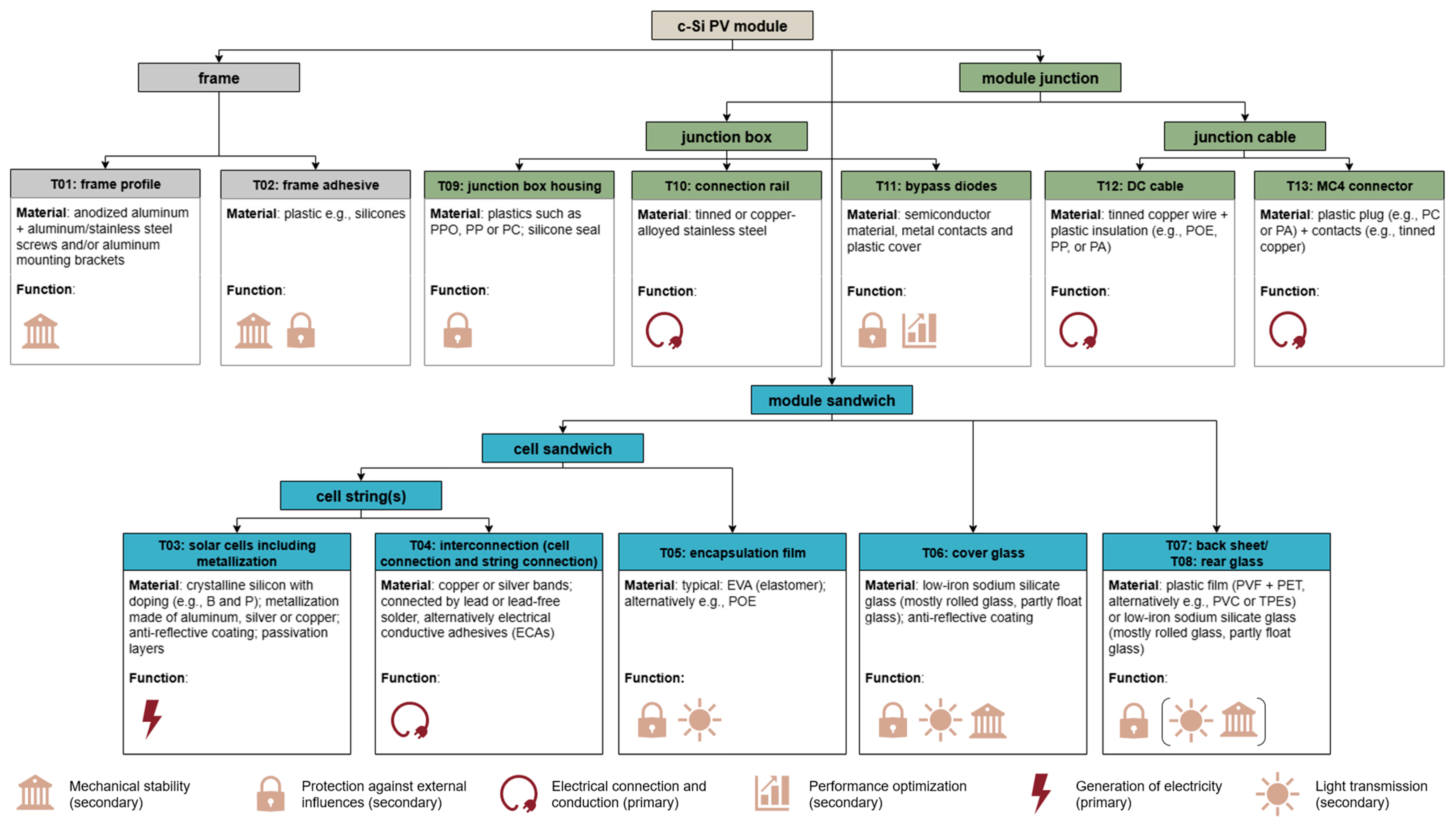
Figure 2 shows the structural and functional analysis of c-Si PV modules. The illustration is based on information from sources [42,43,44,45,46] and the analysis of market-available products. The structure is divided into three main levels: the frame, the module sandwich, and the module junction. The functional analysis shows that there are no negligible components and that the module is reduced to the bare essentials. The cells and the contacts, which are responsible for generating and conducting electricity, form the primary function part.
The risk assessment is carried out on the basis of [47,48,49,50,51,52,53,54,55] and is incorporated into the assessment of repair relevance. Based on the literature review, indicators for the failure occurrence and the significance of the failure were identified and evaluated. This can be illustrated by the ‘glass breakage’ failure mode in the cover glass component. This failure mode can be caused by mechanical stress or impact, such as improper handling and mounting, hail damage, vandalism, temperature cycles, and hotspots. The damage affects light transmission and thus leads to power losses. Furthermore, it can lead to insulation faults and can contribute to further degradation effects. Additionally, glass fragments pose a safety risk. The effects of glass breakage are classified as moderate by Jordan, Silverman et al. [48]. Moreover, glass breakage is a common cause of complaints. In a study by De Graaff, Lacerda et al. [52], for example, 33% of reported faults are defects in the glass. However, this does not allow for a direct conclusion regarding the probability of occurrence. Studies in the review by Al Mahdi, Leahy et al. [54] show an overall low incidence. Damage is highly dependent on specific events, such as vandalism. Accordingly, the failure occurring is rated with a three and the significance of the failure with a nine, resulting in an overall score of 27 for the defect. When added to the other four defect scores for the component, this yields a total score of 34. Relative to the maximum possible score, this results in a rating of 0.68 for the risk assessment of the cover glass.
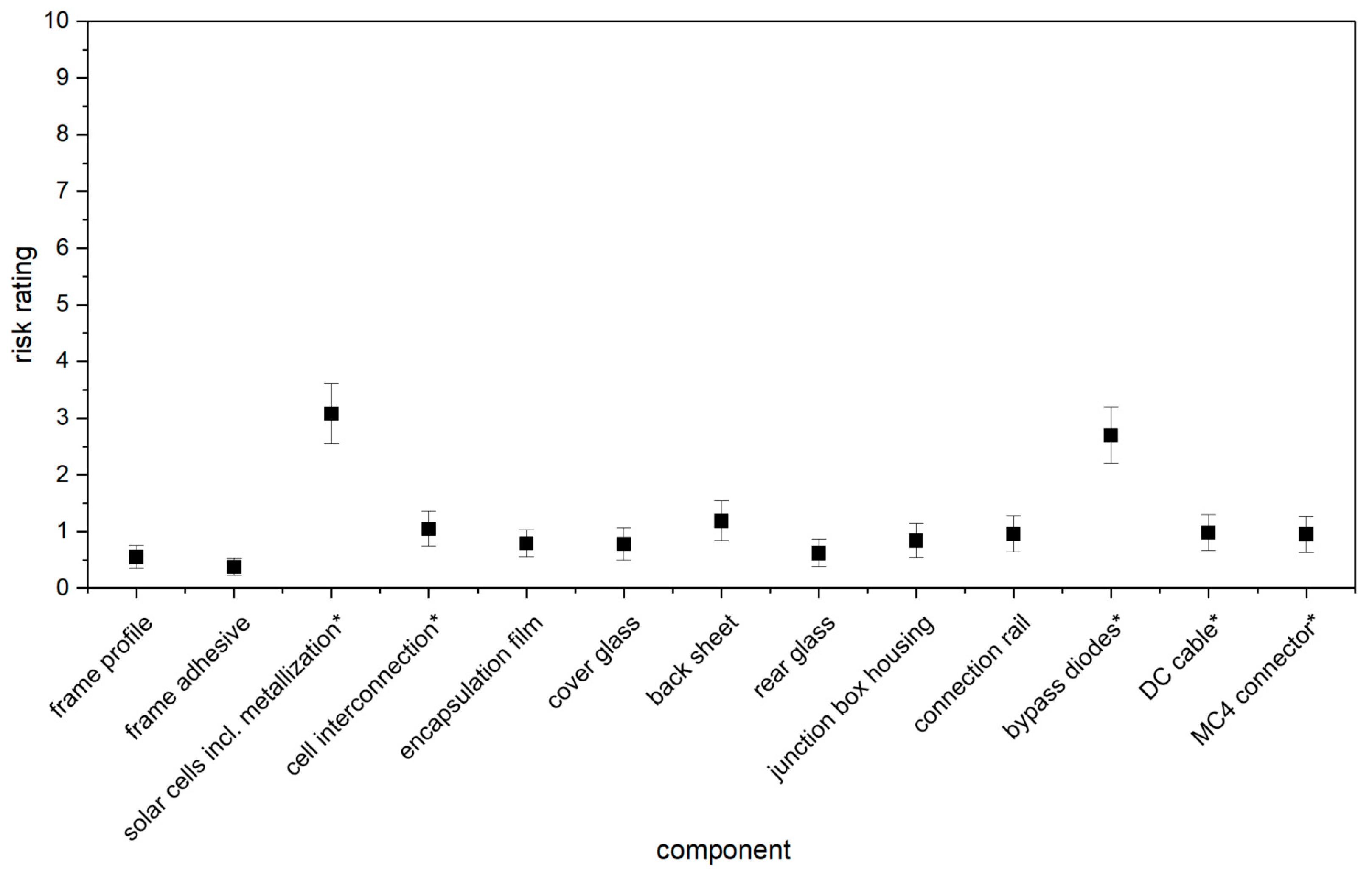
Figure 3 shows all the results of the risk assessment. It becomes clear that the cells and bypass diodes in particular have a comparatively high risk rating, meaning that the areas of the module sandwich and the junction box are particularly relevant in terms of fault frequency in combination with the effects of the faults. Overall, however, the risk assessment values are below four, meaning that apart from the need for repairs, the product does not pose an increased safety risk.
Since the ratings are first multiplied with each other, the risk assessment is particularly sensitive to failure mechanisms with high ratings. However, the standard deviations show that this does not change the basic trend of the risk assessment and that the interpretation remains the same in terms of relevance.
The risk assessment is then combined with information on the material, the type of function, and the safety relevance to form an assessment of the component’s repair relevance. For the cover glass, for example, the risk assessment is below one, the material is classified as robust, and the component performs a secondary function. However, defects can be safety-relevant and often lead to complaints. Therefore, the repair potential is rated neutral with a one.
The results of the risk assessment can also be used to evaluate the component’s relevance for reuse. The assessment is additionally based on references [43,56,57,58,59,60,61] to obtain further information on the service life and dimensioning of components. For example, the silicate glass used in the front panel is a durable component that, like windows, is expected to last for over 30 years [62]. The risk assessment is below one and faults are primarily caused by extreme events. The projected lifespan of the anti-reflective coating in 2024 was 15 years, with a trend toward 20–25 years in the future [43]. Accordingly, the component’s reusability is rated as a two.
The ‘International Technology Roadmap for Photovoltaics’ [43] is consulted separately for the assessment of update relevance. The potential for updates is not particularly high for PV modules overall. Innovations to increase efficiency are available, but at first glance, the effort for an update cannot be justified. Technology updates are therefore only worthwhile in combination with relevant repairs. For the cover glass, the innovation potential, for example, is rated as minimal due to further developments in the anti-reflective coating. The component’s update relevance is therefore rated at 0.5.
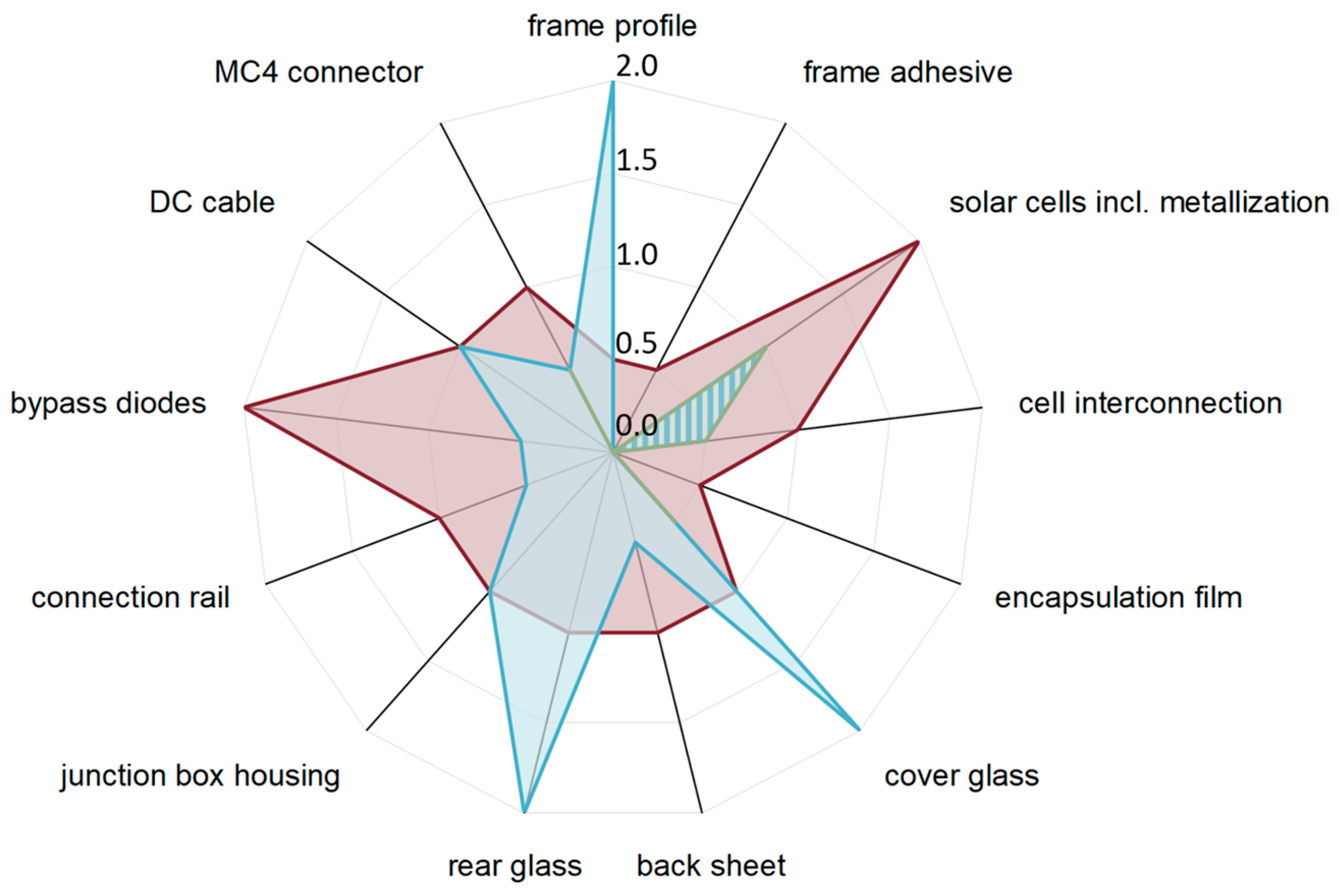
Figure 4 shows a summary of the areas of relevance. The solar cells and bypass diodes are particularly relevant for repair. In contrast, the glass components and the frame show particular potential for reuse in a remanufactured product. Moreover, there is minimal potential for upgrading the solar cells, as well as the connectors, cell connectors, and the cover glass.
Research on cost shares has shown that the components can be divided into three categories: components with high cost shares, components with moderate cost shares, and components with low cost shares. The cells, including metallization, have a high cost share in their entirety. According to a study from 2018, the cost share is over 50% [63]. The share of a single cell, on the other hand, is moderate. Other components with moderate costs are the frame and the glass, followed by the encapsulation film, cell interconnection, and all junction components [63]. Frame adhesive and individual junction components, such as connectors and diodes, tend to have low cost shares.
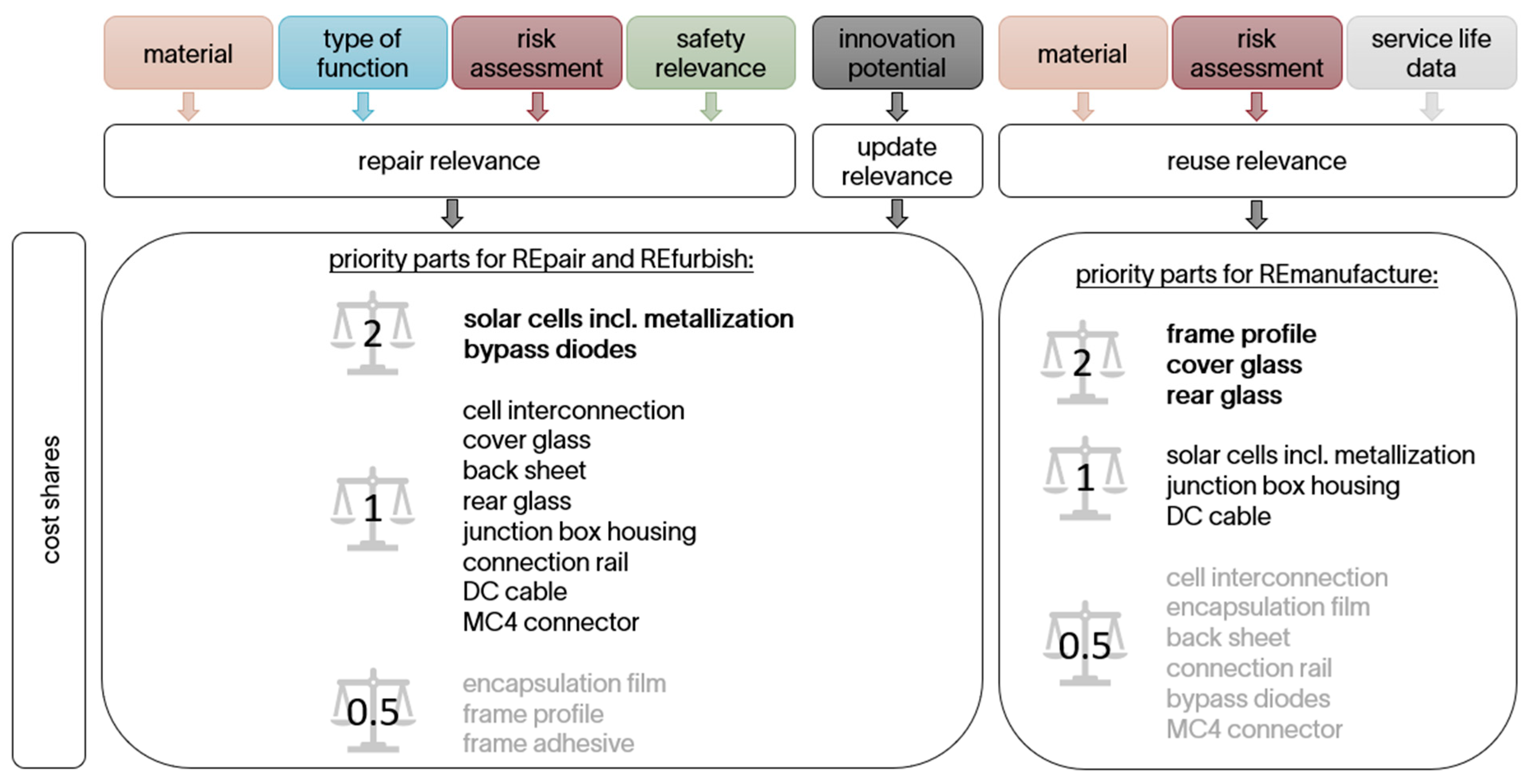
The overall result is shown in Figure 5. The final weighting for REpair and REfurbish is determined by the higher rating in terms of repair and update relevance.

4. Discussion

This chapter interprets the findings reported in Section 3, highlighting their significance and implications. The discussion is structured into a recommendation for an assessment method, the context of current regulatory and technological developments, and a short outlook for further steps.

4.1. Recommendation for an Assessment Method

Based on the results of this study, the use of a semi-quantitative procedure is considered to be expedient to assess the RE-ability of PV modules. The definition of qualitative criteria makes it possible to derive recommendations for action. At the same time, the derivation of a key figure can be helpful for tracking a continuous improvement process in product development and compare products with each other based on a method that is reproducible and as objective as possible. The EN 45554 [26] standard should therefore be used as a basis and has to be adapted or supplemented. It is crucial to adapt the standard specifically for PV modules, as these do not fit the typical structure of an ErP. Nevertheless, the development of this study aims to generate a method that creates a good compromise between objectivity and informative value as well as the effort required in terms of time and data. In addition, the list of criteria is a complementary initial draft, which should be further optimized in its application. One aspect, for example, is the specification of the energy and power range for the criterion ‘Force/energy requirements’ specifically for PV modules. This is only possible through empirical values gained from application.
The assessment of relevance can be incorporated into the assessment of RE-ability as a weighting of the components and can be used as a basis for the RE-ability evaluation in general. However, the relevance assessment was conducted only for c-Si modules, so the data cannot be directly applied to other module types, such as thin-film. Nevertheless, by consulting additional literature and adapting comparable components, this approach can also be applied to other module types. If the component structure and material selection are significantly modified in new module designs, the analysis of the priority parts must be revised too. It should also be noted that the assessment is not entirely objective. However, based on the trends in the results and the effort required, it can be considered sufficiently objective at this point.
The current cost shares are not included in the weighting, but they should be included in the discussion about the assessment of current module designs. On the one hand, REpair and REfurbish are more beneficial for defects in parts with low cost shares (e.g., junction components and single cells). On the other hand, REmanufacture is more cost-efficient with high-quality reconditioned parts (e.g., total number of cells, cover glass and frame).
The final goal of the assessment is to calculate a key figure for the RE-ability of a PV module built on the product characteristics. Based on existing standards and the results of this study, the following procedure is recommended.
  • Evaluation of the criteria in Table 3 and Table 4 with the classes for each component; use of research and the implementation of individual assembly, disassembly, and repair processes based on the structure and functional analysis in Figure 2.
  • Assigning classes to a numerical system between 0 and 10.
  • Summary of the individual components evaluation for each criterion to form an evaluation for the overall product; use of the utility value principle and the parts weighting of Figure 5, resulting in a rating between 0 and 10 for each criterion.
  • Equally weighted summation of the criteria ratings; use of the utility value, resulting in an overall rating between 0 and 10.
The key figures calculated in this way reflect an assessment of the product design’s technical suitability for the R-principles REpair, REfurbish, and REmanufacture. This means that a higher key figure indicates a simpler underlying process. This also influences economic feasibility. However, the product design should not be viewed in isolation, as other structural aspects and the cost shares of components influence economic implementation in practice. For REfurbish and REmanufacture in particular, structural aspects become increasingly important in the context of economic feasibility, as they are linked to a more complex business model.

4.2. Context of Current Regulatory and Technological Developments

The aim of this study was to establish a basis for evaluating the RE-ability and thus further define the requirements for resource-efficient PV modules. As already outlined in the Introduction, requirements aimed at resource-saving products are also the subject of current regulatory developments. Studies related to the Eco-Design Directive/Regulation primarily focus on the junction box in the context of REpair-ability. Moreover, REfurbish and REmanufacture are placed in the background [11,12,64]. The relevance of the junction box is also supported by this study, but it is expanded by additional components. In addition, a comprehensive analysis of the various R-principles is conducted.
The right to repairability focuses on supply-side and demand-side requirements relating to the processes of repair and reuse [15]. Structural aspects were not included in this study, as the focus was on product design. However, these represent important additional requirements that should not be neglected in the context of PV modules when optimizing their design for REpair, REfurbish and REmanufacture.
The international standards ISO 59040:2025 and ISO 59020:2024 provide a methodological framework for declaring and assessing the circularity of products within the context of a company’s overall performance [16,17]. The methodology presented in this paper can be used to establish a preliminary basis for assessment. Results of the product assessment can subsequently be incorporated, for example, into criteria of the product circularity data sheet such as ‘ability of product to be disassembled’ or ‘ability of the product to be upgraded’.
Initial repair processes and the remanufacturing of old cells have been examined in preliminary studies over the past few years [65,66,67,68,69,70,71,72]. However, various challenges have emerged and only a few of these processes have been implemented in the commercial sector, with the result that modules with isolated defects are disposed of for recycling, even though a large percentage of the module remains functional [73,74]. These mechanisms result in a significant loss of raw materials. The R-principles, which extend the useful life of products, can counteract this. Furthermore, the principles of REfurbish and REmanufacture can contribute to an independent supply of raw materials for the EU, as the raw materials for new modules can be recovered from old ones within the EU. However, implementing this step requires a change in the module design.
Early alternative designs already demonstrate the potential benefits for repair processes. One example is the startup Biosphere Solar, which is collaborating with TU Delft to develop a module featuring liquid encapsulation and modular contacting [75,76]. Abdullayev et al. demonstrate possibilities for design in the context of disassembly with a polycarbonate PV module [77]. An initial repairability study on a modular junction box also highlights the advantages of an alternative design [65]. Evaluation methods that can be used for both prototype construction and more advanced products are not state-of-the-art. However, they are necessary to make the development process effective and efficient. A preliminary framework for evaluating prototypes is presented in an article within the context of the Biosphere Solar module [78]. However, this framework also does not address the complexity of all three R-principles, and the criteria are slightly simplified in the context of prototypes. Many criteria, such as the tools used and the skills required, are nevertheless consistent with the methodology of this study. Overall, the method presented in this article thus represents a major milestone in the systematic development of sustainable PV module designs for REpair, REfurbish and REmanufacture.

4.3. Outlook

In the next step, the entire evaluation method should be applied to an initial module sample. This will enable both further validation and optimization of the methodology as well as the development of recommendations for action for a RE-ability-optimized module design. The resulting key figures can be used to compare products and their optimization levels. The individual component ratings are particularly relevant for targeted optimization of product design. The results of the component prioritization already indicate which components should be given attention in this regard. For better repairability, for example, these are the cells and the bypass diodes.
To further validate the relevance of the components, additional experts may be consulted in the future when conducting the assessment. This will enable a more detailed statistical analysis and thus enhance the reliability of the data.

5. Conclusions

Current regulations and standards, such as the Eco-Design Regulation and ISO 59040:2025 regarding the product circularity data sheet, highlight the need for structured circular product development. Robust assessment methods are essential for this. However, in the context of product development for PV modules optimized for REpair, REfurbish and REmanufacture, this is not yet state-of-the-art. The study presented in this article addressed this gap and demonstrated an initial method for evaluating c-Si PV modules. The foundation for this lies in the examination of current evaluation methods within the framework of ErPs. EN 45554 [26] and semi-quantitative methods in general have proven to be a useful foundation. The analysis of the processes underlying the three R-principles, combined with the criteria of existing methods, resulted in a unified catalog of criteria containing ten process-related and four component-related evaluation criteria. The application of the criteria differs for the individual principles only with regard to the priority parts and the specific processes evaluated for the individual principles. In this regard, the study showed that for REpair and REfurbish, the focus should be particularly on the individual cells and the connecting components. For REmanufacture, the entirety of the cells, the frame, and the glass are particularly relevant. However, other components should also be included in the assessment, although with less weighting. Overall, this study has established a comprehensive evaluation framework that can be applied to circular product development within the context of numerous current standards and regulations. By applying this framework, the long-term potential of the circular principles of REpair, REfurbish, and REmanufacture can be better exploited, thereby contributing to a sustainable and independent PV value chain. As the method is applied in the future, the method itself can also be further optimized and validated.

Author Contributions

Conceptualization, writing—original draft preparation, supervision, visualization, data curation, investigation, and project administration, A.K.S.; methodology, A.K.S. and H.W.; validation, formal analysis and writing—review and editing, A.K.S., H.W., F.S. and E.S.-H. All authors have read and agreed to the published version of the manuscript.

Funding

This research was funded by the Deutsche Forschungsgemeinschaft (DFG, German Research Foundation)—project number 533268552.

Institutional Review Board Statement

Not applicable.

Informed Consent Statement

Not applicable.

Data Availability Statement

The basic data presented in this study are included in the article. Further inquiries can be directed to the corresponding author.

Conflicts of Interest

The funders had no role in the design of the study; in the collection, analyses, or interpretation of data; in the writing of the manuscript; or in the decision to publish the results.

Abbreviations

The following abbreviations are used in this manuscript:
AsMeRAssessment Matrix for ease of Repair
BBoron
CECircular economy
c-SiCrystalline silicon
ECAElectrical conductive adhesive
EDIMEase of disassembly metric
ErPsEnergy-related products
EUEuropean Union
EVAEthylene-vinyl acetate
HSBIBielefeld University of Applied Sciences and Arts
JRCJoint Research Center
OFailure occurring
PPhosphorus
PAPolyamide
PCPolycarbonate
PETPolyethylene terephthalate
POEPolyolefin elastomers
PPPolypropylene
PPOPolyphenylene ether
PRIProduct repairability indicator
PVPhotovoltaic
PVCPolyvinyl chloride
PVFPolyvinyl fluoride
RE-abilityREpair-, REfurbish- and REmanufactur-ability
RRRisk rating
RSSRepair scoring system
SSignificance of the failure
TPEThermoplastic elastomers

References

  1. Lin, D.; Wackernagel, M. Estimating the Date of Earth Overshoot Day 2025; Global Footprint Network. 2025. Available online: https://overshoot.footprintnetwork.org/about-earth-overshoot-day/ (accessed on 21 April 2026).
  2. Haigh, L.; de Wit, M.; von Daniels, C.; Colloricchio, A.; Hoogzaad, J. The Circularity Gap Report 2021: Solutions for a Linear World That Consumes Over 100 Billion Tonnes of Materials and Has Warmed by 1-Degree; Circle Economy: Amsterdam, The Netherlands, 2021. [Google Scholar]
  3. European Parliament and Council of the European Union. Directive 2009/125/EC of the European Parliament and of the Council of 21 October 2009 Establishing a Framework for the Setting of Ecodesign Requirements for Energy-Related Products (German Version). Off. J. Eur. Union 2009, 285, 10. [Google Scholar]
  4. Hofmann, H.; Spindler, J. Materials in Electrical Engineering: Fundamentals—Structure—Characteristics—Testing—Applications—Technology, 7th ed.; Hanser Publishing: Munich, Germany, 2013. (In German) [Google Scholar]
  5. Osann, I.; Mattheis, H. Workbook Circular: Economy Developing Innovations—Shaping Transformation: With Methods, Tools and Checklists! Hanser Publishing: Munich, Germany, 2021. (In German) [Google Scholar]
  6. EN 45552:2020; General Method for the Assessment of the Durability of Energy-Related Products; German Version; DIN’s Standards Committee Principles of Environmental Protection (NAGUS) and German Commission for Electrotechnical, Electronic & Information Technologies of DIN and VDE. Beuth Publishing: Berlin, Germany, 2020.
  7. Kirchherr, J.; Reike, D.; Hekkert, M. Conceptualizing the circular economy: An analysis of 114 definitions. Resour. Conserv. Recycl. 2017, 127, 221–232. [Google Scholar] [CrossRef]
  8. Oreski, G.; Tsanakas, I.; Eder, G.C.; van der Heide, A.; Stromberg, R.; Gassner, A.; Ariolli, D.; Oviedo Hernandez, G.; Bruckman, L.; Jahn, U. Performance and Reliability Aspects of 2nd Life Photovoltaic Modules; Report No. T13-37:2026; International Energy Agency: Paris, France, 2026. [Google Scholar] [CrossRef]
  9. European Commission. Commission Regulation (EU) 2023/1670 of 16 June 2023 Laying Down Ecodesign Requirements for Smartphones, Mobile Phones Other Than Smartphones, Cordless Phones and Slate Tablets Pursuant to Directive 2009/125/EC of the European Parliament and of the Council and Amending Commission Regulation (German Version). Off. J. Eur. Union 2023, 214, 47–93. [Google Scholar]
  10. European Commission. Commission Regulation (EU) 2019/2023 of 1 October 2019 Laying Down Ecodesign Requirements for Household Washing Machines and Household Washer-Dryers Pursuant to Directive 2009/125/EC of the European Parliament and of the Council, Amending Commission Regulation (EC) No 1275/2008 and Repealing Commission Regulation (German Version). Off. J. Eur. Union 2019, 315, 285–312. [Google Scholar]
  11. Wade, A.; Neuhaus, H.; Probst, L.; Sauer, T.; Moser, D.; Rohr, C.; Rossi, R. Expert Input Paper—Eco-Design & Energy Labelling for Photovoltaic Modules, Inverters and Systems in the EU; ETIP PV; SolarPower Europe: Brussels, Belgium; PVthin: Brussels, Belgium; European Solar Manufacturing Council: Brussels, Belgium; IECRE: Brussels, Belgium, 2021. [Google Scholar] [CrossRef]
  12. Dodd, N.; Espinosa, N.; van Tichelen, P.; Peeters, K.; Soares, A. Preparatory Study for Solar Photovoltaic Modules, Inverters and Systems: Final Report; Publications Office of the European Union: Luxembourg, 2020. [Google Scholar] [CrossRef]
  13. European PV Manufacturing Industry. A request for Ecodesign and Energy Label Legislation that Serves the Environment and European Solar PV Manufacturing: To the European Commissioner for the Internal Market Thierry BRETON, CC: To the Director-General Kerstin JORNA, Directorate-General for Internal Market, Industry, Entrepreneurship & SMEs. 2024. Available online: https://esmc.solar/wp-content/uploads/2024/02/ (accessed on 17 April 2026).
  14. European Parliament and Council of the European Union. Regulation (EU) 2024/1781 of the European Parliament and of the Council of 13 June 2024 Establishing a Framework for the Setting of Ecodesign Requirements for Sustainable Products, Amending Directive (EU) 2020/1828 and Regulation (EU) 2023/1542 and Repealing Directive 2009/125/EC. Off. J. Eur. Union. 2024. Available online: http://data.europa.eu/eli/reg/2024/1781/oj (accessed on 21 April 2026). (In German)
  15. European Parliament and Council of the European Union. Directive (EU) 2024/1799 of the European Parliament and of the Council of 13 June 2024 on Common Rules Promoting the Repair of Goods and Amending Regulation (EU) 2017/2394 and Directives (EU) 2019/771 and (EU) 2020/1828. Off. J. Eur. Union. 2024. Available online: http://data.europa.eu/eli/dir/2024/1799/oj (accessed on 21 April 2026). (In German)
  16. ISO 59040:2025; Circular Econom—Product Circularity Data Sheet. International Standards Organisation: Geneva, Switzerland, 2025.
  17. ISO 59020:2024-05; Circular Economy—Measuring and Assessing Circularity Performance. International Standards Organisation: Geneva, Switzerland, 2024.
  18. Fraunhofer ISE. Photovoltaics Report, Updated: 31 October 2025. Available online: https://www.ise.fraunhofer.de/ (accessed on 24 May 2026).
  19. Bielefeld University of Applied Sciences and Arts. Circular Economy Knowledge Base. Available online: https://www.hsbi.de/incamsbi/wissensbasis-circular-economy (accessed on 21 April 2026). (In German)
  20. RAL gGmbH. Products and Services with the Blue Angel Label: Overview of Award Criteria by Industry. 2026. Available online: https://www.blauer-engel.de/de/publikationen/detail/uebersicht-der-vergabekriterien-nach-branchen-januar-2026 (accessed on 17 April 2026). (In German)
  21. RAL gGmbH. Blue Angel—Scientifically Developed. Available online: https://www.blauer-engel.de/de/blauer-engel/unser-zeichen-fuer-die-umwelt/wissenschaftlich-erarbeitet (accessed on 28 July 2024). (In German)
  22. German Environment Agency. Blue Angel—The Environmental Label—Cell Phones, Smartphones, and Tablets: Assignment criteria, January 2022 Edition, Version 3; RAL gGmbH. Available online: https://www.blauer-engel.de/uz106 (accessed on 21 April 2026). (In German)
  23. European Commission. About the EU Ecolabel; Directorate-General for Environment. Available online: https://environment.ec.europa.eu/topics/circular-economy/eu-ecolabel/about-eu-ecolabel_en (accessed on 21 April 2026).
  24. European Commission. EU Ecolabel Facts and Figures; Directorate-General for Environment. Available online: https://environment.ec.europa.eu/topics/circular-economy/eu-ecolabel/business/ecolabel-facts-and-figures_en (accessed on 21 April 2026).
  25. European Commission. Commission Decision (EU) 2020/1804 of 27 November 2020 Establishing the EU Ecolabel Criteria for Electronic Displays: 2020/1804. Off. J. Eur. Union 2020, 402, 73–88. [Google Scholar]
  26. EN 45554:2020; General Methods for the Assessment of the Ability to Repair, Reuse and Upgrade Energy-Related Products; German Version; DIN’s Standards Committee Principles of Environmental Protection (NAGUS) and German Commission for Electrotechnical, Electronic & Information Technologies of DIN and VDE. Beuth Publishing: Berlin, Germany, 2020.
  27. ONR 192102; Label of Excellence for Durable, Repair-Friendly Designed Electrical and Electronic Appliances. Austrian Standards International (ASI)—Committee 157 Waste Management: Vienna, Austria, 2014.
  28. Pirkner, G.; Seidl, S.; Winkler, J.; Hackl, N.; Eisenriegler, S.; Gizdavic, N.; Weiß, N. Sustainability Label for Easy-to-Repair Products: Establishment of a Sustainability Label for Electrical and Electronic Devices (White and Brown Goods) Designed to be Repair-Friendly, to Help Consumers Make Informed Purchasing Decisions; Austrian Federal Ministry of Mobility, Innovation, and Technology: Vienna, Austria, 2008; Available online: https://nachhaltigwirtschaften.at/ (accessed on 21 April 2026). (In German)
  29. iFixit. Repair It? Of Course!: Repairing is Good for Consumers and the Environment. Repairing Promotes the Production of Durable Products. Available online: https://de.ifixit.com/reparierbarkeit (accessed on 21 April 2026). (In German)
  30. Flipsen, B.; Bakker, C.; van Bohemen, G. Developing a reparability indicator for electronic products. In Proceedings of Electronics Goes Green 2016+; Fraunhofer IZM, Ed.; IEEE: Piscataway, NJ, USA, 2016; pp. 332–340. [Google Scholar] [CrossRef]
  31. Suovanen, J. How iFixit Scores Repairability: What’s a Repairability Score, and How is that Calculated? Available online: https://www.ifixit.com/News/75533/how-ifixit-scores-repairability (accessed on 21 April 2026).
  32. Bracquené, E.; Brusselaers, J.; Dams, Y.; Peeters, J.; de Schepper, K.; Duflou, J.; Dewulf, W. Repairability Criteria for Energy Related Products: Study in the BeNeLux Context to Evaluate the Options to Extend the Product Life Time—Final Report; BeNeLux: Brussels, Belgium, 2018; Available online: https://www.benelux.int (accessed on 21 April 2026).
  33. Alfieri, F.; Cordella, M.; Sanfelix, J. Analysis and Development of a Scoring System for Repair and Upgrade of Products; Final Report: EUR 29711; Publications Office of the European Union: Luxembourg, 2019. [Google Scholar] [CrossRef]
  34. Bracquené, E.; Peeters, J.; Alfieri, F.; Sanfélix, J.; Duflou, J.; Dewulf, W.; Cordella, M. Analysis of evaluation systems for product repairability: A case study for washing machines. J. Clean. Prod. 2021, 281, 125122. [Google Scholar] [CrossRef]
  35. Spiliotopoulos, C.; Alfieri, F.; La Placa, M.G.; Bracquene, E.; Laps, E.; van Moeseke, T.; Duflou, J.; Dangal, S.; Bolanos Arriola, J.; Flipsen, B.; et al. Product Reparability Scoring System: Specific Application to Smartphones and Slate Tablets; Publication Office of the European Union: Luxembourg, 2022. [Google Scholar] [CrossRef]
  36. Cordella, M.; Sanfelix, J.; Alfieri, F. Development of an Approach for Assessing the Reparability and Upgradability of Energy-related Products. Procedia CIRP 2018, 69, 888–892. [Google Scholar] [CrossRef]
  37. Round Table Repair. Repair Index. Available online: https://runder-tisch-reparatur.de/reparaturindex/ (accessed on 21 April 2026). (In German)
  38. Ruiz-Pastor, L.; Mesa, J.A. Proposing an integrated indicator to measure product repairability. J. Clean. Prod. 2023, 395, 136434. [Google Scholar] [CrossRef]
  39. Vanegas, P.; Peeters, J.R.; Cattrysse, D.; Tecchio, P.; Ardente, F.; Mathieux, F.; Dewulf, W.; Duflou, J.R. Ease of disassembly of products to support circular economy strategies. Resour. Conserv. Recycl. 2018, 135, 323–334. [Google Scholar] [CrossRef]
  40. de Fazio, F.; Bakker, C.; Flipsen, B.; Balkenende, R. The Disassembly Map: A new method to enhance design for product repairability. J. Clean. Prod. 2021, 320, 128552. [Google Scholar] [CrossRef]
  41. EN 45553:2020; General Method for the Assessment of the Ability to Remanufacture Energy-Related Products; German Version; DIN’s Standards Committee Principles of Environmental Protection (NAGUS) and German Commission for Electrotechnical, Electronic & Information Technologies of DIN and VDE. Beuth Publishing: Berlin, Germany, 2020.
  42. Mertens, K. Photovoltaics: Textbook on Fundamentals, Technology, and Practice, 5th ed.; Hanser Publishing: Munich, Germany, 2020. (In German) [Google Scholar]
  43. Fischer, M.; Woodhouse, M.; Baliozian, P. International Technology Roadmap for Photovoltaics (ITRPV)—2023 Results; VDMA: Frankfurt, Germany, 2024. [Google Scholar]
  44. Schaeffer, H.A.; Langfeld, R. Glass as a Material: An old Material with a Bright Future, 2nd ed.; Springer Nature: Berlin, Germany, 2020. [Google Scholar]
  45. Wu, B. Myth vs. Reality: Aluminum–Stainless Pairs in Solar Frames. Anern Blog—Solar for Beginners. 3 September 2025. Available online: https://www.anernstore.com/blogs/diy-solar-guides/aluminum-stainless-solar-frames-myths (accessed on 22 April 2026).
  46. Bilbao, J.I.; Heath, G.; Norgren, A.; Lunardi, M.M.; Carpenter, A.; Corkish, R. PV Module Design for Recycling, IEA PVPS Task 12; Report T12-23:2021; International Energy Agency: Paris, France, 2021; Available online: https://iea-pvps.org/ (accessed on 22 April 2026).
  47. Köntges, M.; Kurtz, S.; Packard, C.; Jahn, U.; Berger, K.A.; Kato, K. Performance and Reliability of Photovoltaic Systems: Subtask 3.2: Review of Failures of Photovoltaic Modules: IEA PVPS Task 13: External Final Report IEA-PVPS; International Energy Agency: Paris, France, 2014; Available online: https://iea-pvps.org/ (accessed on 22 April 2026).
  48. Jordan, D.C.; Silverman, T.J.; Wohlgemuth, J.H.; Kurtz, S.R.; van Sant, K.T. Photovoltaic failure and degradation modes. Prog. Photovolt. Res. Appl. 2017, 25, 318–326. [Google Scholar] [CrossRef]
  49. Lillo-Sánchez, L.; López-Lara, G.; Vera-Medina, J.; Pérez-Aparicio, E.; Lillo-Bravo, I. Degradation analysis of photovoltaic modules after operating for 22 years. A case study with comparisons. Sol. Energy 2021, 222, 84–94. [Google Scholar] [CrossRef]
  50. Lorenzo, E.; Zilles, R.; Moretón, R.; Gómez, T.; Martínez de Olcoz, A. Performance analysis of a 7-kW crystalline silicon generator after 17 years of operation in Madrid. Prog. Photovolt. Res. Appl. 2014, 22, 1273–1279. [Google Scholar] [CrossRef]
  51. Aghaei, M.; Fairbrother, A.; Gok, A.; Ahmad, S.; Kazim, S.; Lobato, K.; Oreski, G.; Reinders, A.; Schmitz, J.; Theelen, M.; et al. Review of degradation and failure phenomena in photovoltaic modules. Renew. Sustain. Energy Rev. 2022, 159, 112160. [Google Scholar] [CrossRef]
  52. DeGraaff, D.; Lacerda, R.; Campeau, Z.; Sunpower Corp. Degradation Mechanisms in Si Module Technologies Observed in the Field; Their Analysis and Statistics. In Proceedings of the NREL 2011 Photovoltaic Module Reliability Workshop, Golden, CO, USA, 16 February 2011. [Google Scholar]
  53. Schulze, K.; Groh, M.; Nieß, M.; Vodermayer, C.; Wotruba, G.; Becker, G. Investigation of aging effects in monocrystalline PV modules with more than 15 years of operation using electroluminescence and power measurements. In Proceedings of the 28 PV-Symposium, Bad Staffelstein, Germany, 6–8 March 2013; Nordmann, T., Ed.; OTTI: Regensburg, Germany, 2013. (In German) [Google Scholar]
  54. Al Mahdi, H.; Leahy, P.G.; Alghoul, M.; Morrison, A.P. A Review of Photovoltaic Module Failure and Degradation Mechanisms: Causes and Detection Techniques. Solar 2024, 4, 43–82. [Google Scholar] [CrossRef]
  55. Rajput, P.; Malvoni, M.; Kumar, N.M.; Sastry, O.S.; Tiwari, G.N. Risk priority number for understanding the severity of photovoltaic failure modes and their impacts on performance degradation. Case Stud. Therm. Eng. 2019, 16, 100563. [Google Scholar] [CrossRef]
  56. EN 50618:2014: DIN EN 50618 (VDE 0283-618); Electric Cables for Photovoltaic Systems—German Version; German Commission for Electrotechnical, Electronic & Information Technologies of DIN and VDE. VDE Publishing: Berlin, Germany, 2015.
  57. Rane, K.P.; Shiradkar, N. Long term durability assessment of Schottky bypass diodes in photovoltaic modules under high temperature reverse bias operation. Sol. Energy 2025, 286, 113152. [Google Scholar] [CrossRef]
  58. EN IEC 62790:2020; Junction Boxes for Photovoltaic Modules—Safety Requirements and Tests (IEC 62790:2020); German Version; German Commission for Electrotechnical, Electronic & Information Technologies of DIN and VDE. VDE Publishing: Berlin, Germany, 2021.
  59. Yang, B.; Liu, J.; Li, J.; Wang, C.; Wang, Z. Durability Test and Service Life Prediction Methods for Silicone Structural Glazing Sealant. Buildings 2025, 15, 1664. [Google Scholar] [CrossRef]
  60. HTS-ALU. Aluminum Solar Panel Frame. Available online: https://hts-alu.com/aluminium-frame-for-solar-panel/ (accessed on 22 April 2026).
  61. Foshan Shenghai Aluminum Co., Ltd. Aluminum Frame for Solar Panel Is the Best Choice. Available online: https://www.shenghai-alu.com/article/aluminum-frame-for-solar-panel-is-the-best-choice (accessed on 22 April 2026).
  62. German Federal Ministry for Housing, Urban Development and Building. Service Lives of Building Components: BBSR-Table of Service Life—As of March 13, 2026. Available online: https://www.nachhaltigesbauen.de/austausch/nutzungsdauern-von-bauteilen/ (accessed on 9 April 2026). (In German)
  63. Woodhouse, M.A.; Smith, B.; Ramdas, A.; Margolis, R.M. Crystalline Silicon Photovoltaic Module Manufacturing Costs and Sustainable Pricing: 1H 2018 Benchmark and Cost Reduction Road Map; NREL—National Renewable Energy Laboratory: Golden, CO, USA, 2019. [Google Scholar] [CrossRef]
  64. European Commission. Discussion Paper on Potential Ecodesign Requirements and Energy Labelling Scheme(s) for Photovoltaic Modules, Inverters and Systems; European Commission: Brussels, Belgium, 2021. [Google Scholar]
  65. Badran, G.; Lazarov, V.K.; Dhimish, M. Extending Photovoltaic Module Lifetime Through Targeted Repair of Short-Circuited Bypass Diodes. Solar 2026, 6, 4. [Google Scholar] [CrossRef]
  66. Rabanal-Arabach, J.; Beltran-Condori, S.; Videla-Magnata, N.; Rojas-Henriquez, K.; Guzman-Gonzalez, R.; Fuentealba-Vidal, E. Photovoltaic Modules Repair: Application Case of Spot-Welding in Junction Box Bussing Ribbons. In Proceedings of IEEE 53rd Photovoltaic Specialists Conference (PVSC), Montreal, QC, Canada, 8–13 June 2026; IEEE: Piscataway, NJ, USA, 2025; pp. 319–322. [Google Scholar] [CrossRef]
  67. Voronko, Y.; Eder, G.C.; Breitwieser, C.; Mühleisen, W.; Neumaier, L.; Feldbacher, S.; Oreski, G.; Lenck, N. Repair options for PV modules with cracked backsheets. Energy Sci. Eng. 2021, 9, 1583–1595. [Google Scholar] [CrossRef]
  68. Beaucarne, G.; Eder, G.; Jadot, E.; Voronko, Y.; Mühleisen, W. Repair and preventive maintenance of photovoltaic modules with degrading backsheets using flowable silicone sealant. Prog. Photovolt. Res. Appl. 2022, 30, 1045–1053. [Google Scholar] [CrossRef]
  69. Lee, K.; Cho, S.; Yi, J.; Chang, H. Prediction of Power Output from a Crystalline Silicon Photovoltaic Module with Repaired Cell-in-Hotspots. Electronics 2022, 11, 2307. [Google Scholar] [CrossRef]
  70. Kawano, Y.; Chantana, J.; Kuroda, Y.; Hirose, K.; Minemoto, T. Development of repairing technique for interconnection of silicon photovoltaic modules using an induction heating system. Sol. Energy 2023, 261, 55–62. [Google Scholar] [CrossRef]
  71. Rosillo, F.G.; Nieto-Morone, M.B.; Esteva, J.B.; Soriano, F.; Temprano, S.; González, C.; Del Alonso-García, M.C. Repairing ribbon bus bar interruptions in photovoltaic modules using non-intrusive interruption location. Renew. Energy 2024, 223, 120012. [Google Scholar] [CrossRef]
  72. Schlenker, S.; Wambach, K.; Müller, A.; Klenk, M.; Wallat, S.; Kopecek, R.; Wefringhaus, E. The second life of a 300 kW PV generator manufactured with recycled wafers from the oldest German PV power plant. In Proceedings of the 21st European Photovoltaic Solar Energy Conference and Exhibition, Dresden, Germany, 4–8 September 2006. [Google Scholar]
  73. Basnet, R.; Jones, L.; Azmie, M.A.; Jones, M.; McCann, M.; Ernst, M. Advancing circular economy of silicon Photovoltaics: Current status and challenges of PV module reuse. Sol. Energy Mater. Sol. Cells 2025, 292, 113816. [Google Scholar] [CrossRef]
  74. Tsanakas, I.A.; Oreski, G.; Eder, G.; Gassner, A.; van der Heide, A.; Ariolli, D.M.G.; Hernandez, G.O.; Moser, D.; Wambach, K. Toward Reuse-Ready PV: A Perspective on Recent Advances, Practices, and Future Challenges. Adv. Energy Sustain. Res. 2025, 6, 2400237. [Google Scholar] [CrossRef]
  75. Bothra, U.; Weemaes, S.; Rijsman, T.; Poli, A.; Brinksma, S.; Isabella, O.; Vogt, M.R. Liquid PV Module Encapsulation to Enable Circular Design. Prog. Photovolt. Res. Appl. 2026, 34, 667–678. [Google Scholar] [CrossRef]
  76. Mahajan, M. Developing Modular Interconnection Techniques for Disassemblable PV Modules. Master’s Thesis, Delft University of Technology, Delft, The Netherlands, 2025. Available online: http://repository.tudelft.nl/ (accessed on 22 April 2026).
  77. Abdullayev, J.; Givans, J.; Pearce, J.M. Open-source distributed production of polycarbonate solar photovoltaic modules designed for disassembly. J. Clean. Prod. 2026, 551, 147931. [Google Scholar] [CrossRef]
  78. Timmers Verhoeven, A.G. Balancing Repairability and Technical Requirements: A Reliability-Based Optimization Approach for PV Module Design; Applied University Study; Delft University of Technology: Delft, The Netherlands, 2025; Available online: https://www.biosphere.solar/repositories/research (accessed on 2 April 2026).
Figure 1. Incorporation of the researched indicators into the component weighting.
Sustainability 18 05612 g001
Figure 2. Structure and function analysis of c-Si PV modules with back sheet or rear glass consisting of the following assemblies: frame (gray), module junction (green), and module sandwich (blue); the arrows indicate the relationships between assemblies and components, while the info boxes for each component list the materials and functions (primary in red and secondary in copper); function symbols in brackets are optional depending on the component version.
Sustainability 18 05612 g002
Figure 3. Risk assessment for c-Si PV module components; * components with safety-critical failure mechanisms.
Sustainability 18 05612 g003
Figure 4. Repair (red), reuse (blue) and update (green) relevance for PV module components from low (0) to high (2) relevance.
Sustainability 18 05612 g004
Figure 5. Overall result of determining the priority parts including the incorporated indicators (see Figure 1) and the weighting of the components on levels 2 (bold), 1 (neutral), and 0.5 (muted).
Sustainability 18 05612 g005
Table 1. Evaluation matrix for failure occurring and significance of the failure.
RatingFailure Occurring (O)Significance of the Failure (S)
1Extremely unlikely: The failure is practically impossible and will never occur under any conditions.No impact on power or security
2Very unlikely: The failure is extremely rare and may occur under specific conditions.Power losses less than the warranty specifies
3Unlikely: The failure may occur occasionally, but it remains relatively rare and only under certain conditions.Rating 1 or 2 + significant promotion of other relevant failure mechanisms
4Occasionally: The failure occurs in isolated cases, but it is not the norm.Power losses on the level of the warranty
5Possible: The error may occur under normal conditions, but it is not common.Rating 4 + significant promotion of other relevant failure mechanisms
6Likely: This failure can occur frequently, especially under certain conditions.Power losses exceed the power guarantee
7Common: The failure occurs frequently and is to be expected in many situations.Rating 6 + significant promotion of other relevant failure mechanisms
8Very likely: The failure occurs in most cases and can often be observed.Almost complete loss of power
9Extremely likely: The failure is almost certain to occur and will occur in almost all relevant cases.Power degradation and long-term safety risks
10Certainly: The failure will definitely occur and cannot be avoided.Power degradation and direct safety risks
Table 2. Summary of existing assessment methods.
MethodProduct GroupTarget GroupSelecting Criteria for Priority PartsScoring System
Blue Angel Label
[20,21,22]
Wide range of different product groupsDeclaration for consumerNon-transparentQualitative (requirements must be fulfilled for the label)
EU Ecolabel
[23,24,25]
Wide range of different product groupsDeclaration for consumerNot defined or non-transparentQualitative (requirements must be fulfilled for the label)
EN 45554 [26]ErPs; products in generalGeneralFunctional relevance,
failure probability
Weighting of parts and criteria possible; summation of part-specific and product-specific criteria to an overall score
ONR 192102 [27,28]White and brown goodsDeclaration for consumerNot defined; only essential parts are mentioned in general termsCombination of mandatory criteria and target criteria; overall score from 0 to 10
IFIXIT Score [29,30,31]Electronic productsDeclaration for consumerFunctional relevance,
failure probability
Individual point system with penalty points, 80% of points for product design; overall score from 0 to 10
AsMeR [32]ErPsDeclaration for consumerMost frequent failure modes or misuses; failure probability, functional relevanceWeighting based on the process step and criteria group matrix; derivation of the maximum score per criterion from the weighting; 0 to 10 points per criterion; summation to an overall score
RSS [33,34,35,36]Generic productsDeclaration for consumerFunctional relevance,
failure probability,
(environmental impact based on LCA)
Combination of mandatory criteria and target criteria; 0 to 1 point for each target criterion; weighting of parts and criteria with factors or percentages; summation and scaling to an overall score for certain categories
French Repair Index [37]Selection of electrical devicesDeclaration for consumerFunctional relevance,
failure probability
Total score of 100; derivation of a score from 0 to 10
PRI [38]Products in generalProduct development/designNot providedWeighting factor of the parts based on the physical and functional connection of a part;
score from 0 to 10 for each part
EDIM [39]GeneralPolitical context and product designNot relevantQuantitative; MOST-based time in seconds
Disassembly Map [40]GeneralProduct development/designFunctional relevance,
failure probability; technology development for upgradeability, economic value for refurbishment
Classification of criteria; visualization using symbols and colors
Table 3. Catalog for process-related criteria.
CriterionDescriptionClassification
Disassembly depth *Number of assembly levels that must be disassembled in order to repair, replace, or remove a componentA: 1 level
B: 2–3 levels
C: >3 levels
Type of fasteners
and connectors *
Reusability and removability of the fasteners and connectors relevant for the evaluated work stepsA: Reusable
B: Removable
C: Neither reusable nor removable
Type of toolsType and availability of the tools that are required as a minimum for the evaluated work stepsA: No tools required/possible with basic or supplied tools
B: Possible with product-specific tools
C: Possible with other commercially available tools
D: Possible with proprietary tools
E: Not possible with any existing tool
Working
environment
Working environment that is required as a minimum for the evaluated work stepsA: Operating environment
B: Workplace environment
C: Production-equivalent environment
HandlingHands needed to carry out the work stepsA: 1 hand
B: 2 hands
C: >2 hands
Force/energy
requirements
Force or energy required for the work steps when using a suitable tool A: Low force intensity/energy requirements
B: Moderate force intensity/energy requirements
C: High force intensity/energy requirements
Required
manipulation
Need to manipulate the product on a working surface or need to walk around the product to implement the individual work steps A: No manipulation necessary
B: Minimal manipulation required
C: Complex manipulation necessary
AccessibilityDescribes how easily accessible the location is for the evaluated work step (e.g., component movement necessary, restricted range of motion, hard-to-reach connection point)A: Free accessibility
B: Slightly limited accessibility
C: Significantly limited accessibility
Skill levelRequired skills of personnel for every single work stepA: Generalist
B: Expert
C: Manufacturer or acknowledged expert
D: Not feasible with any existing skill
Risk of injuryLevel of risk of being injured during implementation of the work stepsA: Low-to-no risk
B: Some risk
C: High risk
* This criterion is not completely suitable for repair/reconditioning processes without the disassembly of the component.
Table 4. Catalog for component-related criteria.
CriterionDescriptionClassification
IdentifiabilityAbility to identify the componentsA: Possible using information on the component
B: Possible using additional information material
C: Not possible
Standardization Degree of unified design of the components in the context of the product industryA: Standardization across the entire industry
B: Limited variety of variants of the component
C: No standardization
Cleaning Possibilities for cleaning the components without damageA: Suitable for common cleaning agents
B: Requires special cleaning agents
C: Cleaning without damage not possible
Failure detectionPossibilities for failure detection in the context of the required toolsA: Integrated into the product or possible without hardware and/or software
B: Additional hardware and/or software is required
C: Failures cannot be detected
Disclaimer/Publisher’s Note: The statements, opinions and data contained in all publications are solely those of the individual author(s) and contributor(s) and not of MDPI and/or the editor(s). MDPI and/or the editor(s) disclaim responsibility for any injury to people or property resulting from any ideas, methods, instructions or products referred to in the content.