1. Introduction
In recent decades, global attention to climate change has increased markedly, as it is now recognized as one of the most critical challenges facing sustainable development and food security at both regional and international levels. These changes have contributed to profound disruptions in ecological systems through rising temperatures, fluctuations in precipitation patterns, and increasing water salinity as a result of sea level rise. Such shifts directly affect marine and inland ecosystems and, consequently, the productivity and sustainability of fish resources [
1]. The impacts of climate change are no longer confined to production alone but have extended to all stages of the value chain, including processing, storage, transportation, and international trade. This expansion has intensified uncertainty in global fish markets and contributed to fluctuations in supply and demand [
2,
3].
In Egypt, this issue holds particular significance due to the structural characteristics of the fisheries sector, which relies heavily on aquaculture as the primary source of production. Egypt contributes more than 80 percent of total fish production in Africa and ranks among the leading producers globally in this field [
4]. However, the sector faces increasing challenges, including declining water quality and rising salinity levels in the northern lakes, the effects of higher temperatures on growth and productivity rates, and the growing incidence of diseases in intensive aquaculture systems [
5,
6]. Moreover, the heavy dependence on freshwater resources, particularly those linked to the Nile River, heightens the sector’s vulnerability to climate variability, which affects water availability, quality, and distribution [
7,
8]. As a lower-middle-income country characterized by increasing food demand, limited freshwater resources, and growing dependence on climate-sensitive production systems, Egypt represents a particularly important case for examining the interaction between climate change and fish foreign trade in developing economies.
The implications of climate change extend beyond production to directly influence the performance of Egypt’s fish foreign trade. Export and import volumes, prices, and the costs of production, transportation, and storage are all affected, leading to a restructuring of the fish trade system. This has resulted in increased pressure on the balance of payments due to rising imports needed to cover the domestic food gap, alongside a decline in the competitiveness of some exports due to higher costs or reduced quality. Consequently, instability in the sector’s trade performance has intensified [
9,
10]. Furthermore, climate-driven shifts in the global distribution of fish resources may lead to a reconfiguration of international markets and changing demand patterns, thereby influencing the market share of Egyptian exports [
2,
4]. In addition, the water dimension emerges as a critical factor in analyzing this relationship, particularly within the framework of the virtual water concept. The fish trade is closely linked to the efficiency and cost of water use, as well as the degree of reliance on non-domestic water resources. Accordingly, climate change may reshape export and import decisions by affecting water productivity and the costs associated with its use. This underscores the need for integrated policies that connect water resource management with foreign trade strategies [
11,
12,
13].
Despite the growing body of literature addressing climate change and fisheries sustainability, most previous studies have primarily focused on the effects of climate change on fish production, aquaculture systems, food security, and ecosystem dynamics, while limited attention has been directed toward its implications for fish foreign trade performance, particularly in developing countries and the Egyptian context. Moreover, few empirical studies have simultaneously examined the relationship between climate indicators and fish trade indicators within an integrated econometric framework capable of distinguishing between short-run and long-run effects.
Accordingly, the research problem of the current study centers on understanding how climate change affects the performance of Egypt’s fish foreign trade sector and whether long-run equilibrium relationships exist between climate change indicators and fish trade indicators. In this context, the study seeks to answer the following research questions: To what extent do climate change indicators affect Egyptian fish exports and imports? How do climate variables influence total fish trade volume and fish trade balance performance? Do long-run equilibrium relationships exist between climate indicators and fish foreign trade indicators in Egypt?
Despite the growing body of literature addressing climate change and fisheries production, limited empirical studies have examined the direct relationship between climate change indicators and fish foreign trade performance, particularly in developing countries and within the Egyptian context. In light of the above, there is a clear need to analyze the combined effects of climate change on the performance of Egypt’s fish foreign trade. This requires a comprehensive understanding of both direct and indirect transmission channels and an evaluation of their implications for domestic production, trade costs, and competitiveness. Such analysis can support the formulation of effective adaptation policies that enhance the sustainability of the fisheries sector and strengthen its position in international markets under changing climatic conditions.
2. Review of the Literature
Climate change has become one of the most significant environmental challenges affecting fisheries production and trade worldwide. The existing literature indicates that climate change influences fisheries systems through multiple physical, ecological, economic, and institutional pathways. Rising sea surface temperatures, ocean acidification, sea-level rise, altered ocean circulation, and changes in nutrient dynamics have been identified as major factors affecting fish stock productivity, species distribution, and ecosystem stability [
14,
15].
Several studies have emphasized that increases in sea surface temperature and changing marine conditions directly affect fish growth, recruitment, habitat suitability, and catch composition. Tropical fisheries are considered particularly vulnerable to climate change because of their narrow thermal tolerance ranges and strong dependence on stable environmental conditions [
15]. Other studies argued that climate-driven ecosystem disruptions may contribute to fisheries collapse unless ecosystem-based fisheries management approaches are adopted [
16]. Similarly, climate warming may reduce maximum sustainable yields and alter optimal fisheries management strategies, although adaptive management approaches may partially mitigate these negative effects [
17].
The literature also documented the economic consequences of climate change on fisheries production and profitability. Climate change scenarios were found to significantly reduce fisheries production and landed catches in several coastal regions, with substantial regional disparities in economic impacts and adaptation capacities [
18]. In addition, warming and ecological competition were shown to negatively affect fisheries productivity and long-term sustainability, particularly in small-scale coastal fisheries [
19]. Other studies highlighted that climate-adaptive fisheries reforms may improve resilience and reduce future economic losses under moderate climate change scenarios [
14].
Another important theme in the literature concerns adaptation and governance mechanisms. Previous studies consistently emphasized the importance of climate-aware and ecosystem-based fisheries management systems. Ecosystem-based fisheries management frameworks can reduce the risks of climate-driven fisheries collapse, although their effectiveness depends on the magnitude of warming and governance capacity [
16]. Effective adaptation also requires integrated approaches that combine environmental management, economic efficiency, and institutional flexibility [
17,
19].
The literature has also highlighted the growing role of aquaculture as a complementary strategy to offset declines in capture fisheries production. Aquaculture expansion may contribute to food security and fisheries resilience; however, the sector itself remains vulnerable to climate-related stressors such as temperature increases, disease outbreaks, and water quality deterioration [
20]. Likewise, the sustainability of aquaculture depends on technological innovation, environmental regulation, and adaptive management practices [
19].
At the regional level, Mediterranean and North African studies have demonstrated that climate change poses significant risks to fisheries systems and coastal economies. Climate change increases interconnected risks related to water resources, ecosystems, and food security across the Mediterranean region [
21]. Rising temperatures and salinity changes negatively affect fisheries yields and economic performance in Mediterranean countries [
22]. Mediterranean aquaculture systems are also increasingly threatened by warming temperatures, sea-level rise, acidification, and disease risks [
23].
In the Egyptian context, several studies addressed the vulnerability of fisheries production systems and coastal zones to climate change. The Nile Delta has been identified as one of the most vulnerable coastal regions to sea-level rise, storm surges, and coastal erosion, threatening fisheries infrastructure and aquaculture activities [
24]. Other studies developed inundation models for the northern coastal zone of the Nile Delta and revealed substantial future risks to fish farms and coastal fisheries due to sea-level rise and land subsidence [
25].
Climate-related pressures affecting aquaculture systems in Egypt have also received increasing attention. Climate change negatively affects fish farming through rising water temperatures, increasing salinity levels, declining dissolved oxygen concentrations, and higher disease incidence [
26]. Furthermore, climate change threatens aquaculture activities and food security in the Nile Delta through inundation risks and environmental degradation [
27]. Other studies discussed the implications of climate-related degradation of marine and coastal resources for Egypt’s blue economy and fisheries sustainability [
28].
Despite the growing body of literature on climate change and fisheries production, several research gaps remain evident. Most previous studies focused primarily on fisheries production, ecological impacts, aquaculture systems, and adaptation policies, while limited attention has been devoted to the implications of climate change for fish foreign trade indicators such as exports, imports, trade balance, total trade volume, and export competitiveness. In addition, empirical studies examining the relationship between climate change and fish trade in developing countries remain relatively scarce, particularly in the Egyptian context. Furthermore, limited studies have applied econometric approaches capable of distinguishing between short-run and long-run effects of climate variables on fisheries trade performance.
Accordingly, the current study seeks to address these gaps by analyzing the impact of climate change on Egypt’s fish foreign trade using the Autoregressive Distributed Lag (ARDL) model. The study extends the existing literature by integrating climate indicators with fish trade indicators within a unified econometric framework and by examining both the short-run and long-run dynamics between climate change and fish foreign trade performance in Egypt.
2.1. Study Contribution
The current study contributes to the existing literature by extending the analysis of climate change impacts beyond fisheries production to include fish foreign trade performance in Egypt. While previous studies mainly focused on the environmental, ecological, and production-related effects of climate change on fisheries and aquaculture systems, limited empirical attention has been devoted to analyzing its implications for fish exports, imports, trade balance, total trade volume, and export coverage ratio, particularly in the Egyptian context.
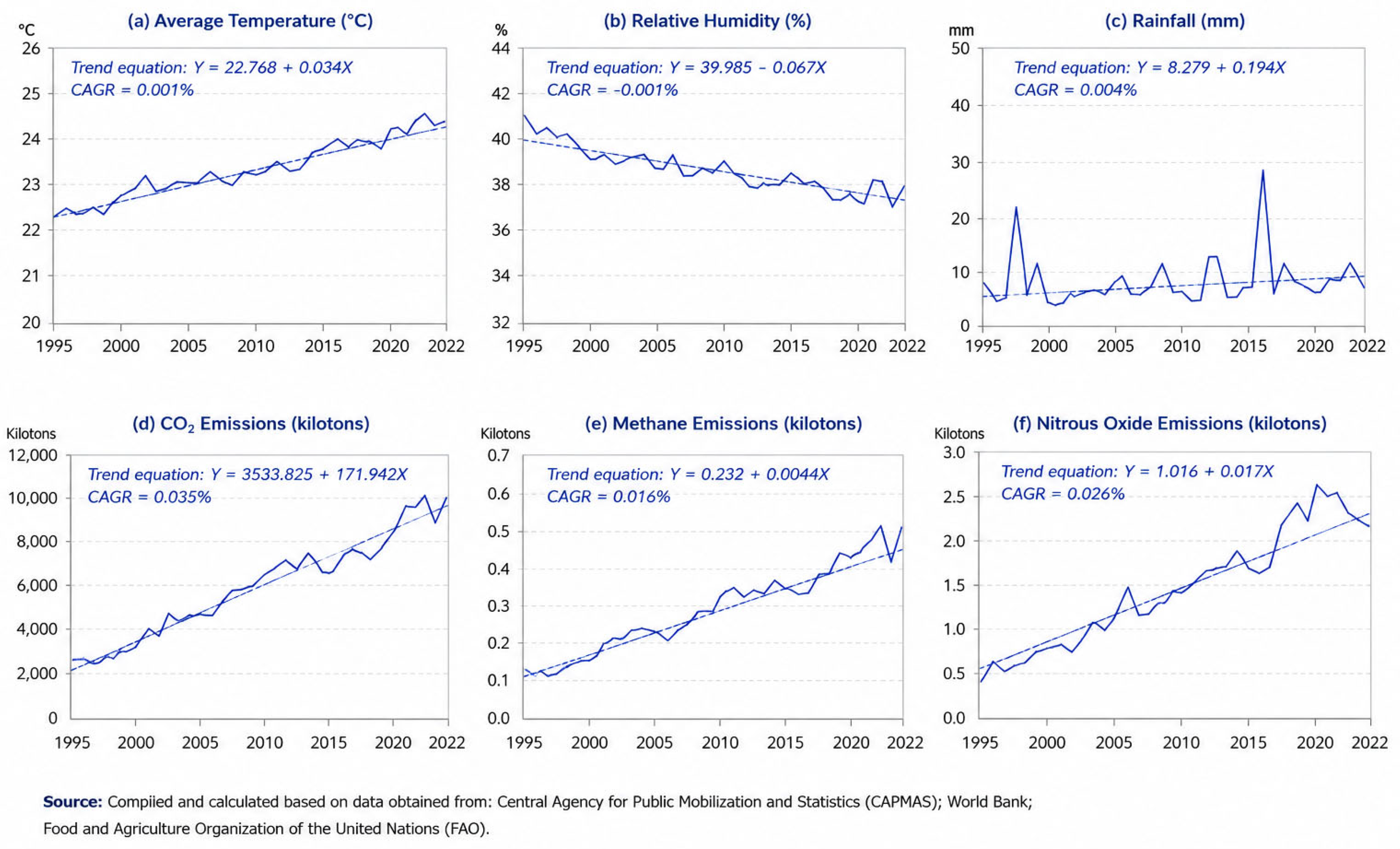
The study also contributes by providing an empirical assessment of the relationship between climate change indicators and fish foreign trade indicators in Egypt during the period of 1995–2022. In this regard, the study integrates climate variables, including average surface air temperature, relative humidity, rainfall, carbon dioxide emissions, methane emissions, and nitrous oxide emissions, with fish trade indicators within a unified analytical framework.
The theoretical foundation of this study is based on the assumption that climate change affects fish foreign trade through multiple direct and indirect transmission channels. Rising temperatures, changes in rainfall patterns, and increasing greenhouse gas emissions influence fish productivity, water quality, production costs, and the sustainability of fisheries resources. These environmental changes subsequently affect export competitiveness, import dependence, trade balance performance, and the overall stability of fish foreign trade. Accordingly, the empirical framework of the current study incorporates climate indicators and fish trade indicators within an integrated ARDL model to evaluate both short-run and long-run relationships.
Methodologically, the study applies the Autoregressive Distributed Lag (ARDL) model to investigate both short-run and long-run relationships between climate change variables and fish foreign trade performance. The use of the ARDL approach allows the estimation of dynamic relationships among variables with different orders of integration and enables the identification of long-run equilibrium relationships between climate indicators and fish trade variables.
In addition, the study contributes to the sustainability and fisheries economics literature by providing evidence on how climate change may influence the performance and competitiveness of the fish trade sector in Egypt. The findings may support policymakers in designing climate-adaptive strategies aimed at improving fisheries sustainability, strengthening export performance, reducing trade vulnerabilities, and enhancing food security under changing climatic conditions.
2.2. Research Significance
The significance of this study lies in its examination of the interaction between climate change and Egypt’s fish foreign trade, a critical nexus where environmental, economic, and strategic dimensions intersect. From an environmental perspective, the fisheries sector is among the most vulnerable to changes in temperature, water salinity, and sea level rise, all of which directly affect the availability and quality of fish stocks [
29]. Economically, fish foreign trade represents an important source of foreign exchange earnings and contributes to narrowing the food gap. However, climate variability may weaken export competitiveness and increase dependence on imports [
1]. At the strategic level, the importance of this research is reinforced by its alignment with Egypt’s Vision 2030, which places food security and the sustainability of natural resources at the core of its development agenda. Accordingly, analyzing this relationship is essential for guiding future policy formulation [
4].
2.3. Research Problem
The research problem centers on examining how climate change affects the performance of Egypt’s fish foreign trade. Although the fisheries sector constitutes a key pillar of food security and an important component of Egypt’s balance of payments, it faces increasing challenges due to climate change. Climatic phenomena such as rising temperatures, increasing water salinity, and changes in ocean current patterns have led to a decline in fish productivity in certain coastal areas. This has negatively affected domestic supply and weakened Egypt’s competitiveness in international markets [
30]. In addition, these changes have increased reliance on fish imports to meet the food gap, thereby exerting additional pressure on the trade balance [
1]. Accordingly, the central research question can be formulated as follows: How does climate change affect Egypt’s fish foreign trade?
2.4. Research Objectives
This study aims to achieve the following objectives:
To measure the impact of climate change on the performance of fish foreign trade in Egypt.
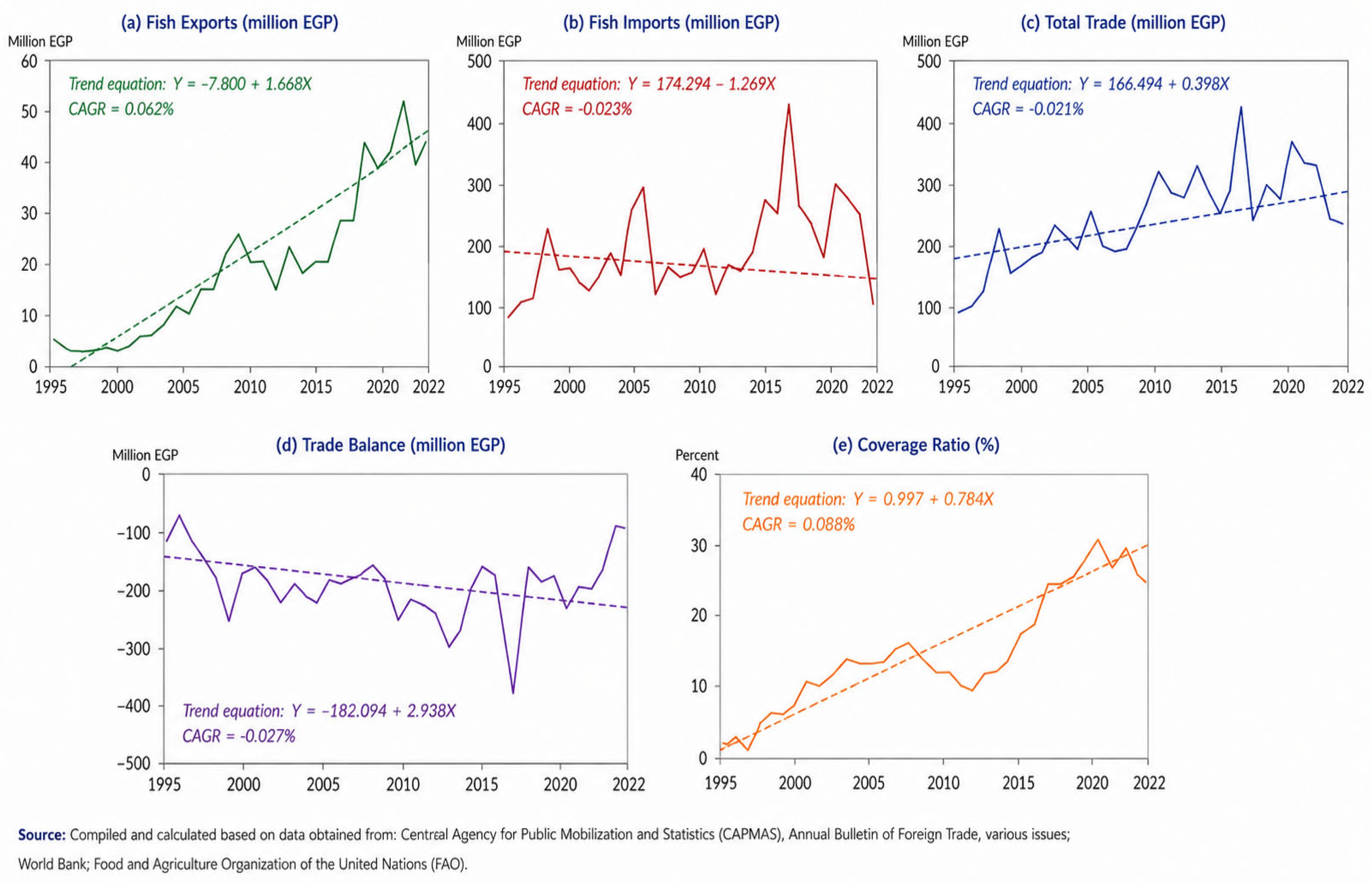
To examine and analyze the development of the following variables: average surface air temperature, relative humidity, rainfall, carbon dioxide emissions, methane emissions, nitrous oxide emissions, the value of Egyptian fish exports, the value of fish imports, total trade volume, the fish trade balance, and the export to import coverage ratio over the period from 1995 to 2022.
To conduct an econometric analysis of the relationship between climate change and fish foreign trade in Egypt during the period of 1995 to 2022 using the Autoregressive Distributed Lag model.
To estimate and analyze the responsiveness of fish foreign trade in Egypt to climate change, and to determine whether a long-run relationship exists between them.
8. Discussion
The findings of the current study provide important empirical evidence regarding the relationship between climate change and the performance of Egypt’s fish foreign trade during the period of 1995–2022. The results generally indicate that climate variables affect fish trade performance both directly and indirectly through their influence on environmental quality, fisheries productivity, production costs, and market competitiveness. Overall, the estimated ARDL models reveal that climate impacts on Egypt’s fish trade sector are more pronounced in the short run, while limited evidence of long-run equilibrium relationships was identified, except in the fish export model.
The long-run estimation results for fish exports demonstrate that nitrous oxide emissions exert a statistically significant negative effect on export performance. This finding is consistent with previous studies emphasizing the adverse effects of environmental degradation and greenhouse gas emissions on fisheries productivity and trade competitiveness [
19,
23,
24]. Higher greenhouse gas emissions contribute to water quality deterioration, ecological stress, and reduced sustainability of aquatic ecosystems, which may weaken the productive and export capacities of fisheries sectors over time. Similar conclusions were reported in Mediterranean and developing-country studies, which found that climate-related environmental stress negatively affects fisheries sustainability and export performance [
26,
27].
The results also indicate that rainfall represents the most influential short-run climatic variable affecting fish exports, fish imports, and total fish trade volume. The positive short-run effect of rainfall on exports may reflect improvements in environmental and hydrological conditions that support fisheries productivity and aquaculture activities. This finding is consistent with studies suggesting that favorable climatic conditions and improved water availability may enhance fish production and market supply in the short term [
25,
31]. At the same time, the short-run fluctuations observed in imports and trade balance indicators confirm that climate variability may generate temporary disturbances in domestic supply conditions, thereby affecting import demand and trade performance.
Another important finding concerns the absence of cointegration relationships in the fish imports, total trade volume, and fish trade balance models. This result suggests that climate change does not exert a stable long-run equilibrium effect on these trade indicators, but rather influences them through temporary and dynamic adjustments associated with production conditions, domestic market fluctuations, transportation costs, and short-term supply constraints. This interpretation partially agrees with previous studies indicating that climate variability affects food imports and trade systems indirectly through its effects on production efficiency, food availability, and market stability [
23,
26]. The findings also support the argument that developing countries remain highly vulnerable to climate-induced trade fluctuations due to their dependence on climate-sensitive production systems and limited adaptive capacities [
12,
27].
The results further highlight the particular importance of Egypt as a case study within the climate change and fisheries literature. Egypt’s fisheries sector depends heavily on aquaculture systems that are highly sensitive to water quality, temperature changes, salinity levels, and environmental degradation. At the same time, the fish trade has become increasingly important for food security, export diversification, and narrowing the domestic food gap. Consequently, climate-related environmental pressures may simultaneously affect both production systems and trade competitiveness. This finding aligns with previous studies emphasizing the vulnerability of Mediterranean and Nile Delta fisheries systems to climate-related environmental risks, including sea-level rise, warming temperatures, and water resource pressures [
28,
29,
30,
31,
32].
From a sustainability perspective, the results indicate that the gradual improvement observed in fish exports and export coverage ratios may reflect the adaptive capacity of Egypt’s fisheries and aquaculture sector despite increasing climatic pressures. The expansion of aquaculture production, improvements in production technologies, and the development of export-oriented systems may have partially mitigated some negative climate effects. However, the continuing increase in greenhouse gas emissions and environmental pressures remains a significant long-term challenge for fisheries sustainability and trade resilience. These findings support the growing international literature emphasizing that climate change should not be viewed solely as an environmental issue, but also as a major economic and trade-related challenge affecting food security, resource sustainability, and external sector performance in developing economies.
9. Conclusions
This study examined the impact of climate change on the performance of Egypt’s fish foreign trade during the period of 1995–2022 using the Autoregressive Distributed Lag (ARDL) approach. The analysis incorporated major climate indicators, including temperature, rainfall, relative humidity, and greenhouse gas emissions, together with fish trade indicators represented by exports, imports, total trade volume, trade balance, and export coverage ratio.
The empirical findings indicate that climate change exerts heterogeneous effects on the different dimensions of Egypt’s fish foreign trade. The results confirmed the existence of a long-run equilibrium relationship only in the fish exports model, suggesting that export performance is structurally associated with climate and environmental conditions over time. In contrast, no long-run cointegration relationship was identified for fish imports, total trade volume, or fish trade balance, indicating that these indicators are mainly influenced by short-run market dynamics and temporary climatic fluctuations.
At the short-run level, rainfall emerged as the most influential climatic variable affecting fish trade indicators, while nitrous oxide emissions showed a statistically significant negative long-run effect on fish exports. These findings suggest that climate change affects fish trade indirectly through its influence on fisheries productivity, environmental quality, production efficiency, and trade competitiveness. The results also demonstrate that the fisheries sector in Egypt remains highly sensitive to environmental and climatic pressures despite the gradual improvements observed in export performance and coverage ratios during the study period.
The study contributes to the growing literature on climate change and fisheries economics by extending the analysis beyond fisheries production to examine fish foreign trade performance within an integrated econometric framework. The findings provide empirical evidence on how climate variables influence exports, imports, trade balance performance, and trade sustainability in the context of a developing economy highly dependent on climate-sensitive production systems. From a policy perspective, the findings highlight the importance of integrating climate adaptation and environmental sustainability into fisheries and trade policies. Strengthening climate-resilient aquaculture systems, improving water-use efficiency, reducing environmentally harmful emissions, and enhancing trade infrastructure and export competitiveness are essential for improving the long-run sustainability and resilience of Egypt’s fisheries sector under changing climatic conditions.
Despite its contributions, the study is subject to several limitations. The analysis relied on annual time-series data, which may limit the ability to capture short-term climatic fluctuations and seasonal variations. In addition, the estimated models focused primarily on climate indicators and did not incorporate some institutional, technological, and international market variables that may also influence fish trade performance.
Future research may extend the current analysis by employing panel data for multiple countries, incorporating institutional and governance variables, and applying alternative econometric approaches capable of capturing nonlinear and asymmetric climate effects on fisheries trade. Further studies may also examine the implications of climate change for specific fisheries subsectors and regional export markets.




 ,
,