Industrial Symbiosis Synergies: A Pathway to Sustainable and Future Circular Economies
 , , and
Abstract
1. Introduction: Economic Perspectives on Industrial Symbiosis
2. Literature Review
2.1. From Linear Economy to Circular Economy Through IS
2.2. Circular Economy and Its Evolution
2.3. IS Contribution of the Circular Economy
3. Data and Methods
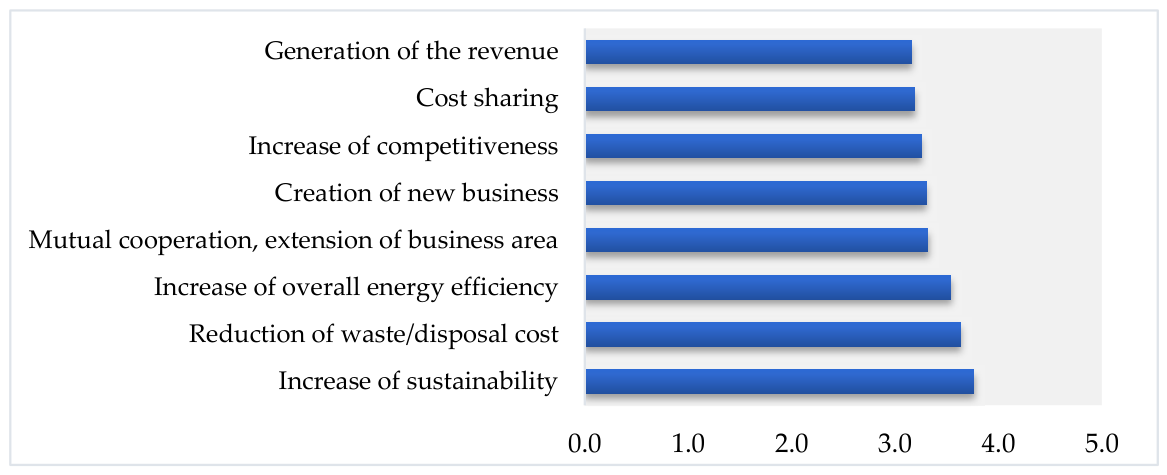
- Economic and business drivers: The survey asks respondents to rate their expectations regarding the expected economic benefits of IS implementation, including waste reduction, cost savings, improved competitiveness, sustainability, and new business opportunities. These questions provide useful insights regarding IS as an economic driver.
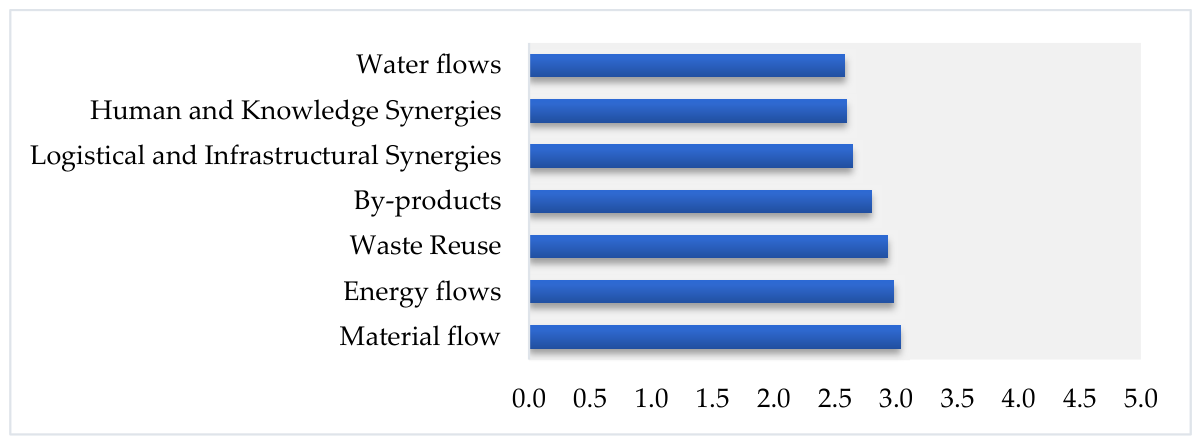
- Actors and synergies: The methodological approach highlights the importance of main actors by evaluating their involvement levels among internal company actors, industry partners, and public institutions. Moreover, synergies between resources are assessed regarding material, energy, water, by-products, logistics, and knowledge flows, reflecting the multidimensional nature of IS.
- Technologies and tools: A special section is concerned with the implementation of process, digital, and ICT technologies, as well as innovations in quality regarding by-products. This provides information on the technological level of the industries and technology gaps.
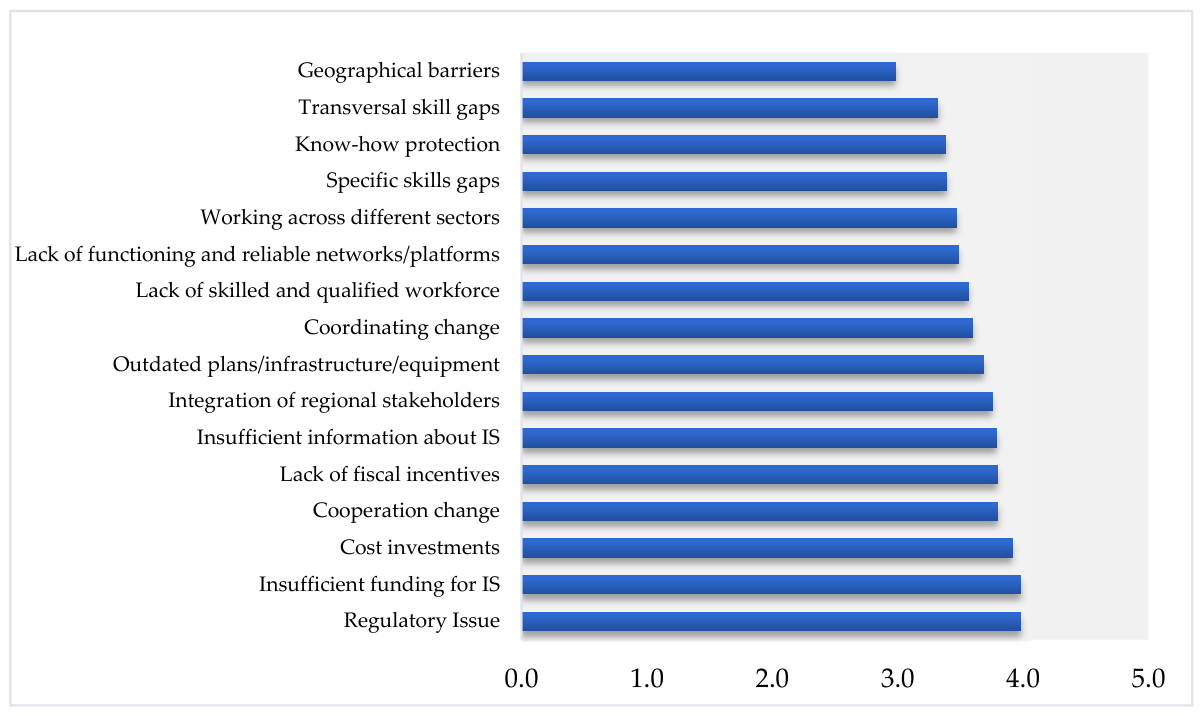
- Barriers and challenges: The survey also covers structural challenges from a systematic point of view, including funding, regulations, awareness, and cooperation. The role of fiscal, regulatory, organizational, and geographic barriers is also assessed. This provides a multilayered view of systemic inefficiencies.
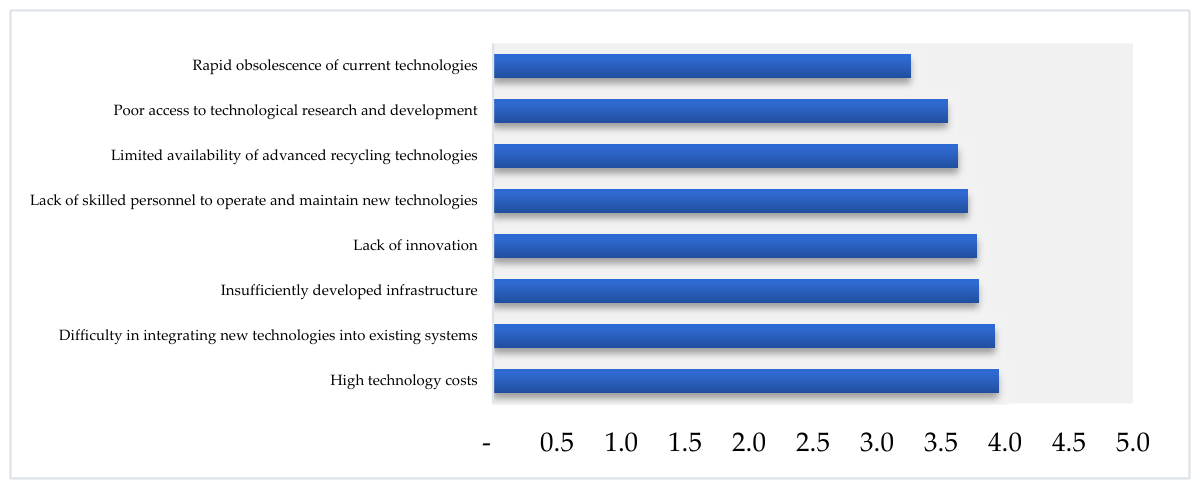
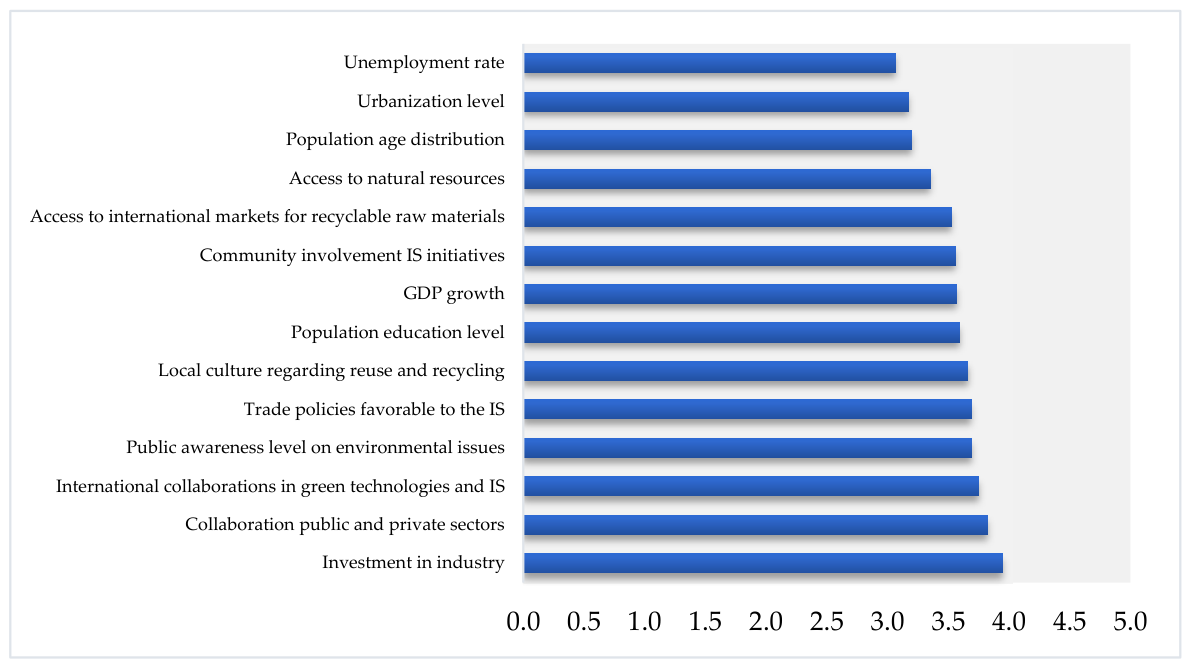
- Technological and socio-economic conditions: The technological barriers of high technology, low R&D infrastructure, and a lack of qualified personnel are analyzed, as well as socio-economic aspects including GDP growth, unemployment rates, educational levels, and cultural aspects regarding reuse and recycling. This provides a multilayered view of IS performance.
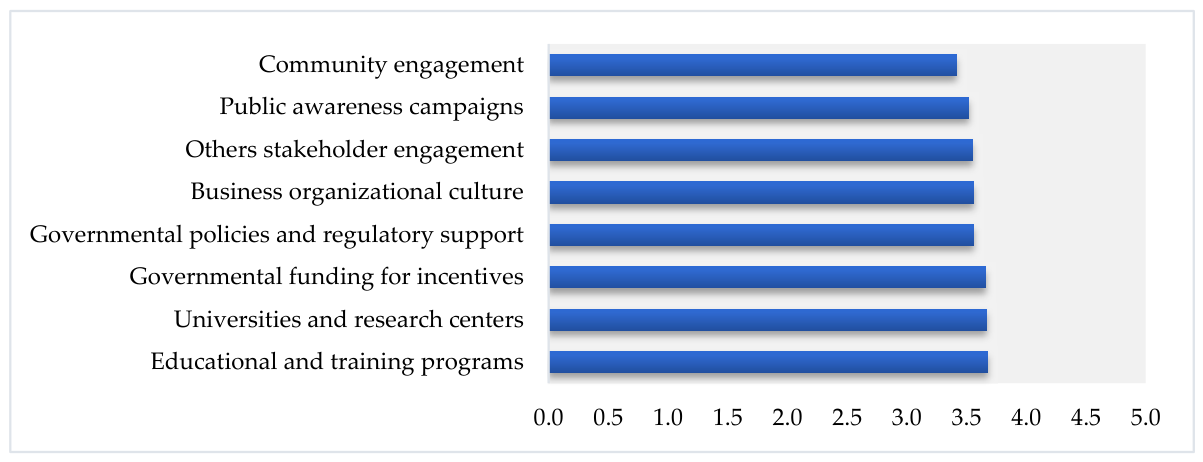
- Awareness and institutional support: The influence of awareness conditions such as governmental policies, funding schemes, educational initiatives, and community engagement. These indicators help assess the institutional ecosystem and its capacity to sustain IS initiatives.
4. Results and Discussion
5. Conclusions
Author Contributions
Funding
Institutional Review Board Statement
Informed Consent Statement
Data Availability Statement
Conflicts of Interest
References
- OECD. Global Material Resources Outlook to 2060: Economic Drivers and Environmental Consequences; OECD Publishing: Paris, France, 2019. [Google Scholar]
- Astuti, R.S.D.; Astuti, A.D.; Hadiyanto. Preliminary design of industrial symbiosis of SMEs using material flow cost accounting (MFCA). E3S Web Conf. 2018, 73, 04008. [Google Scholar] [CrossRef]
- Sun, Y.; Li, Y.; Ning, J.; Fu, H.; Liu, F.; Feng, Z.; Liu, G.; Shi, L. Twelve pathways of carbon neutrality for industrial parks. J. Clean. Prod. 2024, 437, 140753. [Google Scholar] [CrossRef]
- Sgambaro, L.; Gamberini, R.; Rimini, B.; Mora, C. Exploring industrial symbiosis for circular economy: A content analysis of implementation variables. Manag. Decis. 2024. [Google Scholar] [CrossRef]
- Laatsit, M.; Johansson, G. Fostering industrial symbiosis in process industries: An innovation policy perspective. Environ. Technol. Innov. 2025, 37, 104027. [Google Scholar] [CrossRef]
- Liu, J.; Qian, Y.; Song, S.-F.; Duan, R.-R. Industrial symbiotic agglomeration and green economic growth: A spatial difference-in-differences approach. J. Clean. Prod. 2022, 364, 132560. [Google Scholar] [CrossRef]
- Hossain, M.; Al Aziz, R.; Karmaker, C.L.; Debnath, B.; Bari, A.B.M.M.; Islam, A.R.M.T. Exploring the barriers to implement industrial symbiosis in the apparel manufacturing industry: Implications for sustainable development. Heliyon 2024, 10, e34156. [Google Scholar] [CrossRef]
- European Environment Agency. Paving the Way for a Circular Economy: Insights on Status and Potentials; EEA Report No. 11/2019; European Environment Agency: Copenhagen, Denmark, 2019; Available online: https://www.eea.europa.eu/publications/circular-economy-in-europe-insights (accessed on 30 March 2026).
- Sanz-Torró, V.; Calafat-Marzal, C.; Guaita-Martinez, J.M.; Vega, V. Assessment of European countries’ national circular economy policies. J. Environ. Manag. 2025, 373, 123835. [Google Scholar] [CrossRef]
- Chertow, M. Industrial symbiosis: Literature and taxonomy. Annu. Rev. Environ. Resour. 2000, 25, 313–337. [Google Scholar] [CrossRef]
- Clift, R.; Druckman, A. Taking Stock of Industrial Ecology; Springer: Berlin/Heidelberg, Germany, 2015. [Google Scholar]
- Marciniuk-Kluska, A.; Kluska, M. An attempt to assess the implementation of the circular economy in the EU-27 as an important element of sustainable development. Sustainability 2025, 17, 4942. [Google Scholar] [CrossRef]
- Yilmaz, O.; Yontem, E.; Alkaya, E. Industrial Symbiosis Indicators; H2020-WASTE-2014-two-stage, Ref. Ares (2016) 5432278-19/09/2016; European Commission: Bruxelles, Belgium, 2016; Available online: https://ec.europa.eu/research/participants/documents/downloadPublic?documentIds=080166e5ace5dfaf&appId=PPGMS (accessed on 30 March 2026).
- Kantor, I.; Bütün, H.; Robineau, J.; Maqbool, S.; Zwaenepoel, B.; Norbert, R.; Arias, S.; Cervo, H.; Wolf, F.; Santecchia, A. Long- and short-lists of key performance indicators in industry and for industrial symbiosis. Authorea 2019. [Google Scholar] [CrossRef]
- Arruda, E.H.; Melatto, R.A.P.B.; Levy, W.; Conti, D.M. Circular economy: A brief literature review (2015–2020). Sustain. Oper. Comput. 2021, 2, 79–86. [Google Scholar] [CrossRef]
- Lamba, H.K.; Kumar, N.S.; Dhir, S. Circular economy and sustainable development: A review and research agenda. Int. J. Prod. Perform. Manag. 2024, 73, 497–522. [Google Scholar] [CrossRef]
- Ellen MacArthur Foundation. Circular Economy Systems Diagram. 2019. Available online: https://www.ellenmacarthurfoundation.org/topics/circular-economy-introduction/overview (accessed on 30 March 2026).
- Sihvonen, S.; Ritola, T. Conceptualizing ReX for aggregating end-of-life strategies in product development. Procedia CIRP 2015, 29, 639–644. [Google Scholar] [CrossRef]
- Streimikiene, D.; Mikalauskiene, A.; Burbaite, G. The role of sustainable finance in achieving sustainable development goals. Econ. Sociol. 2023, 16, 271–298. [Google Scholar] [CrossRef]
- Eisenreich, A.; Füller, J.; Stuchtey, M.; Gimenez-Jimenez, D. Toward a circular value chain: Impact of the circular economy on a company’s value chain processes. J. Clean. Prod. 2022, 378, 134375. [Google Scholar] [CrossRef]
- Nainggolan, D.; Pedersen, A.; Smed, S.; Zemo, K.H.; Hasler, B.; Termansen, M. Consumers in a circular economy: Economic analysis of household waste sorting behaviour. Ecol. Econ. 2019, 166, 106402. [Google Scholar] [CrossRef]
- European Environment Agency (EEA). Seasonal Climate Services for Energy Demand and Renewable Generation in Europe; European Environment Agency: Copenhagen, Denmark, 2024; Available online: https://www.eea.europa.eu/ (accessed on 30 March 2026).
- Zioło, M.; Bąk, I.; Spoz, A. Theoretical framework of sustainable value creation by companies. What do we know so far? Corp. Soc. Responsib. Environ. Manag. 2023, 30, 2344–2361. [Google Scholar] [CrossRef]
- Ehrenfeld, J.; Gertler, N. Industrial ecology in practice: The evolution of interdependence at Kalundborg. J. Ind. Ecol. 2008, 1, 67–79. [Google Scholar] [CrossRef]
- Park, J.M.; Park, J.Y.; Park, H.-S. A review of the national eco-industrial park development program in Korea: Progress and achievements in the first phase (2005–2010). J. Clean. Prod. 2016, 114, 33–44. [Google Scholar] [CrossRef]
- Mirata, M.; Lindfors, A.; Kambanou, M.L. A business value framework for industrial symbiosis. J. Ind. Ecol. 2024, 28, 1541–1553. [Google Scholar] [CrossRef]
- Wadström, C.; Johansson, M.; Wallén, M. A framework for studying outcomes in industrial symbiosis. Renew. Sustain. Energy Rev. 2021, 151, 111526. [Google Scholar] [CrossRef]
- Wu, J.; Qi, H.; Wang, R. Insight into industrial symbiosis and carbon metabolism from the evolution of the iron and steel industrial network. J. Clean. Prod. 2016, 135, 251–262. [Google Scholar] [CrossRef]
- Qu, W.; Zhang, Y.; Kong, L. Promoting industrial symbiosis: Does the synergistic drive of innovation and domestic demand work? Evidence from listed enterprises in China. Sustainability 2025, 17, 165. [Google Scholar] [CrossRef]
- Giacometti, A.; Kāle, M.; Berlina, A. Industrial Symbiosis—An End or a Means? Nordregio-INTERREG: Vilnius, Lithuania, 2025. [Google Scholar]
- Zhu, Y.; Dawande, M.; Gavirneni, N.; Jayaraman, V. Industrial symbiosis: Impact of competition on firms’ willingness to implement. IISE Trans. 2020, 53, 897–913. [Google Scholar] [CrossRef]
- Fric, U.; Levnajić, Z.; Modic, D.; Rončević, B. Industrial symbiosis networks supporting circularity: Understanding complexity, cyclicality and resilience. Environ. Technol. Innov. 2025, 37, 104026. [Google Scholar] [CrossRef]
- Oughton, C.; Kurup, B.; Anda, M.; Ho, G. Industrial symbiosis—Recommendations on a business framework conducive for successful industrial symbiosis at the Kwinana industrial area. Renew. Energy Environ. Sustain. 2023, 8, 20. [Google Scholar] [CrossRef]
- Mironova, D.Y.; Pashkova, E.A.; Budrin, A.G.; Baranov, I.V.; Varadarajan, V.; Afrifa, S. Enhancing university innovation through industrial symbiosis. J. Compr. Bus. Adm. Res. 2025, 2, 2. [Google Scholar] [CrossRef]
- Zhang, Y.; Zheng, H.; Chen, B.; Su, M.; Liu, G. A review of industrial symbiosis research: Theory and methodology. Front. Earth Sci. 2015, 9, 91–104. [Google Scholar] [CrossRef]
- Verbeek, M. A Guide to Modern Econometrics, 5th ed.; John Wiley & Sons, Ltd.: New York, NY, USA, 2017. [Google Scholar]
- Wooldridge, J.M. Introductory Econometrics: A Modern Approach, 7th ed.; South-Western Cengage Learning: Boston, MA, USA, 2020. [Google Scholar]



| Abbreviation | Type of Variable | Description of the Variable |
|---|---|---|
| IIS | Dependent | Indicator of the main resource synergies (industrial symbiosis) represented by the question: “What is the level of the main resource synergies involved in the application of practices of industrial symbiosis in your country? (1 = very low, 5 = very high)” {is an average indicator of the perception level of synergies (scale 1 to 5): material flow; energy flows; water flows; waste reuse; by-products; logistical and infrastructural synergies; and human and knowledge synergies}. |
| IEB | Independent | Indicator of the economic benefits, represented by the question “What is the level of the expected economic benefits for the businesses from the application of practices of IS in your country? (1 = very low, 5 = very high)” {is an average indicator of the reduction of waste/disposal cost; increase in sustainability; increase in competitiveness; increase in overall energy efficiency; creation of new business; generation of revenue; mutual cooperation, extension of business area; and cost sharing}. |
| IAI | Independent | Indicator of the actor’s involvement represented by the question “What is the level of the main actors involved for the IS implementation in your country? (1 = very low, 5 = very high)” {is an average indicator of the internal actors of the company (e.g., Operation Manager, Technical Manager, Quality Manager, etc.); industrial actors (e.g., financial partners, other industries in various sectors, etc.); and public actors (e.g., local agencies, public parties, etc.)}. |
| IB | Independent | Indicator of the barriers, represented by the question “Assess the degree of impact of barriers to IS implementation in your country (1 = not important, less important, 5 = very important)” {is an average indicator of the insufficient funding for IS; lack of fiscal incentives; integration of regional stakeholders; cost investments; regulatory issue; outdated plans/infrastructure/equipment; cooperation change; insufficient information about industrial symbiosis; coordinating change; geographical barriers; transversal skill gaps; working across different sectors; lack of functioning and reliable networks/platforms; know-how protection; specific skills gaps; and lack of skilled and qualified workforce}. |
| IESC | Independent | Indicator of the economic and social conditions, represented by the question “How do you evaluate the impact of the following economic and social conditions on the efficiency of the IS in your country? (1 = very negatively, 5 = very positively)” {is an average indicator of GDP growth; investment in industry; unemployment rate; collaboration public and private sectors; population education level; population age distribution; urbanization level; public awareness level on environmental issues; community involvement is initiatives; local culture regarding reuse and recycling; access to international markets for recyclable raw materials; trade policies favorable to the IS; international collaborations in green technologies and industrial symbiosis; access to natural resources; and transport and logistics infrastructure}. |
| IAT | Independent | Indicator of the awareness and training, represented by the question “How do you evaluate the impact of the following awareness conditions on the IS implementation in your country? (1 = very negatively, 5 = very positively)” {is an average indicator of the governmental policies and regulatory support; governmental funding for incentives; universities and research centers; educational and training programs; public awareness campaigns; community engagement; business organizational culture; and other stakeholder engagements}. |
| Ln(IIS) | Ln(IEB) | Ln(IAI) | Ln(IB) | Ln(IESC) | Ln(IAT) | Mean | Standard Deviation | |
|---|---|---|---|---|---|---|---|---|
| Ln(IIS) | 1.00 | 1.04 | 0.30 | |||||
| Ln(IEB) | 0.51 * | 1.00 | 1.23 | 0.21 | ||||
| Ln(IAI) | 0.65 * | 0.32 | 1.00 | 1.07 | 0.31 | |||
| Ln(IB) | −0.44 * | −0.01 | −0.31 | 1.00 | 1.28 | 0.14 | ||
| Ln(IESC) | 0.28 | 0.01 | 0.33 | 0.25 | 1.00 | −0.29 | 0.62 | |
| Ln(IAT) | −0.11 | −0.42 ** | −0.17 | 0.22 | 0.09 | 1.00 | 0.18 | 0.31 |
| Dependent Variable: Ln(IIS) | Coefficient | t-Statistic | Prob. |
|---|---|---|---|
| Independent Variables | |||
| Constant | 1.088342 | 2.702952 | 0.0115 |
| Ln(IEB) | 0.711286 | 4.157901 | 0.0003 |
| Ln(IAI) | 0.274585 | 2.204608 | 0.0359 |
| Ln(IB) | −0.956361 | −3.833733 | 0.0007 |
| Ln(IESC) | 0.135476 | 2.297321 | 0.0293 |
| Ln(IAT) | 0.220494 | 1.942919 | 0.0621 |
| R-squared | 0.702000 | ||
| Adjusted R-squared | 0.648786 | ||
| F-statistic | 13.19197 | 0.000001 |
| The Test | Null Hypothesis | Test Result | Decision | |
|---|---|---|---|---|
| Statistics | Probability | |||
| Model function: Ramsey RESET test | H0: “the model function is appropriate (logarithm form) | F-statistic = 0.8245 | 0.2753 | H0 is not rejected |
| Multicollinearity: VIF test (Variance Inflation Factors) | H0: “model has not multicollinearity {Cov(ɛi; ɛj) = 0 and Cov(xi; xj) = 0 for each i ≠ j}” | Centered VIF < 10 | — | H0 is not rejected |
| Autocorrelation: LM test (Breusch–Godfrey) | H0: “model has not autocorrelation {Cov(ɛi; ɛi = I − p) = 0 for p = 1, 2, 3, 4}” | Chi-squared = 0.2160 | 0.8976 | H0 is not rejected |
| Heteroskedasticity: Breusch–Pagan–Godfrey | H0: “model has not heteroskedasticity {E(ɛi2) = constant}” | F-statistic = 3.1391 | 0.6785 | H0 is not rejected |
| Normality of the residual distribution ɛi: Jarque–Bera test | H0: “the residual {ɛi} of the model has normality distribution” | Chi-squared = 2.4163 | 0.2987 | H0 is not rejected |
Disclaimer/Publisher’s Note: The statements, opinions and data contained in all publications are solely those of the individual author(s) and contributor(s) and not of MDPI and/or the editor(s). MDPI and/or the editor(s) disclaim responsibility for any injury to people or property resulting from any ideas, methods, instructions or products referred to in the content. |
© 2026 by the authors. Licensee MDPI, Basel, Switzerland. This article is an open access article distributed under the terms and conditions of the Creative Commons Attribution (CC BY) license.
Share and Cite
Lleshaj, L.; Puche, A.M.; Shahini, B.; Kasumovic, M.; Zani, B.; Shapkova Kocevska, K. Industrial Symbiosis Synergies: A Pathway to Sustainable and Future Circular Economies. Sustainability 2026, 18, 5602. https://doi.org/10.3390/su18115602
Lleshaj L, Puche AM, Shahini B, Kasumovic M, Zani B, Shapkova Kocevska K. Industrial Symbiosis Synergies: A Pathway to Sustainable and Future Circular Economies. Sustainability. 2026; 18(11):5602. https://doi.org/10.3390/su18115602
Chicago/Turabian StyleLleshaj, Llesh, Almudena Muñoz Puche, Besa Shahini, Merim Kasumovic, Blisard Zani, and Katerina Shapkova Kocevska. 2026. "Industrial Symbiosis Synergies: A Pathway to Sustainable and Future Circular Economies" Sustainability 18, no. 11: 5602. https://doi.org/10.3390/su18115602
APA StyleLleshaj, L., Puche, A. M., Shahini, B., Kasumovic, M., Zani, B., & Shapkova Kocevska, K. (2026). Industrial Symbiosis Synergies: A Pathway to Sustainable and Future Circular Economies. Sustainability, 18(11), 5602. https://doi.org/10.3390/su18115602