Article

Assessing Mangrove Recovery Dynamics and Replacement Cost Estimates for Sustainable Coastal Management Using a Multi-Temporal Remote Sensing and GEP Accounting Framework in Dongzhai Harbor, China


1
School of Ecology, Hainan University, Haikou 570228, China
2
Hainan Baoting Tropical Forest Ecosystem Observation and Research Station, School of Ecology, Hainan University, Haikou 570228, China
*
Authors to whom correspondence should be addressed.
Sustainability 2026, 18(11), 5594; https://doi.org/10.3390/su18115594
Submission received: 30 March 2026 / Revised: 16 May 2026 / Accepted: 21 May 2026 / Published: 2 June 2026
(This article belongs to the Section Development Goals towards Sustainability)

Abstract

As coastal communities face escalating climate risks driven by climate change and biodiversity loss, integrating mangrove ecosystems into sustainability-oriented governance frameworks spanning ecological conservation, climate adaptation, and natural capital accounting has become a global priority. However, quantifying their protection values based on spatiotemporal shoreline dynamics under extreme disturbance remains challenging. Focusing on Dongzhai Harbor (China), this study integrates multi-temporal remote sensing (2010–2021), shoreline evolution analysis, and the Replacement Cost Method to assess ecosystem resilience against Super Typhoon Rammasun in 2014. Results show mangroves exhibited substantial post-disturbance resilience, with only 6.10% area loss following Typhoon Rammasun and 46% natural recovery within six years. Bootstrap confidence intervals for the mangrove-shoreline association overlapped zero across all three temporal periods, indicating that the observational data do not support a statistically confirmed causal protection effect at the landscape scale. This finding underscores that spatially co-occurring ecosystem services do not automatically imply causation, reinforcing the need for empirically grounded valuation in sustainable land-use planning. Because mangroves naturally establish in sheltered environments, the observed spatial overlap between mangroves and the shoreline cannot be interpreted as direct evidence of causal shoreline stabilization. Based on this framework, the potential protection value reached 907.65 × 10⁴ CNY yr−1 across 32.57 km of weighted coastline aligned with mangroves. Notably, erosional segments contributed 50.5% of this value despite comprising only 27.3% of the length, indicating that the replacement-cost estimate is concentrated in erosional segments under the assumed parameters. While acknowledging the need for local biophysical validation and uncertainty analysis in scaling, these findings support integrating dynamic nature-based solutions into territorial planning and Gross Ecosystem Product accounting. The resulting valuation framework offers a replicable pathway for advancing multi-dimensional sustainability encompassing climate-adaptive coastal governance, natural capital integration, and evidence-based coastal spatial planning.

1. Introduction

Due to climate change and rising sea levels, coastal defense planning increasingly needs to consider both conventional engineering structures and Nature-based Solutions (NbSs). Hard structures, such as concrete seawalls, remain important coastal defense measures, but their construction and maintenance costs can be substantial, and their performance under extreme wave loading may require repair, reinforcement, or upgrading [1,2]. These considerations have increased interest in NbSs as complementary coastal adaptation measures. Among NbSs, mangroves are widely recognized for their capacity to attenuate waves and reduce flood exposure, with global assessments estimating substantial annual flood protection benefits worldwide [3].
To operationalize NbSs, international frameworks like the System of Environmental Economic Accounting–Ecosystem Accounting (SEEA-EA) have established global standards for ecosystem service valuation. In China, this framework has been localized as Gross Ecosystem Product (GEP) accounting and has been operationalized through mandatory accounting in 28 provincial pilots [4,5]. Despite these advances, current GEP practices often rely on static indicators of “shoreline stability.” Ouyang et al. (2020) [6] argue that this limitation may underestimate mangrove service value by 40–60% because it ignores dynamic ecological processes. Consequently, scholars have called for integrating resilience indices into GEP accounting to capture the “potential resilience value.” This concept reflects the capacity of ecosystems to contribute to protective functions under dynamic coastal conditions [7]. It specifically addresses how mangroves may provide potential cost-saving wave attenuation even in erosional segments. Field measurements demonstrate that mangrove forests can attenuate wave heights by 13–66% depending on forest width and density [8] and persist despite shoreline retreat, whereas artificial structures would require expensive reinforcement [9].
The Dongzhai Harbor Mangrove Nature Reserve (Hainan, China) serves as a critical reference site for these dynamics. Previous studies documented ecological processes in Dongzhai Harbor, such as mangrove rehabilitation impacts [10]. However, a prominent research gap remains in coupling these biological observations with economic valuation. Although previous research successfully quantified the role of mangroves in sheltering coastal economic activity [11], most assessments have focused on ecological structure and function, often stopping short of translating these dynamics into replacement cost estimates [12,13]. There is a lack of integrated frameworks that estimate the value of mangroves based on their observed persistence in high-energy zones, which leads to a significant undervaluation of their protective function.
This study addresses this gap by utilizing the 2010–2021 period as a natural experiment to characterize coastal resilience. This period encompasses Super Typhoon Rammasun (2014), which was the strongest typhoon to strike the region since 1970 [8]. Rammasun provides a unique “stress test”, which aligns with global assessments demonstrating that mangroves protect 18 million people annually from coastal flooding [14]. Directly comparing mangrove performance with engineered structures at this site is not possible without localized empirical engineering data from the same event. We therefore use engineered structures only as a replacement cost benchmark, not as a direct performance comparator [15,16,17]. This study focuses on the observed disturbance–recovery trajectory of mangroves in Dongzhai Harbor following Typhoon Rammasun and uses multi-temporal remote sensing to quantify how mangrove extent and shoreline dynamics co-occur over 2010–2021 [16]. The resulting valuation is interpreted as a potential protection value under explicit accounting assumptions, rather than as evidence that mangroves outperformed engineered coastal defenses during the typhoon [18].
Methodologically, this study differs from previous mangrove coastal protection valuation studies in three respects. First, it uses multi-temporal remote sensing to reconstruct the disturbance and recovery trajectory of mangrove extent from 2010 to 2021, rather than relying on a single static snapshot of ecosystem condition. Second, it quantifies the spatial adjacency between mapped mangrove extent and shoreline position at regular transect intervals so that mangrove-aligned shoreline length serves as the spatial quantity input for valuation. Third, because site-matched empirical data on engineered structure performance are unavailable, the replacement cost estimate is constructed as a GEP-oriented accounting proxy by combining literature-derived engineering cost parameters with spatially explicit mangrove coverage estimates. This proxy is intended to estimate potential protection value under stated assumptions, not to demonstrate the empirical superiority of mangroves over engineered coastal defenses.

2. Materials and Methods

2.1. Study Area

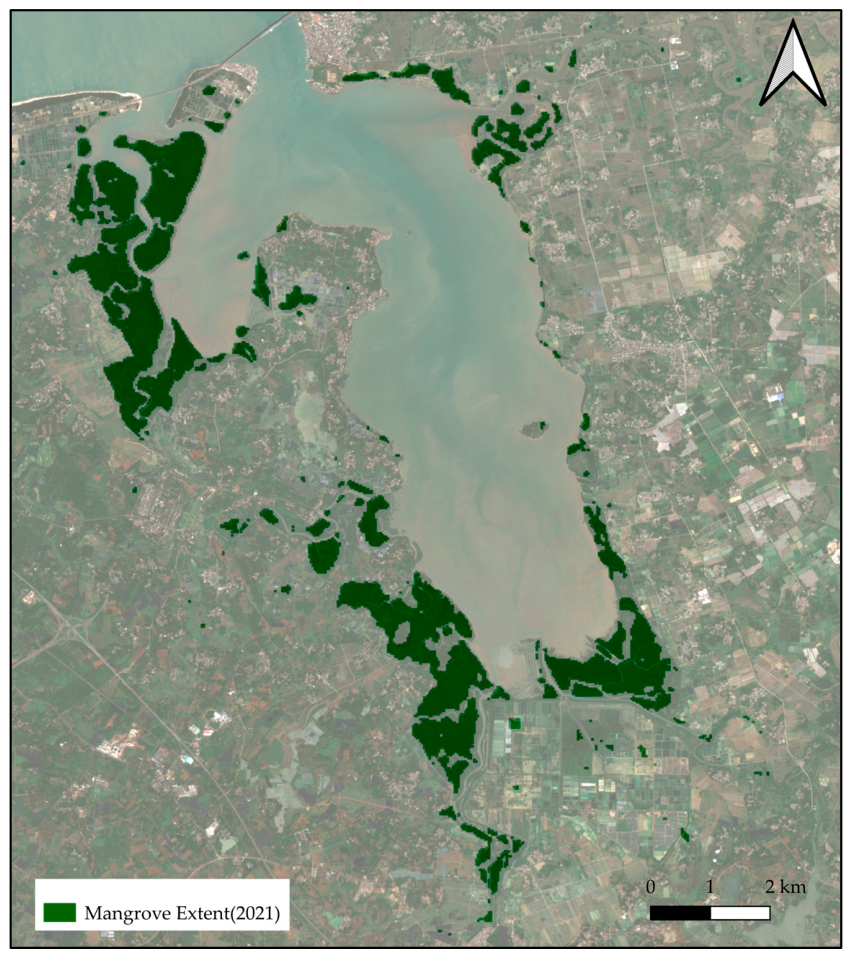
The study area is the Dongzhai Harbor Mangrove Nature Reserve in northeastern Hainan Island (19°51′–20°11′ N, 110°32′–110°44′ E) (Figure 1). The region is characterized by a tropical monsoon climate with a mean annual temperature of about 23–24 °C and annual precipitation of 1600–2000 mm. It features an irregular semidiurnal tidal regime with a microtidal range of about 1.6–2.3 m [19]. Mangroves are widely distributed within the reserve. The dominant species include Kandelia obovata, Bruguiera gymnorhiza, and Avicennia marina, making it one of the most typical and complete mangrove distribution areas in China [20,21]. Given its representativeness, Dongzhai Harbor is both an ideal area for monitoring coastal dynamics and an important sample site for assessing mangrove protective benefits and ecological value.

2.2. Data Sources and Preprocessing

2.2.1. Shoreline Data

To ensure temporal consistency with the mangrove data from Fu et al. [22], shoreline extraction was conducted for 2010, 2015, and 2021 using the same dry-season composite period (November–March). The extraction methodology followed Zhang et al. [23], employing water body index classifications applied to Landsat/Sentinel-2 imagery via the Google Earth Engine platform. Landsat 5 TM images (2010), Landsat 8 OLI images (2015), and Sentinel-2 MSI images (2021) were selected with time windows spanning one year before and after each target year. Cloud cover thresholds were set to 40% for 2010 (due to limited scene availability) and 30% for 2015 and 2021. All images underwent atmospheric correction and cloud masking using QA bands, with surface reflectance converted to physical units by sensor-specific scaling factors.
The Modified Normalized Difference Water Index (MNDWI) was calculated as:
M N D W I = Green SWIR 1 Green   +   SWIR 1
A multi-criterion water classification was applied: (1) MNDWI > −0.1, (2) NDVI < 0.2, and (3) NIR reflectance < 0.2. This multi-threshold approach minimizes confusion between water bodies and dark terrestrial features. The MNDWI threshold of −0.1 was validated against regional percentile distributions (P50 values ranged from 0.15 to 0.22 across all periods).
To reduce salt-and-pepper noise in the binary water mask, morphological filtering was applied using a circular kernel with 2-pixel radius (erosion followed by dilation, one iteration each) [24]. Connected component analysis then retained only water patches with at least 25 connected pixels (2.25 ha at 30 m resolution), filtering isolated misclassifications and small ponds. To separate coastal from inland water bodies, a 1000-m buffer zone was created around land areas (defined as JRC Global Surface Water occurrence frequency below 10%) [25,26], effectively discriminating natural coastal waters from aquaculture ponds and reservoirs without additional permanent water filtering. The filtered water mask was converted to vector format at 30 m resolution using 4-connectivity. For each period, only the largest water body polygon was retained, with coastlines extracted from the outer coordinate ring (index 0), excluding internal island boundaries. Final vectors were simplified with 10-m maximum error. To ensure spatial consistency across sensors, the Sentinel-2 composite (2021) was resampled from 10 m to 30 m resolution using mean aggregation after median composite generation but before MNDWI calculation, ensuring water index values represent conditions comparable to Landsat pixels [27].
Although the pixel size is 30 m, sub-pixel positioning accuracy is achievable through continuous threshold-based classification [28]. The MNDWI threshold (−0.1) defines the land-water boundary by capturing spectral gradients within mixed pixels, an approach distinct from using discrete pixel edges. During vectorization, the algorithm traces iso-value contours that can fall anywhere within pixels, enabling positioning accuracy (within a 20-m margin) finer than the nominal pixel resolution (30 m). This represents approximately 0.67 pixel units of precision, consistent with established principles in remote sensing coastline extraction [24].
The extracted coastline was validated using multiple independent methods. Visual comparison against 10-m Sentinel-2 imagery showed positional accuracy within a 20-m margin. Furthermore, cross-validation with an independent coastline dataset for Hainan Province produced an average difference of 15.3 m. Both validation metrics fell within the acceptable uncertainty range for 30-m resolution products [29]. The vertex density of extracted shorelines (20.2 points/km) preserved greater morphological detail compared to coarser reference datasets (0.2 points/km). Although absolute displacement magnitudes differed from reference data due to varying shoreline definitions (instantaneous waterline vs. high-tide line), applying consistent methodology across all years ensured reliable detection of relative trends and directional changes in coastal evolution [28]. The three extracted shoreline epochs, 2010, 2015, and 2021, constitute the sole shoreline dataset used in the subsequent coupling and valuation analyses. No 2020 shoreline dataset is used in the analytical framework. The independent coastline dataset is used only for accuracy assessment and does not enter the mangrove-shoreline coupling or valuation calculations.

2.2.2. Mangrove Reference and Validation Data

This study utilized the mangrove classification dataset published by Fu et al., which provides mangrove distribution on Hainan Island from 1991–2021 based on a residual U-Net (Res-UNet) deep-learning approach [22]. To assess typhoon impacts and recovery dynamics, mangrove distributions were extracted for three key periods. The 2010 data represent the pre-typhoon baseline. The 2015 data capture the post-Typhoon Rammasun state, one year following the July 2014 landfall. The 2021 data reflect the medium-term recovery state. All classifications were clipped to the Dongzhai Harbor extent (110.52° E–110.66° E, 19.89° N–20.03° N) using the standardized study boundary.
The coupling and valuation analyses use mangrove classifications from 2010, 2015, and 2021 together with shoreline data extracted for the same three years. The primary annualized flow estimate is based on two non-overlapping periods: 2010–2015 paired with the 2010 mangrove distribution, and 2015–2021 paired with the 2015 mangrove distribution. The 2010–2021 shoreline-change record paired with the 2021 mangrove distribution is retained only as a supplementary terminal-state scenario. Because this full-period record overlaps with the two sub-periods, it is excluded from the duration-weighted flow calculation [30]. Full details of this framework are provided in Section 2.5.1 and Section 2.6.1.
The 2021 mangrove classification reflects mangrove conditions spanning 2020–2021, making its pairing with the self-extracted 2021 shoreline effectively contemporaneous. This temporal offset concerns the mangrove classification reference period only and does not imply the use of a 2020 shoreline layer in the coupling or valuation analyses [22]. The 2021 classification therefore represents the post-recovery equilibrium state seven years after Rammasun, providing a conservative estimate of resilient protective capacity [31,32]. Supporting technical details are provided in the Supplementary Materials.

2.2.3. Typhoon Event Characterization

To contextualize mangrove disturbance patterns, we analyzed typhoon activity using the China Meteorological Administration (CMA) Best Track Dataset (2010–2021) [33,34]. The dataset provides 6-hourly records of typhoon positions, wind speeds, and central pressure. Typhoons passing within 300 km of Dongzhai Harbor (19.95° N, 110.59° E) were identified, and their intensity was classified using the Saffir-Simpson scale [35,36]. The minimum distance from each typhoon track to the study site was calculated using great-circle distance formulas.
During 2010–2021, 25 typhoons met the distance criterion, with 3 reaching Category 3 or higher intensity. Super Typhoon Rammasun (18 July 2014) was the most severe, making landfall approximately 20 km away with maximum winds of 72 m/s (Category 5). Typhoon activity was higher during 2010–2015, with 8 events including 2 Category 3 or above storms, compared to 7 events with 1 Category 3 or above storm during 2015–2021. This difference validates the rationale for the three-period design in assessing ecosystem responses to extreme disturbances (Figure S1).

2.3. Mangrove Classification Data and Accuracy Assessment

The mangrove distribution data for the study area were extracted from the island-wide remote sensing dataset developed by Fu et al. [22]. This dataset utilizes a Res-UNet deep-learning approach to map mangrove canopy cover, achieving an island-wide overall accuracy of 96.43% with a margin of error of 1.15%, based on held-out validation samples strictly separated from training data. This canopy-focused product directly reflects the structural extent of living mangroves relevant to coastal protection functions [37].
To assess local applicability within the study area, a spatial consistency assessment was conducted by overlaying the 2021 Res-UNet classification against a 2020 ground survey reference (102 patches, 2157.15 ha) derived from the same source dataset. This analysis resulted in a Precision (User’s Accuracy) of 95.2%, an Overall Accuracy of 95.5%, and an F1 Score of 70.8% with a Kappa of 0.685 (Table 1). The area-based confusion matrix underlying these metrics is presented in Table 2. Because the ground survey data partially informed the original Res-UNet model development [22], and spatial overlap between training and validation samples is known to introduce optimistic bias into accuracy estimates [38], these metrics primarily reflect the spatial consistency and reliability of the classified pixels, serving as an internal validation distinct from a fully independent external test. Consequently, any overlap between training data and the ground survey reference is more likely to inflate Recall than to compromise Precision. However, the observed Recall of 56.54% remains a genuine limitation regardless of its origin. It indicates that a large fraction of mangrove area was not detected by the classification, and this omission weakens the counterfactual interpretation of mangrove-absent transects throughout the coupling analysis. Although Precision at 95.2% remains the metric most directly relevant to the transect-level coupling analysis, high Precision alone cannot compensate for the uncertainty introduced by low Recall in distinguishing true absence from undetected presence.
Omission errors in the Res-UNet classification were examined using patch-area and spatial-structure diagnostics. The first consisted of 234 small independent patches with areas below 1 ha, with a mean estimated width of 10.8 m and a median of 8.5 m. These patches mainly represent narrow fringe or belt-like stands that are difficult to resolve using 30 m resolution imagery. Width-stratified results show that 223 of these patches were narrower than 30 m and the remaining 11 patches were between 30 and 50 m, with no Type A omitted patches wider than 50 m (Table S1).
The second mechanism consisted of 77 internal detection gaps within larger continuous forest blocks at or above 1 ha, accounting for 901.23 ha, or 96.1% of the total omitted area (Table S1). These gaps indicate localized sub-patch misclassification within otherwise mapped forest blocks, rather than complete omission of large mangrove stands. Nevertheless, this omitted area remains a genuine detection gap, and its full functional significance cannot be resolved from the classification data alone [39,40].
Precision remains high and consistent across all periods at 97.46%, 99.12%, and 95.92% for 2010, 2015, and 2021, respectively (Table 1), confirming that mangrove-present transect classifications are reliable regardless of year. Producer’s Accuracy varies across periods, standing at 85.82% in 2010 and 83.58% in 2015 compared with 93.38% in 2021, reflecting the known limitations of Landsat-5 TM relative to later sensors and greater patch fragmentation in earlier years [22,41]. Underdetection in 2010 and 2015 causes mangrove-aligned coastline lengths to be underestimated in earlier periods, and also weakens period-to-period comparisons and the interpretation of mangrove-absent transects, as some transects classified as mangrove-absent may reflect omission errors rather than true absence. Supplementary Table S2 further compares the width characteristics of detected and omitted mangrove patches. Detected true-positive patches had a mean width of 41.9 m and a median width of 22.5 m, whereas Type A omitted patches had a mean width of 10.8 m and a median width of 8.5 m. Type B internal gaps had a mean width of 53.8 m and a median width of 49.6 m, reflecting their occurrence inside larger forest blocks rather than as independent omitted fringe stands. These results indicate that classification uncertainty is mainly associated with patch width and within-block detection gaps. However, because stratified accuracy by landscape type or shoreline dynamic type is unavailable, landscape-type-specific omission bias cannot be fully ruled out. Given that Type A omission errors comprise narrow fringe stands below the 50 m hydrodynamic threshold and Type B errors occur as internal gaps within otherwise correctly identified forest blocks, the transect-level classification of mangrove-absent segments is unlikely to be systematically contaminated by undetected mangrove presence, preserving the validity of the mangrove-present versus mangrove-absent comparison at the 50 m buffer scale. The 50 m threshold is used in this study as a literature-supported working threshold for defining mangrove-aligned shoreline in the replacement-cost accounting framework. Published wave-attenuation studies indicate that mangrove belt width is an important determinant of wave attenuation and that attenuation generally increases with wider and denser mangrove fringes [39]. However, the specific 50 m distance has not been locally validated for Dongzhai Harbor using site-specific hydrodynamic measurements or modelling. Its application here should therefore be interpreted as a conservative accounting assumption used to delimit the spatial quantity input for valuation, rather than as a locally confirmed hydrodynamic boundary or functional protection threshold. It should nonetheless be acknowledged that the local validation is not fully independent, as the ground survey data partly informed the original Res-UNet model development, and that the low overall Recall of 56.54% weakens the counterfactual interpretation of mangrove-absent transects. These factors together constitute an interpretive boundary that constrains the strength of conclusions drawn from the coupling analysis, particularly any inference that mangrove-absent transects represent true absence of mangrove cover rather than detection gaps, and are addressed further in Section 4.2.

2.4. Shoreline Change Quantification

To systematically measure shoreline displacement, we generated 1342 perpendicular transects along the 2010 baseline at 50 m intervals [42], each extending 500 m on both sides (1000 m total length). For each transect, intersection points with the 2010, 2015, and 2021 shorelines were calculated using spatial intersection operations in Python GeoPandas (version 1.0.1), following the principles of the Digital Shoreline Analysis System (DSAS, version 5.0) [43]. Shoreline displacement was measured as the distance change between intersection points (Net Shoreline Movement), with positive values indicating landward retreat (erosion) and negative values indicating seaward advance (accretion). Quality control filtering removed transects with extreme displacements (exceeding a 500-m margin), providing period-specific valid datasets for the subsequent coupling analysis (Section 2.5).

2.5. Mangrove-Shoreline Spatial Association Analysis

2.5.1. Shoreline Dynamic Classification

The shoreline-mangrove spatial association analysis uses two flow periods and one supplementary terminal-state scenario. The two flow periods are 2010–2015 paired with the 2010 mangrove distribution and 2015–2021 paired with the 2015 mangrove distribution. The full 2010–2021 shoreline-change record paired with the 2021 mangrove distribution is used only as a supplementary terminal-state scenario to describe the end-state spatial configuration and is excluded from the primary annualized flow estimate.

2.5.2. Mangrove-Aligned Shoreline Quantification

The mangrove-aligned shoreline length was calculated as the number of transects with mangrove presence within a 50 m buffer multiplied by the 50 m transect spacing. The 50 m buffer is used as a literature-supported working assumption for defining mangrove-aligned shoreline. Because it has not been locally validated for Dongzhai Harbor, it should be interpreted as a conservative accounting threshold [6] rather than a confirmed hydrodynamic boundary [44,45]. This metric quantifies cumulative alongshore coverage where mangroves potentially provide direct protection services, differing from geometric shoreline length measured by traditional surveying methods [46].

2.5.3. Statistical Association Testing

To characterize spatial associations between mangrove presence and shoreline dynamics, transects were classified as mangrove-present or mangrove-absent based on 50 m buffer intersection, then grouped into erosional, stable, and accretional categories. For the primary 2010–2021 period, a protection equivalence indicator (α) was derived as the ratio of mean annual shoreline change rates between mangrove-present and mangrove-absent transects within each coastal type, following the rate-ratio approach of Menéndez et al. [3]. For erosional transects, only strong erosion cases (shoreline retreat exceeding 20 m) were retained to exclude low-magnitude noise. Uncertainty in α was quantified using bootstrap resampling (n = 3000 iterations), with 95% confidence intervals (95% CIs) reported. Cross-period validation repeated this procedure across all three temporal periods to assess robustness. Spatial stratification by geographic zone (bay mouth, middle, and head along the bay axis; east and west shore across the lateral axis) was conducted to detect systematic bias from spatially non-random reference transect distributions. The resulting coupling statistics and α estimates, combined with wave attenuation capacity from numerical modelling studies [39], provide inputs for the replacement cost valuation in Section 2.6.

2.6. Coastal Protection Service Valuation Using Replacement Cost Method

2.6.1. Valuation Model

The Replacement Cost Method estimates the cost of artificial seawalls required to provide equivalent shoreline protection if mangroves were absent. Concrete seawalls were selected as the replacement structure for three reasons. First, the GEP accounting framework adopted in China’s provincial pilots commonly uses seawall construction cost as a proxy for coastal protection valuation, ensuring consistency with the replacement-cost method [6]. Second, concrete seawalls provide a length-based shoreline protection benchmark that can be directly matched with the mangrove-aligned coastline quantified in this study. Artificial reefs and hybrid protection systems can attenuate wave energy and may provide important complementary functions, but they are not equivalent to the shoreline-fronted replacement structure assumed in this accounting framework [47]. Third, sand-dune restoration is less applicable to the mud-flat substrates and embayed mangrove setting of Dongzhai Harbor [48]. Therefore, the seawall-based estimate should be interpreted as a conservative replacement-cost benchmark rather than as the only possible engineering alternative [49]. Following the Gross Ecosystem Product (GEP) accounting framework for coastal zone regulating services, the ecosystem service value is expressed as an annualized flow over the accounting period, establishing a continuous metric distinct from a single-year snapshot. These estimates are parameter-driven. The spatial quantity input derives from the mangrove-aligned shoreline length established through the 50 m buffer convention, and the unit value inputs, including differentiated seawall construction costs and literature-derived protection equivalence coefficients (α), are drawn entirely from external sources rather than local hydrodynamic measurements. The valuation results should therefore be understood as assumption-dependent accounting estimates, not as empirically grounded measures of realized avoided costs. The annualized protective value is calculated as [6,30]:
V annual = i C i   ×   L i ×   ( C R F + m )   ×   α i
where Li is the temporally weighted mangrove-aligned shoreline length for coast type i (km), derived from the three-period spatial association analysis (Section 2.4 and Section 2.5); Ci is the differentiated seawall unit construction cost (104 CNY/km); αi is the protection equivalence coefficient; and (CRF + m) is the combined annual cost coefficient. The Capital Recovery Factor (CRF) is defined as [49]:
CRF = r 1 + r n 1 + r n 1
where r is the social discount rate (4%) and n is the seawall design life (50 years) [6,50].
The primary annualized flow estimate uses only two non-overlapping sub-periods: 2010–2015 (5 years), paired with the 2010 mangrove distribution, and 2015–2021 (6 years), paired with the 2015 mangrove distribution. These two periods cover the full eleven-year study window without temporal overlap, giving a total duration-weighted denominator of 11 years. For each shoreline type, the duration-weighted mangrove-aligned shoreline length is calculated as:
L i f l o w = 5 L i , 2010 2015   +   6 L i ,   2015 2021 11
The 2010–2021 shoreline-change record paired with the 2021 mangrove distribution is reported separately as a supplementary terminal-state capacity scenario. Because this interval overlaps with both sub-periods, it is excluded from the duration-weighted denominator and is not used to calculate the primary annualized flow estimate. Instead, this supplementary scenario serves as a conservatism check, allowing for comparison of the present-day equilibrium protective capacity against the primary annualized flow estimate. The resulting duration-weighted mangrove-aligned shoreline lengths for each shoreline type are reported in Section 3.4.

2.6.2. Parameter Specification

Valuation parameters were stratified by shoreline type to reflect distinct engineering and ecological conditions. Seawall construction costs (Ci) were specified in 2020 constant CNY and stratified by shoreline type to reflect distinct structural requirements. The stable-segment baseline unit cost was derived via a GDP-per capita localization procedure from a Shenzhen reference value reported in WRI (2021) [51]. The WRI report documents a CPI-adjusted average unit cost of 66,000 CNY/m (6.6 × 10⁴ CNY/m, 2020 constant price) for baseline-scenario seawall reconstruction (50-year return period) in coastal Shenzhen.
To localize this value to Hainan Province, the GDP-per capita ratio method was applied [6]:
C H a i n a n , s t a b l e = C S h e n z h e n × G D P H a i n a n G D P S h e n z h e n
where CHainan,stable and CShenzhen represent the baseline seawall construction unit costs for Hainan and Shenzhen, respectively; GDPHainan and GDPShenzhen denote their corresponding GDP per capita values. Substituting the respective 2021 statistical yearbook values (base year 2020: 57,018 and 203,489 CNY) and the Shenzhen reference cost (66,000 CNY/m) results in a Hainan stable-segment baseline of approximately 18,493 CNY/m. Erosional segments were assigned a cost premium of 30% above this baseline (approximately 2404 × 104 CNY/km), reflecting the additional structural demand of deeper anti-scour foundations under elevated wave loading on dynamic erosional coasts [52]. Accretionary segments received a discount of 30% (approximately 1295 × 104 CNY/km), reflecting reduced subgrade preparation costs where natural sediment accumulation provides stable foundation conditions [53]. All unit costs represent construction and installation costs only; land acquisition and consultancy fees are excluded, consistent with GEP replacement cost accounting convention [54].
The protection equivalence coefficients (αi), representing the fraction of seawall replacement cost equivalent to mangrove protection, were drawn from a global meta-analysis of 171 sites [3]. Adhering to the conservative accounting principle of the GEP framework to prevent overestimation, baseline values were set at the lower quartile (Q1) of each type’s literature range. Specifically, αerosion was assigned a value of 0.300 (literature range 0.25–0.45), αstable was assigned a value of 0.200 (range 0.15–0.35), and αaccretion was assigned a value of 0.138 (range 0.10–0.25) [55,56]. The higher coefficient assigned to erosional coasts reflects the greater marginal protective value in high-energy environments, consistent with the economic logic that the value of protection is proportional to the potential damage prevented. Erosional segments face the highest wave loading, require the most structurally demanding engineering alternative, and therefore represent the highest replacement cost avoided per unit length. To provide site-level corroboration for these globally derived values, transect-level coastline retreat rates (2010–2021) were stratified into geographic zones along the bay axis. The resulting local protection indicators and their consistency with the adopted Q1 baseline are presented in Section 3.3.4.
Additional economic parameters included a 50-year design life (n), a 4% discount rate (r), and a 2.5% maintenance rate (m) [1,57], resulting in a combined annual coefficient (CRF + m) of 0.0716.

2.6.3. Sensitivity Analysis

Parameter uncertainty was addressed through three complementary approaches. Scenario analysis substituted the median (Q2) and upper quartile (Q3) of each αᵢ literature range while holding all other parameters fixed, generating conservative, moderate, and optimistic annual estimates with a coefficient of variation calculated to assess scenario spread. Because Equation (2) is linear in each parameter, this single-driver structure produces a directly interpretable measure of αᵢ uncertainty.
One-factor-at-a-time analysis varied each parameter across empirically grounded ranges. The seawall unit cost was varied symmetrically by 30% around the Hainan baseline to represent residual regional construction-cost variation and cumulative material-price inflation during 2010–2021, which is estimated at approximately 25–35% based on water-conservancy project price indices [58]. Because provincial cost differentials are already partly reflected in the GDP-per capita scaling in Equation (4), this 30% range is used to represent the remaining economic uncertainty in construction costs. Additionally, the protection equivalence coefficient was varied from the literature minimum to maximum [3], the discount rate was between 3% and 5%, and the coastline length was varied by 20% [6,26]. To assess cumulative uncertainty, a Monte Carlo simulation (n = 10,000) simultaneously sampled αᵢ from truncated normal distributions centered at Q1, the unit cost from uniform distributions over the 30% range, and the discount rate uniformly between 3% and 5% [52]. This approach generated a full probability distribution of annual protection values, yielding the mean, median, 95% confidence interval, coefficient of variation, and baseline percentile rank [59], with full numerical results reported in Section 3.4.

3. Results

3.1. Coastal Line Extraction and Spatiotemporal Evolution

Using Google Earth Engine and the Modified Normalized Difference Water Index, we extracted shorelines for Dongzhai Harbor for the years 2010, 2015, and 2021. To ensure data comparability, we applied dry-season images from November to March with a consistent 30-m resolution and a water threshold of minus 0.1, while a 1000-m coastal buffer was maintained across all years. The dataset included 13 Landsat 5 TM scenes for 2010, 24 Landsat 8 OLI scenes for 2015, and 53 Sentinel-2 MSI scenes for 2021, with the latter resampled to 30 m to mitigate scale discrepancies. The extracted shoreline lengths were 96.52 km in 2010, 95.55 km in 2015, and 99.60 km in 2021. Corresponding water areas were measured at 44.64 km2, 44.82 km2, and 45.49 km2 for the respective years. The slight shortening of the shoreline between 2010 and 2015 primarily reflects the coastal impact of Typhoon Rammasun in 2014, while the continued expansion of water area from 2015 to 2021 suggests localized landward retreat in specific sectors, as detailed in Table 3.
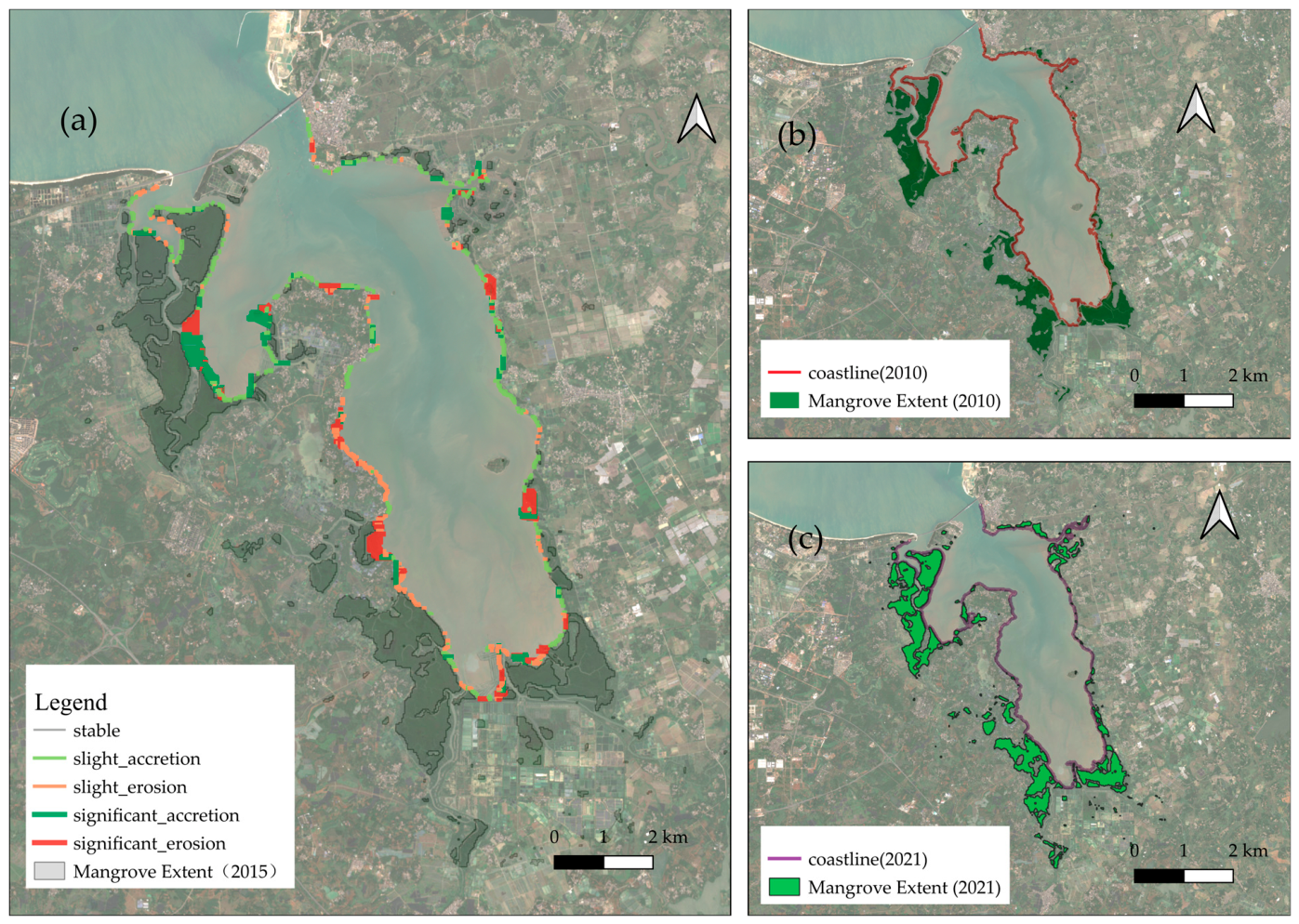
To quantify these changes, we generated 1342 transects perpendicular to the 2010 baseline with a 50-m spacing. After excluding outliers and ensuring spatial matching quality, 1122 valid transects were retained for the primary 2010–2021 analysis. To ensure statistical consistency, we categorized these transects into three primary groups. There were 268 stable transects representing 23.9% of the total, where the shoreline change remained within 5 m. The erosional group, characterized by a landward retreat exceeding 5 m, comprised 330 transects or 29.4% of the dataset. The accretion group, indicating a seaward advance of more than 5 m, included 524 transects and accounted for 46.7% of the total. For enhanced spatial visualization in Figure 2a, we further subdivided the erosional and accretional categories into slight changes between 5 and 20 m and significant changes exceeding 20 m. The spatial distributions of the 2010 and 2021 mangrove extents along the baseline shoreline are shown in Figure 2b and Figure 2c, respectively. The overall shoreline exhibited a net seaward advance with a mean value of minus 7.18 m and a standard deviation of 95.76 m, where negative values denote accretion. Subsequent coupling analysis in Section 3.3 utilized period-specific subsets, resulting in 979 transects for 2010–2015, 1039 for 2015–2021, and the aforementioned 1122 transects for the full 2010–2021 analysis.

3.2. Mangrove Distribution Dynamics and Typhoon Resilience Assessment

Based on Res-UNet deep-learning classification, mangrove area in Dongzhai Harbor showed a decline-recovery trajectory over the 2010–2021 period, coinciding with Super Typhoon Rammasun (July 2014) impacts and subsequent natural regeneration.

3.2.1. Typhoon Impact and Spatial Heterogeneity (2010–2015)

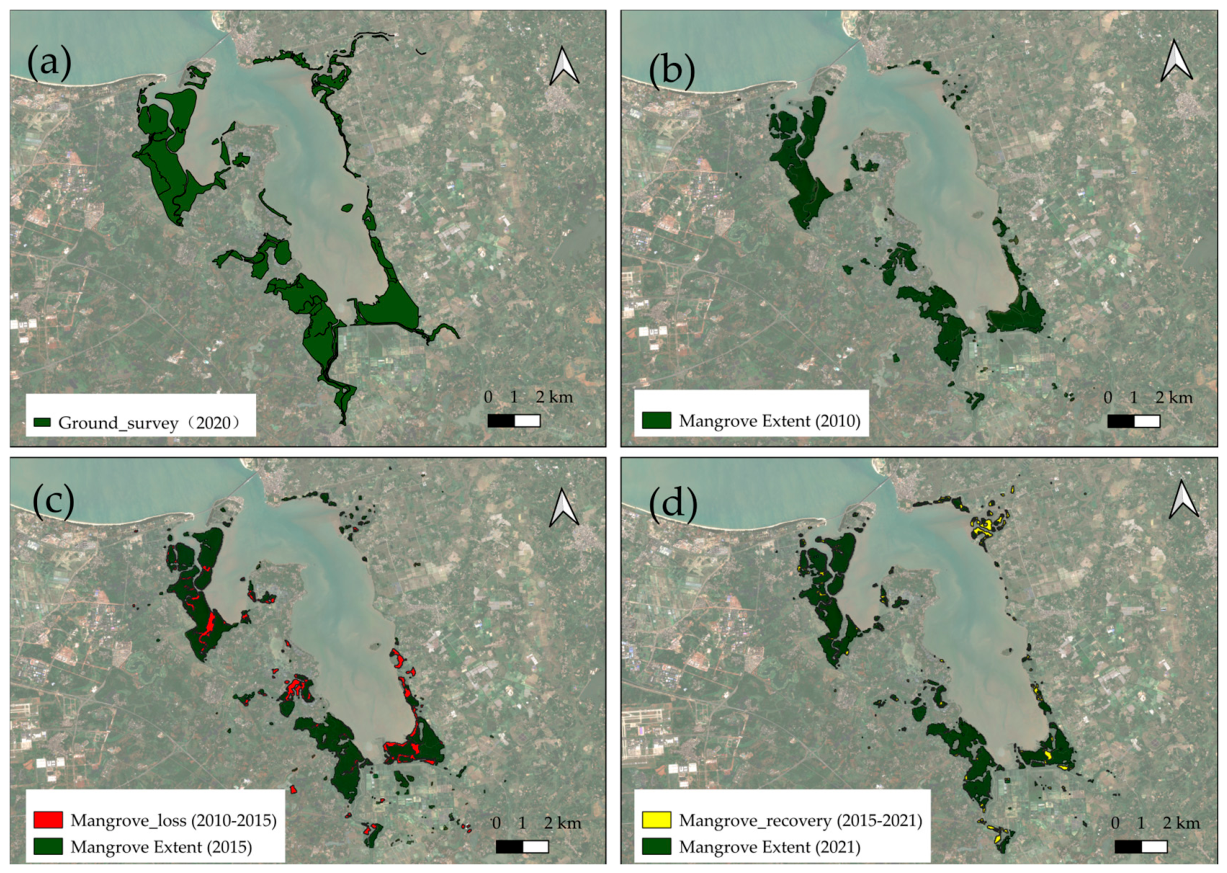
The 2021 mangrove classification was validated against a 2020 ground survey reference covering 102 patches (Figure 3a). The period from 2010 to 2015 experienced a net mangrove area loss of 6.10% (Figure 3b,c). This result indicates partial persistence of mapped mangrove extent after Typhoon Rammasun, although it does not provide a direct performance comparison with engineered coastal structures. Spatial damage patterns exhibited marked heterogeneity across the harbor. Severely impacted zones, defined by a local loss exceeding 20%, were concentrated in the exposed northern and southern segments which were subject to direct storm surge and maximum wind stress. Moderately impacted zones with losses between 5 and 20% occurred along eastern shores characterized by young regenerating stands. Meanwhile, minimally impacted zones with less than 5% loss were found in interior embayments that benefited from topographic protection. Based on ground-level surveys at the same site, Gao et al. (2025) [15] documented a collapse in canopy density across all species within one month of landfall and demonstrated that damage severity correlated positively with basal diameter and tree height, but negatively with stand density.

3.2.2. Recovery Dynamics and Management Implications (2015–2021)

The six-year recovery period from 2015 to 2021 showed a 2.98% increase in mangrove area, representing a recovery of 46% of the total typhoon-induced losses. Spatial recovery exhibited distinct geographic clustering. Concentrated recovery zones, where more than 50% of the local loss was regained, included northeastern areas with successful natural regeneration from intact propagule sources and southern embayments protected by topographic sheltering. In contrast, no-recovery zones, accounting for 54% of the initial loss, were distributed primarily along western and northern exposed shorelines. In these areas, typhoon damage exacerbated pre-existing degradation from aquaculture expansion and substrate instability. Gao et al. (2025) [15] utilized permanent plot monitoring to demonstrate that while late-successional species such as Bruguiera sexangula and Kandelia obovata exhibited sharply rising mortality throughout the two years post-disturbance due to limited resprouting capacity, pioneer species including Avicennia marina and Rhizophora stylosa successfully recovered canopy density within 24 months. Together, these damage and recovery patterns demonstrate that mangrove resilience is strongly mediated by landscape position and stand maturity, with topographically sheltered interior zones exhibiting both lower initial damage and faster subsequent recovery than exposed shoreline segments (Figure 3d).

3.3. Coupling Relationship Analysis

3.3.1. Multi-Period Coupling Patterns

Using GIS spatial intersection analysis with 50 m buffers, we quantified mangrove-shoreline coupling across three temporal periods corresponding to the disturbance-recovery cycle, following the temporal matching framework described in Section 2.2.2.
For the full study period (2010–2021), the overall mangrove presence rate was 75.3%, with accretional segments showing the highest coupling rate, consistent with established sediment-trapping mechanisms. During the post-typhoon recovery period (2015–2021), coupling in erosional segments declined while accretional segments showed increased coupling, likely reflecting sediment redistribution following Typhoon Rammasun. These patterns reflect the spatial co-occurrence of mangroves and shoreline dynamics and do not constitute evidence of confirmed causal relationships, as the observational design does not control for the multiple environmental and anthropogenic factors that jointly govern both mangrove establishment and shoreline change. It should be noted that the low recall of 56.54% in the area-based validation means that a non-trivial fraction of transects classified as mangrove-absent may in fact contain mangrove cover below the detection threshold of the Res-UNet classification. Period-to-period comparisons of coupling rates should be interpreted with this limitation in mind. Complete period-specific coupling statistics are presented in Table 4.

3.3.2. Multi-Scale Buffer Analysis

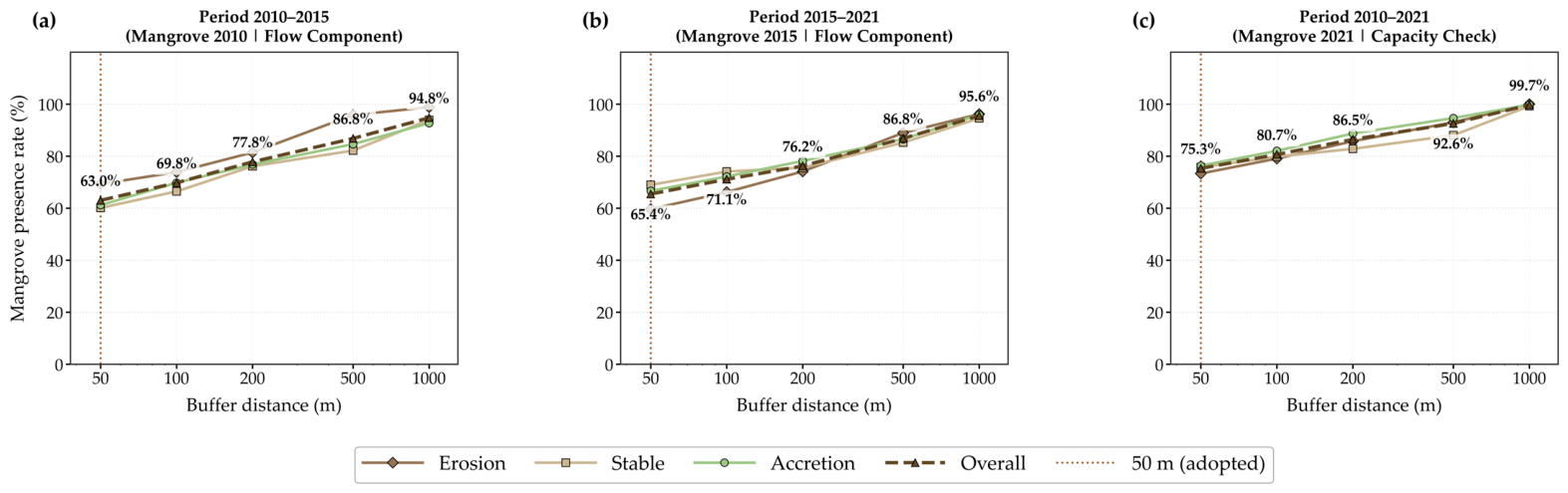
Multi-scale analysis using 50 m to 1000 m buffers demonstrated that mangrove presence rates increased monotonically with buffer distance (Figure 4a–c), confirming spatial proximity patterns expected from ecological and hydrodynamic processes. At the 50 m buffer, erosional, stable, and accretional segments showed 73.3%, 75.7%, and 76.3% mangrove presence, respectively, yielding an overall coupling rate of 75.3%. At the 1000 m buffer, rates converged to 100.0%, 99.3%, and 99.8%, indicating that most shoreline segments have mangroves within kilometer-scale vicinity regardless of local dynamics.
The 50 m threshold was adopted as the standard for protection service quantification based on two criteria. First, 50 m is associated in the broader literature with the mangrove fringe zone where direct wave attenuation is commonly evaluated in the nearshore mangrove fringe zone. This association is adopted here as a working assumption and has not been independently validated for Dongzhai Harbor’s specific hydrodynamic regime. Second, it aligns with the conservative lower-bound accounting principle of the GEP framework, avoiding systematic overestimation of the protected coastline length. These criteria are independent of the statistical differentiation of presence rates among shoreline types, which varies continuously with buffer distance and does not constitute an appropriate basis for threshold selection. It should be noted that the small differences in presence rates across shoreline types at 50 m (73.3% to 76.3%) reflect the spatial distribution of mangroves relative to each dynamic category and determine the quantity dimension of the valuation, while the divergence in unit protection values across shoreline types arises entirely from the differentiated engineering cost structure and protection equivalence coefficients assigned to each type, as detailed in Section 3.4.
To confirm that this threshold choice does not materially affect the valuation conclusions, a supplementary scenario was conducted using the 100 m coupling results. Under the 100 m buffer, the total mangrove-aligned coastline length increases from the baseline 32.57 km to 35.68 km across the Flow Component periods, producing a total annual protection value of 991.56 × 10⁴ CNY yr−1 under the Q1 baseline, a 9.2% increase relative to the 50 m estimate. This increment falls well within the ±20% coastline length uncertainty range incorporated in the OAT analysis and is substantially smaller than the Monte Carlo coefficient of variation of 16.5%. The relative value shares across shoreline types and the ranking of unit values remain unchanged under both buffer distances. These results indicate that the principal conclusions are robust to the buffer threshold choice within the range examined, and support the interpretation that the 50 m selection represents a conservative lower bound within the adopted GEP accounting framework. However, this cross-buffer comparison tests sensitivity within an accounting convention rather than providing empirical confirmation that either threshold corresponds to the true hydrodynamic influence boundary at Dongzhai Harbor.

3.3.3. Spatial Distribution Patterns

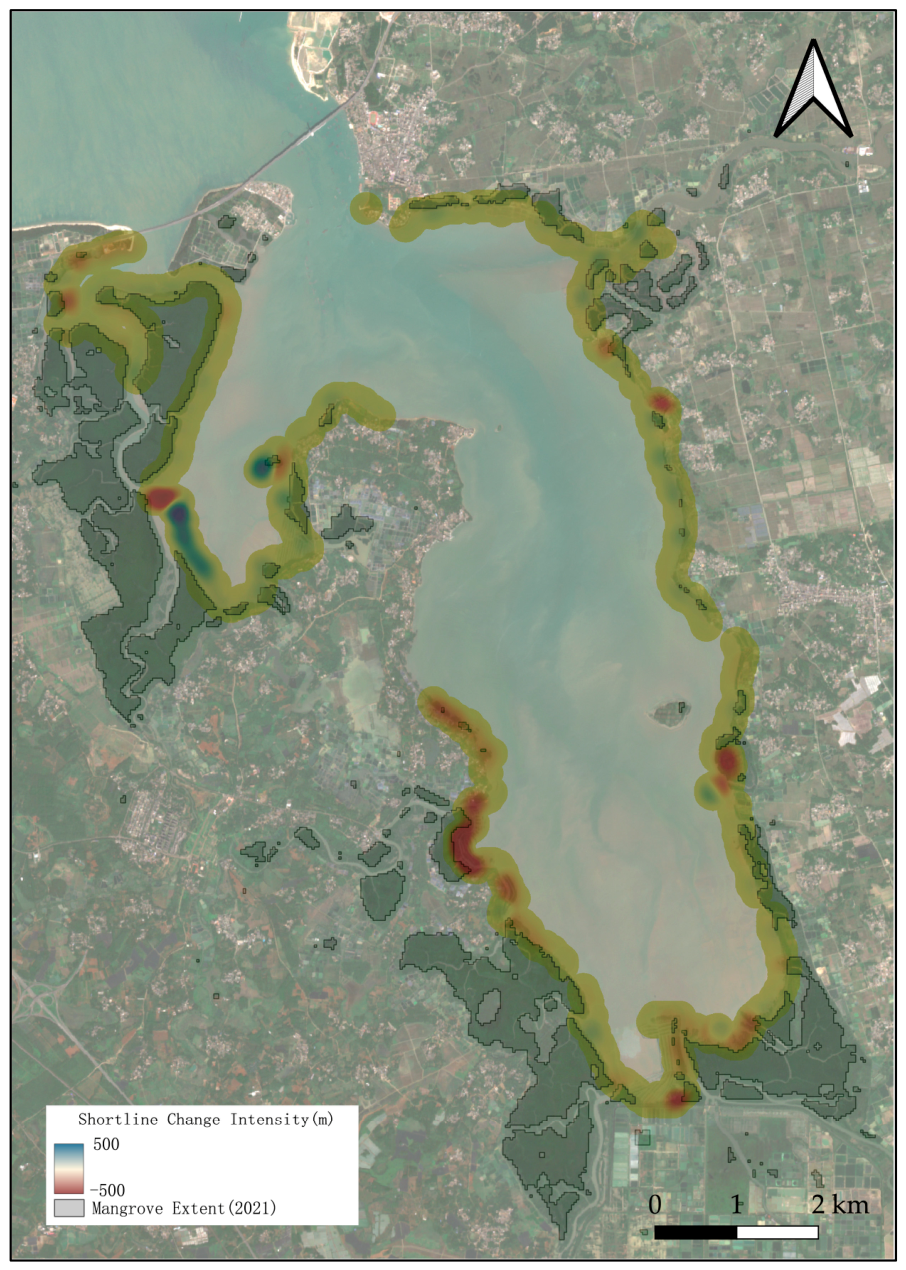
Spatial distribution analysis reveals pronounced geographic variations in shoreline dynamics. Heatmap visualization in Figure 5 shows concentrated accretion hotspots, which are indicated by blue clusters representing seaward sediment deposition primarily in western embayments and southern creek systems, where wave energy is naturally attenuated by topographic sheltering and bathymetric conditions. In contrast, erosion hotspots indicated by orange-red clusters representing landward shoreline retreat are dispersed along northern and eastern exposed coastlines subjected to higher incident wave energy and typhoon impacts.
The spatial relationship between shoreline dynamics and mangrove distribution indicates strong environmental filtering in mangrove establishment. Erosional segments with mangrove presence are clustered in northern exposed shores and bay-mouth locations, representing critical protection zones where natural wave attenuation services are most valuable due to their inherently high erosion risk. These areas demonstrate that mangroves can persist under moderately energetic conditions when sufficient sediment supply and suitable substrate are present, though whether their presence stabilizes otherwise eroding shorelines or simply reflects historical establishment in temporarily favorable conditions cannot be conclusively determined from observational remote sensing data alone.

3.3.4. Statistical Characterization of Mangrove-Shoreline Associations

Mangroves naturally establish in sheltered, low-energy environments, meaning that their spatial distribution is non-random with respect to hydrodynamic conditions. This environmental filtering creates inherent confounding between mangrove presence and shoreline dynamics, and makes it difficult to isolate causal protection signals from observational remote sensing data alone. The co-occurrence statistics presented below therefore quantify the landscape configuration where protection services may potentially be delivered, establishing a spatial baseline independent of the realized magnitude of causal shoreline stabilization.
The 75.3% coupling rate quantifies the spatial extent where mangroves and different shoreline dynamics co-occur at the 50 m scale. This spatial pattern provides the quantity input for replacement cost valuation in Section 3.4, which estimates service value based on observed spatial extent combined with protective capacity derived from field-based wave-attenuation studies and global meta-analyses.
Statistical characterization using the rate-ratio approach compared mean annual shoreline change rates between mangrove-present and mangrove-absent transects within each coastal type, restricting the analysis to segments experiencing strong erosion exceeding 20 m. Bootstrap resampling (n = 3000 iterations) yielded 95% confidence intervals that overlapped zero across all three temporal periods. No statistically distinguishable difference in shoreline change rates was detected between mangrove-present and mangrove-absent transects at the observational scale. It should be noted, however, that the area-based recall of the mangrove classification is only 56.54%, meaning that a substantial proportion of transects assigned to the mangrove-absent category may contain mangrove cover that was not detected by the Res-UNet classification. This misclassification would tend to attenuate any observable difference in shoreline change rates between the two groups, contributing to the non-significant bootstrap confidence intervals. The absence of a detectable signal therefore cannot be interpreted as evidence of no protection effect. It may equally reflect the limited ability of the classification to distinguish true mangrove absence from undetected presence. This classification uncertainty constitutes an unresolved interpretive boundary on all counterfactual comparisons between mangrove-present and mangrove-absent transects throughout this analysis. Spatial stratification further revealed pronounced geographic heterogeneity. The Bay Mouth and Bay Head zones produced coefficients within the literature range, whereas the Bay Middle zone generated a negative estimate, likely reflecting the concentration of reference transects in artificially stabilized and fetch-sheltered segments.
The concentration of mangroves in sheltered embayments and creek systems reflects strong environmental filtering, where wave energy, sediment supply, and salinity regimes jointly determine establishment success. Erosional segments with mangrove presence along northern exposed shores represent areas where restoration programs have strategically deployed mangroves in high-risk zones, introducing additional heterogeneity into the spatial comparison. Together, these factors explain why the observed co-occurrence pattern cannot by itself be interpreted as evidence of causal shoreline stabilization.
The physical basis for wave attenuation by mangroves is well-established at the micro-scale, with field measurements demonstrating wave height reductions of 13 to 66 percent depending on forest width and density. The replacement cost estimates in Section 3.4 therefore bridge these micro-scale mechanisms with landscape-scale spatial persistence to produce an upper-bound estimate of potential protection value consistent with GEP accounting conventions.

3.4. Coastal Protection Value

Based on the integration of ecological resilience and shoreline dynamics, the total Potential Replacement Value (PRV) of the mangrove coastal protection service in Dongzhai Harbor was estimated. Before presenting the valuation results, it is necessary to clarify their interpretive basis. The local co-occurrence analysis provides the spatial quantity input for valuation, but it does not independently verify the per-unit protective capacity assumed by the literature-derived coefficients. Accordingly, all values reported below should be read as assumption-dependent replacement-cost estimates of potential protection value rather than as locally confirmed economic measures of realized avoided costs, and this interpretive boundary applies throughout the remainder of this section.
The 46% recovery of typhoon-induced mangrove losses over 2015–2021 indicates partial post-disturbance recovery of mapped mangrove extent. This recovery trajectory supports the inclusion of post-disturbance recovery capacity when interpreting potential coastal protection value under the replacement-cost/GEP accounting framework. It does not, by itself, demonstrate that mangroves can serve as a persistent replacement for engineered coastal structures. Under the revised flow framework, which combines only the two non-overlapping periods, the estimated annual protective replacement value reached 907.65 × 10⁴ CNY yr−1 across 32.57 km of duration-weighted mangrove-aligned coastline under the first-quartile baseline. The supplementary terminal-state capacity scenario, based on the 2021 mangrove distribution paired with the full 2010–2021 shoreline-change record, produced an estimate of 1.148 × 10⁴ CNY yr−1. This scenario is reported only as a supplementary comparison and is excluded from the duration-weighted flow calculation.
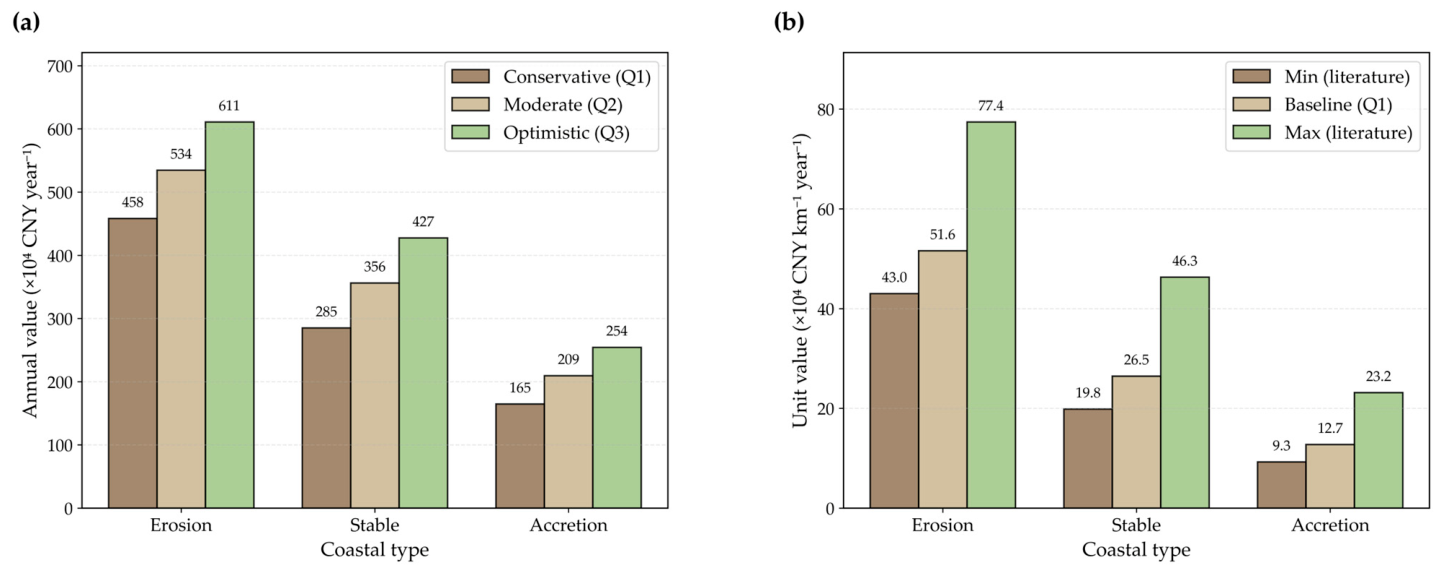
Value distribution varies substantially among shoreline types (Table 5; Figure 6a). Erosional segments exhibit the highest annual contribution at 458.10 × 10⁴ CNY yr−1 under the Q1 baseline, approximately 1.6 times greater than stable segments (284.96 × 10⁴ CNY yr−1) and 2.8 times greater than accretional segments (164.58 × 10⁴ CNY yr−1). On a per-kilometer basis (Figure 6b), erosional segments provide a baseline unit value of 51.6 × 10⁴ CNY km−1 yr−1, substantially exceeding those of stable (26.5 × 10⁴ CNY km−1 yr−1) and accretional coasts (12.7 × 10⁴ CNY km−1 yr−1). Consequently, while erosional segments comprise 27.3% of the duration-weighted mangrove-aligned coastline length (Table 5), they account for 50.5% of the baseline protection value. This disproportionate contribution stems from the differentiated cost and coefficient assignments in the replacement-cost model, where erosional segments carry a higher seawall unit cost (2404.1 × 104 CNY km−1) and a higher α coefficient (0.30). These values reflect greater structural demand and marginal protection value in high-energy environments. The pattern thus follows the internal logic of the valuation framework, and is not a locally confirmed signal of greater mangrove protection effectiveness in erosional segments in Dongzhai Harbor.
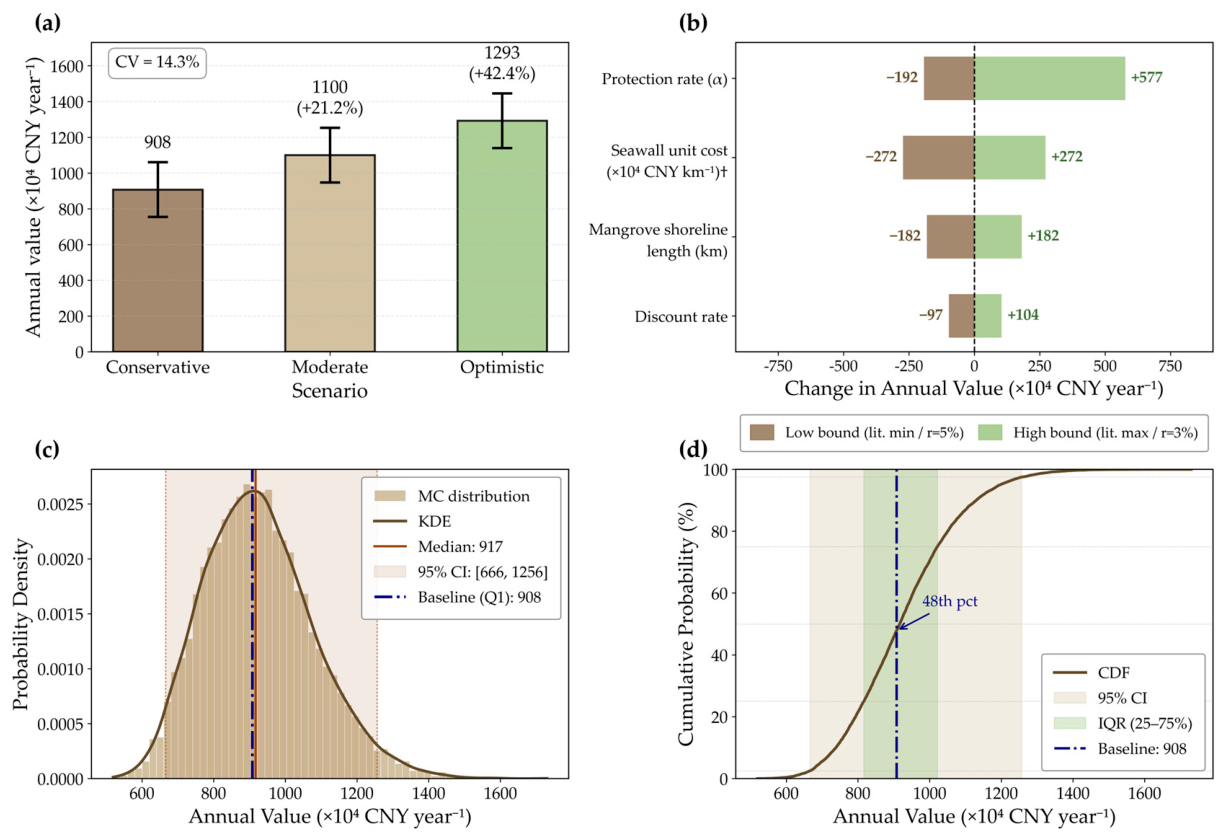
Sensitivity and uncertainty analysis confirmed the robustness of these estimates across the full parameter space (Figure 7). The scenario analysis (Figure 7a) produced annual values of 907.65, 1100.12, and 1292.60 × 104 CNY yr−1 under conservative (Q1), moderate (Q2), and optimistic (Q3) assumptions, respectively, with a coefficient of variation of 14.3%. OAT analysis (Figure 7b) identified αi as the dominant source of parametric uncertainty, with an elasticity of 1.973 substantially exceeding those of Ci (1.000), Li (1.000), and r (0.445). The asymmetric value swing for α i (from a decrease of 192 to an increase of 577 × 104 CNY yr−1) reflects the wider relative uncertainty of the protection equivalence coefficient across the global literature compared to the other parameters. The discount rate exerts comparatively minor influence, with value fluctuations from a decrease of 97 to an increase of 104 × 104 CNY yr−1 over the 3–5% range, confirming that the valuation is governed primarily by observed physical quantities and standardized engineering costs, with minimal dependence on financial assumptions.
A Monte Carlo simulation (Figure 7c,d, based on 10,000 iterations) generated a mean of 926.36 × 10⁴ CNY yr−1, a median of 916.64 × 10⁴ CNY yr−1, and a 95% confidence interval ranging from 665.95 to 1256.28 × 104 CNY yr−1, with a coefficient of variation of 16.5%. The Q1 baseline value falls at the 48th percentile of this distribution, confirming it as a genuinely conservative estimate. The right-skewed distribution reflects the asymmetric uncertainty of the protection equivalence coefficient (αi) across the literature range, with upside scenarios contributing a heavier tail than downside scenarios.

4. Discussion

This research quantified mangrove coastal protection services in Dongzhai Harbor through integrated multi-temporal remote sensing (2010–2021) and GEP-consistent economic valuation, producing a conservative baseline annual protection value of 907.65 × 10⁴ CNY across 32.57 km of weighted mangrove-aligned coastline. The study advances previous work through performing spatially differentiated valuation by shoreline type and generating a three-tier uncertainty framework with asymmetric, empirically grounded parameter ranges.

4.1. Mangrove Shoreline Dynamics and Typhoon Resilience

Dongzhai Harbor exhibits distinct spatial patterns of eastern accretion and western erosion that significantly influence mangrove establishment patterns. As shown in Table 4, mangrove coupling was highest in accretionary segments under the long-term equilibrium state, consistent with established sediment-trapping mechanisms, while erosional segments maintained substantial coupling despite high wave energy. The decline in erosional coupling during the post-typhoon recovery period reflects natural regeneration constraints in high-energy zones [60], whereas the concurrent increase in accretionary coupling likely reflects sediment redistribution creating new vegetative zones following Typhoon Rammasun.
The spatial distribution of the valuation results provides a critical perspective on nature-based solutions as erosional segments cover only 273% of the total weighted coastline length but contribute 50.5% of the baseline protection value. This disproportionate contribution reflects the higher engineering cost structure and protection-equivalence coefficients assigned to erosional environments under the replacement-cost model. It should not be interpreted as a locally confirmed stronger protective effect of mangroves in erosional segments [3,49,61].
In contrast to the structural displacement and toe erosion commonly reported for concrete seawalls under comparable storm conditions in the broader literature [62,63], mangroves in Dongzhai Harbor maintained partial spatial extent in erosional segments throughout the study period. The mapped mangrove extent declined by 6.10% after Typhoon Rammasun and subsequently recovered 46% of the typhoon-induced losses over the following six years. This pattern indicates partial persistence and recovery of mangrove cover at the landscape scale. However, because recovery in mapped area does not verify hydrodynamic protection performance, this result supports inclusion of recovery capacity in potential protection value assessment, but not the conclusion that mangroves constitute a confirmed functional substitute for engineered structures. The bootstrap confidence intervals for mangrove shoreline associations overlapped zero across all three temporal periods, reflecting the combined influence of hydrodynamic energy gradients, sediment supply, bathymetric sheltering, and restoration history [60,61]. The estimated annual protection value therefore represents a potential replacement cost under explicit assumptions, not a field-validated avoided cost [64].
Despite this observed resilience, the incomplete recovery of 54 percent of typhoon losses signals persistent vulnerability in high-energy zones. Given low recovery rates in erosional areas and projections of more frequent intense typhoons, hybrid approaches combining conservation with strategic engineering are recommended where natural succession is insufficient [65]. Ground-based permanent plot monitoring by Gao et al. (2025) provides complementary evidence at the one-, twelve-, and twenty-four-month timescales, suggesting that the area loss detected between 2010 and 2015 reflects both immediate structural damage and delayed mortality in late-successional species [15]. In contrast to these finely resolved field measurements, the three-epoch remote sensing design only captures aggregate area trajectories across pre-typhoon, post-typhoon and recovery states, and cannot resolve the fine-scale disturbance and early recovery processes operating at weekly to monthly intervals that the ground-based record documents. High-frequency satellite monitoring would be necessary to fully characterize these sub-annual dynamics in future assessments.

4.2. Protection Value and Limitations

The valuation results are subject to a fundamental interpretive boundary. These replacement cost estimates represent potential protection values based on the theoretical premise that landscape-scale mangrove distribution provides protection equivalent to controlled experimental settings. Since the observational statistical analysis produced confidence intervals overlapping zero across all three temporal periods, these figures cannot be interpreted as confirmed measures of realized avoided costs. Alternative replacement structures, including hybrid vegetation–seawall systems, artificial reefs, and sand-dune restoration where geomorphologically suitable, could yield different and potentially lower cost estimates than concrete seawalls [47,48]. The seawall-based approach therefore provides a standardized replacement cost benchmark consistent with GEP accounting conventions, but it should not be interpreted as the only feasible coastal protection option.
The period-specific variation in Producer’s Accuracy represents a genuine limitation of the classification dataset. The lower Producer’s Accuracy in 2010 and 2015 means that mapped mangrove extent in earlier periods is likely an underestimate of true conditions, introducing uncertainty into the flow component quantity inputs. More critically for the coupling analysis, the area-based recall of 56.54% means that mangrove-absent transects cannot be treated as confirmed locations of mangrove absence across any period. Any counterfactual comparison between mangrove-present and mangrove-absent segments is therefore subject to an unquantifiable contamination bias, the direction of which would tend to reduce apparent differences in shoreline change rates between the two groups rather than inflate them [38]. This limitation has been partly constrained by the omission error diagnostics presented in Section 2.3, which show that Type A omission errors are concentrated in narrow fringe patches below the 50 m hydrodynamic threshold and that Type B errors occur as internal gaps within otherwise correctly identified forest blocks. These structural characteristics reduce, but do not eliminate, the risk of systematic contamination of the mangrove-absent category. The low recall therefore remains an unresolved limitation that weakens all counterfactual inferences drawn from the coupling analysis, and cannot be reframed as an analytical advantage. More importantly, this underdetection weakens the period-to-period comparability of the coupling analysis and reduces confidence in the interpretation of mangrove-absent transects across all periods. Higher-resolution imagery in future research would be necessary to reduce omission errors in earlier periods and to produce more reliable period-specific estimates of mangrove extent and associated protection value. The revised flow estimate, based on two non-overlapping periods, produces an annualized service-flow metric more consistent with GEP accounting than a terminal-year snapshot [6], while type-specific cost and coefficient differentiation address the oversimplification of uniform valuation models [61]. The Q1 conservative baseline reflects the GEP principle of avoiding overestimation, with the Monte Carlo 95% confidence interval ranging from 665.95 to 1256.28 × 104 CNY yr−1 providing quantified bounds for planning applications.
The replacement cost estimates are driven primarily by inputs derived from the external literature, operating independently of local empirical measurements. These external inputs include the protection equivalence coefficients from Menéndez et al. [3], the GEP accounting conventions governing parameter selection, and the wave attenuation thresholds used to interpret mapped mangrove extent [37,39]. The local co-occurrence analysis contributes to the quantity dimension of the valuation by establishing how much coastline is mangrove-aligned under each dynamic category, but it does not independently verify the per-unit protective capacity that the globally derived coefficients assume. This structure is inherent to replacement cost applications at sites where controlled hydrodynamic experiments are unavailable, and it is consistent with the GEP framework’s design as a standardized accounting tool that deliberately separates spatial quantity inputs from literature-derived unit values [6]. The degree to which global protection equivalence coefficients represent local mangrove performance under Dongzhai Harbor’s specific hydrodynamic conditions therefore remains unquantified, and site-specific hydrodynamic modeling represents the necessary next step toward confirmed avoided costs. The same qualification applies to the 50 m buffer threshold, which is adopted from the broader literature as a conservative accounting convention and would require local hydrodynamic validation before it could be treated as an empirically confirmed functional boundary for Dongzhai Harbor. Future multi-scenario valuation incorporating locally validated hydrodynamic data and alternative replacement structures would provide a more informative cost envelope for site-specific management decisions [47,48].
All seawall unit costs are expressed in 2020 constant CNY, derived via GDP per capita localization from the adjusted Shenzhen reference [51]. The estimated 25 to 35 percent cumulative material inflation from 2010 to 2021 is encompassed within the plus or minus 30 percent cost sensitivity range [58]. Because elasticity analysis confirms that cost uncertainty with an elasticity of 1.000 is subordinate to the protection equivalence coefficient with an elasticity of 1.973, inflation variability does not materially alter the study conclusions. While the reported absolute currency values reflect construction costs specific to Hainan Province, the methodological framework is designed for broad transferability. The dual temporal structure, GDP per capita localization, conservative first quartile baseline, and energy-stratified cost differentiation can be readily implemented in other mangrove-fronted coastal systems by integrating jurisdiction-specific cost data [52]. Future research should integrate high-revisit-frequency satellite imagery with ground-based monitoring to resolve sub-annual disturbance dynamics following extreme events, incorporate species-specific hydrodynamic modeling, and apply locally calibrated wave attenuation measurements to narrow the uncertainty range between the current potential protection value estimates and field-validated avoided costs.

4.3. Implications for GEP Accounting and Coastal Management

This study provides methodological support for quantifying coastal protection services within China’s GEP accounting framework [4,6]. The temporally weighted three-period valuation approach satisfies the GEP requirement that ecosystem service quantities reflect observed service flows over the full accounting period. This continuous metric moves beyond the limitations of terminal-year snapshots, representing an advance over single-period replacement cost implementations commonly reported in the literature. The conservative baseline value of 907.65 × 10⁴ CNY yr−1 with a characterized uncertainty range of 665.95 to 1256.28 × 104 CNY yr−1 provides a defensible entry for coastal protection services in regional GEP balance sheets.
The spatially differentiated unit values, which stand at 51.6 × 10⁴ CNY km−1 yr−1 for erosional segments and 12.7 × 10⁴ CNY km−1 yr−1 for accretional segments, enable the identification of coastline segments with disproportionately high assumed replacement costs, indicating candidate areas for further ecological investigation and potential conservation redline consideration. Actual designation should be contingent on site-specific hydrodynamic validation [66]. Mangrove–coastline systems account for 75.3% of the study area’s coastline, underscoring their relevance for inclusion in territorial spatial planning [67]. The observed resilience of naturally recovering mangrove stands, reflected in limited typhoon-related area loss and partial autonomous recovery, supports their consideration as candidate nature-based solutions within coastal climate adaptation frameworks, subject to future hydrodynamic validation of the actual magnitude of protective benefits [68]. Future GEP-oriented assessments could expand to incorporate carbon sequestration, fisheries support, and recreational values, thereby contributing to more comprehensive sustainability-oriented decision-making [69].

5. Conclusions

This study quantified mangrove coastal protection services in Dongzhai Harbor through integrated multi-temporal remote sensing (2010–2021) and economic valuation consistent with gross ecosystem product accounting. Crucially, these estimates represent potential protection values based on theoretical cost savings, establishing a valuation baseline distinct from statistically confirmed realized avoided costs. Operating within this interpretive boundary, the analysis demonstrated that the mangrove system exhibited substantial resilience to Super Typhoon Rammasun in 2014, experiencing only a 6.10% area loss followed by 46% natural recovery over six years. Additionally, while spatial analysis revealed a 75.3% co-occurrence between mangroves and the shoreline, this pattern largely reflects natural establishment in sheltered, low-energy environments, highlighting an inherent ecological site preference independent of the confirmed causal protection. Because the area-based recall of the mangrove classification is 56.54%, transects classified as mangrove-absent should not be interpreted as confirmed locations of mangrove absence. This classification uncertainty constrains all counterfactual inferences drawn from the coupling analysis.
To account for this inherent site-selection effect, the valuation strictly adhered to conservative accounting principles. The estimated annual protection value is 907.65 × 10⁴ CNY yr−1 (95% confidence interval, 665.95 to 1256.28 × 104 CNY yr) for 32.57 km of coastline defined as mangrove-aligned under the 50 m buffer convention. This assumption-dependent estimate relies on literature-based protection equivalence coefficients (α from 0.138 to 0.300 across shoreline types), differentiated seawall unit costs localized to Hainan Province, and the spatial extent of mangrove-aligned coastline established by the 50 m buffer threshold. It should not be interpreted as a directly observed economic value or a field-validated measure of realized avoided costs. Notably, erosional segments contributed 50.5% of the total value despite comprising only 27.3% of the coastline length. This concentration reflects the structure of the replacement-cost model in which erosional segments are assigned higher engineering costs and protection equivalence coefficients. It does not represent a locally confirmed empirical signal of greater mangrove effectiveness in high-energy zones. Because bootstrap confidence intervals for the mangrove–shoreline associations overlapped zero across all three temporal periods, the estimated values represent assumption-dependent potential protection values, not statistically confirmed measures of realised avoided costs. These findings nonetheless support mangroves as theoretically cost-effective coastal infrastructure within territorial planning frameworks, and underscore the need for future site-specific hydrodynamic modelling to assess actual protective benefits.

Supplementary Materials

The following supporting information can be downloaded at: https://www.mdpi.com/article/10.3390/su18115594/s1. The Supplementary Materials contain the following items: Table S1: Width-stratified area distribution of false-negative mangrove patches by omission type; Table S2: Width characteristics of detected and omitted mangrove patches; Figure S1: Typhoon activity near Dongzhai Harbor (2010–2021). (a) Tracks of all typhoons passing within 300 km of Dongzhai Harbor (red star), with Super Typhoon Rammasun (2014) highlighted in red. (b) Scatter plot of maximum wind speed versus minimum distance to Dongzhai Harbor for each typhoon event, color-coded by intensity category. Rammasun (black star) made landfall approximately 20 km from the study site with maximum winds of 72 m/s (Category 5), representing the most severe disturbance event during the study period. Typhoon data sourced from the China Meteorological Administration (CMA) Best Track Dataset (2010–2021).

Author Contributions

Conceptualization, W.L. and P.W.; methodology, Y.L.; software, Y.L.; validation, Y.L.; formal analysis, Y.L.; investigation, Y.L.; resources, W.L. and P.W.; data curation, Y.L.; writing—original draft preparation, Y.L.; writing—review and editing, Y.L., W.L. and P.W.; visualization, Y.L.; supervision, W.L. and P.W.; project administration, W.L. and P.W.; funding acquisition, W.L. and P.W. All authors have read and agreed to the published version of the manuscript.

Funding

This research was funded by the Hainan Province Science and Technology Special Fund (Grant No. ZDYF2024SHFZ078).

Institutional Review Board Statement

Not applicable.

Informed Consent Statement

Not applicable.

Data Availability Statement

The mangrove distribution data used in this study are openly available from Figshare at https://doi.org/10.6084/m9.figshare.21405531 (accessed on 10 March 2025) Typhoon track data are available from the China Meteorological Administration Best Track Dataset at https://tcdata.typhoon.org.cn/zjljsjj.html (accessed on 15 April 2025). The processed shoreline datasets and analysis scripts supporting the results of this study are available as Supplementary Materials.

Acknowledgments

The authors gratefully acknowledge the Google Earth Engine platform for providing cloud computing resources. We are also grateful to all the foundations that support us.

Conflicts of Interest

The authors declare no conflicts of interest.

Abbreviations

The following abbreviations are used in this manuscript:
NbSsNature-based Solutions
GEPGross Ecosystem Product
SEEA-EASystem of Environmental-Economic Accounting—Ecosystem Accounting
MNDWIModified Normalized Difference Water Index
NDVINormalized Difference Vegetation Index
DSASDigital Shoreline Analysis System
CRFCapital Recovery Factor
GISGeographic Information System
CMAChina Meteorological Administration
OATOne-factor-at-a-time
PRVPotential Replacement Value

References

  1. Hinkel, J.; Lincke, D.; Vafeidis, A.T.; Perrette, M.; Nicholls, R.J.; Tol, R.S.J.; Marzeion, B.; Fettweis, X.; Ionescu, C.; Levermann, A. Coastal flood damage and adaptation costs under 21st century sea-level rise. Proc. Natl. Acad. Sci. USA 2014, 111, 3292–3297. [Google Scholar] [CrossRef]
  2. Jung, M.-K.; Lee, B.; Park, M.; Kwon, H.-H. Enhancing seawall resilience: A probabilistic analysis of armor stone stability against wave-induced forces. J. Coast. Res. 2025, 113, 135–139. [Google Scholar] [CrossRef]
  3. Menéndez, P.; Losada, I.J.; Torres-Ortega, S.; Narayan, S.; Beck, M.W. The global flood protection benefits of mangroves. Sci. Rep. 2020, 10, 4404. [Google Scholar] [CrossRef]
  4. Zheng, H.; Wu, T.; Ouyang, Z.; Polasky, S.; Ruckelshaus, M.; Wang, L.; Xiao, Y.; Gao, X.; Li, C.; Daily, G.C. Gross ecosystem product (GEP): Quantifying nature for environmental and economic policy innovation. Ambio 2023, 52, 1952–1967. [Google Scholar] [CrossRef]
  5. United Nations. System of Environmental-Economic Accounting: Ecosystem Accounting; United Nations: New York, NY, USA, 2024. [Google Scholar]
  6. Ouyang, Z.; Song, C.; Zheng, H.; Polasky, S.; Xiao, Y.; Bateman, I.J.; Liu, J.; Ruckelshaus, M.; Shi, F.; Xiao, Y.; et al. Using gross ecosystem product (GEP) to value nature in decision making. Proc. Natl. Acad. Sci. USA 2020, 117, 14593–14601. [Google Scholar] [CrossRef]
  7. Arkema, K.K.; Griffin, R.; Maldonado, S.; Silver, J.; Suckale, J.; Guerry, A.D. Linking social, ecological, and physical science to advance natural and nature-based protection for coastal communities. Ann. N. Y. Acad. Sci. 2017, 1399, 5–26. [Google Scholar] [CrossRef]
  8. Zhang, X.; Jiao, H.; Chen, G.; Shen, J.; Huang, Z.; Luo, H. Forest damage by super typhoon Rammasun and post-disturbance recovery using Landsat imagery and the machine-learning method. Remote Sens. 2022, 14, 3826. [Google Scholar] [CrossRef]
  9. Ayassamy, P. Mangroves as a nature-based solution and a tool for coastal resilience. Wetlands 2025, 45, 89. [Google Scholar] [CrossRef]
  10. Si, T.; Qiu, P.; Li, L.; Zhou, W.; Chen, C.; Shi, Q.; Jiang, M.; Yang, Y. Land use change and mangrove restoration modulate heavy metal accumulation in tropical coastal sediments: A nearly decade-long study from Hainan, China. Land 2025, 14, 1259. [Google Scholar] [CrossRef]
  11. Hochard, J.P.; Hamilton, S.; Barbier, E.B. Mangroves shelter coastal economic activity from cyclones. Proc. Natl. Acad. Sci. USA 2019, 116, 12232–12237. [Google Scholar] [CrossRef]
  12. Uddin, M.M.; Huang, L.; Bin, X. Spatial and temporal changes of heavy metals in coastal mangrove sediment in China: Review of present status. J. Biol. Sci. 2019, 19, 314–322. [Google Scholar] [CrossRef]
  13. Setiyaningrum, I.F.; Harini, R.; Wirasanti, N. Economic valuation of the mangrove ecosystem in Purwodadi Sub-district, Purworejo Regency, Central Java. IOP Conf. Ser. Earth Environ. Sci. 2020, 451, 012052. [Google Scholar] [CrossRef]
  14. Beck, M.W.; Losada, I.J.; Menéndez, P.; Reguero, B.G.; Díaz-Simal, P.; Fernández, F. The global flood protection savings provided by coral reefs. Nat. Commun. 2018, 9, 2186. [Google Scholar] [CrossRef]
  15. Gao, X.; Leung, F.; Wang, W. Assessing typhoon impacts on mangroves and post-typhoon recovery patterns to inform projects using mangroves as nature-based solutions. Glob. Ecol. Conserv. 2025, 61, e03667. [Google Scholar] [CrossRef]
  16. Zhang, X.; Lin, P.; Chen, X. Coastal protection by planted mangrove forest during typhoon Mangkhut. J. Mar. Sci. Eng. 2022, 10, 1288. [Google Scholar] [CrossRef]
  17. Reckner, M.; Tien, I. Community-scale spatial mapping to prioritize green and grey infrastructure locations to increase flood resilience. Sustain. Resilient Infrastruct. 2023, 8, 289–310. [Google Scholar] [CrossRef]
  18. Cabello, K.E.; Germentil, M.Q.; Blanco, A.C.; Macatulad, E.G.; Salmo, S.G., III. Post-disaster assessment of mangrove forest recovery in Lawaan-Balangiga, Eastern Samar using NDVI time series analysis. ISPRS Ann. Photogramm. Remote Sens. Spat. Inf. Sci. 2021, 3, 243–250. [Google Scholar] [CrossRef]
  19. Yan, X.; Deng, Y.; Ke, X.; Peng, K.; Xie, X.; Gan, Y.; Li, Q. Sedimentary evolution and mangrove dynamics in Dongzhai Harbor, Hainan Island since the late Pleistocene. J. Earth Sci. 2025, 36, 2251–2265. [Google Scholar] [CrossRef]
  20. Xin, Y.; Ming-Xun, R.E.N. Species distribution pattern and formation mechanism of mangrove plants around the South China Sea. Chin. J. Plant Ecol. 2023, 47, 1105–1115. [Google Scholar] [CrossRef]
  21. Bai, J.; Meng, Y.; Gou, R.; Lyu, J.; Dai, Z.; Diao, X.; Zhang, H.; Luo, Y.; Zhu, X.; Lin, G. Mangrove diversity enhances plant biomass production and carbon storage in Hainan island, China. Funct. Ecol. 2021, 35, 774–786. [Google Scholar] [CrossRef]
  22. Fu, C.; Song, X.; Xie, Y.; Wang, C.; Luo, J.; Fang, Y.; Cao, B.; Qiu, Z. Research on the spatiotemporal evolution of mangrove forests in the Hainan Island from 1991 to 2021 based on SVM and Res-UNet algorithms. Remote Sens. 2022, 14, 5554. [Google Scholar] [CrossRef]
  23. Zhang, L.; Chen, B. The 30-m Datasets of Coastline Changes in Hainan Island from 1990 to 2020. 2022. Available online: https://data.casearth.cn/thematic/hainan/243 (accessed on 16 January 2025).
  24. Chen, J.; Wang, Y.; Wang, J.; Zhang, Y.; Xu, Y.; Yang, O.; Zhang, R.; Wang, J.; Wang, Z.; Lu, F.; et al. The performance of Landsat-8 and Landsat-9 data for water body extraction based on various water indices: A comparative analysis. Remote Sens. 2024, 16, 1984. [Google Scholar] [CrossRef]
  25. Pekel, J.-F.; Cottam, A.; Gorelick, N.; Belward, A.S. High-resolution mapping of global surface water and its long-term changes. Nature 2016, 540, 418–422. [Google Scholar] [CrossRef]
  26. Zhang, X.; Liu, L.; Zhao, T.; Gao, Y.; Chen, X.; Mi, J. GISD30: Global 30 m impervious-surface dynamic dataset from 1985 to 2020 using time-series Landsat imagery on the Google Earth Engine platform. Earth Syst. Sci. Data 2022, 14, 1831–1856. [Google Scholar] [CrossRef]
  27. Arekhi, M.; Goksel, C.; Balik Sanli, F.; Senel, G. Comparative evaluation of the spectral and spatial consistency of Sentinel-2 and Landsat-8 OLI data for Igneada Longos Forest. ISPRS Int. J. Geo-Inf. 2019, 8, 56. [Google Scholar] [CrossRef]
  28. Bishop-Taylor, R.; Nanson, R.; Sagar, S.; Lymburner, L. Mapping Australia’s dynamic coastline at mean sea level using three decades of Landsat imagery. Remote Sens. Environ. 2021, 267, 112734. [Google Scholar] [CrossRef]
  29. Apostolopoulos, D.; Nikolakopoulos, K. A review and meta-analysis of remote sensing data, GIS methods, materials and indices used for monitoring the coastline evolution over the last twenty years. Eur. J. Remote Sens. 2021, 54, 240–265. [Google Scholar] [CrossRef]
  30. Han, N.; Li, N.; Li, X. Research on accounting of ecosystem services flow based ecological compensation: A case study of 18 cities and counties of Hainan Island. J. Ecol. Rural Environ. 2025, 41, 205–214. [Google Scholar] [CrossRef]
  31. Yan, X.; Cai, R.; Guo, H.; Xu, W.; Tan, H. Vulnerability of Hainan Dongzhaigang mangrove ecosystem to the climate change. J. Appl. Oceanogr. 2019, 38, 338–349. [Google Scholar] [CrossRef]
  32. Wang, Y.; Guo, Z.; Zheng, S.; Zhang, M.; Shu, X.; Luo, J.; Qiu, L.; Gao, T. Risk assessment for typhoon-induced storm surges in Wenchang, Hainan Island of China. Geomat. Nat. Hazards Risk 2021, 12, 880–899. [Google Scholar] [CrossRef]
  33. Ying, M.; Zhang, W.; Yu, H.; Lu, X.; Feng, J.; Fan, Y.; Zhu, Y.; Chen, D. An overview of the China Meteorological Administration tropical cyclone database. J. Atmos. Ocean. Technol. 2014, 31, 287–301. [Google Scholar] [CrossRef]
  34. Lu, X.; Yu, H.; Ying, M.; Zhao, B.; Zhang, S.; Lin, L.; Bai, L.; Wan, R. Western North Pacific tropical cyclone database created by the China Meteorological Administration. Adv. Atmos. Sci. 2021, 38, 690–699. [Google Scholar] [CrossRef]
  35. Velázquez-Salazar, S.; Valderrama-Landeros, L.; Villeda-Chávez, E.; Cervantes-Rodríguez, C.G.; Troche-Souza, C.; Alcántara-Maya, J.A.; Vázquez-Balderas, B.; Rodríguez-Zúñiga, M.T.; Cruz-López, M.I.; Flores-de-Santiago, F.; et al. Mangrove damage and early-stage canopy recovery following hurricane Roslyn in Marismas Nacionales, Mexico. Forests 2025, 16, 1207. [Google Scholar] [CrossRef]
  36. Mo, Y.; Simard, M.; Hall, J.W. Tropical cyclone risk to global mangrove ecosystems: Potential future regional shifts. Front. Ecol. Environ. 2023, 21, 269–274. [Google Scholar] [CrossRef]
  37. Zhang, R.; Chen, Y.; Lei, J.; Zhou, X.; Yao, P.; Stive, M.J.F. Experimental investigation of wave attenuation by mangrove forests with submerged canopies. Coast. Eng. 2023, 186, 104403. [Google Scholar] [CrossRef]
  38. Karasiak, N.; Dejoux, J.-F.; Monteil, C.; Sheeren, D. Spatial dependence between training and test sets: Another pitfall of classification accuracy assessment in remote sensing. Mach. Learn. 2022, 111, 2715–2740. [Google Scholar] [CrossRef]
  39. van Wesenbeeck, B.K.; van Zelst, V.T.M.; Antolinez, J.A.A.; de Boer, W.P. Quantifying uncertainty in wave attenuation by mangroves to inform coastal green belt policies. Commun. Earth Environ. 2025, 6, 258. [Google Scholar] [CrossRef]
  40. Xu, C.; Wang, J.; Sang, Y.; Li, K.; Liu, J.; Yang, G. An effective deep learning model for monitoring mangroves: A case study of the Indus Delta. Remote Sens. 2023, 15, 2220. [Google Scholar] [CrossRef]
  41. Vasquez, J.; Acevedo-Barrios, R.; Miranda-Castro, W.; Guerrero, M.; Meneses-Ospina, L. Determining changes in mangrove cover using remote sensing with Landsat images: A review. Water Air Soil Pollut. 2023, 235, 18. [Google Scholar] [CrossRef]
  42. Mentaschi, L.; Vousdoukas, M.I.; Pekel, J.-F.; Voukouvalas, E.; Feyen, L. Global long-term observations of coastal erosion and accretion. Sci. Rep. 2018, 8, 12876. [Google Scholar] [CrossRef]
  43. Himmelstoss, E.A.; Henderson, R.E.; Kratzmann, M.G.; Farris, A.S. Digital Shoreline Analysis System (DSAS), Version 5.0, User Guide; U.S. Geological Survey Open-File Report 2018-1179; U.S. Geological Survey: Reston, VA, USA, 2018; 110p. [CrossRef]
  44. Lopez-Arias, F.; Maza, M.; Calleja, F.; Govaere, G.; Lara, J.L. Integrated drag coefficient formula for estimating the wave attenuation capacity of Rhizophora sp. mangrove forests. Front. Mar. Sci. 2024, 11, 1383368. [Google Scholar] [CrossRef]
  45. Wei, X.; Mo, W.; Xiong, L.; Hu, X.; Cheng, H. Field investigation of wave attenuation in a mangrove forest dominated by Avicennia marina (Forsk.) Viern. Plants 2025, 14, 135. [Google Scholar] [CrossRef]
  46. Baig, M.R.I.; Ahmad, I.A.; Shahfahad; Tayyab, M.; Rahman, A. Analysis of shoreline changes in Vishakhapatnam coastal tract of Andhra Pradesh, India: An application of digital shoreline analysis system (DSAS). Ann. GIS 2020, 26, 361–376. [Google Scholar] [CrossRef]
  47. Perricone, V.; Mutalipassi, M.; Mele, A.; Buono, M.; Vicinanza, D.; Contestabile, P. Nature-based and bioinspired solutions for coastal protection: An overview among key ecosystems and a promising pathway for new functional and sustainable designs. ICES J. Mar. Sci. 2023, 80, 1218–1239. [Google Scholar] [CrossRef]
  48. Bridges, T.S.; Smith, J.M.; King, J.K.; Simm, J.D.; Dillard, M.; deVries, J.; Reed, D.; Piercy, C.D.; van Zanten, B.; Arkema, K.; et al. Coastal natural and nature-based features: International guidelines for flood risk management. Front. Built Environ. 2022, 8, 904483. [Google Scholar] [CrossRef]
  49. Narayan, S.; Beck, M.W.; Reguero, B.G.; Losada, I.J.; van Wesenbeeck, B.; Pontee, N.; Sanchirico, J.N.; Ingram, J.C.; Lange, G.-M.; Burks-Copes, K.A. The effectiveness, costs and coastal protection benefits of natural and nature-based defences. PLoS ONE 2016, 11, e0154735. [Google Scholar] [CrossRef]
  50. Zhang, W.; Zeng, J.; Ge, Z.-M.; Yun, P.; Zhu, K.-H.; Zhou, K.; Liu, S.-X.; Lyu, Q.; Chen, H.-Y. Dike risk evaluation incorporating the contribution of coastal wetlands: A case study on Chongming Island, China. Ocean Coast. Manag. 2023, 245, 106874. [Google Scholar] [CrossRef]
  51. Ding, H.; Yu, T.; Xi, W.; Lu, L.; Fong, W.K.; Cao, Y.; Kuang, S.; Cui, Y.; Zhou, J.; Liu, H.; et al. Accelerating Climate-Resilient Infrastructure Investment in China; World Resources Institute: Beijing, China, 2021. [Google Scholar] [CrossRef]
  52. Toimil, A.; Camus, P.; Losada, I.J.; Le Cozannet, G.; Nicholls, R.J.; Idier, D.; Maspataud, A. Climate change-driven coastal erosion modelling in temperate sandy beaches: Methods and uncertainty treatment. Earth-Sci. Rev. 2020, 202, 103110. [Google Scholar] [CrossRef]
  53. GB/T 51015-2014; Code for Design of Sea Dike Project. Ministry of Housing and Urban-Rural Development of the People’s Republic of China: Beijing, China, 2014. Available online: https://www.chinesestandard.net/PDF/English.aspx/GBT51015-2014 (accessed on 23 April 2026).
  54. Zheng, H.; Wang, L.; Peng, W.; Zhang, C.; Li, C.; Robinson, B.E.; Wu, X.; Kong, L.; Li, R.; Xiao, Y.; et al. Realizing the values of natural capital for inclusive, sustainable development: Informing China’s new ecological development strategy. Proc. Natl. Acad. Sci. USA 2019, 116, 8623–8628. [Google Scholar] [CrossRef]
  55. Luisetti, T.; Ferrini, S.; Grilli, G.; Jickells, T.D.; Kennedy, H.; Kröger, S.; Lorenzoni, I.; Milligan, B.; van der Molen, J.; Parker, R.; et al. Climate action requires new accounting guidance and governance frameworks to manage carbon in shelf seas. Nat. Commun. 2020, 11, 4599. [Google Scholar] [CrossRef]
  56. Costanza, R.; de Groot, R.; Braat, L.; Kubiszewski, I.; Fioramonti, L.; Sutton, P.; Farber, S.; Grasso, M. Twenty years of ecosystem services: How far have we come and how far do we still need to go? Ecosyst. Serv. 2017, 28, 1–16. [Google Scholar] [CrossRef]
  57. Nicholls, R.J.; Lincke, D.; Hinkel, J.; Brown, S.; Vafeidis, A.T.; Meyssignac, B.; Hanson, S.E.; Merkens, J.-L.; Fang, J. A global analysis of subsidence, relative sea-level change and coastal flood exposure. Nat. Clim. Change 2021, 11, 338–342. [Google Scholar] [CrossRef]
  58. Ding, Y. Research on price index and price difference index of water conservancy projects. China Price J. 2022, 9, 63–66. [Google Scholar]
  59. Wang, B.; Li, X.; Ma, C.-F.; Zhu, G.-F.; Luan, W.-F.; Zhong, J.-T.; Tan, M.-B.; Fu, J. Uncertainty analysis of ecosystem services and implications for environmental management: An experiment in the Heihe River Basin, China. Sci. Total Environ. 2022, 821, 153481. [Google Scholar] [CrossRef]
  60. Gijsman, R.; Horstman, E.M.; Swales, A.; Balke, T.; Willemsen, P.W.J.M.; Van Der Wal, D.; Wijnberg, K.M. Biophysical modeling of mangrove seedling establishment and survival across an elevation gradient with forest zones. J. Geophys. Res. Earth Surf. 2024, 129, e2024JF007664. [Google Scholar] [CrossRef]
  61. van Zelst, V.T.M.; Dijkstra, J.T.; van Wesenbeeck, B.K.; Eilander, D.; Morris, E.P.; Winsemius, H.C.; Ward, P.J.; de Vries, M.B. Cutting the costs of coastal protection by integrating vegetation in flood defences. Nat. Commun. 2021, 12, 6533. [Google Scholar] [CrossRef]
  62. Peters, R.; Walther, M.; Lovelock, C.; Jiang, J.; Berger, U. The interplay between vegetation and water in mangroves: New perspectives for mangrove stand modelling and ecological research. Wetl. Ecol. Manag. 2020, 28, 697–712. [Google Scholar] [CrossRef]
  63. Hu, Z.; Temmerman, S.; Zhu, Q.; Wang, X.; Wu, J.; Xu, T.; Schoutens, K.; Suzuki, T.; Yang, Z.; Bouma, T.J. Predicting nature-based coastal protection by mangroves under extreme waves. Proc. Natl. Acad. Sci. USA 2025, 122, e2410883122. [Google Scholar] [CrossRef]
  64. van Zanten, B.; Brander, L.M.; Castaneda, J.-P.; Herrera, D.; Kaczan, D.; Brown, B.M.; Smith, I.A.; Jongman, B. Integrated spatial cost-benefit analysis of large-scale mangrove conservation and restoration in Indonesia. Front. Environ. Sci. 2025, 13, 1459034. [Google Scholar] [CrossRef]
  65. Li, Y.; Tang, Y.; Wang, S.; Toumi, R.; Song, X.; Wang, Q. Recent increases in tropical cyclone rapid intensification events in global offshore regions. Nat. Commun. 2023, 14, 5167. [Google Scholar] [CrossRef]
  66. Gao, J.; Wang, Y.; Zou, C.; Xu, D.; Lin, N.; Wang, L.; Zhang, K. China’s ecological conservation redline: A solution for future nature conservation. Ambio 2020, 49, 1519–1529. [Google Scholar] [CrossRef]
  67. Fan, J.; Wang, Y.; Wang, C.; Chen, T.; Jin, F.; Zhang, W.; Li, L.; Xu, Y.; Dai, E.; Tao, A.; et al. Reshaping the sustainable geographical pattern: A major function zoning model and its applications in China. Earth’s Future 2019, 7, 25–42. [Google Scholar] [CrossRef]
  68. Seddon, N.; Daniels, E.; Davis, R.; Chausson, A.; Harris, R.; Hou-Jones, X.; Huq, S.; Kapos, V.; Mace, G.M.; Rizvi, A.R.; et al. Global recognition of the importance of nature-based solutions to the impacts of climate change. Glob. Sustain. 2020, 3, e15. [Google Scholar] [CrossRef]
  69. Friess, D.A.; Yando, E.S.; Abuchahla, G.M.O.; Adams, J.B.; Cannicci, S.; Canty, S.W.J.; Cavanaugh, K.C.; Connolly, R.M.; Cormier, N.; Dahdouh-Guebas, F.; et al. Mangroves give cause for conservation optimism, for now. Curr. Biol. 2020, 30, R153–R154. [Google Scholar] [CrossRef]
Figure 1. Dongzhai Harbor Mangrove Nature Reserve, Hainan Island. Background imagery consists of Sentinel-2 MSI Level-2A true-color composite imagery (RGB Bands 4/3/2) with a spatial resolution of 10 m, acquired during 2022–2023.
Sustainability 18 05594 g001
Figure 2. Shoreline change patterns and mangrove distribution in Dongzhai Harbor (2010–2021). (a) Spatial distribution of shoreline changes categorized into five types for visualization, including stable within 5 m, slight accretion or erosion between 5 and 20 m, and significant accretion or erosion exceeding 20 m. (b) Baseline shoreline and mangrove extent in 2010. (c) Baseline shoreline and mangrove extent in 2021. Background imagery consists of Sentinel-2 MSI Level-2A true-color composite imagery (RGB Bands 4/3/2) with a spatial resolution of 10 m, acquired during 2022–2023.
Sustainability 18 05594 g002
Figure 3. Mangrove distribution in Dongzhai Harbor across different periods: (a) 2020 field survey data (ground truth); (b) 2010 baseline; (c) 2015 post-typhoon; (d) 2021 recovery state. Background imagery consists of Sentinel-2 MSI Level-2A true-color composite imagery (RGB Bands 4/3/2) with a spatial resolution of 10 m, acquired during 2022–2023.
Sustainability 18 05594 g003
Figure 4. Multi-scale analysis of mangrove presence rates across varying buffer distances (50 m to 1000 m) for different coastal types during three temporal periods: (a) 2010–2015, (b) 2015–2021, and (c) 2010–2021. The vertical dotted line indicates the adopted 50 m threshold for protection service quantification.
Sustainability 18 05594 g004
Figure 5. Spatial heatmap of overall shoreline change from 2010 to 2021. The integrated visualization shows accretion hotspots concentrated in sheltered embayments and erosion hotspots distributed along exposed coastlines. The color scale uses blue for seaward movement or accretion and red for landward movement or erosion, with values measured in meters. Background imagery consists of Sentinel-2 MSI Level-2A true-color composite imagery (RGB Bands 4/3/2) with a spatial resolution of 10 m, acquired during 2022–2023.
Sustainability 18 05594 g005
Figure 6. Comparison of protective value of different coastal types. (a) Annual protection value comparison across three scenarios by coastal erosion type. (b) Unit value comparison showing literature bounds vs. this study’s results by coastal erosion type.
Sustainability 18 05594 g006
Figure 7. Sensitivity and uncertainty analysis of coastal protection value. (a) Three-scenario analysis driven by α i (Q1/Q2/Q3; CV = 14.3%). (b) Tornado chart from OAT analysis with parameter-specific asymmetric ranges. ( Seawall unit cost range (±30%) encompasses regional variation and 2010–2021 inflation (~25–30%); all values in CNY) (c) Monte Carlo probability density distribution (n = 10,000; CV = 16.5%). (d) Cumulative distribution function with Q1 baseline at 48th percentile.
Sustainability 18 05594 g007
Table 1. Classification accuracy of the mangrove dataset employed in this study (Selected periods; Source: Fu et al. [22]).
PeriodClassificationMangrovesNon-Mangroves
2010Mangroves1153
2010Non-mangroves19503
2010Total134506
2015Mangroves1121
2015Non-mangroves22499
2015Total134500
2021Mangroves1416
2021Non-mangroves10503
2021Total151509
Table 2. Area-based confusion matrix for local accuracy validation of the 2021 Res-UNet mangrove classification at Dongzhai Harbor (reference: 2020 ground survey; unit: ha).
Predicted MangrovePredicted Non-MangroveRow Total (ha)
Reference Mangrove1219.68937.472157.15
Reference Non-mangrove61.0620,041.9020,102.96
Column total (ha)1280.7320,979.3722,260.11
Note: Precision (User’s Accuracy): 95.23%; Recall (Producer’s Accuracy): 56.54%; F1 Score: 70.96%; Overall Accuracy (OA): 95.51%; Cohen’s Kappa: 0.6869. The uniform application of the Res-UNet methodology ensures comparable classification reliability for the 2010 and 2015 periods despite ground survey reference data being limited to 2020 and 2021. While the source dataset lacks stratified accuracy by landscape type, the consistently high precision values across all three periods indicate low commission error for mapped mangrove-present pixels. Classification uncertainty is therefore mainly associated with omission errors, especially narrow fringe patches and internal gaps within larger forest stands. These results should not be interpreted as evidence that classification accuracy is uniform across all landscape categories.
Table 3. Statistical characteristics of shoreline evolution and transect categorization (2010–2021).
Coast TypeNumber of
Transects
Percentage
(%)
Mean Change
(m)
Standard Deviation
(m)
Erosion33029.40%83.8379.27
Stable26823.90%−0.040.24
Accretion52446.70%−68.1582.01
Total1122100.00%−7.1895.76
Table 4. Multi-period coupling dynamics between mangrove distribution and shoreline changes (50 m buffer).
PeriodLayer RoleMangrove YearCoast TypeTotal
Transects
With MangrovePercentage (%)Avg. Change (m)
2010–2015flow_component2010Erosion26418369.376.44
2010–2015flow_component2010Stable33119960.10
2010–2015flow_component2010Accretion38423561.2−67.76
2015–2021flow_component2015Erosion29017359.766.01
2015–2021flow_component2015Stable33222969−0.02
2015–2021flow_component2015Accretion41727866.7−51.15
2010–2021capacity_check2021Erosion33024273.383.83
2010–2021capacity_check2021Stable26820375.7−0.04
2010–2021capacity_check2021Accretion52440076.3−68.15
Table 5. Assumption-dependent potential replacement cost across different shoreline types.
Shoreline TypeMangrove Length (km)Length Share (%)Seawall Unit Cost (×104 CNY km−1)α Q1 (Conservative, Baseline)α Q2 (Moderate)α Q3 (Optimistic)α Literature RangeAnnual Value Q1 (×104 CNY yr−1)Annual Value Q2 (×104 CNY yr−1)Annual Value Q3 (×104 CNY yr−1)Unit Value Q1 (×104 CNY km−1 yr−1)Value Share Q1 (%)Capitalized Value 50 yr Q1 (×104 CNY)
Erosion8.8827.32404.10.30.350.4[0.25, 0.45]458.1534.45610.8151.650.56402.6
Stable10.7733.11849.30.20.250.3[0.15, 0.35]284.96356.21427.4526.4631.43982.7
Accretion12.9239.71294.50.1380.1750.212[0.1, 0.25]164.58209.46254.3512.7418.12300.2
Total32.57100907.651100.121292.610012,685.4
Disclaimer/Publisher’s Note: The statements, opinions and data contained in all publications are solely those of the individual author(s) and contributor(s) and not of MDPI and/or the editor(s). MDPI and/or the editor(s) disclaim responsibility for any injury to people or property resulting from any ideas, methods, instructions or products referred to in the content.