Article

Fe Salts Hinder and Fe Oxides Help: Divergent Mechanisms in Sewage Sludge Anaerobic Digestion

School of Environmental & Chemical Engineering, Shanghai University, No. 99 Shangda Road, Shanghai 200444, China
*
Author to whom correspondence should be addressed.
Sustainability 2026, 18(11), 5580; https://doi.org/10.3390/su18115580
Submission received: 1 May 2026 / Revised: 27 May 2026 / Accepted: 29 May 2026 / Published: 1 June 2026

Abstract

Anaerobic digestion (AD) is an important method for sewage sludge (SS) stabilization and methane recovery. Fe compounds are widely present in SS because they are commonly used for phosphorus removal and organic matter (OM) capture in wastewater treatment plants. Endogenous Fe occurs in different forms, but the roles of these forms in SS AD remain unclear. This study systematically compared the effects of FeCl3, Poly-FeCl3, Fe3O4, FeOOH, and Fe5HO8·4H2O on AD. The results showed that FeCl3 and Poly-FeCl3 decreased methane yield by 9.90% and 11.92%, respectively, whereas Fe3O4, FeOOH, and Fe5HO8·4H2O increased it by 18.54%, 15.23%, and 15.09%. The analysis suggested that flocculating salts FeCl3 and Poly-FeCl3 groups increased sludge particle size, decreased SCOD concentrations by 10.21% and 12.41%, as well as F420 by 16.88% and 28.63%, respectively, thereby inhibited the methanogenesis process. In contrast, Fe3O4, FeOOH, and Fe5HO8·4H2O enhanced methane production by promoting OM hydrolysis, with SCOD concentrations increased by 12.71%, 8.99%, and 7.47%, respectively. XRD, CV, and EIS results showed that Fe3O4 likely promoted methanogenesis through a stable Fe(III)/Fe(II) cycle and electron transfer. Although FeOOH and Fe5HO8·4H2O also underwent Fe(III)/Fe(II) conversion, their promoting effects were weaker than that of Fe3O4, possibly because the lack of a bulk mixed-valence structure reduced the efficiency of continuous electron transfer. This study highlights that the chemical form of Fe in SS fundamentally determines its effects on AD performance.

1. Introduction

Anaerobic digestion (AD) is a key method for sewage sludge (SS) reduction, stabilization, and resource recovery, as it can convert biodegradable organic compounds into biogas [1]. However, its application is constrained by insufficient release of organic matter (OM), slow hydrolysis, and incomplete methanogenesis [2,3,4]. It has been reported that only 30–40% of the OM in SS is converted into CH4 [5]. Therefore, exploring effective methods to enhance OM release, accelerate intermediate conversion, and improve methane production is necessary. Methanogenic archaea drive terminal methane production, traditionally relying on interspecies hydrogen transfer (IHT) and interspecies formate transfer (IFT) to maintain syntrophic partnerships [6]. In IHT, H2 acts as a diffusible electron carrier, yet the H+/H2 redox potential (E0′ = −414 mV) is substantially more negative than those of NADH (−320 mV), FADH2 (−220 mV), and ferredoxin (−398 mV) [7], resulting the H2 generation being thermodynamically unfavorable unless its partial pressure in the system drops to a very low level (<10−4–10−5 atm) [8]. In recent years, direct interspecies electron transfer (DIET) has emerged as a more efficient alternative, which allows fermentative bacteria to transfer electrons directly to methanogens via conductive appendages (e.g., nanowires) [9,10]. Compared with the IHT/IFT, DIET has higher electron transfer efficiency and lower energy loss, and is thus considered a promising way to enhance anaerobic conversion of organic waste and improve methane production [11].
As the by-product of wastewater treatment, the compositions of SS are the key factors that affect following AD performance. In wastewater treatment plants, Fe is a common component of SS. Fe salt flocculants are widely used for chemical phosphorus removal, enhanced suspended wastewater OM removal. These applications result in a large amount of Fe entering the subsequent SS treatment process [12,13,14,15]. The average Fe content in SS reached 68.9 mg/g dry sludge [16]. In addition, Fe in SS usually does not exist in a single form but coexists as Fe phosphates, Fe oxides, Fe (oxy)hydroxides, and their transformation products [17]. Among these, Fe oxides (e.g., Fe3O4) have received particular attention because they can participate in electron transfer, regulate the redox environment, and affect microbial metabolism, being thus regarded as potential enhancers for AD [18].
Despite these observations, the mechanisms by which different Fe compounds affect AD remain poorly understood. Fe salt flocculants were found to decrease AD performance, as they form dense sludge flocs and reduce the hydrolysis of organic mass [19]. For example, Zhu et al. found that adding 40 g/kg TS poly-ferric chloride (Poly-FeCl3) reduced methane production by 20.0%. Moreover, the dissimilatory iron reduction (DIR) process competed with methyl-CoM for electrons, which further lowered methane production [19]. In contrast, Yu et al. found that adding 200 mg/L ferric chloride (FeCl3) to SS increased total gas yield by 79.6% [20]. On the other hand, certain Fe oxides have been reported to increase methane production rate and OM degradation efficiency. For example, Fe3O4 was reported to significantly promote the AD process and improved methane yield [18,21]. Hematite (Fe2O3) and Goethite (α-FeOOH) were also found to increase methane efficiency and facilitate OM degradation to some extent [22]. These positive effects are often attributed to the influence of Fe oxides on the redox environment, electron transfer ability and microbial metabolism pathways. However, a systematic comparison of different Fe compounds-ranging from soluble Fe salts to various Fe oxides is still lacking. Therefore, two common Fe salts (FeCl3 and Poly-FeCl3) were selected as the Fe-based additives, while Fe3O4, FeOOH, and Ferrihydrite (Fe5HO8·4H2O) were chosen as representative Fe oxides, as these three compounds differ in stability, conductivity, Fe(II)/Fe(III) composition, and redox activity.
To address these knowledge gaps, this study systematically investigated the effects of five typical Fe compounds (FeCl3, Poly-FeCl3, Fe3O4, FeOOH, and Fe5HO8·4H2O) on SS AD, including: (1) organic components conversion and methane production; (2) the evolution of Fe compounds and the underlying mechanisms linking Fe forms to AD outcomes. By systematically comparing these soluble Fe salts with Fe oxides, this study aims to clarify the specific effects of different Fe forms on OM conversion, electron transfer, and methane production. This study aims to clarify how different Fe compounds influence the efficient bioconversion of SS into biogas.

2. Materials and Methods

2.1. Materials and Sludge Characteristics

SS was collected from a secondary clarifier of a wastewater treatment plant in Shanghai, China. The SS was first passed through a 10–mesh sieve to remove debris and coarse particles, then concentrated by gravity settling for 12 h with supernatant decantation. The concentrated SS exhibited total solid (TS) of 20.22 ± 0.25 g/L, volatile solid (VS) of 14.07 ± 0.42 g/L, and a total chemical oxygen demand (TCOD) of 13.25 ± 0.63 g/L (Table 1). Anaerobic inoculum was obtained from industrial scale mesophilic AD operated at 37 ± 1 °C, with TS values of 69.44 ± 0.45 g/L and VS values of 55.68 ± 0.57 g/L.
Six groups of AD tests, including a control group (without Fe addition), a Fe3O4 group, a FeOOH group, a Fe5HO8·4H2O group, a FeCl3 group, and a Poly-FeCl3, group were set up in this study. The Fe dosage of 40 mg Fe/g TS was chosen to encompass the typical range observed in chemically enhanced primary treatment residuals (2.648.3 mg Fe/g TS) [19,23].

2.2. Sludge Conditioning and Batch AD Tests

For Fe salt conditioning, FeCl3 and Poly-FeCl3 were dosed via wet addition to establish homogeneous distribution. Briefly, FeCl3 was dissolved in deionized water to yield a stock solution of 100 mg Fe/mL. Calculated volumes of FeCl3 or Poly-FeCl3 stock solutions were separately pipetted into 200 mL SS aliquots to achieve the target Fe dosage. The mixtures were rapidly mixed at 120–150 rpm for 2 min, followed by slow stirring at 40–60 rpm for 15 min to facilitate floc maturation without shear disruption [24,25].
For the Fe3O4, FeOOH, and Fe5HO8·4H2O groups, 0.22 g Fe3O4, 0.26 g FeOOH, and 0.28 g Fe5HO8·4H2O were weighed, respectively. Each Fe compound was added to 200 mL of SS to obtain the same Fe dosage of 40 mg Fe/g TS. The mixtures were then stirred at 120–150 rpm for 10 min to ensure uniform suspension. The conditioned SS was then used for the subsequent batch AD tests. The pH value of all sludge samples was adjusted to 7.0 by using 4M HCl before AD.
The batch experiments were carried out in 120 mL serum bottles. Each bottle contained 10 mL of inoculum sludge, 50 mL of well-mixed Fe-containing sludge, and 5 g/L buffer solution (sodium bicarbonate). The headspace was purged with high-purity N2 for 5 min to establish anaerobic conditions, after which the bottles were immediately sealed with butyl rubber stoppers and aluminum crimp caps. All bottles were incubated in a constant-temperature orbital shaker at 37 ± 1 °C and 180 rpm. Triplicate reactors were prepared for each treatment, alongside control reactors without Fe amendment. Biogas production was monitored periodically throughout the digestion period. All samples were prepared in triplicate, and the sludge without added Fe compounds was used as the experimental control group.

2.3. Analysis Methods

The methane content of the biogas was measured using a gas chromatograph equipped with a thermal conductivity detector (GC-TCD). Before analysis, the gas pressure in the injector was equilibrated to the same conditions as the headspace of the serum bottles. A 1 mL of the pressure equilibrated biogas was then withdrawn by using a gas-tight syringe and injected into the GC-TCD for analysis. A calibration curve was established using standard methane gas, and the methane volume fraction in each sample was calculated from the corresponding peak area. The methane volume in each bottle was then obtained by multiplying the methane volume fraction by the corresponding headspace volume. Finally, methane production was normalized to the TS content of the substrate and expressed as mL CH4/g TS. Volatile fatty acids (VFAs), including acetic acid, propionic acid, and butyric acid, were measured using a gas chromatograph (GC, Shanghai Chromatograph) equipped with a flame ionization detector (FID). The measurements of total solid (TS), volatile solid (VS), soluble chemical oxygen demand (SCOD), and soluble protein were conducted according to the standardized methods established by the American Public Health Association [26]. Dissolved organic matter (DOM) was measured by an excitation-emission matrix (EEM) fluorescence spectrometer (F-7000, Hitachi, High-Tech Corporation, Tokyo, Japan) [27]. The concentration of Fe2+ and Fe(II) was determined by the 1,10-phenanthroline method [28]. For total Fe(II) measurement, samples were extracted with 0.5 M HCl at an extractant/sample ratio of 1:9 (v/v) under dark conditions at 25 °C for 24 h. The extract was centrifuged at 8500 rpm for 5 min, and the supernatant was filtered through a 0.22 μm aqueous membrane. The filtrate was then mixed with 200 mM 4-(2-hydroxyethyl)-1-piperazineethanesulfonic acid (HEPES) buffer containing 0.1% 1,10-phenanthroline at a ratio of 1:1 (v/v), reacted in the dark for 10 min, and measured at 510 nm to determine the Fe(II) concentration. The solid-phase Fe(II) concentration was calculated by subtracting the liquid-phase Fe2+ concentration from the HCl-extractable total Fe(II) concentration. X-ray diffraction (XRD) was used to identify the crystalline phases and mineralogical transformation of Fe-containing solids after AD. The particle size distribution of the sludge samples was measured using a laser particle size analyzer (MASTERSIZER 2000, Malvern Instruments Ltd., Malvern, UK) to evaluate the effect of different Fe compounds on sludge particle size. Before measurement, the sludge samples were gently mixed to ensure homogeneity without destroying the floc structure. The median particle size, expressed as D50, was used to compare the particle size changes among different treatment groups.
The electrochemical redox behavior of the AD samples was characterized by cyclic voltammetry (CV), using a three-electrode electrochemical workstation (Chenhua, CHI660,Shanghai, China) [29]. The prepared graphite sheet was used as the working electrode, with an Hg/Hg2Cl2 electrode as the reference electrode and graphite as the counter electrode. The measurement was carried out in 10× PBS, and the AD liquid was directly added into the buffer solution for measurement. The scan range was from −0.6 V to 0.8 V, with a scan rate of 50 mV/s. Electrochemical impedance spectroscopy (EIS) was conducted using the same three-electrode system. The frequency range was set from 1 × 10⁵ Hz to 0.01 Hz.
Protease activity was measured according to the method described by Maeda et al. [30]. The samples were centrifuged at 10,000 rpm for 10 min, and the supernatants were collected and passed through a 0.2 μm membrane filter. The filtered supernatants were then subjected to protease activity determination. Coenzyme F420 was measured according to the method of P. J. Reynolds [31]. All experiments were performed in triplicate, and the results were reported as mean ± standard deviation values.

3. Results

3.1. Effects of Fe Compounds on the Evolution of OM During AD

3.1.1. Effects of Different Iron Compounds on Methane Production

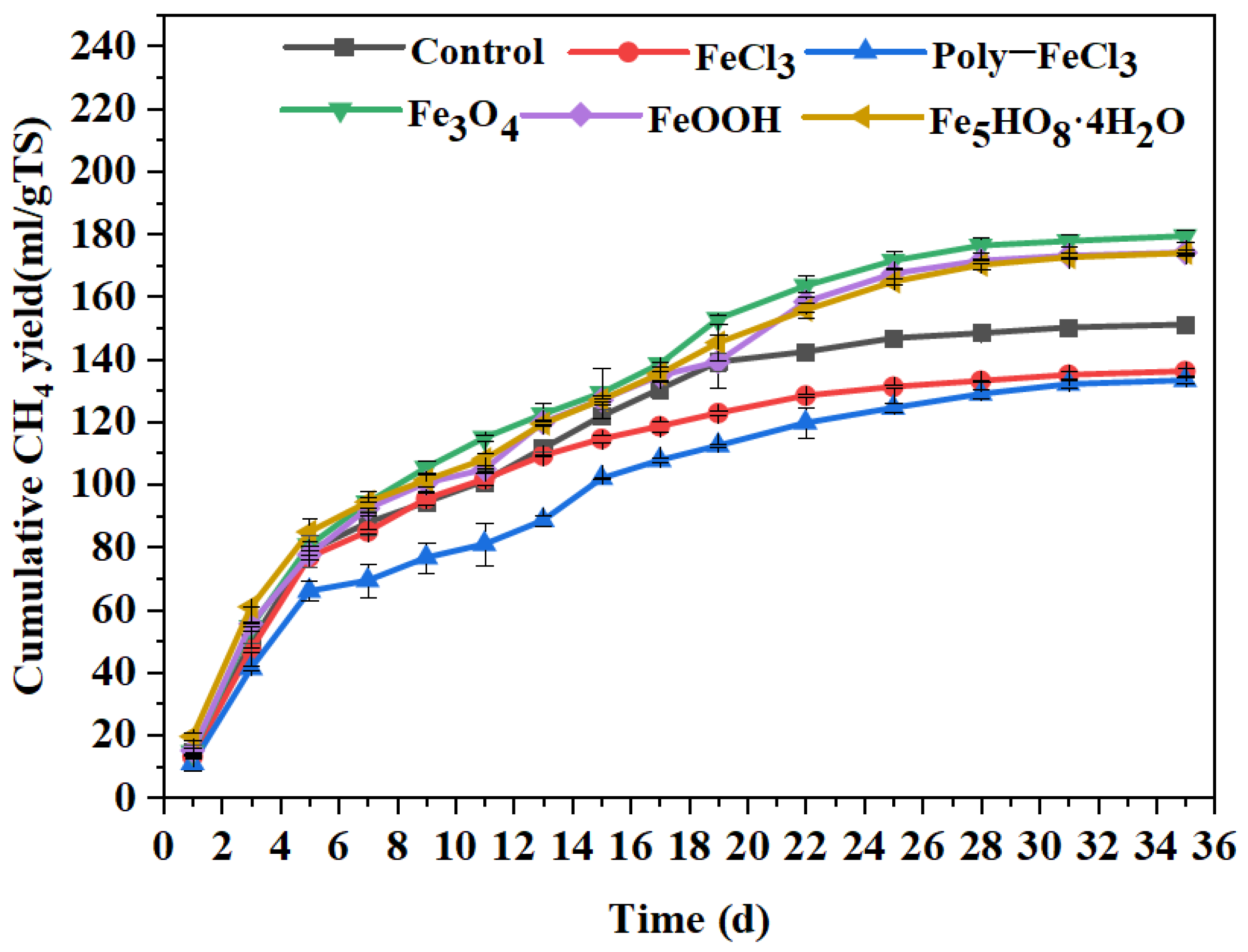
The effects of Fe salts and Fe oxides on SS AD were clearly different, with Fe salts reducing methane production and Fe oxides promoting it. Figure 1 shows the changes in cumulative methane production in each group. Specifically, the methane yield of the control group reached 151.49 mL CH4/g TS, while the yield was reduced by 9.90% and 11.92%, respectively when FeCl3 and Poly-FeCl3 were added. In contrast, the Fe3O4 group achieved the highest cumulative methane yield of 179.30 mL CH4/g TS (an increase by 18.54%). The methane yields in the FeOOH and Fe5HO8·4H2O groups also increased by 15.23% and 15.09%, respectively. These results indicate that different Fe compounds exert divergent effects on SS AD, fundamentally determined by their chemical forms and underlying reaction mechanisms.
The inhibitory effect observed for Poly-FeCl3 is consistent with the findings of Zhu et al., who reported that adding 40 g/kg TS of Poly-FeCl3 reduced methane yield by 20.0%, attributing this inhibition to the formation of dense sludge flocs that physically encapsulated OM and restricted hydrolysis [19]. Our work further confirmed the inhibitory tendency for Poly-FeCl3 and FeCl3 for SS AD. It should be noted that the inhibitory effect of FeCl3 observed in this study differs from the result of Qin et al. [32], who reported that 200 mg/L FeCl3 increased methane yield by 28.9% during high–solids sludge AD. This difference may be attributed to the different Fe dosage, sludge properties, and AD conditions. At lower FeCl3 dosage, Fe(III) may provide beneficial trace elements or electron–accepting capacity for anaerobic microorganisms. In contrast, the promoting effects of Fe oxides observed in this study confirm previous reports that solid Fe-based minerals can enhance methane production during AD. Zhao et al. found that Fe3O4 addition increased methane production from 1261.70 mL to 1638.80 mL by improving hydrolysis, acidification, and subsequent conversion processes [33]. In summary, the subsequent sections further examine how different Fe compounds affect the hydrolysis, acidification, and methanogenesis stages of SS AD, in order to clarify why Fe salts inhibited methane accumulation whereas Fe oxides promoted it.

3.1.2. Effects of Different Fe Compounds on OM Degradation

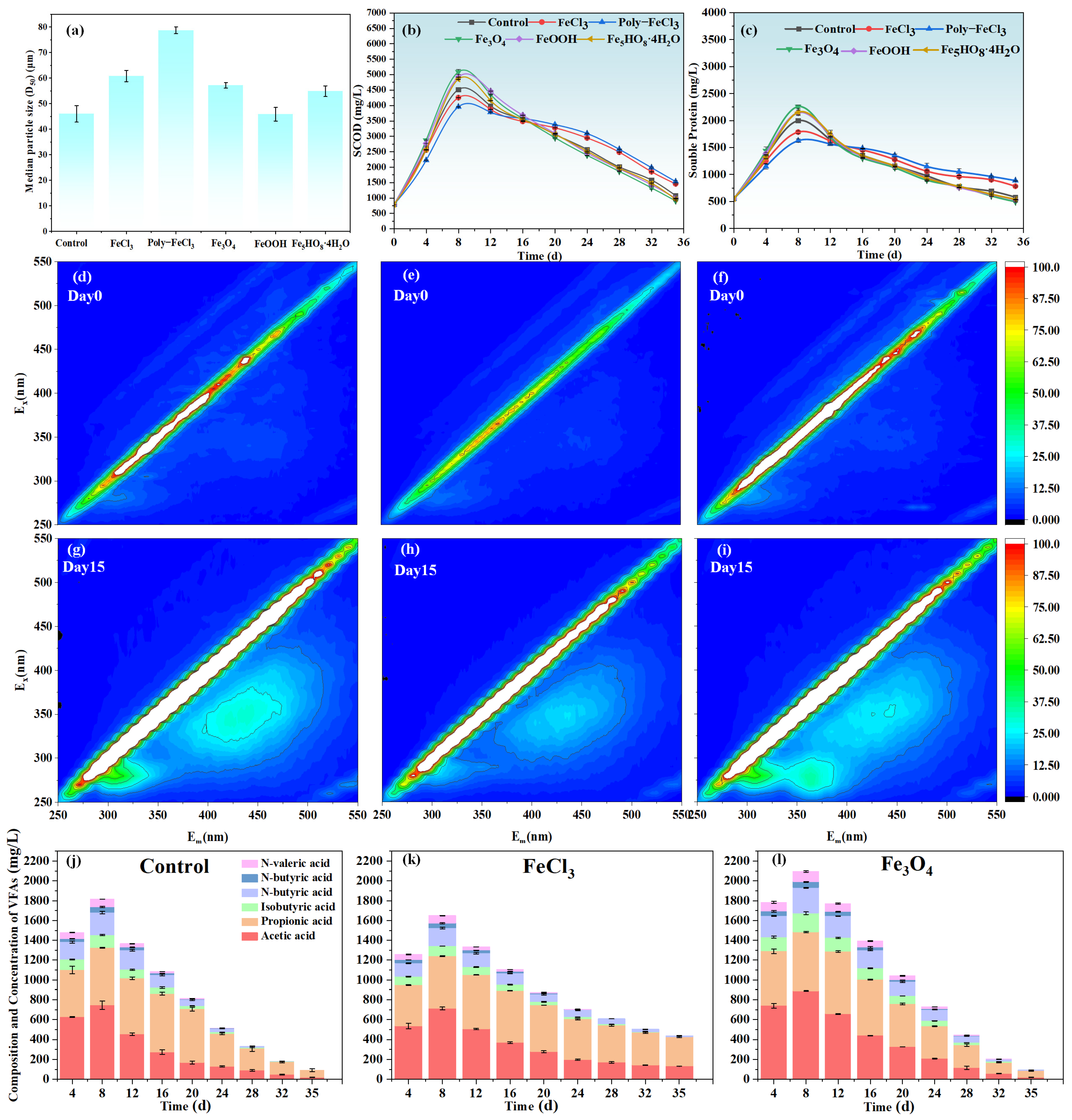
The divergent effects of Fe compounds on methane production were fundamentally rooted in their distinct influences on OM solubilization and transformation throughout the sequential stages of AD. Hydrolysis is the rate limiting initial step of SS AD. In this study, all Fe compounds increased SS particle size to varying degrees before AD (Figure 2a). The D50 value increased from 45.99 μm in the control to 78.68, 60.81 μm in the Poly-FeCl3 and FeCl3 groups, respectively. In contrast, Fe3O4, FeOOH, and Fe5HO8·4H2O exerted milder effects on particle size enlargement (D50: 57.15, 46.86, and 54.84 μm, respectively). These particle size results confirm that the Fe salts caused stronger sludge flocculation than the Fe oxides under the same Fe dosage.
The particle size in the Fe salt groups could be increased because the released Fe3+ could neutralize the negative charges on colloidal particles and EPS in the sludge [34]. This promoted the aggregation and flocculation of small particles, leading to the formation of sludge flocs and an increase in particle size. In contrast, the particle size increases caused by Fe3O4, FeOOH, and Fe5HO8·4H2O were negligible. In particular, FeOOH is a stable solid–phase mineral with low solubility and cannot rapidly release large amounts of Fe(III) hydrolysis products into the liquid phase. Therefore, its charge neutralization and bridging abilities are much weaker. The disparate particle size distributions suggested that Fe salts and Fe oxides established fundamentally different sludge matrices, which would consequently govern OM accessibility and mass transfer efficiency during subsequent AD.
During the early hydrolytic stage, different groups showed contrasting OM release patterns. SCOD is an overall indicator of soluble OM. Figure 2b shows that the SCOD concentration in all groups during AD first increased and then decreased over time. The highest SCOD concentration appeared on day 8, ranging from about 3900 to 5100 mg/L. Among all groups, the Fe3O4 group showed the highest SCOD concentration of 5086.33 mg/L, which was 12.71% higher than the control (4513.38 mg/L). FeOOH and Fe5HO8·4H2O also promoted OM release, with SCOD values of 4919.34 and 4850.88 mg/L, respectively. In contrast, SCOD in the FeCl3 and Poly-FeCl3 groups decreased to 4052.34 and 3953.89 mg/L, which were 10.21% and 12.40% lower than the control. Soluble protein showed a trend consistent with SCOD. The Fe3O4 group achieved the highest value of 2255.23 mg/L, surpassing the control by 13.03%, whereas the Poly-FeCl3 group exhibited the lowest peak at 1624.55 mg/L, representing an 18.60% reduction. FeCl3 decreased by 10.63% compared with the control group (Figure 2c). This difference indicates that the dense flocs formed by Poly-FeCl3 and FeCl3 physically encapsulated particulate OM and restricted the effective contact between extracellular hydrolytic enzymes and substrates, thereby attenuating protein solubilization. This interpretation is corroborated by Zhu et al. [19], who reported that Poly-FeCl3 promoted SS aggregation and hindered organic solubilization through hydroxy polymer bridging. Conversely, the elevated SCOD and soluble protein concentrations in the Fe3O4 group suggest that this mixed-valence Fe oxide facilitated OM release, potentially through enriching hydrolytic microorganisms and stimulating extracellular enzyme secretion at the solid-liquid interface. This interpretation is supported by the findings of Peng et al., who reported that Fe3O4 can strengthen the hydrolysis stage of SS AD by adsorbing and enriching functional microorganisms and increasing extracellular enzyme secretion [35]. These results show that the inhibitory effect of Fe salts and the promoting effect of Fe oxides on methane production can be traced back to the hydrolysis stage.
3D-EEM fluorescence spectra provided complementary evidence for the differential OM transformation trends (Figure 2d,i). From day 0 to day 15, three groups exhibited intensified fluorescence signals, indicating that sludge flocs were gradually broken during AD and that particulate OM was released into the liquid phase. Notably, the control group displayed prominent fluorescence peaks on day 15, suggesting the accumulation of soluble metabolites. In contrast, the FeCl3 group showed attenuated fluorescence intensity, reinforcing the conclusion that flocculation constrained OM liberation. The Fe3O4 group, however, presented distinct protein-like and humic-like fluorescence peaks with enhanced intensity, demonstrating its superior capacity for OM release and transformation.
The VFAs profiles further suggest that the different OM release patterns influenced the subsequent acidification stage. As shown in Figure 2j–l, the three representative groups reached peak total VFAs concentrations around day 8 (1649–2094 mg/L). The Fe3O4 group attained the highest VFAs concentration of 2094.91 mg/L, which was 15.40% higher than the control group (1815.39 mg/L). In contrast, the FeCl3 group showed the lowest VFAs concentration of 1649.33 mg/L, representing a decrease of 9.14%. Acetic acid dominated the VFAs composition across all treatments, accounting for over 40% of the total. Furthermore, a clearer distinction was observed during the subsequent VFAs consumption phase: the Fe3O4 group exhibited the lowest residual propionic acid concentration at the end of AD (64.79 mg/L), FeCl3 showed the highest residual propionic acid concentration at the end of AD (295.39 mg/L). The efficient propionate degradation is particularly significant since propionate oxidation is thermodynamically unfavorable [36]. These results demonstrate that Fe3O4 played a dual role in SS AD by promoting acidification products formation in the early stage and facilitating intermediate VFAs conversion in the later stage. Conversely, FeCl3 led to VFAs accumulation and inhibited further consumption.

3.1.3. Effects of Different Fe Compounds on Activity of Key Enzymes During AD

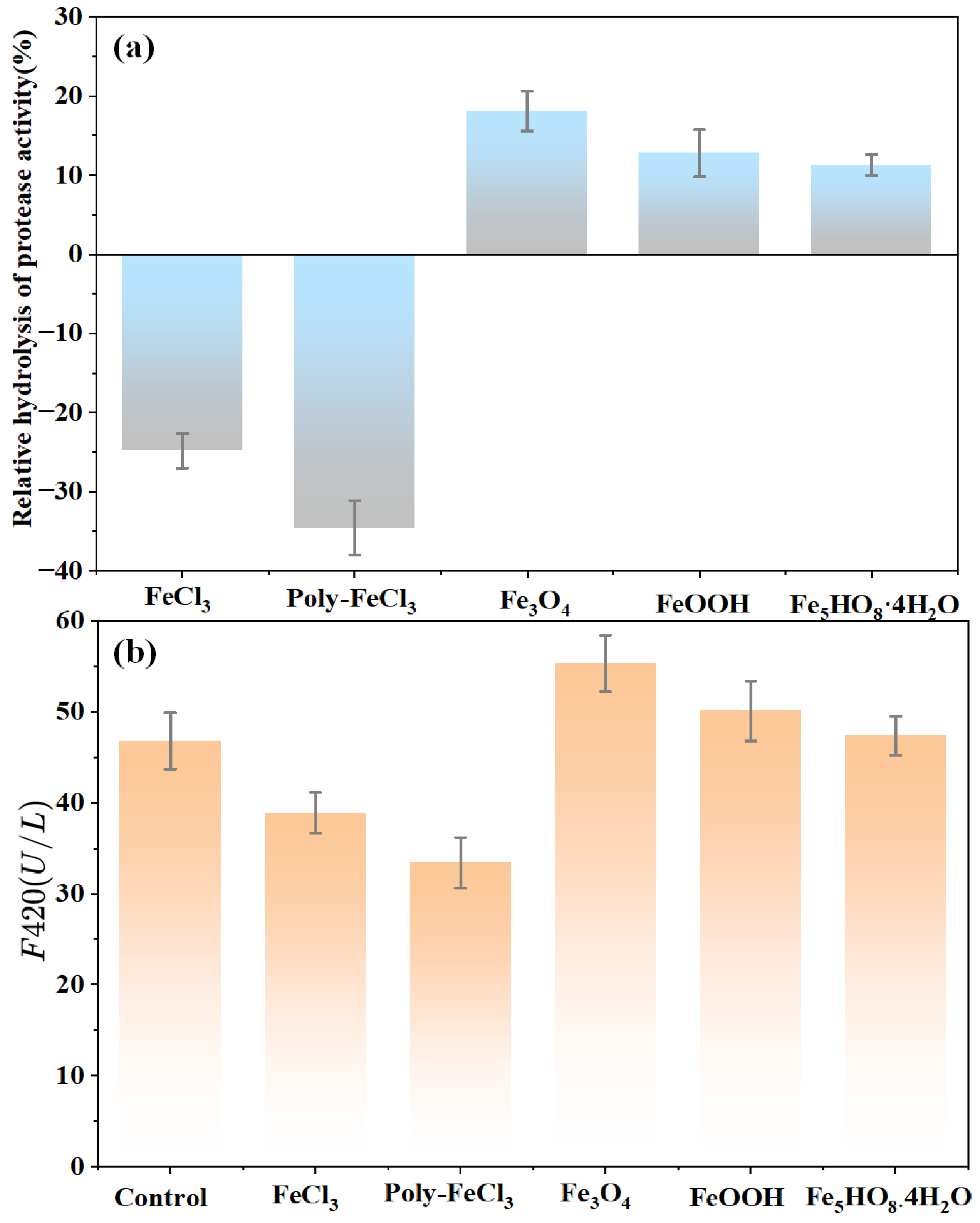
To further decipher the mechanistic basis for the divergent OM transformation, the activities of two key enzymes were analyzed. Protease, as the principal enzyme initiating protein hydrolysis, serves as a sensitive indicator of OM hydrolysis capacity in SS. The Fe3O4 group exhibited a 19.23% increase in protease activity relative to the control, whereas the Poly-FeCl3 and FeCl3 groups showed substantial reductions of 35% and 26.12%, respectively (Figure 3a). In addition, the FeOOH and Fe5HO8·4H2O groups showed increases of about 13.54% and 11.09%, respectively. This enzymatic pattern directly explains the observed soluble protein variation: the dense floc structures induced by Fe salts physically sequestered particulate proteins from protease attack, while Fe3O4 likely provided favorable surface microenvironments for hydrolytic bacteria and enhanced the retention of extracellular enzymes.
The coenzyme F420 content, which reflects methanogenic metabolic vigor, also showed a trend consistent with methane yields (Figure 3b). Compared with the control group (46.8 U/L), the F420 content in the FeCl3 and Poly-FeCl3 groups decreased by 16.88% and 28.63%, respectively. However, the Fe oxide groups showed higher F420 contents overall, with increases of 22.43%, 15.61%, and 11.96% in the Fe3O4, FeOOH, and Fe5HO8·4H2O groups, respectively. The different F420 levels directly correspond to the relevant methane yields, further suggesting Fe salts inhibited F420 activity, and Fe oxides were more favorable for sustaining methanogenic activity. Previous studies have reported that Fe oxides provide a more advantageous redox environment and surface conditions for methanogens [37].

3.2. Evolution of Fe and the Mechanism on Sludge AD

3.2.1. Transformation of Different Fe Compounds

The contrasting AD performances and OM conversion across different groups (Section 3.1) are fundamentally linked to the distinct transformation pathways and redox activities of the added Fe compounds. To elucidate this connection, the dynamics of soluble Fe2+ and solid-phase Fe(II) were monitored, and the electrochemical properties and mineralogical evolution of the Fe phases were further characterized.
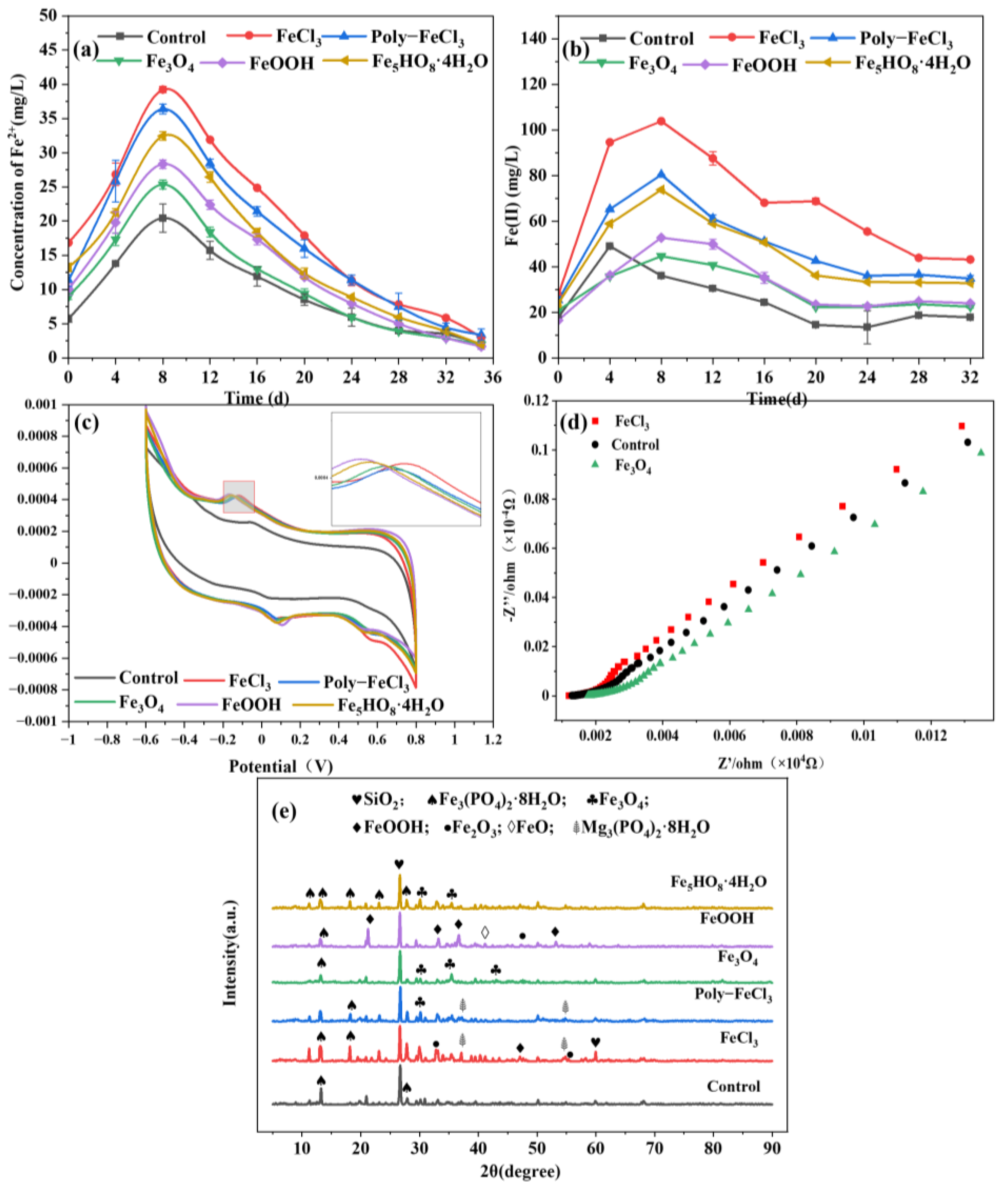
As shown in Figure 4a, soluble Fe2+ concentration in all Fe groups increased during the initial 8 days of AD, in which DIR may have been involved, where Fe(III) species serve as terminal electron acceptors for microbial metabolism [38]. Subsequently, soluble Fe2+ concentrations declined, suggesting re-oxidation, adsorption onto sludge flocs, or incorporation into secondary minerals. Concomitantly, the solid-phase Fe(II) content (Figure 4b) generally increased over time, implying a net accumulation of reduced Fe in the solid matrix.
Notably, the FeCl3 and Poly-FeCl3 groups exhibited relatively high soluble Fe2+ and Fe(II) throughout the process (the concentrations were 39.23 and 103.82 mg/L, and 36.39 and 80.35 mg/L, respectively). However, this larger soluble Fe(II) pool did not translate into enhanced methanogenesis. Instead, these groups showed suppressed CH4 yields along with reduced SCOD, soluble protein and protease activity and decreased VFAs accumulation (Figure 1, Figure 2 and Figure 3). This suggests that while ferric Fe from soluble salts is readily bioavailable for DIR, this process competes with methanogenesis for electrons, and the simultaneous formation of dense flocs physically hinders OM hydrolysis, overriding any potential benefit from DIR-derived soluble Fe(II).
In contrast, the Fe3O4 group achieved the highest CH4 production, although it showed only moderate soluble Fe2+ and Fe(II) accumulation of 25.34 and 44.62 mg/L, respectively, which were 23.91% and 23.70% higher than the control. This suggests that the promoting effect of Fe3O4 was not mainly due to the release of large amounts of free Fe2+. Instead, as a mixed-valence and conductive mineral, Fe3O4 likely enhanced electron transfer through surface Fe(III)/Fe(II) redox cycling. This pathway may allow electron transfer between acetogens and methanogens without strong Fe dissolution, thereby reducing electron competition caused by DIR [36,39]. In comparison, FeOOH and Fe5HO8·4H2O released more soluble Fe2+ than Fe3O4, reaching 28.34 and 32.44 mg/L, respectively, but their CH4 yields were lower. This may be because they lack intrinsic mixed valence and have lower conductivity, which limited sustained electron transfer compared with Fe3O4.

3.2.2. Electrochemical Evidence and Mineralogical Transformation of Fe

To explore the electron transfer capability of the different samples, CV was performed. As illustrated in Figure 4c, all Fe groups exhibited more pronounced redox peaks than the control, confirming that Fe addition enhances the overall redox activity. The CV curves of the FeCl3 and Poly-FeCl3 groups displayed strong redox peaks, consistent with their active soluble Fe2+ release. However, the imbalance between oxidation and reduction currents may imply that the Fe redox cycle is not fully coupled to methanogenesis. Conversely, the Fe3O4 group showed a more symmetrical and stable redox response, suggesting a reversible and sustainable Fe(III)/Fe(II) surface redox process. This balanced electrochemical behavior might help Fe3O4 act as a stable electron mediator, potentially substituting for c-type cytochromes to enhance electron transfer. In addition, the electrochemical impedance spectroscopy (EIS) results (Figure 4d) showed that Fe compounds had a clear effect on the system’s impedance. The Fe3O4 group had the lowest impedance, while the FeCl3 group had the highest. Taken together with the cumulative methane production and CV curves, the low impedance in the Fe3O4 group indicated more efficient electron transfer and stronger interfacial redox activity. These features favored microbial methane production and may also have promoted OM hydrolysis and acidification. In contrast, electron transfer was limited in the high-impedance FeCl3 group, leading to a significant decrease in methane production.
The mineralogical fate of the added Fe compounds after AD provides further evidence for these dynamic transformations (Figure 4e). Characteristic peaks for Fe3O4 appeared in the Poly-FeCl3 group, indicating the neo-formation of Fe3O4 due to Fe(III) reduction and subsequent mineralization during AD. Similarly, the Fe5HO8·4H2O treatment also showed the formation of Fe3O4, indicating a transformation from Fe(III)-rich phases toward more reduced and crystalline Fe-bearing minerals. The FeCl3 group showed the formation of FeOOH and FeO phases. These mineralogical changes, together with the temporal variations in soluble Fe2+ and solid-associated solid-phase Fe(II), indicate that the added Fe compounds underwent continuous redistribution among dissolved, adsorbed, and mineral-bound Fe pools during AD. Such secondary mineralization is an important sign of Fe transformation in the biogeochemical Fe cycle. Fe(III)-bearing minerals may be involved in this process as redox-active intermediates, participating in Fe transformation and OM conversion through reversible Fe(III)/Fe(II) transformation, while also providing potential interfaces for extracellular electron exchange.

3.2.3. Mechanism of Different Fe Compounds and Prospect for Application

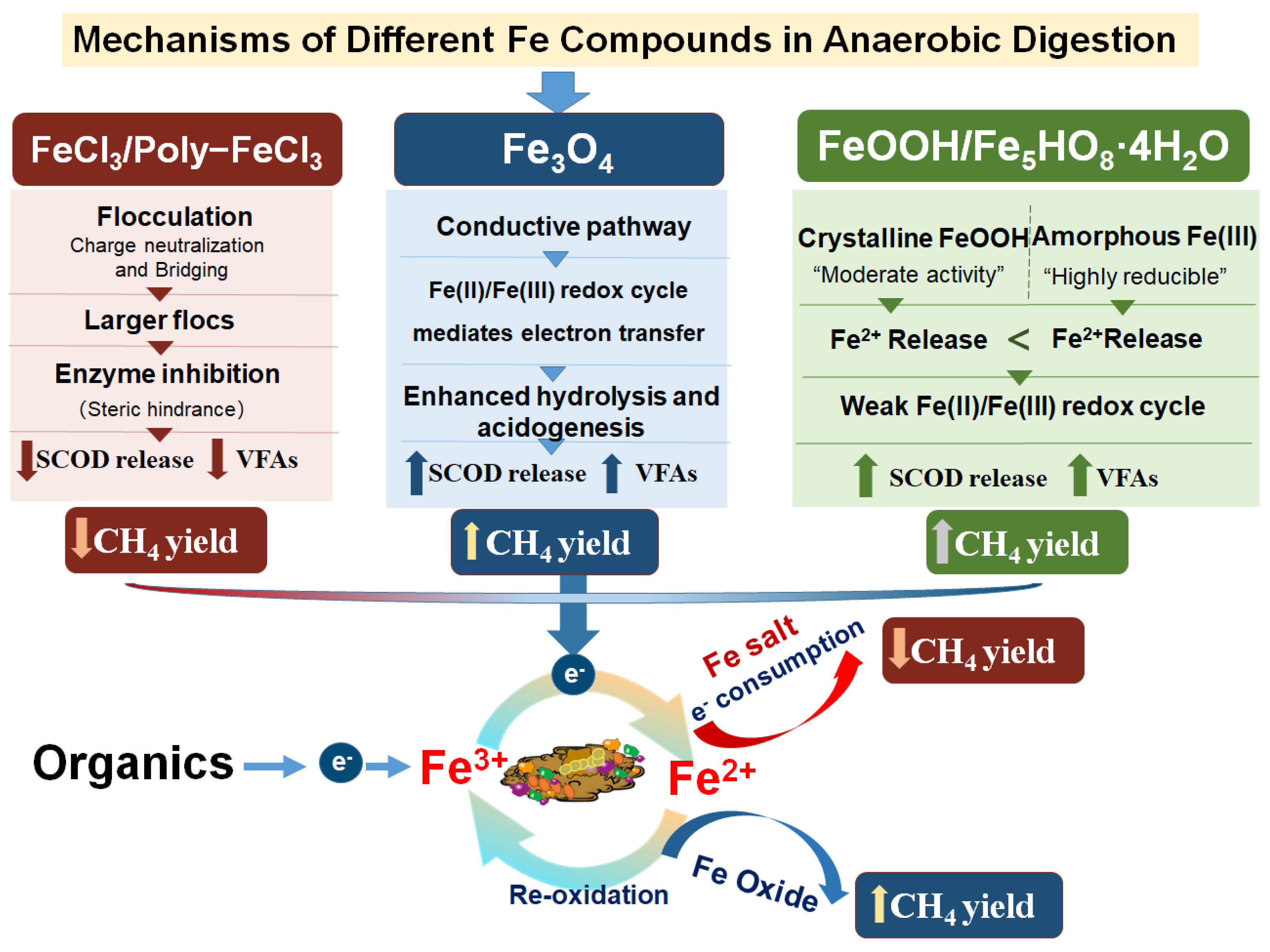
Figure 5 summarizes the mechanisms of different Fe compounds on AD of SS. Overall, Fe did not remain static. Instead, it went through a continuous process of Fe(III) reduction, Fe2+ release, liquid-phase migration, and solid-phase adsorption or precipitation, thereby affecting both electron transfer and OM conversion. The different effects of Fe compounds were mainly related to their influences on sludge structure, OM hydrolysis and release, OM degradation, and Fe(III)/Fe(II) transformation.
Based on the distinct transformation pathways (Section 3.2.1) and electrochemical properties (Section 3.2.2) of the added Fe compounds, the mechanisms underlying their different effects on AD can be elucidated in Figure 5. For the Fe salt groups (FeCl3 and Poly-FeCl3), inhibition was mainly caused by floc formation. Fe(III) hydrolysis products formed dense sludge flocs (D50 increased to 60.81 and 78.68 μm, respectively; Figure 2a) that limited OM hydrolysis. Consequently, protease activity was suppressed (decreased by 26% and 35% in Figure 3a), resulting in the reduction of soluble protein and SCOD release (Figure 2b,c), and ultimately lowering CH4 yields by 9.90% and 11.92% (Figure 1). Second, soluble Fe(III) was readily reduced via DIR and competed with methanogenesis for electrons. Although secondary mineralization (e.g., Fe3O4 formation) was observed (Figure 4e), the overall effect remained inhibitory. For the FeOOH and Fe5HO8·4H2O groups, moderate enhancement was observed. These pure Fe(III) oxides did not induce strong flocculation (D50: 46.86 and 54.84 μm; Figure 2a). Their reductive dissolution released soluble Fe2+ (Figure 4a) and drove Fe(III)/Fe(II) redox cycling, as indicated by enhanced CV redox peaks (Figure 4c). Consequently, CH4 yields increased by 15.23% and 15.09% (Figure 1). However, electron transfer relied on dissolution–reprecipitation, which is less efficient than solid-state conduction.
For the Fe3O4 group, the strongest enhancement was achieved (CH4 yield increased by 18.5% in Figure 1). Several mechanisms contributed: (i) Fe3O4 caused only mild flocculation (D50: 57.15 μm; Figure 2a), thereby preserving greater OM accessibility; (ii) as a mixed-valence conductive mineral, Fe3O4 might have directly participated in extracellular electron transfer via surface Fe(III)/Fe(II) redox cycles, consistent with the balanced CV response (Figure 4c) and moderate soluble Fe2+ levels (Figure 4a); and (iii) Fe3O4 likely facilitated DIET by substituting for c-type cytochromes and working with conductive pili, thereby promoting propionate degradation, as evidenced by the lowest residual propionate (Figure 2i). Additionally, higher protease activity and coenzyme F420 content (Figure 3a,b) indicated enhanced hydrolysis and methanogenesis.
The results also have practical implications for wastewater treatment plants. Fe salts, which are commonly used as coagulants, may adversely affect sludge AD because they promote sludge flocculation and limit OM solubilization. Therefore, the application of Fe-based coagulants should be carefully managed when sludge is subsequently used for AD. In contrast, Fe oxides, especially Fe3O4, enhanced methane production under the tested conditions, suggesting their potential as functional additives for improving methane recovery from SS. This study can provide theoretical guidance on the effects of Fe compounds on sludge AD. In addition, in terms of practical application, the Fe dosage applied in this study was within the same order of magnitude as the Fe levels commonly reported in sludge and those used in practical sludge treatment, indicating that the selected dosage is relevant to real-world applications.
To further clarify the relationship between our results and previous reports, a comparison between this study and relevant studies on Fe-assisted sludge AD is summarized in Table 2. Previous studies mainly focused on a single Fe compound or a specific type of Fe additive, whereas the present study systematically compared soluble Fe salts and solid-phase Fe oxides under the same Fe dosage and digestion conditions. Overall, Table 2 indicates that the apparently contradictory effects of Fe compounds reported in the literature may be partly explained by differences in Fe chemical form, dosage, sludge properties, and digestion conditions, while the present study demonstrates under identical experimental conditions that Fe salts mainly inhibit AD, whereas Fe oxides promote AD.

4. Conclusions

This study demonstrated that different Fe compounds in SS had quite different effects on following AD. FeCl3 and Poly-FeCl3 increased sludge particle size and formed compact flocs, which restricted OM release and reduced protease activity. As a result, methane yields decreased by 9.90% and 11.92%, respectively. In contrast, Fe3O4, FeOOH, and Fe5HO8·4H2O promoted OM release, with SCOD increasing by 12.71%, 8.99%, and 7.47%, respectively, and supported Fe(III)/Fe(II) cycling. As a result, methane production increased by 18.54%, 15.23%, and 15.09%, respectively.

Author Contributions

Y.B.: writing for original draft, review and editing, formal analysis, and data curation; Y.S.: writing for original draft, editing, data curation, conceptualization; X.Y.: review and editing, investigation, formal analysis; Q.L.: conceptualization; H.C.: writing for original draft, resources, project administration, methodology, investigation, funding acquisition, formal analysis, data curation, funding acquisition. All authors have read and agreed to the published version of the manuscript.

Funding

The authors greatly acknowledge financial support from the National Natural Science Foundation of China (No. 22376136).

Institutional Review Board Statement

Not applicable.

Informed Consent Statement

Not applicable.

Data Availability Statement

Data will be made available on request.

Conflicts of Interest

The authors declare no conflicts of interest.

Abbreviations

The following abbreviations are used in this manuscript:
ADAnaerobic digestion
SSSewage sludge
OMOrganic matter
IHTInterspecies hydrogen transfer
IFTInterspecies formate transfer
DIETDirect interspecies electron transfer
DIRDissimilatory iron reduction
DOMDissolved organic matter
TSTotal solid
SCODSoluble chemical oxygen demand
VFAsVolatile fatty acids
CVCyclic voltammetry
TCODTotal chemical oxygen demand
VSVolatile solid
TCDThermal conductivity detector
GCGas chromatograph
FIDFlame ionization detector
EEMExcitation-emission matrix
EPSExtracellular polymeric substances
ORPOxidation-reduction potential
dDay
°C Degree Celsius

References

  1. Martins, G.; Salvador, A.F.; Pereira, L.; Alves, M.M. Methane Production and Conductive Materials: A Critical Review. Environ. Sci. Technol. 2018, 52, 10241–10253. [Google Scholar] [CrossRef]
  2. Ma, J.; Duong, T.H.; Smits, M.; Verstraete, W.; Carballa, M. Enhanced biomethanation of kitchen waste by different pre-treatments. Bioresour. Technol. 2011, 102, 592–599. [Google Scholar] [CrossRef]
  3. Rafique, R.; Poulsen, T.G.; Nizami, A.S.; Asam, Z.U.Z.; Murphy, J.D.; Kiely, G. Effect of thermal, chemical and thermo-chemical pre-treatments to enhance methane production. Energy 2010, 35, 4556–4561. [Google Scholar] [CrossRef]
  4. Heo, N.H.; Park, S.C.; Lee, J.S.; Kang, H. Solubilization of waste activated sludge by alkaline pretreatment and biochemical methane potential (BMP) tests for anaerobic co-digestion of municipal organic waste. Water Sci. Technol. 2003, 48, 211–219. [Google Scholar] [CrossRef]
  5. Ferrer, I.; Ponsá, S.; Vázquez, F.; Font, X. Increasing biogas production by thermal (70 °C) sludge pre-treatment prior to thermophilic anaerobic digestion. Biochem. Eng. J. 2008, 42, 186–192. [Google Scholar] [CrossRef]
  6. Wang, W.; Lee, D.-J. Direct interspecies electron transfer mechanism in enhanced methanogenesis: A mini-review. Bioresour. Technol. 2021, 330, 124980. [Google Scholar] [CrossRef] [PubMed]
  7. Stams, A.J.M.; Plugge, C.M. Electron transfer in syntrophic communities of anaerobic bacteria and archaea. Nat. Rev. Microbiol. 2009, 7, 568–577. [Google Scholar] [CrossRef] [PubMed]
  8. Tezel, U.; Padhye, L.P.; Huang, C.H.; Pavlostathis, S.G. Biotransformation of nitrosamines and precursor secondary amines under methanogenic conditions. Environ. Sci. Technol. 2011, 45, 8290–8297. [Google Scholar] [CrossRef]
  9. Rotaru, A.E.; Shrestha, P.M.; Liu, F.; Markovaite, B.; Chen, S.; Nevin, K.P.; Lovley, D.R. Direct interspecies electron transfer between Geobacter metallireducens and Methanosarcina barkeri. Appl. Environ. Microbiol. 2014, 80, 4599–4605. [Google Scholar] [CrossRef]
  10. Rotaru, A.E.; Shrestha, P.M.; Liu, F.; Shrestha, M.; Shrestha, D.; Embree, M.; Zengler, K.; Wardman, C.; Nevin, K.P.; Lovley, D.R. A new model for electron flow during anaerobic digestion: Direct interspecies electron transfer to Methanosaeta for the reduction of carbon dioxide to methane. Energy Environ. Sci. 2014, 7, 408–415. [Google Scholar] [CrossRef]
  11. Cheng, Q.; Call, D.F. Hardwiring microbes: Via direct interspecies electron transfer: Mechanisms and applications. Environ. Sci. Process. Impacts 2016, 18, 968–980. [Google Scholar] [CrossRef]
  12. Baek, G.; Kim, J.; Lee, C. A review of the effects of iron compounds on methanogenesis in anaerobic environments. Renew. Sustain. Energy Rev. 2019, 113, 109282. [Google Scholar] [CrossRef]
  13. Asensi, E.; Alemany, E.; Duque-Sarango, P.; Aguado, D. Assessment and modelling of the effect of precipitated ferric chloride addition on the activated sludge settling properties. Chem. Eng. Res. Des. 2019, 150, 14–25. [Google Scholar] [CrossRef]
  14. Pradhan, S.K.; Torvinen, E.; Siljanen, H.M.P.; Pessi, M.; Heinonen-Tanski, H. Iron flocculation stimulates biogas production in Microthrix parvicella-spiked wastewater sludge. Int. J. Environ. Sci. Technol. 2015, 12, 3039–3046. [Google Scholar] [CrossRef]
  15. Shewa, W.A.; Dagnew, M. Revisiting Chemically Enhanced Primary Treatment of Wastewater: A Review. Sustainability 2020, 12, 5928. [Google Scholar] [CrossRef]
  16. Liu, Q.; Zhang, Y. Investigation and analysis of heavy metal content in sludge from wastewater treatment plants. Green Technol. 2022, 24, 5. (In Chinese) [Google Scholar]
  17. Li, R.-h.; Cui, J.-l.; Li, X.-d.; Li, X.-y. Phosphorus Removal and Recovery from Wastewater using Fe-Dosing Bioreactor and Cofermentation: Investigation by X-ray Absorption Near-Edge Structure Spectroscopy. Environ. Sci. Technol. 2018, 52, 14119–14128. [Google Scholar] [CrossRef] [PubMed]
  18. Wang, T.; Zhang, D.; Dai, L.; Dong, B.; Dai, X. Magnetite Triggering Enhanced Direct Interspecies Electron Transfer: A Scavenger for the Blockage of Electron Transfer in Anaerobic Digestion of High-Solids Sewage Sludge. Environ. Sci. Technol. 2018, 52, 7160–7169. [Google Scholar] [CrossRef]
  19. Zhu, S.; Chen, H. Unraveling the role of polyferric chloride in anaerobic digestion of waste activated sludge. Bioresour. Technol. 2022, 346, 126620. [Google Scholar] [CrossRef]
  20. Yu, B.; Lou, Z.; Zhang, D.; Shan, A.; Yuan, H.; Zhu, N.; Zhang, K. Variations of organic matters and microbial community in thermophilic anaerobic digestion of waste activated sludge with the addition of ferric salts. Bioresour. Technol. 2015, 179, 291–298. [Google Scholar] [CrossRef] [PubMed]
  21. Ayaa, P.; McFarland, M. Effect of Magnetite on Anaerobic Digester Biogas, Hydrogen Sulfide Gas, Digester Effluent, and Related Processes. J. Environ. Eng. 2021, 147, 05021005. [Google Scholar] [CrossRef]
  22. Yao, D.; Wang, J.; Chen, T.; Tan, J.; Wang, G. Methanogenic and carbon sequestration process facilitated by goethite and hematite in the presence of dissimilatory iron-reducing bacteria. Fresenius Environ. Bull. 2016, 25, 1883–1891. [Google Scholar]
  23. Zhan, W.; Li, L.; Tian, Y.; Lei, Y.; Zuo, W.; Zhang, J.; Jin, Y.; Xie, A.; Zhang, X.; Wang, P.; et al. Insight into the roles of ferric chloride on short-chain fatty acids production in anaerobic fermentation of waste activated sludge: Performance and mechanism. Chem. Eng. J. 2021, 420, 129809. [Google Scholar] [CrossRef]
  24. Zhang, J.; Yang, H.; Li, W.; Wen, Y.; Fu, X.; Chang, J. Variations of sludge characteristics during the advanced anaerobic digestion process and the dewaterability of the treated sludge conditioning with PFS, PDMDAAC and synthesized PFS-PDMDAAC. Water Sci. Technol. 2018, 78, 1189–1198. [Google Scholar] [CrossRef]
  25. Zouboulis, A.I.; Moussas, P.A.; Vasilakou, E. Polyferric sulphate: Preparation, characterisation and application in coagulation experiments. J. Hazard. Mater. 2008, 155, 459–468. [Google Scholar] [CrossRef]
  26. Standard Methods for the Examination of Water and Wastewater; American Public Health Association: Washington, DC, USA, 2012.
  27. Chen, H.; Tang, M.; Yang, X.; Tsang, Y.F.; Wu, Y.; Wang, D.; Zhou, Y. Polyamide 6 microplastics facilitate methane production during anaerobic digestion of waste activated sludge. Chem. Eng. J. 2021, 408, 127251. [Google Scholar] [CrossRef]
  28. Fortune, W.B.; Mellon, M.G. Determination of Iron with o-Phenanthroline: A Spectrophotometric Study. Ind. Eng. Chem.-Anal. Ed. 1938, 10, 60–64. [Google Scholar]
  29. Wang, M.; Zhao, Z.; Zhang, Y. Magnetite-contained biochar derived from fenton sludge modulated electron transfer of microorganisms in anaerobic digestion. J. Hazard. Mater. 2021, 403, 123972. [Google Scholar] [CrossRef]
  30. Maeda, T.; Yoshimura, T.; García-Contreras, R.; Ogawa, H.I. Purification and characterization of a serine protease secreted by Brevibacillus sp. KH3 for reducing waste activated sludge and biofilm formation. Bioresour. Technol. 2011, 102, 10650–10656. [Google Scholar] [CrossRef]
  31. Reynolds, P.J.; Colleran, E. Evaluation and improvement of methods for coenzyme F420 analysis in anaerobic sludges. J. Microbiol. Methods 1987, 7, 115–130. [Google Scholar] [CrossRef]
  32. Qin, Y.; Chen, L.; Wang, T.; Ren, J.; Cao, Y.; Zhou, S. Impacts of ferric chloride, ferrous chloride and solid retention time on the methane-producing and physicochemical characterization in high-solids sludge anaerobic digestion. Renew. Energy 2019, 139, 1290–1298. [Google Scholar]
  33. Zhao, Z.; Zhang, Y.; Li, Y.; Quan, X.; Zhao, Z. Comparing the mechanisms of ZVI and Fe3O4 for promoting waste-activated sludge digestion. Water Res. 2018, 144, 126–133. [Google Scholar] [PubMed]
  34. Hu, X.; Chen, K.; Lai, X.; Ji, S.; Kaiser, K. Effects of Fe(III) on biofilm and its extracellular polymeric substances (EPS) in fixed bed biofilm reactors. Water Sci. Technol. 2016, 73, 2060–2066. [Google Scholar] [CrossRef] [PubMed]
  35. Peng, H.; Zhang, Y.; Tan, D.; Zhao, Z.; Zhao, H.; Quan, X. Roles of magnetite and granular activated carbon in improvement of anaerobic sludge digestion. Bioresour. Technol. 2018, 249, 666–672. [Google Scholar] [CrossRef]
  36. Yuan, Y.; Hu, X.; Chen, H.; Zhou, Y.; Zhou, Y.; Wang, D. Advances in enhanced volatile fatty acid production from anaerobic fermentation of waste activated sludge. Sci. Total Environ. 2019, 694, 133741. [Google Scholar] [PubMed]
  37. Zhong, Y.; He, J.; Wu, F.; Zhang, P.; Zou, X.; Pan, X.; Zhang, J. Metagenomic analysis reveals the size effect of magnetite on anaerobic digestion of waste activated sludge after thermal hydrolysis pretreatment. Sci. Total Environ. 2022, 851, 158133. [Google Scholar] [CrossRef]
  38. Weber, K.A.; Achenbach, L.A.; Coates, J.D. Microorganisms pumping iron: Anaerobic microbial iron oxidation and reduction. Nat. Rev. Microbiol. 2006, 4, 752–764. [Google Scholar] [CrossRef]
  39. Zhuang, L.; Tang, Z.; Yu, Z.; Li, J.; Tang, J. Methanogenic Activity and Microbial Community Structure in Response to Different Mineralization Pathways of Ferrihydrite in Paddy Soil. Front. Earth Sci. 2019, 7, 325. [Google Scholar] [CrossRef]
  40. Orrantia, M.; Armenta, M.A.; Alvarez, L.H.; Burboa-Charis, V.A.; Meza-Escalante, E.R.; Olivas, A.; Arroyo, E.; Maytorena, V.M. Enhanced methane production via anaerobic digestion assisted with Fe3O4 nanoparticles supported on microporous granular activated carbon. Fuel 2024, 360, 130517. [Google Scholar] [CrossRef]
  41. Xu, H.; Wang, M.; Hei, S.; Qi, X.; Zhang, X.; Liang, P.; Fu, W.; Pan, B.; Huang, X. Neglected role of iron redox cycle in direct interspecies electron transfer in anaerobic methanogenesis: Inspired from biogeochemical processes. Water Res. 2024, 262, 122125. [Google Scholar] [CrossRef]
  42. Yang, Y.; Chen, H.; Liu, J.; Chen, B.; Yang, F.; Wang, L.; Wang, Y.; Dou, M.; Wan, J. Effects of different iron minerals on organics removal pathway and end-products during anaerobic digestion. Environ. Sci. Water Res. Technol. 2023, 9, 1663–1671. [Google Scholar] [CrossRef]
Figure 1. The effects of Fe compounds on cumulative methane production.
Sustainability 18 05580 g001
Figure 2. Effects of Fe compounds on the evolution of OM during AD: (a) effect on particle size before AD; (b) effect on OM release during AD; (c) effect on soluble protein; (df) effect on DOM on day 0 of AD; (gi) effect on DOM on day 15 of AD; (jl) effect on VFAs during AD.
Sustainability 18 05580 g002
Figure 3. Effects of Fe compounds on relative enzyme activity during SS AD: (a) effect on protease concentration; (b) effect on coenzyme F420 concentration.
Sustainability 18 05580 g003
Figure 4. Characteristics of evolution of different Fe compounds: (a) changes in Fe2+ in the supernatant; (b) changes in solid-phase Fe(II); (c) cyclic voltammetry curves; (d) EIS Nyquist plots; (e) XRD patterns of sludge samples after AD.
Sustainability 18 05580 g004
Figure 5. Mechanism diagram of AD affected by different Fe compounds.
Sustainability 18 05580 g005
Table 1. Main features of concentrated SS and inoculum sludge.
ParametersUnitsSewage SludgeInoculum
pH/6.44 ± 0.01/
TS (g/L)g/L20.22 ± 0.2569.44 ± 0.45
VS (g/L)g/L14.07 ± 0.4255.68 ± 0.57
TCOD (g/L)g/L13.25 ± 0.63/
Table 2. Comparison of this study with previous studies on Fe compounds during SS AD.
Fe CompoundsDosageEffect on Cumulative Methane ProductionReference
FeCl3200 mg/LMethane yield increased by 28.9%.[32]
Poly-FeCl340 g/kg TSMethane yield decreased by 20.0%.[19]
Fe3O4120 mg/LMethane yield increased by 69.6%.[40]
FeOOH1675 mg Fe/LMethane yield increased by 37.33%.[41]
Fe5HO8·4H2O4545 mg Fe/LMethane yield decreased by 23.0%.[42]
This study40 mg Fe/g TSFeCl3 and Poly-FeCl3 decreased methane yield by 9.90% and 11.92%, respectively. Fe3O4, FeOOH, and Fe5HO8·4H2O increased methane yield by 18.54%, 15.23%, and 15.09%, respectively./
Disclaimer/Publisher’s Note: The statements, opinions and data contained in all publications are solely those of the individual author(s) and contributor(s) and not of MDPI and/or the editor(s). MDPI and/or the editor(s) disclaim responsibility for any injury to people or property resulting from any ideas, methods, instructions or products referred to in the content.