Ecodesign in the Spanish Toy Industry: Case Studies, Ecodesign Strategies and Evolution



Abstract
1. Introduction
- “The integration of environmental aspects into product design and development, with the goal of reducing adverse environmental impacts throughout the entire life cycle of the product,” as defined by ISO 14006 (Environmental Management Systems—Guidelines for Incorporating Ecodesign) [19].
- Alternatively, ecodesign, also known as design for the environment, is the inclusion of environmental considerations during product development to minimize impacts across life cycle stages.
2. Materials and Methods
2.1. Study Design
- (1)
- A documentary review of projects and initiatives that apply or promote ecodesign strategies in the toy sector;
- (2)
- A stakeholder survey capturing professional perceptions of the adoption and evolution of these strategies over the past three decades.
2.2. Documentary Review and Project Selection
- Development or testing of sustainable materials, processes, or components applicable to toys;
- Introduction of energy-efficient or circular manufacturing practices;
- Participation of the Spanish toy industry;
- Explicit alignment with one or more ecodesign strategies (Axes 1–8).
2.3. Survey Design and Data Collection
- Profile information: Gender, age group, professional role (designer, manufacturer, environmental or quality manager, researcher, educator), and years of experience.
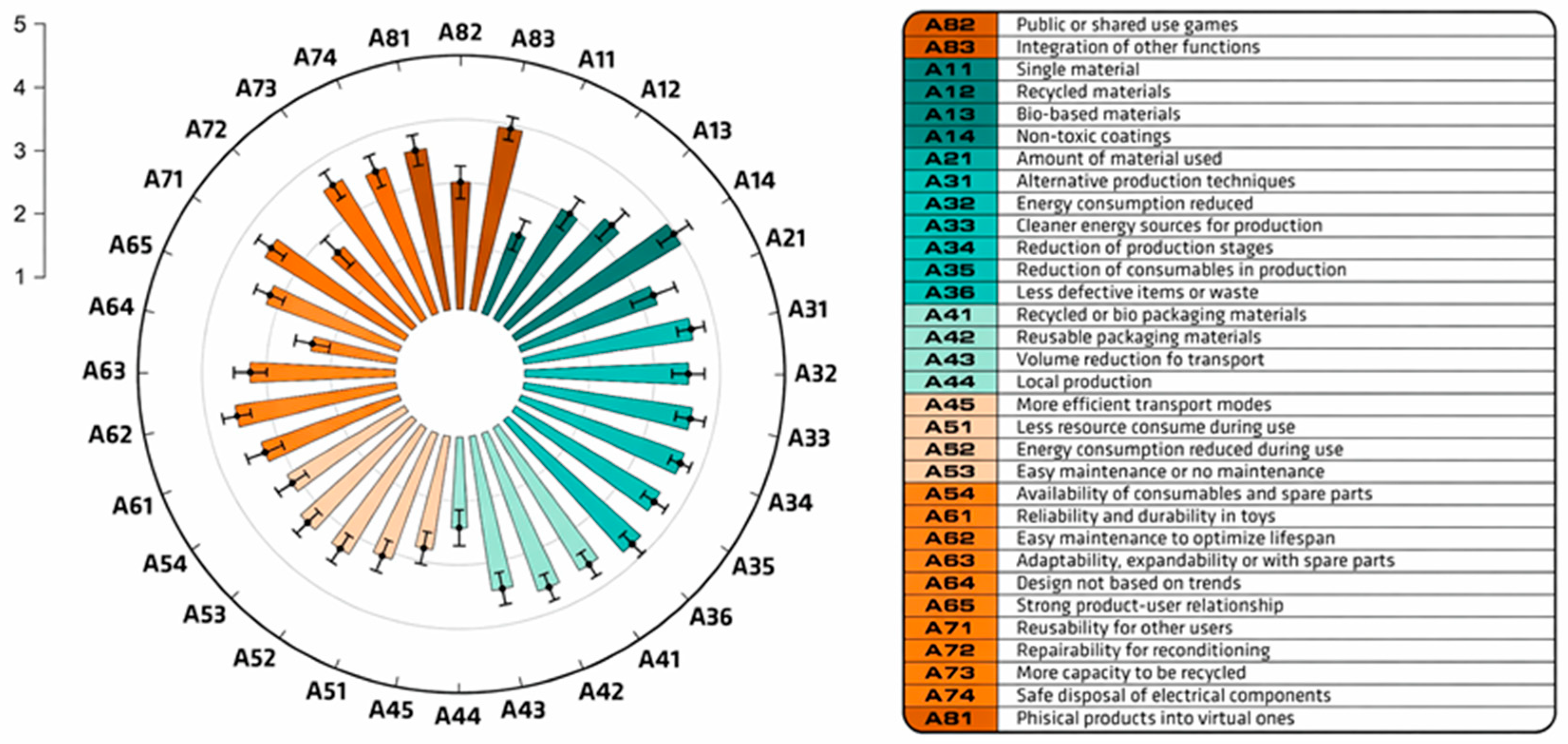
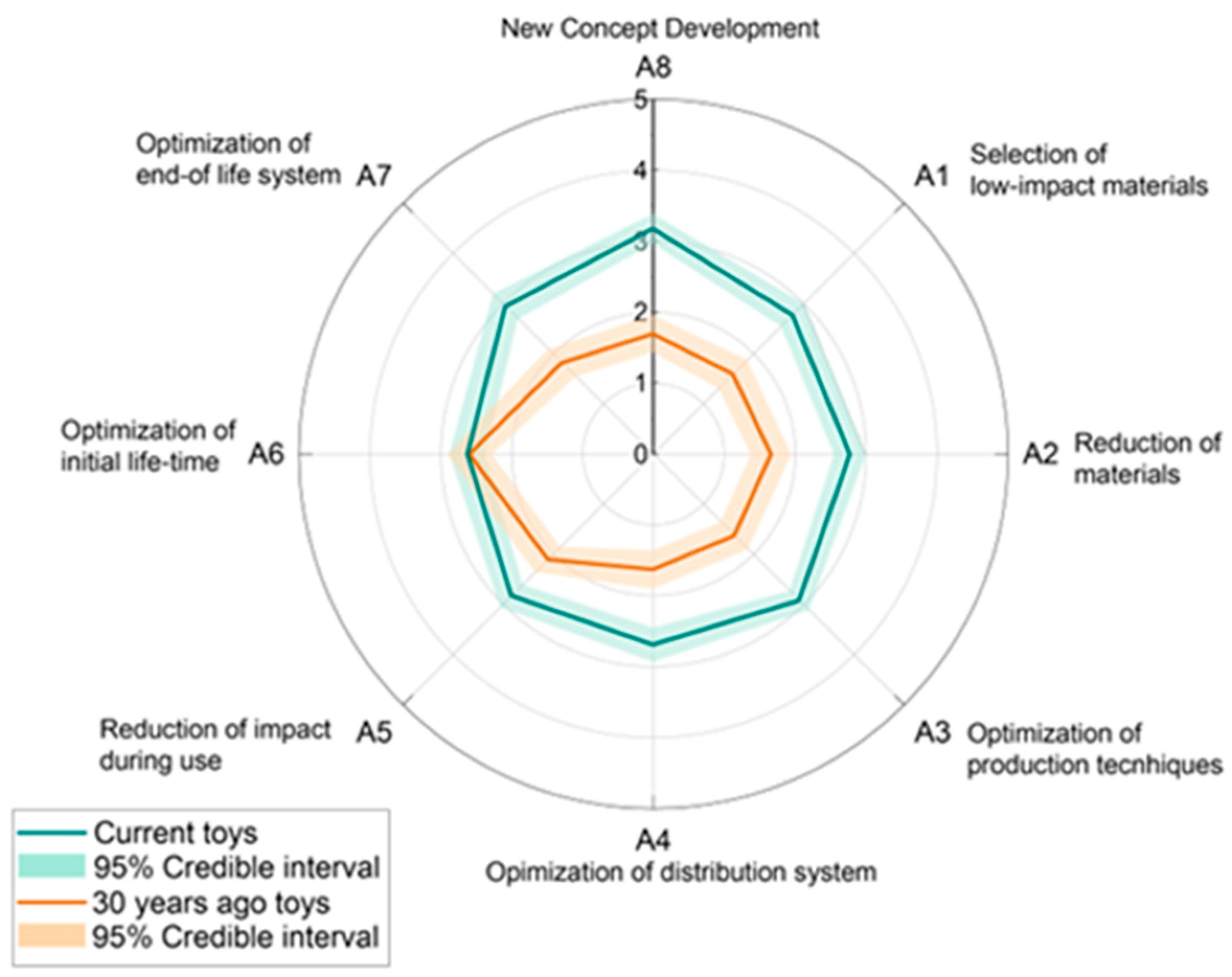
- Ecodesign assessment: A series of Likert scale items (ranging from 0, “not at all eco-friendly,” to 5, “fully eco-friendly”) was employed for each dimension of the ecodesign strategy wheel. These items were used to evaluate and compare environmental performance between the baseline of 30 years ago and the current state.
2.4. Data Analysis
2.5. Ethical and Quality Considerations
3. Results and Discussion
3.1. Descriptive Review of Toy Ecodesign
3.1.1. Axis 1 (A1): Selection of Low-Impact Materials
3.1.2. Axis 2 (A2): Reduction in Material Usage
3.1.3. Axis 3 (A3): Techniques to Optimize Production
3.1.4. Axis 4 (A4): Optimization of Distribution Systems
3.1.5. Axis 5 (A5): Reduction of Impact During the Use Phase
3.1.6. Axis 6 (A6): Enhancing Product Lifespan
3.1.7. Axis 7 (A7): Enhancing End-of-Life Management
3.1.8. Axis 8 (A8): Innovative Concept Creation
3.2. Survey Results
3.3. Triangulated Insights into Spain Ecodesign Implementation
- Material and Process Innovation (A1–A3)
- Distribution (A4)
- Use and Product Lifetime Extension (A5–A6)
- End of Life (A7)
- New Design Concepts (A8)
4. Discussion
4.1. Main Findings and Interpretation
4.2. Comparative Analysis of Professional Profiles and Gender Dynamics
4.3. Comparison with Previous Research
4.4. Policy and Industry Implications
- Regulatory alignment and voluntary standards. The forthcoming EU Regulation 2024/1781 may provide an opportunity to further formalize ecodesign criteria for toys, linking safety, material circularity, and traceability requirements. Based on the perceptions analyzed, proactive engagement with this regulation could help the industry move beyond reactive compliance.
- Support for small- and medium-sized enterprises (SMEs). Given that more than 95% of toy manufacturers are SMEs, targeted support measures, such as eco-innovation funding, technical training, and access to life cycle assessment tools, would likely be essential to overcome resource limitations and technological barriers identified by sector stakeholders.
- Design education and consumer awareness. Persistent misconceptions that “ecofriendly toys” might be less attractive or safe than conventional ones appear to influence both producers and consumers. Awareness campaigns and clearer environmental labeling may contribute to improving the acceptance of sustainable materials without compromising safety or play value.
- Product longevity and service-based models. Business models perceived as promising, such as toy rental, repair services, or component replacement, could potentially extend product life and reduce waste in line with circular economy principles. Similarly, promoting secondary markets for high-quality, durable toys may reinforce gradual cultural shifts toward reuse and longer product lifespans.
4.5. Limitations and Future Research
- Validate the updated ecodesign strategy wheel through international and cross-sectoral samples to enhance external validity;
- Incorporate quantitative sustainability indicators—such as carbon footprint, energy demand, or material circularity index—and link them to specific toy categories and production processes;
- Investigate consumer perspectives on eco-attributes, play value, and willingness to pay to align producer–consumer expectations and support the development of effective circular and low-carbon design strategies within the toy sector.
5. Conclusions
Author Contributions
Funding
Institutional Review Board Statement
Informed Consent Statement
Data Availability Statement
Acknowledgments
Conflicts of Interest
Appendix A
Appendix A.1. Survey on the Ecological State of the Toy Industry: A Professional Perspective
- 1.
- Main Professional Experience: (Mandatory)(Select only one option.)
- Toy Production
- Supply Chain
- Sales
- Technology Center
- University
- Early Childhood Education
- Other: __________
- 2.
- Age: (Mandatory)(Select only one option.)
- 20–29
- 30–39
- 40–49
- 50–59
- 60–69
- 70 or older
- 3.
- Gender: (Mandatory)(Select only one option.)
- Female
- Male
- Prefer not to say
- 4.
- Country (Nationality): (Mandatory)(Select only one option from the list below.)List omitted due to its length.Rate the adoption of the following ecological strategies in the selection of toy materials today compared to those from 30 years ago.
Strategy Strongly Disagree Disagree Agree Strongly Agree Toys are made from a single material ☐ ☐ ☐ ☐ Materials are recycled ☐ ☐ ☐ ☐ Material composition reduces fossil carbon footprint (bio-based materials or additives to reduce petroleum use) ☐ ☐ ☐ ☐ No toxic coatings (e.g., chrome) ☐ ☐ ☐ ☐ - 5.
- How ecological were the materials of toys 30 years ago?Rate on a scale from 0 to 5, where 0 means Not Ecological and 5 means Totally Ecological.
- 0–1–2–3–4–5
- 6.
- How ecological are the materials of toys today?Rate on a scale from 0 to 5, where 0 means Not Ecological and 5 means Totally Ecological.
- 0–1–2–3–4–5
- 7.
- Quantity of Materials in Toys:How would you rate the quantity of material used in toys from 30 years ago?Rate on a scale from 0 to 5, where 0 means Not Ecological and 5 means Totally Ecological.
- 0–1–2–3–4–5
- 8.
- How would you rate the quantity of material used in toys today?Rate on a scale from 0 to 5, where 0 means Not Ecological and 5 means Totally Ecological.
- 0–1–2–3–4–5
- 9.
- Toy Production Techniques:Rate the adoption of the following ecological strategies in the production of toys today compared to those from 30 years ago.
Strategy Strongly Disagree Disagree Agree Strongly Agree Alternative production techniques have been introduced ☐ ☐ ☐ ☐ Energy consumption has been reduced ☐ ☐ ☐ ☐ Energy sources used are cleaner ☐ ☐ ☐ ☐ The stages of the manufacturing process have been reduced ☐ ☐ ☐ ☐ Consumables have been reduced and/or are cleaner ☐ ☐ ☐ ☐ Fewer defective parts and/or waste are produced ☐ ☐ ☐ ☐ - 10.
- How ecological were the production techniques used in the manufacturing of toys 30 years ago?Rate on a scale from 0 to 5, where 0 means Not Ecological and 5 means Totally Ecological.
- 0–1–2–3–4–5
- 11.
- How ecological are the production techniques used in the manufacturing of toys today?Rate on a scale from 0 to 5, where 0 means Not Ecological and 5 means Totally Ecological.
- 0–1–2–3–4–5
- 12.
- Toy Distribution, Packaging, and Sales:Rate the adoption of the following ecological strategies in the distribution, packaging, and sales of toys today compared to those from 30 years ago.
Strategy Strongly Disagree Disagree Agree Strongly Agree Packaging materials are bio-based and/or recycled ☐ ☐ ☐ ☐ Packaging materials can be recycled or reused for toy storage or other uses ☐ ☐ ☐ ☐ Toys are shipped disassembled to reduce transport volume ☐ ☐ ☐ ☐ Toys are produced locally ☐ ☐ ☐ ☐ More efficient transportation methods are prioritized (ship and train before airplane and truck) ☐ ☐ ☐ ☐ - 13.
- How ecological was the distribution, packaging, and sales of toys 30 years ago?Rate on a scale from 0 to 5, where 0 means Not Ecological and 5 means Totally Ecological.
- 0–1–2–3–4–5
- 14.
- How ecological is the distribution, packaging, and sales of toys today?Rate on a scale from 0 to 5, where 0 means Not Ecological and 5 means Totally Ecological.
- 0–1–2–3–4–5
- 15.
- Environmental Impact During Toy Use:Rate the adoption of the following ecological strategies regarding the impact during use of toys today compared to those from 30 years ago.
Strategy Strongly Disagree Disagree Agree Strongly Agree No resource consumption or emissions occur during use ☐ ☐ ☐ ☐ Energy consumption has been reduced and/or comes from renewable sources ☐ ☐ ☐ ☐ Maintenance is simple or not required ☐ ☐ ☐ ☐ Spare parts and/or repair options are available ☐ ☐ ☐ ☐ - 16.
- How ecological was the environmental impact during the use of toys 30 years ago?Rate on a scale from 0 to 5, where 0 means Not Ecological and 5 means Totally Ecological.
- 0–1–2–3–4–5
- 17.
- How ecological is the environmental impact during the use of toys today?Rate on a scale from 0 to 5, where 0 means Not Ecological and 5 means Totally Ecological.
- 0–1–2–3–4–5
- 18.
- Optimization of Toy Lifespan:Rate the adoption of the following ecological strategies for optimizing the lifespan of toys today compared to those from 30 years ago.
Strategy Strongly Disagree Disagree Agree Strongly Agree Toys are reliable and durable ☐ ☐ ☐ ☐ No maintenance is required, or it is very simple ☐ ☐ ☐ ☐ Toys are more adaptable, expandable, or include spare parts ☐ ☐ ☐ ☐ Design is not influenced by trends ☐ ☐ ☐ ☐ A strong product-user relationship is created ☐ ☐ ☐ ☐ - 19.
- How ecological was the optimization of toy lifespan 30 years ago?Rate on a scale from 0 to 5, where 0 means Not Ecological and 5 means Totally Ecological.
- 0–1–2–3–4–5
- 20.
- How ecological is the optimization of toy lifespan today?Rate on a scale from 0 to 5, where 0 means Not Ecological and 5 means Totally Ecological.
- 0–1–2–3–4–5
- 21.
- Toy End-of-Life System:Rate the adoption of the following ecological strategies regarding the end-of-life system of toys today compared to those from 30 years ago.
Strategy Strongly Disagree Disagree Agree Strongly Agree Toys are reusable for other users ☐ ☐ ☐ ☐ Toys are repaired for refurbishment ☐ ☐ ☐ ☐ Toys are more recyclable ☐ ☐ ☐ ☐ For electric or electronic toys, the safe disposal of batteries and components is facilitated ☐ ☐ ☐ ☐ - 22.
- How ecological was the end-of-life system for toys 30 years ago?Rate on a scale from 0 to 5, where 0 means Not Ecological and 5 means Totally Ecological.
- 0–1–2–3–4–5
- 23.
- How ecological is the end-of-life system for toys today?Rate on a scale from 0 to 5, where 0 means Not Ecological and 5 means Totally Ecological.
- 0–1–2–3–4–5
- 24.
- Development of New Concepts:Rate the adoption of the following ecological strategies in the development of new toy concepts today compared to those from 30 years ago.
Strategy Strongly Disagree Disagree Agree Strongly Agree Physical products are replaced by virtual ones ☐ ☐ ☐ ☐ Public or shared play is encouraged ☐ ☐ ☐ ☐ Toys integrate other functions, such as educational or psychomotor functions ☐ ☐ ☐ ☐ - 25.
- How ecological were concepts such as the virtualization of products or the integration of functions in toys 30 years ago?Rate on a scale from 0 to 5, where 0 means Not Ecological and 5 means Totally Ecological.
- 0–1–2–3–4–5
- 26.
- How ecological are concepts such as the virtualization of products or the integration of functions in toys today?Rate on a scale from 0 to 5, where 0 means Not Ecological and 5 means Totally Ecological.
- 0–1–2–3–4–5
Appendix A.2. Statistics

| N | Posterior | 95% Credible Interval | |||
|---|---|---|---|---|---|
| Mean | Variance | Lower Bound | Upper Bound | ||
| E11 | 73 | 2.36 | 0.017 | 2.10 | 2.61 |
| E12 | 73 | 3.03 | 0.019 | 2.75 | 3.30 |
| E13 | 73 | 3.30 | 0.022 | 3.01 | 3.59 |
| E14 | 73 | 3.96 | 0.020 | 3.68 | 4.24 |
| E1_30 | 72 | 1.60 | 0.021 | 1.31 | 1.88 |
| E1_0 | 73 | 2.78 | 0.013 | 2.55 | 3.01 |
| E2_30 | 72 | 1.67 | 0.021 | 1.38 | 1.95 |
| E2_0 | 73 | 2.78 | 0.013 | 2.55 | 3.01 |
| E31 | 72 | 3.63 | 0.011 | 3.42 | 3.83 |
| E32 | 73 | 3.52 | 0.016 | 3.27 | 3.77 |
| E33 | 73 | 3.62 | 0.014 | 3.39 | 3.85 |
| E34 | 73 | 3.67 | 0.007 | 3.50 | 3.84 |
| E35 | 73 | 3.60 | 0.011 | 3.39 | 3.81 |
| E36 | 73 | 3.77 | 0.012 | 3.55 | 3.98 |
| E3_30 | 72 | 1.63 | 0.019 | 1.36 | 1.89 |
| E3_0 | 73 | 2.92 | 0.010 | 2.73 | 3.11 |
| E41 | 73 | 3.59 | 0.012 | 3.37 | 3.81 |
| E42 | 73 | 3.62 | 0.012 | 3.40 | 3.83 |
| E43 | 72 | 3.43 | 0.017 | 3.17 | 3.69 |
| E44 | 73 | 2.42 | 0.021 | 2.14 | 2.71 |
| E45 | 72 | 2.79 | 0.017 | 2.54 | 3.05 |
| E4_30 | 72 | 1.63 | 0.019 | 1.36 | 1.89 |
| E4_0 | 73 | 2.68 | 0.015 | 2.44 | 2.93 |
| E51 | 72 | 3.10 | 0.017 | 2.84 | 3.36 |
| E52 | 71 | 3.31 | 0.016 | 3.06 | 3.56 |
| E53 | 72 | 3.32 | 0.015 | 3.08 | 3.56 |
| E54 | 72 | 3.11 | 0.018 | 2.84 | 3.38 |
| E5_30 | 72 | 2.10 | 0.016 | 1.85 | 2.35 |
| E5_0 | 73 | 2.82 | 0.013 | 2.60 | 3.05 |
| E61 | 73 | 3.26 | 0.023 | 2.96 | 3.56 |
| E62 | 73 | 3.52 | 0.013 | 3.30 | 3.74 |
| E63 | 72 | 3.25 | 0.017 | 2.99 | 3.51 |
| E64 | 73 | 2.33 | 0.019 | 2.06 | 2.60 |
| E65 | 73 | 3.19 | 0.015 | 2.95 | 3.43 |
| E6_30 | 73 | 2.59 | 0.026 | 2.27 | 2.90 |
| E6_0 | 73 | 2.62 | 0.017 | 2.36 | 2.87 |
| E71 | 72 | 3.53 | 0.016 | 3.28 | 3.78 |
| E72 | 72 | 2.68 | 0.021 | 2.39 | 2.97 |
| E73 | 72 | 3.56 | 0.015 | 3.31 | 3.80 |
| E74 | 71 | 3.44 | 0.017 | 3.18 | 3.70 |
| E7_30 | 72 | 1.82 | 0.019 | 1.55 | 2.09 |
| E7_0 | 73 | 2.95 | 0.016 | 2.70 | 3.19 |
| E81 | 73 | 3.58 | 0.015 | 3.33 | 3.82 |
| E82 | 73 | 3.01 | 0.018 | 2.75 | 3.27 |
| E83 | 73 | 3.93 | 0.009 | 3.75 | 4.11 |
| E8_30 | 73 | 1.70 | 0.018 | 1.43 | 1.96 |
| E8_0 | 73 | 3.18 | 0.011 | 2.97 | 3.39 |
| Axis | Correlation Coefficient | Experience | Gender |
|---|---|---|---|
| E1.0 | Kendall’s τ | ||
| Spearman’s ρ | |||
| E2.0 | Kendall’s τ | ||
| Spearman’s ρ | |||
| E32 | Kendall’s τ | 0.222 * (0.040) | |
| Spearman’s ρ | 0.242 * (0.039) | ||
| E35 | Kendall’s τ | 0.247 * (0.025) | |
| Spearman’s ρ | 0.264 * (0.024) | ||
| E4.30 | Kendall’s τ | −0.226 * 0.036) | |
| Spearman’s ρ | −0.249 * (0.035) | ||
| E5.1 | Kendall’s τ | 0.224 * (0.038) | |
| Spearman’s ρ | 0.246 * (0.037) | ||
| E5.2 | Kendall’s τ | 0.270 * (0.014) | |
| Spearman’s ρ | 0.293 * (0.013) | ||
| E5.4 | Kendall’s τ | 0.222 * (0.041) | |
| Spearman’s ρ | 0.242 * (0.041) | ||
| E7.2 | Kendall’s τ | 0.316 ** (0.003) | |
| Spearman’s ρ | 0.349 ** (0.003) | ||
| E7.3 | Kendall’s τ | 0.270 * (0.014) | |
| Spearman’s ρ | 0.290 * (0.013) | ||
| E7.4 | Kendall’s τ | 0.225 * (0.040) |
References
- Global Sales Data. Available online: https://www.toyassociation.org/ta/toys/research-and-data/data/global-sales-data.aspx (accessed on 23 March 2026).
- Circana Reports on the 2023 Global Toy Industry Retail Sales Results. Available online: https://www.circana.com/post/circana-reports-on-the-2023-global-toy-industry-retail-sales-results (accessed on 23 March 2026).
- Stronger Toy Safety Rules Enter into Force—Internal Market, Industry, Entrepreneurship and SMEs. Available online: https://single-market-economy.ec.europa.eu/news/stronger-toy-safety-rules-enter-force-2025-12-23_en (accessed on 23 March 2026).
- Asociación Española de Fabricantes de Juguetes|Dossier de Prensa. Available online: https://www.aefj.es/dossier-de-prensa/ (accessed on 23 March 2026).
- Aiju Instituto Tecnológico de Producto Infantil y Ocio|AIJU. Available online: https://www.aiju.es/ (accessed on 2 December 2024).
- Joshi, M.; Khandekar, P. Prioritizing Barriers to Circular Economy Implementation in Toy Industry using Analytical Hierarchy Process: Prioritizing Barriers to Ce Implementation. J. Sci. Ind. Res. 2025, 84, 278–286. [Google Scholar]
- Alsaigh, R.A.; Althobaiti, H.S.; Ahmad, N.; Rizwan Khan, M. Presence of Hazardous Chemical Elements in Low-Cost Children’s Toys: A Risk to Their Development in Early Childhood. J. King Saud Univ. Sci. 2024, 36, 103206. [Google Scholar] [CrossRef]
- Montessori, M. The Montessori Method; Transaction Publishers: New Brunswick, NJ, USA, 2013. [Google Scholar]
- San Lorenzo, R.; Blanco, Ú. Urbanismo Representación de la Arquitectura, M. Diseño y Desarrollo de Un Juguete Infantil Basado En El Método Montessori de Enseñanza; Universidad de Valladolid: Valladolid, Spain, 2024. [Google Scholar]
- Edwards, S. Beyond Child’s Play: Sustainable Product Design in the Global Doll-Making Industry; Routledge: London, UK, 2017; ISBN 9780895033864. [Google Scholar]
- Plan de Negocio Para La Producción y Comercialización de Juguetes Didácticos Ecoamigables a Partir Del Uso de Remanentes de La Industria Maderera. Available online: https://repositorio.esan.edu.pe/items/1b05a08f-d162-4bb7-adb4-dfb81f02a1a4 (accessed on 19 April 2026).
- Cuervo Díez, M.S. El Poder Del Color, La Influencia de Los Colores En El Consumidor; Universidad de León: León, Spain, 2012. [Google Scholar]
- Yamane, Y.; Kayo, C. Environmental Impact Assessment of Toys Toward Sustainable Production and Consumption in Japan. Sustainability 2025, 17, 2351. [Google Scholar] [CrossRef]
- ISO 14040:2006; Environmental Management—Life cycle Assessment—Principles and Framework. International Organization for Standardization (ISO): Geneva, Switzerland, 2006.
- de Freitas Netto, S.V.; Sobral, M.F.F.; Ribeiro, A.R.B.; da Luz Soares, G.R. Concepts and Forms of Greenwashing: A Systematic Review. Environ. Sci. Eur. 2020, 32, 19. [Google Scholar] [CrossRef]
- Brotóns, I.B.; Serrano, J.G.; Miralles, F.F. Retos Del Diseño de Producto Circular En El Corazón de La Industria Valenciana. Nuevos Roles Del/a Diseñador/a. ARXIU. Rev. L’arxiu Val. Disseny 2023, 2, 137–164. [Google Scholar] [CrossRef]
- Figueroa, J.G.; Méndez, L.E.T. El Diseño Industrial En La Creación de Juguetes Didácticos Sustentables: La Importancia Del Aporte Cultural. Cuad. Cent. Estud. Diseño Comun. Ensayos 2026, 29, 109–126. [Google Scholar]
- Collantes-González, R.D. Las cuatro RS en la industria del juguete: Desafíos presentes y futuros. REA Rev. Cient. Espec. Educ. Ambient. 2024, 3, 115–130. [Google Scholar] [CrossRef]
- ISO 14006:2020; Environmental Management Systems—Guidelines for Incorporating Ecodesign. International Organization for Standardization (ISO): Geneva, Switzerland, 2020.
- Galán, J.; Gual, J.; Marín, J.M.; Olucha, J.; Torrent, R.; Vidal, R. Historia del Diseño Industrial en España; Manuales Arte Cátedra: Madrid, Spain, 2010. [Google Scholar]
- Wimmer, W. The ECODESIGN Checklist Method: A Redesign Tool for Environmental Product Improvements. Proc. Int. Symp. Environ. Conscious Des. Inverse Manuf. 1999, 1999, 685–688. [Google Scholar] [CrossRef]
- Volínová, L. Environmental Assessment Using MECO Matrix—Case Study. In Proceedings of the Intensive Programme “Renewable Energy Sources; University of West Bohemia: Železná Ruda-Špičák, Czech Republic, 2011. [Google Scholar]
- Home—The Centre for Sustainable Design. Available online: https://cfsd.org.uk/ (accessed on 15 May 2024).
- Ritthoff, M.; Rohn, H.; Liedtke, C. Calculating MIPS: Resource Productivity of Products and Services; Wuppertal Institute for Climate, Environment and Energy: Wuppertal, German, 2002. [Google Scholar]
- Huijbregts, M.A.J.; Hellweg, S.; Frischknecht, R.; Hendriks, H.W.M.; Hungehbühler, K.; Hendriks, A.J. Cumulative Energy Demand as Predictor for the Environmental Burden of Commodity Production. Environ. Sci. Technol. 2010, 44, 2189–2196. [Google Scholar] [CrossRef]
- Goedkoop, M. The Eco-Indicator 99 Methodology. J. Life Cycle Assess. Jpn. 2007, 3, 32–38. [Google Scholar] [CrossRef]
- Brezet, H.; Van Hemel, C. Ecodesign: A Promising Approach to Sustainable Production and Consumption; Rathenau Institute (United Nations Environment Programme): Paris, France, 1997. [Google Scholar]
- Technological Institutes of the Valencian Community—Redit. Available online: https://www.redit.es/en/home/ (accessed on 16 April 2026).
- LIFE 3.0—LIFE11 ENV/ES/000513. Available online: https://webgate.ec.europa.eu/life/publicWebsite/project/LIFE11-ENV-ES-000513/new-biodegradable-and-eco-friendly-almond-shell-based-masterbatches-for-traditional-sectors (accessed on 19 February 2024).
- Inicio Del Proyecto Europeo “Eco-SHELL: Materias Primas Con Alto Valor Añadido a Partir de La Cáscara de Huevo” En El Que AIJU Participa—AIJU. Available online: https://www.aiju.es/2015/03/03/inicio-del-proyecto-europeo-eco-shell-materias-primas-con-alto-valor-anadido-a-partir-de-la-cascara-de-huevo-en-el-que-aiju-participa/ (accessed on 30 March 2026).
- Biomateriales Funcionales Como Alternativa Sostenible En Productos de Consumo de La Comunitat Valenciana: Sectores Juguete, Envase y Menaje—BioFcase—AIJU. Available online: https://www.aiju.es/proyectos/biomateriales-funcionales-como-alternativa-sostenible-en-productos-de-consumo-de-la-comunitat-valenciana-sectores-juguete-envase-y-menaje-biofcase/ (accessed on 7 October 2024).
- Desarrollo de Nuevos Materiales Reciclados a Partir de Residuos de Envases de PET Multicapa En Aplicaciones de Calzado, Juguete y Construcción—RECImPET—AIJU. Available online: https://www.aiju.es/proyectos/recimpet/ (accessed on 6 October 2024).
- Proyecto BIOMAT4FUTURE Aditivos Funcionales Naturales—AIJU. Available online: https://www.aiju.es/proyectos/proyecto-biomat4future-aditivos-funcionales-naturales/ (accessed on 23 October 2024).
- Aplicabilidad Del Uso de Los Marcadores Químicos Para La Discriminación de Plásticos de Color Negro Durante El Reciclaje de Productos Infantiles—TRACER—AIJU. Available online: https://www.aiju.es/proyectos/aplicabilidad-uso-marcadores-quimicos-discriminacion-de-plastico-color-negro-durante-reciclaje-productos-infantiles-tracer/ (accessed on 23 October 2024).
- CAPyALM: Development of Polymeric Materials That Capture and Store Sun Energy for Obtaining Coatings by Injection—AIJU. Available online: https://www.aiju.es/en/proyectos/dc8e0caa-ebc5-4bb6-aa99-7c9b817edff8/ (accessed on 23 October 2024).
- Alignment of Representative Sectors of the Valencian Community with the Circular Economy and Industrial Symbiosis—Eco-INDUSTRY—AIJU. Available online: https://www.aiju.es/en/proyectos/alignment-of-representative-sectors-of-the-valencian-community-with-the-circular-economy-and-industrial-symbiosis-eco-industry/ (accessed on 23 October 2024).
- Tecnologías Robóticas Avanzadas Para La Manipulación de Objetos Deformables En Sectores Manufactureros—SOFTMANBOT—AIJU. Available online: https://www.aiju.es/proyectos/robotica-avanzada/ (accessed on 23 October 2024).
- Desarrollo de Probióticos y Productos de Valor Añadido a Partir de Residuos de La Fabricación de Cerveza—Biovalora—AIJU. Available online: https://www.aiju.es/proyectos/residuos-para-biomateriales/ (accessed on 23 October 2024).
- Nuevas Formulaciones Flexibles Sin Plastificantes o Con Plastificantes de Origen Bio Para Rotomoldeo—FLEXIROT—AIJU. Available online: https://www.aiju.es/proyectos/nuevas-formulaciones-flexibles-sin-plastificantes-o-con-plastificantes-de-origen-bio-para-rotomoldeo-flexirot/ (accessed on 23 October 2024).
- CHILDTIZENS II. Desarrollo de Herramientas de Evaluación Del Potencial Del Juguete Como Elemento de Concienciación En Valores Cívicos Del Ciudadano Infantil. Estudio Piloto—AIJU. Available online: https://www.aiju.es/proyectos/childtizens2-herramientas-de-evaluacion-del-potencial-del-juguete/ (accessed on 23 October 2024).
- Desarrollo de Productos de Consumo Sostenibles: Economía Circular, MARcado Ambiental y SImbiosis Industrial En Sectores Tractores de La Comunidad Valenciana—ECOMARSI—AIJU. Available online: https://www.aiju.es/proyectos/productos-de-consumo-sostenible/ (accessed on 23 October 2024).
- PAHSS “Evaluación Del Impacto de Las Nuevas Regulaciones En Las Superficies Atenuadoras de Impacto En Las Áreas de Juego Fabricadas Con Materiales Reciclados y Mejora de Sus Propiedades Toxicológicas.”—AIJU. Available online: https://www.aiju.es/proyectos/regulaciones-en-las-areas-de-juego/ (accessed on 23 October 2024).
- Desarrollo y Mejora de Biomateriales Para Productos de Consumo de Un Solo Uso—BECOMING GREEN—AIJU. Available online: https://www.aiju.es/proyectos/desarrollo-y-mejora-de-biomateriales-para-productos-de-consumo-de-un-solo-uso-becoming-green/ (accessed on 23 October 2024).
- Investigación y Desarrollo de Sistemas Energéticos Avanzados Aptos Para Productos de Consumo Del Sector Del Juguete y Ocio—SISENERGY—AIJU. Available online: https://www.aiju.es/proyectos/investigacion-y-desarrollo-de-sistemas-energeticos-avanzados-aptos-para-productos-de-consumo-del-sector-del-juguete-y-ocio/ (accessed on 23 October 2024).
- I+D de Nuevos Componentes Sostenibles Aplicables al Sector Del Juguete Eléctrico-Electrónico-ECOTOY—AIJU. Available online: https://www.aiju.es/proyectos/id-de-nuevos-componentes-sostenibles-aplicables-al-sector-del-juguete-electrico-electronico-ecotoy/ (accessed on 23 October 2024).
- Fabricación Avanzada de Productos Manufactureros Tradicionales Mediante Tecnologías de Additive Manufacturing—AMFAB II—AIJU. Available online: https://www.aiju.es/proyectos/frabricacion-avanzada-de-productos-manufactureros-tradicionales-mediante-tecnologias-de-additive-manufacturing-amfab-ii/ (accessed on 23 October 2024).
- Diagnóstico Para La Transferencia de Tecnologías y Metodologías de Trabajo Para Alargar La Vida Útil de Los Aceites Hidraúlicos a Empresas Del Sector de Inyección de Plástico—OliMTD—AIJU. Available online: https://www.aiju.es/proyectos/diagnostico-para-la-transferencia-de-tecnologias-y-metodologias-de-trabajo-para-alargar-la-vida-util-de-los-aceites-hidraulicos-a-empresas-del-sector-de-inyeccion-de-plastico-olimtd/ (accessed on 23 October 2024).
- IBUS—An Integrated Business Model for Customer Driven Custom Product Supply Chains|IBUS|Project|Fact Sheet|H2020|CORDIS|European Commission. Available online: https://cordis.europa.eu/project/id/646167/en (accessed on 28 February 2024).
- I+D Para La Optimización En El Reciclaje de Vertidos Del Sector Juguete, Producto Infantil y de Ocio. ECOZAMAK 2—AIJU. Available online: https://www.aiju.es/proyectos/id-para-la-optimizacion-en-el-reciclaje-de-vertidos-del-sector-juguete-producto-infantil-y-de-ocio-ecozamak-2/ (accessed on 23 October 2024).
- Guney, M.; Zagury, G.J. Bioaccessibility of As, Cd, Cu, Ni, Pb, and Sb in Toys and Low-Cost Jewelry. Environ. Sci. Technol. 2014, 48, 1238–1246. [Google Scholar] [CrossRef]
- Ibáñez-García, A.; Berbegal-Pina, R.; Vidal, R.; Martínez-García, A. Sustainability in the Development of Natural Pigment-Based Colour Masterbatches and Their Application in Biopolymers. Polymers 2024, 16, 2116. [Google Scholar] [CrossRef]
- Érase Una Vez Juguetes de Hojalata y Cuerda. Available online: https://repositorio.itm.edu.co/handle/20.500.12622/1520 (accessed on 28 July 2024).
- Carlos Alberola, M.; Colomer Mendoza, F.J.; Gallardo Izquierdo, A.; Constancio Ma Amparo, P. Analizando Los Productos Desde El Punto de Vista de La Circularidad. Aplicación a Los Envases de Juguetes. In Actas del X Simposio Iberoamericano de Ingeniería de Residuos: Hacia la Circularidad y el Residuo cero; Universitat Jaume I: Castelló de la Plana, Spain, 2023; pp. 28–35. ISBN 978-84-09-53123-3. [Google Scholar]
- AIJU. Análisis Prospectivo de las Tecnologías Limpias (tl’s) en la Comunitat Valenciana. tl’s Aplicables al Sector Juguete; AIJU: Ibi, Spain, 2008. [Google Scholar]
- Valle, E.L.; Juguete, D. El Valle Del Juguete Ibi y Onil; Asociación de Investigación de la Industria Juguetera: Alicante, Spain, 2015. [Google Scholar]
- Inicio|Idae. Available online: https://www.idae.es/ (accessed on 16 April 2026).
- L_202401275ES.000101.Fmx.Xml. Available online: https://eur-lex.europa.eu/legal-content/ES/TXT/HTML/?uri=OJ:L_202401275 (accessed on 16 April 2026).
- Tur-Viñes, V.; Ramos-Soler, I.; Costa Ferrer, M. Comunicación Silenciosa: Estudio Comparativo Internacional de Envases de Juguetes. Quest. Public. 2014, 19, 35–50. [Google Scholar] [CrossRef]
- Development of New Light High-Performance Environmentally Benign Composites Made of Bio-Materials and Bio-Resins for Electric Car Application|ECOSHELL|Project|News & Multimedia|FP7|CORDIS|European Commission. Available online: https://cordis.europa.eu/project/id/265838/reporting (accessed on 29 April 2024).
- Inventario Nacional de Gases de Efecto Invernadero (GEI). Available online: https://www.miteco.gob.es/ca/calidad-y-evaluacion-ambiental/temas/sistema-espanol-de-inventario-sei-/inventario-gases-efecto-invernadero.html (accessed on 25 March 2026).
- Introducción a La OMI. Available online: https://www.imo.org/es/about/pages/default.aspx (accessed on 25 March 2026).
- Crisan Voica, A.; Crisan Voica, A. Estudio Correlacional de Variable Que Afectan La Sostenibilidad En El Transporte Marítimo—TECNOCAMPUS; TecnoCampus: Mataró, Spain, 2022. [Google Scholar]
- Zumstein, D.; Oswald, C.; Brauer, C. Online Retailer Survey 2022: Success Factors and Omnichannel Services in Digital Commerce; ZHAW Zürcher Hochschule für Angewandte Wissenschafte: Winterthur, Switzerland, 2022. [Google Scholar] [CrossRef]
- Jaime, L.; Fonseca, H. Celdas, Pilas Y Baterías de Ion-Litio una Alternativa para….??? Universidad de América: Bogotá, Colombia, 2019. [Google Scholar]
- Sempere, P. Scalextric, el juguete que convirtió a niños y padres en pilotos. Cinco Dias 2017, 14–15. [Google Scholar]
- Santos, J.E.; Vergara, R.A.G. Purchase and Collection Motivations of Co-Branded Limited-Edition Collectibles: The Case of the Jollibee Funko Pop. Int. J. Multidiscip. Appl. Bus. Educ. Res. 2023, 4, 737–747. [Google Scholar] [CrossRef]
- Victoria-Uribe, R.; García-Albarrán, M.A.; Utrilla-Cobos, S.A. La Nostalgia. La Relación Con El Diseño de Productos, El Consumo y Su Potencial Sustentable. Legado Arquit. Diseño 2019, 13, 12–19. [Google Scholar]
- Champkins, M.; Bocken, N. Stimulating circulation in the circular economy: A case study of value generation for a relesase platform for LEGO bricks. J. Clean. Prod. 2025, 516, 145505. [Google Scholar] [CrossRef]
- Públicos—ECOTIC Gestión de Residuos de Aparatos Electricos y Electronicos (RAEE) y Sistema Integrado de Gestión (SIG). Available online: https://www.ecotic.es/ (accessed on 27 February 2024).
- Home—Comparte y Recicla. Available online: https://www.comparteyrecicla.com/ (accessed on 27 February 2024).
- McKennedy, J.; Enright, S.; Durand, M. The plan-it-play project: Where the circular economy and the toy industry meet. J. Acad. Res. Innov. Spring 2025, 20, 4. [Google Scholar] [CrossRef]
- Pigosso, D.C.A.; Zanette, E.T.; Filho, A.G.; Ometto, A.R.; Rozenfeld, H. Ecodesign Methods Focused on Remanufacturing. J. Clean. Prod. 2010, 18, 21–31. [Google Scholar] [CrossRef]
- Nueve de Cada Diez Juguetes Viejos Acaban En Un Vertedero. Available online: https://www.lavanguardia.com/vida/20081229/53608312190/nueve-de-cada-diez-juguetes-viejos-acaban-en-un-vertedero.html (accessed on 6 October 2024).
- Pérez-Belis, V.; Bovea, M.D.; Simó, A. Consumer Behaviour and Environmental Education in the Field of Waste Electrical and Electronic Toys: A Spanish Case Study. Waste Manag. 2015, 36, 277–288. [Google Scholar] [CrossRef]
- Solé, M.; Watson, J.; Puig, R.; Fullana-i-Palmer, P. Proposal of a New Model to Improve the Collection of Small WEEE: A Pilot Project for the Recovery and Recycling of Toys. Waste Manag. Res. 2012, 30, 1208–1212. [Google Scholar] [CrossRef]
- Proyecto ECOJOGUINA. Agència de Residus de Catalunya. Available online: https://residus.gencat.cat/es/ambits_dactuacio/valoritzacio_reciclatge/reciclatge_a_la_industria/disseny_per_al_reciclatge/projecte_ecojoguina_lecodisseny_aplicat_a_les_joguines/index.html (accessed on 23 October 2024).
- Muñoz, I.; Gazulla, C.; Bala, A.; Puig, R.; Fullana, P. LCA and Ecodesign in the Toy Industry: Case Study of a Teddy Bear Incorporating Electric and Electronic Components. Int. J. Life Cycle Assess. 2009, 14, 64–72. [Google Scholar] [CrossRef]
- Ortiz-Colón, A.-M.; Jordán, J.; AgredaI, M. Gamificación En Educación: Una Panorámica Sobre El Estado de La Cuestión SECCIÓN: ARTÍCULOS This Content Is Licensed under a Creative Commons Attribution-Type BY-NC. Educ. Pesqui. 2018, 44, 173773. [Google Scholar] [CrossRef]
- Piedra Para Hacer Mandalas Mandala Stone. Available online: https://minilandgroup.com/educational/es/mandala-stone.html (accessed on 23 October 2024).
- Comparte y Recicla—Tus Juguetes Darán Mucho Juego. Available online: https://www.comparteyrecicla.com/ (accessed on 23 October 2024).
- Bocken, N.M.P.; de Pauw, I.; Bakker, C.; van der Grinten, B. Product Design and Business Model Strategies for a Circular Economy. J. Ind. Prod. Eng. 2016, 33, 308–320. [Google Scholar] [CrossRef]
- Pigosso, D.C.A.; McAloone, T.C.; Rozenfeld, H. Characterization of the State-of-the-Art and Identification of Main Trends for Ecodesign Tools and Methods: Classifying Three Decades of Research and Implementation. J. Indian Inst. Sci. 2015, 95, 405–427. [Google Scholar]



| Acronym/Reference | Date | Title |
|---|---|---|
| MASTALMOND LIFE11 [29] ENV/ES/000513 | 2012–2015 | New biodegradable and eco-friendly almond-shell-based masterbatches for traditional sectors. |
| ECOSHELL [30] ECO/13/630469 Eco-SHELL | 2014–2016 | High value-added raw materials from eggshells. |
| BIOFCASE [31] GVRTE/2022/312994 | 2022–2023 | Functional biomaterials as a sustainable alternative in consumer products in the Valencian community: toy, packaging and household goods sectors. |
| RECIMPET [32] INNEST/2021/6 | 2021–2023 | Development of new recycled materials from multilayer PET packaging waste in footwear, toy and construction applications. |
| RIDE-ON-LI | 2016–2017 | Development of new ride-on toy electric vehicles with new lithium-based energy systems. |
| BIOMAT4FUTURE [33] IMDEEA/2020/39 | 1 January 2020, 18 months | Development and innovation of natural functional additives for the use of biomaterials in sustainable toys. |
| TRACER [34] CONV23/DGINN/25 | 1 January 2023, 12 months | Applicability of the use of chemical markers for the discrimination of black colored plastics during recycling. |
| CAP Y ALM [35] IMDECA/2013/6 | 2013–2015 | Development of polymeric materials that capture and store solar energy to obtain injection-molded coatings. |
| ECOINDUSTRY [36] IMDEEA/2023/85 | 1 July 2023 18 months | Alignment of representative sectors of the Valencian community with the circular economy and industrial symbiosis. |
| SOFTMANBOT [37] 2020 Horizon Nº 869855 | 1 October 2019 42 months | Advanced robotic technologies for the handling of deformable objects in manufacturing industries. |
| BIOVALORA [38] INNEST/2021/363 | 1 October 2021 2 years | Development of probiotics and value-added products from brewery residues. |
| FLEXIROT [39] IMDEEA/2018/39 | 1 January 2018 12 months | New flexible formulations with organic plasticizers for rotational molding. |
| CHILDTZENS II [40] IMDEEA/2022/77 | 1 February 2022 31 December 2022 | Development of tools to evaluate the potential of toys as an element for raising awareness of civic values among children. Pilot study. |
| ECOMARSI [41] IMDEEA/2021/14 | 1 January 2021 21 months | Development of sustainable consumer products, circular economy, environmental marking and industrial symbiosis in tractor sectors of the Valencian community. |
| PAHSS [42] IMDEEA/2021/18 | 1 January 2021 12 months | Evaluation of the impact of new regulations on attenuating surfaces in playgrounds made of recycled materials and improvement of their toxicological properties. |
| BECOMING GREEN [43] IMDEEA/2019/68 | 2019 18 months | Development and improvement of biomaterials for single-use consumer products. |
| SISENERGY [44] IMAMCE/2015/1 | 2015 | Research and development of advanced energy systems suitable for consumer products in the toy and leisure sectors. |
| ECOTOY [45] IMAMCE/2015/1 | 2015 | R&D of new sustainable components applicable to the electric and electronic toy sectors. |
| AMFAB II [46] IMDECA/2016/3 | 2015–2016 | Advanced manufacturing of traditional manufacturing products using Additive Manufacturing technologies. |
| Oli MTD [47] | 1 January 2006 | Diagnosis for technology transfer and work methods for extending the useful life of hydraulic oils to companies of the sector of plastic injection. |
| IBUS [48] H2020-NMP35-2014 | 1 September 2015 31 August 2019 | An integrated business model for customer-driven custom product supply chains |
| ECOZAMAK [49] IMDEEA/2013/7 | 1 January 2013 1 January 2014 | Develop environmental technology solutions that are of interest to and applicable for improving zamak injection, used as a productive process in companies of various sectors of the Region of Valencia such as the toy sector, children’s products and leisure products. |
| Axis | Mean (Interval 95%) | Difference 30 Years Ago Δ | Significant Correlations | Interpretation |
|---|---|---|---|---|
| A1. Materials | 2.8 (2.55, 3.01) | +1.2 | Experience (+) | Clear improvement in material selection through the substitution of conventional plastics with bio-based and recycled compounds. Perception of progress increases with professional experience. |
| A2. Material efficiency | 2.8 (2.55, 3.01) | +1.1 | Experience (+) | Consistent progress in reducing raw-material consumption and improving process efficiency, particularly recognized by more experienced professionals. |
| A3. Production optimization | 2.9 (2,73, 3.11) | +1.3 | Gender (♂ > ♀, p < 0.05) | Strong gains achieved through cleaner technologies, process automation, and energy-efficiency measures. Male respondents, more often engaged in industrial or technical roles, report slightly higher ratings. |
| A4. Distribution | 2.7 (2.44, 2.93) | +1.0 | Experience (−) | Moderate advances in recyclable packaging and transport efficiency, though more experienced respondents express caution regarding wider logistical transformation. |
| A5. Use phase | 2.8 (2.60, 3.05) | +0.7 | Experience (+); Gender (♀ > ♂, p < 0.05 | Modest improvement in energy performance and maintenance simplicity. Female respondents perceive greater advancement in safety and usability, a tendency also stronger among more experienced professionals. |
| A6. Lifespan | 2.6 (2.36, 2.87) | +0.0 | -- | No measurable progress in durability or adaptability. Short life cycles and trend-driven design continue to dominate the market. |
| A7. End of life | 2.9 (2.70, 3.19) | +1.1 | Experience (+) | Noticeable improvement in recyclability and reuse, consistent with other axes. More experienced respondents recognize steady progress in recovery systems despite limited repair and refurbishment practices. |
| A8. New concepts | 3.2 (2.97, 3.39) | +1.5 | -- | The strongest improvement overall, associated with digitalization, multifunctional design, and shared-use play models that promote dematerialization and enhanced sustainability outcomes. |
Disclaimer/Publisher’s Note: The statements, opinions and data contained in all publications are solely those of the individual author(s) and contributor(s) and not of MDPI and/or the editor(s). MDPI and/or the editor(s) disclaim responsibility for any injury to people or property resulting from any ideas, methods, instructions or products referred to in the content. |
© 2026 by the authors. Licensee MDPI, Basel, Switzerland. This article is an open access article distributed under the terms and conditions of the Creative Commons Attribution (CC BY) license.
Share and Cite
Berbegal-Pina, R.; Balaguer, S.; Ibáñez-García, A.; Vidal, R. Ecodesign in the Spanish Toy Industry: Case Studies, Ecodesign Strategies and Evolution. Sustainability 2026, 18, 5577. https://doi.org/10.3390/su18115577
Berbegal-Pina R, Balaguer S, Ibáñez-García A, Vidal R. Ecodesign in the Spanish Toy Industry: Case Studies, Ecodesign Strategies and Evolution. Sustainability. 2026; 18(11):5577. https://doi.org/10.3390/su18115577
Chicago/Turabian StyleBerbegal-Pina, Raquel, Sergio Balaguer, Ana Ibáñez-García, and Rosario Vidal. 2026. "Ecodesign in the Spanish Toy Industry: Case Studies, Ecodesign Strategies and Evolution" Sustainability 18, no. 11: 5577. https://doi.org/10.3390/su18115577
APA StyleBerbegal-Pina, R., Balaguer, S., Ibáñez-García, A., & Vidal, R. (2026). Ecodesign in the Spanish Toy Industry: Case Studies, Ecodesign Strategies and Evolution. Sustainability, 18(11), 5577. https://doi.org/10.3390/su18115577