1. Introduction
Under the background of the comprehensive promotion of the rural revitalization strategy and the accelerated rise of the low-altitude economy, rural low-altitude tourism has become an important bridge connecting the deep integration of urban and rural areas and promoting economic transformation and upgrading. As an emerging experience economy, low-altitude tourism is not only the application of general aviation technology in the underserved rural and lower-iter regional markets but also an important force to promote the rural revitalization strategy.
With the rapid expansion of drone sightseeing, low-altitude flight camps, and other formats, the development model of rural low-altitude tourism is undergoing a profound change, which also brings many practical challenges to its sustainable development: (1) Insufficient infrastructure support—rural general aviation infrastructure is weak, and there is a lack of airspace collaborative management platform based on Geographic Information System (GIS) and multi-modal visualization. (2) Digital technology empowerment is not deep enough. It fails to make full use of emerging digital tools, such as Artificial Intelligence-Generated Content (AIGC), to innovate the design and operation mode of tourism products. (3) Cultural heritage protection dilemma—low-altitude aircraft may be used to use data related to rural cultural resources. Without strict protection, cultural heritage faces the risk of outflow and abuse. (4) It is difficult to balance economic benefits and ecological environment protection. The operation of low-altitude tourism is facing the test of ecological carrying capacity, and the benefit distribution mechanism and policy governance system of farmers are not perfect. However, at present, there is still a lack of a systematic and suitable sustainability assessment tool for rural complex scenes in academia. The existing evaluation framework focuses on single economic growth or macro-level ecological protection, ignoring the synergy of spatial digital governance, cultural heritage protection, and rural inclusiveness.
In response to these problems and challenges, we should systematically evaluate the construction and operation of rural low-altitude tourism around a series of practical dimensions, such as the completeness of general aviation infrastructure, the spatial activation and digital protection of rural traditional cultural heritage, the economic driving effect of farmers‘ income increase and industrial integration, and the carrying capacity of ecological environment. Only by constructing a comprehensive evaluation framework covering multi-dimensional indicators can we explore a better way to help rural revitalization. Our research aims to promote the transformation of rural low-altitude tourism from simple extensive development to quality and efficiency improvement, so as to provide scientific diagnostic tools and policy implementation suggestions for accurate allocation of rural resources, ecological coordination, and long-term governance. In view of the shortcomings of the existing research, we have explored a new evaluation system for the sustainable development of rural low-altitude tourism. Its core contribution is reflected in the following three aspects:
(1) A comprehensive evaluation framework integrating economic benefits, ecological environment, social inclusion, cultural heritage protection, infrastructure, and digital management is constructed to solve the problems of the single research dimension and disconnection between ecology and society.
(2) The triangular fuzzy number-TOPSIS group decision-making method is integrated, the triangular fuzzy interval is used to deal with the subjective uncertainty of expert evaluation, and the group opinions are aggregated by triangular similarity to enhance the robustness of the evaluation results.
(3) A unified evaluation system for the sustainable development of rural low-altitude tourism is designed to optimize the path, so as to provide practical enlightenment for optimizing the allocation of space resources, promoting the protection of local cultural heritage, and providing rural governance policies.
The rest of this article is organized as follows:
Section 2 sorts out the theoretical basis and research gaps through literature review;
Section 3 constructs the evaluation index system of low-altitude tourism that fits the rural scene;
Section 4 introduces the construction of evaluation model based on fuzzy TOPSIS triangle interval. In
Section 5, combined with expert scoring and visual data, the evaluation results of empirical samples are given, and the performance of each village and the specific path optimization direction are discussed.
Section 6 summarizes the core findings, contributions, and limitations of this study.
3. Establishment of Evaluation Index System and Mathematical Model
3.1. Sustainable Evaluation Indicator System
In order to scientifically evaluate the sustainable development level of low-altitude tourism under the background of rural revitalization, based on the literature review in
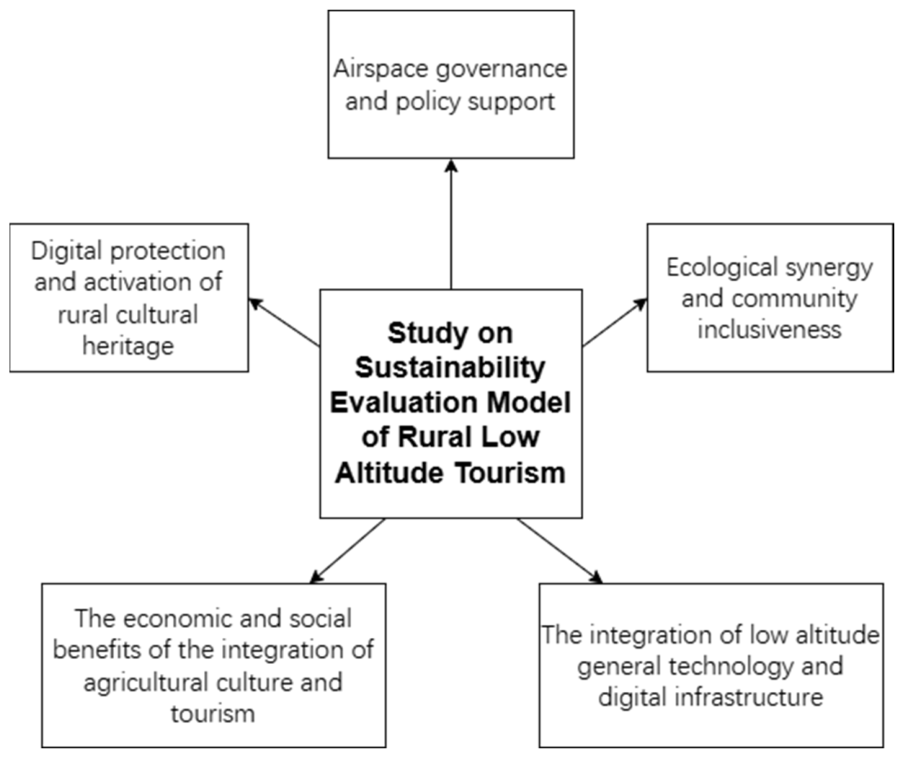
Section 2, this study constructs a multi-dimensional evaluation system based on complex rural scenes. The system covers five core dimensions: (1) the integration of low-altitude general technology and digital infrastructure, (2) the digital protection and activation of rural cultural heritage, (3) the economic and social benefits of the integration of agricultural culture and tourism, (4) ecological coordination and community inclusiveness, and (5) airspace governance and policy support.
The construction of the evaluation system follows the principles of systematicness and operability. Each indicator closely fits the theoretical basis and empirical findings of existing research. The system evaluation model comprehensively covers the technical driving force, cultural core, economic support, ecological bottom line, and institutional guarantee of rural low-altitude tourism, and the clear definition of each index and the available data sources ensure its operability. The system aims to fully reflect the development status of rural low-altitude tourism, accurately identify bottlenecks, and provide a reliable tool for identifying development bottlenecks and optimizing the promotion path.
The coordinated evolution of general aviation technology and digital infrastructure provides technical support for rural low-altitude tourism to break through geographical and airspace constraints and realize business innovation. This dimension focuses on infrastructure completeness, technology application depth, and system collaboration efficiency. The completeness of low-altitude digital infrastructure reflects the coverage level of facilities such as 5G network, edge computing nodes, and navigable landing platforms, which is the basic guarantee for low-altitude tourism operation [
1,
2,
4]. AIGC technology penetration depth measures the adoption and application of artificial intelligence generated content in low-altitude tourism product design, immersive experience, and smart marketing [
3,
5]; the response efficiency of airspace collaborative management reflects the collaborative level of cross-regional airspace dynamic scheduling and obstacle avoidance based on GIS and UAV cloud system [
1,
5]. The resilience of technology iteration reflects the ability of low-altitude tourism system to adapt to the rapid iteration of UAV and AI technology and avoid technological lock-in [
6,
18].
- 2.
Digital protection and activation of rural cultural heritage
Rural cultural heritage is the core attraction of low-altitude tourism, and its digital protection and activation directly affect the cultural thickness and uniqueness of tourism products. This dimension focuses on the whole process from static archiving to dynamic activation. The digital coverage rate of in situ cultural heritage realizes the permanent preservation and visual presentation of ancient villages and non-heritage sites through UAV oblique photography and three-dimensional modeling [
7,
9]. The completion of low-altitude heritage survey measures the ability to identify cultural heritage elements that are difficult to find in ground surveys using technologies such as airborne LiDAR [
10]. The intensity of public participation in intangible cultural heritage reflects the degree of public participation in cultural heritage interaction through new forms such as low-altitude live broadcast [
12,
13]. The digital integrity of cultural resources ensures the standardized management and reusability of cross-platform digital cultural archives [
7]. The willingness of intergenerational inheritance measures the willingness and behavior of local youth to participate in cultural inheritance through low-altitude digital cultural tourism projects [
13].
- 3.
The economic and social benefits of the integration of agricultural culture and tourism
The deep integration of agricultural culture and tourism provides material guarantee and endogenous power for the sustainable development of rural low-altitude tourism, reflecting its value transformation and the pulling ability of agriculture. The GDP contribution rate of the integration industry of agriculture, culture, and tourism directly reflects the structural driving effect of low-altitude tourism and related formats on the rural economy [
14,
16]. The economic output of value co-creation measures the total economic benefits generated by the government, leading enterprises and village collective cooperatives in the cooperative development of aerial sightseeing, drone formation performance, and other projects [
18,
20]. The local employment driving effect highlights the direct and indirect employment absorption capacity of low-altitude tourism operations for returning youth and local farmers in terms of flying hand training, ground service, and homestay management [
14,
15].
- 4.
Ecological synergy and community inclusiveness
Ecological synergy and social inclusion embody the concept of harmonious coexistence between low-altitude tourism and rural natural environment and community, which is the core connotation of rural resilience development. The frequency of multi-agent cooperation reflects the level of synergy and interaction between enterprises, village committees, and farmers in the co-construction and sharing of tourism revenue and environmental governance [
20,
28]. Digital skills training coverage measures the inclusiveness of digital literacy training such as drone applications for low-income farmers and older groups to bridge the digital divide [
26,
27]. The green energy utilization ratio measures the substitution level of renewable energy for traditional energy in electric vertical take-off and landing aircraft such as eVTOL and UAV take-off and landing facilities [
23,
24]. Farmers’ satisfaction reflects the local residents’ comprehensive evaluation of low-altitude tourism in noise control, privacy protection, and benefit distribution [
28]. The low-carbon operation level reflects the green material selection and carbon emission reduction effect of the landing site and viewing facilities in the whole life cycle [
23,
29].
- 5.
Airspace governance and policy support
Airspace governance and policy support provide institutional guarantee for the standardized operation and large-scale development of rural low-altitude tourism, focusing on safety supervision, innovation incentives, and fair access. The completeness of low-altitude airspace management reflects the efficiency of military–civilian coordination in the examination and approval of airspace division and the completeness of the construction of low-altitude safety supervision and regulation system [
30,
31]. The intensity of policy support reflects the economic and institutional support provided by the government for low-altitude tourism through special subsidies, tax breaks, and landing point construction incentives [
30,
32]. The digital public service level measures the maturity of ‘one-stop’ government approval, airspace reporting, and meteorological information sharing services for low-altitude tourism enterprises [
32,
33]. The efficiency of cross-subject collaborative governance measures the level of efficient collaboration among government departments, industry associations, general aviation enterprises, and village collectives in formulating industry standards and dealing with infringement disputes.
The above evaluation system comprehensively covers the key factors affecting the sustainable development of low-altitude tourism under the background of rural revitalization, and forms a systematic, pluralistic, and multi-level evaluation framework (
Table 2). Each indicator has a clear definition, which can effectively diagnose the sustainable development level of rural low-altitude tourism.
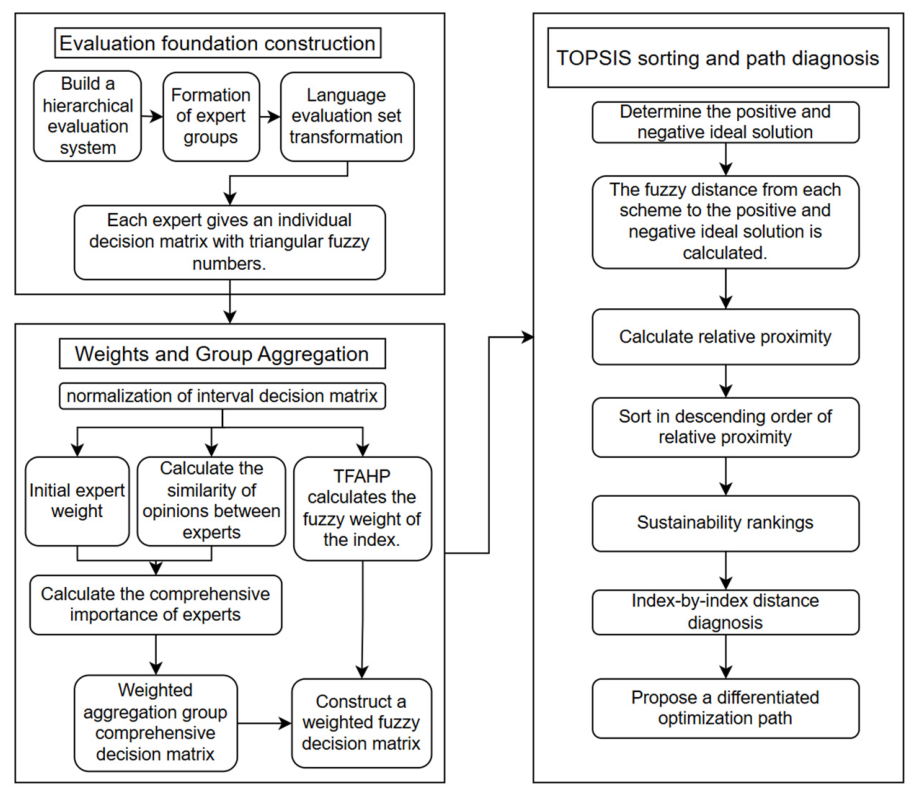
Due to the ambiguity and uncertainty of subjective judgment in the evaluation process, as well as the differences in the impact of various indicators on the system objectives, it is necessary to use scientific evaluation methods to determine the index weight and process the evaluation information. Therefore, this study adopts the triangular fuzzy number-TOPSIS group decision-making method. In the index scoring stage, the initial decision matrix is constructed by combining the expert investigation and the triangular fuzzy number. In the weight determination stage, the triangular fuzzy analytic hierarchy process (TF-AHP) is used to rank the weights of the indicators. In the stage of expert opinion aggregation, the comprehensive decision matrix is calculated by the combination of triangular similarity and group decision-making method, which fully respects the authority of individual experts and the consensus of groups. Finally, the triangular fuzzy number-TOPSIS method is used to sort the schemes and optimize the paths, so as to realize the accurate and objective evaluation of the sustainable development level of low-altitude tourism under the background of rural revitalization.
3.2. Evaluation Mathematics Model: Triangular Fuzzy Number-TOPSIS Group Decision Making Method
In order to solve the ambiguity and uncertainty of subjective judgment in the evaluation of sustainable development of rural low-altitude tourism, the triangular fuzzy number-TOPSIS group decision-making method is introduced into the evaluation process.
Compared with the traditional analytic hierarchy process (AHP), the triangular fuzzy number describes the expert judgment in the form of three intervals [
39,
40] and takes the ‘most pessimistic estimation, the most likely estimation, and the most optimistic estimation’ into consideration at the same time, which can more truly reflect the expert’s cognitive ambiguity of the performance of each index in the emerging field of rural low-altitude tourism. In the stage of weight determination, the triangular fuzzy analytic hierarchy process (TFAHP) is used to make the weight distribution closer to the actual decision-making scene. In the stage of scheme evaluation, the group decision method comprehensively determines the weight of experts, taking into account the individual authority of experts and the consensus of group judgment. The TOPSIS method is used to calculate the fuzzy distance from each evaluation object to the positive and negative ideal solution to carry out the comprehensive ranking of multi-dimensional indicators. This method (
Figure 1) combines the uncertain advantages of triangular fuzzy numbers with the intuitiveness of TOPSIS multi-attribute ranking, which can effectively overcome the information loss caused by traditional methods.
Based on the constructed sustainability evaluation system, a three-level hierarchical structure (
Figure 2) is established, including the target layer (the sustainable development level of low-altitude tourism in the context of rural revitalization), the criterion layer (5 first-level indicators), and the index layer (21 second-level indicators), which provides a clear framework for the subsequent weight calculation and evaluation implementation.
3.2.1. Methods: Triangular Fuzzy Number-TOPSIS Group Decision Making Method
Definition 1. Let a, where , , and are the supported lower and upper bounds, respectively. If is the median (the most probable value) of a, then a is called a triangular fuzzy number. If the triangular fuzzy number a satisfies , then a is called a normal triangular fuzzy number. Its membership function can be expressed as: Let , . The basic operation rules of triangular fuzzy numbers are as follows:
(1) ;
(2) ;
(3) = [,,];
(4) , .
Definition 2. Let any two normal triangular fuzzy numbers , , called The similarity of normalized triangular fuzzy numbers. Obviously, the larger the is, the greater the similarity is. In particular, when = 1, there is a = b, that is, the normalized triangular fuzzy numbers a, b are equal.
Definition 3. Let , be any two triangular fuzzy numbers.is the distance from the triangular fuzzy number to the triangular fuzzy number .
3.2.2. Triangular Fuzzy Number Language Evaluation Set
The sustainability evaluation of rural low-altitude tourism involves a large number of indicators that are difficult to quantify accurately. Experts are more inclined to use natural language for evaluation, which has certain ambiguity. The triangular fuzzy number is a method of transforming fuzzy uncertain linguistic variables into certain values. The use of triangular fuzzy numbers in evaluation methods can aptly solve the contradiction that the performance of the evaluated object cannot be accurately measured and can only be evaluated by natural language. For experts to evaluate the performance of the sample on each secondary index, the evaluation language set and its corresponding triangular fuzzy number are shown in
Table 3.
3.2.3. The Principle and Steps of Triangular Fuzzy Number-TOPSIS Group Decision-Making Method
The triangular fuzzy number-TOPSIS group decision model is an improvement of the standard TOPSIS theory: its attribute values are represented by triangular fuzzy numbers, and the group decision theory is integrated into the normalization process. By aggregating the individual opinions of each expert, the normalized comprehensive triangular fuzzy number decision matrix of the expert group is obtained. Combined with the decision maker’s cognition of the importance of the index, the normalized weighted triangular fuzzy number decision matrix is obtained, and the positive and negative ideal schemes are finally determined and sorted.
Step 1. Comparison and selection index evaluation value determination. For a triangular fuzzy number group multi-attribute decision-making problem, the expert population is , the alternative set is , the evaluation attribute set is , and the expert weight vector is . The evaluation value (attribute value) of the expert for the alternative under the evaluation attribute is given, where \operatorname is the lower limit of the evaluation value, and is the most likely estimate. is the upper limit of the evaluation value, thus forming a triangular fuzzy number decision matrix , .
The weight of the target layer is given by the analytic hierarchy process, and the weight value of the detailed index layer is given by the triangular fuzzy number analytic hierarchy process. The specific determination scale is shown in
Table 4.
According to the scoring standard of the importance of triangular fuzzy numbers, the importance degree triangular fuzzy matrix between the indexes under each target layer is constructed, and the importance degree is sorted. The calculation method of the triangular fuzzy matrix determined by the specific triangular fuzzy number analytic hierarchy process is as follows:
is the weight value of the second-level index under the k-first-level index;
denotes the importance value of the i-th index relative to the j-th index.
The weight vector of the expert is known through multiple inquiries to the on-site management personnel.
Step 2. Decision matrix normalization. Due to the different dimensions of each index, it is necessary to standardize the decision matrix. Let
and
be the subscript sets of cost-effective and cost-effective indicators, respectively.
denotes the number of alternatives, and
denotes the number of attributes of alternatives. In this paper, for the sake of convenience, all attribute assignments are assigned to benefit indicators; that is, the greater the evaluation value, the greater the contribution of this attribute to the scheme. The normalized formula is:
where
. According to the triangular fuzzy number algorithm, the above equation is expanded as follows:
The normalized decision matrix , is obtained, where .
Step 3. Determine the comprehensive importance of individual experts. The advantage of group decision-making is that it can overcome the limitations brought by the blind areas of personal knowledge and ability. However, different experts have different professional fields and experiences in different evaluation indicators. Therefore, it is necessary to determine the corresponding expert weight vector for each evaluation index , where , . The initial value of is determined by project managers based on the professional qualifications and actual performance of experts in various fields.
However, only considering the importance of individual experts may lead to one-sidedness in the evaluation results. In this study, the comprehensive importance of experts is determined by a weighted synthesis of the importance of individual experts and the similarity of group opinions, which not only respects the professionalism of individual experts but also takes into account the objectivity of group decision-making.
Firstly, according to Definition 2, the similarity between any two experts
and
to the normalized evaluation value of the same sample
under the same index
is calculated:
Then, we calculate the average similarity of expert
in the expert group when evaluating the index
of sample
:
and calculate the relative similarity:
Considering the similarity between the individual authority of the expert and the group opinion, the comprehensive importance of the expert
is obtained when the evaluation value of the aggregation scheme
under the subjective evaluation attribute
:
where
is the weight coefficient, and
. The size of
reflects the tendency of evaluation: the larger the
, the more inclined to group opinions; the smaller the
, the more inclined to individual authority. This study takes
, taking into account the professional authority of experts and the consistency of group opinions.
Step 4. Expert group decision matrix aggregation. According to the comprehensive importance of experts, the standardized decision matrix of each expert individual is weighted and aggregated to obtain the standardized comprehensive triangular fuzzy number decision matrix of the expert group.
Step 5. Determine the index weight and construct a weighted decision matrix. The triangular fuzzy analytic hierarchy process (TF-AHP) is used to determine the index weight. According to the importance comparison scale of
Table 4, the experts compare the same level of indicators in pairs, construct a triangular fuzzy judgment matrix, and calculate the fuzzy vector weight of each indicator by the square root method,
, that is,
. Combined with the Formulas (3)–(12), the fuzzy weight is multiplied by the normalized comprehensive decision matrix, and the normalized weighted triangular fuzzy number decision matrix
is obtained, where:
Step 6. Determine the positive ideal scheme and the negative ideal scheme. Since all indicators are benefit indicators, the positive ideal scheme
is a set of the maximum fuzzy values in all samples on each indicator, and the negative ideal scheme
is a set of the minimum fuzzy values in all samples on each indicator:
Step 7. Calculate the fuzzy distance from each sample to the ideal solution. According to the vertex method formula of Definition 3, the distance
from the sample
to the positive ideal scheme and the distance
—to the negative ideal scheme are calculated:
Step 8. Calculate the relative proximity. The relative closeness
of each alternative sample
to the ideal scheme is:
No additional defuzzification is required, as the ranking is directly based on the fuzzy closeness coefficient, following standard fuzzy TOPSIS practice.
Here, . The larger the , the closer the sample is to the positive ideal scheme and the farther away from the negative ideal scheme, that is, the higher the sustainable development level of low-altitude tourism.
Step 9. Scheme sorting. According to the order of relative proximity from large to small, the sample rural low-altitude tourism projects are sorted to determine the order of advantages and disadvantages of the sustainable development level of low-altitude tourism under the background of rural revitalization. Based on the distance difference between each village and the positive ideal scheme in each index dimension, the path diagnosis and optimization analysis are carried out to provide a decision-making basis for formulating differentiated sustainable development strategies.
3.3. Rural Low-Altitude Tourism Project Selection and Data Collection
In order to verify the sustainability evaluation system and evaluation mathematical model of low-altitude tourism under the background of rural revitalization, this study selected five domestic real villages with mature low-altitude tourism as research samples. The selection of samples follows the principles of typical representativeness, data accessibility, and diversity of development models, and refers to the evaluation criteria of national low-altitude economic pilot areas and key rural tourism villages at this stage. The final five samples selected are as follows:
- ●
Anji County, Zhejiang Province: Anji County was selected as the pilot area of low-altitude economy in Zhejiang Province, which is the first demonstration area for the integration and development of low-altitude economy and rural tourism in China. It has deployed multiple low-altitude flight formats, such as paragliders, power umbrellas, hot air balloons, dragonfly aircraft, etc., and is committed to building a low-altitude cultural tourism benchmark in the Yangtze River Delta region.
- ●
Yangshuo, Guangxi: Yangshuo has a world-class karst peak forest landscape and an annual tourist base of more than 20 million people, and the development foundation of low-altitude tourism is superior. At present, the county has formed a diversified product supply system, with hot air balloons, paragliders, and helicopter sightseeing as the core.
- ●
Zhangye colorful Danxia scenic spot (Nantai village): Zhangye colorful Danxia scenic spot is a typical representative of the development of low-altitude tourism in northwest China. The core product of “Helicopter Overlooking + Hot Air Balloon Tethered Flight” was built, and the differentiated experience projects, such as power umbrellas and delta wings, were developed synchronously to form a three-dimensional experience matrix.
- ●
Hunan Zhangjiajie National Forest Park (Yuanjiajie Village): China’s first immersive sightseeing experience activity with panoramic drones as the carrier landed in Zhangjiajie. Visitors can use VR glasses to explore the cultural and technological integration of heritage protection and scientific and technological innovation through the first-person-perspective 360-degree shuttle between the peak forest clouds and the sea and explore the cultural and technological integration of the low-altitude tourism development model driven by two wheels of heritage protection and scientific and technological innovation.
- ●
Nanwan Village, Lingshui, Hainan: Relying on the advantages of tropical coastal ecological resources and free trade port policy, it carries out low-altitude tourism projects, such as paragliding, hot air balloons, and power umbrellas, and actively explores the application pilot of new electric aircraft, such as eVTOL.
The above five sample rural low-altitude tourism projects represent five differentiated low-altitude tourism development models: mountain agglomeration type (Anji Baofu Town), landscape market-driven type (Yangshuo), heritage landform-driven type (Zhangye Nantai Village), cultural and technological integration type (Zhangjiajie Yuanjiajie Village), and island policy innovation type (Lingshui Nanwan Village), covering various geographical features such as plains, mountains, islands, karst, and Danxia, providing a more comprehensive empirical basis for the applicability and universality of the evaluation system.
In order to ensure the objectivity of weight determination, this study invited 15 experts to participate in the evaluation. The experts were selected based on three criteria: (i) at least 10 years of working or research experience in one of the five core domains (general aviation management, low-altitude tourism operation, digital village construction, ecological assessment, cultural heritage protection, or rural governance); (ii) current employment in academia, industry, or government sectors; and (iii) willingness to participate in two rounds of pairwise comparison surveys. The initial expert weights (
) for each evaluation indicator were determined by project managers based on the expert’s professional qualifications, years of experience, and publication/project records in their respective fields. The team covers five core areas related to the evaluation system, with a balanced gender ratio and a diverse professional background (
Table 5).
In order to ensure objectivity and accuracy, data based on multi-channel acquisition is evaluated.
- (a)
City and county statistical yearbooks and departmental bulletins. (, , , , , )
This kind of data provides objective statistical data with legal validity for the evaluation system, which can effectively eliminate the subjective deviation caused by single-expert scoring. The data are derived from the annual statistical bulletins and special reports of the departments of industry and information bureau, transportation bureau, culture and tourism bureau, statistics bureau, human resources, and social security bureau in the cities and counties where the sample projects are located.
For , raw data were collected through direct inquiries to local culture and tourism bureaus via official correspondence and on-site visits; the percentage of complete digital archives was calculated by the research team based on bureau records.
- (b)
Industry association report and enterprise operation data. (, , , , )
This kind of data reflects the actual operating performance of low-altitude tourism operating enterprises and industrial clusters and can capture the micro-operational dynamics that are difficult to reflect in macro-statistical data. The data come from the annual report of the General Aviation and UAV Industry Association, the white paper of the enterprise, the environmental, social, and governance (ESG) report, and the energy consumption measurement ledger of the low-altitude tourism operation enterprises in the sample village.
For , where formal ESG reports were unavailable (most small rural operators), data were collected through direct surveys and interviews with enterprise managers, supplemented by available energy consumption records (electricity bills, fuel purchase logs, etc.).
- (c)
Expert group blind evaluation score. (, , , )
For the evaluation indicators that are difficult to quantify directly, this study uses the blind evaluation method of domain experts to convert qualitative judgments into comparable quantitative values. The expert group is composed of scholars and senior practitioners from the fields of general aviation management, cultural heritage protection, archive management, digital humanities, and general aviation policy research. Each indicator was scored using a 0–100-point system, and the final score was the average of the expert scores after the outliers were removed (following the 3σ principle).
- (d)
Third-party survey and community interview data. (, , )
This kind of data is obtained through field investigation, which aims to reflect the subjective perception and participation of stakeholders such as farmers and the public. This kind of data comes from in-depth interviews with village cadres, business leaders, and farmers’ representatives or questionnaire surveys of community farmers. All interview and questionnaire data have been anonymized, and only summary statistical results are used in the evaluation, which is in line with academic ethical norms.
For , desensitized behavioral data were obtained from a commissioned third-party research agency specializing in digital behavior analytics. Aggregated metrics (annual visits, interactions, shares) were provided to the research team under a data use agreement.
Based on the above information collection process, this study summarizes the relevant data and scores of 21 indicators in each sample rural low-altitude tourism project. All indicators are efficiency indicators, and the data range is set to 0–100 (integer) by the expert group to ensure logical consistency and horizontal comparability.
4. Results
4.1. Indicator Weight
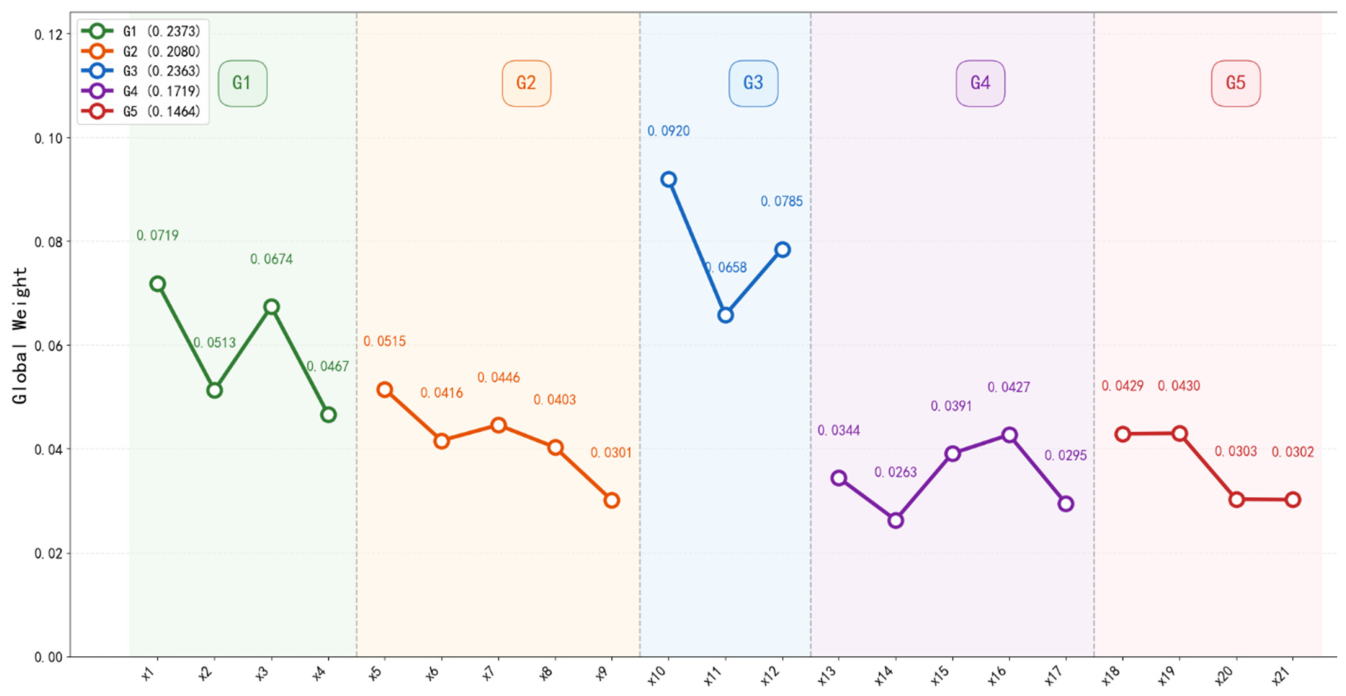
Based on the triangular fuzzy analytic hierarchy process (TF-AHP), 15 experts were invited to compare the first-level indicators and the second-level indicators according to the importance comparison scale of
Table 4, and the triangular fuzzy judgment matrix was constructed. The fuzzy vector weight of each index is calculated by the geometric average method. After defuzzification and normalization, the final weight of each index is obtained. The consistency ratio CR of all judgment matrices is less than 0.1, which meets the consistency test requirements. The final weights of the first-level indicators and the second-level indicators are calculated, as shown in
Table 6 and
Figure 3.
4.2. The Sustainable Development Ranking of Sample Rural Low-Altitude Tourism Projects
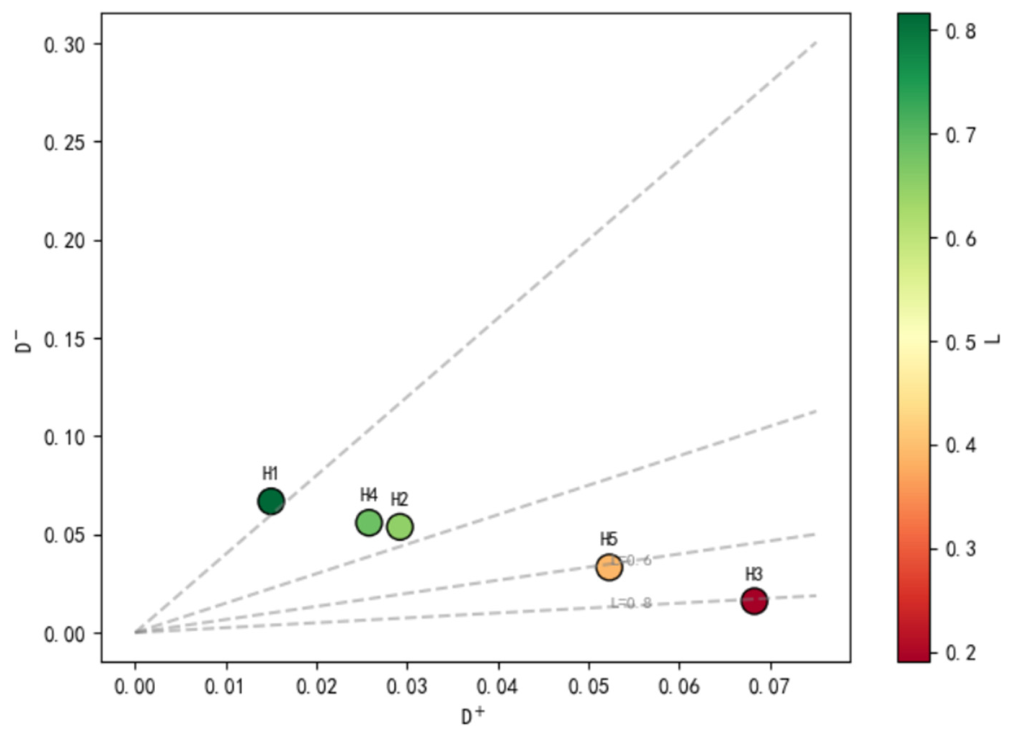
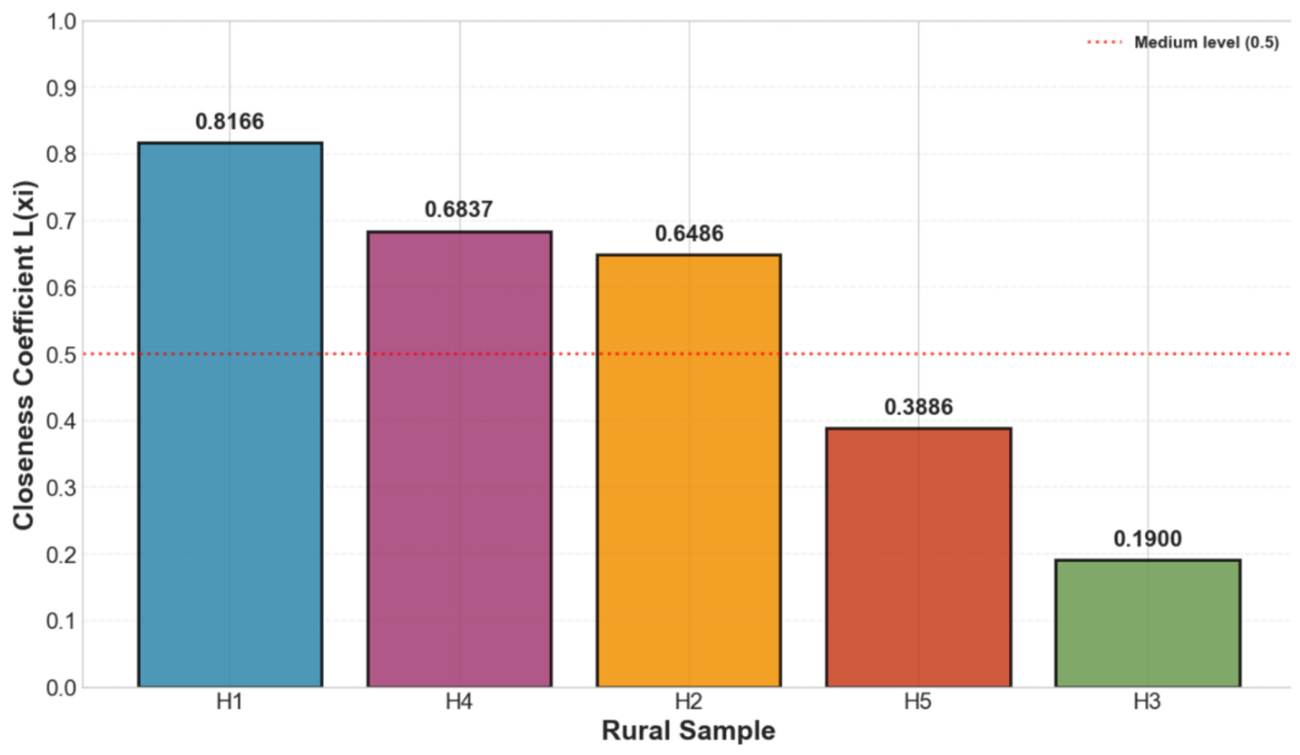
Based on the method mentioned in 3.2, the TOPSIS comprehensive ranking of five rural low-altitude tourism projects was obtained by calculation (
Table 7 and
Figure 4 and
Figure 5).
The Euclidean distance and relative closeness (L) of each project to the positive ideal solution (D+) and the negative ideal solution (D−) are calculated. The distance from Zhejiang Anji to the positive ideal solution is the shortest (D+ = 0.0150), and the distance to the negative ideal solution is the longest (D− = 0.0668), so the closeness is the highest (L = 0.8166), ranking first.
The D+ of Yuanjiajie in Hunan is 0.0258, D− is 0.0559, and the closeness is 0.6837, ranking second. The D+ of Yangshuo in Guangxi is 0.0292, D− is 0.0538, and the closeness is 0.6486, ranking third. The D+ of Lingshui in Hainan is 0.0523, D− is 0.0332, and the closeness degree is 0.3886, ranking fourth. The distance between Gansu Nantai and the positive ideal solution is the longest (D+ = 0.0683), the distance between Gansu Nantai and the negative ideal solution is the shortest (D− = 0.0160), and the closeness is the lowest (L = 0.1900), ranking fifth.
The comprehensive ranking results show that among the five sample projects, Anji in Zhejiang has the highest level of sustainable development of rural low-altitude tourism, followed by Yuanjiajie in Hunan, Yangshuo in Guangxi, Lingshui in Hainan, and Nantai in Gansu. This ranking reflects the comprehensive performance differences in the dimensions of industrial base, ecological environment, social culture, and governance efficiency.
4.3. The Dimensional Performance of Sample Rural Low-Altitude Tourism Projects
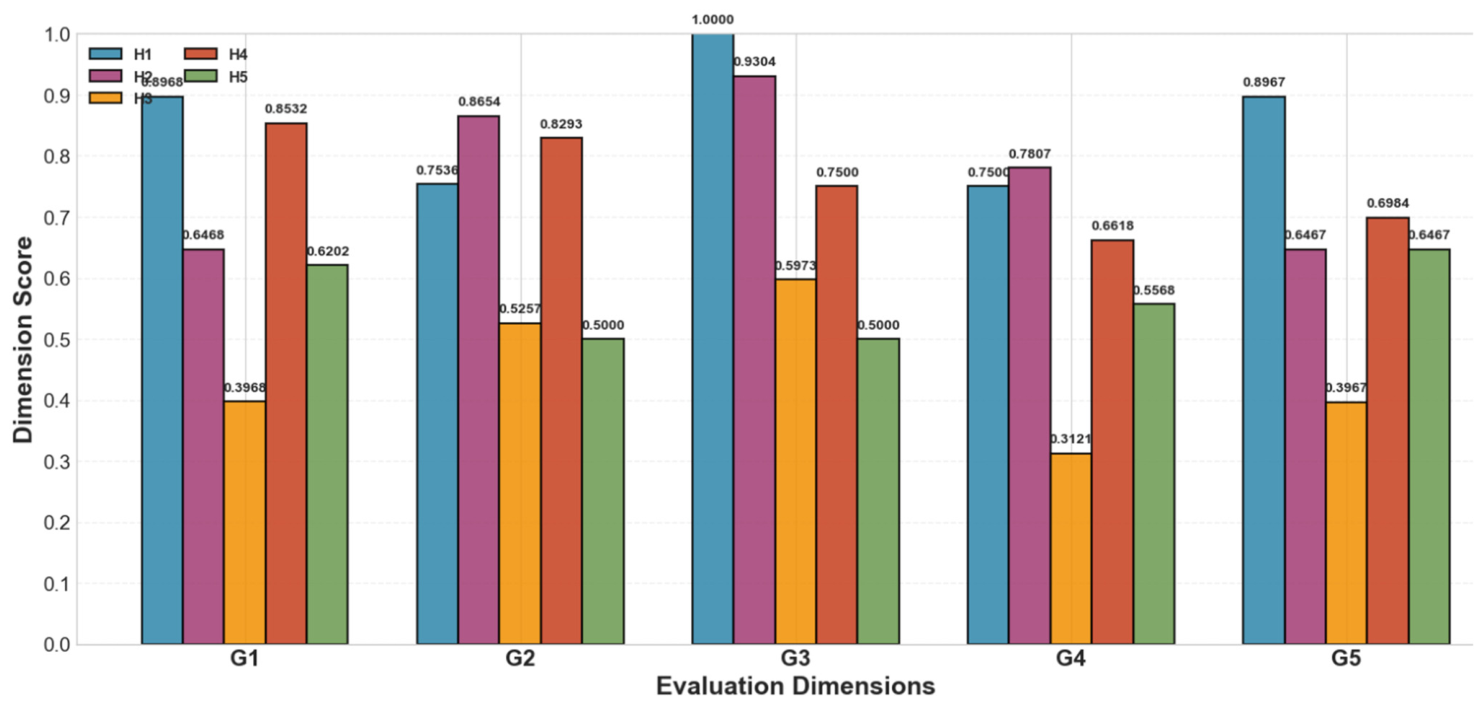
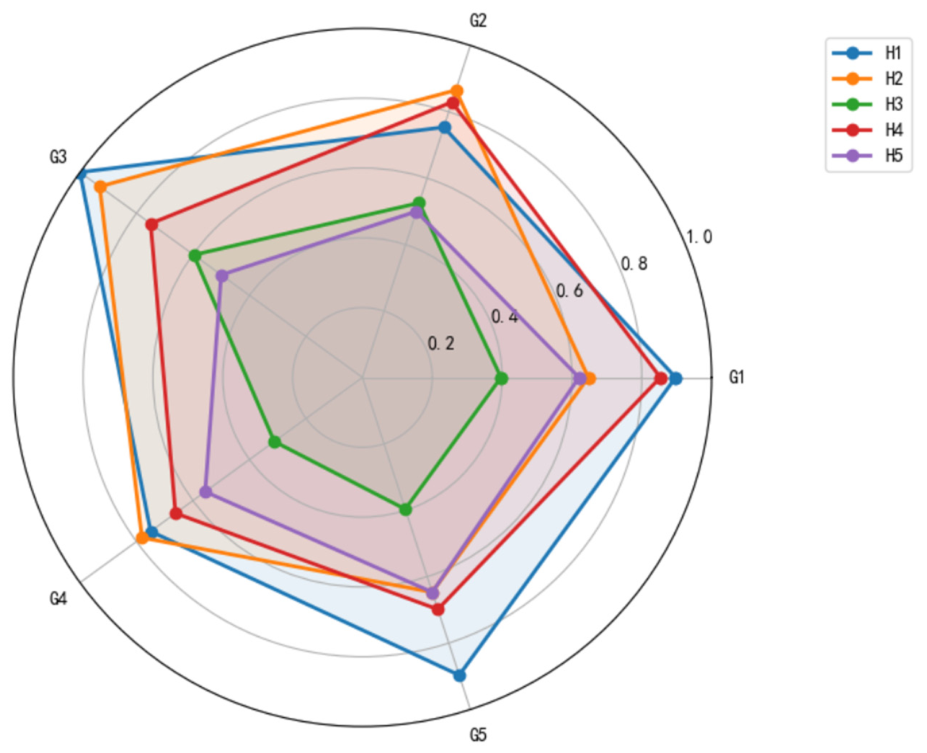
In order to deeply analyze the advantages and disadvantages of each project in different dimensions of the evaluation system, this study calculated the triangular fuzzy TOPSIS of five sample projects under the five first-level index dimensions of
, and the results are shown in
Table 8 and
Figure 6.
These five projects have different performance patterns in five main dimensions. In terms of technical infrastructure (), Zhejiang Anji scored the highest (0.8968), followed by Hunan Yuanjiajie (0.8532), Guangxi Yangshuo (0.6468), Hainan Lingshui (0.6202), and Gansu Nantai (0.3968). Anji’s advantages are due to its leading layout in the construction of a low-altitude intelligent take-off and landing network and digital management platform.
In terms of cultural heritage (), Yangshuo in Guangxi leads with 0.8654, which is mainly due to its deep integration of unique karst landscape cultural resources and low-altitude sightseeing experience. Hunan Yuanjiajie (0.8293) and Zhejiang Anji (0.7536) followed, while Hainan Lingshui (0.5000) and Gansu Nantai (0.5257) scored lower in this dimension.
In terms of economic benefits (), Zhejiang Anji has the most prominent performance, with a score of 1.0000, highlighting the maturity of its low-altitude tourism industry chain and the pulling effect of high-value-added consumption. Guangxi Yangshuo (0.9304) ranks second with its huge tourist market and optimized industrial structure, Hunan Yuanjiajie (0.7500) ranks third, and there is a significant gap between Gansu Nantai (0.5973) and Hainan Lingshui (0.5000).
In terms of ecological inclusion (), Yangshuo in Guangxi ranked first with 0.7807, reflecting its significant improvement in green energy utilization and community satisfaction. Zhejiang Anji (0.7500) followed and Hunan Yuanjiajie (0.6618) ranked third, followed by Hainan Lingshui (0.5568) and Gansu Nantai (0.3121).
In terms of policy governance (), Zhejiang Anji ranked first with 0.8967, highlighting its remarkable achievements in low-altitude airspace management reform and systematic policy support. Hunan Yuanjiajie (0.6984) ranked second, Guangxi Yangshuo and Hainan Lingshui were 0.6467, and Gansu Nantai (0.3967) ranked last.
5. Discussion
The results of this study have significant analytical value. Through these results, we can understand the differentiated role of digital infrastructure intensity, cultural heritage activation depth, agricultural and cultural tourism economic benefits, ecological inclusiveness, and airspace governance policies in the sustainable development of rural low-altitude tourism. This confirms the research contribution proposed in the first part: the integration of low-altitude general technology and AIGC digital as the core transformation force, balancing the roles of economic benefits, cultural heritage, community inclusion, and policy support.
5.1. Explanation of Index Weight
The weight distribution of 21 secondary indicators determined by the triangular fuzzy analytic hierarchy process reflects the relative importance of each dimension in evaluating the sustainable development level of rural low-altitude tourism. The quantitative results show that the weight distribution presents the characteristics of hierarchy and practicality.
At the level of first-level indicators, the economic and social benefits () of the integration of agricultural culture and tourism have the highest weight, reaching 0.2363, followed by the integration of low-altitude general technology and digital infrastructure ( 0.2373), followed by the digital protection and activation of rural cultural heritage ( 0.2080), ecological coordination and community inclusiveness ( 0.1719), and airspace governance and policy support ( 0.1464). This shows that the primary driving force for the sustainable development of rural low-altitude tourism at this stage is the combined influence of economic performance and digital infrastructure.
At the level of secondary indicators, the top three indicators of global weight are as follows: the GDP contribution rate of agricultural culture and tourism integration industry ( 0.0920), the driving effect of local employment ( 0.0785), and the completeness of low-altitude digital infrastructure ( 0.0719). This is in line with reality. Local governments and villagers are most concerned about ‘how much GDP increment can be brought’ and ‘how many local jobs can be created’, while hard infrastructure, such as 5G base stations, is the premise of all activities.
It is worth noting that the weight of intergenerational inheritance willingness () is only 0.0301, ranking second to last. This reflects that the evaluation practice at the current stage still focuses on short-term measurable indicators, and the long-term nature of cultural heritage has not been fully weighted. Similarly, the coverage of digital skills training (, 0.0263) has the lowest weight, indicating that digital inclusion measures for vulnerable groups are marginalized in the current evaluation system, and future policy formulation can strengthen the assessment of digital empowerment of vulnerable groups.
In general, the weight system takes economic benefits and digital infrastructure as the core engine, cultural heritage activation and ecological inclusion as the important support, and airspace policy as the institutional guarantee, which provides a basis for subsequent evaluation.
5.2. A Comparative Analysis of Sample Rural Low-Altitude Tourism Projects
Based on the triangular fuzzy number TOPSIS method, the sustainable development evaluation results of the five sample projects are sorted according to the closeness degree L () as follows: Zhejiang Anji (0.8166), Hunan Yuanjiajie (0.6837), Guangxi Yangshuo (0.6486), Hainan Lingshui (0.3886), and Gansu Nantai (0.1900). Combined with relevant specific data, literature, and actual policies, the detailed interpretation of the evaluation conclusions is as follows.
- (a)
Anji, Zhejiang: a comprehensive lead under the guidance of systematic policies
Anji ranks first with a closeness of 0.8166. Its scores in the three dimensions of low-altitude general technology and digital infrastructure integration (, 0.8968), economic and social benefits of agricultural culture and tourism integration (, 1.0000), and airspace governance and policy support (, 0.8967) are the highest in the sample, especially in the economic benefit dimension, which highlights the maturity of its low-altitude tourism industry chain and the pulling effect of high value-added consumption. This is highly related to the systematic layout of Anji as a pilot of a low-altitude economic ‘first flying zone’ in Zhejiang Province.
In April 2025, the Deqing–Anji joint pilot was successfully shortlisted for the first pilot list of low-altitude economic “first flight zone” in Zhejiang Province. Anji immediately issued the ‘Anji County to promote the high-quality development of low-altitude economy and create a pilot implementation plan for the provincial low-altitude economy’ flying zone ‘(2025–2027)’ and clearly proposed to cultivate a new form of low-altitude service industry. In terms of infrastructure construction, Anji has built helicopter take-off and landing points, drone nests, opened cultural tourism sightseeing and traffic short barge routes, and systematically created the ‘aerial view of Anji’ low-altitude cultural tourism brand. A series of systematic policy arrangements and infrastructure investment in Anji have provided solid support for its overall leadership. However, its ecological and social inclusion dimension (, 0.7500) is higher than that of Yuan Jiajie (0.6618), but lower than that of Yangshuo (0.7807), suggesting that the community participation and digital inclusive mechanism may still need to be improved in the stage of rapid expansion.
- (b)
Yuan Jiajie, Hunan: Integration exploration and shortcomings under the impact of policy
Yuan Jiajie’s closeness is 0.6837, ranking second. Its technical infrastructure dimension (0.8532) and cultural heritage dimension (0.8293) performed well. AIGC technology penetration depth (), technology iteration resilience (), and cultural heritage digital coverage () were the highest scores, reflecting the unique path of cultural and technological integration development. However, its economic benefit dimension (0.7500) has lagged behind Yangshuo (0.9304), and the ecological inclusion dimension (0.6618) is also lower than Yangshuo (0.7807). During May Day 2025, low-altitude cultural and tourism safety accidents occurred in Zhangjiajie and other places. The National Development and Reform Commission immediately promoted the local government to conduct an in-depth investigation of safety hazards, and clearly expanded the application scenarios of low-altitude economy in an orderly manner, following the principles of “carrying goods first and carrying people later, isolating first and integrating later, and outer suburbs first and urban areas later.”
This policy has a dual impact on Yuan Jiajie. On the one hand, its leading layout in the integration of AIGC and UAV technology conforms to the direction of the state’s encouragement of technological innovation and supports a higher technical score. On the other hand, the tightening of supervision following safety accidents may have negatively influenced the willingness of intergenerational inheritance () and other dimensions that rely on extensive community participation. At the same time, Yuan Jiajie was overtaken by Yangshuo in terms of economic benefits and ecological inclusiveness, suggesting a possible relative neglect of public participation, green operation, and grassroots capacity building in the process of rapid expansion, which has become a key bottleneck restricting its leap to a higher level of sustainable development.
- (c)
Yangshuo, Guangxi: double breakthrough of market heat and green transformation
The closeness of Yangshuo is 0.6486, ranking third, but the gap with second place has been greatly narrowed. Its cultural heritage dimension (0.8654) is still the highest sample, the economic benefit dimension (0.9304) ranks second, and the ecological inclusion dimension (0.7807) surpasses Anji and Yuanjiajie and becomes a new bright spot. This change is due to Yangshuo’s significant improvement in indicators such as green energy utilization () and community farmers’ satisfaction (), as well as the continuous economic pull brought by the tourist base.
Relying on the world-class karst peak forest landscape and the huge tourist base of more than 20 million people a year, Yangshuo has formed a mature product system and market pricing network for low-altitude tourism projects such as hot air balloons and paragliding. In recent years, Yangshuo has made significant progress in the dimension of ecological inclusion by promoting electric hot air balloons and strengthening community training. However, in recent years, the frequent occurrence of low-altitude tourism accidents is still a risk that cannot be ignored. According to the official website of the Civil Aviation Administration, the number of general aviation enterprises that have caused fatal accidents since 2024 has been on the rise, and the ‘super-scope, super-qualification and super-capacity’ operation problems of some enterprises still exist. Despite Yangshuo’s eye-catching performance in economic benefits and ecological inclusion, the technical infrastructure dimension (0.6468) is still relatively weak, and the accumulation of security risks and the lag of technical management are still potential challenges for its sustainable development. Although the proportion of fully electric flying aircraft remains below 5%, recent investments in electric ground support equipment and renewable energy for facilities have improved the green energy utilization rate.
- (d)
Hainan Lingshui: Policy dividend and weak industrial foundation coexist
The closeness of the Tomb Water is 0.3886, ranking fourth. It scored higher on indicators such as policy support intensity () and airspace management completeness (), reflecting the radiation effect of Hainan Free Trade Port policy advantages on Lingshui; however, the scores on indicators such as digital coverage of cultural heritage () and intergenerational inheritance willingness () are low. The economic benefits and cultural heritage dimensions are the lowest in the sample, and the problem of insufficient utilization of local cultural resources is more prominent.
Since 2025, Hainan has intensively promoted the implementation of low-altitude economic policies, issued free trade port tourism regulations to clearly support low-altitude tourism, and took the lead in piloting ‘island-wide low-altitude airspace classification management’. Relying on the dividend of the free trade port system, Lingshui has obvious advantages in policy support and airspace opening. However, it has not yet been found that Lingshui has formed an industrial scale or iconic operating enterprise with regional identification in the field of low-altitude tourism. Compared with Anji’s systematic layout and Yangshuo’s mature market network, Lingshui is still in the early stage of transforming policy advantages into actual industrial achievements. Determining how to effectively transmit institutional dividends to ‘soft dimensions’ such as cultural heritage activation and social inclusion is the key proposition for Lingshui to enhance its comprehensive competitiveness in the future.
- (e)
Gansu Nantai: Resource advantages have not been transformed into development momentum
The closeness degree of Nantai is 0.1900, ranking at the bottom, and the scores of all dimensions are the lowest in the sample. This result is in sharp contrast to the rich geological tourism resources of Zhangye colorful Danxia, indicating that its resource advantages have not been transformed into development momentum.
Although the low-altitude tourism project of the colorful Danxia scenic spot was successfully selected into the first batch of typical cases of transportation and tourism integration development in China, Linze County has formulated the ‘Zhangye World Geopark and Danxia Scenic Area Low-altitude Tourism Service Specification’, and implemented the whole process standardized management of low-altitude sightseeing projects, such as helicopters and hot air balloons. However, the core tourism resources of the colorful Danxia are concentrated within the scenic spot, and the industrial linkage with the surrounding villages is relatively weak. Villagers’ participation mainly stays in traditional service links such as catering and accommodation, and the community driving effect outside the scenic spot is limited. More importantly, the region has significant shortcomings in the dimensions of digital skills training and multi-agent collaborative governance, resulting in a score of only 0.3121 in the ecological inclusion dimension, which is far lower than that of other villages. This development model of “resource concentration and income spillover” has led to a significant deviation between resource endowment and actual performance. As a world-class geological business card, the colorful Danxia has a certain product maturity in its low-altitude tourism project. However, from the perspective of sustainable development, determining how to effectively transmit resource advantages to downstream communities and realize the symbiotic development of scenic spots and villages is still the core proposition that needs to be solved urgently.
- (f)
Environmental and social risks require urgent attention
Beyond the five common challenges discussed above, low-altitude tourism also generates negative externalities that must be addressed. From an environmental perspective, low-altitude aircraft generate noise pollution that affects both wildlife in ecologically sensitive areas (e.g., the karst landscape of Yangshuo and the peak forest of Zhangjiajie) and the quality of life of rural residents. Fuel-powered drones and hot air balloons also contribute to carbon emissions, contradicting the goals of green transformation. From a social perspective, low-altitude aircraft may intrude on villagers’ private spaces, raising concerns about unauthorized photography, data collection, and the potential misuse of cultural heritage information. Safety risks remain a critical concern. To mitigate these negative effects, local governments should (i) establish low-altitude flight noise standards and implement ‘no-fly zones’ near residential areas and ecologically protected zones; (ii) mandate the use of electric vertical take-off and landing (eVTOL) aircraft and provide subsidies for their adoption; (iii) develop clear privacy protection regulations for aerial data collection; and (iv) strengthen safety supervision through random inspections and blacklisting mechanisms for non-compliant operators.
5.3. Common Challenges and Optimization Paths
By analyzing the index scores and actual conditions of the five sample projects, several common problems affecting the sustainable development of rural low-altitude tourism are identified. These problems need to be systematically addressed in future practice.
- (a)
The willingness of intergenerational inheritance is generally low, and cultural sustainability faces the risk of failure.
The willingness of intergenerational inheritance () did not exceed 0.75 in all samples. Yuanjiajie and Nantai are significantly lower. Even in Yangshuo, which has the highest score in the cultural heritage dimension, its intergenerational inheritance willingness has not been improved synchronously, reflecting the disconnection between ‘digitization of cultural resources’ and ‘youth participation activation’. The global weight of this index is only 0.0301, which reflects the key problem of whether the cultural heritage can be truly ‘live’ inherited.
Most rural low-altitude tourism projects are dominated by external enterprises, and local youth participation channels are narrow. The annual average of 1.2 million online intangible cultural heritage interactions in Yangshuo has not been effectively transformed into offline inheritance posts; Nantai is facing the plight of the outflow of young adults. To solve this problem, it is necessary to deeply bundle the “youth return incentive” with the “low-altitude cultural tourism entrepreneurship incubation.” The “rural low-altitude cultural tourism youth fund” can be set up to provide start-up subsidies for young people returning home to engage in drone pilots and digital cultural creation.
- (b)
The digital skills gap exacerbates social exclusion and hinders inclusive development.
The global weight of digital skills training coverage () is the lowest, and all villages except Anji have not reached ‘good’ in this index. The scores of Yangshuo, Lingshui, and Nantai directly lowered the overall performance of their ecological and social inclusion dimension (). At the same time, the satisfaction of community farmers () was significantly positively correlated with the coverage of digital training.
Low-income farmers and the elderly lack basic digital skills, such as drone operations and e-commerce live broadcasts, resulting in new jobs created by low-altitude tourism being occupied by outsiders. The optimization path should focus on the ‘training-certification-employment’ closed loop: on the one hand, digital skills certification can be linked to village collective dividends, and farmers who participate in training and obtain certificates can obtain higher income distribution coefficients. On the other hand, we can learn from the experience of Berlin’s ‘Digital Inclusion Plan for Creative Industries’ and give tax relief to operators who take the initiative to carry out community training.
- (c)
Multi-agent cooperation is a mere formality, and the benefit-sharing mechanism is not yet perfect.
The frequency of multi-agent cooperation () is generally low in all villages. Although Anji and Yuanjiajie are superior to others, Nantai and Lingshui reflect the lack of institutionalized consultation channels between villagers, enterprises, and village committees. Correspondingly, the economic output of value co-creation () performed better in Anji and Yangshuo, while it lagged behind in Nantai and Lingshui.
Most rural low-altitude tourism projects adopt the dual model of ‘enterprise investment + scenic spot resources’, with village collectives and farmers only acting as marginal participants. Although Lingshui holds a dividend meeting every quarter, the farmers’ right to speak is limited. The optimization path should focus on three aspects: First, it is mandatory for low-altitude tourism projects to sign a ‘multi-stakeholder benefit-sharing agreement’ before the project is approved, and the proportion of farmers’ dividends (such as not less than 20% of annual profits); the second is to promote Anji’s ‘cooperative shareholding’ model, which quantifies assets, such as drone formation performances and take-off and landing sites, into households, so that farmers can change from ‘bystanders’ to ‘shareholders’.
- (d)
The level of ecological low-carbon operation is uneven, and the green transformation lacks rigid constraints.
Green energy efficiency () and low carbon operation level () show obvious polarization. Yangshuo’s outstanding performance on and promotes its dimension to leap to the top; Anji and Yuanjiajie are in the middle reaches; the south station is seriously backward. However, Yangshuo’s low-carbon operating level is still only ‘good’, indicating that its green transformation is not yet complete, and the current situation of less than 5% of electric aircraft is not fully reflected in the score.
Most local governments have not yet included the proportion of eVTOL and the utilization rate of green building materials in the access standards of low-altitude tourism projects. Although the number of tourists in Yangshuo is large, the proportion of electric aircraft is less than 5%; the fuel-powered parachute and hot air balloon in Nantai are still the main vehicles, and the carbon emission intensity is high. Suggestions for optimizing the path: First, formulate a ‘green operation guide for rural low-altitude tourism’, clarifying that new take-off and landing sites must use photovoltaic ceilings and the proportion of electric aircraft in the operating fleet should not be less than 30% by 2030; the second is to incorporate carbon emission intensity into the annual ESG report of low-altitude tourism enterprises and eliminate the priority of airspace use for enterprises that have failed to meet the standards for two consecutive years.
- (e)
The efficiency of cross-subject collaborative governance is low, and the ‘last mile’ of policy implementation is blocked.
The efficiency of cross-subject collaborative governance () scores vary greatly among villages. Anji benefited from the normalized coordination of the ‘first flight zone’ special class, while Nantai, Lingshui, and Yangshuo were at the lower middle level. Correspondingly, the completeness of low-altitude airspace management () and the level of digital public services () also show the characteristics of the strong and the strong-Anji is ‘excellent’, while Nantai is only ‘poor’ in .
The airspace approval involves the military, land, and people, and many villages lack full-time coordination agencies. The airspace approval of Nantai needs to go through 3 departments and takes 10 working days. In the peak season, about 30% of the potential flights are lost due to the delay of approval. In addition, many places have not yet established a ‘one-stop’ digital service platform, and enterprises need to run multiple windows offline. The optimization path should focus on: first, to promote Anji’s ‘low-altitude flight service center’ mode, set up an airspace coordinator at the county level, and realize the flight plan ‘one window, one day’; the second is to establish a quarterly mechanism of “military-civilian tripartite joint meeting” to regularly resolve airspace use conflicts and standard disputes.
5.4. Model Robustness and Methodological Significance
In order to test the subjective dependence of the constructed evaluation framework for the sustainable development of rural low-altitude tourism on the weight selection, and to respond to potential methodological questions, this study carried out robustness verification through the first-level index weight disturbance analysis. The purpose is to examine whether the relative rankings of the five sample projects are consistent when the weights of each dimension fluctuate within a reasonable range, so as to evaluate the scientific rigor and practical reliability of the evaluation results.
Specifically, the sensitivity analysis is based on the first-level index weights determined by 15 experts in TF AHP [
41], ±10% and ±20% single index disturbances are applied to the five dimensions, respectively, and four combined disturbance scenarios are constructed. The weights of secondary indicators at all levels under the same dimension are scaled to ensure that the sum of the total weights is 1. The complete triangular fuzzy number TOPSIS calculation is re-run for the weight combination after each disturbance, and the new ranking of each project is obtained, and the Spearman rank correlation coefficient (
) with the original ranking is calculated. Pro
indicates that the perturbation ranking is highly consistent with the original ranking, and
indicates exactly the same; the lower the
, the greater the ranking fluctuation.
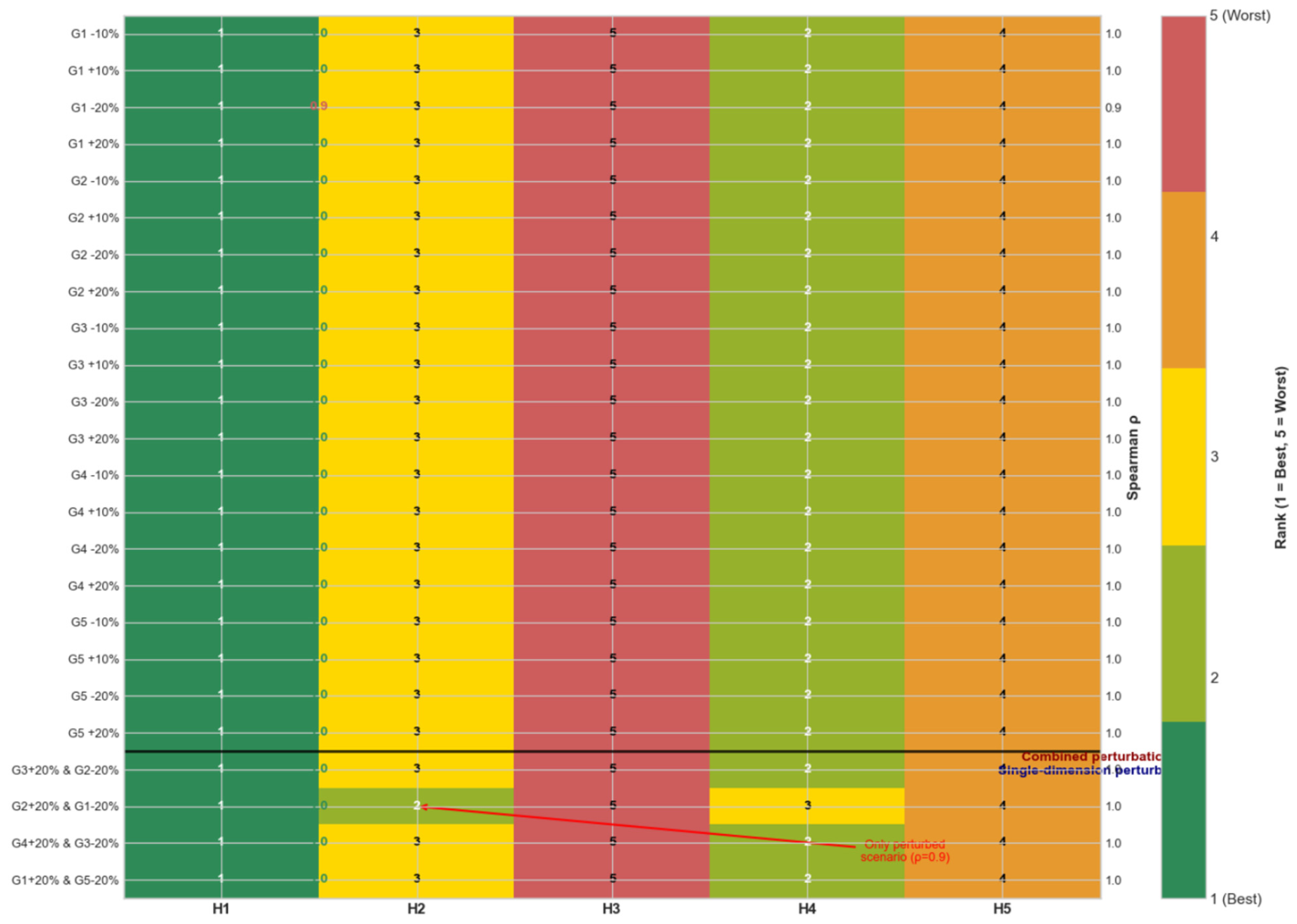
The rankings and Spearman correlation coefficients in all disturbance scenarios are shown in
Table 9 and
Figure 7. The results show that the evaluation framework shows high robustness. In all 24 disturbance scenarios, there are 23 scenarios with
; that is, the ranking order of each project has not changed. It is worth noting that even under the extreme combination disturbance
+ 20% &
− 20% (while increasing the weight of cultural heritage by 20% and reducing the weight of technical infrastructure by 20%), the rankings of Yangshuo and Yuanjiajie are swapped, while the rankings of Anji, Nantai, and Lingshui are completely unchanged, and Spearman
. All other combined perturbations did not cause any ranking changes (
).
The sensitivity analysis confirms that the evaluation framework has high robustness. The ranking results do not depend on a specific set of weight assignments but truly reflect the substantive performance differences in the five rural low-altitude tourism projects in the five dimensions of digital infrastructure, cultural heritage, economic benefits, ecological inclusion, and policy governance. Compared with traditional AHP or ordinary fuzzy AHP, the triangular fuzzy number TOPSIS group decision-making method adopted in this study improves the rigor of the method in two aspects: on the one hand, the triangular fuzzy number retains the fuzziness and uncertainty in expert evaluation in the form of ‘lower limit-most likely value-upper limit’. On the other hand, the group decision-making mechanism based on similarity aggregation effectively eliminates the influence of individual extreme preferences. Even if the extreme disturbance of ±20% is applied to the weight of the first-level index, the core conclusion remains unchanged, and only the intermediate ranking has a reasonable swap under the premise of conforming to the dimension advantage logic. This verifies the high anti-interference ability of the framework for weight selection.
In a word, this evaluation framework has both strong robustness and moderate sensitivity, which can provide stable and credible sustainability diagnosis for rural low-altitude tourism projects with different development models, and also provide a reusable method for similar multi-attribute rural assessment problems.
6. Conclusions
The purpose of this study is to fill the gap in the evaluation system of the low-altitude tourism sustainable development system under the rural revitalization strategy. With the core objectives of scientificity, operability, and cross-regional comparability, a five-dimensional evaluation framework covering the integration of low-altitude general technology and digital infrastructure, the digital protection and activation of rural cultural heritage, the economic and social benefits of the integration of agricultural culture and tourism, ecological coordination and community inclusiveness, and airspace governance and policy support is constructed. Through the empirical data of five typical villages, a complete research chain from theoretical construction to application diagnosis is formed. The research process strictly follows the methodology paradigm of combining qualitative and quantitative data.
First of all, through a systematic literature review and expert in-depth interviews, a sustainability evaluation index system including five first-level indicators and 21 second-level indicators was constructed: (1) integration of low-altitude general technology and digital infrastructure; (2) digital protection and activation of rural cultural heritage; (3) the economic and social benefits of the integration of agricultural culture and tourism; (4) ecological synergy and community inclusiveness; (5) and airspace governance and policy support.
6.1. The Core Contributions of Research
In summary, the innovative contributions of this study are reflected in three aspects: method innovation, theoretical construction, and empirical application:
- (a)
Reduce the subjectivity in multi-attribute decision making
In this study, the triangular fuzzy number TOPSIS group decision-making method is introduced into the field of rural low-altitude tourism evaluation. The triangular fuzzy number retains the fuzziness and uncertainty in expert evaluation in the form of three intervals of ‘lower limit-most likely value-upper limit’ and effectively weakens the influence of extreme personal preferences through the group decision-making mechanism of similarity aggregation. Compared with the traditional analytic hierarchy process, this method significantly improves the objectivity of weight distribution and the credibility of the results.
- (b)
Construct a comprehensive evaluation model that fits the low-altitude rural tourism scene.
The proposed five-dimensional evaluation system overcomes the limitations of single-dimension or fragmented frameworks in existing research and integrates forward-looking indicators, such as AIGC permeability, airspace synergy efficiency, and intergenerational inheritance willingness, with traditional elements. Through the empirical test of five different development models of rural low-altitude tourism projects, the model shows good distinguishing ability and universality and provides a replicable and comparable systematic diagnostic tool for rural low-altitude tourism.
- (c)
To realize the deep combination of ‘field data + expert wisdom’.
The study collected multi-channel raw data from five sample rural low-altitude tourism projects and invited 15 experts from the fields of general aviation management, cultural heritage protection, and ecological assessment to participate in weight scoring and index evaluation. This combination of quantitative and qualitative methods not only verifies the validity of the model but also provides an empirical decision-making basis for local governments to identify shortcomings and optimize resource allocation.
6.2. Limitations and Future Research Directions
Although this study has achieved valuable results in theory and practice, there are still the following limitations that need to be further improved in the future:
- (a)
Extensibility of sample range
This study selected five typical representative rural low-altitude tourism projects, covering mountain, karst, island, and other geographical types and different development models, but the sample size is small and concentrated in China. Future research should include more cases from different regions (such as the southwest border, northern grassland, etc.) and international cases to further test the cross-cultural and cross-regional adaptability of the framework.
- (b)
The lack of dynamic evaluation dimension
At present, cross-sectional data is used, which is difficult to capture the temporal evolution characteristics of sustainable development of low-altitude tourism (such as technical iteration, policy adjustment, annual changes in community participation). Subsequent research can introduce time series analysis or longitudinal tracking methods to construct a dynamic evaluation model to reveal the causal feedback mechanism between dimensions.
- (c)
The subjectivity of expert scoring and the fine-tuning of methodology
Although the triangular fuzzy number weakens the subjective bias to a certain extent, some indicators (especially the activation of cultural heritage, etc.) still rely on expert judgment and limited questionnaire data. In the future, some subjective ratings can be replaced by big data mining (such as sentiment analysis of tourist reviews, real-time energy consumption monitoring of drone operations). In addition, the conversion mode of ‘excellent’ corresponding to [0.75, 1,1] in
Table 3 produces a ‘ceiling effect’ to a certain extent, resulting in Anji’s score of 1.000 in the
dimension. It is suggested that asymmetric fuzzy numbers should be used in subsequent studies (for example, ‘excellent’ is set to [0.80, 0.92, 0.98]) to enhance the discrimination between excellent samples.
In a word, through method innovation and empirical analysis, this study constructs a scientific, operable, and policy reference value evaluation framework for the sustainable development of rural low-altitude tourism. The research results not only enrich the theoretical system of the interdisciplinary field of rural tourism and low-altitude economy but also provide quantitative benchmarks and action guidelines for promoting the high-quality development of low-altitude tourism according to local conditions. With the accumulation of data and the iteration of methods, the framework will continue to improve and better serve the strategic needs of the integrated development of rural revitalization and low-altitude economy in the digital age.