Article

Atmospheric Deposition of Trace Toxic Metal Elements (TMEs) from Weathering of a Black Shale High Geological Background Areas in the Loushao Basin, Hunan Province, China: Pollution Characteristics and a Health Risk Assessment

1
School of Resource & Environment and Safety Engineering, Hunan University of Science and Technology, Xiangtan 411201, China
2
School of Earth Science and Space Information Engineering, Hunan University of Science and Technology, Xiangtan 411201, China
3
Engineering and Mine Geological Survey and Monitor Institute of Hunan Province, Changsha 410004, China
4
Hunan Provincial Key Laboratory of Geochemical Processes and Resource Environmental Effects, Geophysical and Geochemical Survey Institute of Hunan Province, Changsha 410114, China
5
Hunan Geological Disaster Monitoring and Early Warning and Emergency Rescue Engineering Technology Research Center, Changsha 410004, China
*
Author to whom correspondence should be addressed.
These authors contributed equally to this work.
Sustainability 2026, 18(11), 5522; https://doi.org/10.3390/su18115522 (registering DOI)
Submission received: 21 March 2026 / Revised: 30 April 2026 / Accepted: 6 May 2026 / Published: 1 June 2026
(This article belongs to the Section Pollution Prevention, Mitigation and Sustainability)

Abstract

This study is based on pollution assessment system and sustainability under a high geological background. The findings from atmospheric deposition research indicate that the exceedance rates for Cd, As, and Hg elements in black shale are 408%, 141%, and 220%, respectively. In atmospheric deposition, the concentrations of Cd, Hg, and Pb exceed the background values by 2.83, 3.29, and 4.08 times in dry conditions and by 3.6, 4.07, and 3.43 times in wet conditions. The difference between dry and wet deposition primarily reflects the concentration variations of Cd, Hg, and As. The distribution of Cd concentrations exceeding standards is widespread, covering over 71% of the total area, and shows a negative correlation with the enrichment patterns in weathered soils. Source analysis indicates that the contribution rates of PC1 for dry and wet deposition are 84.1% and 80.5%, respectively. This finding reveals that atmospheric deposition is significantly influenced by natural weathering processes, while anthropogenic factors exacerbate the overall pollution levels. The HI values for As, Hg, Pb, and Cr for both adults and children are all greater than 1, with the HI value for Pb in dry deposition reaching 13.5, indicating it poses the most severe health risk to children’s safety.

1. Introduction

Toxic metals are naturally abundant in bedrock, and parent rocks such as shale can be highly enriched in As, Cd, Cu, and Ni. Under high geological background conditions, these metals are further concentrated in soil due to their strong sulfur affinity [1,2,3]. The Loushao Basin is a typical high-geological-background area in China with extensive highly weathered and unweathered black shale, in which toxic metals commonly exceed average rock abundances. Increasing natural weathering of black shale has raised health concerns via skin contact and ingestion [4,5]. Atmospheric deposition drives metal accumulation and acts as a key transport medium [6,7]. Most source studies focus on anthropogenic inputs, while natural geogenic contributions remain understudied [8,9]. Toxic metal exposure is closely linked to respiratory, cardiovascular, neurological, and even carcinogenic risks [10,11,12,13]. Natural geological controls are increasingly recognized as important drivers. In the Loushao Basin, black shale is significantly enriched in toxic metals compared with regional backgrounds [14,15,16]. Long-term weathering causes substantial metal migration and marked secondary enrichment in atmospheric deposition. This study aims to improve multimedia pollution assessment by linking atmospheric metal accumulation to natural weathering in high-geological-background areas.
Atmospheric deposition can be divided into dry and wet deposition, which exhibit significant differences in composition, solubility, and environmental behavior. These distinctions subsequently influence the bioavailability of elements and exposure risks [17,18]. For instance, cadmium (Cd) shows significantly higher solubility in wet deposition compared to dry deposition, making it more likely to pose potential hazards through contact and ingestion pathways [19,20]. Current research in areas with high geological backgrounds often focuses on single elements or specific environmental media. In Southwest China, studies tend to concentrate on typical elements [21,22,23,24], resulting in a lack of comprehensive assessments of multi-element and multi-media pollution characteristics and health risks within the same high geological background region. Recent studies in the Loushao Basin, which has a high geological background, have addressed aspects such as soil formation processes from weathering, the environmental effects of bedrock weathering, and water pollution in areas with high geological backgrounds [25,26,27,28,29,30]. Existing research suggests that inhalation of insoluble particles can lead to unforeseen health risks, with the extent of impact assessed in relation to the particle size, total surface area, and dimensions of atmospheric deposition particles [31,32,33,34]. However, there remains a significant gap in systematic studies specifically addressing the characteristics of toxic metal pollution in both dry and wet atmospheric deposition, as well as the health risks associated with oral ingestion and dermal contact.
This study focuses on the Loushao Basin, a typical high geological background area in Hunan Province characterized by widely distributed black shale undergoing intensive natural weathering. During weathering, toxic metals are released and migrate into multiple environmental media, especially weathered soils and atmospheric deposition. The novelty of this work lies in its focus on atmospheric dry and wet deposition, which has rarely been systematically studied in this region, and in the multi-media coupling analysis of atmospheric deposition and weathered soils. By comparing accumulation characteristics, identifying pollution sources, and mapping spatial patterns, this study further quantifies health risks and clarifies the consistent geogenic sources of toxic metals from black shale weathering. These findings improve multi-media risk assessment in high geological background areas and provide a scientific basis for regional environmental management.

2. Materials and Methods

2.1. Research Area

This study focuses on Linli County, Changde City, located in the core area of the Loushao Basin in Hunan Province. The Loushao Basin primarily encompasses the central regions of four prefecture-level cities: Loudi, Shaoyang, Yiyang, and Changde, spanning geographic coordinates from 105°21′ to 113°20′ E longitude and 25°25′ to 31°46′ N latitude. This region is situated at the transitional zone between the southeastern edge of the Yangtze landmass and the Huaxia landmass. The primary high geological background consists of two rock systems: the Cambrian and Permian formations, with black shale comprising over 80% of this composition. The weathering of these black rock strata has resulted in significantly elevated concentrations of heavy metals such as cadmium (Cd) and lead (Pb) in various media, including soil, water, sediments, and agricultural crops. The levels of toxic metal elements are far higher than those found in ordinary rocks. Studies have shown that different geological backgrounds and parent materials can significantly impact regional ecological environmental pollution [35,36].
Situated in a subtropical monsoon climatic zone, the Loushao Basin experiences extensive weathering of black shale, facilitating the mobilization of these elements into the atmosphere and other environmental media. During the natural weathering and migration processes, notable secondary enrichment of toxic heavy metals occurs. Investigating the sources of TMEs in atmospheric deposition is crucial for refining multi-media pollution assessment frameworks in regions characterized by high geological background.

2.2. Sample Collection

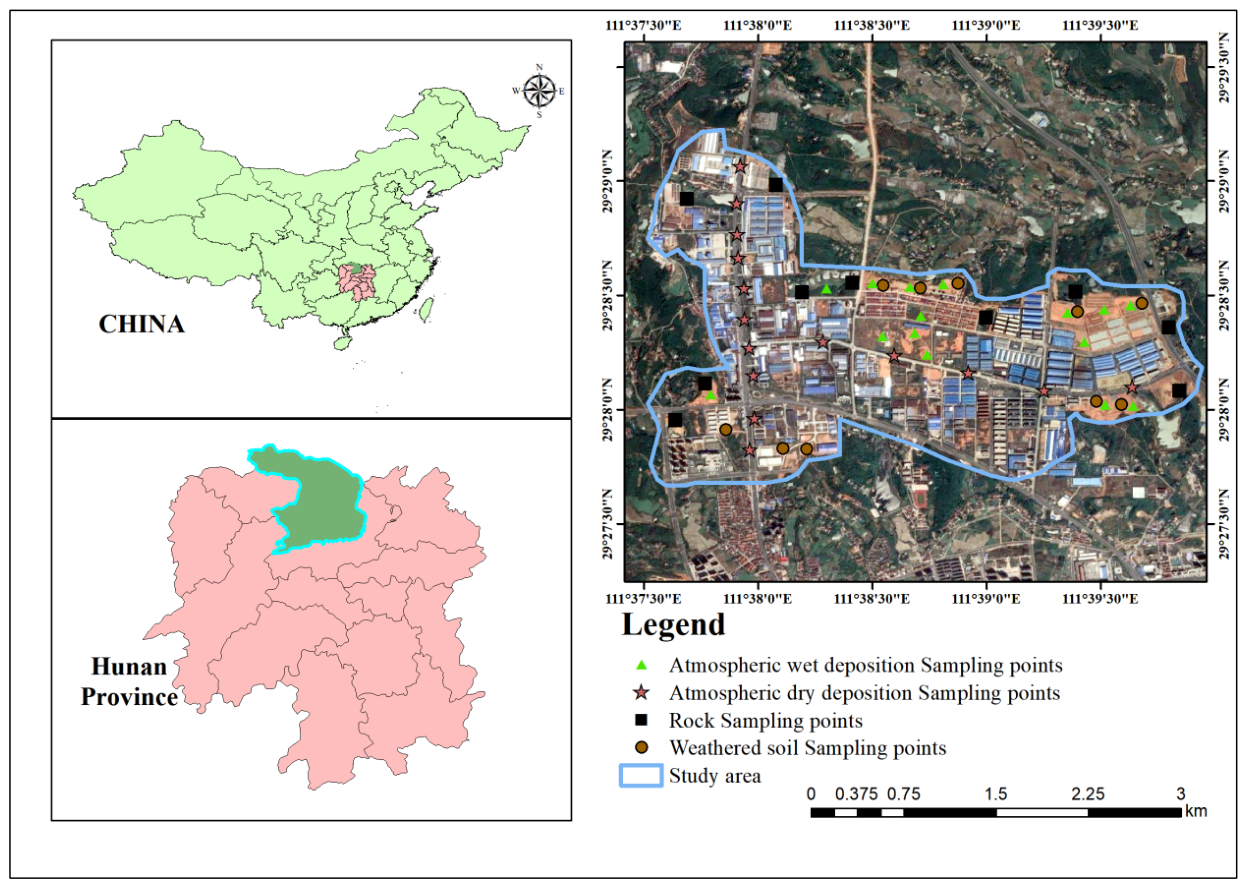
Atmospheric deposition samples (dry and wet) were collected in the Loushao Basin, with 15 sampling points for each type (total 30, Figure 1). Sampling was carried out intensively over a continuous monitoring period, with consistent collection frequency during the whole campaign. Dry deposition sites were placed along major roads to distinguish geological and anthropogenic sources. Wet deposition points were located in open, flat urban and agricultural areas to ensure representative collection. In addition, 10 weathered soil and 10 black shale bedrock samples were collected in typical weathering zones to identify the influence of natural weathering on atmospheric deposition.
Atmospheric deposition samples were collected using polyethylene barrels, capturing both dry and wet deposits at a height of 3 m above the ground. Polyethylene barrels were pre-soaked in a 25% nitric acid solution for 48 h, followed by cleaning with deionized water 3–5 times before conducting the sampling work. Finally, 60–80 mL of a 2% ethylene glycol solution was added before use [37]. For black shale sampling, a vertical groove cutting method from the bottom up was employed. Using a geological hammer and chisel or other marking tools, the outline of the vertical grooves was marked on the rock face. The principle of segmental excavation was followed, and debris was collected into sample bags using brushes, ensuring that the collected material was labeled with the sampling location (depth) to avoid contamination. Weathered soil was collected using a shovel at a vertical angle of 90° to the ground, cutting out a 20 cm high soil face. This 20 cm profile was divided into four layers of soil (5 cm each), which were mixed and placed into sample bags for storage. The sampling volume was kept consistent without any angled cuts to ensure uniformity.
However, due to the extensive influence of the geological background in the sampling area, the primary intention of this collection was to focus on the impact of a high geological background across a broader region. This approach aims to reflect the varying degrees of influence among different samples rather than comparing the states of different samples. As such, sediment samples were obtained from different regions, with dry and wet deposition sampling points belonging to distinct functional areas, which are not paired points and therefore do not provide conditions suitable for direct comparison.

2.3. Sample Pretreatment

The atmospheric deposition samples were primarily analyzed for the content of five toxic metal elements: Cd, Hg, Pb, As, and Cr. The concentrations of As and Hg in solid state were determined using atomic fluorescence spectroscopy with an atomic fluorescence spectrometer, while the contents of Cd, Pb, and Cr were measured using an iCAP Qc inductively coupled plasma mass spectrometer through inductively coupled plasma mass spectrometry (ICP-MS). The detection methods for elements in wet deposition samples were consistent with those used for solid state samples. Before testing, screening was conducted to remove black shale fragments and impurities, selecting intact rock pieces for cleaning and drying. The samples were then ground to a 200-mesh particle size and set aside. Weathered soil samples were air-dried, passed through a two-millimeter sieve, and a small amount of the sample was placed into a porcelain mortar for grinding. Afterward, the processed samples were stored in polyethylene sample bags for further use.
To ensure accuracy and reliability of elemental analysis, strict quality assurance and quality control (QA/QC) procedures were implemented in this study [38]. Analyses were performed in accordance with Chinese national standard methods: Cd, Pb and Cr were determined by inductively coupled plasma mass spectrometry (ICP-MS) following HJ 737-2015 [39]; As and Hg were determined by atomic fluorescence spectrometry (AFS) following HJ 694-2014 [40]. Calibration curves were established using national certified reference materials: GBW07406, GBW07407 (soil) and GBW(E)080128 (aqueous solution). One standard sample was inserted for calibration every 10 test samples. Blind duplicate samples accounted for 15% of all samples, and all samples were measured in triplicate. Method precision was evaluated by relative standard deviation (RSD), with RSD values of parallel samples all < 5%. Method accuracy was assessed by spike recovery, with recoveries ranging from 92.6% to 107.3%. Instrument blanks, method blanks and full-process blanks were conducted simultaneously; all blank values were below method detection limits, and blank spike recoveries met quality control requirements.
The results indicate that the concentrations of the five toxic metal elements in atmospheric deposition within areas of high geological background exceeded the minimum detection limits, achieving a compliance rate of 100%. These findings suggest that the data is reliable. QA/QC procedures including blanks, duplicate analyses, and instrument calibration were applied, and all data met the quality requirements for elemental analysis.

2.4. Data and Spatial Analysis

All experimental sample data were analyzed using SPSS 26.0 for descriptive statistical analysis. Outlier data points were removed using the Grubbs test, and the normality of the toxic metal element concentration data was assessed using the Kolmogorov–Smirnov test [41,42,43]. Results showed that Hg, As, and Cr were not normally distributed; therefore, log-transformation was performed to achieve approximate normality for parametric statistical analysis. Spatial visualization analysis of the toxic metal elements was conducted using ArcGIS 10.8 software with a resolution of 1 km. The Kriging interpolation method and the inverse distance weighting method were utilized to determine the spatial distribution differences between dry and wet deposition [44,45].
Given the limited sample size and nonideal distribution characteristics, correlation analysis and principal component analysis (PCA) were regarded as exploratory and descriptive to identify general geochemical trends, rather than for rigorous statistical inference. Analysis of variance (ANOVA) was not applied in this study. All multivariate statistical procedures were carried out in strict accordance with standard methodological requirements to ensure correct implementation.

2.5. Health Risk Index Method

This study evaluated the health risks posed by toxic elements in atmospheric deposition within a high geological background region primarily influenced by natural weathering, using health risk assessment models recommended by the USEPA (2004a, 2004b) [46]. The average daily doses (ADD) via two typical exposure pathways, namely direct ingestion and dermal contact, were calculated separately for adults and children in the Loushao Basin, Hunan Province. The carcinogenic and non-carcinogenic risks associated with toxic metal (loid) elements were assessed following established methods [47,48,49,50]. According to USEPA (2004a, 2004b) [46] guidelines, the average daily doses for ingestion and dermal absorption are calculated as (1) and (2):
A D D i n g e s t i o n = C W × I R × A B S g × E F × E D B W × A T
A D D d e r m a l = C W × S A × K P × E F × E T × E D B W × A T
where Cw represents the volume-weighted average concentration of toxic elements in atmospheric deposition (μg/L). Ingestion rate (IR) was set to 2.0 mg/day for adults and 0.64 mg/day for children [51]. Exposure frequency (EF) was assumed to be 350 days/year [48]. Skin surface area (SA) was 18,000 cm2 for adults and 6600 cm2 for children [51]. Exposure time (ET) was 0.58 h/day for adults and 1.0 h/day for children [47]. Exposure duration (ED) was 70 years for adults and 6 years for children [46]. Body weight (BW) was 65 kg for adults and 20 kg for children. Averging time (AT) for non-carcinogenic effects was 25,550 days for adults and 2190 days for children [46]. Gastrointestinal absorption factor (ABSg) was set to 1.0. Dermal permeability coefficient (Kp) values were 0.001 cm/h for Pb, As, and Cd, 0.003 cm/h for Cr, and 0.004 cm/h for Hg, consistent with [46,48].
The non-carcinogenic hazard quotient (HQ) was calculated as (3):
H a z a r d   Q u o t i e n t   ( H Q ) = A D D / R f D
where RfD represents the oral reference dose and dermal reference dose for each element. In this study, RfDingestion and RfDdermal were derived based on USEPA guidelines and applied consistently for both exposure pathways. The hazard index (HI) was obtained as the sum of HQ values from ingestion and dermal contact (4):
H a z a r d   I n d e x   ( H I ) = ( H Q i n g e s t i o n + H Q d e r m a l )
If HQ > 1 or HI > 1, adverse non-carcinogenic health effects are considered likely.

3. Results and Discussion

3.1. Concentration Analysis in Atmospheric Deposition

The elevated concentrations of toxic metals in atmospheric deposition are mainly attributed to the natural weathering of underlying black shale bedrock, which has been widely documented as the dominant geogenic source in this region [1,2,3,52]. According to current mainstream research findings, the background values of toxic metal elements such as Cd, As, Hg, Pb, and Cr in atmospheric deposition are typically referenced by their concentrations in soil or sediments (mg/kg). This approach is primarily due to the fact that particulate matter from atmospheric deposition ultimately becomes fixed in soils or water bodies. This source is analogous to the secondary enrichment resulting from the natural weathering and migration of black shale in high geological background areas, which provides a significant reference point [53]. Moreover, the high geological background is concentrated in Hunan Province, China. Therefore, the soil element background values of Hunan Province are utilized as the basis for this study to determine the extent of element exceedance in weathered soils within high geological background areas [54]. This region exhibits a high degree of weathering, with metal elements in atmospheric deposition primarily originating from soil dust and rock weathering. Both sources share similar origin characteristics with the regional soil. Thus, employing the same soil background values as geochemical baselines to reflect natural source contributions is deemed feasible.
The results indicate a consistent pattern of pollution for toxic metal element exceedances under both dry and wet deposition conditions (Table 1). Specifically, the concentrations of Cd, Hg, and Pb in dry deposition exceeded background values by factors of 2.83, 3.29, and 4.08, respectively; while in wet deposition, the exceedances were 3.6, 4.07, and 3.43 times greater than the background values. This indicates a significant pollution risk, attributable to the combined effects of high geological background levels and anthropogenic influences on these three elements. Additionally, the areas selected for wet deposition sampling predominantly include open lands at the periphery of urban zones and main agricultural regions, making them susceptible to fixation of toxic metals via rainfall and stormwater runoff into soils and primary water sources. This fixation can lead to health risk issues associated with exceedances of toxic metal concentrations. According to the concentration measurement results, notable differences exist between dry and wet deposition samples. Influenced by the dissolution characteristics of the elements, the concentrations of Cd, Hg, and As in wet deposition samples are significantly higher than those in dry deposition samples. Soluble toxic metal Hg exists in either gaseous or soluble complex forms, which preferentially facilitates its fixation during wet deposition, leading to significantly higher concentrations than observed in dry deposition. Furthermore, the property of Hg being readily soluble in water is reflected in wet deposition [55,56,57]. In contrast, the concentrations of Pb and Cr in dry deposition samples show a significant increase compared to those in wet deposition samples. In addition to differences in insolubility, the sampling locations for dry deposition play an essential role in this phenomenon. Dry deposition was conducted along major thoroughfares, where various anthropogenic factors significantly influence concentration enrichment. For instance, a substantial source of Pb originates from gasoline combustion emissions related to vehicles. Consequently, Pb exhibits considerably higher enrichment in dry deposition due to the dual impact of high geological background and anthropogenic factors [58,59].
By analyzing the concentrations of major toxic elements in well-preserved black shale bedrock and highly weathered soil profiles, it was determined that the concentrations of Cd, As, and Hg in the black shale bedrock are significantly higher than their typical background values in common rocks, with exceedance rates of 408%, 141%, and 220%, respectively. These findings suggest that, as elements in black shale undergo substantial weathering and migration, the two primary secondary enrichment media most directly related to weathering—atmospheric deposition and weathered soils—are particularly susceptible to contamination by these elements. A comparative analysis of the exceedances in weathered soils and atmospheric deposition revealed that only As in the weathered soils exhibited a significant exceedance of 129%. Based on the contribution ratio of weathering enrichment, it can be inferred that the secondary enrichment of Cd and Hg primarily contributes to pollution accumulation in atmospheric deposition, with the natural weathering of black shale serving as the dominant influencing factor. Additionally, Pb in the soils showed an exceedance of 113%, reflecting the combined effects of multiple factors. On the one hand, natural weathering of the black shale bedrock substantially enriched Pb in the soils; on the other hand, anthropogenic emissions of Pb also contributed to the exceedance. Nonetheless, the high geological background remains the primary driver of this pollution phenomenon. Other Toxic Metal Elements (TMEs), including Cu, Ni, Zn, Mn, Co, and Sb, were also determined in this study. The results show that their concentrations in black shale, weathered soil, and atmospheric dry and wet deposition are close to or below the regional background values, without obvious enrichment or exceedances. Thus, these elements were not discussed as core research objects due to their insignificant pollution characteristics.

3.2. Spatial Distribution Characteristics

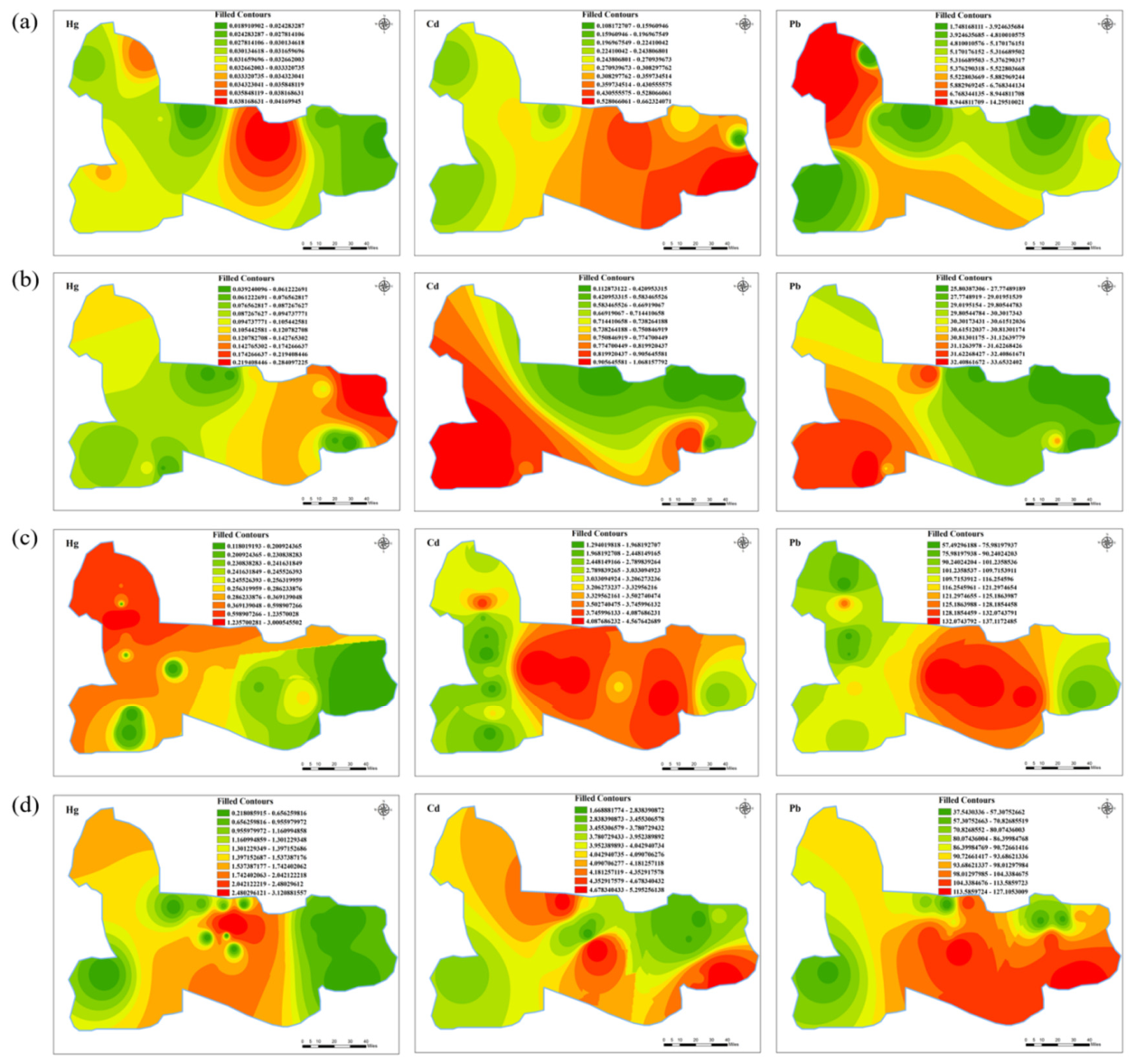
To comprehensively reflect the distribution differences in severely exceeded toxic metal elements in atmospheric dry and wet deposition within the study area, ArcGIS 10.8 was used for spatial visualization analysis through the Inverse Distance Weighting (IDW) method. Specifically, the IDW interpolation was performed with a search radius of 5 km (consistent with the spatial scale of the study area) and all sampling points (n = 32) were included to ensure the reliability of spatial distribution results. By classifying the heavy metal concentrations from four different sample types—rock (Figure 2a), weathered soil (Figure 2b), dry deposition (Figure 2c), and wet deposition (Figure 2d)—this study aims to clarify the spatial coupling relationship between black shale distribution, element migration during weathering, and the concentration patterns of dry/wet deposition, thereby illustrating how the spatial variation in black shale weathering affects atmospheric deposition processes.
The distribution pattern of mercury (Hg) in black shale shows a strong consistency with that in weathered soil, with both concentrations concentrated in the northeastern region of the study area. This finding reflects the pronounced weathering characteristics of high-value zones: extensive natural weathering of black shale bedrock has led to significant retention of toxic metal elements in the newly formed weathered soil, thereby reducing the input of Hg into atmospheric deposition in this region. In contrast, the mid-to-high-value areas for Hg in dry deposition are primarily located in the western part of the study area, accounting for nearly 50% of the region. In this area, the natural weathering of black shale has not formed extensive weathering belts; thus, a considerable amount of Hg is released into the atmosphere during the weathering process and accumulates in dry deposition, leading to elevated concentrations. Additionally, certain human engineering activities in this region may further exacerbate Hg pollution. In wet deposition, the mid-to-high-value regions for Hg are concentrated in a small central area, accounting for a relatively small proportion. However, it is important to note that Hg in wet deposition generally has better solubility, and its concentration frequently exceeds that in dry deposition in local high-value areas. Therefore, the low-value regions in wet deposition only reflect the spatial distribution of Hg in wet deposition itself, rather than the overall Hg concentration in the study area, highlighting significant differences in the spatial patterns between dry and wet deposition processes [19,60]. Cadmium (Cd), identified as the element with the highest exceedance rate in black shale, exhibits significant spatial variability, with over 80% of the area classified as mid-to-high value. High-value regions of Cd in black shale are predominantly situated in the central and eastern parts of the study area. In contrast, weathered soil shows a different concentration distribution, with high-value zones occurring south of the western region. Field investigations indicate that this disparity is mainly due to the strong fixation of Cd (released from black shale) in the weathered soil of this area, resulting in relatively low Cd concentrations in atmospheric deposition. This confirms that the natural weathering and migration of black shale significantly influence the spatial distribution of Cd in atmospheric deposition. The distribution of Cd in dry deposition exhibits a pattern of intermediate highs and lower extremes, with high-value areas accounting for over 71% of the total area, indicating a high level of pollution in the region. The large proportion of high-value areas for Cd in dry deposition can be attributed to its poor solubility: during the natural weathering and migration of black shale, Cd is prone to secondary enrichment and primarily accumulates in dry deposition, leading to concentrations that severely exceed acceptable levels [61,62]. In comparison to dry deposition, the mid-to-high-value regions of Cd in wet deposition are significantly influenced by sampling location selection. Wet deposition samples were mainly collected from open areas at the edge of towns and key agricultural regions, which are concentrated in the central and eastern parts of the study area. High-value regions of Cd in wet deposition appear in the northwest portion of the study area, which is likely due to the higher degree of natural weathering of black shale in this area—this geological background factor directly affects the Cd concentration in wet deposition. Overall, the proportion of mid-to-high-value regions for Cd in wet deposition is notably lower than that in dry deposition, consistent with the poor solubility of Cd (which is more likely to accumulate in dry particulate deposition). Lead (Pb) shows a consistent spatial concentration distribution pattern between black shale and weathered soil, with mid-to-high-value areas located in the western part of the study area. Notably, there is a subtle difference: high-value zones of Pb in black shale are concentrated in the northwest, while those in weathered soil are predominantly in the southwest. This discrepancy is attributed to anthropogenic factors (e.g., industrial emissions, agricultural activities) that affect the sources of Pb in weathered soil, leading to higher concentrations in the southwest. The high-value regions of Pb in atmospheric dry deposition primarily concentrate in the central part of the study area, where residential areas are densely populated and subject to significant anthropogenic influences, such as emissions from lead-acid batteries, industrial activities, and gasoline additives [1]. In wet deposition, Pb concentrations start from the main thoroughfares traversing the study area, with notably higher concentrations in the central and western regions—concentrations increase closer to these thoroughfares. Thus, it is reasonable to conclude that the primary source of Pb in wet deposition is vehicular exhaust emissions from road traffic [38,63,64]. Consequently, under the dual influence of anthropogenic activities and natural weathering migration processes, both dry and wet atmospheric deposition of Pb exhibit a significant prevalence of high-value regions.
Considering the spatial distribution patterns of pollution among black shale, weathered soil, and both dry and wet atmospheric deposition, it is observed that the natural weathering of black shale is accompanied by the migration and enrichment of elements, which primarily involves two types of fixation: fixation in weathered soil and fixation in atmospheric deposition. A clear spatial pattern was identified: when the mid-to-high-value zones of black shale and weathered soil exhibit similar distribution patterns, the enrichment of elements in atmospheric deposition tends to show the opposite concentration behavior (i.e., lower concentrations in deposition). Conversely, when the mid-to-high-value regions of black shale and weathered soil differ, the mid-to-high-value areas of black shale and atmospheric deposition tend to show similar distribution patterns (i.e., higher concentrations in deposition). Although atmospheric dry and wet deposition may present slight deviations due to their different physical forms (particulate vs. aqueous), they generally conform to this pattern. The main reason for this outcome is that the sources of elements in both weathered soil and atmospheric deposition are predominantly influenced by the natural weathering of black shale: when a higher concentration of elements is fixed in one medium (either weathered soil or deposition) in a particular area, it will result in lower concentrations in the other medium within the same area. Some limitations of this study should be addressed. The number of sampling points is relatively limited, which may weaken the robustness of parametric statistical analysis. Therefore, the statistical results are used to illustrate general geochemical trends rather than rigorous quantitative deduction. Meanwhile, restricted by sampling density, the spatial distribution maps interpolated by IDW are only for qualitative trend visualization instead of accurate quantitative spatial prediction. These limitations do not affect the core conclusions that this study reveals the concentration levels, source characteristics, and potential health risks of toxic metals in atmospheric deposition under the high geological background. Future studies will increase the sampling density and optimize the monitoring layout to improve the reliability of statistical analysis and spatial interpolation results.

3.3. Analysis of Dry and Wet Deposition Sources

3.3.1. Correlation Analysis

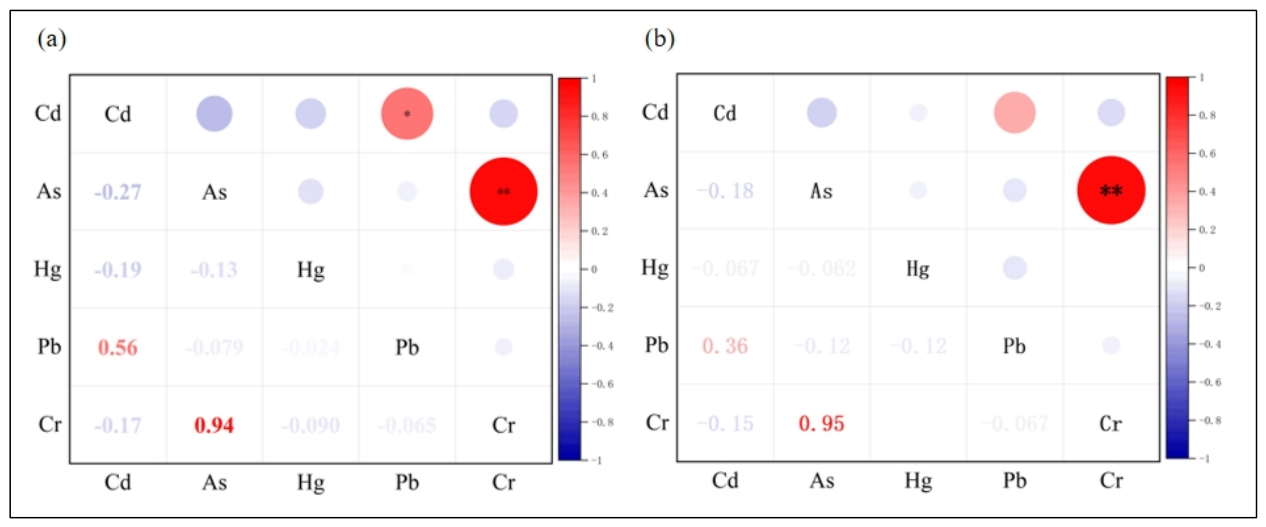
A correlation heatmap was utilized to analyze the concentrations of toxic metal elements in atmospheric deposition samples under both dry and wet conditions from the high geological background area of the Hunan Loushao Basin. This analysis aimed to determine the source associations among the toxic metal elements and to assess the extent of influence from the high geological background sources. Typically, a correlation probability value of <0.01 indicates a highly significant correlation, while a probability value of <0.05 suggests a moderately significant correlation [22,65,66].
The correlation between elements in both dry and wet deposition samples shows certain differences, but overall, the trends remain consistent. In both dry and wet deposition samples, the significant correlation between toxic metal elements Cr and As is most evident. It is essential to primarily consider the consistency in the sources of these two elements in atmospheric dry deposition in high geological background regions. The second most significant correlation is between toxic metals Cd and Pb. This correlation may result from the combined influence of natural weathering of black shale and anthropogenic factors under high geological background conditions. However, it is also observed that in Figure 3a (dry deposition samples), the correlation between Cd and Pb is stronger than in Figure 3b (wet deposition samples). Additionally, in dry deposition samples, Hg shows a negative correlation with both As and Cd, which is not observed in wet deposition samples. In wet deposition, the toxic metal elements Pb, As, and Hg show a negative correlation. This suggests that even though the high geological background is a primary influencing factor, many other factors also influence the accumulation of these elements in atmospheric deposition samples. Further source identification studies using different receptor models are required to explore the possible origins of these elements [58,65].

3.3.2. Principal Component Analysis

Principal component analysis (PCA) was employed to trace and identify the different source pathways of toxic metal elements in dry and wet atmospheric deposition within the high geological background area of the Loushao Basin, Hunan Province. After performing numerical analysis and normal distribution simulation on the detection data from both dry and wet deposition using SPSS 26.0, the KMO and Bartlett tests of sphericity were conducted to eliminate invalid data. The results of the data analysis indicated that all KMO values exceeded 0.5, and the significance of Bartlett’s test was less than 0.05, confirming the suitability of the PCA model for pollution source tracing analysis [65,67,68,69,70,71]. The results of the dry deposition data test showed a KMO value of 0.573 with a significance result of 0, while the wet deposition data test showed a KMO value of 0.547 with a significance result of 0. Both results satisfy the criteria for conducting PCA to explore the possible sources of different elemental components.
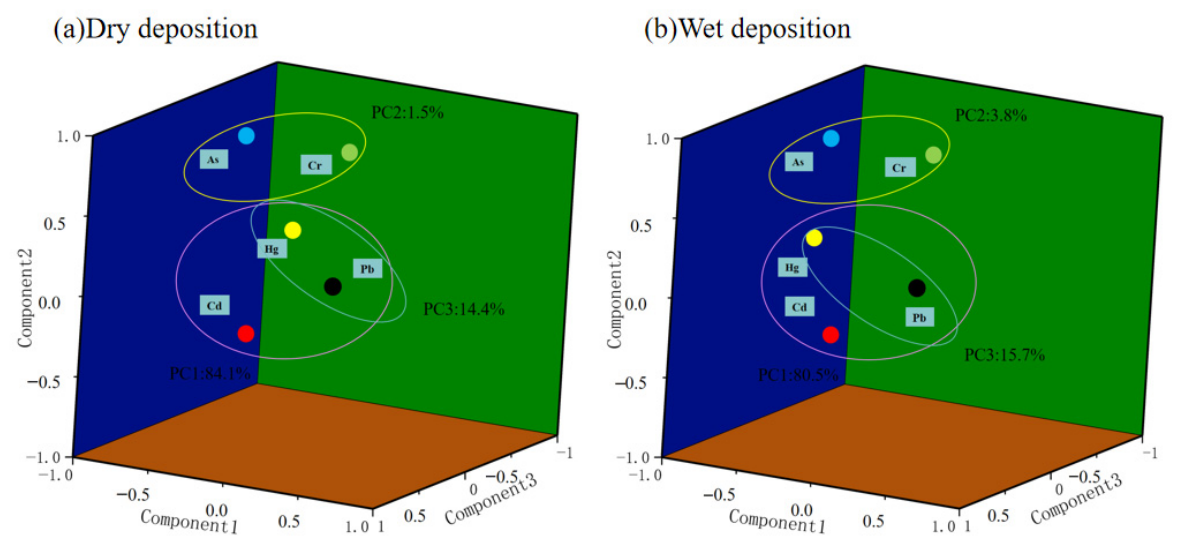
Existing research indicates that when several elements belong to the same component, they are typically considered to have similar sources [72,73,74,75]. In dry deposition PC1, the toxic metal elements with the highest load are Cd, Hg, and Pb, which together account for 84.1% of the cumulative variance, representing the largest component (Figure 4a). Field investigations and existing studies suggest that the high variance contribution rate of PC1 primarily reflects the overall contributions of natural geological backgrounds such as soil dust and mineral weathering. Within this context, the natural weathering and migration of black shale, which is rich in elements like Cd, Hg, and Pb, leads to the enrichment of these elements. As a result, there is a notable accumulation of these three elements in the atmospheric dry deposition samples [25,26,27,28]. The PC2 component accounts for only 1.5% and is primarily composed of As and Cr. The source of this component is mainly attributed to anthropogenic factors leading to the enrichment of these elements in atmospheric deposition. The emissions from coal-fired power plants and industrial boilers contain Cr, especially in areas with significant coal element accumulation [76]. The source of As is also predominantly anthropogenic, and existing studies show that As is typically found as a companion metal to Sb in mining regions [44,58]. In PC3, the elements with the highest load are Hg and Pb, accounting for 14.4%. The main source of Pb is attributed to insufficient combustion emissions from gasoline used in road transport and the emission of gasoline additives, leading to a significant accumulation of Pb in atmospheric deposition. Similarly, the concentration of Hg in atmospheric deposition is influenced by substantial automobile exhaust emissions, as well as some industrial waste gas emissions [59,77]. Figure 4b shows that the elemental composition percentages for wet deposition PC1, PC2, and PC3 are 80.5%, 3.8%, and 15.7%, respectively. The main constituent elements of the three components are consistent with those of dry deposition, confirming that the sources of elemental enrichment in both dry and wet atmospheric deposition are unified in the region [78]. However, the differences in component proportions reflect the varying capacities for element enrichment across different types of deposition.
It is noteworthy that previous studies have indicated that, under natural evolution without the influence of other factors, the concentration of Cr in atmospheric deposition typically exhibits a pattern where dry deposition exceeds wet deposition. However, this study presents an opposing conclusion. Considering the elemental source pathways of regional atmospheric deposition and the numerical simulation results, this research primarily reflects influences from high geological backgrounds, resulting in findings that differ from those observed in typical geological regions. PCA is merely a preliminary statistical analysis tool and is inadequate for fully distinguishing the nuanced contributions from natural and anthropogenic sources. In the absence of more robust source apportionment techniques, such as Positive Matrix Factorization (PMF) and isotopic fingerprinting, it is challenging to accurately quantify the contribution ratios of natural weathering versus human activities. Future assessments of the impacts under high geological background conditions will require a comprehensive evaluation using multiple methods and perspectives.

4. Health Risk Assessment

Based on measured element concentrations in dry and wet atmospheric deposition, potential health risks to local residents were assessed. For dry deposition, HI values of As, Hg, Pb, and Cr were greater than 1 for both adults and children, which may imply potential health risks. For adults, the HI followed the order Pb > Cr > Hg > As, with Pb exhibiting a relatively higher potential risk. Prolonged Pb exposure may be associated with neurological effects such as limb numbness and muscle weakness [79,80]. Cr represented the second notable potential risk; long-term contact might be related to skin ulcers, dermatitis, and gastrointestinal symptoms including diarrhea and vomiting [81]. Elevated Hg levels could be linked to chronic neurological impacts, suggesting its potential risk deserves attention. Exposure may be associated with skin lesions and related dermal effects.
Health risks for children followed a similar pattern but were generally more pronounced. For children, the HI order was Pb > Hg > Cr > As, with all HI values higher than those for adults, indicating that children may be more vulnerable to toxic elements from atmospheric deposition. Notably, the HI of Pb in dry deposition for children exceeded 10, suggesting a relatively notable potential health concern. For wet deposition, the elements associated with potential health risks were generally comparable to those in dry deposition, although HI values were lower, likely due to lower elemental concentrations. In wet deposition, the HI of Cd for children was greater than 1, indicating that Cd in wet deposition may also represent a potential health risk for children that warrants consideration.
The corresponding reference doses (RfD), hazard quotients (HQ), and hazard indices (HI) for each element in dry and wet deposition are summarized in Table 2.

5. Conclusions

This study continues the work on the pollution characteristics, sources, and risk assessments of toxic metal elements in multi-media in the typical high geological background area of the Hunan Loushao Basin in China. It evaluates the threat to local human health caused by the concentration exceedances of elements in atmospheric dry and wet deposition within the region. The findings contribute to the pollution assessment system caused by natural weathering in high geological background areas and lead to the following key conclusions:
(1)
The exceedance rates of Cd, As, and Hg in black shale are 408%, 141%, and 220%, respectively. The high concentrations in the bedrock directly affect the natural weathering of major secondary enrichment media, such as weathered soils and atmospheric deposition. In weathered soils, only As and Pb exceed the standard, with exceedance rates of 129% and 113%, respectively. In atmospheric deposition, the toxic metal elements with the most serious exceedances are Cd, Hg, and Pb. The exceedance rates for dry deposition are 2.83, 3.29, and 4.08 times, respectively, while for wet deposition, they are 3.6, 4.07, and 3.43 times. In atmospheric wet deposition samples, the concentrations of Cd, Hg, and As are significantly higher than in dry deposition samples. The differences in concentration are primarily attributed to the solubility and dissolution rates of the elements.
(2)
The exceedance of Cd concentrations in atmospheric dry deposition is relatively widespread, covering more than 71% of the total study area. Medium-to-high values of Hg are primarily distributed in the western part of the study region, accounting for nearly 50%, and are largely influenced by natural weathering. High-value areas of the toxic metal element Pb are concentrated in central residential zones, mainly due to pollution accumulation caused by anthropogenic activities. Although there are some differences in wet deposition, the overall spatial distribution pattern remains generally consistent. The distribution patterns of weathered soil and atmospheric deposition are negatively correlated, and both are directly linked to secondary enrichment resulting from the natural weathering of black shale.
(3)
The source analysis results of atmospheric dry and wet deposition show that PC1 accounts for 84.1% and 80.5% of the variance in dry and wet deposition, respectively. The enrichment of Cd, Hg, and Pb elements in atmospheric deposition is primarily due to the natural weathering and migration of black shale, with anthropogenic factors contributing to the enrichment of As, Cr, Pb, and Hg in the deposition. The differences between dry and wet deposition are not the main influencing factors for the sources of these elements.
(4)
The HI values for As, Hg, Pb, and Cr elements in atmospheric deposition are greater than 1 for both adults and children, indicating the potential health hazards posed by these elements. The most serious threat is posed by Pb in dry deposition for children, with an HI value of 13.5, which can easily lead to neurological disorders. The elements with significant health risks in both dry and wet atmospheric deposition are largely consistent. However, in wet deposition, the HI value for Cd in children exceeds 1, suggesting that the health threat from Cd should be considered, while in contrast, the potential threat from Cd in dry deposition is relatively lower.

Author Contributions

X.D.: Methodology, Investigation, Software, Formal analysis. L.C.: Methodology, Investigation, Software, Formal analysis. B.R.: Conceptualization, Supervision, Writing—review and editing, Validation. Q.X.: Investigation; W.Y.: Investigation. Z.C.: Investigation. All authors have read and agreed to the published version of the manuscript.

Funding

This study was supported by the Project of the National Natural Science Foundation of China (41973078) and the Key Research Development Program of the Hunan Provincial Natural Science Foundation (2022SK2073), Postgraduate Scientific Research Innovation Project of Hunan Province (CX20231049).

Institutional Review Board Statement

Not applicable.

Informed Consent Statement

Not applicable.

Data Availability Statement

Data will be made available on request.

Conflicts of Interest

The authors declare that they have no known competing financial interests or personal relationships that could have appeared to influence the work reported in this paper.

References

  1. Hou, D.; Jia, X.; Wang, L.; McGrath, S.P.; Zhu, Y.-G.; Hu, Q.; Zhao, F.-J.; Bank, M.S.; O’Connor, D. Global soil pollution by toxic metals threatens agriculture and human health. Science 2025, 388, 316–321. [Google Scholar] [CrossRef] [PubMed]
  2. Ren, B.; Ma, W.; Zhang, M. The morphological transformation and migration characteristics of cadmium and selenium during the soil formation process of black rock series. Chin. J. Soil Water Conserv. 2024, 38, 391–399. [Google Scholar] [CrossRef]
  3. Cai, Q.S.; Hu, M.Y.; Yang, Z.; Qiu, X.; Zhang, B.; Li, H.; Hu, Z.; Deng, Q. Sedimentary environment and organic matter accumulation of black rock series of Wufeng-Longmaxi formations in foreland depression, western Hunan Province: An example from Well TD2 in Changde area. Earth Sci. 2024, 49, 2330–2345. [Google Scholar]
  4. Yadav, I.C.; Devi, N.L.; Singh, V.K.; Li, J.; Zhang, G. Spatial distribution, source analysis, and health risk assessment of heavy metals contamination in house dust and surface soil from four major cities of Nepal. Chemosphere 2019, 218, 1100–1113. [Google Scholar] [CrossRef]
  5. Dusengemungu, L.; Mubemba, B.; Gwanama, C. Evaluation of heavy metal contamination in copper mine tailing soils of Kitwe and Mufulira, Zambia, forreclamation prospects. Sci. Rep. 2022, 12, 11283. [Google Scholar] [CrossRef]
  6. Marx, S.K.; Kamber, B.S.; McGowan, H.A. Scavenging of atmospheric trace metal pollutants by mineral dusts: Inter-regional transport of Australian trace metal pollution to New Zealand. Atmos. Environ. 2008, 42, 2460–2478. [Google Scholar] [CrossRef]
  7. Li, Y.; Zhou, S.; Jia, Z.; Liu, K.; Wang, G. Temporal and spatial distributions and sources of heavy metals in atmospheric deposition in western Taihu Lake, China. Environ. Pollut. 2021, 284, 117465. [Google Scholar] [CrossRef]
  8. Duruibe, J.C.O.; Egwurugwu, J. Heavy metal pollution and human biotoxic effects. Int. J. Phys. Sci. 2007, 2, 112–118. Available online: https://academicjournals.org/article/article1380209337_Duruibe%20et%20al.pdf (accessed on 29 April 2026).
  9. Abdel-Latif, N.M.; Saleh, I.A. Heavy metals contamination in roadside dust along major roads and correlation with urbanization activities in Cairo, Egypt. J. Am. Sci. 2012, 8, 379–389. Available online: https://www.jofamericanscience.org/journals/am-sci/am0806/047_9402am0806_379_389.pdf (accessed on 29 April 2026).
  10. Nordberg, G.F.; Fowler, B.A.; Nordberg, M. (Eds.) Handbook on the Toxicology of Metals, 3rd ed.; Academic Press: San Diego, CA, USA, 2007. [Google Scholar] [CrossRef]
  11. Ostrom, E. A General framework for analyzing sustainability of social-ecological systems. Science 2009, 325, 419. [Google Scholar] [CrossRef]
  12. Pimm, S.L. Food Webs; Springer: Dordrecht, The Netherlands, 1982. [Google Scholar]
  13. Zhao, Q.; Shi, H.; Wu, Z. The Comprehensive Development Strategy and Countermeasures of Agricultural Resources in Red-Yellow Soil Region; Jiangxi Science and Technology Press: Nanchang, China, 1992. [Google Scholar]
  14. Turekian, K.K.; Wedepohl, K.H. Distribution of the elements in some major units of the earth’s crust. Geol. Soc. Am. Bull. 1961, 72, 175–192. [Google Scholar] [CrossRef]
  15. Sun, X.; Jia, L. Migration Characteristics of Heavy Metal Elements in Rock-Soil-Plant System in Yangmeikeng Area, Shenzhen. South China Geol. 2020, 36, 270–279. [Google Scholar]
  16. Chi, Q.H.; Yan, M.C. Abundance of Elements in Applied Geochemistry; Geological Publishing House: Beijing, China, 2007. [Google Scholar]
  17. Jordi, A.; Basterretxea, G.; Tovar-Sanchez, A.; Alastuey, A.; Querol, X. Copper aerosols inhibit phytoplankton growth in the Mediterranean Sea. Proc. Natl. Acad. Sci. USA 2012, 109, 21246–21249. [Google Scholar] [CrossRef] [PubMed]
  18. Wilcke, W.; Kaupenjohann, M. Heavy metal distribution between soil aggregate core and surface fractions along gradients of deposition from the atmosphere. Geoderma 1998, 83, 55–66. [Google Scholar] [CrossRef]
  19. Morselli, L.; Olivieri, P.; Brusori, B.; Passarini, F. Soluble and insoluble fractions of heavy metals in wet and dry atmospheric depositions in Bologna, Italy. Environ. Pollut. 2003, 124, 457–469. [Google Scholar] [CrossRef]
  20. Liu, H.-L.; Zhou, J.; Li, M.; Obrist, D.; Wang, X.-Z.; Zhou, J. Chemical speciation of trace metals in atmospheric deposition and impacts on soil geochemistry and vegetable bioaccumulation near a large copper smelter in China. J. Hazard. Mater. 2021, 413, 125346. [Google Scholar] [CrossRef]
  21. Xia, X.; Ji, J.; Zhang, C.; Yang, Z.; Shi, H. Carbonate bedrock control of soil Cd background in Southwestern China: Its extent and influencing factors based on spatial analysis. Chemosphere 2022, 290, 133390. [Google Scholar] [CrossRef]
  22. Wu, W.; Qu, S.; Nel, W.; Ji, J. The impact of natural weathering and mining on heavy metal accumulation in the karst areas of the Pearl River Basin, China. Sci. Total Environ. 2020, 734, 139480. [Google Scholar] [CrossRef]
  23. Wen, Y.; Li, W.; Yang, Z.; Zhang, Q.; Ji, J. Enrichment and source identification of Cd and other heavy metals in soils with high geochemical background in the karst region, Southwestern China. Chemosphere 2020, 245, 125620. [Google Scholar] [CrossRef]
  24. Wang, Y.; Duan, X.; Wang, L. Spatial distribution and source analysis of heavy metals in soils influenced by industrial enterprise distribution: Case study in Jiangsu Province. Sci. Total Environ. 2020, 710, 134953. [Google Scholar] [CrossRef]
  25. Cai, Z.; Ren, B.; Xie, Q.; Deng, X.; Yin, W.; Chen, L. Heterogeneous comparative analysis of potentially toxic elements(PTEs)in different media stem from the black rock system under a high geologic background. J. Clean. Prod. 2024, 481, 144139. [Google Scholar] [CrossRef]
  26. Cai, Z.; Ren, B.; Xie, Q.; Deng, X.; Yin, W.; Chen, L. Toxic element characterization against a typical high geology background: Pollution enrichment, source tracking, spatial distribution, and ecological risk assessment. Environ. Res. 2024, 255, 119146. [Google Scholar] [CrossRef]
  27. Cai, Z.; Ren, B.; Xie, Q.; Deng, X.; Yin, W.; Chen, L. Assessment of health risks posed by toxicological elements of the food chain in a typical high geologic background. Ecol. Indic. 2024, 161, 111981. [Google Scholar] [CrossRef]
  28. Chen, L.; Ren, B.; Deng, X.; Yin, W.; Xie, Q.; Cai, Z.; Zou, H. Black shale bedrock control of soil heavy metal typical high geological background in China Loushao Basin: Pollution characteristics, source and Influence assessment based on spatial analysis. J. Hazard. Mater. 2024, 477, 135072. [Google Scholar] [CrossRef] [PubMed]
  29. Chen, L.; Ren, B.; Deng, X.; Yin, W.; Cai, Z. Black shale high geological background potential toxic elements(PTEs) in middle reaches of the Yangtze River tributary basin water environment, China: Distribution, pollution sources, and risk assessment. J. Hazard. Mater. 2024, 480, 136132. [Google Scholar] [CrossRef]
  30. Chen, L.; Ren, B.; Deng, X.; Yin, W.; Xie, Q.; Cai, Z.; Zou, H. Potential toxic elements (PTEs) in rhizosphere soils and crops under a black shale high geological background: Pollution characteristics, distribution and risk assessment. Ecol. Indic. 2024, 165, 112236. [Google Scholar] [CrossRef]
  31. Oberdörster, G.; Oberdörster, E.; Oberdörster, J. Nanotoxicology: An emerging discipline evolving from studies of ultrafine particles. Environ. Health Perspect. 2005, 113, 823–839. Available online: https://pubmed.ncbi.nlm.nih.gov/16002369/ (accessed on 29 April 2026). [CrossRef]
  32. Kreyling, W.G.; Semmler-Behnke, M.; Möller, W. Ultrafine particle-lung interactions: Does size matter? J. Aerosol Med. 2006, 19, 74–83. [Google Scholar] [CrossRef]
  33. Hei, H. Review Panel on Ultrafine Particles: Understanding the Health Effects of Ambient Ultrafine Particles; HEI Perspectives 3; Health Effects Institute: Boston, MA, USA, 2013; Available online: https://www.healtheffects.org/system/files/Perspectives3.pdf (accessed on 29 April 2026).
  34. Salma, I.; Füri, P.; Németh, Z.; Balásházy, I.; Hofmann, W.; Farkas, Á. Lung burden and deposition distribution of inhaled atmospheric urban ultrafine particles as the first step in their health risk assessment. Atmos. Environ. 2015, 104, 39–49. [Google Scholar] [CrossRef]
  35. McLaughlin, M.J.; Smolders, E.; Zhao, F.J.; Grant, C.; Montalvo, D. Chapter One: Managing cadmium in agricultural system. Adv. Agron. 2021, 166, 1–129. [Google Scholar]
  36. Klaes, B.; Wörner, G.; Thiele-Bruhn, S.; Arz, H.W.; Struck, J.; Dellwig, O.; Groschopf, N.; Lorenz, M.; Wagner, J.-F.; Urrea, O.B.; et al. Element mobility related to rock weathering and soil formation at the westward side of the southernmost Patagonian Andes. Sci. Total Environ. 2022, 817, 152977. [Google Scholar] [CrossRef]
  37. Amodio, M.; Catino, S.; Dambruoso, P.R.; de Gennaro, G.; Di Gilio, A.; Giungato, P.; Laiola, E.; Marzocca, A.; Mazzone, A.; Sardaro, A.; et al. Atmospheric Deposition: Sampling Procedures, Analytical Methods, and Main Recent Findings from the Scientific Literature. Adv. Meteorol. 2014, 2014, 161730. [Google Scholar] [CrossRef]
  38. Ye, J.; Zhong, H.; Xu, Z.; Ma, C. Study on the Flux of Heavy Metal Elements in Atmospheric Dry Wet Deposition and Its Impact on Farmland Soil: A Case Study of Chongzhou. Geophys. Chem. Explor. 2025, 49, 708–717. [Google Scholar]
  39. HJ 737-2015; Soil and Sediment-Determination of 12 Metal Elements by Inductively Coupled Plasma Mass Spectrometry. Ministry of Ecology and Environment of China: Beijing, China, 2015.
  40. HJ 694-2014; Water Quality—Determination of Mercury, Arsenic, Selenium, Bismuth and Antimony—Atomic Fluorescence Spectrometry. Ministry of Ecology and Environment of China: Beijing, China, 2015.
  41. Liu, Y.; Wei, G. Improvement of GRUBBS method in outlier detection. Henan Sci. 2006, 124, 642–645. [Google Scholar]
  42. Liu, F.; Shi, X.; Yu, D.; Pan, X. Characteristics of spatial variability of total soil nitrogen in the typical area of Taihu Lake basin. Geogr. Sci. 2004, 23, 63–70. [Google Scholar]
  43. Wang, J. Using SPSS17 Evaluation of the Normal Probability Distribution Diagram of 0 Software for the Writing of the “Medical Imaging Technology” Exam Paper—Attached with the Results of the 11th Student Exam. Mod. Instrum. 2012, 18, 45–47. [Google Scholar]
  44. Zou, H.; Ren, B.; Deng, X.; Li, T. Geographic distribution, source analysis, and ecological risk assessment of PTEs in the topsoil of different land uses around the antimony tailings tank: A case study of Longwangchi tailings pond, Hunan, China. Ecol. Indic. 2023, 150, 110205. [Google Scholar] [CrossRef]
  45. Xie, Q.; Ren, B.; Shi, X.; Hursthouse, A. Factors on the distribution, migration, and leaching of potential toxic metals in the soil and risk assessment around the zinc smelter. Ecol. Indic. 2022, 144, 109502. [Google Scholar] [CrossRef]
  46. USEPA. Risk Assessment Guidance for Superfund Volume 1. Human Health Evaluation Manual (Part E, Supplemental Guidance for Dermal Risk As-sessment); EPA/540/R/99/005; Office of Superfund Remediation and Technology Innovation, U.S. Environmental Protection Agency: Washington, DC, USA, 2004.
  47. Kim, E.; Little, J.C.; Chiu, N. Estimating exposure to chemical contaminants in drinking water. Environ. Sci. Technol. 2004, 38, 1799–1806. [Google Scholar] [CrossRef] [PubMed]
  48. Zeng, X.; Liu, Y.; You, S.; Zeng, G.; Tan, X.; Hu, X.; Hu, X.; Huang, L.; Li, F. Spatial distribution, health risk assessment and statistical source identification of the trace elements in surface water from the Xiangjiang River, China. Environ. Sci. Pollut. Res. 2015, 22, 9400–9412. [Google Scholar] [CrossRef] [PubMed]
  49. Meng, Q.; Zhang, J.; Zhang, Z.; Wu, T. Geochemistry of dissolved trace elements and heavy metals in the Dan River Drainage (China): Distribution, sources, and water quality assessment. Environ. Sci. Pollut. Res. 2016, 23, 8091–8103. [Google Scholar] [CrossRef]
  50. Şener, Ş.; Şener, E.; Davraz, A. Evaluation of water quality using water quality index (WQI) method and GIS in Aksu River (SW-Turkey). Sci. Total Environ. 2017, 584–585, 131–144. [Google Scholar] [CrossRef]
  51. Wang, J.; Liu, G.; Liu, H.; Lam, P.K. Multivariate statistical evaluation of dissolved trace elements and a water quality assessment in the middle reaches of Huaihe River, Anhui, China. Sci. Total Environ. 2017, 583, 421–431. [Google Scholar] [CrossRef] [PubMed]
  52. Chen, X.; Fu, X.; Li, G.; Zhang, J.; Li, H.; Xie, F. Source-specific probabilistic health risk assessment of heavy metals in surface water of the Yangtze River Basin. Sci. Total Environ. 2024, 926, 171923. [Google Scholar] [CrossRef]
  53. Yan, Y.; Zhang, Q.; Wang, G.G.; Fang, Y.-M. Atmospheric deposition of heavy metals in Wuxi, China: Estimation based on native moss analysis. Environ. Monit. Assess. 2016, 188, 360. [Google Scholar] [CrossRef]
  54. Xia, X.; Ji, J.; Yang, Z.; Han, H.; Huang, C.; Li, Y.; Zhang, W. Cadmium risk in the soil-plant system caused by weathering of carbonate bedrock. Chemosphere 2020, 254, 126799. [Google Scholar] [CrossRef] [PubMed]
  55. Seinfeld, J.H.; Pandis, S.N. Atmospheric Chemistry and Physics: From Air Pollution to Climate Change; John Wiley & Sons: Hoboken, NJ, USA, 2016. [Google Scholar]
  56. Baral, D.; Dvorak, B.I.; Admiraal, D.; Jia, S.; Zhang, C.; Li, X. Tracking the Sources of Antibiotic Resistance Genes in an Urban Stream during Wet Weather using Shotgun Metagenomic Analyses. Environ. Sci. Technol. 2018, 52, 9033–9044. [Google Scholar] [CrossRef] [PubMed]
  57. Misyura, S. Developing the environmentally friendly technologies of combustion of gas hydrates. Reducing harmful emissions during combustion. Environ. Pollut. 2020, 265, 114871. [Google Scholar] [CrossRef]
  58. Chen, L.; Ren, B.; Deng, X.; Yin, W.; Xie, Q.; Cai, Z. Potential toxic heavy metals in village rainwater runoff of antimony mining area, China: Distribution, pollution sources, and risk assessment. Sci. Total Environ. 2024, 920, 170702. [Google Scholar] [CrossRef]
  59. Liang, J.; Liu, J.; Yuan, X.; Zeng, G.; Yuan, Y.; Wu, H.; Li, F. A method for heavy metal exposure risk assessment to migratory herbivorous birds and identification of priority pollutants/areas in wetlands. Environ. Sci. Pollut. Res. 2016, 23, 11806–11813. [Google Scholar] [CrossRef]
  60. Cooke, C.A.; Martínez-Cortizas, A.; Bindler, R.; Gustin, M.S. Environmental archives of atmospheric Hg deposition–a review. Sci. Total Environ. 2020, 709, 134800. [Google Scholar] [CrossRef]
  61. Zhang, Y.; Xiang, Y.B.; Chen, W.Y. Heavy metal content in the bark of Camphora tree in Xiangtan and its environmental significance. Appl. Ecol. Environ. Res. 2019, 17, 9827–9835. Available online: https://www.aloki.hu/pdf/1704_98279835.pdf (accessed on 29 April 2026). [CrossRef]
  62. Zhao, W.; Song, Y.; Guan, D.; Ma, Q.; Guo, C.; Wen, Y.; Ji, J. Study on Soil Heavy Metal Pollution and Bioavailability in Typical Distribution Areas of Black Rock Series. J. Agric. Environ. Sci. 2018, 37, 1332–1341. [Google Scholar]
  63. Jeong, H.; Choi, J.Y.; Lee, J.; Lim, J.; Ra, K. Heavy metal pollution by road-deposited sediments and its contribution to total suspended solids in rainfall runoff from intensive industrial areas. Environ. Pollut. 2020, 265, 115028. [Google Scholar] [CrossRef]
  64. Zang, F.; Wang, H.; Zhao, C.; Nan, Z.; Wang, S.; Yang, J.; Li, N. Atmospheric wet deposition of trace elements to forest ecosystem of the Qilian Mountains, northwest China. CATENA 2021, 197, 104966. [Google Scholar] [CrossRef]
  65. Liu, B.; Guo, X.; Zhu, Y. Soil heavy metal source analysis based on random forest model: A case study of Jinzhong Basin. Resour. Environ. Arid Reg. 2019, 33, 106–111. [Google Scholar] [CrossRef]
  66. Wu, W.; Qu, S.; Nel, W.; Ji, J. The influence of natural weathering on the behavior of heavy metals in small basaltic watersheds: A comparative study from different regions in China. Chemosphere 2021, 262, 127897. [Google Scholar] [CrossRef]
  67. Dong, Z.; Kang, S.; Qin, X.; Li, X.; Qin, D.; Ren, J. New insights into trace elements deposition in the snow packs at remote alpine glaciers in the northern Tibetan Plateau, China. Sci. Total Environ. 2015, 529, 101–113. [Google Scholar] [CrossRef]
  68. Zhou, H.; Yue, X.; Chen, Y.; Liu, Y. Source-specific probabilistic contamination risk and health risk assessment of soil heavy metals in a typical ancient mining area. Sci. Total Environ. 2023, 906, 167772. [Google Scholar] [CrossRef]
  69. Kumar, M.; Ramanathan, A.; Tripathi, R.; Farswan, S.; Kumar, D.; Bhattacharya, P. A study of trace element contamination using multivariate statistical techniques and health risk assessment in groundwater of Chhaprola Industrial Area, Gautam Buddha Nagar, Uttar Pradesh, India. Chemosphere 2017, 166, 135–145. [Google Scholar] [CrossRef]
  70. Xiao, J.; Wang, L.; Deng, L.; Jin, Z. Characteristics, sources, water quality and health risk assessment of trace elements in river water and well water in the Chinese Loess Plateau. Sci. Total Environ. 2019, 650, 2004–2012. [Google Scholar] [CrossRef]
  71. Varol, M. Assessment of heavy metal contamination in sediments of the Tigris River (Turkey) using pollution indices and multivariate statistical techniques. J. Hazard. Mater. 2011, 195, 355–364. [Google Scholar] [CrossRef]
  72. Ren, B.; Liu, K.; Ma, H. Analysis of manganese pollution load in rainwater runoff from a metal mining area based on the SWAT model. Environ. Pollut. Control 2014, 36, 50–54. [Google Scholar]
  73. Ren, B.; Ma, H.; Zheng, X.; Binquan, L.; Yi, Z. Spatial structure characteristics of heavy metal content and pollution level in rainwater runoff from manganese mining areas. J. Environ. Sci. 2014, 34, 1730–1737. [Google Scholar] [CrossRef]
  74. Ke, W.; Zeng, J.; Zhu, F.; Luo, X.; Feng, J.; He, J.; Xue, S. Geochemical partitioning and spatial distribution of heavy metals in soils contaminated by lead smelting. Environ. Pollut. 2022, 307, 119486. [Google Scholar] [CrossRef]
  75. Zhang, M.; Wang, X.; Liu, C.; Lu, J.; Qin, Y.; Mo, Y.; Xiao, P.; Liu, Y. Identification of the heavy metal pollution sources in the rhizosphere soil of farmland irrigated by the Yellow River using PMF analysis combined with multiple analysis methods—Using Zhongwei city, Ningxia, as an example. Environ. Sci. Pollut. Res. 2020, 27, 16203–16214. [Google Scholar] [CrossRef]
  76. Xing, J.; Liu, H. The impact of atmospheric deposition on pollution distribution and element cycling in soil in China. Shaanxi Agric. Sci. 2023, 69, 72–77+92. [Google Scholar]
  77. Dannevig, H.; Hovelsrud, G.K.; Hermansen, E.A.; Karlsson, M. Culturally sensitive boundary work: A framework for linking knowledge to climate action. Environ. Sci. Policy 2020, 112, 405–413. [Google Scholar] [CrossRef]
  78. Liu, Y.; Gao, W.; Chai, S. Assessment of Fluxes and Ecological and Health Risks of Toxic Trace Elements in Atmospheric Deposition from the Baicheng-Songyuan Area, Jilin Province, Northeast China. Atmosphere 2024, 15, 744. [Google Scholar] [CrossRef]
  79. Nag, R.; Cummins, E. Human health risk assessment of lead (Pb) through the environmental-food pathway. Sci. Total Environ. 2022, 810, 151168. [Google Scholar] [CrossRef]
  80. Zhou, J.; Du, B.; Hu, Y.; Liang, J.; Liu, H.; Fan, X.; Zhang, L.; Cui, H.; Liu, X.; Zhou, J. A new criterion for the health risk assessment of Se and Pb exposure to residents near a smelter. Environ. Pollut. 2019, 244, 218–227. [Google Scholar] [CrossRef]
  81. Luo, X.; Ren, B.; Hursthouse, A.S.; Jiang, F.; Deng, R.-J.; Wang, Z. Source identification and risk analysis of potentially toxic elements (PTEs) in rainwater runoff from a manganese mine (south central Hunan, China). Water Supply 2021, 21, 824–835. [Google Scholar] [CrossRef]
Figure 1. Schematic diagram of the study area.
Sustainability 18 05522 g001
Figure 2. (a) Spatial distribution of Hg, Cd, and Pb elements in black shale, (b) weathered soil, (c) dry deposition, and (d) wet deposition.
Sustainability 18 05522 g002
Figure 3. Pearson correlation of metals in (a) Dry and (b) Wet deposition of Loushao Basin.
Sustainability 18 05522 g003
Figure 4. PCA of the sources of toxic metal elements in (a) dry and (b) wet deposition in atmosphere.
Sustainability 18 05522 g004
Table 1. Statistical characteristic values of Toxic Metal Elements.
Sample TypeElementMinMaxAverage ValueSdCVSkewness CoefficientKurtosis CoefficientBackground Value
Dry deposition (mg/kg)Cd1.294.572.941.020.350.050−0.971.04
As1.6316.064.623.350.733.1311.189.90
Hg0.123.010.490.711.443.5413.130.15
Pb57.40137.10106.1625.150.24−0.58−0.8126.00
Cr25.40117.0053.0520.060.382.408.0378.00
Wet
deposition (mg/kg)
Cd1.665.303.741.040.28−0.32−0.161.04
As2.6316.265.413.220.593.0110.489.90
Hg0.213.120.610.721.183.3912.320.15
Pb37.40127.1089.1428.580.32−0.53−0.9626.00
Cr20.40107.0041.1220.120.492.769.0578.00
Black shale (μg/g)Cd0.110.660.290.160.561.692.870.070
As1.797.603.321.660.492.215.642.36
Hg0.0190.0420.0300.00660.220.12−0.0140.014
Pb1.7514.304.563.770.832.185.6030.08
Cr0.3023.907.697.560.981.151.0210.00
Weathered soil
(μg/g)
Cd0.111.0680.490.390.790.39−1.911.040
As11.4214.9112.730.970.0701.171.899.90
Hg0.0390.280.0940.0710.762.577.260.15
Pb25.8033.7029.472.760.0900.13−1.6226.00
Cr64.6086.7075.968.780.120.092−2.03078.00
Table 2. Reference doses (RfD), hazard quotients (HQ), and hazard index (HI) for each element in both dry and wet deposition.
ElementRfDingestion
(μg/kg/day)
RfDdermal
(μg/kg/day)
HQingestion
Adult
Child
HQdermal
Adult
Child
HI = ΣHQs
Adult
Child
Dry deposition
As0.300.800.454
0.473
0.889
1.83
1.34
2.30
Cd0.501.200.173
0.180
0.377
0.775
0.550
0.955
Cr3.006.500.522
0.543
3.77
7.75
4.29
8.29
Pb1.403.002.24
2.33
5.45
11.2
7.69
13.5
Hg0.0300.0800.485
0.504
3.79
7.80
4.28
8.30
Wet deposition
As0.300.800.532
0.553
1.04
2.14
1.57
2.70
Cd0.501.200.221
0.230
0.480
0.986
0.701
1.22
Cr3.006.500.404
0.421
2.92
6.01
3.32
6.43
Pb1.403.001.88
1.95
4.58
9.40
6.46
11.4
Hg0.0300.0800.485
0.624
4.69
9.65
5.45
10.3
Disclaimer/Publisher’s Note: The statements, opinions and data contained in all publications are solely those of the individual author(s) and contributor(s) and not of MDPI and/or the editor(s). MDPI and/or the editor(s) disclaim responsibility for any injury to people or property resulting from any ideas, methods, instructions or products referred to in the content.