1. Introduction
The decarbonisation of the European built environment is one of the most structurally complex challenges in EU climate policy. Buildings account for approximately 40% of EU final energy consumption [
1] and, when full lifecycle emissions are included, approximately 36% of the Union’s CO
2 output [
2]. The legislative responsemandates zero-emission new buildings from 2028 (public sector) and 2030 (private sector), alongside deep renovation of the worst-performing 15% of the existing stock by 2030. The EU Renovation Wave Strategy targets 35 million building renovations by 2030, representing an estimated annual investment opportunity of €275 billion [
3].
Bio-based construction materials—derived from renewable plant and biological sources—have attracted increasing policy and scientific attention as potential contributors to these objectives. Their principal environmental advantages are well documented: negative to near-zero embodied carbon [
4,
5], atmospheric carbon sequestration locked within the built structure over multi-decade timescales [
6,
7], hygroscopic moisture regulation without mechanical systems [
8,
9], end-of-life biodegradability, and capacity to stimulate rural bioeconomy development [
10]. The EU bioeconomy generates approximately €2.7 trillion in annual value added and 17.1 million direct jobs [
11], providing an institutional and industrial platform with demonstrated scaling capacity. Despite this theoretical promise, bio-based construction materials remain below 2% of the EU construction materials market by value [
12]. The gap between environmental potential and market reality is the central problem motivating this research.
A review of the published comparative literature since 2010 identifies two persistent analytical gaps that this article addresses. First, the majority of existing comparative studies evaluate individual materials in isolation [
13,
14,
15], without a portfolio framework that accounts for the heterogeneous demand profiles, climate zones, building stock typologies, and regulatory environments across EU member states. The most comprehensive recent synthesis [
16], reviewing 395 studies on thermal, acoustic, durability and mechanical performance, provides extensive empirical data but does not address market-access maturity, EU regulatory barriers, or supply chain readiness as preconditions for adoption. Second, assessments have predominantly treated environmental performance as the primary or sole evaluation criterion [
13,
17], systematically underweighting durability maturity as a market-access precondition, economic scaling constraints, and the emerging fire performance dimension associated with the expansion of Wildland–Urban Interface (WUI) zones in Southern Europe [
18,
19]. The distinction between laboratory-documented durability and in-use performance over building-relevant timeframes—the precondition for insurance, civil liability and professional specification—remains unaddressed in prior comparative assessments.
This article addresses both gaps through a structured multi-criteria assessment covering seven bio-based material categories across three benefit pillars, integrated with a durability maturity classification, regional risk profile analysis, and multi-scenario sensitivity testing. A third contextual dimension is also examined: the structural vulnerability of conventional construction inputs—particularly petrochemical-derived insulations (EPS, XPS, polyurethane)—to geopolitical disruption of naphtha supply chains, which creates a supply security argument for domestic bio-based alternatives that is conceptually separate from environmental arguments. This article addresses the following research questions:
RQ1: Which EU-produced bio-based construction materials can deliver the highest combined environmental, economic and social benefits to EU citizens in the period 2025–2030?
RQ2: How robust are these rankings to variation in the relative weighting of the three benefit pillars, and to simultaneous perturbation across all criteria?
RQ3: What policy conditions are necessary and sufficient to enable the scaling of the leading materials within the five-year horizon?
2. Methodology
2.1. Material Selection and Scope
Seven bio-based material categories were selected for assessment on the basis of three explicit inclusion criteria: (i) the material can be produced at commercially relevant scale within the EU using primarily EU-sourced feedstocks; (ii) peer-reviewed performance data and/or documented market evidence exists for the European climatic and regulatory context; and (iii) the material has a plausible pathway to construction market relevance within the five-year analytical horizon. The selected categories are wood fibre and cellulose insulation; expanded cork agglomerates (insulation corkboard, ICB); mass timber (CLT and Glulam); hemp–lime composites (hempcrete); straw bale with earth/lime plaster systems; mycelium-based composites (MBC); and cellulose aerogels.
The grouping of wood fibre insulation and cellulose insulation into a single category reflects their shared raw material base (lignocellulosic residues), overlapping technical performance envelope, and common EU supply chain structure.
2.2. Multi-Criteria Scoring Framework
Each material was evaluated across twelve sub-criteria organised under three equally weighted pillars (
Table 1). Sub-criteria within each pillar are also equally weighted. Scores were assigned on a 1–5 ordinal scale on the basis of published quantitative data extracted from peer-reviewed sources, EPD datasets, and EU market research. The maximum composite score is 60 (12 criteria × 5 points). Pillar sub-totals are shown explicitly in the Scoring Matrix table (
Section 3.3) to allow transparent verification of composite scores. For scale interpretation, a score of 1 on any criterion indicates a structural limitation that constrains market adoption in the EU context; a score of 5 indicates best-in-class performance within the assessment cohort. Intermediate scores of 2, 3, and 4 reflect relative positioning within the assessment cohort: a score of 2 indicates below-average performance relative to the cohort with identifiable but manageable constraints; a score of 3 indicates mid-range performance with trade-offs or partial data coverage; and a score of 4 indicates above-average performance approaching best-in-class with minor limitations.
The scoring scale requires comment. The 1–5 ordinal scores are summed to produce composite scores, treating ordinal rankings as cardinal values. This is a known limitation of expert-scoring approaches in multi-criteria analysis [
20], as acknowledged in
Section 4.1. The approach was retained because it is standard practice in structured comparative assessments in the construction materials literature [
13,
20], and because the robustness analyses in
Section 3.5—single-criterion perturbation, Monte Carlo simulation, and TOPSIS comparison—collectively demonstrate that the principal rankings are stable, mitigating the most consequential risk of this choice.
Table 1.
Analytical framework: pillars, sub-criteria and key metrics.
Table 1.
Analytical framework: pillars, sub-criteria and key metrics.
| Pillar | Sub-Criteria | Key Metrics | Primary Literature |
|---|
| Environmental | Embodied carbon; carbon sequestration; fire risk compatibility; seismic risk compatibility | kg CO2-eq/m3; tCO2/building; EN 13501 class [21] | [4,5] |
| Economic | EU supply chain maturity; cost competitiveness; 5-year scaling potential; job creation/rural economy | CAGR; cost per m2; jobs/€M investment | [12,22] |
| Social | Indoor air quality; thermal comfort; renovation suitability; social/affordable housing fit | VOC levels (μg/m3); PMV index; retrofit compatibility | [8,9] |
2.3. Cross-Cutting Variables
Durability maturity is classified as the primary market-access condition, reflecting civil liability, insurance, and professional liability frameworks [
23]. Three tiers are defined: (i) Green—in-use durability documented over decades, barriers primarily institutional; (ii) Amber—partial durability evidence with unresolved technical constraints; (iii) Red—durability unresolved, R&D investment required.
Fire performance was assessed against two scenarios: (a) indoor compartment fire per EN 13501-1 [
21] and (b) WUI external fire exposure, for which no harmonised EU test protocol currently exists [
24]. The assessment does not constitute normative EN 13501-1 testing [
21]. WUI external fire performance is discussed qualitatively in
Section 3.2 as a regional risk issue, recognising that no harmonised EU test protocol exists for this exposure scenario. Authors acknowledge that blending both exposure scenarios into a single numerical score is a limitation; future assessments should score standard fire classification and WUI exposure separately once an EU test methodology has been established.
Seismic risk compatibility was evaluated qualitatively against the fundamental principle of Eurocode 8 (EN 1998-1) [
25], which states that seismic design favours reduced structural mass and connection ductility. The assessment is explicitly a qualitative regional risk screen, not a normative Eurocode 8 analysis.
EU regional demand profile was applied as a contextual filter distinguishing between new construction-dominant markets (Ireland, Netherlands, Germany, Poland, Scandinavia), renovation-dominant markets (France, Germany, Austria, Belgium), and Mediterranean markets (Portugal, Spain, Italy, Greece) subject to combined seismic exposure, expanding WUI fire risk, and large historic masonry renovation needs.
2.4. Sensitivity Analysis and Robustness Testing Design
To test the robustness of composite scores and rankings, four complementary analyses were conducted, with two extensions added in response to peer review. First, three alternative pillar-weighting scenarios were evaluated in addition to the baseline equal-weight scenario (
Table 2). Scenario A prioritises environmental performance; Scenario B prioritises economic scaling; Scenario C prioritises social value. Second, a single-criterion perturbation analysis systematically varied each of the twelve criterion scores by ±1 and ±2 points (clamped to [1, 5]), holding all other scores constant, generating 48 perturbation tests per material (336 total); additionally, a pillar-level systematic bias test simultaneously shifted all four sub-criteria within each pillar by ±1, generating six further scenarios. Third, a Monte Carlo simulation (5000 iterations) applied independent noise to each criterion score simultaneously under two distributions, uniform U(−1, +1) and triangular (mode 0, bounds ±1), with clamping to [1, 5], generating probabilistic rank distributions under both assumptions. Fourth, the TOPSIS (Technique for Order of Preference by Similarity to Ideal Solution) method was applied to the same scoring matrix using equal criterion weights, and the resulting ranking was compared to the additive scoring ranking using the Spearman rank correlation coefficient (ρ).
2.5. Data Sources
The assessment draws on published EPDs and peer-reviewed LCA literature; EU industry association market data (European Panel Federation, European Timber Trade Federation, European Industrial Hemp Association); peer-reviewed performance studies for thermal, acoustic and structural properties, including the most comprehensive bio-based insulation review available at the time of writing (ref. [
26], synthesising 395 studies on carbon footprint, thermal conductivity, acoustic absorption, durability and mechanical performance); regulatory documents including EPBD 2024 [
27], CPR revision drafts, EN 13501-1, EN 1998-1, and EN 15978 [
28]; and EU policy documents including the Renovation Wave Strategy and EU Bioeconomy Strategic Framework 2025 [
11].
3. Results
3.1. Durability Maturity Classification
Table 3 presents the durability maturity classification that conditions the interpretation of all subsequent scoring and policy recommendations. For Green-tier materials, regulatory and market instruments can deliver rapid returns. For Amber- and Red-tier materials, sustained public R&D investment must be the primary policy lever.
3.2. Fire and Seismic Risk Profile
The Mediterranean basin has warmed by approximately 1.5–2.0 °C above pre-industrial baselines, facing projected further increases of 3–5 °C by 2100 [
40]. The 2022 European wildfire season burned over 785,000 hectares [
41]. By mid-century, southern Europe is expected to face a substantial increase in wildfire danger and burned-area potential; reviews report projected burned-area increases of 15–25% per decade under high-emission scenarios, alongside expansion of fire-prone conditions northwards and into Mediterranean mountain regions [
19].
Table 4 summarises the fire and seismic risk profile of selected bio-based materials. EN 13501-1 [
21] fire classification does not address WUI external fire exposure—a critical regulatory gap [
18]. For Mediterranean contexts where traditional rammed earth and compressed earth construction remains prevalent, the assessment cohort’s leading materials compare as follows regarding the dimensions most relevant to specifier choice in that region: hempcrete offers non-combustible performance (lime binder), seismic compatibility as non-structural infill, and breathability suited to historic masonry; CLT with non-combustible cladding offers structural capability with validated seismic performance; and cellulose aerogels offer non-flammable super-insulation suitable for constrained retrofit profiles. Rammed earth’s known advantage—non-combustibility—is matched or exceeded by hempcrete and cellulose aerogels, while its catastrophic brittle failure mode under seismic loading (documented across the Mediterranean arc) represents a disqualifying limitation that the bio-based alternatives do not share.
3.3. Multi-Criteria Scoring Results
Scores in
Table 5 are based on published quantitative data extracted from peer-reviewed sources (
Section 3.4 provides the literature basis per material). Pillar sub-totals are shown explicitly below the criterion scores to enable independent arithmetic verification. A score of 5 indicates performance at or near the best available in the EU context; a score of 1 indicates a significant structural limitation relative to the assessment cohort.
3.4. Material Profiles
3.4.1. Wood Fibre and Cellulose Insulation (Composite Score: 54/60)
Wood fibre insulation (from low-grade timber and sawmill residues) and cellulose insulation (from recycled paper and wood waste) are the most commercially mature bio-based insulation products in Europe. EU production is estimated at 25–35 million m
2 per year [
12], with an established industrial base in Germany, Austria, Switzerland, France and the Nordic countries. Embodied carbon is negative to near-zero (−30 to +20 kg CO
2-eq/m
3;) [
4,
16]. Thermal conductivity ranges from 0.040 to 0.11 W/m·K for wood fibre insulation boards and 0.040 to 0.06 W/m·K for loose-fill cellulose products [
16], competitive with standard mineral wool at equivalent densities. The market is growing at 8–12% CAGR. The sector supports approximately 15,000 direct EU jobs. High thermal mass improves summer overheating protection [
13]. Hygroscopic behaviour reduces condensation risk in renovation applications [
31], a property confirmed across bio-based insulation categories by [
16]. Under environmental-priority weighting (Scenario A), this material ranks third behind cork and hemp–lime—a finding that underscores the importance of the regenerative carbon sequestration argument in weighting scenarios where environmental credentials are prioritised.
3.4.2. Expanded Cork Agglomerates—Insulation Corkboard, ICB (Composite Score: 53/60)
Expanded cork agglomerates (insulation corkboard, ICB) are produced by heating cork granules—a by-product of the wine cork stopper industry—in autoclaves with superheated steam at 300–350 °C, which causes cellular expansion and releases natural adhesives that bind the granules without synthetic binders [
38]. Portugal and Spain together account for approximately 80% of global cork production, making this the most geographically concentrated EU bio-based supply chain in the assessment. The global market leader, Amorim Cork Composites, is headquartered in Portugal.
Cork’s environmental profile is distinguished by two properties absent from any other material in this assessment. First, the cork oak bark can be harvested without felling the tree, which regenerates new cork every nine years over a productive life of approximately 150 years. After stripping, the tree accelerates growth and CO
2 absorption, sequestering carbon at three to five times the rate of an unstripped tree [
38]. This regenerative sequestration mechanism gives cork a perfect environmental pillar sub-score (20/20). Second, cork achieves the strongest fire resistance profile of any bio-based insulation material in the assessment. Its oxygen index of 26% exceeds the atmospheric oxygen content of 21%, making it self-extinguishing under normal atmospheric conditions—it cannot sustain combustion when the ignition source is removed. Under fire, cork retains its cellular architecture rather than melting or collapsing, and does not release toxic gases, in direct contrast to EPS and XPS [
38]. This fire profile is directly relevant for Mediterranean Europe’s expanding WUI zones, where the absence of toxic gas emission and self-extinguishing behaviour are a concrete safety advantage over petrochemical insulations.
Durability is Green-tier, supported by the longest documented outdoor exposure data of any material in this assessment. The Portugal Pavilion constructed for Expo 2000 in Hannover, subsequently reconstructed in Coimbra in 2002, provides approximately 20 years of continuous outdoor exposure data: physical and structural performance has been confirmed as excellent, with only surface colour dynamics (initial bleaching, subsequent patina formation in shaded areas) observed [
38]. The Observatory for Cork Oak in Coruche, Portugal, has maintained excellent facade performance for 15 years, since its 2009 construction. One specification caveat has been identified: standard low-density ICB with significant intergranular voids accumulates moisture and biological growth (moss, lichens) in persistently humid, shaded conditions after approximately 15 to 20 years. High-density ICB without intergranular voids resolves this, at a cost premium [
30,
31].
The thermal conductivity of ICB for thermal insulation applications ranges from 0.046 to 0.055 W·m
−1·K
−1 (dry) at densities of 98–195 kg/m
3 [
16,
30], directly competitive with standard mineral wool and significantly better than EPS at equivalent densities. This thermal performance is confirmed across the 596-sample database compiled by Ye et al. (2025) [
16], which demonstrates that density is the primary driver of thermal conductivity across all bio-based insulation materials through a validated linear predictive model (λ = 1.284 × 10
−4ρ + 3.316 × 10
−2; R
2 = 0.79). Under economic-priority weighting (Scenario B), cork ranks second behind wood fibre, reflecting its strong supply chain maturity (5/5) and 5-year scaling potential (4/5), partially offset by its current cost premium relative to mineral wool and EPS. The job creation and rural economy score (5/5) reflects the labour-intensive cork oak silviculture system—the montado agro-forestry landscape of southern Portugal and Spain—which supports some of the highest rural employment densities and biodiversity values in European agriculture. Under environmental-priority weighting (Scenario A), cork achieves the highest composite score of any material in the assessment (55.8 weighted points), driven by its perfect environmental sub-score.
3.4.3. Hemp–Lime Composites—Hempcrete (Composite Score: 51/60)
France is the global market leader, with over 12,000 documented hemp-based buildings [
8]. Hemp sequesters approximately 8–15 tonnes of CO
2 per hectare per growing season [
42], with a carbon footprint range of −4.28 to +0.89 kgCO
2-eq/kg across product types—the most negative lower bound of any bio-based material in the Ye et al. (2025) [
16] carbon footprint database. Hempcrete achieves a perfect environmental pillar sub-score (20/20), tied with cork. The thermal conductivity of hemp–lime composites ranges from 0.090 to 0.196 W/m·K [
16], reflecting the dense lime matrix; hemp shiv composites without cementitious binders achieve lower values of 0.050–0.079 W/m·K. This distinction is relevant to durability: untreated hemp shiv exhibits fast water vapour transmission and limited moisture resistance [
16], whereas the lime binder in hempcrete substantially modifies the hygrothermal behaviour and provides the effective non-combustibility that is a decisive advantage in WUI zones [
18]. Hygroscopic performance makes hempcrete uniquely compatible with the large stock of historic masonry buildings requiring breathable retrofit solutions [
9,
32,
33,
43]. The EU market is estimated at €350–500 million, growing at approximately 12% CAGR [
44]. Under environmental-priority weighting (Scenario A), hemp–lime achieves the second highest composite score, behind cork and ahead of wood fibre.
3.4.4. Mass Timber—CLT and Glulam (Composite Score: 49/60)
Mass timber is the only bio-based material category capable of being substituted for concrete and steel in primary structural applications, enabling fully timber-framed buildings above eight storeys. Europe accounts for approximately 80% of global CLT production capacity [
22]. A typical CLT mid-rise residential building sequesters 300–600 tonnes of CO
2 over its service life [
5,
7]. Mass timber’s seismic performance has been validated in full-scale shaking table tests on a seven-storey CLT building under design-level seismic loading [
29] Fire performance requires non-combustible cladding in WUI contexts, adding approximately 8–12% to cladding costs. Under economic-priority weighting (Scenario B), mass timber rises to 3rd position, displacing hemp–lime, which reflects its stronger supply chain maturity and 5-year scaling potential relative to hempcrete.
3.4.5. Straw Bale Systems (Composite Score: 46/60)
Straw bale achieves outstanding thermal insulation performance, with wall U-values of 0.10–0.15 W/m
2·K [
24]; loose straw bales achieve thermal conductivities of 0.046–0.057 W/m·K at low densities of 20–162 kg/m
3, while straw panels and composite systems span 0.034–0.143 W/m·K depending on density and binder type [
16]. Its embodied carbon ranges from −2.30 to +1.95 kgCO
2-eq/kg, with insulation-specific applications achieving negative or near-zero values, as straw is a co-product of cereal cultivation and requires no additional agricultural inputs [
16,
45]. Durability presents the primary market barrier: untreated straw bale is prone to moisture absorption and mould growth when moisture levels are elevated, and untreated straw-based materials demonstrate limited fire and biotic resistance without protective finishes [
16]; these constraints are consistent with the Amber-tier classification in
Table 3. The primary limitation for renovation is system thickness (typically 400–500 mm). Insurance sector actuarial models for straw bale are underdeveloped across most EU markets. Straw bale holds 5th place under all four weighting scenarios, the Monte Carlo simulation, and TOPSIS—the most stable rank in the assessment.
3.4.6. Mycelium-Based Composites (Composite Score: 37/60)
Mycelium composites achieve thermal conductivities of 0.036–0.06 W/m·K and Class B fire performance without chemical treatment [
36,
37]. The critical constraint is moisture sensitivity: unprotected specimens degrade within approximately 60 days under ambient conditions [
35,
37]. Within the 5-year horizon, mycelium composites are realistically confined to interior panels, acoustic insulation, and packaging substitution.
3.4.7. Cellulose Aerogels (Composite Score: 39/60)
Optimized cellulose/nanocellulose aerogels can reach thermal conductivities below 0.020 W·m
−1·K
−1, with reported values as low as 0.0155–0.018 W·m
−1·K
−1. This is roughly two times lower than typical white EPS and many XPS insulation boards, which commonly lie around 0.033–0.038 W·m
−1·K
−1 [
34]. They are non-flammable, in direct contrast to EPS and XPS. Highly transparent silanised variants (SiCellA) achieve visible-range light transmission of 97–99%, enabling integration into multi-pane insulating glass units [
26]. Current production costs remain prohibitive for volume applications, and the supply chain is at pre-commercial stage.
3.5. Robustness Analysis
Section 3.5 presents four complementary robustness analyses applied to the composite scores from
Table 5. The analyses are reported in sequence: pillar-weight sensitivity (
Section 3.5.1), single-criterion perturbation (
Section 3.5.2), Monte Carlo simulation (
Section 3.5.3), and TOPSIS method comparison (
Section 3.5.4). The four analyses collectively address three sources of uncertainty in the scoring framework: sensitivity to pillar weighting assumptions, sensitivity to individual criterion score assignments, and methodological sensitivity to the choice of aggregation rule.
3.5.1. Pillar-Weight Sensitivity
Table 6 presents the material rankings under the four pillar-weighting scenarios defined in
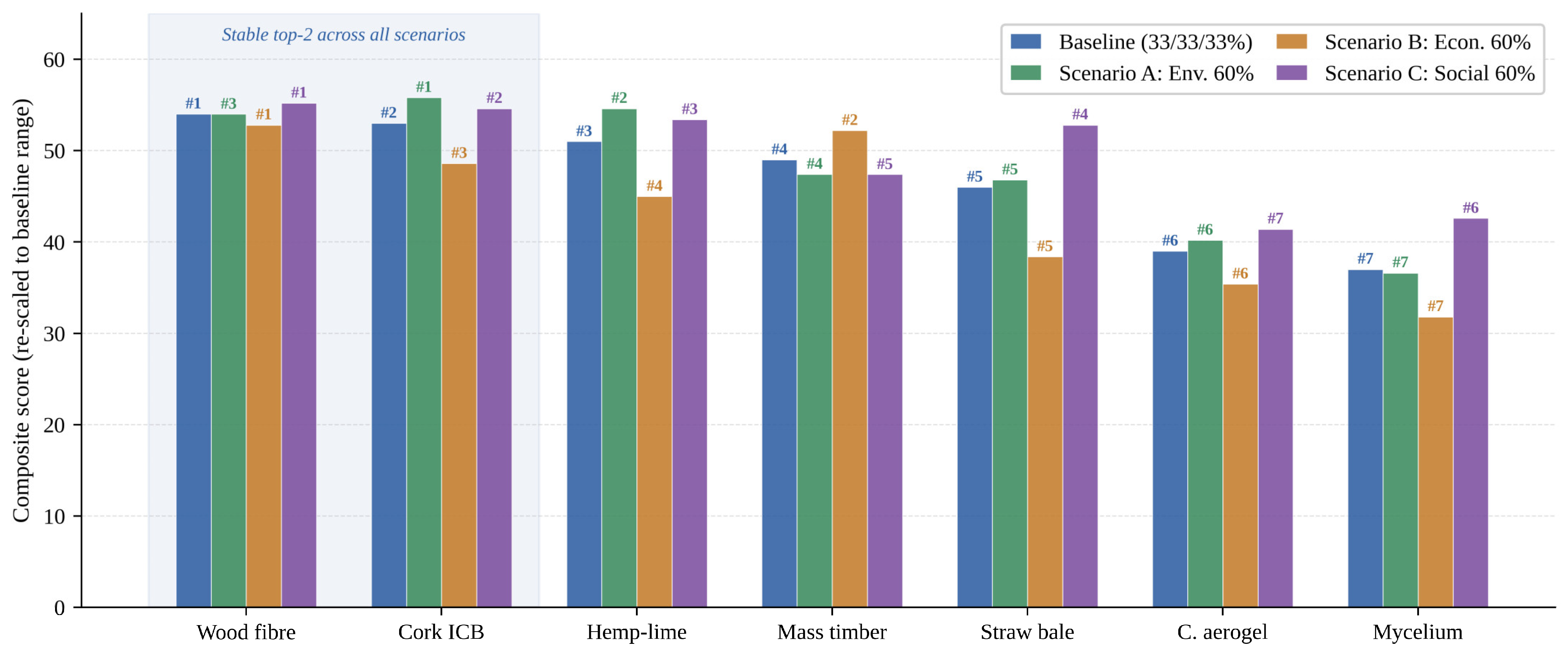
Section 2.4. The most significant finding is that cork (ICB) achieves the highest composite score of any material under environmental-priority weighting (Scenario A), rising above wood fibre/cellulose insulation. This reflects cork’s perfect environmental pillar sub-score (20/20), driven by its unique regenerative harvest mechanism—the cork oak continues to grow and sequesters carbon at an accelerated rate after bark stripping—and its self-extinguishing fire behaviour. Hemp–lime ranks second under Scenario A for the same environmental pillar advantage (20/20). Under all other weighting scenarios, wood fibre/cellulose insulation retains the top position, with cork consistently in second. Straw bale holds 5th position across all four scenarios—the most stable rank of any material in the assessment. The three-material portfolio—wood fibre, cork, and hemp–lime—comprises the top 3 in the baseline, Scenario A, and Scenario C; under Scenario B (economic priority), mass timber replaces hemp–lime in the top 3, reflecting hemp’s weaker economic sub-score.
Figure 1 plots the composite scores across all four scenarios; the shaded region highlights the invariant top-2 composition.
3.5.2. Single-Criterion Perturbation Analysis
To test sensitivity to individual score assignments, each of the twelve criterion scores was perturbed by −1, +1, −2, and +2 points in turn, while holding all other scores constant and clamping to the [1, 5] scale. This generated 48 perturbation tests per material (12 criteria × 4 directions), and 336 total perturbation tests across the assessment. For each perturbation, material ranks under the perturbed scores were compared to the baseline ranks, and any rank change was recorded. The ±2 extension was added in response to a peer review recommendation, addressing the limitation acknowledged in
Section 4.1 of the original submission.
Table 7 reports the results. No material changed its composite rank across any of the 48 perturbations per material (336 total), covering both ±1 and ±2 extensions. Under ±2 perturbation, the minimum score gap that protects the top-2 ranking is the 3-point distance between rank-1 (wood fibre, 54) and rank-3 (hemp–lime, 51): a ±2 shift on any single criterion moves a maximum of 2 composite-score points, which is insufficient to bridge this gap. The 2-point gap between ranks 3 and 4 (hemp–lime 51, mass timber 49) is similarly protected; a −2 shift on any single hempcrete criterion reduces its score by at most 2 points, producing a tie with mass timber but not a rank reversal, consistent with the TOPSIS performance-score ordering. Additionally, a pillar-level systematic bias test was conducted: all four sub-criterion scores within each pillar were simultaneously shifted by +1 and then −1 (clamped to [1, 5]), representing a coherent rater bias across an entire pillar. Across the six resulting scenarios, no rank change was observed. These extensions confirm that the rankings are insensitive not only to individual ±1 criterion perturbations but also to larger ±2 errors and to correlated pillar-level bias—together a materially stronger robustness result.
3.5.3. Monte Carlo Simulation
To simulate the joint effect of simultaneous uncertainty across all criteria, a Monte Carlo simulation was conducted with 5000 iterations using two alternative noise distributions. The primary run applied independent uniform random noise U(−1, +1) to each criterion score simultaneously, with clamping to [1, 5]. The uniform distribution was selected as the maximum-entropy, minimum-assumption choice for bounded uncertainty, treating all error magnitudes within ±1 as equally probable and thereby producing the widest possible dispersion of simulated scores (a conservative choice). A second run used a triangular distribution (mode = 0, minimum = −1, maximum = +1) per criterion, placing greater probability mass near zero, consistent with the assumption that small scoring errors are more likely than large ones. Composite scores were recalculated under each perturbed matrix, and ranks were recorded across both runs.
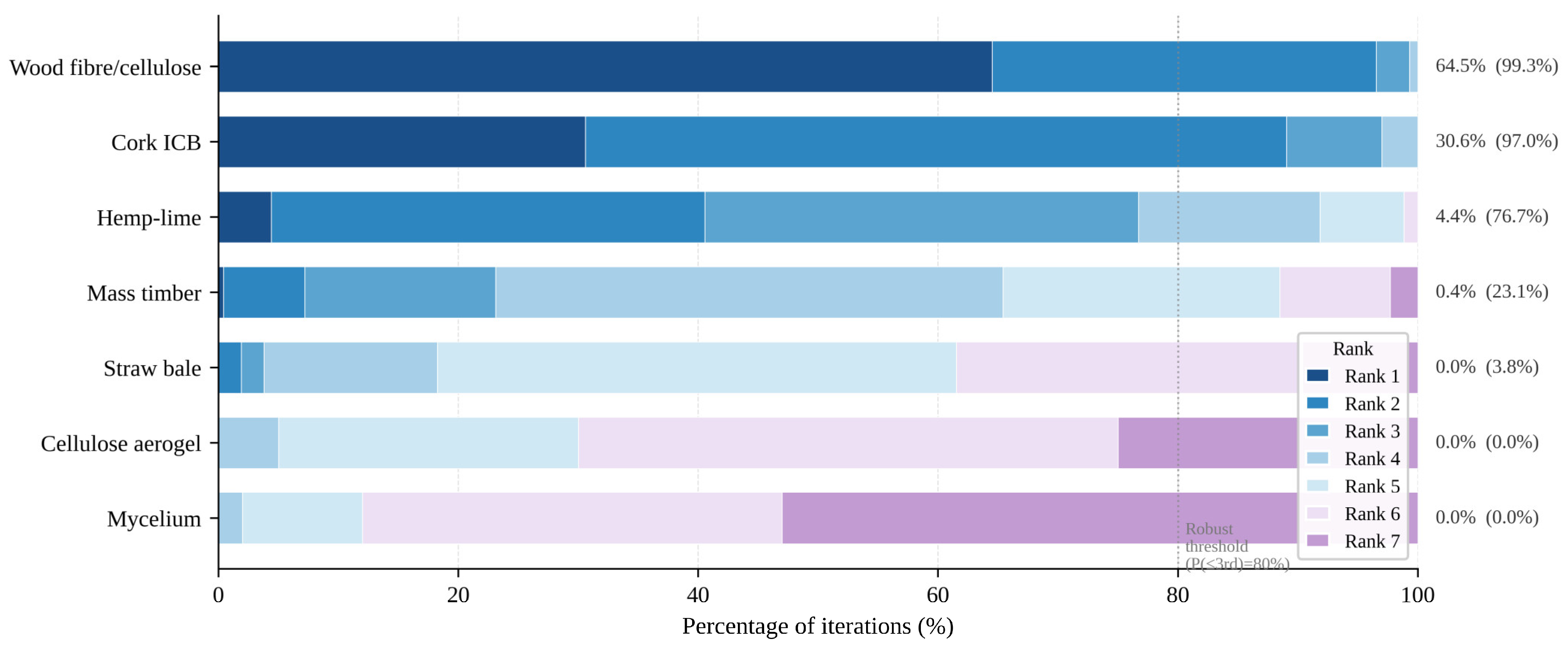
Table 8 presents the Monte Carlo results for both distributions. Under uniform noise, wood fibre/cellulose insulation ranked first in 64.5% of iterations and within the top 3 in 99.3% of iterations; cork (ICB) ranked first in 30.6% and within the top 3 in 97.0%; hemp–lime ranked first in 4.4% and within the top 3 in 76.7% of iterations. The three materials’ modal ranks (1st, 2nd, and 3rd respectively) match the baseline ranking exactly. The 1-point gap between cork (53) and wood fibre (54) produces the most notable Monte Carlo result: cork leads in nearly one third of uniform-noise iterations, confirming that these two materials are essentially tied at the top of the portfolio given the scoring uncertainty. Mass timber ranked within the top 3 in 23.1% of iterations, driven by scenarios in which cork or hemp–lime scores declined and mass timber’s strong economic sub-score prevailed. Cellulose aerogels and mycelium composites ranked within the top 3 in effectively 0% of iterations, confirming their classification as outside the leading portfolio under any plausible scoring variant. Under the triangular distribution, the narrower dispersion of noise produces tighter probability bands: wood fibre ranked first in 71.2% of iterations (uniform: 64.5%), cork first in 26.4% (uniform: 30.6%), and hemp–lime within the top three in 82.1% (uniform: 76.7%). Modal rankings are identical under both distributions. The comparison confirms that the uniform distribution was the more conservative assumption; switching to a distribution concentrating mass near zero further consolidates the leading portfolio rather than destabilising it.
Figure 2 shows the full rank-frequency distribution across all seven materials under uniform noise.
3.5.4. TOPSIS Method Comparison
To test whether the additive scoring methodology produces results consistent with a formally established MCDA method, the TOPSIS (Technique for Order of Preference by Similarity to Ideal Solution) algorithm was applied to the same scoring matrix. TOPSIS ranks alternatives by their relative proximity to an ideal solution: the ideal solution maximises all criteria simultaneously, while the anti-ideal solution minimises them. Each alternative is scored by the ratio of its distance from the anti-ideal to the sum of its distances from the ideal and anti-ideal, producing a performance coefficient in the range [0, 1] where higher values indicate greater proximity to the ideal solution.
The TOPSIS calculation applied equal criterion weights (1/12 per criterion) to the normalised decision matrix. The Spearman rank correlation coefficient (ρ) was calculated between the additive scoring ranking and the TOPSIS ranking to quantify the degree of convergence between the two methods.
Table 9 presents the results. The TOPSIS ranking is identical to the additive scoring ranking across all seven materials, yielding a Spearman correlation of ρ = 1.000. This result provides strong evidence that the additive scoring method, despite treating ordinal scores as cardinal values, produces the same rank order as a formally normalised MCDA method that does not make this assumption. The convergence is particularly significant for the assessment of the leading portfolio: wood fibre and cork occupy positions 1 and 2 under both methods without exception, with hemp–lime third.
The robustness analyses in this section collectively confirm that the composite scores and rankings generated by the additive scoring framework are insensitive to reasonable variation in pillar weights; insensitive to single-criterion score perturbations of ±1 and ±2 points; insensitive to correlated pillar-level bias; robust to simultaneous uncertainty across all criteria under both uniform and triangular Monte Carlo noise distributions; and convergent with the TOPSIS formal MCDA method. These results directly address the principal methodological limitation acknowledged in
Section 4.1—that ordinal scores are treated as cardinal values—by demonstrating that the rankings they produce cannot be altered by the sources of uncertainty that this limitation introduces under any scenario tested. The implication for the policy portfolio recommendations in
Section 5 is that wood fibre/cellulose insulation and cork (ICB) are effectively tied at the top of the ranking, with hemp–lime third, forming a stable three-material portfolio as the optimal near-term investment target under the stated assessment framework and its associated uncertainties.
4. Discussion
No single bio-based material leads across all evaluation dimensions, and singling out any one material would be a mistake. Wood fibre/cellulose insulation is the strongest performer in renovation-dominant markets across northern and central Europe. Cork (ICB) leads for façade cladding and ETICS applications across Mediterranean and Atlantic Europe, where its WUI fire performance and EU supply chain integration are decisive. Hempcrete is the right call for historic building renovation where breathability is the constraint; mass timber for new construction where structural scale is required. The sensitivity analysis reinforces this portfolio logic: internal ranks within the top 3 shift depending on the policy priority, but the composition of the top 2—wood fibre and cork—is entirely stable across all four weighting scenarios, all perturbation tests, the full Monte Carlo distribution, and the TOPSIS comparison. The third portfolio position is contested between hemp–lime, which is strongest in baseline, environmental and social scenarios, and mass timber, which is strongest in economic scenarios. The distinction has direct implications for policy design: instruments targeting embodied carbon regulation and renovation support hemp–lime; instruments targeting industrial scaling and new construction support mass timber.
The supply chain security argument for bio-based materials has been underweighted in prior assessments. The structural dependence of conventional construction insulation on petrochemical inputs—EPS, XPS, polyurethane, and PIR foams are all naphtha-derived—creates a vulnerability conceptually distinct from environmental arguments. Scenario analyses of a sustained Strait of Hormuz closure suggest potential price increases in naphtha-dependent products in the range of 35–80% within 90 days of disruption [
46], while domestically produced cellulose, hemp, timber and cork insulation are structurally immune to this exposure. This supply security argument has received insufficient attention in the existing bio-based construction literature, and the geopolitical events of 2026 have made this vulnerability increasingly difficult to ignore in policy contexts.
WUI fire performance is the second underweighted issue. EN 13501-1 [
21] fire classification does not address WUI external fire exposure—sustained radiant heat flux, ember deposition, and prolonged external flame contact [
21]. Hempcrete and cellulose aerogels, both effectively non-combustible in their installed form, may outperform EPS and XPS under WUI conditions, yet this advantage is invisible in current regulatory assessments. Cork, with an oxygen index of 26%, exceeding the atmospheric oxygen content of 21%, adds a third material with a meaningful WUI fire profile. The revision of the Construction Products Regulation presents a critical policy window to address this gap by introducing WUI external fire exposure as a named use-case category with associated test protocols.
The third issue—the one that most directly shapes policy design—is the hierarchical structure of market barriers. These do not operate as a flat catalogue of independent factors but as a cascade: the primary structural blocker—the absence of mandatory whole-life embodied carbon regulation in building permits—creates the conditions that sustain downstream barriers. Under current EU regulation, only operational energy performance is regulated; the embodied carbon of construction materials carries no regulatory cost, despite being responsible for a growing share of lifetime building emissions as operational energy efficiency improves [
47]. Contractor skill deficits, insurance unfamiliarity, and supply chain fragmentation are largely consequences of this low market volume rather than its causes. Research on barriers to bio-based construction specifically identifies the near-total absence of operational infrastructure for recovering and reusing bio-based construction elements across EU markets [
48]. Policy programmes concentrating resources on training or R&D in the absence of prior or concurrent action on this primary regulatory failure are unlikely to generate commensurate returns.
The LCA methodology framework has two gaps specific to bio-based materials. EN 15978 [
27] and EN 15804 [
49] share three deficiencies: biogenic carbon timing is inconsistently captured; composting is excluded as an end-of-life pathway; and land-use change effects go unaccounted for [
50]. These gaps prevent credible cross-study comparison and systematically weaken bio-based materials in green procurement decisions. A commission mandate to CEN for bio-specific LCA methodology development, validated as a prerequisite for EU Taxonomy bio-based construction criteria, is a necessary precondition for regulatory parity.
4.1. Study Limitations
Four limitations bear stating. The criterion scores are derived from the authors’ structured interpretation of published data, not from an independent expert panel with formally tested inter-rater reliability. The robustness analyses reported in
Section 3.5 test sensitivity to pillar-weight variation, individual criterion perturbation (±1 and ±2 points), simultaneous multi-criterion perturbation via Monte Carlo simulation (under both uniform and triangular noise distributions), pillar-level systematic bias, and MCDA method choice via TOPSIS. No rank changes were observed across any of these tests. A Delphi exercise with a geographically diverse panel of European experts would substantially strengthen the scoring foundation and is recommended as future work.
The assessment evaluates individual bio-based material categories rather than complete building assemblies. Scores for fire performance, seismic compatibility, renovation suitability and durability are intended to reflect performance in a representative well-specified construction assembly (i.e., typical best-practice detailing as documented in the cited literature), not the raw material in isolation; these properties are acknowledged to depend on detailing, protective layers, workmanship, structural system, and code compliance, which vary by project. Authors note this as a limitation where scores may overstate performance achievable in lower-quality installations. A full building assembly LCA, incorporating interactions between bio-based materials and supporting structures, would provide more precise environmental accounting. The economic scoring draws on market price data rather than full lifecycle cost assessments; LCC comparisons would likely show more favourable results for bio-based materials, given lower operational energy costs and zero landfill obligation at end of life. Market projections carry inherent uncertainty over a 5-year horizon and CAGR figures should be treated as indicative. Several economic pillar data sources—particularly European Panel Federation and European Timber Trade Federation publications—are produced by industry associations with a commercial interest in favourable assessments; these have been cross-referenced with independent academic sources where available. A data quality sensitivity analysis was conducted as a conservative bias correction: for each economic sub-criterion score drawn primarily from an industry association source (EU supply chain maturity, 5-year scaling potential, and job creation/rural economy), the score was reduced by 1 point. No rank changes were observed relative to the baseline ranking, consistent with the ±1 perturbation results reported in
Section 3.5.2; the leading portfolio of wood fibre, cork, and hemp–lime is insensitive to plausible upward commercial bias in economic scoring. Additionally, EU supply chains for the assessed materials are not fully contained within EU borders: CLT production may involve Nordic-sourced timber processed in Austria or Germany; cork granulation involves some non-EU chemical inputs; and hemp processing capacity remains geographically concentrated. The EU supply chain maturity scores reflect the degree of EU integration documented in the cited literature; cross-border upstream stages represent a refinement for future work with supply chain traceability data.
Acoustic performance was not included as a scoring criterion, which represents a limitation in the EU renovation context where several member states impose mandatory acoustic standards for residential buildings alongside thermal requirements. Ye et al. [
16], synthesising 453 acoustic measurements, report NRC values of 0.15–0.67 for hemp, 0.07–0.83 for straw bale, and 0.21–0.30 for expanded cork agglomerates. Had acoustic performance been included as a sub-criterion under the Social pillar, cork’s score would have been modestly penalised relative to hemp and straw—likely by 1 point—while wood fibre boards (NRC 0.06–0.49) would have scored comparably to cork; excluding acoustic performance may affect the relative position of cork, hemp, and straw within the Social pillar. A 1-point reduction in cork’s Social sub-score would bring its composite score from 53 to 52, which remains above hemp–lime (51) and mass timber (49); the single-criterion perturbation analysis (
Section 3.5.2) demonstrates that no rank change occurs under any ±1 point shift on any criterion. Cork’s top-2 position is therefore robust to the inclusion of this criterion, though authors caution that the effect on the relative positions of cork, hemp, and straw within the Social pillar cannot be confidently characterised as negligible at finer resolution. Policy implications are scoped to EU member states only; the UK is treated as a reference market for historic building stock characteristics.
The MCDA framework also leaves out upstream feedstock sustainability. Bio-based materials are not environmentally equivalent by virtue of being bio-based: their sustainability depends strongly on sourcing pathway, regeneration rate, land-use implications, and scale of demand. The materials assessed span meaningfully different feedstock profiles: mass timber and wood fibre insulation depend on forest biomass and the intensity of its extraction; cellulose insulation is predominantly derived from recycled paper waste streams; cork is harvested from bark without felling the tree, with documented ecological co-benefits in the montado agro-forestry system; hemp and straw are agricultural crops and cereal cultivation co-products, respectively, with different land-use demands; and mycelium composites are typically produced from agricultural residues. The MCDA environmental pillar awards high scores for carbon sequestration and embodied carbon performance, but does not include criteria for sustainable feedstock availability, land-use change risk, biodiversity impact, or forest management certification. As a result, the environmental pillar may overstate net benefits for materials whose scaling would require intensified forestry or dedicated land conversion, without equally accounting for the ecological opportunity cost of biomass extraction. Authors recommend that future assessments include an explicit feedstock sustainability criterion—distinguishing between waste/residue-based, crop-based, and primary biomass-based feedstock pathways—and that policy recommendations for scaling bio-based construction materials be conditioned on certified sustainable sourcing, particularly for forest-derived products.
5. Policy Implications
Track A—Mediterranean and WUI-exposed zones (southern Europe: Portugal, Spain, Italy, Greece and expanding WUI perimeters). The priority portfolio for this track is cork (ICB), hempcrete, and cellulose aerogels, selected by three overlapping constraints peculiar to this region. All three handle WUI fire: cork’s oxygen index of 26% makes it self-extinguishing under normal atmospheric conditions; hempcrete’s lime binder is non-combustible; cellulose aerogels are non-flammable. All three are seismically compatible—non-structural or low-mass, consistent with the Eurocode 8 preference for reduced structural mass and connection ductility. And hempcrete’s vapour-open breathability is the right match for the large stock of historic masonry in Mediterranean urban centres requiring breathable retrofit. The priority regulatory action for this track is the introduction of WUI external fire exposure as a named use-case category in the revised Construction Products Regulation—a change that would make visible the fire performance advantages of hempcrete, cellulose aerogels, and cork that current EN 13501-1 [
21] testing cannot capture. Simultaneously, CEN technical standards for hemp–lime spray systems should be fast-tracked to resolve the primary regulatory barrier to hempcrete specification in southern EU markets. Note: no harmonised EN ageing attenuation standard exists for bio-based materials; as noted in
Section 3.1, the development of such a standard is a prerequisite for insurance and professional liability frameworks in this region.
Track B—New-construction-dominant markets (northern Europe: Ireland, Netherlands, Poland, Scandinavia, northern Germany). The priority portfolio for this track is mass timber (CLT/Glulam) and wood fibre/cellulose insulation. Mass timber is the only bio-based material capable of being substituted for concrete and steel in primary structural applications above eight storeys; its validated seismic and fire performance (Ceccotti et al., 2013) [
29] and the concentration of European CLT production capacity in the Nordic-Alpine arc make it the natural structural backbone for new-build programmes in these markets. Wood fibre insulation complements mass timber as the insulation product with the deepest EU supply chain and the broadest renovation and new-build applicability. The priority regulatory action for this track is mandatory whole-life embodied carbon declarations in building permits, modelled on France’s RE2020 regulation [
47]; without this primary regulatory instrument, cost–benefit calculations favour conventional materials regardless of downstream incentives. Agricultural policy must be aligned with construction demand: explicit industrial hemp and flax cultivation support under national CAP Strategic Plans, targeting significant expansion of EU bio-based crop cultivation area by 2028, would anchor the upstream feedstock supply for insulation products in these markets. Public finance instruments should accompany this: bio-based construction should be included in EIB Green Bond eligible categories, and InvestEU guarantee instruments should be applied to de-risk investment in bio-based processing infrastructure.
Track C—Deep renovation-dominant markets (central and western Europe: France, Germany, Austria, Belgium, Netherlands renovation stock). The priority portfolio for this track is wood fibre/cellulose insulation and hempcrete. Wood fibre’s hygroscopic buffering behaviour reduces condensation risk in renovation applications [
31] and its renovation suitability score (5/5) reflects the widest compatibility across building typologies in the existing stock. Hempcrete’s breathability makes it the preferred retrofit solution for historic and masonry buildings requiring vapour-open assemblies [
9]. The priority regulatory action for this track is whole-life embodied carbon regulation (as for Track B) accompanied by fast-tracking of CEN prefabricated straw bale panel standards and mandatory bio-based material minimum shares in public building procurement—20% of insulation by value as an initial benchmark, consistent with projected EU production capacity [
12]—phased progressively from 2026, to create the volume anchor necessary to attract private supply chain investment. Bio-based construction training should be financed through the EU Social Fund and Just Transition Fund, targeting the contractor workforce in renovation-dominant markets where the skills deficit is greatest. EU Taxonomy criteria should explicitly recognise hemp, straw, and mycelium-based materials to unlock green finance at project level. Cross-cutting EU-level instruments applicable across all three tracks include the following: Horizon Europe investment directed to mycelium composite moisture resistance, cellulose aerogel ambient-pressure production scale-up, and prefabricated bio-based panel systems targeting cost parity with conventional alternatives; a commission mandate to CEN for bio-specific LCA methodology development addressing the biogenic carbon, composting, and land-use change gaps in EN 15804 [
49] and EN 15978 [
27]; and the development of harmonised EN ageing attenuation standards for bio-based construction materials, which is identified in
Section 3.1 as a prerequisite for insurance and professional liability frameworks across all three tracks.
These interventions deliver maximum effectiveness when coordinated within a named EU Bio-Based Construction Materials Action Plan under the European Green Deal umbrella. The three-track regional structure reflects that the primary market barriers and leading material portfolios differ materially across southern, northern, and central/western Europe: instruments optimised for Mediterranean WUI fire contexts are not the same as those for Nordic new-build or central European deep renovation, and generic EU-level recommendations applied uniformly will underperform against differentiated ones. The sequencing principle is essential across all tracks: market-pull instruments applied before the primary regulatory failure—the absence of mandatory whole-life embodied carbon regulation—is corrected will not generate commensurate returns, and R&D investment directed at materials with unresolved durability cannot act as a substitute for the market development that Green-tier materials with documented in-use performance actually require.
6. Conclusions
This paper assessed bio-based construction materials producible within the EU across durability maturity, regional demand heterogeneity, WUI fire performance, supply security, and an extended robustness analysis.
Which bio-based materials deliver the highest combined benefits to EU citizens over 2025–2030? The assessment points to a three-material portfolio rather than a single answer. Wood fibre and cellulose insulation (54/60) and expanded cork agglomerates (53/60) consistently rank first and second across all scenarios tested. Hemp–lime composites (51/60) hold the third position under baseline, environmental and social priority weighting; mass timber (49/60) displaces hemp–lime in third place when economic scaling is prioritised. No single material leads across all dimensions, and the evidence does not support treating any one of the three as dispensable. Cork’s emergence into the shared top-2 position is the most notable finding relative to prior comparative assessments: it reflects twenty years of documented outdoor durability, a perfect environmental pillar sub-score driven by the regenerative carbon sequestration of the cork oak, self-extinguishing fire behaviour in the precise conditions—sustained external radiant heat—that are expanding across Southern Europe, and a supply chain centred in the Iberian montado that is more deeply EU-integrated than that of any other material in the assessment.
The robustness results point consistently in one direction. No material changed its rank under any single-criterion perturbation of ±1 or ±2 points across all 336 perturbation tests, nor under the six pillar-level systematic bias tests. Under Monte Carlo simulation with uniform noise, wood fibre ranked first in 64.5% of iterations and cork in 30.6%, confirming that the two are essentially tied at the top across realistic scoring uncertainty; under the triangular distribution, wood fibre ranked first in 71.2% and cork in 26.4%, with identical modal rankings. Hemp–lime ranked within the top three in 76.7% of uniform-noise iterations and 82.1% of triangular iterations. The TOPSIS method, which does not share the additive scoring method’s treatment of ordinal scores as cardinal values, produced an identical ranking order (Spearman ρ = 1.000). The one weighting scenario that alters the internal composition of the top three—environmental priority, which places cork first, hemp–lime second and wood fibre third—reinforces rather than undermines the case for the portfolio: all three materials appear at the top regardless of how environmental credentials are weighted relative to economic and social dimensions.
The core policy message is straightforward. Mandatory whole-life embodied carbon regulation is the single structural precondition. Without it, all other instruments—standards harmonisation, procurement quotas, skills investment, agricultural policy alignment, R&D funding—operate in a market that lacks the fundamental incentive to favour low-carbon materials. France’s RE2020 regulation demonstrates that this precondition can be met within a national legislative cycle; its extension across major EU member states would immediately restructure procurement decisions across the continent.
WUI zone expansion across Southern Europe elevates fire performance from a niche regulatory concern to a first-order evaluation criterion—yet the current EU fire classification framework, developed for indoor compartment fire scenarios, does not address the sustained radiant heat loads and ember deposition characteristic of WUI events. The revision of the Construction Products Regulation may offer a suitable policy vehicle for closing this gap. Separately, the structural dependence of conventional insulation products on naphtha-derived petrochemical inputs creates a supply security argument for domestic bio-based alternatives that is conceptually separate from environmental arguments and has received insufficient weight in both academic and policy discourse. Finally, durability maturity must function as a first-order filter in policy instrument design: regulatory and market-pull instruments deliver high returns only for materials with documented in-use performance; for materials where durability remains unresolved, the appropriate policy lever is sustained R&D investment, not premature market mandates.
The five-year window from 2025 to 2030 is a real and immediate scaling opportunity. Bio-based materials currently represent less than 2% of the EU construction materials market. Moving that share to a level commensurate with the environmental ambitions of the European Green Deal requires coordinated action across regulatory, financial, agricultural and skills policy—action that is most effectively delivered within a named EU Bio-Based Construction Materials Action Plan. The materials, supply chains, and performance evidence are in place. What is missing is the policy framework to deploy them.