Effects of Tree Height and Spatial Layout on Thermal Comfort in a Residential Area Based on ENVI-Met: A Case Study of a Typical Hot Summer Day in Qingdao


 and
and
Abstract
1. Introduction
2. Materials and Methods
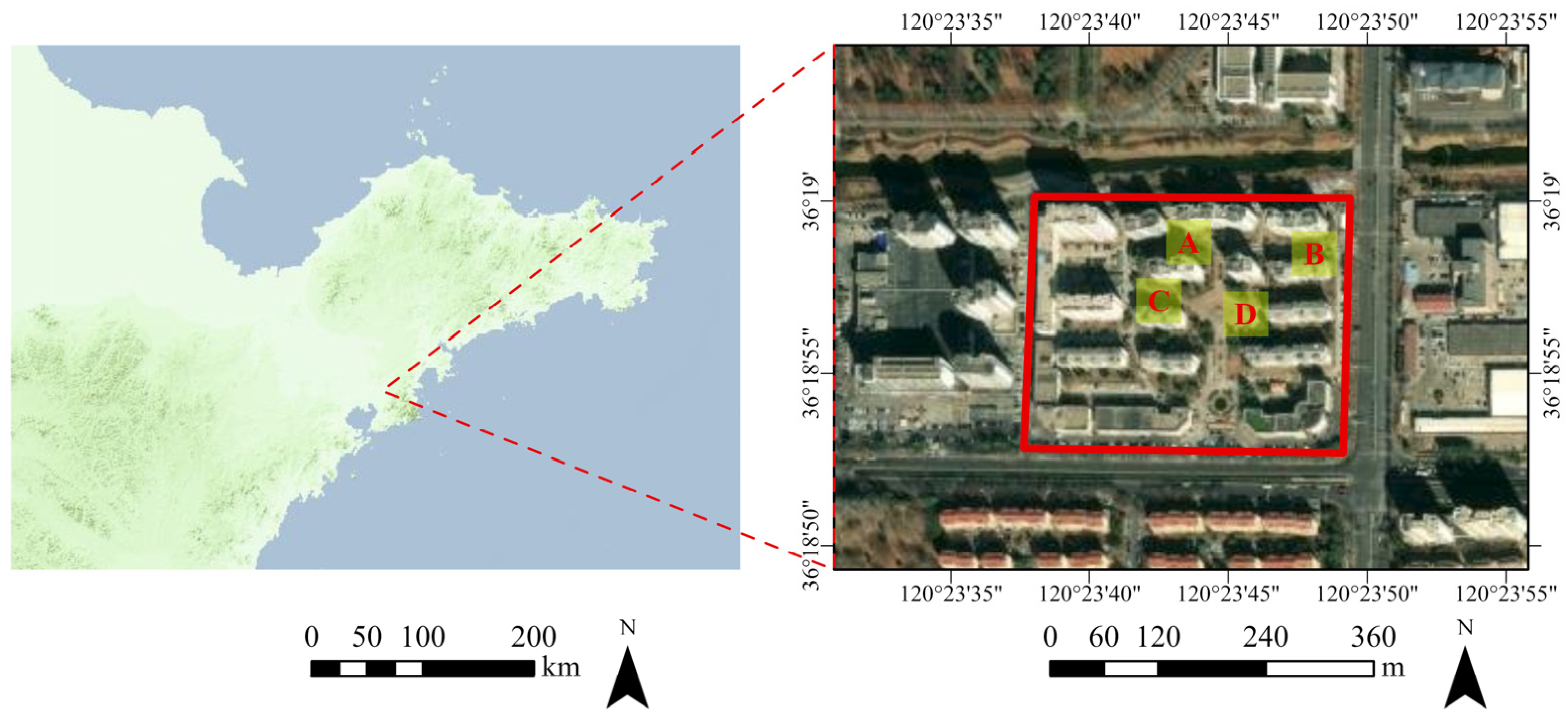
2.1. Study Area
2.2. Field Measurement Scheme
2.3. ENVI-Met Microclimate Simulation
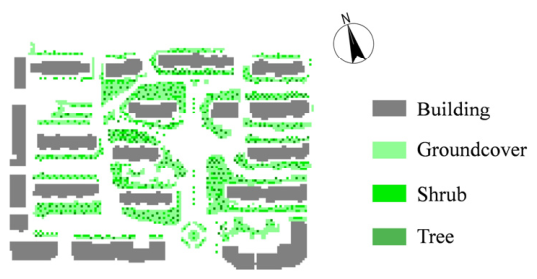
2.3.1. Study Area Model Construction and Parameter Setting
2.3.2. Model Evaluation
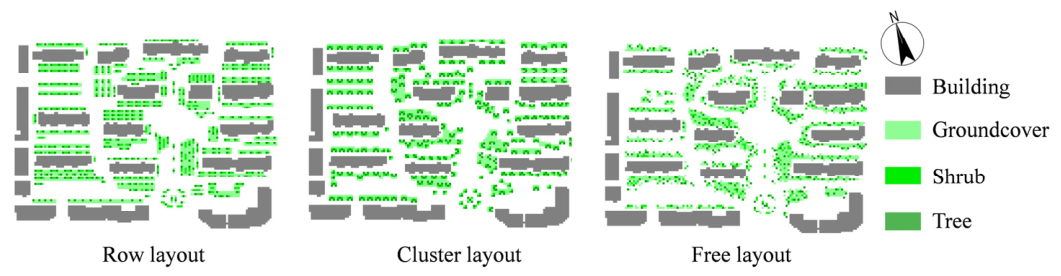
2.4. Simulation Scenarios
2.5. Statistical Analysis
3. Results
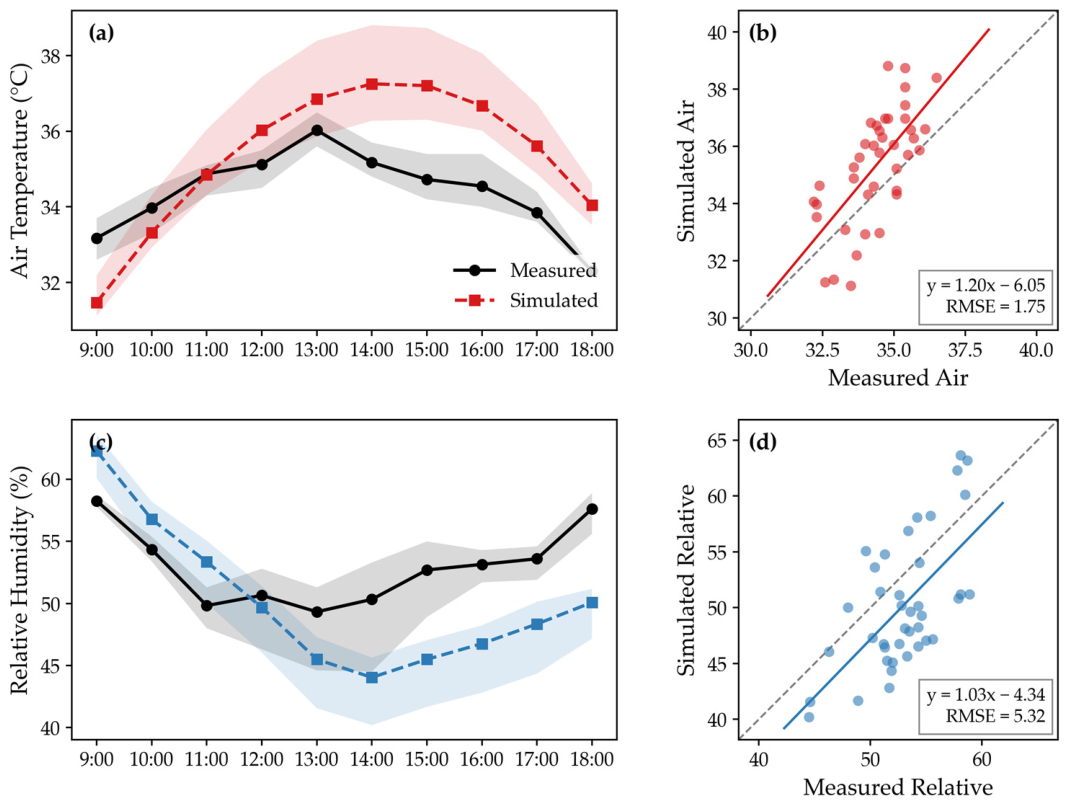
3.1. Model Accuracy Verification
3.2. Thermal Comfort Responses to Different Tree Configuration Schemes
3.2.1. Results of Significance Testing
3.2.2. Responses of ΔTa, ΔTmrt, and ΔPET Under Various Schemes During Typical Peak Heat Hours
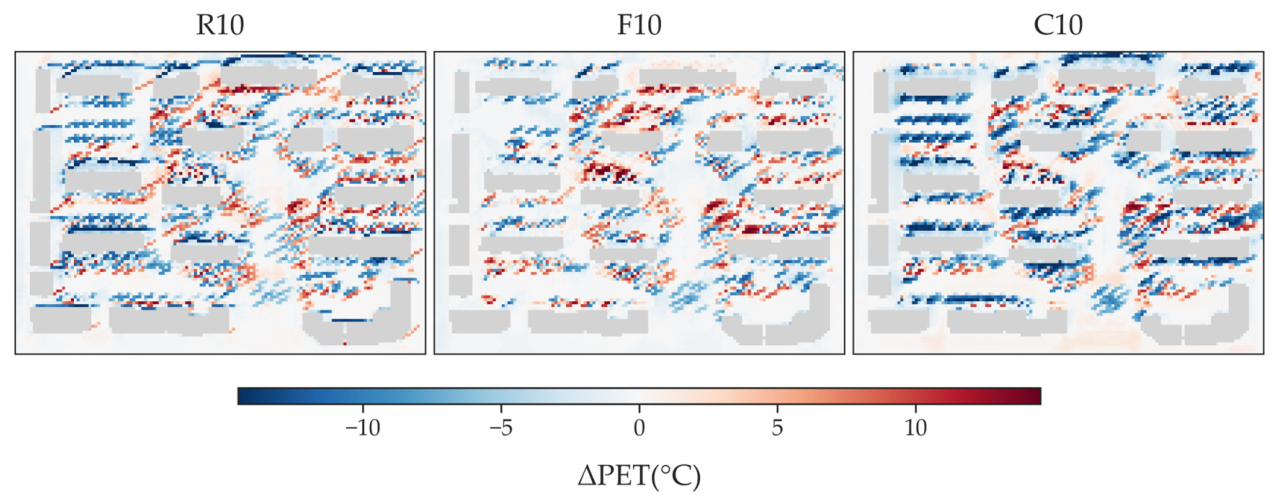
3.3. Analysis of Spatial Heterogeneity in PET Improvement
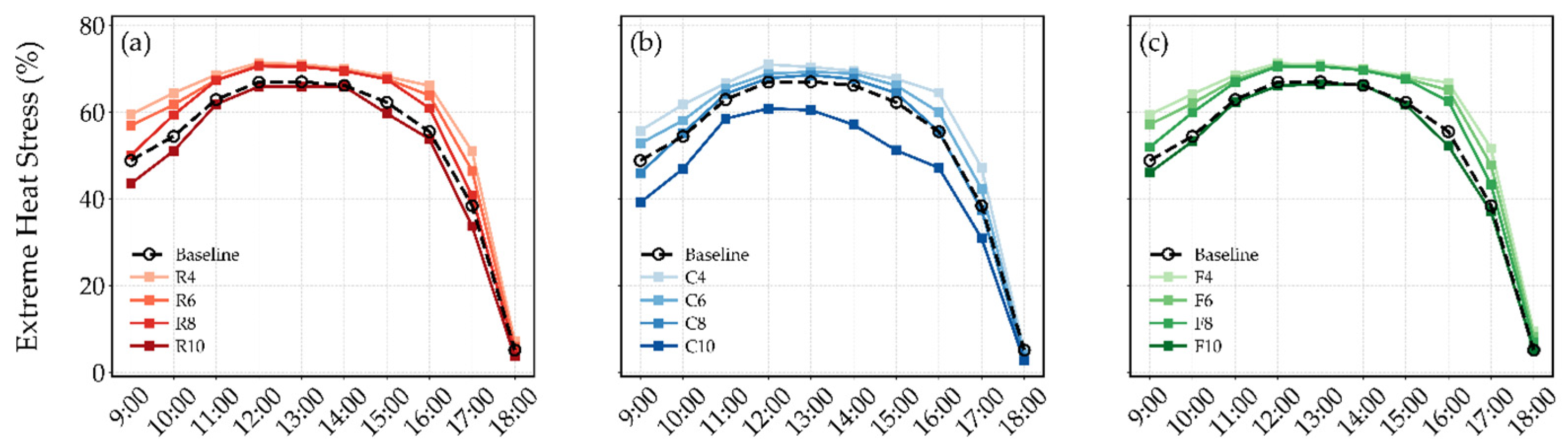
3.4. Daytime Variations in Extreme Heat Stress
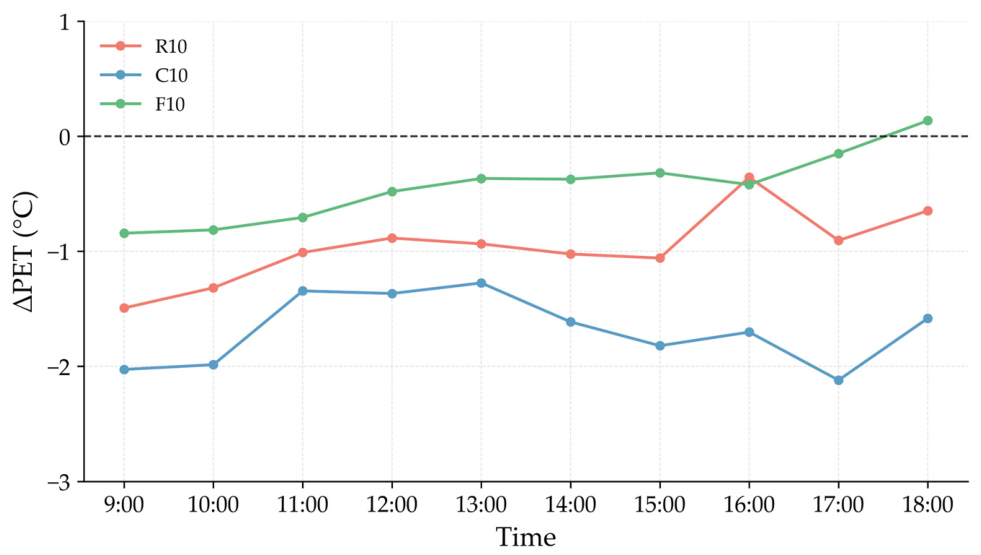
3.5. Daytime Variations in PET Improvement
4. Discussion
4.1. Regulatory Mechanisms of Tree Spatial Layouts on Radiation and Thermal Comfort
4.2. PET Responses to Low-to-Medium-Height Clustered Trees
4.3. Synergistic Strategies of Tree Height and Spatial Layout for Optimizing Thermal Comfort in Residential Areas
4.4. Research Limitations
5. Conclusions
- Tree height is a key factor influencing the improvement of summer thermal comfort. Compared with 4 m, 6 m, and 8 m trees, 10 m tall trees can significantly reduce Tmrt and PET during peak radiation periods, especially under extreme heat stress conditions. This indicates that the vertical development of the canopy plays a decisive role in mitigating extreme pedestrian-level heat load.
- Spatial layout modulates the cooling effect of tree height. The cluster layout shows the most stable and efficient capacity to reduce PET, followed by the row layout, whereas the free layout exhibits relatively unstable improvement due to fragmented shading and insufficient continuity. This suggests that shading continuity and spatial integrity are essential prerequisites for effective radiation control.
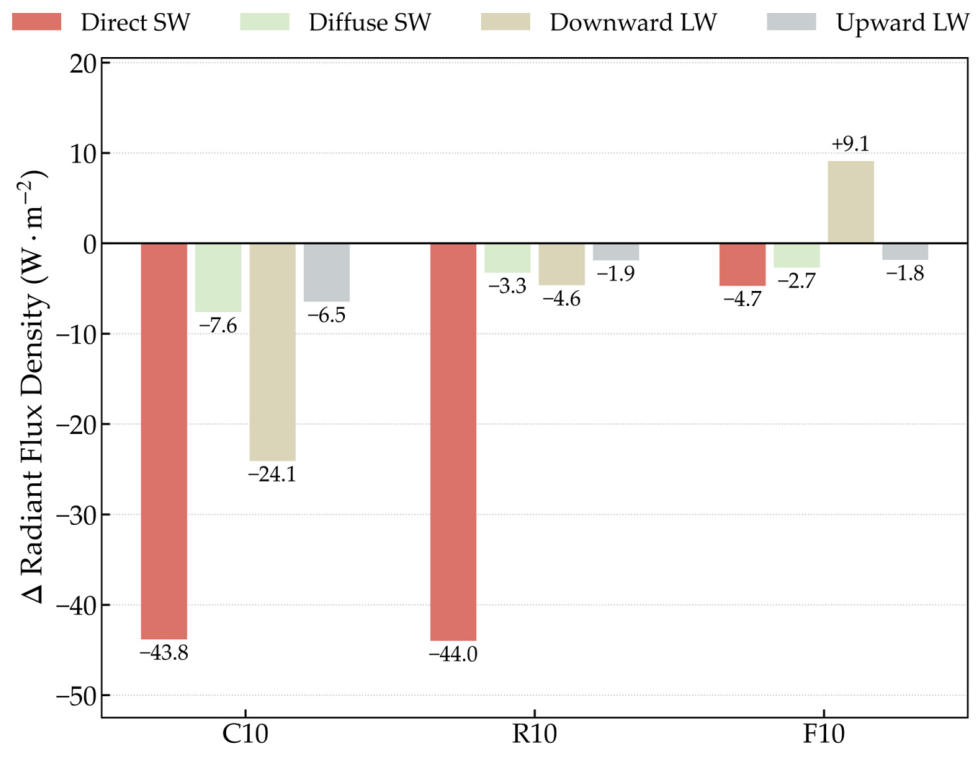
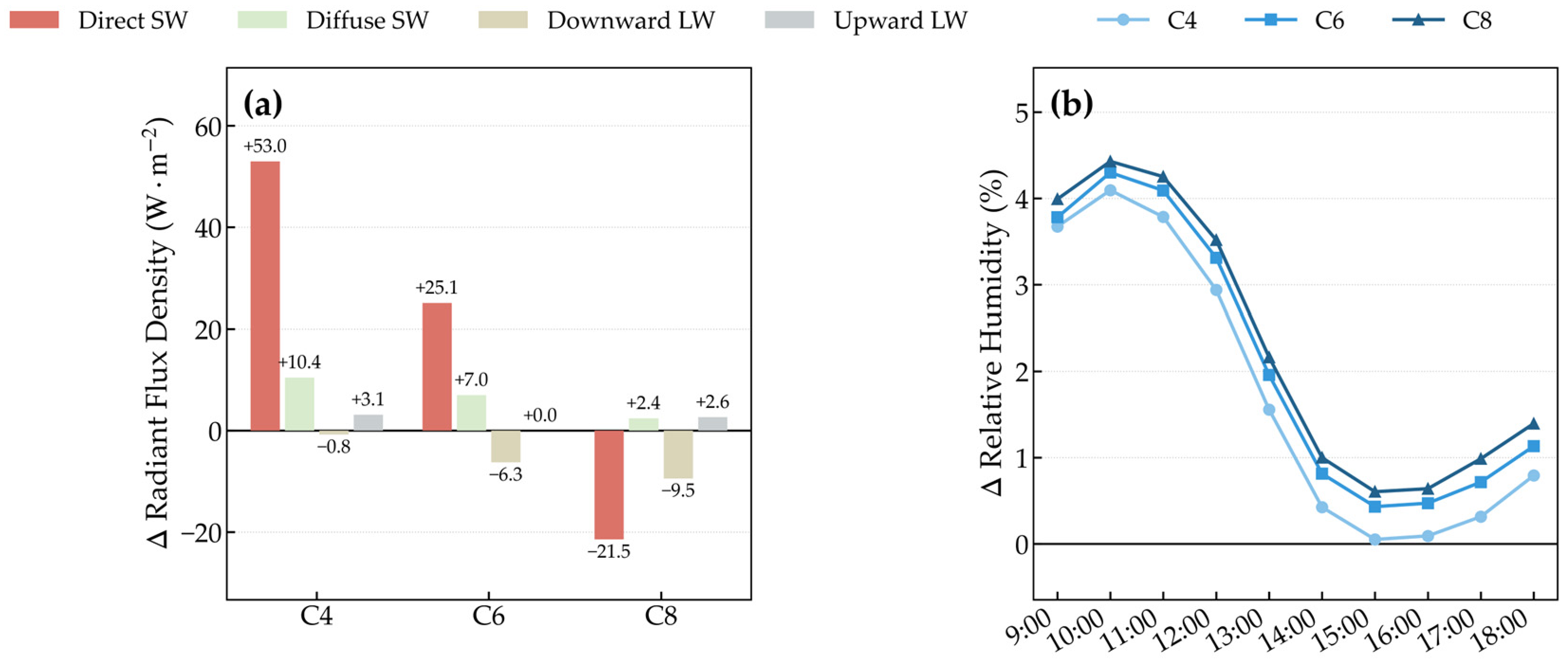
- Although low- and medium-height trees (≤6 m) in the cluster layout can reduce local air temperature through transpiration, their insufficient capacity to intercept shortwave radiation and the enhanced accumulation of longwave radiation may instead lead to higher PETs than the baseline. Therefore, greening optimization in residential areas should comprehensively consider the matching relationship among tree height, canopy structure, and the layout of activity spaces.
Supplementary Materials
Author Contributions
Funding
Institutional Review Board Statement
Informed Consent Statement
Data Availability Statement
Conflicts of Interest
Abbreviations
| UHI | Urban heat island |
| PET | Physiological equivalent temperature |
| Tmrt | Mean radiant temperature |
| LAD | Leaf area density |
| LAI | Leaf area index |
| Ta | Air temperature |
| RH | Relative humidity |
| WS | Wind speed |
| RMSE | Root mean square error |
| ANOVA | Analysis of variance |
| HSD | Honestly Significant Difference |
References
- Manoli, G.; Fatichi, S.; Schläpfer, M.; Yu, K.; Crowther, T.W.; Meili, N.; Bou-Zeid, E. Magnitude of urban heat islands largely explained by climate and population. Nature 2019, 573, 55–60. [Google Scholar] [CrossRef] [PubMed]
- Patle, S.; Ghuge, V.V. Multi-scale assessment of seasonal microclimate and outdoor thermal comfort: A semi-arid city case analysis. Urban Clim. 2025, 64, 102691. [Google Scholar] [CrossRef]
- Wu, Y.; Mashhoodi, B.; Patuano, A. Effective street tree and grass designs to cool European neighbourhoods. Urban Clim. 2025, 61, 102376. [Google Scholar] [CrossRef]
- Zhao, X.; Kong, K.; Wang, R.; Liu, J.; Zhang, Y. Assessing the cooling effects of urban parks and their potential influencing factors: Perspectives on maximum impact and accumulation effects. Sustainability 2025, 17, 7015. [Google Scholar] [CrossRef]
- Feng, L.; Shuai, L.; Zhou, Y.; Zhang, X.; Sun, J. Improving the green space arrangement in residential areas from the perspective of tree leaf temperature utilizing scenario simulation in ENVI-met. Sci. Total Environ. 2024, 918, 170650. [Google Scholar] [CrossRef]
- Wong, N.H.; Tan, C.L.; Kolokotsa, D.D.; Takebayashi, H. Greenery as a mitigation and adaptation strategy to urban heat. Nat. Rev. Earth Environ. 2021, 2, 166–181. [Google Scholar] [CrossRef]
- Hwang, R.L.; Lin, T.P.; Matzarakis, A. Seasonal effects of urban street shading on long-term outdoor thermal comfort. Build. Environ. 2011, 46, 863–870. [Google Scholar] [CrossRef]
- Morakinyo, T.E.; Kong, L.; Lau, K.K.L.; Yuan, C.; Ng, E. A study on the impact of shadow-cast and tree species on in-canyon and neighborhood’s thermal comfort. Build. Environ. 2017, 115, 1–17. [Google Scholar] [CrossRef]
- Li, T.; Gao, Q.; Sun, M.; Li, J.; Zhang, G. Effect of evergreen tree planting patterns on the winter microclimate and thermal comfort in residential areas: A study in Tai’an. Urban Clim. 2025, 61, 102458. [Google Scholar] [CrossRef]
- Kong, L.; Lau, K.K.L.; Yuan, C.; Chen, Y.; Xu, Y.; Ren, C.; Ng, E. Regulation of outdoor thermal comfort by trees in Hong Kong. Sustain. Cities Soc. 2017, 31, 12–25. [Google Scholar] [CrossRef]
- Cai, Y.; Li, C.; Pan, C.; Wang, G.; Xu, J.; Cui, W.; Zhou, Y.; Zhou, G. Quantifying the impact of single-tree morphological characteristics on the vertical gradient cooling effect and human thermal comfort during summer. Urban For. Urban Green. 2025, 107, 128789. [Google Scholar] [CrossRef]
- Abdi, B.; Hami, A.; Zarehaghi, D. Impact of small-scale tree planting patterns on outdoor cooling and thermal comfort. Sustain. Cities Soc. 2020, 56, 102085. [Google Scholar] [CrossRef]
- Tsoka, S.; Tsikaloudaki, A.; Theodosiou, T. Analyzing the ENVI-met microclimate model’s performance and assessing cool materials and urban vegetation applications–A review. Sustain. Cities Soc. 2018, 43, 55–76. [Google Scholar] [CrossRef]
- Xi, T.; Li, Q.; Mochida, A.; Meng, Q. Study on the outdoor thermal environment and thermal comfort around campus clusters in subtropical urban areas. Build. Environ. 2012, 52, 162–170. [Google Scholar] [CrossRef]
- Cortes, A.; Rejuso, A.J.; Santos, J.A.; Galupino, J.P. Evaluating mitigation strategies for urban heat island in Mandaue City using ENVI-met. J. Urban Manag. 2022, 11, 97–106. [Google Scholar] [CrossRef]
- Banerjee, S.; Pek, R.X.Y.; Yik, S.K.; Ignatius, M.; Wong, N.H. Assessing impact of urban densification on outdoor microclimate and thermal comfort using ENVI-met simulations for Combined Spatial-Climatic Design (CSCD) approach. Sustain. Cities Soc. 2024, 105, 105302. [Google Scholar] [CrossRef]
- Cong, Y.; Zhu, R.; Yang, L.; Zhang, X.; Liu, Y.; Meng, X.; Gao, W. Correlation Analysis of Thermal Comfort and Landscape Characteristics: A Case Study of the Coastal Greenway in Qingdao, China. Buildings 2022, 12, 541. [Google Scholar] [CrossRef]
- Chen, H.; Liu, R.; Wang, Y.; Peng, Z. Assessing seasonal thermal environment of two tree species: Integrating modeling and in-situ data in hot-summer and cold-winter climates. Build. Environ. 2025, 269, 112394. [Google Scholar] [CrossRef]
- Liu, S.; Ma, S.; Tian, Y.; Li, L.; Hao, Q.; Liu, Q.; Liu, Z.; Zhang, Y.; Li, Y. Study on the influence of residential building form and layout on thermal environment: Taking Yilufa Sunshine Scenic Garden community in Qingdao as an example. J. Qingdao Agric. Univ. (Nat. Sci. Ed.) 2025, 42, 268–274. [Google Scholar]
- Su, Y.; Sun, J.; Li, S.; Li, J.; Wu, Z.; Li, J.; Li, X.; Wang, D.; Wang, W. UTCI assessment of outdoor thermal comfort in Arid-Hot university campuses during summer. Energy Build. 2025, 351, 116683. [Google Scholar] [CrossRef]
- Gomaa, M.M.; Othman, E.; Mohamed, A.F.; Ragab, A. Quantifying the impacts of courtyard vegetation on thermal and energy performance of university buildings in hot arid regions. Urban Sci. 2024, 8, 136. [Google Scholar] [CrossRef]
- Karimimoshaver, M.; Shahrak, M.S. The effect of height and orientation of buildings on thermal comfort. Sustain. Cities Soc. 2022, 79, 103720. [Google Scholar] [CrossRef]
- Wang, T.; Chen, X.R.; Zhang, J.A.; Ye, C.D. ENVI-met simulation study on the influence of different greening renovation schemes on microclimate environment of residential district. J. South China Agric. Univ. 2019, 40, 61–68. [Google Scholar]
- Yang, X.; Zhao, L.; Bruse, M.; Meng, Q. Evaluation of a microclimate model for predicting the thermal behavior of different ground surfaces. Build. Environ. 2013, 60, 93–104. [Google Scholar] [CrossRef]
- Salata, F.; Golasi, I.; de Lieto Vollaro, A.; de Lieto Vollaro, R. Urban microclimate and outdoor thermal comfort. A proper procedure to fit ENVI-met simulation outputs to experimental data. Sustain. Cities Soc. 2016, 26, 318–343. [Google Scholar] [CrossRef]
- Höppe, P. The physiological equivalent temperature—A universal index for the biometeorological assessment of the thermal environment. Int. J. Biometeorol. 1999, 43, 71–75. [Google Scholar] [CrossRef]
- Zhang, Y.; Li, X.; Liu, S.; Liu, Z.; Li, Y. The Cooling Effects of Greening Strategies Within High-Density Urban Built-Up Areas in Coastal Slope Terrain. Sustainability 2025, 17, 11054. [Google Scholar] [CrossRef]
- Morakinyo, T.E.; Lam, Y.F. Simulation study on the impact of tree-configuration, planting pattern and wind condition on courtyard-scale indoor/outdoor thermal comfort. Build. Environ. 2016, 103, 262–275. [Google Scholar] [CrossRef]
- Zhang, L.; Zhan, Q.; Lan, Y. Effects of the tree distribution and species on outdoor environment conditions in a hot summer and cold winter zone: A case study in Wuhan residential quarters. Build. Environ. 2017, 112, 183–197. [Google Scholar] [CrossRef]
- Hernández-Herráez, G.; Martínez-Lastras, S.; Lagüela, S.; Martín-Jiménez, J.A.; Del Pozo, S. Morphological and Environmental Drivers of Urban Heat Islands: A Geospatial Model of Nighttime Land Surface Temperature in Iberian Cities. Appl. Sci. 2025, 15, 6093. [Google Scholar] [CrossRef]
- Lai, D.; Guo, D.; Hou, Y.; Lin, C.; Chen, Q. Studies of outdoor thermal comfort in northern China. Build. Environ. 2014, 77, 110–118. [Google Scholar] [CrossRef]
- Meili, N.; Manoli, G.; Burlando, P.; Bou-Zeid, E.; Fatichi, S. Tree effects on urban microclimate: Diurnal, seasonal, and climatic temperature differences explained by separating radiation, evapotranspiration, and roughness effects. Urban For. Urban Green. 2021, 58, 126970. [Google Scholar] [CrossRef]
- Jayasinghe, S.; Jayasooriya, V.; Dassanayake, S.M.; Muthukumaran, S. Effects of street tree configuration and placement on roadside thermal environment within a tropical urban canyon. Int. J. Biometeorol. 2024, 68, 1133–1142. [Google Scholar] [CrossRef]
- Wu, C.G.; Fan, X.; Xiao, Q.K.; Guo, G.Y.; Cheng, Y.T. Research progress on the impact of street canyon street trees planting on environmental thermal comfort and adaptive design. J. West. Hum. Settl. 2023, 38, 60–66. [Google Scholar]
- Liu, C.; Fang, Y.; Shi, Y.; Wang, M.; Han, M.; Chen, X. Impact of the Mean Radiant Temperature (Tmrt) on Outdoor Thermal Comfort Based on Urban Renewal: A Case Study of the Panjiayuan Antique Market in Beijing, China. Buildings 2025, 15, 2398. [Google Scholar] [CrossRef]
- Konarska, J.; Lindberg, F.; Larsson, A.; Thorsson, S.; Holmer, B. Transmissivity of solar radiation through crowns of single urban trees—Application for outdoor thermal comfort modelling. Theor. Appl. Climatol. 2014, 117, 363–376. [Google Scholar] [CrossRef]
- Rutter, N.; Essery, R.; Baxter, R.; Hancock, S.; Horton, M.; Huntley, B.; Reid, T.; Woodward, J. Canopy structure and air temperature inversions impact simulation of sub-canopy longwave radiation in snow-covered boreal forests. J. Geophys. Res. Atmos. 2023, 128, e2022JD037980. [Google Scholar] [CrossRef]
- Wang, C.; Wang, Z.H.; Yang, J. Cooling effect of urban trees on the built environment of contiguous United States. Earth’s Future 2018, 6, 1066–1081. [Google Scholar] [CrossRef]
- Bonan, G. Ecological Climatology: Concepts and Applications; Cambridge University Press: Cambridge, UK, 2015. [Google Scholar]
- Krüger, E.L.; Minella, F.O.; Matzarakis, A. Comparison of different methods of estimating the mean radiant temperature in outdoor thermal comfort studies. Int. J. Biometeorol. 2014, 58, 1727–1737. [Google Scholar] [CrossRef]
- Sherwood, S.C.; Huber, M. An adaptability limit to climate change due to heat stress. Proc. Natl. Acad. Sci. USA 2010, 107, 9552–9555. [Google Scholar] [CrossRef] [PubMed]
- Li, J.B.; Zhai, Z.H.; Li, H.Y.; Deng, Y.; Chen, S.; Wang, Y.; Ding, Y. Study on cooling and humidifying effects of typical greening arbors in Guangzhou. Clim. Environ. Res. 2024, 29, 13–24. [Google Scholar]
- Guerri, G.; Crisci, A.; Morabito, M. Urban microclimate simulations based on GIS data to mitigate thermal hot-spots: Tree design scenarios in an industrial area of Florence. Build. Environ. 2023, 245, 110854. [Google Scholar] [CrossRef]
- Song, P.H. Microclimate Characteristics and Simulation of Two Green Space Layouts. Master’s Thesis, Henan Agricultural University, Zhengzhou, China, 2013. Available online: https://xueshu.baidu.com/ndscholar/browse/detail?paperid=1a7102d68a8063ee79d10ce768681a26&site=xueshu_se (accessed on 11 February 2026).
- Wang, J.J. Analysis of Landscape Microclimate in Old Residential Areas of Shanghai Based on ENVI-Met and Strategies for Green Space Resilience Renovation. Master’s Thesis, Shanghai Institute of Technology, Shanghai, China, 2019. Available online: https://xueshu.baidu.com/ndscholar/browse/detail?paperid=142708k0t80s0r60we1b0gs0u7711640&site=xueshu_se (accessed on 18 March 2026).
- Zhang, T.; Fu, X.; Qi, F.; Shen, Y.; Xu, P.; Tao, Y.; Liu, T.; Song, Y. Optimizing pedestrian thermal comfort in urban street canyons for summer and winter: Tree planting or low-albedo pavements? Sustain. Cities Soc. 2025, 120, 106143. [Google Scholar] [CrossRef]
- Yan, S.; Zhang, T.; Wu, Y.; Lv, C.; Qi, F.; Chen, Y.; Wu, X.; Shen, Y. Cooling effect of trees with different attributes and layouts on the surface heat island of urban street canyons in summer. Atmosphere 2023, 14, 857. [Google Scholar] [CrossRef]





| Plant Species | Scientific Name | Plant Type | Height (m) | Crown Spread (m) | LAD (m2/m3) |
|---|---|---|---|---|---|
| Kentucky bluegrass | Poa pratensis L. | Grass | 0.2 | - | 0.30, 0.30, 0.30, 0.30, 0.30, 0.30, 0.30, 0.30, 0.30, 0.30 |
| Littleleaf boxwood | Buxus sinica var. parvifolia M. Cheng | Shrub | 1 | - | 0.60, 0.60, 0.15, 0.32, 0.48, 0.69, 0.98, 1.21, 0.78, 0 |
| Small Dragon juniper | Juniperus chinensis ‘Kaizuka’ | Low tree | 4 | 1.5–3 | 0.75, 0.75, 0.75, 0.36, 0.84, 0.92, 1.23, 1.21, 0.78, 0 |
| Dragon juniper | Juniperus chinensis ‘Kaizuka’ | Medium tree | 6 | 2–3 | 0.75, 0.75, 0.75, 0.36, 0.84, 0.92, 1.23, 1.21, 0.78, 0 |
| Yulan magnolia | Magnolia denudata Desr. | Tall tree | 8 | 4–8 | 0.075, 0.075, 0.075, 0.075, 0.25, 1.15, 1.06, 1.05, 0.92, 0 |
| Chinese tulip tree | Liriodendron chinense | Large tree | 10 | 8–10 | 0.04, 0.04, 0.07, 0.11, 1.10, 1.10, 1.10, 1.10, 0.10, 0 |
| Parameter Category | Parameter | Input Value |
|---|---|---|
| Geographic parameters | Location | Qingdao, China |
| Coordinates | 36°31′ N, 120°40′ E | |
| Time and date | Start date | 26 July 2025 |
| Start time | 4:00 | |
| Total simulation time | 14 h | |
| Meteorological conditions | Max/Min temperature | 35.2/27.8 °C |
| Max/Min relative humidity | 83.8%/52.8% | |
| Wind direction | 197.57° | |
| Wind speed at 10 m | 1.60 m/s | |
| Surface materials | Brick road (KK) | Roughness: 0.01, Albedo: 0.3, Emissivity: 0.9 |
| Asphalt road (ST) | Roughness: 0.01, Albedo: 0.12, Emissivity: 0.9 | |
| Loam soil (LO) | Roughness: 0.015, Albedo: 0, Emissivity: 0.9 | |
| Grey concrete (PG) | Roughness: 0.01, Albedo: 0.3, Emissivity: 0.9 | |
| Initial soil conditions | 0–20 cm depth | 20 °C/65% |
| 20–50 cm depth | 20 °C/70% | |
| 50–200 cm depth | 19 °C/75% | |
| Below 200 cm | 18 °C/75% |
| Scenario | ΔTa (Mean ± SD)/°C | ΔPET (Mean ± SD)/°C | ΔTmrt (Mean ± SD)/°C |
|---|---|---|---|
| R4 | 0.22 ± 0.23 f | 0.72 ± 1.75 cde | 2.17 ± 4.63 c |
| R6 | 0.14 ± 0.20 ef | 0.43 ± 1.69 cd | 1.10 ± 4.26 bc |
| R8 | 0.12 ± 0.19 e | 0.22 ± 1.66 bc | 0.46 ± 4.10 b |
| R10 | −0.13 ± 0.21 cd | −1.21 ± 1.87 a | −3.06 ± 4.29 a |
| C4 | −0.08 ± 0.23 d | 1.27 ± 1.47 e | 3.85 ± 3.87 d |
| C6 | −0.19 ± 0.19 bc | 0.79 ± 1.34 cde | 2.34 ± 3.60 cd |
| C8 | −0.24 ± 0.18 b | 0.38 ± 1.39 cd | 1.21 ± 3.73 bc |
| C10 | −0.61 ± 0.26 a | −1.69 ± 2.21 a | −3.47 ± 5.09 a |
| F4 | 0.61 ± 0.20 i | 1.21 ± 1.62 e | 2.38 ± 4.50 cd |
| F6 | 0.55 ± 0.17 hi | 0.97 ± 1.50 de | 1.52 ± 4.04 bc |
| F8 | 0.53 ± 0.17 h | 0.79 ± 1.40 cde | 0.94 ± 3.77 bc |
| F10 | 0.33 ± 0.18 g | −0.33 ± 1.28 b | −1.95 ± 3.23 a |
| PET (°C) | Thermal Sensation | Physiological Stress Level |
|---|---|---|
| 11~24 | Neutral | No thermal stress |
| 24~31 | Slightly warm | Slight heat stress |
| 31~36 | Warm | Moderate heat stress |
| 36~46 | Hot | Strong heat stress |
| >46 | Very hot | Extreme heat stress |
Disclaimer/Publisher’s Note: The statements, opinions and data contained in all publications are solely those of the individual author(s) and contributor(s) and not of MDPI and/or the editor(s). MDPI and/or the editor(s) disclaim responsibility for any injury to people or property resulting from any ideas, methods, instructions or products referred to in the content. |
© 2026 by the authors. Licensee MDPI, Basel, Switzerland. This article is an open access article distributed under the terms and conditions of the Creative Commons Attribution (CC BY) license.
Share and Cite
Liu, S.; Liu, Z.; Wang, K.; Hao, Q.; Li, L.; Jia, M.; Zhang, Y.; Li, Y. Effects of Tree Height and Spatial Layout on Thermal Comfort in a Residential Area Based on ENVI-Met: A Case Study of a Typical Hot Summer Day in Qingdao. Sustainability 2026, 18, 5504. https://doi.org/10.3390/su18115504
Liu S, Liu Z, Wang K, Hao Q, Li L, Jia M, Zhang Y, Li Y. Effects of Tree Height and Spatial Layout on Thermal Comfort in a Residential Area Based on ENVI-Met: A Case Study of a Typical Hot Summer Day in Qingdao. Sustainability. 2026; 18(11):5504. https://doi.org/10.3390/su18115504
Chicago/Turabian StyleLiu, Shiyu, Zhike Liu, Kun Wang, Qing Hao, Le Li, Mingqi Jia, Ying Zhang, and Yanhua Li. 2026. "Effects of Tree Height and Spatial Layout on Thermal Comfort in a Residential Area Based on ENVI-Met: A Case Study of a Typical Hot Summer Day in Qingdao" Sustainability 18, no. 11: 5504. https://doi.org/10.3390/su18115504
APA StyleLiu, S., Liu, Z., Wang, K., Hao, Q., Li, L., Jia, M., Zhang, Y., & Li, Y. (2026). Effects of Tree Height and Spatial Layout on Thermal Comfort in a Residential Area Based on ENVI-Met: A Case Study of a Typical Hot Summer Day in Qingdao. Sustainability, 18(11), 5504. https://doi.org/10.3390/su18115504