Machine Learning-Based Tourism Demand Prediction Using Tourism Instability Indicators


Abstract
1. Introduction
2. Related Work
3. Conceptualization and Model Development
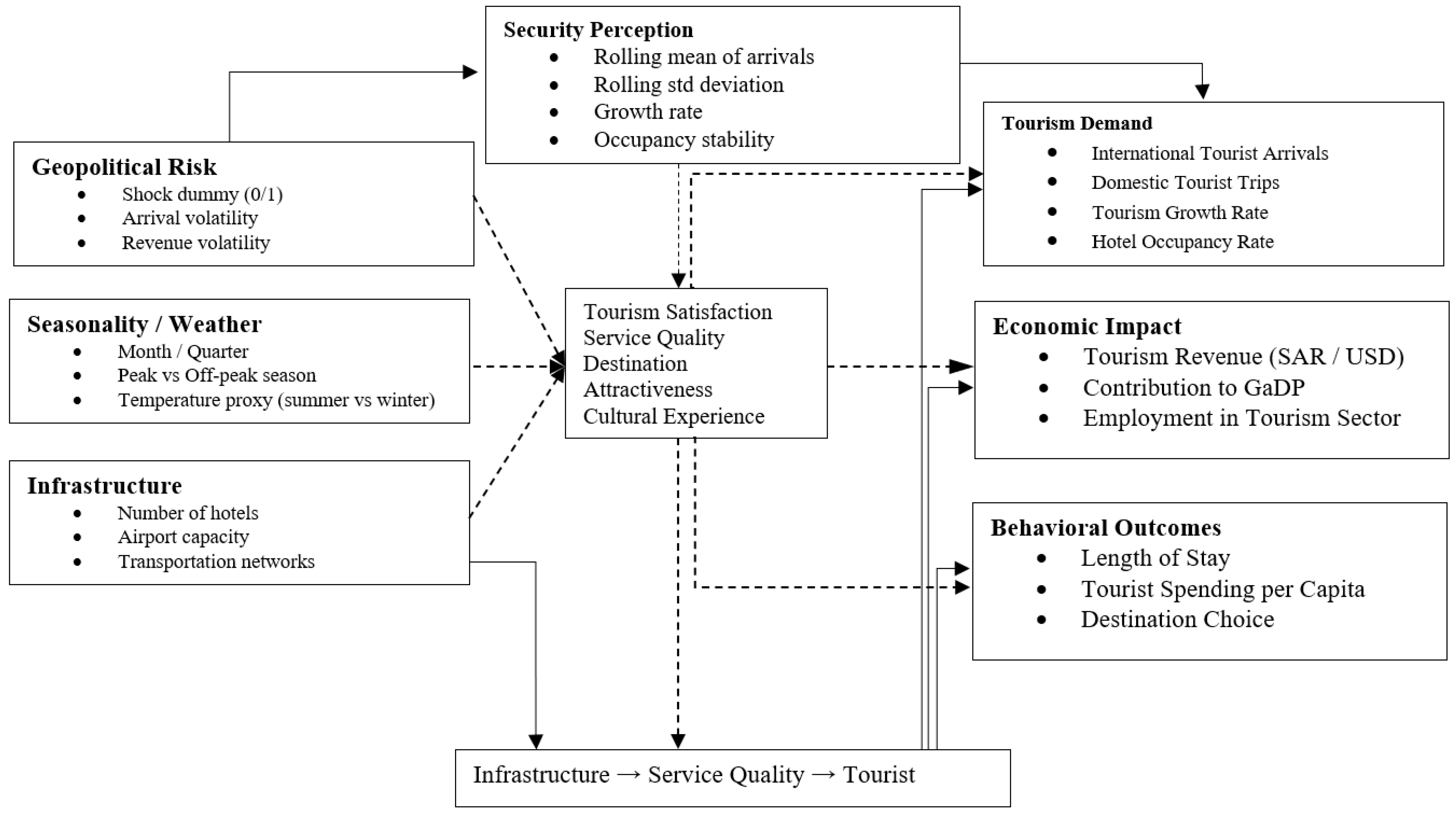
3.1. Conceptualization
3.2. Model Development
3.2.1. Extra Trees Regressor
3.2.2. AdaBoost Regressor
3.2.3. K-Nearest Neighbors Regressor
3.2.4. Gradient Boosting Regressor
3.2.5. Ridge Regression Baseline
4. Research Methodology
4.1. Dataset Description
4.2. Dataset Preprocessing
4.3. Feature Engineering
4.4. Target Construction
4.5. Experimental Overview
5. Experimental Analysis and Presentation of the Results
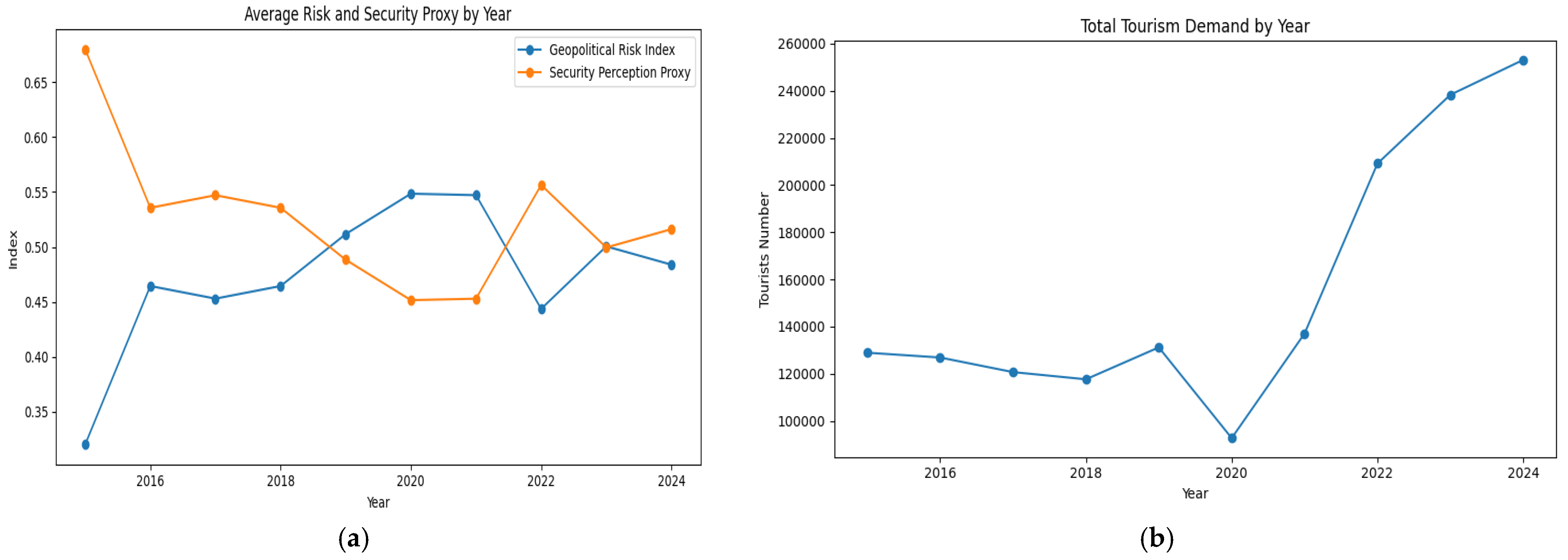
5.1. Exploratory Analysis
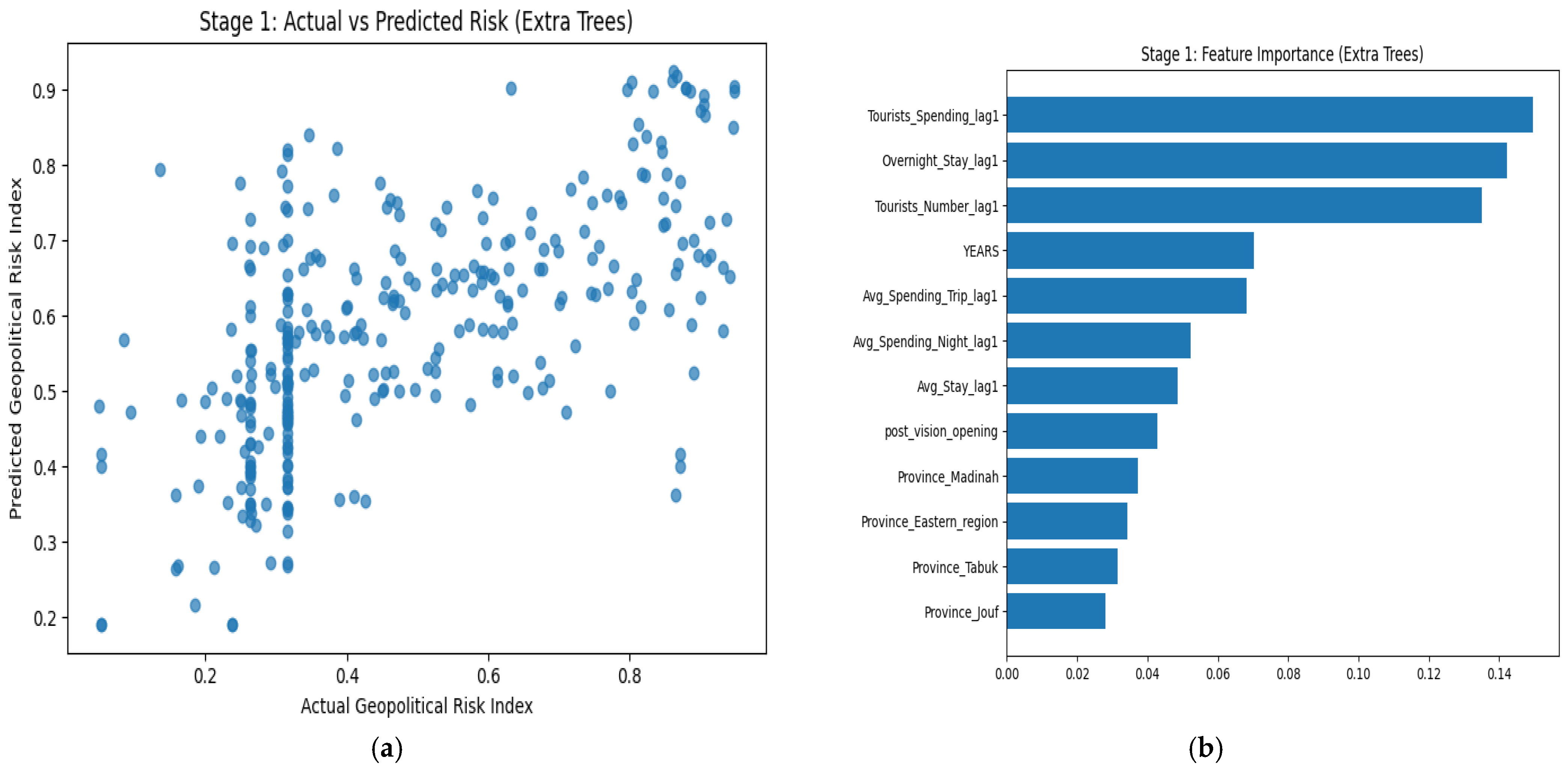
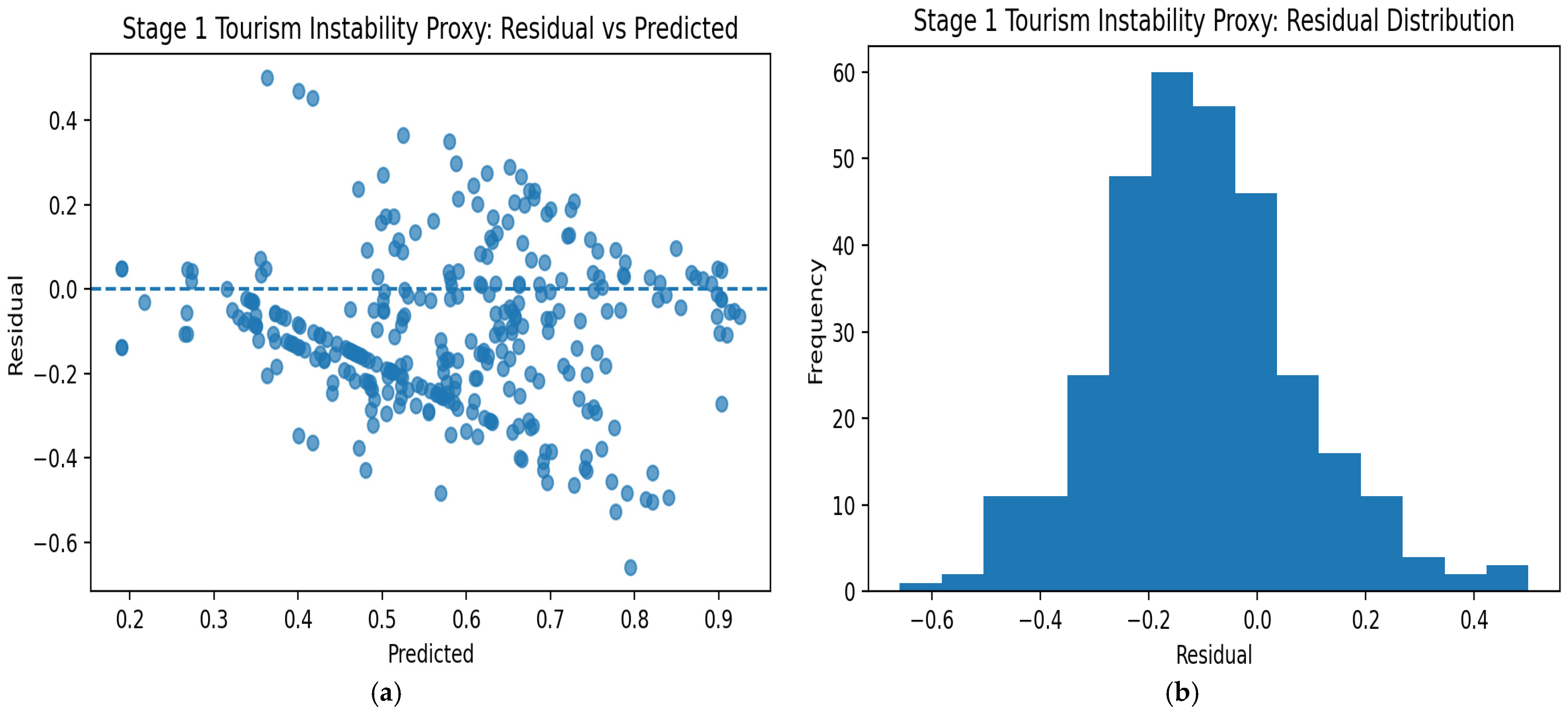
5.2. The Results of the Prediction of Geopolitical Risk
5.3. The Results of the Prediction of Tourism Demand
6. Discussion
6.1. Principal Findings
6.2. Comparative Findings with Previous Research
6.3. Limitations and Recommendations for Future Work
7. Conclusions
Funding
Institutional Review Board Statement
Informed Consent Statement
Data Availability Statement
Acknowledgments
Conflicts of Interest
References
- Kiani, D. Tourism as a Catalyst for Economic Diversification in Saudi Arabia: Vision 2030 and Beyond. J. Econ. Financ. Account. Stud. 2026, 8, 13–25. [Google Scholar] [CrossRef]
- Alsulami, A.G.; Alharbi, A.; Khan, U.A.; Al-Hejri, A.M.; Alshamrani, S.S.; Almotiri, J. Predicting tourism growth in Saudi Arabia with machine learning models for vision 2030 perspective. Sci. Rep. 2026, 16, 2556. [Google Scholar] [CrossRef] [PubMed]
- Louati, A.; Louati, H.; Alharbi, M.; Kariri, E.; Khawaji, T.; Almubaddil, Y.; Aldwsary, S. Machine learning and artificial intelligence for a sustainable tourism: A case study on Saudi Arabia. Information 2024, 15, 516. [Google Scholar] [CrossRef]
- Alzahrani, A.; Alshehri, A.; Alamri, M.; Alqithami, S. AI-driven innovations in tourism: Developing a hybrid framework for the Saudi tourism sector. AI 2025, 6, 7. [Google Scholar] [CrossRef]
- Tooba, I.K. Saudi Arabia Tourism Dataset (2015–2024). Kaggle 2024. Available online: https://www.kaggle.com/datasets/toobaik/saudi-arabia-tourism-dataset-20152024 (accessed on 25 April 2026).
- Hailemariam, A.; Ivanovski, K. The impact of geopolitical risk on tourism. Curr. Issues Tour. 2021, 24, 3134–3140. [Google Scholar] [CrossRef]
- Papagianni, E.; Evgenidis, A.; Tsagkanos, A.; Megalooikonomou, V. Tourism demand in the face of geopolitical risk: Insights from a cross-country analysis. J. Travel Res. 2024, 63, 2094–2119. [Google Scholar] [CrossRef]
- Huo, H.; Li, Q. Influencing factors of the continuous use of a knowledge payment platform—Fuzzy-set qualitative comparative analysis based on triadic reciprocal determinism. Sustainability 2022, 14, 3696. [Google Scholar] [CrossRef]
- Dimitriadou, A.; Gogas, P.; Papadimitriou, T. Tourism and uncertainty: A machine learning approach. Curr. Issues Tour. 2025, 28, 2278–2298. [Google Scholar] [CrossRef]
- Qin, F.; Bi, J.W.; Li, H.; Xu, H. Tourism demand forecasting using social media data: A deep learning–based ensemble model with social media communication conversion rates. Ann. Tour. Res. 2025, 115, 104058. [Google Scholar] [CrossRef]
- Fu, X.; Qin, Y. A Hybrid Machine Learning Framework for Tourism Demand Forecasting. Discov. Artif. Intell. 2026, 6, 63. [Google Scholar] [CrossRef]
- Huang, J.; Zhang, C. Daily tourism demand forecasting with the iTransformer model. Sustainability 2024, 16, 10678. [Google Scholar] [CrossRef]
- Lee, G.C. A Data-Driven Approach to Tourism Demand Forecasting: Integrating Web Search Data into a SARIMAX Model. Data 2025, 10, 73. [Google Scholar] [CrossRef]
- Zhang, Y.; Tan, W.H.; Zeng, Z. Tourism demand forecasting based on a hybrid Temporal neural network model for sustainable tourism. Sustainability 2025, 17, 2210. [Google Scholar] [CrossRef]
- Chen, J.; Li, C.; Huang, L.; Zheng, W. Tourism demand forecasting: A deep learning model based on spatial-temporal transformer. Tour. Rev. 2025, 80, 648–663. [Google Scholar] [CrossRef]
- Sun, K.; Chi, J.; Tao, M.; Saadaoui, J. What are the Implications of Geopolitical Risks on Travel and Leisure Firms? Financ. Res. Lett. 2025, 91, 109419. [Google Scholar] [CrossRef]
- Raheem, I.D.; le Roux, S. Geopolitical risks and tourism stocks: New evidence from causality-in-quantile approach. Q. Rev. Econ. Financ. 2023, 88, 1–7. [Google Scholar] [CrossRef]
- Hu, M.; Li, M.; Chen, Y.; Liu, H. Tourism forecasting by mixed-frequency machine learning. Tour. Manag. 2025, 106, 105004. [Google Scholar] [CrossRef]
- Georgakis, A.; Profilidis, V.; Botzoris, G.N. Forecasting tourism demand using search engine data. In Proceedings of the 10th International Congress on Transportation Research (ICTR2021), Rhodes, Greece, 1–3 September 2021. [Google Scholar]
- Alshammari, B.; South, R.B.; Raleigh, K. Saudi Arabia outbound tourism: An analysis of trends and destinations. J. Policy Res. Tour. Leis. Events 2025, 17, 824–846. [Google Scholar] [CrossRef]
- OECD. OECD Tourism Trends and Policies 2024. Available online: https://www.oecd.org/en/publications/oecd-tourism-trends-and-policies-2024_80885d8b-en/full-report/component-57.html (accessed on 26 April 2026).
- Mastelini, S.M.; Nakano, F.K.; Vens, C.; de Leon Ferreira, A.C.P. Online extra trees regressor. IEEE Trans. Neural Netw. Learn. Syst. 2022, 34, 6755–6767. [Google Scholar] [CrossRef] [PubMed]
- Sudhamathi, T.; Perumal, K. Ensemble regression based Extra Tree Regressor for hybrid crop yield prediction system. Meas. Sens. 2024, 35, 101277. [Google Scholar] [CrossRef]
- Antolini, F.; Cesarini, S. Predicting Domestic Tourists’ Length of Stay in Italy leveraging Regression Decision Tree Algorithms. Electron. J. Appl. Stat. Anal. 2024, 17, 621. [Google Scholar] [CrossRef]
- Ozaslan, I.N.; Degirmenci, A.; Karal, O. Tourism demand forecasting for Turkey by using adaboost algorithm. In 2022 Innovations in Intelligent Systems and Applications Conference (ASYU); IEEE: Piscataway, NJ, USA, 2022; pp. 1–5. [Google Scholar] [CrossRef]
- He, M.; Qian, X. Forecasting tourist arrivals using STL-XGBoost method. Tour. Econ. 2026, 32, 408–436. [Google Scholar] [CrossRef]
- Tsai, J.K.; Hung, C.H. Improving AdaBoost classifier to predict enterprise performance after COVID-19. Mathematics 2021, 9, 2215. [Google Scholar] [CrossRef]
- Suzanti, I.O.; Kamil, F.I.; Rochman, E.M.S.; Azis, H.; Suni, A.F.; Rachman, F.H.; Solihin, F. Imbalanced Text Classification on Tourism Reviews using Ada-boost Naïve Bayes. J. ELTIKOM J. Tek. Elektro Teknol. Inf. Dan Komput. 2025, 9, 91–97. [Google Scholar] [CrossRef]
- Novita, D. Comparison of K-Nearest Neighbor and Neural Network for Prediction International Visitor in East Java. BAREKENG J. Ilmu Mat. Dan Terap. 2024, 18, 2070. [Google Scholar] [CrossRef]
- Webb, T.; Lee, M.; Schwartz, Z.; Vouk, I. Beyond accuracy: The advantages of the k-nearest neighbor algorithm for hotel revenue management forecasting. Tour. Econ. 2024, 30, 1216–1236. [Google Scholar] [CrossRef]
- Nagy, B.; Oltean, F.D.; Gabor, M.R. Entrepreneurship or Resources for a Better Tourism? AK Nearest Neighbors and Decision Tree Dynamic Analysis for Romania. 2023. Available online: http://hdl.handle.net/20.500.14044/34995 (accessed on 29 April 2026).
- Tapak, L.; Abbasi, H.; Mirhashemi, H. Assessment of factors affecting tourism satisfaction using K-nearest neighborhood and random forest models. BMC Res. Notes 2019, 12, 749. [Google Scholar] [CrossRef] [PubMed]
- Sattayanuchit, W.; Wongkhunnen, W.; Chaisaengpratheep, N. Application of Gradient Boosting Regression to Evaluate the Impact of Family Tourism on Children’s Experiential Learning in Nakhon Ratchasima Province. J. Multidiscip. Acad. Res. Dev. (JMARD) 2025, 7, 35–53. [Google Scholar]
- Anshori, M.Y.; Katias, P.; Herlambang, T.; Meutia, N.S.; Othman, Z.B.; Azmi, M.S. Predicting hotel revenue using gradient boosting regression and support vector regression: A comparative analysis. J. Revenue Pricing Manag. 2025, 1–10. [Google Scholar] [CrossRef]
- Wang, Y. Evaluation of Tourist Satisfaction Based Light Gradient Boosting Machine Technique. In 2024 International Conference on Intelligent Algorithms for Computational Intelligence Systems (IACIS); IEEE: Piscataway, NJ, USA, 2024; pp. 1–5. [Google Scholar] [CrossRef]
- Liu, C. Scenic area data analysis based on NLP and ridge regression. In 2021 IEEE International Conference on Electronic Technology, Communication and Information (ICETCI); IEEE: Piscataway, NJ, USA, 2021; pp. 270–277. [Google Scholar] [CrossRef]
- Hu, X.; Li, W. Group penalized Poisson regressions forecast daily tourism demand. Int. J. Mach. Learn. Cybern. 2026, 17, 87. [Google Scholar] [CrossRef]
- Vasenska, I. Comparative analysis of machine learning and deep learning models for tourism demand forecasting with economic indicators. FinTech 2025, 4, 46. [Google Scholar] [CrossRef]




| Model | MAE | RMSE | R2 |
|---|---|---|---|
| Extra Trees | 0.168468 | 0.209492 | 0.184437 |
| KNN | 0.180302 | 0.211289 | 0.170379 |
| AdaBoost | 0.180597 | 0.211334 | 0.170026 |
| Gradient Boosting | 0.176862 | 0.214185 | 0.147484 |
| Ridge Baseline | 0.270414 | 0.315196 | −0.84623 |
| Model | MAE | RMSE | R2 |
|---|---|---|---|
| Extra Trees | 1120.573 | 2749.096 | 0.577487 |
| KNN | 1287.985 | 3035.79 | 0.484767 |
| AdaBoost | 1262.692 | 3102.071 | 0.462023 |
| Gradient Boosting | 1387.188 | 3195.806 | 0.42902 |
| Ridge Baseline | 1713.186 | 3208.847 | 0.424351 |
| Task | Model | MAE | RMSE | R2 |
|---|---|---|---|---|
| risk_prediction | Extra Trees | 0.168468 | 0.209492 | 0.184437 |
| risk_prediction | KNN | 0.180302 | 0.211289 | 0.170379 |
| risk_prediction | AdaBoost | 0.180597 | 0.211334 | 0.170026 |
| risk_prediction | Gradient Boosting | 0.176862 | 0.214185 | 0.147484 |
| risk_prediction | Ridge Baseline | 0.270414 | 0.315196 | −0.846233 |
| tourism_demand_prediction | Extra Trees | 1120.57 | 2749.1 | 0.577487 |
| tourism_demand_prediction | Gradient Boosting | 1287.99 | 3035.79 | 0.484767 |
| tourism_demand_prediction | KNN | 1262.69 | 3102.07 | 0.462023 |
| tourism_demand_prediction | AdaBoost | 1387.19 | 3195.81 | 0.42902 |
| tourism_demand_prediction | Ridge Baseline | 1713.19 | 3208.85 | 0.424351 |
| Ref. | Study | Model | MAE | RMSE/MSE | R2 |
|---|---|---|---|---|---|
| [2] | Saudi Tourism ML | Ensemble Voting | 0.0133 | MSE = 0.0007 | 0.9601 |
| RF/GB variants | 0.0339 | — | 0.8736 | ||
| [3] | Saudi Tourism Spending | RF/KNN | 0.05879 | - | — |
| [9] | Tourism and Uncertainty | GBT | - | 15,463.20 | 0.9 |
| [12] | iTransformer | Transformer | 14.1152 | 19.2557 | - |
| [14] | Hybrid NN | hybrid BiLSTM | 18–19 | 22 | 0.85 |
| This Study (Stage 1) | GRI Prediction | Extra Trees | 0.168 | 0.209 | 0.184 |
| This Study (Stage 2) | Tourism Demand | Extra Trees | 1120.57 | 2749.1 | 0.577 |
Disclaimer/Publisher’s Note: The statements, opinions and data contained in all publications are solely those of the individual author(s) and contributor(s) and not of MDPI and/or the editor(s). MDPI and/or the editor(s) disclaim responsibility for any injury to people or property resulting from any ideas, methods, instructions or products referred to in the content. |
© 2026 by the author. Licensee MDPI, Basel, Switzerland. This article is an open access article distributed under the terms and conditions of the Creative Commons Attribution (CC BY) license.
Share and Cite
Zamzami, I.F. Machine Learning-Based Tourism Demand Prediction Using Tourism Instability Indicators. Sustainability 2026, 18, 5503. https://doi.org/10.3390/su18115503
Zamzami IF. Machine Learning-Based Tourism Demand Prediction Using Tourism Instability Indicators. Sustainability. 2026; 18(11):5503. https://doi.org/10.3390/su18115503
Chicago/Turabian StyleZamzami, Ikhlas Fuad. 2026. "Machine Learning-Based Tourism Demand Prediction Using Tourism Instability Indicators" Sustainability 18, no. 11: 5503. https://doi.org/10.3390/su18115503
APA StyleZamzami, I. F. (2026). Machine Learning-Based Tourism Demand Prediction Using Tourism Instability Indicators. Sustainability, 18(11), 5503. https://doi.org/10.3390/su18115503