Review

Organic Compared to Conventional Crop Yields: A Mini-Review

Dienstleistungszentrum Ländlicher Raum Rheinhessen-Nahe-Hunsrück, Kompetenzzentrum Ökologischer Landbau Rheinland-Pfalz (KÖL), Rüdesheimer Straße 60-68, 55545 Bad Kreuznach, Germany
Sustainability 2026, 18(11), 5483; https://doi.org/10.3390/su18115483 (registering DOI)
Submission received: 13 May 2026 / Revised: 26 May 2026 / Accepted: 28 May 2026 / Published: 30 May 2026
(This article belongs to the Section Sustainable Agriculture)

Abstract

Organic farming is an alternative method to produce agricultural products. Here, an update of results is provided related to the internationally important topic organic compared to conventional crop yields. The most recently published meta-analyses continue to show that organic crop yields, average across all crop species worldwide, are roughly about 15–25% lower than yields of conventionally produced crops. Organic cereal and potato yields are often 30–40% lower, whereas legume and animal pollinator-dependent crop species are able to match conventional crop yields quite often. Thus, the level of the yield difference is dependent on the crop species among many other factors such as the geographic origin of the yield comparison studies. Here, a summary of informative articles is provided, which can be a useful guide for people, who are interested in the topic organic compared to conventional crop yields. This mini-review concludes that organic farming should be promoted, among other farming systems, although organic compared to conventional crop yields are usually lower, because organic farming has many strengths. For example, in general, organic farming is environmentally friendly, thus a sustainable farming system. Therefore, it might be wise to promote a fair and respectful co-existence of different agricultural production systems, including organic agriculture.

1. Introduction

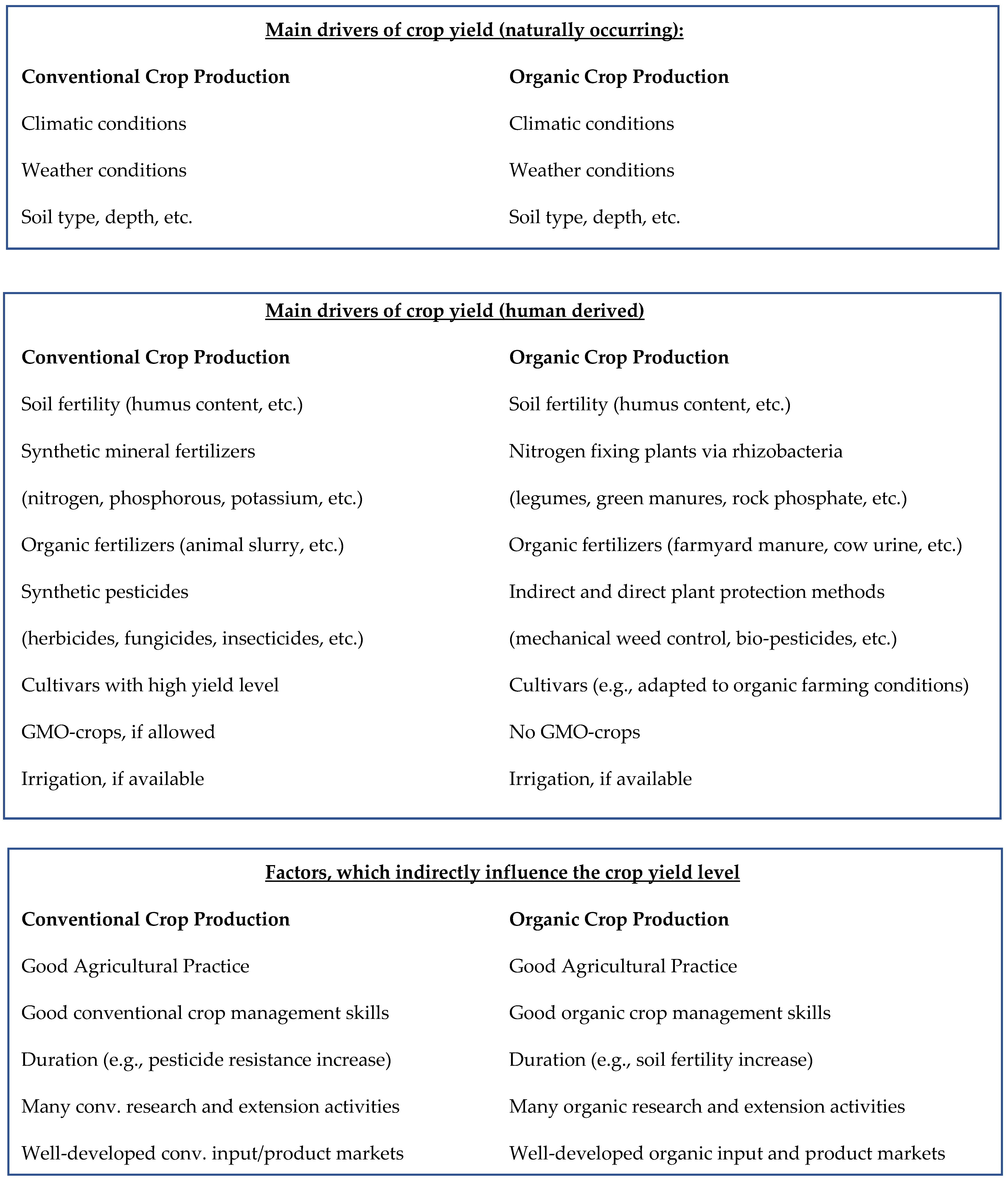
In the second half of the 20th century, crop yields in conventional farming increased, for example, through (1) improved crop cultivars, (2) the use of synthetically produced mineral fertilizers, (3) the use of synthetically produced pesticides, (4) innovative technologies, (5) and improved research and extension activities. On the other hand, organic farming is an alternative method to produce agricultural products. It ideally relies on natural processes, biodiversity, and other ecological principles, rather than on the use of synthetically produced inputs [1]. For example, inputs such as genetically modified organisms (GMOs), synthetically produced pesticides, and mineral fertilizers are prohibited in organic crop production, whereas some organic inputs such as organic fertilizers and bio-pesticides can be used (Figure 1). For more information related to certified organic farming, please, consult the respective national organic production standards.
Since about 20 years, there is a controversial scientific debate, if organic farming can feed the world [2,3,4,5,6,7]. Interestingly, some scientists rightly mentioned that hunger is mainly caused by poverty and inequality rather than scarcity of food due to low production [8]. In 2023, the share of global organic agricultural land area was just about 2.1% (98.9 million hectares organic) of total global agricultural land, whereby more than two-thirds (68.5 million ha organic) of this organic agricultural land area was grassland, mainly located in Australia [9]. Just about 1.2% of total global arable land was under organic management (16.2 million ha organic), whereby about 5.7 million ha were dedicated to organic cereal production [9]. These patterns are in agreement with Gabriel et al. [10] who stated, where farms tend to be small, and dairy (or mixed) rather than arable farming is performed, organic farms are more likely to occur. Moreover, these authors also reported that organic farms mainly occur in areas where cereal production is marginal. In other words, organic farms are rare in highly productive arable regions [11]. Therefore, it is very unlikely that in the coming decades many organic farms will be located in globally important food baskets, which feed the ever-increasing human world population (according to [12] 8.3 billion in 2026, about 10.0 billion in 2060s, about 10.3 billion in 2080s, around 2100 population reduction projected). Consequently, both food security can be maintained, and sustainability of agriculture can be enhanced if stakeholders are promoting research and extension activities in organic agriculture in order to support co-existence of different farming systems. The aim of this mini-review is to highlight recently published results and to provide a short and concise overview on the topic organic compared to conventional crop yields.

2. Methods

Here, the “traditional/classical” method of a literature search was performed. In short, several times between November 2025 and March 2026, the literature search engine Google Scholar was used to find publications, which are relevant for the topic organic compared to conventional crop yields, using the search terms “organic agriculture” and “organic farming”. The main focus was on meta-analyses and review articles, which represent publication types that analyze and summarize data of crop yield comparisons. Nevertheless, some original articles, which represent, for example, research approaches to collect crop yield data (e.g., long-term field experiments) were also included because they are informative as well. The focus was on articles published in international peer-reviewed journals in English language. Mainly, recently published articles were considered, specifically those published from 2012 to March 2026 in order to keep the mini-review up-dated. Initial filtering was based on title then on abstract, and finally, the text was screened for the article’s relevance when necessary. In addition, more methods for finding relevant publications such as screening the Google Scholar lists of citations of meta-analyses were used, which were published from 2012 to March 2026 (Table 1), whereby the meta-analysis by Seufert et al. [13] was cited more than 3200 times (according to Google Scholar 13 May 2026), and each year this successful article collects about 200–300 new citations. The idea behind is, that a relevant high-quality article, published from 2012 to March 2026, has cited at least one meta-analysis, for example, the one by Seufert et al. [13]. Thus, there is a high likelihood to find a relevant article, including another meta-analysis. In addition, more suitable publications were often found in the list of references of relevant articles. In summary, in total roughly about 8000–10,000 articles (presumably even more) were screened by the author for their relevance using Google Scholar (see above) and via screening the reference lists of relevant articles.
Table 1 shows publications such as meta-analyses, review articles, and original articles, which represent research approaches to collect (e.g., long-term field experiment) and analyze crop yield data (e.g., meta-analysis). Moreover, a few related but broader topics such as biodiversity, soil carbon, pesticide-free systems, co-existence of farming systems, and consumer choice are shortly discussed here. Please, note that this narrative mini-review is not comprehensive nor systematic. Consequently, the reader should keep in mind that the findings presented here are not derived from a systematic review. In other words, this narrative mini-review summarizes selected literature rather than exhaustively synthesizing all evidence, which can be potentially found in the literature.
Therefore, readers interested in details, not mentioned here, are referred to comprehensive review articles specifically related to the topic organic compared to conventional crop yields by Seufert [23] and by Wilbois and Schmidt [24]. These two review articles are very suitable to complement the brief information provided in this narrative mini-review, consequently interested readers are strongly encouraged to read them as well. For example, Seufert [23] analyzed several meta-analyses in depth and compared their results and methodology used. Seufert [23] found, for example, differences in statistical methods used, number of yield comparisons considered, and crop species included in the specific crop group comparisons. These kind of sources of heterogeneity affect the confidence in the reported crop yield differences in the meta-analyses, whereby the respective complete crop yield comparison data set to be analyzed should be reliable, both in terms of quantity and quality. For example, a specific crop yield comparison is less reliable if just a few data were calculated, because these kinds of comparisons are hardly meaningful. Interested readers are referred to Seufert [23] for more details. These are just a few examples why different meta-analyses reported different yield differences in organic compared to conventional crop yields. Nevertheless, the overall conclusion does not change when considering all these methodological differences, namely that crop yields are usually lower in organic compared to conventional farming across studies (Table 1). Moreover, for example, the review articles by Aulakh et al. [21], Meemken and Qaim [25], and Reganold and Wachter [29] are providing useful information on organic agriculture, including the topic organic compared to conventional crop yields (Table 1). In addition, Kirchmann et al. [49] provide guidelines how to design field experiments correctly, which aim to compare organic and conventional crop yields.

3. Organic Compared to Conventional Crop Yields (Yield Level and Yield Stability)

Two recently published meta-analyses, namely De la Cruz et al. [16] and Alvarez [17], continue to show that organic crop yields, average across all crop species worldwide, are usually roughly about 15–25% lower than yields of conventionally produced crops (Table 2). However, it must be mentioned that De la Cruz et al. [16] and Alvarez [17] used different statistical methods, different number of yield comparisons, and the specific crop groups were different. For example, De la Cruz et al. [16] considered in total 786 crop yield comparisons (44% from North America, 42% from Europe, and 14% elsewhere), whereas Alvarez [17] considered in total 206 crop yield comparisons (also mostly from North America and Europe). These differences should be kept in mind when comparing the specific results of both meta-analyses.
The results of all other previously published meta-analyses [2,5,13,18,19,50,51] are summarized in Wilbois and Schmidt [24] (see Table 1 therein, MDPI Agronomy, open access). In these meta-analyses, the yield reduction in organic crops compared to conventional crops ranged from 9% to 32% (average across all crops worldwide), whereby most meta-analyses found that the yield difference is roughly about 20% [5,19]. This is in agreement with Gong et al. [52].
However, a recently published meta-analysis by Raghavendra et al. [15] that focused on India, found a smaller crop yield difference of about 5% across all crop species considered in India. For example, average yields of vegetables (+6.4%, not significant) and legume species (+12.5%, not significant) were in tendency, higher in organic compared to conventional farming in India [15]. On the other hand, the yields of cotton Gossypium hirsutum (−21.0%, significant), wheat Triticum aestivum (−10.0%, significant), soybean Glycine max (−9.8%, significant), and rice Oryza sativa (−1.8%, not significant) were lower in organic farming. Thus, results can be different when comparing worldwide versus country-specific crop yields, namely an average crop yield difference of roughly about 20% worldwide [5,19] compared to about 5% in India [15]. Raghavendra et al. [15] reported that in India, the average farm size was about 1.1 ha in 2015/2016. Therefore, it is possible, that in India under small-scale production conditions, it is easier to achieve relatively high organic crop yields, which are often similar to conventional crop yields, compared to large-scale production conditions elsewhere (see more information below). Consequently, an average crop yield difference of about 5% in India compared to about 20% worldwide is plausible.
Most recently, the meta-analysis by Aizen et al. [14] has found that animal pollinator-dependent crops compared to animal pollinator-independent crops, often achieved similar yields in organic compared to conventional farming. Especially, the yield was similar for crops in which animal pollination contributes more than 50% of total yield [14]. This concerns crops such as sunflower (Helianthus annuum) and many vegetable and fruit crop species such as watermelon (Citrullus lanatus) [53,54]. Thus, the level of the yield difference is dependent on the crop species and organic farmers may consider this knowledge in order to realize similar yields in organic compared to conventional farming due to appropriate crop species choice. In addition, fruit and vegetable crops may fetch high prices, particularly if premium prices for organic products can be realized, also important to cover potential higher production and certification costs in organic farming.
There is strong evidence that the yield difference of heavy feeder plants is often especially great, namely plants which need a high amount of nitrogen to produce high yields such as most cereal species including wheat. Because usually 30–40% less grain yield is reported for organically compared to conventionally grown cereals [13,17,46,47]. Theoretically, the yield difference of light feeders (e.g., lettuce, Lactuca sativa var. capitata) and medium feeders (e.g., carrot, Daucus carota) should be less great, as long as other important factors are not significantly reducing their organic yield potential (e.g., insect pests, diseases, weeds). Legume crop species often performed well under organic management [13], most likely because they are able to use the atmospheric nitrogen, namely biological nitrogen fixation via rhizobacteria [55]. Thus, growth and yield of legumes are generally less dependent on human applied nitrogen fertilizers compared to non-legume crop species such as wheat. Therefore, for example, alfalfa (Medicago sativa) and grass-clover ley are particularly well suited for organic farming such as reported for the United States of America [47] and these crops can be fed in organic dairy farming, an economically sound usage of forage legumes.
Furthermore, the topic stability of crop yield across years in long-term experiments [56] in organic compared to conventional farming was investigated, for example, by Smith et al. [39], Knapp and Van der Heijden [57], Schrama et al. [36], and Knapp et al. [35], whereby most researchers found that crop yield stability is usually lower in organic compared to conventional farming. The yield stability across years can be related to the yield level [57]. Therefore, yield stability can be measured in various ways, for example, (1) directly via the standard deviation of yields across years or (2) indirectly via the coefficient of variation, that divides the yield variability across years by the mean yield of the respective time period. In short, cropping systems with high yield levels tend to have a high yield stability across years. Interested readers are referred, for example, to Knapp and Van der Heijden [57] for more details. In summary, usually in organic compared to conventional farming both are lower, (1) level of crop yield and (2) stability of crop yield across years, although in a few cases, organic crop yield level and stability was higher. For example, Knapp et al. [35] reported that in their long-term field experiment, increased yield differences in single years were due to poor performance of the organic system rather than better performance of the conventional system. Thus, organic crop yield stability across years should be as high as possible, whereby time of organic management can matter, for example, due to continuously improved soil fertility and improved farmers’ organic management skills (see below). For example, Döring et al. [33] reported that initially organic yields were lower; however, after about 10 years they started to approach conventional yields in their long-term experiment in grapevine (Vitis vinifera) in Germany. This is in agreement with results by Schrama et al. [36]. On the other hand, grain yield of winter wheat has stagnated since 1990 for conventional production systems in Switzerland, while the trend under organic management was slightly negative [58]. Thus, the results related to crop yield level and crop yield stability across years may be dependent on crop species, time under organic management and many other site-specific conditions. Presumably, these are likely reasons why Seufert et al. [13] found a wide variation of yield differences, for example, depending on crop species and crop management practices. For example, legume species had the smallest yield difference (−5%) of the crop groups analyzed [13]. This is in agreement with Raghavendra et al. [15], who focused on India and found even higher yields of organic compared to conventional legumes (see above). Moreover, Seufert et al. [13] found when best organic management practices were considered as a major factor in their meta-analysis, that the yield difference was reduced from −25% to −13% in organic compared to conventional crops, suggesting that the crop management skills of farmers are very important in organic farming to realize high yield and quality (see below).

4. Most Often Discussed Reasons for the Lower Organic Crop Yields

The most often discussed reason for the lower organic yields is sub-optimal plant nutrition, especially nitrogen limitations, because synthetically produced mineral fertilizers cannot be used in organic farming. Sub-optimal can be both, nutrient amount and timely availability when nutrient demand of crop plants is high. Most organic fertilizers, which are available in considerable amounts, are ‘slow release by nature’ (e.g., biological fixed nitrogen of legumes via rhizobacteria, green manure, farmyard manure), whereas organic fertilizers, which are ‘fast release by nature’ are too expensive for large-scale organic production and/or are rare (e.g., animal urine, sugar cane molasses diluted in water, biogas slurry). However, just a small percentage of the nitrogen amount in ‘slow release by nature’ organic fertilizers like farmyard manure is quickly and directly available to plants compared to mineral fertilizers, because microorganisms need to mineralize the organically bound nitrogen first, before it is plant available [23]. For example, Bilsborrow et al. [38] reported that fertilization had the greatest effect on organic wheat grain yield and quality in their long-term experiment. Indeed, there is an overwhelming agreement among scientists, that the number one reason for the lower organic crop yields is nitrogen limitations, both amount and timely availability at peak demands of crop plants [22,59,60], especially in crops such as wheat [24]. Most likely, this is one reason why meta-analyses show that organic crop yields are lower than conventional ones, because cereal crops such as wheat are the dominating crops in most meta-analyses. Possible phosphorus limitations are also often discussed [59,61], whereas all other macro- and micro-nutrients are less often discussed as likely reasons for the lower organic crop yields.
The second most often discussed reason for the lower organic yields is sub-optimal plant protection, because synthetically produced pesticides (e.g., insecticides, fungicides, herbicides) cannot be used in organic farming. However, especially, weeds can reduce yields in organic farming in many crop species such as the meta-analysis by Muneret et al. [62] showed, although in some organically managed crops, weeding methods can be quite effective (e.g., plastic mulch, flaming, hoeing). Generally, yield loss potential due to a certain pest type (e.g., insect pests, pathogens, weeds) is also dependent on the crop species cultivated. For example, yield of oilseed rape (Brassica napus) is usually at risk due to insect pest infestation. More information can be found in the literature [62,63].
Also quite often discussed as a likely reason for the lower organic crop yields, are the management skills of the organic farmers [13]. In general, the higher the skills are, the higher the organic yield, the smaller the yield difference of organic compared to conventional crops [64,65]. However, it is not always the case. For example, organic farmers usually cannot challenge a conventional high-input wheat crop that can reach 9–11 t/ha grain yield due to three timely applied mineral fertilizer applications at three different developmental stages of the wheat crop, where nitrogen demand is high. Organic farmers may reach 6–8 t/ha wheat grain yield under optimal circumstances (see below). In other words, usually the higher the yield potential of the conventionally produced crop, the higher the yield difference compared to organic crops. The on-farm yield potential is dependent on (1) environmental factors (e.g., soil fertility, temperature, radiation, and precipitation conditions), (2) crop management (e.g., crop rotation, soil tillage method, cultivar choice), (3) the input level (e.g., fertilizer, irrigation), and (4) yield reducing factors (e.g., insect pests, diseases, weeds). Regular crop monitoring and timely application of appropriate crop management interventions are crucial to realize high crop yield and quality in any farming system, however, particularly important in organic farming according to Juroszek et al. [65,66,67]. For example, the tomato production strategy of a well-trained experienced organic farmer in Taiwan appeared to be superior. His tomato crop was very vigorous and both, the marketable tomato fruit yield and quality were high. He fertilized his crop moderately, irrigated his crop moderately, and sprayed an effective Bt-product immediately after the detection of tomato fruit worm (Helicoverpa armigera) and tobacco cut worm (Spodoptera litura), and was, therefore, able to prevent severe damage to his crop. In summary, a combination of (1) high soil fertility and good soil structure, (2) appropriate climatic conditions during winter under tropical climatic conditions for tomato fruit ripening, (3) high organic crop management skills, (4) a disease resistant tomato cultivar, and (5) timely application of a bio-pesticide based on frequent crop monitoring were most likely the reasons for his success [65].
Moreover, very often discussed is the topic plant breeding under organic farming conditions [68] and cultivar choice [69], whereby cultivars which are well adapted to organic farming conditions should be used (e.g., nitrogen-efficient, rapid early growth to suppress weeds, disease resistant), if available. On the other hand, Juroszek and Tsai [70] showed that hybrids of sweet pepper (Capsicum annuum), bred under conventional farming conditions, performed very well under organic farming conditions and realized both, high yield and quality. Thus, the specific plant breeding conditions may not always be crucial.
It is important to note that in the USA and Canada, most farmers grow, for example, wheat as low-input crop (usually a relatively low yield level per unit area), whereas in western Europe such as Germany, wheat (sown in fall) is usually a high-input crop with a high yield potential. Thus, it is important to consider global and regional crop management differences when discussing the results of yield comparisons across continents and countries. In summary, many scientists assume [6,28] that widespread use of best organic management practices and well-adapted cultivars to organic farming conditions will reduce the crop yield differences between organic compared to conventional farming in the future.

5. It Is Meaningful to Improve Organic Crop Yields

Balmford et al. [71] stated that sustainable high-yield farming systems are essential across our globe to be able to spare land for conservation purpose in order to maintain biodiversity, because most species decline under any sort of farming system. Thus, the organic compared to conventional crop yield debate concerns nature conservation, in addition to many other aspects. For example, Don et al. [44] stated that lower crop yields in organic farming can reduce the amount of crop biomass returned to the soil after harvest. Thus, maintaining the soil organic matter content under organic compared to conventional farming may be more difficult due to lower crop biomass, although organic farmers usually cultivate more legume crop species (e.g., alfalfa, grass-clover ley), which usually improve the soil organic matter content. Keeping these examples in mind, it is meaningful to improve organic crop yields, where needed and possible. This is in agreement with Shennan et al. [28] who concluded that despite evidence for generally lower yields in organic systems, on the other hand, there are considerable environmental benefits of organic compared to conventional farming (see below). Therefore, investments in research and extension activities are justified in order to improve organic farming systems. Nevertheless, one should keep in mind, that large-scale arable organic farming is conducted quite often in marginal agricultural environments (see introduction), because generally farmers in productive high-yield arable farming areas are reluctant to convert to organic farming [11]. Thus, under practical large-scale arable farming conditions, there are barriers to achieve high yields in organic farming due to marginal production conditions, at least in respect to non-legume field crops such as wheat. On the other hand, under small-scale organic fruit and vegetable production conditions, it may be easier to achieve high yields, often comparable to conventional crop yields [15,70]. This is in agreement with Shriya et al. [72] who reported that agronomic challenges such as weed management in organic farming generally increase with increasing farm size. Thus, various aspects need to be taken into account when improving organic farming systems. In addition, these various aspects can also be important when analyzing and discussing organic compared to conventional crop yield differences. Sometimes weather conditions may be the overriding factor, sometimes soil type and fertility, sometimes plant nutrition, sometimes plant protection, and sometimes the organic farmer management skills (Figure 1). However, most likely, quite often interactions of many different factors shown in Figure 1 are dominating the outcome of results. Thus, the generalization of results is difficult. For example, Seufert [23] concluded that more scientific evidence needs to be collected to allow generalizable conclusions on factors influencing the size of the organic compared to conventional yield differences, whereby the challenge is to isolate important variables amongst a whole range of potential drivers which are often correlated and/or interact with each other. Interested readers are referred to Seufert [23] for more details. In addition, organic and conventional farming can have more similarities than differences. For example, conventional farmers may also use organic fertilizers (e.g., animal slurry of conventionally raised animals), grow forage legume crops (e.g., alfalfa to feed conventional dairy cows), and use indirect methods of crop protection such as required in both Integrated Pest Management and organic farming. This is also an important aspect, which should be kept in mind when comparing organic and conventional crop yields presented in different publications.

6. Conclusions

Table 1 shows that the crop yield level is usually lower in organic compared to conventional farming, independent on the research approach considered, including quantitative meta-analyses, qualitative review articles, long-term field experiments under temperate climatic conditions, long-term field experiments under tropical and subtropical climatic conditions, and practical farming conditions. In addition, the crop yield stability across years is also usually lower in organic compared to conventional farming. Across meta-analyses, Seufert [23] found, for example, differences in statistical methods used, number of yield comparisons considered, and crop species included in the specific crop group comparisons. These are a few plausible examples why different meta-analyses reported different yield level differences in organic compared to conventional farming (see two recently published examples in Table 2). Anyhow, the overall conclusion does not change when considering all these methodological differences, namely that crop yield level and crop yield stability across years are usually lower in organic compared to conventional farming across various studies.
The most often discussed reason for the usually lower organic crop yields is (1) lower plant nutrient supply in organic farming, both nutrient amount and timely availability when crop plant nutrient demand is high, because synthetically produced mineral fertilizers cannot be used. The second most often discussed reason is (2) sub-optimal plant protection in organic farming, because synthetically produced pesticides (e.g., herbicides, fungicides, insecticides) cannot be used. Moreover, also quite often discussed are (3) the management skills of the organic farmers, which should be superior, and (4) the lack of cultivars better adapted to organic farming conditions. Several researchers showed (see above) that the level of the yield difference is dependent on the crop species and organic farmers may consider this knowledge in order to realize similar yields in organic compared to conventional farming due to appropriate crop species choice (e.g., legume species, animal dependent pollinator crops).
In summary, many scientists, particularly those engaged in organic farming research, assume that widespread use of best organic management practices and well-adapted cultivars to organic farming conditions will reduce the crop yield differences between organic compared to conventional farming in the future. Consequently, research and extension activities related to organic farming should be promoted, especially in countries, where organic farming should play a major role in agriculture.

7. Outlook

It is noteworthy to mention, that this outlook contains a few value-oriented statements of the author (e.g., agricultural policy preferences), which might be a matter of debate. Anyhow, interestingly, there are scientists who argue that conventional farming systems should be improved in order to reduce their environmental footprint [71]. Indeed, pesticide-free farming systems, where mineral fertilizers can be used, emerge as a new type of farming system such as reported by Finger and Möhring [73], who provide information on a successfully implemented pesticide-free bread wheat production system in Switzerland. Strictly seen, the controversial scientific debate if yields and qualities of organically compared to conventionally produced plant products are often higher or lower can be ceased. Presumably, it might be better to promote a fair and respectful co-existence of different agricultural production systems, including organic, pesticide-free, integrated, and conventional, whereby each of them has strengths and weaknesses. Fair would be, for example, to allocate appropriate financial resources to each of the farming systems. Respectful would be, for example, to accept strengths and weaknesses of a particular farming system, whereby the respective weaknesses of a particular farming system should be improved in the future. For example, organic compared to conventional farming is usually more environmentally friendly [28,74], thus more sustainable (e.g., less ground water pollution, more biodiversity). Boschiero et al. [74] found, despite the lower yields (independently per unit area or per unit output calculated), that organic systems show overall a better environmental performance than conventional ones. These results were valid for the majority of the impacts assessed (e.g., eco-toxicity, human toxicity, eutrophication, and use of resources). In addition, organically produced plant products are very suitable for baby food (e.g., usually no pesticide residues, low nitrate contents) [64]. On the other hand, organically compared to conventionally produced crops usually have lower yields (see conclusions). Consumers like to decide which kind of food they buy: be it organically, pesticide-free, integrated or conventionally produced, or a mixture of all. Therefore, it might be wise to promote a fair and respectful co-existence of different agricultural production systems, including organic agriculture.

Funding

This research received no external funding.

Institutional Review Board Statement

Not applicable.

Informed Consent Statement

Not applicable.

Data Availability Statement

Data are contained within the article.

Acknowledgments

The author wishes to thank Matthias Gutzler (Dienstleistungszentrum Ländlicher Raum Rheinhessen-Nahe-Hunsrück, Bad Kreuznach, Germany). He also thanks Sonja Li (Lycoming College, Williamsport, Pennsylvania, USA). Moreover, the author is grateful to the three anonymous reviewers who provided insightful comments to improve the manuscript. The views expressed in this article are the author’s own and do not necessarily represent those of the employer.

Conflicts of Interest

The author declares no conflicts of interest.

Abbreviations

The following abbreviations are used in this manuscript:
bio-pesticideBiological Pesticide
Bt-productBacillus thuringiensis Product
conv.Conventional
e.g.,Example Given
GMOGenetically Modified Organism
ha Hectare
IPMIntegrated Pest Management
t/haTons per Hectare
vs.Versus
%Percent

References

  1. IFOAM. International Federation of Organic Agriculture Movements. 2026. Available online: https://www.ifoam.bio/why-organic/shaping-agriculture/four-principles-organic (accessed on 14 March 2026).
  2. Badgley, C.; Moghtader, J.; Quintero, E.; Zakem, E.; Chappell, M.J.; Aviles-Vazquez, K.; Samulon, A.; Perfecto, I. Organic agriculture and the global food supply. Renew. Agric. Food Syst. 2007, 22, 86–108. [Google Scholar] [CrossRef]
  3. Connor, D.J. Organic agriculture cannot feed the world. Field Crops Res. 2008, 106, 187–190. [Google Scholar] [CrossRef]
  4. Kirchmann, H.; Bergström, L.; Kätterer, T.; Andrén, O.; Andersson, R. Can organic crop production feed the world? In Organic Crop Production—Ambitions and Limitations; Kirchmann, H., Bergström, L., Eds.; Springer: Dordrecht, The Netherlands, 2008; pp. 39–72. [Google Scholar]
  5. Ponisio, L.C.; M’Gonigle, L.K.; Mace, K.C.; Palomino, J.; De Valpine, P.; Kremen, C. Diversification practices reduce organic to conventional yield gap. Proc. R. Soc. B Biol. Sci. 2015, 282, 20141396. [Google Scholar] [CrossRef]
  6. Muller, A.; Schader, C.; El-Hage Scialabba, N.; Brüggemann, J.; Isensee, A.; Erb, K.H.; Smith, P.; Klocke, P.; Leiber, F.; Stolze, M.; et al. Strategies for feeding the world more sustainably with organic agriculture. Nat. Commun. 2017, 8, 1290. [Google Scholar] [CrossRef] [PubMed]
  7. Connor, D.J. Land required for legumes restricts the contribution of organic agriculture to global food security. Outlook Agric. 2018, 47, 277–282. [Google Scholar] [CrossRef]
  8. Holt-Giménez, E.; Shattuck, A.; Altieri, M.; Herren, H.; Gliessman, S. We already grow enough food for 10 billion people… and still can’t end hunger. J. Sustain. Agric. 2012, 36, 595–598. [Google Scholar] [CrossRef]
  9. Schlatter, B.; Trávníček, J.; Helbing, M.; Willer, H. Current statistics on organic agriculture worldwide: Area, operators, international trade and retail sales. In The World of Organic Agriculture. Statistics and Emerging Trends 2025; Willer, H., Trávníček, J., Schlatter, B., Eds.; Research Institute of Organic Agriculture FiBL and IFOAM–Organics International: Frick, Switzerland; Bonn, Germany, 2025; pp. 32–86. [Google Scholar]
  10. Gabriel, D.; Carver, S.J.; Durham, H.; Kunin, W.E.; Palmer, R.C.; Sait, S.M.; Stagl, S.; Benton, T.G. The spatial aggregation of organic farming in England and its underlying environmental correlates. J. Appl. Ecol. 2009, 46, 323–333. [Google Scholar] [CrossRef]
  11. Smith, H.G.; Bergkvist, G.; Brady, M.V.; Carrié, R.; Dahlin, S.; Ekroos, J.; Jörgensen, C.; Öborn, I.; Sidemo-Holm, W.; Watson, C.A. Constraints on the expansion of organic farming in highly productive regions. Agric. Syst. 2026, 235, 104699. [Google Scholar] [CrossRef]
  12. Worldometer. World Population: Past, Present, and Future. 2026. Available online: https://www.worldometers.info/world-population/ (accessed on 31 March 2026).
  13. Seufert, V.; Ramankutty, N.; Foley, J.A. Comparing the yields of organic and conventional agriculture. Nature 2012, 485, 229–232. [Google Scholar] [CrossRef]
  14. Aizen, N.; Sáez, A.; Morales, C.L.; Aizen, M.A. The conventional-to-organic yield gap diminishes with increasing crop pollinator dependence. Proc. R. Soc. B Biol. Sci. 2026, 293, 2063. [Google Scholar] [CrossRef]
  15. Raghavendra, K.J.; Kumara, T.K.; Gowda, C.; Kandpal, A.; Bhat, S.; Amrutha, T.; Shivaswamy, G.P.; Nithyashree, M.L.; Ravisankar, N. A meta-analysis on economic performance of organic vis-a-vis conventional farming in India. Clean Technol. Environ. Policy 2025, 27, 3589–3600. [Google Scholar] [CrossRef]
  16. de la Cruz, V.Y.V.; Cheng, W.; Tawaraya, K. Yield gap between organic and conventional farming systems across climate types and sub-types: A meta-analysis. Agric. Syst. 2023, 211, 103732. [Google Scholar] [CrossRef]
  17. Alvarez, R. Comparing productivity of organic and conventional farming systems: A quantitative review. Arch. Agron. Soil Sci. 2022, 68, 1947–1958. [Google Scholar] [CrossRef]
  18. Lesur-Dumoulin, C.; Malézieux, E.; Ben-Ari, T.; Langlais, C.; Makowski, D. Lower average yields but similar yield variability in organic versus conventional horticulture. A meta-analysis. Agron. Sustain. Dev. 2017, 37, 45. [Google Scholar] [CrossRef]
  19. de Ponti, T.; Rijk, B.; Van Ittersum, M.K. The crop yield gap between organic and conventional agriculture. Agric. Syst. 2012, 108, 1–9. [Google Scholar] [CrossRef]
  20. Brügge, K.; Don, A. Einfluss der ökologischen Landwirtschaft auf den Bodenkohlenstoff—Ergebnisse aus Bodeninventuren aus Deutschland; Johann Heinrich von Thünen-Institut: Braunschweig, Germany, 2025. Thünen Report 125. (In German) [Google Scholar]
  21. Aulakh, C.S.; Sharma, S.; Thakur, M.; Kaur, P. A review of the influences of organic farming on soil quality, crop productivity and produce quality. J. Plant Nutr. 2022, 45, 1884–1905. [Google Scholar] [CrossRef]
  22. Döring, T.F.; Neuhoff, D. Upper limits to sustainable organic wheat yields. Sci. Rep. 2021, 11, 12729. [Google Scholar] [CrossRef]
  23. Seufert, V. Comparing yields: Organic versus conventional agriculture. In Encyclopedia of Food Security and Sustainability; Ferranti, P., Berry, E.M., Anderson, J.R., Eds.; Elsevier: Dordrecht, The Netherlands, 2019; pp. 196–208. [Google Scholar]
  24. Wilbois, K.P.; Schmidt, J.E. Reframing the debate surrounding the yield gap between organic and conventional farming. Agronomy 2019, 9, 82. [Google Scholar] [CrossRef]
  25. Meemken, E.M.; Qaim, M. Organic agriculture, food security, and the environment. Annu. Rev. Resour. Econ. 2018, 10, 39–63. [Google Scholar] [CrossRef]
  26. Röös, E.; Mie, A.; Wivstad, M.; Salomon, E.; Johansson, B.; Gunnarsson, S.; Wallenbeck, A.; Hoffmann, R.; Nilsson, U.; Sundberg, C.; et al. Risks and opportunities of increasing yields in organic farming. A review. Agron. Sustain. Dev. 2018, 38, 14. [Google Scholar] [CrossRef]
  27. Seufert, V.; Ramankutty, N. Many shades of gray—The context-dependent performance of organic agriculture. Sci. Adv. 2017, 3, e1602638. [Google Scholar] [CrossRef]
  28. Shennan, C.; Krupnik, T.J.; Baird, G.; Cohen, H.; Forbush, K.; Lovell, R.J.; Olimpi, E.M. Organic and conventional agriculture: A useful framing? Annu. Rev. Environ. Resour. 2017, 42, 317–346. [Google Scholar] [CrossRef]
  29. Reganold, J.P.; Wachter, J.M. Organic agriculture in the twenty-first century. Nat. Plants 2016, 2, 15221. [Google Scholar] [CrossRef]
  30. Tuomisto, H.L.; Hodge, I.D.; Riordan, P.; Macdonald, D.W. Does organic farming reduce environmental impacts?—A meta-analysis of European research. J. Environ. Manag. 2012, 112, 309–320. [Google Scholar]
  31. Goulding, K.W.; Trewavas, A.J.; Giller, K.E. Can organic farming feed the world? A contribution to the debate on the ability of organic farming systems to provide sustainable supplies of food. In Proceedings of the International Fertiliser Society Conference, Cambridge, UK, 11 December 2009; International Fertiliser Society: Chester, UK, 2009; pp. 1–27. [Google Scholar]
  32. Mondelaers, K.; Aertsens, J.; Van Huylenbroeck, G. A meta-analysis of the differences in environmental impacts between organic and conventional farming. Br. Food J. 2009, 111, 1098–1119. [Google Scholar] [CrossRef]
  33. Döring, J.; Steng, K.; Wohlfahrt, Y.; Meißner, G.; Friedel, M.; Scheidweiler, M.; Stoll, M.; Hofmann, M.; Kauer, R. Overcoming yield gaps in organic and biodynamic viticulture: Insights from an 18-year field trial. Agron. Sustain. Dev. 2026, 46, 13. [Google Scholar] [CrossRef]
  34. Yang, X.; Drury, C.F.; Reynolds, W.D.; Reeb, M.A. Comparison of the economic performance of organic and conventional corn–soybean–winter wheat rotations in southwestern Ontario, Canada. Can. J. Plant Sci. 2024, 104, 641–651. [Google Scholar] [CrossRef]
  35. Knapp, S.; Gunst, L.; Mäder, P.; Ghiasi, S.; Mayer, J. Organic cropping systems maintain yields but have lower yield levels and yield stability than conventional systems—Results from the DOK trial in Switzerland. Field Crops Res. 2023, 302, 109072. [Google Scholar] [CrossRef]
  36. Schrama, M.; De Haan, J.J.; Kroonen, M.; Verstegen, H.; Van der Putten, W.H. Crop yield gap and stability in organic and conventional farming systems. Agric. Ecosyst. Environ. 2018, 256, 123–130. [Google Scholar] [CrossRef]
  37. Shah, A.; Askegaard, M.; Rasmussen, I.A.; Jimenez, E.M.C.; Olesen, J.E. Productivity of organic and conventional arable cropping systems in long-term experiments in Denmark. Eur. J. Agron. 2017, 90, 12–22. [Google Scholar] [CrossRef]
  38. Bilsborrow, P.; Cooper, J.; Tétard-Jones, C.; Średnicka-Tober, D.; Barański, M.; Eyre, M.; Schmidt, C.; Shotton, P.; Volakakis, N.; Cakmak, I.; et al. The effect of organic and conventional management on the yield and quality of wheat grown in a long-term field trial. Eur. J. Agron. 2013, 51, 71–80. [Google Scholar] [CrossRef]
  39. Smith, R.G.; Menalled, F.D.; Robertson, G.P. Temporal yield variability under conventional and alternative management systems. Agron. J. 2007, 99, 1629–1634. [Google Scholar] [CrossRef]
  40. Bautze, D.; Unternährer, A.; Matheri, F.; Muriuki, M.; Karanja, E.; Kiboi, M. Organic farming with smallholder input rates cannot close the yield gap in Central Kenya. Org. Agric. 2026, 16, 9. [Google Scholar] [CrossRef]
  41. Riar, A.; Sisodia, B.; Keller, C.; Patidar, I.; Stuerz, S.; Goldmann, E.; Singh, A.; Bhullar, G.S. Long-term economic and yield comparison of organic and conventional cotton-based production systems with wheat and soybean rotations in central India. Eur. J. Agron. 2025, 171, 127814. [Google Scholar] [CrossRef]
  42. Bautze, D.; Karanja, E.; Musyoka, M.; Rüegg, J.; Goldmann, E.; Kiboi, M.; Kampermann, I.; Cotter, M.; Riar, A.; Matheri, F.; et al. Closing the crop yield gap between organic and conventional farming systems in Kenya: Long-term trial research indicates agronomic viability. J. Agric. Food Res. 2024, 18, 101499. [Google Scholar] [CrossRef]
  43. García-Velázquez, L.; Sánchez-Cueto, P.; Lladó, S.; Gozalo, B.; Ochoa, V.; Bongiorno, G.; Clocchiatti, A.; Barral, M.P.; Stathopoulos, N.; Zoka, M.; et al. Optimizing biodiversity, multifunctionality and yield when transitioning to organic farming. Nat. Sustain. 2026, 9, 682–691. [Google Scholar] [CrossRef]
  44. Don, A.; Brügge, K.; Emde, D.; Aiteew, K.; Poeplau, C. No detectable elevated soil carbon under organic farming in German croplands − results from two soil surveys. Geoderma 2025, 464, 117634. [Google Scholar] [CrossRef]
  45. Schader, C.; Heidenreich, A.; Kadzere, I.; Egyir, I.; Muriuki, A.; Bandanaa, J.; Clottey, J.; Ndungu, J.; Grovermann, C.; Lazzarini, G.; et al. How is organic farming performing agronomically and economically in sub-Saharan Africa? Glob. Environ. Change 2021, 70, 102325. [Google Scholar] [CrossRef]
  46. Brückler, M.; Resl, T.; Reindl, A. Comparison of organic and conventional crop yields in Austria. Die Bodenkult. J. Land Manag. Food Environ. 2017, 68, 223–236. [Google Scholar] [CrossRef]
  47. Kniss, A.R.; Savage, S.D.; Jabbour, R. Commercial crop yields reveal strengths and weaknesses for organic agriculture in the United States. PLoS ONE 2016, 11, e0161673. [Google Scholar] [CrossRef] [PubMed]
  48. Smith, O.M.; Cohen, A.L.; Rieser, C.J.; Davis, A.G.; Taylor, J.M.; Adesanya, A.W.; Jones, M.S.; Meier, A.R.; Reganold, J.P.; Orpet, R.J.; et al. Organic farming provides reliable environmental benefits but increases variability in crop yields: A global meta-analysis. Front. Sustain. Food Syst. 2019, 3, 82. [Google Scholar] [CrossRef]
  49. Kirchmann, H.; Kätterer, T.; Bergström, L.; Börjesson, G.; Bolinder, M.A. Flaws and criteria for design and evaluation of comparative organic and conventional cropping systems. Field Crops Res. 2016, 186, 99–106. [Google Scholar] [CrossRef]
  50. Stanhill, G. The comparative productivity of organic agriculture. Agric. Ecosyst. Environ. 1990, 30, 1–26. [Google Scholar] [CrossRef]
  51. Lotter, D.W.; Seidel, R.; Liebhardt, W. The performance of organic and conventional cropping systems in an extreme climate year. Am. J. Altern. Agric. 2003, 18, 146–154. [Google Scholar] [CrossRef]
  52. Gong, S.; Hodgson, J.A.; Tscharntke, T.; Liu, Y.; van der Werf, W.; Batáry, P.; Knops, J.M.H.; Zou, Y. Biodiversity and yield trade-offs for organic farming. Ecol. Lett. 2022, 25, 1699–1710. [Google Scholar] [CrossRef]
  53. Bertleff, D.; Vey, V.; Birnbeck, S.; Volz, H.; Fiedler, J.; Sauer, N.; Zhang, J.; Steffan-Dewenter, I.; Holzschuh, A. Wild pollinators and honeybees respond differently to landscape-scale organic farming and increase sunflower yields. J. Appl. Ecol. 2025, 62, 2515–2528. [Google Scholar] [CrossRef]
  54. Vezzani, L.; Schipper, A.M.; Thuiller, W.; Verburg, P.H.; Smith, H.G.; Marques, A. Global relationships between crop yield and pollinator abundance. J. Appl. Ecol. 2025, 62, 1498–1508. [Google Scholar] [CrossRef]
  55. Zhao, J.; Chen, J.; Beillouin, D.; Lambers, H.; Yang, Y.; Smith, P.; Zeng, Z.; Olesen, J.E.; Zang, H. Global systematic review with meta-analysis reveals yield advantage of legume-based rotations and its drivers. Nat. Commun. 2022, 13, 4926. [Google Scholar] [CrossRef] [PubMed]
  56. Dardonville, M.; Villerd, J.; Therond, O. Disentangling yield level and yield stability when comparing multifaceted agricultural production systems. Eur. J. Agron. 2026, 172, 127869. [Google Scholar]
  57. Knapp, S.; Van der Heijden, M.G. A global meta-analysis of yield stability in organic and conservation agriculture. Nat. Commun. 2018, 9, 3632. [Google Scholar] [CrossRef]
  58. Herrera, J.M.; Levy Häner, L.; Mascher, F.; Hiltbrunner, J.; Fossati, D.; Brabant, C.; Charles, R.; Pellet, D. Lessons from 20 years of studies of wheat genotypes in multiple environments and under contrasting production systems. Front. Plant Sci. 2020, 10, 1745. [Google Scholar] [CrossRef]
  59. Stewart, B.A.; Hou, X.; Yalla, S.R. Facts and myths of feeding the world with organic farming methods. In Principles of Sustainable Soil Management in Agroecosystems; Lal, R., Stewart, B.A., Eds.; CRC Press, Taylor & Francis Group: Boca Raton, FL, USA, 2013; pp. 87–108. [Google Scholar]
  60. Reumaux, R.; Karlsson, M.; Carrié, R.; Öborn, I.; Watson, C.A.; Bergkvist, G.; Dahlin, A.S.; Ekroos, J.; Wetterlind, J.; Smith, H.G. Determinants of yield variation of organic cereals in productive agricultural areas. Agric. Syst. 2026, 234, 104689. [Google Scholar] [CrossRef]
  61. Cooper, J.; Reed, E.Y.; Hörtenhuber, S.; Lindenthal, T.; Løes, A.K.; Mäder, P.; Magid, J.; Oberson, A.; Kolbe, H.; Möller, K. Phosphorus availability on many organically managed farms in Europe. Nut. Cycl. Agroecosyst. 2018, 110, 227–239. [Google Scholar] [CrossRef]
  62. Muneret, L.; Mitchell, M.; Seufert, V.; Aviron, S.; Djoudi, E.A.; Pétillon, J.; Rusch, A. Evidence that organic farming promotes pest control. Nat. Sustain. 2018, 1, 361–368. [Google Scholar] [CrossRef]
  63. Van Bruggen, A.H.; Gamliel, A.; Finckh, M.R. Plant disease management in organic farming systems. Pest Manag. Sci. 2016, 72, 30–44. [Google Scholar] [CrossRef] [PubMed]
  64. Juroszek, P.; Lumpkin, H.M.; Yang, R.Y.; Ledesma, D.; Ma, C.H. Fruit quality and bioactive compounds with antioxidant activity of tomatoes grown on-farm: Comparison of organic and conventional management systems. J. Agric. Food Chem. 2009, 57, 1188–1194. [Google Scholar] [CrossRef]
  65. Juroszek, P.; Ledesma, D.; Ma, C.H.; Yang, R.Y.; Lumpkin, H.M.; Lin, C.C.; Tsai, H.H.; Wu, D.L.; Hanson, P.M.; Palada, M.C. Plant vigour and yields of organically and conventionally grown tomato crops in Taiwan. Acta Hortic. 2008, 767, 257–266. [Google Scholar] [CrossRef]
  66. Juroszek, P.; Lumpkin, T.A.; Palada, M.C. Sustainable vegetable production systems. Acta Hortic. 2008, 767, 133–149. [Google Scholar] [CrossRef]
  67. Juroszek, P.; Lumpkin, T.A.; Easdown, W.; Tsai, H.H. Organic vegetable production and research needs in the tropics and subtropics. In Organic Agriculture in the Tropics and Subtropics; Köpke, U., Ed.; Verlag Dr. Köster: Berlin, Germany, 2008; pp. 29–51. [Google Scholar]
  68. Lammerts van Bueren, E.T.; Jones, S.S.; Tamm, L.; Murphy, K.M.; Myers, J.R.; Leifert, C.; Messmer, M.M. The need to breed crop varieties suitable for organic farming, using wheat, tomato and broccoli as examples: A review. NJAS Wagening. J. Life Sci. 2011, 58, 193–205. [Google Scholar] [CrossRef]
  69. Romo-Pérez, M.L.; Rekowski, A.; Zörb, C. Re-evaluating onion varieties in organic farming: Evidence from a decade of multi-environment trials. Eur. J. Agron. 2026, 174, 127969. [Google Scholar] [CrossRef]
  70. Juroszek, P.; Tsai, H.H. Yields of organically grown sweet pepper cultivars and lines during the hot-wet and cool-dry season in the tropics. HortTechnology 2009, 19, 418–422. [Google Scholar] [CrossRef]
  71. Balmford, A.; Bateman, I.J.; Eyres, A.; Swinfield, T.; Ball, T.S. Sustainable high-yield farming is essential for bending the curve of biodiversity loss. Proc. R. Soc. B Biol. Sci. 2025, 380, 1917. [Google Scholar] [CrossRef]
  72. Shriya, R.; Wilson, H.; Lubell, M. Agronomic and systemic challenges in organic agriculture exhibit asymmetric economies of scale. Agric. Syst. 2026, 234, 104645. [Google Scholar] [CrossRef]
  73. Finger, R.; Möhring, N. The emergence of pesticide-free crop production systems in Europe. Nat. Plants 2024, 10, 360–366. [Google Scholar] [CrossRef] [PubMed]
  74. Boschiero, M.; De Laurentiis, V.; Caldeira, C.; Sala, S. Comparison of organic and conventional cropping systems: A systematic review of life cycle assessment studies. Environ. Impact Assess. Rev. 2023, 102, 107187. [Google Scholar] [CrossRef]
Figure 1. Examples of main direct drivers of crop yield (naturally occurring and human derived) in organic and conventional farming and examples of factors, which can indirectly influence the crop yield level in a farming system (and the organic versus conventional crop yield difference). The main drivers discussed here are highlighted in red color. Note: Often the similarities of organic and conventional farming systems are stronger than their differences. For example, both farming systems are dependent on suitable climate, weather, and soil conditions. In addition, conventional farmers may also use organic fertilizers, grow forage legume crops, and use indirect methods of crop protection such as those required in Integrated Pest Management (IPM). Therefore, it is often difficult to make general statements related to organic versus conventional farming systems.
Sustainability 18 05483 g001
Table 1. Publications related to the topic organic compared to conventional crop yields, published during the past 20 years, with focus on recent studies (published 2026–2012). Several illustrative examples of each research approach are shown rather than to provide a complete evidence base.
Research ApproachPublications (Examples)Main Finding Related to Crop Yield
Meta-analysisAizen et al. [14], Raghavendra et al. [15], de la Cruz et al. [16], Alvarez [17], Lesur-Dumoulin et al. [18], Ponisio et al. [5], de Ponti et al. [19], Seufert et al. [13]Usually lower crop yields in organic farming
Review article which include information on crop yield comparisonSmith et al. [11], Brügge and Don [20], Aulakh et al. [21], Döring and Neuhoff [22], Seufert [23], Wilbois and Schmidt [24], Meemken and Qaim [25], Röös et al. [26], Muller et al. [6], Seufert and Ramankutty [27], Shennan et al. [28], Reganold and Wachter [29], Tuomisto et al. [30], Goulding et al. [31], Mondelaers et al. [32], Kirchmann et al. [4]Usually lower crop yields in organic farming
Long-term field experiment under temperate climatic conditionsDöring et al. [33], Yang et al. [34], Knapp et al. [35], Schrama et al. [36], Shah et al. [37], Bilsborrow et al. [38], Smith et al. [39]Usually lower crop yields in organic farming
Long-term field experiment under tropical and subtropical climatic conditionsBautze et al. [40], Riar et al. [41], Bautze et al. [42]Usually lower crop yields in organic farming
Practical farming conditionsGarcía-Velázquez et al. [43], Don et al. [44], Schader et al. [45], Brückler et al. [46], Kniss et al. [47], Smith et al. [48]Usually lower crop yields in organic farming
Note: most yield comparisons are from North America and Europe, because most research was conducted there. In addition, most yield comparisons in these continents were related to cereals such as wheat. Usually, crop yields are lower in organic compared to conventional farming, although this is dependent on crop species (e.g., legume vs. non-legume crop species, animal pollinator-dependent vs. animal pollinator-independent crop species) and other circumstances such as (1) geographic origin of the yield comparison studies, (2) input level (high vs. low input), (3) cultivar choice, (4) farm size (large vs. small), (5) time under organic management, and (6) organic crop management skills of farmers (see text below).
Table 2. Organic compared to conventional crop yields according to two global meta-analyses (average across all crops worldwide). Only the results of crop groups are shown, which can be easily compared (see also footnote).
Meta-AnalysisAll CropsCerealsLegumesVegetables
De la Cruz et al. [16]−18%−18%−25%−15%
Alvarez [17]−25%−30%−10%−25%
Note: De la Cruz et al. [16] considered in total nine crop groups (four are shown in this table). In addition, they considered fruits and nuts (+2%), root and tuber crops (−29%), spices and aromatic crops (−51%), sugar crops (−22%), and oilseed crops (−16%). However, Alvarez [17] considered in total five crop group species (four are shown in this table). In addition, he considered other crops (−19%). This difference and all other differences in materials and methods used in both meta-analyses might have influenced the results shown in this table to a certain degree. Interested readers are referred to the respective meta-analysis for more details.
Disclaimer/Publisher’s Note: The statements, opinions and data contained in all publications are solely those of the individual author(s) and contributor(s) and not of MDPI and/or the editor(s). MDPI and/or the editor(s) disclaim responsibility for any injury to people or property resulting from any ideas, methods, instructions or products referred to in the content.