Eco-Hydrological Change and Its Implications for Sustainable Dryland Management in Xinjiang, China: A Multi-Source Remote Sensing Assessment


Abstract
1. Introduction
2. Materials and Methods
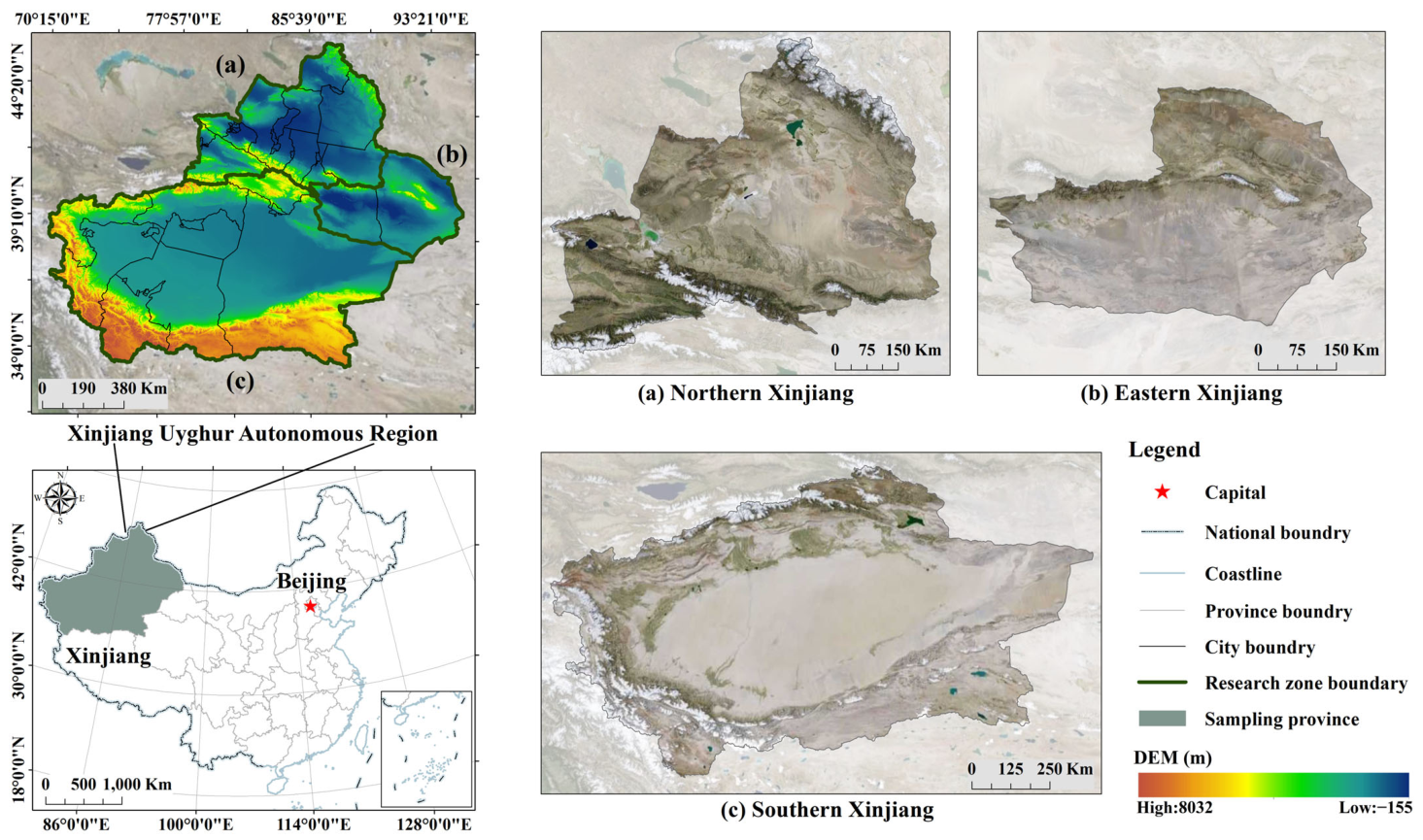
2.1. The Study Area
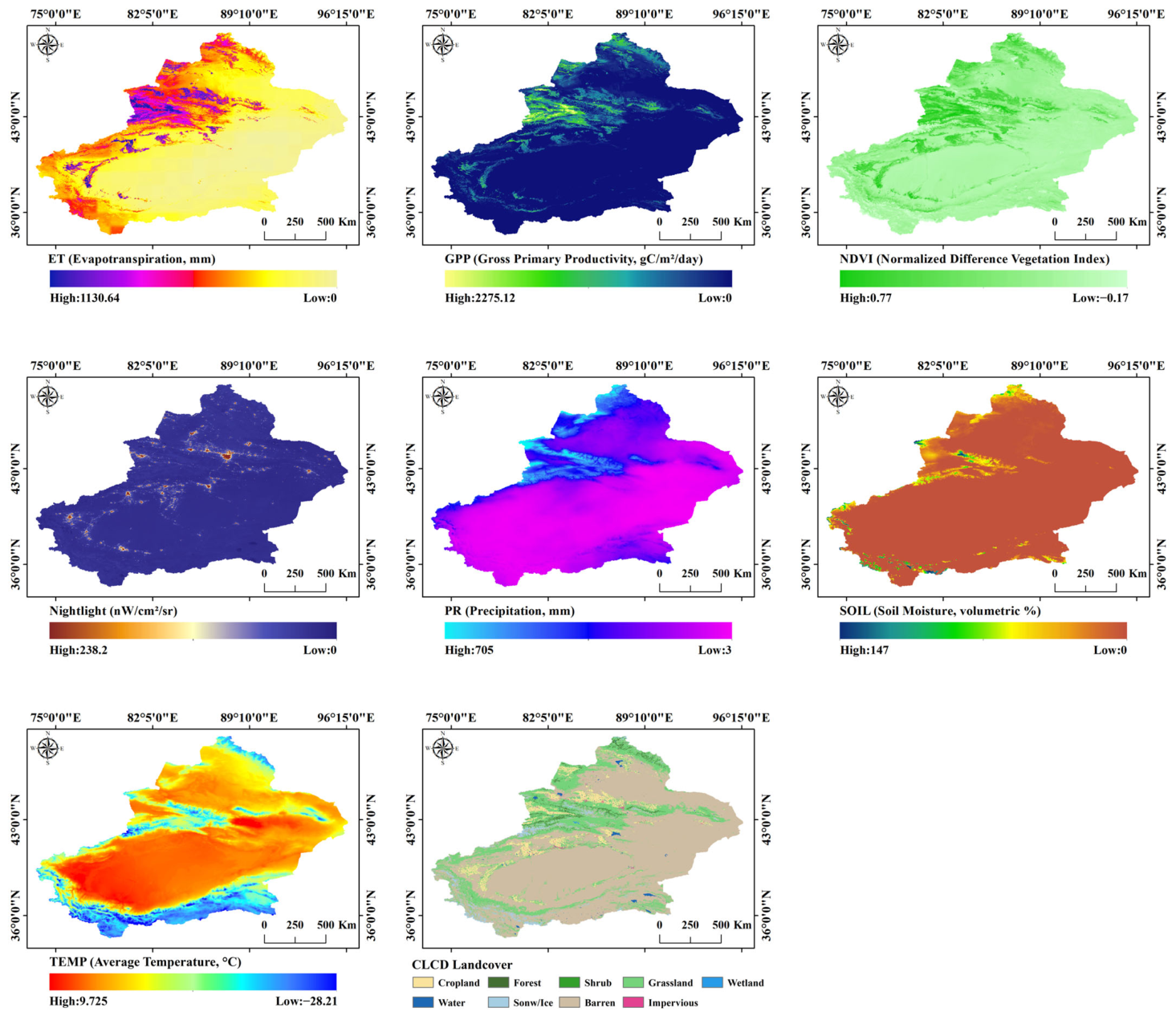
2.2. Data Sources and Processing
2.3. Algorithm
2.3.1. Construction of Integrated Ecohydrological Indices and Coupling Diagnostics
- (1)
- Composite Assessment via Ecohydrological Principal Index (EcoIndex)
- (2)
- Continuous Assessment via Ecohydrological Synchrony Index (ESI)
- (3)
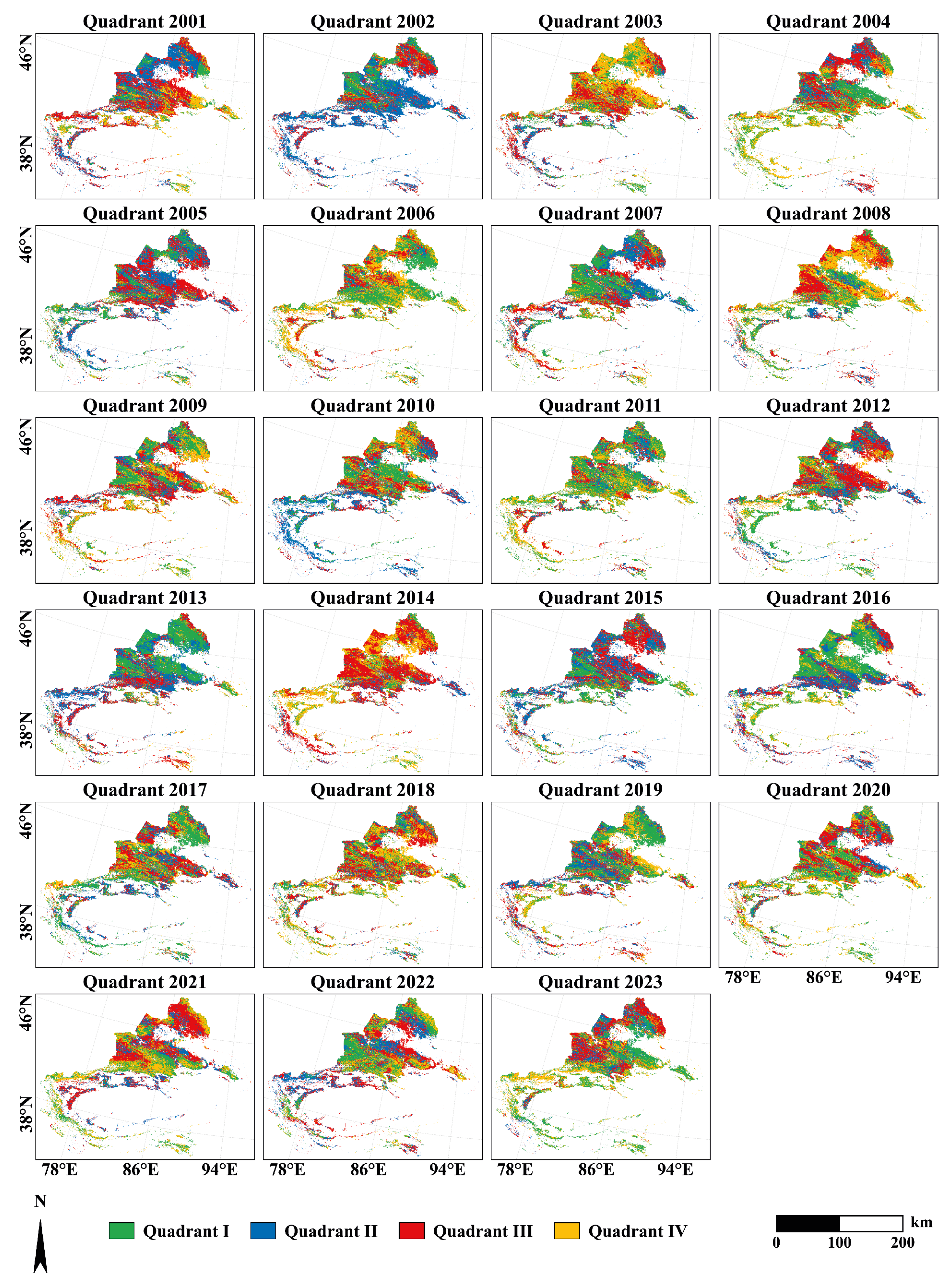
- Categorical Assessment via Quadrant Transition Mapping
2.3.2. Detection of Temporal Trends in Ecohydrological Processes
2.3.3. Attribution of Ecohydrological Dynamics via Ensemble Driver Modeling
3. Results
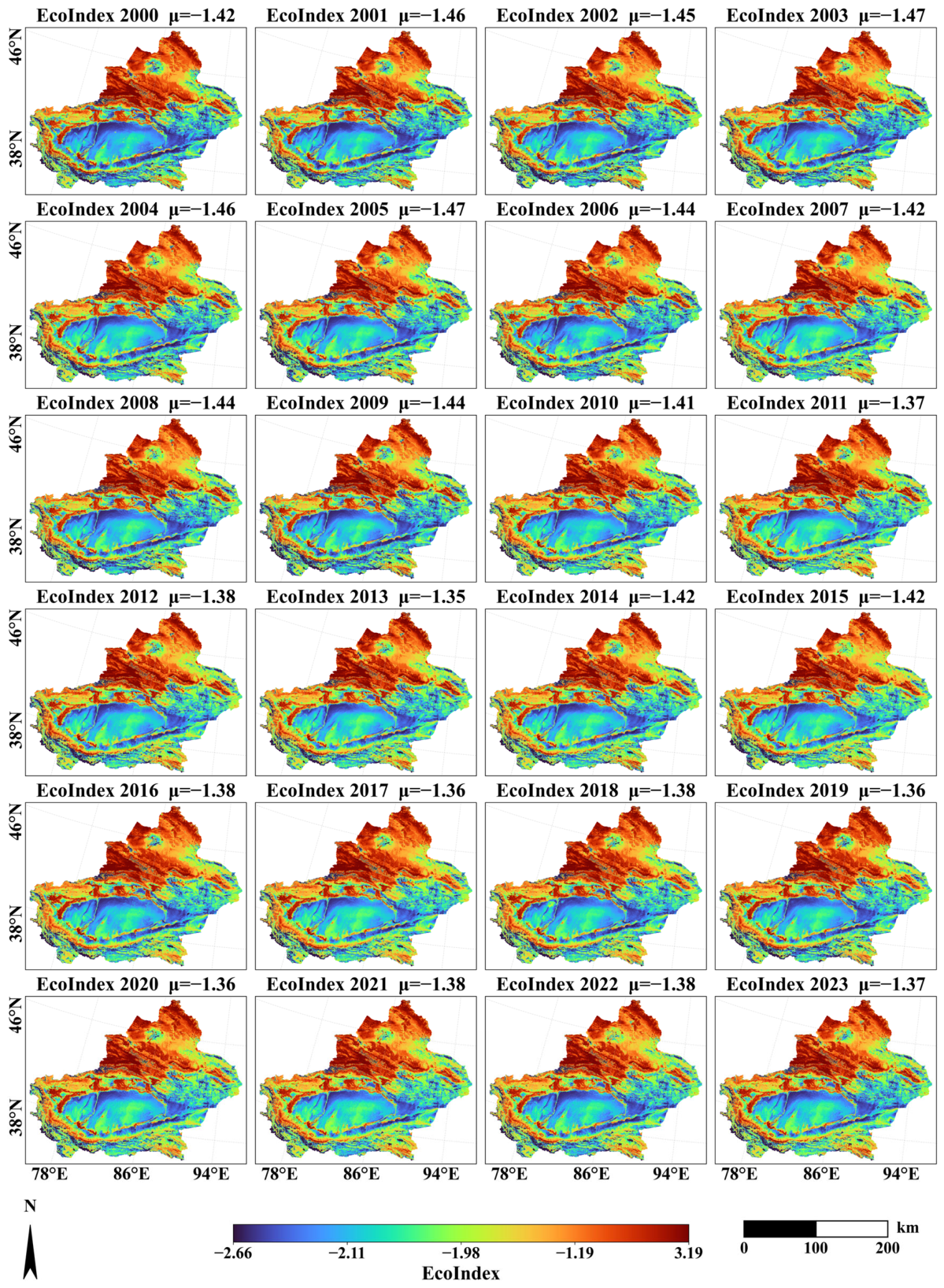
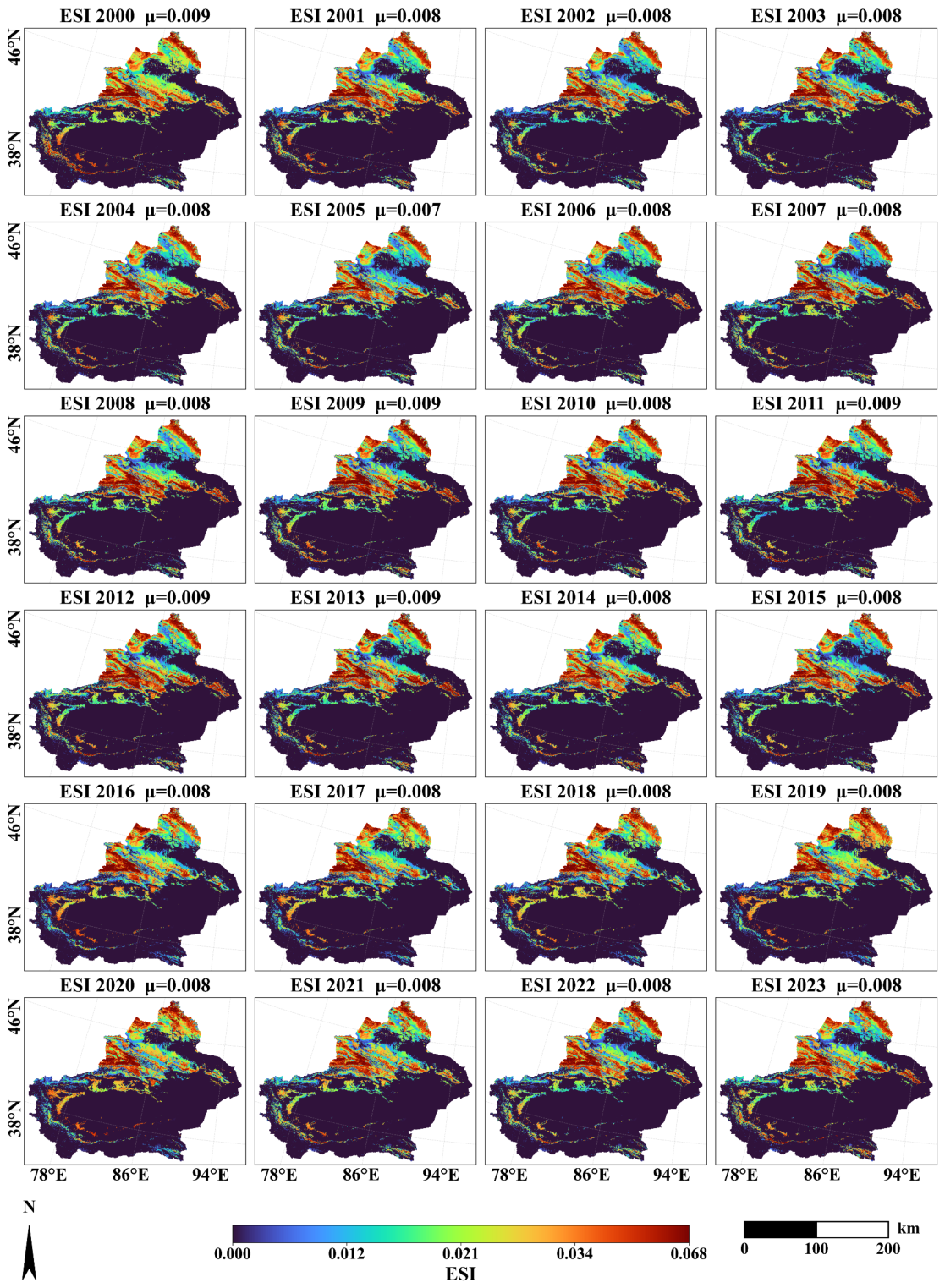
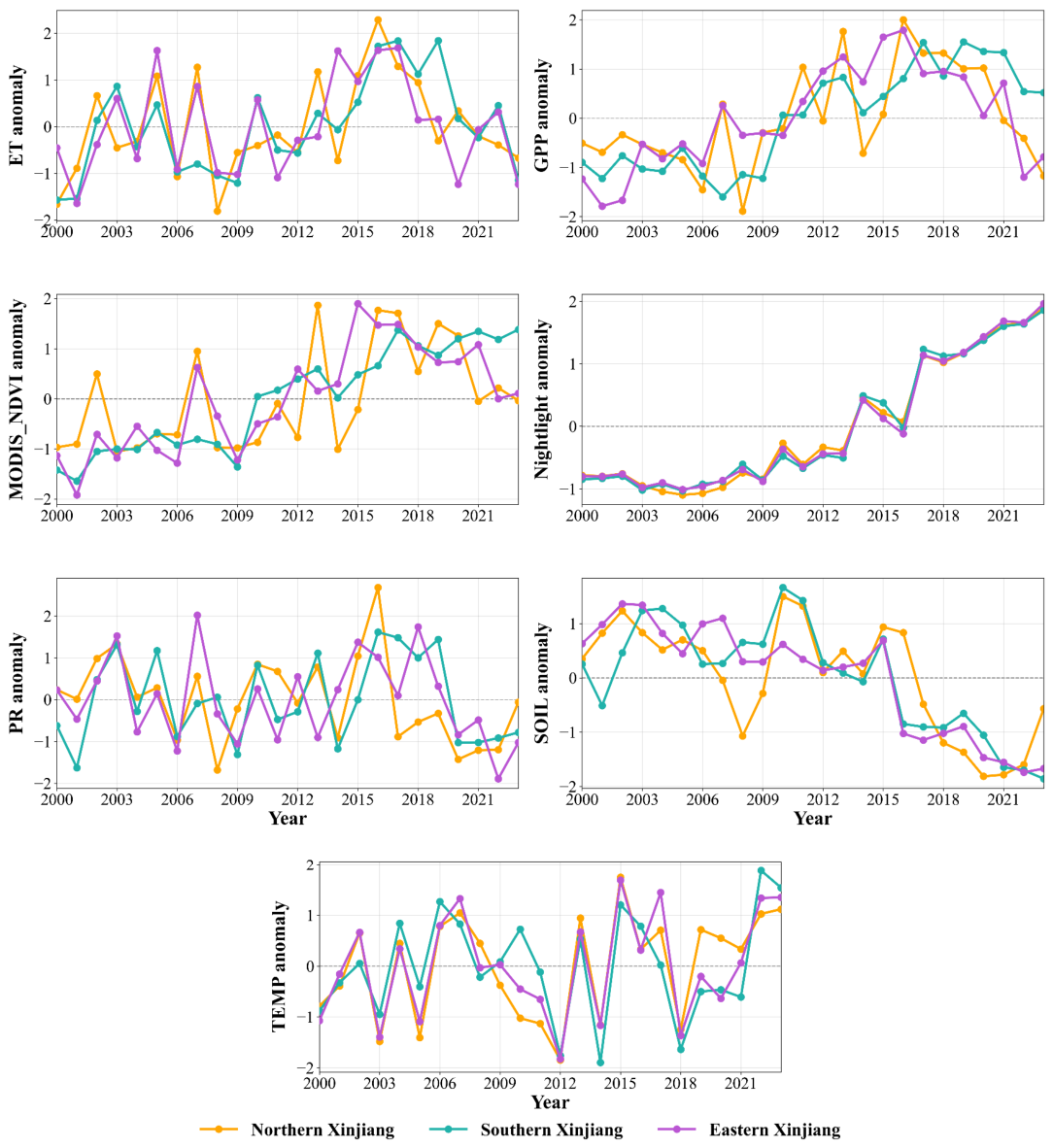
3.1. Spatiotemporal Dynamics of Eco-Structural Traits in Xinjiang (2000–2023)
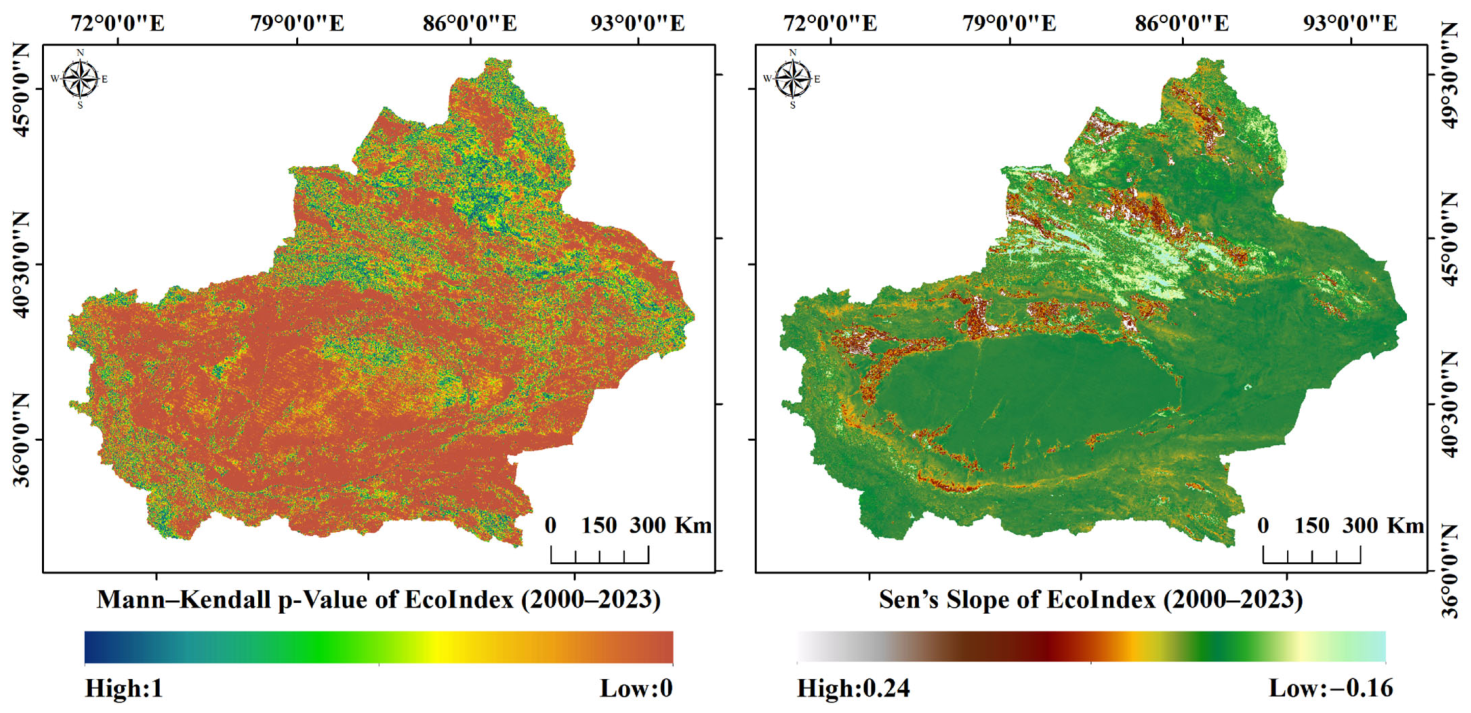
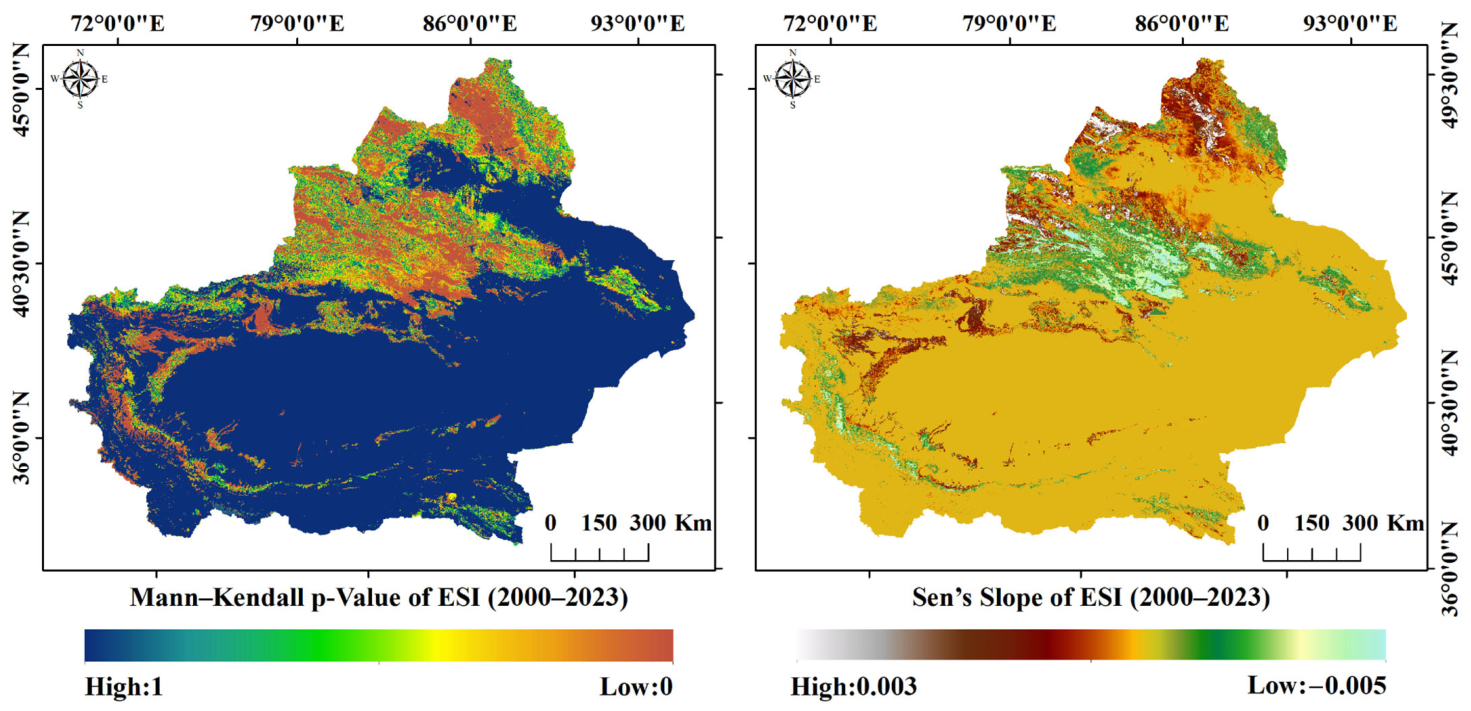
3.2. Temporal Trends of Eco-Hydrological Dynamics in Xinjiang (2000–2023)
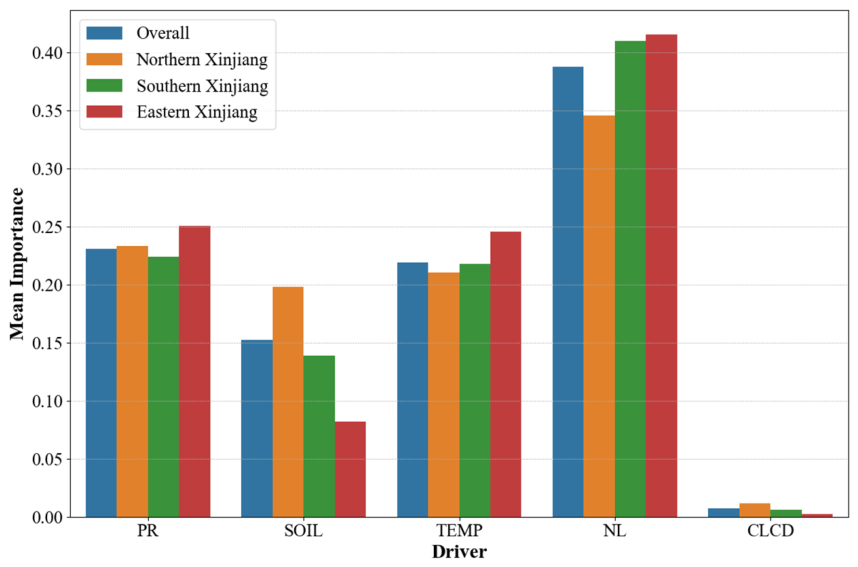
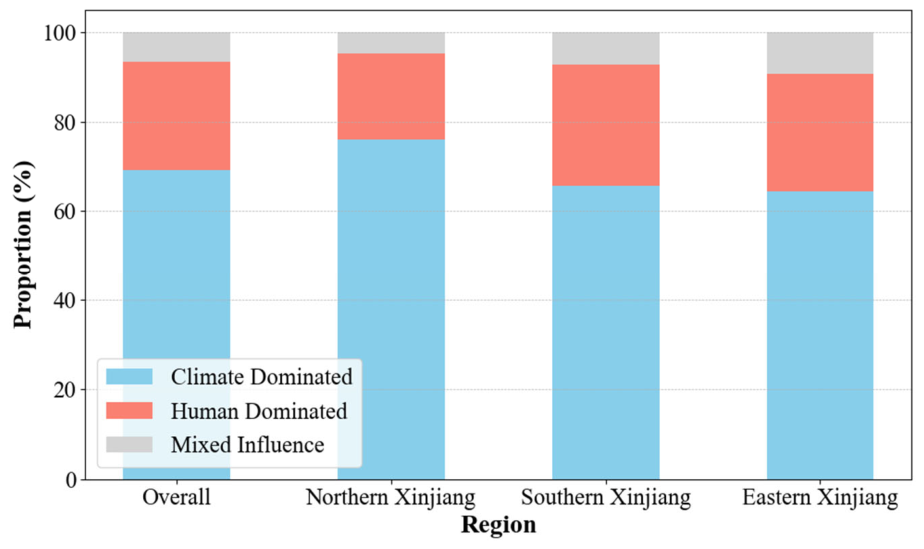
3.3. Attribution of Climatic and Anthropogenic Drivers of Eco-Hydrological Changes Across Xinjiang
4. Discussion
4.1. Climatic Forcing as the Structural Backbone of Eco-Hydrological Dynamics
4.2. Anthropogenic Disruptions and the Amplification of Localized Eco-Hydrological Instabilities
4.3. Emergent Mixed Influence Zones and Coupled Socio-Ecological Fragility
4.4. Methodological Reflections and Analytical Robustness
5. Conclusions
Author Contributions
Funding
Institutional Review Board Statement
Informed Consent Statement
Data Availability Statement
Conflicts of Interest
References
- Ma, Z.; Dong, C.; Tang, Z.; Wang, N. Altitude-Dependent Responses of Dryland Mountain Ecosystems to Drought under a Warming Climate in the Qilian Mountains, NW China. J. Hydrol. 2024, 630, 130763. [Google Scholar] [CrossRef]
- Olsoy, P.; Mitchell, J.; Glenn, N.; Flores, A. Assessing a Multi-Platform Data Fusion Technique in Capturing Spatiotemporal Dynamics of Heterogeneous Dryland Ecosystems in Topographically Complex Terrain. Remote Sens. 2017, 9, 981. [Google Scholar] [CrossRef]
- Peterson, G.; Westfall, D. Managing Precipitation Use in Sustainable Dryland Agroecosystems. Ann. Appl. Biol. 2004, 144, 127–138. [Google Scholar] [CrossRef]
- Bai, H.; Li, L.; Wu, Y.; Liu, C.; Gong, Z.; Feng, G.; Sun, G. Study on the Influence of Meteorological Elements on Growing Season Vegetation Coverage in Xinjiang, China. Electron. Res. Arch. 2022, 30, 3463–3480. [Google Scholar] [CrossRef]
- Bai, J.; Wang, N.; Hu, B.; Feng, C.; Wang, Y.; Peng, J.; Shi, Z. Integrating Multisource Information to Delineate Oasis Farmland Salinity Management Zones in Southern Xinjiang, China. Agric. Water Manag. 2023, 289, 108559. [Google Scholar] [CrossRef]
- Dinca, L.; Badea, O.; Guiman, G.; Braga, C.; Crisan, V.; Greavu, V.; Murariu, G.; Georgescu, L. Monitoring of Soil Moisture in Long-Term Ecological Research (LTER) Sites of Romanian Carpathians. Ann. For. Res. 2018, 61, 171–188. [Google Scholar] [CrossRef]
- Aboudrare, A.; Debaeke, P.; Bouaziz, A.; Chekli, H. Effects of Soil Tillage and Fallow Management on Soil Water Storage and Sunflower Production in a Semi-Arid Mediterranean Climate. Agric. Water Manag. 2006, 83, 183–196. [Google Scholar] [CrossRef]
- Azad, M.; Jalali, M.; Sattari, M.; Mastouri, R. Evaporation and Precipitation Prediction for Future Time Frames via Combined Machine Learning-Climate Change Models: Quri Gol Wetland Case. J. Agric. Sci.-Tarim Bilim. Derg. 2025, 30, 447–469. [Google Scholar] [CrossRef]
- Bai, X.; Fan, Z.; Yue, T. Dynamic Pattern-Effect Relationships between Precipitation and Vegetation in the Semi-Arid and Semi-Humid Area of China. Catena 2023, 232, 107425. [Google Scholar] [CrossRef]
- Dong, Z.; Ji, X.; Ma, K. Detection and Attribution of Eco-Hydrological Alteration Based on Deep Learning-Driven Gap-Filled Runoff in a Large-Scale Catchment. J. Hydrol.-Reg. Stud. 2025, 58, 102228. [Google Scholar] [CrossRef]
- Abel, C.; Horion, S.; Tagesson, T.; Brandt, M.; Fensholt, R. Towards Improved Remote Sensing Based Monitoring of Dryland Ecosystem Functioning Using Sequential Linear Regression Slopes (SeRGS). Remote Sens. Environ. 2019, 224, 317–332. [Google Scholar] [CrossRef]
- Adil, M.; Lu, S.; Yao, Z.; Zhang, C.; Lu, H.; Bashir, S.; Maitah, M.; Gul, I.; Razzaq, S.; Qiu, L. No-Tillage Enhances Soil Water Storage, Grain Yield and Water Use Efficiency in Dryland Wheat (Triticum aestivum) and Maize (Zea mays) Cropping Systems: A Global Meta-Analysis. Funct. Plant Biol. 2024, 51, FP23267. [Google Scholar] [CrossRef]
- Al-Kindi, K.; Al Nadhairi, R.; Al Akhzami, S. Dynamic Change in Normalised Vegetation Index (NDVI) from 2015 to 2021 in Dhofar, Southern Oman in Response to the Climate Change. Agriculture 2023, 13, 592. [Google Scholar] [CrossRef]
- Anees, S.; Mehmood, K.; Rehman, A.; Rehman, N.; Muhammad, S.; Shahzad, F.; Hussain, K.; Luo, M.; Alarfaj, A.; Alharbi, S.; et al. Unveiling Fractional Vegetation Cover Dynamics: A Spatiotemporal Analysis Using MODIS NDVI and Machine Learning. Environ. Sustain. Indic. 2024, 24, 100485. [Google Scholar] [CrossRef]
- Adak, T.; Kumar, G.; Chakravarty, N.V.K.; Katiyar, R.K.; Deshmukh, P.S.; Joshi, H.C. Biomass and Biomass Water Use Efficiency in Oilseed Crop (Brassica juncea L.) under Semi-Arid Microenvironments. Biomass Bioenergy 2013, 51, 154–162. [Google Scholar] [CrossRef]
- Qin, L.; Yuan, Y.; Shang, H.; Yu, S.; Liu, W.; Zhang, R. Impacts of Global Warming on the Radial Growth and Long-Term Intrinsic Water-Use Efficiency (iWUE) of Schrenk Spruce (Picea Schrenkiana Fisch. et Mey) in the Sayram Lake Basin, Northwest China. Forests 2020, 11, 380. [Google Scholar] [CrossRef]
- Alvarez-Cabria, M.; Barquín, J.; Peñas, F. Modelling the Spatial and Seasonal Variability of Water Quality for Entire River Networks: Relationships with Natural and Anthropogenic Factors. Sci. Total Environ. 2016, 545, 152–162. [Google Scholar] [CrossRef] [PubMed]
- Chen, C.; Dong, T.; Wang, Z.; Wang, C.; Song, W.; Zhang, H. Exploring Optimal Features and Image Analysis Methods for Crop Type Classification from the Perspective of Crop Landscape Heterogeneity. Remote Sens. Appl.-Soc. Environ. 2024, 36, 101308. [Google Scholar] [CrossRef]
- Huang, T.; Ou, G.; Wu, Y.; Zhang, X.; Liu, Z.; Xu, H.; Xu, X.; Wang, Z.; Xu, C. Estimating the Aboveground Biomass of Various Forest Types with High Heterogeneity at the Provincial Scale Based on Multi-Source Data. Remote Sens. 2023, 15, 3550. [Google Scholar] [CrossRef]
- Li, S.; Li, X.; Gong, J.; Dang, D.; Dou, H.; Lyu, X. Quantitative Analysis of Natural and Anthropogenic Factors Influencing Vegetation NDVI Changes in Temperate Drylands from a Spatial Stratified Heterogeneity Perspective: A Case Study of Inner Mongolia Grasslands, China. Remote Sens. 2022, 14, 3320. [Google Scholar] [CrossRef]
- Kafy, A.-A.; Bakshi, A.; Saha, M.; Al Faisal, A.; Almulhim, A.; Rahaman, Z.; Mohammad, P. Assessment and Prediction of Index Based Agricultural Drought Vulnerability Using Machine Learning Algorithms. Sci. Total Environ. 2023, 867, 161394. [Google Scholar] [CrossRef]
- Abdullah, S.; Barua, D. Combining Geographical Information System (GIS) and Machine Learning to Monitor and Predict Vegetation Vulnerability: An Empirical Study on Nijhum Dwip, Bangladesh. Ecol. Eng. 2022, 178, 106577. [Google Scholar] [CrossRef]
- Attia, A.; Govind, A.; Qureshi, A.S.; Feike, T.; Rizk, M.S.; Shabana, M.M.A.; Kheir, A.M.S. Coupling Process-Based Models and Machine Learning Algorithms for Predicting Yield and Evapotranspiration of Maize in Arid Environments. Water 2022, 14, 3647. [Google Scholar] [CrossRef]
- Du, L.-T.; Ma, L.-L.; Pan, H.-Z.; Qiao, C.-L.; Meng, C.; Wu, H.-Y.; Tian, J.; Yuan, H.-Y. Carbon-Water Coupling and Its Relationship with Environmental and Biological Factors in a Planted Caragana Liouana Shrub Community in Desert Steppe, Northwest China. J. Plant Ecol. 2022, 15, 947–960. [Google Scholar] [CrossRef]
- Al Saadi, F.; Parra-Rivas, P. Transitions between Dissipative Localized Structures in the Simplified Gilad-Meron Model for Dryland Plant Ecology. Chaos 2023, 33, 033129. [Google Scholar] [CrossRef]
- Pandey, A.; Islam, A.; Parida, B.; Dwivedi, C. Permafrost Destabilization Induced Hazard Mapping in Himalayas Using Machine Learning Methods. Adv. Space Res. 2025, 75, 6188–6206. [Google Scholar] [CrossRef]
- Castillo-Riffart, I.; Galleguillos, M.; Lopatin, J.; Perez-Quezada, J. Predicting Vascular Plant Diversity in Anthropogenic Peatlands: Comparison of Modeling Methods with Free Satellite Data. Remote Sens. 2017, 9, 681. [Google Scholar] [CrossRef]
- Abraham, A.; Kundapura, S. Assessing the Impacts of Land Use, Land Cover, and Climate Change on the Hydrological Regime of a Humid Tropical Basin. Nat. Hazards Rev. 2023, 24, 05023009. [Google Scholar] [CrossRef]
- Acharki, S.; Raza, A.; Vishwakarma, D.; Amharref, M.; Bernoussi, A.; Singh, S.; Al-Ansari, N.; Dewidar, A.; Al-Othman, A.; Mattar, M. Comparative Assessment of Empirical and Hybrid Machine Learning Models for Estimating Daily Reference Evapotranspiration in Sub-Humid and Semi-Arid Climates. Sci. Rep. 2025, 15, 2542. [Google Scholar] [CrossRef] [PubMed]
- Georgescu, L.; Balsalobre-Lorente, D.; Zlati, M.; Fortea, C.; Antohi, V.; Barbuta-Misu, N. Cluster Analysis of the Transition to Climate Neutrality in the European Union. Sustain. Dev. 2025, 33, 1498–1519. [Google Scholar] [CrossRef]
- Alsafadi, K.; Bashir, B.; Mohammed, S.; Abdo, H.G.; Mokhtar, A.; Alsalman, A.; Cao, W. Response of Ecosystem Carbon-Water Fluxes to Extreme Drought in West Asia. Remote Sens. 2024, 16, 1179. [Google Scholar] [CrossRef]
- Chen, Y.; Li, J.; Ju, W.; Ruan, H.; Qin, Z.; Huang, Y.; Jeelani, N.; Padarian, J.A.; Propastin, P. Quantitative Assessments of Water-Use Efficiency in Temperate Eurasian Steppe along an Aridity Gradient. PLoS ONE 2017, 12, e0179875. [Google Scholar] [CrossRef]
- Bai, Y.; Zha, T.; Bourque, C.P.-A.; Jia, X.; Ma, J.; Liu, P.; Yang, R.; Li, C.; Du, T.; Wu, Y. Variation in Ecosystem Water Use Efficiency along a Southwest-to-Northeast Aridity Gradient in China. Ecol. Indic. 2020, 110, 105932. [Google Scholar] [CrossRef]
- Cai, P.; Li, C.; Luo, G.; Zhang, C.; Ochege, F.U.; Caluwaerts, S.; De Cruz, L.; De Troch, R.; Top, S.; Termonia, P.; et al. The Responses of the Ecosystems in the Tianshan North Slope under Multiple Representative Concentration Pathway Scenarios in the Middle of the 21st Century. Sustainability 2020, 12, 427. [Google Scholar] [CrossRef]
- Fu, B. Ecological and environmental effects of land-use changes in the Loess Plateau of China. Chin. Sci. Bull.-Chin. 2022, 67, 3768–3779. [Google Scholar] [CrossRef]
- Zhang, J.; Zhang, P.; Deng, X.; Ren, C.; Deng, M.; Wang, S.; Lai, X.; Long, A. Study on the Spatial and Temporal Trends of Ecological Environment Quality and Influencing Factors in Xinjiang Oasis. Remote Sens. 2024, 16, 1980. [Google Scholar] [CrossRef]
- Kong, J.; Zan, M.; Chen, Z.; Xue, C.; Yang, S. Study on the Response of Vegetation Water Use Efficiency to Drought in the Manas River Basin, Xinjiang, China. Forests 2024, 15, 114. [Google Scholar] [CrossRef]
- Reddy, K.S.; Maruthi, V.; Pankaj, P.K.; Kumar, M.; Pushpanjali; Prabhakar, M.; Reddy, A.G.K.; Reddy, K.S.; Singh, V.K.; Koradia, A.K. Water Footprint Assessment of Rainfed Crops with Critical Irrigation under Different Climate Change Scenarios in SAT Regions. Water 2022, 14, 1206. [Google Scholar] [CrossRef]
- Agarwal, S.; Nagendra, H. Classification of Indian Cities Using Google Earth Engine. J. Land Use Sci. 2019, 14, 425–439. [Google Scholar] [CrossRef]
- Alemu, H.; Senay, G.; Kaptue, A.; Kovalskyy, V. Evapotranspiration Variability and Its Association with Vegetation Dynamics in the Nile Basin, 2002–2011. Remote Sens. 2014, 6, 5885–5908. [Google Scholar] [CrossRef]
- Xie, S.; Mo, X.; Hu, S.; Liu, S. Contributions of Climate Change, Elevated Atmospheric CO2 and Human Activities to ET and GPP Trends in the Three-North Region of China. Agric. For. Meteorol. 2020, 295, 108183. [Google Scholar] [CrossRef]
- Ali, S.; Xu, Y.; Jia, Q.; Ma, X.; Ahmad, I.; Adnan, M.; Gerard, R.; Ren, X.; Zhang, P.; Cai, T.; et al. Interactive Effects of Plastic Film Mulching with Supplemental Irrigation on Winter Wheat Photosynthesis, Chlorophyll Fluorescence and Yield under Simulated Precipitation Conditions. Agric. Water Manag. 2018, 207, 1–14. [Google Scholar] [CrossRef]
- Bejagam, V.; Sharma, A. Remote Sensing-Based Multi-Scale Characterization of Ecohydrological Indicators (EHIs) in India. Ecol. Eng. 2023, 187, 106841. [Google Scholar] [CrossRef]
- Chen, S.; Fu, Y.; Hao, F.; Li, X.; Zhou, S.; Liu, C.; Tang, J. Vegetation Phenology and Its Ecohydrological Implications from Individual to Global Scales. Geogr. Sustain. 2022, 3, 334–338. [Google Scholar] [CrossRef]
- Adebayo, O.; Singh, A.; Bista, P.; Angadi, S.; Ghimire, R. Compost Addition Improves Soil Water Storage and Crop Water Productivity in Cover Crop Integrated Sorghum Production System under a Limited Irrigation Management. Irrig. Sci. 2025, 43, 1559–1573. [Google Scholar] [CrossRef]
- Ali, S.; Jan, A.; Manzoor; Sohail, A.; Khan, A.; Khan, M.I.; Inamullah; Zhang, J.; Daur, I. Soil Amendments Strategies to Improve Water-Use Efficiency and Productivity of Maize under Different Irrigation Conditions. Agric. Water Manag. 2018, 210, 88–95. [Google Scholar] [CrossRef]
- Jiang, Z.; Ni, X.; Xing, M. A Study on Spatial and Temporal Dynamic Changes of Desertification in Northern China from 2000 to 2020. Remote Sens. 2023, 15, 1368. [Google Scholar] [CrossRef]
- Liu, X.; de Sherbinin, A.; Zhan, Y. Mapping Urban Extent at Large Spatial Scales Using Machine Learning Methods with VIIRS Nighttime Light and MODIS Daytime NDVI Data. Remote Sens. 2019, 11, 1247. [Google Scholar] [CrossRef]
- Arshad, S.; Kazmi, J.; Prodhan, F.; Mohammed, S. Exploring Dynamic Response of Agrometeorological Droughts towards Winter Wheat Yield Loss Risk Using Machine Learning Approach at a Regional Scale in Pakistan. Field Crops Res. 2023, 302, 109057. [Google Scholar] [CrossRef]
- Bahrami, H.; Homayouni, S.; McNairn, H.; Hosseini, M.; Mahdianpari, M. Regional Crop Characterization Using Multi-Temporal Optical and Synthetic Aperture Radar Earth Observations Data. Can. J. Remote Sens. 2022, 48, 258–277. [Google Scholar] [CrossRef]
- Abdi, B.; Kolo, K.; Shahabi, H. Assessment of Land Degradation Susceptibility within the Shaqlawa Subregion of Northern Iraq-Kurdistan Region via Synergistic Application of Remotely Acquired Datasets and Advanced Predictive Models. Environ. Monit. Assess. 2024, 196, 1103. [Google Scholar] [CrossRef]
- Burrell, A.; Evans, J.; Liu, Y. Detecting Dryland Degradation Using Time Series Segmentation and Residual Trend Analysis (TSS-RESTREND). Remote Sens. Environ. 2017, 197, 43–57. [Google Scholar] [CrossRef]
- Shi, Y.; Jin, N.; Ma, X.; Wu, B.; He, Q.; Yue, C.; Yu, Q. Attribution of Climate and Human Activities to Vegetation Change in China Using Machine Learning Techniques. Agric. For. Meteorol. 2020, 294, 108146. [Google Scholar] [CrossRef]
- Edwin, I.; Chukwuka, O.; Ochege, F.; Ling, Q.; Chen, B.; Nzabarinda, V.; Ajaero, C.; Hamdi, R.; Luo, G. Quantifying Land Change Dynamics, Resilience and Feedback: A Comparative Analysis of the Lake Chad Basin in Africa and Aral Sea Basin in Central Asia. J. Environ. Manag. 2024, 361, 121218. [Google Scholar] [CrossRef]
- Kaur, H.; Huggins, D.; Rupp, R.; Abatzoglou, J.; Stöckle, C.; Reganold, J. Agro-Ecological Class Stability Decreases in Response to Climate Change Projections for the Pacific Northwest, USA. Front. Ecol. Evol. 2017, 5, 74. [Google Scholar] [CrossRef]
- Acharki, S.; Singh, S.; do Couto, E.; Arjdal, Y.; Elbeltagi, A. Spatio-Temporal Distribution and Prediction of Agricultural and Meteorological Drought in a Mediterranean Coastal Watershed via GIS and Machine Learning. Phys. Chem. Earth 2023, 131, 103425. [Google Scholar] [CrossRef]
- Aguilar, R.; Zurita-Milla, R.; Izquierdo-Verdiguier, E.; de By, R. A Cloud-Based Multi-Temporal Ensemble Classifier to Map Smallholder Farming Systems. Remote Sens. 2018, 10, 729. [Google Scholar] [CrossRef]
- Ablat, X.; Liu, G.; Liu, Q.; Huang, C. Application of Landsat Derived Indices and Hydrological Alteration Matrices to Quantify the Response of Floodplain Wetlands to River Hydrology in Arid Regions Based on Different Dam Operation Strategies. Sci. Total Environ. 2019, 688, 1389–1404. [Google Scholar] [CrossRef]
- Akbas, E.; Celik, R.; Esit, M.; Deger, I. Climate Change Impacts on Hydrological and Meteorological Variables in Diyarbakır Province: Trend Analysis and Machine Learning-Based Drought Forecasting. Theor. Appl. Climatol. 2025, 156, 295. [Google Scholar] [CrossRef]
- Al-Ghobari, H.M.; Mohammad, F.S.; El Marazky, M.S.A.; Dewidar, A.Z. Automated Irrigation Systems for Wheat and Tomato Crops in Arid Regions. Water SA 2017, 43, 354–364. [Google Scholar] [CrossRef]
- Yin, X.; Feng, Q.; Zheng, X.; Wu, X.; Zhu, M.; Sun, F.; Li, Y. Assessing the Impacts of Irrigated Agriculture on Hydrological Regimes in an Oasis-Desert System. J. Hydrol. 2021, 594, 125976. [Google Scholar] [CrossRef]
- de Almeida, C.; Galvao, L.; Ometto, J.; Jacon, A.; Pereira, F.; Sato, L.; Silva, C.J.; Brancalion, P.; de Aragao, L. Advancing Forest Degradation and Regeneration Assessment Through Light Detection and Ranging and Hyperspectral Imaging Integration. Remote Sens. 2024, 16, 3935. [Google Scholar] [CrossRef]
- Huang, D.; Cao, S.; Zhao, W.; Zhao, P.; Chen, J.; Yu, M.; Zhu, Z. Urban Greening amidst Global Change: A Comparative Study of Vegetation Dynamics in Two Urban Agglomerations in China under Climatic and Anthropogenic Pressures. Ecol. Indic. 2024, 159, 111739. [Google Scholar] [CrossRef]
- Araya, A.; Kisekka, I.; Prasad, P.V.V.; Holman, J.; Foster, A.J.; Lollato, R. Assessing Wheat Yield, Biomass, and Water Productivity Responses to Growth Stage Based Irrigation Water Allocation. Trans. ASABE 2017, 60, 107–121. [Google Scholar] [CrossRef]
- An, X. Responses of Water Use Efficiency to Climate Change in Evapotranspiration and Transpiration Ecosystems. Ecol. Indic. 2022, 141, 109157. [Google Scholar] [CrossRef]







| Category | Data Name | Source/Product | Unit | Temporal Aggregation | Target Resolution |
|---|---|---|---|---|---|
| Baseline Indicator | CLCD | Zenodo/China Land Cover Dataset | class index | annual | 825 m |
| Process Indicator | ET | NASA MODIS ET product | mm | annual sum/annual mean | 825 m |
| Process Indicator | GPP | NASA MODIS GPP product | annual mean/sum | 825 m | |
| Process Indicator | NDVI | MODIS NDVI product | dimensionless | annual mean | 825 m |
| Driver | Nighttime light | NOAA/EOG intercalibrated annual nighttime light product | annual composite/annual mean | 825 m | |
| Driver | PR | TerraClimate precipitation | mm | annual sum | 825 m |
| Driver | SOIL | TerraClimate soil moisture | product-defined unit | annual mean | 825 m |
| Driver | TEMP | TerraClimate average temperature | °C | annual mean | 825 m |
| Quadrant | Condition | Ecological Interpretation |
|---|---|---|
| I | Simultaneous enhancement of water use efficiency and vegetation growth | |
| II | Vegetation gain despite declining water efficiency (potential water stress relaxation) | |
| III | Co-degradation of water efficiency and vegetation productivity | |
| IV | Water conservation accompanied by vegetation decline (emerging vegetation stress) |
| Region | Indicator | Up (%) | Down (%) | Stable (%) | Mean Slope (Up) | Mean Slope (Down) |
|---|---|---|---|---|---|---|
| Overall | EcoIndex | 44.01 | 3.35 | 52.64 | 0.0107 | −0.0211 |
| Overall | ESI | 5.17 | 3.11 | 91.71 | 0.0005 | −0.0004 |
| Northern Xinjiang | EcoIndex | 18.60 | 7.02 | 74.39 | 0.0401 | −0.0271 |
| Northern Xinjiang | ESI | 13.93 | 6.68 | 79.39 | 0.0006 | −0.0005 |
| Southern Xinjiang | EcoIndex | 54.91 | 2.17 | 42.92 | 0.0079 | −0.0167 |
| Southern Xinjiang | ESI | 2.86 | 2.21 | 94.94 | 0.0004 | −0.0004 |
| Eastern Xinjiang | EcoIndex | 37.50 | 2.32 | 60.17 | 0.0041 | −0.0075 |
| Eastern Xinjiang | ESI | 0.20 | 0.91 | 98.89 | 0.0005 | −0.0004 |
| Region | PR Mean | PR Median | SOIL Mean | SOIL Median | TEMP Mean | TEMP Median | NL Mean | NL Median | CLCD Mean | CLCD Median |
|---|---|---|---|---|---|---|---|---|---|---|
| Overall | 0.248 | 0.218 | 0.233 | 0.202 | 0.174 | 0.14 | 0.166 | 0.127 | 0.179 | 0.139 |
| Northern Xinjiang | 0.295 | 0.261 | 0.259 | 0.228 | 0.198 | 0.157 | 0.135 | 0.096 | 0.113 | 0.075 |
| Southern Xinjiang | 0.222 | 0.194 | 0.215 | 0.185 | 0.157 | 0.13 | 0.205 | 0.174 | 0.209 | 0.171 |
| Eastern Xinjiang | 0.21 | 0.18 | 0.197 | 0.168 | 0.142 | 0.113 | 0.172 | 0.144 | 0.186 | 0.156 |
| Region | Climate Dominated (%) | Human Dominated (%) | Mixed Influence (%) |
|---|---|---|---|
| Overall | 63.27 | 22.41 | 14.32 |
| Northern Xinjiang | 75.08 | 12.42 | 12.5 |
| Southern Xinjiang | 53.75 | 30.64 | 15.61 |
| Eastern Xinjiang | 55.8 | 23.49 | 20.71 |
Disclaimer/Publisher’s Note: The statements, opinions and data contained in all publications are solely those of the individual author(s) and contributor(s) and not of MDPI and/or the editor(s). MDPI and/or the editor(s) disclaim responsibility for any injury to people or property resulting from any ideas, methods, instructions or products referred to in the content. |
© 2026 by the authors. Licensee MDPI, Basel, Switzerland. This article is an open access article distributed under the terms and conditions of the Creative Commons Attribution (CC BY) license.
Share and Cite
Zhang, Q.; Ji, Y.; Zhang, D.; Zhu, A. Eco-Hydrological Change and Its Implications for Sustainable Dryland Management in Xinjiang, China: A Multi-Source Remote Sensing Assessment. Sustainability 2026, 18, 5478. https://doi.org/10.3390/su18115478
Zhang Q, Ji Y, Zhang D, Zhu A. Eco-Hydrological Change and Its Implications for Sustainable Dryland Management in Xinjiang, China: A Multi-Source Remote Sensing Assessment. Sustainability. 2026; 18(11):5478. https://doi.org/10.3390/su18115478
Chicago/Turabian StyleZhang, Qing, Yuqi Ji, Donghui Zhang, and Aijun Zhu. 2026. "Eco-Hydrological Change and Its Implications for Sustainable Dryland Management in Xinjiang, China: A Multi-Source Remote Sensing Assessment" Sustainability 18, no. 11: 5478. https://doi.org/10.3390/su18115478
APA StyleZhang, Q., Ji, Y., Zhang, D., & Zhu, A. (2026). Eco-Hydrological Change and Its Implications for Sustainable Dryland Management in Xinjiang, China: A Multi-Source Remote Sensing Assessment. Sustainability, 18(11), 5478. https://doi.org/10.3390/su18115478