From Code to Climate Action: Evaluating the Energy Efficiency Performance of the Saudi Building Code Across Climatic Zones and Its Alignment with Vision 2030 Sustainability Targets

Abstract
1. Introduction
2. Literature Review
2.1. Building Energy Governance: International Context
2.2. The Saudi Building Code: Development and Evidence Base
2.3. Mostadam and the Green Building Rating System Ecosystem in Saudi Arabia
3. Methodology
3.1. Research Design and Research Questions
3.2. Systematic Literature Review Protocol
3.3. EUI Data Synthesis and Normalisation
3.4. Climatic Zone Framework
3.5. Comparative Rating System Analysis
3.6. Policy Recommendation Framework
3.7. Systematic Literature Review Protocol
4. The Saudi Building Code: Architecture, Evolution, and Energy Performance
4.1. Code Architecture and the Sustainability Dimension
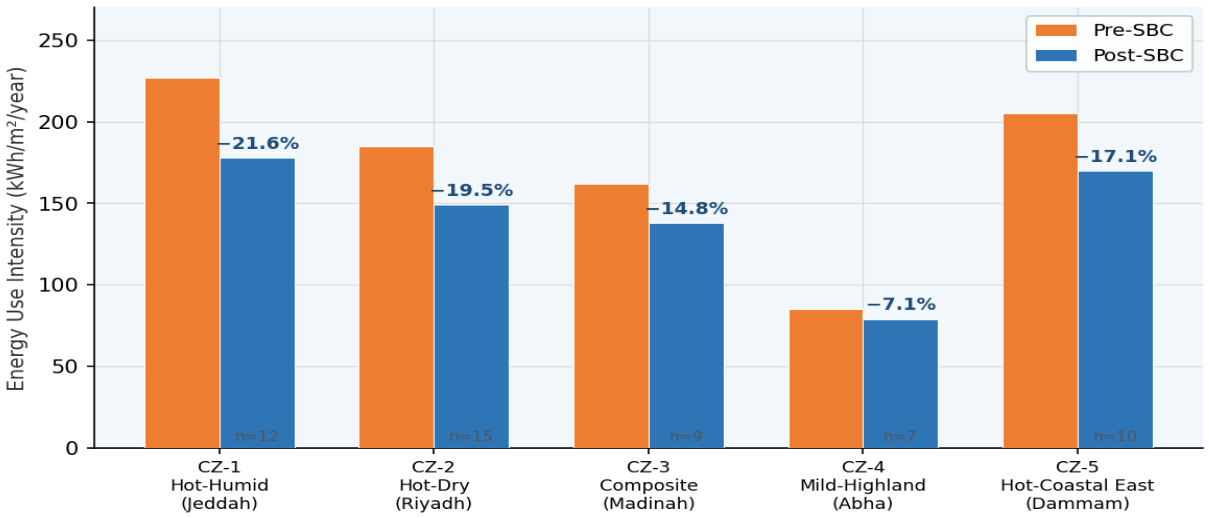
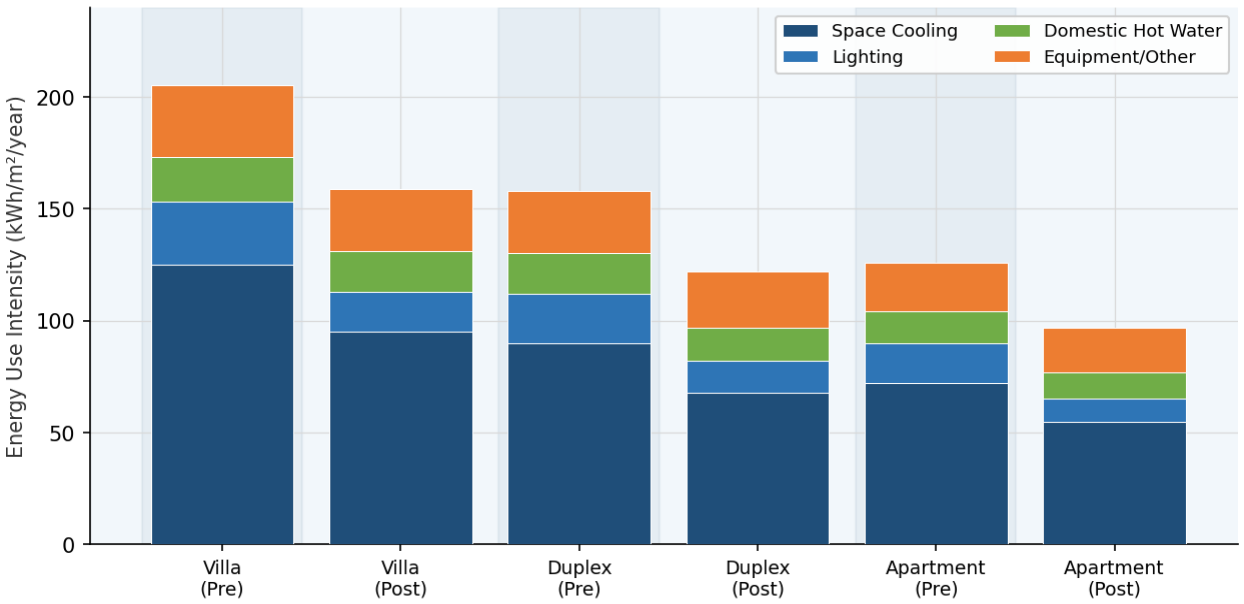
4.2. EUI Performance by Climatic Zone
4.3. Limitations of the Current Prescriptive Compliance Framework
5. The Mostadam Rating System: Suitability, Performance, and Comparative Position
5.1. Design Philosophy and Alignment with the SBC
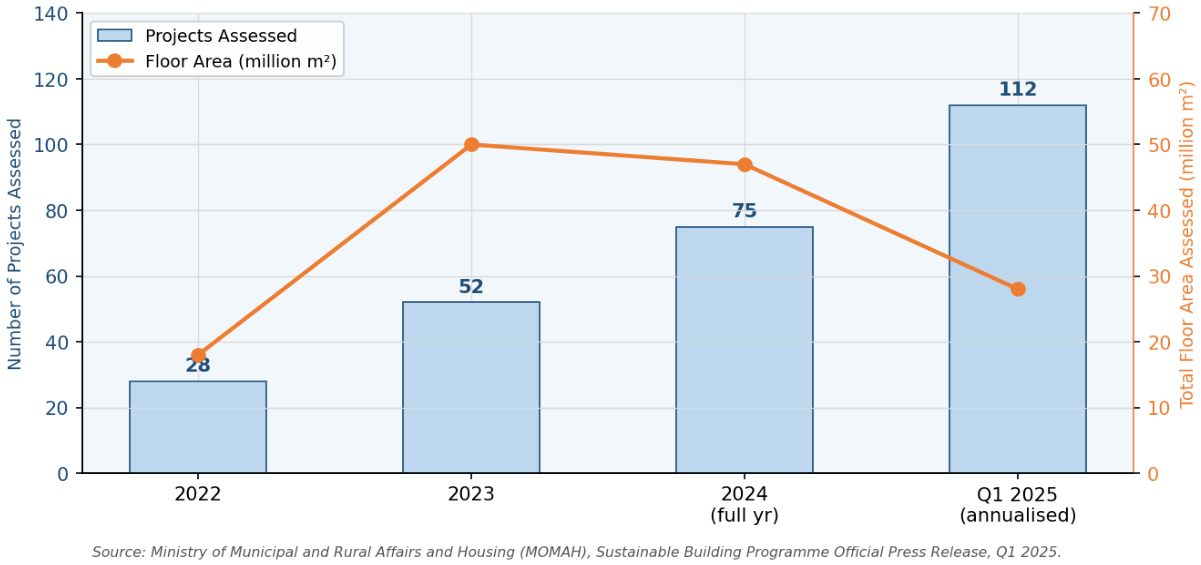
5.2. Adoption Trajectory and Market Reach
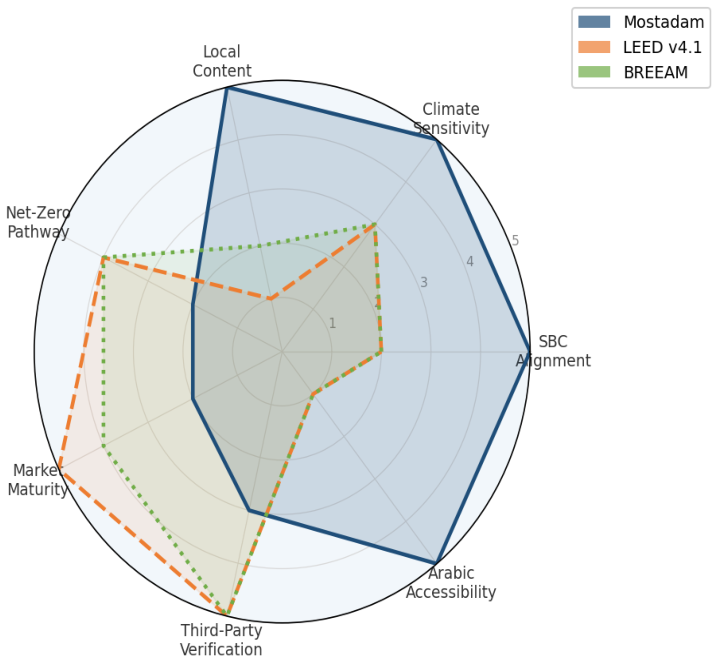
5.3. Comparative Analysis: Mostadam in the Saudi Context
6. Policy Recommendations: Toward Performance-Led Building Energy Governance
6.1. P1: Mandate Climate-Differentiated EUI Targets (★★★)
6.2. P2: Expand Mandatory Mostadam Scope (★★★)
6.3. P3: Performance-Based Compliance Path (★★)
6.4. P4: Link Mostadam to REDF Mortgage Incentives (★★★)
6.5. P5: National Post-Occupancy Monitoring System (★★)
6.6. P6: Minimum PV Thresholds in SBC 601 (★★)
6.7. P7: Capacity Building for Code Compliance Inspectors (★)
7. Discussion
7.1. Implications for Vision 2030 and Net-Zero Commitments
7.2. The Energy Efficiency Paradox and Policy Design
7.3. Limitations
7.4. Future Research Directions
8. Conclusions
Funding
Institutional Review Board Statement
Informed Consent Statement
Data Availability Statement
Conflicts of Interest
References
- Saudi Electricity Regulatory Authority (SERA). Energy Sales by Consumption Category and Year; SERA: Riyadh, Saudi Arabia, 2024.
- International Energy Agency (IEA). World Energy Outlook 2024; IEA: Paris, France, 2024. [Google Scholar]
- Kingdom of Saudi Arabia. Vision 2030: Ambitious Nation, Vibrant Society, Thriving Economy; Council of Economic and Development Affairs: Riyadh, Saudi Arabia, 2016. Available online: https://www.vision2030.gov.sa/ (accessed on 13 March 2026).
- Saudi Building Code National Committee. Saudi Building Code: Introduction and General Principles; Saudi Building Code Centre: Riyadh, Saudi Arabia, 2007.
- Saudi Building Code National Committee. Saudi Building Code: Energy Conservation Requirements SBC 601; Saudi Building Code Centre: Riyadh, Saudi Arabia, 2018.
- International Energy Agency (IEA). Saudi Green Building Code 2024 (SBC 1001). IEA Policies Database 2024. Available online: https://www.iea.org/policies/25904-saudi-green-building-code-2024-sbc-1001 (accessed on 15 March 2026).
- Olawale, M.A.; Al-Homoud, M.S.; Abdou, A.A.; Mohammed, M.A. A Comprehensive Assessment of the Impact of the Saudi Building Code (SBC) on Energy Performance of Residential Buildings in Saudi Arabia. Energy Build. 2025, 349, 116524. [Google Scholar] [CrossRef]
- Saudi Building Code Centre. Saudi Green Building Code SBC 1001, 2024 ed.; Saudi Building Code Centre: Riyadh, Saudi Arabia, 2024.
- Belaïd, F.; Dubyan, M.A. The Role of Residential Energy Efficiency in Shaping the Energy Transition in Saudi Arabia. IAEE Energy Forum. 2021. Available online: https://www.iaee.org/ (accessed on 30 March 2026).
- Qi, Z.; Peng, J.; Deng, J. Building Code Reform and Carbon Neutrality in China. Energy Policy 2023, 182, 113721. [Google Scholar] [CrossRef]
- Cuce, E.; Cuce, P.M.; Wood, C.J.; Riffat, S.B. Toward Aerogel Based Thermal Superinsulation in Buildings. Renew. Sustain. Energy Rev. 2014, 34, 273–299. [Google Scholar] [CrossRef]
- General Authority for Statistics. Population and Housing Census; GASTAT: Riyadh, Saudi Arabia, 2022. Available online: https://www.stats.gov.sa/ (accessed on 26 February 2026).
- Saudi Energy Efficiency Center (SEEC). National Energy Efficiency Program: Building Sector Roadmap; SEEC: Riyadh, Saudi Arabia, 2023.
- Belaïd, F. Resolving the Energy Efficiency Paradox: Leveraging Benefits for Saudi Arabia’s Building Sector. Humanit. Soc. Sci. Commun. 2025, 12, 1573. [Google Scholar] [CrossRef]
- Ismaeil, E.M.H.; Sobaih, A.E. Energy Efficiency and Conservation Approaches in Institutional Buildings: The Riyadh Reformatory Case in Saudi Arabia. Sustainability 2025, 17, 5808. [Google Scholar] [CrossRef]
- Allahaim, F.S.; El Shenawy, A.M.; Alfalah, G. Impact of the Saudi Building Code on Residential Construction Costs. Buildings 2024, 14, 233. [Google Scholar] [CrossRef]
- Balabel, A.; Alwetaishi, M. Stakeholder’s Perspective on Green Building Rating Systems in Saudi Arabia. Sustainability 2021, 13, 8463. [Google Scholar] [CrossRef]
- Al-Homoud, M.S. Performance Characteristics of Common Building Thermal Insulation Materials. Build. Environ. 2005, 40, 353–366. [Google Scholar] [CrossRef]
- Kamboj, P.; Hejazi, M.; Belaïd, F.; Aldubyan, M.; Qiu, Y.; Kyle, P.; Iyer, G. Achieving Net-Zero GHG Emissions of Saudi Arabia by 2060: The Transformation of the Building Sector. KAPSARC Discussion Paper, March 2024. Available online: https://ideas.repec.org/p/prc/dpaper/ks--2024-dp07.html (accessed on 1 March 2026).
- Evans, M.; Shui, B.; Takagi, T. Country Report on Building Energy Codes in 22 Countries; Pacific Northwest National Laboratory: Richland, WA, USA, 2009. Available online: https://www.pnnl.gov/ (accessed on 15 March 2026).
- European Parliament. Directive (EU) 2024/1275 on the Energy Performance of Buildings (Recast); Official Journal of the European Union: Brussels, Belgium, 2024; Available online: https://eur-lex.europa.eu/legal-content/EN/TXT/?uri=OJ:L_202401275 (accessed on 2 March 2026).
- Santamouris, M.; Kolokotsa, D. Passive Cooling Dissipation Techniques for Buildings. Energy Build. 2013, 57, 74–94. [Google Scholar] [CrossRef]
- Jaffe, A.B.; Stavins, R.N. The Energy-Efficiency Gap. Energy Policy 1994, 22, 804–810. [Google Scholar] [CrossRef]
- Xiao, Z.; Kishore, R.A.; Kommandur, S.; Booten, C.; Wheeler, L.M.; Cui, S. Demonstration and Characterization of Insertable Passive Thermal Switches for Dynamic Building Envelopes. Cell Rep. Phys. Sci. 2025, 6, 102668. [Google Scholar] [CrossRef]
- Kommandur, S.; Kishore, R.A. Contact-Based Passive Thermal Switch with a High Rectification Ratio. ACS Eng. Au 2023, 3, 76–83. [Google Scholar] [CrossRef]
- Alpin Limited; Ministry of Housing. Mostadam Technical Guidelines: Residential Buildings v2.0; Sustainable Building Program: Riyadh, Saudi Arabia, 2022. [Google Scholar]
- Mujeebu, M.A.; Alshamrani, O. Prospects of Energy Conservation in Buildings: The Saudi Arabian Scenario. Renew. Sustain. Energy Rev. 2016, 58, 1647–1663. [Google Scholar] [CrossRef]
- Skyline Holdings. Sustainable Buildings and Energy Efficiency in Saudi Arabia. 2025. Available online: https://skylineholding.com/en/blog/sustainable-buildings-and-energy-efficiency-in-saudi-arabia (accessed on 25 February 2026).
- Ministry of Municipal and Rural Affairs and Housing (MOMAH). Sustainable Building Program Records 64% Increase in Q1 2025; Official Press Release: Riyadh, Saudi Arabia, 2025. Available online: https://momah.gov.sa/en/node/14958 (accessed on 15 March 2025).
- Research and Markets. Saudi Arabia Energy Efficient Buildings Industry Report 2025; GlobeNewswire: Dublin, Ireland, 2026; Available online: https://www.globenewswire.com/ (accessed on 13 March 2026).
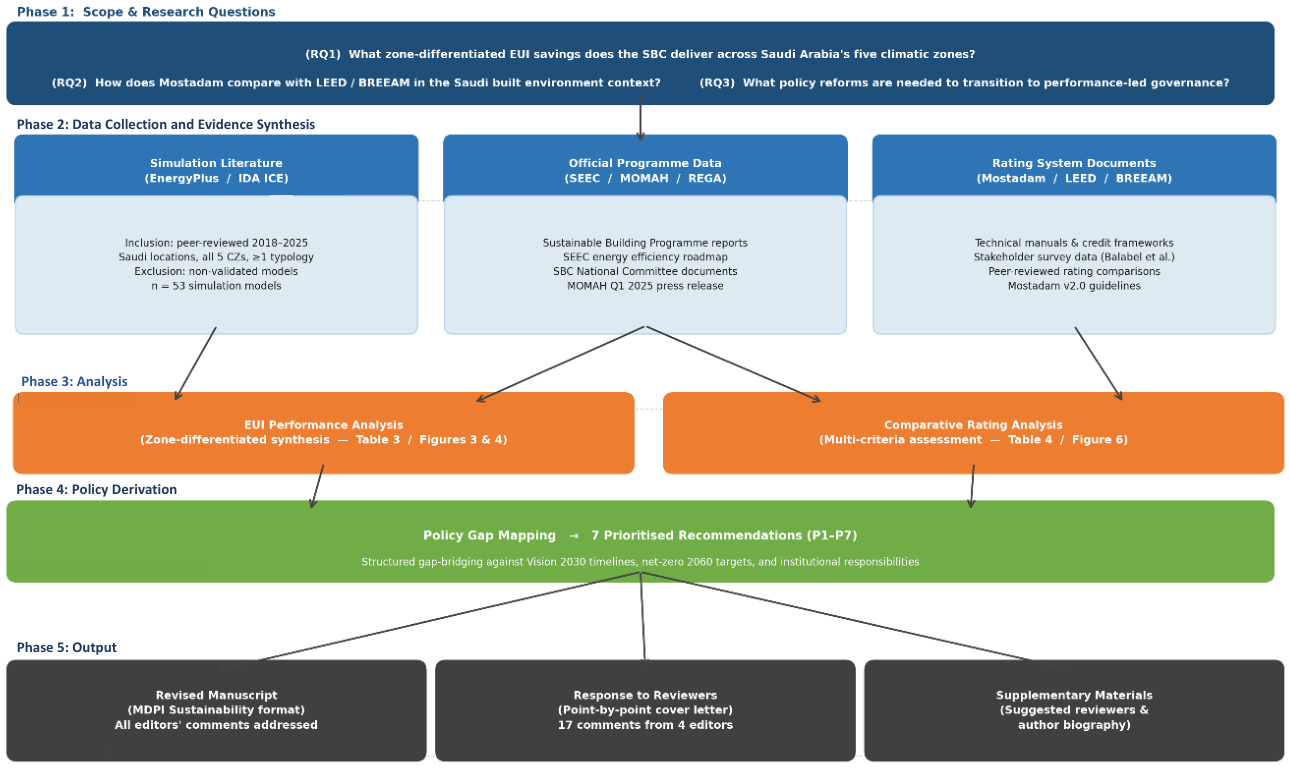
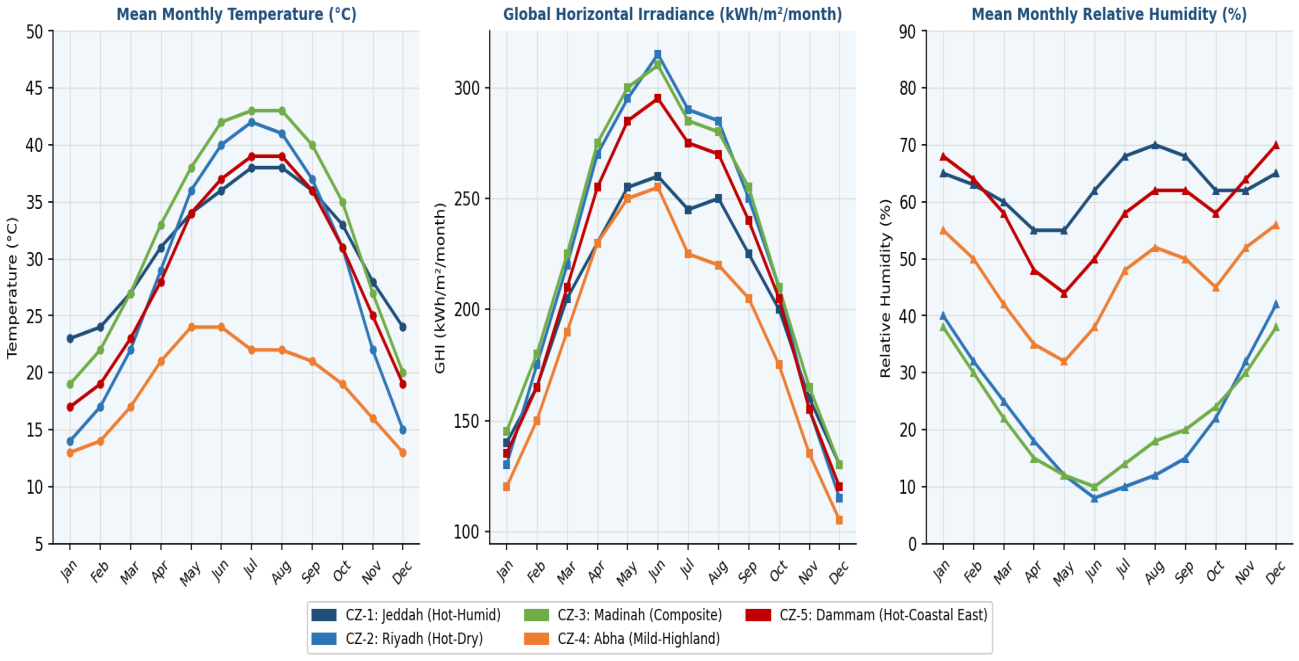



| Study | Focus Area | Journal/Source | Method/Scope | Contribution to This Paper |
|---|---|---|---|---|
| [7] | EUI simulation all 5 CZs | Energy Build. | 46 locations; 3 typologies; SBC vs. baseline | Largest dataset on SBC residential EUI; core source for Table 2 |
| [14] | Energy efficiency paradox Saudi buildings | Hum. Soc. Sci. Commun. | Conceptual + survey | Identifies financing, behavioral, and split-incentive barriers |
| [15] | Institutional building EE Riyadh | Sustainability | Single-building simulation; SBC 401 | LED savings 74%; insulation reduces EUI to 58% of baseline |
| [16] | SBC impact on construction costs | Buildings (MDPI) | Survey—developers, architects, citizens | Cost premium of SBC; gap with construction practice |
| [17] | Mostadam stakeholder perceptions | Sustainability | Survey—Saudi construction professionals | 61% would adopt Mostadam; limited awareness among SMEs |
| [18] | Thermal insulation materials KSA | Build. Environ. | Laboratory + simulation | Reference for envelope material performance in hot climates |
| [19] | Net-zero pathway for Saudi buildings | Energy Sustain. Dev. | Scenario modelling to 2060 | Floor space doubling projection; net-zero policy implications |
| [20] | Building energy codes 22 countries | PNNL Report | Cross-country policy review | Performance-based paths outperform prescriptive-only regimes |
| SBC Chapter | Title | Scope & Update Frequency |
|---|---|---|
| SBC 601 | Energy Conservation Requirements | Envelope performance (U-values, SHGC), HVAC efficiency, lighting, domestic hot water. Applicable to all occupancy types. Updated 2018. |
| SBC 602 | Residential Energy Standards | Low-rise residential-specific energy standards; thermal envelope; cooling loads. Reviewed every 3–5 years. |
| SBC 1001 (SgBC) | Saudi Green Building Code | Mandatory sustainability chapter; foundation of Mostadam. Most recent edition: 2024. Covers site, water, energy, materials, IEQ. |
| SBC 501 | Mechanical Requirements | HVAC system design, ventilation, thermal comfort. Interlinked with SBC 601 compliance pathways. |
| SBC 401 | Electrical Requirements | Electrical installations, EER labelling, metering. Reviewed alongside energy chapter updates. |
| Zone | Climate/Key Cities | Pre-SBC EUI (kWh/m2/yr) | Post-SBC EUI (kWh/m2/yr) | Reduction (%) | No. of Models | Key Sources |
|---|---|---|---|---|---|---|
| CZ-1 | Hot-Humid (Jeddah, Yanbu) | 191–263 | 121–235 | 20–25 | 12 | [7,17] |
| CZ-2 | Hot-Dry (Riyadh, Qassim) | 150–220 | 120–175 | 18–22 | 15 | [7,15] |
| CZ-3 | Composite (Madinah, Hail) | 130–195 | 112–165 | 12–18 | 9 | [7,18] |
| CZ-4 | Mild-Highland (Abha, Taif) | 57–113 | 46–112 | 5–10 | 7 | [7,27] |
| CZ-5 | Hot-Coastal East (Dammam, Al-Khobar) | 170–240 | 140–198 | 15–20 | 10 | [1,7] |
| Criterion | Mostadam | LEED v4.1 | BREEAM | Analytical Note |
|---|---|---|---|---|
| Governance body | Ministry of Housing/Sustainable Building Prog. | USGBC (USA) | BRE Group (UK) | Mostadam best aligned with KSA regulatory authority |
| SBC alignment | Direct—built from SBC 501, 601, 1001 | Partial—external adaptation required | Partial—external adaptation required | Critical advantage for mandatory compliance integration |
| Climate sensitivity | High—Saudi-specific zones (5 CZs) | Moderate—global baseline | Moderate—global baseline | Mostadam avoids costly recalibration |
| Local content reward | Yes—credits for KSA materials | No | Limited | Directly supports Vision 2030 localisation goals |
| Net-zero pathway | Developing (2030/2060 aligned) | LEED Zero add-on | BREEAM Net Zero | Key gap requiring strengthening |
| Certification levels | 5 levels | 4 levels | 6 levels | Comparable depth |
| Language | Arabic-first bilingual | English | English | Significant advantage for wider KSA practitioner adoption |
| Market maturity (KSA) | Growing rapidly (64% YoY 2025) | Established—80+ countries | Established—Middle East strong | LEED/BREEAM hold legacy advantage |
| Caveat | Best suited to KSA; limited portability | Global portability; requires local adaptation | Global portability; requires local adaptation | Local vs. international systems serve different purposes |
| Criterion | Mostadam Score | Rationale | LEED v4.1 Score | Rationale | BREEAM Score | Rationale |
|---|---|---|---|---|---|---|
| SBC Alignment | 5 | Derived directly from SBC 501, 601, and 1001; no adaptation required; mandatory SBC compliance is a prerequisite for Mostadam certification | 2 | Developed under ASHRAE/IBC framework; requires country-specific adaptation and reconciliation with SBC provisions | 2 | Developed under UK Building Regulations; requires significant adaptation for SBC compliance; no direct SBC integration |
| Climate Sensitivity | 5 | Built around Saudi Arabia’s five-zone climatic classification; zone-specific performance benchmarks; Arabic-language climate guidance | 3 | Global baseline applicable to hot climates; ASHRAE 90.1 foundation provides partial relevance; no Saudi-specific zone calibration | 3 | Global baseline; BREEAM International version addresses hot climates generically but lacks Saudi-specific zone criteria |
| Local Content Reward | 5 | Explicit credits for locally sourced materials and services; directly aligned with Vision 2030 National Industrial Development objectives | 1 | No credits for local content; global material sourcing treated equivalently | 2 | Limited regional sourcing credits available in some BREEAM International versions; not calibrated to the Saudi supply chain |
| Net-Zero Pathway | 2 | Net-zero pathway provisions under active development; 2024 SgBC 1001 revision advances renewable energy requirements but lacks a formalised net-zero certification route | 4 | LEED Zero add-on programme provides established net-zero operational carbon certification with measurement and verification protocols | 4 | BREEAM Net Zero framework available with granular M&V protocols; recognised by green bond market and sustainability-linked finance |
| Market Maturity | 2 | Rapidly growing (64% year-on-year in Q1 2025) but still early-stage in Saudi Arabia; limited practitioner certification infrastructure; third-party assessor base developing | 5 | Established in 80+ countries; deep Saudi market presence particularly in commercial and hospitality sectors; large pool of accredited professionals | 4 | Strong Middle East market presence; established in Saudi Arabia, particularly through commercial and institutional projects; BREEAM assessor network available |
| Third-Party Verification | 3 | Assessment framework exists; Sustainable Building Programme administers compliance verification; independent third-party assessor network smaller than international systems | 5 | Robust third-party verification infrastructure; GBCI-accredited professionals globally; recognised by capital markets for green finance | 5 | Independent BREEAM-licensed assessor network; strongly recognised by institutional investors and lenders for ESG reporting |
| Arabic Accessibility | 5 | Arabic-first bilingual documentation; all technical guidance, credit interpretations, and assessment tools available in Arabic; culturally adapted for Saudi professional context | 1 | English-language system; Arabic translation of selected documents available but technical guidance remains primarily in English | 1 | English-language system; no systematic Arabic documentation; practitioners in Saudi Arabia require translation of technical content |
| # | Priority | Recommendation | Lead Agency | Timeline | Evidence Base/Rationale |
|---|---|---|---|---|---|
| P1 | ★★★ | Mandate climate-differentiated EUI targets per zone in SBC 601 revision | Saudi Building Code Centre | 2026–2027 | Addresses core prescriptive path limitation; highest potential aggregate impact |
| P2 | ★★★ | Expand Mostadam mandatory scope to all new commercial buildings > 1000 m2 | Ministry of Housing | 2026 | Directly increases market penetration beyond giga-projects |
| P3 | ★★ | Introduce performance-based compliance path alongside prescriptive path | Saudi Building Code Centre | 2027–2028 | Enables dynamic envelope technologies; recognises diverse typologies |
| P4 | ★★★ | Link Mostadam certification to REDF mortgage incentives | Ministry of Finance/REDF | 2026–2027 | Addresses financing barrier—most structurally impactful for private residential |
| P5 | ★★ | Establish national post-occupancy monitoring database (BMS/smart meter) | SEEC/MOMAH | Ongoing | Closes accountability gap; enables evidence-based future code revision |
| P6 | ★★ | Integrate minimum PV thresholds for buildings >500 m2 into SBC 601 | SEEC/Saudi Building Code Centre | 2027 | Embeds renewables as standard design element; supports 50% RE target by 2030 |
| P7 | ★ | Develop capacity-building programmes for code compliance inspectors | Saudi Building Code Centre/Universities | 2025–2026 | Addresses enforcement gap; prerequisite for P1–P3 effective implementation |
Disclaimer/Publisher’s Note: The statements, opinions and data contained in all publications are solely those of the individual author(s) and contributor(s) and not of MDPI and/or the editor(s). MDPI and/or the editor(s) disclaim responsibility for any injury to people or property resulting from any ideas, methods, instructions or products referred to in the content. |
© 2026 by the author. Licensee MDPI, Basel, Switzerland. This article is an open access article distributed under the terms and conditions of the Creative Commons Attribution (CC BY) license.
Share and Cite
Allahaim, F.S. From Code to Climate Action: Evaluating the Energy Efficiency Performance of the Saudi Building Code Across Climatic Zones and Its Alignment with Vision 2030 Sustainability Targets. Sustainability 2026, 18, 5459. https://doi.org/10.3390/su18115459
Allahaim FS. From Code to Climate Action: Evaluating the Energy Efficiency Performance of the Saudi Building Code Across Climatic Zones and Its Alignment with Vision 2030 Sustainability Targets. Sustainability. 2026; 18(11):5459. https://doi.org/10.3390/su18115459
Chicago/Turabian StyleAllahaim, Fahad S. 2026. "From Code to Climate Action: Evaluating the Energy Efficiency Performance of the Saudi Building Code Across Climatic Zones and Its Alignment with Vision 2030 Sustainability Targets" Sustainability 18, no. 11: 5459. https://doi.org/10.3390/su18115459
APA StyleAllahaim, F. S. (2026). From Code to Climate Action: Evaluating the Energy Efficiency Performance of the Saudi Building Code Across Climatic Zones and Its Alignment with Vision 2030 Sustainability Targets. Sustainability, 18(11), 5459. https://doi.org/10.3390/su18115459