1. Introduction
Urban mobility systems are facing increasing pressure due to rapid urbanization, population growth, and rising travel demand. These dynamics contribute to congestion, energy consumption, and environmental externalities, reinforcing the urgent need for more sustainable transport solutions [
1]. Public transport (PT) plays a central role in sustainable mobility strategies, as it can reduce congestion, lower greenhouse gas emissions, and improve the overall efficiency of urban transport systems [
2]. However, despite substantial investments in PT infrastructure and service improvements, private car use remains dominant in many urban contexts, particularly among regular commuters [
3].
Understanding the behavioral mechanisms that influence individuals’ willingness to shift from private cars to PT is therefore critical for effective transport planning [
4,
5]. While previous research has extensively examined the effects of objective factors such as travel time, cost, and service quality [
5,
6], less attention has been paid to the underlying psychological processes that connect these factors to behavioral outcomes. In particular, the intention–adoption gap—defined here as the discrepancy between an individual’s stated intention to reduce car use and their actual willingness to shift to PT as a regular commuting mode—remains insufficiently explored in the context of employee commuting. This gap is theoretically significant because it suggests that the standard assumption of a linear progression from attitude to intention to behavior, as proposed by the Theory of Planned Behavior [
7], may break down under conditions of structural car dependency, where contextual constraints override motivational readiness. Operationally, it raises the question of whether perceived service quality and travel burden act directly on willingness, or only indirectly by first shaping intention, and whether the strength of that intention itself conditions the magnitude of these effects.
Focusing on employee commuting provides a relevant and policy-sensitive context, as this group represents a significant share of daily urban travel demand and exhibits relatively stable travel patterns. From a systemic perspective, commuting behavior has implications not only for individuals but also for organizations and society [
8,
9].
Previous studies have examined commuting behavior using clustering techniques and spatial analysis, highlighting heterogeneity in preferences and constraints, as well as widespread dissatisfaction with PT attributes such as travel time, comfort, and reliability [
4,
5].
Building on this foundation, the present study advances the literature by examining the interplay between perceived PT service quality and travel burden, and how these factors influence individuals’ willingness to adopt PT. Importantly, the study distinguishes between subjective perceptions (service quality) and objective commuting conditions (travel burden), allowing for a more nuanced understanding of how different types of factors shape travel behavior. Furthermore, it explicitly examines the role of the intention to reduce car use as both a mediating and a moderating mechanism in this relationship.
The novelty of this study is threefold. First, unlike most existing studies that treat intention as either a dependent variable or a simple predictor, this study simultaneously tests its dual role as both a mediator and a moderator, providing a more complete picture of how intention shapes the pathway from travel conditions to behavioral outcomes. Second, it integrates the subjective and objective dimensions of travel conditions (perceived PT service quality and measured travel burden) within a single model, rather than examining them in isolation, as is common in the literature. Third, it applies a counterfactual causal mediation framework to binary outcomes, addressing a methodological gap in transport behavior research, where linear assumptions are frequently violated but rarely corrected.
Moreover, in terms of modeling, this study contributes by applying a causal mediation framework within a nonlinear (logistic) modeling context, following the counterfactual approach. This enables a more rigorous decomposition of direct and indirect effects than traditional linear methods, particularly in the presence of binary outcomes and mediators. Empirically, the analysis is based on survey data collected from car-dependent commuters in Rome, a context characterized by persistent reliance on private vehicles despite the presence of an extensive PT system.
By identifying the behavioral drivers and constraints underlying modal shift decisions, this study provides insights directly relevant to sustainable transport planning. It aims to clarify whether improving PT service quality or increasing travel burden associated with car use is more effective in promoting a shift toward more sustainable modes. The findings are expected to support policymakers and practitioners in designing targeted interventions that address both behavioral and structural dimensions of urban mobility.
The remainder of the paper is organized as follows.
Section 2 reviews the relevant literature on PT service quality, travel burden, and the intention–behavior gap and presents the case study area and research hypotheses.
Section 3 describes the data collection process and the characteristics of the survey sample.
Section 4 outlines the methodological framework, detailing the causal mediation and moderation models adopted.
Section 5 presents the results of the reliability analysis, mediation models, and moderation analysis.
Section 6 discusses the findings in relation to local policy implications and broader lessons transferable to other urban contexts.
Section 7 concludes the paper by summarizing the main contributions, theoretical implications, and directions for future research.
2. Literature Review
Understanding user behavior is essential for effective transport planning, as it directly influences transportation system performance, policy outcomes, and the achievement of sustainable mobility goals. Travel behavior is shaped by a wide range of factors, including economic, demographic, cultural, and technological conditions, as well as the characteristics of transport infrastructure [
10]. In this context, reducing car dependency has become a central objective of sustainable urban mobility strategies.
A broad set of policy approaches has been proposed to address car dependency, including public awareness campaigns, compact urban development, investment in PT, promotion of active mobility, restrictions on car use, shared mobility solutions, and virtual mobility alternatives [
11]. These strategies generate multiple benefits, ranging from environmental improvements to enhanced public health, social equity, and urban livability. Empirical evidence suggests that pricing policies are particularly effective in reducing automobile use, while land-use policies play a more significant role in shaping long-term travel patterns [
12]. The integration of these approaches is therefore critical. Case studies from regions such as California and Central Europe further demonstrate that coordinated transport and land-use policies can significantly reduce car reliance while improving accessibility and quality of life [
13,
14].
Within this broader policy framework, PT service quality has emerged as a key determinant of travel behavior. Previous studies consistently show that perceived service quality strongly influences PT adoption. Qualitative and quantitative research highlights the importance of operational performance, comfort, reliability, and the vehicle environment [
15] in shaping user perceptions and mode-choice decisions [
16,
17,
18].
In addition, attributes such as safety, information availability, and perceived accessibility play a crucial role in determining user satisfaction and long-term adoption of PT systems [
19]. These structural barriers have been empirically documented in the Italian context, where urban ergonomics indicators reveal widespread deficiencies in pedestrian infrastructure and PT supply that limit salutogenic and sustainable travel behavior [
20]. Such findings suggest that improving service quality is essential not only for attracting new users but also for retaining existing ones. However, while some research emphasizes the primacy of comfort and reliability in shaping PT adoption [
15,
16,
17], others point to perceived travel time and cost as the dominant determinants [
18,
19]. Crucially, most of these studies focus on current PT users or the general population, leaving largely unexplored how car-dependent commuters—who have already made a habitual modal choice—evaluate PT service quality and whether such evaluations translate into a willingness to shift modes. This sampling selectivity limits the transferability of existing findings to the case study at hand.
At the same time, travel burden, typically defined in terms of travel time, cost, and effort, represents another important factor influencing commuting behavior. Higher travel burdens, including longer travel times, multiple transfers, and increased costs, have been shown to affect mode choice decisions across different socio-economic groups [
21]. However, the relationship between travel burden and behavioral change is not straightforward. While unfavorable travel conditions can disrupt habitual behavior, they do not necessarily lead to a shift toward more sustainable modes [
22]. For example, even substantial reductions in PT fares may fail to induce a modal shift if other structural barriers persist [
23]. These findings indicate that increasing the burden of car use alone may not be sufficient to encourage sustainable travel behavior. A key limitation of this body of work is that travel burden and service quality are typically examined in isolation, as competing explanations for modal inertia. Studies that focus exclusively on objective travel conditions tend to underestimate the role of subjective perceptions. In contrast, studies that focus on perceived quality often fail to account for the structural constraints that make car use practically necessary. The interaction between these two dimensions and their combined effect on behavioral intention have received insufficient attention, particularly in contexts where both poor PT quality and high commuting burden coexist, as is the case in many Southern European cities.
A growing body of literature has also highlighted an intention–behavior gap in the context of sustainable mobility. Despite high levels of awareness regarding the environmental impacts of transport, individuals often fail to translate their intentions into actual behavioral change [
24,
25].
This gap has been attributed to a range of factors, including attitudes, perceived behavioral control, contextual constraints, and habitual behavior [
26,
27]. Empirical studies have shown that willingness to adopt sustainable transport options is often constrained by structural and situational factors, such as vehicle ownership, accessibility, and distance traveled, rather than by a lack of information or awareness [
27,
28]. Importantly, existing studies on the intention–behavior gap in transport tend to treat intention as a unidimensional construct, without examining whether it functions differently depending on the level of perceived service quality or travel burden that a commuter faces. This limits the analytical precision of the gap concept. If intention is conditional on structural factors, then policies that target attitudes without addressing those factors are unlikely to close the gap. This critical distinction motivates the present study’s dual treatment of intention as both a mediator and a moderator.
To better understand these dynamics, recent research has increasingly applied mediation frameworks to explore the mechanisms linking external factors to travel behavior. For instance, income has been shown to influence mode choice both directly and indirectly through mediating variables such as residential location [
29]. At the same time, car ownership can mediate the relationship between the built environment and travel behavior [
30].
Similarly, psychological constructs such as attitudes and perceived benefits have been found to mediate the effects of perceived constraints on travel decisions [
31]. These studies demonstrate the importance of considering indirect pathways and intermediate variables when analyzing travel behavior.
Despite these advances, there remains a limited understanding of how perceived service quality and travel burden interact with behavioral intention to influence willingness to adopt PT, particularly in car-dependent urban contexts. Moreover, existing studies often rely on linear modeling approaches, which may not adequately capture the complexity of relationships involving binary outcomes and nonlinear effects.
More specifically, to the authors’ best knowledge, the literature has yet to establish whether intention functions as a reliable mediator between perceived travel conditions and actual modal shift decisions in car-dependent urban contexts, or whether its mediating role is conditional on the structural constraints that characterize such environments. This distinction matters for policy: if intention is a robust mediator, then campaigns aimed at strengthening pro-PT attitudes may be sufficient to promote modal shift; if it is not, structural interventions targeting service quality and travel burden become the primary levers. Existing studies have not directly tested these competing interpretations within a unified analytical framework, particularly in Southern European cities, where car dependency is historically entrenched, and PT investment has not translated into proportional ridership gains.
To address these gaps, the present study integrates perceived PT service quality (subjective evaluation) and travel burden (objective commuting conditions) within a unified analytical framework. It further examines the dual role of intention to reduce car use as both a mediator and a moderator in the relationship between travel conditions and willingness to adopt PT. By applying a causal mediation approach within a logistic regression framework, this study provides a more nuanced understanding of the behavioral mechanisms underlying the intention–adoption gap in sustainable commuting. The present study departs from existing research in three important respects. First, whereas most mediation studies in transport behavior examine intention as a simple intermediate variable between attitudes and behavior [
29,
30,
31], this study explicitly tests whether intention also moderates the effect of travel conditions on willingness to adopt PT. This distinction has direct policy implications. Second, while prior studies have examined perceived service quality and travel burden separately, this study integrates both within the same analytical framework, enabling a direct comparison of their relative and combined effects. Third, applying a counterfactual causal mediation framework to binary outcomes addresses a recognized methodological gap: most transport mediation studies rely on linear models, which are technically inappropriate when both the mediator and the outcome are dichotomous variables. Together, these features allow this study to provide a more precise account of why the intention–adoption gap persists among car-dependent commuters in a highly motorized urban context.
Then, building on the existing literature on service quality, travel burden, and the intention–behavior gap, this study develops a conceptual framework to examine both direct and indirect relationships between these factors.
To summarize, to address the challenges mentioned above, this study fills critical gaps in the transport behavior literature by examining the intention-adoption gap among car-dependent commuters through a unified causal framework. Unlike prior works that treat intention as unidimensional or examine factors in isolation, we test its dual role as both a mediator and a moderator by integrating perceived PT service quality and objective travel burden.
Table 1 summarizes key strands of previous research on intention–behavior gaps, structural constraints, and mediation approaches in travel behavior, highlighting their main findings, methodological issues leading to limitations, and the specific ones addressed by this study, thereby providing a more nuanced understanding of modal shift mechanisms in structurally constrained urban contexts such as Rome.
2.1. Case Study Area
To understand the background of the present study, some key figures are presented in
Table 2 [
4], from which a high motorization rate and an unbalanced modal share favoring private cars emerge as critical issues. This is exacerbated by local land patterns, with a vibrant city center, consolidated areas with highly mixed land use, and outskirts where residences and commercial facilities generate commuting activity at usual peak times along the city’s major arterials. These, in turn, were original Roman roads connecting the city to the farther regions, and their original design to accommodate non-motorized modes is still a cause of congestion nowadays. Thus, the snapshot is of a city where car traffic is a burden, jeopardizing the local environment and the city’s livability.
The 2000s Rome’s Master Plan (Nuovo Piano Regolatore Generale, or PRG) outlines a forward-looking transport strategy focused on sustainable mobility, aiming to shift the city away from heavy reliance on private cars toward efficient public options. This approach promises cleaner air, less noise pollution, and safer travel for residents. Coherently, the plan prioritizes balancing public and private transport by expanding collective high-capacity systems, primarily rail, to reduce private motorized vehicle use. A main “backbone” network integrates rail lines (regional and metro), trams, and dedicated bus corridors, supported by feeder bus services at key interchange hubs, with minimal expansion of road infrastructure, all aimed at boosting PT competitiveness. Transit extensions target suburbs and new urban centers around Rome, extending southeast and to coastal areas. Complementing this, 200 km of new dedicated surface corridors (14 lines, plus 50 km existing trams) use trams, light rail, trolleybuses, or eco-buses along major radials. These high-capacity routes are planned to replicate metro performance at lower cost and faster rollout. Also, the several planned intermodal hubs (urban or metropolitan-scale) featuring park-and-ride lots, bus terminals, bike paths, taxis, and shops, evolve beyond basic parking spots into lively community nodes [
35]. The 2019 local Sustainable Urban Mobility Plan (SUMP) aligns with PRG’s approach, sharing the same goals about air quality improvements, reduction in land consumption (especially impervious surfaces), and safer travel conditions [
36], being road safety a long-lamented problem in the city, also due to the higher percentages of powered two-wheelers and, after the pandemic, kick-scooters.
In this context, the scale of commuting flows into Rome further underscores the mobility challenge the city faces. According to the most recent data from Rome’s Statistical Office, in 2024, approximately 343,000 workers commuted daily or weekly into the capital from other municipalities, representing a 12.5% increase in the city’s functional population beyond its resident base [
37]. Most of these commuters originate from within the Lazio region (81%), with 59.7% coming from other municipalities within the Metropolitan City of Rome. In comparison, a non-negligible share (19%) travels entirely from other Italian regions. In terms of workforce profile, commuters are predominantly male (67.6%), aged between 40 and 54 years, and employed on standard contracts (88.1%), with a slightly higher incidence of atypical employment among female commuters (15.3%) than among male commuters (10.3%). Commuters are mostly employed in public administration, transport and communications, and manufacturing, suggesting that these workers are disproportionately engaged in trip-sensitive, schedule-bound occupations with limited flexibility for remote working—conditions that reinforce car dependency and make modal shift particularly challenging [
37,
38,
39].
Table 2.
Key mobility figures in Rome.
Table 2.
Key mobility figures in Rome.
| Urban Features | Year | Source |
|---|
| Population (inh) | 2,755,309 | 2023 | [40] |
| Area (sqkm) | 1287 | 2022 | [36] |
| Density (inh/sq km) | 2141 |
| Registered fleet (veh) | 1,823,155 pass. cars | 2023 | [41] |
| 389,122 PTWs |
| 7616 buses and coaches |
| 194,366 others |
| 2,414,259 total |
| Registered electric modes (veh) | 13,133 | | [36] |
| Car sharing fleet (veh) | 1408 | 2022 | [38] |
| Motorization rate ([veh/inh] ∗ 1000), Rome | 930 | [38] |
| Motorization rate ([veh/inh] ∗ 1000), Italy | 684 | [42] |
| Modal share (%) (2020) | 60 pass. cars | 2020 | [43] |
| 20 transit |
| 18 walking |
| 2 bikes |
| Travel time (min) | 40.6 | 2024 | [44] |
| Congestion level (%) | 38 | 2021 | [45] |
| Pedestrianized areas (sqm) | 393,277 | 2018 | [36] |
| Bike network (km) | 230 |
| Peak daily access to the central LTZs (veh) | 120,000 |
| Transit—bus fleet (veh.) | 2244 |
| Transit—bus network (km) | 4711 |
| Average bus route length (km) | 12.8 |
| Average bus travel time (m) | 41.5 |
| Bus commercial speed (km/h) | 16.9 |
| Bus network density (route km/network km) | 3.98 | 2022 | [38] |
| Electric kick-scooter fleet, estimated (veh) | 14,517 |
| Park&Ride supply (parking lot) | 14,958 | 2020 | [46] |
| Pay-for-parking, on-street supply (parking lot) | 74,134 |
| Average daily trips (unit) | 5,900,000 |
| Population daily traveling (%) | 98 |
| Average trip per capita (trip/inh) | 2.37 |
| Travel types (%) | 21 systematic |
| 35 non-systematic |
| Multimodal trips (private and public modes/1000) | 80 |
2.2. Research Hypotheses
Based on the reviewed literature and the identified research gaps, and considering the local environment synthesized in
Section 2.1, this study proposes the following hypotheses:
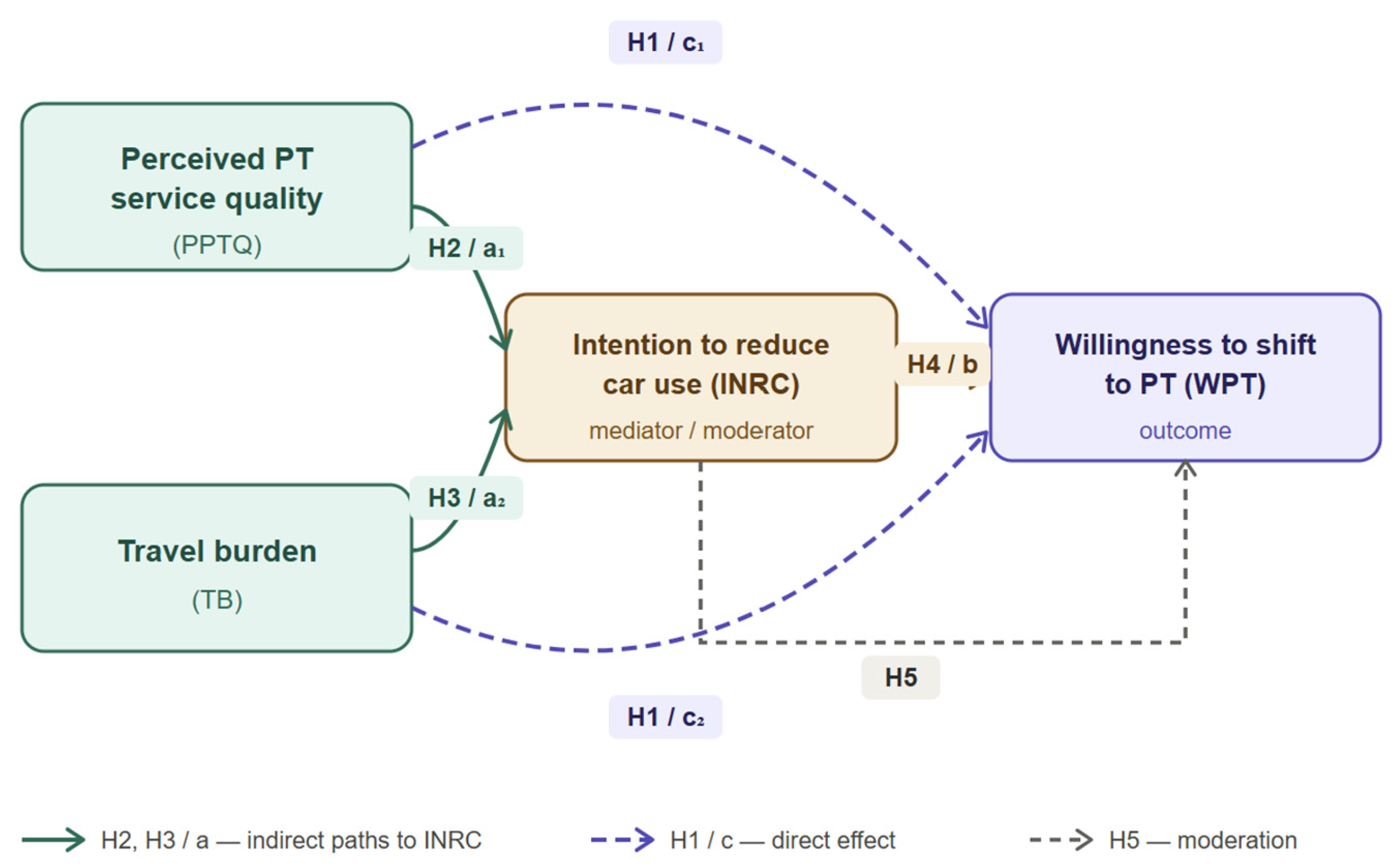
H1: Perceived PT service quality positively influences willingness to use PT.
H2: Travel burden influences individuals’ intention to reduce car use.
H3: Intention to reduce car use positively affects willingness to use PT.
H4: Intention to reduce car use mediates the relationship between travel conditions and willingness to use PT.
H5: Intention to reduce car use moderates the relationship between travel conditions and willingness to use PT.
These five hypotheses follow directly from the critical gaps identified in the literature. The direct effect of perceived PT service quality on willingness to adopt PT (H1) is grounded in consistent empirical evidence that subjective service evaluations shape mode choice [
15,
16,
17,
18], while its effect on intention (H2, jointly with travel burden) reflects findings that both perceived and objective travel conditions influence pro-sustainable behavioral intentions [
21,
22,
23,
26,
27]. The hypothesis that intention positively affects willingness (H3) is derived from the Theory of Planned Behavior [
7], which posits intention as the proximal determinant of behavior. At the same time, H4 (mediation) follows from the established use of mediation frameworks in transport research [
29,
30,
31] and the theoretical expectation that travel conditions influence behavior indirectly through attitudinal and motivational states. Finally, H5 (moderation) directly addresses the critical gap identified above. If intention is not a uniform conduit but a variable one, strengthened or weakened by structural factors, then its moderating role should be explicitly tested rather than assumed. Taken together, these hypotheses constitute an integrated test of the conditions under which the intention–adoption gap is reproduced or reduced among car-dependent commuters.
3. Data Collection and Data Processing
A total of 392 valid responses were collected from employees in Rome between May and July 2024. Rome’s PT system, built around its metro network, supports sustainable mobility; however, a strong reliance on private cars persists, even among residents living in proximity to transit stations. Commuting choices are influenced by factors such as travel time, convenience, and work flexibility, while the complexity of the PT network and accessibility challenges continue to hinder its wider adoption [
39]. All of the above complied with the prescribed requirements regarding ethical approval and informed consent. For this study, only respondents who regularly commute by car and are not engaged in remote work were selected, resulting in a subsample of 190 individuals. The final subsample (N = 190) falls within the range commonly observed in mediation studies. A review of published research indicates that a substantial proportion of mediation analyses are conducted with sample sizes ranging from 100 to 200 [
47]. While larger samples are generally required to detect small mediation effects with high statistical power, the present sample size is thus considered adequate for exploratory analysis and for identifying moderate-to-strong relationships.
3.1. Descriptive Statistics—All Respondents
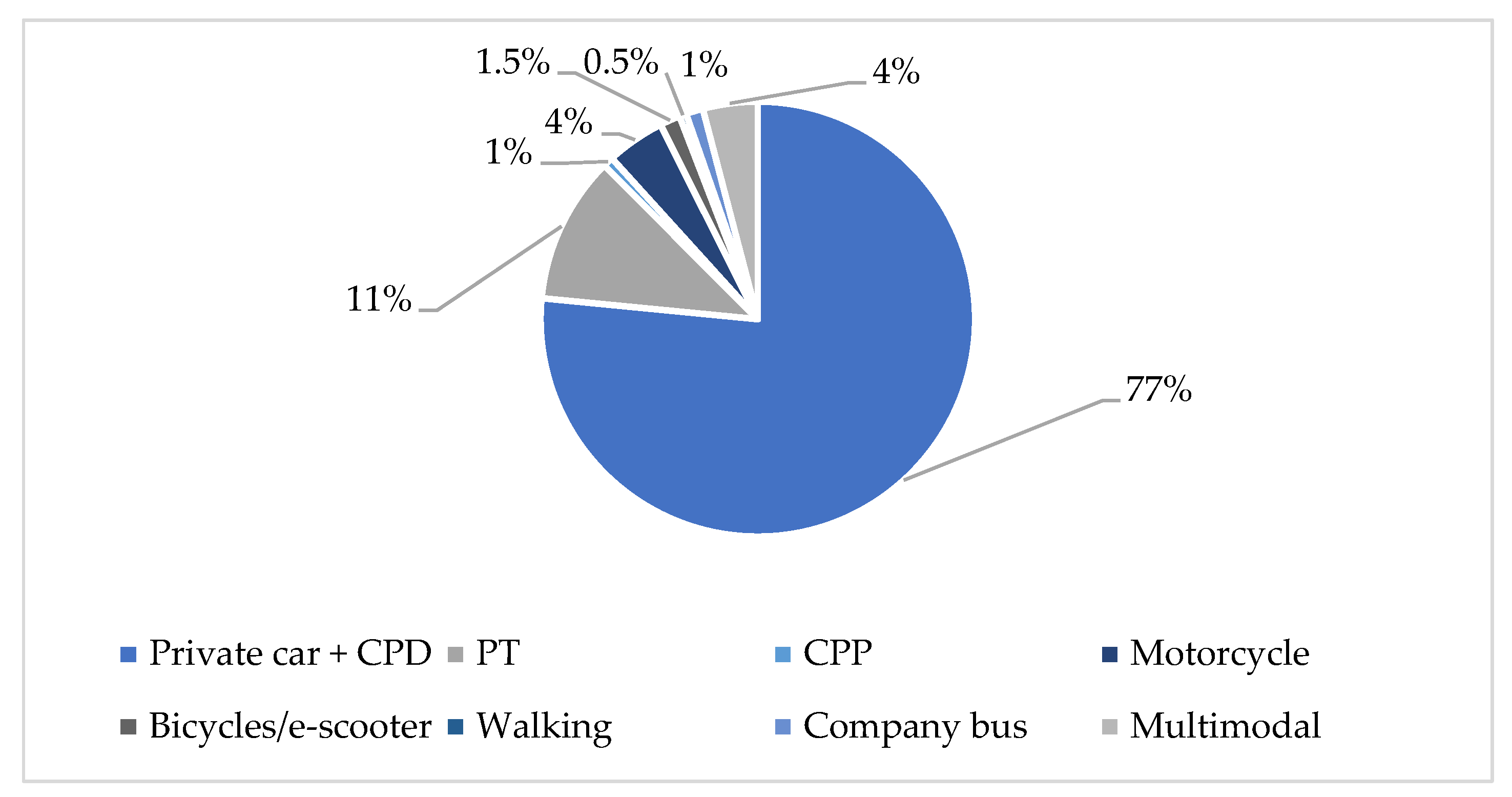
Private cars and carpooling as drivers (CPD) represent the dominant commuting mode (77%), followed by PT (11%). Motorcycles and multimodal travel each account for 4% of trips. In contrast, bicycles/e-scooters, walking, company buses, and carpooling as passengers (CPP) each represent 2% or less of the total (see
Figure 1).
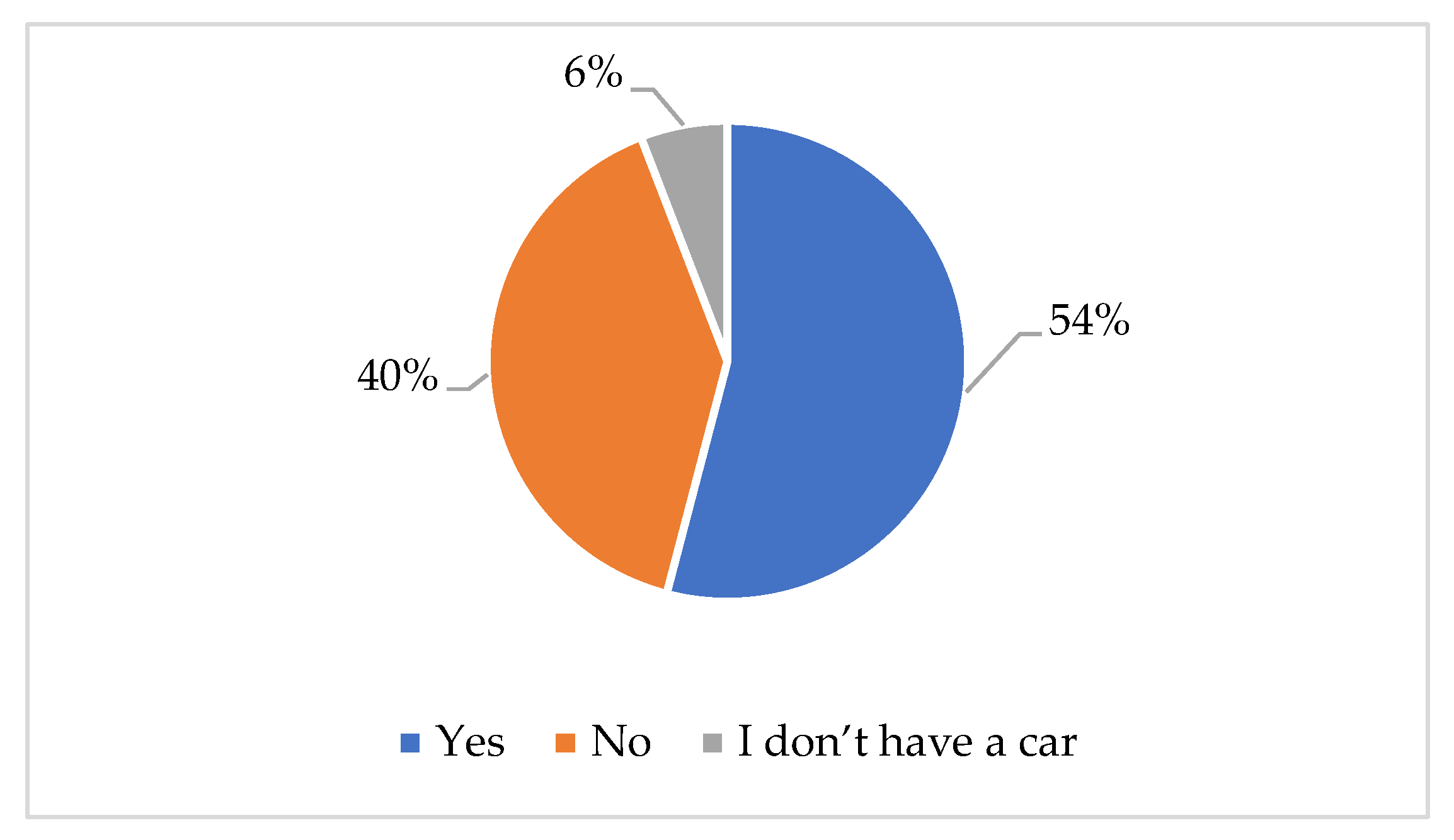
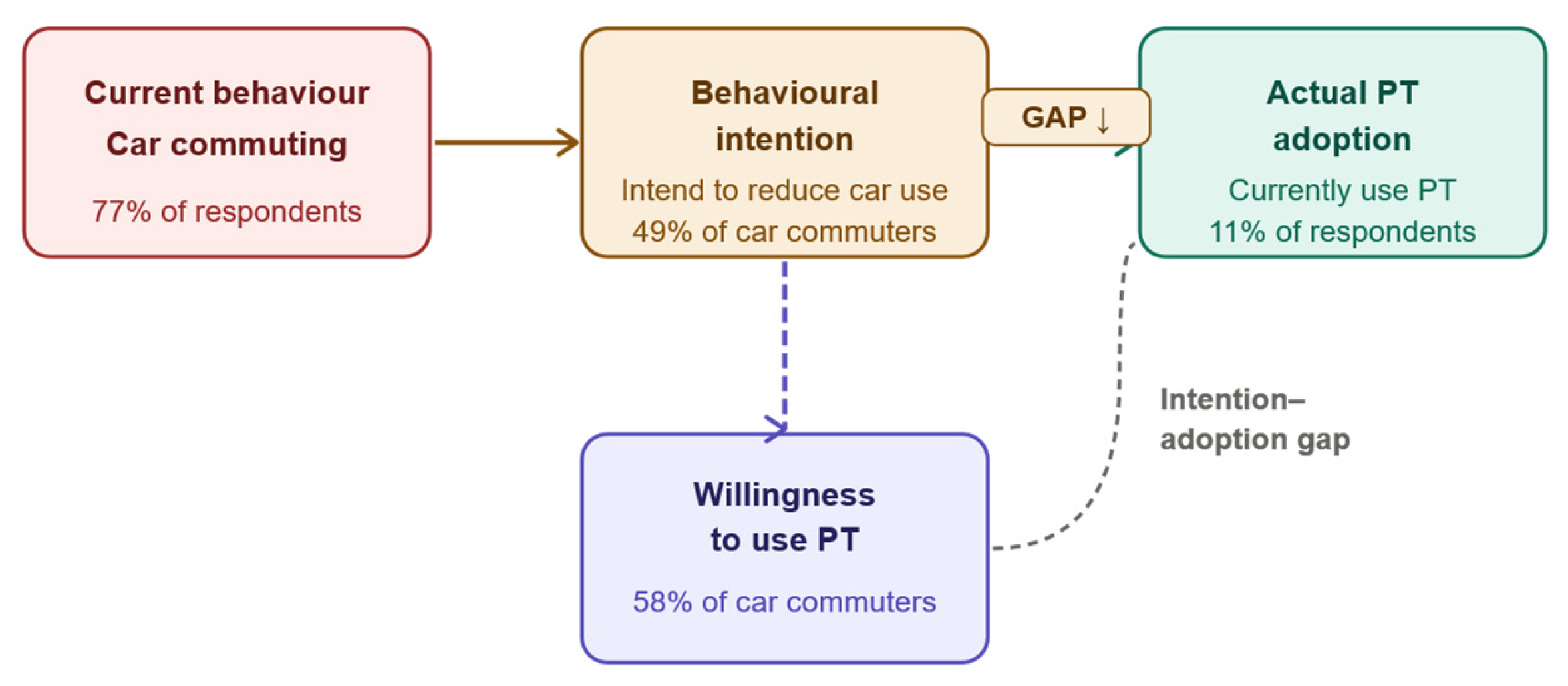
Around 54% of respondents (212 out of 392) expressed an intention to reduce car use. However, as mentioned earlier, private cars remain the dominant mode of commuting (77%), while only 11% of respondents regularly use PT. This contrast highlights a clear intention–behavior gap in commuting choices (see
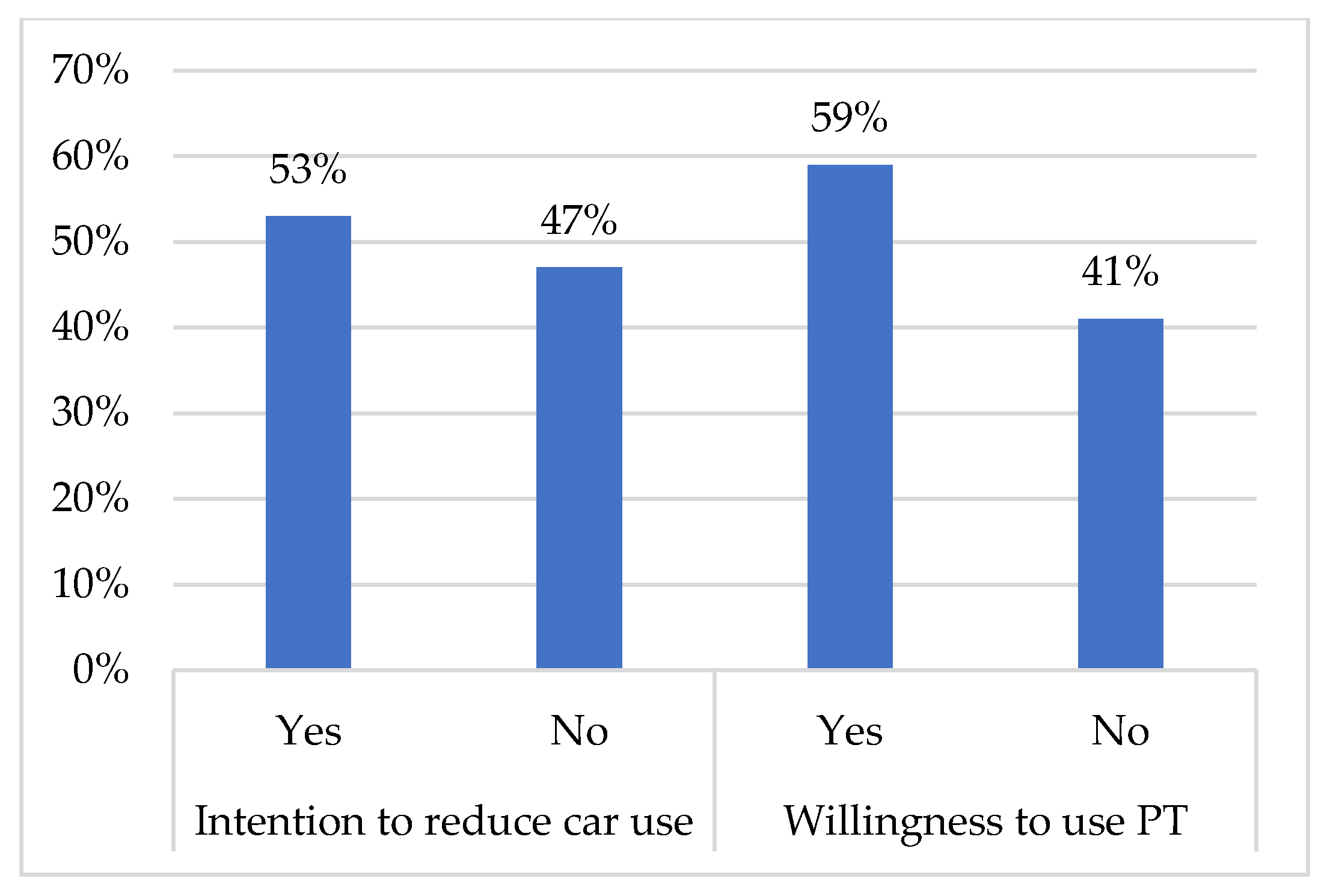
Figure 2). Among car drivers (300 respondents), the intention to reduce car use was almost equal: 53% were interested, and 47% were not. However, almost 60% of car drivers showed willingness to use PT (see
Figure 3).
Figure 4 synthesizes the key findings from this sample description, illustrating the widening gap between current car commuting behavior, stated intentions to reduce car use, and actual PT adoption, which constitutes the central empirical puzzle this study seeks to explain.
3.2. Descriptive Statistics of the Data Used for Analysis
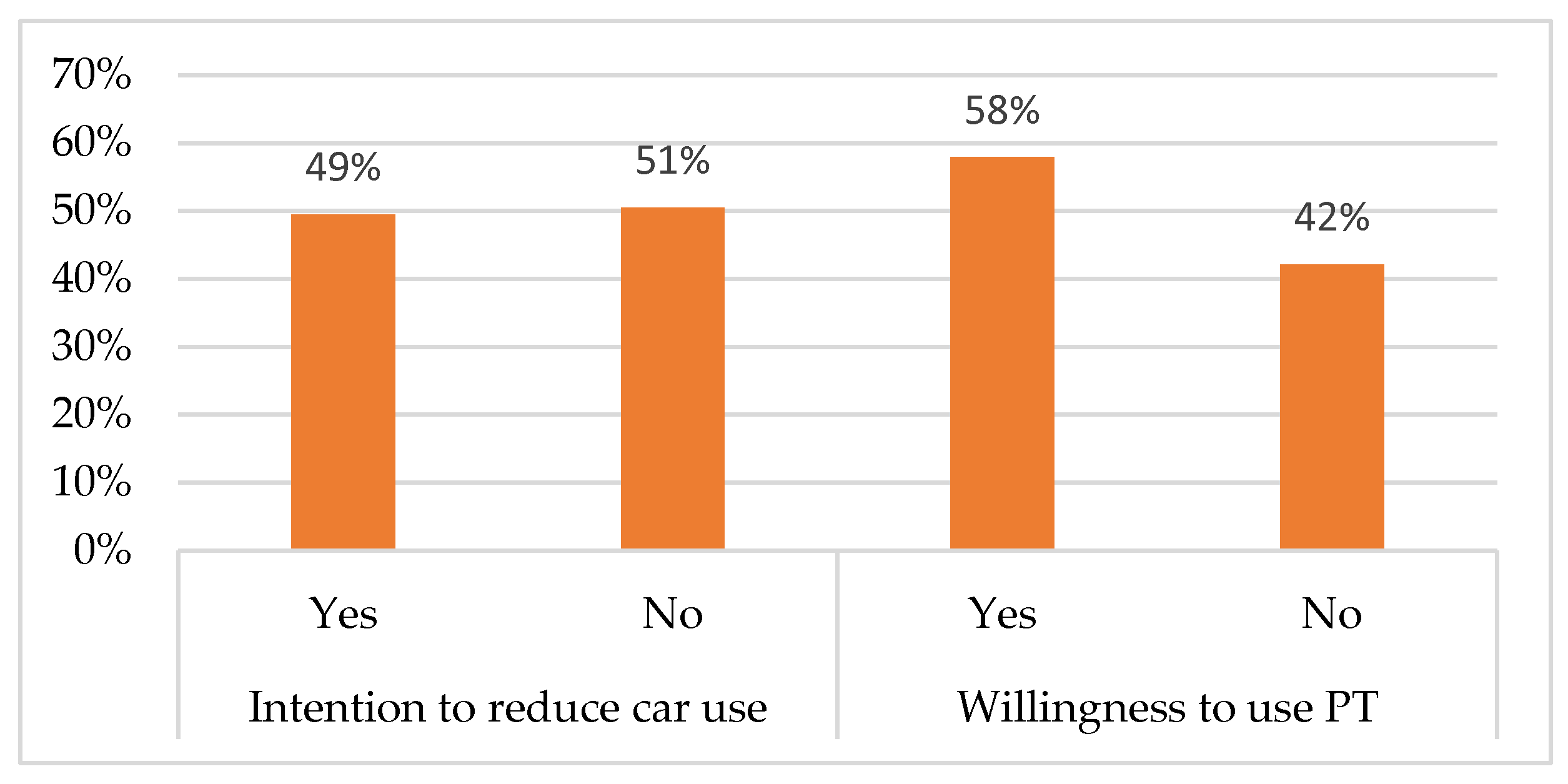
As mentioned earlier, 190 respondents who regularly commute by car and do not work remotely were selected. Among them, there was nearly balanced gender distribution: 93 females (49%) and 97 males (51%). Regarding age, many respondents were between 31 and 40 years old (40%), followed by 40–50 years old (23%) and 51–60 years old (21%). Younger adults (21–30 years old) accounted for 13% of the sample, while only a small proportion were 60 years old or older (3%). In terms of satisfaction with car use, responses were relatively evenly distributed: 25 respondents (13%) reported being very dissatisfied, 56 (29%) dissatisfied, 54 (28%) satisfied, and 55 (29%) very satisfied. In total, 49% expressed an intention to reduce car use, and 58% indicated a willingness to shift to PT (see
Figure 5). Regarding sample size, the N = 190 car-dependent employee subsample aligns with mediation analysis standards. More specifically, a study [
48] reports power calculations confirming the adequacy of our simple mediation (N ≥ 136, 80% power). Fritz and MacKinnon [
47] document that approximately 35% of published mediation studies employ samples between 100–200 participants, with simple mediation models—mirroring our base specifications—achieving adequate power (≥80%) at N = 78–136 for moderate indirect effects (a × b = 0.14–0.39), which is precisely our observed range. For logistic mediation with binary outcomes, Vittinghoff et al. [
49] confirm that N ≈ 200 suffices when ≥10–20 events occur per parameter, satisfied here across INRC (n = 93 yes) and WPT (n = 110 yes). The significant intention × burden interaction further validates detection power. This N thus supports robust estimation of our targeted causal pathways within this theoretically constrained population.
4. Methodology
The variables used in the upcoming methodology are listed in
Table 3. The variable, “Perceived PT Service Quality” (PPTQ), consists of six indicators, such as Comfort, Punctuality, Perceived Travel Time, Information (schedules, routes, etc.), Proximity to PT stops, and Perceived travel cost, each measured on a Likert scale: Poor, Fair, Good, Excellent.
Another variable, Travel Burden (TB), was constructed using two objective commuting characteristics: actual commuting time (continuous, in minutes) and actual travel cost (ordinal categories in euros). Accessibility to company parking was not considered because its variability is limited to the sample (only a small proportion of respondents report parking difficulties).
Although both constructs include time- and cost-related elements, PPTQ reflects perceived service attributes, whereas TB captures objective commuting conditions.
A composite index was computed as the mean of the six items, with higher values indicating more favorable perceptions of PT service quality.
For TB, all components were standardized before aggregation to ensure comparability. A composite index was then computed as their mean, with higher values representing greater commuting burden.
Intention to Reduce Car Use (INRC) and Willingness to Shift to PT (WPT) were modeled as binary variables (1 = yes, 0 = no).
The conceptual framework assumes that PPTQ and TB influence employees’ willingness to use PT. INRC is expected to play a dual role. First, it acts as a mediator, explaining how perceived service quality and travel burden translate into behavioral willingness. Second, intention may moderate the relationship between these factors and willingness, strengthening or weakening their effects. This framework enables the analysis of the intention–adoption gap in sustainable commuting (
Figure 6).
The models were estimated without socio-demographic variables for reasons that are both theoretically grounded and empirically motivated. To begin with, the sample was restricted to a behaviorally homogeneous subgroup—car-dependent employees who do not engage in remote work—which already partially controls for the variation that demographic factors typically capture in general-population studies. This homogeneity is not incidental but deliberate, and it directly shapes the analytical logic that follows.
Building on this, the study’s core objective is mechanism-oriented rather than profile-oriented. The counterfactual mediation framework adopted here [
50,
51] motivates including covariates only when they address specific confounding structures in the treatment–mediator or mediator–outcome relationships, rather than as a default analytical practice. Since PPTQ and TB are structural features of commuters’ travel environment rather than self-selected individual attributes, there is no strong theoretical basis to expect age, gender, or income to systematically confound the pathways from these structural conditions to intention or willingness within this already constrained subpopulation. Crucially, it is important to distinguish between two separate concerns: whether socio-demographic variables would reveal heterogeneity in estimated effects across subgroups, and whether their omission biases the average effects estimated here. These are distinct issues; the presence of subgroup heterogeneity does not necessarily imply bias in the average estimated effects, particularly when the omitted variables are not confounders of the structural pathways under investigation.
The empirical characteristics of the sample itself further reinforce this theoretical argument. The near-equal gender distribution (49% female, 51% male) and the strong concentration in the 31–50 age band (63% of respondents), with only 3% aged 60 or above, mean that socio-demographic variables exhibit limited within-sample variance. A variable with restricted range can account for only a small fraction of residual variance in either the mediator or the outcome—a necessary condition for omitted variable bias to materially distort estimated effects that is not satisfied here [
52,
53]. Moreover, in a sample of N = 190, parsimony in model specification is statistically advisable, as including covariates with limited explanatory value risks inflating standard errors and reducing the precision of indirect effect estimates, as stressed in [
47].
Finally, there is a broader research design rationale that ties these considerations together. The present study is conceived as a direct methodological complement to the authors’ prior work [
4,
5], in which socio-demographic heterogeneity across transport modes was systematically explored on a broader sample of Italian commuters. Having established the demographic and behavioral profiles of car-dependent employees in those studies, the present contribution deliberately shifts the analytical focus from who uses which mode to how structural travel conditions. Through these mechanisms, shape willingness to shift among those already car-dependent. Reintroducing socio-demographic variables here would therefore reproduce rather than extend the inferential logic of the prior work, without adding the mechanistic insight that motivates the current contribution. This progression—from demographic profiling to causal mechanism analysis—is consistent with established methodological practice in travel behavior research [
54].
The explicit examination of socio-demographic heterogeneity within the causal mediation framework nonetheless remains a recommended direction for future research with larger samples, as discussed in
Section 6.3.
The variables operationalizing the conceptual framework appear in
Table 3. Travel Burden (TB) combines actual commuting time and cost (the primary structural disincentives to modal shift identified in transport economics [
21,
22,
23]) through z-score standardization and averaging to balance their distinct yet complementary influences within mediation models. Perceived PT Quality (PPTQ) aggregates six attributes (Comfort, Punctuality, Time perception, Information, Proximity, Cost perception) that transport literature consistently identifies as key drivers of car users’ mode choice decisions [
15,
16,
17,
18,
19], following the standard unweighted mean for reflective scales. Intention to Reduce Car Use (INRC) and Willingness to Shift to PT (WPT) employ binary coding (yes = 1/no = 0) to directly test the intention-adoption gap empirically observed in our sample (49% vs. 58%,
Figure 5), aligning with TPB proximal prediction and behavioral readiness measurement [
4,
5], respectively.
Table 3 summarizes these constructs alongside their construction details.
The following subsections present the methodological framework adopted in this study. First, the classical mediation approach based on linear regression is introduced, providing the conceptual foundation for analyzing indirect effects. Next, the limitations of linear models for binary variables are discussed, motivating the transition to logistic regression models. Finally, the adopted approach is presented, combining logistic regression with a causal mediation framework to estimate direct and indirect effects, along with moderation models to examine interaction effects.
4.1. Linear Regression- Classical Mediation
A mediation model explains the mechanism through which two variables are related by introducing an intermediate variable (M), which is assumed to transmit the effect of an independent variable (X) to an outcome variable (Y).
Classical approaches to mediation analysis rely on linear regression models, where the relationships between variables are expressed through a system of equations [
55]:
where c is the overall effect of the X on Y, c′ the direct effect of X on Y controlling for the M,
the effect of X on M, and
the effect of M on Y; j
1, j
2, and j
3 are the intercepts for each equation; and
,
, and
are the corresponding residuals in each equation [
55].
Similarly, moderation analysis examines whether the relationship between X and Y varies across levels of a third variable (Z). Moderation is typically conceptualized as an interaction between variables, in which the effect of one variable depends on the level of another. Detailed discussions of moderator effects, along with frameworks for their estimation and interpretation, are provided by Aiken and West [
56].
In linear models, moderation is typically specified through an interaction term:
where
represents the effect of X on Y when Z equals zero, while
reflects the effect of Z on Y when X equals zero. The intercept is denoted by
, and
represents the residual term, and
captures the moderation effect [
56].
4.2. Transition to Logistic Regression Models
While the classical framework is based on linear regression, it is not appropriate for the present study. Both the mediator (intention to reduce car use) and the outcome (willingness to use PT) are binary variables, taking values of 0 or 1. Linear regression models assume continuous dependent variables and can produce predicted values outside the [0,1] range, making them unsuitable for modeling probabilities.
To address this limitation, this study adopts logistic regression models, which model the probability of an event occurring through the logit transformation. Logistic regression ensures that predicted probabilities remain within the valid range and allows for a more appropriate interpretation of effects in terms of log-odds.
Furthermore, in nonlinear models such as logistic regression, the decomposition of effects into direct and indirect components cannot be reliably estimated by simple coefficient multiplication (i.e.,
ab), as in linear models, due to the nonlinearity of the link function. Therefore, this study adopts the causal mediation framework based on the counterfactual approach proposed by Imai et al. [
50], which enables valid estimation of mediation effects under nonlinear specifications.
4.3. Logistic Regression for Mediation and Moderation
This study adopts a causal mediation framework to examine how perceived PT service quality and travel burden influence individuals’ willingness to use PT, both directly and indirectly through their intention to reduce car use. Mediation analysis allows the decomposition of the total effect of an independent variable into direct and indirect components operating through a mediator.
Following the counterfactual (potential outcomes) approach proposed by Imai et al. [
50], the outcome variable is expressed as a potential outcome
, representing the value of the outcome when the independent variable is set to
and the mediator to
. The mediator is similarly defined as
, indicating the value of the mediator under the treatment condition
.
The Average Causal Mediation Effect (ACME), which captures the indirect effect of the independent variable on the outcome through the mediator, is defined as:
The average direct effect (ADE), representing the direct effect of the independent variable on the outcome not operating through the mediator, is defined as:
The total effect (TE) is defined as:
In this study, the treatment variables (PPTQ and TB) are continuous (their calculation will be presented in
Section 5.1, “Variable Construction”); therefore, the causal mediation effects are interpreted as the effect of a change in the predictor, following the continuous treatment framework proposed by Imai et al. [
50].
The specified models correspond to logistic regression models estimated in R (version 4.5.2) using the glm () function with a binomial logit link. Causal mediation effects (ACME, ADE, and total effects) were estimated using the mediate () function from the mediation package, employing a simulation-based bootstrap procedure (5000 iterations) to obtain robust confidence intervals.
This approach enables mediation analysis under nonlinear model specifications and is particularly suitable for binary outcomes and mediators.
4.3.1. Mediation Model
Given the binary nature of both the mediator (INRC) and the outcome (WPT), the mediation models were estimated using logistic regression.
The mediator model estimates the effect of independent variables on the probability of intending to reduce car use. In this study, mediation analysis was conducted in three ways:
The outcome model evaluates the effect of independent variables and the mediator on the probability of willingness to shift to PT. The outcome model was estimated in three specifications, corresponding to the separate and combined inclusion of the independent variables:
4.3.2. Moderation Model
To further examine whether the relationship between the independent variables and willingness to use PT varies depending on individuals’ intention to reduce car use, a moderation analysis was conducted using logistic regression with interaction terms. The general moderation model is specified as:
where:
represents the independent variable (PPTQ or TB);
represents the moderator;
is the interaction term capturing the moderation effect.
A statistically significant interaction coefficient () indicates that the effect of the independent variable on the outcome varies across levels of the moderator. Separate moderation models were estimated for PPTQ× INRC and TB× INRC.
All models were estimated using logistic regression because the dependent and mediator variables were dichotomous. Mediation effects (ACME, ADE, and total effects) were also computed using a simulation-based approach.
5. Results
The Results section is structured into several subsections. First, the reliability analysis conducted for the two variables, PPTQ and TB, is presented. Second, the results of the mediation models, considering each predictor separately, are reported. This is followed by the mediation model that incorporates both predictors simultaneously. Finally, the results of the moderation analysis are provided.
5.1. Variable Construction
Regarding the PPTQ, a composite mean index was computed and used in subsequent logistic mediation analyses (see
Table 4).
Descriptive statistics revealed a concentration of responses at the lower end of the scale. For example, 72% of respondents selected “1” (the lowest score on the Likert scale) for travel time, 61% for comfort, and 61% for punctuality, indicating generally low perceived PT service quality.
As mentioned earlier, travel burden (TB) was treated as a formative construct based on objective indicators: actual travel time (continuous)and actual travel cost (categorical). Each variable was standardized (z-scores) to account for differences in scale, and a composite Travel Burden Index was computed by averaging the standardized values.
Descriptive statistics for the index showed a mean of 0.00 (M = 0.003, SD ≈ 1), as expected from standardization, with values ranging from −2.29 to 2.25. The first quartile was −0.44, the median was 0.18, and the third quartile was 0.7, suggesting that most respondents experienced a low to moderate travel burden. In contrast, a smaller proportion experienced a relatively high burden (see
Table 5).
5.2. Mediation for PT Service Quality and Travel Burden Separately
Logistic mediation analysis using 5000 bootstrapped simulations showed that the indirect effect of PPTQ on WPT via INRC was negligible and non-significant (ACME = −0.007, 95% CI [−0.047, 0.061], p = 0.802). The direct effect was positive and significant (ADE = 0.100, 95% CI [0.015, 0.180], p = 0.023), and the total effect was also significant (Total Effect = 0.093, 95% CI [0.011, 0.195], p = 0.026). The proportion mediated was effectively zero (Prop. Mediated = −0.074, p = 0.783), indicating that intention to reduce car use does not mediate the effect of PT service quality on willingness to use PT.
For TB, the indirect effect via INRC was negative and not significant (ACME = −0.036, 95% CI [−0.105, 0.016],
p = 0.17). In addition, the direct effect was not significant (ADE = 0.056, 95% CI [−0.032, 0.131],
p = 0.21), and the total effect was also non-significant (
p = 0.72). The proportion mediated was unstable and non-significant. Overall, these findings indicate that travel burden does not significantly affect willingness to use PT, either directly or indirectly through intention.
Table 6 presents the summary of these results.
5.3. Mediation Model That Includes PPTQ and TB Simultaneously
A combined (parallel) mediation model was estimated, including both predictors simultaneously. The mediator model examined the effects of PT service quality (PPTQ) and travel burden (TB) on intention to reduce car use (INRC). The results indicate that TB has a marginally significant negative effect on intention (β = −0.353, p = 0.053), whereas PPTQ does not significantly influence intention (β = 0.068, p = 0.701). This suggests that intention is weakly associated with travel burden but not with perceived service quality.
In the outcome model, both PPTQ and INRC significantly increase willingness to use PT. PPTQ has a positive effect (β = 0.581, p = 0.009), while INRC shows a strong positive effect (β = 1.99, p < 0.001). TB also has a significant positive direct effect on willingness (β = 0.442, p = 0.037), indicating that higher travel burden is associated with greater willingness to shift to PT, even after controlling for other factors.
These findings suggest that PT service quality and travel burden affect willingness to use PT primarily through direct effects. As noted earlier, travel burden did not exhibit a significant effect in the separate model. This change in significance suggests that the effect of travel burden is conditional on including perceived service quality. In the separate model, travel burden does not capture a clear behavioral signal; however, when controlling for service quality, its effect becomes observable, indicating a suppression or conditional relationship between objective and perceived travel conditions.
5.4. Moderation Analysis Results for PPTQ and TB
First, considering PPTQ, the results indicate that PT service quality has a significant positive effect on willingness to use PT (β = 0.607,
p = 0.026). Intention to reduce car use (INRC) also shows a strong positive effect (β = 1.810,
p < 0.001). However, the interaction between PT service quality and intention is not statistically significant (β = −0.376,
p = 0.352), suggesting that intention does not moderate the effect of service quality (see
Table 7).
Second, considering TB, travel burden does not have a significant direct effect on willingness to use PT (β = −0.3, p = 0.263), while INRC remains a strong predictor (β = 2.1, p < 0.001). The interaction between TB and INRC is significant (β = 1.24, p = 0.003), suggesting a potential moderating effect of intention.
Overall, these results differ from those of classical linear mediation models because the relationships are nonlinear. In this context, interpretation relies on causal mediation effects (ACME and ADE) rather than solely on regression coefficients.
6. Discussion
The findings of this study provide important insights into the behavioral mechanisms underlying modal choice in car-dependent contexts and offer relevant implications for sustainable transport planning and policy design.
A key result is the distinct and asymmetric roles of perceived PT service quality and travel burden. The analysis shows that perceived PT service quality has a direct and significant effect on individuals’ willingness to use PT, and this effect is not mediated by the intention to reduce car use. This is supported by the mediation results, in which the indirect effect is negligible and non-significant (ACME = −0.007, p = 0.802). In contrast, both the direct effect (p = 0.023) and the total effect (p = 0.026) are significant. This suggests that improvements in PT service attributes are associated with higher openness to PT use, even without evidence of mediation through behavioral intention to shift away from private car use. From a transport planning perspective, this finding highlights the importance of service-level improvements as immediate behavioral drivers, reinforcing the role of quality-oriented interventions in increasing PT attractiveness.
In contrast, travel burden does not exhibit a statistically significant effect on willingness to use PT in the separate mediation model, either directly or indirectly. The indirect effect via intention is negative but non-significant (ACME = −0.036, p = 0.17), and both the direct and total effects are also non-significant. These results indicate that, when considered independently, travel burden is not a strong determinant of willingness to use PT. However, the results of the combined (parallel) mediation model provide a more nuanced picture. In this model, travel burden is marginally negatively associated with the intention to reduce car use (β = −0.353, p = 0.053), although the effect is only marginally significant. At the same time, travel burden exhibits a positive and statistically significant direct effect on willingness to use PT (β = 0.442, p = 0.037). This suggests that, when controlling for perceived service quality, individuals experiencing higher travel burden may be more willing to consider higher willingness toward PT use, even if their intention to reduce car use remains weak. This pattern suggests that the effect of travel burden is conditional on model specification rather than reflecting a simple behavioral inconsistency. When considered independently, travel burden captures structural constraints that do not translate into behavioral change; however, when controlling for perceived service quality, its positive effect becomes visible. This pattern may indicate a conditional or suppressor-like relationship between travel burden and perceived service quality, whereby the effect of travel burden is observable only after controlling for perceived service quality.
The moderation results provide additional insights. The interaction between PT service quality and intention is not statistically significant (p = 0.352), indicating that the positive effect of service quality on willingness is consistent across different levels of intention. In contrast, the interaction between travel burden and intention is positive and statistically significant (β = 1.24, p = 0.003), suggesting that intention may moderate the relationship between travel burden and willingness to use PT. This indicates that the effect of travel burden becomes stronger at higher levels of intention, although the direct effect of travel burden itself remains non-significant in the separate model. From a broader perspective, these findings highlight that improving PT service quality remains a key and robust driver of willingness to use PT. In contrast, the role of travel burden appears to be context-dependent and sensitive to model specifications, indicating that its influence is less stable and may depend on interactions with other behavioral factors. The observed differences between separate and combined model specifications also highlight the importance of considering multiple determinants simultaneously when analyzing travel behavior, as single-variable models may obscure conditional relationships.
Finally, by applying a causal mediation framework within a nonlinear (logistic) context, this study contributes methodologically by distinguishing between direct, indirect, and interaction effects. The results emphasize that, in complex travel behavior settings, relying solely on linear or single-equation interpretations may obscure important dynamics between variables.
The empirical findings provide differentiated support for the proposed hypotheses, reflecting the complex interplay between perceived conditions, structural constraints, and behavioral intention. H1 and H3 are supported, confirming that perceived PT service quality is positively and significantly associated with willingness to use PT. That intention to reduce car use is a strong predictor of such willingness. H2 receives only partial support, as travel burden shows a marginally significant negative association with intention in the combined model (p = 0.053), but no significant effect in the separate mediation analysis. H4 is not supported, as no significant mediation effect was observed. Finally, H5 receives mixed support: while no moderating effect of perceived service quality is observed, a significant interaction effect is found between travel burden and intention (p = 0.003), suggesting that intention moderates the relationship between travel burden and willingness to use PT under certain conditions. Overall, these results indicate that behavioral intention plays a strong direct role in shaping willingness, but its indirect and moderating roles are limited and context dependent.
6.1. Policy Implications at the Local Level
The findings from this study on the intention-adoption gap among car-dependent commuters in Rome underscore the need for targeted policy interventions that prioritize improving transit service quality and address structural constraints associated with the car travel burden. These insights align with Rome’s SUMP, offering actionable pathways to bridge behavioral gaps and foster behavioral openness toward PT.
The statistically significant direct association between perceived PT service quality and willingness to use PT (ADE = 0.100,
p = 0.023), with no evidence of mediation through intention (ACME = −0.007,
p = 0.802), suggests that service-oriented improvements are the most empirically supported lever available to policymakers. Among the service attributes measured, comfort, punctuality, and perceived travel time showed the strongest concentration of negative evaluations in the sample (61–72% of respondents rating them at the lowest level), indicating where perceived quality gains are most achievable and where investment is most likely to be associated with increased willingness to shift modes. These align with the results pioneered by several projects funded by the European Commission in the first decades of the 2000s [
15], as well as with EU directives under the Urban Mobility Observatory, which emphasize safety, efficiency, and pollution cuts [
57]. This also means that structural constraints need to be addressed; more specifically, the reported travel burden’s marginally negative link to intention (β = −0.353,
p = 0.053) suggests a marginal effect, where high car costs/time may reflect limited transit alternatives rather than dissatisfaction. Policies should tackle this via first- and last-mile solutions: micromobility hubs near stops that complement the free-floating supply, structured cycle routes encircling the city, and more pedestrianized zones. SUMP’s directions for cycling and “environmental islands” (as the Zone 30s are called in the Italian Highway Code) can reduce burden while strengthening the role of non-motorized modes in overall mobility planning.
Finally, equity implications should be emphasized. The study’s sample, 190 car-dependent commuters with balanced gender distribution (49% female) and a peak concentration aged 31–40 years (40%), mirrors Rome’s typical working-age workforce, ensuring broad policy applicability beyond niche groups to the city’s dominant 77% car-commuting population. Travel burden shows a marginal negative association with the intention to reduce car use (β = −0.353, p = 0.053), suggesting that employees with higher travel burden may be less inclined to consider modal shifts, despite 58% expressing openness to PT. At the same time, travel burden exhibits a positive direct effect on willingness to use PT in the combined model (β = 0.442, p = 0.037), indicating a more complex behavioral response. The significant interaction between travel burden and intention (β = 1.24, p = 0.003) further suggests that individuals who are already inclined to reduce car use may respond more strongly to improvements in travel conditions. Accordingly, targeted measures—such as subsidized transit passes or company shuttles coordinated with PT—could enhance the effectiveness of such interventions. Unlike the robust direct effect of perceived service quality (ADE = 0.100, p = 0.023), which operates independently of intention, policies addressing travel burden may be more effective when combined with strategies that strengthen behavioral readiness to change.
6.2. Learning from the Case Study
The Rome findings offer several policy lessons that are transferable to other urban contexts facing similar challenges. The statistically robust association between perceived PT service quality and willingness to shift modes (ADE = 0.100,
p = 0.023), operating independently of prior intention, aligns with a broad international literature. A systematic review of 104 studies on bus service quality in developing countries [
58] identified comfort, reliability, and accessibility as the most decisive determinants of ridership. A large-scale discrete choice experiment in the post-pandemic UK context similarly found that tangible service attributes outweighed environmental motivations in shaping commuters’ willingness to switch from private vehicles to PT [
59]. Swedish and Portuguese evidence further confirms that perceptions of safety, comfort, and information provision are primary antecedents of PT adoption [
18,
19]. Taken together, these convergent findings suggest that investing in perceptible service improvements constitutes a direct behavioral lever for willingness to use PT—one that does not require behavioral intention as an intermediate step [
60], and that cities like Athens and other Mediterranean contexts with low bus punctuality despite expanded metro networks could directly apply.
The second critical lesson concerns travel burden. Conventional urban transport policy frequently assumes that increasing the burden of car use (through congestion charges, parking restrictions, or fuel taxes) will organically push commuters toward public alternatives. The Rome data partly question this assumption. In the separate mediation model, travel burden does not show a significant total or direct effect on willingness to shift to PT. In contrast, the combined model exhibits a positive and significant direct effect (β = 0.442,
p = 0.037). At the same time, travel burden is marginally negatively associated with the intention to change behavior (β = −0.353,
p = 0.053). In highly car-dependent environments, higher commuting costs and longer travel times may not necessarily signal dissatisfaction that motivates change, but rather reflect structural conditions in which the absence of viable alternatives fosters continued reliance on the private car. This mechanism is well documented in the Flemish context: a large qualitative study drawing on participants of a month-long reduced-car campaign found that the most cited barrier to modal shift was not unwillingness to change but the objective absence of adequate PT options, particularly outside peak hours and in non-urban corridors [
32]. This is consistent with evidence from Germany’s nearly fare-free transit experiment of 2022–2023 [
23], in which substantially reduced fares failed to generate the expected modal shift because structural barriers (network coverage gaps, reliability deficits) remained intact. The model-dependent nature of travel burden’s effects in this study is consistent with evidence that the relationship between objective commuting costs and behavioral change is not straightforward and varies across contexts [
21,
22], thereby reinforcing the argument that demand-management measures cannot be assumed to produce uniform modal-shift responses. These findings suggest that congestion pricing schemes are more likely to generate modal shift when coupled with credible, pre-existing PT alternatives. When such alternatives are absent, higher commuting costs appear more likely to reflect structural entrenchment than to motivate behavioral change, and demand-management measures risk generating revenue without generating mode shift [
61].
A third lesson concerns the essence of reliance on automobiles. The Rome study indicates that the intention–adoption gap points to an important role for structural restrictions. This has significant ramifications for behavior modification initiatives and transportation demand control strategies, and research into the value-action gap in sustainable transport consistently confirms that. A recent study examining environmentally aware car users in the UK found that even among commuters with strong pro-environmental attitudes, the perceived dominance of cars in terms of convenience and relative cost, combined with the lack of comparable transit options, effectively prevented intention from translating into action [
62]. Similarly, car-dependent practices in Flanders were documented through a pattern of structural entrapment, in which residents openly acknowledged car dependency as a burden while simultaneously regarding it as inescapable given existing land-use and network conditions [
63]. In the Rome context, the marginal negative association between travel burden and intention to reduce car use may reflect this broader structural dynamic. It is also worth noting that behavioral research provides substantial evidence that attitude–behavior discrepancies persist even when individuals demonstrate strong awareness of the environmental repercussions of driving [
24,
27]. In Rome, over half of auto commuters (49%) indicated a desire to decrease car usage; however, structural constraints may hinder the realization of this intention. These constraints may partly reflect characteristics of Rome’s historical urban structure—including radial road layouts and an urban fabric largely developed before mass motorization—as well as current infrastructural limitations, such as insufficient park-and-ride facilities.
The policy consequence is that investment should be aimed towards expanding network coverage and integrating multimodal systems. Micromobility hubs near metro and bus stations, safeguarded cycling pathways linking peripheral neighborhoods to transit nodes, and employer-subsidized transit passes for high-burden commuters are structural interventions that tackle the systemic barriers identified in the Rome data. This aligns with the observation that reducing vehicle dependency requires a multifaceted approach that incorporates land-use, pricing, network, and behavioral policies, rather than relying on a single strategy [
11,
12]. A study analyzing Norwegian national travel survey data using logistic regression found that travel-time competitiveness between PT and the car, alongside parking restrictions, explained the largest share of mode-choice variance, reinforcing the principle that structural conditions, not persuasion, are the dominant determinants of daily commuting choices [
64].
Ultimately, a novel contribution of the Rome study is its finding on the role of the intention to reduce car use. Classical behavioral theory, rooted in the Theory of Planned Behavior [
7] and its transport applications [
60,
65], often positions intention as the central mediating mechanism linking attitudes, social norms, and perceived behavioral control to actual behavior. The Rome data significantly qualify this view. The mediation analysis shows that intention does not significantly mediate the effect of service quality on willingness to use PT (ACME = −0.007,
p = 0.802). Intention is a strong, direct predictor of willingness (β = 1.99,
p < 0.001 in the combined model). Still, it does not serve as the mechanism by which service quality improvements translate into behavioral openness. This is in line with a growing body of critical evidence on the intention–behavior relationship: a landmark meta-analysis demonstrated that experimentally induced changes in behavioral intention produce surprisingly modest effects on actual behavior, suggesting that intention is a necessary but far from sufficient condition for behavioral change [
66]; more recently, fundamental questions were raised about the predictive validity of intention-based models in stable behavioral contexts, arguing that habitual behaviors, like daily car commuting, are particularly resistant to intention-based intervention [
67].
The findings suggest that service improvements may influence willingness even in the absence of a strong pre-existing intention and that these improvements directly influence willingness. Such insight has practical consequences for transport communication strategies. Case studies that have invested heavily in awareness campaigns and nudge interventions designed to activate pro-environmental intentions [
12,
14] in other contexts may misdirect resources. Scandinavian experiences conclusively show that the most effective interventions are those that reduce the effort and uncertainty associated with sustainable mode use, rather than those that seek to change individual commuters’ motivational states [
68]. The Rome evidence suggests that direct service enhancement (perceptible improvements in what commuters experience or expect to experience) is a more efficient behavioral lever than persuasion-oriented intention activation.
Rome’s challenges are not unique. Its high motorization rate, historical road geometry, sprawling commuter zones, and structurally constrained PT system echo conditions found in many Southern European and Mediterranean cities navigating the transition to sustainable urban mobility. The transport research community has long understood that mode choice is shaped by the interplay between trip characteristics, system performance, and environmental context [
69]. What the present study adds is a methodologically grounded decomposition of the relative roles of subjective perceptions, objective conditions, and behavioral intentions within that interplay, applied to a homogeneous subpopulation of car-dependent employees whose behavioral dynamics are not well captured by general-population models. The counterfactual causal mediation framework applied here could be replicated in comparable urban contexts—particularly those combining high car dependency with underperforming PT systems—to diagnose whether perceived service quality or structural travel conditions constitute the binding constraint on willingness to use PT, though the exploratory nature of the present study and its single-city scope warrant caution in direct transferability of the specific findings.
6.3. Caveats
Like any exploratory study, the present one is subject to some limitations. First, as discussed in
Section 4, socio-demographic variables were not included as covariates in the mediation and moderation models. While the methodological justification for this choice was provided there (including the homogeneity of the subpopulation, the mechanism-oriented nature of the analysis, and the limited within-sample demographic variance), it is important to acknowledge that the absence of socio-demographic controls leaves subgroup heterogeneity unexplored. Demographic characteristics such as gender, age, and income may moderate the strength of the estimated relationships across population subgroups, and the current findings should be interpreted as average effects within the car-dependent employee population rather than as uniform effects across all demographic profiles. Future research with larger samples is encouraged to explicitly incorporate these variables within the causal mediation framework, to examine whether and how the intention–adoption gap differs across socio-demographic subgroups.
Second, parking accessibility was not included in the travel burden index because it showed limited variability in the sample, reducing its statistical relevance in the analysis. Future studies may reconsider including this variable in the travel burden construct, particularly in datasets where parking accessibility shows sufficient variability to contribute meaningfully to the results.
Third, this study is based on 190 valid responses. Future studies are encouraged to use larger sample sizes to improve the robustness and generalizability of the findings. As a recommendation for future studies, further analysis could be conducted to explain why travel burden differs between the separate and combined models.
Next to consider, the counterfactual causal mediation framework adopted here rests on the sequential ignorability assumption, that there are no unmeasured confounders of the mediator–outcome relationship, which is fundamentally untestable with observational cross-sectional data. Accordingly, all mediation estimates should be interpreted as conditional associations rather than as formally identified causal effects, and the assumed directionality of the relationships cannot be empirically verified without longitudinal or experimental designs. Eventually, as all variables were derived from self-reported responses collected within the same survey instrument, the possibility of common method bias cannot be excluded [
70], and the binary operationalization of intention and willingness, while methodologically justified, reduces the nuance of inherently continuous constructs. Future research addressing these constraints through repeated measurements, objective behavioral outcomes, and ordinal or continuous operationalizations would allow for more precise and causally robust conclusions.
7. Conclusions
This study examined the associations between perceived PT service quality (PPTQ) and travel burden (TB) and individuals’ willingness to shift to PT (WPT), with particular attention to the mediating and moderating role of intention to reduce car use (INRC). By applying a counterfactual causal mediation framework within a logistic regression setting, the analysis provides both methodological and empirical contributions to the understanding of travel behavior among car-dependent employees in Rome.
The results reveal a statistically significant direct association between perceived PT service quality and willingness to use PT (ADE = 0.100, p = 0.023), with no evidence of mediation through intention (ACME = −0.007, p = 0.802). This indicates that more favorable perceptions of PT service attributes are positively associated with openness to, and willingness to, use PT, independent of individuals’ prior intention to reduce car use. That intention does not function as a significant intermediate mechanism in this pathway. Intention is nonetheless confirmed as a strong and statistically significant direct predictor of willingness (β = 1.99, p < 0.001 in the combined model), consistent with H3.
Travel burden does not exhibit a statistically significant total or direct effect on willingness in the separate mediation model (p = 0.72), and its indirect effect through intention is also non-significant (ACME = −0.036, p = 0.17). In the combined model, however, TB shows a positive and statistically significant direct association with willingness (β = 0.442, p = 0.037) and a marginally negative association with intention (β = −0.353, p = 0.053). These model-dependent results suggest that the effect of travel burden is conditional on the simultaneous inclusion of perceived service quality and should be interpreted with caution, given the marginal significance of the latter association.
The moderation analysis shows that intention does not significantly moderate the association between PPTQ and willingness (p = 0.352) but does exhibit a statistically significant interaction with travel burden (β = 1.24, p = 0.003), indicating that the association between TB and willingness is stronger among those already disposed to reduce car use. Overall, these findings provide partial support for the proposed hypotheses: H1 and H3 are supported; H2 receives only marginal support in the combined model; H4 is not supported; and H5 receives partial support, limited to the TB-INRC interaction.
Taken together, the results indicate that perceived PT service quality is a more statistically consistent correlate of willingness to shift modes than travel burden, whose associations are model-dependent and only partially significant. The absence of significant mediation effects across all model specifications suggests that the intention–adoption gap among car-dependent commuters in Rome is not primarily explained by the indirect pathways tested here. That willingness is more directly associated with perceived service conditions than with motivational readiness as measured by stated intention.
From a methodological standpoint, the study illustrates the value of applying a counterfactual causal mediation framework to binary outcomes in transport behavior research, where linear assumptions are frequently used but technically inappropriate. The simultaneous testing of intention as both a mediator and a moderator—rather than in either role alone—is supported by the asymmetric results obtained, which would not have been detectable under a conventional single-role specification.
These findings should be interpreted within the boundaries of the study design. The analysis is cross-sectional, based on a sample of 190 car-dependent employees in a single city, and does not include socio-demographic covariates, thereby limiting the generalizability of the results and leaving subgroup heterogeneity unexplored. Future research should address these limitations by incorporating larger, more diverse samples; longitudinal data; socio-demographic controls; and more detailed measures of accessibility and multimodal integration to further examine the behavioral dynamics underlying the intention–adoption gap in car-dependent urban contexts.