Review

A Review of Particle Swarm Optimization Control Parameters for Maximum Power Point Tracking Under Different Conditions

by
Bianca Magalhães
1,*,
José Pombo
1,
Willians Mendes
2,
Maria Calado
1,
Sílvio Mariano
1 and
Miguel Louro
3
1
IT—Instituto de Telecomunicações, University of Beira Interior, 6201-001 Covilhã, Portugal
2
IFMT—Instituto Federal de Educação Ciência e Tecnologia de Mato Grosso, Quilombo, Cuiabá 78043-409, Brazil
3
E-REDES—Distribuição de Eletricidade, S.A., 1050-121 Lisbon, Portugal
*
Author to whom correspondence should be addressed.
Sustainability 2026, 18(11), 5442; https://doi.org/10.3390/su18115442
Submission received: 27 March 2026 / Revised: 25 May 2026 / Accepted: 26 May 2026 / Published: 28 May 2026

Abstract

The increasing importance of photovoltaic (PV) systems in the context of the energy transition, together with the need to improve their efficiency, has driven the adoption and development of intelligent and advanced maximum power point tracking (MPPT) techniques. Among these approaches, the Particle Swarm Optimization (PSO) algorithm stands out due to its simplicity, ease of implementation, low number of control parameters, robustness, and fast convergence capability, making it widely applied in modern MPPT systems. However, the performance of PSO in MPPT applications depends on the appropriate selection of both algorithm control parameters and implementation/configurations parameters. The control parameters include the cognitive (C1) and social (C2) learning factors, as well as the inertia factor (w), which directly influence swarm dynamics and the balance between exploration and exploitation mechanisms, that is, between global and local search. On the other hand, configuration parameters such as the number of particles and the initialization strategy affect the initial population diversity, the convergence speed toward the maximum power point, and the computational cost of the algorithm, defining the trade-off between speed and accuracy. Despite the extensive research in this field, there is still no clear consensus regarding the most suitable PSO parameter configuration for MPPT applications. This paper presents a statistical analysis of PSO parameter selection in MPPT applications, identifying the most frequently adopted parameter configurations and trends reported in the literature. The findings provide useful guidelines for researchers to select the PSO parameters according to different operating conditions, particularly under partial shading and irradiance variations. From a sustainability perspective, improving MPPT performance contributes to maximizing PV energy harvesting, reducing energy losses, and enhancing the reliability of PV systems, thereby supporting the transition toward more sustainable energy generation.

1. Introduction

Renewable energies, which are clean and inexhaustible energy sources, are becoming increasingly competitive in relation to fossil fuels. They are characterized by their wide availability in nature and their significant diversity, as well as by the fact that they do not emit greenhouse gases responsible for climate change and environmental degradation. These advantages contribute to the growing role of renewable energies in global electricity production [1].
Renewable energy capacity is estimated to have increased by 50% (1.200 GW) between 2019 and 2024, with photovoltaics (PVs) production leading this expansion and accounting for nearly 60% of the total growth [2]. From a technical perspective, photovoltaic solar energy is generated from PV cells and modules capable of directly converting solar energy into electrical energy, using direct and diffused radiation [3].
In an efficient and optimized PV production system it is necessary to ensure that operation remains as close as possible to the maximum power point (MPP). This optimal operating point depends mainly on weather conditions (temperature and irradiance) [4]. Furthermore, the current–voltage (I–V) characteristic curve of a PV module presents a nonlinear behavior, requiring the use of Maximum Power Point Tracking (MPPT) methods to determine this optimal operating point and ensure maximum energy extraction from the PV system.
Substantial research on MPPT algorithms has been proposed in the last few decades. These methods can be broadly classified into conventional methods and intelligent methods. Among the most commonly used conventional methods are: Fractional Short Circuit (FSC) [5], Fractional Open Circuit (FOC) [6], Perturb and Observe (P&O) [7], Incremental Conductance (IC) [8] and Hill Climbing (HC) [9]. While popular techniques like P&O, HC and IC are effective in tracking the MPP under uniform irradiance conditions, they present significant limitations under Partial Shading Conditions (PSCs), i.e., when the irradiance across PV modules is non-uniform. Under these operating conditions, their performance degrades significantly, exhibiting poor convergence, slow tracking speed, and more pronounced steady-state oscillations. Furthermore, they may converge to a local MPP instead of the global one, resulting in reduced overall efficiency of the PV system [10].
To mitigate the disadvantages of conventional methods, intelligent methods are presented as an alternative due to their numerous advantages, such as the ability to deal with nonlinearity, extensive exploration in the search space, and the coherent ability to achieve global optimal regions.
Among the various methods found in the literature are: Fuzzy Logic Control (FLC) [11], Artificial Neural Network (ANN) [12], Genetic Algorithm (GA) [13], Particle Swarm Optimization (PSO) [14], Ant Colony Optimization (ACO) [15], Cuckoo Search (CS) [16], Fire Fly Algorithm (FA) [17] and Grey Wolf Optimization (GWO) [18].
To further enhance MPPT performance, many researchers have proposed hybrid approaches that combine two or more different techniques, such as conventional methods, intelligent methods, or a combination of both. These hybrid MPPT methods aim to exploit the advantages of each method/approach while mitigating their individual limitations. In [19], the authors review developments over the last five years (2015 to 2026) regarding conventional and intelligent MPPT methods and highlighting several hybrid methods. Overall, the application of hybrid MPPT methods has proven to be highly effective in tracking the global MPP. However, these methods generally involve higher computational cost, which can be a limitation in real-time applications, as well as increased complexity in determining and tuning the various associated control and configuration parameters.
In fact, the appropriate selection of various configuration and control parameters is essential to ensure efficient tracking of the global MPP under different environmental conditions. However, there is still no clear consensus in the literature regarding the optimal choice of these parameters. In most cases, their selection is performed empirically through trial-and-error procedures, which can lead to suboptimal results and performance and, moreover, reduce the overall efficiency of the MPPT method. In this context, optimization techniques have increasingly been explored as a systematic approach to determine more suitable parameter configurations and improve tracking performance [20].
In particular, the PSO algorithm has been well accepted by the research community due to its simplicity, robustness, easy implementation and efficiency in multimodal problems. However, its performance is highly sensitive to the choice of configuration and control parameters, with different settings leading to significantly different computational behaviors and results. In other words, a parameter set that performs efficiently in one scenario may produce unexpected or suboptimal results in another [21].
Regarding the control parameters, the inertia weight, cognitive learning factor and social learning factor establish harmony between the diversification and intensification mechanisms. A large inertia weight value favors the diversification mechanism, i.e., it facilitates global search. Reduced inertia weight values favor the intensification mechanism, forcing the construction of new solutions close to the best solution found thus far (local search). The cognitive learning factor ( C 1 ) and social learning factor ( C 2 ) are acceleration coefficients that control the influence of cognitive and social learning on the particle’s overall velocity, where C 1 expresses how much confidence a particle has in its position, while C 2 expresses how much confidence a particle has in the positions of its neighbors. Low values of C 1 and C 2 result in smooth particle trajectories, while high values cause more acceleration, with sharp movements towards the best solution found thus far. Incorrect initialization of C 1 and C 2 can result in divergent or cyclical behavior.
Regarding configuration parameters, the performance of PSO is also strongly influenced by the swarm size (number of particles) and the particle initialization strategy. In conceptual terms, a larger number of particles enables a more comprehensive and efficient exploration of the search space, increasing the likelihood of locating high-quality solutions. However, this improved exploration capability comes at the expense of higher computational cost, which may limit its applicability in real-time systems. Conversely, a reduced number of particles lowers the computational cost but may compromise swarm diversity, increasing the risk of premature convergence to suboptimal solutions. In addition, the initial distribution of particles has a significant impact on the algorithm’s effectiveness, as it determines how well the search space is initially covered and how efficiently the exploration phase is conducted. If the initial swarm does not adequately cover the different regions of the search space, the PSO may struggle to locate the global optimum, particularly if it lies outside the initially explored area [22].
This article analyses and evaluates the influence of the control and configuration parameters of the PSO when applied to MPPT methods in PV systems. The study follows an analytical and comparative approach, based on a review of the specialized scientific literature. Although there are several review articles addressing MPPT methods in general [5,6,8,9], as well as studies comparing different conventional and intelligent methods, including MPPT-PSO-based algorithms [15,17,18], this article distinguishes itself by performing a structured and quantitative analysis, supported by statistical evidence, specifically focused on the influence of PSO control and configuration parameters when applied to MPPT methods in PV systems.
In particular, the control parameter such as the inertia weight (w), the cognitive factor (C1), and the social factor (C2) are analyzed. In addition, configuration parameters such as the number of particles and the initialization strategy are studied, as they influence swarm diversity, convergence speed, and the computational cost of the algorithm.
The adopted methodology aims to identify patterns, best practices, and limitations across different parameters configurations reported in the literature, allowing for a better understanding of how parameter variations affect MPPT algorithm performance under different operating conditions, including partial shading conditions. Based on this analysis, this article proposes well-founded guidelines for appropriate parameter selection, contributing to improved efficiency and robustness, as well as providing a practical basis for real-time implementation.
This article is organized into five sections. Section 2 provides a review of the fundamental concepts, including the PV systems modeling and the theoretical principles of the PSO algorithm. Section 3 presents a comprehensive analysis of various studies in the literature that investigate the application of PSO to MPPT algorithms. Section 4 discusses the criteria for selecting the PSO control and configuration parameters, with focus on their impact on performance in MPPT applications. Finally, Section 5 summarizes the main conclusions of the article.

2. Materials and Methods

2.1. Modeling of PV Systems

Reliable mathematical representation is essential for reproducing the electrical behavior of PV systems, such as cells and modules, with sufficient accuracy. Different modeling approaches have been proposed in the literature, varying in complexity and parameter requirements. Among them, the single-diode model (SDM) and the double-diode model (DDM) are the most employed for PV characterization. The SDM is generally preferred because of its simpler structure and lower computational cost, as it requires fewer parameters. In contrast, the DDM provides a more detailed representation of the PV behavior, offering improved accuracy under specific operating conditions, particularly at low irradiance levels and for certain PV technologies [23]. For this reason, both models were considered in this work to represent the nonlinear current–voltage (I–V) characteristics of the analyzed PV devices. This section introduces the formulation of these models and briefly discusses their main characteristics, including their response under partial shading conditions.

2.1.1. Single-Diode Model

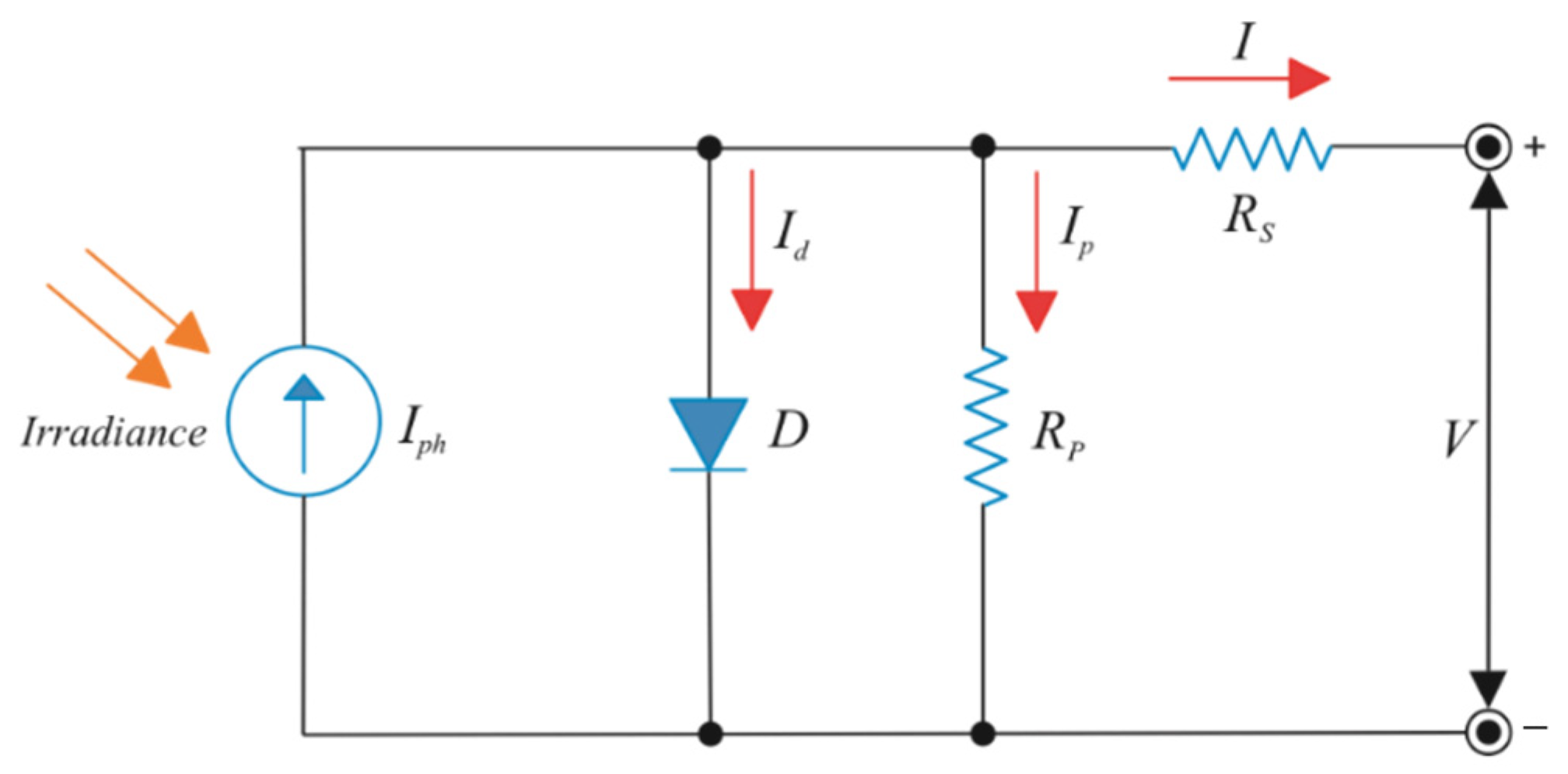
The equivalent electrical circuit of the single-diode model (SDM) is illustrated in Figure 1 [24]. This representation consists of a current source associated with the photocurrent ( I p h ), whose magnitude depends on solar irradiance and cell temperature. A diode is connected in parallel with this source to represent the electrical behavior of the PN junction within the PV device. To improve the accuracy of the model and capture internal losses, two resistive elements are incorporated: a series resistance ( R s ) and a shunt resistance ( R p ). The series resistance models the internal ohmic losses caused by the semiconductor material and metallic interconnections, whereas the shunt resistance represents leakage current paths within the cell structure [25]. Based on Kirchhoff’s current law (KCL), the current output (I) of the equivalent circuit shown in Figure 1 is expressed by (1).
I = I p h I 0 e x p q ( V + I R s ) n N s k T 1 V + I R s R p
where I 0 denotes the diode reverse saturation current, V is the output voltage of the PV device, n represents the diode ideality factor, and N s corresponds to the number of series connected cells. The constants k = 1.3806503 × 10⁻²³ J/K and q = 1.60217646 × 10⁻¹⁹ C represent the Boltzmann constant and the electron charge, respectively, while T is the temperature expressed in Kelvin. Based on these variables, the SDM can be fully described by a set of five unknown parameters, defined as τ = I p h , I 0 , n , R s , R p , which determine the electrical behavior and shape of the PV current–voltage characteristic curve.

2.1.2. Double-Diode Model

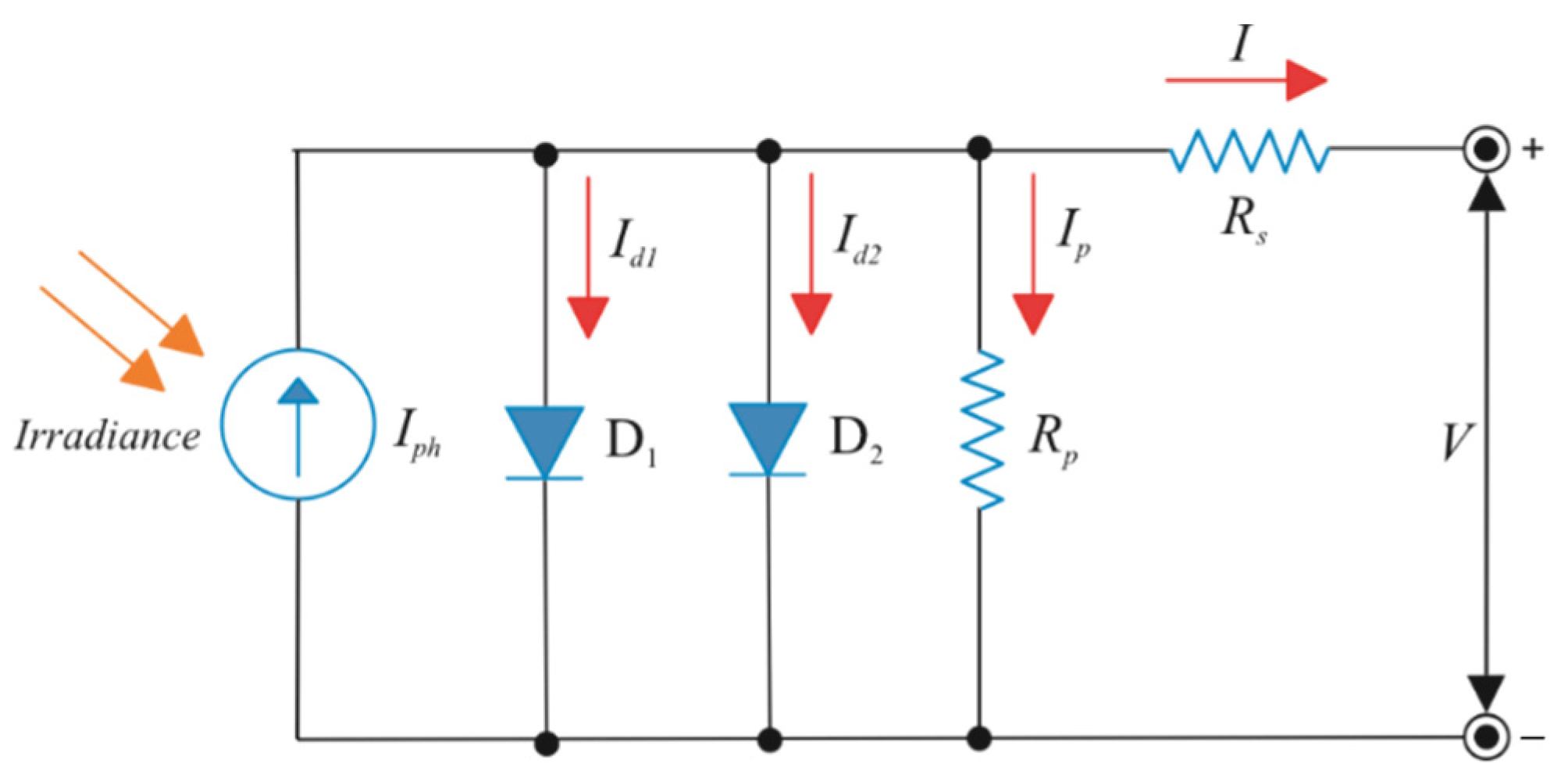
Figure 2 presents the equivalent electrical circuit of the double-diode model (DDM) [26]. In contrast to the SDM, this model incorporates two diodes connected in parallel with the current source to provide a more detailed representation of the internal PN junction phenomena. The first diode (D1) is associated with the diffusion mechanism of charge carriers, modeling the transport of minority carriers through the depletion region. The second diode (D2) accounts for recombination losses, representing the recombination process of carriers within the space charge region [27]. By applying Kirchhoff’s current law (KCL) to the equivalent circuit shown in Figure 2, the output current (I) can be expressed by (2).
I = I p h I 01 e x p q ( V + I R s ) n 1 N s k T 1 I 02 e x p q ( V + I R s ) n 2 N s k T 1 V + I R s R p
where I 01 and I 02 represent the reverse saturation currents of diodes D1 and D2, respectively. Likewise, n 1 and n 2 correspond to the ideality factors associated with each diode, defining their individual electrical behavior within the model. As a result, the double-diode model (DDM) is defined by a set of seven unknown parameters, expressed as τ   =   [ I ph ,   I 01 ,   I 02 ,   n 1 ,   n 2 ,   R s ,   R p ] , which collectively determine the PV device response and provide a more detailed approximation of its current–voltage characteristics.

2.1.3. SDM and DDM on Partial Shading Condition

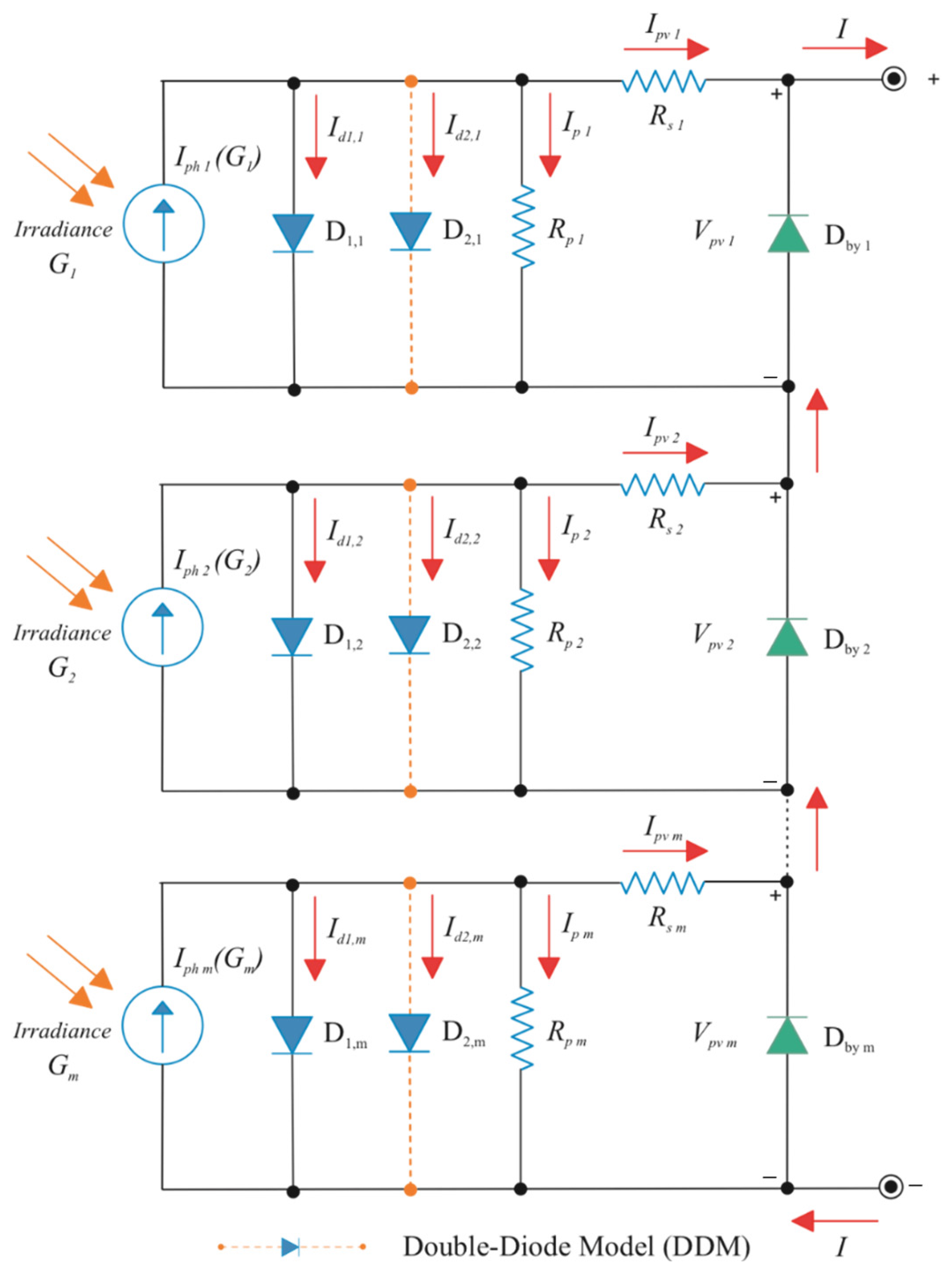
Under partial shading conditions (PSCs), the energy production of photovoltaic systems can be significantly reduced, affecting their efficiency and operational reliability. One of the main concerns associated with PSC is the formation of hot spots, which may cause overheating and permanent damage to shaded cells. To prevent this effect, bypass diodes ( D b y ) are commonly integrated into PV modules, providing an alternative current path when shaded cells operate under reverse bias conditions. These bypass diodes are typically arranged in an antiparallel configuration, dividing the module into m cell groups, where each group is protected by one bypass diode. The number of bypass diodes is determined by the module design and depends on the total number of series connected cells. In commercial PV modules, the use of three bypass diodes is the most common configuration. Figure 3 illustrates the equivalent electrical circuit of the double-diode model (DDM) for a photovoltaic module equipped with m bypass diodes.
According to [28], the electrical behavior of bypass diodes can be represented through an equivalent resistance ( R b y ) dependent on the photocurrent I p h . In this simplified approach, the bypass diode is modeled as a variable resistance whose value changes according to its operating state. When the diode is reverse biased, it behaves as a very high resistance (approximately 1010 Ω), effectively blocking the current flow. Conversely, under forward bias conditions, its resistance becomes very low (approximately 10−2 Ω), allowing the current to bypass the shaded cell group. This mathematical representation is expressed in (3).
R b y ( I p h ) = 10 2       D b y       O n 10 10       D b y       O f f
As described in [28], under partial shading conditions (PSCs), the resulting current output and voltage of the PV module can be determined by solving the set of equations given in (4) and (5).
I = I p h   1 G 1 i = 1 u I 0 i   1 e x p V p v   1 + I p v   1 R s   1 n i   1 × V t 1 V p v   1 + I p v   1 R s   1 R p   1                                         I > I p h   2 I p h   2 G 2 i = 1 u I 0 i   2 e x p V p v   2 + I p v   2 R s   2 n i   2 × V t 1 V p v   2 + I p v   2 R s   2 R p   2           I p h   2 I I p h   m I p h   m G m i = 1 u I 0 i   m e x p V p v   m + I p v   m R s   m n i   m V t 1 V p v   m + I p v   m R s   m R p   m                   I < I p h   m
V = V p v   1                                                                                                       I > I p h   2 V p v   2 + V p v   1                                                   I p h   2 I I p h   m V p v   m + V p v   2 + V p v   1                                               I < I p h   m
where G denotes the irradiance level applied to each PV group, following the condition G 1 > G 2 > > G m ; I p v and V p v represent the output current and voltage of each PV group, respectively; and u indicates the number of diodes considered in the equivalent PV model, with u = 1 for SDM and u = 2 for DDM.
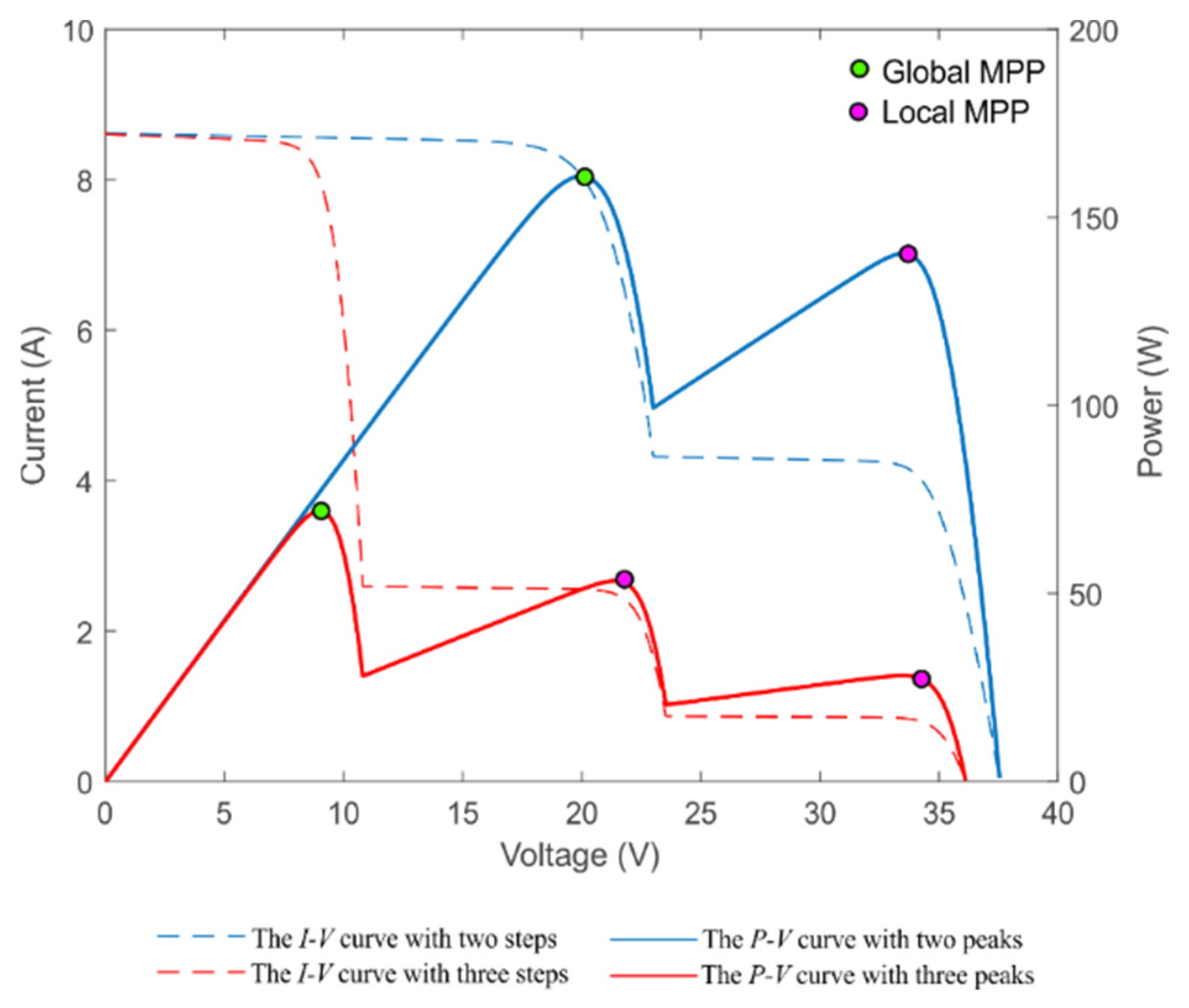
The integration of bypass diodes in PV modules is essential to protect shaded cells from excessive reverse voltage stress, thereby reducing the risk of hot spot formation. Although this protection improves system reliability, the activation of bypass diodes under forward bias modifies the electrical characteristics of the module, producing multiple steps in the I–V curve and several peaks in the P–V curve, as illustrated in Figure 4. Among these peaks, only one corresponds to the global peak (GP), which represents the actual maximum power point (MPP), while the remaining peaks correspond to local peaks (LPs).

2.2. Particle Swarm Optimization (PSO)

The Particle Swarm Optimization (PSO) algorithm, introduced by Russell Eberhart and James Kennedy in 1995, is a population-based metaheuristic optimization method inspired by the collective behavior observed in nature, such as bird flocking and fish schooling. This optimization strategy mimics the social interaction among individuals searching for resources, where information sharing helps guide the population toward promising solutions [29].
In PSO, each particle represents a candidate solution whose quality is assessed by means of an objective function. The movement of each particle in the search space is governed by three main components, as described in (6). The first component corresponds to the inertia term ( w ), which controls the influence of the previous velocity and promotes exploration of new regions in the search space, contributing to the diversification mechanism. The second component directs the particle toward its own best previously achieved position (xPbest), reflecting the individual learning process. The third component guides the particle toward the best solution identified by the entire swarm (xGbest), representing the social learning behavior of the population. The last two components strengthen the intensification mechanism by encouraging the search around historically successful regions. Once the new velocity is computed, the particle position is updated according to (7).
V i , d ( t + 1 ) = w V i , d ( t ) f i r s t   t e r m + C 1 r 1 x P b e s t , d x i , d ( t ) s e c o n d   t e r m + C 2 r 2 x G b e s t , d x i , d ( t ) t h i r d   t e r m
x i , d t + 1 = x i , d t + V i , d t + 1
where w denotes the inertia factor, which controls the influence of the particle’s previous velocity on its current movement. The variables r 1 and r 2 are random numbers uniformly distributed between 0 and 1, introducing stochastic behavior into the search process. The parameter C 1 corresponds to the cognitive coefficient, regulating the influence of the particle’s own best experience, while C 2 represents the social coefficient, which determines the influence of the best solution found by the swarm. The term V i defines the velocity of the i-th particle, and t indicates the current iteration step of the optimization procedure.

2.3. PSO-Based MPPT Controller and Problem Formulation

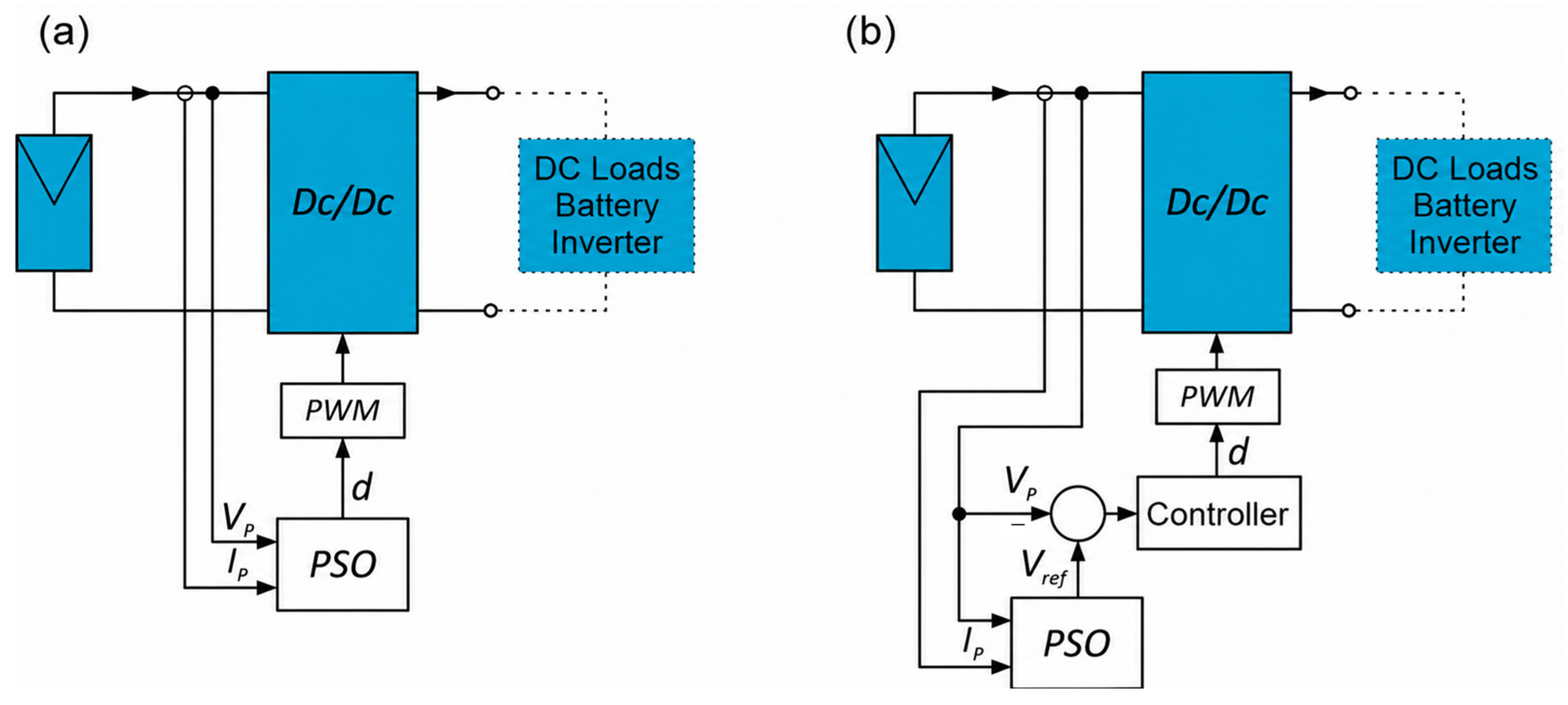
The control structure of a PV system with MPPT can be implemented in either an open-loop or closed-loop configuration, as illustrated in Figure 5, depending on the desired level of complexity and performance of the PV system. In the open-loop configuration (Figure 5a), the MPPT algorithm acts directly on the DC/DC converter by dynamically adjusting its duty cycle. On the other hand, in the closed-loop configuration (Figure 5b), the MPPT algorithm generates an operating reference, while an additional controller (e.g., a Proportional-Integral (PI) or Proportional-Integral-Derivative (PID) controller) is responsible for ensuring that the control system follows this reference by dynamically adjusting the duty cycle of the DC/DC converter. This structure allows for better compensation and handling of the nonlinearities inherent to the PV panel behavior.
In general, the optimization process is directly related to the power produced by the PV system. The objective of the MPPT algorithm is to maximize this power by exploring different operating points along the characteristic P–V curve of the PV system. In the case of MPPT algorithms based on PSO, each particle in the population represents a possible solution, i.e., an operating point of the PV system. This operating point is typically associated with the duty cycle of the DC/DC converter or the reference voltage (or current) of the PV system, thus forming a one-dimensional optimization problem.
Initially, the particles in the population are distributed within the admissible operating range (search space). For each particle, the PV system voltage and current are measured, and the output power is subsequently calculated. Based on these measurements and calculations, each particle updates its personal best solution ( x P b e s t ), corresponding to the best operating point it has achieved so far, while simultaneously the global best solution ( x G b e s t ) of the swarm is determined, representing the MPP found to date. The particle positions (new solutions) are then iteratively updated according to Equations (6) and (7), promoting exploration of the search space. This process is repeated over successive iterations, with the DC/DC converter continuously adjusted according to the new solutions/particles, leading to a progressive refinement of the operating point until convergence to the MPP.

3. Related Work

3.1. Literature Search Protocol

The studies included in this article were identified through a systematic search conducted in Scopus, Web of Science, and IEEE Xplore databases, covering the period from 2010 onwards. The following combination of keywords was used: (“Particle Swarm Optimization” OR “PSO”) AND (“Maximum Power Point Tracking” OR “MPPT”) AND (“photovoltaic” OR “PV”).
The inclusion criteria required that: (i) the study explicitly employed the PSO algorithm; (ii) control and configuration parameters were reported; and (iii) the article was published in a peer-reviewed journal or conference proceeding indexed in the selected databases.
Studies were excluded if: (i) PSO was used only for the optimization of other controllers and not directly applied to MPPT; (ii) control and configuration parameter values were not explicitly reported; or (iii) the document corresponded to grey literature, such as technical reports or theses.
Based on these criteria, a sample of 42 studies was identified, highlighting the high diversity in PSO parameterization and the variability of approaches reported in the literature. This diversity reflects the absence of a universally accepted standard configuration, with different combinations of control parameters and PSO variants being commonly adopted. Furthermore, this methodological heterogeneity underscores the need for systematic analyses to identify trends, best practices, and the most effective parameter settings.
The 42 selected articles/studies, published between 2010 and 2026, were identified across 18 peer-reviewed journals and conference proceedings, with the highest concentration in Institute of Electrical and Electronics Engineers (IEEE) Transactions on Industrial Electronics (n = 5), Solar Energy (n = 4), and Applied Energy (n = 3). Table 1 summarizes the temporal evolution of the reviewed studies according to PSO strategy type.
Classical PSO strategies were employed in 57% of the reviewed studies, while modified PSO variants, including hybrid and adaptive approaches, accounted for the remaining 43%. The results also indicate a growing trend toward hybrid and advanced PSO implementations in recent years, particularly to improve global maximum power point tracking under partial shading conditions.
Within this defined corpus, the temporal distribution of studies provides useful insight into the evolution of PSO-based MPPT research. The higher concentration of publications during the 2014–2019 period may be associated with the consolidation of PSO as a robust global optimization technique for MPPT under partial shading conditions, particularly in studies comparing classical PSO with conventional MPPT methods and early hybrid strategies.
In contrast, the comparatively lower number of studies in the 2023–2024 window should not be interpreted as a loss of relevance of PSO-based MPPT, but rather as an indication of the field’s maturation and its gradual transition toward more specialized, adaptive, hybrid, and application-specific variants. Thus, the temporal distribution complements the statistical analysis by showing not only how often certain parameter choices appear, but also how PSO-MPPT research has evolved within the boundaries of the selected dataset.
It should be noted that the selected corpus is not intended to represent an exhaustive census of all PSO-based MPPT publications. Rather, it constitutes a structured and reproducible dataset obtained from predefined scientific databases and eligibility criteria, with emphasis on studies that explicitly report the PSO control and configuration parameters required for comparative analysis.
Given the large and heterogeneous body of literature on PSO-MPPT applications, additional relevant studies may exist outside the final dataset due to differences in indexing, terminology, keyword selection, or incomplete parameter reporting. Therefore, the statistical results should be interpreted as evidence of parameterization trends within the selected corpus, rather than as an exhaustive mapping of the entire field.

3.2. Related Work Overview

The selection of PSO control parameters and configuration, such as the inertia weight (w), cognitive learning factor (C1), social learning factor (C2), number of particles (np), and initial particle position (ipp), has a significant impact on the algorithm’s performance and efficiency [30]. One of the most important PSO control parameters is the inertia weight that establishes the balance between the diversification and intensification mechanisms, i.e., a large inertia weight value favors the diversification mechanism (global search), while a small inertia weight value favors the intensification mechanism (local search). When Shi and Eberhart [31] first presented the concept of inertia weight, in 1998, they considered it as a constant. Over the years, different strategies for setting inertia weight were introduced by many researchers to increase the PSO’s capability to determine high-quality solutions with low computational cost [32]. The most common strategy is linearly decreasing the inertia weight (Table 2) from 0.9 to 0.4 as a function of iterations to improve the balance between the intensification and the diversification mechanisms.
In the velocity equation, three different terms influence the particle’s motion at a t iteration. The first term is a product of w (the inertia weight constant, usually a positive constant value) and the particle’s previous velocity. In most cases w is set to be 1 or a value between 0 and 1. For w = 1 , the particle’s movement is completely affected by its previous motion direction; so, it may keep moving in the same direction [33]. However, if 0 < w < 1 , the influence of the previous motion is reduced, allowing the particle to navigate to other regions in the search space.
The cognitive learning factor ( C 1 ) and social learning factor ( C 2 ), also called acceleration constants (Table 3), control the attraction of particles (movement) towards the best particle position (xPbest) and the best position reached by all particles in the population (xGbest). High values for these control parameters cause sudden particle movements that compromise the achievement of high-quality solutions and increase the probability of particles getting trapped in local optimums (premature convergence) [34]. However, if the value of these control parameters is too low, particles move slowly, increasing the computational cost and the probability of premature convergence and particle stagnation (convergence to a solution that is not a global or local optimum).
If C 1 is null, the particle will not have cognitive abilities, i.e., it will be unable to compare its own best position with its current position, only with that of other particles. This leads to faster convergence of the PSO. However, particles can easily become trapped in local optimum. If C 2 is null, the particle will have no social abilities, i.e., it will not be able to verify the best position of the other particles of the population. Thus, because of this lack of interaction between particles, reaching the best solution will be more difficult. To confront this problem, some researchers set C 1 and C 2 with linear decay to find the equilibrium between interacting agents in the search for the best solution, i.e., initially the agents have more social and cognitive capability, forcing the agents to interact with all particles, including themselves, and in later iterations, this capability is reduced, making the agents slow down around the high-quality solution [35,36,37].
However, in the specialized literature, a common choice for the acceleration constants is C 1 = C 2 = 2 and has been generally acceptable for most optimization problems. It is very important to find a balance in setting these parameters, in order to encourage individuals to move around the search space, without clustering at the local optimums, and find the best solution efficiently.
The number of particles in the population (np) is primarily determined by the dimensionality and complexity of the optimization problem. In general, problems with higher dimensionality or greater complexity require a larger number of particles to ensure adequate exploration of the search space and to avoid premature convergence. In addition, an excessively large number of particles increases computational cost without necessarily improving solution quality, as reported in several studies on the sensitivity of PSO parameters. On the other hand, a reduced number of particles can limit the algorithm’s ability to effectively explore the search space, also leading to suboptimal results (premature convergence) [38].
Also, several sensitivity studies on PSO control and configuration parameters have studied the influence of particle initialization strategies. These studies indicate that the initial distribution of particles can significantly affect both the convergence speed and the quality of the final solution obtained by the PSO. Different initialization strategies may lead to statistically significant variations in performance and results, highlighting the importance of this stage in the optimization process. While random initialization is commonly adopted due to its simplicity, it may reduce population diversity in the early iterations and increase the likelihood of premature convergence to local optima rather than the global optimum. For this reason, some authors, such as in [39,40], have proposed hybrid initialization strategies based on empirical observations. Their results suggest that approximately 30–40% of the initial particle positions may be assigned randomly, while the remaining particles are initialized selectively within the search space. This hybrid approach enhances information sharing among particles and improves the propagation of movement across the swarm, leading to better exploration of the search space and improved convergence behavior.
There are numerous studies in the literature that are applied to MPPT methods in PV systems. Table 4 summarizes the main features of the different approaches reported in these studies, particularly in terms of their parameterization (control and configuration).
Table 4 highlights the absence of a standard configuration for PSO parameter settings in the literature. In many cases, parameter selection relies on empirical trial-and-error procedures, which can lead to suboptimal results under different operating conditions. Although similar values for c 1 , c 2 , and w   are commonly adopted, the absence of standardization in defining the number of particles and their initialization can significantly affect the algorithm’s efficiency, accuracy and performance. For statistical analysis purposes, classical and modified PSO variants were jointly considered, since all of them preserve the same fundamental swarm-based optimization mechanism.

4. Discussion

The number of particles is a critical configuration parameter in the PSO algorithm, as it directly influences the exploration of the search space, the computational cost, tracking efficiency and the oscillations in the output power of the DC/DC converter.
The literature analysis indicates that a significant portion of authors favors the use of a reduced number of particles (typically up to 5). Approximately 33% of the studies report the use of only three particles. The choice of a reduced number of particles is generally justified by the simplicity of the optimization problem (one-dimensional), since the control variable corresponds to the reference voltage or the converter duty cycle. In this context, smaller populations reduce computational cost, accelerate the convergence, and decrease power oscillations during the search process, which is particularly advantageous in PV systems subject to rapid environmental changes. This trend may also be attributed to practical implementation constraints, particularly in real-time applications, where limited computational resources favor simpler algorithm settings/configurations. However, it is important to distinguish between prevalence and optimality when interpreting these frequency distributions of reported values. Indeed, some authors highlight the need for a larger number of particles, particularly under more complex operating conditions. For example, Chao et al. (2015) [49] and Ram and Rajasekar (2017) [62] reported that increasing the number of particles from 3 to 5 under PSC reduced the occurrence of local peak trapping and improved global search capability.
For this reason, some approaches use larger populations, typically with 20 or more particles (approximately 18% of studies). These strategies are more common under PSC, where the P–V characteristic curve exhibits multiple local maxima. In these scenarios, increasing the number of particles enhances the algorithm’s exploration capacity and reduces the probability of convergence to local optima. However, an excessive number of particles can lead to an increase in convergence time and additional oscillations in the DC/DC converter output power, thus compromising the dynamic performance and overall efficiency of the system.
The selection of the number of particles should not be based solely on empirical rules, obtained through trial and error, or on values frequently reported in the literature. Instead, it should be formalized through a simulation-based parametric analysis, in which different numbers of particles are evaluated according to performance metrics such as tracking efficiency, convergence time, and output power ripple, among others. Furthermore, practical implementation constraints must be considered. In low-cost embedded systems, such as microcontrollers, increasing the number of particles implies higher computational cost and resource usage, which may limit the feasibility of real-time implementation. Finally, the power system dynamics and the DC/DC converter response time should also be considered as fundamental constraints for defining this parameter.
The cognitive ( C 1 ) and social ( C 2 ) learning factors play a fundamental role in particles’ behavior in the PSO algorithm, as they govern the balance between individual experience and the collective influence of the swarm. The literature analysis indicates that approximately 74% of studies use C1 and C2 values in the range of 1.0 and 2.0, which is considered adequate for a wide variety of optimization problems. This range provides an effective balance between exploration of the search space and the ability to converge to high-quality solutions.
Furthermore, these values tend to promote more stable particle behavior, ensuring an adequate balance between individual learning and social influence, without introducing excessive oscillations in particle trajectories during the optimization process.
On the other hand, approximately 18% of authors define both parameters as 2.0, while a smaller fraction adopts adaptive strategies or variable learning coefficients. This diversity of approaches highlights that, although there is a dominant tendency toward the 1.0–2.0 range, there is still no definitive consensus regarding the optimal balance between the cognitive and social learning factors in the PSO algorithm.
The inertia factor ( w ) controls the influence of a particle’s previous velocity on its current movement. The literature analysis indicates that approximately 60% of authors adopt a fixed inertia factor, typically in the range of 0.2 to 1.2, suggesting that these values are generally effective across a wide range of MPPT-PSO algorithms. However, 35% of authors used a linear decreasing strategy, reducing the inertia factor from 0.9 to 0.4 over iterations. This approach can improve the balance between intensification and diversification mechanisms. It allows for a broader exploration of the search space during the initial stages of the algorithm and progressively leads to more refined convergence in later iterations. Alternative strategies, such as adaptive or dynamic inertia adjustment, are less common, representing 5% of cases.
The selection of the inertia factor and the cognitive and social learning coefficients is strongly conditioned by the desired dynamic behavior (trajectory) of the particles throughout the iterative process until convergence to the MPP. Additionally, the choice of these control parameters depends on the specific variant of the PSO algorithm considered. Different variants introduce their own mechanisms, i.e., different parameterizations that significantly alter the dynamic behavior of the particles. In hybrid approaches, this dependence becomes even more pronounced. When PSO is combined with other methods, its role in the overall process directly influences the adopted parameterization. For instance, if PSO is predominantly used to rapidly identify the region near the MPP, it may be advantageous to favor parameters that promote trajectories with abrupt (divergent) movements but globally convergent behavior, i.e., a diversification mechanism. Conversely, if its role also includes solution refinement, it is necessary to adjust the parameters to promote a smoother, more stable, and more accurate particle dynamic towards the MPP (intensification mechanism).
Several studies have shown that the convergence behavior of the PSO algorithm is highly sensitive to the choice of these control parameters [83,84,85,86], particularly regarding parameter tuning, initialization strategy, and operating conditions under partial shading scenarios, as also discussed in [87]. The literature analysis indicates that there is no universally optimal set of values for these parameters. However, various guidelines have been proposed to support their selection, with the aim of ensuring convergence of the PSO algorithm, as well as controlling the dynamic behavior (trajectory) of the particles throughout the iterative process towards an equilibrium point. One of the earliest relevant contributions in this field was proposed by Maurice Clerc and James Kennedy, through heuristic rules derived from the analysis of a deterministic PSO, i.e., without a stochastic component. From this study, the condition presented in Equation (8) was established, in which, for a given value of ϕ, it is possible to determine a constriction coefficient that ensures stability and convergence of the PSO algorithm.
1 > w > 1 2 ( ϕ 1 + ϕ 2 ) 0
Considering that 0 w < 1 , ϕ 1 = c 1 U ( 0,1 ) , and ϕ 2 = c 2 U ( 0,1 ) , the coefficients c 1 and c 2   act as upper bounds of these random variables. Thus, Equation (8) can be rewritten as:
1 > w > 1 2 ( c 1 + c 2 ) 0
However, in a stochastic iterative process, it may occur that, even when ϕ 1 and ϕ 2 are random and the parameter w violates the condition stated in Equation (8), the PSO algorithm still exhibits globally convergent behavior. In such cases, the particle may follow a predominantly convergent trajectory over most iterations, despite occasional divergent steps.
Additionally, Van den Bergh and Engelbrecht demonstrated that convergent behavior can also be observed, provided that the ratio given in Equation (10) is close to 1:
ϕ ratio = ϕ crit c 1 + c 2
where
ϕ crit = s u p ϕ ( 0 , c 1 + c 2 0.5   ϕ 1
In conclusion, the existence of various guidelines in the specialized literature provides a useful metric for evaluating PSO behavior. However, the selection of control parameters cannot be regarded in an isolated or universal manner, since it depends on several intrinsic factors of the algorithm itself, as well as extrinsic factors related to the specific application, such as the characteristics of the optimization problem and the dynamics of the P–V curve (with or without partial shading conditions). Therefore, PSO parameterization should be understood as a multidimensional trade-off aimed at achieving the desired dynamic behavior.
Particle initialization is another aspect in PSO, as it can affect the coverage of the search space and the convergence of the algorithm. An analysis showed that 68% of the authors adopted random or uniform particle initialization, which is easy to implement and can be effective in many scenarios. However, 27% of the authors use selective initialization strategies, which can improve search space coverage and avoid premature convergence to local optima. This strategy is particularly useful in complex problems where the initial distribution of particles can significantly affect the performance of the PSO.
The operating conditions analyzed include PSC and variations in irradiance, load, and Standard Test Conditions (STCs). Partial shading conditions were the most common scenario, accounting for 80% of the cases, reflecting its practical importance in PV systems. PSC is a significant challenge for MPPT algorithms because it creates multiple local maxima in the P–V characteristic curve, requiring robust algorithms to identify the global maximum. Variations in irradiance, load, and STCs accounted for 20% of the authors, indicating that this condition, although relevant, is less common in the studies analyzed.
To further investigate the relationship between parameter configuration and operating conditions, a qualitative analysis (the chi-square test of independence) of the reviewed studies was performed considering the presence or absence of PSC. The analysis indicates that larger swarm sizes and variable inertia weight strategies, particularly linear decreasing strategy, are more frequently adopted in studies addressing partial shading conditions. This tendency reflects the need for stronger exploration capabilities in the multimodal P–V characteristics curve, where multiple local maxima may arise and increase the risk of premature convergence. In contrast, studies conducted under uniform irradiance tend to adopt smaller swarm sizes and fixed inertia weights, prioritizing faster convergence and lower computational complexity, and a more stable dynamic response.
These observations reinforce the practical recommendation that the number of particles should be adjusted according to the complexity of the optimization problem, especially under partial shading conditions, where broader search space coverage becomes more important. Regarding the initialization strategy (random/selective), the qualitative analysis of the chi-square test of independence did not reveal a statistically significant association with PSC. This lack of statistical significance may be explained by the fact that the choice between random and selective initialization does not necessarily have a direct or dominant impact on PSO performance. In many cases, any potential influence is overshadowed by more critical factors, such as the PSO control parameters or the hybridization strategy adopted, which tend to play a more decisive role in determining overall performance.
Although this review focuses on PSO control and configuration parameters, it is important to recognize that system-level characteristics may also influence the performance and practical suitability of PSO-based MPPT algorithms. Factors such as the number of PV modules, the series/parallel configuration of PV strings, the rated power of the system, the number and arrangement of bypass diodes, the DC/DC converter topology, and the selected control variable may affect the shape of the P–V curve, the number of local maxima under partial shading, the convergence behavior, the output power oscillations, and the computational burden of the MPPT controller.
However, these variables were not systematically analyzed in the present study because the objective of this review was specifically to evaluate the reported PSO parameterization practices, and because hardware-level information is not consistently provided across the reviewed literature. A dedicated future review should therefore address the interaction among PSO parameter selection, PV array architecture, converter topology, and real-time implementation constraints.
From the analysis conducted, it can be concluded that the selection of control and configuration parameters should not rely exclusively on heuristic approaches (empirical rule), such as trial-and-error procedures, nor on the direct adoption of values commonly reported in the literature (citation cascade). Instead, a more rigorous and systematic methodology is recommended, based on parametric simulation, in which multiple combinations of control and configuration parameters are systematically evaluated under representative operating conditions. This evaluation should be carried out using well-defined and established performance metrics widely accepted by the research community. In addition, practical implementation constraints must be considered, particularly in embedded and real-time systems, where computational resources and execution time directly affect algorithm implementation.

5. Conclusions

This article analyzed the performance and configuration of the main control and configuration parameters associated with the PSO algorithm applied to PV systems, with a focus on MPPT applications under different operating conditions. The analysis of control parameters included the cognitive (C1) and social (C2) learning factors, as well as the inertia factor (w), along with configuration parameters such as the number of particles and the initialization strategy.
This work aimed to identify patterns, best practices, and limitations associated with the different parameter configurations reported in the literature, contributing to a better understanding of how these variations affect MPPT algorithm performance under different operating conditions, including partial shading conditions.
The literature review shows that the choice of PSO parameters generally follows recurring trends, strongly influenced by the empirical experience of researchers and the reuse of configurations previously validated in earlier studies. However, the high frequency of certain parameter values should not be interpreted as evidence of optimality, but rather as a reflection of established practices within the research community.
The statistical analysis indicates that the most common configurations include small swarm sizes, typically consisting of three particles; learning coefficients (C1 and C2) in the range of 1.0 to 2.0; a fixed inertia factor between 0.2 and 1.2 or, alternatively, linear decreasing strategies from 0.9 to 0.4; as well as a predominance of random particle initialization. Nevertheless, these choices are often highly dependent on the specific application context and operating conditions, with no clear consensus on universally optimal parameter values. Therefore, a systematic and simulation-based approach is recommended, in which different parameter combinations are evaluated in a structured and comparative manner, using appropriate performance metrics while also considering practical implementation constraints.
From a sustainability perspective, improving the efficiency of MPPT algorithms directly contributes to maximizing PV energy harvesting, reducing energy losses, and increasing the reliability of renewable energy systems. More efficient PSO parameter configurations enable better utilization of PV resources, especially under PSC, enhancing the overall energy yield of PV installations and supporting the transition toward cleaner and more sustainable electricity production.
By enhancing the operational efficiency of PV systems, optimized PSO-based MPPT techniques can support the broader goals of sustainability, including higher renewable energy penetration, improved energy efficiency, and reduced environmental impact. Future research should focus on systematic sensitivity analysis and adaptive parameter tuning mechanisms to establish more robust and sustainable PSO-MPPT design guidelines.

Author Contributions

Conceptualization, B.M.; methodology, B.M., W.M. and S.M.; validation, B.M., W.M. and M.C.; formal analysis, B.M., W.M., J.P., M.C. and S.M.; investigation, B.M., W.M., J.P., M.C. and S.M.; resources, M.C. and S.M.; writing—original draft preparation, B.M.; writing—review and editing, B.M., W.M. and M.C.; visualization, B.M., W.M., J.P., M.C., S.M. and M.L.; supervision, M.C., S.M. and M.L. All authors have read and agreed to the published version of the manuscript.

Funding

This work is funded by national funds through FCT—Fundação para a Ciência e a Tecnologia, I.P., and, when eligible, co-funded by EU funds under project/support UID/50008/2025—Instituto de Telecomunicações, with DOI identifier <https://doi.org/10.54499/UID/50008/2025>.

Institutional Review Board Statement

Not applicable.

Informed Consent Statement

Not applicable.

Data Availability Statement

The original contributions presented in the study are included in the article; further inquiries can be directed to the corresponding author.

Acknowledgments

The authors gives their special thanks to the Fundação para a Ciência e a Tecnologia (FCT), Portugal, for the Ph.D. Grant (2023.02678.BDANA) and E-REDES, Portugal, and IFMT, Brazil, for supporting this research.

Conflicts of Interest

Author Miguel Louro is employed by the company E-REDES—Distribuição de Eletricidade, S.A. The remaining authors declare that the research was conducted in the absence of any commercial or financial relationships that could be construed as a potential conflict of interest.

Abbreviations

The following abbreviations are used in this manuscript:
ACOAnt Colony Optimization
ANNArtificial Neural Network
CSCuckoo Search
DDMDouble-Diode Model
FLCFuzzy Logic Control
FAFirefly Algorithm
FSCFractional Short Circuit
FOCFractional Open Circuit
GAGenetic Algorithm
GWOGrey Wolf Optimization
HCHill Climbing
ICIncremental Conductance
MPPTMaximum Power Point Tracking
MPPMaximum Power Point
PVPhotovoltaic
PSOParticle Swarm Optimization
PSCPartial Shading Condition
P&OPerturb and Observe
SDMSingle-Diode Model
STCStandard Test Condition

References

  1. IEA. Renewables Information; IEA: Paris, France, 2019. Available online: https://www.iea.org/data-and-statistics/data-product/renewables-information (accessed on 5 March 2020).
  2. IEA. Renewables 2019; IEA: Paris, France, 2019. Available online: https://www.iea.org/reports/renewables-2019 (accessed on 5 March 2020).
  3. IEA. Solar Energy: Mapping the Road Ahead; IEA: Paris, France, 2019. Available online: https://www.iea.org/reports/solar-energy-mapping-the-road-ahead (accessed on 5 March 2020).
  4. Mohapatra, A.; Nayak, B.; Das, P.; Mohanty, K.B. A review on MPPT techniques of PV system under partial shading condition. Renew. Sustain. Energy Rev. 2017, 80, 854–867. [Google Scholar] [CrossRef] [Scilit]
  5. Nzoundja Fapi, C.B.; Wira, P.; Kamta, M.; Tchakounté, H.; Colicchio, B. Simulation and dSPACE Hardware Implementation of an Improved Fractional Short-Circuit Current MPPT Algorithm for Photovoltaic System. Appl. Sol. Energy (Engl. Transl. Geliotekhnika) 2021, 57, 93–106. [Google Scholar] [CrossRef] [Scilit]
  6. Alsulami, A.F.; Al Arefi, S.M.S. Fraction Open Circuit and Fractional Short Circuit Based Incremental Conductance Maximum Power Point Tracking Controller. In Proceedings of the 10th IEEE International Conference on Renewable Energy Research and Applications, ICRERA 2021, Istanbul, Turkey, 26–29 September 2021; pp. 184–189. [Google Scholar] [CrossRef] [Scilit]
  7. Rao, C.; Hajjiah, A.; El-Meligy, M.A.; Sharaf, M.; Soliman, A.T.; Mohamed, M.A. A Novel High-Gain Soft-Switching DC-DC Converter with Improved PO MPPT for Photovoltaic Applications. IEEE Access 2021, 9, 58790–58806. [Google Scholar] [CrossRef] [Scilit]
  8. Triki, Y.; Bechouche, A.; Seddiki, H.; Abdeslam, D.O. An Improved Incremental Conductance Based MPPT Algorithm for Photovoltaic Systems. In Proceedings of the IECON 2021—47th Annual Conference of the IEEE Industrial Electronics Society, Toronto, ON, Canada, 13–16 October 2021. [Google Scholar] [CrossRef] [Scilit]
  9. Jately, V.; Azzopardi, B.; Joshi, J.; Venkateswaran, B.; Sharma, A.; Arora, S. Experimental Analysis of hill-climbing MPPT algorithms under low irradiance levels. Renew. Sustain. Energy Rev. 2021, 150, 111467. [Google Scholar] [CrossRef] [Scilit]
  10. Pandey, A.; Dasgupta, N.; Mukerjee, A.K. High-performance algorithms for drift avoidance and fast tracking in solar MPPT system. IEEE Trans. Energy Convers. 2008, 23, 681–689. [Google Scholar] [CrossRef] [Scilit]
  11. Basha, C.H.; Murali, M.; Chakarajamula, C.; Basha, H. A new design of transformerless, non-isolated, high step-up DC-DC converter with hybrid fuzzy logic MPPT controller. Int. J. Circuit Theory Appl. 2022, 50, 272–297. [Google Scholar] [CrossRef] [Scilit]
  12. Villegas-Mier, C.G.; Rodriguez-Resendiz, J.; Álvarez-Alvarado, J.M.; Rodriguez-Resendiz, H.; Herrera-Navarro, A.M.; Rodríguez-Abreo, O. Artificial Neural Networks in MPPT Algorithms for Optimization of Photovoltaic Power Systems: A Review. Micromachines 2021, 12, 1260. [Google Scholar] [CrossRef] [Scilit] [PubMed]
  13. Chao, K.H.; Rizal, M.N. A Hybrid MPPT Controller Based on the Genetic Algorithm and Ant Colony Optimization for Photovoltaic Systems under Partially Shaded Conditions. Energies 2021, 14, 2902. [Google Scholar] [CrossRef] [Scilit]
  14. Andrade, L.M.; Vicente, P.S.; Tofoli, F.L.; Moreira Vicente, E. A critical analysis of PSO and its variations applied to MPPT for PV Systems under Partial Shading Condition. In 2019 IEEE 15th Brazilian Power Electronics Conference and 5th IEEE Southern Power Electronics Conference (COBEP/SPEC); IEEE: New York, NY, USA, 2019; pp. 1–6. [Google Scholar] [CrossRef] [Scilit]
  15. Phanden, R.K.; Sharma, L.; Chhabra, J.; Demir, H.I. A novel modified ant colony optimization based maximum power point tracking controller for photovoltaic systems. Mater. Today Proc. 2021, 38, 89–93. [Google Scholar] [CrossRef] [Scilit]
  16. Ma, M.; Zhou, L.; Zhao, H.; Tan, H.; Jiang, L.; Fan, K. Simulation Study of Photovoltaic Array MPPT Based on Improved CS Algorithm. In Proceedings of the 2021 IEEE 5th Conference on Energy Internet and Energy System Integration (EI2), Taiyuan, China, 22–24 October 2021; pp. 744–749. [Google Scholar] [CrossRef] [Scilit]
  17. Titri, S.; Larbes, C.; Azli, H.; Benkhira, F.; Djemai, N. A Powerful Bio-Inspired Fire Fly Algorithm Based MPPT Controller for PV Systems Under Partial Shading Conditions. Lect. Notes Netw. Syst. 2021, 361, 133–143. [Google Scholar] [CrossRef] [Scilit]
  18. Motamarri, R.; Bhookya, N.; Chitti Babu, B. Modified grey wolf optimization for global maximum power point tracking under partial shading conditions in photovoltaic system. Int. J. Circuit Theory Appl. 2021, 49, 1884–1901. [Google Scholar] [CrossRef] [Scilit]
  19. De Oliveira Silva, M.; Flora Calili, R.; Louzada, D.R. Comparative Review of MPPT Algorithms. In Conference Record of the IEEE Photovoltaic Specialists Conference; IEEE: New York, NY, USA, 2021; pp. 1140–1147. [Google Scholar] [CrossRef] [Scilit]
  20. Jiang, L.L.; Srivatsan, R.; Maskell, D.L. Computational intelligence techniques for maximum power point tracking in PV systems: A review. Renew. Sustain. Energy Rev. 2018, 85, 14–45. [Google Scholar] [CrossRef] [Scilit]
  21. Rezaee Jordehi, A.; Jasni, J. Parameter selection in particle swarm optimization: A survey. J. Exp. Theor. Artif. Intell. 2013, 25, 527–542. [Google Scholar] [CrossRef] [Scilit]
  22. Pedrycz, W.; Sillitti, A.; Succi, G. Computational Intelligence: An Introduction; Springer: Berlin/Heidelberg, Germany, 2007. [Google Scholar] [CrossRef] [Scilit]
  23. Abbassi, R.; Abbassi, A.; Jemli, M.; Chebbi, S. Identification of unknown parameters of solar cell models: A comprehensive overview of available approaches. Renew. Sustain. Energy Rev. 2018, 90, 453–474. [Google Scholar] [CrossRef] [Scilit]
  24. Gradella Villalva, M.; Gazoli, J.R.; Ruppert Filho, E. Comprehensive Approach to Modeling and Simulation of Photovoltaic Arrays. IEEE Trans. Power Electron. 2009, 24, 1198–1208. [Google Scholar] [CrossRef] [Scilit]
  25. Nunes, H.G.G.; Pombo, J.A.N.; Mariano, S.J.P.S.; Calado, M.R.A.; Felippe de Souza, J.A.M. A new high-performance method for determining the parameters of PV cells and modules based on guaranteed convergence particle swarm optimization. Appl. Energy 2018, 211, 774–791. [Google Scholar] [CrossRef] [Scilit]
  26. Ishaque, K.; Salam, Z.; Taheri, H. Simple, fast and accurate two-diode model for photovoltaic modules. Sol. Energy Mater. Sol. Cells 2011, 95, 586–594. [Google Scholar] [CrossRef] [Scilit]
  27. Elbaset, A.A.; Ali, H.; Abd El Sattar, M. New seven parameters model for amorphous silicon and thin film PV modules based on solar irradiance. Sol. Energy 2016, 138, 26–35. [Google Scholar] [CrossRef] [Scilit]
  28. Seyedmahmoudian, M.; Mekhilef, S.; Rahmani, R.; Yusof, R.; Renani, E.T. Analytical modeling of partially shaded photovoltaic systems. Energies 2013, 6, 128–144. [Google Scholar] [CrossRef] [Scilit]
  29. Kennedy, J.; Eberhart, R. Particle swarm optimization. In Proceedings of the ICNN’95—International Conference on Neural Networks, Perth, WA, Australia, 27 November–1 December 1995; Volume 4, pp. 1942–1948. [Google Scholar] [CrossRef] [Scilit]
  30. He, Y.; Ma, W.J.; Zhang, J.P. The Parameters Selection of PSO Algorithm influencing on performance of Fault Diagnosis. MATEC Web Conf. 2016, 63, 02019. [Google Scholar] [CrossRef] [Scilit]
  31. Shi, Y.; Eberhart, R. A modified particle swarm optimizer. In Proceedings of the IEEE International Conference on Evolutionary Computation, Anchorage, AK, USA, 4–9 May 1998; pp. 69–73. [Google Scholar] [CrossRef] [Scilit]
  32. Bansal, J.C.; Singh, P.K.; Saraswat, M.; Verma, A.; Jadon, S.S.; Abraham, A. Inertia weight strategies in particle swarm optimization. In Proceedings of the 2011 3rd World Congress on Nature and Biologically Inspired Computing, NaBIC, Salamanca, Spain, 19–21 October 2011; pp. 633–640. [Google Scholar] [CrossRef] [Scilit]
  33. Azli, H.; Titri, S.; Larbes, C. Modified Particle Swarm Optimization Based MPPT with Adaptive Inertia Weight. Lect. Notes Netw. Syst. 2020, 102, 115–123. [Google Scholar] [CrossRef] [Scilit]
  34. Li, H.R.; Gao, Y.L. Particle swarm optimization algorithm with exponent decreasing inertia weight and stochastic mutation. In Proceedings of the 2009 2nd International Conference on Information and Computing Science, ICIC 2009, Manchester, UK, 21–22 May 2009; Volume 1, pp. 66–69. [Google Scholar] [CrossRef] [Scilit]
  35. Anasuya. Machine Learning and Optimization Techniques in IoT and Smart Systems: A Survey of Recent Trends. Sci. Manag. Des. J. 2024, 2, 19–27. [Google Scholar] [CrossRef] [Scilit]
  36. Suganthan, P.N. Particle swarm optimiser with neighbourhood operator. In Proceedings of the 1999 Congress on Evolutionary Computation, CEC 1999, Washington, DC, USA, 6–9 July 1999; Volume 3, pp. 1958–1962. [Google Scholar] [CrossRef] [Scilit]
  37. Ratnaweera, A.; Halgamuge, S.K.; Watson, H.C. Self-organizing hierarchical particle swarm optimizer with time-varying acceleration coefficients. IEEE Trans. Evol. Comput. 2004, 8, 240–255. [Google Scholar] [CrossRef] [Scilit]
  38. Wang, D.; Tan, D.; Liu, L. Particle swarm optimization algorithm: An overview. Soft Comput. 2018, 22, 387–408. [Google Scholar] [CrossRef] [Scilit]
  39. Raß, A.; Schmitt, M.; Wanka, R. Explanation of stagnation at points that are not local optima in particle swarm optimization by potential analysis. In GECCO 2015—Companion Publication of the 2015 Genetic and Evolutionary Computation Conference; Association for Computing Machinery: New York, NY, USA, 2015; pp. 1463–1464. [Google Scholar] [CrossRef] [Scilit]
  40. Cazzaniga, P.; Nobile, M.S.; Besozzi, D. The impact of particles initialization in PSO: Parameter estimation as a case in point. In Proceedings of the 2015 IEEE Conference on Computational Intelligence in Bioinformatics and Computational Biology, CIBCB 2015, Niagara Falls, ON, Canada, 12–15 August 2015. [Google Scholar] [CrossRef] [Scilit]
  41. Chowdhury, S.R.; Saha, H. Maximum power point tracking of partially shaded solar photovoltaic arrays. Sol. Energy Mater. Sol. Cells 2010, 94, 1441–1447. [Google Scholar] [CrossRef] [Scilit]
  42. Miyatake, M.; Veerachary, M.; Toriumi, F.; Fujii, N.; Ko, H. Maximum power point tracking of multiple photovoltaic arrays: A PSO approach. IEEE Trans. Aerosp. Electron. Syst. 2011, 47, 367–380. [Google Scholar] [CrossRef] [Scilit]
  43. Ishaque, K.; Salam, Z.; Amjad, M.; Mekhilef, S. An Improved Particle Swarm Optimization (PSO)–Based MPPT for PV with Reduced Steady-State Oscillation. IEEE Trans. Power Electron. 2012, 27, 3627–3638. [Google Scholar] [CrossRef] [Scilit]
  44. Liu, Y.H.; Huang, S.C.; Huang, J.W.; Liang, W.C. A particle swarm optimization-based maximum power point tracking algorithm for PV systems operating under partially shaded conditions. IEEE Trans. Energy Convers. 2012, 27, 1027–1035. [Google Scholar] [CrossRef] [Scilit]
  45. Chao, K.H.; Chen, J.P. A Maximum Power Point Tracking Method Based on Particle Swarm Optimization for Photovoltaic Module Arrays with Shadows. ICIC Express Lett. 2014, 8, 626–633. [Google Scholar]
  46. Abdulkadir, M.; Yatim, A.H.M.; Yusuf, S.T. An Improved PSO-Based MPPT Control Strategy for Photovoltaic Systems. Int. J. Photoenergy 2014, 2014, 1–11. [Google Scholar] [CrossRef] [Scilit]
  47. Seyedmahmoudian, M.; Mekhilef, S.; Rahmani, R.; Yusof, R.; Shojaei, A.A. Maximum power point tracking of partial shaded photovoltaic array using an evolutionary algorithm: A particle swarm optimization technique. J. Renew. Sustain. Energy 2014, 6, 023102. [Google Scholar] [CrossRef] [Scilit]
  48. Lian, K.L.; Jhang, J.H.; Tian, I.S. A maximum power point tracking method based on perturb-and-observe combined with particle swarm optimization. IEEE J. Photovolt. 2014, 4, 626–633. [Google Scholar] [CrossRef] [Scilit]
  49. Chao, K.H.; Lin, Y.S.; Lai, U.D. Improved particle swarm optimization for maximum power point tracking in photovoltaic module arrays. Appl. Energy 2015, 158, 609–618. [Google Scholar] [CrossRef] [Scilit]
  50. Babu, T.S.; Rajasekar, N.; Sangeetha, K. Modified Particle Swarm Optimization technique based Maximum Power Point Tracking for uniform and under partial shading condition. Appl. Soft Comput. J. 2015, 34, 613–624. [Google Scholar] [CrossRef] [Scilit]
  51. Seyedmahmoudian, M.; Mekhilef, S.; Rahmani, R.; Yusof, R.; Shojaei, A.A. Simulation and Hardware Implementation of New Maximum Power Point Tracking Technique for Partially Shaded PV System Using Hybrid DEPSO Method. IEEE Trans. Sustain. Energy 2015, 6, 850–862. [Google Scholar] [CrossRef] [Scilit]
  52. Sundareswaran, K.; Vignesh Kumar, V.; Palani, S. Application of a combined particle swarm optimization and perturb and observe method for MPPT in PV systems under partial shading conditions. Renew. Energy 2015, 75, 308–317. [Google Scholar] [CrossRef] [Scilit]
  53. Cheng, P.C.; Peng, B.R.; Liu, Y.H.; Cheng, Y.S.; Huang, J.W. Optimization of a fuzzy-logic-control-based MPPT algorithm using the particle Swarm optimization technique. Energies 2015, 8, 5338–5360. [Google Scholar] [CrossRef] [Scilit]
  54. Mirhassani, S.M.; Golroodbari, S.Z.M.; Golroodbari, S.M.M.; Mekhilef, S. An improved particle swarm optimization based maximum power point tracking strategy with variable sampling time. Int. J. Electr. Power Energy Syst. 2015, 64, 761–770. [Google Scholar] [CrossRef] [Scilit]
  55. Saad, N.H.; El-Sattar, A.A.; Mansour, A.E.A.M. Improved particle swarm optimization for photovoltaic system connected to the grid with low voltage ride through capability. Renew. Energy 2016, 85, 181–194. [Google Scholar] [CrossRef] [Scilit]
  56. Oliveira, F.M.; Oliveira da Silva, S.A.; Durand, F.R.; Sampaio, L.P.; Bacon, V.D.; Campanhol, L.B.G. Grid-tied photovoltaic system based on PSO MPPT technique with active power line conditioning. IET Power Electron. 2016, 9, 1180–1191. [Google Scholar] [CrossRef] [Scilit]
  57. Lal, V.N.; Singh, S.N. Modified particle swarm optimization-based maximum power point tracking controller for single-stage utility-scale photovoltaic system with reactive power injection capability. IET Renew. Power Gener. 2016, 10, 899–907. [Google Scholar] [CrossRef] [Scilit]
  58. Shi, J.; Zhang, W.; Zhang, Y.; Xue, F.; Yang, T. MPPT for PV systems based on a dormant PSO algorithm. Electr. Power Syst. Res. 2015, 123, 100–107. [Google Scholar] [CrossRef] [Scilit]
  59. Dileep, G.; Singh, S.N. An improved particle swarm optimization based maximum power point tracking algorithm for PV system operating under partial shading conditions. Sol. Energy 2017, 158, 1006–1015. [Google Scholar] [CrossRef] [Scilit]
  60. Mao, M.; Zhang, L.; Duan, Q.; Oghorada, O.J.K.; Duan, P.; Hu, B. A Two-Stage Particle Swarm Optimization Algorithm for MPPT of Partially Shaded PV Arrays. Int. J. Green Energy 2017, 14, 694–702. [Google Scholar] [CrossRef] [Scilit]
  61. Koad, R.B.A.; Zobaa, A.F.; El-Shahat, A. A Novel MPPT Algorithm Based on Particle Swarm Optimization for Photovoltaic Systems. IEEE Trans. Sustain. Energy 2017, 8, 468–476. [Google Scholar] [CrossRef] [Scilit]
  62. Ram, J.P.; Rajasekar, N. A new robust, mutated and fast tracking LPSO method for solar PV maximum power point tracking under partial shaded conditions. Appl. Energy 2017, 201, 45–59. [Google Scholar] [CrossRef] [Scilit]
  63. Mao, M.; Zhang, L.; Duan, Q.; Chong, B. Multilevel DC-link converter photovoltaic system with modified PSO based on maximum power point tracking. Sol. Energy 2017, 153, 329–342. [Google Scholar] [CrossRef] [Scilit]
  64. Chen, P.-Y.; Chao, K.-H.; Liao, B.-J. Joint Operation between a PSO-Based Global MPP Tracker and a PV Module Array Configuration Strategy under Shaded or Malfunctioning Conditions. Energies 2018, 11, 2005. [Google Scholar] [CrossRef] [Scilit]
  65. Li, H.; Yang, D.; Su, W.; Lu, J.; Yu, X. An Overall Distribution Particle Swarm Optimization MPPT Algorithm for Photovoltaic System under Partial Shading. IEEE Trans. Ind. Electron. 2019, 66, 265–275. [Google Scholar] [CrossRef] [Scilit]
  66. Lodhi, E.; Shafqat, R.N.; D.E, K.K.; Lodhi, Z. Application of Particle Swarm Optimization for Extracting Global Maximum Power Point in PV System under Partial Shadow Conditions. Int. J. Electron. Electr. Eng. 2019, 5, 223–229. [Google Scholar] [CrossRef] [Scilit]
  67. Ibrahim, A.; Aboelsaud, R.; Obukhov, S. Improved particle swarm optimization for global maximum power point tracking of partially shaded PV array. Electr. Eng. 2019, 101, 443–455. [Google Scholar] [CrossRef] [Scilit]
  68. Priyadarshi, N.; Padmanaban, S.; Holm-Nielsen, J.B.; Blaabjerg, F.; Bhaskar, M.S. An Experimental Estimation of Hybrid ANFIS–PSO-Based MPPT for PV Grid Integration Under Fluctuating Sun Irradiance. IEEE Syst. J. 2020, 14, 1218–1229. [Google Scholar] [CrossRef] [Scilit]
  69. Hamouda, N.; Babes, B.; Kahla, S.; Boutaghane, A.; Beddar, A.; Aissa, O. ANFIS Controller Design Using PSO Algorithm for MPPT of Solar PV System Powered Brushless DC Motor Based Wire Feeder Unit. In Proceedings of the 2020 International Conference on Electrical Engineering (ICEE), Istanbul, Turkey, 25–27 September 2020; pp. 1–6. [Google Scholar] [CrossRef] [Scilit]
  70. Hayder, W.; Ogliari, E.; Dolara, A.; Abid, A.; Ben Hamed, M.; Sbita, L. Improved PSO: A Comparative Study in MPPT Algorithm for PV System Control under Partial Shading Conditions. Energies 2020, 13, 2035. [Google Scholar] [CrossRef] [Scilit]
  71. Javed, S.; Ishaque, K. A comprehensive analyses with new findings of different PSO variants for MPPT problem under partial shading. Ain Shams Eng. J. 2022, 13, 101680. [Google Scholar] [CrossRef] [Scilit]
  72. Ezzeddine, K.; Hamouda, M.; Merchaoui, M.; Kanaan, H.Y.; Al-Haddad, K. A PSO-Based MPPT Algorithm for Grid-Connected Photovoltaic Current Source Inverter. In Proceedings of the 2022 IEEE International Conference on Electrical Sciences and Technologies in Maghreb (CISTEM), Tunis, Tunisia, 26–28 October 2022; pp. 1–6. [Google Scholar] [CrossRef] [Scilit]
  73. Zhang, M.; Zhuang, K.; Zhao, T.; Xue, J.; Gao, Y.; Cui, S.; Qiao, Z. MPPT Control Algorithm Based on Particle Swarm Optimization and Adaptive Linear Active Disturbance Rejection Control. Energies 2022, 15, 9091. [Google Scholar] [CrossRef] [Scilit]
  74. del Rio, A.; Barambones, O.; Uralde, J.; Artetxe, E.; Calvo, I. Particle Swarm Optimization-Based Control for Maximum Power Point Tracking Implemented in a Real Time Photovoltaic System. Information 2023, 14, 556. [Google Scholar] [CrossRef] [Scilit]
  75. Odo, M.C.; Ejiogu, E.C. Particle swarm optimization based sliding mode control for maximum power point tracking in solar PV systems. Int. J. Power Electron. Drive Syst. (IJPEDS) 2024, 15, 892–901. [Google Scholar] [CrossRef] [Scilit]
  76. Sajid, I.; Sarwar, A.; Tariq, M.; Ahmad, S.; Bakhsh, F.I.; Mohamed, A.S.N.; Islam, M.R. An MPPT method using phasor particle swarm optimization for PV-based generation system under varying irradiance conditions. IET Renew. Power Gener. 2024, 18, 4197–4209. [Google Scholar] [CrossRef] [Scilit]
  77. Sooriamoorthy, D.; Manoharan, A.; Sivanesan, S.K.; Soon, K.L.; Cheong, A.C.H.; Perumal, S.K.S. Optimizing solar maximum power point tracking with adaptive PSO: A comparative analysis of inertia weight and acceleration coefficient strategies. Results Eng. 2025, 27, 106429. [Google Scholar] [CrossRef] [Scilit]
  78. Abbas, A.; Farhan, M.; Shahzad, M.; Liaqat, R.; Ijaz, U. Power Tracking and Performance Analysis of Hybrid Perturb–Observe, Particle Swarm Optimization, and Fuzzy Logic-Based Improved MPPT Control for Standalone PV System. Technologies 2025, 13, 112. [Google Scholar] [CrossRef] [Scilit]
  79. Zhang, L.; Wang, S.; Ni, Z.; Li, F. Maximum power point tracking control of photovoltaic systems using a hybrid improved whale particle swarm optimization algorithm. Energy Sources Part A Recovery Util. Environ. Eff. 2025, 47, 1789–1803. [Google Scholar] [CrossRef] [Scilit]
  80. Duranay, Z.B.; Güldemir, H. Mitigating Partial Shading Effects in Photovoltaic Systems Using Particle Swarm Optimization-Tuned Sliding Mode Control. Processes 2025, 13, 1463. [Google Scholar] [CrossRef] [Scilit]
  81. Mokoena, T.J.; Dlamini, N.P.; Nkosi, S.M.; Thabo Mokoena, C.J. Performance Evaluation of Different MPPT Algorithms under Partial Shading Conditions for Rooftop Solar Systems. Int. J. Res. Adv. Electron. Eng. 2026, 7, 64–70. [Google Scholar] [CrossRef] [Scilit]
  82. Alejandro Fernández, M. Performance comparison of different maximum power point tracking algorithms under partial shading conditions. Int. J. Adv. Electr. Eng. 2026, 7, 52–57. [Google Scholar] [CrossRef] [Scilit]
  83. Clerc, M.; Kennedy, J. The particle swarm—Explosion, stability, and convergence in a multidimensional complex space. IEEE Trans. Evol. Comput. 2002, 6, 58–73. [Google Scholar] [CrossRef] [Scilit]
  84. Trelea, I.C. The particle swarm optimization algorithm: Convergence analysis and parameter selection. Inf. Process. Lett. 2003, 85, 317–325. [Google Scholar] [CrossRef] [Scilit]
  85. van den Bergh, F.; Engelbrecht, A.P. A Study of Particle Swarm Optimization Particle Trajectories. Inf. Sci. 2006, 176, 937–971. [Google Scholar] [CrossRef] [Scilit]
  86. Engelbrecht, A.P. Computational Intelligence: An Introduction; John Wiley & Sons: Hoboken, NJ, USA, 2007; Volume 2. [Google Scholar]
  87. Díaz Martínez, D.; Trujillo Codorniu, R.; Giral, R.; Vázquez Seisdedos, L. Evaluation of particle swarm optimization techniques applied to maximum power point tracking in photovoltaic systems. Int. J. Circuit Theory Appl. 2021, 49, 1849–1867. [Google Scholar] [CrossRef] [Scilit]
Figure 1. Electrical equivalent circuit of the single-diode photovoltaic model (SDM).
Sustainability 18 05442 g001
Figure 2. Electrical equivalent circuit of the double-diode photovoltaic model (DDM).
Sustainability 18 05442 g002
Figure 3. Electrical equivalent circuit of the DDM under partial shading conditions.
Sustainability 18 05442 g003
Figure 4. Electrical characteristic curves (I–V and P–V) under varying shading conditions.
Sustainability 18 05442 g004
Figure 5. Control structure of a PV system with MPPT. (a) Direct PWM duty-cycle generation by PSO; (b) PSO-based reference voltage generation with closed-loop control.
Sustainability 18 05442 g005
Table 1. The distribution of studies by year and PSO strategy.
PeriodNo. of StudiesClassical PSOModified PSOMain Application Context
2010–2013422Partial shading/irradiance changes
2014–20161174Partial shading
2017–20191055Partial shading/hybrid methods
2020–2022743Standard test conditions/partial shading
2023–2024440Partial shading/grid-connected
2025–2026624Partial shading/hybrid and advanced PSO
Total4224 (57%)18 (43%)
Table 2. The inertia weight (w) effect.
Value of wEffect
Fixed w   =   1 Balanced search, may lead to oscillations around the solution.
w > 1 Greater exploration, slower convergence, unstable behavior.
w < 0.4 Faster convergence, potential risk of local optima.
Dynamic (e.g., w_max = 0.9 to w_min = 0.4)Gradual refinement of search, improved tracking accuracy.
Table 3. Cognitive and social learning factors ( C 1 & C 2 Range) impact.
C 1  & C 2 RangeImpact
Low, C1 (<1)Weak individual search, over-reliance on global search (Gbest).
Low, C2 (<1)Weak influence of Gbest, exploration dominates, slow convergence.
Balanced, C1 & C2 (e.g., 2)Optimal balance for general cases with stable convergence.
High, C1 or C2 (>3)Instability, overshooting solutions
Table 4. Main characteristics of the reviewed PSO-based MPPT approaches.
ReferencesYearStrategy of PSOParametersInitial Particle PositionOperational Conditions
n p c 1 c 2 w Strategy of w
[41]2010Modified51.491.491–0.5RandomRandomUnder partial shading
[42]2011Classical31.21.60.4ConstantSelectiveUnder partial shading
[43]2012Modified31.21.60.4ConstantSelectiveUnder changes in irradiance, in load, and partial shading
[44]2012Modified3110.4ConstantRandomUnder partial shading
[45]2014Classical31.51.50.4ConstantRandomUnder partial shading
[46]2014Classical31–1.21.6–11–0.1Linear decaySelectiveUnder varying environmental conditions
[47]2014Classical1021.51.2ConstantRandomUnder partial shading
[48]2014Modified3220.4ConstantRandomUnder partial shading
[49]2015Classical34–14–10.8–0.2Linear decayRandomUnder partial shading
[50]2015Classical31.61.80.4ConstantReflective impedanceUnder uniform irradiation and partial shading
[51]2015Classical321.51.2ConstantRandomUnder partial shading
[52]2015Classical62–12–11–0.1Linear decayUniformUnder partial shading
[53]2015Classical50121–0.1Linear decayRandomUnder standard test conditions
[54]2015Modified3121ConstantSelectiveUnder different conditions, including partial shading condition
[55]2016Classical31–1.21.6–11–0.1Linear decaySelectiveUnder normal operation and grid fault condition
[56]2016Classical51.51.20.9–0.4Linear decayRandomUnder partial shading
[57]2016Modified31.451.630.4ConstantSelectiveUnder partial shading
[58]2016Modified50.810.4ConstantSelectiveUnder partial shading
[59]2017Classical52–12–11–0.1Linear decayUniformUnder partial shading
[60]2017Classical90.60.80.9–0.4Linear decayRandomUnder partial shading
[61]2017Modified30.81.20.4ConstantSelectiveUnder partial shading
[62]2017Modified51.41.81–0.3Linear decayRandomUnder partial shading
[63]2017Modified20220.9–0.4Linear decaySelectiveUnder different fast-variation shading patterns
[64]2018Classical4120.7ConstantRandomUnder shaded or malfunctioning conditions
[65]2019Classical50.220.4ConstantUniformUnder partial shading
[66]2019Classical201.520.9ConstantRandomUnder partial shading
[67]2019Modified4110.4ConstantRandomUnder partial shading
[68]2020Modified501.520.8ConstantSelectiveUnder changes in irradiance, and partial shading
[69]2020Modified40121ConstantRandomUnder standard test conditions
[70]2020Classical2/3/6/100.20.60.2ConstantRandomUnder standard test conditions
[71]2022Classical31.21.60.4ConstantRandomUnder different conditions, including partial shading
[72]2022Classical-1.20.40.7ConstantRandomUnder standard test conditions
[73]2022Classical30.320.5ConstantRandomUnder standard test conditions
[74]2023Classical50.20.60.2ConstantRandomUnder irradiance variation
[75]2024Modified1001.520.9–0.1Linear decayRandomUnder standard test conditions
[76]2024Modified31.21.60.4ConstantRandomUnder partial shading
[77]2025Modified41–21–20.05–0.11AdaptiveRandomUnder partial shading and uniform irradiance
[78]2025Classical40.10.20.5ConstantRandomUnder varying operating conditions
[79]2025Modified-22-DynamicRandomUnder partial shading
[80]2025Modified521.80.8ConstantRandomUnder partial shading
[81]2026Classical20220.9–0.4Linear decayRandomUnder partial shading
[82]2026Modified10220.9–0.4Linear decayRandomUnder partial shading
Disclaimer/Publisher’s Note: The statements, opinions and data contained in all publications are solely those of the individual author(s) and contributor(s) and not of MDPI and/or the editor(s). MDPI and/or the editor(s) disclaim responsibility for any injury to people or property resulting from any ideas, methods, instructions or products referred to in the content.