Predicting and Explaining Household Energy Poverty in China Using Bayesian-Optimised XGBoost Models

Abstract
1. Introduction
2. Literature Review
2.1. From Fuel Poverty to Multidimensional Energy Poverty
2.2. A Multidimensional Macro Research Framework on Energy Poverty
2.3. Micro-Level Household Energy Poverty Gaps and Constraints
2.4. Machine Learning Methods in Energy Poverty Research
3. Materials and Methods
3.1. Data Sources
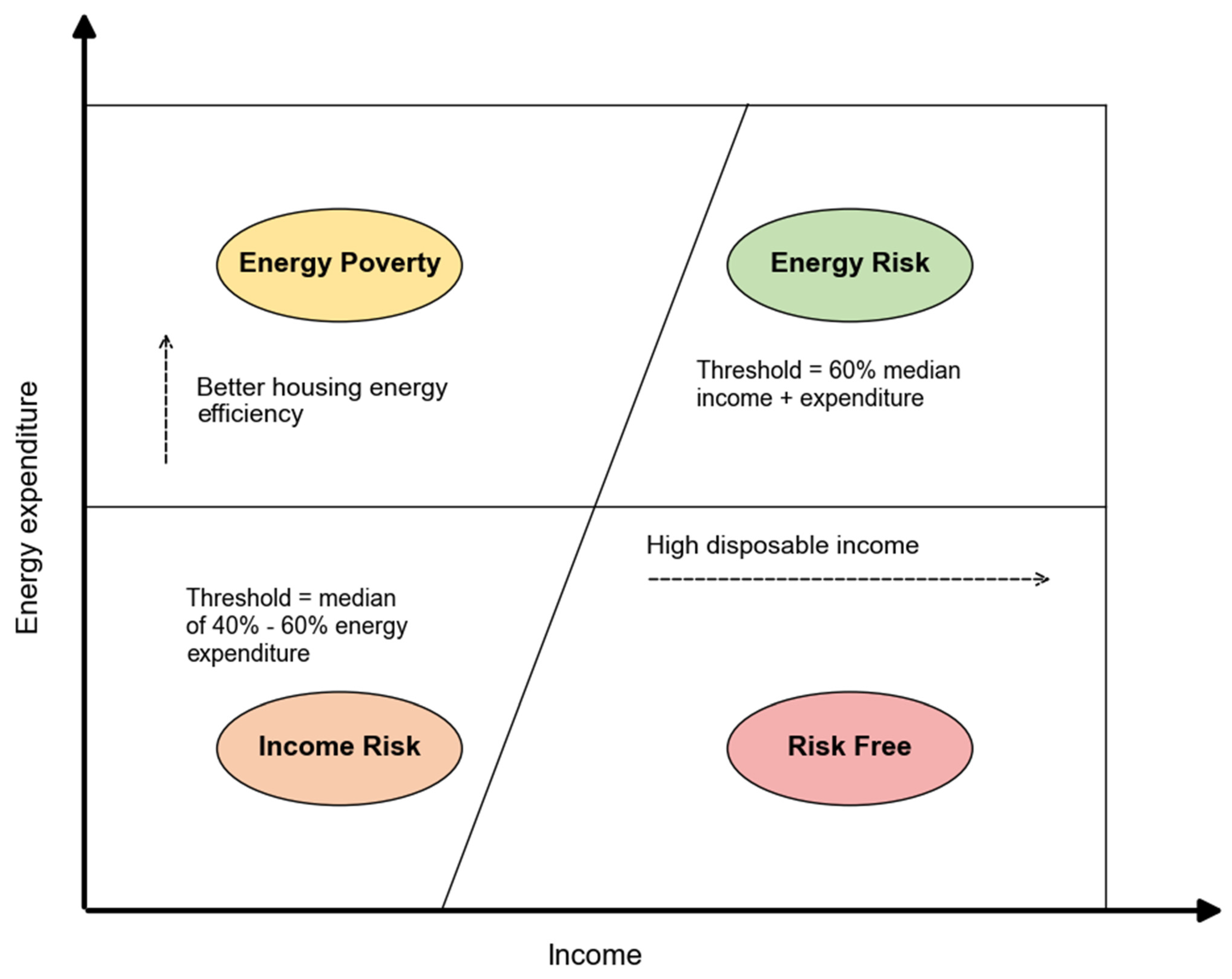
3.2. Classification Framework
3.3. Variable Selection
3.4. Model Configuration
3.5. Applicability of the LIHC Framework
4. Results
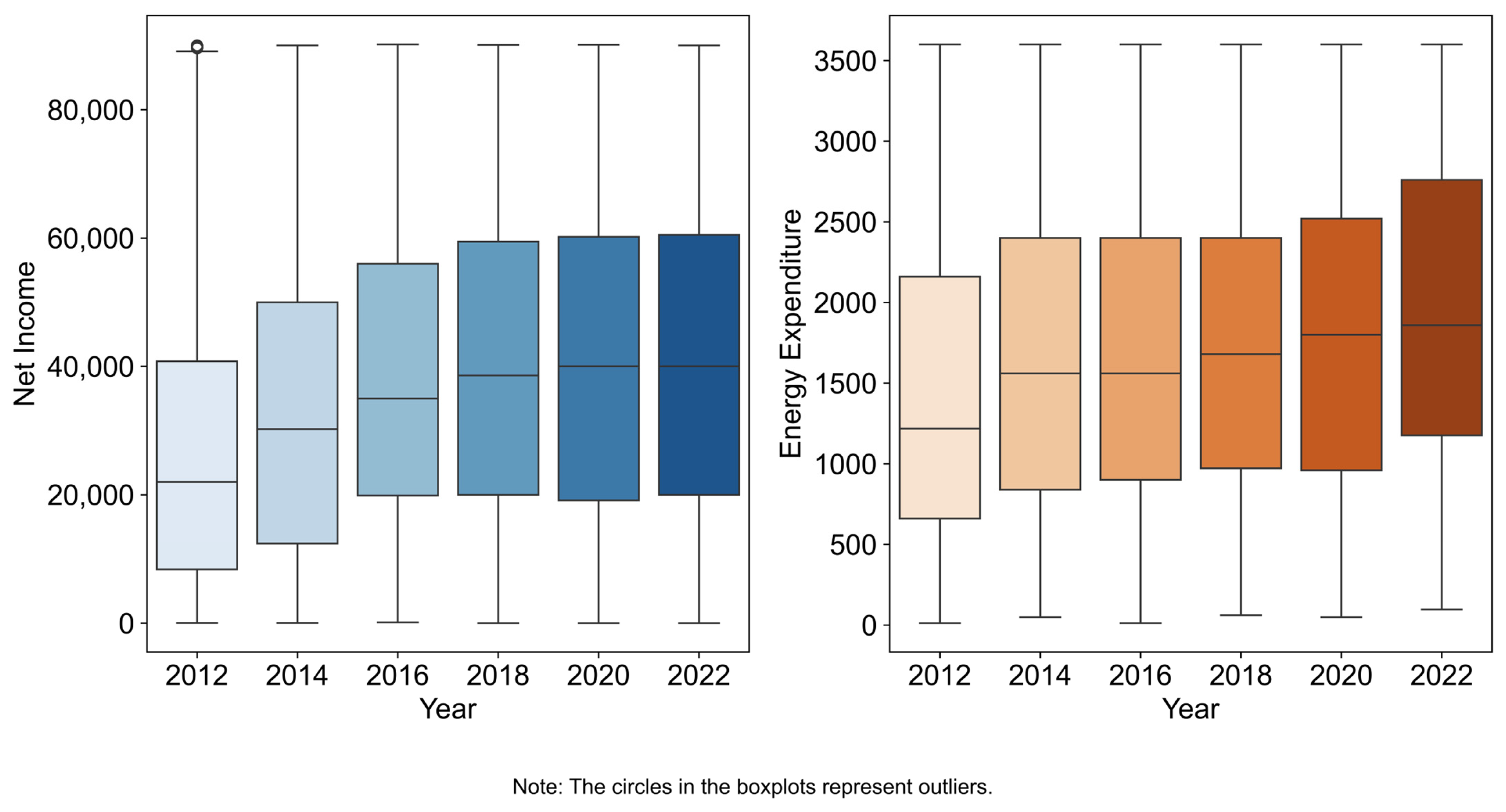
4.1. Descriptive Statistics
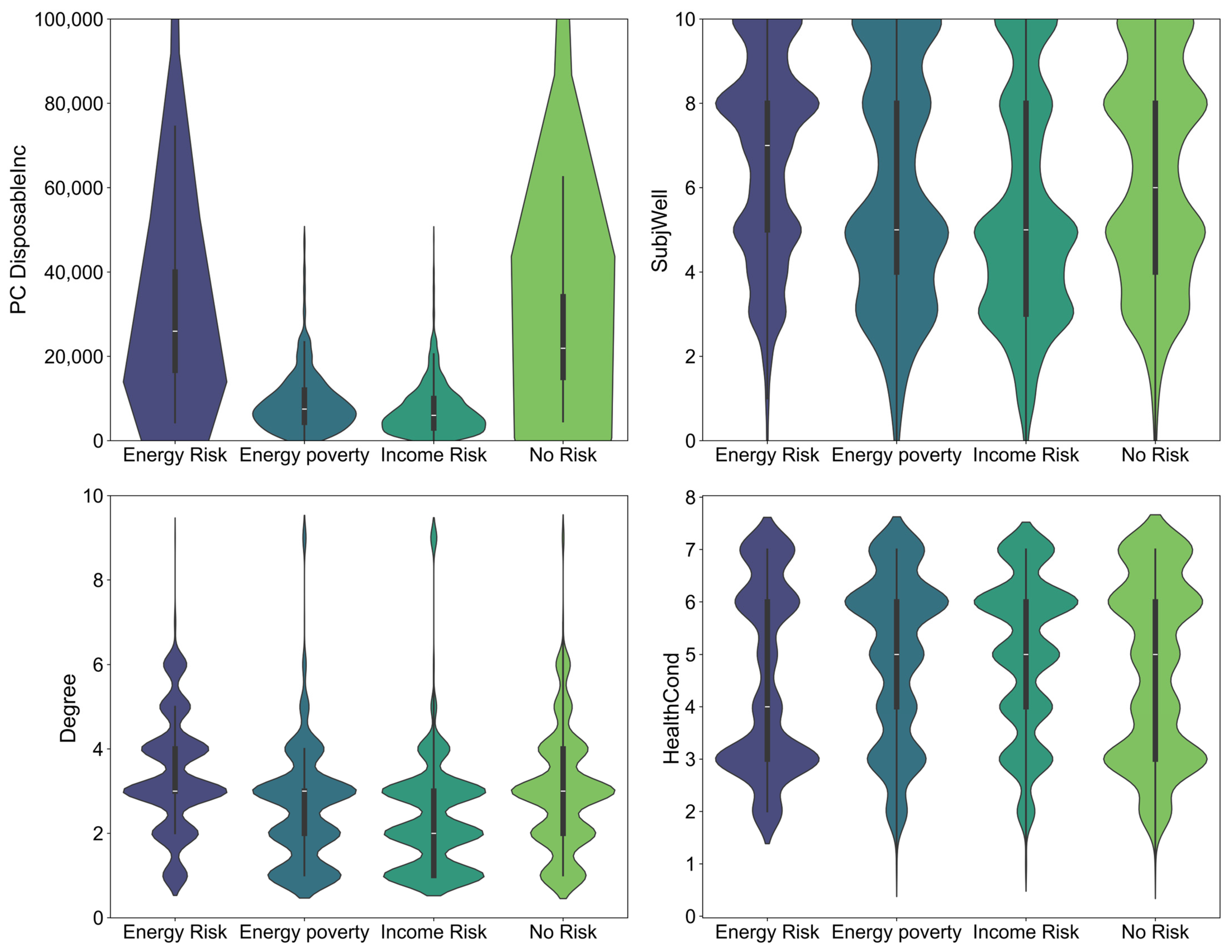
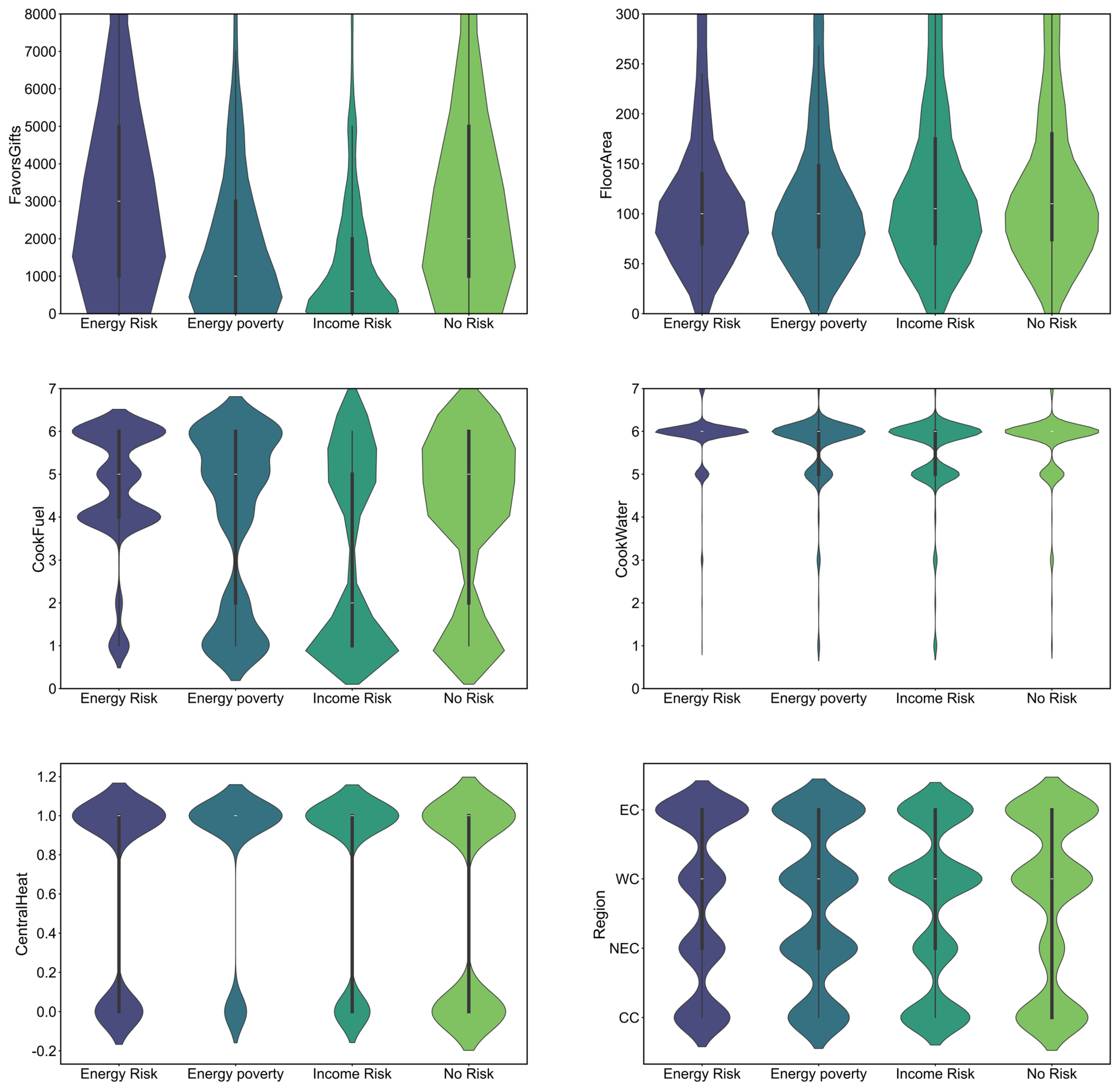
4.2. Risk Group Characteristics and Difference Testing
4.3. Feature Analysis
4.4. Model Evaluation
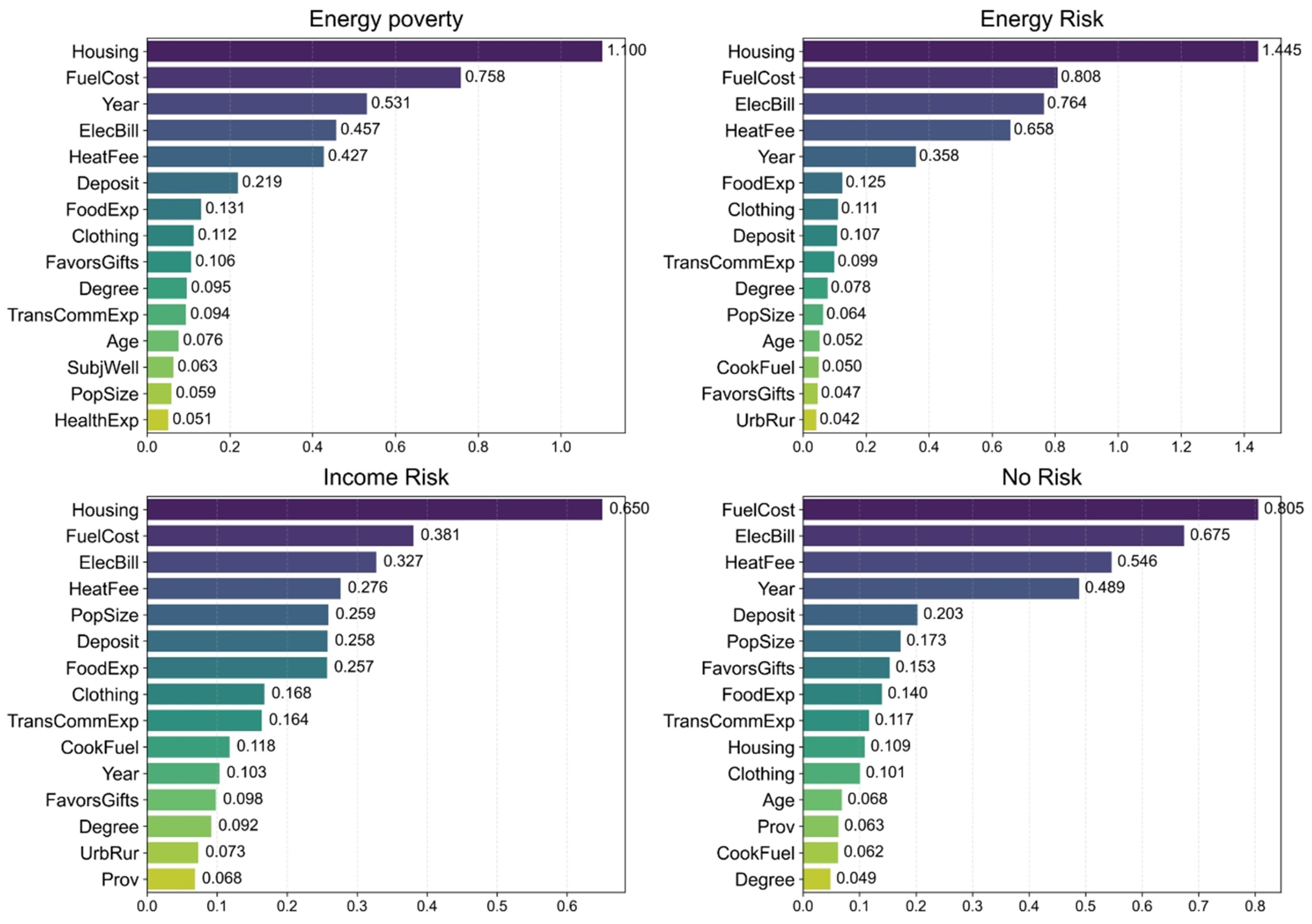
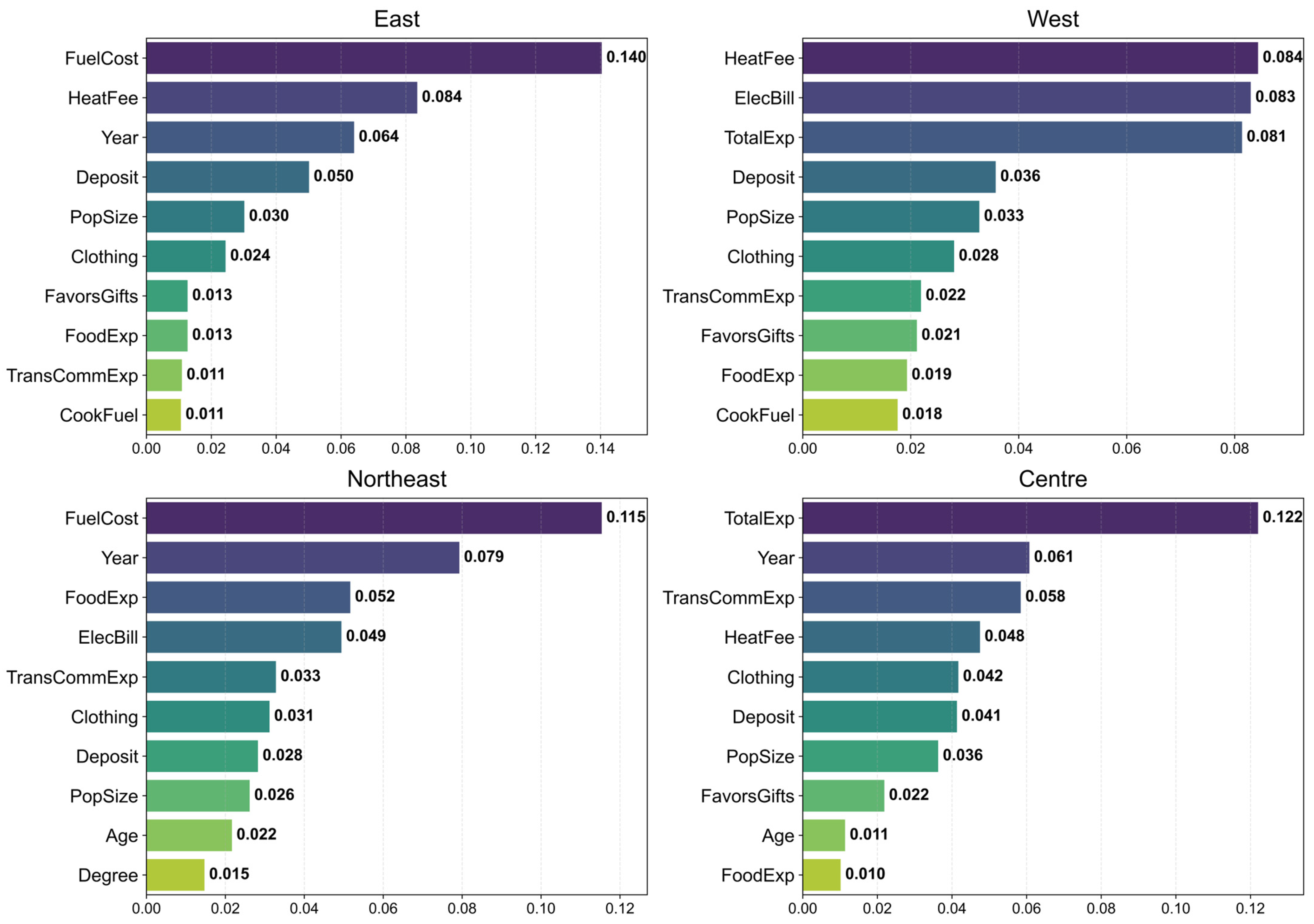
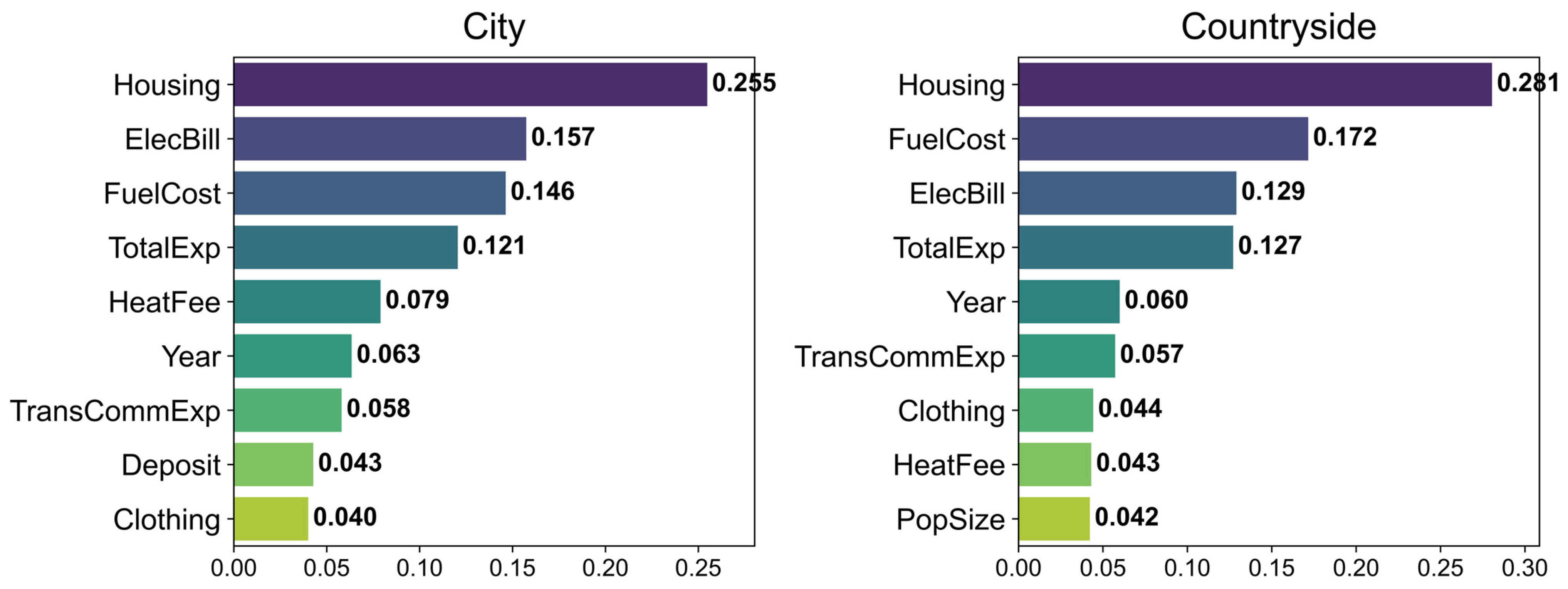
4.5. Feature Importance Analysis
4.6. SHAP Analysis
5. Discussion
6. Conclusions
6.1. Research Findings
6.2. Research Limitations and Future Directions
Author Contributions
Funding
Data Availability Statement
Conflicts of Interest
Appendix A

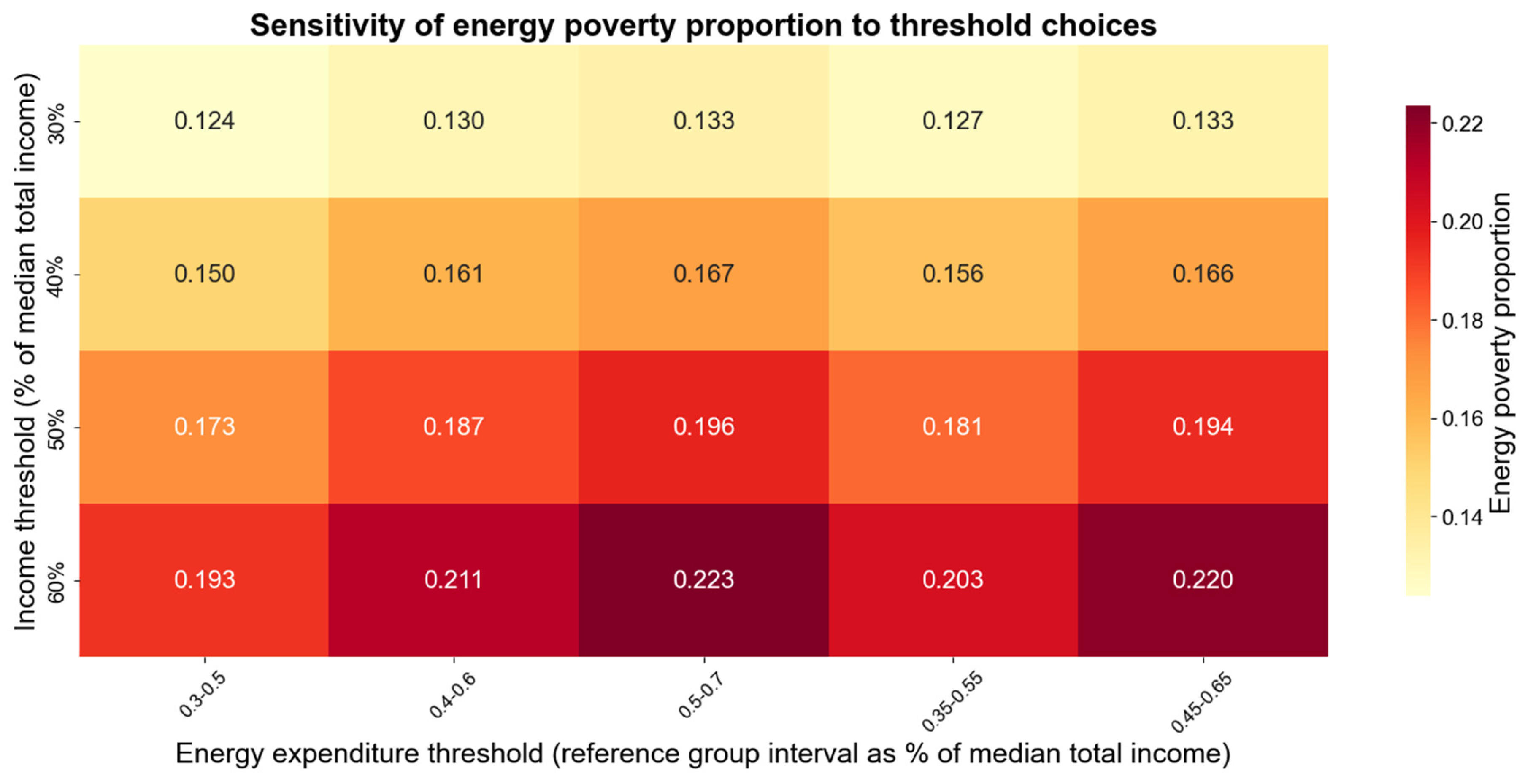
| Income Threshold | Energy Poverty Ratio |
|---|---|
| 30% | 13.03% |
| 40% | 16.11% |
| 50% | 18.73% |
| 60% | 21.13% |
| Energy Expenditure Threshold | Energy Poverty Ratio |
|---|---|
| 30–50% | 15.03% |
| 40–60% | 16.11% |
| 50–70% | 16.74% |
| 35–55% | 15.64% |
| 45–65% | 16.60% |

| Absolute Poor = False | Absolute Poor = True | Total for This Row | |
|---|---|---|---|
| Energy poor = False | 14,614 household | 261 household | 14,875 household |
| Energy poor = True | 1294 household | 1562 household | 2856 household |
| Column total | 15,908 household | 1823 household | 17,731 household |
| Model Type | Risk Category | Accuracy Rate (%) | Recall Rate (%) | F1 Score (%) | Number of Sample Points (Units) |
|---|---|---|---|---|---|
| Model 1 | Energy poverty | 90 | 92 | 91 | 283 |
| Energy risk | 89 | 91 | 90 | 1035 | |
| Income risk | 97 | 96 | 97 | 858 | |
| Risk-free | 93 | 92 | 92 | 1380 | |
| Overall accuracy | 93 | 3556 | |||
| Model 2 | Energy poverty | 100 | 99 | 99 | 283 |
| Energy risk | 100 | 100 | 100 | 1035 | |
| Income risk | 99 | 100 | 100 | 858 | |
| Risk-free | 100 | 100 | 100 | 1380 | |
| Overall accuracy | 100 | 3556 |
References
- Frederick S. Pardee Institute for International Futures (Josef Korbel School of International Studies, University of Denver); United Nations Development Programme (UNDP)). Advancing the SDG Push with Equitable Low-Carbon Pathways; UNDP Flagship Publication No. 4; Frederick S. Pardee Institute for International Futures (Josef Korbel School of International Studies, University of Denver): Denver, CO, USA; United Nations Development Programme (UNDP): New York, NY, USA, 2024; pp. 1–29. Available online: https://www.undp.org/publications/advancing-sdg-push-equitable-low-carbon-pathways (accessed on 10 March 2025).
- International Energy Agency. Tracking SDG7: The Energy Progress Report 2024; International Energy Agency: Paris, France, 2024; Available online: https://documents.worldbank.org/en/publication/documents-reports/documentdetail/099031225175211404 (accessed on 2 January 2025).
- Antunes, M.; Teotónio, C.; Quintal, C.; Martins, R. Energy Affordability Across and Within 26 European Countries: Insights into the Prevalence and Depth of Problems Using Microeconomic Data. Energy Econ. 2023, 127, 107044. [Google Scholar] [CrossRef] [Scilit]
- Addai, B.; Tang, W.; Twumasi, M.A.; Asante, D.; Agyeman, A.S. Access to Financial Services and Lighting Energy Consumption: Empirical Evidence from Rural Ghana. Energy 2022, 253, 124109. [Google Scholar] [CrossRef] [Scilit]
- Hills, J. Getting the Measure of Fuel Poverty: Final Report of the Fuel Poverty Review; 1465-3001; LSE Research Online: London, UK, 2012; Available online: https://eprints.lse.ac.uk/43153 (accessed on 6 December 2024).
- Semple, T.; Rodrigues, L.; Harvey, J.; Figueredo, G.; Gillott, M. A Critical Review of Existing Fuel Poverty Definitions in England: Problematisation, Obfuscation and Compatibility with a Just Energy Transition. Energy Res. Soc. Sci. 2025, 127, 104263. [Google Scholar] [CrossRef] [Scilit]
- Papada, L.; Kaliampakos, D. Artificial Neural Networks as a Tool to Understand Complex Energy Poverty Relationships: The Case of Greece. Energies 2024, 17, 3163. [Google Scholar] [CrossRef] [Scilit]
- Lesala, M.E.; Mukumba, P.; KeChrist, O. Rural Energy Poverty: An Investigation into Socioeconomic Drivers and Implications for Off-Grid Households in the Eastern Cape Province, South Africa. Economies 2025, 13, 128. [Google Scholar] [CrossRef] [Scilit]
- Wang, F.; Zha, D.; Geng, H.; Zhang, C. Regional Disparities and Spatial Convergence in Energy Poverty: Evidence from China’s Rural Areas. Environ. Dev. Sustain. 2025, 1–31. [Google Scholar] [CrossRef]
- Chen, F.; Qiu, H.; Yang, S. Energy Transition of the Poor: Quasi-Experimental Evidence from Poverty Alleviation Relocation Program in China. Energy Policy 2025, 199, 114536. [Google Scholar] [CrossRef] [Scilit]
- Kashour, M.; Jaber, M.M. Revisiting Energy Poverty Measurement for the European Union. Energy Res. Soc. Sci. 2024, 109, 103420. [Google Scholar] [CrossRef] [Scilit]
- Boardman, B. Opportunities and Constraints Posed by Fuel Poverty on Policies to Reduce the Greenhouse Effect in Britain. Appl. Energy 1993, 44, 185–195. [Google Scholar] [CrossRef] [Scilit]
- Sy, S.A.; Mokaddem, L. Energy Poverty in Developing Countries: A Review of the Concept and Its Measurements. Energy Res. Soc. Sci. 2022, 89, 102562. [Google Scholar] [CrossRef] [Scilit]
- Bouzarovski, S.; Damigos, D.; Kmetty, Z.; Simcock, N.; Robinson, C.; Jayyousi, M.; Crowther, A. Energy Justice Intermediaries: Living Labs in the Low-Carbon Transformation. Local Environ. 2023, 28, 1534–1551. [Google Scholar] [CrossRef] [Scilit]
- Nussbaumer, P.; Bazilian, M.; Modi, V. Measuring Energy Poverty: Focusing on What Matters. Renew. Sustain. Energy Rev. 2012, 16, 231–243. [Google Scholar] [CrossRef] [Scilit]
- Khanna, R.A.; Li, Y.; Mhaisalkar, S.; Kumar, M.; Liang, L.J. Comprehensive Energy Poverty Index: Measuring Energy Poverty and Identifying Micro-Level Solutions in South and Southeast Asia. Energy Policy 2019, 132, 379–391. [Google Scholar] [CrossRef] [Scilit]
- Al Kez, D.; Foley, A.; Lowans, C.; Del Rio, D.F. Energy Poverty Assessment: Indicators and Implications for Developing and Developed Countries. Energy Convers. Manag. 2024, 307, 118324. [Google Scholar] [CrossRef] [Scilit]
- Li, Y.; Zhang, W.; Zhao, B.; Sharp, B.; Nie, J. Does Energy Poverty Affect Subjective Well-Being? Evidence from a Cross-Country Analysis. Appl. Econ. 2026, 58, 141–156. [Google Scholar] [CrossRef] [Scilit]
- Igawa, M.; Managi, S. Energy Poverty and Income Inequality: An Economic Analysis of 37 Countries. Appl. Energy 2022, 306, 118076. [Google Scholar] [CrossRef] [Scilit]
- Hosan, S.; Sen, K.K.; Rahman, M.M.; Karmaker, S.C.; Chapman, A.J.; Saha, B.B. Mitigating Energy Poverty: A Panel Analysis of Energy Policy Interventions in Emerging Economies of the Asia-Pacific Region. Energy 2024, 291, 130367. [Google Scholar] [CrossRef] [Scilit]
- Simcock, N.; Jenkins, K.E.H.; Lacey-Barnacle, M.; Martiskainen, M.; Mattioli, G.; Hopkins, D. Identifying Double Energy Vulnerability: A Systematic and Narrative Review of Groups At-Risk of Energy and Transport Poverty in the Global North. Energy Res. Soc. Sci. 2021, 82, 102351. [Google Scholar] [CrossRef] [Scilit]
- Śmiech, S.; Karpinska, L.; Bouzarovski, S. Impact of Energy Transitions on Energy Poverty in the European Union. Renew. Sustain. Energy Rev. 2025, 211, 115311. [Google Scholar] [CrossRef] [Scilit]
- Homsy, G.C.; Kang, K.E. Energy Burden: Exploring the Intersection of Race, Income, and Community Characteristics Across the United States. Energy Res. Soc. Sci. 2025, 127, 104207. [Google Scholar] [CrossRef] [Scilit]
- Waldron, R.; Sugrue, S.; Simcock, N.; Holloway, L. Precarious Lives: Exploring the Intersection of Insecure Housing and Energy Conditions in Ireland. Energy Res. Soc. Sci. 2025, 121, 103992. [Google Scholar] [CrossRef] [Scilit]
- del Río, P.; Burguillo, M.; Kiefer, C.P. Which Are the Main Determinants of Energy Poverty? A Systematic Review of the Literature. Energy Effic. 2025, 18, 58. [Google Scholar] [CrossRef] [Scilit]
- Yue, J.; Chen, S.; Weng, Z.; Xie, Y.; Xu, M. Heterogeneous Characteristics of Household Energy Poverty and Sustainable Development: Perspective from the Household Life Cycle. Energy 2025, 337, 138581. [Google Scholar] [CrossRef] [Scilit]
- Tang, L.; Mahmood, H.; Khalid, S. Examining the Impact of Structural Reforms on Energy Poverty: A Threshold Effect of Energy Affordability. Energy 2025, 320, 135101. [Google Scholar] [CrossRef] [Scilit]
- Vandyck, T.; Della Valle, N.; Temursho, U.; Weitzel, M. EU Climate Action Through an Energy Poverty Lens. Sci. Rep. 2023, 13, 6040. [Google Scholar] [CrossRef] [Scilit] [PubMed]
- Spandagos, C.; Reaños, M.A.T.; Lynch, M.Á. Energy Poverty Prediction and Effective Targeting for Just Transitions with Machine Learning. Energy Econ. 2023, 128, 107131. [Google Scholar] [CrossRef] [Scilit]
- Dalla Longa, F.; Sweerts, B.; van der Zwaan, B. Exploring the Complex Origins of Energy Poverty in The Netherlands with Machine Learning. Energy Policy 2021, 156, 112373. [Google Scholar] [CrossRef] [Scilit]
- Burlig, F.; Knittel, C.; Rapson, D.; Reguant, M.; Wolfram, C. Machine Learning from Schools About Energy Efficiency. J. Assoc. Environ. Resour. Econ. 2020, 7, 1181–1217. [Google Scholar] [CrossRef] [Scilit]
- Gawusu, S.; Jamatutu, S.A.; Zhang, X.; Moomin, S.T.; Ahmed, A.; Mensah, R.A.; Das, O.; Ackah, I. Spatial Analysis and Predictive Modeling of Energy Poverty: Insights for Policy Implementation. Environ. Dev. Sustain. 2026, 28, 851–898. [Google Scholar] [CrossRef] [Scilit]
- Gawusu, S.; Jamatutu, S.A.; Ahmed, A. Predictive Modeling of Energy Poverty with Machine Learning Ensembles: Strategic Insights from Socioeconomic Determinants for Effective Policy Implementation. Int. J. Energy Res. 2024, 2024, 9411326. [Google Scholar] [CrossRef] [Scilit]
- Kim, H.; Kwon, Y.; Choi, Y. Determinants of Electricity Consumption of Energy-Vulnerable Group Using Ensemble Gradient-Boosting Algorithm. KSCE J. Civ. Eng. 2022, 26, 5010–5021. [Google Scholar] [CrossRef] [Scilit]
- Zou, W.; Cheng, X.; Fan, Z.; Lin, C. Measuring and Decomposing Relative Poverty in China. Land 2023, 12, 316. [Google Scholar] [CrossRef] [Scilit]
- Ravallion, M. On Measuring Global Poverty. Annu. Rev. Econ. 2020, 12, 167–188. [Google Scholar] [CrossRef] [Scilit]
- Darvas, Z. Why Is It So Hard to Reach the EU’s Poverty Target? Soc. Indic. Res. 2019, 141, 1081–1105. [Google Scholar] [CrossRef] [Scilit]
- Popova, D. Impact of Equity in Social Protection Spending on Income Poverty and Inequality. Soc. Indic. Res. 2023, 169, 697–721. [Google Scholar] [CrossRef] [Scilit]
- Patel, J.A.; Nielsen, F.B.H.; Badiani, A.A.; Assi, S.; Unadkat, V.; Patel, B.; Ravindrane, R.; Wardle, H. Poverty, Inequality and COVID-19: The Forgotten Vulnerable. Public Health 2020, 183, 110. [Google Scholar] [CrossRef] [Scilit]
- Sovacool, B.K. Defining, Measuring, and Tackling Energy Poverty. Energy Poverty Glob. Chall. Local Solut. 2014, 2, 21–53. [Google Scholar] [CrossRef] [Scilit]
- Siksnelyte-Butkiene, I.; Streimikiene, D.; Lekavicius, V.; Balezentis, T. Energy Poverty Indicators: A Systematic Literature Review and Comprehensive Analysis of Integrity. Sustain. Cities Soc. 2021, 67, 102756. [Google Scholar] [CrossRef] [Scilit]
- Anastasiou, A.; Zaroutieri, E. Energy Poverty and the Convergence Hypothesis Across EU Member States. Energy Effic. 2023, 16, 38. [Google Scholar] [CrossRef] [Scilit]
- Sarkodie, S.A.; Strezov, V. Empirical Study of the Environmental Kuznets Curve and Environmental Sustainability Curve Hypothesis for Australia, China, Ghana and USA. J. Clean. Prod. 2018, 201, 98–110. [Google Scholar] [CrossRef] [Scilit]
- Zheng, J.; Dang, Y.; Assad, U. Household Energy Consumption, Energy Efficiency, and Household Income–Evidence from China. Appl. Energy 2024, 353, 122074. [Google Scholar] [CrossRef] [Scilit]
- Ackermann, I.; Radulescu, D. Unveiling the Energy Price Tag-Assessing the Burden of Household Energy Expenditures Among European Countries. Energy Policy 2026, 208, 114919. [Google Scholar] [CrossRef] [Scilit]
- Choumert-Nkolo, J.; le Roux, L. Leaving the Hearth You Know: Internal Migration and Energy Poverty. World Dev. 2024, 180, 106628. [Google Scholar] [CrossRef] [Scilit]
- Burlinson, A.; Giulietti, M.; Law, C.; Liu, H.-H. Fuel Poverty and Financial Distress. Energy Econ. 2021, 102, 105464. [Google Scholar] [CrossRef] [Scilit] [PubMed]
- Sultana, N.; Hossain, S.Z.; Almuhaini, S.H.; Düştegör, D. Bayesian Optimization Algorithm-Based Statistical and Machine Learning Approaches for Forecasting Short-Term Electricity Demand. Energies 2022, 15, 3425. [Google Scholar] [CrossRef] [Scilit]
- Lundberg, S.M.; Erion, G.; Chen, H.; DeGrave, A.; Prutkin, J.M.; Nair, B.; Katz, R.; Himmelfarb, J.; Bansal, N.; Lee, S.-I. From Local Explanations to Global Understanding with Explainable AI for Trees. Nat. Mach. Intell. 2020, 2, 56–67. [Google Scholar] [CrossRef] [Scilit] [PubMed]
- Aas, K.; Jullum, M.; Løland, A. Explaining Individual Predictions When Features Are Dependent: More Accurate Approximations to Shapley Values. Artif. Intell. 2021, 298, 103502. [Google Scholar] [CrossRef] [Scilit]
- Piao, X.; Managi, S. Household Energy-Saving Behavior, Its Consumption, and Life Satisfaction in 37 Countries. Sci. Rep. 2023, 13, 1382. [Google Scholar] [CrossRef] [Scilit]
- Zhu, M. Unveiling Complexities: Income Inequality and Inequality of Opportunity in China. Rev. Dev. Econ. 2025, 29, 670–717. [Google Scholar] [CrossRef] [Scilit]
- Ceglia, F.; Marrasso, E.; Samanta, S.; Sasso, M. Addressing Energy Poverty in the Energy Community: Assessment of Energy, Environmental, Economic, and Social Benefits for an Italian Residential Case Study. Sustainability 2022, 14, 15077. [Google Scholar] [CrossRef] [Scilit]
- Tu, G.; Morrissey, K.; Sharpe, R.A.; Taylor, T. Combining Self-Reported and Sensor Data to Explore the Relationship Between Fuel Poverty and Health Well-Being in UK Social Housing. Wellbeing Space Soc. 2022, 3, 100070. [Google Scholar] [CrossRef] [Scilit]
- Hao, N.; Peng, B.; Tang, K.; Wu, J. Does Energy Poverty Trap Exist in Chinese Cities? Evidence from Evaluating the Co-Evolution of Energy Consumption and Income. Cities 2024, 150, 105082. [Google Scholar] [CrossRef] [Scilit]
- Yang, H.; Li, X.; Yan, J. The Impact of Energy Poverty on Subjective Well-Being: Evidence from China. Humanit. Soc. Sci. Commun. 2025, 12, 379. [Google Scholar] [CrossRef] [Scilit]
- Mustre-del-Río, J.; Sánchez, J.M.; Mather, R.; Athreya, K. The Effects of Macroeconomic Shocks: Household Financial Distress Matters. Rev. Financ. Stud. 2025, 38, 564–604. [Google Scholar] [CrossRef] [Scilit]
- Nsenkyire, E.; Nunoo, J.; Sebu, J.; Iledare, O. Household Multidimensional Energy Poverty: Impact on Health, Education, and Cognitive Skills of Children in Ghana. Child. Indic. Res. 2023, 16, 293–315. [Google Scholar] [CrossRef] [Scilit]
- Middlemiss, L. Who Is Vulnerable to Energy Poverty in the Global North, and What Is Their Experience? Wiley Interdiscip. Rev. Energy Environ. 2022, 11, e455. [Google Scholar] [CrossRef] [Scilit]
- Qi, X.; Chen, J.; Wang, J.; Liu, H.; Ding, B. The Impact of Urbanization on the Alleviation of Energy Poverty: Evidence from China. Cities 2024, 151, 105130. [Google Scholar] [CrossRef] [Scilit]
- Adjei-Mantey, K.; Inglesi-Lotz, R.; Amoah, A. Environmental Consciousness and Household Energy Poverty in Ghana. Glob. Environ. Change 2024, 88, 102896. [Google Scholar] [CrossRef] [Scilit]
- Shi, H.; Li, S.; Zhang, J. The Impact of Water Scarcity on Energy Poverty and Its Mechanism: Evidence from a Rural Household Analysis in Northern China. Water Policy 2025, 27, 615–638. [Google Scholar] [CrossRef] [Scilit]
- Burguillo, M.; del Río, P.; Juez-Martel, P. Does Energy Poverty Influence Decarbonisation Through Electrification of the Heating Sector? Energy Build. 2024, 312, 114110. [Google Scholar] [CrossRef] [Scilit]
- Lu, S.; Ren, J. A Global Spatial–Temporal Energy Poverty Assessment and Social Impacts Analysis. Int. J. Energy Res. 2024, 2024, 8247272. [Google Scholar] [CrossRef] [Scilit]
- Cervantes, M.Á.M.; Solís, L.R. Energy Poverty and Social Justice in Mexico: The Rights of Electricity Consumers. Electr. J. 2024, 37, 107372. [Google Scholar] [CrossRef] [Scilit]
- Karpinska, L.; Śmiech, S. Multiple Faces of Poverty. Exploring Housing-Costs-Induced Energy Poverty in Central and Eastern Europe. Energy Res. Soc. Sci. 2023, 105, 103273. [Google Scholar] [CrossRef] [Scilit]
- Zalostiba, D.; Kiselovs, D. A review: The Energy Poverty Issue in the European Union and Latvia. Latv. J. Phys. Tech. Sci. 2021, 58, 227–248. [Google Scholar] [CrossRef] [Scilit]
- Gao, Z.; Jia, Z.; Zhang, C.; Gao, S.; Yang, X.; Hao, Y. Energy Poverty in China: Measurement, Regional Inequality, and Dynamic Evolution. Energies 2026, 19, 143. [Google Scholar] [CrossRef] [Scilit]
- Wang, Y.; Xu, B. Assessing the Effective Drivers of Energy Poverty Reduction in China: A Spatial Perspective. Energy 2025, 320, 135427. [Google Scholar] [CrossRef] [Scilit]
- Lu, C.; Wan, S. Determinants of Energy Poverty Among Chinese Households: Risk Prediction Model Using Machine Learning Algorithms. Energy 2025, 337, 138502. [Google Scholar] [CrossRef] [Scilit]
- Feng, J.; Chen, Y.; Gulzar, F.; Mirzaliev, S.; Alofaysan, H.; Mark, P. The Dynamics of Energy Poverty in China: Household Level Analysis and Mitigation Strategies. Energy Sci. Eng. 2025, 13, 2011–2021. [Google Scholar] [CrossRef] [Scilit]
- Apergis, N.; Polemis, M.; Soursou, S.-E. Energy Poverty and Education: Fresh Evidence from a Panel of Developing Countries. Energy Econ. 2022, 106, 105430. [Google Scholar] [CrossRef] [Scilit]
- Martiskainen, M.; Sovacool, B.K.; Lacey-Barnacle, M.; Hopkins, D.; Jenkins, K.E.; Simcock, N.; Mattioli, G.; Bouzarovski, S. New Dimensions of Vulnerability to Energy and Transport Poverty. Joule 2021, 5, 3–7. [Google Scholar] [CrossRef] [Scilit]
- Matschoss, K.; Laakso, S.; Rinkinen, J. Disruptions and Energy Demand: How Finnish Households Responded to the Energy Crisis of 2022. Energy Res. Soc. Sci. 2025, 121, 103977. [Google Scholar] [CrossRef] [Scilit]
- Bardazzi, R.; Gastaldi, F.; Iafrate, F.; Pansini, R.V.; Pazienza, M.G.; Pollastri, C. Inflation and Distributional Impacts: Have Mitigation Policies Been Successful for Vulnerable and Energy Poor Households? Energy Policy 2024, 188, 114082. [Google Scholar] [CrossRef] [Scilit]
- Banna, H.; Alam, A.; Chen, X.H.; Alam, A.W. Energy Security and Economic Stability: The Role of Inflation and War. Energy Econ. 2023, 126, 106949. [Google Scholar] [CrossRef] [Scilit]
- Lambin, X.; Schleich, J.; Faure, C. The Energy Efficiency Gap in the Rental Housing Market: It Takes Both Sides to Build a Bridge. Energy J. 2023, 44, 75–92. [Google Scholar] [CrossRef] [Scilit]
- Haider, S.; Mahapatra, B.; Mohammad, S.; Mitra, A. Understanding the Socioeconomic Determinants of Cooking Fuel Expenditure in Uttar Pradesh, India. Discov. Sustain. 2024, 5, 182. [Google Scholar] [CrossRef] [Scilit]
- Das, I.; Rogers, B.; Nepal, M.; Jeuland, M. Fuel Stacking Implications for Willingness to Pay for Cooking Fuels in Peri-Urban Kathmandu Valley, Nepal. Energy Sustain. Dev. 2022, 70, 482–496. [Google Scholar] [CrossRef] [Scilit]
- Jiang, K.; Xing, R.; Luo, Z.; Li, Y.; Wang, J.; Zhang, W.; Zhu, Y.; Men, Y.; Shen, G.; Tao, S. Unclean but Affordable Solid Fuels Effectively Sustained Household Energy Equity. Nat. Commun. 2024, 15, 9761. [Google Scholar] [CrossRef] [Scilit]
- Eisfeld, K.; Seebauer, S. The Energy Austerity Pitfall: Linking Hidden Energy Poverty with Self-Restriction in Household Use in Austria. Energy Res. Soc. Sci. 2022, 84, 102427. [Google Scholar] [CrossRef] [Scilit]
- Zambrano-Monserrate, M.A. Mapping the Impact of Artificial Intelligence on Energy Poverty: New Evidence from Spatial Panel Models. Energy Econ. 2025, 151, 108909. [Google Scholar] [CrossRef] [Scilit]
- Hussain, S.A.; Razi, F.; Hewage, K.; Sadiq, R. The Perspective of Energy Poverty and 1st Energy Crisis of Green Transition. Energy 2023, 275, 127487. [Google Scholar] [CrossRef] [Scilit]
- Della Valle, N.; Maduta, C.; D’Agostino, D.; Koukoufikis, G. Unpacking Energy Vulnerability in the European Union: Linking Thermal Discomfort with Adaptive Capacity. Energy Res. Soc. Sci. 2025, 129, 104376. [Google Scholar] [CrossRef] [Scilit]
- Großmann, K.; Oettel, H.; Sandmann, L. At the Intersection of Housing, Energy, and Mobility Poverty: Trapped in Social Exclusion. Energies 2024, 17, 1925. [Google Scholar] [CrossRef] [Scilit]
- Waldron, R.; Sugrue, S.; Wijburg, G.; Manzo, L.K. The ‘Double Precarity’of Housing and Energy Conditions: Lived Experiences and Structural Drivers. Energy Res. Soc. Sci. 2025, 129, 104373. [Google Scholar] [CrossRef] [Scilit]
- Drago, C.; Gatto, A. Measuring Energy Poverty and Energy Vulnerability. Sustain. Cities Soc. 2023, 92, 104450. [Google Scholar] [CrossRef] [Scilit]
- Wang, Y.; Lin, B. Can Energy Poverty Be Alleviated by Targeting the Low Income? Constructing a Multidimensional Energy Poverty Index in China. Appl. Energy 2022, 321, 119374. [Google Scholar] [CrossRef] [Scilit]
- Mei, X.; Seo, B.K. The Relationships Among Housing, Energy Poverty, and Health: A Scoping Review. Energy Sustain. Dev. 2024, 83, 101568. [Google Scholar] [CrossRef] [Scilit]
- Zhao, J.; Dong, K.; Dong, X.; Shahbaz, M. How Renewable Energy Alleviate Energy Poverty? A Global Analysis. Renew. Energy 2022, 186, 299–311. [Google Scholar] [CrossRef] [Scilit]
- besnİLİ memİŞ, O.; Aydin, R. Indirect Impact of Public Expenditures and Inflation on Energy Poverty: Empirical Evidence from 32 Developing Countries. Appl. Econ. 2025, 57, 805–822. [Google Scholar] [CrossRef] [Scilit]
- Rakotomena, M.; Ricci, O. Measuring Energy Poverty: A Climate-Aware Multidimensional Approach. Soc. Indic. Res. 2025, 180, 943–969. [Google Scholar] [CrossRef] [Scilit]
- Prakash, K.; Churchill, S.A.; Smyth, R. Perception and Reality of Energy Poverty in Australia: Do They Shape Voting Intentions? Aust. Econ. Rev. 2025, 58, 131–139. [Google Scholar] [CrossRef] [Scilit]






| Variable Category | Variable Name | Variable Definition |
|---|---|---|
| Household size and housing characteristics | Population size | Human beings |
| Gender | Male/Female | |
| Age | 1–100 | |
| Highest qualification | 1.Never attended school 2.Semi-literate 3.Primary school 4.Junior High School 5.Senior Secondary School/ Technical Secondary School/Vocational Secondary School/Technical College 6.College 7.Undergraduate degree 8.Master’s degree 9.Doctor | |
| State of health | 1–7 points (1 being very poor, 7 being very good) | |
| Health insurance | Yes/No | |
| Subjective well-being | 0–10 points (0 being the lowest, 10 being the highest) | |
| Living space | square metre | |
| Geographical location and regional positioning | Region | 1.Eastern Region 2.Western Region 3.Central Region 4. North-Eastern Region |
| urban and rural | Urban/Rural | |
| Province | Generated based on province codes | |
| Household finances and income-expenditure structure | Total revenue | 1.High income 2.Upper-middle 3.Middle 4.Lower-middle 5.Low income |
| Total expenditure | Yuan | |
| Per capita disposable income | Yuan (net income per capita) | |
| deposit | Yuan | |
| Monthly electricity bill | Yuan | |
| Monthly fuel charges | Yuan | |
| Heating costs | Yuan | |
| Healthcare | Yuan | |
| Education and Training | Yuan | |
| Transport and Communications | Yuan | |
| Housing expenditure | Yuan | |
| Food expenditure | Yuan | |
| Clothing expenditure | Yuan | |
| Social gift expenditure | Yuan | |
| Energy Access and Consumption Patterns | Water for cooking | 1.Rivers, lakes and waterways 2.Well water 3.Tap water 4.Bottled water/Purified water/Filtered water 5.Rainwater 6.Cellar water 7.Pond water/Mountain spring water |
| Cooking fuel | 1.Firewood 2.coal 3.Canned gas/Liquefied petroleum gas 4.Natural gas/Pipeline gas 5.Solar energy/biogas 6.Electricity 7.Other | |
| Power supply status | After 16 years, all defaults are stable. | |
| Is there central heating? | 1.Yes; 0. No |
| Urb Rur | Energy Poverty | Energy Risk | Income Risk | No Risk |
|---|---|---|---|---|
| 0 = Rur | 8.82 | 18.87 | 34.23 | 38.08 |
| 1 = Urb | 7.06 | 39.60 | 13.78 | 39.56 |
| Has Heat Fee | Energy Poverty | Energy Risk | Income Risk | No Risk |
|---|---|---|---|---|
| false | 6.42 | 21.79 | 27.86 | 43.92 |
| true | 13.29 | 54.51 | 11.15 | 21.05 |
| Variable | Energy-Risk (N = 6900) | Income-Risk (N = 4290) | No-Risk (N = 5714) | Energy-Poverty (N = 1414) | F-Statistic | p-Value |
|---|---|---|---|---|---|---|
| Urban/Rural status | 0.67 (0.47) | 0.28 (0.45) | 0.50 (0.50) | 0.44 (0.50) | 524.38 | 0.000 *** |
| Housing area (sqm) | 130.56 (129.36) | 136.56 (129.93) | 138.75 (121.65) | 133.92 (134.48) | 4.29 | 0.005 *** |
| Electricity expenditure | 192.37 (197.33) | 50.15 (36.15) | 77.21 (45.10) | 120.72 (142.50) | 1374.80 | 0.000 *** |
| Fuel expenditure | 163.05 (219.21) | 41.05 (48.29) | 52.70 (48.63) | 224.72 (340.59) | 979.89 | 0.000 *** |
| Education expenditure | 6951.42 (15,432.27) | 1756.30 (4590.53) | 4772.45 (9771.95) | 2561.47 (6173.95) | 201.51 | 0.000 *** |
| Food expenditure | 28,466.71 (25,886.95) | 8589.42 (8020.39) | 18,879.98 (16,984.74) | 13,834.25 (11,715.48) | 965.33 | 0.000 *** |
| Clothing expenditure | 4361.53 (6756.57) | 912.09 (1324.20) | 2650.15 (3925.39) | 1735.35 (2407.49) | 484.60 | 0.000 *** |
| Housing expenditure | 14,353.90 (39,015.46) | 3210.70 (20,360.37) | 8900.17 (33,073.25) | 8295.77 (19,021.32) | 97.95 | 0.000 *** |
| Medical expenditure | 7143.97 (18,536.07) | 4103.05 (12,255.00) | 5517.37 (15,360.69) | 5718.89 (20,401.83) | 28.03 | 0.000 *** |
| Transport/Comm. exp. | 7837.47 (7991.43) | 1813.48 (2520.99) | 4560.83 (4951.33) | 3533.47 (4141.67) | 953.19 | 0.000 *** |
| Household size | 4.24 (1.78) | 3.04 (1.62) | 4.02 (1.68) | 3.56 (1.76) | 449.20 | 0.000 *** |
| Age | 52.87 (16.04) | 62.80 (16.19) | 53.06 (14.95) | 60.31 (17.33) | 449.06 | 0.000 *** |
| Cooking water source | 5.84 (0.64) | 5.45 (0.97) | 5.69 (0.77) | 5.59 (0.89) | 190.23 | 0.000 *** |
| Cooking fuel type | 4.63 (1.52) | 3.02 (2.42) | 4.01 (2.26) | 3.87 (2.07) | 460.90 | 0.000 *** |
| Education level | 3.33 (1.35) | 2.27 (1.37) | 2.88 (1.34) | 2.51 (1.38) | 506.97 | 0.000 *** |
| Gift/Social expenditure | 4713.35 (7484.71) | 1417.38 (2484.55) | 3549.10 (5984.35) | 1913.58 (3238.45) | 293.38 | 0.000 *** |
| Energy expenditure | 5208.10 (3676.72) | 1195.02 (750.51) | 1707.02 (829.06) | 4936.41 (4582.29) | 3090.55 | 0.000 *** |
| Net income | 125,026.41 (232,275.60) | 13,199.15 (8473.72) | 98,074.99 (223,700.76) | 17,418.29 (9926.89) | 354.74 | 0.000 *** |
| Model Type | Risk Category | Accuracy Rate (%) | Recall Rate (%) | F1 Score (%) |
|---|---|---|---|---|
| Energy poverty | 68 | 36 | 47 | 283 |
| Energy risk | 82 | 92 | 87 | 1035 |
| Income risk | 74 | 66 | 70 | 858 |
| Risk-free | 78 | 83 | 81 | 1380 |
| Overall accuracy | 78 | 3556 |
| Literature | Data Research Context | Measurement Method | Key Variables | Methodological Approach | Limitations of Existing Research | Improvements Contributions |
|---|---|---|---|---|---|---|
| Hills (2012) [5] | UK | LIHC indicator (Binary classification) | Income and energy expenditure | Static classification method | Binary classification ignores potential vulnerable groups | Extended LIHC into a dynamic four-quadrant risk identification system |
| Igawa and Managi (2022) [19] | Cross-national research | Macroindicators | Income inequality | Econometric analysis | Macro-level perspective lacking micromechanisms | Integrated macropatterns with household-level mechanisms |
| Yue et al. (2025) [26] | Household life cycle perspective | Heterogeneity analysis of energy poverty | Life cycle factors | Statistical correlation analysis | Lacks predictive framework | Introduced predictive analysis and dynamic transition mechanisms |
| Spandagos et al. (2023) [29] | Machine learning prediction | Multiple indicators | Socio-economic variables | Machine learning methods | “Black box” issue with insufficient interpretability | Introduced SHAP to enhance model interpretability |
| Gawusu et al. (2024) [33] | Spatial machine learning | Socio-economic data | Regional and economic variables | Ensemble learning methods | Solely focused on prediction, lacks mechanistic explanation | Combined prediction with mechanistic explanation |
| This Paper | China (CFPS panel data, 2012–2022) | Dynamic LIHC four-quadrant system | Income, energy, housing, and multidimensional household variables | Bayesian optimized XGBoost + SHAP | Limited indicator scope; lacks causal policy evaluation | Enhanced dynamic risk classification; early warning prediction; interpretable non-linear mechanism analysis |
Disclaimer/Publisher’s Note: The statements, opinions and data contained in all publications are solely those of the individual author(s) and contributor(s) and not of MDPI and/or the editor(s). MDPI and/or the editor(s) disclaim responsibility for any injury to people or property resulting from any ideas, methods, instructions or products referred to in the content. |
© 2026 by the authors. Licensee MDPI, Basel, Switzerland. This article is an open access article distributed under the terms and conditions of the Creative Commons Attribution (CC BY) license.
Share and Cite
Wang, H.; Qian, Z.; Liu, Q.; Liu, Y.; Wang, H.; Wei, S. Predicting and Explaining Household Energy Poverty in China Using Bayesian-Optimised XGBoost Models. Sustainability 2026, 18, 5416. https://doi.org/10.3390/su18115416
Wang H, Qian Z, Liu Q, Liu Y, Wang H, Wei S. Predicting and Explaining Household Energy Poverty in China Using Bayesian-Optimised XGBoost Models. Sustainability. 2026; 18(11):5416. https://doi.org/10.3390/su18115416
Chicago/Turabian StyleWang, Hubang, Zhili Qian, Qiaohan Liu, Yujie Liu, Hongli Wang, and Shimin Wei. 2026. "Predicting and Explaining Household Energy Poverty in China Using Bayesian-Optimised XGBoost Models" Sustainability 18, no. 11: 5416. https://doi.org/10.3390/su18115416
APA StyleWang, H., Qian, Z., Liu, Q., Liu, Y., Wang, H., & Wei, S. (2026). Predicting and Explaining Household Energy Poverty in China Using Bayesian-Optimised XGBoost Models. Sustainability, 18(11), 5416. https://doi.org/10.3390/su18115416