1. Introduction
Material stocks embodied in buildings, infrastructure, and other long-lived assets are central to resource-use dynamics because they mediate the relationship between socioeconomic development, material demand, and future waste generation. In the built environment, annual material inflows do not simply pass through the economy; they accumulate in service-providing stocks that persist for decades and generate delayed outflows through aging, demolition, and replacement. Dynamic material stock–flow analysis has therefore become an important approach for examining how past inflows shape present stocks and future outflows in buildings and infrastructure [
1,
2,
3,
4,
5].
Over the past two decades, dynamic material flow analysis has advanced substantially in its ability to represent cohort turnover, product lifetimes, and the accumulation of materials in long-lived stocks. Reviews and large-scale applications have clarified the value of dynamic stock–flow modeling for linking historical resource use to current stock levels, future secondary material availability, and long-term sustainability transitions [
6,
7,
8]. In built-environment studies, dynamic models have been used to reconstruct dwelling stocks, estimate demolition waste, and assess future material demand under different turnover assumptions [
2,
9,
10]. These developments have made stock-based analysis increasingly relevant for resource efficiency, circular-economy planning, and the management of long-lived material systems.
However, the application of dynamic stock–flow modeling becomes methodologically difficult when the available evidence base is incomplete, heterogeneous, or only partially observable. In many data-constrained settings, annual construction or inflow statistics begin too late to represent the full cohort history of the existing stock; benchmark stock observations are available only for selected years; classifications differ across statistical sources; and direct observations of demolition or retirement flows are absent or incomplete. These problems are particularly consequential because dynamic stock–flow models depend not only on the magnitude of current inflows, but also on historical depth, stock initialization, and the age structure through which delayed outflows emerge. Recent literature has shown that material stock estimates remain highly sensitive to data structure, allocation procedures, lifetime assumptions, and model boundary choices, even where dynamic modeling techniques are well established [
4,
11,
12,
13].
This creates a methodological challenge that is not fully resolved by existing dynamic stock–flow practice. Prior studies have developed important techniques for material-stock accounting, fixed-capital stock modeling, final-product allocation, and historical reconstruction of flows and stocks [
14,
15,
16,
17,
18]. Yet in applied data-scarce contexts, procedures such as data harmonization, historical inflow reconstruction, stock calibration, empirical validation, and uncertainty assessment are often implemented as case-specific technical steps rather than formalized as parts of a unified reconstruction methodology. As a result, a model may satisfy a stock–flow balance mathematically while still remaining structurally implausible, empirically weakly anchored, or insufficiently transparent in how missing system information has been handled.
These limitations matter for the sustainability uses of dynamic stock–flow analysis. By linking present material use with accumulated stocks, future outflows, waste generation, and potential secondary material availability, stock–flow approaches provide an important analytical basis for resource-efficiency assessment, circular-economy planning, and the management of long-lived built-environment systems [
3,
7,
16,
17,
19,
20]. These applications are especially relevant in rapidly urbanizing and data-constrained settings, where decisions related to construction, waste, and secondary resources must often be considered despite fragmented historical evidence [
4,
11,
12,
21]. Developing reconstruction approaches that remain transparent and interpretable under such constraints is therefore important for extending the practical usefulness of dynamic stock–flow analysis to sustainability questions under non-ideal data conditions.
This study addresses that gap by reframing dynamic material stock–flow modeling under data scarcity as a problem of system reconstruction rather than simple data compilation. The central methodological concern is not merely how to fill missing observations, but how to reconstruct an internally coherent, empirically anchored, and interpretable stock–flow system when the underlying statistical evidence does not initially form a complete accounting structure. From this perspective, historical inflow reconstruction, stock anchoring, validation, and robustness analysis are not optional extensions added after modeling; they are integral components of the reconstruction process itself.
To operationalize this perspective, the study develops a closed-loop reconstruction framework, in the methodological sense of an iterative feedback-based reconstruction process, that links six methodological components: data structure diagnosis, data system harmonization, historical inflow reconstruction, stock anchoring through calibration, dynamic stock–flow simulation, and credibility assessment through empirical consistency checking, uncertainty propagation, and sensitivity analysis. The framework is designed to make explicit which form of structural weakness each reconstruction step addresses and to evaluate whether the reconstructed system remains credible under incomplete information.
Vietnam’s residential building system is used as a demanding demonstration case because it combines the key conditions that motivate the framework: fragmented statistical coverage, incomplete historical inflow depth, intermittent benchmark stock observations, heterogeneous housing classifications, and limited direct evidence on demolition outflows. A related empirical study has recently applied a stock-driven dynamic material flow analysis to Vietnam’s residential sector to investigate material accumulation, demolition dynamics, socioeconomic drivers, and circular-economy scenarios [
22]. The present study addresses a different research objective. Rather than extending the substantive interpretation of Vietnam’s residential transition, it isolates and formalizes the methodological reconstruction logic required to build credible dynamic stock–flow systems under data scarcity.
Accordingly, this paper makes three contributions. First, it provides a conceptual reframing of data-scarce dynamic stock–flow analysis as an iterative system reconstruction problem rather than a direct data-assembly task. Second, it develops a closed-loop methodological framework that integrates diagnosis, harmonization, historical reconstruction, stock anchoring, empirical checking, and robustness assessment into a single reconstruction logic. Third, it demonstrates the methodological value of this logic through comparative reconstruction settings in the Vietnam case, showing how omission of historical depth or stock anchoring produces distinct and interpretable forms of structural bias. These contributions are intended to support more transparent, credible, and reproducible dynamic stock–flow modeling for sustainability-oriented resource assessment in data-constrained built-environment and material-systems research.
The remainder of the paper is structured as follows.
Section 2 presents the reconstruction perspective, framework, computational workflow, and methodological procedure.
Section 3 demonstrates the framework using Vietnam’s residential building system and evaluates the consequences of alternative reconstruction settings.
Section 4 discusses the methodological implications, transferability, and limitations of the proposed approach.
Section 5 concludes the paper.
2. Materials and Methods
This section develops the methodological basis of the study. It first establishes the reconstruction perspective that guides the paper, then presents the closed-loop framework for dynamic material stock–flow modeling under data scarcity. The framework is subsequently operationalized through a modular computational workflow and a sequence of reconstruction procedures covering data harmonization, historical inflow reconstruction, dynamic stock–flow simulation, stock anchoring, and credibility assessment. The Vietnam residential building system is used later to demonstrate how this methodology can be implemented under realistic conditions of incomplete and heterogeneous data.
2.1. From Data Compilation to System Reconstruction
Dynamic material stock–flow analysis is widely used to examine long-lived material systems by linking annual inflows, in-use stocks, and delayed outflows through cohort-based modeling and lifetime assumptions [
1,
2,
3]. This approach provides a physically consistent basis for understanding stock accumulation, turnover, and future waste generation in buildings and other durable systems [
4,
16]. In practice, however, its application depends on whether the underlying data are sufficiently coherent, temporally compatible, and conceptually aligned with the modeled system. This requirement is difficult to satisfy in many emerging and data-constrained contexts, where stock, inflow, and outflow information may be fragmented across statistical sources, reported for different administrative purposes, or compiled using inconsistent classifications and system boundaries [
11,
12,
17].
Under such conditions, dynamic stock–flow modeling cannot be treated as a straightforward exercise in data assembly. Construction activity may be reported annually, whereas benchmark stock information is available only for selected census or survey years. Housing categories may differ across sources, material-intensity data may originate from engineering norms or case-based estimates rather than routine monitoring systems, and demolition outflows may be largely absent from official statistics. If these datasets are combined directly without prior diagnosis and reconciliation, the resulting stock–flow system may appear numerically complete while remaining structurally inconsistent or empirically weakly grounded. Apparent quantitative precision can therefore conceal systematic bias, especially when historical inflow depth is insufficient or previously accumulated and otherwise underrepresented stock components are not addressed explicitly [
4,
12].
This study addresses that challenge by reframing dynamic stock–flow modeling under data scarcity as a problem of system reconstruction rather than simple data compilation. The objective is not to assemble a seemingly complete dataset, but to construct a stock–flow representation that is internally coherent, empirically anchored, and explicit about its assumptions and unresolved uncertainties. From this perspective, incomplete and heterogeneous data are not merely external defects to be corrected before modeling begins; they are part of the reconstruction problem itself.
This reconstruction perspective has three methodological implications. First, stock–flow modeling should begin with data structure diagnosis rather than direct simulation, so that gaps, mismatches, and boundary inconsistencies are identified before they propagate through the model. Second, stock anchoring should be treated as a structural reconstruction step rather than as a purely post hoc statistical adjustment: when available inflow histories do not sufficiently represent the benchmark stock, the resulting discrepancy must be made explicit and addressed in a transparent way [
14,
15,
16]. Third, uncertainty assessment is integral to model credibility. Because the system is reconstructed under incomplete information, the objective is not to eliminate uncertainty, but to bound it, interpret it, and assess whether the reconstructed dynamics remain stable under plausible variation in key assumptions [
12,
23].
Accordingly, the proposed approach treats dynamic stock–flow modeling as an iterative reconstruction process. Available data are first diagnosed and harmonized into a coherent analytical basis; missing historical depth is then addressed through reconstruction rules; stock trajectories are anchored to empirical benchmarks; and the resulting system is evaluated through validation, uncertainty propagation, and sensitivity analysis. If important inconsistencies remain, assumptions, harmonization choices, or reconstruction rules are revisited, and the process is repeated. The outcome is not a claim of perfect representation, but a stock–flow system that is structurally coherent, empirically interpretable, and transparent about the evidentiary limits under which it has been reconstructed.
2.2. Closed-Loop Reconstruction Framework
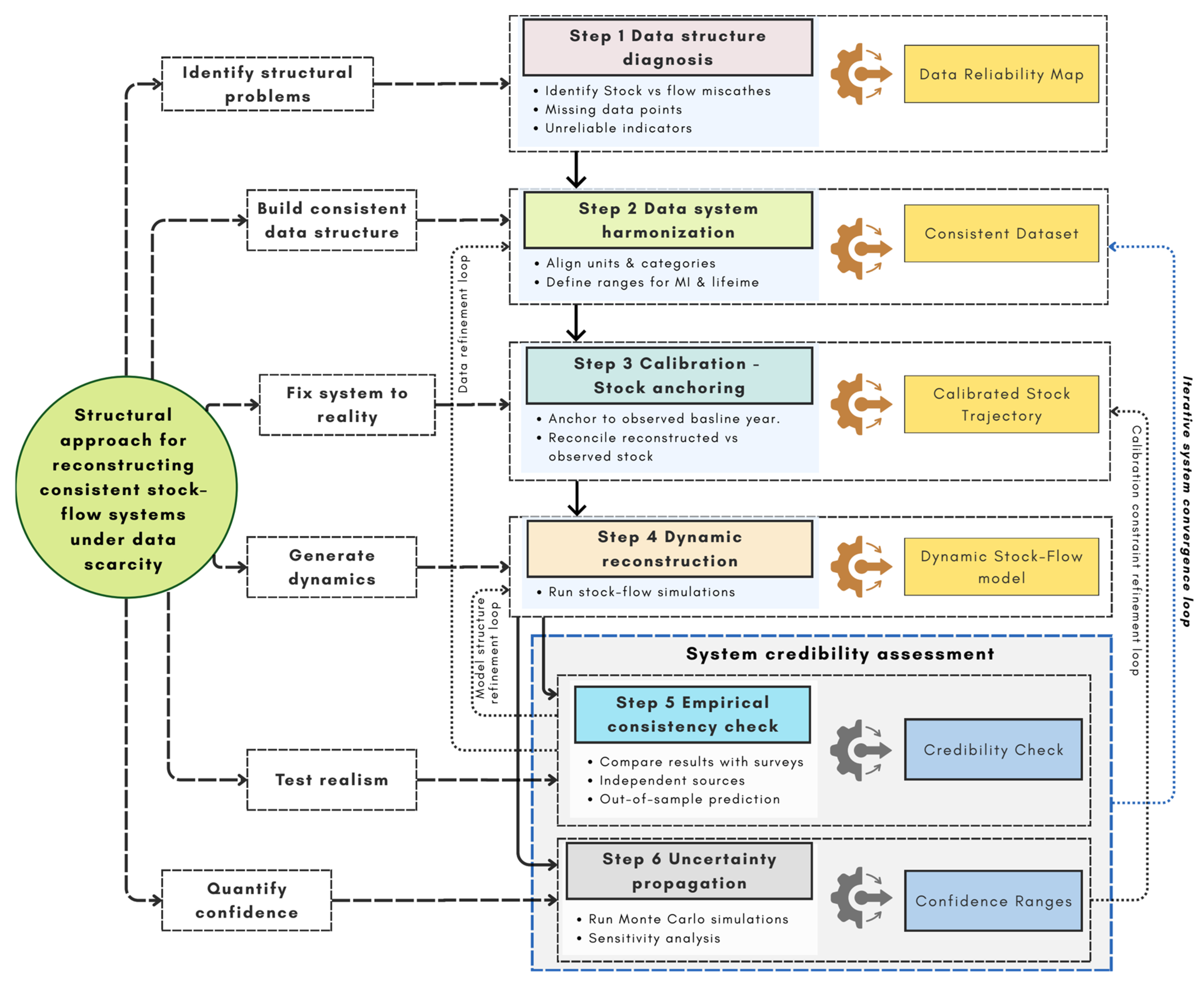
To operationalize the reconstruction perspective introduced above, this study proposes a closed-loop framework for dynamic material stock–flow systems under data scarcity (
Figure 1). The framework integrates data diagnosis, data harmonization, model construction, empirical checking, and uncertainty assessment into a unified methodological structure. Rather than treating reconstruction as a one-way sequence from data compilation to model output, it defines an iterative process in which the interpretation of available evidence and the structure of the reconstructed system are progressively refined through feedback.
The framework is conceptual in scope, while the operational workflow presented in
Table 1 translates it into a practical reconstruction procedure. Its purpose is to make explicit which methodological problem is addressed at each stage, what intermediate output is generated, and how credibility is assessed when the available evidence is incomplete.
As shown in
Figure 1, the framework consists of six interdependent components: (1) data structure diagnosis, (2) data system harmonization, (3) stock anchoring through calibration, (4) dynamic reconstruction, (5) empirical consistency check, and (6) uncertainty propagation. Together, these components transform fragmented inputs into a progressively more coherent stock–flow representation.
Data structure diagnosis identifies the main structural limitations of the available evidence base, including inconsistencies between stock and flow data, temporal gaps, missing outflow information, and mismatches in classification or system boundary. Data system harmonization then aligns heterogeneous datasets into a consistent analytical form by reconciling units, time steps, analytical categories, and system boundaries, while also defining plausible parameter ranges where direct observations are incomplete.
Stock anchoring through calibration links the reconstructed system to benchmark observations. When the dynamically reconstructed stock trajectory remains below the observed benchmark stock, the discrepancy is treated as an explicit stock-level gap requiring methodological attention. In the present framework, this gap is interpreted primarily as underrepresented stock not captured by the effective inflow history, while recognizing that it may also reflect incompletely recorded additions, classification mismatch, or other forms of statistical undercoverage. Calibration therefore serves as a structural anchoring step that improves compatibility with available benchmark evidence without claiming full recovery of the hidden historical stock structure.
Dynamic reconstruction then generates annual inflow, stock, and outflow trajectories through a cohort-based stock–flow model. It uses harmonized inputs, reconstructed historical depth, calibrated stock conditions, and explicit lifetime assumptions to represent material accumulation and delayed turnover.
The final two components form the credibility assessment stage. The empirical consistency check compares reconstructed outputs with independent benchmark observations, including stock- or service-level indicators where available. Uncertainty propagation evaluates the robustness of the reconstructed system under plausible variation in key parameters through Monte Carlo simulation and sensitivity analysis. Taken together, these procedures test whether the reconstruction moves beyond formal accounting consistency to a representation that is benchmark-compatible and robust enough for cautious interpretation under incomplete evidence.
A defining feature of the framework is that these components are connected through iterative feedback loops, forming a closed loop rather than a one-way workflow. Validation and uncertainty findings can therefore inform earlier stages of harmonization, calibration, or reconstruction when inconsistencies remain unresolved. Within this study, convergence is interpreted in methodological rather than absolute terms: a reconstructed system is considered credible when it satisfies three conditions simultaneously: (1) internal consistency among inflows, stocks, and outflows; (2) empirical agreement with benchmark observations; and (3) bounded uncertainty that does not undermine interpretation of the system’s main dynamics.
Table 1 summarizes the operational workflow used to implement this framework. While the framework is organized around six conceptual components, the workflow expands them into a sequence of practical reconstruction stages, including historical inflow reconstruction and iterative refinement, to make the procedure transparent and reproducible.
2.3. Computational Workflow and Input Data
The closed-loop reconstruction framework was implemented through a modular Python workflow that transforms fragmented evidence into a coherent dynamic stock–flow representation. Data processing and statistical analyses were performed using Python (version 3.10.12) within the Google Colaboratory cloud environment. The workflow follows the methodological sequence summarized in
Figure 1 and
Table 1, with separate modules for data loading and harmonization, historical inflow reconstruction, dynamic stock–flow simulation, stock anchoring through calibration, empirical consistency checking, and robustness assessment. This modular structure was adopted to improve transparency, reproducibility, and adaptability across data-constrained applications.
The workflow uses model-ready input datasets derived from public statistical sources and engineering parameter information. For the Vietnam demonstration, six core input categories were required: annual residential construction inflow expressed in floor area, benchmark stock information for the calibration year, a material-intensity matrix by housing type, Weibull lifetime parameters, macro-level socioeconomic indicators used for historical reconstruction, and construction-stage material loss rates. Together, these inputs provide the minimum information needed to harmonize annual construction activity, extend missing historical inflow depth, convert service-based units into material quantities, estimate cohort retirement, and evaluate stock-level consistency with benchmark evidence.
The annual inflow series records newly completed residential floor area by housing type and year and provides the primary time-series basis for dynamic stock–flow modeling. Benchmark stock information serves as the empirical anchor for reconciling the reconstructed stock trajectory with observed system states. The material-intensity matrix converts area-based stock and flow variables into material quantities, enabling inflow, in-use stock, and outflow to be expressed in physical mass terms. Weibull lifetime parameters define the retirement behavior of housing cohorts and therefore govern the timing and magnitude of delayed outflows, consistent with established dynamic stock–flow modeling practice [
1,
3,
10]. Macro-level indicators support historical inflow reconstruction where direct observations are incomplete. Construction loss rates are applied where the workflow distinguishes net inflow to stock from gross material input and construction-stage waste.
To enhance reproducibility, the computational procedure was organized into modular scripts corresponding to the main reconstruction stages. A master runner script links these modules in sequence and generates the calibrated stock series, methodological comparison outputs, and figures used in this study. The Python implementation and model-ready input datasets for the Vietnam demonstration are provided in the
Supplementary Materials.
The
supplementary package is designed to reproduce the reconstruction workflow reported in this paper rather than to serve as a complete archive of heterogeneous raw statistical documents used during diagnosis and preprocessing. The methodological objective of the paper is to show how fragmented evidence can be transformed into an internally coherent stock–flow system; accordingly, the
Supplementary Materials provide the harmonized inputs and computational procedures necessary to reproduce that reconstruction logic.
2.4. Operational Reconstruction Procedure for Dynamic Stock–Flow Systems
The operational reconstruction procedure links annual inflows, in-use stocks, and delayed outflows through a cohort-based stock–flow model. It begins with annual residential construction activity expressed in floor area, harmonizes this activity into a stable analytical classification, converts it into material inflows using housing-type-specific material-intensity coefficients, and then simulates stock accumulation and cohort retirement over time.
Let
denote annual inflow,
in-use stock, and
annual outflow in year t. The stock balance is defined as:
This identity provides the accounting basis of the reconstruction process and is widely used in dynamic stock–flow modeling of long-lived systems [
1,
3]. Under data scarcity, however, the main methodological challenge lies not in the balance equation itself, but in constructing a sufficiently coherent inflow history, estimating plausible delayed outflows, and obtaining a stock trajectory that remains compatible with available benchmark evidence.
2.4.1. Data Harmonization and Annual Inflow Construction
The first operational step is to harmonize annual inflow data into a stable analytical structure suitable for dynamic reconstruction. Housing categories reported in official statistical sources were mapped into a consistent set of dwelling classes that could be followed across time. New residential floor area was adopted as the inflow service unit because it connects reported construction activity with both stock formation and the expansion of housing services.
Where short gaps existed in the annual inflow series, they were filled using documented interpolation rules. For years lacking subtype detail, aggregate inflows were distributed across housing classes using fixed shares from the earliest reporting period with stable disaggregation. These steps were not intended to create artificial precision, but to preserve the reported aggregate scale of construction activity while establishing the temporal and categorical continuity required for cohort-based modeling. This treatment is consistent with the broader need in dynamic material stock analysis to reconcile heterogeneous data structures before interpreting stock–flow outputs [
4,
11,
12].
After harmonization, annual floor-area inflows were converted into material inflows by multiplying newly completed floor area by the corresponding material-intensity coefficient for each housing type and material category:
where
is newly completed floor area for housing type I in year t, and
is the material intensity coefficient for material m in housing type
i. This conversion yielded annual inflow series by material and housing type, which formed the input to the stock–flow simulation. When the workflow distinguishes embodied stock additions from total construction demand, construction-loss factors are applied to separate net stock inflow from gross material input and construction-stage waste.
2.4.2. Historical Inflow Reconstruction
Because the observed inflow series does not extend far enough to represent the full cohort history of the stock existing in the calibration period, the inflow record was extended through historical reconstruction. This step is necessary in long-lived stock systems because older cohorts may contribute little to recent construction activity while still exerting substantial influence on current stock levels and delayed outflow emergence.
To restore the missing temporal depth required for cohort modeling, the pre-observation inflow series was approximated using a transparent macroeconomic proxy-based reconstruction rule. In the Vietnam demonstration, gross domestic product (GDP) was selected as the primary reconstruction proxy because it provides a continuous annual series over the missing historical period and, within the observed period, showed a strong empirical relationship with reconstructed residential material inflow. A power-law function was therefore fitted to the observed GDP–inflow relationship:
where
is the total annual material inflow in year t,
is the gross domestic product in year t, and a and b are fitted parameters estimated from the observed period. This step does not claim exact historical recovery; rather, it provides the temporal depth needed to represent older cohorts whose omission would otherwise lead to systematic underestimation of stock and outflow.
In the Vietnam demonstration, the fitted GDP–inflow relationship showed strong agreement over the observed period (
), as reported in the related empirical application of the residential stock–flow model [
22]. This diagnostic supports the use of GDP as a transparent approximation for restoring missing cohort depth in the present methodological demonstration.
GDP was used in preference to population or urbanization rate as the primary backcasting driver because the reconstruction target is historical construction-related material inflow rather than demographic scale alone. Population and urbanization capture important demand-side conditions, but they do not directly represent variation in the intensity of construction activity, investment, and economic expansion associated with residential material accumulation. The GDP-based relationship was therefore adopted as a parsimonious macro-level proxy for reconstructing missing inflow history under the available data conditions.
This reconstruction should not be interpreted as exact recovery of annual historical construction activity. In rapidly transforming economies, the relationship between GDP and material inflow may change over time because of shifts in urbanization, housing typology, construction technology, policy, or material intensity. Accordingly, the backcast series is used here to restore the historical depth required for cohort-based stock–flow modeling, rather than to claim precise year-by-year reconstruction of unobserved inflows. The implications of uncertainty in historical reconstruction are later considered in the interpretation of model credibility and limitations.
2.4.3. Cohort-Based Stock–Flow Simulation
After establishing a continuous inflow history, the model tracks each annual cohort through time and estimates retirements using housing-type-specific survival functions. This formulation follows established dynamic material stock modeling approaches in which past inflow cohorts are tracked over time and released as outflows according to age-dependent retirement behavior [
1,
2,
3,
9].
For each housing type
i, the probability that a building cohort remains in use at age a is represented by a Weibull survival function:
where
is the scale parameter and
is the shape parameter. The corresponding retirement probability between age a − 1 and age a is derived from the decline in survival probability over that interval.
Annual outflow in year tis then estimated by summing the retiring fractions of all past inflow cohorts:
where
is the inflow of cohort
, and
is the probability that a cohort entering in year
retires in year
. In the implemented model, this calculation is conducted by housing type so that differences in stock persistence and demolition timing can be represented explicitly.
This structure allows outflows to emerge gradually as a function of stock aging, rather than being imposed exogenously or inferred as a residual. Permanent, semi-permanent, and less-permanent dwellings are therefore assigned distinct lifetime parameters to reflect differences in structural durability and expected service life. This differentiation is important because lifetime assumptions can substantially affect estimated stock persistence and delayed demolition flows in building-material systems [
10].
The resulting preliminary stock–flow system is internally coherent in accounting terms: historical inflows, surviving in-use stock, and delayed outflows are dynamically linked through cohort turnover. However, internal coherence alone does not guarantee empirical plausibility. If the reconstructed inflow history does not fully represent the stock observed in benchmark data, the simulated trajectory may remain systematically under-scaled. Dynamic simulation is therefore followed by a separate stock-anchoring step, described in
Section 2.4.4.
2.4.4. Stock Anchoring Through Calibration
A central feature of the reconstruction procedure is the use of stock anchoring to reconcile the dynamically reconstructed trajectory with available benchmark observations. Even after historical inflow reconstruction, the simulated stock may remain below the observed benchmark stock because part of the system is not fully represented by the reconstructed inflow history. In the present study, this residual discrepancy is interpreted primarily as an underrepresented stock gap associated with stock formed before the effective observation window. However, under data-scarce conditions, it may also partly reflect incompletely recorded or informally constructed stock additions within the observation period, classification inconsistencies, or other forms of statistical undercoverage.
Let
denote the benchmark stock in the calibration year
, and
the dynamically reconstructed stock before calibration. The stock gap is defined as:
An additive anchoring adjustment is then applied to the reconstructed stock trajectory:
This additive formulation was selected because it provides a parsimonious way to restore benchmark-compatible stock magnitude without rescaling the reconstructed post-window inflow–outflow dynamics. Unlike multiplicative correction, which would alter the entire modeled trajectory proportionally, the additive adjustment isolates the unresolved stock-level discrepancy and makes it explicit.
The calibration term in Equation (7) should therefore be understood as a stock-level anchoring correction, not as a fully reconstructed age-distributed cohort of unobserved buildings. In the present implementation, is carried forward as an additive adjustment to the stock trajectory and is not separately assigned an explicit retirement function or age structure. Accordingly, the anchoring step improves the plausibility of reconstructed stock magnitude, but it does not fully recover the demolition dynamics of unobserved or poorly documented legacy stock. If a substantial portion of the calibrated stock gap consists of older buildings that retire during the analysis period, delayed outflows may remain underestimated.
This choice reflects a deliberate trade-off under data scarcity. Explicitly assigning an age profile and retirement trajectory to the unresolved stock gap would require additional assumptions that cannot be robustly supported by the available evidence. The present study therefore prioritizes transparent stock-level anchoring while keeping the limits of that correction visible. Where richer historical evidence is available, future applications could extend the framework by representing the calibrated stock gap as an age-structured latent stock subject to conditional retirement functions.
Calibration is thus treated as a structural correction that improves empirical compatibility at the stock level while preserving the modeled dynamics generated from documented and reconstructed inflow cohorts. Its methodological role is not to eliminate all uncertainty in the unobserved stock component, but to prevent a dynamically coherent yet systematically under-scaled stock representation from being mistaken for an empirically credible reconstruction.
2.4.5. Reconstruction Logic and Transition to Credibility Assessment
The output of the operational procedure is a calibrated dynamic stock–flow reconstruction in which inflows, in-use stocks, and delayed outflows are linked coherently over time and aligned, where possible, with available benchmark observations. This reconstructed system is then evaluated through empirical consistency checking, uncertainty propagation, and sensitivity analysis. In the present study, empirical checking focuses on whether reconstructed stock- and service-related indicators remain compatible with independent benchmark observations, while uncertainty and sensitivity analyses assess whether the main reconstructed dynamics remain interpretable under plausible variation in material-intensity parameters, lifetime assumptions, and calibration-related inputs.
Taken together, the reconstruction procedure is designed to move from fragmented evidence toward a stock–flow representation that is not only mathematically consistent, but also empirically anchored and transparent about its remaining uncertainty. The objective is therefore not to produce a single exact estimate of all unobserved variables, but to establish a defensible methodological pathway for reconstructing dynamic system behavior under data scarcity.
2.5. Empirical Consistency, Uncertainty, and Sensitivity Analysis
The credibility of the reconstructed stock–flow system was evaluated through three complementary procedures: empirical validation, uncertainty propagation, and sensitivity analysis. These correspond to the final stages of the closed-loop framework and assess whether the reconstructed dynamics are not only internally consistent, but also empirically plausible and robust under incomplete information. In this study, these procedures are treated as integral components of reconstruction rather than optional post hoc checks. This is particularly important in data-scarce contexts, where the methodological challenge is not only to generate a feasible stock–flow trajectory, but also to determine whether it is sufficiently credible for interpretation.
2.5.1. Empirical Consistency Check
Empirical validation was conducted by comparing reconstructed outputs against independent benchmark observations. The principal validation target was residential floor area per capita for selected benchmark years, because this indicator is directly linked to the reconstructed stock and provides an observable representation of housing service level. Validation at the service level is particularly appropriate under data scarcity, where complete annual stock observations are rarely available but benchmark service-level indicators from census or survey sources provide identifiable system states against which reconstructed trajectories can be assessed.
Model performance was evaluated using mean absolute percentage error (MAPE), defined as:
where
is the observed benchmark value in year
,
is the corresponding model estimate, and
is the number of benchmark observations. In addition to MAPE, absolute differences between observed and modeled values were examined to assess whether the reconstructed system reproduced plausible stock and service levels without relying on overfitting. Validation is therefore interpreted here as an empirical consistency check rather than a claim of exact historical recovery.
2.5.2. Uncertainty Propagation
Because the reconstructed stock–flow system was developed under incomplete and heterogeneous data conditions, uncertainty was treated explicitly as part of the modeling process. Key parameters were represented as ranges rather than fixed point values, and their uncertainty was propagated through the model using Monte Carlo simulation. This enables the reconstructed system to be interpreted as a set of plausible trajectories rather than as a single deterministic outcome, consistent with recent efforts to make material-stock estimates more transparent under uncertain data and parameter conditions [
12,
13].
In the baseline reconstruction, uncertainty was assigned chiefly to two parameter groups: housing-type material intensities and lifetime parameters. Material intensities were varied within documented ranges, while lifetime uncertainty was represented through variation in the Weibull scale parameter for each housing type. Where relevant, calibration-related inputs were also examined as part of the uncertainty structure.
Let
denote the vector of uncertain inputs. For each Monte Carlo iteration
, a sampled parameter vector
was drawn from the specified distributions and passed through the reconstruction model:
where
denotes the reconstruction model and
the simulated outputs for iteration
. The resulting ensemble was summarized using the median (P50) trajectory together with the 5th and 95th percentiles, representing the 90% uncertainty interval.
These outputs were used to assess whether the principal qualitative dynamics of the reconstructed system—such as sustained stock growth and delayed outflow emergence—remained stable under plausible parameter variation. The uncertainty analysis is used to examine whether the reconstructed system preserves its main qualitative behavior across plausible parameter ranges, rather than to assign precise probabilistic confidence to each annual estimate.
2.5.3. Sensitivity Analysis
A one-at-a-time perturbation exercise was additionally used to screen which assumptions most strongly alter the reconstructed outputs. This analysis isolates the effect of individual assumptions by perturbing one parameter at a time while holding others at their baseline values. In data-scarce stock–flow modeling, such screening helps distinguish whether reconstructed behavior is governed mainly by assumptions related to stock magnitude, temporal turnover, or calibration structure. More broadly, sensitivity analysis is a useful component of model interpretation because it identifies which assumptions warrant the greatest caution or future refinement [
23].
For each selected parameter
, the relative change in output
was evaluated under positive and negative perturbations around the baseline value. If
denotes the baseline parameter and
the perturbation rate, then:
The corresponding percentage impact on output was calculated as:
This procedure was applied to lifetime parameters, material-intensity coefficients, and calibration-related inputs. The resulting patterns were used to identify which assumptions exert the greatest influence on reconstructed stock and outflow estimates. Methodologically, this clarifies whether model behavior is controlled primarily by temporal assumptions, such as longevity and retirement timing, or by magnitude assumptions, such as material-intensity coefficients and stock-composition parameters.
Sensitivity analysis therefore supports the interpretation of the reconstructed system by indicating where uncertainty is most consequential and where improved data or alternative assumptions would have the greatest effect on model credibility. Its limitations as a one-at-a-time approach, particularly its inability to capture interactions among uncertain inputs, are discussed in
Section 4.5.
2.5.4. Credibility-Oriented Interpretation
Taken together, empirical consistency checking, uncertainty propagation, and sensitivity analysis support a credibility-oriented interpretation of the reconstructed system. In this study, a stock–flow reconstruction is considered methodologically credible when three conditions are satisfied simultaneously:
Inflows, stocks, and outflows remain internally consistent under the stock-balance identity;
Key reconstructed indicators remain acceptably compatible with available benchmark observations;
The main system dynamics remain stable enough for interpretation under plausible variation in uncertain inputs.
Calibration-related assumptions, including the unresolved stock-level gap addressed through anchoring, are therefore not treated as fixed corrections that remove uncertainty. Instead, they are understood as part of the broader evidentiary structure that must be interpreted alongside validation and robustness assessment.
These conditions do not eliminate uncertainty or imply exact historical reconstruction. Rather, they indicate that the system is sufficiently coherent, empirically anchored, and transparent in its remaining limitations to support interpretation under data scarcity. This perspective is central to the paper’s methodological argument: without such assessment, reconstructed outputs would remain little more than unsupported point estimates. Detailed computational routines and supporting robustness materials are provided in the
Supplementary Materials.
3. Results
This section evaluates the proposed reconstruction framework through the Vietnam residential building case. The purpose is not to provide a new substantive interpretation of Vietnam’s residential material transition, which has been examined in a related empirical study, but to test whether the framework can reconstruct a stock–flow system that is structurally coherent, empirically anchored, and sufficiently transparent for interpretation under data scarcity. The analysis proceeds in four steps. First,
Section 3.1 explains why the Vietnam case satisfies the methodological conditions that motivate reconstruction. Second,
Section 3.2 examines the consequences of omitting two core reconstruction steps: historical inflow reconstruction and stock anchoring. Third,
Section 3.3 compares alternative reconstruction settings to clarify the cumulative methodological contribution of the full framework. Finally,
Section 3.4 assesses whether the reconstructed system meets the proposed credibility conditions through benchmark consistency and robustness analysis.
3.1. Why the Vietnam Case Requires System Reconstruction
Vietnam’s residential building system provides a suitable stress-test for the proposed framework because it contains both the minimum empirical basis needed for dynamic reconstruction and the structural data limitations that make direct stock–flow accounting unreliable. Annual residential construction activity is available for much of the recent period through official statistics on newly completed floor area, and benchmark information on residential stock and housing service levels is available for selected survey and census years. These data make it possible to operationalize a dynamic stock–flow model and to evaluate reconstructed outputs against external observations. The demonstration therefore draws on official national construction statistics together with selected census- and survey-based housing benchmarks, while parameter information is provided through model-ready inputs described in
Section 2.3 and the
Supplementary Materials.
At the same time, the available evidence does not initially form a complete or internally closed accounting structure. The observed construction inflow series begins too late to represent the full cohort history of the stock existing in the calibration period. Direct annual observations of demolition or retirement flows are largely absent. Benchmark stock observations are intermittent rather than continuous. In addition, housing categories are reported using classifications and levels of detail that vary across statistical sources, requiring harmonization before the data can be combined consistently in a dynamic model.
These conditions create three specific reconstruction needs. First, historical depth must be restored so that older building cohorts are represented in the turnover process rather than omitted from the age structure of the system. Second, stock anchoring is required because reconstructed inflows and estimated outflows do not fully account for the benchmark stock level at the calibration year. Third, credibility assessment is needed because under incomplete evidence, internal stock–flow balance alone cannot demonstrate that the reconstructed system is empirically plausible.
The Vietnam case is therefore methodologically informative precisely because it is neither data-rich nor data-empty. It contains enough information to support a transparent reconstruction procedure, but not enough to justify direct compilation or unqualified point estimation. This makes it well suited for evaluating whether the proposed framework can transform fragmented evidence into a more credible dynamic stock–flow representation.
Table 2 summarizes the methodological test conditions represented by the Vietnam demonstration case and links each data constraint to the corresponding reconstruction component of the proposed framework. Additional case-specific empirical anchors used for historical inflow reconstruction, stock anchoring, and empirical consistency checking are summarized in
Appendix A.
3.2. Diagnostic Effects of Historical Reconstruction and Stock Anchoring
This subsection evaluates two core reconstruction operations by examining the structural consequences of omitting them from the Vietnam demonstration case. The purpose is not to identify alternative empirical scenarios, but to test whether historical inflow reconstruction and stock anchoring address distinct weaknesses in the incomplete stock–flow system.
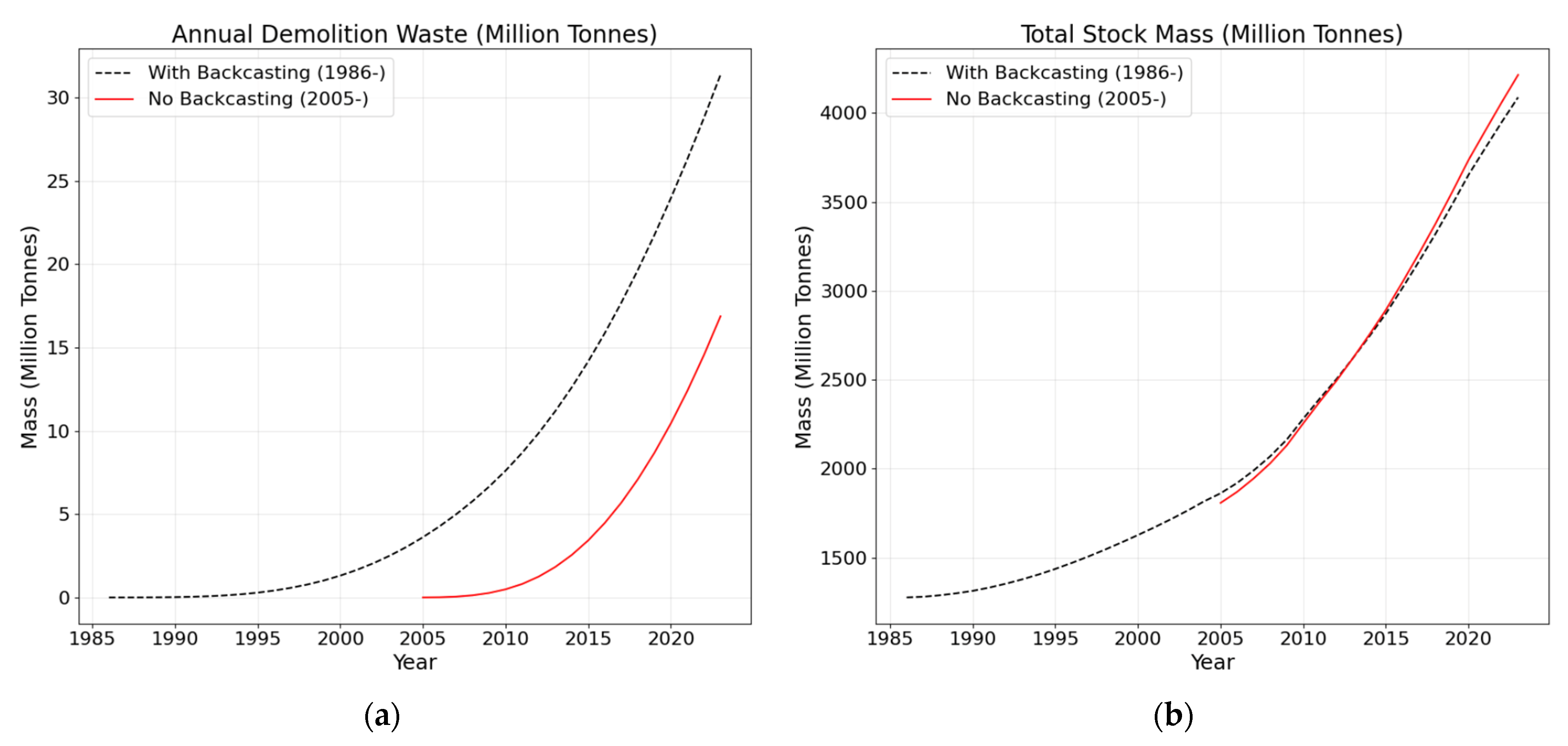
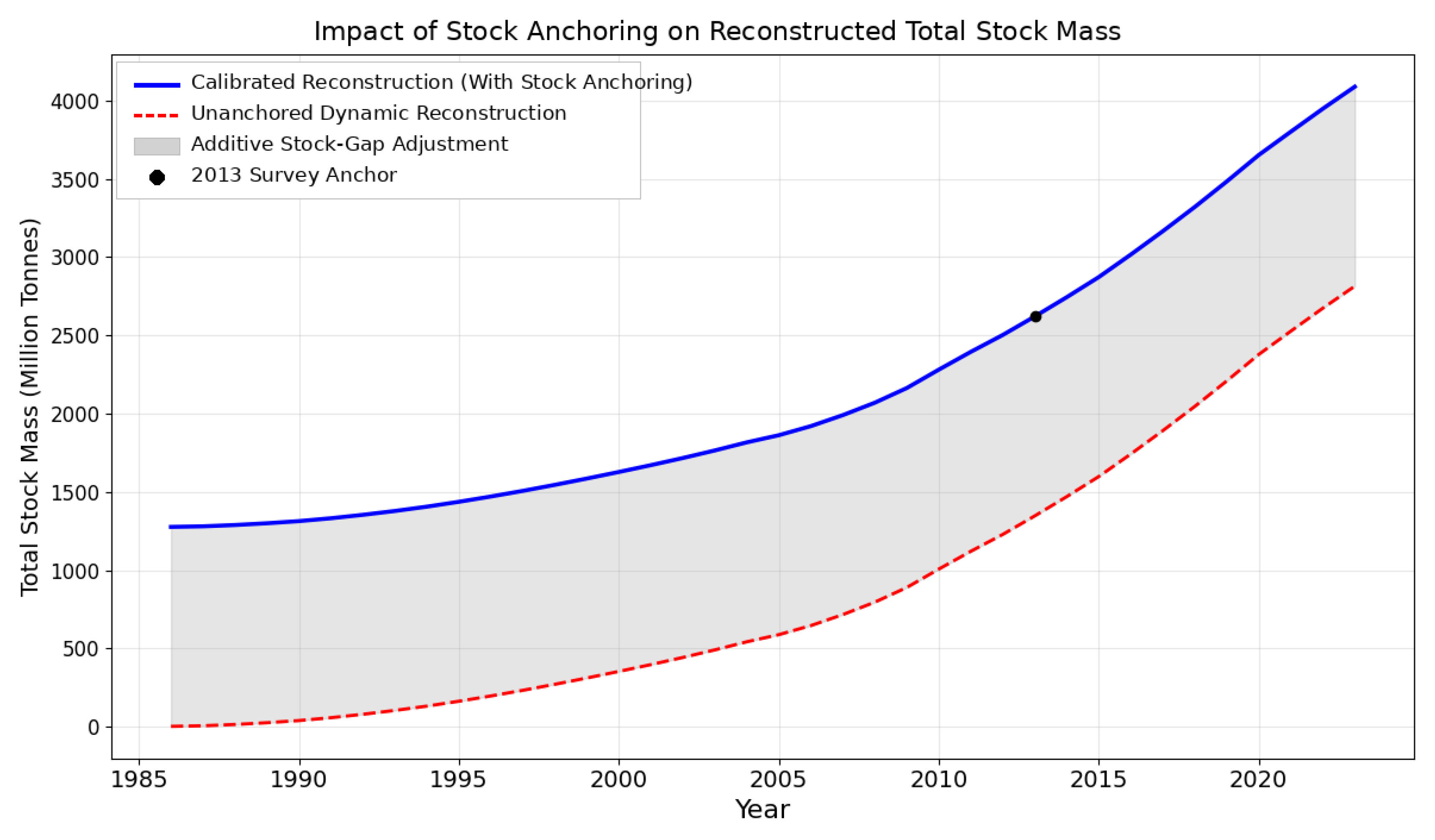
The diagnostic comparisons in
Figure 2 and
Figure 3 use the same underlying Vietnam residential stock–flow application introduced earlier [
22], but are reorganized here to evaluate the methodological roles of historical inflow reconstruction and stock anchoring.
The first diagnostic concerns historical inflow truncation.
Figure 2 compares the reconstructed system with and without historical inflow backcasting. When the model relies only on the observed inflow window, earlier building cohorts are excluded from the system representation. This creates an artificially young stock structure. The effect is especially visible in demolition outflows, because delayed retirement depends on the age composition of accumulated stock rather than on recent inflow levels alone. As a result, omission of historical reconstruction has a moderate effect on total stock magnitude but a much stronger effect on the timing and emergence of modeled outflows.
This comparison shows that historical backcasting performs a specific methodological function: it restores the cohort depth required for delayed outflow reconstruction. A stock–flow model may appear broadly reasonable when judged only by aggregate stock levels, while still misrepresenting turnover dynamics if earlier cohorts are omitted. Historical reconstruction is therefore not merely a gap-filling procedure; it is necessary for preserving the temporal structure of the system.
The second diagnostic concerns stock anchoring through calibration. Even after historical inflow reconstruction, the dynamically generated stock trajectory remains below the benchmark stock level in the calibration year, indicating that the reconstructed inflow history does not fully account for the observed system magnitude.
Figure 3 compares the calibrated and uncalibrated trajectories. The calibrated trajectory restores benchmark-compatible stock magnitude, while the uncalibrated trajectory remains persistently under-scaled over time.
This comparison highlights a different methodological role from that of historical backcasting. Historical reconstruction addresses missing temporal depth in the cohort structure, whereas stock anchoring addresses missing system-level relative to available benchmark evidence. A model can therefore satisfy the internal stock-balance identity while still remaining empirically implausible if its overall stock magnitude is not benchmark-compatible.
Taken together,
Figure 2 and
Figure 3 demonstrate that the two reconstruction steps correct different forms of structural bias. Without historical inflow reconstruction, delayed outflow behavior is distorted because the stock system lacks sufficient cohort memory. Without stock anchoring, the reconstructed stock trajectory remains systematically too low even if the dynamic flow logic is internally consistent. The methodological value of the framework lies in treating these problems separately and resolving them through explicit, transparent reconstruction operations rather than allowing them to remain hidden within an apparently complete model.
3.3. Comparative Methodological Assessment of Reconstruction Settings
The preceding diagnostics show that historical inflow reconstruction and stock anchoring address different weaknesses in a data-scarce stock–flow system. To synthesize these effects, this subsection compares four reconstruction settings that represent progressively more complete responses to the identified data constraints. The comparison is methodological rather than scenario-based: it evaluates how different reconstruction choices affect the credibility of the resulting stock–flow representation.
- (i)
Direct compilation of the fragmented evidence base;
- (ii)
Dynamic reconstruction without historical backcasting or stock anchoring;
- (iii)
Dynamic reconstruction with historical backcasting only;
- (iv)
The full closed-loop reconstruction framework proposed in this study.
Table 3.
Comparative methodological assessment of alternative reconstruction settings under data scarcity.
Table 3.
Comparative methodological assessment of alternative reconstruction settings under data scarcity.
| Reconstruction Setting | Historical Depth | Stock Anchoring | Internal Dynamic Consistency | Empirical Plausibility | Main Methodological Limitation |
|---|
| Direct compilation | Limited and fragmented | No | Low | Low | Available inflow, stock, and outflow evidence do not initially form a coherent accounting structure. Classification mismatches, incomplete stock representation, and missing outflow information remain unresolved. |
| Dynamic reconstruction without backcasting or anchoring | Limited to the observed inflow window | No | Moderate | Low | The cohort structure is artificially young. Stock magnitude remains underestimated, and delayed outflow emergence is distorted because earlier inflow cohorts are omitted. |
| Dynamic reconstruction with backcasting only | Extended through reconstructed inflow history | No | High | Moderate | Temporal continuity is improved, but the reconstructed stock level remains below benchmark observations because unresolved stock-level discrepancy is not corrected. |
| Full reconstruction framework | Extended through reconstructed inflow history | Yes | High | High | Remaining uncertainty is made explicit rather than eliminated. Outputs still require interpretation with benchmark, uncertainty, and sensitivity context. |
Direct compilation provides the weakest basis for interpretation because the available inflow, stock, and outflow evidence does not initially form a coherent accounting structure. Classification differences, incomplete historical depth, and absent demolition observations remain unresolved. A dynamic stock–flow model without backcasting or anchoring improves internal linkage between inflows, stocks, and outflows, but it still represents an artificially young system and therefore distorts delayed turnover. Adding historical backcasting improves temporal continuity and produces a more defensible cohort structure, yet the reconstructed stock level remains insufficiently aligned with benchmark observations when stock anchoring is omitted.
The full framework combines historical reconstruction, stock anchoring, empirical consistency checking, and robustness assessment. Its advantage is therefore cumulative rather than attributable to a single adjustment. It restores the temporal structure needed for delayed outflow interpretation, corrects the stock-level discrepancy relative to benchmark evidence, and subjects the resulting system to credibility assessment under uncertainty. In this sense, the framework does not claim to recover an exact hidden history; rather, it provides a more transparent and defensible reconstruction than incomplete alternatives under the same data limitations.
This comparison also clarifies the standard against which the proposed framework should be judged. Under data scarcity, methodological credibility cannot be established merely by producing a numerically complete time series. It requires showing that identifiable sources of structural bias have been diagnosed, addressed through explicit reconstruction steps, and evaluated against empirical and robustness criteria.
Table 3 therefore serves as a comparative assessment of how the proposed framework improves the interpretability of a reconstructed stock–flow system relative to less complete modeling configurations.
3.4. Credibility and Robustness of the Reconstructed System
The final question is whether the reconstructed system is sufficiently credible and robust to support interpretation under data scarcity. In this study, credibility is evaluated against three conditions: (i) internal dynamic consistency, meaning that inflows, stocks, and outflows are linked through a coherent stock–flow accounting structure; (ii) empirical plausibility, meaning that reconstructed outputs remain compatible with available external benchmark observations; and (iii) robust interpretability, meaning that the main system dynamics remain stable enough to interpret under plausible parameter variation.
The reconstructed system satisfies the first condition by preserving explicit cohort-based relationships among inflows, in-use stocks, and delayed outflows. Unlike direct compilation or incomplete reconstruction settings, the full framework links annual material additions, stock accumulation, and retirement flows within one internally consistent dynamic structure. This does not guarantee exact recovery of the hidden historical system, but it establishes the minimum accounting coherence required for meaningful interpretation.
The second condition is assessed through empirical consistency checks against independent benchmark observations. After historical inflow reconstruction and stock anchoring, the reconstructed stock trajectory becomes compatible with available stock-related service benchmarks. This indicates that the framework improves not only mathematical completeness but also empirical alignment with observed system-level conditions. Under incomplete data, such benchmark compatibility is a more appropriate test of plausibility than expecting exact annual recovery of all unobserved flows.
The third condition concerns robustness under uncertainty. Uncertainty propagation shows that the range of plausible outcomes widens over time, especially for delayed outflows, which depend strongly on reconstructed cohort depth and lifetime assumptions. However, the main dynamic pattern remains interpretable: the reconstructed system continues to show sustained stock accumulation and delayed outflow emergence rather than collapsing into qualitatively different trajectories under plausible parameter variation. This supports the use of the reconstructed system for methodological interpretation, while still requiring caution in the reading of exact magnitudes.
Sensitivity analysis further clarifies which assumptions dominate different components of model behavior. Lifetime-related parameters exert the strongest influence on the timing and emergence of outflows, whereas material-intensity assumptions more strongly affect the magnitude of stock and material flows. This distinction is important because it shows that uncertainty is not uniform across outputs: some parts of the reconstructed system are more sensitive to temporal assumptions, while others are more sensitive to conversion factors. The uncertainty ranges shown in
Supplementary Figure S1 should therefore be interpreted as evidence of bounded but non-negligible uncertainty, not as narrow confidence intervals for exact values.
Taken together, these results support the central methodological claim of the paper. The proposed framework does not eliminate uncertainty or fully reveal unobserved historical system components. Rather, it produces a reconstructed stock–flow representation whose internal logic is explicit, whose compatibility with benchmark evidence can be examined, and whose main dynamics remain interpretable under plausible variation. Under data scarcity, this combination of consistency, empirical anchoring, and robustness constitutes the relevant standard of methodological credibility.
4. Discussion
This section discusses what the demonstration reveals about the conditions under which dynamic material stock–flow systems can be interpreted credibly. Particular attention is given to the roles of historical depth, stock anchoring, and robustness assessment in distinguishing structurally plausible reconstructions from unsupported point estimates. Although the framework is demonstrated here using Vietnam’s residential building system, the case is used to evaluate the reconstruction logic under realistic data-scarcity conditions rather than to reproduce a separate empirical analysis.
4.1. Methodological Contribution Relative to Existing Stock–Flow Approaches
Dynamic material stock–flow analysis has developed a strong methodological foundation for representing long-lived systems through inflow histories, cohort aging, lifetime distributions, and delayed outflows. Existing urban and national building-stock studies have demonstrated the value of stock–flow modeling for quantifying material accumulation, turnover, and demand-reduction challenges in built-environment systems [
24,
25]. The contribution of the present framework is different: it focuses on how such systems can be reconstructed credibly when the data structure itself is incomplete or fragmented.
The methodological contribution of this paper is not to replace those established approaches, but to address a specific problem that becomes visible when they are applied under fragmented and incomplete evidence: how to reconstruct a dynamic stock–flow system when the available inputs do not initially form a coherent accounting structure. In such settings, data harmonization, historical extension, calibration, validation, and uncertainty analysis are often treated as separate practical tasks that support model implementation. The present framework brings these elements together as an explicit reconstruction logic and clarifies the distinct methodological role of each step.
This distinction matters because a dynamic model can be formally complete without being sufficiently credible. For example, a cohort-based stock–flow model may preserve the accounting identity among inflow, stock, and outflow, but still distort turnover dynamics if the historical inflow record is too short. Likewise, a model may include reconstructed historical inflows and remain inconsistent with available benchmark stock observations if unresolved stock-level discrepancies are not addressed. The comparative reconstruction settings presented in
Section 3 show that these deficiencies are not interchangeable: historical inflow reconstruction restores temporal depth, stock anchoring restores benchmark-compatible scale, and validation and robustness analysis determine whether the resulting system is interpretable under uncertainty.
In this sense, the proposed framework contributes a credibility-oriented reconstruction perspective. Its value lies less in introducing an entirely new stock–flow equation than in formalizing the minimum methodological sequence needed to prevent structurally biased reconstructions from being mistaken for reliable system estimates. Compared with direct compilation or partial dynamic reconstruction, the framework offers three practical advantages: it makes the data problem explicit at the outset, separates different sources of structural bias rather than masking them within a single model output, and links model construction to explicit credibility checks rather than treating validation and uncertainty as optional afterthoughts.
The results therefore support the broader argument that data scarcity changes the standard by which dynamic stock–flow modeling should be judged. In data-rich contexts, the central methodological effort may focus on model refinement, higher-resolution parameters, or scenario sophistication. In data-scarce contexts, the first requirement is more basic but no less important: demonstrating that the system has been reconstructed through a transparent logic that makes its assumptions, corrections, and remaining uncertainties visible.
4.2. What the Vietnam Demonstration Adds, and How It Differs from Related Vietnam Studies
The Vietnam demonstration serves two related but distinct purposes in this paper. First, it provides a demanding empirical setting in which the proposed reconstruction framework can be tested against realistic data constraints. Second, it helps clarify how the methodological problem addressed here differs from the substantive research questions examined in related Vietnam-focused studies.
A related Vietnam-focused stock–flow–service study has also demonstrated the usefulness of stock-oriented analysis for interpreting resource use, service provision, and infrastructure-related transitions in Vietnam. However, its primary contribution lies in service-oriented resource analysis rather than in formalizing a general reconstruction methodology for dynamic stock–flow systems under fragmented and incomplete evidence [
26].
The present paper addresses a different question. It does not seek to extend the empirical interpretation of Vietnam’s residential stock dynamics or circular-economy outcomes. Instead, it extracts and formalizes the methodological reconstruction problem that arises before such substantive analysis can be considered credible: how to assemble fragmented inflow, stock, and parameter evidence into a dynamic stock–flow system that is internally coherent, benchmark-aware, and transparent about unresolved uncertainty. The Vietnam case is therefore used here not as a new empirical object, but as a methodological demonstration of why reconstruction logic matters.
The diagnostic comparisons in
Section 3 are not intended to compete with or reproduce the empirical results of the related sectoral study. Rather, they reveal the methodological consequences of specific reconstruction choices. In particular, the Vietnam demonstration shows that omitting historical inflow depth and omitting stock anchoring lead to different forms of structural distortion, even when the same underlying system is being modeled. The central insight of this study is that, before dynamic stock–flow outputs are used for substantive interpretation, the reconstruction pathway itself must be made explicit and evaluated.
The case also has broader significance beyond Vietnam. Many emerging and data-constrained economies face a similar combination of partial inflow histories, intermittent benchmark observations, changing statistical classifications, and missing direct outflow data. The Vietnam demonstration therefore provides an analytically useful example of how a reconstruction framework can be operationalized where the evidence base is sufficient to support modeling, but insufficient to justify direct compilation or unqualified point estimates. In this sense, the case contributes substantively to the methodological argument without shifting the paper away from its primary focus on reconstruction under data scarcity.
4.3. Implications for Sustainability-Oriented Resource Assessment and Practice
Dynamic material stock–flow analysis is increasingly used to support sustainability-oriented understanding of resource systems because it connects present material inputs with accumulated in-use stocks, future outflows, waste emergence, and potential secondary material availability. These relationships are relevant to several core areas of sustainability research and practice, including resource-efficiency assessment, circular-economy planning, long-term waste management, and the evaluation of material demand associated with built-environment development [
3,
7,
16,
17,
19,
20]. Related studies further show that material-stock information can support circular-economy implementation, demolition-waste planning, secondary resource assessment, and demand-reduction strategies in built-environment systems [
19,
20,
21,
25,
27].
The present framework contributes to these applications by addressing a methodological condition that often limits their use in practice: the absence of complete and internally consistent long-term data. In data-constrained settings, estimates of accumulated stock, future demolition outflows, or potential secondary resource availability may become misleading if the underlying reconstruction omits historical depth, does not reconcile modeled stock with available benchmark observations, or presents point estimates without explicit credibility assessment. The framework developed here does not remove these data limitations, but it provides a structured way to identify them, address them where defensible, and make remaining uncertainty visible.
This contribution is particularly relevant for rapidly urbanizing economies, where decisions related to construction, infrastructure expansion, waste generation, and secondary resource use often need to be informed before comprehensive long-term statistical systems are available. The Vietnam demonstration shows that dynamic stock–flow analysis can still provide sustainability-relevant evidence under such conditions, provided that the reconstruction process is explicit, empirically anchored where possible, and interpreted within clearly stated uncertainty bounds. In this sense, the methodological framework helps extend the practical reach of material stock–flow analysis to contexts where sustainability challenges are pressing, but the evidence base remains incomplete.
The implications are not limited to academic model development. For sustainability practice, the framework encourages a more cautious and transparent use of reconstructed stock–flow outputs in resource and waste management discussions. Rather than treating data-scarce models as precise forecasts, it supports their use as credibility-bounded analytical tools for identifying whether stock accumulation, delayed outflow emergence, or unresolved benchmark inconsistencies are likely to influence sustainability interpretation. This is especially important when such outputs are used to inform debates on resource efficiency, demolition-waste preparedness, or the potential role of secondary materials in future construction systems.
4.4. Boundary Conditions and Transferability of the Framework
The proposed framework is intended for data-constrained dynamic stock–flow reconstruction, but it is not universally applicable to every economy or every material system, regardless of the available evidence. Its transferability depends on whether a minimum set of empirical conditions is met. In contexts with more systematic stock–flow inventories or harmonized material accounts, such as national or provincial stock–flow databases, the reconstruction burden may be lower, but the same logic of data diagnosis and credibility assessment remains relevant [
28].
First, the system must have at least a partially observable inflow basis that can serve as the starting point for dynamic reconstruction. This may take the form of construction activity, product inflows, floor-area additions, or other time-series indicators that are conceptually linked to stock accumulation. If no meaningful inflow evidence exists, historical reconstruction becomes too speculative to support a credible dynamic model.
Second, the framework requires at least one external benchmark or plausibility anchor for the stock system, such as stock observations, service-level indicators, census-based estimates, or other independently reported system-level information. Without such anchors, a model may be internally balanced but cannot be evaluated for empirical plausibility.
Third, the system must permit a defensible representation of retirement or delayed outflow behavior, usually through lifetime functions, survival assumptions, or other turnover parameters. These inputs may be uncertain, but they need to be justifiable enough to support sensitivity and uncertainty assessment. In the absence of any basis for turnover representation, dynamic outflow reconstruction becomes difficult to interpret.
Fourth, the framework is most useful where the available data contain identifiable structural inconsistencies that can be addressed through explicit reconstruction steps—for example, truncated historical depth, classification mismatch, benchmark stock gaps, or missing outflow observations. In data-rich contexts, some components of the framework may become less central because direct observations already provide stronger empirical closure. Conversely, in extremely data-poor contexts, the framework may reveal that credible reconstruction is not yet feasible without additional evidence.
These conditions mean that the framework is best understood as a transferable methodological architecture, not as a universal plug-in model. Its reconstruction logic can be adapted to different countries, sectors, and stock types, but the specific operational choices—such as the backcasting proxy, calibration benchmark, turnover function, and uncertainty design—must be tailored to the available evidence and system characteristics. The Vietnam demonstration illustrates one such implementation for residential buildings; other applications would require their own data diagnosis and reconstruction choices.
This bounded interpretation is important for avoiding overgeneralization. The framework does not claim that all data gaps can be resolved, nor that every reconstructed stock–flow system becomes equally reliable after applying the same sequence of steps. Instead, it provides a structured way to determine whether reconstruction is feasible, which gaps require methodological intervention, and how the resulting system should be interpreted under remaining uncertainty.
4.5. Limitations and Directions for Methodological Refinement
The framework improves transparency and credibility in dynamic stock–flow reconstruction under data scarcity, but it does not eliminate the limitations created by incomplete historical evidence. Four issues are especially important for interpreting the present demonstration and for refining future applications.
First, the historical inflow reconstruction relies on a GDP-based backcasting relationship. In the Vietnam demonstration, this choice is supported by the strong diagnostic fit observed over the available period and by the need for a continuous macro-level proxy to extend the missing inflow history. However, this relationship should not be interpreted as temporally invariant. In rapidly transforming economies, the material intensity of economic growth may change because of shifts in urbanization, housing form, construction technology, regulation, or investment structure. The reconstructed pre-observation inflow series therefore restores the cohort depth needed for dynamic modeling, but it does not constitute exact year-by-year recovery of historical construction activity. Future applications could compare alternative backcasting drivers or multi-variable reconstruction rules where richer long-run evidence is available.
Second, the additive stock-anchoring term improves benchmark compatibility at the stock level but does not fully reconstruct the hidden dynamics of the unresolved stock gap. In the present implementation, the calibration term is carried forward as a stock-level adjustment and is not assigned an explicit age distribution or separate retirement trajectory. This means that the framework corrects an under-scaled stock representation, but it may still underestimate delayed outflows if part of the calibrated gap corresponds to older stock that retires during the modeled period. In addition, the stock gap should not be interpreted exclusively as pre-window legacy stock; under fragmented statistical systems, it may also partly reflect incompletely recorded, informally constructed, or classification-misaligned additions within the observation window. Future methodological extensions could represent the calibrated gap as an age-structured latent stock subject to conditional retirement assumptions when sufficient evidence exists.
Third, the empirical plausibility assessment remains constrained by the availability of intermittent benchmarks rather than continuous validation data. Benchmark consistency can show that the reconstructed system is compatible with selected external observations, but it cannot fully verify every annual stock, inflow, or outflow estimate. This limitation is inherent to data-scarce reconstruction and reinforces the need to interpret the results as credibility-bounded estimates rather than exact historical recovery.
Fourth, the study uses one-at-a-time sensitivity analysis to identify which assumptions most strongly influence key outputs. This approach is useful for screening dominant individual parameters, but it does not capture higher-order interactions among uncertain inputs, such as simultaneous variation in material intensity, lifetime parameters, and reconstruction assumptions. Future work could extend the framework through global sensitivity methods, including variance-based approaches such as Sobol indices, where the analytical scope and data structure justify that additional complexity [
23,
29]. This would provide a fuller understanding of interaction effects within reconstructed stock–flow systems.
These limitations do not undermine the purpose of the framework; rather, they define the boundary of what credible reconstruction can claim under incomplete evidence. The methodological contribution lies in making such unresolved issues explicit, separating different sources of uncertainty, and preventing stock–flow outputs from being interpreted as more precise or complete than the underlying data structure permits.
5. Conclusions
This study develops a methodological framework for reconstructing dynamic material stock–flow systems under data scarcity. It argues that when historical inflows, benchmark stocks, classifications, and outflow observations are incomplete or fragmented, the central task is not simply to compile available data into a model, but to reconstruct a system that is internally coherent, empirically anchored, and transparent about remaining uncertainty.
To address this problem, the paper proposes a closed-loop reconstruction framework that integrates data structure diagnosis, harmonization, historical inflow reconstruction, stock anchoring, dynamic stock–flow simulation, and credibility assessment through empirical consistency checking, uncertainty propagation, and sensitivity analysis. The framework is demonstrated using Vietnam’s residential building system, which provides a demanding but operationally tractable case of incomplete historical depth, intermittent stock benchmarks, and missing direct demolition observations.
The comparative reconstruction analysis shows that different omissions produce different forms of methodological bias. Without historical inflow reconstruction, the system lacks sufficient cohort depth, and delayed outflow behavior is distorted. Without stock anchoring, the reconstructed stock trajectory remains systematically under-scaled relative to benchmark evidence. The full framework improves methodological credibility by addressing these weaknesses explicitly and by subjecting the reconstructed system to empirical and robustness checks. It does not claim exact recovery of unobserved historical dynamics, but it provides a more transparent and defensible basis for interpretation than incomplete reconstruction settings.
The Vietnam demonstration also shows why this methodological issue matters for sustainability-oriented analysis in practice. In rapidly urbanizing and data-constrained systems, interpretations of stock accumulation, future outflow emergence, demolition-waste pressures, and potential secondary material availability can change materially depending on how historical depth, benchmark inconsistencies, and missing system components are handled. A framework that makes these reconstruction choices explicit therefore strengthens the evidentiary basis for resource-efficiency assessment, circular-economy planning, and long-term waste and material management under non-ideal data conditions. The case contributes not only as a stress test of the framework, but also as evidence that reconstruction choices affect the credibility of sustainability-oriented stock analysis in emerging-economy contexts.
More broadly, the framework offers a transferable methodological architecture for data-constrained stock–flow research, provided that minimum conditions for reconstruction are met: partially observable inflow evidence, at least one external plausibility anchor, defensible turnover assumptions, and a transparent basis for uncertainty assessment. Future work can refine the framework through alternative backcasting strategies, age-structured treatment of calibrated stock gaps, and global sensitivity methods capable of capturing interactions among uncertain inputs.
Overall, the study contributes to sustainability-oriented material-systems research by clarifying how dynamic stock–flow models should be reconstructed, evaluated, and interpreted when the available evidence is incomplete. By extending the practical credibility of such analysis under data scarcity, the framework helps make material stock–flow assessment more usable in contexts where resource, waste, and circularity challenges are pressing but comprehensive long-term data systems remain limited.