2. Materials and Methods
2.1. Study Area
The study was conducted in Xilingol League (Xianghuang Banner, Zhengxiangbai Banner) and Ordos City (Etuoke Banner), representing arid and semi-arid grasslands with typical household division and grassland fragmentation.
2.2. Mixed Methods and Data Integration
This study employed a sequential explanatory mixed-methods design. In the quantitative phase, statistical data from 2001 to 2023 (Inner Mongolia Statistical Yearbooks) were analyzed to identify long-term trends in household numbers, household size, grassland area, and livestock. These trends informed the qualitative phase, in which we used thematic coding of interviews and participatory observation to interpret behavioral mechanisms. Joint interpretation across both phases ensured validity and complementarity. The qualitative phase drew on field surveys (2014–2023) comprising semi-structured interviews, participatory observation, and policy document analysis. Quantitative trends provided the contextual background, while qualitative data explained behavioral mechanisms; joint interpretation ensured validity.
2.3. Sampling, Participants, and Data Analysis
Purposive and snowball sampling covered four household types (zero-livestock, small-scale, medium-scale, well-off) and over 30 grassroots cadres, with 120+ households interviewed and all identities anonymized. Data included nearly 100 first-hand materials, field notes, and policy texts. Analysis followed four steps: transcription and open/axial/selective coding; extraction of core themes (driving mechanisms, three governance functions, triple constraints); triangulation of statistics, interviews, and documents; and long-term follow-up surveys to reduce recall bias and ensure representativeness.
2.4. Key Definitions and Measurements
Household division is defined as the formal separation of household registration, living arrangement, and independent operation, distinct from residential separation. Herder differentiation stratifies households into four types based on sheep units and grassland area: zero-livestock (0–50 sheep units, no breeding), small-scale (50–150, limited grassland), medium-scale (150–300, stable operation), and well-off (>300, abundant grassland and labor). Governance effectiveness was measured through objective indicators (vegetation coverage, overload rate, self-regulation frequency) and subjective indicators (willingness to reduce livestock, policy satisfaction).
3. Driving Mechanisms for the Long-Term Increase in the Number of Pastoral Households
The main reasons for the continuous growth in the number of pastoral households are institutional incentives, property rights arrangements, and changes in the labor market. The long-term superposition and synergy of these three factors have jointly shaped the long-term trajectory of the number of pastoral households. This section presents evidence on three driving mechanisms—ecological subsidy policies, grassland use-rights confirmation, and livestock market returns—followed by a cautious assessment of competing explanations.
3.1. The Continuous Incentive of Grassland Ecological Reward and Subsidy Policy
In 2011, the state initiated the first round of grassland ecological protection subsidy and reward mechanisms in major pastoral areas such as Inner Mongolia. This policy provided an annual subsidy of 7.5 yuan per mu for grazing exclusion areas and a reward of 2.5 yuan per mu for grassland-livestock balance areas. The grasslands eligible for ecological rewards had to be contracted to households, and the subsidy funds were directly distributed to herders through “one card” systems [
11].
Due to the direct link between the reward and subsidy funds and the area of the grassland and the differences in grassland areas among pastoral households, some herders with small grassland areas received very little reward and subsidy funds [
12]. The implementation of the policy soon raised questions about fairness. To balance the interests of all parties, places like Xilingol League in Inner Mongolia were the first to introduce complementary measures of minimum guarantees and maximum caps. Pastoral households with a per capita grassland area of less than 500 mu were granted subsidies according to the standard of 3000 yuan per person per year. If the grassland area was too large, the subsidy amount per-person could not exceed twice the per capita net income of farmers and herders in the previous year.
This adjustment effectively alleviated the problem of absolute unfairness but unexpectedly gave rise to a new family behavioral logic: for herders with small grassland areas, household division became a rational choice to increase the guaranteed minimum subsidy. During a 2019 survey in Xianghuang Banner, a herder told the author a detailed calculation: his family consists of four members, with a grassland area of only 2800 mu. If calculated on a household basis, the reward and subsidy funds granted according to the grassland area were significantly lower than the guaranteed minimum subsidy calculated based on the four family members. If the son who had married but had not yet established a separate household was separately accounted for, he could obtain an additional guaranteed minimum income, which was an amount that could not be ignored for a herder family with a single source of income.
However, this household division strategy brought short-term institutional benefits to herders but also produced a hidden institutional cost: the cost of grassland fence construction increased exponentially after household division, the independent operation of small families led to diminishing marginal benefits of labor, and the collaborative advantages of traditional large families were institutionally disintegrated [
13].
The second round (2016–2020) and the third round (2021–2025) grassland ecological reward and subsidy policies have continued this core framework [
14]. This long-term and stable institutional incentive has enabled households to make family decisions based on livelihood rationality over the past two decades. From the perspective of policy design, the ecological reward and subsidy policy has played a positive role in curbing the continuous degradation of grasslands, and the incentive for household division is actually an unintended consequence of the operation of the system. This suggests that the evaluation of a public policy should take into account both its ecological performance and social performance and avoid making simple judgments in a single dimension [
15].
3.2. Institutional Solidification of Grassland Use-Rights Confirmation Policy
The promotion of the grassland ecological reward and subsidy policy has objectively accelerated the implementation of grassland use-rights confirmation and contracting. Against the backdrop of stabilizing and improving the grassland contract management system, the work of grassland use-rights confirmation, contracting, and basic grassland demarcation was basically completed in 2015. Since 2017, Inner Mongolia has launched the implementation of separating grassland ownership, contracting rights, and management rights, clearly emphasizing the need to stabilize the existing land and grassland contracting relationship and maintain it for a long time [
16].
From the perspective of policy’s original intention, the purpose of grassland use-rights confirmation is to stabilize the contracting relationship and protect the legitimate rights and interests of herders. However, in the actual implementation process, the two policies of grassland use-rights confirmation and ecological reward and subsidy have been highly overlapping in their implementation periods, both lasting for more than ten years and forming a long-term policy superposition effect. Grassland use-rights confirmation defines the institutional boundary for household division and provides a legal channel for it, while ecological rewards and subsidies offer direct economic incentives for household division. Use-rights confirmation and household division have formed a mutually reinforcing interactive relationship, jointly promoting the continuous growth of the number of pastoral households.
On the one hand, already divided households need to clarify their respective grassland boundaries through use-rights confirmation to avoid disputes caused by unclear rights; on the other hand, the advancement of use-rights confirmation has also provided a solid institutional guarantee for more household divisions. Prior to this, although some herders had actually lived and operated separately, they were still regarded as a single household at the statistical level because the grassland contract relationship had not been formally changed. The implementation of use-rights confirmation has transformed these hidden household divisions into explicit household divisions, further promoting the growth of the number of pastoral households [
17].
It should be pointed out that the path of clarifying property rights represented by grassland use-rights confirmation is not unique to China. In East African pastoral areas, “group ranches” in countries such as Kenya have been successively subdivided into privatized plots since the 1980s. Studies have shown that this fragmentation of property rights has led to serious consequences, including a decline in herders’ livestock numbers and deterioration of food security, as herders have been forced to sell more livestock to cope with the cash-flow pressures arising from fragmented operations [
18]. Similarly, recent policy discussions on the formalization of grassland property rights in Mongolia have sparked widespread controversy, with pastoralists generally holding a skeptical attitude. They worry that formalized land titling will restrict the mobility essential for them to adapt to environmental variability [
9]. These cross-border experiences indicate that although grassland use-rights confirmation is originally intended to protect rights and improve efficiency, its actual effects often run counter to policy expectations under the unbalanced ecological conditions of arid and semi-arid pastoral areas [
19]. This constitutes a common dilemma in global pastoral governance.
3.3. Cyclical Fluctuations in the Relative Returns from Animal Husbandry and Return Migration of Labor
In addition to policy factors, dynamic changes in the labor market have also been a significant driving force behind the growth in the number of pastoral households. Around 2010, the market prices of beef and mutton in Inner Mongolia continued to rise, leading to a significant improvement in the profitability of livestock production. Meanwhile, the state increased subsidies for the large-scale breeding of beef cattle and mutton sheep, which further stimulated herders’ enthusiasm for breeding [
20]. Additionally, the increasing pressure of urban employment gave rise to a notable wave of return migration for employment in pastoral areas, with many herders who had been working outside returning to the grasslands to resume livestock production.
Most of the returnees are young people who have established families away from their parental households. After returning to the pastoral area, they are reluctant to operate with their parents and prefer to establish separate households. This choice is derived from differences in lifestyles. Young people pursue an independent living space and are unwilling to be bound by the traditional family. Based on the consideration of economic rationality, a newly established household can independently receive ecological rewards and subsidies and can obtain independent contracting rights in future grassland use-rights confirmation, leaving room for their long-term development [
21].
The outbreak of the COVID-19 pandemic in 2020 further solidified and reinforced this trend. The pandemic was not the initial driving force behind the growth in the number of pastoral households—the growth trend had already begun around 2010—but it profoundly altered the balance of push and pull forces between urban and rural areas. Specifically, the uncertainty of urban employment increased significantly, and urban-rural disparities in social security were amplified during the crisis. Faced with the instability of urban migrant income and the subsistence guarantee provided by pastoral areas, many young herders who were originally in a “semi-urbanized” state returned to the grasslands. This choice was not a simple “return migration”; instead, it represented herders’ re-anchoring of family livelihood security in a risk society, keeping populations that might otherwise have gradually moved out anchored in the grasslands and directly driving a further increase in the number of pastoral households [
22].
3.4. Competing Explanations and Causal Identification
We acknowledge that our study does not employ a formal causal identification design (e.g., instrumental variables, difference-in-differences). The following discussion therefore presents plausible, evidence-supported interpretations rather than definitive causal claims. To strengthen causal inference and avoid mistaking correlation for causation, we systematically identify, evaluate, and rule out a series of competing explanations that may account for the long-term growth in the number of pastoral households. By excluding alternative drivers, we ensure that the core mechanisms identified in this study—ecological reward and subsidy policies, grassland use-rights confirmation, and livestock market returns—represent plausible causal factors rather than merely coincidental correlates.
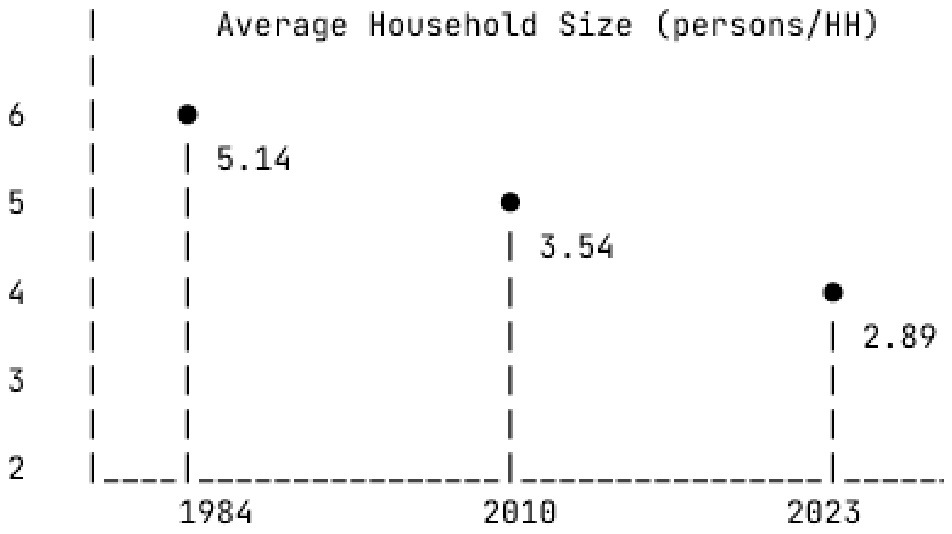
First, Demographic change and population aging are unlikely to be primary drivers based on the available evidence. Total population in pastoral areas remained nearly stable between 1984 and 2023, rising only slightly from 1.84 million to 1.86 million. In contrast, the number of pastoral households nearly doubled, and average household size decreased sharply from 5.14 to 2.89 persons. Demographic structures evolve slowly and cannot explain the accelerated increase in household splitting after 2010, which coincided precisely with the launch of the first-round grassland ecological subsidy policy. The timing, magnitude, and pace of household growth are inconsistent with demographic explanations.
Second, household registration (hukou) rules are excluded as a key driver. No major reforms lowering the administrative barriers to household division occurred in Inner Mongolia’s pastoral areas during 2001–2023. The stability of hukou requirements stands in sharp contrast to the rapid acceleration of household division after 2011. This temporal mismatch indicates that institutional thresholds for registration did not trigger the observed structural change.
Third, marriage and traditional inheritance customs are ruled out. Cultural and customary practices change gradually across generations, not abruptly after 2011. Field interviews consistently confirm that herders divided households primarily to increase per capita minimum-guarantee subsidies, not to fulfill marriage or inheritance norms. Since customs cannot explain the policy-synchronized surge in household division, they do not constitute a causal mechanism.
Fourth, welfare access criteria are rejected as a major driver. Expansions in social welfare, medical insurance, and educational support proceeded incrementally, with no sharp shifts corresponding to the inflection point of household growth around 2010–2011. Most welfare benefits are attached to individuals rather than household units, providing only weak incentives for formal separation. Welfare policy therefore cannot explain large-scale, policy-induced household fission.
Fifth, local administrative and statistical incentives are eliminated. Interviews with grassroots cadres confirm that no performance targets or administrative pressures encouraged increasing registered household counts. On the contrary, grassland fragmentation and small-scale operation raised management costs, giving local authorities incentives to restrain rather than promote household division. Administrative manipulation is not strongly supported by our data and field interviews.
After controlling for all major competing explanations, these mechanisms remain the most consistent explanation given the qualitative and descriptive evidence available. The long-term growth of pastoral households is best explained by the combined effects of institutional incentives from ecological subsidies, property-rights solidification from grassland tenure confirmation, and cyclical fluctuations in livestock market returns. These three interlocking mechanisms provide the strongest and most temporally consistent causal account of household structural change.
4. Ecological Governance Functions of Pastoral Households: A Neglected Perspective
This section presents evidence on three spontaneous ecological governance functions of pastoral households: population regulation, grass-livestock balance, and human-land adjustment. The analysis draws on qualitative data from field surveys.
For a long time, academic research on household functions has focused on economic production, social support, intergenerational inheritance, and other dimensions. For instance, Deng Dacai’s research proposed that in the context where state power had not yet penetrated the grassroots and social organizations were underdeveloped, households undertook three major categories and ten subcategories of social functions [
8]. In grassland pastoral areas, the ecological environment of the Mongolian Plateau is fragile, characterized by scarce precipitation, strong winds, and frequent sandstorms. The ecological condition of grasslands is directly related to the survival and development of pastoral households and even determines the sustainability of pastoral societies [
23].
In traditional pastoral society, population pressure on grasslands was relatively low. Natural disasters and wars served as informal mechanisms regulating human numbers. Grasslands were commonly owned, and herders maintained the grass-livestock balance through nomadism and seasonal transhumance [
24]. Compared with the extensive grasslands, the human population was often a scarce resource. Despite these long-standing ecological dynamics, the ecological governance functions of pastoral households have rarely been systematically examined in academic research.
Since the 1980s, this traditional regulatory pattern has been fundamentally transformed. The implementation of the dual contract system for grasslands and livestock has fixed grassland use rights at the pastoral household level. During the initial stage of grassland allocation, a distribution method of “60% based on population and 40% based on livestock” was widely adopted across various regions. Meanwhile, the quantity of grassland allocated was closely associated with the density of local pastoral households—households in areas with fewer residents could obtain more grassland. These practices created an uneven initial distribution. The policy of “no additional grassland for new family members, no reduction for those who leave” further locked in this inequality and allowed it to pass across generations [
25]. Under this institutional framework, pastoral households have spontaneously developed mechanisms to address the imbalances among people, grass, and livestock. These informal practices form the micro-level foundation of grassland ecological governance.
4.1. Population Adjustment Mechanism
In grassland ecological governance, the common practice at the state level is to implement compulsory ecological resettlement. In the early 2000s, large-scale resettlement programs were launched in Inner Mongolia. Many herders were moved from grasslands to resettlement communities or suburban areas and encouraged to shift to non-pastoral livelihoods such as dairy farming. The goal was to reduce ecological pressure by reducing the population on the grasslands [
26]. However, long-term follow-up surveys in Etuoke Banner and Xianghuang Banner show that many ecological migrants returned to their original grasslands soon after relocation. A returning herder interviewed in 2021 in Etuoke Banner said, “Raising dairy cows in resettlement areas requires purchasing feed at a cost, and milk prices are unstable. After a year of hard work, the income is even lower than that from grazing on the grasslands. Moreover, we have lived on the grasslands for generations and are accustomed to the grassland lifestyle.” This standardized, one-size-fits-all resettlement model proved inconsistent with herders’ livelihood rationality and encountered substantial practical obstacles.
Compared with compulsory adjustment at the state level, the population adjustment mechanism at the household level is more complex, flexible, and better aligned with the actual conditions of pastoral areas, which is mainly reflected in three aspects.
First, pastoral households have taken the initiative to change their fertility attitudes. In traditional societies, having more children meant more labor and more wealth, which was an important pursuit for herder families. However, after the grassland is contracted to the household, the livestock carrying capacity of each household is relatively fixed, which is clearly recognized by herders. Herders understand that if the number of livestock exceeds the carrying capacity of the grassland, grassland degradation will eventually affect household income and even threaten their own survival. In order to maintain the balance of people, grass, and livestock, more and more herders began to take the initiative to control family size. In interviews, one herder’s statement was quite representative: “I thought having more sons was good because they could help herd sheep and manage the grassland when they grew up; now there is only so much grassland—having more sons would instead be troublesome. When the family is divided, the grassland is not divided enough. It is enough to have two children.” This change in perception has enabled pastoral households to complete the self-regulation of population growth within the family, without the need for external compulsory intervention.
Second, pastoral households attach great importance to their children’s education. For pastoral households with a small per capita grassland area, facing limited grassland resources and survival pressure, providing their children with education to move out of the grasslands and obtain employment in urban areas has become an important livelihood path, as well as an indirect way to alleviate population pressure on the grasslands [
27]. Xianghuang Banner is a typical case: the human-land relationship in this banner is tense, and the grassland area per pastoral household is generally small, but local herders have always attached great importance to their children’s education. As early as 1983, it met the standard of an illiteracy-free banner, and in 1985, the enrollment rate of school-age children reached 98.6%, and the graduation rate reached 91.4%. In contrast, data from the Fourth National Population Census in 1990 showed that the proportion of the population over 16 years old in Inner Mongolia who were “illiterate or barely literate” still reached 15%, indicating that the level of educational development in Xianghuang Banner was significantly higher than the average level of the region. This tradition has continued to this day; in recent years, the college entrance examination admission rate in pastoral areas has remained consistently higher than the average level of rural and pastoral areas in the region. A large number of young people have shifted to non-pastoral employment through education, which has objectively reduced the population pressure on the grasslands.
Third, the continuation of traditional customs such as adoption and levirate marriage. This is a typical non-monetary ecological adaptation strategy. There is an imbalance in population distribution among pastoral households: some families have no sons, and under the influence of the traditional concept of raising sons for old age, they will adopt sons from close relatives; some families have only daughters and tend to recruit sons-in-law, while families with more sons, facing the practical pressure of limited grasslands, are also willing to let their sons go out to “establish their own households” to reduce the family burden. The author’s survey in Harigentu Gacha shows that among the 227 households, more than 10% of households had cases of adoption or uxorilocal marriage. Compared with the monetary incentives of modern ecological compensation, this customary adjustment has lower costs and stronger stability, but it is gradually disintegrating amid the waves of marketization and individualization [
28]. This seemingly traditional population adjustment method has actually effectively balanced the labor distribution among pastoral households, alleviated the livelihood pressure of some families, and indirectly regulated the relationship between population and resources on the grasslands.
4.2. Grass-Livestock Balance Mechanism
In recent years, the problem of grassland degradation has become increasingly prominent, and the grass-livestock contradiction has become the core issue of grassland ecological governance. At the state level, a series of regulatory measures have been adopted, including grazing prohibition, grass-livestock balance assessment, and subsidies for livestock reduction, aiming to alleviate the grass-livestock contradiction and curb grassland degradation [
29]. Taking the grass-livestock balance policy as an example, the government determines the reasonable livestock carrying capacity for each pastoral household in accordance with fixed standards and requires households exceeding the approved carrying capacity to reduce their livestock within a specified time limit; otherwise, they will face penalties. However, in the actual implementation process, this policy has encountered widespread resistance from herders, and the implementation effect has been greatly reduced.
The emergence of such resistance is not accidental but the rational response of herders to the dual risks of ecology and market. From the perspective of a moral economy based on survival ethics and safety first, herders’ tendency to raise more livestock is not simply driven by greed or short-sightedness but rather a typical risk-averse rational behavior to hedge against the non-equilibrium nature of the grassland ecosystem and sharp fluctuations in market prices [
30].
As a typical non-equilibrium ecosystem, grassland productivity varies significantly across different years, seasons, and locations: in years with favorable weather conditions, the grassland grows well, and its actual carrying capacity is much higher than the approved standard; in contrast, in years affected by natural disasters such as droughts or snowstorms, even livestock raising in line with the approved standard may still result in grassland overgrazing [
31]. If the approved livestock reduction standards are strictly implemented, a large number of livestock will die in disaster years, making herders’ production unsustainable and even pushing them into poverty; conversely, in good years, herders cannot quickly restore their herd size, thus missing opportunities for income increase. Therefore, herders tend to adopt risk-aversion strategies, preferring to raise more livestock to cope with uncertainties, which is not irrational behavior but their optimal choice under the existing constraints.
However, it is important to clarify that such “non-compliant” livestock-raising behavior by herders is not uncontrolled. In long-term production practices, herders have accumulated rich experience in grassland management and formed a set of autonomous grass-livestock balance adjustment mechanisms, which mainly include three aspects.
The first is to alleviate overgrazing pressure through grassland leasing and forage purchase. When signs of overloading appear on the grassland, some herders will take the initiative to lease grassland from neighbors or relatives or purchase forage to make up for the forage gap in winter and spring, thereby avoiding overgrazing of the grassland. In recent years, the operating costs of the livestock industry have continued to rise, coupled with market fluctuations, leading to a significant decline in livestock production returns. Many herders have fallen into a cycle of borrowing—repaying—reborrowing. In this context, the traditional reluctance of herders to sell livestock has changed. More and more herders choose to fatten lambs within the same year or sell them to large-scale fattening bases. This approach has two benefits: it not only reduces the demand for forage in winter and spring, and reduces the cost of livestock production, but also effectively reduces the grazing pressure on the grassland.
The second is to achieve flexible adjustment by relying on the traditional Suruke system. Suruke, a Mongolian term meaning herd trusteeship, is a traditional animal husbandry management model in pastoral areas. In years when the grass-livestock contradiction is prominent, some herders will entrust part of their livestock to other herders’ pastures, pay a trusteeship fee based on the number of livestock, or settle accounts by means of young livestock sharing. This model is highly flexible: the entrusting party can maintain the herd size and retain the production foundation without increasing the pressure on their own pastures; the receiving party can obtain additional cash or livestock income to make up for their own operational deficiencies. The field research found that this traditional system still maintains vitality in pastoral areas to this day and has been deeply integrated with modern market mechanisms, with specialized entrusted breeding pastures emerging, which further improves the efficiency of grass-livestock balance regulation.
The third is to explore the community co-management model to solve the governance dilemma. In traditional nomadic society, the grassland is publicly owned, and herders can adjust the relationship between grass and livestock by “transhumance”, so as to allow grasslands to rest and recover. After the implementation of the dual contract system for grasslands and livestock in the 1980s, although the grassland was nominally contracted to households, the coverage rate of grassland fencing was relatively low: by the end of 2016, the area of fenced grasslands in Inner Mongolia accounted for only 44% of the grassland area contracted to households, a decrease of 880,400 hectares compared with the previous year, and this proportion has continued to decline since 2020. A large number of grasslands remain in a semi-open state, leaving room for cooperative governance among herders.
Research in Chanaihe Village, Qinghai Province, provides a useful reference: on the premise of ensuring the overall grass-livestock balance of the entire village, the village verifies the reasonable livestock carrying capacity according to the grassland area of each household, imposes fines on households exceeding the approved carrying capacity, and uses the fine proceeds to compensate non-overloaded households and households without livestock. This model not only respects the dominant position of herders in operation but also achieves the goal of ecological governance beyond the household level. In recent years, some areas in Inner Mongolia have explored a model of lamb raising by individual households and centralized fattening by enterprises or cooperatives. Urad Rear Banner has innovatively launched the grassland ecological protection model of “household-level grazing prohibition, village-level breeding, and township-level management.” Through the interest linkage mechanism of “company + base + herder”, it has guided red camel raising to shift from disordered, scattered breeding to order-based, large-scale, and standardized production. These practices all provide valuable experiences for herders to participate in ecological governance.
It is worth noting that the effectiveness of traditional ecological governance mechanisms in pastoral areas has been empirically supported by international comparative studies. Fernández-Giménez et al.’s quantitative study on 130 herding households in Mongolia showed that herding households that implemented autumn or winter “otor” migrations and established grazing reserve areas had significantly better ecological resilience indicators in their winter camps—including resource conservation and soil stability, as well as species richness and functional diversity—than those that did not take these measures [
32]. This finding is highly consistent with the concept of “transhumance” and the practice of setting aside haymaking pastures observed by the authors in Inner Mongolia pastoral areas, indicating that herders’ autonomous grassland management strategies have cross-regional and cross-cultural ecological effectiveness.
4.3. Human-Land Relationship Adjustment Mechanism
In traditional society, the core way to regulate the relationship between people and the grassland is the grassland inheritance system. The nomadic economy had a great demand for grassland areas. When the eldest son married and moved out to live separately, he would receive some livestock and property and needed to find his own grassland. The youngest son inherited his father’s grassland, a custom known as “the youngest son guards the hearth”. During periods when grassland resources were abundant, this system could absorb the new population by expanding outward, maintaining the balance between humans and the land. However, grassland resources are ultimately limited. When the expansion space disappeared, wars among the grassland tribes became increasingly frequent, and the expansion of the Mongol Empire was also closely related to this internal population pressure.
In modern society, the path to grassland expansion has been completely closed, and the state has continuously strengthened its protection of grasslands, further restricting the development and utilization of grasslands. Faced with the dual pressures of limited grassland resources and increasing population, herders have begun to turn their attention to non-pastoral employment, and labor transfer has become an important path to regulate the human-land relationship. Unlike government-mandated transfer, this type of labor transfer is a choice made by pastoral households after independent trade-offs, which is more in line with herders’ livelihood needs and has stronger sustainability. A study based on two rounds of follow-up survey data in Inner Mongolia pastoral areas shows that after the implementation of the grassland subsidy and reward policy, 55.25% of pastoral households experienced occupational differentiation, among which 48.40% transitioned to non-pastoral occupations, showing an overall trend towards non-pastoral differentiation.
Non-pastoral employment is mainly divided into two paths: the first is to seek employment in areas outside the pastoral areas. In 2005, the number of laborers employed outside the pastoral areas in Inner Mongolia was 85,900; this figure increased to 142,300 in 2017, accounting for 12.8% of the total labor force in the pastoral areas that year, and further rose to approximately 165,000 in 2023, accounting for 13.5%. The second is to engage in non-pastoral industries within the pastoral areas, including industry, construction, transportation, wholesale and retail, catering and accommodation, etc. In 2023, the number of people employed in non-pastoral industries within the pastoral areas was about 152,000, accounting for 15.2% of the total labor force in the pastoral areas. The combined income from these two types of non-pastoral employment accounted for approximately 28% of the per capita income of herders in 2023, an increase from 25% in 2017, and has become an important supplement to herders’ household income.
From the perspective of family strategies, this is a rational arrangement made by pastoral households: the fragmentation of grasslands caused by equal grassland division makes traditional animal husbandry unsustainable and unable to support the long-term development of families. As a result, many families have consciously implemented intergenerational division of labor: parents stay in pastoral areas to continue operating animal husbandry, safeguarding the family’s “livelihood base”; their children go out to work, expanding the family’s income sources. In this division of labor, intergenerational support plays a key role: parents reserve a fallback option for their migrant children, who can return to the grasslands at any time if they encounter difficulties in urban employment; migrant children provide cash income for the family, alleviating household livelihood pressure and reducing the burden of livestock production. This intergenerational collaboration within families has effectively alleviated the human-land contradiction and achieved a preliminary balance between household livelihoods and grassland ecology.
Livelihood diversification is not unique to China’s pastoral areas but a common strategy adopted by pastoral areas worldwide to cope with resource constraints. In northern Kenya, research has found that factors such as educational level, water resource accessibility, and household asset holdings significantly influence herders’ decisions to transition from pure pastoralism to agro-pastoralism or non-pastoral employment [
33]. Although livelihood diversification has become increasingly prevalent, policy design should prioritize supporting livelihood activities that complement rather than replace pastoralism. This finding has important implications for Inner Mongolia’s pastoral areas: when guiding herders’ livelihood transformation, it is necessary to avoid the simplistic and arbitrary approach of “abandoning pastoralism for alternative livelihoods” and instead explore a gradual path of integrated development between animal husbandry and the secondary and tertiary industries.
5. Triple Constraints on the Ecological Governance Capacity of Pastoral Households
The household, as a micro-regulator, does not operate in a vacuum. Based on the authors’ long-term follow-up surveys, at least three interrelated constraints have continued to operate and further intensified between 2017 and 2023, significantly weakening herders’ ecological governance effectiveness. This section examines three mutually interacting constraints: household scale and resource endowments, unintended consequences of state policies, and pressures from marketization. Together, they erode the ecological governance capacity of pastoral households, which are undergoing a profound shift from spontaneous regulation to passive response.
5.1. The Foundational Influence of Household Scale and Resource Endowments
The ecological governance function of herders does not emerge without material foundations but is based on a certain family size and resource endowments. Generally speaking, the more grassland and livestock assets a pastoral household owns and the larger its family size, the stronger its ability to undertake ecological governance functions. This is because households with sufficient grassland and an abundant labor force have more room to carry out refined grassland management practices such as rotational grazing and rest grazing, and also have the capacity to bear ecological inputs such as forage purchase and grassland improvement. In contrast, households with small grassland areas and limited labor, forced by livelihood pressure, often have to adopt an extensive management model and lack the space for choice and economic capacity to engage in ecological governance.
The continuous growth in the number of pastoral households since 2010 has directly led to two major consequences: first, the scale of pastoral households has continued to shrink, with the average household population declining from 5.14 in 1984 to 2.89 in 2023; the family structure has shifted from being dominated by extended families to nuclear families, with a large number of one-person and two-person households emerging, making the problem of labor shortage increasingly prominent. Second, the average grassland area per household has shrunk synchronously; under the premise that the total grassland area remains basically stable, the increase in the number of pastoral households will inevitably lead to a reduction in the average grassland area per household. According to the authors’ calculation, the average grassland area per household in Inner Mongolia pastoral areas in 2023 was approximately 35% lower than that in 2000, and the degree of grassland fragmentation has continued to intensify.
A more prominent issue is the inherent imbalance in grassland allocation. During the initial grassland allocation, the mixed allocation method based on population and livestock, combined with regional differences in pastoral household density, resulted in a substantial gap in grassland area among different pastoral households. The policy of “increasing people without increasing grassland, reducing people without reducing grassland” has further solidified this imbalance and enabled its intergenerational transmission. In recent years, the scale of industrial and commercial capital entering pastoral areas for grassland transfer has continued to expand; some enterprises and large-scale pastoral operators have formed large-scale operations through large-scale grassland transfer, which has further exacerbated the polarization of grassland possession and further weakened the ecological governance capacity of some small pastoral households.
International comparative studies have confirmed the widespread negative effects of grassland fragmentation. The book Landscape Fragmentation in Arid and Semi-Arid Regions: Consequences for Human and Natural Systems, edited by Galvin et al., compiles case studies from nine pastoral areas worldwide and systematically demonstrates how landscape fragmentation—whether driven by natural or socio-economic factors—weakens the ability of herders and wildlife to compensate for temporal heterogeneity through spatial heterogeneity, ultimately leading to an overall decline in resource accessibility [
34]. A study based on survey data from 410 herding households in Inner Mongolia shows that resource endowments, such as total family population and contracted grassland area, act as deep-rooted factors; through key variables including awareness of governance policies and forage expenditure, these endowments indirectly affect social embedded factors such as herders’ perceptions of policy impacts on their lives and their understanding of governance necessity, thereby influencing herders’ willingness to participate in ecological governance. This finding confirms the deep constraints imposed by resource endowments on herders’ ecological governance capabilities.
5.2. The Double-Edged Sword Effect of State Policy
Facing an increasingly severe grassland ecological crisis, China has strongly intervened in grassland ecological governance since the 1990s. From early measures such as enclosure, transfer, and ecological resettlement to later practices including grass-livestock balance assessment and the implementation of ecological reward and subsidy policies, the role of the state in grassland ecological governance has become increasingly prominent. Some scholars have summarized this process as the centralization of ecological governance power, with the central government’s dominant position in grassland protection affairs being continuously strengthened [
35]. However, some studies have pointed out that although the externally introduced property rights system reform of grassland-livestock dual contracting has released production capacity in the short term, it has led to the disembedding of the market from society and nature. This phenomenon is prominently reflected in the so-called “three pastoral problems”: namely, ecological degradation in pastoral areas, rising animal husbandry costs, and difficulties in herders’ livelihoods [
36].
The state’s intervention in grassland ecological governance is necessary: grassland ecological protection is a public issue that transcends the household level, characterized by non-excludability and non-rivalry. Solely relying on the scattered and spontaneous actions of herders is insufficient to achieve the overall goal of ecological governance, and thus, the state is required to coordinate and promote grassland ecological protection. However, the problem lies in the fact that top-down policies often deviate from the actual situation of pastoral areas during their implementation, resulting in unexpected negative effects, which are continuously amplified as the policies become long-term.
Among them, the “broken windows effect” caused by administrative loopholes is particularly typical: after the implementation of ecological reward and subsidy policies, different types of herders have adopted differentiated coping strategies. For herders with few or no livestock, against the backdrop of rising grazing costs, leasing grasslands to non-local herders and relocating to urban areas has become a rational choice—they can not only obtain ecological reward and subsidy funds but also collect grassland rent, with total income even higher than that from their own animal husbandry operations. The problem, however, lies with the grassland lessees: to pay the rent and gain operating profits, non-local herders inevitably increase their herd size. The large influx of these “external livestock” has caused psychological imbalance among local medium-sized and well-off herder households. A study based on survey data of 820 herders in northern pastoral areas has confirmed that there is a significant neighborhood effect in herders’ stocking rate decisions: 62% of herders in high-transfer areas report “neighbors’ overload affects my stocking rate,” confirming the peer effect. Zero-livestock households’ grassland rent leads to 27% higher external livestock inflow, proving the broken windows effect [
37]. Herders are adversely influenced by their neighbors’ high stocking rates and high overgrazing ratios, thus falling into a vicious cycle of overgrazing—they hold the belief that “others can raise more livestock, but they themselves have to reduce theirs,” and then expand their herd size through loans and other means to circumvent policy constraints. In the absence of effective supervision, the behavior of herders with few or no livestock leasing their grasslands has led to an increase rather than a decrease in the total number of livestock in pastoral areas. Therefore, effectively managing the grassland-transfer behavior of such groups is equivalent to closing a major channel of external overgrazing.
Furthermore, the low subsidy standards constitute another prominent issue. Although the third round of ecological reward and subsidy policies has raised the subsidy standards, there remains a significant gap compared with the income losses incurred by herders due to livestock reduction. Animal husbandry has a long production cycle, and it takes multiple production cycles to restore the original herd size after livestock reduction. However, the existing subsidy standards are far from sufficient to compensate for the economic losses caused by livestock reduction, making it difficult to motivate herders to reduce livestock numbers. Against this background, many herders adopt a wait-and-see or delaying attitude towards the livestock reduction policy.
The international academic community has conducted in-depth discussions on the relationship between the formalization of property rights and pastoral governance. Some studies, taking Mongolia as a case, have pointed out that the governance of pastoral resources should avoid one-size-fits-all policy designs. Whether herders reserve grasslands depends more on social capital, rule consensus, and forage accessibility rather than formalized grassland property rights; social relations and mobility are the key to maintaining the resilience of pastoral areas, which explains why many herders hold a skeptical attitude towards the formalization of grassland property rights [
38]. Robinson et al. further clarified the particularity of property rights systems in pastoral areas theoretically: unlike traditional common-pool resource governance, which emphasizes clear boundaries as the primary design principle. Traditional pastoral systems place greater emphasis on flexibility and resource accessibility, forming a “complex mosaic” property rights pattern—different resources are associated with rights of varying intensities, and rights overlap and intersect among different groups [
10]. These theoretical insights help explain why the grassland use-rights confirmation and reward and subsidy policies in China’s pastoral areas, although initiated with the original intention of clarifying property rights and encouraging protection, have inadvertently given rise to unintended consequences of accelerated household division and weakened governance in practice.
5.3. The Dual Impacts of the Marketization Process
Marketization first entered pastoral areas through livestock product circulation and then gradually extended to the supply of production inputs, the consumption of daily necessities, and other aspects. In recent years, with the advancement of the reform of the “three rights separation” of grassland, the transfer of grassland use rights has gradually become market-oriented, and the impact of market-oriented factors on the ecological governance capacity of pastoral households has become increasingly complex.
On the one hand, the continuous rise in the market prices of beef and mutton has stimulated herders’ enthusiasm for livestock raising. Against the background of marketization, the living pressure on herders who have transferred to urban areas for employment has been increasing, forcing them to either expand their livestock raising scale again or lease grasslands at high prices to obtain short-term cash income, which indirectly exacerbates grassland pressure. On the other hand, against the background of marketization, the price fluctuations of livestock products and the rise in forage prices have objectively compelled herders to treat animal husbandry operations more rationally, abandoning the traditional concept that “more livestock means more profit.” In the non-equilibrium grassland ecological environment, blindly pursuing the growth of livestock quantity is highly likely to face the operational risk of failing to make ends meet.
An increasing number of herders have gradually realized that they need to maintain an appropriate herd size according to the quality of grasslands; whether to expand the scale of operation through grassland transfer also requires careful trade-offs on the basis of cost–benefit accounting. This compelled rationality has promoted the transformation of herders’ operation models toward more refined management. From 2021 to 2023, the proportion of fattened lambs sold in pastoral areas of Inner Mongolia increased significantly, and the phenomenon of grassland overloading in winter and spring was alleviated, which was largely the result of market pressure. A study based on data from 402 herders in the Yili pastoral area, Xinjiang, has confirmed that alternative livestock-raising practices, such as stall feeding and pen raising, can significantly improve the welfare level of herders’ families, and large-scale livestock raising is an important channel for herders to enhance family welfare through alternative livestock-raising practices. This finding reveals the internal driving force of the transformation of herders’ operation model under the condition of marketization [
39].
5.4. Coupling Mechanism: The Interactive Reinforcement of Triple Constraints
The three constraints of resource endowment, policy, and market do not operate in isolation but form a dynamic coupling system characterized by mutual reinforcement, which continuously erodes the ecological governance capacity of pastoral households. Resource fragmentation, resulting from shrinking household sizes and divided grassland plots, directly amplifies policy loopholes: small-scale households, increasingly reliant on subsidy and rental income, face weaker supervision due to blurred grassland boundaries, making it easier to rent grassland to external operators or hide overgrazing behaviors—undermining the binding force of governance policies. Meanwhile, policy distortions, such as inadequate subsidy standards and homogeneous design, intensify market risks: herders, driven by the peer effect, often follow neighbors’ high stocking rates and expand herds through loans to avoid short-term income losses, which in turn amplifies market volatility and raises production costs.
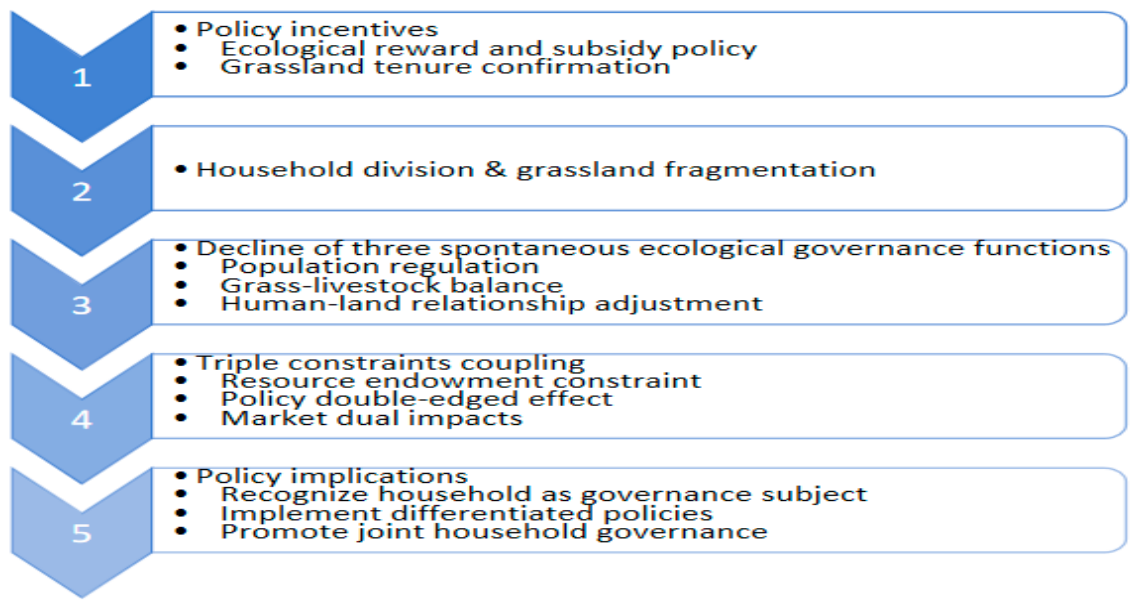
Market pressures, in turn, further fuel household division: unstable livestock prices and rising forage costs push herders to split households to secure more individual-based subsidies, share operational risks, and maintain basic livelihoods. This deepens grassland fragmentation, completing a self-reinforcing vicious cycle where fragmentation weakens policy effectiveness, policy failures exacerbate market risks, and market pressures drive further household splitting. Under this persistent coupling effect, the spontaneous ecological governance functions once formed by pastoral households—population regulation, grass-livestock balance adjustment, and human-land coordination—gradually lose their vitality, as herders shift from proactive, self-initiated adaptation to passive, defensive responses, leading to a marginal decline in grassland ecological governance effectiveness.
6. Conclusions and Policy Implications
In practice, herders have formed a micro-level ecological governance mechanism covering population regulation, grass-livestock balance, and human-land coordination. Supported by relatively integrated traditional pastoral households, these mechanisms have long maintained a basic balance between humans, grasslands, and livestock under limited external intervention. Based on the reality of ecological governance in Inner Mongolia’s pastoral areas, this study puts forward three policy implications to support grassland ecological governance.
6.1. Recognizing the Central Role of Pastoral Households in Ecological Governance
This study shows that herders are not only users and beneficiaries of grassland resources, but also direct practitioners and participants in ecological governance. The experience, knowledge, and self-regulating mechanisms formed through long-term production and livelihood practices constitute valuable resources for grassland governance. In some pastoral areas of Inner Mongolia, local practices have explored models that combine household lamb rearing with centralized fattening by enterprises or cooperatives, effectively linking small-scale pastoral households with modern animal husbandry systems [
40]. The third round of ecological reward and subsidy policies has also explicitly supported herders’ participation in grassland management and protection, with some regions piloting grassland ranger systems to enhance their involvement. Policy design should regard pastoral households as key partners in ecological governance to fully mobilize their enthusiasm and creativity.
6.2. Recognizing Differentiation Among Pastoral Households and Implementing Differentiated Policies
Herders differ significantly in livelihood patterns, management capacity, policy needs, policy responses, and ability to withstand policy shocks. Policy design should adopt targeted governance strategies based on household differentiation. For livestock-free or low-livestock households, which are major suppliers of grassland transfer, efforts should focus on standardizing transfer practices and establishing a filing and review system for cross-banner inflows of livestock operators to prevent overgrazing by external herds. For households dependent on animal husbandry but lacking adequate grassland, grass-livestock balance subsidies can be appropriately increased to compensate for income losses from livestock reduction. For herders with stable non-pastoral employment, a combined policy of ecological compensation and orderly exit can be explored to ease population pressure on grasslands. The social security system should be improved to reduce livelihood uncertainties and enable stable urban settlement. Existing research also supports differentiated policies tailored to grassland types, alongside strengthened compensation and publicity to improve herders’ willingness to participate [
41].
6.3. Enhance the Ecological Governance Capabilities of Pastoral Households and Promote the Reorganization of Pastoral Areas
In recent years, excessive fragmentation of household operations has split grasslands beyond both economic and ecological carrying capacity, eroding the ecological resilience of pastoral households. Given the indivisible nature of grassland resources and the mutual-aid logic inherent in livestock production, an overly rigid household-based property rights system is fundamentally ill-suited to pastoral areas. Grassland governance must therefore shift from fragmented household management and scattered property rights toward joint household governance. Policy design should, on the basis of clarifying grassland use rights, focus on enhancing endogenous motivation and adopt flexible approaches such as virtual use-right confirmation and boundary-free confirmation to retain elasticity in grassland use and support joint operation and rotational grazing. Promoting integrated reorganization through rotational grazing communities—combining economic cooperation with ecological co-management—can effectively alleviate grassland fragmentation and labor shortages, while also helping to break the vicious cycle of grassland fragmentation, policy loopholes, market risks, and further household division, ultimately transforming herders from passive governance subjects into active participants (
Table 1).
It is necessary to further discuss the developmental benefits brought by the transformation of pastoral household management models. The transformation has multiple positive impacts: first, it enhances income stability of herders, which is achieved by connecting small-scale pastoral operations with modern animal husbandry systems and optimizing targeted policy support; second, it promotes the improvement of herders, human capital, as cooperative governance and standardized production practices help herders accumulate more professional knowledge and management skills; third, it effectively reduces grassland pressure through rational grassland utilization, scientific rotational grazing and orderly exit mechanisms for herders with non-pastoral employment; fourth, it strengthens the adaptability of pastoral areas to modernization, realizing a balance between traditional pastoral ecological knowledge and scientific governance methods.
Grassland ecological governance is a long-term, complex, and systematic project that requires top-level policy guidance, grassroots self-adjustment and cooperation, scientific and technological support, and the inheritance and innovation of traditional ecological knowledge. Households will remain the fundamental production and social unit in grassland pastoral areas for the foreseeable future. Enabling this traditional institutional form to gain new vitality in modernization and unleash its positive role in ecological governance will continue to be an important topic for sustained research and exploration.
Limitations: This study has several limitations. First, the findings are regionally specific to Xilingol League and Ordos City in Inner Mongolia and may not be directly generalizable to other pastoral areas in China or Central Asia. Second, retrospective interview data may be subject to recall bias, although we mitigated this through long-term follow-up surveys. Third, given the qualitative and descriptive nature of the evidence, we do not claim formal causal identification; rather, we offer plausible, evidence-supported interpretations. Future research could employ quasi-experimental designs or longitudinal panel data to further test the causal mechanisms proposed here.