1. Introduction
The big challenges of the 21st century such as climate change, pandemics, resource depletion, and social inequality have intensified the need for sustainable strategies and leadership across all sectors, including healthcare [
1,
2,
3,
4,
5]. Thus, healthcare organizations have made attempts to demonstrate their environmental, social and governance impact through reporting [
6,
7,
8,
9,
10,
11]. In this context, sustainability reporting in healthcare is increasingly understood as a structured form of non-financial disclosure through which healthcare organizations communicate how their environmental, social, and governance practices affect organizational accountability, stakeholder trust, and broader health-system value [
12,
13]. This is particularly important because healthcare organizations no longer function solely as providers of care but they are also major consumers of energy, water, infrastructure, and materials, while generating significant waste and environmental externalities that can undermine public health if left unmanaged [
14,
15].
Therefore, there is growing demand for “green healthcare,” which seeks to deliver health services in an environmentally responsible and socially accountable way [
16,
17]. At the same time, the literature shows that sustainability disclosure in healthcare remains uneven, fragmented, and often underdeveloped relative to the importance of the sector’s mission and impact [
18]. Although sustainability reporting is increasingly linked to ESG, SDG alignment, transparency, accountability, and long-term resilience, many healthcare organizations still lack the strategic direction, governance mechanisms, and reporting culture needed to integrate these elements into routine organizational practice [
10,
13,
19,
20].
Leadership is relevant to this discussion because sustainability reporting and employee-level environmental behaviour depend not only on formal reporting requirements, but also on how sustainability is communicated, supported, and made visible within organizations [
13,
21,
22,
23,
24,
25]. In healthcare settings, this is particularly important because sustainability-related initiatives often compete with immediate operational priorities such as patient care, crisis response, legal risk, financial constraint, and service continuity [
26,
27].
Existing studies indicate that limited strategic direction, insufficient training, fragmented responsibilities, and weak organizational support can hinder the integration of ESG and sustainability reporting in healthcare organizations [
19,
20,
22,
28,
29,
30,
31,
32,
33]. Although prior research has advanced understanding of sustainability reporting in healthcare, much of this work has focused on disclosure practices, reporting frameworks, institutional pressures, governance arrangements, and accountability [
12,
13,
18,
19,
20]. In parallel, studies on green leadership, organizational climate, and employee green behavior have examined how leadership support and workplace perceptions shape pro-environmental behavior at work [
34,
35,
36,
37,
38]. However, these two research streams are still only partly connected to healthcare research. Sustainability reporting is often examined as a disclosure or governance issue, whereas employee green behavior is commonly examined as an organizational behavior issue. Less is known about whether ESG awareness and sustainability reporting readiness are accompanied by a sustainability-oriented leadership climate that is visible to employees and associated with their own environmental behavior. This is the specific gap addressed by the present study in the Greek healthcare context.
To address this gap, the objective of this study is to examine ESG awareness, sustainability reporting readiness, and the relationship between leadership climate for sustainability and employee green behavior in Greek healthcare organizations. The study approaches leadership not as an individual managerial trait, but as a perceived organizational climate reflected in commitment to environmental strategies, shared values, openness to environmental concerns, staff training, and support for environmentally responsible action.
The study makes three contributions. First, it provides empirical evidence on ESG awareness and sustainability reporting readiness in Greek healthcare organizations, a context in which systematic evidence remains limited. Second, it connects the sustainability reporting literature with the employee green behavior literature by examining reporting readiness together with perceived leadership climate and self-reported green behavior. Third, it shows that leadership climate for sustainability is positively associated in moderate level with employee green behavior, thereby identifying leadership climate as a relevant organizational condition while avoiding causal or determinative claims.
The remainder of the article is structured as follows.
Section 2 presents the theoretical background and conceptual framework.
Section 3 describes the materials and methods.
Section 4 reports empirical results.
Section 5 discusses the findings and
Section 6 concludes the article.
The theoretical framing of this study draws mainly on organizational climate theory and institutional perspectives on sustainability reporting. Organizational climate theory suggests that employees’ workplace behaviors are shaped not only by formal policies, but also by shared perceptions of organizational priorities, values, support, communication and expected conduct. In this study, leadership climate for sustainability is therefore understood as the perceived organizational environment through which sustainability becomes visible, legitimate and actionable for employees. At the same time, institutional perspectives help explain why ESG awareness and sustainability reporting readiness matter as contextual conditions, since healthcare organizations are increasingly exposed to external expectations related to transparency, accountability, sustainability disclosure and public value. Together, these perspectives support the view that employee green behavior in healthcare is shaped by both internal organizational climate and the broader institutional context of sustainability reporting.
2. Theoretical Background
2.1. ESG Awareness and Sustainability Reporting Readiness in Healthcare
Sustainability reporting in healthcare has received growing attention because healthcare organizations are increasingly expected to account for their environmental, social, and governance impacts [
6,
7,
8,
9,
10,
11,
12,
13]. The environmental footprint, including energy use, emissions, water consumption, medical waste, infrastructure, and material intensity, makes sustainability reporting relevant not only as a disclosure practice but also as a mechanism of organizational accountability and transparency [
14,
15,
18]. At the same time, healthcare organizations operate under mission-driven conditions, where sustainability must be balanced with patient care, safety, service continuity, legal risk, and resource constraints [
13,
19,
20,
26,
27].
Prior studies show that healthcare sustainability reporting remains uneven and often weakly institutionalized [
18,
19,
20]. Common barriers include limited awareness, fragmented responsibilities, insufficient data systems, lack of sector-specific guidance, weak governance integration, resource constraints, and the perception that ESG frameworks are more closely associated with corporate or for-profit settings than with healthcare organizations [
19,
20,
22,
28,
29,
30,
31,
32,
33,
34,
35,
36]. These challenges suggest that sustainability reporting readiness should not be understood only as the existence of formal reports or technical indicators. It also depends on whether sustainability is recognized, communicated, and made visible within the organization.
For this reason, ESG awareness is treated in the present study as a contextual condition of sustainability reporting readiness. If employees are unaware of whether ESG practices or sustainability reports exist, this may indicate that sustainability has not yet been sufficiently embedded in internal communication, role clarity, or organizational routines. This perspective is especially relevant in healthcare, where external reporting expectations may increase before internal awareness and implementation capacity are fully developed [
10,
13,
19,
20]. Accordingly, the study first examines the extent to which employees perceive ESG criteria, sustainability reporting, and related practices as visible within Greek healthcare organizations.
2.2. Leadership Climate and Employee Green Behavior
A second relevant strand of the literature concerns the relationship between leadership, organizational climate, and employee green behavior. Leadership is widely recognized as relevant to sustainability because leaders influence priorities, allocate attention and resources, support training, shape organizational culture, and affect whether environmental responsibility becomes part of everyday work [
37,
38,
39,
40,
41,
42,
43]. In healthcare organizations, this role is particularly important because sustainability-related initiatives must be integrated into complex professional environments where clinical priorities, operational pressures, and established routines strongly shape employee behavior [
44,
45,
46,
47].
The present study does not examine sustainability reporting systems or implementation performance directly. Instead, it focuses on the internal visibility of ESG and reporting practices and on whether employees perceive a sustainability-oriented leadership climate within their organization. This distinction is important because the empirical model is concerned with employees’ perceptions of organizational conditions, not with an objective assessment of reporting quality or sustainability performance.
Rather than examining leadership only as individual managerial behavior, this study focuses on leadership climate for sustainability. Organizational climate theory suggests that workplace behavior is shaped by employees’ shared perceptions of organizational priorities, values, support, communication, and expected conduct [
42,
48,
49,
50]. In this study, leadership climate for sustainability refers to employees’ perceptions that the organization demonstrates commitment to environmental strategies, supports value congruence, promotes a collective environmental mission, allows environmental concerns to be expressed, and provides training on environmental issues.
Employee green behavior is treated as a related but distinct behavioral domain. Prior studies suggest that employees are more likely to engage in pro-environmental workplace behavior when they perceive supportive leadership, a green organizational climate, environmental policies, and organizational commitment [
42,
48,
49,
50,
51]. In healthcare, such behavior may include proposing environmental ideas, supporting the organization’s environmental image, and voluntarily participating in environmental initiatives at work. This distinction between perceived organizational climate and employee-level behavior allows the study to examine whether sustainability-oriented organizational conditions are associated with reported green behavior among healthcare professionals.
The literature also indicates that sustainability-related perceptions may vary across organizational groups. Employees in managerial or supervisory positions may be more exposed to sustainability planning, reporting processes, and strategic communication than front-line staff. Similarly, public and private healthcare organizations may differ in governance structures, operational pressures, and reporting incentives [
5,
52,
53,
54,
55,
56,
57,
58,
59,
60,
61]. However, because such differences depend heavily on sample composition and organizational context, they should be examined cautiously and treated as exploratory unless supported by balanced and representative data.
2.3. Conceptual Framework and Research Questions
Based on the above theoretical framing, the conceptual framework of the study positions ESG awareness and sustainability reporting readiness as contextual organizational conditions, leadership climate for sustainability as the main explanatory construct, and employee green behavior as the main behavioral outcome. The framework assumes that sustainability-related leadership climate may be associated with employee green behavior by making environmental priorities more visible, legitimate, and embedded in everyday organizational practice.
The study is exploratory in design. This is because no single internationally established instrument was available that fully captured the combined focus on ESG awareness, sustainability reporting readiness, leadership climate, and employee green behavior in the Greek healthcare context. The questionnaire (
Appendix A) was therefore developed through theoretical synthesis and concept operationalization, drawing on relevant work in sustainability reporting, organizational climate, green leadership, and employee green behavior [
12,
13,
18,
19,
20,
37,
38,
39,
40,
42,
48,
49,
50,
51,
60,
61,
62]. The resulting constructs should therefore be understood as context-specific operationalizations that require further validation in future research. Accordingly, this study addresses four research questions:
RQ1. To what extent are healthcare organizations in Greece perceived as aware of ESG criteria, sustainability reporting, and related sustainability practices?
RQ2. Do the leadership-related and employee behavior-related survey items form distinct and internally consistent constructs reflecting (a) leadership climate for sustainability and (b) employee green behavior?
RQ3. Is a stronger leadership climate for sustainability positively associated with higher employee green behavior among healthcare professionals?
RQ4. Does leadership climate for sustainability explain variation in employee green behavior beyond demographic and occupational characteristics, and do these constructs differ across sectoral and hierarchical groups?
These research questions are directly aligned with the empirical strategy of the study. RQ1 is addressed through descriptive statistics and cross-tabulated awareness findings. RQ2 is examined through reliability analysis and exploratory factor analysis. RQ3 is examined through correlation analysis, while RQ4 is addressed through group comparison tests and hierarchical regression analysis. In this way, the theoretical framework remains proportionate to the exploratory empirical design and focuses on the constructs examined in the study.
Because the study addresses an emerging combination of themes for which no single internationally established instrument was available in the Greek healthcare context, the empirical design takes an exploratory construct-building approach. The questionnaire was therefore developed through theoretical synthesis and concept operationalization rather than direct adoption of a previously validated international scale. As a result, the study aims to provide analytically useful and context-sensitive measurement of the focal constructs, while acknowledging that comparability with prior research remains partial and that further validation work is needed.
Given the absence of a single, fully validated research tool that covers all the dimensions under examination, this study proceeded to develop the questionnaire through a theoretical synthesis of the existing literature. This approach is based on the principle of concept operationalization, drawing on established theoretical models and empirical findings from the fields of organizational behavior and green work behavior.
In this context, the model proposed by Xiao et al. [
51] served as the primary theoretical foundation of this study, as it highlights the combined role of employee–organization fit, perceived insider status, and green organizational climate in shaping employees’ voluntary green behavior. The contribution of this model is not limited to individual variables but serves as a conceptual framework for organizing and interpreting the dimensions of the questionnaire.
Within this theoretical framework, the structure of the measurement tool does not arise arbitrarily or in a fragmented manner but is the result of a targeted synthesis and conceptual alignment of the main factors documented in the literature as determinants of green behavior in the workplace. This ensures the conceptual coherence and theoretical validity of the tool, despite the absence of a universally validated international questionnaire that fully covers the research subject.
3. Materials and Methods
3.1. Study Design
This study adopts a quantitative, exploratory research design based on questionnaire data to examine sustainability awareness, reporting readiness, and the relationship between leadership climate for sustainability and employee green behavior in Greek healthcare organizations. The design is exploratory in two respects. First, the measurement instrument was developed specifically for this study through theoretical synthesis, because no single internationally established scale was available that fully captured the combination of ESG awareness, sustainability reporting readiness, leadership climate, and employee green behavior in the Greek healthcare context. Second, the analytical strategy combines descriptive, non-parametric, and regression-based techniques in order to examine the data from complementary perspectives rather than to claim a single definitive measurement model.
The study focused on healthcare professionals employed in public hospitals and private clinics across Greece. Participants came from administrative, medical, nursing, and technical services, thus allowing the analysis to capture a broad range of occupational perspectives on sustainability-related organizational conditions. The target population was selected because these groups are directly involved in organizational routines, managerial processes, and service delivery, and can therefore observe both leadership practices and sustainability-related organizational behavior.
The measurement instrument was developed as a theory-informed research tool rather than as a direct replication of an internationally validated scale. This approach allowed the questionnaire to capture the combined focus of the study on ESG awareness, sustainability reporting readiness, leadership climate, and employee green behavior in the Greek healthcare context. At the same time, it limits comparability with prior studies and requires the findings to be interpreted as exploratory.
Ordinary least squares regression was used on composite indices derived from Likert-type items. This approach was considered acceptable for the exploratory purpose of the study, because the composite scores were treated as approximately continuous summary variables. However, given that non-parametric techniques were also used for comparisons and correlations, the regression findings should be interpreted as an exploratory analytical extension rather than as a definitive test of a validated latent-variable model.
3.2. Sample and Sampling Procedure
A purposive sampling strategy was used. This non-probability sampling approach was considered appropriate because the study sought responses from participants with direct experience of healthcare organizational life and potential exposure to leadership and sustainability practices. Eligible participants were adults aged over 18 years, employed in Greek healthcare organizations, and able to understand the Greek language sufficiently to complete the questionnaire.
The final sample consisted of 379 healthcare workers. Of these, 349 respondents were employed in the public sector and 30 in private clinics. Participants represented a range of professional roles and hierarchical positions, including employees, heads/supervisors, and directors. This diversity was considered important to examine whether sustainability-related perceptions and behaviors vary across occupational and organizational groups. Although the distribution between public and private sector respondents was uneven, it reflects the broader footprint of the public healthcare sector in Greece and allows cautious exploratory comparison between the two sectors. For this reason, public–private comparisons were treated as exploratory rather than confirmatory. To reduce the impact of distributional assumptions and unequal group sizes, the study used non-parametric tests for sector comparisons and interpreted sector-based findings with caution.
3.3. Data Collection Instrument
Data were collected using a structured questionnaire designed to capture perceptions related to sustainability awareness, reporting practices, leadership-related organizational conditions, and employee environmental behavior in healthcare organizations. The questionnaire included demographic and occupational variables as well as three substantive blocks of items.
The first block assessed awareness of ESG-related concepts, sustainability reporting, and organizational sustainability practices. These items captured whether respondents were aware of ESG criteria, whether their organizations were perceived to publish sustainability reports, and whether sustainability-related actions or structures were visible within the organization.
The second block focused on leadership- and organizational climate-related perceptions. These items assessed the extent to which respondents perceived commitment to environmental strategies, alignment between personal and organizational values, collective enthusiasm for environmental mission, openness to environmental concerns, staff training on environmental issues, and direct motivation from supervisors toward greener action. These items were designed to capture perceived leadership climate as experienced by employees within the organization, rather than leaders’ self-evaluation or an external audit of organizational sustainability performance.
The third block assessed employee green behavior at work. These items captured behaviors such as proposing environmental ideas, undertaking actions that support the organization’s environmental image, and participating voluntarily in environmentally beneficial initiatives within the workplace.
Most attitudinal and behavioral items were measured on ordinal Likert-type scales, allowing both descriptive and inferential analysis. The questionnaire was designed to support the four research questions developed in the theoretical framework, progressing from descriptive assessment of awareness and reporting readiness to the examination of leadership-related constructs and their association with employee behavior.
The instrument was designed as a theory-informed research tool rather than as a direct replication of an internationally validated scale. For this reason, the resulting measures should be interpreted as context-specific operationalizations of the focal constructs. Their use is appropriate for exploratory analysis within the present study, but they do not eliminate the need for future confirmatory validation and cross-study comparability testing.
The internal consistency of the main multi-item scales was satisfactory. The leadership climate for sustainability index demonstrated high internal reliability, and the Employee Green Behavior index also showed good reliability. These results supported the use of composite scores for subsequent correlational, comparative, and regression analyses. Reliability was treated as one element of measurement quality, while construct structure was examined separately through exploratory factor analysis.
All participants were informed about the aim of the study and the voluntary, anonymous, and confidential nature of their participation. Informed consent was obtained from all respondents prior to data collection.
3.4. Variables
In addition to single-item descriptive variables, two composite measures were constructed for the analytical part of the study. The first was a leadership climate for sustainability index, based on five items reflecting organizational commitment to environmental strategies, value congruence, collective environmental mission, openness to environmental concerns, and staff training on environmental issues (items B2, B4, B5, B6, and B7). The second was an Employee Green Behavior index, based on three items reflecting idea generation, environmentally supportive action, and voluntary green initiatives at work (items G4, G5, and G6).
These indices were computed as mean scores of their component items after reliability and exploratory factor analysis supported their internal coherence and conceptual distinctiveness. Supervisor green motivation (item B1) was retained as a separate single-item variable because it captured direct managerial encouragement and was analytically useful as a narrower leadership indicator alongside the broader organizational climate construct.
More specifically, item selection for the two composite indices followed a two-step procedure. First, the exploratory factor analysis was used to identify items that clustered conceptually and empirically around a common latent dimension. Second, only items with substantively interpretable and sufficiently strong loadings on the relevant factor were retained in the final composite measure. On this basis, the leadership climate for sustainability index included items B2, B4, B5, B6, and B7, while the Employee Green Behavior index included items G4, G5, and G6. Item B1 was not included in the broader leadership climate index because, although it was related to the same conceptual domain, it was retained separately to capture direct supervisor encouragement as a narrower leadership-related indicator. After item selection, composite scores were calculated as the arithmetic mean of the retained items so that the resulting indices remained on the same response scale as the original questionnaire items and could be interpreted more intuitively.
Unweighted mean scores were preferred over factor-score weighting for two reasons. First, the retained items within each construct showed conceptually coherent content and comparable loading patterns, supporting the treatment of the indicators as parallel manifestations of the same broader construct. Second, arithmetic means preserve the original response metric of the questionnaire, which facilitates interpretation and comparison across analyses. The use of equal weighting therefore reflected a deliberate choice in favor of transparency and interpretability in an exploratory study design, rather than an assumption that all items are theoretically identical in substantive importance.
3.5. Statistical Analysis
Data analysis was conducted using IBM SPSS Statistics 26. The analytical strategy was designed to answer the four research questions of the study. First, descriptive statistics were used to present the demographic profile of the sample and to map awareness of ESG criteria, sustainability reporting, and related sustainability practices in Greek healthcare organizations.
Second, internal consistency analysis was performed for the multi-item leadership- and behavior-related blocks using Cronbach’s alpha. Cronbach’s alpha was used as an indicator of internal reliability rather than as a stand-alone test of construct validity.
Third, an exploratory factor analysis (EFA) was conducted on the leadership- and behavior-related items (B1, B2, B4–B7, G4–G6) to examine whether the questionnaire items formed interpretable latent dimensions corresponding to the conceptual framework of the study. Sampling adequacy was assessed through the Kaiser–Meyer–Olkin (KMO) statistic, while Bartlett’s test of sphericity was used to confirm the suitability of the correlation matrix for factor analysis. Factor extraction was based on the eigenvalue-greater-than-one criterion, and rotated factor loadings were used to interpret the factor structure.
Fourth, associations between the main analytical variables were examined using Spearman’s rank-order correlation coefficient. This choice was considered appropriate because the study included ordinal Likert-type variables and composite scores derived from them, and because the aim was to assess monotonic associations without relying strictly on parametric assumptions.
Fifth, group differences in the composite indices were examined using non-parametric tests. This choice was also considered appropriate in view of the unequal size of some comparison groups, especially in the public–private sector analysis. Mann–Whitney U tests were used for comparisons involving two groups, such as public versus private sector, while Kruskal–Wallis tests were used for comparisons involving three or more groups, such as job position categories. These tests were preferred because they are robust for ordinal data and uneven group distributions.
Finally, an exploratory hierarchical ordinary least squares regression was conducted with Employee Green Behavior as the dependent variable. In the first step, demographic and occupational controls (age, gender, sector, education level, and job position) were entered. In the second step, the leadership climate for sustainability index was added. In the third step, supervisor green motivation was added as a narrower leadership indicator. This modelling strategy was used to assess whether the broader leadership climate contributed incremental explanatory value beyond background characteristics and beyond direct supervisor encouragement alone.
The use of OLS regression in this context should be understood as an analytic approximation rather than as a strict latent-variable modelling approach. Although the original questionnaire items were ordinal Likert-type indicators, the regression analysis was performed on composite mean scores derived from internally coherent item sets, which were treated as approximately continuous summary variables for exploratory purposes. This approach is widely used in survey-based organizational research, but it does not remove the underlying measurement limitations of ordinal source items. For this reason, the regression findings are interpreted cautiously and in conjunction with the non-parametric and correlational results, rather than as a stand-alone basis for strong inferential claims.
Statistical significance was evaluated at the conventional level of p < 0.05. Given the cross-sectional and self-reported nature of the data, all inferential findings were interpreted as associational rather than causal.
3.6. Methodological Limitations
Several methodological limitations should be acknowledged. First, the use of purposive non-probability sampling limits the generalizability of the findings beyond the study sample. Second, the cross-sectional design does not allow causal inference. Third, the data are based on self-reported perceptions and may therefore be influenced by common-method bias or subjective interpretation. Fourth, the private-sector subsample was substantially smaller than the public-sector subsample, which requires caution in sectoral comparisons. Accordingly, comparisons between public and private sector respondents should be interpreted as indicative rather than representative of the two sectors as a whole.
Fifth, the measurement instrument was developed specifically for the purposes of this study through theoretical synthesis rather than through direct use of internationally established scales. Although this allowed closer alignment with the Greek healthcare context and with the combined focus on ESG awareness, sustainability reporting readiness, leadership climate, and employee green behavior, it also limits comparability with prior studies and constrains the strength of construct validation. The identified constructs should therefore be understood as exploratory and context-sensitive operationalizations rather than as fully established measurement models.
Sixth, the composite indices were constructed using unweighted mean scores. Although this approach improves interpretability and is common in exploratory survey research, it assumes equal contribution of the retained items to the broader construct. Future studies could therefore examine whether weighted composite measures, confirmatory factor analysis, or latent-variable modelling yield more refined estimates of the relationships observed here.
Seventh, the study combines non-parametric tests and OLS regression within the same analytical design. This was done deliberately, because the earlier stages of the analysis focused on ordinal item properties and distributionally cautious association testing, whereas the regression stage used composite mean scores as approximately continuous summary variables. Nevertheless, this combination introduces methodological tension and reinforces the need to interpret the regression findings as exploratory rather than definitive. Future research could address this issue through alternative modelling strategies, including ordinal regression, robust regression approaches, structural equation modelling, or confirmatory latent-variable frameworks.
This limitation should also be considered in light of the wider structure of the Greek healthcare sector. Recent national statistics confirm the structural importance of both public and private healthcare providers in Greece. However, the private-sector subsample in the present study remains small. Therefore, the public–private comparison should be interpreted only as exploratory and not as evidence of a stable sectoral difference.
Finally, because most respondents occupied front-line rather than managerial roles, the findings primarily reflect how sustainability-related leadership is perceived across the wider workforce. This strengthens the relevance of the study for organizational diffusion, but it also means that the results should not be interpreted as equivalent to leadership self-assessments by senior decision-makers. Despite these limitations, the dataset provides a useful empirical basis for examining sustainability awareness, leadership-related organizational conditions, and employee green behavior in the Greek healthcare context.
4. Research Results
4.1. Demographics
The sample was predominantly female, with women making up 76.25% and men 23.75%. The participants’ average age was 44.6 years (SD = 9.99). In terms of education, most had a master’s degree (35.09%), followed by those with technological education diplomas (24.27%), higher education degrees (20.6%), secondary education (15.3%), and a smaller proportion held PhDs (4.75%). The vast majority were employed in the public sector (92.08%), with only 7.92% working in the private sector. Geographically, most participants worked in the 1st Health District (Attica) (45.38%), followed by the 2nd Health District (19.79%). Smaller representations came from the 6th (12.14%), 5th (11.35%), 3rd (5.28%), 7th (3.96%), and 4th Health Districts (2.11%). A significant portion worked in large health organizations with over 250 employees (62.01%). Regarding roles, administrative staff formed the largest group (42.5%), followed by nursing staff (32.7%), medical staff (20.3%), and technical staff (4.5%). The majority of participants were employees (82.32%), while supervisors (11.87%) and managers (5.8%) made up smaller proportions of the sample.
4.2. ESG Awareness and Sustainability Reporting in Greek Healthcare Organizations
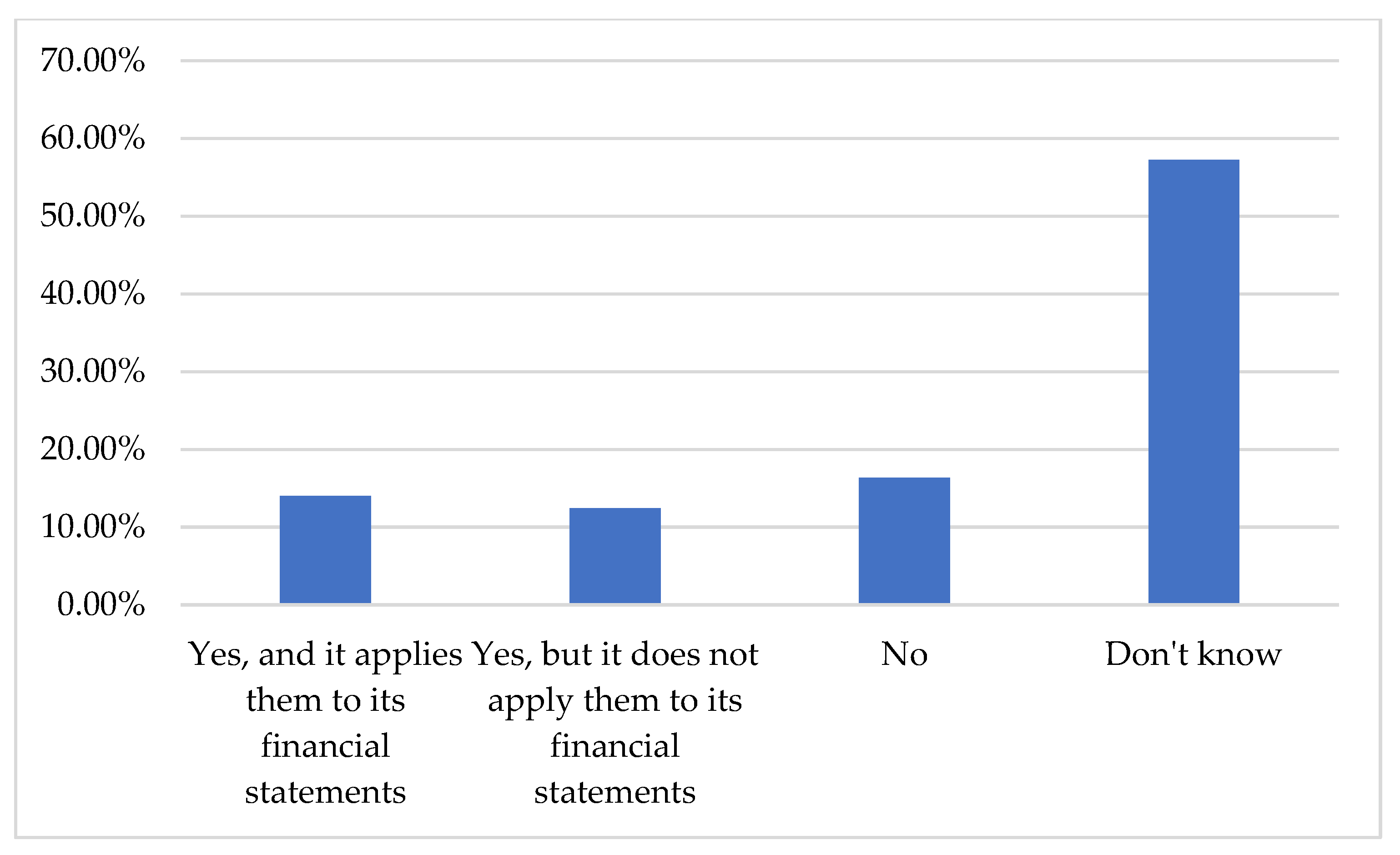
When asked whether their organization was aware of ESG criteria, respondents reported that the data analysis revealed that the majority (57.26%) of respondents do not know whether their organization is aware of ESG factors, while only a small percentage (13.98%) state that they are applied in the financial statements. In addition, 16.36% report that their organization is not aware, and 12.40% are aware of ESG, but do not incorporate them into financial data (
Figure 1).
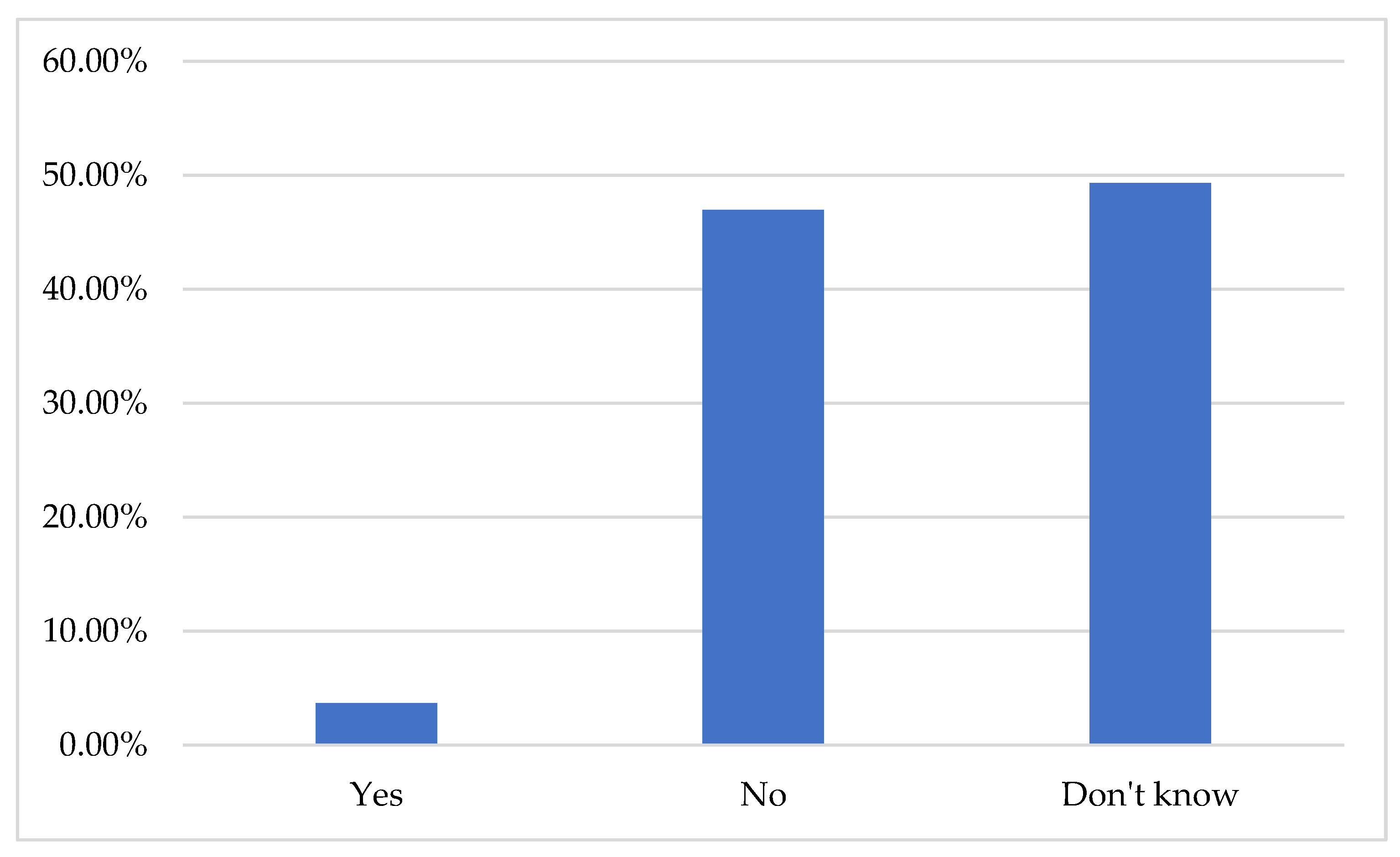
Furthermore, respondents were asked whether their organization develops sustainability reports (
Figure 2). Analyzing the results, it is found that most of the respondents, state either that their organization does not develop sustainability reports (46.97%) or that they do not know if it does (49.34%). Only a small percentage (3.69%) state that their organization does develop such reports. These data demonstrate the limited integration of sustainability at the level of accountability and transparency, and the need for greater awareness and promotion of this practice at the organizational level.
The results reveal substantial gaps between the growing strategic importance of sustainability reporting and its actual institutionalization within Greek healthcare organizations. Most respondents were either unaware of whether their organization was familiar with ESG criteria or stated that ESG was not systematically incorporated into financial or non-financial organizational practice. Similarly, sustainability reporting remained extremely limited: only a very small proportion of respondents indicated that their organization actually develops sustainability reports, while the overwhelming majority either reported that no such reports exist or were unaware of their existence. These findings indicate that sustainability reporting in Greek healthcare remains weakly embedded at the levels of transparency, accountability, and organizational routine, despite the broader strategic pressures identified in the literature.
At the same time, the results show that awareness matters. The statistically significant association between organizational ESG awareness and the development of sustainability reports suggests that reporting is more likely to emerge where ESG has already been recognized as institutionally relevant. This is consistent with the broader reporting literature, which argues that sustainability disclosure becomes more systematic when awareness, governance support, and reporting culture are already present [
12,
19,
41]. In the Greek healthcare context, the findings therefore reinforce the view that awareness is not merely a cognitive issue but part of the institutional preconditions for the adoption of sustainability reporting.
According to
Table 1 below, the correlation between the organization’s awareness of ESG criteria and the development of sustainability reports is statistically significant (
p-value < 0.001) and of moderate strength (Cramer’s V = 0.348). This indicates that organizations that demonstrate greater awareness of ESG factors are more likely to develop and publish sustainability reports—and vice versa. This association highlights the link between ESG awareness and the institutionalization of sustainability practices in terms of accountability and transparency.
4.3. Validation of Leadership- and Behavior-Related Constructs
To examine whether the leadership- and behavior-related items formed interpretable constructs, an exploratory factor analysis was conducted on items B1, B2, B4–B7, and G4–G6. The data were suitable for factor analysis (KMO = 0.851; Bartlett’s test of sphericity: χ
2 (36) = 1526.36,
p < 0.001) (
Table 2).
The rotated solution supported a two-factor structure (
Table 3). The first factor captured a broader leadership and organizational climate for sustainability, with strong loadings for organizational commitment to environmental strategies, value congruence, collective environmental mission, openness to environmental concerns, and staff training. The second factor captured employee green behavior, with strong loadings for proposing environmental ideas, undertaking actions that improve the organization’s environmental image, and engaging voluntarily in environmental initiatives at work.
Based on this structure, two composite indices were computed. The leadership climate for sustainability index showed high internal consistency (Cronbach’s α = 0.862), while the employee green behavior index also demonstrated good reliability (Cronbach’s α = 0.831). The mean score of the leadership climate index was 2.64 (SD = 0.84), and the mean score of the green behavior index was 2.55 (SD = 0.95), both indicating relatively modest levels of perceived sustainability-oriented leadership climate and employee environmental engagement.
These findings add measurement support to the substantive interpretation of the survey. More specifically, they show that the leadership-related items do not operate as isolated perceptions, but form a coherent organizational pattern linked to commitment, communication, training, and cultural openness. At the same time, employee pro-environmental action also appears as a distinct behavioral domain rather than a diffuse attitude. This distinction is important because it allows the study to move beyond simple descriptive frequencies and examine whether sustainability-related leadership conditions are associated with actual green behavior in the workplace.
From an analytical perspective, this result strengthens the argument that sustainability in healthcare should be examined not only through isolated policy awareness, but also through the internal organizational climate that may enable or constrain employee action.
4.4. Associations, Group Differences, and Predictors of Green Behavior
Spearman correlation analysis (
Table 4) showed that the leadership climate for sustainability index was positively associated with Employee Green Behavior (rho = 0.281,
p < 0.001). Supervisor green motivation was also positively associated with Employee Green Behavior (rho = 0.243,
p < 0.001), while its strongest association was observed with the broader leadership climate for sustainability index (rho = 0.584,
p < 0.001). These results indicate a positive but moderate relationship between sustainability-oriented organizational climate and employee environmental action. The findings therefore suggest an association of practical interest, but not one that should be interpreted as strong or determinative.
Substantively, this means that sustainability-related leadership in healthcare should not be understood only as direct managerial encouragement. Rather, it appears to operate through a wider organizational climate in which environmental commitment, communication, training, and shared values create more favorable conditions for employee participation in green practices.
Group comparisons revealed some noteworthy differences (
Table 5). First, Private-sector employees reported higher levels of green behavior compared to those in the public sector, with the difference being statistically significant (Mann–Whitney U = 3857.0,
p = 0.016), whereas the difference in leadership climate between sectors was not statistically significant (
p = 0.151). However, this finding should be interpreted with caution, given the smaller sample size in the private sector. Although this finding should be interpreted very cautiously due to the much smaller private-sector subsample (N = 30), it may tentatively indicate that employee environmental action is reported somewhat more positively in private healthcare settings. However, the imbalance between sector groups does not allow strong generalization.
Second, job position was significantly associated with both leadership climate and green behavior. Respondents in higher hierarchical roles reported more favorable perceptions of the leadership climate for sustainability and somewhat higher levels of green behavior overall (Kruskal–Wallis p = 0.014 in both cases). Descriptively, directors reported the highest leadership climate score (M = 3.12), while heads/supervisors reported the highest green behavior score (M = 2.96). By contrast, front-line employees consistently reported the lowest scores on both indices.
No statistically significant differences were observed for gender or service/department in the two composite indices. Taken together, these findings suggest that sustainability-related perceptions and behaviors are not distributed evenly across the workforce, but vary partly according to organizational position and, to a lesser extent, sectoral context.
This pattern is consistent with the view that sustainability in healthcare is experienced differently across hierarchical levels, with managerial actors being more exposed to strategic discourse and organizational initiatives than front-line staff.
To examine whether leadership-related variables predict employee green behavior beyond demographic and occupational characteristics, a hierarchical regression analysis was conducted (
Table 6). In the first model, age, gender, sector, education, and job position explained 5.0% of the variance in green behavior. When the leadership climate for sustainability index was added, the explained variance increased to 12.4% (ΔR
2 = 0.074,
p < 0.001), indicating a substantial incremental contribution. Adding supervisor green motivation in a final step increased the explained variance only marginally to 12.9%, and this change was not statistically significant (
p = 0.138).
In the final model, the leadership climate for sustainability index emerged as a significant positive predictor of employee green behavior (B = 0.258, β = 0.228, p < 0.001). In addition, working in the private sector (B = 0.407, p = 0.021) and having a higher educational level (B = 0.090, p = 0.033) were also associated with stronger green behavior. By contrast, supervisor green motivation as a single item did not remain statistically significant once the broader leadership climate variable was included.
This finding is theoretically relevant because it suggests that employee green behavior is associated more consistently with the broader organizational climate than with isolated managerial encouragement alone. However, the overall variance explained remains modest, indicating that additional organizational and individual factors are also likely to influence green behavior in healthcare settings.
The regression findings therefore support a broader organizational interpretation of leadership, according to which sustainability-oriented behavior is fostered not only by direct supervision, but by a more comprehensive climate of environmental support and institutional commitment.
5. Discussion
This study examined ESG awareness, sustainability reporting readiness, and the relationship between leadership climate for sustainability and Employee Green Behavior in Greek healthcare organizations. Overall, ESG awareness and sustainability reporting appear to remain weakly institutionalized and not clearly visible to many employees in the organizations represented in the sample. At the same time, leadership climate for sustainability was positively associated with Employee Green Behavior. These findings should be interpreted as exploratory and context-bound, rather than as evidence of causal effects or strong organizational impact.
One important finding concerns the limited visibility of sustainability reporting within the sampled healthcare organizations. Many respondents were either unaware of ESG-related practices or uncertain about whether their organization develops sustainability reports. This does not necessarily mean that such practices are absent. Rather, it suggests that, where they exist, they may not be sufficiently communicated across the workforce. ESG awareness and sustainability reporting readiness should therefore be understood not only as technical or compliance-related issues, but also as matters of internal communication, role clarity, and organizational diffusion.
The measurement results distinguish between perceived organizational conditions and employee-level behavior. Leadership climate for sustainability captures employees’ perceptions of organizational commitment to environmental strategies, value congruence, collective environmental mission, openness to environmental concerns, and staff training. Employee Green Behavior captures self-reported actions such as proposing environmental ideas, supporting the organization’s environmental image, and participating in voluntary environmental initiatives. Although these constructs showed internal coherence, they should be treated as exploratory and context-specific operationalizations rather than as fully standardized measures directly comparable with internationally validated instruments.
The positive association between leadership climate for sustainability and Employee Green Behavior is central to the study’s empirical contribution. Leadership climate remained a significant predictor of employee green behavior after controlling demographic and occupational characteristics. This suggests that employee engagement in environmentally responsible action may be linked not only to direct managerial encouragement, but also to the wider organizational climate in which sustainability is communicated, supported, and legitimized. However, the association was moderate, and the overall explained variance of the regression model remained limited. Leadership climate should therefore be understood as one relevant organizational condition among several, rather than as a dominant explanation of employee green behavior.
A further point concerns direct supervisor motivation. Supervisor green motivation did not remain statistically significant once the broader leadership climate variable was included. This may indicate that employee green behavior is more consistently related to the wider perceived organizational environment than to direct managerial encouragement alone. Nevertheless, the regression analysis should be viewed as an exploratory analytical extension based on composite mean scores, not as a definitive test of a fully validated latent-variable model. Further measurement validation is therefore needed.
The group comparison results provide additional but tentative insights. Respondents in higher hierarchical positions reported more favorable perceptions of leadership climate and, overall, higher levels of green behavior. This may reflect greater exposure of managerial staff to sustainability-related planning, communication, or organizational initiatives. Lower scores among front-line employees may indicate that sustainability-related messages and practices are less visible in day-to-day operational settings. The finding that private-sector respondents reported higher green behavior should be interpreted with particular caution because of the small size of the private-sector subsample. Although recent national statistics confirm the structural importance of both public and private healthcare providers in Greece, the present sample does not allow a robust sectoral comparison. This result should therefore be treated as exploratory and hypothesis-generating rather than as evidence of a stable sectoral difference.
Taken together, the findings suggest that leadership in healthcare sustainability should not be viewed only as top-down authority or direct managerial instruction. Rather, it may also be expressed through an organizational climate that aligns strategy, values, communication, training, and employee participation around sustainability goals. Such a climate may help make sustainability more visible and behaviorally relevant within organizations. However, the evidence remains moderate and exploratory, and does not justify strong claims about organizational leverage or transformational impact.
The practical implications of the study are therefore bounded. Healthcare organizations seeking to strengthen sustainability engagement should not rely only on formal reporting documents or isolated managerial encouragement. Sustainability may need to be communicated more clearly across staff groups, linked to training and everyday work routines, and supported through visible organizational practices. Particular attention should be given to front-line employees, who may be less exposed to strategic sustainability discussions but are central to the operational implementation of environmental practices.
The study contributes to the healthcare sustainability literature by connecting ESG awareness, sustainability reporting readiness, perceived leadership climate, and employee green behavior within a single empirical framework. Its main value lies in showing that sustainability in healthcare can be examined not only through formal reporting mechanisms, but also through employees’ perceptions of organizational climate and their own reported environmental behaviors. This contribution is particularly relevant in the Greek healthcare context, where empirical evidence on these issues remains limited, but it should be understood as exploratory rather than determinative.
Several limitations should be considered when interpreting the findings. The cross-sectional design does not allow causal conclusions, and the self-reported nature of the data may introduce common-method and social desirability bias. The sample is heavily weighted toward the public sector, while the private-sector subsample is relatively small. In addition, the measurement instrument was developed for the purposes of this study and requires further validation. Future research could use longitudinal designs, larger and more balanced samples, confirmatory factor analysis, and multi-source data, including managerial assessments, sustainability reports, training records, and objective environmental indicators.
In summary, ESG awareness and sustainability reporting are still weakly visible to many healthcare employees in the sampled organizations, while leadership climate for sustainability is positively but moderately associated with employee green behavior. Perceived leadership climate appears to be a meaningful organizational condition related to employee environmental engagement, but it does not fully explain such behavior. Strengthening the internal visibility and practical relevance of sustainability may therefore support employee participation in environmental initiatives and more systematic sustainability reporting, although further research is needed to confirm these relationships over time.
6. Conclusions
This study examined ESG awareness, sustainability reporting readiness, and the relationship between leadership climate for sustainability and employee green behavior in Greek healthcare organizations. The main empirical findings indicate that ESG awareness and sustainability reporting remain limited and weakly visible to many employees in the organizations represented in the sample. The analysis also identified two distinct and internally consistent constructs: leadership climate for sustainability and employee green behavior. Leadership climate for sustainability was positively associated with employee green behavior and remained a significant predictor after controlling for demographic and occupational characteristics.
These findings suggest that employee green behavior in healthcare may be related not only to individual attitudes or direct managerial encouragement, but also to the broader organizational climate through which sustainability is communicated, supported, and made visible. However, this relationship should be interpreted cautiously. The association was moderate, and the overall explanatory power of the regression model remained limited. Therefore, leadership climate for sustainability should be understood as one relevant organizational condition associated with employee green behavior, rather than as a sufficient or dominant explanation. The observed differences across hierarchical groups and between public- and private-sector respondents should also be treated as exploratory, particularly because of the small private-sector subsample.
Overall, the study provides exploratory evidence from the Greek healthcare context. Its findings suggest that sustainability in healthcare should not be understood only as a matter of formal reporting mechanisms or external ESG expectations. It may also depend on whether sustainability is made visible and meaningful inside organizations through leadership support, communication, training, shared values, and everyday work practices. In this respect, healthcare organizations may benefit from strengthening the internal visibility and practical relevance of sustainability. ESG awareness and sustainability reporting should not remain confined to formal documents, senior management, or administrative functions, but should be communicated in ways that are understandable to different staff groups and connected with training, role clarity, and everyday work routines.
These conclusions should be interpreted within the limits of the study. The research used a cross-sectional and self-reported survey design, which does not allow causal inference and may be affected by common-method or social desirability bias. The sample was heavily weighted toward the public sector, while the private-sector subsample was small. In addition, the measurement instrument was developed for the purposes of this study and requires further validation. The conclusions should therefore be read as exploratory and context-bound, especially given the use of study-specific measurement items and an analytical strategy that combines ordinal-data techniques with regression on composite scores.
Future research should use longitudinal designs, larger and more balanced samples, confirmatory factor analysis, and multi-source data, including managerial assessments, sustainability reports, training records, and objective environmental indicators. Within the limits of its exploratory design, the study highlights leadership climate as one potentially relevant organizational factor associated with employee green behavior in Greek healthcare organizations, while further research is needed to confirm these relationships and examine how they develop across different healthcare settings.




 ,
,