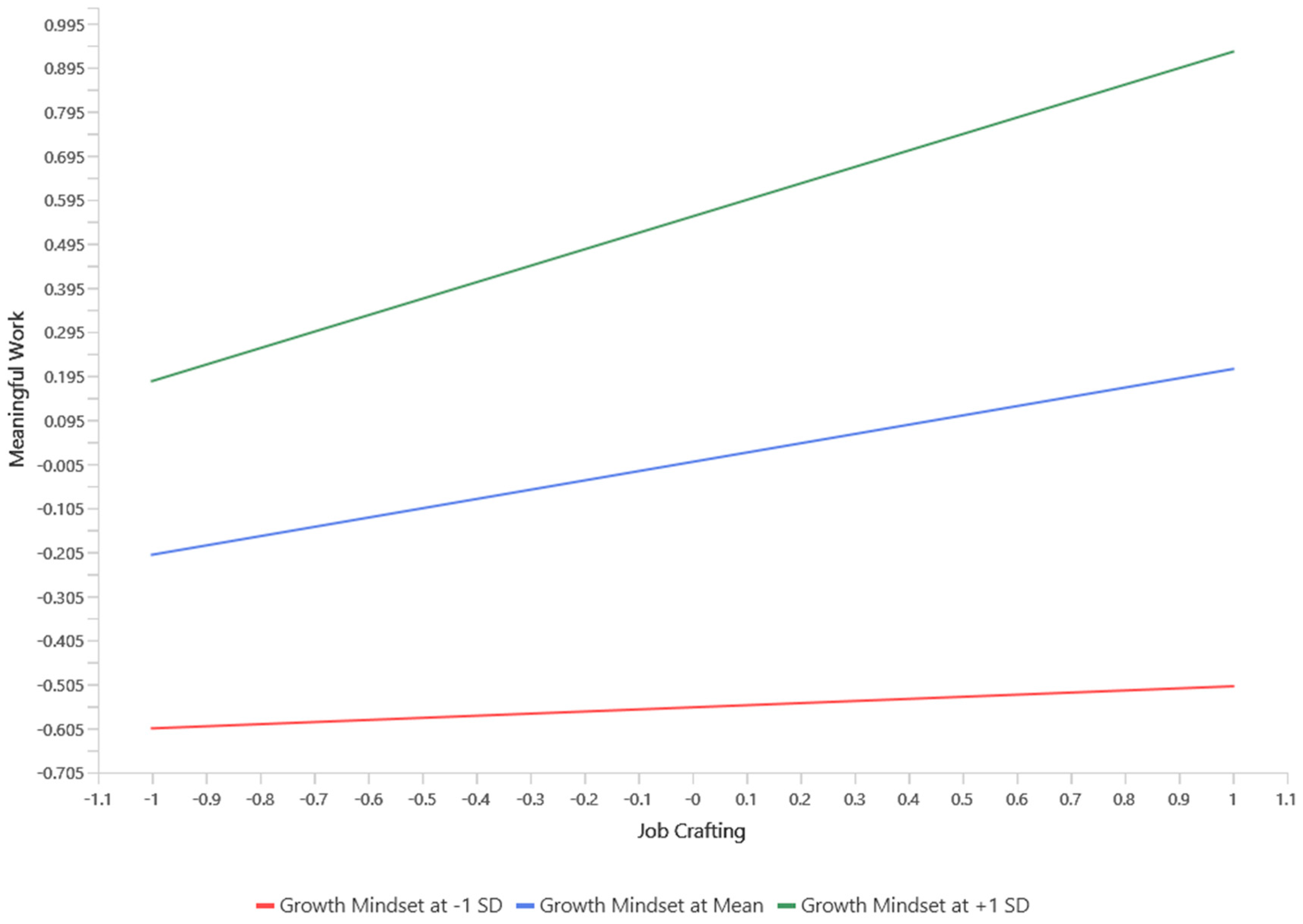
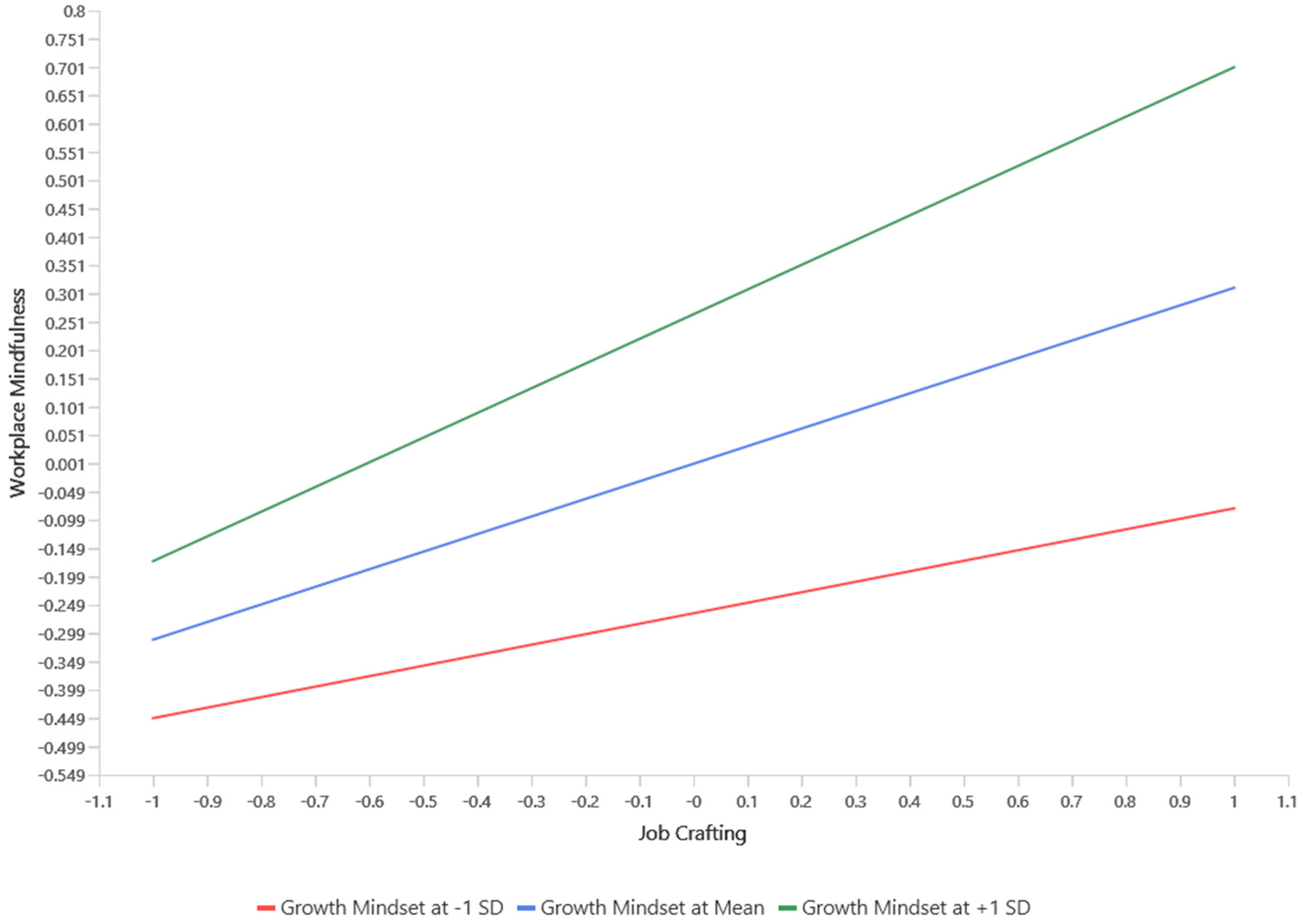
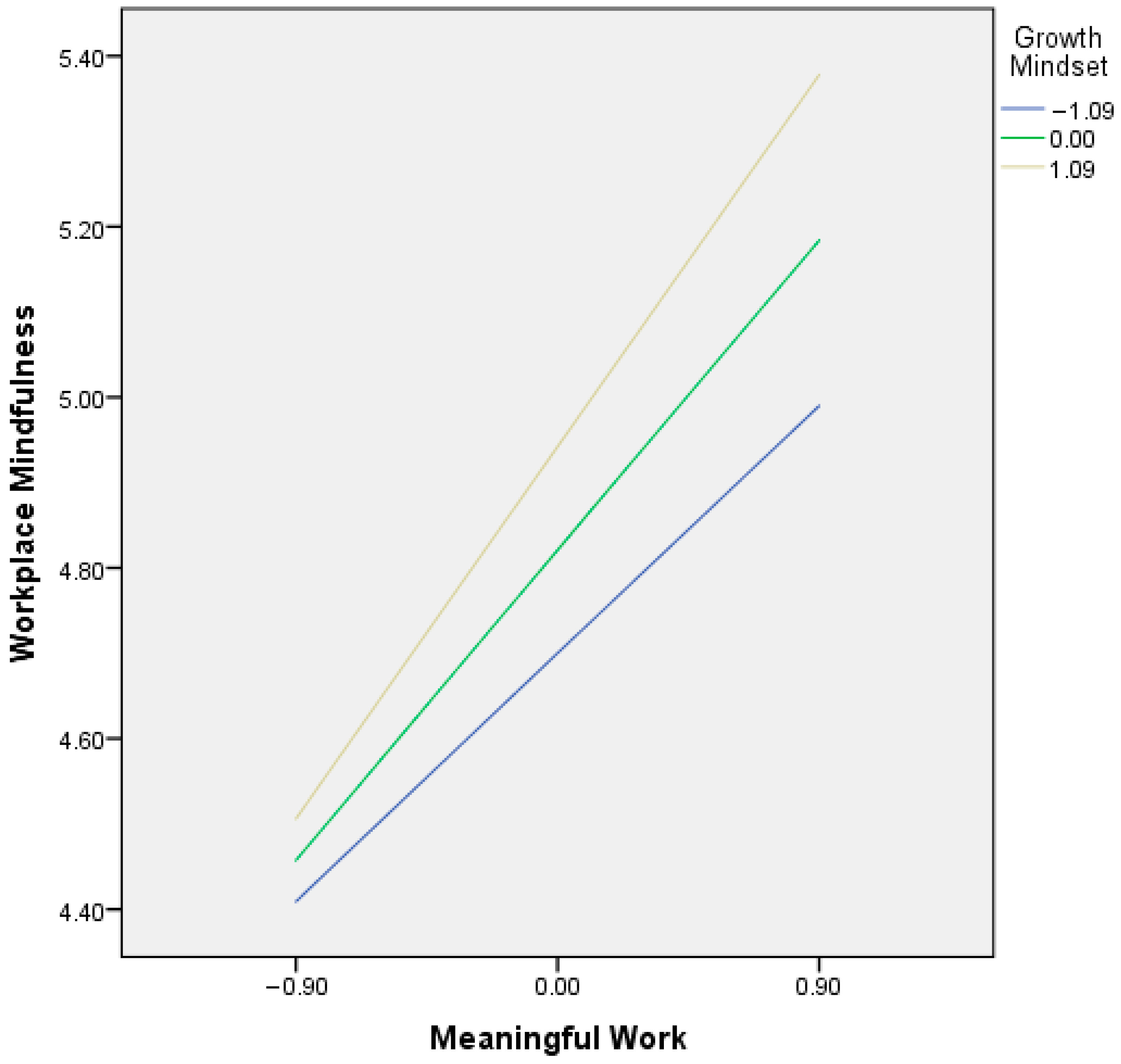
Sustaining Workplace Mindfulness in the Hospitality Industry: The Roles of Job Crafting, Meaningful Work, and Growth Mindset


Abstract
1. Introduction
2. Theoretical Background and Hypotheses
2.1. Job Demands–Resources (JD-R) Theory
2.2. Growth Mindset Theory
2.3. Job Crafting and Workplace Mindfulness
2.4. Job Crafting and Meaningful Work
2.5. Meaningful Work and Workplace Mindfulness
2.6. The Mediating Role of Meaningful Work
2.7. The Moderating Role of Growth Mindset
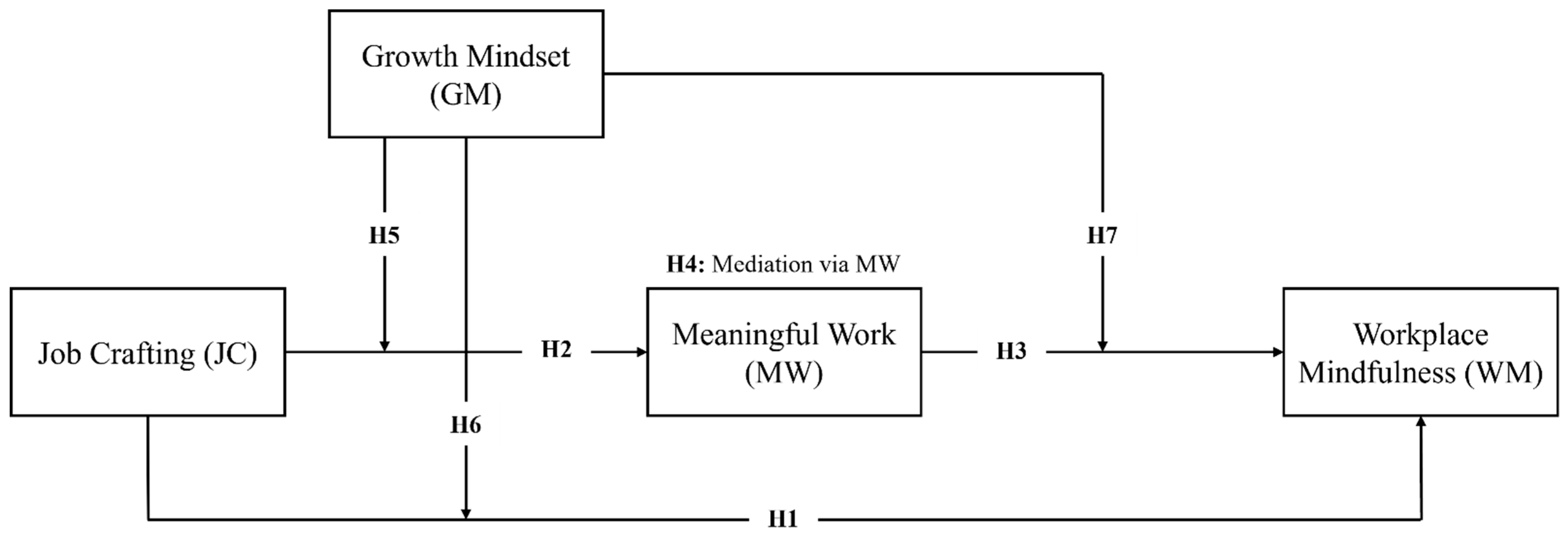
2.8. Conceptual Model
3. Methods
3.1. Sample and Data Collection Procedure
3.2. Measurement Approach and Instruments
3.2.1. Job Crafting
3.2.2. Meaningful Work
3.2.3. Growth Mindset
3.2.4. Workplace Mindfulness
3.3. Assessment of Method-Related Bias
3.4. Analytical Strategy
4. Results
4.1. Test of Measurement Model
4.2. Test of the Structural Model
4.3. Test of Moderated Mediation Model
5. Discussion
6. Implications
6.1. Theoretical Implications
6.2. Practical Implications
6.3. Limitations and Future Research
Author Contributions
Funding
Institutional Review Board Statement
Informed Consent Statement
Data Availability Statement
Conflicts of Interest
Appendix A

| Construct | Item No. | Item Wording | Source |
|---|---|---|---|
| Job Crafting | Slemp and Vella-Brodick [102] | ||
| Task Crafting | JCTC1 | Introduce new approaches to improve your work | |
| JCTC2 | Change the scope or types of tasks that you complete at work | ||
| JCTC3 | Introduce new work tasks that you think better suit your skills or interests | ||
| JCTC4 | Choose to take on additional tasks at work | ||
| JCTC5 | Give preference to work tasks that suit your skills or interests | ||
| Cognitive Crafting | JCCC1 | Think about how your job gives your life purpose | |
| JCCC2 | Remind yourself about the significance your work has for the success of the organization | ||
| JCCC3 | Remind yourself of the importance of your work for the broader community | ||
| JCCC4 | Think about the ways in which your work positively impacts your life | ||
| JCCC5 | Reflect on the role your job has for your overall well-being | ||
| Relational Crafting | JCRC1 | Make an effort to get to know people well at work | |
| JCRC2 | Organize or attend work related social functions | ||
| JCRC3 | Organize special events in the workplace (e.g., celebrating a co-worker’s birthday) | ||
| JCRC4 | 14 Choose to mentor new employees (officially or unofficially) | ||
| JCRC5 | 15 Make friends with people at work who have similar skills or interests | ||
| Meaningful Work | Steger et al. [103] | ||
| Positive Meaning | MWPM1 | I have found a meaningful career | |
| MWPM2 | I understand how my work contributes to my life’s meaning | ||
| MWPM3 | I have a good sense of what makes my job meaningful | ||
| MWPM4 | I have discovered work that has a satisfying purpose | ||
| Greater-Good Motivation | MWGM1 | I know my work makes a positive difference in the world | |
| MWGM2 | My work helps me make sense of the world around me | ||
| MWGM3 | I understand how my work makes the world a better place | ||
| Contribution to Meaning-Making | MWCM1 | I view my work as contributing to my personal growth | |
| MWCM2 | My work helps me better understand myself | ||
| MWCM3 | My work allows me to understand more about who I am as a person | ||
| Growth Mindset | GM1 | I believe I can improve the way I do my work by seeking better ideas. | Kim et al. [104] and Oh et al. [61] |
| GM2 | I am willing to try new approaches in order to improve my work. | ||
| GM3 | I learn from different opinions to improve my abilities at work. | ||
| GM4 | I believe I can develop further by learning and working with others. | ||
| Workplace Mindfulness | Zheng et al. [70] | ||
| Awareness | WMAW1 | I can clearly stay aware of my feelings when performing work tasks. | |
| WMAW2 | If there is a problem in my work, I can quickly be aware of it. | ||
| WMAW3 | At work, I am aware of what thoughts are passing through my mind. | ||
| WMAW4 | In the event of a work-related emergency, I can sense my emotional changes. (developed by students) | ||
| WMAW5 | When an unexpected event happens at work, I am immediately aware of it. | ||
| WMAW6 | If there are problems while doing my work, I will be acutely aware of where the problem is in time. | ||
| Attention | WMAT1 | I pay attention to my current work. | |
| WMAT2 | When I am working, my attention is completely focused on my work. | ||
| WMAT3 | When I talk to others at work, I stay focused on the conversation. | ||
| WMAT4 | At work, I can easily concentrate on what I am doing. | ||
| WMAT5 | When I notice an absence of mind at work, I return to the task of the here and now. | ||
| WMAT6 | When I am communicating with others, I can concentrate, even in an environment with many distractions. | ||
| Acceptance | WMAC1 | I can accept my emotions regardless of whether they are good or bad at work. | |
| WMAC2 | If I make a mistake at work, I don’t take it too hard. | ||
| WMAC3 | At work, I can calmly accept criticism or complaints from others. | ||
| WMAC4 | I go easy on myself when things go wrong at work. | ||
| WMAC5 | At work, I don’t make judgments about whether my thoughts are good or bad. | ||
| WMAC6 | I accept unpleasant experiences at work. | ||
References
- Hu, F.; Trivedi, R.; Teichert, T. Using Hotel Reviews to Assess Hotel Frontline Employees’ Roles and Performances. Int. J. Contemp. Hosp. Manag. 2022, 34, 1796–1822. [Google Scholar] [CrossRef]
- Bilek, G. Modeling Tourism Demand in Turkey (2008–2024): Time-Series Approaches for Sustainable Growth. Sustainability 2025, 17, 1396. [Google Scholar] [CrossRef]
- Babakus, E.; Yavas, U.; Karatepe, O.M. The Effects of Job Demands, Job Resources and Intrinsic Motivation on Emotional Exhaustion and Turnover Intentions: A Study in the Turkish Hotel Industry. Int. J. Hosp. Tour. Adm. 2008, 9, 384–404. [Google Scholar] [CrossRef]
- Zhang, X.; Wang, Y.; Li, F.; Li, Y.; Meng, X. Frontline Hotel Employees’ Job Crafting: Scale Development. Int. J. Hosp. Manag. 2025, 131, 104295. [Google Scholar] [CrossRef]
- Kristiana, Y.; Sijabat, R.; Sudibjo, N.; Bernarto, I. Service-Oriented Job Crafting for Employee Well-Being in Hotel Industry: A Job Demands-Resources Perspective. Cogent Bus. Manag. 2025, 12, 2463816. [Google Scholar] [CrossRef]
- Coelho, P.; de Jesus, S.N.; Viseu, J. Job Crafting in Hospitality: A Systematic Literature Review. J. Hosp. Tour. Insights 2025, 9, 1045–1064. [Google Scholar] [CrossRef]
- Lai, J.; Lui, S.S.; Hon, A.H.Y. Does Standardized Service Fit All?: Novel Service Encounter in Frontline Employee-Customer Interface. Int. J. Contemp. Hosp. Manag. 2014, 26, 1341–1363. [Google Scholar] [CrossRef]
- Kristiana, Y.; Sijabat, R.; Sudibjo, N.; Bernarto, I. Hotel Employee Well-Being: The Role of Job Crafting and Work Engagement. Int. J. Relig. 2024, 5, 200–211. [Google Scholar] [CrossRef]
- Lichtenthaler, P.W.; Fischbach, A. A Meta-Analysis on Promotion- and Prevention-Focused Job Crafting. Eur. J. Work Organ. Psychol. 2019, 28, 30–50. [Google Scholar] [CrossRef]
- Tims, M.; Twemlow, M.; Fong, C.Y.M. A State-of-the-Art Overview of Job-Crafting Research: Current Trends and Future Research Directions. Career Dev. Int. 2021, 27, 54–78. [Google Scholar] [CrossRef]
- Wrzesniewski, A.; Dutton, J.E. Crafting a Job: Revisioning Employees as Active Crafters of Their Work. Acad. Manag. Rev. 2001, 26, 179–201. [Google Scholar] [CrossRef]
- Ok, C.; Lim, S. Job Crafting to Innovative and Extra-Role Behaviors: A Serial Mediation through Fit Perceptions and Work Engagement. Int. J. Hosp. Manag. 2022, 106, 103288. [Google Scholar] [CrossRef]
- Teng, H.-Y. Job Crafting and Customer Service Behaviors in the Hospitality Industry: Mediating Effect of Job Passion. Int. J. Hosp. Manag. 2019, 81, 34–42. [Google Scholar] [CrossRef]
- Xu, J.; Wang, C.; Zhang, T.; Zhu, L. How Job Crafting Affects Hotel Employees’ Turnover Intention during COVID-19: An Empirical Study from China. Sustainability 2023, 15, 9468. [Google Scholar] [CrossRef]
- Swieai, W.; Alzubi, A.B.; Aljuhmani, H.Y.; Topal, H. Unpacking the Role of Proactive Personality in Enhancing Safety Behavior: A Moderated Mediation Model in Turkish Healthcare Organizations. J. Health Organ. Manag. 2025, 1–29. [Google Scholar] [CrossRef]
- Güçlü Nergiz, H.; Unsal-Akbiyik, B.S. Job Crafting, Task Performance, and Employability: The Role of Work Engagement. Sage Open 2024, 14, 21582440241271125. [Google Scholar] [CrossRef]
- Schaufeli, W.B.; Bakker, A.B.; Salanova, M. The Measurement of Work Engagement With a Short Questionnaire: A Cross-National Study. Educ. Psychol. Meas. 2006, 66, 701–716. [Google Scholar] [CrossRef]
- Chen, C.-Y.; Yen, C.-H.; Tsai, F.C. Job Crafting and Job Engagement: The Mediating Role of Person-Job Fit. Int. J. Hosp. Manag. 2014, 37, 21–28. [Google Scholar] [CrossRef]
- Judge, T.A.; Weiss, H.M.; Kammeyer-Mueller, J.D.; Hulin, C.L. Job Attitudes, Job Satisfaction, and Job Affect: A Century of Continuity and of Change. J. Appl. Psychol. 2017, 102, 356–374. [Google Scholar] [CrossRef]
- Cheng, J.-C.; O-Yang, Y. Hotel Employee Job Crafting, Burnout, and Satisfaction: The Moderating Role of Perceived Organizational Support. Int. J. Hosp. Manag. 2018, 72, 78–85. [Google Scholar] [CrossRef]
- Kim, H.; Im, J.; Qu, H. Exploring Antecedents and Consequences of Job Crafting. Int. J. Hosp. Manag. 2018, 75, 18–26. [Google Scholar] [CrossRef]
- Kim, H.; Im, J.; Qu, H.; NamKoong, J. Antecedent and Consequences of Job Crafting: An Organizational Level Approach. Int. J. Contemp. Hosp. Manag. 2018, 30, 1863–1881. [Google Scholar] [CrossRef]
- Dane, E.; Brummel, B.J. Examining Workplace Mindfulness and Its Relations to Job Performance and Turnover Intention. Hum. Relat. 2014, 67, 105–128. [Google Scholar] [CrossRef]
- Dane, E. Paying Attention to Mindfulness and Its Effects on Task Performance in the Workplace. J. Manag. 2011, 37, 997–1018. [Google Scholar] [CrossRef]
- Hur, W.-M.; Shin, Y.; Kim, J.Y. Service Employees’ Mindfulness and Job Crafting amid COVID-19: The Roles of Resilience, Organizational Health Climate, and Health-Oriented Leadership. Curr. Psychol. 2024, 43, 16979–16991. [Google Scholar] [CrossRef]
- Aldrin, N.; Merdiaty, N. Effect of Job Crafting on Work Engagement with Mindfulness as a Mediator. Cogent Psychol. 2019, 6, 1684421. [Google Scholar] [CrossRef]
- Bai, J.; Tian, Q.; Sanchez, J.I. The Role of Mindfulness on the Relationship between Job Complexity and Job Crafting: A Self-Regulation Approach. Eur. Manag. J. 2025. [Google Scholar] [CrossRef]
- Hebl, W.I.; Theis, I.; Guisard, T.; Madera, J.M. The Hospitality & Tourism Frontline Employee: A Bibliometric Analysis. Int. J. Hosp. Manag. 2026, 133, 104451. [Google Scholar] [CrossRef]
- Xiong, W.; Huang, M.; Okumus, B.; Leung, X.Y.; Cai, X.; Fan, F. How Emotional Labor Affect Hotel Employees’ Mental Health: A Longitudinal Study. Tour. Manag. 2023, 94, 104631. [Google Scholar] [CrossRef]
- Amissah, E.F.; Blankson-Stiles-Ocran, S.; Mensah, I. Emotional Labour, Emotional Exhaustion and Job Satisfaction in the Hospitality Industry. J. Hosp. Tour. Insights 2021, 5, 805–821. [Google Scholar] [CrossRef]
- Shi, X.; Gordon, S.; Adler, H. Challenging or Hindering? Understanding the Daily Effects of Work Stressors on Hotel Employees’ Work Engagement and Job Satisfaction. Int. J. Hosp. Manag. 2022, 103, 103211. [Google Scholar] [CrossRef]
- Reb, J.; Narayanan, J.; Chaturvedi, S.; Ekkirala, S. The Mediating Role of Emotional Exhaustion in the Relationship of Mindfulness with Turnover Intentions and Job Performance. Mindfulness 2017, 8, 707–716. [Google Scholar] [CrossRef]
- Yin, J.; Ni, Y.; Fan, Y.; Chen, Y. Navigating Unpleasant Interactions: The Influence of Customer Mistreatment on Hospitality Employee Responses Employing Mindfulness as a Moderator. Sustainability 2023, 15, 14288. [Google Scholar] [CrossRef]
- Allan, B.A.; Batz-Barbarich, C.; Sterling, H.M.; Tay, L. Outcomes of Meaningful Work: A Meta-Analysis. J. Manag. Stud. 2019, 56, 500–528. [Google Scholar] [CrossRef]
- Lysova, E.I.; Allan, B.A.; Dik, B.J.; Duffy, R.D.; Steger, M.F. Fostering Meaningful Work in Organizations: A Multi-Level Review and Integration. J. Vocat. Behav. 2019, 110, 374–389. [Google Scholar] [CrossRef]
- Hulshof, I.L.; Demerouti, E.; Le Blanc, P.M. Day-Level Job Crafting and Service-Oriented Task Performance: The Mediating Role of Meaningful Work and Work Engagement. Career Dev. Int. 2020, 25, 355–371. [Google Scholar] [CrossRef]
- Tan, K.-L.; Yeap, P.F. The Impact of Work Engagement and Meaningful Work to Alleviate Job Burnout Among Social Workers in New Zealand. Manag. Decis. 2021, 60, 3042–3065. [Google Scholar] [CrossRef]
- Bakker, A.B.; Demerouti, E. Job Demands–Resources Theory: Taking Stock and Looking Forward. J. Occup. Health Psychol. 2017, 22, 273–285. [Google Scholar] [CrossRef]
- Bakker, A.B.; Demerouti, E. Job Demands–Resources Theory: Frequently Asked Questions. J. Occup. Health Psychol. 2024, 29, 188–200. [Google Scholar] [CrossRef]
- Tims, M.; Bakker, A.B.; Derks, D. The Impact of Job Crafting on Job Demands, Job Resources, and Well-Being. J. Occup. Health Psychol. 2013, 18, 230–240. [Google Scholar] [CrossRef]
- Alghwail, R.E.; Mohammad, S.; Arslan, A. Green Workplace Mindfulness and Employee Productivity in Healthcare: Unpacking the Roles of Work Engagement and Green Climate Perception. Sustainability 2026, 18, 4144. [Google Scholar] [CrossRef]
- Kumprang, K.; Suriyankietkaew, S. Mechanisms of Organizational Mindfulness on Employee Well-Being and Engagement: A Multi-Level Analysis. Adm. Sci. 2024, 14, 121. [Google Scholar] [CrossRef]
- Karpagavalli, R.; Suganthi, L. Growth Mindset and Positive Work Reflection for Affective Well-Being: A Three-Way Interaction Model. Humanit. Soc. Sci. Commun. 2024, 11, 230. [Google Scholar] [CrossRef]
- Caniëls, M.C.J.; Semeijn, J.H.; Renders, I.H.M. Mind the Mindset! The Interaction of Proactive Personality, Transformational Leadership and Growth Mindset for Engagement at Work. Career Dev. Int. 2018, 23, 48–66. [Google Scholar] [CrossRef]
- Dweck, C.S.; Chiu, C.; Hong, Y. Implicit Theories: Elaboration and Extension of the Model. Psychol. Inq. 1995, 6, 322–333. [Google Scholar] [CrossRef]
- Lazarus, R.S.; Folkman, S. Stress, Appraisal, and Coping; Springer Publishing Company: New York, NY, USA, 1984; ISBN 978-0-8261-4192-7. [Google Scholar]
- Keating, L.A.; Heslin, P.A. The Potential Role of Mindsets in Unleashing Employee Engagement. Hum. Resour. Manag. Rev. 2015, 25, 329–341. [Google Scholar] [CrossRef]
- Heslin, P.A.; Keating, L.A. In Learning Mode? The Role of Mindsets in Derailing and Enabling Experiential Leadership Development. Leadersh. Q. 2017, 28, 367–384. [Google Scholar] [CrossRef]
- Burnette, J.L.; Pollack, J.M. Implicit Theories of Work and Job Fit: Implications for Job and Life Satisfaction. Basic. Appl. Soc. Psychol. 2013, 35, 360–372. [Google Scholar] [CrossRef]
- Zhang, M.; Geng, R.; Hong, Z.; Song, W.; Wang, W. The Double-Edged Sword Effect of Service Recovery Awareness of Frontline Employees: From a Job Demands-Resources Perspective. Int. J. Hosp. Manag. 2020, 88, 102536. [Google Scholar] [CrossRef]
- Abdou, A.H.; Albohnayh, A.S.M. Promoting Psychological Wellbeing in Hospitality: The Interactive Roles of Autonomy-Supportive Leadership, Psychological Need Satisfaction, and Perceived Organizational Support. Front. Psychol. 2026, 17, 1813978. [Google Scholar] [CrossRef]
- Bakker, A.B.; Demerouti, E.; Sanz-Vergel, A. Job Demands–Resources Theory: Ten Years Later. Annu. Rev. Organ. Psychol. Organ. Behav. 2023, 10, 25–53. [Google Scholar] [CrossRef]
- Al’Ararah, K.; Çağlar, D.; Aljuhmani, H.Y. Mitigating Job Burnout in Jordanian Public Healthcare: The Interplay between Ethical Leadership, Organizational Climate, and Role Overload. Behav. Sci. 2024, 14, 490. [Google Scholar] [CrossRef]
- Lee, D.Y.; Jo, Y. The Job Demands-Resource Model and Performance: The Mediating Role of Employee Engagement. Front. Psychol. 2023, 14, 1194018. [Google Scholar] [CrossRef]
- Li, Y.; Chen, C.; Yuan, Y. Evolving the Job Demands-Resources Framework to JD-R 3.0: The Impact of after-Hours Connectivity and Organizational Support on Employee Psychological Distress. Acta Psychol. 2025, 253, 104710. [Google Scholar] [CrossRef]
- Galanakis, M.D.; Tsitouri, E. Positive Psychology in the Working Environment. Job Demands-Resources Theory, Work Engagement and Burnout: A Systematic Literature Review. Front. Psychol. 2022, 13, 1022102. [Google Scholar] [CrossRef]
- Albrecht, S.L.; Green, C.R.; Marty, A. Meaningful Work, Job Resources, and Employee Engagement. Sustainability 2021, 13, 4045. [Google Scholar] [CrossRef]
- Junça-Silva, A.; Silva, S.; Caetano, A. Job Crafting, Meaningful Work and Performance: A Moderated Mediation Approach of Presenteeism. SN Bus. Econ. 2022, 2, 31. [Google Scholar] [CrossRef]
- Letona-Ibañez, O.; Martinez-Rodriguez, S.; Ortiz-Marques, N.; Carrasco, M.; Amillano, A. Job Crafting and Work Engagement: The Mediating Role of Work Meaning. Int. J. Environ. Res. Public Health 2021, 18, 5383. [Google Scholar] [CrossRef]
- Siu, O.; Yang, Y.; Li, A.; Wang, H.; Ng, T.K. Leveraging a Dual-Focused Growth Mindset to Boost Employee Resilience and Work Well-Being: Evidence From a Two-Wave Survey and an Intervention Study. Stress Health 2025, 41, e70093. [Google Scholar] [CrossRef]
- Oh, J.; Han, S.J.; Han, S.H. Linking a Growth Mindset, Job Crafting and in-Role Performance via Meaningfulness at Work: A Moderated Mediation Model. J. Workplace Learn. 2024, 36, 364–381. [Google Scholar] [CrossRef]
- Costantini, A.; Demerouti, E.; Ceschi, A.; Sartori, R. Implementing Job Crafting Behaviors: Exploring the Effects of a Job Crafting Intervention Based on the Theory of Planned Behavior. J. Appl. Behav. Sci. 2022, 58, 477–512. [Google Scholar] [CrossRef]
- Yeager, D.S.; Dweck, C.S. What Can Be Learned from Growth Mindset Controversies? Am. Psychol. 2020, 75, 1269–1284. [Google Scholar] [CrossRef]
- Wang, Z.; Chen, H. When Leader Expectations Inspire and When They Overwhelm: The Role of Growth Mindset and Prior Performance in Employee Emotional and Engagement Responses to Leader High Performance Expectations. J. Bus. Psychol. 2026, 41, 179–200. [Google Scholar] [CrossRef]
- Yu, T.; He, L.; Ying, H.; Liu, J.; Wu, Y.; Wang, Y.; Pan, X. Growth Mindset and Job Crafting: A Trait Activation Perspective with Job Autonomy as Moderator. Behav. Sci. 2024, 14, 1221. [Google Scholar] [CrossRef]
- Nagy, T.; Sik, K.; Török, L.; Bőthe, B.; Takacs, Z.K.; Orosz, G. Brief Growth Mindset and Mindfulness Inductions to Facilitate Task Persistence After Negative Feedback. Collabra Psychol. 2023, 9, 74253. [Google Scholar] [CrossRef]
- Wang, X.; Liu, Y.; Zhan, L.; Zhang, R. Nature’s Gift, Job’s Shift: Exploring the Impact of Nature Exposure at Work on Job Crafting. Int. J. Psychol. 2025, 60, e70100. [Google Scholar] [CrossRef]
- Saraç, M.; Akdeniz Balyemezler, H. The Impact of Mindfulness on Work Attitudes: The Mediating Role of Psychological Capital. Int. J. Workplace Health Manag. 2025, 19, 110–128. [Google Scholar] [CrossRef]
- Sönmez, N.K. The Effect of Psychological Capital and Emotional Labor on Job Performance: A Study on Five Star Hotel Enterprises in Antalya. Istanb. Bus. Res. 2021, 50, 303–329. [Google Scholar] [CrossRef]
- Zheng, X.; Ni, D.; Liu, X.; Liang, L.H. Workplace Mindfulness: Multidimensional Model, Scale Development and Validation. J. Bus. Psychol. 2023, 38, 777–801. [Google Scholar] [CrossRef]
- Awwad, R.I.; Aljuhmani, H.Y.; Hamdan, S. Examining the Relationships Between Frontline Bank Employees’ Job Demands and Job Satisfaction: A Mediated Moderation Model. Sage Open 2022, 12, 21582440221079880. [Google Scholar] [CrossRef]
- Rescalvo-Martin, E.; Gutierrez, L.; Llorens-Montes, F.J. Extra-Role Service under Pressure in the Hospitality Industry: The Role of Mindfulness. Tour. Manag. Perspect. 2022, 44, 101030. [Google Scholar] [CrossRef]
- Karatepe, O.M.; Beirami, E.; Bouzari, M.; Safavi, H.P. Does Work Engagement Mediate the Effects of Challenge Stressors on Job Outcomes? Evidence from the Hotel Industry. Int. J. Hosp. Manag. 2014, 36, 14–22. [Google Scholar] [CrossRef]
- Rosso, B.D.; Dekas, K.H.; Wrzesniewski, A. On the Meaning of Work: A Theoretical Integration and Review. Res. Organ. Behav. 2010, 30, 91–127. [Google Scholar] [CrossRef]
- Bailey, C.; Madden, A. What Makes Work Meaningful—Or Meaningless. MIT Sloan Manag. Rev. 2016, 57, 53–61. [Google Scholar]
- Sonnentag, S. A Task-Level Perspective on Work Engagement: A New Approach That Helps to Differentiate the Concepts of Engagement and Burnout. Burn. Res. 2017, 5, 12–20. [Google Scholar] [CrossRef]
- Lyddy, C.J.; Good, D.J. Being While Doing: An Inductive Model of Mindfulness at Work. Front. Psychol. 2017, 7, 2060. [Google Scholar] [CrossRef]
- Fairlie, P. Meaningful Work, Employee Engagement, and Other Key Employee Outcomes: Implications for Human Resource Development. Adv. Dev. Hum. Resour. 2011, 13, 508–525. [Google Scholar] [CrossRef]
- Hülsheger, U.R.; Alberts, H.J.E.M.; Feinholdt, A.; Lang, J.W.B. Benefits of Mindfulness at Work: The Role of Mindfulness in Emotion Regulation, Emotional Exhaustion, and Job Satisfaction. J. Appl. Psychol. 2013, 98, 310–325. [Google Scholar] [CrossRef]
- He, J.; Li, X.; Wang, H.; Xu, Z. A Study on the Relationship between Mindfulness and Work Performance of Web Editors: Based on the Chain Mediating Effect of Workplace Spirituality and Digital Competencies. Front. Psychol. 2023, 13, 1068735. [Google Scholar] [CrossRef]
- Good, D.J.; Lyddy, C.J.; Glomb, T.M.; Bono, J.E.; Brown, K.W.; Duffy, M.K.; Baer, R.A.; Brewer, J.A.; Lazar, S.W. Contemplating Mindfulness at Work: An Integrative Review. J. Manag. 2016, 42, 114–142. [Google Scholar] [CrossRef]
- Singh, N.; Bamel, U. Can Transcendence Be Attained through Mindfulness? The Mediating Role of Meaningful Work. J. Organ. Eff. People Perform. 2020, 7, 257–273. [Google Scholar] [CrossRef]
- Shen, L.; Jie, S.; Zhong, X. How Team Mindfulness Influences Team Performance: A Chain-Mediation Model. Team Perform. Manag. Int. J. 2025, 31, 573–592. [Google Scholar] [CrossRef]
- Majeed, M.; Irshad, M.; Khan, I.; Saeed, I. The Impact of Team Mindfulness on Project Team Performance: The Moderating Role of Effective Team Leadership. Proj. Manag. J. 2023, 54, 162–178. [Google Scholar] [CrossRef]
- Pimenta de Devotto, R.; de Freitas, C.P.P.; Wechsler, S.M. Basic Psychological Need Satisfaction, Job Crafting, and Meaningful Work: Network Analysis. Trends Psychol. 2024, 32, 1180–1200. [Google Scholar] [CrossRef]
- Chen, L.; Li, X.; Xing, L. From Mindfulness to Work Engagement: The Mediating Roles of Work Meaningfulness, Emotion Regulation, and Job Competence. Front. Psychol. 2022, 13, 997638. [Google Scholar] [CrossRef]
- Shaffakat, S.; Otaye-Ebede, L.; Reb, J.; Chandwani, R.; Vongswasdi, P. Mindfulness Attenuates Both Emotional and Behavioral Reactions Following Psychological Contract Breach: A Two-Stage Moderated Mediation Model. J. Appl. Psychol. 2022, 107, 425–443. [Google Scholar] [CrossRef]
- Seo, Y.; Ko, D.; Kim, J. It Is All in the Mind(Set)! Matching Mindsets and Luxury Tourism. J. Travel. Res. 2021, 60, 184–196. [Google Scholar] [CrossRef]
- Çinar, S. The Effects of Tourism Sector on Economic Growth: The Case of Türkiye. Sinop Üniversitesi Sos. Bilim. Derg. 2024, 8, 842–863. [Google Scholar] [CrossRef]
- Kenar, G.; Yeşiltaş, M. Service-Oriented High Performance Human Resource Practices and Proactive Work Behavior: A Moderated Mediation Model. Serv. Ind. J. 2024, 44, 237–264. [Google Scholar] [CrossRef]
- Elshawesh, Y.; Wada, I. Service Quality and Customer Satisfaction: The Mediating Role of Customer Delight. Int. Rev. Manag. Mark. 2026, 16, 273–287. [Google Scholar] [CrossRef]
- Akhtar, M.W.; Karatepe, O.M.; Rescalvo-Martin, E.; Rizwan, M. Thriving at Work as a Mediator between High-Performance Human Resource Practices and Innovative Behavior in the Hotel Industry: The Moderating Role of Self-Enhancement Motive. Int. J. Hosp. Manag. 2024, 123, 103897. [Google Scholar] [CrossRef]
- Farrukh, M.; Ansari, N.Y.; Raza, A.; Meng, F.; Wang, H. High-Performance Work Practices Do Much, but H.E.R.O Does More: An Empirical Investigation of Employees’ Innovative Behavior from the Hospitality Industry. Eur. J. Innov. Manag. 2021, 25, 791–812. [Google Scholar] [CrossRef]
- Podsakoff, P.M.; MacKenzie, S.B.; Lee, J.-Y.; Podsakoff, N.P. Common Method Biases in Behavioral Research: A Critical Review of the Literature and Recommended Remedies. J. Appl. Psychol. 2003, 88, 879–903. [Google Scholar] [CrossRef] [PubMed]
- Karatepe, O.M.; Kim, T.T. Job Crafting and Critical Work-Related Performance Outcomes among Cabin Attendants: Sequential Mediation Impacts of Calling Orientation and Work Engagement. Tour. Manag. Perspect. 2023, 45, 101065. [Google Scholar] [CrossRef]
- Little, R.J.A.; Rubin, D.B. Statistical Analysis with Missing Data, 2nd ed.; Wiley-Interscience: New York, NY, USA, 2002; ISBN 978-0-471-18386-0. [Google Scholar]
- Armstrong, J.S.; Overton, T.S. Estimating Nonresponse Bias in Mail Surveys. J. Mark. Res. 1977, 14, 396–402. [Google Scholar] [CrossRef]
- Brislin, R.W. The Wording and Translation of Research Instruments. In Field Methods in Cross-Cultural Research; Cross-Cultural Research and Methodology Series; Sage Publications, Inc.: Thousand Oaks, CA, USA, 1986; Volume 8, pp. 137–164. ISBN 978-0-8039-2549-6. [Google Scholar]
- Behr, D. Assessing the Use of Back Translation: The Shortcomings of Back Translation as a Quality Testing Method. Int. J. Soc. Res. Methodol. 2017, 20, 573–584. [Google Scholar] [CrossRef]
- McGorry, S.Y. Measurement in a Cross-cultural Environment: Survey Translation Issues. Qual. Mark. Res. Int. J. 2000, 3, 74–81. [Google Scholar] [CrossRef]
- Nunnally, J.C. Psychometric Theory, 2nd ed.; McGraw-Hill Companies: Columbus, OH, USA, 1978. [Google Scholar]
- Slemp, G.R.; Vella-Brodrick, D.A. Optimising Employee Mental Health: The Relationship Between Intrinsic Need Satisfaction, Job Crafting, and Employee Well-Being. J. Happiness Stud. 2014, 15, 957–977. [Google Scholar] [CrossRef]
- Steger, M.F.; Dik, B.J.; Duffy, R.D. Measuring Meaningful Work: The Work and Meaning Inventory (WAMI). J. Career Assess. 2012, 20, 322–337. [Google Scholar] [CrossRef]
- Kim, M.; Han, S.J.; Kim, J. A Short-Form of Team Mindset Scale: Using Psychometric Properties of the Items. Front. Psychol. 2023, 13, 1063541. [Google Scholar] [CrossRef]
- Chang, S.-J.; van Witteloostuijn, A.; Eden, L. From the Editors: Common Method Variance in International Business Research. J. Int. Bus. Stud. 2010, 41, 178–184. [Google Scholar] [CrossRef]
- Spector, P.E. Method Variance in Organizational Research: Truth or Urban Legend? Organ. Res. Methods 2006, 9, 221–232. [Google Scholar] [CrossRef]
- Harman, H.H. Modern Factor Analysis, 3rd ed.; University of Chicago Press: Chicago, IL, USA, 1976; ISBN 978-0-226-31652-9. [Google Scholar]
- Hair, J.F.; Risher, J.J.; Sarstedt, M.; Ringle, C.M. When to Use and How to Report the Results of PLS-SEM. Eur. Bus. Rev. 2019, 31, 2–24. [Google Scholar] [CrossRef]
- Kock, N. Common Method Bias in PLS-SEM: A Full Collinearity Assessment Approach. Int. J. e-Collab. 2015, 11, 1–10. [Google Scholar] [CrossRef]
- Lindell, M.K.; Whitney, D.J. Accounting for Common Method Variance in Cross-Sectional Research Designs. J. Appl. Psychol. 2001, 86, 114–121. [Google Scholar] [CrossRef]
- Ringle, C.M.; Wende, S.; Becker, J.-M. SmartPLS 4; SmartPLS: Oststeinbek, Germany, 2022. [Google Scholar]
- Hair, J.F.; Sarstedt, M.; Ringle, C.M.; Gudergan, S.P. Advanced Issues in Partial Least Squares Structural Equation Modeling, 2nd ed.; SAGE Publications, Inc.: Thousand Oaks, CA, USA, 2024; ISBN 978-1-0718-6250-6. [Google Scholar]
- Hair, J.; Hult, G.T.M.; Ringle, C.M.; Sarstedt, M. A Primer on Partial Least Squares Structural Equation Modeling, 3rd ed.; SAGE Publications, Inc.: Thousand Oaks, CA, USA, 2021; ISBN 978-1-5443-9640-8. [Google Scholar]
- Neiroukh, S.; Emeagwali, O.L.; Aljuhmani, H.Y. Artificial Intelligence Capability and Organizational Performance: Unraveling the Mediating Mechanisms of Decision-Making Processes. Manag. Decis. 2025, 63, 3501–3532. [Google Scholar] [CrossRef]
- Ali, F.; Rasoolimanesh, S.M.; Sarstedt, M.; Ringle, C.M.; Ryu, K. An Assessment of the Use of Partial Least Squares Structural Equation Modeling (PLS-SEM) in Hospitality Research. Int. J. Contemp. Hosp. Manag. 2018, 30, 514–538. [Google Scholar] [CrossRef]
- Spector, P.E. Do Not Cross Me: Optimizing the Use of Cross-Sectional Designs. J. Bus. Psychol. 2019, 34, 125–137. [Google Scholar] [CrossRef]
- Cole, D.A.; Maxwell, S.E. Testing Mediational Models With Longitudinal Data: Questions and Tips in the Use of Structural Equation Modeling. J. Abnorm. Psychol. 2003, 112, 558–577. [Google Scholar] [CrossRef]
- Vaithilingam, S.; Ong, C.S.; Moisescu, O.I.; Nair, M.S. Robustness Checks in PLS-SEM: A Review of Recent Practices and Recommendations for Future Applications in Business Research. J. Bus. Res. 2024, 173, 114465. [Google Scholar] [CrossRef]
- Fornell, C.; Larcker, D.F. Evaluating Structural Equation Models with Unobservable Variables and Measurement Error. J. Mark. Res. 1981, 18, 39–50. [Google Scholar] [CrossRef]
- Franke, G.; Sarstedt, M. Heuristics versus Statistics in Discriminant Validity Testing: A Comparison of Four Procedures. Internet Res. 2019, 29, 430–447. [Google Scholar] [CrossRef]
- Henseler, J.; Ringle, C.M.; Sarstedt, M. A New Criterion for Assessing Discriminant Validity in Variance-Based Structural Equation Modeling. J. Acad. Mark. Sci. 2015, 43, 115–135. [Google Scholar] [CrossRef]
- Elkhweildi, M.; Vetbuje, B.; Alzubi, A.B.; Aljuhmani, H.Y. Leading with Green Ethics: How Environmentally Specific Ethical Leadership Enhances Employee Job Performance Through Communication and Engagement. Sustainability 2025, 17, 7923. [Google Scholar] [CrossRef]
- Tibbe, T.D.; Montoya, A.K. Correcting the Bias Correction for the Bootstrap Confidence Interval in Mediation Analysis. Front. Psychol. 2022, 13, 810258. [Google Scholar] [CrossRef]
- Fassott, G.; Henseler, J.; Coelho, P.S. Testing Moderating Effects in PLS Path Models with Composite Variables. Ind. Manag. Amp Data Syst. 2016, 116, 1887–1900. [Google Scholar] [CrossRef]
- Al-Geitany, S.; Aljuhmani, H.Y.; Emeagwali, O.L.; Nasr, E. Consumer Behavior in the Post-COVID-19 Era: The Impact of Perceived Interactivity on Behavioral Intention in the Context of Virtual Conferences. Sustainability 2023, 15, 8600. [Google Scholar] [CrossRef]
- Hayes, A.F. Partial, Conditional, and Moderated Moderated Mediation: Quantification, Inference, and Interpretation. Commun. Monogr. 2018, 85, 4–40. [Google Scholar] [CrossRef]
- Hayes, A.F.; Rockwood, N.J. Regression-Based Statistical Mediation and Moderation Analysis in Clinical Research: Observations, Recommendations, and Implementation. Behav. Res. Ther. 2017, 98, 39–57. [Google Scholar] [CrossRef]
- Farnana, K.; Alzubi, A.B.; Aljuhmani, H.Y.; Khadem, A. Fostering a Green Workplace: How Responsible Leadership Inspires Voluntary Green Behavior through Perceived Insider Status and Green Work Climate. Kybernetes 2026, 1–31. [Google Scholar] [CrossRef]
- Cetin, G.; Walls, A. Understanding the Customer Experiences from the Perspective of Guests and Hotel Managers: Empirical Findings from Luxury Hotels in Istanbul, Turkey. J. Hosp. Mark. Manag. 2016, 25, 395–424. [Google Scholar] [CrossRef]
- Bhopal, R.; Devi, R. Redesigning Roles through Job Crafting: A Systematic Literature Review and Future Research Directions. Learn. Organ. Int. J. 2026, 33, 299–327. [Google Scholar] [CrossRef]
- Bindl, U.K.; Parker, S.K. Proactive Work Behavior: Forward-Thinking and Change-Oriented Action in Organizations. In APA Handbook of Industrial and Organizational Psychology, Vol 2: Selecting and Developing Members for the Organization; APA Handbooks in Psychology®; American Psychological Association: Washington, DC, USA, 2011; pp. 567–598. ISBN 978-1-4338-0733-6. [Google Scholar]
- Cangiano, F.; Parker, S.K.; Yeo, G.B. Does Daily Proactivity Affect Well-Being? The Moderating Role of Punitive Supervision. J. Organ. Behav. 2019, 40, 59–72. [Google Scholar] [CrossRef]
- Alashiq, S.; Aljuhmani, H.Y. From Sustainable Tourism to Social Engagement: A Value-Belief-Norm Approach to the Roles of Environmental Knowledge, Eco-Destination Image, and Biospheric Value. Sustainability 2025, 17, 4353. [Google Scholar] [CrossRef]
- Reb, J.; Narayanan, J.; Ho, Z.W. Mindfulness at Work: Antecedents and Consequences of Employee Awareness and Absent-Mindedness. Mindfulness 2015, 6, 111–122. [Google Scholar] [CrossRef]
- Holúbek, J.; Giovando, G.; Lazarová, E.; Rozsa, Z. Job Crafting, Meaningful Work and Employee Engagement. Manag. Decis. 2026, 64, 212–241. [Google Scholar] [CrossRef]
- Tims, M.; Derks, D.; Bakker, A.B. Job Crafting and Its Relationships with Person–Job Fit and Meaningfulness: A Three-Wave Study. J. Vocat. Behav. 2016, 92, 44–53. [Google Scholar] [CrossRef]
- Nasr, E.; Emeagwali, O.L.; Aljuhmani, H.Y.; Al-Geitany, S. Destination Social Responsibility and Residents’ Environmentally Responsible Behavior: Assessing the Mediating Role of Community Attachment and Involvement. Sustainability 2022, 14, 14153. [Google Scholar] [CrossRef]
- Alkish, I.; Iyiola, K.; Alzubi, A.B.; Aljuhmani, H.Y. Does Digitization Lead to Sustainable Economic Behavior? Investigating the Roles of Employee Well-Being and Learning Orientation. Sustainability 2025, 17, 4365. [Google Scholar] [CrossRef]
- Bakker, A.B.; de Vries, J.D. Job Demands–Resources Theory and Self-Regulation: New Explanations and Remedies for Job Burnout. Anxiety Stress Coping 2021, 34, 1–21. [Google Scholar] [CrossRef]
- Shahbaz, W.; Parker, J. Workplace Mindfulness: An Integrative Review of Antecedents, Mediators, and Moderators. Hum. Resour. Manag. Rev. 2022, 32, 100849. [Google Scholar] [CrossRef]
- Pandey, A.; Maheshwari, M.; Malik, N. A Systematic Literature Review on Employee Well-Being: Mapping Multi-Level Antecedents, Moderators, Mediators and Future Research Agenda. Acta Psychol. 2025, 258, 105080. [Google Scholar] [CrossRef]


| Construct | Indicators | Outer Loadings | VIF | CA | ρA | CR | AVE |
|---|---|---|---|---|---|---|---|
| Growth Mindset (GM) | 0.872 | 0.873 | 0.912 | 0.722 | |||
| GM1 | 0.862 | 2.359 | |||||
| GM2 | 0.855 | 2.341 | |||||
| GM3 | 0.841 | 2.072 | |||||
| GM4 | 0.840 | 1.963 | |||||
| Job Crafting (JC) | 0.921 | 0.930 | 0.934 | 0.528 | |||
| Task crafting (JCTC) | 0.847 | 0.857 | 0.893 | 0.627 | |||
| JCTC1 | 0.795 | 2.080 | |||||
| JCTC2 | 0.841 | 2.287 | |||||
| JCTC3 | 0.855 | 2.570 | |||||
| JCTC4 | 0.820 | 2.141 | |||||
| JCTC5 | 0.726 | 1.403 | |||||
| Cognitive crafting (JCCC) | 0.767 | 0.802 | 0.817 | 0.616 | |||
| JCCC1 | 0.662 | 1.091 | |||||
| JCCC2 | Dropped | - | |||||
| JCCC3 | Dropped | - | |||||
| JCCC4 | 0.901 | 1.968 | |||||
| JCCC5 | 0.906 | 2.036 | |||||
| Relational crafting (JCRC) | 0.877 | 0.880 | 0.911 | 0.671 | |||
| JCRC1 | 0.800 | 2.070 | |||||
| JCRC2 | 0.869 | 2.644 | |||||
| JCRC3 | 0.839 | 2.210 | |||||
| JCRC4 | 0.779 | 1.896 | |||||
| JCRC5 | 0.806 | 1.914 | |||||
| Meaningful Work (MW) | 0.817 | 0.834 | 0.858 | 0.587 | |||
| Greater-good motivation (MWGM) | 0.828 | 0.830 | 0.898 | 0.745 | |||
| MWGM1 | 0.874 | 2.228 | |||||
| MWGM2 | 0.904 | 2.553 | |||||
| MWGM3 | 0.809 | 1.584 | |||||
| Positive meaning (MWPM) | 0.783 | 0.784 | 0.860 | 0.606 | |||
| MWPM1 | 0.752 | 1.837 | |||||
| MWPM2 | 0.843 | 2.273 | |||||
| MWPM3 | 0.730 | 1.327 | |||||
| MWPM4 | 0.784 | 1.596 | |||||
| Contribution to meaning-making (MWCM) | 0.756 | 0.758 | 0.860 | 0.672 | |||
| MWCM1 | 0.821 | 1.482 | |||||
| MWCM2 | 0.840 | 1.642 | |||||
| MWCM3 | 0.799 | 1.489 | |||||
| Workplace Mindfulness (WM) | 0.886 | 0.895 | 0.905 | 0.568 | |||
| Awareness (WMAW) | 0.882 | 0.884 | 0.911 | 0.630 | |||
| WMAW1 | 0.707 | 1.680 | |||||
| WMAW2 | 0.830 | 2.433 | |||||
| WMAW3 | 0.774 | 2.002 | |||||
| WMAW4 | 0.800 | 2.129 | |||||
| WMAW5 | 0.845 | 2.710 | |||||
| WMAW6 | 0.799 | 2.091 | |||||
| Attention (WMAT) | 0.738 | 0.743 | 0.819 | 0.533 | |||
| WMAT1 | 0.726 | 1.431 | |||||
| WMAT2 | 0.625 | 1.347 | |||||
| WMAT3 | 0.758 | 1.800 | |||||
| WMAT4 | 0.780 | 2.116 | |||||
| WMAT5 | 0.722 | 2.131 | |||||
| WMAT6 | 0.711 | 1.137 | |||||
| Acceptance (WMAC) | 0.720 | 0.743 | 0.818 | 0.581 | |||
| WMAC1 | Dropped | - | |||||
| WMAC2 | 0.614 | 1.322 | |||||
| WMAC3 | 0.670 | 1.378 | |||||
| WMAC4 | 0.791 | 2.047 | |||||
| WMAC5 | 0.810 | 2.142 | |||||
| WMAC6 | 0.730 | 1.430 | |||||
| Constructs | 1 | 2 | 3 | 4 | 5 | 6 | 7 | 8 | 9 | 10 |
|---|---|---|---|---|---|---|---|---|---|---|
| 1. Task crafting | 0.792 | |||||||||
| 2. Cognitive crafting | 0.748 | 0.785 | ||||||||
| 3. Relational crafting | 0.702 | 0.754 | 0.819 | |||||||
| 4. Awareness | 0.381 | 0.416 | 0.412 | 0.794 | ||||||
| 5. Attention | 0.642 | 0.627 | 0.640 | 0.614 | 0.658 | |||||
| 6. Acceptance | 0.405 | 0.470 | 0.429 | 0.581 | 0.479 | 0.693 | ||||
| 7. Greater-good motivation | 0.398 | 0.421 | 0.277 | 0.400 | 0.415 | 0.421 | 0.863 | |||
| 8. Positive meaning | 0.351 | 0.381 | 0.485 | 0.401 | 0.432 | 0.578 | 0.183 | 0.779 | ||
| 9. Contribution to meaning-making | 0.313 | 0.353 | 0.230 | 0.539 | 0.372 | 0.475 | 0.655 | 0.276 | 0.820 | |
| 10. Growth Mindset | 0.630 | 0.622 | 0.582 | 0.440 | 0.635 | 0.511 | 0.490 | 0.358 | 0.470 | 0.850 |
| Factors | 1 | 2 | 3 | 4 | 5 | 6 | 7 | 8 | 9 | 10 |
|---|---|---|---|---|---|---|---|---|---|---|
| 1. Task crafting | ||||||||||
| 2. Cognitive crafting | 0.769 | |||||||||
| 3. Relational crafting | 0.815 | 0.792 | ||||||||
| 4. Awareness | 0.446 | 0.569 | 0.469 | |||||||
| 5. Attention | 0.823 | 0.411 | 0.791 | 0.699 | ||||||
| 6. Acceptance | 0.541 | 0.699 | 0.532 | 0.724 | 0.633 | |||||
| 7. Greater-good motivation | 0.477 | 0.669 | 0.324 | 0.465 | 0.525 | 0.577 | ||||
| 8. Positive meaning | 0.445 | 0.483 | 0.588 | 0.475 | 0.550 | 0.720 | 0.223 | |||
| 9. Contribution to meaning-making | 0.394 | 0.572 | 0.279 | 0.657 | 0.465 | 0.662 | 0.828 | 0.347 | ||
| 10. Growth Mindset | 0.732 | 0.556 | 0.661 | 0.498 | 0.775 | 0.657 | 0.578 | 0.429 | 0.579 |
| Relationship | Path Coefficient (p-Values) | Standard Error | T-Statistics | CIs | Result |
|---|---|---|---|---|---|
| Direct effects | |||||
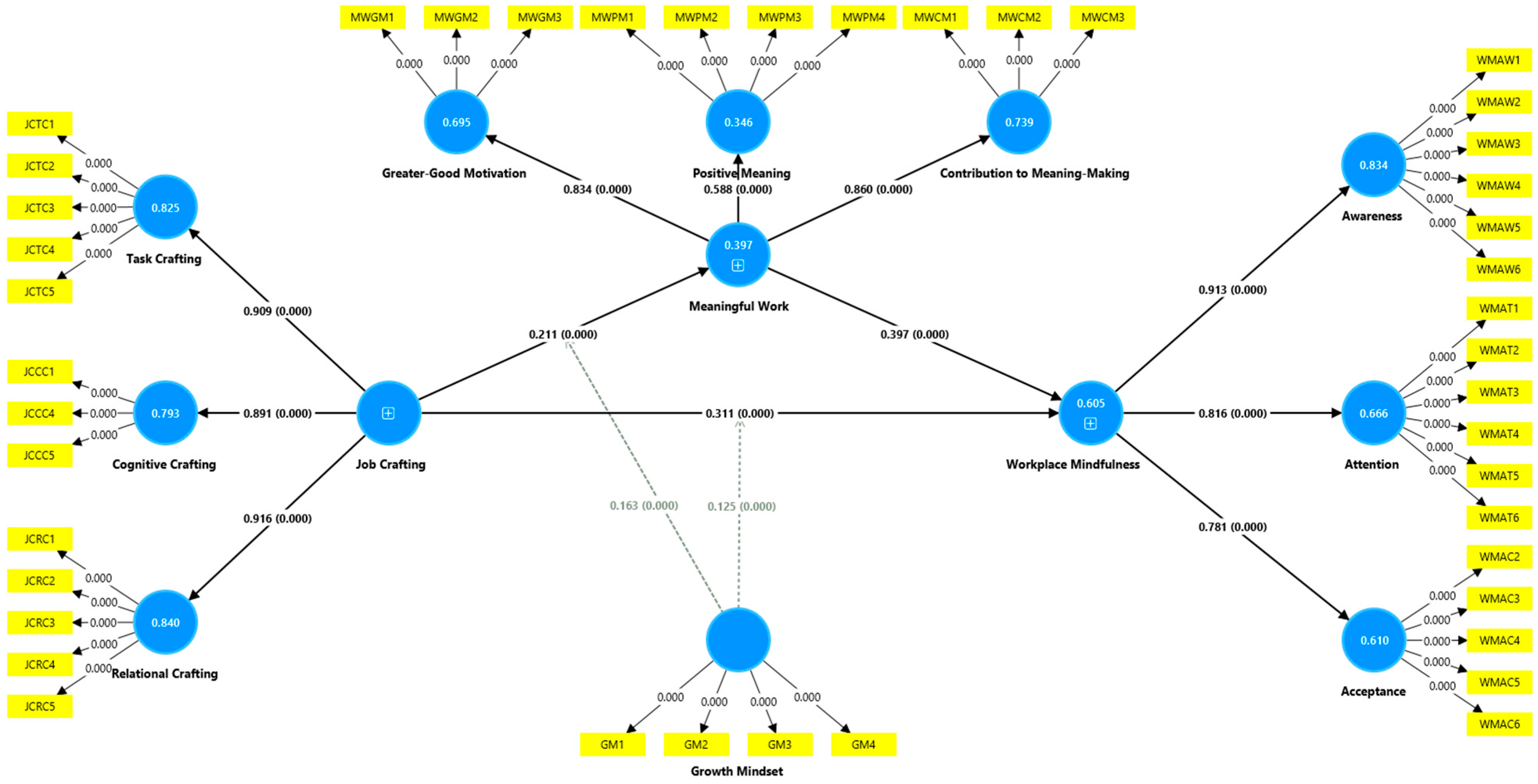
| JC → WM | 0.311 (0.000) | 0.059 | 5.259 | 0.197; 0.426 | Yes |
| JC → MW | 0.211 (0.000) | 0.058 | 3.666 | 0.108; 0.334 | Yes |
| MW → WM | 0.397 (0.000) | 0.042 | 9.516 | 0.313; 0.477 | Yes |
| Indirect effects | |||||
| JC → MW → WM | 0.084 (0.000) | 0.023 | 3.682 | 0.043; 0.132 | Yes |
| Interaction effects | |||||
| GM × JC → MW | 0.163 (0.000) | 0.036 | 4.540 | 0.092; 0.232 | Yes |
| GM × JC → WM | 0.125 (0.000) | 0.030 | 4.196 | 0.072; 0.189 | Yes |
| Conditional Indirect Effects of Meaningful Work at Level of Growth Mindset | 95% BOOT CI | |||
|---|---|---|---|---|
| BOOT Effect | BOOT SE | Lower | Upper | |
| Low-growth mindset | 0.09 | 0.03 | −0.03 | 0.13 |
| Medium-growth mindset | 0.13 | 0.02 | 0.18 | 0.28 |
| High-growth mindset | 0.27 | 0.04 | 0.21 | 0.34 |
Disclaimer/Publisher’s Note: The statements, opinions and data contained in all publications are solely those of the individual author(s) and contributor(s) and not of MDPI and/or the editor(s). MDPI and/or the editor(s) disclaim responsibility for any injury to people or property resulting from any ideas, methods, instructions or products referred to in the content. |
© 2026 by the authors. Licensee MDPI, Basel, Switzerland. This article is an open access article distributed under the terms and conditions of the Creative Commons Attribution (CC BY) license.
Share and Cite
Ghoumah, F.; Khadem, A.; Aljuhmani, H.Y.; Alzubi, A.B. Sustaining Workplace Mindfulness in the Hospitality Industry: The Roles of Job Crafting, Meaningful Work, and Growth Mindset. Sustainability 2026, 18, 5282. https://doi.org/10.3390/su18115282
Ghoumah F, Khadem A, Aljuhmani HY, Alzubi AB. Sustaining Workplace Mindfulness in the Hospitality Industry: The Roles of Job Crafting, Meaningful Work, and Growth Mindset. Sustainability. 2026; 18(11):5282. https://doi.org/10.3390/su18115282
Chicago/Turabian StyleGhoumah, Fathullah, Amir Khadem, Hasan Yousef Aljuhmani, and Ahmad Bassam Alzubi. 2026. "Sustaining Workplace Mindfulness in the Hospitality Industry: The Roles of Job Crafting, Meaningful Work, and Growth Mindset" Sustainability 18, no. 11: 5282. https://doi.org/10.3390/su18115282
APA StyleGhoumah, F., Khadem, A., Aljuhmani, H. Y., & Alzubi, A. B. (2026). Sustaining Workplace Mindfulness in the Hospitality Industry: The Roles of Job Crafting, Meaningful Work, and Growth Mindset. Sustainability, 18(11), 5282. https://doi.org/10.3390/su18115282