A Review of the Application of Machine Learning Models in Groundwater Resources Management and Quality Assessment
Abstract
1. Introduction
2. Bibliometric Overview
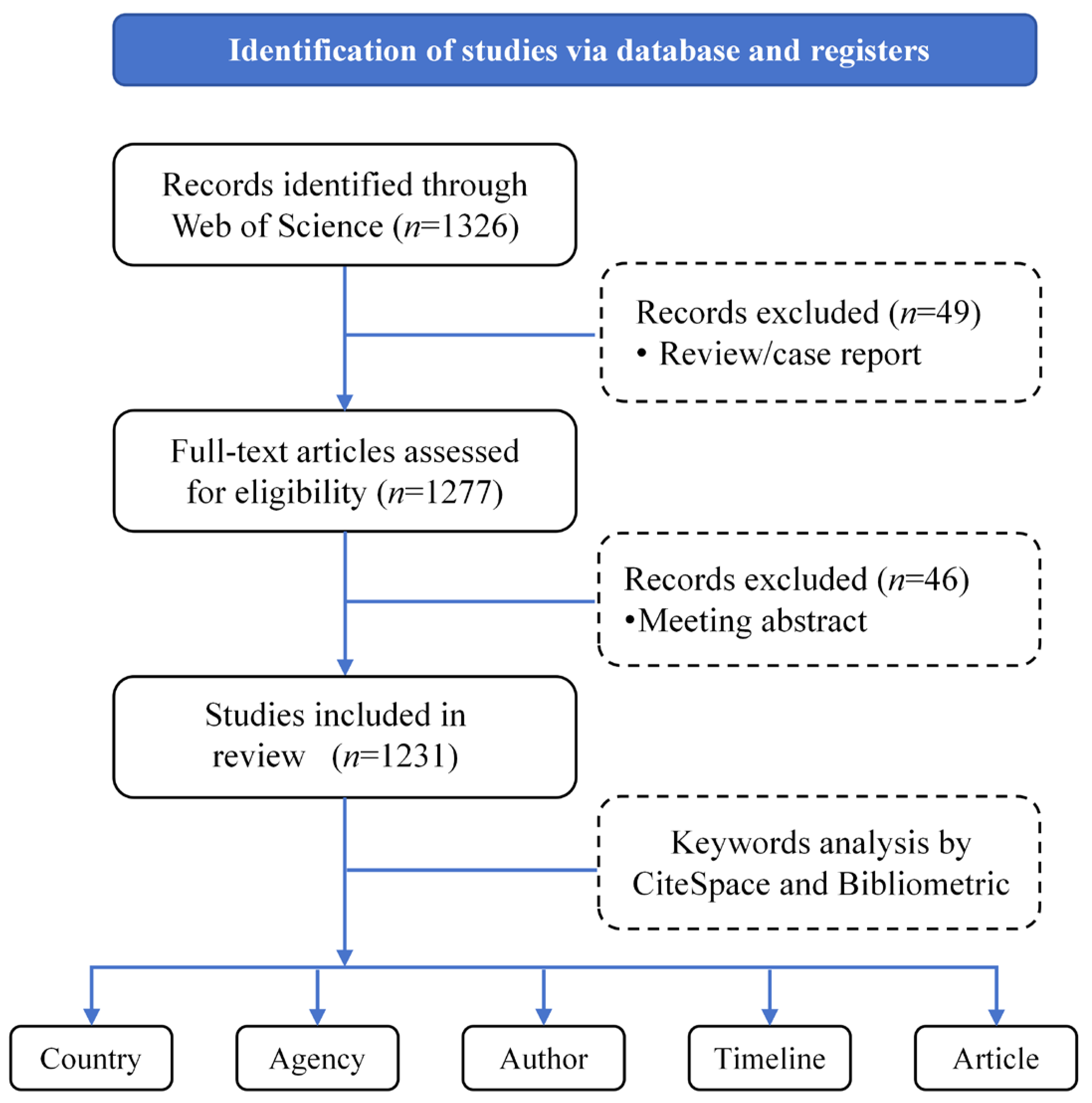
2.1. Data Collection
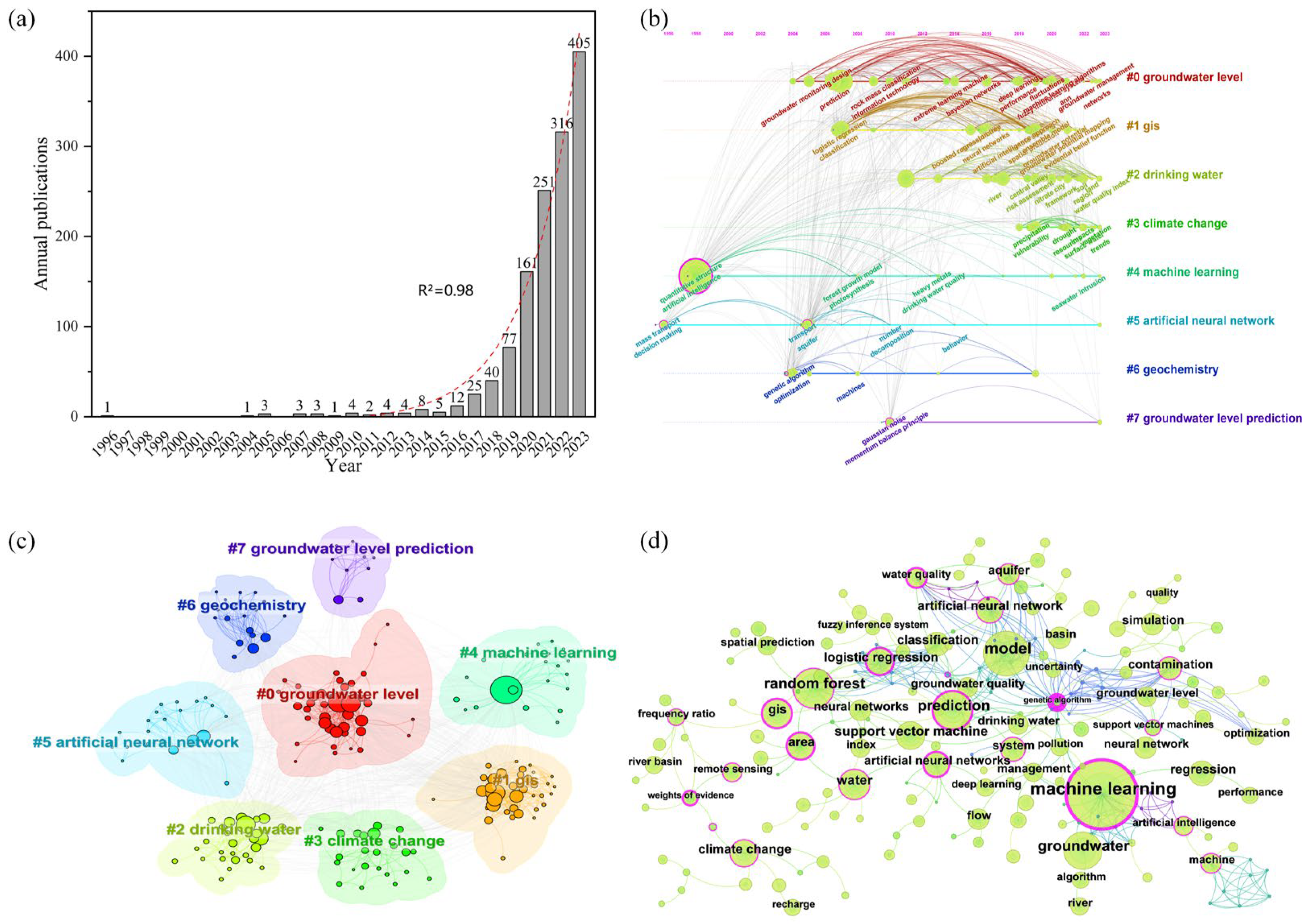
2.2. Research Evolution
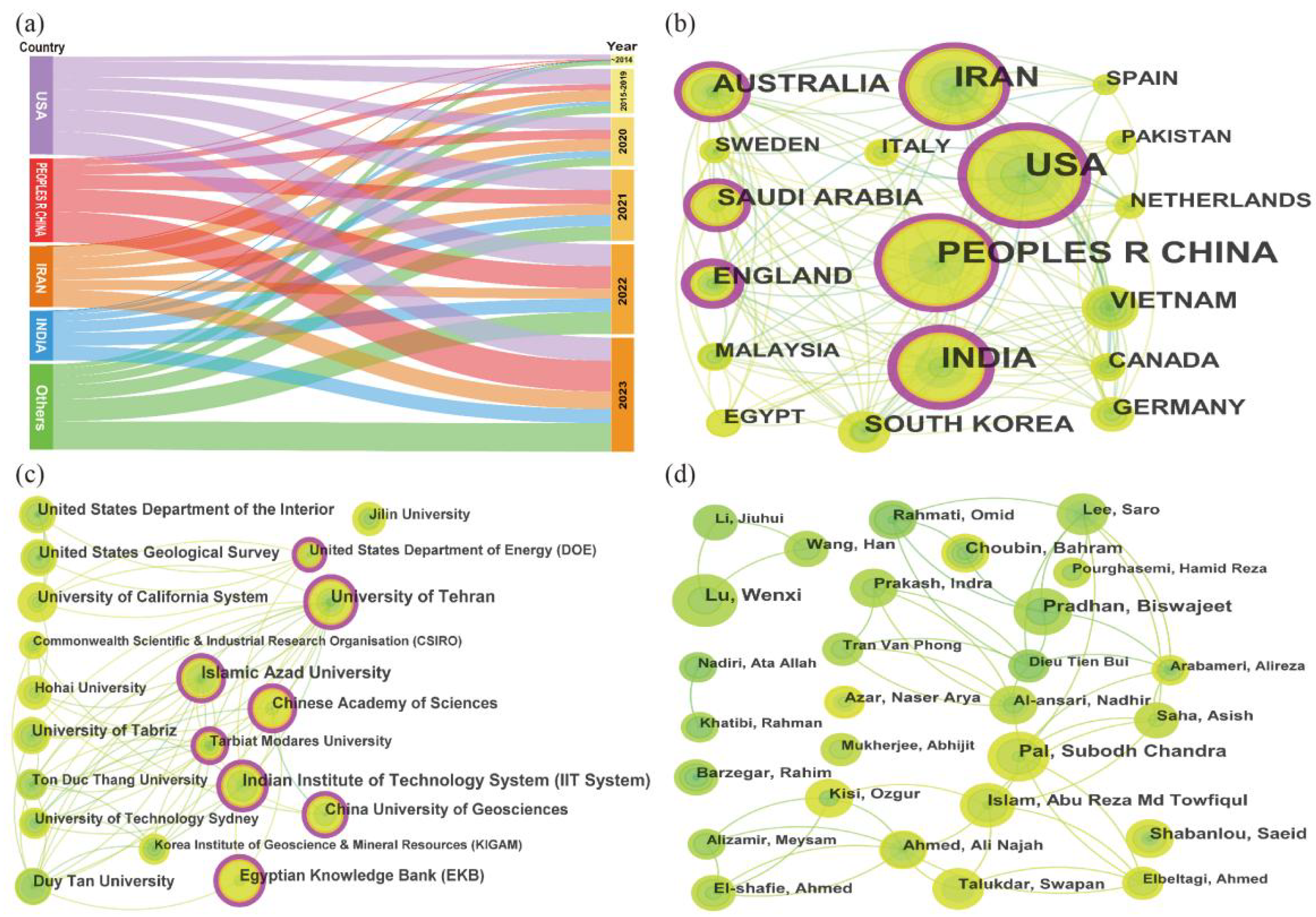
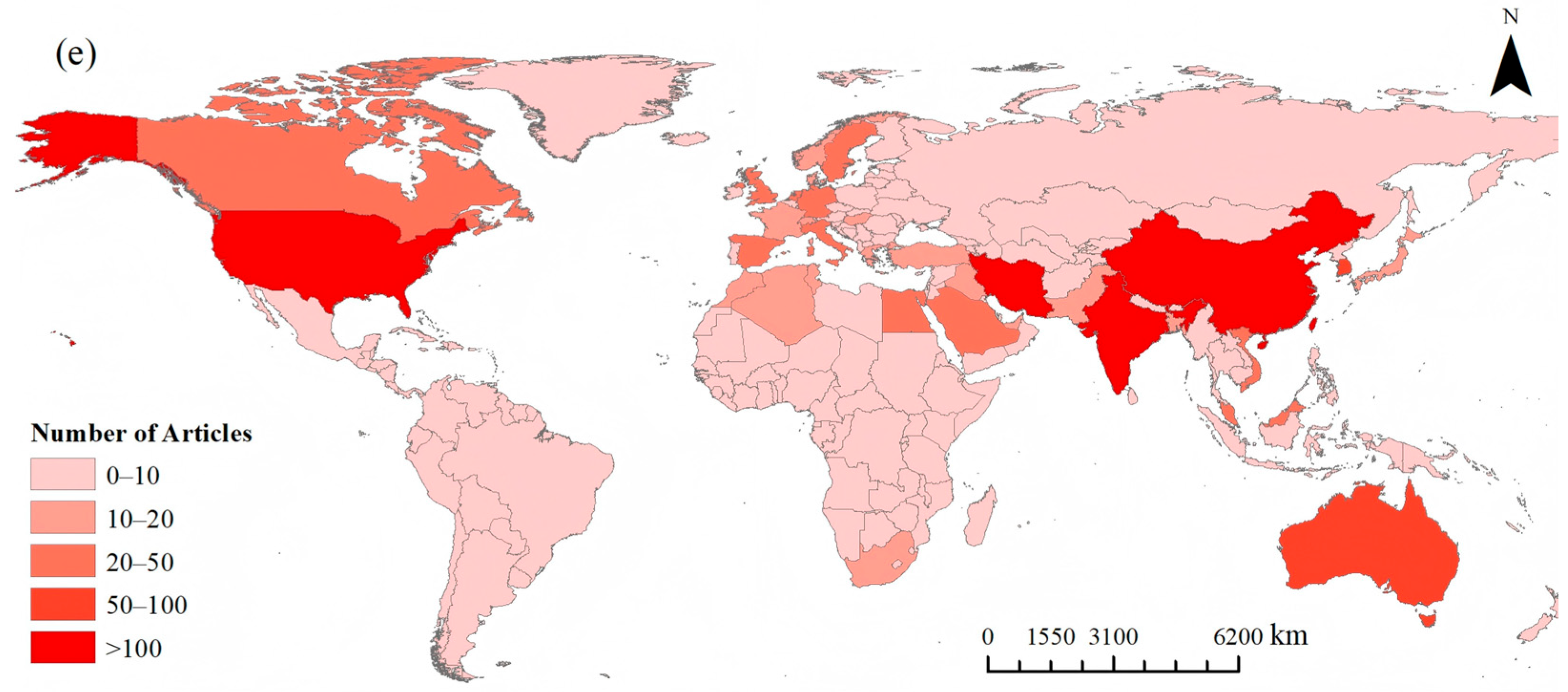
2.3. Geographical Distribution of ML Studies
2.4. Machine Learning Models
3. Application of Machine Learning Models in Groundwater Level and Quality Modeling
3.1. Background on Groundwater Prediction
3.2. Techniques Used in Groundwater Research
3.2.1. Support Vector Machine
3.2.2. Decision Tree
3.2.3. Random Forest
3.2.4. Artificial Neural Network
3.2.5. Logistic Regression
3.2.6. Genetic Algorithm

4. General Discussion
4.1. Supervised Learning Algorithm
4.2. Unsupervised Learning Algorithm
4.3. Comparison of Machine Learning Models with Conventional Methods
5. Future Research Direction
6. Conclusions
Author Contributions
Funding
Institutional Review Board Statement
Informed Consent Statement
Data Availability Statement
Conflicts of Interest
References
- Ghasemian, D.Z. Groundwater Management Using Remotely Sensed Data in High Plains Aquifer; The University of Arizona: Tucson, AZ, USA, 2016. [Google Scholar]
- Jain, M.; Fishman, R.; Mondal, P.; Galford, G.L.; Bhattarai, N.; Naeem, S.; Lall, U.; Balwinder, S.; DeFries, R.S. Groundwater depletion will reduce cropping intensity in India. Sci. Adv. 2021, 7, eabd2849. [Google Scholar] [CrossRef]
- Yin, Z.J.; Xu, Y.Y.; Zhu, X.Y.; Zhao, J.W.; Yang, Y.P.; Li, J. Variations of groundwater storage in different basins of China over recent decades. J. Hydrol. 2021, 598, 126282. [Google Scholar] [CrossRef]
- Koch, F.; Blum, P.; Korbel, K.; Menberg, K. Global overview on groundwater fauna. Ecohydrology 2024, 17, e2607. [Google Scholar] [CrossRef]
- Saccò, M.; Mammola, S.; Altermatt, F.; Alther, R.; Bolpagni, R.; Brancelj, A.; Brankovits, D.; Fišer, C.; Gerovasileiou, V.; Griebler, C.; et al. Groundwater is a hidden global keystone ecosystem. Glob. Change Biol. 2024, 30, e17066. [Google Scholar] [CrossRef]
- Noori, R.; Maghrebi, M.; Jessen, S.; Bateni, S.M.; Heggy, E.; Javadi, S.; Noury, M.; Pistre, S.; Abolfathi, S.; Aghakouchak, A. Decline in Iran’s groundwater recharge. Nat. Commun. 2023, 14, 6674. [Google Scholar] [CrossRef] [PubMed]
- Derdour, A.; Abdo, H.G.; Almohamad, H.; Alodah, A.; Al Dughairi, A.A.; Ghoneim, S.S.M.; Ali, E. Prediction of groundwater quality index using classification techniques in arid environments. Sustainability 2023, 15, 9687. [Google Scholar] [CrossRef]
- Qu, X.Y.; Shi, L.Q.; Han, J. Spatial evaluation of groundwater quality based on toxicological indexes and their effects on ecology and human health. J. Clean. Prod. 2022, 377, 134255. [Google Scholar] [CrossRef]
- Su, F.; Wu, J.; He, S. Set pair analysis-Markov chain model for groundwater quality assessment and prediction: A case study of Xi’an city, China. Hum. Ecol. Risk Assess. 2019, 25, 158–175. [Google Scholar] [CrossRef]
- Cai, H.J.; Shi, H.Y.; Liu, S.N.; Babovic, V. Impacts of regional characteristics on improving the accuracy of groundwater level prediction using machine learning: The case of central eastern continental United States. J. Hydrol. Reg. Stud. 2021, 37, 100930. [Google Scholar] [CrossRef]
- Liu, X.; Lu, D.W.; Zhang, A.Q.; Liu, Q.; Jiang, G.B. Data-Driven Machine learning in environmental pollution: Gains and problems. Environ. Sci. Technol. 2022, 56, 2124–2133. [Google Scholar] [CrossRef]
- Subbarayan, S.; Thiyagarajan, S.; Karuppannan, S.; Panneerselvam, B. Enhancing groundwater vulnerability assessment: Comparative study of three machine learning models and five classification schemes for Cuddalore district. Environ. Res. 2024, 242, 117769. [Google Scholar] [CrossRef]
- Chen, C.; He, W.; Zhou, H.; Xue, Y.R.; Zhu, M.D. A comparative study among machine learning and numerical models for simulating groundwater dynamics in the Heihe River Basin, northwestern China. Sci. Rep. 2020, 10, 3904. [Google Scholar] [CrossRef]
- Kumar, M.; Singh, P.; Singh, P. Machine learning and GIS-RS-based algorithms for mapping the groundwater potentiality in the Bundelkhand region, India. Ecol. Inform. 2023, 74, 101980. [Google Scholar] [CrossRef]
- Teimoori, S.; Olya, M.H.; Miller, C.J. Groundwater level monitoring network design with machine learning methods. J. Hydrol. 2023, 625, 130145. [Google Scholar] [CrossRef]
- Boo, K.B.W.; El-Shafie, A.; Othman, F.; Khan, M.M.H.; Birima, A.H.; Ahmed, A.N. Groundwater level forecasting with machine learning models: A review. Water Res. 2024, 252, 121249. [Google Scholar] [CrossRef] [PubMed]
- Zhang, X.; Dong, F.; Chen, G.; Dai, Z. Advance prediction of coastal groundwater levels with temporal convolutional and long short-term memory networks. Hydrol. Earth Syst. Sci. 2023, 27, 83–96. [Google Scholar] [CrossRef]
- Singh, A.; Patel, S.; Bhadani, V.; Kumar, V.; Gaurav, K. AutoML-GWL: Automated machine learning model for the prediction of groundwater level. Eng. Appl. Artif. Intell. 2024, 127, 107405. [Google Scholar] [CrossRef]
- Yadav, B.; Gupta, P.K.; Patidar, N.; Himanshu, S.K. Ensemble modelling framework for groundwater level prediction in urban areas of India. Sci. Total Environ. 2020, 712, 135539. [Google Scholar] [CrossRef]
- Liu, Q.; Gui, D.W.; Zhang, L.; Niu, J.; Dai, H.; Wei, G.H.; Hu, B.X. Simulation of regional groundwater levels in arid regions using interpretable machine learning models. Sci. Total Environ. 2022, 831, 154902. [Google Scholar] [CrossRef] [PubMed]
- Pandya, H.; Jaiswal, K.; Shah, M.A. A Comprehensive Review of Machine learning algorithms and its application in groundwater quality prediction. Arch. Comput. Methods Eng. 2024, 31, 4633–4654. [Google Scholar] [CrossRef]
- Haggerty, R.; Sun, J.X.; Yu, H.F.; Li, Y.S. Application of machine learning in groundwater quality modeling-A comprehensive review. Water Res. 2023, 233, 119745. [Google Scholar] [CrossRef]
- Ding, Y.Z.; Sun, Q.Y.; Lin, Y.Q.; Ping, Q.; Peng, N.; Wang, L.; Li, Y.M. Application of artificial intelligence in (waste)water disinfection: Emphasizing the regulation of disinfection by-products formation and residues prediction. Water Res. 2024, 253, 121267. [Google Scholar] [CrossRef] [PubMed]
- Chen, C.M. Science mapping: A systematic review of the literature. J. Data Inf. Sci. 2017, 2, 1–40. [Google Scholar] [CrossRef]
- Medina, M.A.; Jacobs, T.L.; Lin, W.C.; Lin, K.C. Ground water solute transport, optimal remediation planning, and decision making under uncertainty. Water Resour. Bull. 1996, 32, 1–12. [Google Scholar] [CrossRef]
- Tahmasebi, P.; Kamrava, S.; Bai, T.; Sahimi, M. Machine learning in geo- and environmental sciences: From small to large scale. Adv. Water Resour. 2020, 142, 103619. [Google Scholar] [CrossRef]
- Podgorski, J.; Berg, M. Global threat of arsenic in groundwater. Science 2020, 368, 845. [Google Scholar] [CrossRef]
- Chen, C.M. CiteSpace II: Detecting and visualizing emerging trends and transient patterns in scientific literature. J. Am. Soc. Inf. Sci. Technol. 2006, 57, 359–377. [Google Scholar] [CrossRef]
- Liu, Z.G.; Yin, Y.M.; Liu, W.D.; Dunford, M. Visualizing the intellectual structure and evolution of innovation systems research: A bibliometric analysis. Scientometrics 2015, 103, 135–158. [Google Scholar] [CrossRef]
- Khalil, A.; Almasri, M.N.; McKee, M.; Kaluarachchi, J.J. Applicability of statistical learning algorithms in groundwater quality modeling. Water Resour. Res. 2005, 41, W05010. [Google Scholar] [CrossRef]
- Khalil, A.F.; Kaheil, Y.H.; Gill, K.M.; McKee, M. Application of Learning Machines and Combinatorial Algorithms in Water Resources Management and Hydrologic Sciences; Utah State University: Logan, UT, USA, 2010; pp. 61–106. [Google Scholar]
- Wunsch, A.; Liesch, T.; Broda, S. Deep learning shows declining groundwater levels in Germany until 2100 due to climate change. Nat. Commun. 2022, 13, 1221. [Google Scholar] [CrossRef]
- Wu, C.C.; Zhang, X.Q.; Wang, W.J.; Lu, C.P.; Zhang, Y.; Qin, W.; Tick, G.R.; Liu, B.; Shu, L.C. Groundwater level modeling framework by combining the wavelet transform with a long short-term memory data-driven model. Sci. Total Environ. 2021, 783, 146948. [Google Scholar] [CrossRef]
- Naghibi, S.A.; Pourghasemi, H.R.; Dixon, B. GIS-based groundwater potential mapping using boosted regression tree, classification and regression tree, and random forest machine learning models in Iran. Environ. Monit. Assess. 2016, 188, 44. [Google Scholar] [CrossRef]
- Vafadar, S.; Rahimzadegan, M.; Asadi, R. Evaluating the performance of machine learning methods and Geographic Information System (GIS) in identifying groundwater potential zones in Tehran-Karaj plain, Iran. J. Hydrol. 2023, 624, 129952. [Google Scholar] [CrossRef]
- Chen, W.; Li, H.; Hou, E.K.; Wang, S.Q.; Wang, G.R.; Panahi, M.; Li, T.; Peng, T.; Guo, C.; Niu, C.; et al. GIS-based groundwater potential analysis using novel ensemble weights-of-evidence with logistic regression and functional tree models. Sci. Total Environ. 2018, 634, 853–867. [Google Scholar] [CrossRef]
- Erickson, M.L.; Elliott, S.M.; Brown, C.J.; Stackelberg, P.E.; Ransom, K.M.; Reddy, J.E.; Cravotta, C.A. Machine-learning predictions of high arsenic and high manganese at drinking water depths of the glacial aquifer system, northern continental United States. Environ. Sci. Technol. 2021, 55, 5791–5805. [Google Scholar] [CrossRef]
- Ransom, K.M.; Nolan, B.T.; Stackelberg, P.E.; Belitz, K.; Fram, M.S. Machine learning predictions of nitrate in groundwater used for drinking supply in the conterminous United States. Sci. Total Environ. 2022, 807, 151065. [Google Scholar] [CrossRef]
- Podgorski, J.E.; Labhasetwar, P.; Saha, D.; Berg, M. Prediction Modeling and Mapping of Groundwater Fluoride Contamination throughout India. Environ. Sci. Technol. 2018, 52, 9889–9898. [Google Scholar] [CrossRef] [PubMed]
- Xiong, J.H.; Abhishek; Guo, S.L.; Kinouchi, T. Leveraging machine learning methods to quantify 50 years of dwindling groundwater in India. Sci. Total Environ. 2022, 835, 155474. [Google Scholar] [CrossRef] [PubMed]
- Hasan, M.F.; Smith, R.; Vajedian, S.; Pommerenke, R.; Majumdar, S. Global land subsidence mapping reveals widespread loss of aquifer storage capacity. Nat. Commun. 2023, 14, 6180. [Google Scholar] [CrossRef]
- Chakraborty, M.; Sarkar, S.; Mukherjee, A.; Shamsudduha, M.; Ahmed, K.M.; Bhattacharya, A.; Mitra, A. Modeling regional-scale groundwater arsenic hazard in the transboundary Ganges River Delta, India and Bangladesh: Infusing physically-based model with machine learning. Sci. Total Environ. 2020, 748, 141107. [Google Scholar] [CrossRef] [PubMed]
- Sajedi-Hosseini, F.; Malekian, A.; Choubin, B.; Rahmati, O.; Cipullo, S.; Coulon, F.; Pradhan, B. A novel machine learning-based approach for the risk assessment of nitrate groundwater contamination. Sci. Total Environ. 2018, 644, 954–962. [Google Scholar] [CrossRef]
- Rogelj, J.; den Elzen, M.; Höhne, N.; Fransen, T.; Fekete, H.; Winkler, H.; Chaeffer, R.S.; Ha, F.; Riahi, K.; Meinshausen, M. Paris Agreement climate proposals need a boost to keep warming well below 2C. Nature 2016, 534, 631–639. [Google Scholar] [CrossRef]
- Barzegar, R.; Fijani, E.; Moghaddam, A.A.; Tziritis, E. Forecasting of groundwater level fluctuations using ensemble hybrid multi-wavelet neural network-based models. Sci. Total Environ. 2017, 599, 20–31. [Google Scholar] [CrossRef]
- Rezaie-Balf, M.; Naganna, S.R.; Ghaemi, A.; Deka, P.C. Wavelet coupled MARS and M5 Model Tree approaches for groundwater level forecasting. J. Hydrol. 2017, 553, 356–373. [Google Scholar] [CrossRef]
- Sahoo, S.; Russo, T.A.; Elliott, J.; Foster, I. Machine learning algorithms for modeling groundwater level changes in agricultural regions of the US. Water Resour. Res. 2017, 53, 3878–3895. [Google Scholar] [CrossRef]
- Erickson, M.L.; Elliott, S.M.; Christenson, C.A.; Krall, A.L. Predicting geogenic Arsenic in drinking water wells in Glacial Aquifers, North-Central USA: Accounting for Depth-Dependent Features. Water Resour. Res. 2018, 54, 10172–10187. [Google Scholar] [CrossRef]
- Kouadri, S.; Elbeltagi, A.; Islam, A.M.T.; Kateb, S. Performance of machine learning methods in predicting water quality index based on irregular data set: Application on Illizi region (Algerian southeast). Appl. Water Sci. 2021, 11, 190. [Google Scholar] [CrossRef]
- Arias-Estévez, M.; López-Periago, E.; Martínez-Carballo, E.; Simal-Gándara, J.; Mejuto, J.C.; García-Río, L. The mobility and degradation of pesticides in soils and the pollution of groundwater resources. Agric. Ecosyst. Environ. 2008, 123, 247–260. [Google Scholar] [CrossRef]
- Olivares, E.A.O.; Torres, S.S.; Jiménez, S.I.B.; Enríquez, J.O.C.; Zignol, F.; Reygadas, Y.; Tiefenbacher, J.P. Climate change, land use/land cover change, and population growth as drivers of groundwater depletion in the Central Valleys, Oaxaca, Mexico. Remote Sens. 2019, 11, 1290. [Google Scholar] [CrossRef]
- Yin, J.N.; Medellín-Azuara, J.; Escriva-Bou, A.; Liu, Z. Bayesian machine learning ensemble approach to quantify model uncertainty in predicting groundwater storage change. Sci. Total Environ. 2021, 769, 144715. [Google Scholar] [CrossRef] [PubMed]
- Lapworth, D.J.; Baran, N.; Stuart, M.E.; Ward, R.S. Emerging organic contaminants in groundwater: A review of sources, fate and occurrence. Environ. Pollut. 2012, 163, 287–303. [Google Scholar] [CrossRef]
- Di Salvo, C. Improving results of existing groundwater numerical models using machine learning techniques: A review. Water 2022, 14, 2307. [Google Scholar] [CrossRef]
- Chen, B.B.; Gong, H.L.; Chen, Y.; Li, X.J.; Zhou, C.F.; Lei, K.C.; Zhu, L.; Duan, L.; Zhao, X.X. Land subsidence and its relation with groundwater aquifers in Beijing Plain of China. Sci. Total Environ. 2020, 735, 139111. [Google Scholar] [CrossRef]
- Afrifa, S.; Zhang, T.; Appiahene, P.; Varadarajan, V. Mathematical and machine learning models for groundwater level changes: A systematic review and bibliographic analysis. Future Internet 2022, 14, 259. [Google Scholar] [CrossRef]
- Hussein, E.A.; Thron, C.; Ghaziasgar, M.; Bagula, A.; Vaccari, M. Groundwater prediction using machine-learning tools. Algorithms 2020, 13, 300. [Google Scholar] [CrossRef]
- Nguyen, P.T.; Ha, D.H.; Avand, M.; Jaafari, A.; Nguyen, H.D.; Al-Ansari, N.; Phong, T.V.; Sharma, R.; Kumar, R.; Le, H.V.; et al. Soft computing ensemble models based on logistic regression for groundwater potential mapping. Appl. Sci. 2020, 10, 2469. [Google Scholar] [CrossRef]
- Rahmati, O.; Falah, F.; Naghibi, S.A.; Biggs, T.; Soltani, M.; Deo, R.C.; Cerdà, A.; Mohammadi, F.; Bui, D.T. Land subsidence modelling using tree-based machine learning algorithms. Sci. Total Environ. 2019, 672, 239–252. [Google Scholar] [CrossRef]
- Sachdeva, S.; Kumar, B. A comparative study between frequency ratio model and gradient boosted decision trees with greedy dimensionality reduction in groundwater potential assessment. Water Resour. Manag. 2020, 34, 4593–4615. [Google Scholar] [CrossRef]
- Ghasemi, A.; Bahmani, O.; Akhavan, S.; Pourghasemi, H.R. Investigation of land-subsidence phenomenon and aquifer vulnerability using machine models and GIS technique. Nat. Hazards 2023, 118, 1645–1671. [Google Scholar] [CrossRef]
- Jiang, Z.W.; Yang, S.H.; Liu, Z.Y.; Xu, Y.; Shen, T.; Qi, S.T.; Pang, Q.Q.; Xu, J.Z.; Liu, F.P.; Xu, T. Can ensemble machine learning be used to predict the groundwater level dynamics of farmland under future climate: A 10-year study on Huaibei Plain. Environ. Sci. Pollut. Res. 2022, 29, 44653–44667. [Google Scholar] [CrossRef]
- Seifi, A.; Ehteram, M.; Singh, V.P.; Mosavi, A. Modeling and uncertainty analysis of groundwater level using six evolutionary optimization algorithms hybridized with ANFIS, SVM, and ANN. Sustainability 2020, 12, 4023. [Google Scholar] [CrossRef]
- Samani, S.; Vadiati, M.; Azizi, F.; Zamani, E.; Kisi, O. Groundwater level simulation using soft computing methods with emphasis on major meteorological components. Water Resour. Manag. 2022, 36, 3627–3647. [Google Scholar] [CrossRef]
- Xu, T.; Valocchi, A.J.; Choi, J.; Amir, E. Use of machine learning methods to reduce predictive error of groundwater models. Groundwater 2014, 52, 448–460. [Google Scholar] [CrossRef]
- Xue, D.M.; Pang, F.M.; Meng, F.Q.; Wang, Z.L.; Wu, W.L. Decision-tree-model identification of nitrate pollution activities in groundwater: A combination of a dual isotope approach and chemical ions. J. Contam. Hydrol. 2015, 180, 25–33. [Google Scholar] [CrossRef] [PubMed]
- Saghebian, S.M.; Sattari, M.T.; Mirabbasi, R.; Pal, M. Ground water quality classification by decision tree method in Ardebil region, Iran. Arab. J. Geosci. 2014, 7, 4767–4777. [Google Scholar] [CrossRef]
- Lee, S.; Lee, C.W. Application of decision-tree model to groundwater productivity-potential mapping. Sustainability 2015, 7, 13416–13432. [Google Scholar] [CrossRef]
- Duan, H.J.; Deng, Z.D.; Deng, F.F.; Wang, D.Q. Assessment of groundwater potential based on multicriteria decision making model and decision tree algorithms. Math. Probl. Eng. 2016, 2016, 2064575. [Google Scholar] [CrossRef]
- Chen, W.; Wang, Z.; Wang, G.R.; Ning, Z.X.; Lian, B.X.; Li, S.J.; Tsangaratos, P.; Ilia, I.; Xue, W.F. Optimizing rotation forest-based decision tree algorithms for groundwater potential mapping. Water 2023, 15, 2287. [Google Scholar] [CrossRef]
- Sachdeva, S.; Kumar, B. Comparison of gradient boosted decision trees and random forest for groundwater potential mapping in Dholpur (Rajasthan), India. Stoch. Environ. Res. Risk Assess. 2021, 35, 287–306. [Google Scholar] [CrossRef]
- Pal, S.; Kundu, S.; Mahato, S. Groundwater potential zones for sustainable management plans in a river basin of India and Bangladesh. J. Clean. Prod. 2020, 257, 120311. [Google Scholar] [CrossRef]
- Pham, Q.B.; Kumar, M.; Di Nunno, F.; Elbeltagi, A.; Granata, F.; Islam, A.M.T.; Talukdar, S.; Nguyen, X.C.; Ahmed, A.N.; Anh, D.T. Groundwater level prediction using machine learning algorithms in a drought-prone area. Neural Comput. Appl. 2022, 34, 10751–10773. [Google Scholar] [CrossRef]
- Rodriguez-Galiano, V.; Mendes, M.P.; Garcia-Soldado, M.J.; Chica-Olmo, M.; Ribeiro, L. Predictive modeling of groundwater nitrate pollution using Random Forest and multisource variables related to intrinsic and specific vulnerability: A case study in an agricultural setting (Southern Spain). Sci. Total Environ. 2014, 476, 189–206. [Google Scholar] [CrossRef]
- Wang, B.; Hipsey, M.R.; Ahmed, S.; Oldham, C. The impact of landscape characteristics on groundwater dissolved organic nitrogen: Insights from machine learning methods and sensitivity analysis. Water Resour. Res. 2018, 54, 4785–4804. [Google Scholar] [CrossRef]
- Judeh, T.; Almasri, M.N.; Shadeed, S.M.; Bian, H.B.; Shahrour, I. Use of GIS, Statistics and machine learning for groundwater quality management: Application to nitrate contamination. Water Resour. 2022, 49, 503–514. [Google Scholar] [CrossRef]
- Chen, Y.Y.; Song, L.H.; Liu, Y.Q.; Yang, L.; Li, D.L. A review of the artificial neural network models for water quality prediction. Appl. Sci. 2020, 10, 5776. [Google Scholar] [CrossRef]
- Darwishe, H.; El Khattabi, J.; Chaaban, F.; Louche, B.; Masson, E.; Carlier, E. Prediction and control of nitrate concentrations in groundwater by implementing a model based on GIS and artificial neural networks (ANN). Environ. Earth Sci. 2017, 76, 649. [Google Scholar] [CrossRef]
- Gemitzi, A.; Petalas, C.; Pisinaras, V.; Tsihrintzis, V.A. Spatial prediction of nitrate pollution in groundwaters using neural networks and GIS: An application to South Rhodope aquifer (Thrace, Greece). Hydrol. Process. 2009, 23, 372–383. [Google Scholar] [CrossRef]
- Heidarzadeh, N. A practical low-cost model for prediction of the groundwater quality using artificial neural networks. J. Water Supply Res. Technol.-Aqua 2017, 66, 86–95. [Google Scholar] [CrossRef]
- Nguyen, P.T.; Ha, D.H.; Jaafari, A.; Nguyen, H.D.; Phong, T.V.; Al-Ansari, N.; Prakash, I.; Le, H.V.; Pham, B.T. Groundwater potential mapping combining artificial neural network and real AdaBoost ensemble technique: The DakNong Province Case-study, Vietnam. Int. J. Environ. Res. Public Health 2020, 17, 2473. [Google Scholar] [CrossRef] [PubMed]
- El Bilali, A.; Taleb, A.; Brouziyne, Y. Groundwater quality forecasting using machine learning algorithms for irrigation purposes. Agric. Water Manag. 2021, 245, 106625. [Google Scholar] [CrossRef]
- Nolan, B.T.; Hitt, K.J.; Ruddy, B.C. Probability of nitrate contamination of recently recharged groundwaters in the conterminous United States. Environ. Sci. Technol. 2002, 36, 2138–2145. [Google Scholar] [CrossRef]
- Scott, M.L.; Shafroth, P.B.; Auble, G.T. Responses of riparian cottonwoods to alluvial water table declines. Environ. Manag. 1999, 23, 347–358. [Google Scholar] [CrossRef]
- Squillace, P.J.; Moran, M.J.; Lapham, W.W.; Price, C.V.; Clawges, R.M.; Zogorski, J.S. Volatile organic compounds in untreated ambient groundwater of the United States, 1985–1995. Environ. Sci. Technol. 1999, 33, 4176–4187. [Google Scholar] [CrossRef]
- Ozdemir, A. Using a binary logistic regression method and GIS for evaluating and mapping the groundwater spring potential in the Sultan Mountains (Aksehir, Turkey). J. Hydrol. 2011, 405, 123–136. [Google Scholar] [CrossRef]
- Lado, L.R.; Polya, D.A.; Hegan, A. A logistic regression method for mapping the As hazard risk in shallow, reducing groundwaters in Cambodia. Mineral. Mag. 2008, 72, 437–440. [Google Scholar] [CrossRef]
- Katoch, S.; Chauhan, S.S.; Kumar, V. A review on genetic algorithm: Past, present, and future. Multimed. Tools Appl. 2021, 80, 8091–8126. [Google Scholar] [CrossRef]
- McKinney, D.C.; Lin, M.D. Genetic algorith solution of groundwater-managemnet models. Water Resour. Res. 1994, 30, 1897–1906. [Google Scholar] [CrossRef]
- Yang, X.-S. Nature-inspired optimization algorithms: Challenges and open problems. J. Comput. Sci. 2020, 46, 101104. [Google Scholar] [CrossRef]
- Mahmod, W.E.; Mohamed, H.I.; Suleiman, A.H. Integrated approach for optimizing groundwater monitoring systems using evolutionary algorithms. Hydrol. Sci. J. 2021, 66, 1963–1978. [Google Scholar] [CrossRef]
- Banadkooki, F.B.; Ehteram, M.; Panahi, F.; Sammen, S.S.; Othman, F.B.; El-Shafie, A. Estimation of total dissolved solids (TDS) using new hybrid machine learning models. J. Hydrol. 2020, 587, 124989. [Google Scholar] [CrossRef]
- Kisi, O.; Azad, A.; Kashi, H.; Saeedian, A.; Hashemi, S.A.A.; Ghorbani, S. Modeling groundwater quality parameters using hybrid neuro-fuzzy methods. Water Resour. Manag. 2019, 33, 847–861. [Google Scholar] [CrossRef]
- Ritzel, B.J.; Eheart, J.W.; Ranjithan, S. Using genitc algorithms to solve a multiple-obective groundwater pollution containment-problem. Water Resour. Res. 1994, 30, 1589–1603. [Google Scholar] [CrossRef]
- Aryafar, A.; Khosravi, V.; Zarepourfard, H.; Rooki, R. Evolving genetic programming and other AI-based models for estimating groundwater quality parameters of the Khezri plain, Eastern Iran. Environ. Earth Sci. 2019, 78, 69. [Google Scholar] [CrossRef]
- Hosseini, S.M.; Mahjouri, N. Developing a fuzzy neural network-based support vector regression (FNN-SVR) for regionalizing nitrate concentration in groundwater. Environ. Monit. Assess. 2014, 186, 3685–3699. [Google Scholar] [CrossRef]
- Ransom, K.M.; Nolan, B.T.; Traum, J.A.; Faunt, C.C.; Bell, A.M.; Gronberg, J.A.M.; Wheeler, D.C.; Rosecrans, C.Z.; Jurgens, B.; Schwarz, G.E.; et al. A hybrid machine learning model to predict and visualize nitrate concentration throughout the Central Valley aquifer, California, USA. Sci. Total Environ. 2017, 601, 1160–1172. [Google Scholar] [CrossRef]
- Jalalkamali, A.; Jalalkamali, N. Groundwater modeling using hybrid of artificial neural network with genetic algorithm. Afr. J. Agric. Res. 2011, 6, 5775–5784. [Google Scholar] [CrossRef]
- Martínez-Santos, P.; Díaz-Alcaide, S.; De la Hera-Portillo, A.; Gómez-Escalonilla, V. Mapping groundwater-dependent ecosystems by means of multi-layer supervised classification. J. Hydrol. 2021, 603, 126873. [Google Scholar] [CrossRef]
- Aish, A.M.; Zaqoot, H.A.; Sethar, W.A.; Aish, D.A. Prediction of groundwater quality index in the Gaza coastal aquifer using supervised machine learning techniques. Water Pract. Technol. 2023, 18, 501–521. [Google Scholar] [CrossRef]
- Oh, J.; Kim, H.R.; Yu, S.; Kim, K.H.; Lee, J.H.; Park, S.; Kim, H.; Yun, S.T. A supervised machine learning approach to discriminate the effect of carcass leachate on shallow groundwater quality around on-farm livestock mortality burial sites. J. Hazard. Mater. 2023, 457, 131712. [Google Scholar] [CrossRef] [PubMed]
- Tesoriero, A.J.; Gronberg, J.A.; Juckem, P.F.; Miller, M.P.; Austin, B.P. Predicting redox-sensitive contaminant concentrations in groundwater using random forest classification. Water Resour. Res. 2017, 53, 7316–7331. [Google Scholar] [CrossRef]
- Mosavi, A.; Hosseini, F.S.; Choubin, B.; Abdolshahnejad, M.; Gharechaee, H.; Lahijanzadeh, A.; Dineva, A.A. Susceptibility prediction of groundwater hardness using ensemble machine learning models. Water 2020, 12, 2770. [Google Scholar] [CrossRef]
- Anjum, R.; Ali, S.A.; Siddiqui, M.A. Assessing the Impact of Land Cover on Groundwater Quality in a Smart City Using GIS and Machine Learning Algorithms. Water Air Soil Pollut. 2023, 234, 182. [Google Scholar] [CrossRef]
- Kumar, S.; Pati, J. Assessment of groundwater arsenic contamination level in Jharkhand, India using machine learning. J. Comput. Sci. 2022, 63, 101779. [Google Scholar] [CrossRef]
- Charulatha, G.; Srinivasalu, S.; Maheswari, O.U.; Venugopal, T.; Giridharan, L. Evaluation of ground water quality contaminants using linear regression and artificial neural network models. Arab. J. Geosci. 2017, 10, 128. [Google Scholar] [CrossRef]
- Nolan, B.T.; Fienen, M.N.; Lorenz, D.L. A statistical learning framework for groundwater nitrate models of the Central Valley, California, USA. J. Hydrol. 2015, 531, 902–911. [Google Scholar] [CrossRef]
- Víctor, G.E.; Marie-Louise, V.; Elisa, D.; Moussa, I.; Giaime, O.; Daira, D.; Pedro, M.S.; Francesco, H. Delineation of groundwater potential zones by means of ensemble tree supervised classification methods in the Eastern Lake Chad basin. Geocarto Int. 2022, 37, 8924–8951. [Google Scholar] [CrossRef]
- Naghibi, S.A.; Dashtpagerdi, M.M. Evaluation of four supervised learning methods for groundwater spring potential mapping in Khalkhal region (Iran) using GIS-based features. Hydrogeol. J. 2017, 25, 169–189. [Google Scholar] [CrossRef]
- Gao, S.L.; Xu, M.H.; Zhao, L.X.; Chen, Y.Y.; Geng, J.H. Seismic predictions of fluids via supervised deep learning: Incorporating various class-rebalance strategies. Geophysics 2023, 88, M185–M200. [Google Scholar] [CrossRef]
- Knoll, L.; Breuer, L.; Bach, M. Nation-wide estimation of groundwater redox conditions and nitrate concentrations through machine learning. Environ. Res. Lett. 2020, 15, 064004. [Google Scholar] [CrossRef]
- Barlow, H.B. Unsupervised Learning. Neural Comput. 1989, 1, 295–311. [Google Scholar] [CrossRef]
- Narvaez-Montoya, C.; Mahlknecht, J.; Torres-Martínez, J.A.; Mora, A.; Bertrand, G. Seawater intrusion pattern recognition supported by unsupervised learning: A systematic review and application. Sci. Total Environ. 2023, 864, 160933. [Google Scholar] [CrossRef]
- Friedel, M.J.; Wilson, S.R.; Close, M.E.; Buscema, M.; Abraham, P.; Banasiak, L. Comparison of four learning-based methods for predicting groundwater redox status. J. Hydrol. 2020, 580, 124200. [Google Scholar] [CrossRef]
- Wu, T.N.; Su, C.S. Application of principal component analysis and clustering to spatial allocation of groundwater contamination. In Proceedings of the Fifth International Conference on Fuzzy Systems and Knowledge Discovery, Jinan, China, 18–20 October 2008; IEEE: New York, NY, USA, 2008; Volume 4, pp. 236–240. [Google Scholar]
- Yang, J.; Ye, M.; Tang, Z.H.; Jiao, T.; Song, X.Y.; Pei, Y.Z.; Liu, H.H. Using cluster analysis for understanding spatial and temporal patterns and controlling factors of groundwater geochemistry in a regional aquifer. J. Hydrol. 2020, 583, 124594. [Google Scholar] [CrossRef]
- Vesselinov, V.V.; Alexandrov, B.S.; O’Malley, D. Contaminant source identification using semi-supervised machine learning. J. Contam. Hydrol. 2018, 212, 134–142. [Google Scholar] [CrossRef] [PubMed]
- Devic, G.; Djordjevic, D.; Sakan, S. Natural and anthropogenic factors affecting the groundwater quality in Serbia. Sci. Total Environ. 2014, 468, 933–942. [Google Scholar] [CrossRef]
- Helena, B.; Pardo, R.; Vega, M.; Barrado, E.; Fernandez, J.M.; Fernandez, L. Temporal evolution of groundwater composition in an alluvial aquifer (Pisuerga River, Spain) by principal component analysis. Water Res. 2000, 34, 807–816. [Google Scholar] [CrossRef]
- Nakagawa, K.; Amano, H.; Berndtsson, R. Spatial Characteristics of groundwater chemistry in Unzen, Nagasaki, Japan. Water 2021, 13, 426. [Google Scholar] [CrossRef]
- Nanni, A.; Roisenberg, A.; Fachel, J.M.G.; Mesquita, G.; Danieli, C. Fluoride characterization by principal component analysis in the hydrochemical facies of Serra Geral Aquifer System in Southern Brazil. An. Acad. Bras. Cienc. 2008, 80, 693–701. [Google Scholar] [CrossRef][Green Version]
- Cloutier, V.; Lefebvre, R.; Therrien, R.; Savard, M.M. Multivariate statistical analysis of geochemical data as indicative of the hydrogeochemical evolution of groundwater in a sedimentary rock aquifer system. J. Hydrol. 2008, 353, 294–313. [Google Scholar] [CrossRef]
- Sahu, P.; Sikdar, P.K. Hydrochemical framework of the aquifer in and around East Kolkata Wetlands, West bengal, India. Environ. Geol. 2008, 55, 823–835. [Google Scholar] [CrossRef]
- Zhang, B.; Song, X.F.; Zhang, Y.H.; Han, D.M.; Tang, C.Y.; Yu, Y.L.; Ma, Y. Hydrochemical characteristics and water quality assessment of surface water and groundwater in Songnen plain, Northeast China. Water Res. 2012, 46, 2737–2748. [Google Scholar] [CrossRef]
- Kim, J.H.; Kim, R.H.; Lee, J.; Cheong, T.J.; Yum, B.W.; Chang, H.W. Multivariate statistical analysis to identify the major factors governing groundwater quality in the coastal area of Kimje, South Korea. Hydrol. Process. 2005, 19, 1261–1276. [Google Scholar] [CrossRef]
- Reghunath, R.; Murthy, T.R.S.; Raghavan, B.R. The utility of multivariate statistical techniques in hydrogeochemical studies: An example from Karnataka, India. Water Res. 2002, 36, 2437–2442. [Google Scholar] [CrossRef]
- Chen, K.P.; Jiao, J.J.; Huang, J.M.; Huang, R.Q. Multivariate statistical evaluation of trace elements in groundwater in a coastal area in Shenzhen, China. Environ. Pollut. 2007, 147, 771–780. [Google Scholar] [CrossRef]
- Huang, G.X.; Sun, J.C.; Zhang, Y.; Chen, Z.Y.; Liu, F. Impact of anthropogenic and natural processes on the evolution of groundwater chemistry in a rapidly urbanized coastal area, South China. Sci. Total Environ. 2013, 463, 209–221. [Google Scholar] [CrossRef]
- Wu, J.H.; Li, P.Y.; Wang, D.; Ren, X.F.; Wei, M.J. Statistical and multivariate statistical techniques to trace the sources and affecting factors of groundwater pollution in a rapidly growing city on the Chinese Loess Plateau. Hum. Ecol. Risk Assess. 2020, 26, 1603–1621. [Google Scholar] [CrossRef]
- Ratolojanahary, R.; Ngouna, R.H.; Medjaher, K.; Dauriac, F.; Sebilo, M. Groundwater quality assessment combining supervised and unsupervised methods. In Proceedings of the IFAC PapersOnline; IFAC: New York, NY, USA, 2019; pp. 340–345. [Google Scholar]
- Sahour, H.; Gholami, V.; Vazifedan, M. A comparative analysis of statistical and machine learning techniques for mapping the spatial distribution of groundwater salinity in a coastal aquifer. J. Hydrol. 2020, 591, 125321. [Google Scholar] [CrossRef]
- Feng, W.; Shum, C.K.; Zhong, M.; Pan, Y. Groundwater storage changes in China from satellite gravity: An overview. Remote Sens. 2018, 10, 674. [Google Scholar] [CrossRef]
- Khan, J.; Lee, E.K.Y.; Balobaid, A.S.; Kim, K. A Comprehensive review of conventional, machine leaning, and deep learning models for groundwater level (GWL) forecasting. Appl. Sci. 2023, 13, 2743. [Google Scholar] [CrossRef]
- Condon, L.E.; Kollet, S.; Bierkens, M.F.P.; Fogg, G.E.; Maxwell, R.M.; Hill, M.C.; Fransen, H.J.H.; Verhoef, A.; Van Loon, A.F.; Sulis, M.; et al. Global groundwater modeling and monitoring: Opportunities and challenges. Water Resour. Res. 2021, 57, e2020WR029500. [Google Scholar] [CrossRef]
- Tao, H.; Hameed, M.M.; Marhoon, H.A.; Zounemat-Kermani, M.; Heddam, S.; Kim, S.; Sulaiman, S.O.; Tan, M.L.; Sa’adi, Z.; Mehrm, A.D.; et al. Groundwater level prediction using machine learning models: A comprehensive review. Neurocomputing 2022, 489, 271–308. [Google Scholar] [CrossRef]
- Elsayed, A.; Levison, J.; Binns, A.; Larocque, M.; Goel, P. A review of machine learning applications in the prediction of selected groundwater quality parameters: Key lessons, knowledge gaps, and future directions. Sci. Total Environ. 2026, 1027, 181693. [Google Scholar] [CrossRef]



| Target Expression | Search Keywords |
|---|---|
| Groundwater | “groundwater” or “ground water” |
| Machine learning (ML) | “machine learning” or “machine learning models” or “artificial intelligence” |
Disclaimer/Publisher’s Note: The statements, opinions and data contained in all publications are solely those of the individual author(s) and contributor(s) and not of MDPI and/or the editor(s). MDPI and/or the editor(s) disclaim responsibility for any injury to people or property resulting from any ideas, methods, instructions or products referred to in the content. |
© 2026 by the authors. Licensee MDPI, Basel, Switzerland. This article is an open access article distributed under the terms and conditions of the Creative Commons Attribution (CC BY) license.
Share and Cite
Liu, Q.; Liang, K.; Xia, F.; Yun, Z.; Deng, S.; Han, X.; Yang, Y.; Jiang, Y. A Review of the Application of Machine Learning Models in Groundwater Resources Management and Quality Assessment. Sustainability 2026, 18, 5261. https://doi.org/10.3390/su18115261
Liu Q, Liang K, Xia F, Yun Z, Deng S, Han X, Yang Y, Jiang Y. A Review of the Application of Machine Learning Models in Groundwater Resources Management and Quality Assessment. Sustainability. 2026; 18(11):5261. https://doi.org/10.3390/su18115261
Chicago/Turabian StyleLiu, Qiyuan, Kunjie Liang, Fu Xia, Zhichao Yun, Sheng Deng, Xu Han, Yu Yang, and Yonghai Jiang. 2026. "A Review of the Application of Machine Learning Models in Groundwater Resources Management and Quality Assessment" Sustainability 18, no. 11: 5261. https://doi.org/10.3390/su18115261
APA StyleLiu, Q., Liang, K., Xia, F., Yun, Z., Deng, S., Han, X., Yang, Y., & Jiang, Y. (2026). A Review of the Application of Machine Learning Models in Groundwater Resources Management and Quality Assessment. Sustainability, 18(11), 5261. https://doi.org/10.3390/su18115261