Article

AHP in Design for Six Sigma Project Selection

1
AGH Doctoral School, AGH University of Krakow, Al. Mickiewicza 30, 30-059 Krakow, Poland
2
Faculty of Management, AGH University of Krakow, Ul. Gramatyka 10, 30-067 Krakow, Poland
*
Author to whom correspondence should be addressed.
Sustainability 2026, 18(11), 5258; https://doi.org/10.3390/su18115258 (registering DOI)
Submission received: 25 February 2026 / Revised: 15 April 2026 / Accepted: 19 May 2026 / Published: 23 May 2026
(This article belongs to the Special Issue Innovative Development and Application of Sustainable Management)

Abstract

Effective project selection is a critical determinant of success for Design for Six Sigma (DFSS), particularly in automotive environments defined by high technical complexity and constrained resources. Because these selection tasks involve competing priorities, they are fundamentally multi-criteria decision-making (MCDA) problems that directly impact a company’s economic performance. This paper proposes a hybrid decision-support framework that integrates the Analytic Hierarchy Process (AHP) with a normalized scoring model. In this approach, classical AHP pairwise comparisons are used to derive consistent criteria weights, while project alternatives are evaluated on a 1–10 normalized scale to ensure the model remains scalable and practical for an industrial setting. The framework was empirically validated through a case study in an automotive company evaluating twelve DFSS project concepts. The results reveal that experts prioritize Product Quality (33%) and Cost/Functionality (33%) above all other factors, with these two criteria accounting for 66% of the total decision weight. Furthermore, the study established classification rules where projects scoring above 7.2 showed high implementation potential, while those below 5.2 were frequently discontinued. This structured approach enables a transparent and justifiable prioritization process that supports economic and operational sustainability by significantly reducing wasted engineering hours and prototype costs.

1. Introduction

Six Sigma gained popularity due to its proven success in decreasing defects and reducing costs in companies such as Motorola and General Electric [1]. The method is perceived as an easy-to-use and adaptable framework for accomplishing, maintaining and boosting achievements [2]. It has been successfully applied in manufacturing and other industries and one of its more prominent characteristics is a systemic approach with DMAIC methodology [3]. Beyond process improvements Six Sigma is a valuable method for product or service design, assuring high-quality solutions and customer satisfaction. Systemic project approach to design tasks, utilizing DMADV method, is characteristic of Design for Six Sigma (DFSS). DFSS has been quickly adopted by the automotive industry due to its capability of fulfilling the requirements for massive availability of reliable and robust products of advanced technology.
The scope of this paper is to share the approach taken by the authors to address the challenge of Six Sigma project selection, with special focus towards product development work in automotive industry. In modern environment continuous process improvement requires to be well-planned to optimize cost and resources of the efforts and maximize the benefits. Cost and resource management, together with corresponding utilization and optimization of the resources and investments, is perceived as a critical success factor for Six Sigma implementation [4]. Publications related to the method concentrate on individual tasks for management and project teams in the early stages of program adaptation but also analyze the detailed organizational aspects that affect successful implementation [5]. One of those is errorless Six Sigma project selection to drive efficient process and product improvements. In fact, the task of project selection is perceived also as critical factor for Six Sigma success, and many authors list it in proposed implementation models [6,7,8,9].
In this paper, authors proposed usage of the Analytic Hierarchy Process (AHP) for Design for Six Sigma project selection. AHP is a reliable, rigorous, and robust method for eliciting and quantifying subjective judgments in multi-criteria decision-making (MCDM) [10]. The proposed model was introduced among groups of engineers using DFSS approach for product development in automotive industry. The solution brings significant benefit, allowing objective measures to be assigned to the projects, making project selection easier to justify.
Authors see significant potential in using the method for Design for Six Sigma project selection with important managerial implications, such as efficient use of given resources or cost saving as the effect of investment avoidance in low-potential projects. Having that in mind, research questions can be formulated as follows: how can a scalable and transparent decision-support method be designed to support the selection and prioritization of Design for Six Sigma (DFSS) projects in industrial product development environments?
This paper introduces a Design for Six Sigma project selection method that integrates AHP with a scoring model, allowing development teams to pinpoint projects with strong implementation prospects and allocate development resources more effectively, ultimately lowering total development costs. The main contribution of the paper is methodological: it presents a hybrid decision-support framework for DFSS project selection that merges AHP-based weighting of criteria with a normalized scoring model for project assessment, and it is demonstrated through an industrial case study. However, the data used to address the research questions are restricted to a non-significant number of projects from a single development hub. The research question, as currently framed, would benefit from additional data collected across multiple development teams.
It is important to clarify that the presented framework is not designed as a normative mathematical proof or a prescriptive optimization model that yields an objectively “optimal” solution under strict axiomatic assumptions.
Instead, it is conceived as a descriptive decision-support tool, grounded in multi-criteria decision-analysis, whose primary purpose is to structure and transparently aggregate expert judgments in the context of Design for Six Sigma (DFSS) project selection. By combining Analytic Hierarchy Process-based criteria weighting with a normalized scoring mechanism, the model supports informed managerial reasoning under uncertainty, while preserving practical usability and scalability in industrial environments. In this sense, the framework supports decision makers by increasing transparency and consistency in project prioritization rather than replacing managerial judgment or claiming universal optimality.
This paper is structured as follows: Introduction section is followed by Materials and Methods section where authors elucidate the principles of Six Sigma approach, with special focus on Design for Six Sigma and tasks related to efficient usage of the methodology. Project selection and its importance are presented based on the literature review. Also, authors bring the concept of AHP in its basic scope and function. In first part of Results section authors describe the approach with details, using the example criteria from the case study based on the automotive company. Second part of Results section provides further example of the method in use based on the comparison of twelve projects. Discussion provides the author’s view on the benefits and limitations of the described approach. Lastly, Conclusions section summarizes the proposed method.

2. Materials and Methods

2.1. Six Sigma and Design for Six Sigma

Six Sigma is a structured, quantitative approach for improving the quality of products and processes [11]. Selection of this methodology provides a familiar approach through which we not only aim to deliver operational and financial gains, but also those related to broader sustainability perspective—social, economic, and environmental [12]. Companies that introduced Six Sigma successfully reached higher quality levels and customer satisfaction, better product designs and process performance.
Six Sigma originated in the 1980s as a corporate strategy containing a set of techniques for improvement of manufacturing processes and the elimination of defects in the Motorola company. The main goal of the strategy was to minimize the dispersion of the characteristics critical for quality of the manufactured products and performed processes, as well as setting of the average values approaching the target values defined by the customers [13].
Frequently related to the Six Sigma concept is DMAIC model—the structured, project-based approach to problem solving including the following phases [14]:
  • Define, with the scope of problem identification and problem-solving team establishment;
  • Measure, with data collection and analysis;
  • Analyze, with identification and prioritization of root cause of the problem;
  • Improve, with removal of real and relevant root causes;
  • Control, where Critical to Quality characteristics are monitored to ensure that the performance is improving and the process is stable.
However, Six Sigma in its scope reaches greatly further than only project work. In fact, to properly define the concept Six Sigma must be understood from the following several views [15]:
6.
Metric view—mainly focused on the quality score or other KPIs affecting company financial results;
7.
Tool view—focused on the problem-solving statistical and quality-related tools;
8.
Project view—with DMAIC, in case of process optimization or DMADV phases in product or process design;
9.
Program view—perceived as all activities in the organization that allow Six Sigma to be successful, from strategic tasks and multiple project managements through aspects of company culture;
10.
Philosophical view—with foundational focus on customer- and data-driven decisions.
Six Sigma has two main strategies, DMAIC and DMADV. The Define, Measure, Analyze, Improve, and Control (DMAIC) strategy is used for process improvement and Define, Measure, Analyze, Design, and Validate for product improvement [2]. Each phase of DMADV has its own objective; at the end of the last phase, it will have come to a design in line with the Design for Six Sigma methodology [16]:
  • Define. During the first phase, information is collected on the client’s requests and needs. Specifically, it is important to note what problems the customer encounters when approaching a specific product already on the market;
  • Measure. In this phase the Quality Function Deployment (QFD) analysis is carried out to translate the customer’s needs into engineering information. In this way it is possible to obtain those characteristics linked to the design that influence whether the customer’s requests are respected or not;
  • Analyze. The key features obtained in the second phase are used to conceive the design of the new product. For this purpose, a benchmarking analysis is carried out, which allows us to study similar designs of competitive models with the product in question;
  • Design. Depending on the results obtained from the analysis phase, we proceed with the design of the new product. In this phase, all the information obtained from the previous points must be taken into consideration and attempts must be made to respect them to the best extent possible;
  • Validate. In this last phase, it is stated with certainty that the finished product confirms the expected results. It is possible to produce prototypes to be tested to ensure that the product is in line with the required characteristics.
Design for Six Sigma is perceived as efficient product development method especially when the complexity level of the product increases in terms of, for example, number of components, material used, manufacturing processes, etc. [17]. For both optimization-oriented and design-oriented methods, selection of the problem to be addressed by the project team is critical.

2.2. Project Selection in Six Sigma

To reach Design for Six Sigma program expected performance, similarly to Six Sigma for the process optimization, companies need to act within strategic-, project- and culture-oriented areas. Project selection tasks are present in every area of the Six Sigma program in the company. Strategy set by the management should include a definition of project selection criteria [6]. Selection of the problem to tackle is directly affecting project teams; therefore, it is present in the tactical area of Six Sigma program as well. Finally, proper project selection has a significant effect on team behavior and motivation during the problem solving, which is strongly related to the organization culture aspects.
Typically project selection process begins with a review of project ideas against predefined and clearly specified criteria [18]. For optimization projects, such criteria may include, for instance, the cost of poor quality, the estimated duration of the project, or the availability of data. For projects related to product development, the criteria may include potential reductions in product manufacturing costs, the level of risk associated with the functionality of the new technical system, or the estimated resources required for task execution. Ultimately, the selection of the most promising project idea is based on a strategic decision that reflects what is most important for the enterprise and its customers [18].
The selection of tasks for project teams in Six Sigma organizations is most often preceded by an analysis of organizational needs and the current business situation [18]. Key process indicators (KPIs) are frequently helpful during project selection. However, in many cases, such indicators alone are insufficient, and additional parameters must also be considered when choosing tasks for project teams.
The selection of projects, including the assignment of appropriate priorities, constitutes a critical factor influencing the success of the Six Sigma methodology within an organization. Numerous researchers emphasize the necessity of choosing suitable optimization projects, as such decisions translate not only into financial success but also into employee motivation.
Desai and Antony, based on studies conducted among enterprises in India, highlight the need for proper project selection and prioritization. The authors underscore the importance of choosing projects according to their potential benefits for the enterprise, their relevance to the customer, and their focus on organizational areas exhibiting unsatisfactory performance [19].
Antony and Kumar, examining small and medium-sized enterprises in the United Kingdom that have implemented Six Sigma, identify appropriate project selection as one of the five leading factors contributing to the success of Six Sigma in an organization [20].
Sandholm and Sörqvist also recognize project selection as one of twelve key factors essential for successful Six Sigma implementation. They note that the responsibility for proper project selection lies with operational management. The authors point to several approaches to project selection—such as focusing on projects with the highest potential financial return or those likely to produce quick results. They also identify the Pareto tool as helpful in assigning projects to project teams [21].
Similar conclusions are drawn by Cheng, who emphasizes that Six Sigma is inherently a project-based methodology. According to the author, proper project selection should maximize the financial benefits for the enterprise. Cheng additionally highlights the necessity of linking project initiatives with the company’s business objectives [22].
Chakraborty and Leyer, studying organizations in the financial sector, point to the need for establishing indicators that support project selection. Among typical indicators are factors such as increased productivity, process stabilization, likelihood of success, financial benefits, cycle time reduction, as well as the availability of a project sponsor and necessary resources. Project selection is carried out with reference to these predefined indicators [23].
The selection of projects to be executed using the DFSS methodology constitutes a crucial step within the Six Sigma framework. This task is particularly significant in engineering design groups due to the typically long duration of development activities. An improper selection of projects may result in the need to discontinue a project due to competing priorities or other organizational constraints. For the enterprise, such interruptions lead to losses in engineering time as well as financial costs associated with project execution, for instance, the cost of prototype materials.
As demonstrated by the studies above, project selection is vital to the successful implementation of the Six Sigma methodology within an organization. Particularly important appears to be the identification of development projects related to product design. Considering this aspect, the Six Sigma deployment teams shall place special emphasis on methods for project selection.

2.3. Project Selection Methods in Six Sigma

Previous studies addressing Six Sigma and Design for Six Sigma (DFSS) project selection consistently recognize this task as a multi-criteria decision-making problem involving competing economic, technical, and organizational objectives [24,25,26,27]. The literature reports a wide range of approaches, including heuristic prioritization matrices and weighted scorecards [25,26], classical multi-criteria decision-analysis methods such as the Analytic Hierarchy Process (AHP) and Analytic Network Process (ANP) [28,29,30], as well as more advanced hybrid frameworks integrating fuzzy logic, DEMATEL, or compromise ranking techniques [31,32,33]. While weighted scoring models and project desirability matrices are valued for their transparency and managerial simplicity, they often rely on subjectively assigned weights [29]. Conversely, AHP-based methods provide a rigorous mechanism for deriving criteria weights through pairwise comparisons and consistency verification [28,31], but their classical formulation requires pairwise comparison of alternatives, which limits scalability and increases computational burden as the number of project ideas grows [29,34]. To address these limitations identified in the literature, the present study adopts a hybrid decision-support approach in which AHP is used exclusively to derive consistent and justifiable criteria weights, while project alternatives are evaluated using a normalized scoring scale. This combination preserves the methodological rigor of AHP at the criteria level while offering a scalable, transparent, and practically applicable mechanism for ranking DFSS project ideas, particularly suited to dynamic industrial environments where new project concepts are continuously introduced.

2.4. Decision-Analysis Techniques

The need to optimize utilization of scarce resources propelled the development of innovative methodological ideas in the middle of the previous century. A new scientific discipline was born with this regard, namely operational research (OR). Rapid development of the discipline was favored by the emergence and dynamic changes in computer technology. As a result people started to believe that they were able to solve any problem immediately. However, they were soon confronted with the complex reality of decision-making problems and a lack of complete information. That was why the results of progress in structured methodology aiming at modeling and resolving decision-making problems started to be universally considered rather as a support for decision-making processes than a miraculous tool for resolving any problem at hand. This paradigm shift necessitated the development of specialized decision-support frameworks.
Decision-analysis methodology [35] emerged in this way. It is based on the division of a given complex decision-making problem into a bunch of relatively small—elementary—problems that are easy to be solved. Then, the obtained solutions of elementary problems undergo appropriate synthesis to form complete solutions of the initial complex problem. Actual effects of decisions made depend on the complex influence of the surrounding environment. This is why the effects of decisions need to be evaluated in a multi-dimensional manner thanks to the application of diverse criteria. Thus, possible decisions are usually modeled by means of a set of attributes with each attribute corresponding to a specific decision effect evaluation criterion. This approach for decision modeling is usually called Multi-Criteria Decision-Making (MCDM).
MCDM methodology is represented by the following two general flavors:
  • Multi-Objective Decision-Making (MODM);
  • Multi-criteria decision-analysis (MCDA), which also used to be called Multi-Attribute Decision-Making (MADM).
The flavors generally differ in the subject of decision-making analysis. MODM generally applies to cases where only a structure of a possible decision is known. The structure is described by a set of attributes related to a set of criteria allowing us to assess a decision in a partial manner. The criteria allow for defining goal function(s) for constrained or unconstrained optimization. The actual optimization finally provides a decision maker with the values of decision attributes that define the optimal decision. Thus, MODM methodology may be generally treated as an approach for optimal decision design. The optimal decision obtained in this way corresponds with a concrete instance of a physical or an abstract object that is defined by an optimal set of values of decision attributes.
Unlike MODM methodology, MCDA deals with a predefined set of decision structures given by defined sets of attribute values. The structures corresponding to concrete objects are called the (decision-making) alternatives or options. During actual MCDA they are usually Decision-Making Units (DMUs). The application of MCDA methodology is based on the general evaluation of considered alternatives. This is why we concentrate on this MCDM flavor in this paper.
The actual development of MCDA methodology was initiated by the seminal efforts of a French team led by Bernard Roy back in the 60s in the last century [36]. The methodology has developed a lot of specific techniques to support decision-analysis since then [37,38,39]. The multiplicity of the techniques generally results from both a diversity of actual decision maker’s needs and a diversity of methodological foundations.
The techniques are described by multiple attributes. The attributes make it possible to classify them in different ways. The most generic classification of MCDA techniques is based on their methodological foundations. There are diverse specific classifications available. They usually differ in the number of identified flavors [40,41]. However, there seems to be an undoubtable consensus about two cardinal MCDA tool flavors [26]. The first flavor is related to the application of the so-called outranking relation. It is mainly represented by two iconic groups of techniques, namely ELECTRE (ÉLimination Et Choix Traduisant la REalité)—proposed by Roy et al. in the 60s in the last century [42,43]—and PROMETHEE (Preference Ranking Organization METHod for Enrichment Evaluation)—originally developed by Brans in the 80s in the last century [44,45]—and numerous derivative techniques [46]. Both cardinal groups of outranking techniques come in different specific alternatives. Each alternative results from the adaptation to solve a specific decision-analysis problem. However, the groups apply their own specific rules for the construction of outranking relations. One of the main reasons for choosing and applying outranking relation methodology results from a need to avoid compensation among DMU attributes, i.e., allowing a high score in one criterion to offset a low score in another criterion. The outranking relation methodology emerged in Francophone countries—France and Belgium. This is why this methodology is called European MADA school.
The second flavor of MCDA comes from seventies in the last century. It is based on preference aggregation, and it generally allows for compensation among DMUs. Several specific approaches represent it. The most notable ones are undoubtedly MAVT and MAUT—Multi-Attribute Value Theory and Multi-Attribute Utility Theory [47]—from the 70s in the last century. They then became a foundation for numerous specific techniques, e.g., SAW (Simple Additive Weighting), AHP [48], and its expansion, namely Analytic Network Process—ANP [49], as well as other AHP-derivative techniques like Ratio Estimation in Magnitude or deci-Bells to Rate Alternatives which are Non-DominaTed—REMBRANDT [50]—and Measuring Attractiveness by a Categorical Based Evaluation TecHnique—MACBETH [51]. The techniques which implement the second MCDA flavor mainly provide necessary means to obtain rankings of DMUs and successive choice of the most preferable DMU. Above mentioned techniques are regarded as so-called American school of MCDA due to its methodological MAVT/MAUT foundations.
The number of available MCDA techniques, even in only the flavors presented above, is large. Hence, the optimal choice of adequate technique becomes a hard task. There are some procedural approaches available that allow for structuring and solving the problem of optimal technique indication. For example, Gershon [52] and Tecle [53] provided universal multi-criteria procedures for the analysis of available MADA techniques. Additionally, recently a general framework for multi-criteria method selection [54], as well as a complete taxonomy of multi-criteria techniques [55], was also proposed. There is also a possibility of avoiding a burden of choosing “the one and only” technique thanks to using several techniques to solve a given decision-analysis problem [56]. The parallel application of different MADA techniques is facilitated by the vast availability of on-line softwares implementing different techniques and dedicated software packages [57,58].
Another possibility for the extension of decision-analysis without relying on a single technique choice is delivered by joint co-ordinated application of MCDA techniques with each other or even completely different approaches. Different techniques have both strengths and weaknesses. Hence, their skillful combined application may provide opportunity for better utilization of their strengths while avoiding their weaknesses. Pairwise comparison-based techniques are susceptible for taking advantage from the combinations with other tools, in particular [59].
AHP was finally chosen for supporting the selection of Six Sigma projects. The choice results from clear merits of the technique, including its capability of covering both tangible and intangible aspects of project management. The capability is particularly important for covering a multiplicity of sustainability dimensions in DFSS (see Section 2.1). On the other hand, its intuitive character, mathematical simplicity and assessment process clarity facilitate its effective embedding into continuous improvement culture of Six Sigma in an enterprise according to a well-known rule of “keeping things as simple as possible but not simpler”.

2.5. Analytic Hierarchy Process Essentials

The application of AHP for solving a given decision-analysis problem requires the structuring of a specific model. The model defines hierarchical dependence of its components as follows: main analysis goal, assessed DMUs, DMU assessment criteria, and other substantial entities, e.g., the lobby, influencing institutions, diverse stakeholders, etc. Actual assessment of model components is made according to the importance of individual model components on main analysis goal. A universal decision-making tool, namely pairwise comparison, is applied with this regard. The related model components undergo contextual comparisons. The actual context of pairwise comparison is related to the model components that make up the adjacent upper hierarchy level of the model. Hence, specificity of a hierarchical AHP model defines all necessary pairwise comparisons of its components.
Basic ordinal scale is utilized to assess the difference in the importance of the main goal between the compared attributes. The scale is made from 9 levels which are typically expressed by a sequence of first nine natural numbers. One on the scale denotes a complete lack of the difference, and 9 expresses extremal difference. The odd scale levels from 3 to 7 denote intermediate difference intensity in favor of the first compared model component. Even scale levels serve as means for expressing a specific odd-level choice hesitance. The reciprocal difference, i.e., the advantage of the second compared model component, is expressed by the reciprocal of the ordinal number representing a scale level related to the intensity of considered difference. This is the so-called reciprocity rule.
The application of pairwise comparisons for a group of n-related model components results in a square reciprocal judgment matrix A (1). The subsequent matrix rows and columns are devoted to the subsequent model components making up the group. A consists of n rows and columns. The rows are related to the appearance of the components as the first entities in pairwise comparisons while the columns are related to the second entities. Hence, matrix component aij (i, j = 1, 2…n) expresses a relative importance for main analysis goal of the i-th consecutive component group member with regard to the relative importance of the j-th consecutive component group member according to the judgment scale.
A = 1 a 1 n a n 1 1
where due to the reciprocity rule: a j i = a i j 1 .
Priorities of component group members are expressed by the components of the principal eigenvector of A, denoted by p, which corresponds to maximum right eigenvalue λ m a x   of A [37]:
A   p = λ max   p
Vector p components usually undergo unitarization to express actual relative share of subsequent members of the component group. The manual calculations of actual value of λ m a x may be cumbersome. Hopefully, simplified calculational procedures that facilitate good-enough approximation of λ m a x value are also available. The procedures facilitate AHP analysis application in a spreadsheet environment, in particular.
It is a known fact that limited inconsistency in human judgments may facilitate obtaining original and innovative solutions. On the other hand, high inconsistency may indicate that the expert was uncertain or unreliable in making judgments; therefore, following the well-known principle “garbage in—garbage out,” the final ranking results may likewise be questionable [60]. This was why the inventor of AHP armored it with a consistency check that ensures that the judgments gathered in matrix A are consistent enough. The consistency index (C.I.) was applied in this paper with this regard. It is expressed by the formula:
C . I .   =   λ max n n 1 .
The index finally allows for obtaining the consistency ratio (C.R.):
C .   R .   =   C . I . R . I . ,
where R.I. denotes the so-called random inconsistency index which directly depends on the cardinality n of a group of compared components.
Saaty suggests that if the consistency ratio exceeds 0.1, the judgments may be too inconsistent to be considered reliable [61]. In such cases, the redefinition of a full set of judgments gathered in matrix A is required to make final priorities p acceptable.

2.6. AHP in Design for Six Sigma Project Selection—General Approach Description

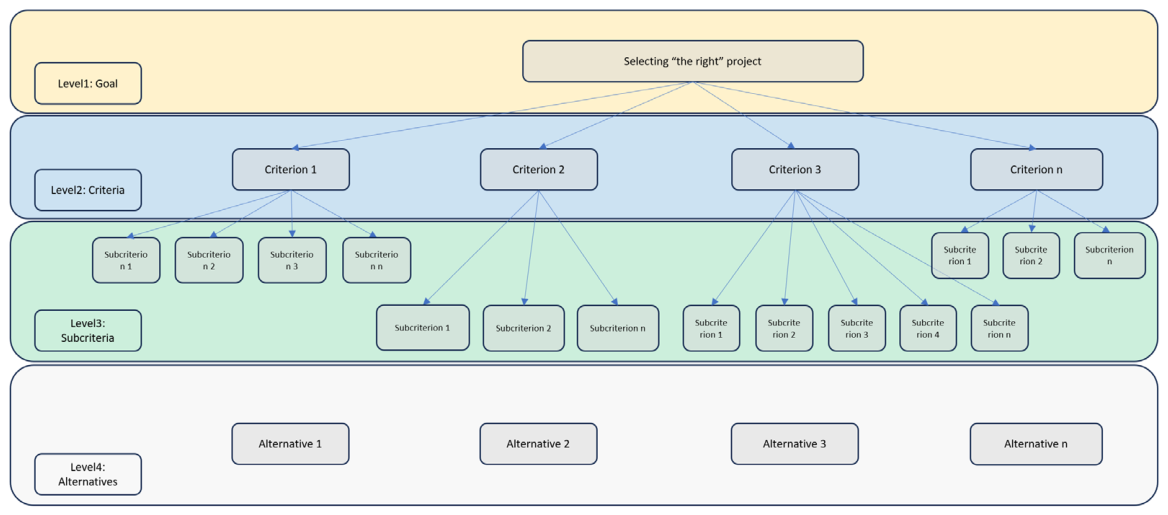
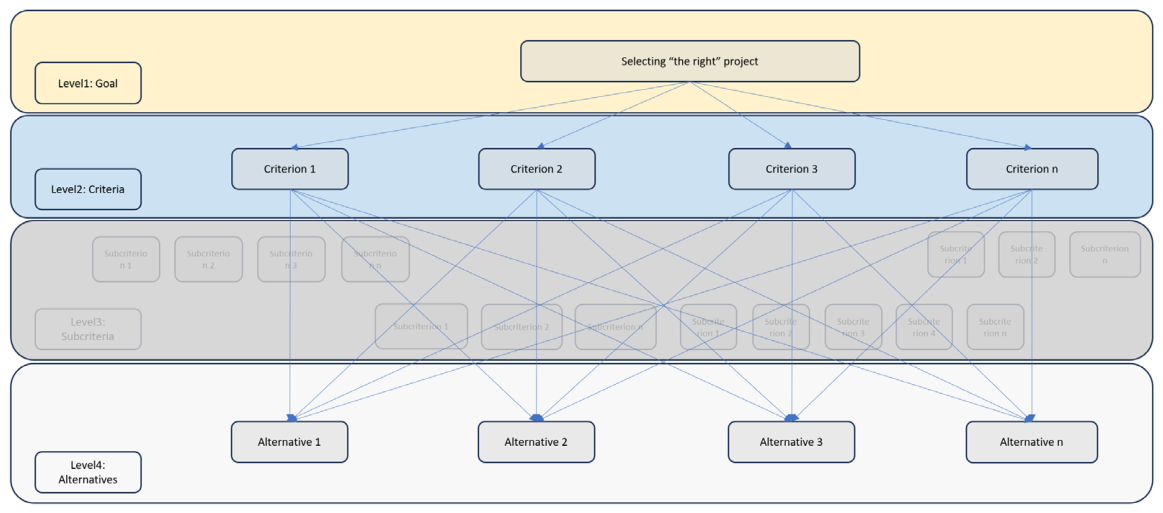
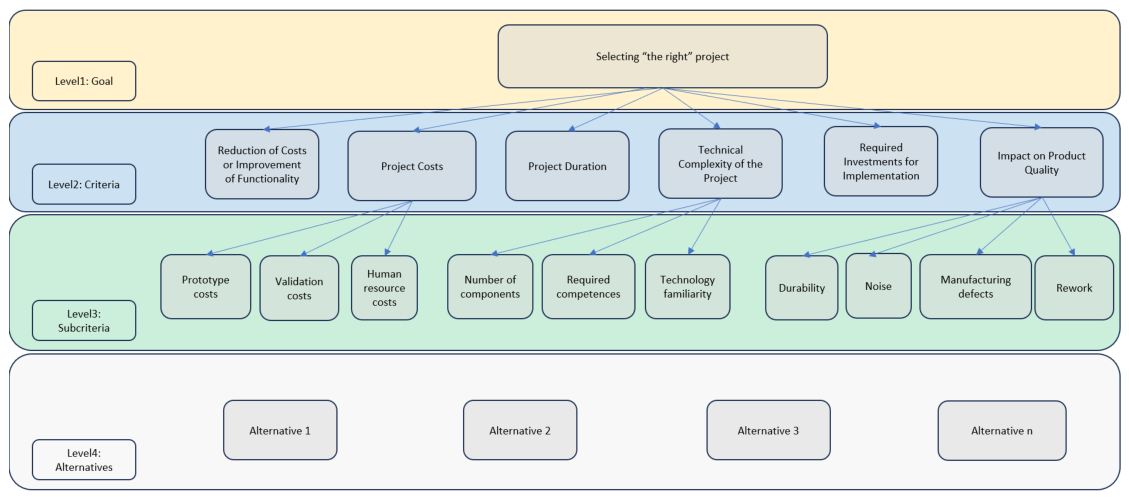
Decision-making is a process of choosing among alternatives based on multiple criteria. In each of these decisions, deep in our mind we have several factors or criteria on what to consider and we also have several alternative choices that we should decide among [62]. The case study is conducted in the automotive company, particularly among product development groups using Design for Six Sigma method. One of the most critical tasks in the development process is project selection. In the studied case the goal of multi-criteria decision-making was to select “the right” project to work on. The next level of decision-making includes selected factors or criteria that are important for project selection. In case of the study 6 factors were selected. Among 3 of them there was a need for further definition using sub-criteria. Sub-criteria, therefore, create a third level of MCDM design. The last level includes alternatives. In the case study twelve alternatives were used; however, the intention of the authors is to allow future comparison of the project ideas with unlimited numbers of alternatives. Graphical representation of the general study approach is shown in Figure 1 and Figure 2.
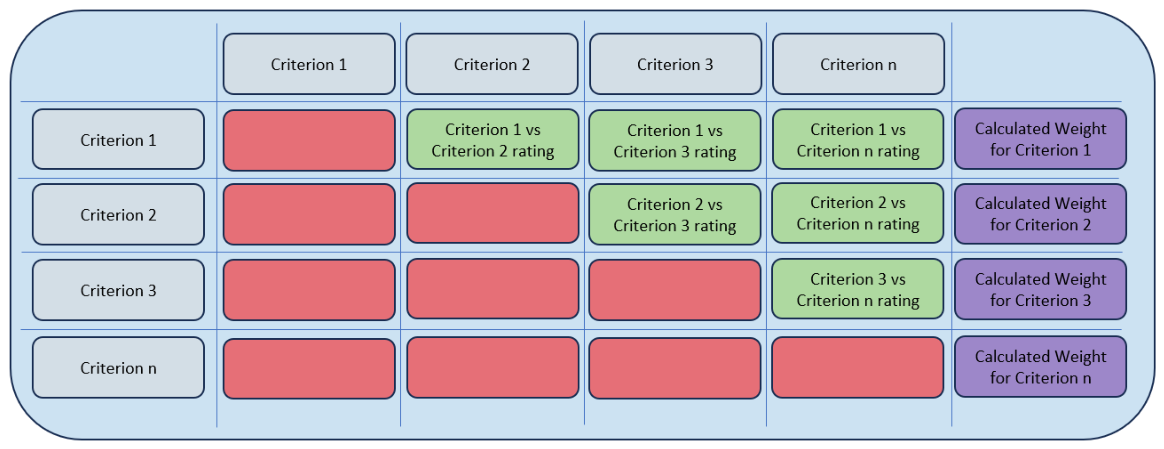
The next step in the conducted study was to assign the priorities (weights) p to the criteria via pairwise comparison. AHP is an expert method, which means that the source of the decision data and an important element of the method itself are the experts. These are the people whose individual judgments are used for the final recommendation [49]. Similarly, in the studied cases, the assessment of criteria was conducted by experts—product development team supervisors. To perform the AHP, the first level of criteria (requirements) is systematically subjected to pairwise comparisons using an n × n matrix—where n is the number of criteria being prioritized [50]. Pairwise comparison of the criteria is illustrated in Figure 3.
The final criteria weights p (2) should satisfy consistency requirement (C.R. < 0.10).
  C . R . = C . I . R . I .
The next step is to provide evaluation of alternatives. In every case of such evaluation, adopted approach needs to ensure that the decision-making process is rational and consistent, enabling the selection of optimal solutions [63]. In the studied case, each alternative is scored by experts—supervisors of the product development teams. Scoring is done for all criteria using normalized 1–10 scale. Intentional application of such a scale allows for avoiding some perspective problems related to the direct application of pairwise comparisons within the full-scale hierarchical AHP model. The problems may result from intended later use of proposed framework for more project alternatives in the future. They could cover, among others, the negative influence of numerous project alternatives on actual direct AHP applicability and computational intensity, meeting required consistency as well as a universal phenomenon of rank reversal [64].
It should be stated that this approach preserves the consistency ratio (C.R.) for weights while mitigating “rank reversal” and “computational intensity” issues when adding new project alternatives in the future.
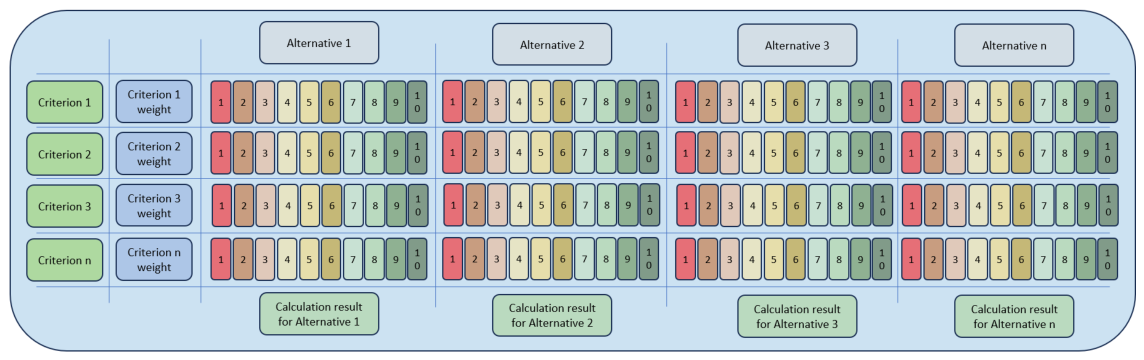
Calculated results for each alternative were based on the sum of individual scoring per criteria multiplied by criteria weight. Maximum achievable result in this case is 10 and minimal is 1. The 1–10 rating is standardized for each criterion and through standard instruction of using the tools dedicated for the evaluators. It is not recommended to introduce changes in individual ratings. In such cases, tools can lead to incorrect conclusions and lose potential for comparative analysis between project ideas.
Additionally, 1–10 scale is pre-set by authors of the tool. Among 6 criteria and 8 sub-criteria, two characteristics can be placed in linear scale with corresponding value, which are cost and project duration. The rest of criteria and sub-criteria are evaluated using subjective evaluation frequently supported by comparison with current standard technical system performance. For example, observing the effect of the development project on the system level noise generation, where score 5 is used for no change for noise performance, deterioration is evaluated lower than 5 and improvement higher than 5. Table 1 includes descriptions of the used scales for each criterion and sub-criterion.
The evaluation of alternatives is presented in the graphical form in Figure 4. This approach, although different than typical alternative paired comparison used in AHP, allows users to add future ideas and compare them with the ones previously assessed. As product development work continuously requires justification of the new ideas, this approach is useful and less complex than alternative paired comparison.
The proposed decision-support framework is based on several underlying assumptions. It assumes that the selected criteria are sufficiently independent to allow linear aggregation using a weighted sum and that expert judgments used for criteria weighting and project scoring are reliable within a given organizational context. The use of a normalized 1–10 scoring scale assumes that experts are able to consistently differentiate between project alternatives while maintaining practical usability. Furthermore, it is assumed that the criteria structure and derived weights remain valid over a certain period, enabling comparison of new project ideas with the previously evaluated ones. These assumptions are considered acceptable in DFSS product development environments, where transparency, scalability, and decision practicality are critical.

3. Results

3.1. Method for Project Selection in the Automotive Company

The implementation team developed a structured procedure for selecting development projects by employing the Analytic Hierarchy Process. AHP is a systemic approach for making complex decisions and is intended for situations in which alternative solutions are known [65].
A user applying AHP should follow four steps to obtain a ranking of alternative solutions. First, the problem must be appropriately structured. Then, values—referred to in AHP as priorities—are calculated based on pairwise comparisons conducted by the user. The decision maker is not required to provide numerical values; instead, a relative assessment of preferences is sufficient, making the process closer to everyday decision-making. The following two additional steps are recommended: a consistency check and sensitivity analysis. Consistency checking is widely used in methods based on pairwise comparisons, such as AHP [40].
For the project selection method applied within the enterprise, a structure of criteria was developed, as presented in Figure 5. Each criterion is also described with detailed additional information on weight, sub-criteria and scale in Appendix A.
The next step was to assign the weight to the criteria via pairwise comparison. Criteria were assessed by experts—product team development supervisors. The summarized results are presented in Table 1. Targeted performance increase or cost saving and quality impact were indicated as the most significant factors. In both cases weight of the factor is 33%. Investment needed for the introduction of the developed concept to production is rated as third from importance standpoint with 18%. Technical complexity, project cost and project duration are the factors of lower importance, with corresponding ratings of 7%, 5% and 3%.
Consistency ratio, C.R., for the assigned rankings was calculated using the maximum eigenvalue λ max and the consistency index, C.I. The result of the calculation (C.R. = 0.097) corresponds to the acceptable consistency level. Hence, the provided judgments are consistent enough and there is no need for their modifications.

3.2. Application of the AHP Method and Project Evaluation in Automotive Company

The project teams evaluated multiple project concepts using the AHP method. Table 2 shows the assessment of 12 product development concepts according to the defined criteria. First of all, the evaluations were done to define the scope of work of product development team designing automotive chassis component. Data were collected based on real case projects (in the paper those are anonymized with names: project idea 1–12). Scoring of the project took place once the project idea was provided by the team member for justification or, in some cases, evaluated backwards, post-completion, to provide the reference point for new concepts. Project evaluation tool has been functional within analyzed development hub for about 1 year before work on this paper was initiated.
Each of the listed ideas, after assessment, is represented by the numerical value, called project idea score. On top of the calculated score, the rank result was prepared helping to place each idea in order from most to least valuable.
All twelve project ideas evaluated using proposed methods were carried on as actual development projects within product development team. In some cases, the evaluation was done for on-going or already completed projects. Although the number of evaluated cases is limited, the approach taken allows for initial estimation of the successful vs unsuccessful project threshold. To allow deeper analysis and full comparability potential, proposed tools need to be used for a longer period of time, and correlation to project success needs to be determined.
The final project rankings are primarily driven by the criteria weighting structure, with Product Quality and Cost/Functionality improvement jointly accounting for 66% of the total weight. As a result, projects with strong expected quality impact consistently achieve higher overall scores, while projects with limited benefits or high technical complexity rank lower despite favorable performance in less influential criteria. This confirms a clear cause-and-effect relationship between criteria weights, project level evaluations, and the obtained rankings.

4. Discussion

4.1. The Outcomes

In the case of project selection tasks for the automotive company, twelve concepts—development ideas, candidates for Design for Six Sigma projects—were evaluated according to previously established and ranked criteria. The resulting analysis provides an unambiguous numerical score for each project idea. In the study, a ten-point scoring scale was used for each criterion; therefore, the calculated project value represents a number from 1 to 10, and lower rated projects are represented by lower numbers. Among the rated projects, the lowest rating is 4.97 and the highest is 8.60. The project with the highest score (8.60) is related to the development of the design tool that allows for assessing the mechanical capabilities of the product. This project highly affects the quality and performance of the design and is achievable within a short time with the involvement of a single specialist. The project was completed and is used with significant benefit to the company.
Other highly rated projects (project idea 11—rated 7.82, project idea 2—rated 7.41, and project idea 7—rated 7.41) are complex projects due to needed time, resource and cost; however, those project highly impact quality and performance, which are the two most significant criteria.
On the opposite end, with a low ranking, there are projects that affect single components, typically with high complexity or involving new technology. Some of those projects were started by the product development team but were canceled or put on hold due to difficulties or a lack of expected progress within the given time.
The proposed project selection tool has the advantage of direct project comparison based on numerical value. With no changes to the criteria or their weights, these scores can be compared over time. Based on a broad list of potential projects and their corresponding evaluations, the product development team can select the most promising concepts for implementation. Moreover, by comparing project scores with actual outcomes (successful implementation vs. discontinuation), it becomes possible to establish a numerical indicator of a concept’s future implementation potential. For example, project idea 4 (score 8.60) led to a highly beneficial implementation with relatively low investment. A similar outcome applies to project idea 7 (score 7.41). Project idea 8 (score 6.31) was successfully completed but required several modifications due to technical complexity. In contrast, project ideas 5 and 10 (scores 5.09 and 4.97) were initiated but later discontinued due to shifting priorities or low benefit relative to effort. The analysis of possible effects delivered by project ideas allows for the general conclusion that high-scoring projects bring the essential reduction in wasted engineering hours and prototype costs. Hence, they deserve high priority due to their ability to facilitate the achievement of operational sustainability that strengthens the strategic position of the enterprise.
Based on these observations, the project teams established classification rules that guide the selection of projects for execution within the Six Sigma framework within the company as follows:
11.
High potential: score > 7.2;
12.
Medium potential: score 5.2–7.2;
13.
Low potential: score < 5.2.

4.2. Limitations of the Method

A principal contribution of this study is the integration of Analytic Hierarchy Process (AHP)-derived weights with a normalized scoring scale ranging from 1 to 10. It should be emphasized that the numerical levels of this scale are to be interpreted as vehicles for expressing inherently subjective expert judgments rather than as absolute or uniquely correct quantitative values.
This hybrid decision-support framework was deliberately developed to alleviate the issues of computational burden and rank reversal that are frequently encountered in full-scale, hierarchical AHP implementations when many alternatives are considered [51,52,53]. The direct use of the Weighted Sum Method (WSM), which underlies AHP, formally requires strict linear independence of the evaluation attributes to derive fully justified results [66], a condition that is not always satisfied in practice. Hence, in fact, the interdependence of the attributes may slightly influence the results. We have nevertheless made a deliberate decision to use AHP despite its possible drawbacks to provide simplified and easy-to-use means that are suitable for transparent expression of established professionals’ perceptions towards essential assessment attributes for perspective Six Sigma projects.
The establishment of formal classification rules—specifically, the >7.2 threshold used to identify high-potential projects—functions as a decision-support mechanism for managerial resource allocation. Empirical observations indicate that projects with scores below 5.2 were frequently discontinued or suspended, typically due to technical complexity or evolving strategic priorities, thereby supporting the predictive validity of the proposed model. The apparent robustness of these findings suggests that further sensitivity analyses are warranted. Nevertheless, given the relatively high concentration of weights on two criteria, even minor perturbations in the weight assigned to “Quality Impact” could substantially modify the ranking of projects currently classified as “Medium Potential”. To more rigorously account for the intrinsic uncertainty associated with expert judgment and scoring, future model iterations could integrate advanced methodological approaches, such as stochastic components or fuzzy set-based frameworks.
Lastly, it is important to note that twelve cases taken into consideration provide information of limited confidence level to properly determine pass-and-fail numerical value for the project rating. More projects need to be evaluated and rated to increase the confidence level in proposed numbers. This work is continued by the development teams.

4.3. General Remarks

It is necessary to recognize the fundamental criticism that Six Sigma frequently treats reliability as an exogenously imposed preference rather than as an emergent property arising from uncertainty. Conversely, a distinct body of the scientific literature argues that continuous improvement initiatives can, under certain conditions, inadvertently degrade system performance [67].
Within the context of the presented automotive case study, we contend that the proposed framework does not impose preferences but instead offers a structured mechanism for eliciting supervisors’ pre-existing strategic priorities. The framework enhances transparency by explicitly revealing these preferences and their mathematical implications, thereby mitigating the “wastage of engineering hours” associated with project selection based solely on intuition.
The empirical findings demonstrate a substantive congruence between strategic priorities in the automotive sector and the proposed hybrid project selection framework. Specifically, the identification of Product Quality (33%) and Cost/Functionality (33%) as the principal decision criteria—together accounting for 66% of the total decision weight—provides quantitative support for the industry’s emphasis on competitiveness and profitability. Both weights are supported by a tolerable Analytic Hierarchy Process (AHP) consistency ratio (C.I. = 0.097), which is clearly below the commonly accepted upper threshold of 0.10.
This concentration of decision weight, while context-specific to the investigated automotive environment, is consistent with the results reported by Antony and colleagues [19,20], who identified appropriate project selection as a dominant success factor for Six Sigma implementations in manufacturing.

5. Conclusions

Developed hybrid decision-support framework prioritizes industrial usability and scalability. By using a direct scoring scale for alternatives, we provide a transparent mechanism for engineers to add future project ideas without re-evaluating the entire project portfolio, a significant operational advantage in long-cycle development environments.
From a sustainability perspective, the framework’s primary contribution is to economic and operational stability. By providing an “unambiguous numerical score,” the model justifies the discontinuation of low-benefit, high-complexity projects early in the development cycle. This prevents the sunk-cost fallacy often associated with expensive automotive prototypes. As suggested by the literature, linking project initiatives to business objectives is essential for long-term Six Sigma success [21,22,23]; our model provides the mathematical link required to operationalize this connection.
Presented results of the integration of Analytic Hierarchy Process (AHP)-derived weights with a normalized 1–10 scoring scale confirm its capability of providing a robust and pragmatic solution for the critical challenge of project selection in automotive Design for Six Sigma (DFSS). By identifying that Product Quality and Cost/Functionality constitute most of the decision significance, the framework ensures that organizational resources are strategically aligned with the most impactful competitive drivers.
From a researcher’s perspective, the primary value of this approach lies in its industrial scalability. Unlike traditional full-scale hierarchical AHP, this hybrid model mitigates issues of rank reversal and computational intensity, allowing engineers to add and compare new project alternatives over time without re-evaluating the entire portfolio [51,52,53]. Furthermore, the established classification rules (e.g., >7.2 for high potential) offer a clear, justifiable mechanism for managerial action, directly supporting economic and operational sustainability by proactively reducing the wastage of engineering hours and prototype costs.
This research also serves as a reminder that the utility of such models depends heavily on mathematical and methodological rigor. Future iterations must move beyond narrative motivation to explicitly address possible problems with the interdependence of attributes. Complex decision-support approaches that cover the interdependence of attributes directly [68,69] may be applied to conduct general sensitivity analysis to justify the results provided by the proposed method. Transitioning from AHP to the Analytic Network Process (ANP) would further bolster the robustness of Six Sigma project assessments by capturing complex feedback loops and dependencies. While the current consistency ratio (C.R. = 0.097) falls within acceptable thresholds, a rigorous validation of the underlying assumptions is imperative. To mitigate expert subjectivity and epistemic uncertainty, future research should integrate sensitivity analyses alongside advanced uncertainty frameworks, such as fuzzy or neutrosophic logic. Ultimately, this study establishes formal architecture for transitioning project selection from biased heuristics into a strategic, data-driven discipline.

Author Contributions

Conceptualization, M.N. and G.G.; methodology, M.N. and G.G.; validation, M.N.; formal analysis, G.G.; investigation, M.N.; writing—original draft preparation, M.N. and G.G.; writing—review and editing, M.N. and G.G.; visualization, M.N.; supervision, G.G. All authors have read and agreed to the published version of the manuscript.

Funding

Ministry of Science and Higher Education of the Republic of Poland under contract no. DWD/6/0288/2022.

Data Availability Statement

The data supporting the reported results in this study are contained within the article itself.

Conflicts of Interest

The authors declare no conflicts of interest.

Appendix A

This appendix refers to the Results section of the paper. Table A1 includes detailed description of the criteria used by product development team in the proposed project selection tool.
Table A1. Description of the criteria used in project selection, followed by criteria weight, sub-criteria description and explanation of the rating scale.
CriterionWeightDescriptionSub-CriterionScale
Reduction in Costs or Improvement of Functionality33%Reducing product manufacturing costs is one of the primary objectives of design engineering teams. It enables the enterprise to increase its competitiveness on the market and to achieve higher profits. The same criterion also incorporates aspects related to product functionality. Enhancing the capabilities of the designed technical system (e.g., higher assistance or improved resistance to environmental conditions) typically leads to increased production costs. To allow project comparison without mutual exclusion of these factors, they were combined into a single AHP category.-The evaluation scale for cost reduction is based on estimated differences in component pricing or manufacturing methods and ranges from 1 to 10, with each value linked to an estimated financial effect. The functionality-improvement criterion is also evaluated on a 1–10 scale, with scores assigned subjectively based on expert judgment.
Required Investments for Implementation18%This criterion reflects the need for investments—such as acquiring new machinery—that may be required to implement outcomes of the development project.-Assessment is based on expert evaluation of necessary production process changes. A 1–10 scale is used, where one indicates extensive process modifications (e.g., replacing multiple machines), and 10 indicates no need for modifications. At this stage, precise cost estimation is often not feasible.
Project Duration4%This criterion represents the estimated time required to complete the project.-A ten-point scale corresponding to durations between 6 and 36 months is applied.
Project Costs5%This criterion is evaluated through the following sub-criteria: prototype component costs, validation costs, and human resource requirements.Prototype costOne indicates the need to build a complete, new technical system, while 10 indicates minimal changes to a small number of components.
Validation costTen corresponds to low-cost validation at component level (often via simulations);
one corresponds to full-system validation, such as life cycle
or environmental durability testing.
Human
resource cost
One indicates the need for many engineers with diverse competencies; 10 indicates a task achievable by a single specialist.
Technical Complexity of the Project8%Technical complexity is also assessed using the following sub-criteria: number of affected components, required competences, and familiarity with applied technology.Number of componentsOne indicates many components require redesign;
10 indicates changes to only one or a few components.
Required competenceLow scores indicate many unique competencies are needed; high scores represent universal engineering competencies.
Technology familiarityLow scores reflect new or unfamiliar manufacturing technologies, while high scores correspond to well-established processes used within the company.
Impact on Product Quality33%This criterion includes several aspects specific to the expectations of customers and manufacturers of electric power-assisted steering systems. The categories include impact on system durability, noise generation, defect rate in manufacturing, and reparability in case
of defect occurrence.
DurabilityOne corresponds to significantly reduced durability relative to the baseline product;
10 corresponds to significantly increased fatigue resistance.
NoiseOne indicates a substantial deterioration in noise level;
10 indicates a significant improvement.
Manufacturing defectsOne reflects an increased defect rate;
10 reflects a significant reduction
of nonconforming products.
Rework abilityOne indicates no possibility for repair;
10 indicates easy repair or the elimination of defect occurrence.

References

  1. Tlapa, D.; Franco-Alucano, I.; Limon-Romero, J.; Baez-Lopez, Y.; Tortorella, G. Lean, Six Sigma, and Simulation: Evidence from Healthcare Interventions. Sustainability 2022, 14, 16849. [Google Scholar] [CrossRef]
  2. Jou, Y.T.; Silitonga, R.M.; Lin, M.C.; Sukwadi, R.; Rivaldo, J. Application of Six Sigma Methodology in an Automotive Manufacturing Company: A Case Study. Sustainability 2022, 14, 14497. [Google Scholar] [CrossRef]
  3. Buestan, M.; Perez, C. Identification of Predictive Nursing Workload Factors: A Six Sigma Approach. Sustainability 2022, 14, 13169. [Google Scholar] [CrossRef]
  4. Ibrahim, A.; Kumar, G. Identification and Prioritization of Critical Success Factors of a Lean Six Sigma–Industry 4.0 Integrated Framework for Sustainable Manufacturing Using TOPSIS. Sustainability 2025, 17, 1331. [Google Scholar] [CrossRef]
  5. Nakielski, M. Critical Success Factors for Six Sigma Implementation—A Case Study from an Automotive Company Located in Poland. Decis. Mak. Manuf. Serv. 2025, 19, 21–39. [Google Scholar] [CrossRef]
  6. Eckes, G. The Six Sigma Revolution: How General Electric and Others Turned Process into Profits; Wiley: New York, NY, USA, 2002. [Google Scholar]
  7. Harry, M.; Schroeder, R. Six Sigma: The Breakthrough Management Strategy Revolutionizing the World’s Top Corporations; Crown Publishing: New York, NY, USA, 2006. [Google Scholar]
  8. Chakravorty, S. Six Sigma Programs: An Implementation Model. Int. J. Prod. Econ. 2009, 119, 1–16. [Google Scholar] [CrossRef]
  9. Pande, P.; Neuman, R.; Cavanagh, R. The Six Sigma Way: How GE, Motorola, and Other Top Companies Are Honing Their Performance; McGraw-Hill: New York, NY, USA, 2000. [Google Scholar]
  10. Tavana, M.; Soltanifar, M.; Santos-Arteaga, F.J. Analytical Hierarchy Process: Revolution and Evolution. Ann. Oper. Res. 2021, 326, 879–907. [Google Scholar] [CrossRef]
  11. Hahn, G.J.; Doganaksoy, N.; Hoerl, R. The Evolution of Six Sigma. Qual. Eng. 2000, 12, 317–326. [Google Scholar] [CrossRef]
  12. Marques, P.; Conceição, L.; Carvalho, A.M.; Reis, J. Driving Sustainable Operations: Aligning Lean Six Sigma Practices with Sustainability Goals. Sustainability 2025, 17, 8898. [Google Scholar] [CrossRef]
  13. Sujova, A.; Simanova, L.; Marcinekova, K. Sustainable Process Performance by Application of Six Sigma Concepts: The Research Study of Two Industrial Cases. Sustainability 2016, 8, 260. [Google Scholar] [CrossRef]
  14. Rodriguez Delgadillo, R.; Medini, K.; Wuest, T. A DMAIC Framework to Improve Quality and Sustainability in Additive Manufacturing—A Case Study. Sustainability 2022, 14, 581. [Google Scholar] [CrossRef]
  15. Zhang, W.; Hill, A.V.; Gilbreath, G.H. A Research Agenda for Six Sigma Research. Qual. Manag. J. 2011, 18, 39–53. [Google Scholar] [CrossRef]
  16. Francia, D.; Donnici, G.; Ricciardelli, G.M.; Santi, G.M. Design for Six Sigma (DFSS) Applied to a New E-Segment Sedan. Sustainability 2020, 12, 787. [Google Scholar] [CrossRef]
  17. Arcidiacono, G.; Risaliti, E.; Del Pero, F. Design for Six Sigma in the Product Development Process Under a Sustainability Point of View: A Real-Life Case Study. Sustainability 2024, 16, 10387. [Google Scholar] [CrossRef]
  18. George, M.L.; Maxey, J.; Rowlands, D.; Price, M. The Lean Six Sigma Pocket Toolbook; McGraw-Hill Education: New York, NY, USA, 2005. [Google Scholar]
  19. Desai, D.A.; Antony, J.; Patel, M.B. An Assessment of the Critical Success Factors for Six Sigma Implementation in Indian Industries. Int. J. Product. Perform. Manag. 2012, 61, 426–444. [Google Scholar] [CrossRef]
  20. Antony, J.; Kumar, M.; Madu, C.N. Six Sigma in Small and Medium-Sized UK Manufacturing Enterprises. Int. J. Qual. Reliab. Manag. 2005, 22, 860–874. [Google Scholar] [CrossRef]
  21. Sandholm, L.; Sorqvist, L. Twelve Requirements for Six Sigma Success. Six Sigma Forum Mag. 2002, 2, 17–24. [Google Scholar]
  22. Cheng, J.-L. Comparative Study of Local and Transnational Enterprises in Taiwan and Their Implementation of Six Sigma. Total Qual. Manag. Bus. Excell. 2007, 18, 793–806. [Google Scholar] [CrossRef]
  23. Chakraborty, A.; Leyer, M. Developing a Six Sigma Framework: Perspectives from Financial Service Companies. Int. J. Qual. Reliab. Manag. 2013, 30, 256–279. [Google Scholar] [CrossRef]
  24. Snee, R.D. Six Sigma: The Evolution of 100 Years of Business Improvement Methodology. Int. J. Six Sigma Compet. Advant. 2001, 1, 4–20. [Google Scholar] [CrossRef]
  25. Snee, R.D.; Rodebaugh, W.F. The Project Selection Process. Qual. Prog. 2002, 35, 78–87. [Google Scholar]
  26. Sharma, U.; Chetiya, A.R. Six Sigma Project Selection: A Critical Review. Int. J. Lean Six Sigma 2010, 1, 193–207. [Google Scholar] [CrossRef]
  27. Kumar, M.; Antony, J. Multiple Criteria Decision Making Techniques for Six Sigma Project Selection. Bus. Process Manag. J. 2009, 15, 838–855. [Google Scholar]
  28. Su, C.T.; Chou, C.J. A Systematic Methodology for the Creation of Six Sigma Projects: A Case Study of Semiconductor Foundry. Expert Syst. Appl. 2008, 34, 2693–2703. [Google Scholar] [CrossRef]
  29. Kumar, M.; Antony, J.; Douglas, A. Does Size Matter for Six Sigma Implementation? TQM J. 2009, 21, 623–635. [Google Scholar] [CrossRef]
  30. Büyüközkan, G.; Öztürkcan, D. An Integrated Analytic Approach for Six Sigma Project Selection. Expert Syst. Appl. 2010, 37, 5835–5847. [Google Scholar] [CrossRef]
  31. Yang, T.; Hsieh, C.H. Six Sigma Project Selection Using National Quality Award Criteria and Delphi Fuzzy MCDM Method. Expert Syst. Appl. 2009, 36, 7594–7603. [Google Scholar] [CrossRef]
  32. Yang, T.; Chou, P.; Cheng, H. A Fuzzy MCDM Method for Six Sigma Project Selection. Expert Syst. Appl. 2008, 35, 765–771. [Google Scholar]
  33. Wang, T.C.; Chang, T.H.; Cheng, S.Y. A Hybrid Fuzzy DEMATEL–ANP–VIKOR Method for Selecting Six Sigma Projects. Math. Probl. Eng. 2014, 2014, 969071. [Google Scholar]
  34. Altıntaş, K.; Dereli, T.; Baykasoglu, A. An Integrated Decision Support System for Six Sigma Project Selection. J. Manuf. Technol. Manag. 2016, 27, 693–718. [Google Scholar]
  35. Goodwin, P.; Wright, G. Decision Analysis for Management Judgment, 5th ed.; Wiley: Chichester, UK, 2014. [Google Scholar]
  36. Roy, B. Classement et Choix en Présence de Points de Vue Multiples (La Méthode ELECTRE). Rev. D’inform. Rech. Opér. 1968, 8, 57–75. [Google Scholar]
  37. Greco, S.; Ehrgott, M.; Figueira, J.R. Multiple Criteria Decision Analysis: State of the Art Surveys; Springer: New York, NY, USA, 2016. [Google Scholar]
  38. Alinezhad, A.; Khalili, J. New Methods and Applications in Multiple Attribute Decision Making (MADM); Springer: Cham, Switzerland, 2019. [Google Scholar]
  39. Greco, S.; Słowiński, R.; Wallenius, J. Fifty Years of Multiple Criteria Decision Analysis. Eur. J. Oper. Res. 2025, 323, 351–377. [Google Scholar] [CrossRef]
  40. Ishizaka, A.; Nemery, P. Multi-Criteria Decision Analysis: Methods and Software; Wiley: Chichester, UK, 2013. [Google Scholar]
  41. Trzaskalik, T. Wielokryterialne Wspomaganie Decyzji. Zesz. Nauk. Politech. Śląskiej 2014, 74, 239–263. [Google Scholar]
  42. Roy, B. The Outranking Approach and the Foundations of ELECTRE Methods. In Readings in Multiple Criteria Decision Aid; Springer: Berlin/Heidelberg, Germany, 1990; pp. 155–183. [Google Scholar]
  43. Figueira, J.R.; Mousseau, V.; Roy, B. ELECTRE Methods. In Multiple Criteria Decision Analysis; Springer: New York, NY, USA, 2016; pp. 155–185. [Google Scholar]
  44. Brans, J.-P. L’Ingénierie de la Décision: La Méthode PROMETHEE; Presses de l’Université Laval: Quebec City, QC, Canada, 1982. [Google Scholar]
  45. Brans, J.-P.; De Smet, Y. PROMETHEE Methods. In Multiple Criteria Decision Analysis; Springer: New York, NY, USA, 2016; pp. 187–219. [Google Scholar]
  46. Martel, J.-M.; Matarazzo, B. Other Outranking Approaches. In Multiple Criteria Decision Analysis; Springer: New York, NY, USA, 2016; pp. 221–282. [Google Scholar]
  47. Keeney, R.L.; Raiffa, H. Decisions with Multiple Objectives; Cambridge University Press: Cambridge, UK, 1975. [Google Scholar]
  48. Saaty, T.L. The Analytic Hierarchy Process; McGraw-Hill: New York, NY, USA, 1980. [Google Scholar]
  49. Saaty, T.L. The Analytic Network Process; RWS Publications: Pittsburgh, PA, USA, 1996. [Google Scholar]
  50. Lootsma, F.A. The REMBRANDT System for Multi-Criteria Decision Analysis; Technical Report; Delft University of Technology: Delft, The Netherlands, 1992. [Google Scholar]
  51. Bana e Costa, C.A.; Vansnick, J.-C. MACBETH—An Interactive Path Towards the Construction of Cardinal Value Functions. Int. Trans. Oper. Res. 1994, 1, 489–500. [Google Scholar] [CrossRef]
  52. Gershon, M.E. Model Choice in Multiobjective Decision Making. Ph.D. Thesis, University of Arizona, Tucson, AZ, USA, 1981. [Google Scholar]
  53. Tecle, A. Choice of a Multicriterion Decision Making Techniques for Watershed Management. Ph.D. Thesis, University of Arizona, Tucson, AZ, USA, 1988. [Google Scholar]
  54. Wątróbski, J.; Jankowski, J.; Ziemba, P.; Kaczmarczyk, A.; Zioło, M. Generalised Framework for Multi-Criteria Method Selection. Omega 2019, 86, 107–124. [Google Scholar] [CrossRef]
  55. Cinelli, M.; Kadziński, M.; Gonzalez, M.; Słowiński, R. How to Support the Application of MCDA. Omega 2020, 96, 102261. [Google Scholar] [CrossRef]
  56. Goutte, S.; Le, H.-V.; Liu, F.; von Mettenheim, H.-J. MCDA Strategies for Portfolio Optimization. Ann. Oper. Res. 2025, 353, 321–351. [Google Scholar] [CrossRef]
  57. Wątróbski, J.; Bączkiewicz, A.; Saabun, W. pyrepo-mcda—Reference Objects Based MCDA Software Package. SoftwareX 2022, 19, 101107. [Google Scholar] [CrossRef]
  58. Huang, H.; Burgherr, P. MCDA Calculator: A Streamlined Decision Support System. In Decision Support Systems XIV; Springer: Cham, Switzerland, 2024; pp. 31–45. [Google Scholar]
  59. Ginda, G. Metody Porównywania Parametrami; DWE: Wrocław, Poland, 2015. [Google Scholar]
  60. Kułakowski, K. Understanding the Analytic Hierarchy Process; CRC Press: Boca Raton, FL, USA, 2020. [Google Scholar]
  61. Burge, S. The Analytic Hierarchy Process Tool. Available online: https://www.burgehugheswalsh.co.uk (accessed on 8 February 2026).
  62. Teknomo, K. Analytic Hierarchy Process (AHP) Tutorial. Available online: https://people.revoledu.com (accessed on 8 February 2026).
  63. Veljić, A.; Viduka, D.; Ilić, L.; Karabasevic, D.; Šijan, A.; Papić, M. Sustainable Decision-Making in Higher Education. Sustainability 2025, 17, 10130. [Google Scholar] [CrossRef]
  64. Tu, J.; Wu, Z. Analytic Hierarchy Process Rank Reversals. Ann. Oper. Res. 2025, 346, 1785–1809. [Google Scholar] [CrossRef]
  65. Wallenius, J. Making Better Decisions; Springer: Cham, Switzerland, 2020. [Google Scholar]
  66. Fishburn, P.C. Independence in Utility Theory with Whole Product Sets. Oper. Res. 1965, 13, 28–45. [Google Scholar] [CrossRef]
  67. Hazelrigg, G.A. Continuous Improvement Processes: Why They Do Not Work and How to Fix Them. J. Mech. Des. 2007, 129, 138–139. [Google Scholar] [CrossRef]
  68. Wang, A.; Sun, L.; Liu, J. An Innovative TOPSIS–Mahalanobis Distance Approach to Comprehensive Spatial Prioritization Based on Multi-Dimensional Drought Indicators. Atmosphere 2024, 15, 1347. [Google Scholar] [CrossRef]
  69. Roszkowska, E.; Filipowicz-Chomko, M.; Łyczkowska-Hanćkowiak, A.; Majewska, E. Extended Hellwig’s Method Utilizing Entropy-Based Weights and Mahalanobis Distance: Applications in Evaluating Sustainable Development in the Education Area. Entropy 2024, 26, 197. [Google Scholar] [CrossRef] [PubMed]
Figure 1. Hierarchical structure of the DFSS project selection framework. The figure presents the multi-level decision structure, starting from the overall decision goal, followed by evaluation criteria and sub-criteria weighted using AHP, and concluding with DFSS project alternatives.
Sustainability 18 05258 g001
Figure 2. Decision-making flow combining AHP-based criteria weighting and scoring-based project evaluation. The figure highlights the separation between criteria weighting using AHP and project evaluation using a normalized scoring scale, leading to the final project ranking.
Sustainability 18 05258 g002
Figure 3. Pairwise comparison matrix used for criteria weighting in AHP. The matrix illustrates expert judgments based on the Saaty 1–9 scale, applied to derive relative importance of evaluation criteria.
Sustainability 18 05258 g003
Figure 4. Project evaluation and ranking procedure based on weighted scoring. The figure illustrates how AHP-derived criteria weights and normalized project scores are combined using a weighted sum to obtain final project rankings.
Sustainability 18 05258 g004
Figure 5. AHP model structure for DFSS project selection in the studied organization. The figure presents the hierarchical arrangement of criteria and sub-criteria used to derive criteria weights for project evaluation.
Sustainability 18 05258 g005
Table 1. Summarized results of criteria pairwise comparison including calculated significance of each factor listed in the last column.
InvestmentCost Saving /Performance ImprovementProject CostQuality ImpactTechnical ComplexityTime to CompleteSignificance by Factor (%)
Investment11/351/45718%
0.120.120.260.090.280.23
Cost saving/performance improvement31616833%
0.350.360.310.360.340.27
Project cost1/51/611/51/22.005%
0.020.060.050.070.030.07
Quality impact41515833%
0.470.360.260.360.280.27
Technical complexity1/51/621/5147%
0.020.060.100.070.060.13
Time to complete1/71/81/21/81/413%
0.020.040.030.050.010.03
Total8.542.7919.502.7817.7530.00100%
Table 2. Assessment of twelve development concept ideas according to the defined criteria using proposed tool. Assessment results in project ranking are provided in last two rows of table below.
CriteriaSub-CriteriaWeightProject Idea 1Project Idea 2Project Idea 3Project Idea 4Project Idea 5Project Idea 6Project Idea 7Project Idea 8Project Idea 9Project Idea 10Project Idea 11Project Idea 12
Cost saving/performance improvement 0.333103101110411103
Investment 0.1881010101010108101058
Time to complete 0.03551010510587557
Project costProto cost0.05/371101058179558
Validation cost0.05/331510781710812
People cost0.05/3757888589875
Technical complexityNumber of components0.07/37110599179857
Required competence0.07/37571089589875
Technology familiarity0.07/37810108989101087
Quality impactDurability0.33/45557555755105
Noise0.33/45557555755105
Manufacturing defects0.33/48556755710586
Rework ability0.33/415105555710557
Result4.997.416.238.605.095.197.416.316.024.977.825.30
Rank result113.5611093.5571228
Disclaimer/Publisher’s Note: The statements, opinions and data contained in all publications are solely those of the individual author(s) and contributor(s) and not of MDPI and/or the editor(s). MDPI and/or the editor(s) disclaim responsibility for any injury to people or property resulting from any ideas, methods, instructions or products referred to in the content.