Article

From Perceived Value to Advocacy: How Customer Experience, Loyalty, and Trust Shape Sustainable Mobile Payment Consumption

by
Rayan Al Haress
* and
Asieh AkhlaghiMofrad
Faculty of Business and Economics, Girne American University, Kyrenia 99320, Turkey
*
Author to whom correspondence should be addressed.
Sustainability 2026, 18(11), 5225; https://doi.org/10.3390/su18115225
Submission received: 7 April 2026 / Revised: 15 May 2026 / Accepted: 16 May 2026 / Published: 22 May 2026

Abstract

Mobile payment services are increasingly embedded in everyday digital consumption, yet their sustainability relevance should not be assumed solely from technological adoption. This study conceptualizes sustainable mobile payment consumption as a relational and digital sustainability issue, reflected in the continuity, trust, diffusion, and resilience of mobile payment ecosystems rather than as a direct measure of environmental sustainability. Drawing on perceived value theory, relationship marketing, social exchange theory, and trust-based consumption logic, this study examines how mobile payment perceived value (MPPV) is associated with customer advocacy through customer experience and customer loyalty, while considering customer trust as a boundary condition. Survey data collected from 382 mobile payment users in Lebanon were analyzed using Partial Least Squares Structural Equation Modeling (PLS-SEM). The findings suggest that MPPV is positively associated with customer experience, customer loyalty, and customer advocacy. Customer experience is positively associated with loyalty while loyalty is positively associated with advocacy. The sequential mediation results are consistent with the proposed relational pathway in which holistic perceived value is linked to advocacy through experience and loyalty rather than through transactional evaluations alone. Customer trust strengthens the associations between MPPV and both loyalty and advocacy, suggesting that trust amplifies value-based relational outcomes in high-uncertainty financial environments. The central finding is that holistic perceived value becomes sustainability-relevant when channeled through accumulated experience and loyalty into advocacy, and that this relational pathway is contingent on trust, a mechanism particularly consequential in Lebanon’s high-uncertainty financial environment. By positioning advocacy as a sustainability-relevant relational outcome, this study clarifies how perceived value, experience, loyalty, and trust jointly contribute to sustainable digital consumption in an emerging economy.

1. Introduction

In recent years, mobile payment technologies have evolved from niche financial innovations into widely adopted digital consumption tools that increasingly shape everyday financial interactions. Beyond their transactional functionality, mobile payment applications are transforming how consumers engage with financial services, influencing consumption routines, relationship continuity, and value creation processes within digital ecosystems [1,2]. In this study, sustainable mobile payment consumption is understood as a form of digital consumption sustainability, rather than as a direct measure of environmental sustainability. Specifically, it refers to the economic, social, relational, and institutional continuity of mobile payment use through efficient transactions, inclusive access, trust-based engagement, and advocacy-supported diffusion. Customer advocacy is treated as a sustainability-relevant relational outcome because users who voluntarily recommend and promote mobile payment services reduce informational barriers for potential adopters, reinforce social norms of digital financial participation, and support the broader diffusion and resilience of digital payment ecosystems, mechanisms that collectively contribute to the social and institutional dimensions of digital sustainability [3,4,5,6]. From this perspective, mobile payment services may contribute to more efficient and inclusive digital financial practices by reducing dependence on cash-based transactions, improving transaction accessibility, and supporting long-term engagement with digital financial platforms [7,8]. Mobile payment services are also valued for their flexibility and convenience [9,10], enabling more efficient, traceable, and accessible financial exchanges that reduce reliance on physical currency [11,12], while simultaneously promoting financial inclusion and responsible digital consumption [13,14]. Research on digital financial ecosystems further suggests that long-term user engagement, advocacy-driven diffusion, and trust-based continuity are foundational to the sustainability of mobile financial services in both developed and emerging markets [15,16]. This transformation is particularly salient in emerging economies such as Lebanon, where shifting digital habits, economic uncertainty, and growing reliance on mobile technologies have positioned mobile payment systems as important components of the broader financial landscape.
However, the sustainability relevance of mobile payment services cannot be inferred from digital adoption alone. A growing body of research has examined mobile payment adoption, continuance intention, service quality, perceived value, loyalty, and trust [17,18,19,20]. While these studies have improved understanding of why consumers adopt and continue using digital payment services, they have primarily focused on individual-level adoption decisions and service continuance, leaving less attention to how value perceptions become associated with advocacy as a relational behavior that supports ecosystem-level sustainability outcomes. Studies have shown that service quality dimensions such as efficiency, reliability, and security influence satisfaction and trust, shaping users’ intentions to continue using mobile payment platforms [21,22,23,24]. Yet the pathway from holistic value perception to advocacy through relational mechanisms remains insufficiently examined. This distinction is important because advocacy goes beyond personal usage; it reflects users’ willingness to recommend, defend, and promote a service within their social networks, thereby helping reduce uncertainty among potential users and strengthening the social acceptance of digital financial practices [3,4].
Prior research suggests that perceived value plays an important role in shaping users’ evaluations of mobile payment services [25,26,27]. Perceived utilitarian value, hedonic value, and social value each contribute to shaping customer loyalty and advocacy intentions [27,28]. However, existing studies tend to examine individual value dimensions (utilitarian, hedonic, and social) rather than modeling perceived value as a holistic higher-order evaluation. This distinction matters because a holistic evaluation integrates functional, emotional, and social assessments into a unified judgment that shapes experience, loyalty, and advocacy in ways that dimension-specific models may not capture. Relationship marketing theory further suggests that sustained interactions and relational bonds are essential for transforming transactional usage into long-term commitment [29,30], and the experiential dimension of digital consumption strengthens satisfaction, continuance intentions, and willingness to recommend the service [26,31]. This creates a need to examine mobile payment perceived value (MPPV) as an integrated construct and to clarify how it is associated with advocacy through customer experience and customer loyalty.
Another important gap concerns the sequencing of relational mechanisms. Studies on mobile commerce and digital services have shown that experience, satisfaction, loyalty, and trust are important determinants of continued engagement and recommendation behavior [31,32,33,34]. Yet most studies examine these variables as parallel or independent predictors rather than as a sequential, relational pathway. Whether customer experience and loyalty operate in sequence (such that perceived value first shapes how users experience the service, and only repeated favorable experiences consolidate the loyalty necessary for outward-facing advocacy) remains insufficiently tested. Accordingly, the present study does not treat advocacy as a simple extension of satisfaction but as a relational outcome that may emerge through accumulated experience and loyalty formation.
Trust represents a further unresolved issue in mobile payment research. Security and privacy concerns remain among the most significant concerns in digital financial services, especially in environments marked by economic instability and institutional uncertainty [35,36,37]. Satisfaction and trust are fundamental relational mechanisms in fostering durable customer relationships in mobile commerce contexts [34,38], and trust functions as a key relational asset that stabilizes exchange relationships, reinforces perceived value, and strengthens customer experience, thereby encouraging long-term loyalty and advocacy behaviors [39]. Although trust has frequently been examined as a direct predictor of adoption or continuance, its conditional role (that is, whether trust determines the extent to which perceived value actually translates into loyalty and advocacy) has received comparatively limited attention [32,33]. In a high-uncertainty context such as Lebanon, users may perceive mobile payment services as valuable, yet such value may be less likely to translate into loyalty or advocacy if users doubt the provider’s integrity, privacy protection, or service reliability. Examining trust as a boundary condition therefore extends existing trust research beyond a direct-effects model.
The Lebanese context provides a particularly relevant setting for examining these relationships. Lebanon represents an emerging and trust-sensitive financial environment shaped by economic volatility, banking-sector disruption, and growing reliance on alternative digital financial services [40,41,42]. Rather than treating Lebanon as a passive geographic backdrop, this study positions the context as analytically meaningful: the heightened uncertainty of Lebanon’s financial environment may accentuate the importance of trust and perceived value in shaping relational outcomes, as consumers in crisis-affected markets increasingly rely on digital financial platforms when confidence in traditional banking institutions has eroded [43,44], making the findings particularly informative for other emerging and institutionally fragile markets. Accordingly, the findings should be interpreted as context-sensitive rather than universally generalizable.
To address these gaps, this study examines how MPPV is associated with customer advocacy through customer experience and customer loyalty and whether customer trust strengthens the associations between MPPV and both loyalty and advocacy. The theoretical logic of the model is deliberately integrative rather than additive: each theoretical lens is assigned a distinct explanatory function. Perceived Value Theory explains why users form overall holistic evaluations of mobile payment services and how these evaluations shape downstream relational responses [25,26,27]. Relationship marketing explains how value evaluations become linked to customer experience and loyalty through sustained service interaction [29,30]. Social Exchange Theory [45] explains why loyal users who perceive favorable service relationships are likely to reciprocate through voluntary advocacy behavior [3,27,46,47]. Trust-based consumption logic explains why perceived value is more likely to translate into relational outcomes when users feel confident in the provider’s integrity and reliability [32,48,49]. A single-theory model would not adequately account for all four steps: value formation, relational accumulation, reciprocal advocacy, and trust contingency.
This study makes several contributions that distinguish it from prior work. First, whereas sustainability framing in mobile payment research has remained largely implicit or declarative, this study explicitly defines the sustainability dimension as digital consumption sustainability and provides a reasoned justification for why advocacy constitutes a sustainability-relevant outcome through its role in ecosystem diffusion and continuity. Second, it advances perceived value research by modeling MPPV as a higher-order construct, capturing users’ holistic evaluation of mobile payment services rather than isolating individual value dimensions, a specification underutilized in prior fintech studies. Third, it contributes to digital relationship marketing by testing a sequential relational pathway (MPPV to customer experience to customer loyalty to customer advocacy) in a single integrated model. Fourth, it extends trust-based fintech research by examining customer trust not as a direct predictor but as a boundary condition that strengthens the relationship between perceived value and both loyalty and advocacy. Finally, it offers context-specific evidence from Lebanon, an emerging economy where financial uncertainty and institutional trust concerns make mobile payment relationships particularly consequential. The novelty of this study lies not in the individual constructs, which are established in the literature, but in their specific configuration: a higher-order value construct examined through a sequential relational pathway, moderated by trust, in a sustainability framing, within a high-uncertainty emerging market context.

2. Theoretical Background and Hypotheses Development

2.1. Underpinning Theories

The rapid diffusion of mobile payment systems has reshaped digital consumption patterns and consumer-technology interactions, particularly in developing and emerging economies where digital infrastructures are expanding rapidly [50,51,52]. As mobile payment platforms become embedded in everyday financial practices, explaining sustained usage, loyalty, and advocacy requires a theoretical foundation that captures value evaluation, relationship development, reciprocal behavior, and trust-based risk reduction.
This study is theoretically grounded in Perceived Value Theory [53], Relationship Marketing theory [54], Social Exchange Theory (SET) [45], and trust-based consumption logic. These perspectives are not used as separate or competing explanations; rather, each theory explains a specific part of the proposed relational model. Perceived Value Theory explains why users form overall evaluations of mobile payment services based on the benefits they receive relative to perceived costs and risks [55,56,57]. In this study, MPPV is treated as a holistic higher-order evaluation that integrates functional, emotional, and social benefits [25,26,27].
Building on these value evaluations, Relationship Marketing theory explains how repeated and favorable service interactions become associated with stronger customer experience and loyalty [29,30,58]. In mobile payment environments, relationship marketing shifts attention from isolated transactions toward enduring digital service relationships, wherein customer experience and loyalty operate as relational mechanisms linking perceived value to advocacy [48]. SET further explains why users may reciprocate favorable service relationships through discretionary behaviors such as advocacy [45,59,60]. From this perspective, advocacy reflects a voluntary response to perceived benefits and relationship quality, rather than a simple continuation of usage [3,27,46,61,62].
Trust occupies a central role across these theoretical perspectives. From a relationship marketing perspective, trust stabilizes long-term customer relationships, while from a social exchange perspective, trust reduces uncertainty and supports reciprocal behavior [32,48,49,51,63]. In this study, trust is conceptualized specifically as a boundary condition that strengthens the translation of perceived value into loyalty and advocacy in a risk-sensitive digital financial environment [34,64]. This is particularly important in mobile payment services, where transactions are intangible, data-sensitive, and dependent on confidence in the provider [35,37].
This theoretical integration is necessary because no single theory fully explains the model. Perceived Value Theory explains the evaluative starting point, Relationship Marketing explains the relational pathway, SET explains advocacy as reciprocal behavior, and trust-based consumption logic explains why these relationships may be stronger under conditions of higher trust [29,62,65]. Table 1 summarizes the theory-to-path mapping used in the study.

2.2. Sustainable Mobile Payment Consumption

This study conceptualizes sustainable mobile payment consumption as a form of digital consumption sustainability, not as a direct measure of environmental sustainability. In the present context, sustainability refers to the long-term economic, social, relational, and institutional continuity of mobile payment use. Economically, mobile payment services may support transaction efficiency and financial accessibility [11,12]. Socially, they may facilitate inclusion and peer diffusion of digital financial practices [13,14]. Relationally, they depend on continued engagement, loyalty, and advocacy [19,20]. Institutionally, they require trust in platform reliability, privacy protection, and service governance [35,36].
Within this perspective, mobile payment systems function as resource-efficient, trust-dependent, and relationship-based digital consumption systems embedded in everyday financial practices. Resource efficiency is reflected in streamlined transactions and reduced dependence on cash-based processes [7,8], while trust dependency arises from the intangible and risk-sensitive nature of digital financial exchanges. Relationship-based consumption highlights the importance of sustained interactions, user involvement, and long-term engagement rather than transactional convenience alone [29,30,66]. Therefore, customer advocacy is sustainability-relevant not because it directly measures environmental behavior, but because it supports the diffusion, normalization, and resilience of digital payment ecosystems [1,3,4].
Recent research underscores the importance of value co-creation and digital engagement in sustaining mobile payment use. Chakraborty et al. [25] show that perceived value co-creation, through service quality and customer involvement, is associated with continuance intention in mobile payment services. Related work on digital financial ecosystems suggests that mobile and internet-based technologies can support broader economic participation in emerging contexts [16]. However, these studies do not fully explain how users move from perceived value to outward-facing advocacy behavior within trust-sensitive mobile payment ecosystems. This gap is important because advocacy can reduce uncertainty for prospective users and contribute to the social diffusion of digital payment practices [3,46].
Sustainable mobile payment consumption is further reinforced by consistent service quality and positive experiential encounters. Tripathi et al. [27] argue that service quality extends beyond technical performance to include users’ emotional and cognitive evaluations, which shape trust formation and engagement over time. Platforms that deliver reliable, secure, and meaningful experiences are better positioned to foster confidence, repeated usage, and relational continuity [21,24]. Thus, sustainable mobile payment consumption is best understood as a relational and ecosystem-level process through which efficient service delivery, user involvement, trust, and advocacy jointly support long-term digital engagement [52].

2.3. Perceived Value in Digital Consumption Contexts

Perceived value refers to consumers’ overall evaluation of the benefits they derive from a service relative to the costs or sacrifices associated with its use [57]. In digital consumption environments, perceived value captures users’ cognitive and emotional assessments of how effectively a service fulfills functional needs, provides enjoyment, and enhances social meaning [55,56]. Within mobile payment contexts, perceived value represents a foundational antecedent shaping customer experience, relational attachment, and advocacy-oriented behavior [25,26].
Consistent with prior research, perceived value in mobile payment systems is commonly conceptualized as a multidimensional construct comprising utilitarian, hedonic, and social value [27,53]. Utilitarian value reflects practical benefits such as convenience, efficiency, speed, and reliability [25,67]. Hedonic value captures emotional and experiential benefits such as enjoyment and affective satisfaction [68,69,70]. Social value reflects benefits related to social interaction, identity enhancement, and peer recognition [25,71]. Rather than treating these dimensions as isolated predictors, this study models them as components of MPPV to capture users’ holistic evaluation of mobile payment services [72].
This higher-order approach is theoretically appropriate because mobile payment users often evaluate services through an integrated judgment of whether the platform is useful, enjoyable, socially acceptable, and worth continued engagement [26,55]. At the same time, this parsimonious treatment does not imply that the dimensions are identical; rather, it reflects the study’s focus on overall perceived value as a relational driver of experience, loyalty, and advocacy [27]. Taken together, perceived value operates as a key antecedent of sustainable digital consumption behavior by supporting positive experiences, relational commitment, and voluntary advocacy within mobile payment ecosystems [28,73].

2.4. Mobile Payment Perceived Value and Customer Advocacy

Customer advocacy represents a voluntary and discretionary behavior through which consumers recommend, defend, or promote a service within their social networks [74]. Unlike simple satisfaction or continuance intention, advocacy reflects a stronger relational outcome because users publicly associate themselves with a service and encourage others to consider it [3,47]. In mobile payment environments, advocacy is particularly relevant because potential users often rely on interpersonal recommendations when evaluating digital financial services [4,5].
MPPV constitutes a central antecedent of advocacy behavior. Drawing on Perceived Value Theory [53,57], consumers are more likely to recommend a service when they perceive that it provides meaningful benefits relative to perceived costs and risks. In mobile payment contexts, this holistic value judgment reflects the extent to which the service is perceived as reliable, useful, enjoyable, socially acceptable, and suitable for everyday financial practices [25,28]. Prior studies show that perceived value is associated with customer engagement, loyalty, and positive word-of-mouth in mobile and digital service settings [27,73]. However, the present study extends this logic by examining advocacy as a sustainability-relevant relational outcome that may support the broader diffusion and continuity of mobile payment ecosystems [3,46].
From an SET perspective [45], advocacy can be interpreted as a reciprocal response to favorable value perceptions and service relationships [61,62]. When users perceive mobile payment services as valuable, they may be more willing to recommend them to others as a way of reinforcing the exchange relationship [48]. Accordingly, the relationship between MPPV and advocacy is expected to reflect a value-based and reciprocal association, rather than a direct causal claim.
H1. 
Mobile payment perceived value (MPPV) is positively associated with customer advocacy.

2.5. Mobile Payment Perceived Value and Customer Experience

Customer experience reflects consumers’ cumulative cognitive and emotional responses arising from interactions with a service over time [26,31]. In digital environments, experience is not limited to a single transaction but includes ongoing perceptions of efficiency, usability, engagement, and informational adequacy [25].
MPPV is expected to be associated with customer experience because users’ overall value evaluations influence how they interpret service encounters [27]. When mobile payment services are perceived as valuable, users are more likely to evaluate interactions positively, experience lower friction, and perceive the service as more meaningful and reliable [25,27]. This relationship is particularly important in digital financial services, where experience is shaped not only by interface quality but also by perceived reliability, usefulness, and confidence in repeated transactions [21,23]. In sustainable digital consumption contexts, positive experiences may support continued engagement by making mobile payment use more acceptable and easier to integrate into everyday routines [13,14].
H2. 
Mobile payment perceived value (MPPV) is positively associated with customer experience.

2.6. Mobile Payment Perceived Value, Customer Experience, and Customer Loyalty

Customer loyalty represents an enduring commitment to continue using a service and maintain a stable relationship with the provider [75]. In mobile payment services, loyalty reflects both behavioral continuance and attitudinal attachment [19,20].
MPPV may be positively associated with loyalty because users who perceive a mobile payment platform as valuable are more likely to develop commitment and resist switching to alternatives [75,76]. Nevertheless, loyalty is also shaped through accumulated service experiences [32,33]. Positive customer experiences are associated with stronger relational bonds, lower uncertainty, and greater perceived reliability in digital financial services [19,20]. This ordering is theoretically important: users first encounter and evaluate the service through experience, and these repeated experiential evaluations then support more stable loyalty formation [29,30]. Thus, customer experience is positioned as a relational mechanism through which value perceptions become associated with loyalty [26,31].
H3. 
Mobile payment perceived value (MPPV) is positively associated with customer loyalty.
H4. 
Customer experience is positively associated with customer loyalty.

2.7. Customer Loyalty and Customer Advocacy

Customer loyalty serves as a key precursor to advocacy behavior [74]. While loyal users continue using a service, advocates go further by voluntarily recommending or defending it. Loyalty reflects accumulated confidence and relational commitment, which may reduce hesitation in publicly endorsing a digital financial service [19,20].
In mobile payment contexts, loyalty-based advocacy may help expand user networks and normalize digital payment practices. Users who repeatedly experience value and reliability are more likely to recommend the service as a trustworthy and effective solution [20]. In this sense, advocacy represents an outward-facing relational behavior through which individual loyalty can contribute to the social diffusion of mobile payment use [3,47].
H5. 
Customer loyalty is positively associated with customer advocacy.

2.8. Sequential Mediation of Customer Experience and Customer Loyalty

Beyond direct associations, MPPV is expected to be linked to customer advocacy through a sequential relational pathway involving customer experience and customer loyalty [19,27]. The proposed sequence is grounded in the logic that users first evaluate service encounters experientially before developing a more stable commitment to the provider. In other words, experience represents the immediate evaluative response to mobile payment use, whereas loyalty reflects a more durable relational outcome that develops after repeated favorable experiences [29,31,77]. This ordering is theoretically meaningful because loyalty requires a degree of accumulated confidence that cannot be formed without prior experiential evaluation; a user who has not yet formed a service experience has no experiential basis on which to develop stable relational commitment [32,33].
This sequential ordering is consistent with relationship marketing and SET. Relationship marketing suggests that repeated positive service encounters are associated with stronger relational commitment over time [19,20], while SET suggests that sustained beneficial exchanges may be associated with discretionary behaviors such as advocacy [45,59]. Prior digital service research similarly indicates that experiential quality and relational attachment are associated with recommendation behavior [26,27]. Thus, the model does not claim to prove temporal causality from cross-sectional data; rather, it tests whether the observed associations are consistent with the theoretically proposed relational sequence [61,62]. This caution is important because the cross-sectional design captures users’ perceptions at one point in time and cannot establish whether experience, loyalty, and advocacy unfold in the proposed order over time.
From a sustainable digital consumption perspective, this pathway is important because advocacy is unlikely to arise from isolated transactions alone. Instead, it is expected to emerge when perceived value is associated with positive experience, when experience is associated with loyalty, and when loyalty is associated with outward-facing advocacy [3,46]. This serial pathway therefore captures how digital consumption may become relationally sustained rather than merely adopted [52].
H6. 
Customer experience and customer loyalty sequentially mediate the relationship between mobile payment perceived value (MPPV) and customer advocacy.

2.9. Moderating Role of Customer Trust

Customer trust functions as a critical boundary condition in digital financial services [34,64]. Trust reflects users’ confidence in a service provider’s integrity, competence, and reliability [25,38,64]. In mobile payment environments, where transactions involve financial risk and data sensitivity, trust shapes whether users are willing to act upon their value perceptions [35,37].
Trust is expected to strengthen the relationship between MPPV and advocacy because users may hesitate to recommend a digital financial service if they doubt its reliability, privacy protection, or provider integrity [32,49]. When trust is high, users may be more willing to rely on their value evaluations and publicly endorse the service [48]. Conversely, when trust is low, perceived value may be less likely to translate into advocacy due to reputational, privacy, or financial concerns [26,34].
Trust is also expected to strengthen the relationship between MPPV and customer loyalty. In mobile payment contexts, value perceptions may encourage continued use, but loyalty is more likely when users believe that the provider can consistently safeguard transactions and maintain reliable service [36,63]. Accordingly, trust is treated not as an additional direct predictor in this model, but as a boundary condition that explains when perceived value is more strongly associated with loyalty and advocacy [39,49].
H7a. 
Customer trust positively moderates the relationship between mobile payment perceived value (MPPV) and customer advocacy, such that the association is stronger when trust is high.
H7b. 
Customer trust positively moderates the relationship between mobile payment perceived value (MPPV) and customer loyalty, such that the association is stronger when trust is high.

2.10. Conceptual Framework

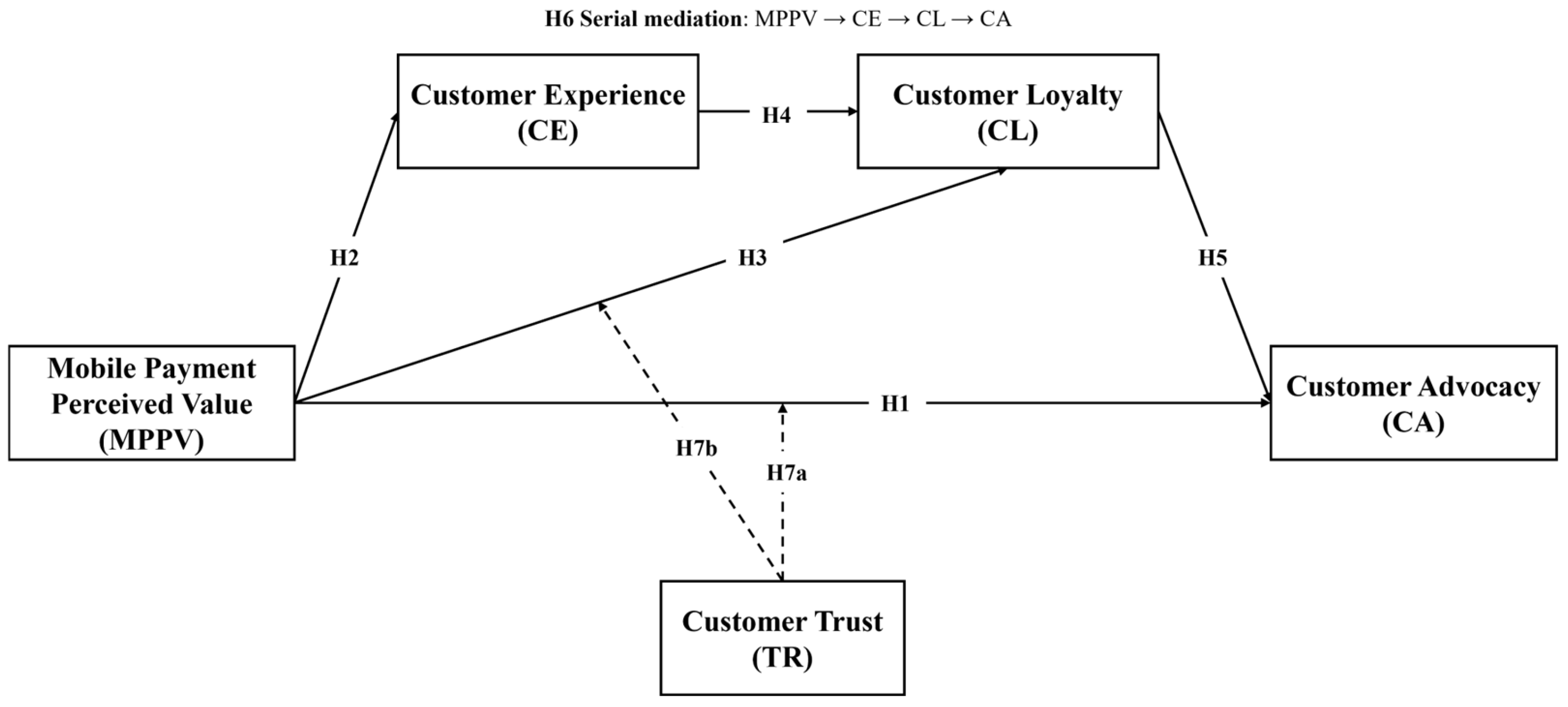
Figure 1 presents the conceptual framework of this study. The model positions MPPV as a higher-order construct reflecting users’ holistic evaluation of mobile payment services. MPPV is proposed to be positively associated with customer advocacy, customer experience, and customer loyalty. Customer experience is further proposed to be associated with customer loyalty, while customer loyalty is proposed to be associated with customer advocacy. In addition, customer experience and customer loyalty are modeled as sequential mediators in the relationship between MPPV and customer advocacy. Customer trust is incorporated as a boundary condition that moderates the relationships between MPPV and both customer advocacy and customer loyalty. Together, the framework explains sustainable mobile payment consumption as a relational digital consumption process in which perceived value becomes associated with advocacy through experience, loyalty, and trust. However, consistent with the cross-sectional design, the framework should be interpreted as a theoretically grounded relational model rather than as evidence of temporal causality. The model also recognizes that the study examines sustainability-relevant relational outcomes rather than direct environmental sustainability outcomes.

3. Methodology

3.1. Research Context

This study was conducted within the Lebanese mobile payment ecosystem, which provides a theoretically meaningful and contextually rich environment for examining sustainable digital consumption behaviors. Lebanon represents an emerging economy characterized by rapid digital transformation alongside prolonged economic instability, institutional fragility, and currency volatility [40,42,78]. In recent years, disruptions within the traditional banking sector have accelerated the adoption of alternative financial technologies, including mobile payment applications and digital wallets, as consumers increasingly rely on app-based solutions for everyday transactions [41,44]. As a result, mobile payment platforms have moved beyond convenience tools to become embedded components of daily financial practices [43].
The Lebanese context is particularly appropriate for investigating the relational dynamics of mobile payment advocacy for three key reasons. First, as an emerging market undergoing digital transition, Lebanon reflects heterogeneous patterns of technology adoption, allowing examination of how perceived value and relational mechanisms operate in evolving financial ecosystems [43,79]. Second, the high level of economic uncertainty amplifies perceived risk in financial exchanges, thereby heightening the importance of trust in shaping long-term engagement and advocacy behaviors [42,44]. Third, digital financial services in Lebanon operate within a trust-sensitive environment in which concerns related to service reliability, data security, and institutional credibility significantly influence consumer evaluations [40,41,44]. Therefore, the Lebanese setting is not treated merely as a background context but as an analytically relevant environment in which economic uncertainty, banking-sector disruption, and institutional trust concerns may shape how users evaluate mobile payment perceived value, customer experience, loyalty, and advocacy [43,44,80,81,82]. These contextual characteristics provide an appropriate setting for examining how perceived value, customer experience, loyalty, and trust are associated with sustainable mobile payment consumption and advocacy behavior. At the same time, because these relationships are examined within a specific high-uncertainty national context, the findings should be interpreted as context-sensitive and should not be generalized uncritically to all mobile payment users or to more institutionally stable digital financial markets. In particular, Lebanon’s banking-sector disruption may intensify the perceived importance of functional value and trust, meaning that the relational patterns observed in this study may differ from those in more stable financial systems.

3.2. Sample and Data Collection

To empirically examine the proposed research model, this study employed a quantitative, cross-sectional survey design, which is appropriate for investigating perceptual constructs and relational mechanisms within digital consumption contexts. Given the focus on mobile payment users in Lebanon, data were collected through an online self-administered questionnaire. This approach enabled access to active mobile payment users across digitally connected networks but also introduced potential self-selection and digital access bias, as users with stronger digital engagement may have been more likely to participate [83,84].
A non-probability convenience sampling approach was adopted because a complete sampling frame of Lebanese mobile payment users was not publicly available [85]. The survey link was distributed through social media platforms, online communities, and messaging applications commonly used in Lebanon. These channels were selected because mobile payment users are more likely to be reachable through digital communication channels; however, this recruitment strategy limits the representativeness of the sample and prevents probability-based generalization to the entire population of Lebanese mobile payment users [86,87]. To ensure relevance, screening questions were included to confirm that respondents were current users of at least one mobile payment application. Only respondents who confirmed prior or current mobile payment use were allowed to proceed with the questionnaire, thereby ensuring that participants had sufficient experience to evaluate the constructs under investigation.
A total of 412 responses were initially received during the data collection period. Following data screening procedures, including the removal of incomplete questionnaires, responses with excessive missing values, and patterned or inconsistent answering, 30 responses were excluded, resulting in a final sample of 382 valid and usable responses for statistical analysis. This final sample size is adequate for estimating the proposed PLS-SEM model, which includes a higher-order construct, sequential mediation, and moderation effects [88,89]. Nevertheless, sample adequacy for statistical estimation should not be interpreted as evidence of demographic representativeness.
Table 2 presents the demographic profile of the respondents. The sample consists predominantly of female respondents (69.1%), with the majority aged between 26 and 40 years (57.9%). Most participants hold a university degree (73.6%), indicating a relatively educated and digitally literate user base. This demographic profile is consistent with the online recruitment strategy and the digital nature of the study context, but it also suggests that the sample may underrepresent less educated users, older users, users with limited internet access, and individuals who rely less frequently on digital financial tools [90,91]. Accordingly, the findings should be interpreted as reflecting the perceptions of digitally reachable mobile payment users rather than the full Lebanese population. This demographic concentration should be considered when interpreting the results, as older, less-educated, rural, lower-income, or less digitally connected users may evaluate mobile payment value, trust, and advocacy differently.

3.3. Measurement Instruments

The survey instrument included established multi-item scales to measure perceived value dimensions, customer experience, customer loyalty, customer trust, and customer advocacy. All constructs were operationalized using validated scales from prior social science research and adapted to the mobile payment context. Responses were recorded using a seven-point Likert scale ranging from 1 (“strongly disagree”) to 7 (“strongly agree”). To improve contextual relevance, the items were reviewed and adapted to refer consistently to mobile payment services rather than generic digital services or mobile commerce. The adapted questionnaire was then reviewed for wording clarity, contextual fit, and construct relevance. A pilot assessment with a small group of mobile payment users was conducted to ensure that the items were understandable in the Lebanese mobile payment context. Minor wording refinements were made before full data collection, while the theoretical meaning of the original scales was preserved. The complete list of measurement items, construct sources, response anchors, and screening question is provided in Appendix A to improve transparency and reproducibility.
Perceived value was conceptualized as a multidimensional construct comprising utilitarian, hedonic, and social value, operationalized based on the PERVAL scale developed by Sweeney and Soutar [53] and Tripathi et al. [27]. This scale has been widely applied in digital service and mobile payment research [21,72,73,92]. In the present study, utilitarian, hedonic, and social value were modeled as components of MPPV, reflecting users’ holistic assessment of the benefits obtained from mobile payment services. This higher-order specification was adopted for theoretical parsimony and to capture the integrated way in which users evaluate mobile payment services in practice.
Customer experience was measured using items adapted from Tripathi et al. [27], reflecting users’ cumulative cognitive and emotional evaluations of their interactions with mobile payment services. The scale captures experiential enjoyment, perceived effectiveness, informational adequacy, and overall satisfaction with mobile payment usage. Customer loyalty was operationalized using established measures from Lin and Wang [75] and Benlian et al. [76], which are widely used in mobile commerce and digital platform research. The scale captures continuance intention, resistance to switching, and commitment to future usage. Customer trust was measured using items adapted from Singh and Sinha [87] and Chakraborty et al. [25]. The scale captures perceptions of legal safeguards, service provider expertise, honesty, and privacy protection. Customer advocacy was operationalized using the scale developed by Sweeney et al. [74], which conceptualizes advocacy as an advanced form of voluntary word-of-mouth behavior involving strong recommendation, endorsement, defense, and proactive promotion.

3.4. Common Method Bias

Given that all constructs were measured using a single survey instrument and self-reported data, the potential for common method bias (CMB) was addressed through procedural and statistical remedies [93]. Procedurally, respondents were assured of anonymity and confidentiality to reduce evaluation apprehension and social desirability bias, and the questionnaire emphasized that there were no right or wrong answers to encourage honest responses [94]. Established measurement scales were used and adapted carefully to the mobile payment context to minimize ambiguity, while item wording was refined to avoid double-barreled or leading statements.
Statistically, Harman’s single-factor test was conducted, and the first unrotated factor accounted for less than 50% of the total variance. In addition, full collinearity variance inflation factor (VIF) values were assessed within the PLS-SEM framework, and all values were below the conservative threshold of 3.3 [95]. These results suggest that CMB is unlikely to fully account for the observed relationships. However, Harman’s single-factor test and full collinearity diagnostics cannot completely eliminate concerns associated with single-source, self-reported, cross-sectional data [96]. Therefore, the findings should be interpreted with appropriate caution, and future research should consider using time-lagged designs, multiple data sources, marker variables, or behavioral usage data to further reduce method-related bias.

3.5. Data Analysis Technique

To examine the proposed relationships, this study employed Partial Least Squares Structural Equation Modeling (PLS-SEM) using SmartPLS (Version 4.1.1.7). PLS-SEM was selected because the model includes a higher-order MPPV construct, multiple latent constructs, sequential mediation, and moderation effects, which require simultaneous estimation of complex relationships [97,98,99]. The use of PLS-SEM was also appropriate because the study emphasizes prediction and theory extension in a context-sensitive digital financial environment rather than strict model confirmation alone. Compared with covariance-based SEM, PLS-SEM is less restrictive regarding distributional assumptions and is suitable for estimating complex models using survey data when prediction and explained variance are central analytical objectives [100,101,102].
The analysis followed a two-stage procedure. First, the measurement model was evaluated in terms of indicator reliability, internal consistency reliability, convergent validity, and discriminant validity. For the higher-order MPPV construct, utilitarian, hedonic, and social value were treated as lower-order dimensions representing an integrated perceived value assessment. The higher-order construct was estimated in SmartPLS using a higher-order modeling procedure appropriate for multidimensional constructs [99]. Second, the structural model was assessed using path coefficients, coefficients of determination (R2), effect sizes (f2), predictive relevance (Q2), and bootstrapping with 5000 resamples to test the statistical significance of direct, mediating, and moderating relationships [101]. Because the study is based on cross-sectional survey data, the mediation results are interpreted as evidence consistent with the proposed theoretical pathway rather than as proof of temporal or causal ordering.

4. Results

4.1. Measurement Model Assessment

The measurement model was evaluated using Partial Least Squares Structural Equation Modeling (PLS-SEM) in accordance with established guidelines [100]. Reliability, convergent validity, discriminant validity, and collinearity were assessed before proceeding to the structural model evaluation. Given that MPPV was conceptualized as a multidimensional construct consisting of hedonic value, social value, and utilitarian value, the higher-order construct was specified as a reflective-reflective construct. The higher-order MPPV construct was estimated in SmartPLS using a two-stage higher-order modeling procedure, in which the lower-order construct scores were first obtained and then used as indicators of the second-order construct [99]. This approach was adopted to capture users’ holistic evaluation of mobile payment value while preserving the conceptual role of the three underlying value dimensions.
Internal consistency reliability was examined using Cronbach’s alpha (CA) and composite reliability (CR). As shown in Table 3, all constructs exceeded the recommended threshold of 0.70 for both CA and CR, indicating satisfactory internal consistency [101,103]. Specifically, MPPV demonstrated strong reliability (CA = 0.926; CR = 0.938), while customer experience (CE), customer loyalty (CL), customer trust (TR), and customer advocacy (CA) also showed acceptable reliability values. However, these reliability results should not be interpreted only as threshold compliance; rather, they suggest that the indicators consistently capture their intended latent constructs while still requiring theoretical interpretation, particularly for MPPV as a higher-order construct.
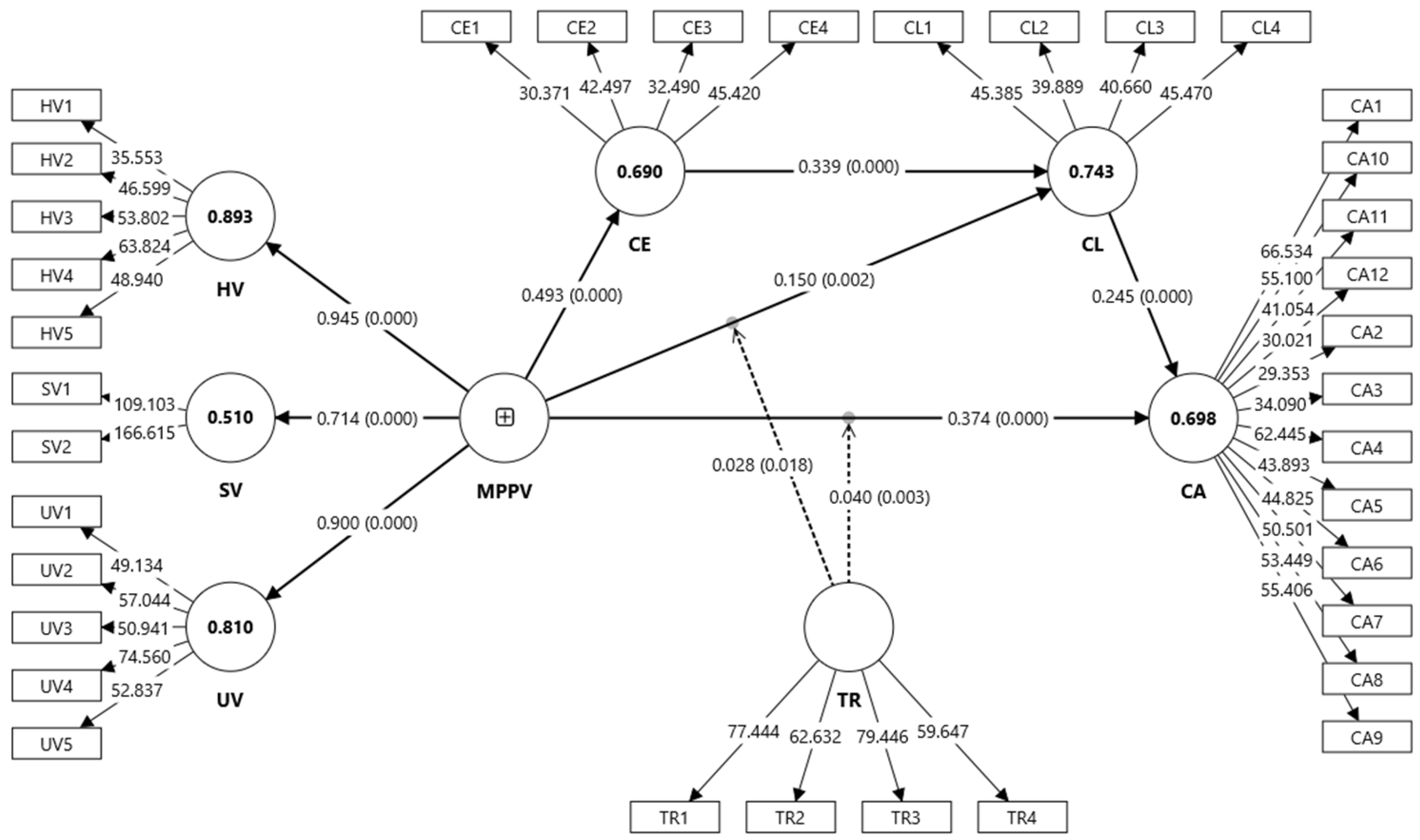
Convergent validity was assessed through outer loadings and average variance extracted (AVE). All item loadings exceeded the recommended minimum of 0.70, ranging from 0.714 to 0.945 for the higher-order MPPV dimensions and from 0.771 to 0.940 for the first-order indicators, indicating acceptable indicator reliability [104,105]. AVE values were above the threshold of 0.50 for all constructs, confirming that each construct explains more than half of the variance of its indicators [106]. MPPV achieved an AVE of 0.603, CE 0.673, CL 0.720, TR 0.789, and CA 0.700, demonstrating adequate convergent validity. For the lower-order value dimensions, hedonic value, social value, and utilitarian value also showed satisfactory reliability and convergent validity, supporting their use as dimensions of the higher-order MPPV construct.
Variance inflation factor (VIF) values were examined to assess potential multicollinearity issues. All VIF values were below the conservative threshold of 3.3, suggesting that collinearity did not pose a substantial concern among the indicators [95,101]. For the higher-order MPPV construct, the lower-order dimensions also showed acceptable collinearity values, supporting their inclusion in the higher-order specification. Nevertheless, modeling MPPV as a second-order construct prioritizes theoretical parsimony and holistic value evaluation, while reducing the ability to interpret the independent contribution of hedonic, social, and utilitarian value separately. Therefore, the higher-order specification should be interpreted as a parsimonious representation of overall perceived value, not as evidence that the three value dimensions contribute equally or operate in the same way. Future research should examine the disaggregated contributions of utilitarian, hedonic, and social value, particularly in crisis-sensitive financial environments where functional necessity may carry greater weight than emotional or social benefits.
Discriminant validity was evaluated using the Heterotrait–Monotrait (HTMT) ratio of correlations, as recommended by Henseler et al. [107]. As shown in Table 4, all HTMT values were below the conservative threshold of 0.85, indicating adequate discriminant validity among the constructs. The highest HTMT value was observed between MPPV and customer advocacy (0.778), which remains below the recommended cut-off. All other inter-construct HTMT ratios ranged between 0.519 and 0.626, further supporting the empirical distinctiveness of the constructs [105]. Taken together, these results suggest that the measurement model provides an acceptable basis for testing the proposed structural relationships, while recognizing that the higher-order MPPV specification should be interpreted as a holistic value assessment rather than as evidence that the three value dimensions operate identically.

4.2. Structural Model Assessment

Following assessment of the measurement model, the structural model was evaluated using bootstrapping with 5000 resamples in SmartPLS 4. Path coefficients, significance levels, explanatory power (R2), effect sizes (f2), and predictive relevance (Q2) were assessed in accordance with established PLS-SEM guidelines [101].
As presented in Table 5 and illustrated in Figure 2, the hypothesized direct relationships were statistically significant. MPPV was positively associated with customer advocacy (β = 0.374, t = 6.350, p < 0.001), supporting H1. The corresponding effect size was moderate (f2 = 0.160), indicating that the direct association between perceived value and advocacy is statistically significant and of meaningful practical magnitude. MPPV was also positively associated with customer experience (β = 0.493, t = 10.596, p < 0.001), supporting H2. The effect size for this path was moderate to large (f2 = 0.327), suggesting that perceived value is more strongly related to how users experience the mobile payment service than to any other outcome in the model. MPPV was further positively associated with customer loyalty (β = 0.150, t = 3.174, p = 0.002), supporting H3, with a small-to-moderate effect size (f2 = 0.124), indicating that the direct association between perceived value and loyalty is statistically significant but comparatively modest, suggesting that loyalty may be more strongly shaped through the experiential pathway than through perceived value alone.
Customer experience was positively associated with customer loyalty (β = 0.339, t = 6.914, p < 0.001), supporting H4. The effect size for this path was moderate (f2 = 0.207), indicating that accumulated service experience is a substantively meaningful relational antecedent of loyalty formation in mobile payment contexts. Customer loyalty was positively associated with customer advocacy (β = 0.245, t = 3.956, p < 0.001), supporting H5, with a small-to-moderate effect size (f2 = 0.140), suggesting that loyalty contributes meaningfully to advocacy behavior, consistent with the proposed relational pathway through which relational commitment supports outward-facing promotion of the service. These findings provide statistical support for the proposed relational model, but they should be interpreted as cross-sectional associations rather than evidence of definitive causal effects.

4.3. Mediation Analysis

The sequential mediation effect was examined using bootstrapping with 5000 resamples [108]. Indirect effects were considered significant when confidence intervals did not include zero. As shown in Table 6, the sequential indirect association from MPPV to customer advocacy through customer experience and customer loyalty was statistically significant (β = 0.041, t = 3.175, p = 0.002), supporting H6. This result is consistent with the proposed relational pathway in which perceived value is associated with advocacy through customer experience and customer loyalty. However, because the data are cross-sectional, this mediation result should not be interpreted as proof of temporal ordering or causality.
Additional indirect associations were also statistically significant. The indirect association from MPPV to customer advocacy through customer loyalty was significant (β = 0.037, p = 0.031), and the indirect association from MPPV to customer loyalty through customer experience was significant (β = 0.167, p < 0.001). Because the direct association between MPPV and customer advocacy remained significant alongside the indirect association, the results are consistent with partial mediation. This interpretation supports the proposed model but remains bounded by the cross-sectional design. Accordingly, the mediation results should be understood as evidence consistent with the theorized relational sequence, rather than as evidence that customer experience temporally precedes loyalty or that loyalty subsequently causes advocacy.

4.4. Moderation Analysis

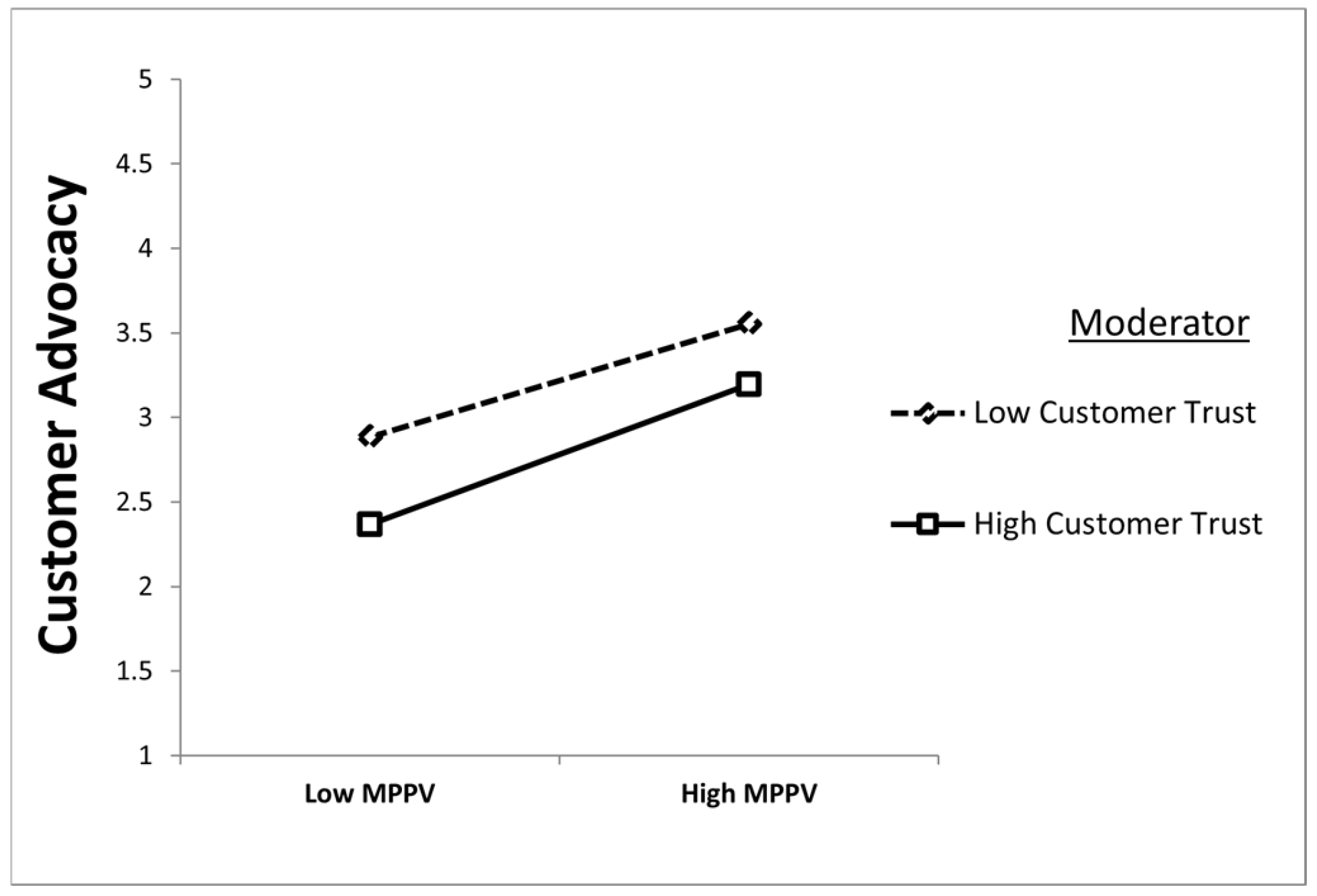
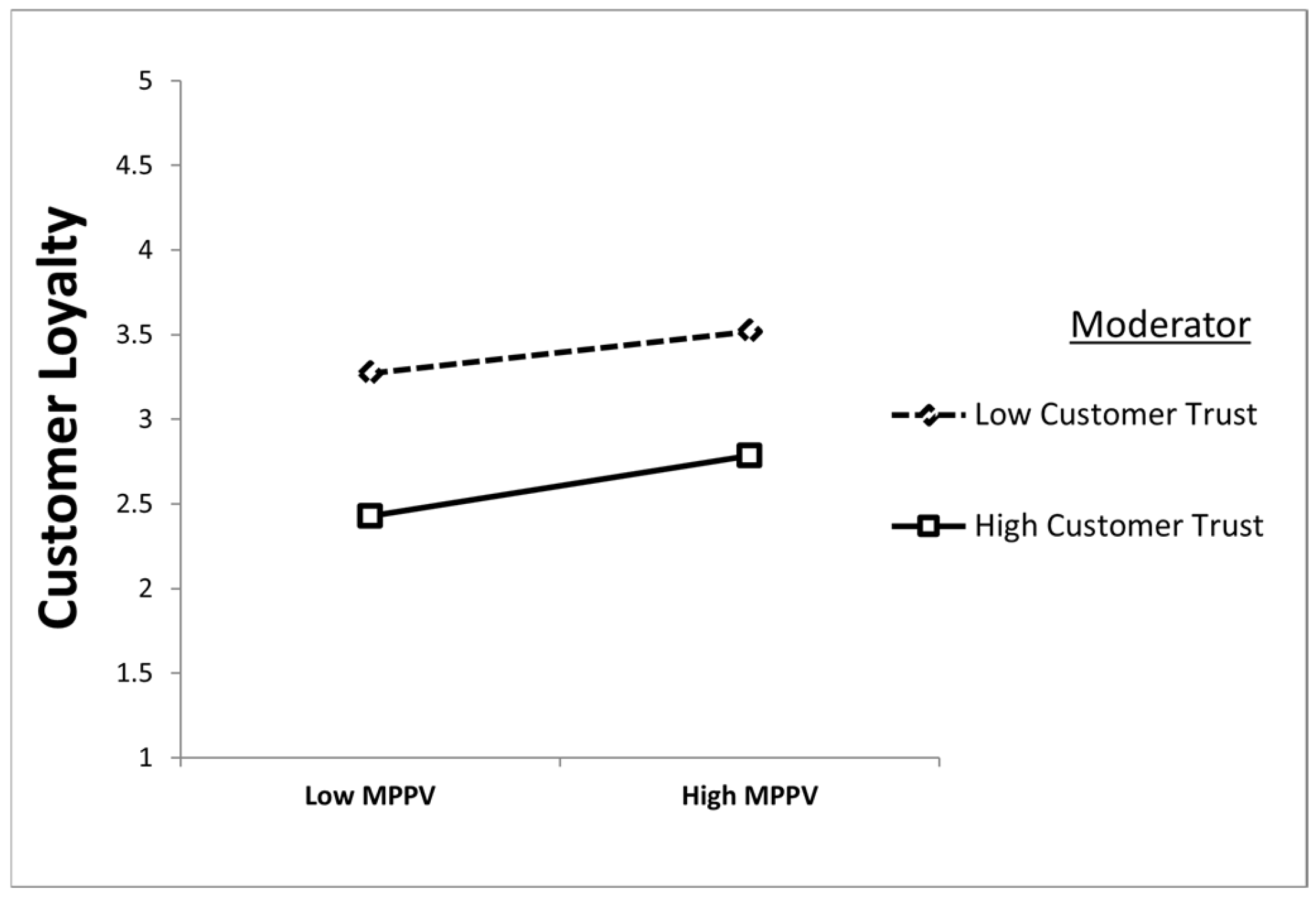
The moderating role of customer trust was examined by including interaction terms between MPPV and customer trust in predicting customer advocacy and customer loyalty [109,110]. As reported in Table 7, both interaction effects were statistically significant. Customer trust moderated the relationship between MPPV and customer advocacy (β = 0.040, p = 0.003), supporting H7a. Customer trust also moderated the relationship between MPPV and customer loyalty (β = 0.028, p = 0.018), supporting H7b. The plots presented in Figure 3 and Figure 4 indicate that the positive associations between MPPV and both customer advocacy and customer loyalty are stronger when customer trust is higher. These findings are consistent with the argument that trust acts as a boundary condition in mobile payment contexts, but they should be interpreted as moderation effects within a cross-sectional model rather than as evidence that trust causally changes user behavior over time.

4.5. Explanatory Power of the Structural Model

The model explained substantial variance in customer advocacy (R2 = 0.698), customer experience (R2 = 0.690), and customer loyalty (R2 = 0.743), reflecting strong explanatory power across all endogenous constructs [111]. Predictive relevance (Q2), assessed through blindfolding, was positive for all endogenous constructs (CA = 0.685; CE = 0.687; CL = 0.733), exceeding the zero threshold and suggesting adequate predictive relevance [101]. Although these results indicate strong model performance, the magnitude of the explained variance should be interpreted with caution. The use of perceptual, self-reported measures collected from the same respondents may increase consistency among constructs, and the convenience sample may reflect a digitally engaged subgroup of mobile payment users. Accordingly, the predictive and explanatory results should be interpreted as evidence of model adequacy within this sample rather than as proof of generalizable behavioral effects across all Lebanese mobile payment users.

5. Discussion and Implications

5.1. Discussion of Key Findings

The findings of this study provide support for a relational interpretation of MPPV, customer experience, customer loyalty, customer trust, and customer advocacy in the Lebanese mobile payment context. Mobile payment sustainability should not be treated as an automatic consequence of digital adoption. Rather, the results suggest that sustainable mobile payment consumption is better understood as a relational and trust-sensitive process through which perceived value becomes associated with continued engagement and advocacy. This interpretation is important because the empirical model does not directly measure environmental sustainability; instead, it examines sustainability-relevant relational outcomes, including loyalty, advocacy, trust, and ecosystem continuity.
The positive association between MPPV and customer advocacy suggests that users who perceive greater overall value in mobile payment services are more likely to recommend and support these services within their social networks. This finding is consistent with prior research showing that perceived value is associated with positive word-of-mouth and customer advocacy in digital service settings [27,73]. Sustained cashless engagement driven by perceived value has also been shown to support continuance intention and platform diffusion in mobile wallet contexts [112]. However, this study extends prior work by positioning advocacy not only as a marketing outcome but also as a relational behavior that may support the diffusion and normalization of mobile payment use. In a context such as Lebanon, where digital financial services operate amid economic instability and institutional uncertainty, advocacy may help reduce perceived uncertainty among potential users by providing socially trusted signals about service reliability.
The results also indicate that MPPV is positively associated with customer experience. This aligns with studies suggesting that users’ value evaluations shape how they interpret digital service encounters [25,27]. The Lebanese context provides a meaningful explanation for this relationship. Under conditions of financial volatility and banking-sector disruption, users may evaluate mobile payment services not only in terms of convenience or enjoyment but also in terms of practical reliability, accessibility, and perceived usefulness in daily financial transactions. Thus, positive customer experience may reflect more than interface satisfaction; it may also reflect users’ perception that mobile payment platforms offer a workable alternative in an uncertain financial environment.
The positive associations among MPPV, customer experience, and customer loyalty further support the relevance of relationship marketing logic in mobile payment ecosystems. Prior research has shown that loyalty in digital and mobile financial contexts is shaped by service quality, trust, and repeated favorable experiences [19,20,75]. From a consumption value perspective, customer loyalty in mobile payment is also shaped by the overall benefits users perceive relative to available alternatives, reinforcing the importance of holistic value evaluation in sustaining relational commitment [113,114]. The present findings refine this literature by suggesting that loyalty is not merely a post-adoption outcome but a relational response connected to users’ cumulative evaluation of value and experience. In this sense, loyalty may help stabilize mobile payment relationships by reducing switching tendencies and encouraging repeated use, especially in markets where users may be cautious about financial technologies.
The association between customer loyalty and customer advocacy suggests that users who maintain stronger commitment to mobile payment services are more willing to recommend and defend these services. This is consistent with Zhao and Bacao [20], who emphasize the importance of post-adoption relational outcomes in mobile payment use. The finding also clarifies the distinction between loyalty and advocacy: loyalty reflects continued commitment, whereas advocacy represents outward-facing relational support. In the Lebanese context, this distinction is particularly important because users’ recommendations may carry strong social influence when institutional trust is weak and consumers rely heavily on peer-based information to evaluate digital financial services.
The sequential mediation result is consistent with the proposed relational pathway linking MPPV to customer advocacy through customer experience and customer loyalty. This result should not be interpreted as proof of temporal causality because the study is based on cross-sectional data. Rather, it suggests that the observed associations are consistent with the theoretical argument that users first evaluate mobile payment services through experience, then develop loyalty, and subsequently become more willing to advocate the service. Because the data were collected from the same respondents at one point in time, the sequential mediation should be interpreted as a theoretically grounded pattern of association rather than evidence that these relational stages necessarily unfold over time. This interpretation aligns with Social Exchange Theory [45], in which favorable exchanges may be associated with reciprocal relational behaviors over time. Importantly, whereas prior studies in mobile payment and digital service contexts have examined perceived value, experience, loyalty, and advocacy as separate or parallel predictors [19,25,27], this study provides a more integrated explanation by testing whether these constructs are associated through a sequential relational chain within a single model.
The moderation results further suggest that customer trust strengthens the associations between MPPV and both customer loyalty and customer advocacy. This finding is consistent with research emphasizing the role of trust in reducing perceived risk and supporting relational stability in mobile commerce and digital financial services [34,64]. Trust has also been shown to moderate the relationship between perceived service quality and behavioral intentions in mobile payment and e-wallet contexts, suggesting that its amplifying role extends beyond direct adoption to broader relational outcomes [115,116,117]. In Lebanon’s high-uncertainty environment, trust may be especially important because users’ willingness to remain loyal or advocate a mobile payment service may depend on whether they believe the provider can safeguard transactions, protect privacy, and deliver reliable service [44]. Whereas prior trust research in mobile commerce has predominantly examined trust as a direct predictor of adoption or continuance, the present study adds that trust may operate as a boundary condition that determines the extent to which perceived value translates into relational outcomes. This distinction is theoretically important because it suggests that strengthening perceived value without also building trust may produce weaker loyalty and advocacy effects in high-uncertainty contexts.
Overall, the findings suggest that sustainable mobile payment consumption is better understood as a relational digital consumption process rather than a purely technological or transactional one. The study’s contribution does not lie in claiming that perceived value, experience, loyalty, trust, or advocacy are new constructs; rather, it lies in showing how these constructs operate together in a high-uncertainty emerging market through a higher-order perceived value structure, a sequential relational pathway, and trust-based boundary conditions. At the same time, the interpretation should remain cautious. The strong model performance may partly reflect the use of self-reported perceptual measures and a digitally reachable convenience sample. Therefore, the findings should be viewed as context-sensitive evidence consistent with the proposed model, rather than as definitive proof of universal behavioral processes.

5.2. Theoretical Implications

This study offers several theoretical implications for perceived value research, digital relationship marketing, and sustainable digital consumption in mobile financial services. First, it extends Perceived Value Theory by examining MPPV as a higher-order construct that captures users’ holistic value evaluation of mobile payment services. Prior research has often examined perceived value dimensions or post-adoption outcomes separately [11,25,27,72,118]. By modeling MPPV as an integrated construct, this study suggests that users may evaluate mobile payment services through an overall judgment of functional, emotional, and social benefits. This approach provides theoretical parsimony and aligns with the integrated nature of digital service evaluations. However, it also reduces the ability to identify the separate weight of utilitarian, hedonic, and social value, particularly in crisis-sensitive contexts. Thus, the higher-order specification should be viewed as a parsimonious modeling strategy rather than as evidence that functional, emotional, and social value contribute equally to advocacy. Future research should therefore examine these value dimensions separately to determine whether utilitarian value becomes especially salient in crisis contexts, while hedonic or social value may become more influential in more stable digital markets.
Second, the study contributes to sustainable digital consumption research by positioning customer advocacy as a sustainability-relevant relational outcome. Advocacy has traditionally been studied as an advanced form of word-of-mouth or customer support behavior [74,119]. The present study extends this view by arguing that, in mobile payment ecosystems, advocacy may support digital consumption sustainability by contributing to the diffusion, continuity, and social normalization of mobile payment use. This contribution is especially relevant because the paper does not claim to measure environmental sustainability directly [66,118,120,121]. Rather, it clarifies a more specific sustainability logic grounded in economic, social, relational, and institutional continuity within digital financial ecosystems.
Third, the findings contribute to digital relationship marketing by identifying customer experience and customer loyalty as relational mechanisms linking MPPV to advocacy. Relationship marketing research emphasizes the role of long-term engagement, trust, and commitment in service relationships [19,38,77]. This study refines that logic by showing that advocacy is associated not only with perceived value but also with the relational sequence through which users evaluate service experiences and develop loyalty. The sequential pathway is therefore important because it suggests that advocacy is more likely to emerge from accumulated relational engagement than from isolated service encounters.
Fourth, the study extends trust-based consumption research by examining trust as a boundary condition rather than merely as a direct antecedent. Prior studies have emphasized the importance of trust in electronic and mobile commerce [34,64,116]. The present study adds that trust may strengthen the association between perceived value and relational outcomes, particularly in high-uncertainty financial environments. This is theoretically meaningful because it suggests that perceived value may be less effective in producing loyalty or advocacy when users doubt provider reliability, privacy protection, or institutional safeguards.
Finally, the study contributes contextually by examining these relationships in Lebanon, where banking-sector disruption and institutional uncertainty make trust especially salient. The Lebanese context does not simply provide a geographical setting; it helps explain why trust may amplify the value-loyalty and value-advocacy associations. This context-sensitive contribution distinguishes the study from more general mobile payment models developed in stable financial environments and highlights the importance of examining digital relationship mechanisms under conditions of financial uncertainty.

5.3. Practical Implications

The findings provide practical implications for fintech providers, digital banks, policymakers, and platform managers operating in Lebanon’s mobile payment ecosystem. First, the positive associations involving MPPV suggest that providers should focus on delivering holistic value rather than isolated functional improvements. In Lebanon, where economic instability, currency fluctuations, and banking-sector disruption have heightened financial uncertainty, users may be especially sensitive to transaction reliability, service accessibility, and fee transparency. Fintech providers should therefore prioritize stable service performance, clear transaction information, transparent pricing, and reliable customer support as core elements of perceived value.
Second, the results suggest that customer experience should be managed as a relational asset. Short-term incentives may encourage trial use, but they may be insufficient for sustaining loyalty or advocacy. Mobile payment providers should reduce friction in onboarding, simplify user interfaces, improve real-time problem resolution, and communicate service updates clearly. These actions are particularly important in a trust-sensitive market where even minor service failures may reinforce uncertainty and weaken relational commitment.
Third, the loyalty-advocacy relationship suggests that providers should cultivate advocacy through relational consistency rather than aggressive promotion. In Lebanon’s socially connected market environment, peer recommendations may influence users’ willingness to adopt or continue using mobile payment services. Referral programs, user testimonials, review platforms, and community-based digital education initiatives may help transform satisfied and loyal users into credible advocates. However, these strategies should be grounded in authentic service quality and trust-building rather than promotional pressure.
Fourth, the moderating role of trust has direct implications for platform governance and communication. Because trust appears to strengthen the value-loyalty and value-advocacy relationships, providers should treat trust as a strategic infrastructure rather than as a communication slogan. This includes visible privacy policies, clear dispute-resolution procedures, transaction security assurances, regulatory compliance, and partnerships with credible institutions. Policymakers can support this process by strengthening consumer protection frameworks, digital payment regulations, and public awareness campaigns focused on safe and responsible mobile payment use.
Fifth, fintech providers and policymakers should address the digital divide among user groups that may be underrepresented in online samples, particularly older, less-educated, rural, lower-income, and less digitally confident consumers. Practical actions may include simplified application interfaces, clearer transaction instructions, Arabic-language support, assisted onboarding, telephone or in-person help channels, and community-based digital literacy programs. Such initiatives can help ensure that mobile payment services are not only attractive to digitally confident users but also accessible and trustworthy for consumers who may face greater barriers to digital financial participation. This implication should be interpreted in light of the sample profile, which was predominantly female and highly educated, and therefore may not fully capture the needs and experiences of all Lebanese mobile payment users.
Finally, managers should interpret advocacy as part of a broader relational performance system. In addition to adoption rates, providers should monitor experience quality, retention, complaint resolution, referral behavior, and user trust indicators. Such metrics can help assess whether mobile payment use is becoming relationally sustained, rather than merely transactionally adopted.

5.4. Limitations and Future Research

Despite its contributions, this study is subject to several limitations that should guide interpretation and future research. The cross-sectional design restricts causal inference, and the findings should therefore be interpreted as associations consistent with the proposed relational model rather than evidence of definitive causal processes. This limitation is particularly relevant to the sequential mediation pathway, as cross-sectional data cannot establish whether customer experience temporally precedes loyalty or whether loyalty subsequently develops into advocacy over time. The empirical setting is limited to Lebanon, an emerging economy shaped by financial instability, banking-sector disruption, and institutional trust concerns. This context provides meaningful insight into mobile payment use under uncertainty, but the relational pathways identified here may not replicate in markets with stronger regulatory systems or more stable traditional banking sectors. Indeed, Lebanon’s financial instability may heighten the salience of trust and functional value, meaning that users’ advocacy may partly reflect financial adaptation and practical necessity rather than only emotional attachment or identification with a digital service provider. The use of non-probability convenience sampling through online channels introduces self-selection and digital access bias, and the sample is predominantly female and highly educated, which may reflect the digital recruitment strategy rather than the broader Lebanese population. Accordingly, the findings should be interpreted as reflecting the perceptions of digitally reachable mobile payment users rather than all Lebanese mobile payment users. This demographic skew limits the extent to which the findings can be generalized to older users, less-educated users, rural users, lower-income consumers, or those with limited digital literacy. In addition, although procedural remedies, Harman’s single-factor test, and full collinearity VIF diagnostics were applied, these methods cannot fully rule out method-related variance associated with single-source, self-reported data. Finally, the sustainability framing should be interpreted carefully because this study examines sustainability-relevant relational outcomes, such as continuity, loyalty, advocacy, trust, and diffusion, rather than direct environmental sustainability outcomes.
Future research should address these limitations through longitudinal, comparative, and multi-method designs. Longitudinal, time-lagged, or panel-based studies could examine whether perceived value, trust, loyalty, and advocacy persist as Lebanon’s financial environment changes or as traditional banking conditions stabilize. Comparative cross-country studies could assess whether the same relational pathways operate in markets with different levels of institutional trust, fintech maturity, and regulatory stability. More diverse and probability-based samples, including stratified designs across age, income, region, and digital literacy groups, would strengthen generalizability. Future studies could also use marker variables, multiple data sources, app usage logs, transaction records, or qualitative interviews to capture behavioral nuances that self-reported survey data may overlook. Finally, future research should compare higher-order and disaggregated perceived value models to examine whether utilitarian, hedonic, and social value operate differently in crisis-sensitive financial environments. Although the higher-order MPPV specification provides theoretical parsimony, it may obscure whether customer advocacy is primarily associated with practical utility, emotional enjoyment, or social recognition. Future disaggregated analyses could clarify whether utilitarian value becomes more influential during periods of financial crisis while hedonic and social value become more salient when mobile payment ecosystems mature or financial conditions stabilize.


Author Contributions

Conceptualization, R.A.H. and A.A.; Validation, R.A.H. and A.A.; Supervision, A.A.; Writing—original draft, R.A.H.; Writing—review and editing, R.A.H. All authors have read and agreed to the published version of the manuscript.

Funding

This research received no external funding.

Institutional Review Board Statement

The study was conducted in accordance with the Declaration of Helsinki and approved by the Girne American University Social Sciences Ethics Committee, (approval code: 2024-25/012, approval date 3 March 2025).

Informed Consent Statement

Informed consent was obtained from all subjects involved in the study.

Data Availability Statement

The data from this study can be requested from the corresponding author, Rayan Al Haress.

Conflicts of Interest

The authors report no conflicts of interest.

Appendix A

Table A1. Measurement Items, Construct Sources, and Scale Information.
ConstructCodeItemSource
Hedonic ValueHV1I feel relaxed and good when I use mobile payment services.Sweeney and Soutar [53]; Tripathi et al. [27]
HV2Using mobile payment services is enjoyable.
HV3Using mobile payment services gives me pleasure.
HV4Using mobile payment services is interesting.
HV5Mobile payment services make me want to use them.
Social ValueSV1Using mobile payment services makes me feel accepted by others.Sweeney and Soutar [53]; Tripathi et al. [27]
SV2Using mobile payment services makes a good impression on others.
Utilitarian ValueUV1Mobile payment services are reliable and well provided.Sweeney and Soutar [53]; Tripathi et al. [27]
UV2Mobile payment services have good functions.
UV3Mobile payment services are provided in a timely manner.
UV4Mobile payment services fulfill my needs well.
UV5Mobile payment services offer consistent service quality.
Customer TrustTR1I feel that there are sufficient legal provisions concerning mobile payment applications.Singh and Sinha [64]; Chakraborty et al. [25]
TR2I feel that mobile payment applications possess sufficient expertise for providing services.
TR3I feel that mobile payment applications are honest in dealing with their customers.
TR4I feel confident about the privacy provided by mobile payment applications.
Customer ExperienceCE1Mobile payment services make my shopping experience enjoyable.Tripathi et al. [27]
CE2Using mobile payment applications enhances my effectiveness.
CE3The more I use mobile payment applications, the more experienced I become with them.
CE4Mobile payment applications allow me to receive relevant information, and I am satisfied with the application.
Customer LoyaltyCL1I plan to continue using mobile payment services in the future.Lin and Wang [75]; Benlian et al. [76]
CL2My preference for using mobile payment services would not willingly change.
CL3It would be difficult to change my beliefs about mobile payment services.
CL4I will use mobile payment services the next time I need to make a purchase or banking transaction.
Customer AdvocacyCA1When I recommend mobile payment services, I always do so strongly.Sweeney et al. [74]
CA2I am enthusiastic in my recommendations of mobile payment services.
CA3I have only good things to say about mobile payment services.
CA4When discussing mobile payment services, I urge people to consider using them.
CA5Whenever there is a conversation about this type of service, I usually strongly recommend mobile payment services without being asked.
CA6I would defend mobile payment services if people made negative comments about them directly to me.
CA7I describe mobile payment services as the best of their kind.
CA8I have told more people about my positive experience with mobile payment services than I have with most other service providers.
CA9When talking about mobile payment services, I usually compare them to competitors and explain why competitors are not as good.
CA10I take the initiative to actively promote mobile payment services, such as passing on details or contacting the provider on behalf of others if needed.
CA11Even when there is no conversation, if I think some people have an interest in this type of service, I strongly recommend mobile payment services without being asked.
CA12When practical, I provide positive written feedback on mobile payment services, such as recommendations, ratings, and comments on review websites.
Screening question: Have you used a mobile payment application or mobile payment service for financial transactions? Only respondents who answered “Yes” were eligible to complete the questionnaire. Instruction to respondents: Thinking of your preferred mobile payment application or service, please indicate the extent to which you agree or disagree with the following statements. Response scale: 1 = strongly disagree, 7 = strongly agree.

References

  1. Leong, C.; Hua, W.; Xiao, X.; Yu, J.; Zhou, Y. Value Co-Creation in a Digital Ecosystem: Exploring Autonomous Co-Creation in a Digital Influencer Ecosystem. Inf. Manag. 2026, 63, 104251. [Google Scholar] [CrossRef]
  2. Palmié, M.; Wincent, J.; Parida, V.; Caglar, U. The Evolution of the Financial Technology Ecosystem: An Introduction and Agenda for Future Research on Disruptive Innovations in Ecosystems. Technol. Forecast. Soc. Change 2020, 151, 119779. [Google Scholar] [CrossRef]
  3. Ankrah, S.T.; He, Z.; Asare-Kyire, L.; Ofori, K.S. Beyond Cash: A User-Centric Approach to Mobile Payment Growth, Service Failure Tolerance and Continuance Intention. Total Qual. Manag. Bus. Excell. 2024, 35, 1847–1878. [Google Scholar] [CrossRef]
  4. Edu, A.S. Paths to Digital Mobile Payment Platforms Acceptance and Usage: A Topology for Digital Enthusiast Consumers. Telemat. Inform. Rep. 2024, 15, 100158. [Google Scholar] [CrossRef]
  5. Rahardja, U.; Sigalingging, C.T.; Putra, P.O.H.; Nizar Hidayanto, A.; Phusavat, K. The Impact of Mobile Payment Application Design and Performance Attributes on Consumer Emotions and Continuance Intention. Sage Open 2023, 13, 21582440231151919. [Google Scholar] [CrossRef]
  6. Verkijika, S.F.; Neneh, B.N. Standing up for or against: A Text-Mining Study on the Recommendation of Mobile Payment Apps. J. Retail. Consum. Serv. 2021, 63, 102743. [Google Scholar] [CrossRef]
  7. Chen, S.-C.; Chung, K.C.; Tsai, M.Y. How to Achieve Sustainable Development of Mobile Payment through Customer Satisfaction—The SOR Model. Sustainability 2019, 11, 6314. [Google Scholar] [CrossRef]
  8. Farinloye, T.; Omotoye, O.; Oginni, A.; Moharrak, M.; Mogaji, E. Bridging the Digital Divide: Consumer Engagement with Transportation Payment Apps in Emerging Economies. J. Consum. Behav. 2024, 23, 3011–3029. [Google Scholar] [CrossRef]
  9. Shahen, A.M.; Sharaf, M.F. The Role of Digital Payment Technologies in Promoting Financial Inclusion: A Systematic Literature Review. FinTech 2025, 4, 59. [Google Scholar] [CrossRef]
  10. Shiau, W.-L.; Shih, C.-H.; Lin, C.-L.; Jiang, S.-Z.; Dwivedi, Y.K.; Yu, W.-P.; Chen, K. Exploring Core Knowledge in Mobile Payment Research. J. Organ. End User Comput. 2025, 37, 1–38. [Google Scholar] [CrossRef]
  11. Angel-Rodriguez, P.; Vicente-Pascual, J.A. Exploring the Adoption of Mobile Payments: A Hybrid Literature Review and Future Research Agenda. Future Bus. J. 2026, 12, 40. [Google Scholar] [CrossRef]
  12. Bhuiyan, M.R.I.; Akter, M.S.; Islam, S. How Does Digital Payment Transform Society as a Cashless Society? An Empirical Study in the Developing Economy. J. Sci. Technol. Policy Manag. 2024, 16, 756–774. [Google Scholar] [CrossRef]
  13. Hopalı, E.; Vayvay, Ö.; Kalender, Z.T.; Turhan, D.; Aysuna, C. How Do Mobile Wallets Improve Sustainability in Payment Services? A Comprehensive Literature Review. Sustainability 2022, 14, 16541. [Google Scholar] [CrossRef]
  14. Leong, L.-Y.; Hew, J.-J.; Wong, L.-W.; Lin, B. The Past and beyond of Mobile Payment Research: A Development of the Mobile Payment Framework. Internet Res. 2022, 32, 1757–1782. [Google Scholar] [CrossRef]
  15. Li, Z.; Xu, Y.; Zou, W. Signal Differences in Chinese Central Bank Communication Channels. Econ. Syst. 2026, 101377. [Google Scholar] [CrossRef]
  16. Nsavyimana, O.; Li, C. Impact Analysis of the Mobile Telephone and the Internet on Economic Development in the East African Community. Data Sci. Financ. Econ. 2025, 5, 156–176. [Google Scholar] [CrossRef]
  17. Al-Sharafi, M.A.; Al-Qaysi, N.; Iahad, N.A.; Al-Emran, M. Evaluating the Sustainable Use of Mobile Payment Contactless Technologies within and beyond the COVID-19 Pandemic Using a Hybrid SEM-ANN Approach. Int. J. Bank Mark. 2022, 40, 1071–1095. [Google Scholar] [CrossRef]
  18. Chakraborty, D.; Mehta, P.; Dash, G.; Khan, N.; Jain, R.K.; Biswas, D. What Drives Consumers to Adopt Mobile Payment Apps in the Post-COVID-19 Scenario: The Role of Openness to Change and User Involvement. J. Glob. Inf. Manag. 2023, 31, 1–24. [Google Scholar] [CrossRef]
  19. Franque, F.B.; Oliveira, T.; Tam, C. Understanding the Factors of Mobile Payment Continuance Intention: Empirical Test in an African Context. Heliyon 2021, 7, e07807. [Google Scholar] [CrossRef]
  20. Zhao, Y.; Bacao, F. How Does the Pandemic Facilitate Mobile Payment? An Investigation on Users’ Perspective under the COVID-19 Pandemic. Int. J. Environ. Res. Public Health 2021, 18, 1016. [Google Scholar] [CrossRef]
  21. Hijazi, R.; Abu Daabes, A.; Al-Ajlouni, M.I. Mobile Payment Service Quality: A New Approach for Continuance Intention. Int. J. Qual. Reliab. Manag. 2023, 40, 2019–2038. [Google Scholar] [CrossRef]
  22. Jun, M.; Palacios, S. Examining the Key Dimensions of Mobile Banking Service Quality: An Exploratory Study. Int. J. Bank Mark. 2016, 34, 307–326. [Google Scholar] [CrossRef]
  23. Pushparaj, N.; Natarajan, M.; Sivakumar, V.J. Exploring the Prominence of Quality Dimensions on M-Payments Apps Customer Experience and Stickiness. Sage Open 2025, 15, 21582440251361988. [Google Scholar] [CrossRef]
  24. Sharma, V.; Jangir, K.; Gupta, M.; Rupeika-Apoga, R. Does Service Quality Matter in FinTech Payment Services? An Integrated SERVQUAL and TAM Approach. Int. J. Inf. Manag. Data Insights 2024, 4, 100252. [Google Scholar] [CrossRef]
  25. Chakraborty, D.; Siddiqui, A.; Siddiqui, M.; Rana, N.P.; Dash, G. Mobile Payment Apps Filling Value Gaps: Integrating Consumption Values with Initial Trust and Customer Involvement. J. Retail. Consum. Serv. 2022, 66, 102946. [Google Scholar] [CrossRef]
  26. Kumari, N.; Biswas, A. Does M-Payment Service Quality and Perceived Value Co-Creation Participation Magnify M-Payment Continuance Usage Intention? Moderation of Usefulness and Severity. Int. J. Bank Mark. 2023, 41, 1330–1359. [Google Scholar] [CrossRef]
  27. Tripathi, S.N.; Malik, N.; Rana, N.P.; Vishnani, S.; Srivastava, S. Validating the Antecedents of Customer M-Payment Loyalty: An Empirical Investigation. Internet Res. 2022, 32, 1862–1890. [Google Scholar] [CrossRef]
  28. Puspitasari, I.; Rusydi, F.; Nuzulita, N.; Hsiao, C.-S. Investigating the Role of Utilitarian and Hedonic Goals in Characterizing Customer Loyalty in E-Marketplaces. Heliyon 2023, 9, e19193. [Google Scholar] [CrossRef]
  29. Hidayat, K.; Idrus, M.I. The Effect of Relationship Marketing towards Switching Barrier, Customer Satisfaction, and Customer Trust on Bank Customers. J. Innov. Entrep. 2023, 12, 29. [Google Scholar] [CrossRef]
  30. Venetis, K.A.; Ghauri, P.N. Service Quality and Customer Retention: Building Long-term Relationships. Eur. J. Mark. 2004, 38, 1577–1598. [Google Scholar] [CrossRef]
  31. Tang, Y.; Son, H. How Perceived Value Drives Usage Intention of AI Digital Human Advisors in Digital Finance. Systems 2025, 13, 973. [Google Scholar] [CrossRef]
  32. Dawood, H.M.; Liew, C.Y.; Lau, T.C. Mobile Perceived Trust Mediation on the Intention and Adoption of FinTech Innovations Using Mobile Technology: A Systematic Literature Review. F1000Res 2022, 10, 1252. [Google Scholar] [CrossRef]
  33. Ghazali, E.M.; Mutum, D.S.; Chong, J.H.; Nguyen, B. Do Consumers Want Mobile Commerce? A Closer Look at M-Shopping and Technology Adoption in Malaysia. Asia Pac. J. Mark. Logist. 2018, 30, 1064–1086. [Google Scholar] [CrossRef]
  34. Jimenez, N.; San-Martin, S.; Azuela, J.I. Trust and Satisfaction: The Keys to Client Loyalty in Mobile Commerce. Acad. Rev. Latinoam. Adm. 2016, 29, 486–510. [Google Scholar] [CrossRef]
  35. Bajwa, F.A.; Fu, J.; Bajwa, I.A.; Ahmad, S.; Mahmood, F. Factors Influencing Usage and Loyalty for Payment App Customers in Saudi Arabia. Acta Psychol. 2025, 255, 104961. [Google Scholar] [CrossRef]
  36. Maureen Nelloh, L.A.; Santoso, A.S.; Slamet, M.W. Will Users Keep Using Mobile Payment? It Depends on Trust and Cognitive Perspectives. Procedia Comput. Sci. 2019, 161, 1156–1164. [Google Scholar] [CrossRef]
  37. Qatawneh, N.; Al-Okaily, A.; Al-Okaily, M.; Ur Rehman, S. Exploring the Antecedent Factors of Continuous Intention to Use Mobile Money: Insights from Emerging Markets. Digit. Policy Regul. Gov. 2024, 27, 175–200. [Google Scholar] [CrossRef]
  38. Samarah, T.; Bayram, P.; Aljuhmani, H.Y.; Elrehail, H. The Role of Brand Interactivity and Involvement in Driving Social Media Consumer Brand Engagement and Brand Loyalty: The Mediating Effect of Brand Trust. J. Res. Interact. Mark. 2021, 16, 648–664. [Google Scholar] [CrossRef]
  39. Reinartz, W.J. Customer Relationship Management: Past, Present, and Future. Int. J. Res. Mark. 2025, 43, 8–27. [Google Scholar] [CrossRef]
  40. Elia, J.; Jabbour Al Maalouf, N.; Serghani, J.; Balouza, M.; Sawaya, C. Lebanon’s Banking Sector 2000–2023: Resilience, Adaptation, and Challenges in Economic, Political, and Regional Landscapes. Manag. Stud. Econ. Syst. 2026, 10, 29–53. [Google Scholar]
  41. Hijazi, M.; Saad, M.; Sidani, S. Financial Inclusion in Lebanon after the Economic Crisis. Cogent Bus. Manag. 2025, 12, 2483966. [Google Scholar] [CrossRef]
  42. World Bank Lebanon Economic Monitor, Spring 2025: Turning the Tide? World Bank: Washington, DC, USA, 2025.
  43. Aoun, D.; Rahal, R.; Sfeir, L.; Jabbour Al Maalouf, N. Understanding Millennials’ Financial Behavior: The Role of Fintech Adoption, Financial Literacy, and the Mediating Effect of Financial Attitudes in a Crisis-Affected Emerging Economy. Int. J. Financ. Stud. 2026, 14, 35. [Google Scholar] [CrossRef]
  44. Khoury, C.M.E.; Doumit, K.P.B.; Alam, A.F.A. The Mediating Role of Consumers’ Perceived Trust in Relation to the Intention to Use Digital Wallets during Lebanon’s Financial Crisis. Int. J. Technol. Mark. 2024, 18, 424–453. [Google Scholar] [CrossRef]
  45. Blau, P.M. Justice in Social Exchange. Sociol. Inq. 1964, 34, 193–206. [Google Scholar] [CrossRef]
  46. Choi, M.K.; Lee, J.S. The Impact of Parasocial Interaction with Anthropomorphized AI Chatbots on Sport Consumers’ Loyalty. Int. J. Sports Mark. Spons. 2025, 26, 713–730. [Google Scholar] [CrossRef]
  47. Park, D.Y. Enhancing Customer Engagement Value: A Comprehensive Review of Integrated Program Strategies beyond Loyalty Programs. J. Serv. Mark. 2025, 39, 1093–1118. [Google Scholar] [CrossRef]
  48. Quaye, E.S.; Taoana, C.; Abratt, R.; Anabila, P. Customer Advocacy and Brand Loyalty: The Mediating Roles of Brand Relationship Quality and Trust. J. Brand Manag. 2022, 29, 363–382. [Google Scholar] [CrossRef]
  49. Sahli, A.; Lallouna, H.B. Exploring Trust in Mobile Payments in Crises Situations. Acad. Mark. Stud. J. 2024, 28, 1–17. [Google Scholar]
  50. Kumar, V.; Lai, K.-K.; Chang, Y.-H.; Bhatt, P.C.; Su, F.-P. A Structural Analysis Approach to Identify Technology Innovation and Evolution Path: A Case of m-Payment Technology Ecosystem. J. Knowl. Manag. 2020, 25, 477–499. [Google Scholar] [CrossRef]
  51. Haritha, P.H. Mobile Payment Service Adoption: Understanding Customers for an Application of Emerging Financial Technology. Inf. Comput. Secur. 2023, 31, 145–171. [Google Scholar] [CrossRef]
  52. Wamba-Taguimdje, S.-L.; Kala Kamdjoug, J.R. Mobile Payments and Money Technologies in Sustainable Development: A Systematic Literature Review and Computer-Assisted Interpretive Analysis. Inf. Technol. Dev. 2025, 31, 435–472. [Google Scholar] [CrossRef]
  53. Sweeney, J.C.; Soutar, G.N. Consumer Perceived Value: The Development of a Multiple Item Scale. J. Retail. 2001, 77, 203–220. [Google Scholar] [CrossRef]
  54. Morgan, R.M.; Hunt, S.D. The Commitment-Trust Theory of Relationship Marketing. J. Mark. 1994, 58, 20–38. [Google Scholar] [CrossRef]
  55. Blut, M.; Chaney, D.; Lunardo, R.; Mencarelli, R.; Grewal, D. Customer Perceived Value: A Comprehensive Meta-Analysis. J. Serv. Res. 2024, 27, 501–524. [Google Scholar] [CrossRef]
  56. Boksberger, P.E.; Melsen, L. Perceived Value: A Critical Examination of Definitions, Concepts and Measures for the Service Industry. J. Serv. Mark. 2011, 25, 229–240. [Google Scholar] [CrossRef]
  57. Zeithaml, V.A. Consumer Perceptions of Price, Quality, and Value: A Means-End Model and Synthesis of Evidence. J. Mark. 1988, 52, 2–22. [Google Scholar] [CrossRef]
  58. Dang, T.-Q.; Tan, G.W.-H.; Aw, E.C.-X.; Ooi, K.-B.; Metri, B.; Dwivedi, Y.K. How to Generate Loyalty in Mobile Payment Services? An Integrative Dual SEM-ANN Analysis. Int. J. Bank Mark. 2023, 41, 1177–1206. [Google Scholar] [CrossRef]
  59. Emerson, R.M. Social Exchange Theory. Annu. Rev. Sociol. 1976, 2, 335–362. [Google Scholar] [CrossRef]
  60. Gao, Z.; Chang, J.Y.-S.; Lim, X.-J.; Cheah, J.-H.; Cham, T.-H.; Sigala, M. What Makes Users Recommend Their Mobile Travel App? Findings From an Innovation Diffusion and Social Exchange Theory Perspective. Int. J. Tour. Res. 2025, 27, e70117. [Google Scholar] [CrossRef]
  61. Ahmad, R.; Nawaz, M.R.; Ishaq, M.I.; Khan, M.M.; Ashraf, H.A. Social Exchange Theory: Systematic Review and Future Directions. Front. Psychol. 2023, 13, 1015921. [Google Scholar] [CrossRef]
  62. Rehman, F.U.; Zahid, H.; Qayyum, A.; Jamil, R.A. Building Relationship Equity: Role of Social Media Marketing Activities, Customer Engagement, and Relational Benefits. J. Theor. Appl. Electron. Commer. Res. 2025, 20, 223. [Google Scholar] [CrossRef]
  63. Alrawad, M.; Lutfi, A.; Almaiah, M.A.; Elshaer, I.A. Examining the Influence of Trust and Perceived Risk on Customers Intention to Use NFC Mobile Payment System. J. Open Innov. Technol. Mark. Complex. 2023, 9, 100070. [Google Scholar] [CrossRef]
  64. Singh, N.; Sinha, N. How Perceived Trust Mediates Merchant’s Intention to Use a Mobile Wallet Technology. J. Retail. Consum. Serv. 2020, 52, 101894. [Google Scholar] [CrossRef]
  65. Berraies, S.; Ben Yahia, K.; Hannachi, M. Identifying the Effects of Perceived Values of Mobile Banking Applications on Customers: Comparative Study between Baby Boomers, Generation X and Generation Y. Int. J. Bank Mark. 2017, 35, 1018–1038. [Google Scholar] [CrossRef]
  66. Zahran, I.; Aljuhmani, H.Y. Seduced by Style: How Instagram Fashion Influencers Build Brand Loyalty Through Customer Engagement in Sustainable Consumption. Sustainability 2025, 17, 7888. [Google Scholar] [CrossRef]
  67. Sheth, J.N.; Newman, B.I.; Gross, B.L. Why We Buy What We Buy: A Theory of Consumption Values. J. Bus. Res. 1991, 22, 159–170. [Google Scholar] [CrossRef]
  68. Gupta, S.; Prusty, S. Does Consumer Empowerment Influence E-Paymentsystems Adoption? A Digital Consumer-Centric Perspective. J. Financ. Serv. Mark. 2024, 29, 1–15. [Google Scholar] [CrossRef]
  69. Laradi, S.; Elfekair, A.; Rehman, H.M.; Hanna, D.; Alrawad, M. Continuance Intention of M-Banking Adoption: The Dynamics of UTAUT3, Trust and Attitudes. FIIB Bus. Rev. 2025, 23197145251358049. [Google Scholar] [CrossRef]
  70. Mehrabian, A. The Development and Validation of Measures of Affiliative Tendency and Sensitivity To Rejection. Educ. Psychol. Meas. 1970, 30, 417–428. [Google Scholar] [CrossRef]
  71. Venkatesh, V.; Morris, M.G.; Davis, G.B.; Davis, F.D. User Acceptance of Information Technology: Toward A Unified View. MIS Q. 2003, 27, 425–478. [Google Scholar] [CrossRef]
  72. Wei, N.; Liang, Y.; Wang, H.; Liu, M. Analysis of Mobile Fintech Adoption Based on Perceived Value and Risk Theory: Findings from PLS-SEM and fsQCA. Humanit. Soc. Sci. Commun. 2025, 12, 973. [Google Scholar] [CrossRef]
  73. Rajaobelina, L.; Prom Tep, S.; Arcand, M.; Ricard, L. The Relationship of Brand Attachment and Mobile Banking Service Quality with Positive Word-of-Mouth. J. Prod. Brand Manag. 2021, 30, 1162–1175. [Google Scholar] [CrossRef]
  74. Sweeney, J.; Payne, A.; Frow, P.; Liu, D. Customer Advocacy: A Distinctive Form of Word of Mouth. J. Serv. Res. 2020, 23, 139–155. [Google Scholar] [CrossRef]
  75. Lin, H.-H.; Wang, Y.-S. An Examination of the Determinants of Customer Loyalty in Mobile Commerce Contexts. Inf. Manag. 2006, 43, 271–282. [Google Scholar] [CrossRef]
  76. Benlian, A.; Titah, R.; Hess, T. Differential Effects of Provider Recommendations and Consumer Reviews in E-Commerce Transactions: An Experimental Study. J. Manag. Inf. Syst. 2012, 29, 237–272. [Google Scholar] [CrossRef]
  77. Aljuhmani, H.Y.; Elrehail, H.; Bayram, P.; Samarah, T. Linking Social Media Marketing Efforts with Customer Brand Engagement in Driving Brand Loyalty. Asia Pac. J. Mark. Logist. 2022, 35, 1719–1738. [Google Scholar] [CrossRef]
  78. Putrevu, J.; Mertzanis, C. The Adoption of Digital Payments in Emerging Economies: Challenges and Policy Responses. Digit. Policy Regul. Gov. 2023, 26, 476–500. [Google Scholar] [CrossRef]
  79. Makhoul, K.E.; Jammal, D.N. Algorithms Meet Adversity: AI in Lebanon’s Battle Against Financial Crisis. Am. J. Econ. 2025, 15, 20–33. [Google Scholar]
  80. Hammoud, J.; Bizri, R.M.; El Baba, I. The Impact of E-Banking Service Quality on Customer Satisfaction: Evidence From the Lebanese Banking Sector. Sage Open 2018, 8, 2158244018790633. [Google Scholar] [CrossRef]
  81. Harb, A.; Thoumy, M.; Yazbeck, M. Customer Satisfaction with Digital Banking Channels in Times of Uncertainty. Banks Bank Syst. 2022, 17, 27–37. [Google Scholar] [CrossRef]
  82. Masri, N.A.; Khawaja, D. The Impact Of Cashless Payments On Smes’ Financial Performance In Mount Lebanon. IOSR J. Econ. Financ. 2024, 15, 41–47. [Google Scholar] [CrossRef]
  83. Jaiswal, D.; Mohan, A.; Deshmukh, A.K. Cash Rich to Cashless Market: Segmentation and Profiling of Fintech-Led-Mobile Payment Users. Technol. Forecast. Soc. Change 2023, 193, 122627. [Google Scholar] [CrossRef]
  84. Koksal, M.H. The Intentions of Lebanese Consumers to Adopt Mobile Banking. Int. J. Bank Mark. 2016, 34, 327–346. [Google Scholar] [CrossRef]
  85. Jbara, H.; El Nemar, S.; Bakhit, W.; Vrontis, D.; Thrassou, A. Impacting Brand Awareness and Emotions in Retail Consumer Decision-Making Within a Digital Context. Analytics 2026, 5, 16. [Google Scholar] [CrossRef]
  86. Al Maalouf, N.; Elia, J.; Sawaya, C.; Boutros, F. The Impact of Social Media on Customer Behavior—Evidence from Lebanon. Arab. Econ. Bus. J. 2024, 16, 1. [Google Scholar] [CrossRef]
  87. Singh, S.; Sagar, R. A Critical Look at Online Survey or Questionnaire-Based Research Studies during COVID-19. Asian J. Psychiatry 2021, 65, 102850. [Google Scholar] [CrossRef] [PubMed]
  88. Guenther, P.; Guenther, M.; Ringle, C.M.; Zaefarian, G.; Cartwright, S. Improving PLS-SEM Use for Business Marketing Research. Ind. Mark. Manag. 2023, 111, 127–142. [Google Scholar] [CrossRef]
  89. Hair, J.F.; Sarstedt, M.; Ringle, C.M.; Gudergan, S.P. Advanced Issues in Partial Least Squares Structural Equation Modeling, 2nd ed.; SAGE Publications, Inc: Thousand Oaks, CA, USA, 2024. [Google Scholar]
  90. Andrade, C. The Limitations of Online Surveys. Indian J. Psychol. Med. 2020, 42, 575–576. [Google Scholar] [CrossRef]
  91. Grewenig, E.; Lergetporer, P.; Simon, L.; Werner, K.; Woessmann, L. Can Internet Surveys Represent the Entire Population? A Practitioners’ Analysis. Eur. J. Political Econ. 2023, 78, 102382. [Google Scholar] [CrossRef]
  92. Alrwashdeh, M.; Jahmani, A.; Ibrahim, B.; Aljuhmani, H.Y. Data to Model the Effects of Perceived Telecommunication Service Quality and Value on the Degree of User Satisfaction and E-WOM among Telecommunications Users in North Cyprus. Data Brief 2020, 28, 104981. [Google Scholar] [CrossRef]
  93. Podsakoff, P.M.; MacKenzie, S.B.; Lee, J.-Y.; Podsakoff, N.P. Common Method Biases in Behavioral Research: A Critical Review of the Literature and Recommended Remedies. J. Appl. Psychol. 2003, 88, 879–903. [Google Scholar] [CrossRef]
  94. Baumgartner, H.; Weijters, B. Dealing with Common Method Variance in International Marketing Research. J. Int. Mark. 2021, 29, 7–22. [Google Scholar] [CrossRef]
  95. Kock, N. Common Method Bias in PLS-SEM: A Full Collinearity Assessment Approach. Int. J. e-Collab. 2015, 11, 1–10. [Google Scholar] [CrossRef]
  96. Podsakoff, P.M.; Podsakoff, N.P.; Williams, L.J.; Huang, C.; Yang, J. Common Method Bias: It’s Bad, It’s Complex, It’s Widespread, and It’s Not Easy to Fix. Annu. Rev. Organ. Psychol. Organ. Behav. 2024, 11, 17–61. [Google Scholar] [CrossRef]
  97. Akter, S.; Fosso Wamba, S.; Dewan, S. Why PLS-SEM Is Suitable for Complex Modelling? An Empirical Illustration in Big Data Analytics Quality. Prod. Plan. Control 2017, 28, 1011–1021. [Google Scholar] [CrossRef]
  98. Neiroukh, S.; Emeagwali, O.L.; Aljuhmani, H.Y. Artificial Intelligence Capability and Organizational Performance: Unraveling the Mediating Mechanisms of Decision-Making Processes. Manag. Decis. 2025, 63, 3501–3532. [Google Scholar] [CrossRef]
  99. Sarstedt, M.; Hair, J.F.; Cheah, J.-H.; Becker, J.-M.; Ringle, C.M. How to Specify, Estimate, and Validate Higher-Order Constructs in PLS-SEM. Australas. Mark. J. 2019, 27, 197–211. [Google Scholar] [CrossRef]
  100. Hair, J.; Hult, G.T.M.; Ringle, C.M.; Sarstedt, M. A Primer on Partial Least Squares Structural Equation Modeling, 3rd ed.; SAGE Publications, Inc: Los Angeles, CA, USA, 2021. [Google Scholar]
  101. Hair, J.F.; Risher, J.J.; Sarstedt, M.; Ringle, C.M. When to Use and How to Report the Results of PLS-SEM. Eur. Bus. Rev. 2019, 31, 2–24. [Google Scholar] [CrossRef]
  102. Sarstedt, M.; Hair, J.F., Jr.; Ringle, C.M. “PLS-SEM: Indeed a Silver Bullet”—Retrospective Observations and Recent Advances. J. Mark. Theory Pract. 2023, 31, 261–275. [Google Scholar] [CrossRef]
  103. Nunnally, J.C. Psychometric Theory, 2nd ed.; McGraw-Hill Companies: New York, NY, USA, 1978. [Google Scholar]
  104. Henseler, J.; Ringle, C.M.; Sinkovics, R.R. The Use of Partial Least Squares Path Modeling in International Marketing. In New Challenges to International Marketing; Sinkovics, R.R., Ghauri, P.N., Eds.; Advances in International Marketing; Emerald Group Publishing Limited: Leeds, UK, 2009; Volume 20, pp. 277–319. [Google Scholar]
  105. Voorhees, C.M.; Brady, M.K.; Calantone, R.; Ramirez, E. Discriminant Validity Testing in Marketing: An Analysis, Causes for Concern, and Proposed Remedies. J. Acad. Mark. Sci. 2016, 44, 119–134. [Google Scholar] [CrossRef]
  106. Fornell, C.; Larcker, D.F. Evaluating Structural Equation Models with Unobservable Variables and Measurement Error. J. Mark. Res. 1981, 18, 39–50. [Google Scholar] [CrossRef]
  107. Henseler, J.; Ringle, C.M.; Sarstedt, M. A New Criterion for Assessing Discriminant Validity in Variance-Based Structural Equation Modeling. J. Acad. Mark. Sci. 2015, 43, 115–135. [Google Scholar] [CrossRef]
  108. Carrión, G.C.; Nitzl, C.; Roldán, J.L. Mediation Analyses in Partial Least Squares Structural Equation Modeling: Guidelines and Empirical Examples. In Partial Least Squares Path Modeling: Basic Concepts, Methodological Issues and Applications; Latan, H., Noonan, R., Eds.; Springer International Publishing: Cham, Switzerland, 2017; pp. 173–195. [Google Scholar]
  109. Al-Geitany, S.; Aljuhmani, H.Y.; Emeagwali, O.L.; Nasr, E. Consumer Behavior in the Post-COVID-19 Era: The Impact of Perceived Interactivity on Behavioral Intention in the Context of Virtual Conferences. Sustainability 2023, 15, 8600. [Google Scholar] [CrossRef]
  110. Henseler, J.; Fassott, G. Testing Moderating Effects in PLS Path Models: An Illustration of Available Procedures. In Handbook of Partial Least Squares: Concepts, Methods and Applications; Esposito Vinzi, V., Chin, W.W., Henseler, J., Wang, H., Eds.; Springer: Berlin/Heidelberg, Germany, 2010; pp. 713–735. [Google Scholar]
  111. Cohen, J. Statistical Power Analysis for the Behavioral Sciences, 2nd ed.; Routledge: Hillsdale, NJ, USA, 1988. [Google Scholar]
  112. Abbasi, G.A.; Sandran, T.; Ganesan, Y.; Iranmanesh, M. Go Cashless! Determinants of Continuance Intention to Use E-Wallet Apps: A Hybrid Approach Using PLS-SEM and fsQCA. Technol. Soc. 2022, 68, 101937. [Google Scholar] [CrossRef]
  113. Amoroso, D.L.; Ackaradejruangsri, P. Going Cashless in Japan: Using Exchange Benefit and Cost Approach to Study Continuance Intention of Mobile Wallet. Technol. Soc. 2024, 78, 102529. [Google Scholar] [CrossRef]
  114. Zhang, Q.; Ariffin, S.K.; Richardson, C.; Wang, Y. Influencing Factors of Customer Loyalty in Mobile Payment: A Consumption Value Perspective and the Role of Alternative Attractiveness. J. Retail. Consum. Serv. 2023, 73, 103302. [Google Scholar] [CrossRef]
  115. Alkhowaiter, W.A. Use and Behavioural Intention of M-Payment in GCC Countries: Extending Meta-UTAUT with Trust and Islamic Religiosity. J. Innov. Knowl. 2022, 7, 100240. [Google Scholar] [CrossRef]
  116. Tian, Y.; Chan, T.J.; Suki, N.M.; Kasim, M.A. Moderating Role of Perceived Trust and Perceived Service Quality on Consumers’ Use Behavior of Alipay e-Wallet System: The Perspectives of Technology Acceptance Model and Theory of Planned Behavior. Hum. Behav. Emerg. Technol. 2023, 2023, 5276406. [Google Scholar] [CrossRef]
  117. Widyanto, H.A.; Kusumawardani, K.A.; Yohanes, H. Safety First: Extending UTAUT to Better Predict Mobile Payment Adoption by Incorporating Perceived Security, Perceived Risk and Trust. J. Sci. Technol. Policy Manag. 2021, 13, 952–973. [Google Scholar] [CrossRef]
  118. Elsotouhy, M.M.; Mobarak, A.M.A.; Dakrory, M.I.; Ghonim, M.A.; Khashan, M.A. An Integrated Model Predicting the Drivers of Mobile Payment Outcomes: Evidence from Emerging Markets. EuroMed J. Bus. 2023, 20, 325–353. [Google Scholar] [CrossRef]
  119. Aureliano-Silva, L.; Fu, X.; Cobanoglu, C.; Parvez, M.O. Unveiling the Mediating Mechanisms: Service Recovery and Customer Advocacy between App Attachment and Customers’ Responses. J. Hosp. Tour. Insights 2025, 8, 1–19. [Google Scholar] [CrossRef]
  120. Abdelrazek, N.A.; El-Bassiouny, N. Online Brand Advocacy for Sustainable Brands: A Study in an Emerging Market. Manag. Sustain. Arab. Rev. 2022, 2, 67–86. [Google Scholar] [CrossRef]
  121. Horrich, A.; Ertz, M.; Bekir, I. Exploring the Role of Social Media in Shaping Sustainable Consumer Behavior: A Qualitative Study. Cogent Bus. Manag. 2025, 12, 2560648. [Google Scholar] [CrossRef]
Figure 1. Conceptual Research Model.
Sustainability 18 05225 g001
Figure 2. Structural Model with Standardized Path Coefficients.
Sustainability 18 05225 g002
Figure 3. Moderating Effect of Trust on MPPV → Customer Advocacy.
Sustainability 18 05225 g003
Figure 4. Moderating Effect of Trust on MPPV → Customer Loyalty.
Sustainability 18 05225 g004
Table 1. Theory to Hypothesis Mapping.
Theoretical LensRole in the ModelRelated Hypotheses
Perceived Value TheoryExplains why holistic MPPV is associated with customer experience, loyalty, and advocacyH1, H2, H3
Relationship Marketing theoryExplains how experience and loyalty form relational pathways toward advocacyH4, H5, H6
Social Exchange TheoryExplains advocacy as a reciprocal relational behavior arising from favorable value and relationship evaluationsH1, H5, H6
Trust-based consumption logicExplains why trust strengthens the effects of MPPV on loyalty and advocacyH7a, H7b
Table 2. Demographic Characteristics of Respondents (n = 382).
VariableCategoryFrequency (n)Percentage (%)
GenderFemale26469.1
Male11830.9
Total382100.0
Age (Years)18–257820.4
26–4022157.9
41–607820.4
Above 6051.3
Total382100.0
Educational LevelNo formal education20.5
Vocational/High school184.7
HND30.8
University degree28173.6
Postgraduate degree7720.2
Other10.2
Total382100.0
Table 3. Measurement Model Results.
Constructs/ItemsOuter LoadingVIFCACRAVE
Second-Order Construct of Mobile Payment Perceived Value (MPPV) 0.9260.9380.603
HV0.9451.000
SV0.7141.000
UV0.9001.000
Hedonic Value (HV) 0.9010.9270.717
HV10.8132.866
HV20.8412.951
HV30.8532.108
HV40.8812.064
HV50.8432.393
Social Value (SV) 0.8560.9330.874
SV10.9301.776
SV20.9401.994
Utilitarian Value (UV) 0.9280.9460.777
UV10.8511.689
UV20.8991.862
UV30.8812.096
UV40.9062.377
UV50.8692.045
Customer Experience (CE) 0.8380.8920.673
CE10.8092.070
CE20.8502.415
CE30.7902.519
CE40.8312.855
Customer Loyalty (CL) 0.8700.9110.720
CL10.8442.819
CL20.8702.858
CL30.8322.855
CL40.8472.549
Customer Trust (TR) 0.9110.9370.789
TR10.8922.881
TR20.8842.482
TR30.8982.269
TR40.8792.269
Customer Advocacy (CA) 0.9150.9330.700
CA10.8712.683
CA20.8202.855
CA30.8032.717
CA40.8602.473
CA50.8392.696
CA60.8242.087
CA70.8442.903
CA80.8582.765
CA90.8452.945
CA100.8502.830
CA110.8102.620
CA120.7712.955
Note: VIF = Variance Inflation Factor; CA = Cronbach’s Alpha; CR = Composite Reliability; AVE = Average Variance Extracted.
Table 4. HTMT Results.
ConstructCACECLMPPVTR
Customer Advocacy (CA)
Customer Experience (CE)0.591
Customer Loyalty (CL)0.6170.591
Mobile Payment Perceived Value (MPPV)0.7780.6260.605
Customer Trust (TR)0.5730.5450.5190.576
Table 5. Direct Effects and Path Significance.
HypothesisPathβS.E.f2t-Valuep-ValueResult
H1MPPV → CA0.3740.0590.1606.350<0.001Supported
H2MPPV → CE0.4930.0460.32710.596<0.001Supported
H3MPPV → CL0.1500.0470.1243.1740.002Supported
H4CE → CL0.3390.0490.2076.914<0.001Supported
H5CL → CA0.2450.0620.1403.956<0.001Supported
Table 6. Indirect Effect Results.
PathβS.E.t-Valuep-ValueResult
H6: MPPV → CE → CL → CA0.0410.0133.1750.002Supported
M1: MPPV → CL → CA0.0370.0172.1550.031Significant
M2: MPPV → CE → CL0.1670.0247.073<0.001Significant
Table 7. Interaction Effect Results.
HypothesisPathβS.E.t-Valuep-ValueResult
H7aTR × MPPV → CA0.0400.0132.9830.003Supported
H7bTR × MPPV → CL0.0280.0122.3620.018Supported
Disclaimer/Publisher’s Note: The statements, opinions and data contained in all publications are solely those of the individual author(s) and contributor(s) and not of MDPI and/or the editor(s). MDPI and/or the editor(s) disclaim responsibility for any injury to people or property resulting from any ideas, methods, instructions or products referred to in the content.