Driving Digital Adoption in Rural Tajikistan: An Extended Technology Acceptance Model (TAM) Analysis of Institutional and Psychological Barriers


Abstract
1. Introduction
- In a transition economy, how do the fundamental components of the Technology Acceptance Model (perceived usefulness and perceived ease of use) affect adoption when augmented by perceived risk and Trust?
- What is the impact of land tenure status on the asset-protection motives and adoption thresholds that differentiate landowners from tenants?
- To what extent does institutional exposure (ISI) function as a supplementary structural control in the digital adoption process?
2. Theoretical Background and Hypotheses
2.1. TAM and Behavioral Determinants of Adoption
2.2. New Institutional Economics and the Institutional Support Index
2.3. Land Ownership as a Structural Moderator
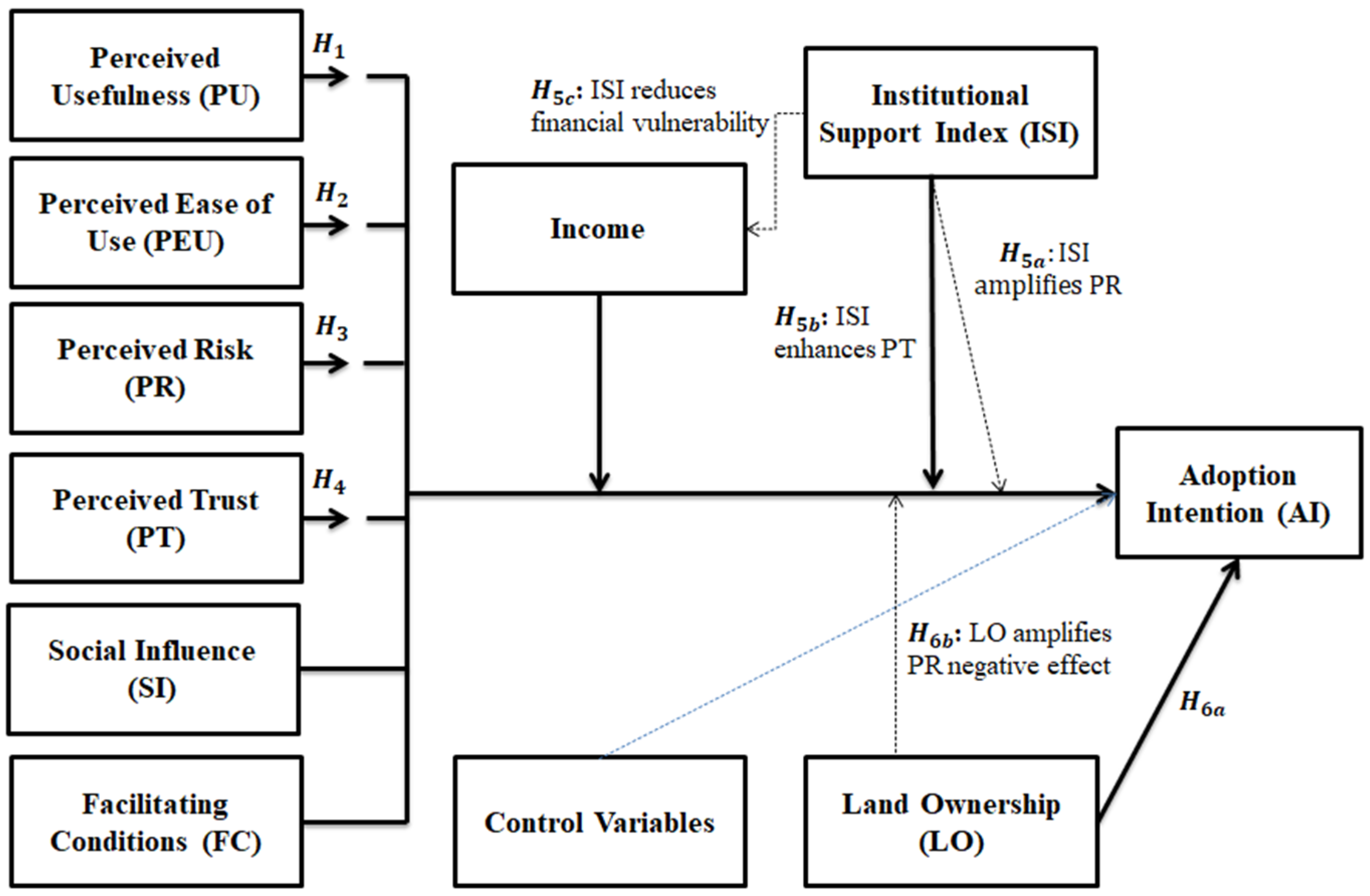
2.4. Conceptual Framework
3. Materials and Methods
3.1. Data Collection
- Pilot Testing: Prior to its widespread distribution, the instrument was pre-tested with 20 farmers and subsequently refined for local linguistic and conceptual context.
3.2. Variable Operationalization
3.3. Model Specification
- Model 1 (Baseline):
- Model 2 (Socioeconomic Heterogeneity):
- Model 3 (Institutional Moderation):
4. Results
4.1. Descriptive Statistics and Construct Validity
4.2. Correlation Structure and CMB Assessment
4.3. Main Logistic Regression Results
4.4. Average Marginal Effects
4.5. Interaction Effects and the Sensitization Effect
4.6. Robustness Checks and Identification Strategy
5. Discussion
5.1. Core Behavioral Drivers: Utility, Trust, and Risk
5.2. The Land Ownership Puzzle
5.3. Exploratory Insights: Institutions as Information Providers
5.4. Limitations of the Study
6. Conclusions
Practical and Policy Implications
Author Contributions
Funding
Institutional Review Board Statement
Informed Consent Statement
Data Availability Statement
Acknowledgments
Conflicts of Interest
Appendix A. Survey Instrument Items

| Construct | Item Code | Item Text |
|---|---|---|
| Adoption Intention (AI) | AI | I intend to use a mobile agricultural application in my farming activities. |
| Perceived Risk | PR1 | Using mobile agricultural applications would involve significant financial risk. |
| PR2 | I am concerned about the reliability of data provided by mobile agricultural apps. | |
| PR3 | I am concerned that my personal/farm data could be misused by app providers. | |
| PR4 | I believe the performance of mobile apps could be unpredictable and risky. | |
| Perceived Trust | PT1 | I believe mobile agricultural apps are reliable and honest. |
| PT2 | I feel confident that mobile agricultural apps protect my personal information. | |
| PT3 | I trust that mobile agricultural apps provide accurate farming information. | |
| PT4 | I believe the technology behind agricultural apps is trustworthy. | |
| Perceived Usefulness | PU1 | Mobile agricultural apps would help me make better farming decisions. |
| PU2 | Using mobile apps would improve my farm productivity. | |
| PU3 | Mobile apps would be useful for accessing market price information. | |
| Perceived Ease of Use | PEU1 | Learning to use a mobile agricultural app would be easy for me. |
| PEU2 | I would find mobile agricultural apps flexible and easy to interact with. | |
| PEU3 | My interaction with a mobile agricultural app would be clear and understandable. | |
| Social Influence | SI1 | People who influence my behavior think I should use mobile apps. |
| SI2 | My family members recommend that I use mobile apps for farming. | |
| SI3 | Other farmers in my community use mobile apps. | |
| Facilitating Conditions | FC1 | I have access to the resources needed to use mobile apps (e.g., smartphone, internet). |
| FC2 | I have the technical knowledge to use mobile agricultural apps. | |
| FC3 | Agricultural support organizations provide technical support for mobile app users. |
References
- Odeh, K.; Ehui, S.K. Digital Solutions in Agriculture Drive Meaningful Livelihood Improvements for African Smallholder Farmers. Agriculture, 2025; forthcoming.
- Thar, S.P.; Ramilan, T.; Farquharson, R.J.; Pang, A.; Chen, D. An empirical analysis of the use of agricultural mobile applications among smallholder farmers in Myanmar. Electron. J. Inf. Syst. Dev. Ctries. 2021, 87, e12159. [Google Scholar] [CrossRef]
- Mahata, C.; Mhagama, P. Factors affecting adoption of mobile phone applications among farmers in Lilongwe, Malawi. In Proceedings of the Conference on Multidisciplinary Research (MyRes); Society for Research and Knowledge Management: Port Louis, Mauritius, 2022; p. 358. [Google Scholar]
- Javaid, M.; Haleem, A.; Khan, I.H.; Suman, R. Understanding the potential applications of Artificial Intelligence in Agriculture Sector. Adv. Agrochem. 2023, 2, 15–30. [Google Scholar] [CrossRef]
- World Bank. Agriculture, Forestry, and Fishing, Value Added (% of GDP)—Tajikistan. World Bank Open Data. 2022. Available online: https://data.worldbank.org (accessed on 15 May 2025).
- FAO. Tajikistan Country Profile. Food and Agriculture Organization of the United Nations. 2018. Available online: http://www.fao.org (accessed on 20 May 2025).
- DataReportal. Digital 2024: Tajikistan. 2024. Available online: https://datareportal.com (accessed on 15 April 2025).
- GSMA. Less than half of population uses mobile internet in Tajikistan. Trend News Agency, 15 May 2024.
- Lerman, Z. Agricultural development in Central Asia: A survey of Uzbekistan, Turkmenistan and Tajikistan. Eurasian Geogr. Econ. 2008, 49, 481–505. [Google Scholar] [CrossRef]
- Davis, F.D. Perceived usefulness, perceived ease of use, and user acceptance of information technology. MIS Q. 1989, 13, 319–340. [Google Scholar] [CrossRef] [PubMed]
- Venkatesh, V.; Morris, M.G.; Davis, G.B.; Davis, F.D. User acceptance of information technology: Toward a unified view. MIS Q. 2003, 27, 425–478. [Google Scholar] [CrossRef]
- World Bank. Land 2030 Umbrella Program: Annual Report 2022; World Bank Group: Washington, DC, USA, 2022. [Google Scholar]
- Khan, N.A.; Chowdhury, A.; Shah, A.A.; Khan, P.; Alotaibi, B.A. The institutional support index: A pragmatic approach to assessing the effectiveness of institutions’ climate risk management support. Clim. Risk Manag. 2023, 42, 100560. [Google Scholar] [CrossRef]
- Meijer, S.S.; Catacutan, D.; Ajayi, O.C.; Sileshi, G.W.; Nieuwenhuis, M. The role of knowledge, attitudes and perceptions in the uptake of agricultural and agroforestry innovations among smallholder farmers in sub-Saharan Africa. Int. J. Agric. Sustain. 2015, 13, 40–54. [Google Scholar] [CrossRef]
- Pavlou, P.A. Consumer acceptance of electronic commerce: Integrating trust and risk with the technology acceptance model. Int. J. Electron. Commer. 2003, 7, 101–134. [Google Scholar] [CrossRef]
- Marius, M.; Bonke, V.; Musshoff, O. Understanding the adoption of smartphone apps in crop protection. Precis. Agric. 2020, 21, 1209–1226. [Google Scholar] [CrossRef]
- North, D.C. Institutions, Institutional Change and Economic Performance; Cambridge University Press: Cambridge, UK, 1990. [Google Scholar]
- Miine, L.K.; Akorsu, A.D.; Boampong, O.; Bukari, S. Drivers and intensity of adoption of digital agricultural services by smallholder farmers in Ghana. Heliyon 2023, 9, e22419. [Google Scholar] [CrossRef]
- Diaz, A.C.; Sasaki, N.; Tsusaka, T.W.; Szabo, S. Factors affecting farmers’ willingness to adopt a mobile app in the marketing of bamboo products. Resour. Conserv. Recycl. Adv. 2021, 11, 200056. [Google Scholar] [CrossRef]
- Nkandu, P.; Phiri, J. Assessing the Effect of ICTs on Agriculture Productivity Based on the UTAUT Model in Developing Countries. Open J. Bus. Manag. 2022, 10, 3436–3454. [Google Scholar] [CrossRef]
- Featherman, M.S.; Pavlou, P.A. Predicting e-services adoption: A perceived risk facets perspective. Int. J. Hum.-Comput. Stud. 2003, 59, 451–474. [Google Scholar] [CrossRef]
- Caffaro, F.; Cremasco, M.M.; Roccato, M.; Cavallo, E. Drivers of farmers’ intention to adopt technological innovations in Italy. J. Rural Stud. 2020, 76, 264–271. [Google Scholar] [CrossRef]
- Gefen, D.; Karahanna, E.; Straub, D.W. Trust and TAM in online shopping: An integrated model. MIS Q. 2003, 27, 51–90. [Google Scholar] [CrossRef]
- McKnight, D.H.; Choudhury, V.; Kacmar, C. Developing and validating trust measures for e-commerce: An integrative typology. Inf. Syst. Res. 2002, 13, 334–359. [Google Scholar] [CrossRef]
- Williamson, O.E. The new institutional economics: Taking stock, looking ahead. J. Econ. Lit. 2000, 38, 595–613. [Google Scholar] [CrossRef]
- Kazumi, T.; Kawai, N. Institutional support and women’s entrepreneurial self-efficacy. Asia Pac. J. Innov. Entrep. 2017, 11, 345–365. [Google Scholar] [CrossRef]
- Shepherd, M.; Turner, J.A.; Small, B.; Wheeler, D. Priorities for science to overcome hurdles thwarting the full promise of the ‘digital agriculture’ revolution. J. Sci. Food Agric. 2020, 100, 5083–5092. [Google Scholar]
- Diamantopoulos, A.; Siguaw, J.A. Formative versus reflective indicators in organizational measure development. Br. J. Manag. 2006, 17, 263–282. [Google Scholar] [CrossRef]
- Zeng, D.; Alwang, J.; Norton, G.; Jaleta, M.; Shiferaw, B.; Yirga, C. Land ownership and technology adoption revisited: Improved maize varieties in Ethiopia. Land Use Policy 2018, 72, 270–279. [Google Scholar] [CrossRef] [PubMed]
- Podsakoff, P.M.; MacKenzie, S.B.; Lee, J.Y.; Podsakoff, N.P. Common method biases in behavioral research: A critical review of the literature and recommended remedies. J. Appl. Psychol. 2003, 88, 879. [Google Scholar] [CrossRef]
- Marenya, P.P.; Barrett, C.B. Household-level determinants of adoption of improved natural resources management practices among smallholder farmers in western Kenya. Food Policy 2007, 32, 515–536. [Google Scholar] [CrossRef]
- Adamides, G.; Stylianou, A.; Kosmas, P.C.; Apostolopoulos, C.D. Factors affecting PC and Internet usage by the rural population of Cyprus. Agric. Econ. Rev. 2013, 14, 16–36. [Google Scholar]
- Nunnally, J.C. Psychometric Theory, 2nd ed.; McGraw-Hill: New York, NY, USA, 1978. [Google Scholar]
- Aiken, L.S.; West, S.G.; Reno, R.R. Multiple Regression: Testing and Interpreting Interactions; Sage: Thousand Oaks, CA, USA, 1991. [Google Scholar]
- Wossen, T.; Abdoulaye, T.; Alene, A.; Haile, M.G.; Feleke, S.; Olanrewaju, A.; Manyong, V. Impacts of extension access and cooperative membership on technology adoption and household welfare. J. Rural Stud. 2017, 54, 223–233. [Google Scholar] [CrossRef]
- Conley, T.G.; Hansen, C.B.; Rossi, P.E. Plausibly exogenous. Rev. Econ. Stat. 2012, 94, 260–272. [Google Scholar] [CrossRef]
- Pivoto, D.; Barham, B.; Waquil, P.D.; Foguesatto, C.R.; Corte, V.F.D.; Zhang, D.; Talamini, E. Factors influencing the adoption of smart farming by Brazilian grain farmers. Int. Food Agribus. Manag. Rev. 2019, 22, 571–588. [Google Scholar] [CrossRef]

| Variable Type | Construct | Symbol | Measurement/Items | Source |
|---|---|---|---|---|
| Dependent | Adoption Intention | AI | Binary: 1 = intend to adopt in next season; 0 = otherwise | [10] |
| Psychometric | Perceived Risk | PR | 4-item scale (mean score); α = 0.904 | [21] |
| Perceived Trust | PT | 4-item scale (mean score); α = 0.938 | [23] | |
| Perceived Usefulness | PU | 3-item scale (mean score); α = 0.865 | [11] | |
| Perceived Ease of Use | PEU | 3-item scale (mean score); α = 0.790 | [11] | |
| Social Influence | SI | 3-item scale (mean score); α = 0.878 | [11] | |
| Facilitating Conditions | FC | 3-item scale (mean score); α = 0.840 | [11] | |
| Institutional | Institutional Support Index | ISI | Formative additive index (0–3) of MC, ES, RF | [13,17] |
| Structural | Land Ownership | LO | Binary: 1 = Landowner (Certificate holder); 0 = Tenant | [12] |
| Socioeconomic | Income | I | Ordinal scale (1–5) | [14] |
| Age | A | Ordinal scale (1–5) | [31] | |
| Gender | G | Binary: 1 = Male; 0 = Female | [2] | |
| Education | E | Ordinal (1–5); College dummy = 1 if E ≥ 4 | [14] | |
| Farming Experience | FE | Ordinal (Years/Categories) | [31] | |
| Farm Size | FS | Ordinal (Hectares/Categories) | [31] | |
| Geographic Location | GL | Binary: 1 = Rural; 0 = Peri-urban/Urban | [32] | |
| Access to Credit | AC | Binary: 1 = Yes; 0 = No | [31] | |
| Training Participation | TP | Binary: 1 = Yes; 0 = No | [27] |
| Variable | n | Mean | SD | Min | Median | Max | α |
|---|---|---|---|---|---|---|---|
| Adoption Intention (AI) | 327 | 0.563 | 0.497 | 0.000 | 1.000 | 1.000 | — |
| Perceived Risk (PR) | 327 | 3.427 | 0.985 | 1.000 | 3.250 | 5.000 | 0.904 |
| Perceived Trust (PT) | 327 | 3.371 | 1.111 | 1.250 | 3.750 | 5.000 | 0.938 |
| Perceived Usefulness (PU) | 327 | 3.577 | 1.074 | 1.667 | 3.667 | 5.000 | 0.865 |
| Perceived Ease of Use (PEU) | 327 | 3.387 | 0.931 | 1.667 | 3.333 | 5.000 | 0.790 |
| Social Influence (SI) | 327 | 3.174 | 1.080 | 1.000 | 3.000 | 5.000 | 0.878 |
| Facilitating Conditions (FC) | 327 | 3.510 | 1.081 | 1.000 | 3.667 | 5.000 | 0.840 |
| Institutional Support Index (ISI) | 327 | 1.685 | 0.976 | 0.000 | 2.000 | 3.000 | 0.45 a |
| Land Ownership (LO = 1 if owner) | 327 | 0.734 | 0.443 | 0 | 1 | 1 | — |
| Gender (G = 1 if male) | 327 | 0.829 | 0.377 | 0 | 1 | 1 | — |
| Income (ordinal 1–5) | 327 | 2.373 | 1.065 | 1 | 2 | 5 | — |
| Farming Experience (FE, ordinal) | 327 | 2.507 | 1.188 | 1 | 3 | 5 | — |
| Training Participation (TP) | 327 | 0.609 | 0.489 | 0 | 1 | 1 | — |
| Variable | Landowners (n = 240) | Tenants (n = 87) | Difference | p-Value |
|---|---|---|---|---|
| Adoption Intention (AI) | 0.60 | 0.46 | 0.14 ** | 0.024 |
| Perceived Usefulness (PU) | 3.76 | 3.06 | 0.70 *** | 0.000 |
| Perceived Trust (PT) | 3.52 | 2.96 | 0.56 *** | 0.000 |
| Perceived Risk (PR) | 3.28 | 3.82 | −0.54 *** | 0.000 |
| Income (I) | 3.33 | 2.98 | 0.35 ** | 0.035 |
| Farm Size (FS) | 1.93 | 1.43 | 0.50 *** | 0.000 |
| Institutional Support (ISI) | 1.50 | 2.18 | −0.68 *** | 0.000 |
| College Education | 0.63 | 0.59 | 0.04 | 0.481 |
| Training Participation (TP) | 0.59 | 0.67 | −0.08 | 0.196 |
| AI | PR | PT | PU | PEU | SI | FC | ISI | |
|---|---|---|---|---|---|---|---|---|
| AI | 1.000 | |||||||
| PR | −0.628 *** | 1.000 | ||||||
| PT | 0.667 *** | −0.718 *** | 1.000 | |||||
| PU | 0.689 *** | −0.681 *** | 0.769 *** | 1.000 | ||||
| PEU | 0.606 *** | −0.702 *** | 0.754 *** | 0.823 *** | 1.000 | |||
| SI | 0.623 *** | −0.702 *** | 0.788 *** | 0.774 *** | 0.813 *** | 1.000 | ||
| FC | 0.632 *** | −0.698 *** | 0.766 *** | 0.776 *** | 0.831 *** | 0.795 *** | 1.000 | |
| ISI | 0.025 | −0.073 | 0.047 | −0.046 | −0.035 | −0.012 | −0.041 | 1.000 |
| Variable | M1: β (SE) | p | M2: β (SE) | p | M3: β (SE) | p |
|---|---|---|---|---|---|---|
| Psychometric Constructs | ||||||
| Perceived Risk (PR) | −0.752 (0.269) | 0.005 *** | −0.859 (0.553) | 0.120 | −0.678 (0.612) | 0.268 |
| Perceived Trust (PT) | 0.630 (0.234) | 0.007 *** | 0.582 (0.244) | 0.017 ** | 0.564 (0.254) | 0.027 ** |
| Perceived Usefulness (PU) | 1.207 (0.307) | <0.001 *** | 1.211 (0.310) | <0.001 *** | 1.278 (0.315) | <0.001 *** |
| Perceived Ease of Use (PEU) | −0.629 (0.418) | 0.132 | −0.691 (0.423) | 0.103 | −0.626 (0.437) | 0.152 |
| Social Influence (SI) | 0.181 (0.344) | 0.598 | 0.199 (0.338) | 0.556 | 0.151 (0.374) | 0.686 |
| Facilitating Conditions (FC) | 0.226 (0.335) | 0.500 | 0.253 (0.328) | 0.440 | 0.306 (0.351) | 0.383 |
| Structural and Demographic Controls | ||||||
| Land Ownership (LO) | −1.402 (0.483) | 0.004 *** | −1.254 (0.448) | 0.005 *** | −1.192 (0.456) | 0.009 *** |
| Gender (G) | 0.082 (0.501) | 0.870 | 0.071 (0.544) | 0.896 | 0.074 (0.562) | 0.896 |
| College Education | 0.213 (0.439) | 0.627 | 0.196 (0.429) | 0.648 | 0.185 (0.461) | 0.689 |
| Farming Experience | −0.198 (0.188) | 0.294 | −0.209 (0.185) | 0.258 | −0.201 (0.207) | 0.331 |
| Income | 0.224 (0.168) | 0.183 | 0.211 (0.167) | 0.207 | 0.207 (0.179) | 0.248 |
| Farm Size | 0.400 (0.284) | 0.158 | 0.430 (0.291) | 0.139 | 0.389 (0.307) | 0.205 |
| Geographic Location | 0.729 (0.573) | 0.204 | 0.708 (0.587) | 0.228 | 0.633 (0.623) | 0.310 |
| Access to Credit | −0.203 (0.480) | 0.672 | −0.265 (0.482) | 0.582 | −0.368 (0.507) | 0.468 |
| Training Participation | −0.249 (0.414) | 0.547 | −0.268 (0.418) | 0.521 | −0.267 (0.429) | 0.534 |
| ISI | — | — | — | — | 0.080 (0.302) | 0.790 |
| Interaction Terms | ||||||
| Gender × PR | — | — | 0.447 (0.636) | 0.482 | 0.400 (0.668) | 0.550 |
| Income × PR | — | — | −0.022 (0.168) | 0.895 | −0.042 (0.189) | 0.823 |
| LO × PR (H6b) | — | — | −0.515 (0.460) | 0.264 | −0.652 (0.447) | 0.145 |
| PR × ISI (H5a) | — | — | — | — | −0.234 (0.353) | 0.509 |
| PT × ISI (H5b) | — | — | — | — | 0.137 (0.262) | 0.601 |
| Income × ISI (H5c) | — | — | — | — | −0.029 (0.169) | 0.863 |
| Model Fit | ||||||
| Observations | 327 | 327 | 327 | |||
| Wald χ2 | 55.67 *** | 58.42 *** | 69.24 *** | |||
| Pseudo-R2 | 0.509 | 0.513 | 0.518 | |||
| Log-likelihood | −110.03 | −109.09 | −108.09 | |||
| AIC | 254.1 | 258.2 | 264.2 |
| Variable | AME (pp) | 95% CI | p-Value | Hypothesis |
|---|---|---|---|---|
| Perceived Usefulness (PU) | +12.2 | [+6.1, +18.3] | <0.001 *** | H1 ✓ |
| Perceived Risk (PR) | −7.6 | [−13.0, −2.3] | 0.005 *** | H3 ✓ |
| Perceived Trust (PT) | +6.4 | [+1.7, +11.0] | 0.007 *** | H4 ✓ |
| Perceived Ease of Use (PEU) | −6.4 | [−14.7, +1.9] | 0.132 | H2 ✗ |
| Land Ownership (LO) | −14.2 | [−23.8, −4.6] | 0.004 *** | H6a ✗/H6b partial ◌ |
| Social Influence (SI) | +1.8 | [−4.9, +8.6] | 0.598 | — |
| Facilitating Conditions (FC) | +2.3 | [−4.3, +8.9] | 0.500 | — |
| Income | +2.3 | [−1.1, +5.6] | 0.183 | H5c (direct) ✗ |
| Scenario | Low PR (−1 SD) | High PR (+1 SD) | Risk Impact (Δ) |
|---|---|---|---|
| Low Institutional Support (−1 SD) | 59.9% | 47.9% | −12.0 pp |
| High Institutional Support (+1 SD) | 67.8% | 37.4% | −30.4 pp |
| ISI Gain (Δ) | +7.9 pp | −10.5 pp | — |
| Variable | Logit M3 β (p) | Probit β (p) | LPM β (p) | IV-Probit β (p) |
|---|---|---|---|---|
| Perceived Usefulness (PU) | 1.278 (<0.001) *** | 0.736 (<0.001) *** | 0.163 (<0.001) *** | 0.691 (<0.001) *** |
| Perceived Trust (PT) | 0.564 (0.027) ** | 0.326 (0.014) ** | 0.072 (0.025) ** | 0.329 (0.015) ** |
| Perceived Risk (PR) | −0.678 (0.268) | −0.378 (0.261) | −0.093 (0.217) | −0.407 (0.007) *** |
| Land Ownership (LO) | −1.192 (0.009) *** | −0.681 (0.007) *** | −0.124 (0.020) ** | −0.884 (0.021) ** |
| LO × PR | −0.652 (0.145) | −0.360 (0.147) | −0.042 (0.476) | — |
| ISI | 0.080 (0.790) | 0.049 (0.789) | 0.013 (0.796) | −0.239 (0.580) |
| R2/Pseudo-R2 | 0.518 | 0.518 | 0.568 | 0.500 |
Disclaimer/Publisher’s Note: The statements, opinions and data contained in all publications are solely those of the individual author(s) and contributor(s) and not of MDPI and/or the editor(s). MDPI and/or the editor(s) disclaim responsibility for any injury to people or property resulting from any ideas, methods, instructions or products referred to in the content. |
© 2026 by the authors. Licensee MDPI, Basel, Switzerland. This article is an open access article distributed under the terms and conditions of the Creative Commons Attribution (CC BY) license.
Share and Cite
Salieva, A.; Zhang, J.; Wan, M.; Wang, E. Driving Digital Adoption in Rural Tajikistan: An Extended Technology Acceptance Model (TAM) Analysis of Institutional and Psychological Barriers. Sustainability 2026, 18, 5218. https://doi.org/10.3390/su18115218
Salieva A, Zhang J, Wan M, Wang E. Driving Digital Adoption in Rural Tajikistan: An Extended Technology Acceptance Model (TAM) Analysis of Institutional and Psychological Barriers. Sustainability. 2026; 18(11):5218. https://doi.org/10.3390/su18115218
Chicago/Turabian StyleSalieva, Azizakhon, Jiafeng Zhang, Miao Wan, and Erpeng Wang. 2026. "Driving Digital Adoption in Rural Tajikistan: An Extended Technology Acceptance Model (TAM) Analysis of Institutional and Psychological Barriers" Sustainability 18, no. 11: 5218. https://doi.org/10.3390/su18115218
APA StyleSalieva, A., Zhang, J., Wan, M., & Wang, E. (2026). Driving Digital Adoption in Rural Tajikistan: An Extended Technology Acceptance Model (TAM) Analysis of Institutional and Psychological Barriers. Sustainability, 18(11), 5218. https://doi.org/10.3390/su18115218