Review

Economic, Social, and Environmental Contributions of Water Buffalo (Bubalus bubalis) Production to the Sustainable Development Goals: A Review


by
Luis A. de la Cruz-Cruz
1,*,
Patricia Roldán-Santiago
2,
Cristian Larrondo
3,
Héctor Orozco-Gregorio
4,
Herlinda Bonilla-Jaime
5,
Milagros González-Hernández
6,
René Rodríguez-Florentino
7 and
Ariadna Yáñez-Pizaña
1
1
Departamento de Producción Agrícola y Animal, Universidad Autónoma Metropolitana-Xochimilco, Ciudad de México 04960, Mexico
2
Departamento de Reproducción, Facultad de Medicina Veterinaria y Zootecnia, Universidad Nacional Autónoma de México, Ciudad de México 04510, Mexico
3
Facultad de Medicina Veterinaria y Agronomía, Universidad de Las Américas, Viña del Mar 7500975, Chile
4
Ingeniería en Producción Animal, Universidad Politécnica de Francisco I. Madero, Tepatepec 42660, Mexico
5
Laboratorio de Psicobiológia Conductual, Departamento de Biología de la Reproducción, Universidad Autónoma Metropolitana-Iztapalapa, Ciudad de México 09340, Mexico
6
Facultad de Agronomía y Veterinaria, Universidad Autónoma de San Luis Potosí, San Luis Potosí 78321, Mexico
7
Recursos Genéticos y Productividad, Colegio de Postgraduados, Campus Montecillo, Texcoco 56264, Estado de México, Mexico
*
Author to whom correspondence should be addressed.
Sustainability 2026, 18(11), 5216; https://doi.org/10.3390/su18115216
Submission received: 22 February 2026 / Revised: 30 April 2026 / Accepted: 14 May 2026 / Published: 22 May 2026
(This article belongs to the Special Issue Sustainable Animal Production and Livestock Practices)

Abstract

This review analyzes the economic, social, and environmental dimensions of water buffalo (Bubalus bubalis) production and its contribution to the Sustainable Development Goals (SDGs). A scoping review following PRISMA-ScR guidelines was conducted using the Web of Science (2020–2026), resulting in 225 included studies. Buffalo production is a multipurpose system that generates value through milk, meat, hides, manure, draft power, and animal-assisted services, with greater longevity than most livestock species. Economically, it supports income diversification, resource efficiency, and functions as a financial asset that can be sold to cover unexpected expenses. Socially, it enhances food security by providing nutrient-dense products, particularly milk with bioactive compounds associated with potential health benefits, and promotes women’s participation in livestock management and household economies. Environmentally, buffalo systems efficiently utilize low-quality forages, are adapted to marginal conditions, contribute to wetland conservation, and provide ecosystem services. These contributions align with several SDGs (1, 2, 5, 8, 12, 13, and 15). However, sector expansion is constrained by limitations in nutrition, management, veterinary services, and reproductive efficiency, as well as environmental challenges related to methane emissions and life cycle impacts. While global methane emissions from buffalo are lower due to their smaller population, emission intensity remains system-dependent and represents a critical challenge. In conclusion, water buffalo production represents a multifunctional and context-dependent system with significant potential to support sustainable development, although targeted innovations are required to improve productivity and address environmental challenges. Future research should integrate One Health and One Welfare approaches, develop long-term studies, and expand research under diverse experimental and field conditions to better characterize the potential health implications of buffalo-derived products. In addition, strengthening circular economy strategies, including region-specific diets to reduce emissions, remains a priority.

1. Introduction

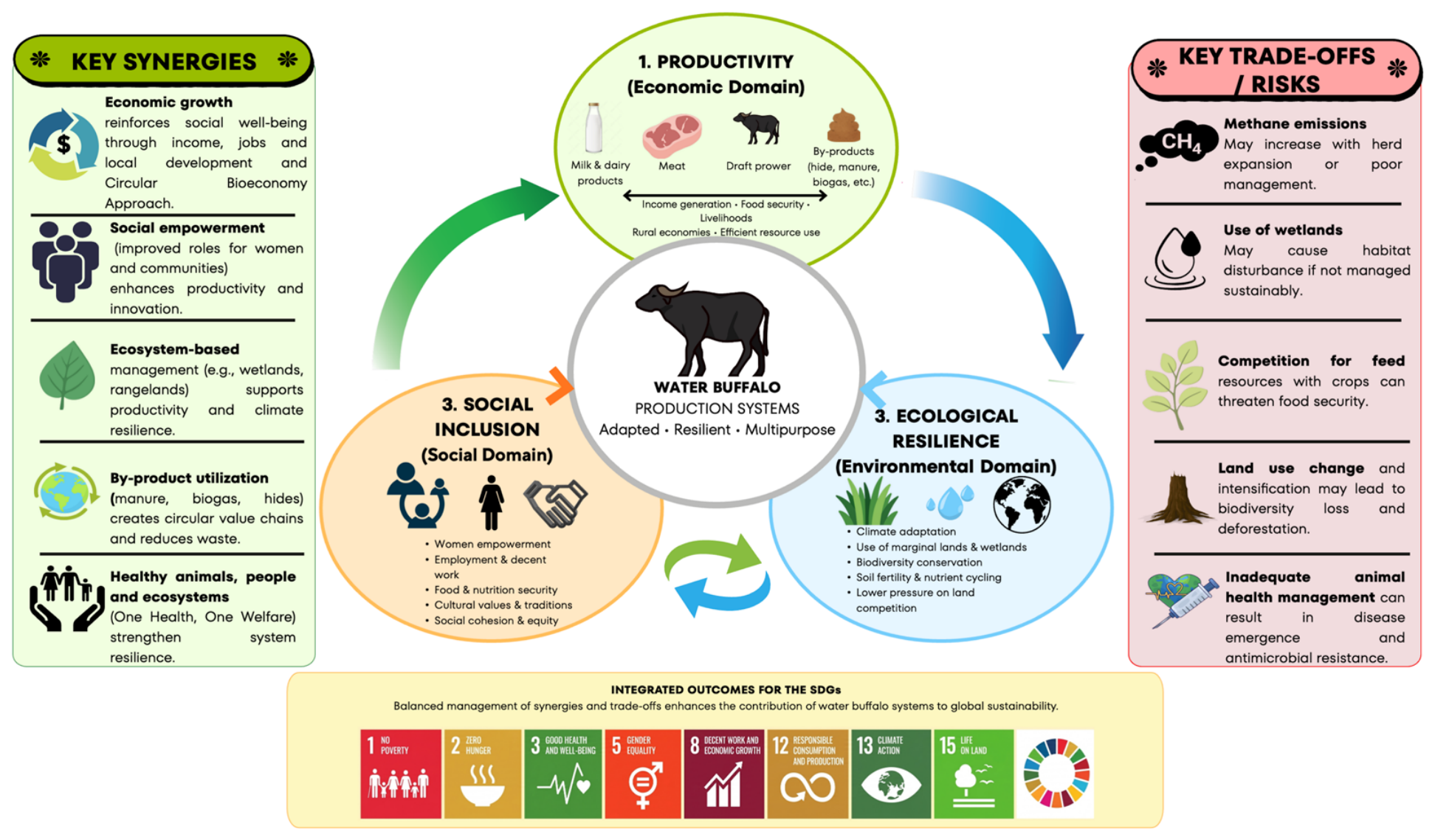
Livestock production generates employment and income globally, ensuring food security and diversity through milk, meat, and eggs [1,2]. However, the sector must address social, environmental, and economic barriers to attain sustainability, specifically regarding consumer perceptions, greenhouse gas (GHG) emissions, deforestation, eutrophication, and biodiversity loss [1,3,4]. Because economic development remains unsustainable if it compromises ecological integrity, integrating environmental conservation with economic growth is mandatory [5]. This paradigm aligns with the United Nations 2030 Agenda and its 17 Sustainable Development Goals (SDGs) to balance social equity and prosperity [6]. Many of these goals, such as zero hunger, good health, and climate action, are directly linked to the livestock industry [7]. Within this framework, water buffalo (Bubalus bubalis) production constitutes a strategic global enterprise capable of advancing the SDGs through a triple-dimensional approach [8,9] (Figure 1).
From an economic perspective, buffaloes serve as multipurpose assets, yielding revenue via milk and meat [10,11,12,13,14]. Buffalo milk has a high total solid content, suitable for the processing of high-value-added dairy products, particularly Mozzarella with Protected Designation of Origin (PDO), along with a wide array of regional derivatives sold in local and global markets [13,15,16,17,18]. Furthermore, buffaloes exhibit notable productive longevity, which extends their useful life and improves the economic efficiency of the herd by reducing replacement costs [19,20]. Additionally, draft power provides a sustainable alternative to mechanized inputs and fossil fuels [21,22]. By-products including hides [20,23] manure for fertilizer [24,25], biogas [26], and natural pigments [27], facilitate a circular economy, securing the financial viability of rural households [28,29].
Socially, the buffalo industry bolsters food security and resilience in marginalized communities. This contribution stems from bioactive compounds in buffalo milk beneficial to human health [30,31,32]. Buffalo management frequently empowers women; since women often manage production and processing, their participation improves socioeconomic status and decision-making authority [33,34].
Regarding environmental impact, Bubalus bubalis is a strategic species for climate adaptation, exhibiting resilience under extreme climatic stress [35]. In tropical and subtropical environments, they maintain productivity under heat stress and high humidity, utilizing wetlands and marginal lands with low agricultural productivity [36,37]. Buffaloes manage invasive vegetation, supporting ecosystem conservation [38,39,40]. Although current buffalo methane emissions remain lower than cattle levels, demographic expansion increases total emissions [41,42], driving research into mitigation [43,44,45,46]. Dietary interventions exploit the buffalo’s superior digestion of coarse forages [47,48].
Despite these advantages, the expansion of the buffalo sector faces barriers. Regarding climate impact, Life Cycle Assessment (LCA) studies indicate that production challenges remain [49,50,51,52]. Misconceptions regarding species “rusticity” cause inadequate management [53] leading to nutritional deficits, limited veterinary services, and reproductive failure [29,54]. Applying One Health and One Welfare frameworks is required to secure sustainability [55,56] (Figure 1). Therefore, the objective of this review is to analyze the economic, social, and environmental dimensions of water buffalo (Bubalus bubalis) production and its contribution to the SDGs.

2. Methodology

2.1. Review Approach

This study employed a scoping review methodology following the PRISMA-ScR (Preferred Reporting Items for Systematic Reviews and Meta-Analyses extension for Scoping Reviews) [57]. A scoping review was selected due to the heterogeneous and multidisciplinary nature of evidence related to economic, social and environmental dimensions of water buffalo (Bubalus bubalis) production. Scoping reviews facilitate the systematic mapping of evidence, identifying key concepts and knowledge gaps [57] by prioritizing thematic breadth and integrative coverage.

2.2. Literature Search Strategy

A bibliographic search was conducted in the Web of Science, including peer-reviewed publications published between 2020 and 2026. The strategy was designed to structure the review around three sustainability pillars: (a) economic contributions; (b) social impacts; and (c) environmental dimensions. Boolean operators, exact phrases, and truncations were utilized to combine the core terms (“water buffalo” OR “Bubalus bubalis”) with the following thematic clusters: (a) Economic dimension: (Poverty OR Livelihood* OR “Smallholder farmers” OR “Income generation” OR Multipurpose OR “Draft power” OR Hide* OR Longevity OR “Animal-assisted services”) AND (“Sustainable production” OR “Circular economy” OR “Resource efficiency” OR Manure); (b) Social dimension: (“Food security” OR “Meat production” OR “Milk production” OR “Milk quality” OR Health OR “Bioactive components”) AND (“Gender equality” OR “Women empowerment” OR “Women’s role”) AND (“One Health” OR “One Welfare”) and (c) Environmental dimension: (“Climate change” OR “Methane emissions” OR “Carbon footprint” OR Adaptation OR “Life Cycle Assessment” OR LCA) AND (Wetlands OR “Ecosystem services” OR Biodiversity).

2.3. Eligibility Criteria and Study Selection

Studies were considered eligible if they addressed the economic, social, or environmental dimensions of water buffalo (Bubalus bubalis) production and their relevance to sustainability. The selection process was guided by thematic relevance, consistent with the exploratory nature of scoping reviews, rather than by strict inclusion and exclusion criteria. Peer-reviewed articles published in English during the last six years were prioritized; however, additional studies outside this time frame were considered when necessary to provide contextual or conceptual support.
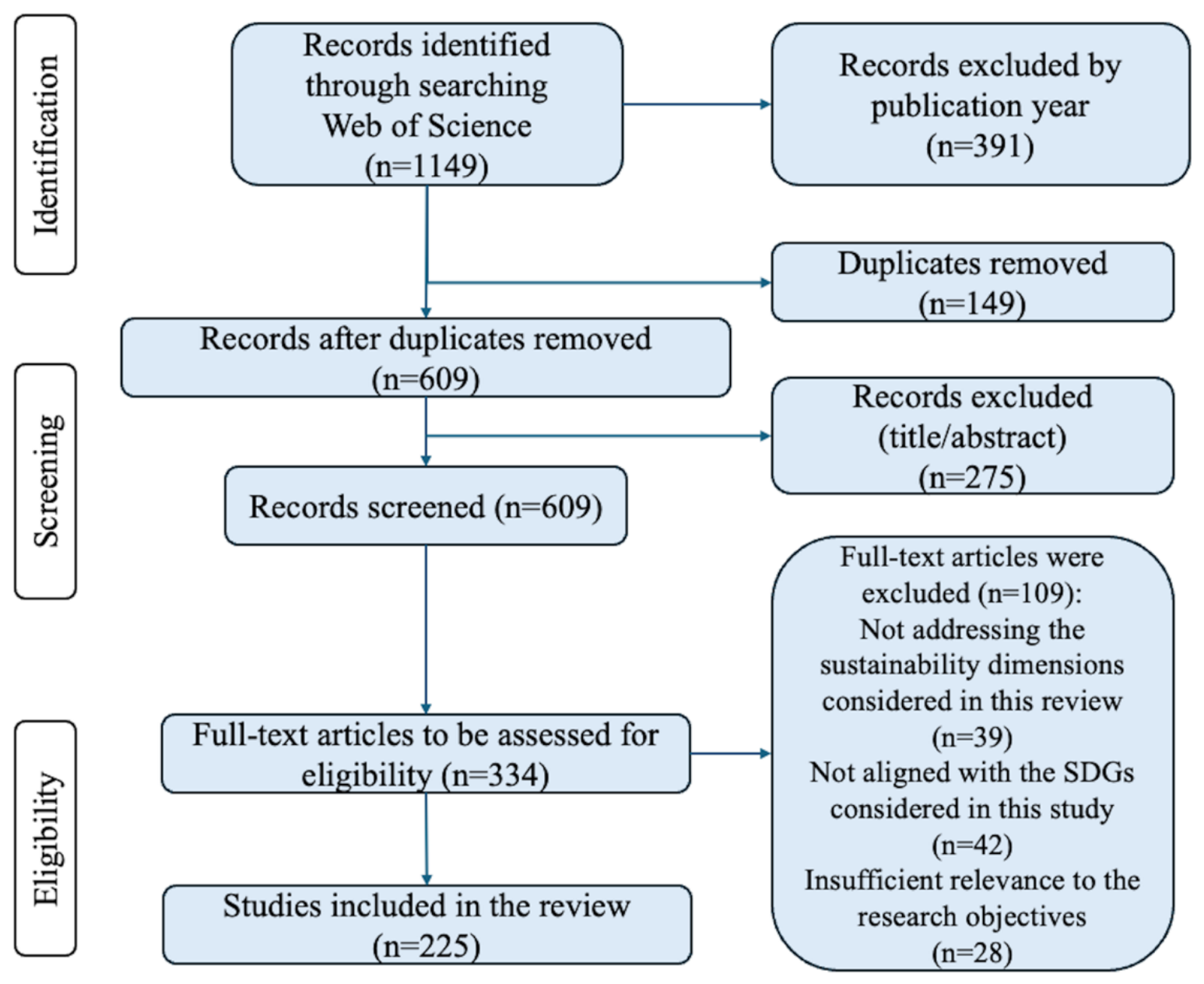
Following title and abstract screening (n = 609), a total of 334 articles were selected for full-text assessment based on their potential relevance to the thematic scope of the review. During the full-text evaluation, 109 articles were excluded due to the following reasons: not addressing the sustainability dimensions considered in this review; not aligned with the SDGs; and insufficient relevance to the research objectives. These categories emerged during the screening process as part of the thematic evaluation of the literature. A total of 225 studies were ultimately included in the review. All retrieved bibliographic records and citations were managed using EndNote software (version 20, Clarivate, Philadelphia, PA, USA). Additional relevant studies were identified through manual searches to complement the analysis, including comparative studies on milk and meat from different species and biocomponents of buffalo milk. These studies were used for contextual support and were not included in the PRISMA-ScR flow diagram. The study selection process is summarized in Figure 2.

3. General Characteristics of Water Buffalo

The domestic water buffalo (Bubalus bubalis), within the Bovidae family and Bovinae subfamily, descends from the wild Indian buffalo. Taxonomy distinguishes swamp buffalo (Bubalus bubalis carabanesis, 2n = 48) and river buffalo (Bubalus bubalis, 2n = 50) via cytogenetic profiles [51,58]. Conversely, the native Sri Lankan buffalo phenotypically resembles the swamp type yet possesses 50 chromosomes, clustering genetically with river populations [59].
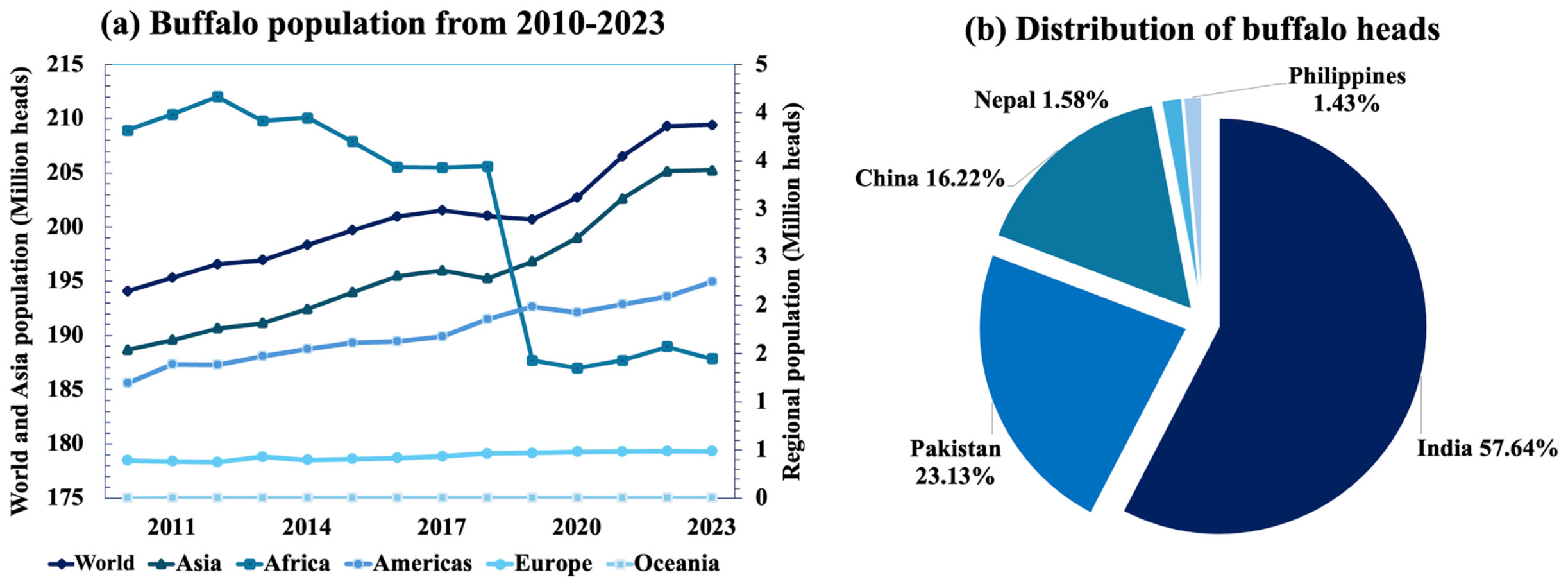
According to FAOSTAT data [60], global buffalo stocks reached more than 209 million buffalo heads in 2023 (Figure 3a) distributed across 77 countries on five continents. Most of the population (approximately 98%) is concentrated in Asia. In contrast, other regions represent smaller proportions: the Americas for 1.07% (centered in Brazil, Venezuela, Colombia, and Argentina), followed by Africa with 0.69% (mainly Egypt), and Europe with 0.23% (particularly Italy, Romania, Bulgaria, Greece, Albania, Kosovo, and North Macedonia), with a minimal presence in Oceania. Key population centers include India, Pakistan, China, Nepal, the Philippines, and Vietnam, which together account for 94% of the global population (Figure 3b) [51,60,61]. Riverine types outnumber swamp buffalo, the latter representing 21% of the total [62,63].
Phylogenetic evidence indicates river buffalo originated in India approximately 5000 years ago through continuous wild-to-domestic introgression. In contrast, swamp buffalo likely emerged near the China–Indochina border around 4000 years ago [64,65]. Geographic isolation, importation, and crossbreeding subsequently generated the diverse breeds currently recognized [66].
Swamp buffalo display phenotypic uniformity despite harboring two distinct lineages [59,65]. These animals are dark gray, often featuring white stripes on the neck, distal limb regions, and tail tip. Their horns are straight or elongated, while their bodies are smaller (325–450 kg BW) than river buffalo. Predominant in Southeast Asia, they primarily serve as draft animals, though milk production is increasing [59,67].
River buffalo exhibit greater phenotypic diversity despite a less defined phylogenetic structure [59]. Typically, black with curved horns and 450–1000 kg BW, these populations undergo selection for milk, meat, dual-purpose, and draft systems. River buffalo comprise approximately 123 breeds, 90 of which are found in Asia, many of them local or indigenous [58,67]. Currently, about 16 breeds of Indo-Pakistani origin are recognized, including Murrah, Nili-Ravi, Kundi, Surti, Mehsana, Jaffarabadi, Nagpuri, Pandharpuri, Manda, Jerangi, Kalahandi, Sambalpur, Bhadawari, Tharai, and Toda [68]. Outside India, the Mediterranean and Trinitarian breeds prevail. The Mediterranean breed, originating from Indic stocks, was refined in Italy [20]. The Trinitarian (Buffalypso) breed resulted from crossing Indic (Murrah, Nili-Ravi, Jaffarabadi, Surti, Bhadawari) and swamp buffalo in Caribbean plantations, eventually forming the genetic base for many American nations [20,69].
River buffalo occupy tropical forests, wet grasslands, and marshes. They spend significant time wallowing in mud to regulate body temperature [70,71]. Notably, indigenous Nepalese buffalo can thrive on steep slopes due to their relatively small body size [42]. Their habitats include rivers, muddy areas, and tall grasses [70,71]; however, diseased or weak individuals remain susceptible to drowning in flooded zones [72].

4. Economic Dimension: Productivity and Efficiency

4.1. Buffalo Production as Strategic Biological Capital and Economic Resilience

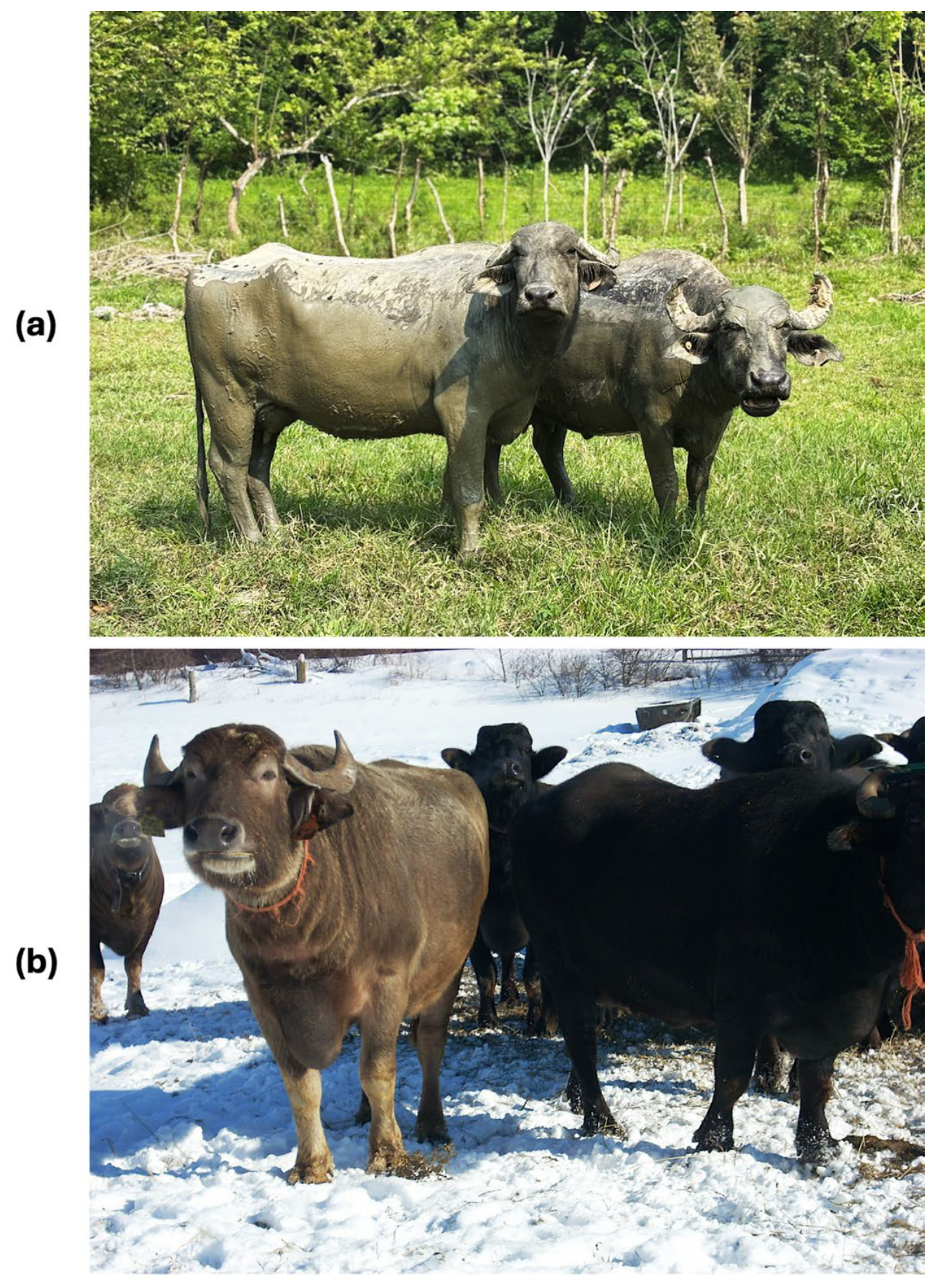
Water buffalo production constitutes a traditional economic activity supporting small-scale family enterprises via adaptability to marginal environments and ecological systems under diverse climatic conditions [73], under both hot and cold conditions (Figure 4a,b). Swamp buffalo farming remains a transgenerational family activity, serving as a primary livelihood and complementary income while generating employment [62]. These farming systems sustain rural livelihoods through multifunctionality—encompassing milk, meat, ecosystem management, and draft power—which secures rural employment within value chains [35].
Swamp buffalo farming remains a transgenerational family activity, serving as a primary livelihood and complementary income while generating employment [62]. These farming systems sustain rural livelihoods through multifunctionality—encompassing milk, meat, ecosystem management, and draft power—which secures rural employment within value chains [35].
In Vietnam, buffaloes surpass crossbred cattle suitability due to a docile temperament facilitating family labor management [28]. Despite lower individual productivity than cattle, higher buffalo milk prices and lower maintenance costs yield superior net income, advancing SDG1 poverty alleviation [10,11]. Specifically, Indian farmers generate a marketed surplus of 17.32 kg of milk per day, with a break-even point at 45% of total yield [12].
Farmers perceive buffalo production as a low-risk income source compared to crop losses from typhoons or droughts [63]. This resilience arises from geographic concentration in coastal zones, river basins, and lowlands, where the species adapts to storm surges, salinity, and low-input regimes [70]. As ‘biological capital’, buffaloes drive development by providing revenue from edible (meat, milk) and non-edible (hides, manure) products [13,74,75].
These assets buffer planned education expenses and unplanned medical or religious costs [29,76,77]. Although animals are liquidated during financial crises, this represents a last resort given their multifunctional value [28,29]. In Laos, buffaloes function as ‘living banks’, integrating manure for rice cultivation with asset liquidity [15].
Buffalo farming generates employment for smallholders and rural women, particularly in Asia [78,79]. Regional data confirms this impact: rural Pakistan’s sector employs 30–35 million farmers [80], while in the Philippines, buffaloes yield USD 214.7 million from meat, USD 174.4 million from milk, and USD 6.54 million from draft power [14]. Philippine small-scale producers prioritize buffaloes for live animal sales (94%), milking (86%), draft power (70%), manure sales (39%), and processing (3%) [29]. In Turkey, 29% of producers meet daily needs and 25% derive their main livelihood from buffaloes, with 98% reporting high satisfaction [73].
Recent transition toward intensive dairy operations and automatic milking systems (AMSs) has solidified the species’ strategic role in developed economies [81]. On the other hand, sector expansion provides market opportunities for landless farmers, improving rural livelihoods in developing regions of both developing and developed nations [7,50,64,79]. In Italy, intensive dairy systems produce “Mozzarella di Bufala Campana”, a Protected Designation of Origin (PDO) product (Regulation (EC) No 103/) [82]. This sector has experienced steady growth—increasing by 26.1% between 2013 and 2017—driven by both local consumption and a continuous rise in exports to Germany, France, the United Kingdom, and the United States [50,83]. In this region, farm-gate milk prices range from USD 1.62 to 1.89 per kg [50,52] compared to those of cow milk (approximately USD 0.55 per kg) [84]. Derivative values average USD 16.52 per kg for Mozzarella, USD 10.3 for Ricotta, USD 0.017 for whey, and USD 16.52 per kg for cheese aged for 60 days [83]. Sales of cull cows (USD 0.59–1.62 per kg BW), young bulls (USD 0.65 per kg BW), and calves (USD 0.35 per kg BW) further contribute to income [52,83].
Intensive dairy systems represent a high-value specialized market; simultaneously, buffalo-derived products mitigate rural–urban migration by promoting population retention. Generating employment in processing and commercialization—from raw milk to specialized derivatives and meat—anchors stability throughout the value chain [11,21,35]. Nevertheless, buffaloes remain underestimated due to structural challenges: inefficient breeding, limited feed quality, low management adoption, and insufficient veterinary support. Absence of specialized production chains and limited policy attention constrain sectoral development [70].
Significant barriers compromise profitability despite documented economic advantages. The misconception of buffalo “rusticity” constitutes a primary challenge, inducing suboptimal management based on the inaccurate assumption that yields persist regardless of environmental stressors. Buffaloes consequently require specialized zootechnical management to ensure homeostasis and welfare [53]. Susceptibility to infectious diseases and limited access to veterinary services and inadequate biosecurity further diminish their market value and economic return [15,36,62]. High mortality rates threaten species viability and neutralize poverty mitigation [77,85].
Reproductive inefficiencies—notably silent estrus and postpartum anestrus—increase culling rates, infertility treatment costs, and calving intervals, directly raising milk production costs [11,78,86,87]. Furthermore, compromised animal health in intensified production systems increases zoonotic risks and the administration of non-therapeutic antimicrobial doses, affecting human well-being [88]. Thus, the One Health and One Welfare frameworks are fundamental to recognizing the interconnection between human, animal, and environmental health [55,56]. In addition, pasture-based production remains a viable alternative to improve socioeconomic status for small and medium enterprises, provided animals receive proper management [53].
Achieving higher profitability requires a restructuring of production systems through the implementation of innovative management, advanced breeding programs, and strengthened marketing policies [73]. Social variables, specifically household literacy, dictate productive efficiency since education facilitates scientific protocol adoption [78]. Currently, information asymmetry regarding prices limits bargaining power, forcing livestock liquidation at suboptimal values [62]. These barriers, coupled with insufficient institutional support, contribute to the undervaluation of the buffalo industry [70].
Although water buffalo production is inherently linked to SDG 1, a research gap persists regarding long-term socioeconomic transitions. While profitability is a fundamental pillar of economic sustainability [18], the real impact must be quantified through social mobility studies and metrics such as the Gini coefficient [89,90]. Such metrics are essential to determine whether the buffalo value chain promotes equitable wealth distribution or functions primarily as a high-efficiency survival strategy within subsistence economies.

4.2. Multi-Purpose Productive Profile of Water Buffalo

4.2.1. Buffalo Milk

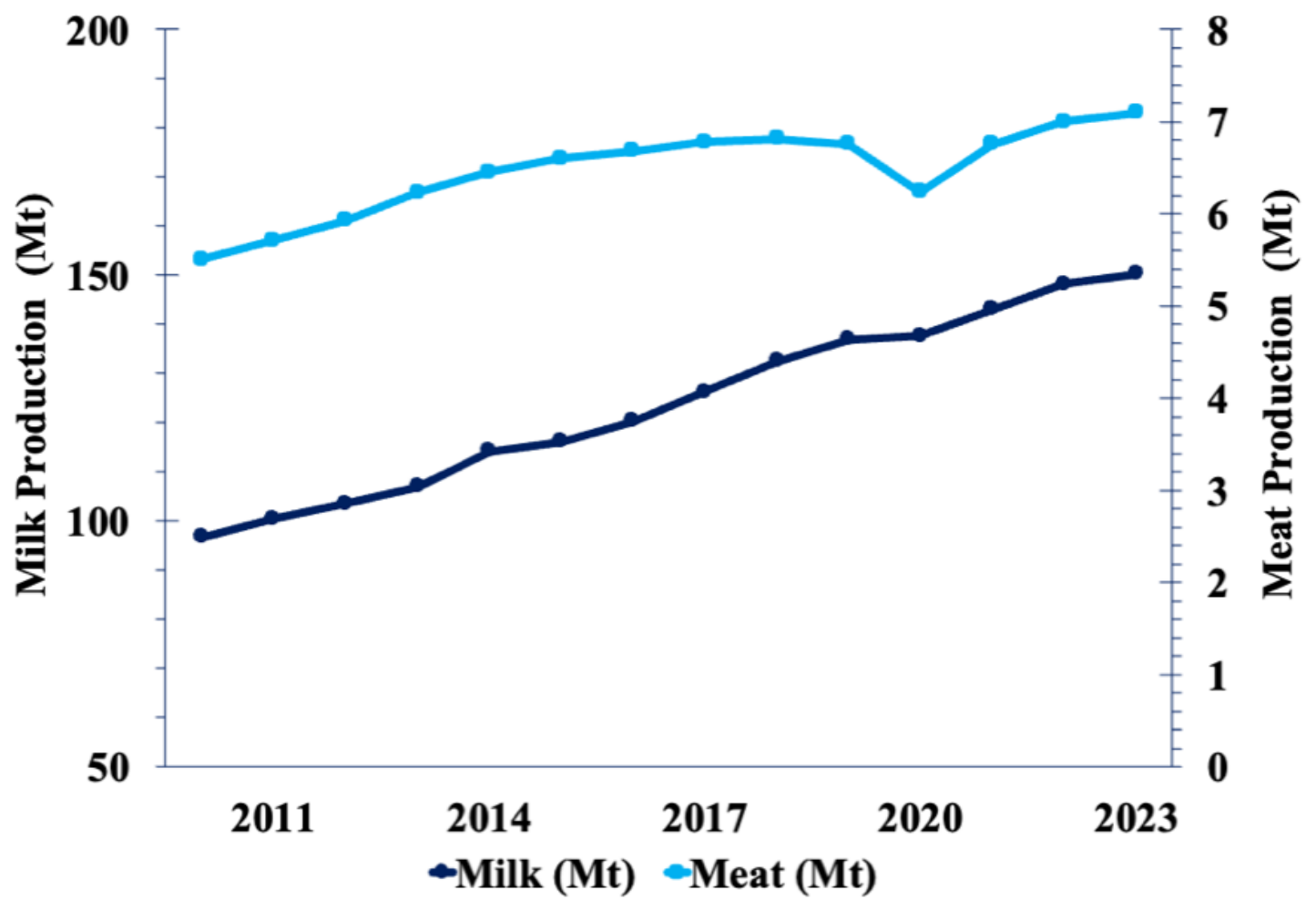
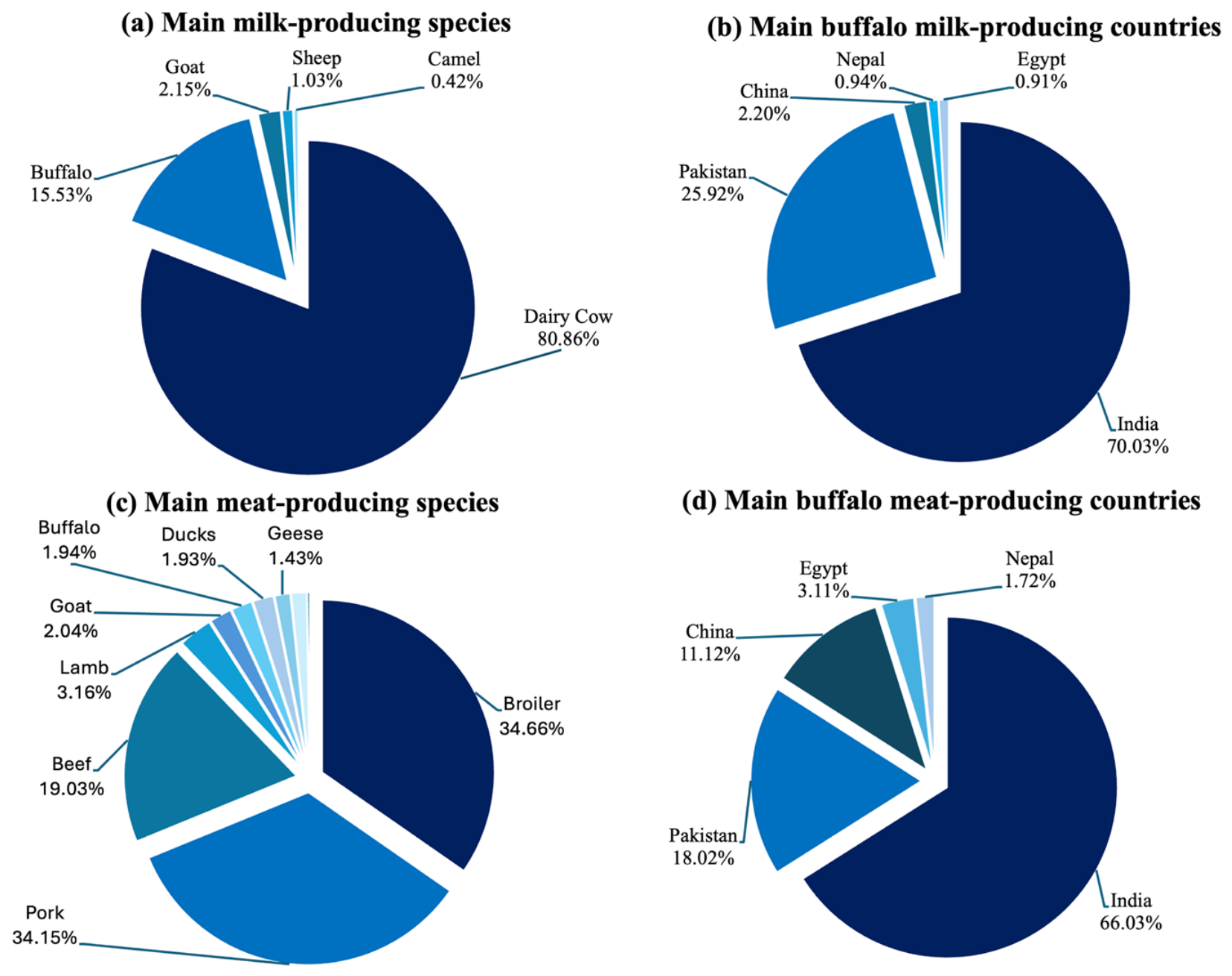
Global buffalo milk production totals 150 million tons (Figure 5), constituting 15.52% of world milk output [60]. Among the five primary dairy species, water buffalo rank second, surpassing goats (2.15%), sheep (1.03%), and camels (0.42%). Horses, donkeys, yaks, and reindeer provide only a marginal share [91] (Figure 6a). Environmental adaptation dictates global milk distribution. Species selection aligns with local conditions: sheep predominate in semi-arid Mediterranean regions, buffaloes in humid tropics, and goats in both nutrient-poor African soils and fertile developed zones. Camels occupy hyper-arid lands. Therefore, animal resilience, local resources, and cultural heritage determine milk availability [92].
Over the past 15 years, buffalo milk production has maintained a 3.5% average annual growth rate [60]. Supply is geographically concentrated; India, Pakistan, China, Nepal, and Egypt contribute over 99% of the global total (Figure 6b). However, the sector holds strategic importance elsewhere: Italy, Turkey, and Bulgaria lead European production [16], while Brazil, Venezuela, and Colombia dominate the Americas. This distribution highlights the species’ versatility and contribution to regional agricultural economies [67].
Buffaloes yield lower daily milk volumes (4 to 11 kg/day over 240–270 days) than dairy cattle, specifically Holsteins (15 to 30 kg/day over 305 days) [93,94]. Nevertheless, buffalo output exceeds that of small ruminants, including ewes (1.10 kg/day over 174–255 days) and goats (1.70 kg/day over 253–294 days) [95]. Buffalo yields align with camels (5.34 kg/day), though camels exhibit longer lactation periods (253–294 days) [96]. While small ruminants in marginal soils and camels in deserts sustain socioeconomic balance, their global impact is limited [92]. Small ruminants (goats and sheep) account for only 2.15% and 1.03% of global milk production compared to buffaloes and cattle, respectively [95].
Although camels can reach daily yields of 25 kg/day, restricted geographical distribution—often localized or limited to zoological settings—impedes large-scale production [97]. Conversely, water buffalo populate tropical and subtropical regions. Superior resilience and productive efficiency enable buffaloes to convert low-quality forages into high-value protein more efficiently than other species [11,67]. Decades of grazing on highly fibrous, low-protein native grasses have driven digestive adaptations that maximize fiber utilization, yielding higher feed conversion rates than cattle [53]. Unique rumen microbial compositions drive these physiological advantages. Compared to Holstein calves, water buffaloes exhibit higher bacterial diversity (p < 0.05), with increased abundance of Firmicutes and fibrolytic bacteria, such as Ruminococcus and Ruminobacter (p < 0.05); contrastingly, Holsteins display higher Bacteroidetes and genus Prevotella [48]. These microbial profiles optimize fiber digestion and feed conversion [47].
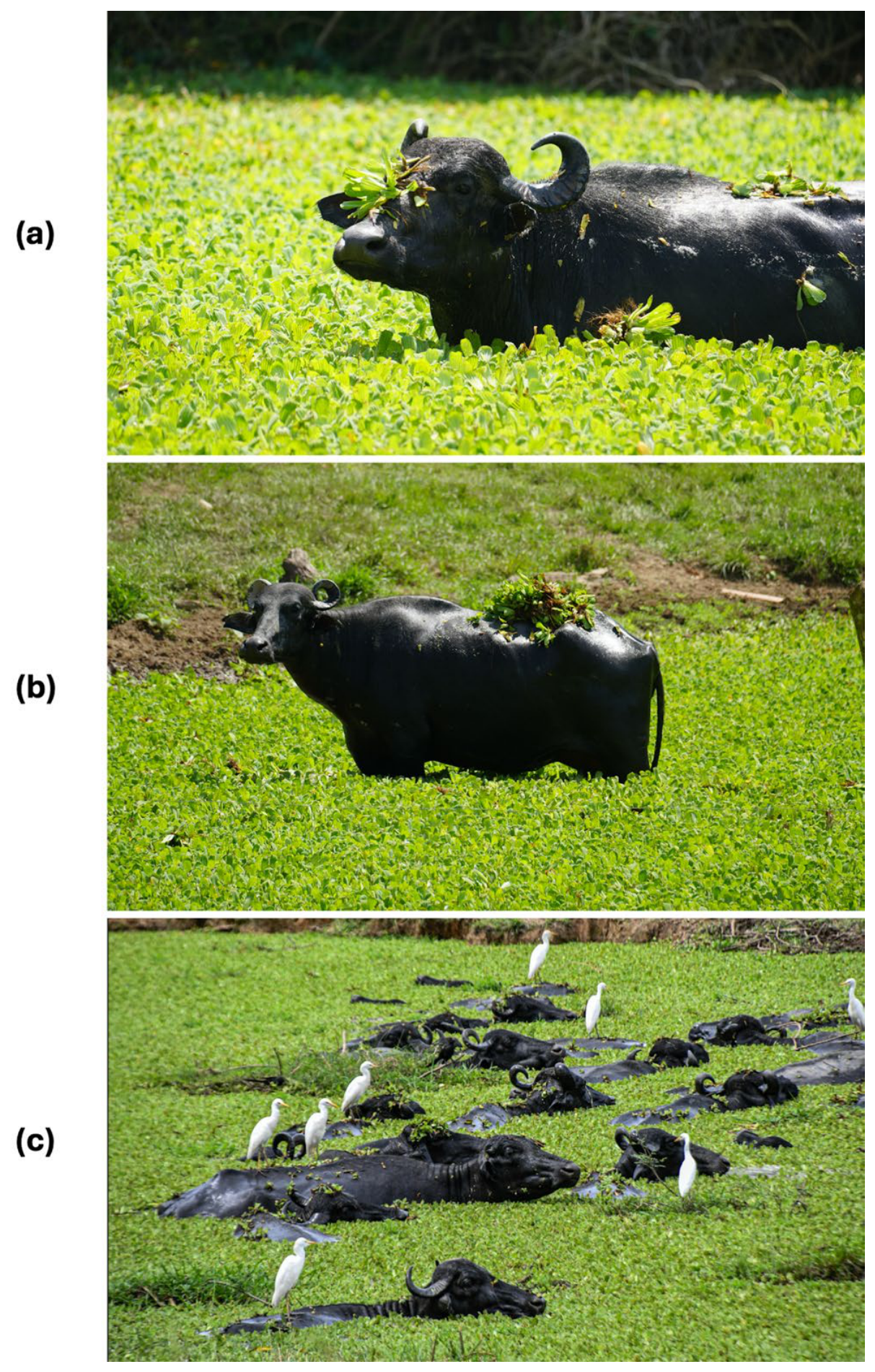
Anatomical traits, including sparse hair and high melanin pigmentation, bolster resilience in tropical and subtropical climates [98]. These features permit tolerance ranging from 0 °C to above 30 °C [93]. A key adaptive behavior is wallowing; buffaloes enjoy creating and immersing in mud ponds they dig themselves, forming a thick layer of mud on their bodies that acts as a protective barrier against solar radiation and parasites [20,38,93]. Consequently, buffalo rearing remains a sustainable option for small- and large-scale systems, exhibiting higher climate change tolerance than other livestock [9,35]. However, specific morphology induces susceptibility to heat stress under intense solar radiation or high humidity [99]. In the absence of natural water bodies, mitigation via natural or artificial shade, fans, and shower systems must support thermoregulation [100,101]. Therefore, the water buffalo represents a strategic resource for food security in regions becoming unsuitable for conventional cattle, ensuring the supply of high-quality protein amidst shifting climate scenarios [59].
Dairy buffalo productivity varies by type and region. River buffalo yield 600 to 4500 kg per lactation [7]. In contrast, swamp buffaloes produce significantly less, averaging 255 kg per lactation, though their milk contains higher protein and fat levels [102]. Murrah, Nili-Ravi, Surti, and Jaffarabadi breeds possess high fat production potential [78]. To enhance productivity, farmers have adopted crossbreeding systems, utilizing Mediterranean and Asian breeds to improve yields in diverse climates [102]. Italian Mediterranean buffaloes average 7–8 kg/day, peaking at 15 kg/day [61,67], whereas Indian yields range from 8.30 to 13.33 kg/day [78]. Specialized crossbreeds in Sri Lanka average 5.92 kg/day [68]. In Brazil, documented values approximate 6.33 kg/day [103] or 1500 to 4500 L per 305-day lactation [53,104]. Egypt records 1454 kg per 270-day lactation [105]. Conversely, lower yields characterize local breeds in Bangladesh (1–3 L/day) [70], and Anatolian buffaloes in Turkey (800–900 kg per 180–220 day lactation) [106].
Genetic improvement and management strategies have yielded peaks of 5000 to 5600 kg per lactation [67]. The third parity remains the most productive due to increased body weight and mammary gland development, associated with increased body weight and mammary gland development [107]. Thus, optimizing buffalo milk productivity is a challenge for industry development and a research priority [108].

4.2.2. Buffalo Meat

Besides its dairy potential, the water buffalo serves as a prominent source of high-quality red meat, confirming its dual-purpose utility [11]. Buffalo meat production totaled approximately 7 million tonnes (Figure 5), ranking sixth worldwide behind poultry, pork, beef, sheep, and goat meat (Figure 6c). This sector maintained an annual growth rate of 2.03% between 2010 and 2023, expanding from 5.50 to 7.09 million tonnes. Supply is highly concentrated; India, Pakistan, China, Egypt, and Nepal generate approximately 95% of global output (Figure 6d) [60]. Competitive pricing, leanness, and the absence of religious taboos drive demand relative to beef [42].
Currently, buffalo meat has gained popularity in several regions, including Africa, Europe, the Americas, and Australia [109,110], particularly when obtained from young animals aged 18–24 months [85,111]. Certified brands, such as TenderBuff® (Australia) and Sapore di Campania® (Italy), have improved market opportunities [112]. Conversely, meat from older animals displays lower quality, specifically increased toughness and darker coloration [113]. Technological interventions now target improved sensory acceptability and shelf life [114,115,116].
Buffaloes efficiently convert low-cost, low-quality forages into animal protein under diverse systems [117,118]. When grazing natural pastures, buffaloes often outperform cattle in weight gain compared to concentrate-fed conditions [109,118]. Particularly under adverse conditions, buffaloes show good weight gains due to anatomical adaptations and fiber-degrading capacity [73].
In the Brazilian Amazon, intensive (0.983 kg/day), semi-intensive (0.880–0.971 kg/day), and silvopastoral (0.575–0.969 kg/day) systems surpass rotational grazing (0.577–0.658 kg/day) and continuous grazing (0.420–0.780 kg/day). Evidence indicates that technological intensification correlates with greater weight gains [53]. Grazing systems generally yield lower weight gains due to increased energy expenditure and higher fiber intake, negatively affecting carcass yield [119].
Intrinsic and extrinsic factors dictate variability in carcass characteristics and meat quality [110]. Significantly, the buffalo sector lacks specialized meat breeds [120]. In Anatolian buffaloes (Turkey), sex determines carcass weight, with males exhibiting up to 15 kg more than females [112]. Crossbreeding Anatolian with Mediterranean buffaloes improves yields (238 kg vs. 273.77 kg), reflecting genetic selection in Italian populations [106]. Additionally, animals under 2 years present lower carcass weights than those over 2 years (150.85 vs. 223.55 kg) [121]. In Mediterranean buffaloes, dietary systems significantly influence carcass weight; animals fed silage maize outperform those on polyphytic pasture hay or grazing (133.6 vs. 118.7 and 105.2 kg, respectively) [119].
Although buffaloes may perform well under different production systems, their carcass yield is lower than that of cattle due to a higher proportion of non-carcass components, particularly skin and head [109]. Carcass yield ranges from 49 to 57% [119] compared to Bos taurus and Bos indicus (59–62.2%) [122]. Nevertheless, buffalo carcasses yield highly accepted cuts, particularly in the hindquarter [109]. Utilizing by-products (50–60% of live weight) increases economic potential and reduces environmental pollution [11]. Expanding the buffalo meat industry requires effective marketing [109]. As consumer acceptance remains a challenge—with buffalo meat often perceived as inferior to beef—strengthening consumer education, quality certification, and producer organization is imperative [111].

4.2.3. Buffalo Draft Power

Despite advances in agricultural mechanization, buffaloes remain significant working animals for small- and medium-scale producers, particularly where irregular topography limits machinery or soil compaction must be avoided [21]. Among draft animals, oxen, buffaloes, and camels provide traction, while horses, mules, donkeys, and camels serve primarily as pack animals [123]. Animal traction saves approximately 20 million tons of petroleum annually; thus, improving draft power utilization represents a primary strategy for small-scale agriculture [124]. Water buffaloes are indispensable for paddy rice farmers. Although cattle exhibit more agility, buffaloes are preferred for their strength, large hooves, and flexible fetlock joints, which provide functional advantages in mud. Buffaloes surpass mechanization in seasonal rice farming because machinery incurs high maintenance costs during idle periods, whereas buffaloes—termed “living tractors”—require low maintenance and offer long working lifespans at a fraction of the cost [85,93]. Additionally, certain geographical areas remain inaccessible to machinery [22].
The traditional role of buffaloes prevails across East and Southeast Asia. In South Asia, dairy buffaloes belong primarily to small-scale producers managing one to five animals [125]. In India, buffaloes supply 20 to 30% of total agricultural energy [71], executing plowing, harrowing, hauling, and operating traditional presses [85,93]. Technically, buffaloes offer distinctive advantages, including resilience to harsh environments and efficient operation in flooded clay soils. With adequate rest, a 600 kg LW buffalo transports 250 kg at 3 km/h during a 10 h workday [85]. Although slower than other species, they pull up to six times their body weight, underscoring their robustness and versatility [126]. To ensure performance and welfare, the sustained workload limit—equivalent to one-tenth (1/10) of LW—must be strictly observed to prevent overexertion [123]. Consequently, integrated management must prioritize nutrition, veterinary care, genetic selection, and ergonomic equipment. Management must prohibit overexertion and promote educational programs to eliminate mistreatment, ensuring compliance with legal frameworks [123].

4.2.4. Buffalo Hide and Leather: Industrial Valorization and Economic Potential

Buffalo hides constitute a significant income stream within the livestock industry. In the Philippines, the combined weight of the head, hide, and shanks reaches 19.89% for crossbred water buffaloes, exceeding the 14.77% observed in cattle Bos indicus [127]. Hides account for approximately 17% of carcass weight and 7% of body weight (BW), with individual units weighing 15–30 kg and covering about 4.5 m2 [128]. Buffalo hides are significantly heavier than cattle counterparts (39.2 kg vs. 27.6 kg) [129]. In addition to its traditional use, buffalo hide exhibits a high amino acid content and high density of collagen fiber bundles, making it an underutilized source for high-yield gelatin extraction [130,131]. The technological valorization of these by-products, such as the extraction of high-density collagen for industrial applications, aligns with SDG 9 (Industry, Innovation, and Infrastructure).
Structurally, buffaloes possess a particularly thick skin with a prominent stratum corneum, which can be up to twice as thick as that of cattle (11 μm versus 5 μm, respectively) [99]. This anatomical robustness facilitates specialized applications: the papillary layer suits high-quality lightweight goods—bags, wallets, belts, gloves, and luxury car upholstery—while the denser reticular layer serves industrial products, including machine gaskets, mats, and work boots [20,23]. To expand the sector, institutions like the Central Leather Research Institute (CLRI) prioritize technologies for upholstery leather, integrating eco-friendly chemicals and sustainable processing to align with global trade standards [71,125].

4.2.5. Longevity of Buffalo

Buffaloes exhibit remarkable productive longevity, particularly under nutrition meeting maintenance and production requirements [53]. While captive water buffaloes can reach 35 years, their productive lifespan in production systems typically spans 9 to 20 years [7,132]. Specifically, the Nili-Ravi breed begins its productive life at 2–3 years and maintains it for 15–20 years [126]. Conversely, other reports cite an average longevity of 7 to 11 years owing to culling [19,20]. In Italy, replacement rates for buffalo cows average 15%, with a productive life of 6.7 lactations [82]. This exceeds farm-level productive lifespans of dairy cows (5.4 years), breeding sows (1.8 years), ewes (7 years), and goats (6 years) [133]. Consequently, buffaloes are among the longest-lived species in contemporary production systems.
Nevertheless, a recent Weibull model analysis in Italy estimated the productive lifespan of Mediterranean buffalo at approximately 4 years. This decline stems from intensive culling driven by udder conformation, production thresholds, disease eradication, delayed first calving, and refined management. Genetic selection programs must incorporate these factors [84]. Ultimately, enhancing buffalo longevity is essential for economic sustainability, as it increases cumulative milk and meat yields while reducing replacement costs [134]. Furthermore, multiparous buffalo cows generate lower long-term greenhouse gas (GHG) emissions than primiparous animals [19,20].

4.2.6. Circular Bioeconomy and Waste Valorization in Buffalo Production

Livestock production significantly reduces waste through contributions to a circular bioeconomy—an economy centered on bio-based products, organic waste streams, resource-efficient value chains, and nutrient cycling [77]. This model seeks to decouple livestock production from greenhouse gas (GHG) emissions by eliminating pollution, circulating materials, and supporting natural regeneration [75]. Although livestock farming generates large manure volumes potentially affecting soil, water, and air quality [135], rigorous management transforms these residues into economic assets. Regarding soil health, buffalo manure serves as high-quality organic fertilizer and construction material, lessening reliance on synthetic inputs [135,136]. In grazing systems, it mitigates desertification by optimizing soil structure, organic matter content, and resilience to erosion [35].
Recent evidence suggests buffalo manure possesses a lower nitrogen (N) concentration than Nellore manure; nevertheless, it accelerates the release of plant-available N and phosphorus (P) via fiber degradation and microbial activity [137]. For example, buffalo manure increases dry matter yield in forage crops, as its carbon-to-nitrogen ratio stimulates biomass production [51]. In Italy, applying buffalo manure vermicompost (140 kg N ha−1)—processed by Eisenia fetida and Eisenia andrei—increased biomass and leaf number while decreasing oxidative stress (p < 0.05). This practice replaces mineral fertilizers within circular economy frameworks [24].
Concerning energy valorization, each buffalo produces 4 to 6 tons of wet manure annually [24], providing a substantial substrate for renewable energy [58]. Buffalo waste demonstrates high biogas potential due to volatile fatty acids [138]. In Southeastern Mexico, anaerobic digestion in lagoon biodigesters achieved an 86.6% Chemical Oxygen Demand (COD) removal efficiency. Post-filtration, the biogas reached 58–60% methane concentrations with a heating value of 25.51 MJ/m3 [26], advancing SDG 7. Emerging technologies like rapid pyrolysis convert manure into bio-oils, transforming bulky residues into high-energy-density liquid resources to replace fossil fuels [25].
Besides solid waste, liquid residues such as whey offer potential; though requiring co-digestion with manure, its organic matter boosts biogas yields. In addition, processed whey can be valorized into protein concentrates, isolates, fermented beverages, or single-cell protein substrates [7]. Finally, the circular bioeconomy incorporates cultural innovation. In Thailand, buffalo manure serves as a natural textile dye; this “eco-fashion” utilizes traditional ecological knowledge to promote intergenerational employment and green products [27]. Collectively, these strategies position buffalo production as a component of sustainable, resource-efficient agricultural systems.

4.2.7. Use in Animal-Assisted Services

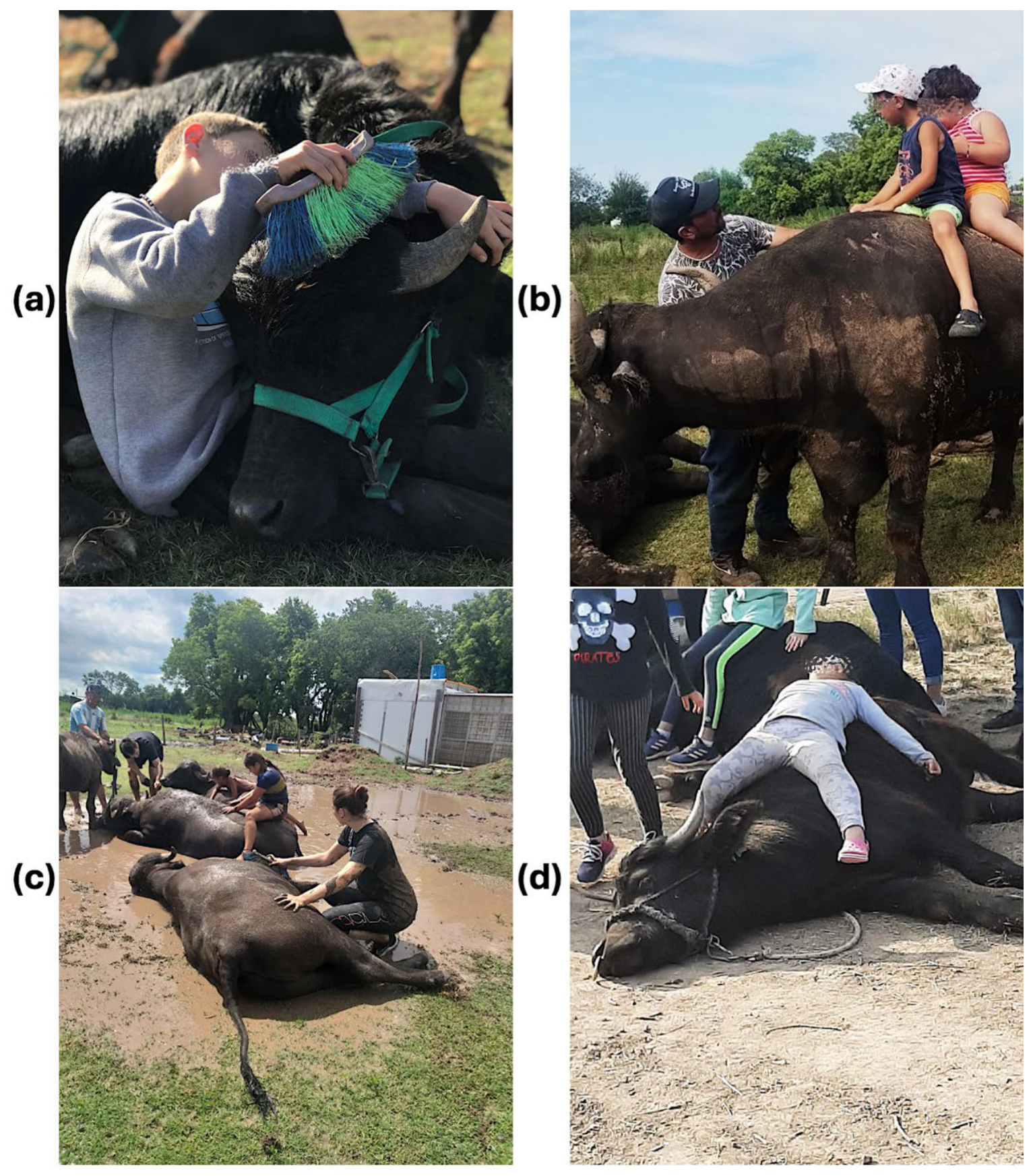
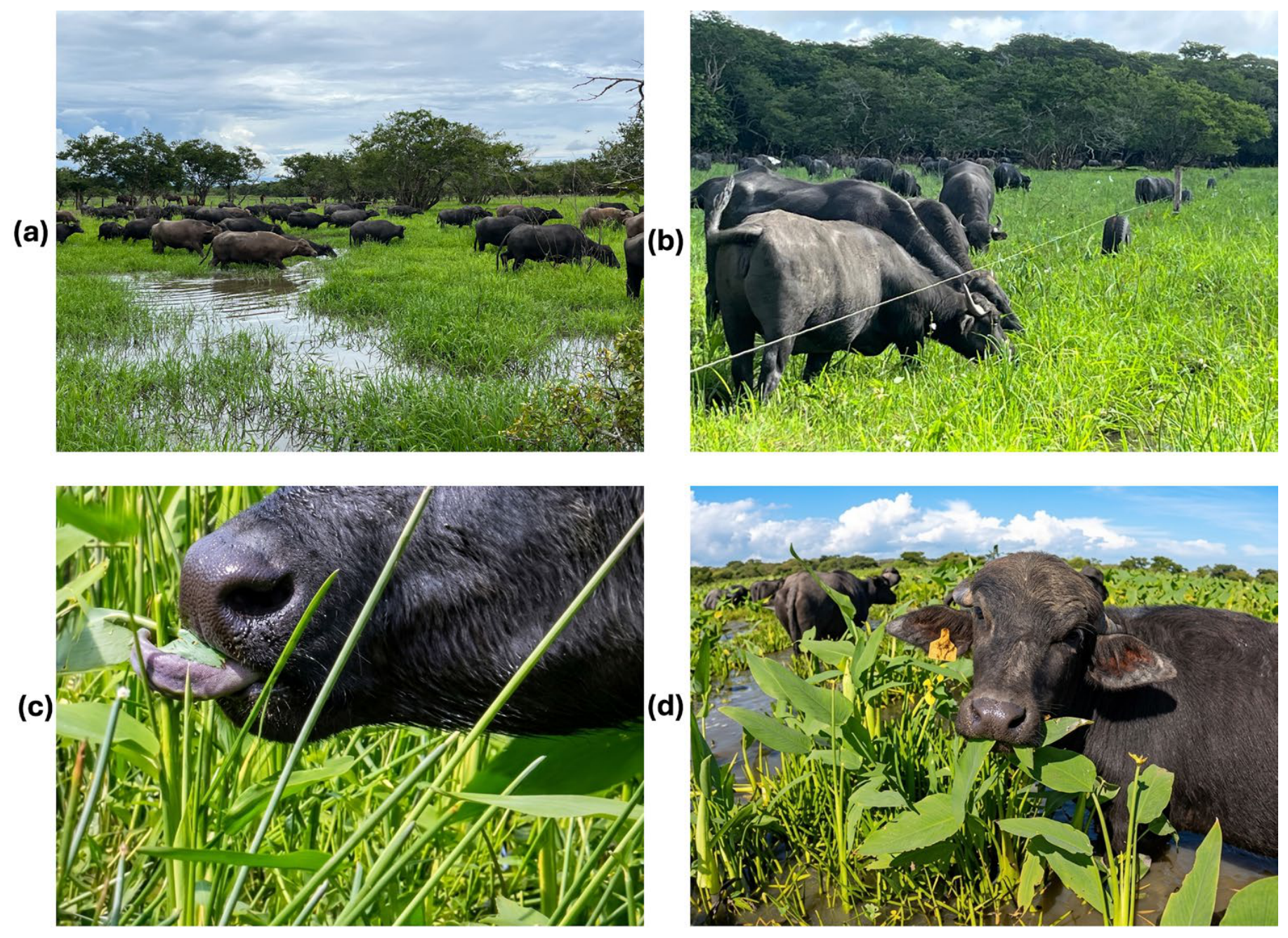
Animals play a role in social and occupational contexts, with empirical evidence suggesting that animal-assisted services (AASs)—comprising therapy (AAT), education (AAE), and support programs (AASPs)—improve physical, mental, and cognitive functioning [139,140]. While a comprehensive theoretical framework is lacking, attachment and the human–animal bond contribute to health benefits [141]. Within this context, buffaloes are increasingly incorporated into interventions. In Argentina, human–buffalo interactions improve confidence and interpersonal communication (Figure 7a–d). Early exposure to human contact facilitates this participation; buffaloes may enter AAS at four months if appropriately socialized and if they demonstrate environmental adaptability and tolerance to physical contact [142].
In many Asian rural communities, the emotional bond between breeders and buffaloes surpasses productive activities, as animals are often viewed as family members [85]. In regions like Vietnam and other parts of Asia, buffaloes historically promote social cohesion, as children from different households interact while tending to animals during grazing and bathing [28]. These interactions highlight the buffalo’s role in daily social life, serving as a precursor to formal AAS inclusion. Nevertheless, research must standardize protocols to maximize human health benefits while adhering to animal welfare standards [55]. Therapeutic objectives must not outweigh animal welfare, as excessive workload and stress remain concerns within AAS frameworks [143].

5. Social Dimension: Food Systems and Social Equity

Animal-source foods (ASFs) supply approximately 18% of global caloric intake and 40% of dietary protein [58,77]. These resources are rich in micro- and macronutrients, providing essential amino acids frequently deficient in plant-based diets [144]. Despite debates on antibiotic resistance and zoonoses, ASFs remain fundamental for the nutritional stability of vulnerable groups, such as infants and pregnant women [75,145]. Moderate increases in milk, egg, and meat consumption among impoverished populations improve nutritional, educational, and economic outcomes [136]. Although global undernutrition fell from 25% in 1970 to 11% in 2016, it still affects 815 million people [146]. With the population projected at 9.7 billion by 2050, surging protein demand will challenge food security [79], meat and dairy demand are estimated to rise 63% and 30%, respectively [74,147].
In this scenario, water buffalo possess high potential to meet these needs [70,132]. Their contribution to SDG 2 (zero hunger) stems from their capacity to provide nutrients in marginalized environments where other livestock fail [35]. Buffalo milk nutritional superiority is evidenced by dry matter (16.30%) and solids (17.58%) levels that exceed cow milk (12.42% and 12.38%) while remaining just below sheep milk (17.60% and 18.00%) (Table 1). This density includes 4.41% protein and 7.28% fat [8,18,148]. Compared to cow milk, energy content nearly doubles (5.10 MJ vs. 2.90 MJ) [31]. Buffalo and sheep milks possess superior mineral density (Ca, P, Mg, and S) due to their substantial colloidal protein fraction. Conversely, cow, goat, and camel milks are more diluted, containing higher potassium for osmotic balance but lower macrominerals linked to the casein micelle structure [91].
Lactose (4.76 g/100 g) provides a vital energy source for neurological activity and hormonal regulation [18]. Furthermore, buffalo milk contains lower cholesterol (275 mg/100 g) and significant vitamins B12, A, C, and B6, as well as calcium, iron, and phosphorus [93,102,108]. High calcium levels help prevent osteoporosis, while vitamin B12 protects against cardiovascular diseases [93,149]. Technologically, buffalo milk fat is double that of cow milk [7]. Larger fat globules and higher solid fat proportions grant buffalo and sheep milks superior cheese-making suitability [18]. High solid concentration ensures thicker consistency and improves industrial cost-effectiveness [31,93,134]. Buffalo milk achieves the highest fresh cheese yield (25.5%) and fat recovery (88.2%), surpassing camel milk (13.8% and 55.0%) [92]. Producing 1 kg of fresh cheese requires 5 L of buffalo milk versus 10 L of cow milk; 1 kg of butter requires 10 L versus 14 L, respectively [68,93]. These characteristics ultimately result in higher dairy product yields, increased income for producers, and greater value addition to by-products when appropriate processing technologies are applied [7].
Buffalo dairy products are traditional in Asian and Caucasian countries, where dahi, ghee, and yogurt are widely consumed. Buffalo cheese is valued for its pure white appearance [18]. Specific regional products include dadih (Indonesia) and kaymak (Turkey) [73,117,150]. Italy remains a global leader in this sector, with Mozzarella di Bufala Campana being the most prominent product. Other PDO-certified products, including ricotta, and traditional Italian cheeses including provola, scamorza, caciotta, and caciocavallo [7,16,17].
Livestock production plays a crucial role in the livelihoods of smallholder farmers worldwide, serving as a cornerstone for poverty alleviation and improved human nutrition through multiple pathways [113]. Women make substantial contributions across different stages of livestock value chains as producers, traders, and consumers, and they influence decisions related to sales, consumption, and household income management derived from animal products, which is essential for household nutritional well-being [40].
Table 1. Physicochemical composition and nutritional quality of milk from major dairy species: a comparative analysis for global food security.
ParameterCow
[8,32,91,92,151,152,153,154,155]
Buffalo
[8,18,32,91,92,151,152,153,154,156,157]
Goat
[91,92,151,152,153,154,155]
Sheep
[91,92,151,152,153,154]
Camel
[91,151,152,153,154,155]
Dry matter (%)12.42 ± 0.58
(11.80–13.00)
16.30 ± 0.77
(15.61–17.70)
14.01 ± 3.27
(11.70–16.33)
17.60 ± 1.27
(16.70–18.50)
11.50 ± 2.68
(9.60–13.40)
Total solids (%)12.38 ± 1.14
(10.80–13.86)
17.58 ± 1.22
(15.70–20.18)
13.11 ± 1.62
(11.57–16.30)
18.00 ± 1.28
(16.86–19.73)
11.23 ± 0.88
(10.44–12.44)
Solid non-fat (%)9.18 ± 0.67
(8.24–9.78)
10.74 ± 2.15
(8.30–15.73)
9.69 ± 0.17
(9.57–9.81)
12.12 ± 0.47
(11.79–12.46)
8.54 ± 0.02
(8.53–8.56)
Fat (%)4.01 ± 0.59
(3.30–5.40)
7.28 ± 0.89
(5.70–8.98)
4.11 ± 0.86
(3.07–5.30)
7.10 ± 0.59
(6.36–7.90)
3.24 ± 1.45
(1.90–6.00)
Protein (%)3.51 ± 0.65
(2.90–5.40)
4.41 ± 0.55
(2.70–5.20)
3.59 ± 0.74
(2.90–5.20)
5.53 ± 0.59
(4.95–6.30)
3.00 ± 0.36
(2.40–3.42)
Lactose (%)4.94 ± 0.43
(4.40–5.60)
4.76 ± 0.67
(3.20–5.36)
4.34 ± 0.61
(3.20–5.00)
4.52 ± 0.55
(3.70–4.90)
4.41 ± 0.38
(4.05–4.90)
Ash (%)0.73 ± 0.06
(0.65–0.80)
0.81 ± 0.09
(0.60–0.90)
0.82 ± 0.07
(0.73–0.90)
0.88 ± 0.07
(0.82–0.98)
0.83 ± 0.06
(0.69–0.90)
Energy (kcal/100 g)66.90 ± 4.38
(62.74–72.13)
104.86 ± 8.27
(96.90–116.55)
63.53
(single value)
105.80
(single value)
-
pH6.63 ± 0.01
(6.62–6.65)
6.68 ± 0.08
(6.61–6.81)
6.55 ± 0.09
(6.50–6.66)
6.56 ± 0.08
(6.49–6.66)
6.55 ± 0.15
(6.44–6.66)
Acidity (%)0.11
(single value)
0.16 ± 0.03
(0.12–0.19)
0.14 ± 0.03
(0.11–0.18)
0.20 ± 0.06
(0.13–0.25)
0.12 ± 0.01
(0.11–0.13)
Casein (g/100 g)2.69 ± 0.38
(2.28–3.27)
3.19 ± 0.26
(2.93–3.61)
2.55 ± 0.42
(2.14–3.18)
4.28 ± 0.57
(3.78–5.20)
2.29 ± 0.18
(2.10–2.46)
Although buffalo milk is popular among health-conscious consumers, goat and camel milks remain superior hypoallergenic alternatives [152,155]. Camel milk resembles human breast milk due to the absence of β-lactoglobulin—the primary whey protein allergen identified in bovine milk—and a high ⍺-lactalbumin content [97,153,158]. It also contains immunoglobulins (Ig) and bioactive peptides that strengthen the immune system [97]. Dromedary and Bactrian camel milks present vitamin C concentrations up to ten times higher than those of cow milk, alongside elevated levels of total salts, calcium, iron, copper, and zinc, while maintaining low cholesterol levels [158]. Similarly, goat milk assimilation resembles human milk; smaller fat globules facilitate digestion, and lower lactose benefits intolerant individuals. Goat milk also contains selenium, which is essential for platelet regeneration, and taurine, which inhibits hypertension [159]. However, camel milk presents technological challenges; large casein micelles and low thermal stability impede UHT treatment and curd formation [155]. Small ruminant milks also face sensory barriers due to ‘goaty’ or ‘sheepy’ flavors, whereas consumers prefer the ‘neutral’ profile of bovine milk [160]. In addition, buffalo milk has gained significant popularity among health-conscious consumers due to its unique physicochemical profile and high concentration of bioactive compounds [30,31,32].
A distinguishing feature of buffalo milk is its natural classification as A2 milk resulting from the absence of the β-casein A1 (β-CN A1) variant [161]. This A2A2 genotype prevents the formation of β-casomorphin-7, a peptide linked to gastrointestinal discomfort and microbiome imbalances [8,30,161]. Therefore, the A2 nature of buffalo milk thus represents a strategic opportunity to expand market reach, particularly among individuals with sensitivities to cow milk or those specifically seeking functional foods [161].
Buffalo milk qualifies as a nutraceutical due to bioactive compounds often exceeding those in cow, sheep, and goat milk [7]. Among ruminant milks, buffalo milk contains high levels of δ-valerobetaine (δVB), carnitine, and short-chain acylcarnitines such as acetyl-l-carnitine (C2Car), propionyl-l-carnitine (C3Car), butyryl-l-carnitine (nC4Car), and isobutyryl-l-carnitine (iC4Car), compounds that are associated with anaerobic fermentation processes in the rumen and are linked to the microbial metabolism responsible for the production of volatile fatty acids and isoacids [162]. Such molecules exhibit potent antioxidant and anti-inflammatory activities and have been shown to inhibit cancer cell proliferation in specific models [32,163] (Table 2).
Additionally, buffalo milk proteins serve as precursors for bioactive peptides derived from β-lactoglobulin and various casein fractions (αs1, αs2, and κ-casein), which possess antihypertensive and antioxidant properties while promoting osteoblast proliferation [164]. In buffalo whey, recent analyses have identified peptides with immunomodulatory, antimicrobial, and cytomodulatory effects on human colon cancer cells [165,166].
Environmental factors and management dictate compound synthesis. Greater individual space improves welfare and correlates with higher functional molecules; specifically, 15 m2 per head yields higher carnitine and δVB levels than 10 m2 [162]. Optimized housing and pasture-based feeding are essential to preserve nutritional integrity, linking animal welfare with consumer health.
Table 2. Bioactive compounds in buffalo milk and meat: health effects, molecular mechanisms, and biological models.
Bioactive ComponentHealth Effect Potential Biological SourceMolecular MechanismReference
Betaines
δ-valerobetaine (δVB)


γ-butyrobetaine (γ-BB)
Glycine betaine
Antioxidant
Anti-inflammatory, cytoprotective
Antineoplastic effect
Milk, whey, buffalo products (ricotta, mozzarella)↓ Pro-inflammatory cytokines (TNF-α, IL-1β and IL-6)
↓ ROS in endothelial cells
↓ Lipid peroxidation
Amelioration of high-glucose cytotoxicity
↓ intracellular malondialdehyde
↑ SIRT1 and SIRT6; inhibition of NF-κB nuclear translocation
Antineoplastic effects in human colon and in head and neck squamous carcinoma cells
↑ Autophagy in cancer cells
↓ fatty acid β-oxidation in mouse cardiomyocytes
↑ Necroptosis (RIPK1/RIPK3/MLKL axis) and Apoptosis (Cleaved Caspase-3/PARP-1).
Synergistic with δ-valerobetaine
[32,162,163,167,168,169,170]
L-carnitineAntioxidant
Anti-inflammatory
Milk, Whey, buffalo products (ricotta, mozzarella)On endothelial cells and platelets
↑ Neuropeotective potential in central and peripheral nervous
regulation of BDNF
[162,167,170]
Short-chain Acylcarnitines:
acetyl-L-carnitine (C2Car) (ALCAR)
Propionyl-L-carnitine (C3Car)
Butytyl-L-carnitine (nC4Car)
Isobutyryl-L-carnitine (iC4Car)
Cytoprotective, antioxidant, anti-inflammatory responsesMilk, whey, buffalo products (ricotta, mozzarella), meat↑ Cytotoxic effects on human colon cancer cells and tongue squamous carcinoma cells
↓ ROS in human umbilical vein endothelial cells
↓ Expression of chemokines and adhesion molecules
↓ TNF-α-mediated inflammatory angiogenesis
[162,167,169,170]
RELEECan alleviate oxidative stress by reducing ROSHydrolysis of buffalo caseinHigh Trolox equivalent antioxidant capacityReferences
VLPVPQK (from buffalo β-casein)Can alleviate oxidative stress by reducing ROS
Apoptotic effect
Milk, hydrolyzed buffalo casein↑ Nuclear translocation of Nrf2 via Keap 1
↑ Expression of antioxidant enzyme HO-1
↓ ROS and mitochondrial damage
↓ Apoptosis (↑ Bcl-2/↓ Bax ratio)
[32,171,172]
Lipid fraction/PUFASHypolipidemic and Hepatic protectionMilk↑ mRNA expression of hepatic genes
↓ Accumulation of total cholesterol and triglycerides in hepatocytes
↓ Hepatic fat
[173]
Casein peptides (EDVPSER, NAVPITPTL, VLPVPQK, HPHPHLSF)Bone-promoting and Anti-osteoporotic in ratsMilk (casein hydrolysates)↑ Expression of osteoblast markers
↑ Bone mineral density and matrix mineralization
↓ Bone resorption cytokines (RANKL, TNF-α, IL-6)
[32,174,175]
YPFPGPIPN (Casein peptide)Antidiabetic (glycemic regulation)Milk (buffalo casein)Inhibition of DPP-4 enzyme for maintaining blood glucose homeostasis[174]
RNAVPITPTLNR, TKVIPYVRYL, YLGYLEQLLR, FALPQYLK (Casein peptide from αs1-CN, αs2-CN, and β-CN)Antidiabetic (hypoglycemic)Milk (buffalo casein)Inhibition of α-glucosidase for maintaining blood glucose homeostasis[176]
YVEELKPTPEGDL (β-lactoglobulin peptide)Gastrointestinal protection and antioxidantRicotta cheese↓ ROS release; ↑ Nrf2 activation; ↑ Cytoprotective factors (HO-1, NQO1, SOD)[177]
FPGPIPK, IPPK, IVPN, QPPQ, YPSG, HPFA, KFQAntioxidant and hypotensiveSkimmed buffalo milk↓ ACE (angiotensin-converting enzyme) activity ↑ Free radical scavenging[172]
YQEPVLGPVRAnti-inflammatory and antioxidantBuffalo milk casein↓ Splenocyte proliferation
↓ Inflammatory cytokines (IFN-γ)
↑ Regulatory cytokines (IL-10 and TGF-β)
↑ Phagocytic activity
↓ ROS generation and oxidative stress (H2O2)
↑ Antioxidant enzymes (Catalase and GPx)
↓ mRNA expression of Nrf-2
[178]
Abbreviations: ACE, angiotensin-converting enzyme; ALCAR, acetyl-L-carnitine; BDNF, brain-derived neurotrophic factor; DPP-4, dipeptidyl peptidase-4; GPx, glutathione peroxidase; HO-1, heme oxygenase-1; IFN-γ, interferon-gamma; IL, interleukin (e.g., IL-1β, IL-6, IL-10); NF-κB, nuclear factor kappa-light-chain-enhancer of activated B cells; NQO1, NAD(P)H quinone dehydrogenase 1; Nrf2, nuclear factor erythroid 2-related factor 2; PUFAs, polyunsaturated fatty acids; ROS, reactive oxygen species; SIRT, sirtuin; SOD, superoxide dismutase; TGF-β, transforming growth factor-beta; and TNF-α, tumor necrosis factor-alpha. Upward arrows (↑) indicate an increase, activation, or up-regulation of the physiological and molecular processes, while downward arrows (↓) indicate a decrease, inhibition, or down-regulation of the respective parameters.
Historically, buffalo meat production was secondary to draft power and milk, with slaughter occurring only at the end of productive life [148]. This established a perception of the meat as dark, tough, and unpalatable, restricting commercialization and market prices [106,114]. In dairy-oriented systems, young males were financial burdens raised under suboptimal conditions, resulting in high mortality rates before six months [125,179,180]. Implementing integrated male calf-rearing programs is essential for farmer profitability and food security [11].
Water buffalo has emerged as a strategic species to meet protein demand, offering physiological advantages over bovine beef. Buffalo meat contains 9% less cholesterol, 10% more minerals, 55% fewer calories, and 10% more protein [53]. It is a source of zinc, phosphorus, and B-complex vitamins essential for energy metabolism and nervous system function [181]. Iron, zinc, and vitamin B12 are particularly abundant in buffalo meat [11]. positioning it as a preferred option for personalized nutrition [111,121].
As indicated in Table 3, buffalo meat protein (21.50 ± 1.88%) surpasses beef (20.18%), pork (20.40%), and goat (19.96%). It presents lower fat concentrations (2.26 ± 1.16%) than beef (3.57%) due to limited marbling [182], although this value depends on the cattle breed compared [115]. This leanness aligns with Bos indicus cattle, where reduced intramuscular adipocytes likely enhance thermotolerance in tropical climates [183]. Nevertheless, under similar conditions, buffaloes and cattle (Bos indicus) exhibit comparable nutrient compositions averaging 74.20% moisture, 20.4% protein, and 1.4% fat [79,118].
Pasture-based systems enhance health-promoting properties. In the Brazilian Amazon, grazing buffaloes yield meat with lower cholesterol, higher α-tocopherol, and superior polyunsaturated fatty acid (PUFA) profiles than intensive systems including lower Atherogenic Index (AI) values compared to intensive systems [184]. In Italy, PUFA n-3, CLA cis-9 trans-11, and n-6/n-3 ratios were also found to be higher in buffaloes raised on high-quality pasture or meadow hay [119]. Although buffalo meat shows a distinct advantage in its n-6/n-3 ratio (4.06) compared to beef (13.62), its cholesterol content remains comparable to that of cattle, specifically Bos indicus (Table 4). Superior lipid quality is confirmed by an Atherogenic Index (AI) of 0.45 and Thrombogenic Index (TI) of 0.78, markedly lower than beef (AI: 0.55; TI: 1.33) and lamb (AI: 1.29; TI: 1.65) (Table 4). Swamp buffalo meat is rich in stearic (C18:0) and oleic (C18:1) acids, alongside anti-inflammatory eicosapentaenoic acid (EPA) [185]. Buffalo meat also provides N-acetylneuraminic acid (Neu5Ac), a nutrient for brain development [115].
Technologically, buffalo meat offers high lean meat proportions and white fat. Robust binding properties render it a promising raw material for sausages and patties [113,121,182]. European markets utilize lean cuts for traditional Italian products like bresaola and sfilacci [115], while Turkey processes buffalo meat into sujuk [112]. Maximizing economic returns requires strategies to improve carcass weight and transform meat from older animals into restructured products [116,186,187]. Therefore, conversion into value-added meat products represents a relevant opportunity to enhance the economic returns of the buffalo meat sector [79].
Bioactive compounds in buffalo meat and milk suggest potential for athletic performance and personalized nutrition [11,32]. However, current evidence requires validation in complex animal models to assess bioavailability and long-term effects of the identified bioactive peptides. Future research must prioritize clinical trials to confirm human efficacy and potential interactions [174].
Table 3. Comparative analysis of proximate composition and lipid profiles across different meat species.
ParameterBroiler
[188,189,190,191]
Pork [158,189,192,193,194]Beef [17,158,182,189,192,193,195,196,197,198]Lamb
[158,189,199,200]
Goat [158,189,201,202]Buffalo [17,110,158,182,184,185,189,196,197,198,203]
Moisture (%)75.58 ± 2.37
(70.0–77.6)
69.00 ± 1.41
(68.0–70.0)
73.30 ± 2.62
(69.3–78.7)
73.37 ± 2.34
(70.0–75.8)
76.24 ± 1.10
(74.5–78.7)
75.05 ± 2.33
(71.6–78.8)
Protein (%)20.91 ± 2.11
(18.5–23.8)
20.40 ± 1.60
(19.0–22.2)
20.18 ± 1.95
(16.5–23.0)
20.84 ± 0.77
(19.4–21.9)
19.96 ± 1.83
(16.2–23.4)
21.50 ± 1.88
(18.3–23.8)
Fat (%)2.31 ± 2.58
(0.1–7.0)
7.35 ± 2.97
(4.7–11.0)
3.57 ± 2.60
(1.2–10.3)
5.31 ± 1.92
(2.7–8.2)
3.31 ± 2.44
(1.2–10.5)
2.26 ± 1.16
(0.5–4.1)
Ash (%)1.07 ± 0.08
(0.9–1.1)
-1.00 ± 0.04
(0.8–1.0)
1.11 ± 0.03
(1.0–1.1)
1.07 ± 0.10
(0.9–1.2)
0.99 ± 0.13
(0.5–1.1)
SFA (%)32.40 ± 6.33
(25.4–44.7)
30.08 ± 4.39
(24.1–36.3)
41.35 ± 5.92
(22.0–46.6)
49.43 ± 8.27
(39.5–60.2)
46.88 ± 5.48
(38.7–52.4)
40.15 ± 8.54
(18.5–59.1)
MUFA (%)30.09 ± 7.42
(20.5–43.7)
40.89 ± 8.87
(29.3–57.4)
34.13 ± 9.53
(15.1–51.6)
33.87 ± 5.49
(25.1–41.3)
47.38 ± 5.58
(41.3–56.8)
29.98 ± 13.08
(8.8–77.3)
PUFA (%)35.47 ± 4.60
(25.3–44.0)
13.91 ± 6.38
(5.5–33.0)
22.74 ± 12.37
(4.4–41.4)
11.02 ± 10.51
(0.3–25.1)
7.44 ± 2.52
(4.5–10.9)
16.36 ± 9.38
(1.5–31.1)
Cholesterol32.74 ± 5.57
(23.5–36.7)
36.03 ± 9.47
(26.7–49.2)
41.97 ± 9.17
(28.8–46.3)
36.07 ± 1.80
(34.1–37.7)
65.81 ± 2.45
(62.4–69.0)
44.43 ± 9.07
(32.2–64.5)
n-6/n-3 ratio7.39 ± 4.26
(2.3–13.0)
7.57 ± 3.14
(3.7–11.4)
13.62 ± 8.35
(3.9–20.8)
4.68 ± 2.37
(1.9–8.5)
2.95 ± 0.26
(2.6–3.2)
4.06 ± 3.10
(0.5–12.4)
AI0.46 ± 0.36
(0.2–1.1)
0.45 ± 0.01
(0.4–0.4)
0.55 ± 0.09
(0.4–0.6)
1.29 ± 0.54
(0.6–2.1)
0.40 ± 0.03
(0.3–0.4)
0.45 ± 0.12
(0.3–0.6)
TI0.66 ± 0.28
(0.3–1.2)
1.01 ± 0.06
(0.9–1.0)
1.33 ± 0.12
(1.1–1.4)
1.65 ± 0.52
(0.8–2.2)
0.61 ± 0.02
(0.5–0.6)
0.78 ± 0.51
(0.2–1.6)
Abbreviations: SD, standard deviation; SFA, saturated fatty acid; MUFA, monounsaturated fatty acid; PUFA, polyunsaturated fatty acid; AI, Atherogenic Index; TI, Thrombogenic Index; TFA, total fatty acid. Units: proximate composition parameters (moisture, protein, fat, and ash) are expressed in %; cholesterol is expressed in mg/100 g of muscle; fatty acid classes (SFA, MUFA, PUFA) are expressed as a percentage of total fatty acids (% of TFA).

Social Equity, Gender Roles, and Empowerment in Buffalo Farming

Women participate across livestock value chains as producers, traders, and consumers. Their involvement in decision making regarding sales and household income correlates with family nutritional outcomes [75]. Agricultural labor participation among women ranges from 20% in Latin America to nearly 50% in Sub-Saharan Africa and East and Southwest Asia [204]. Demographic shifts—including male outmigration, inheritance patterns, widowhood, and educational access—drive the increasing feminization of livestock farming [205]. In low- and middle-income countries, women constitute the majority of poor livestock keepers [34]; therefore, achieving SDG 5 requires addressing constraints faced by landless female smallholders [136].
Livestock function as a financial reserve, granting women autonomy to cover household expenses. Control over products and markets improves food security, as women prioritize family nutrition and education in income allocation [206]. Despite these contributions, gender disparities in intensive and extensive systems persist; women frequently lack access to technology, financial resources, and productive inputs [77]. Social norms often relegate women to smaller species—poultry, guinea pigs, goats, or sheep—restricting the accumulation of large assets like buffaloes or cattle [33,34,207].
Conversely, buffalo rearing serves as an effective agency strategy. Women from higher-income households select improved buffalo breeds to consolidate independent income [208]. Buffalo farming provides a pathway to rural prosperity and improves livelihoods for rural women [209]. This impact is intergenerational; young women often enter buffalo production following mothers who attended agricultural training [208]. In north-central India, rural women elevate living standards through milk sales, improved nutrition, and education [210]. Adopting buffalo rearing enables women to consolidate socioeconomic status [34].
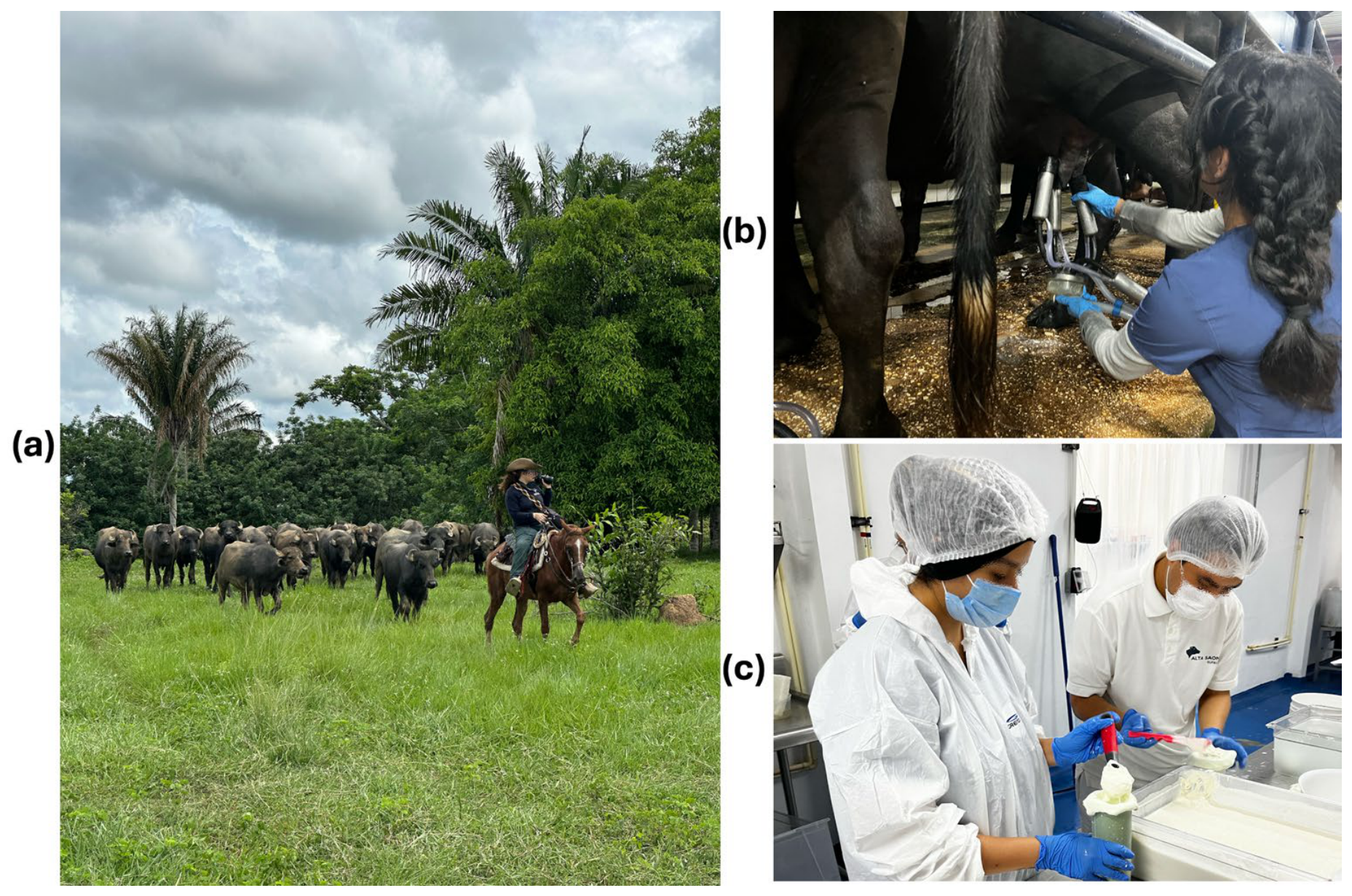
This advancement coexists with an unequal distribution of labor. While buffalo farming strengthens bargaining power, it increases the female workload. Gender norms often assign animal care to women—exceeding six hours daily—without reducing domestic obligations [211]. Although female labor sustains approximately 90% of buffalo milk production, control over biotechnological innovations—specifically artificial insemination and high-yield breeds like Nili-Ravi—remains concentrated among men [212]. Technical gaps are documented; male producers are 2.7 times more likely to possess technical knowledge [12]. To align with SDG 4 and SDG 5, interventions must target structural transformations. Democratizing veterinary training and formalizing social protection are necessary to transition women from labor providers to technical managers, ultimately improving their overall well-being [88,207,213] (Figure 8a–c).

6. Environmental Dimension: Resilience and Planet (SDGs 13, 15)

6.1. Climate Action and Methane Mitigation Strategies (SDG 13)

Global climate trends reflect intensifying warming, with mean surface air temperatures rising 1.44 °C between 1850 and 2018 [42]. This trajectory threatens ecosystems and food security, challenging sustainable livestock production needed to meet animal-source food demand [53]. The intersection of rising temperatures and population growth impedes progress toward SDG 2 and SDG 13 within the 2030 Agenda [214]. Livestock supply chains contribute between 14.5% and 18% of total global greenhouse gas (GHG) emissions [5,42,77,215]. The primary GHGs include methane (CH4), carbon dioxide (CO2), and nitrous oxide (N2O). Enteric CH4, produced during fermentation by microorganisms—bacteria, protozoa, fungi, and archaea—is released primarily via eructation. Conversely, CO2 emissions relate to land-use changes and transport, while N2O stems from manure management and nitrogen fertilizers [3,87,135].
Under the 100-year Global Warming Potential (GWP100) metric, CH4 is 28 times more potent than CO2 despite a short atmospheric lifetime (12.4 years), while N2O is 265 times more potent [216]. For the 2007–2016 period, the global emissions of CO2, CH4, and N2O from the Agriculture, Forestry, and Other Land Use sector were 5.2 ± 2.6 Gt CO2 year−1, 4.5 ± 1.2 Gt CO2 year−1, and 2.3 ± 0.7 Gt CO2 year−1, respectively [42]. Cattle account for the largest livestock emission share (62%), followed by pigs (14%), chickens (9%), buffaloes (8%), and small ruminants (7%) [217]. Cattle and buffaloes generate the highest enteric CH4 emissions because methanogenic archaea reduce CO2 and H2 during ruminal fermentation. This pathway prevents fermentation inhibition but causes a gross energy loss for the animal ranging from 2% to 12% [43]. Likewise, CH4 is also produced from livestock manure during the anaerobic decomposition of organic matter by methanogenic microbes [42].
Although it has been noted that, compared to the cattle rumen microbiome, the buffalo microbiota appears to possess a higher potential for fiber degradation and a lower potential for methane production [47], these effects tend to disappear when emissions are adjusted for dry matter intake. In vivo studies conducted by Malik et al. [218] demonstrate that the lower daily emissions observed in buffaloes compared to cattle (93.1 vs. 141 g/d) are exclusively associated with their lower body weight and dry matter intake (DMI) (6.86 vs. 10.5 kg/d, respectively; p < 0.001). When evaluating methane yield relative to intake, the results are nearly identical (13.4 vs. 13.5 g/kg DMI; p = 0.519), showing that both species have equivalent metabolic efficiency. This phenomenon is explained by a shared microbiological functionality dominated by the genus Methanobrevibacter, which suggests that the diet is more important for reducing emissions than species physiology [219].
In buffaloes, emissions vary by region and system (Table 4). Indian water buffaloes emit an average of 44.02 kg CH4 year−1, peaking at 57.38 kg for lactating cows [42]. Conversely, Mediterranean buffaloes in Italy show lower emissions (27.69 kg CH4 year−1), with organic and family-based systems reducing levels further (22.77 and 21.61 kg) due to dietary protein and fiber differences [220]. Feral populations exhibit higher rates (50–76 kg CH4 year−1) reflecting the high methanogenic potential of low-quality forage [221].
Table 4. Comparative environmental impact assessment of methane emissions and carbon footprints in buffalo and cattle livestock production systems.
SpeciesType of Production Systems and CountryMethodologyMethane Emission (CH4) (% Total of Emissions or kg/Head)Carbon Footprint (kg CO2eq)ObservationsReference
BuffaloHigh-input intensive system, ItalyCradle-to-farm gate LCA45% enteric CH4; 25% indirect emissions.Milk: 3.75 kg CO2 (2.87–5.2) eq/kg de FPCM (baseline value).
Meat: 3.70 kg CO2 eq/kg live weight
The footprint drops to 3.27–3.45 kg when including herd growth functionality and economic allocation.[52]
Cattle and buffaloMultifunctional smallholder dairy system. Anand, Gujarat (India)Cradle-to-farm gate LCACattle: 75.4%
Buffalo: 80.5%
Cow: 1.9–2.3 kg CO2-eq/kg FPCM.
Buffalo: 2.5–3.0 kg CO2-eq/kg FPCM
Footprint is reduced to 1.7 kg CO2-eq when economic functions (manure, finance, and insurance) are considered.[222]
BuffaloConfinement (C), free-ranging (FR),
Italy
Cradle-to-farm gate LCA49.70 y 101.66 kg CH4/head/yr (total)FR: 3.68 kg CO2 eq/kg de FPCM.
C: 4.01 kg CO2 eq/kg de FPCM
Intensive system; higher environmental impact due to high input dependency.
Rearing on natural pasture reduced the global climate impact by 9%.
[82]
BuffaloIntensive farms, ItalyCradle-to-farm gate LCA65% of the total3.4–6.4 kg CO2 eq/kg FPCM (depending on allocation)
28.9–33.9 kg CO2 eq/kg of mozzarella
Milk production accounts for 95% of total GWP. Strategy: improve farm efficiency to reduce impact per kg of cheese.[83]
BuffaloIntensive systems: wheat crop integration (WWC) vs. no wheat (NWC), ItalyCradle-to-farm gate LCA-NWC: 4.91 kg CO2-eq/kg FPCM. WWC: 5.19 kg CO2-eq/kg FPCMIn WWC emissions increase, but eutrophication is significantly reduced thanks to better nutrient management and the use of straw.[50]
BuffaloIntensive systems: corn silage (CS) vs. non-corn silage (NCS),
Italy
Cradle-to-farm gate LCA87% of on-farm emissions derived from enteric fermentation4.96–5.29 kg CO2 eq/kg NBM (no significant difference between systems).
Functional unit: 1 kg normalized buffalo milk (NBM)
CS systems showed lower Acidification and Eutrophication impacts due to higher dry matter yields per hectare.[87]
BuffaloHilly and plain regions (mixed/seasonal),
Nepal
IPCC Tier 236.5–97.5 kg/CH4/head/year-Enteric fermentation contributes 92.6% and manure management 7.4% of CH4/head/year. Enteric fermentation varies by live weight (77–530 kg).[42]
BuffaloSmallholder vs. organized farms, Hisar, Haryana, IndiaCradle-to-farm gate LCAEnteric: 50% of total GHG emissions.Smallholder: 3.54 kg CO2 eq/L of milk.
Organized: 4.53 kg CO2 eq/L of milk
Smallholder systems are environmentally superior due to lower total emissions per liter.[223]
Cattle and BuffaloCrop livestock farms),
India
IPCC Tier 2Indigenous cattle: 39.17–41.26 kg CH4 kg/CH4/head/year
Buffalo: 75.54–84.8 kg CH4 kg/CH4/head/year
Crossbred cow: 74.78–83.98 kg/CH4/head/year
Indigenous cattle (0.90 kg CO2-eq/kg milk
Buffalo: 0.83 kg CO2-eq/kg milk
Crossbred cows: 0.68 kg CO2-eq/kg milk
Differences attributed to quantity and quality of feed available.
Higher Productivity in indigenous cattle.
[224]
Abbreviations: LCA, life cycle assessment; FPCM, fat and protein-corrected milk; CO2 eq, carbon dioxide equivalent; GHG, greenhouse gas; WWC/NWC, wheat crop integration vs. no wheat crop; and CS/NCS, corn silage vs. non-corn silage.
Life Cycle Assessment (LCA) provides a “cradle-to-farm gate” view of the environmental footprint. As indicated in Table 4, carbon footprints are highly sensitive to system technification and dietary strategies. Mediterranean buffalo milk emissions range from 1.5 to 5.27 kg CO2 eq per kg of fat- and protein-corrected milk (FPCM) [49,50]. These values can be five times higher than cow milk (1.0–1.5 kg CO2 eq), primarily because of higher individual cattle productivity [51,225]. Furthermore, Bragaglio, Maggiolino, Romano and De Palo [87] noted that when correcting emissions per kg of FPCM, CO2 eq emissions were 19–32% higher for buffaloes than for cattle in small-scale farming systems, depending on the allocation method considered. In a comprehensive review of 20 different studies, the carbon footprint of cow milk was identified as the lowest among all dairy species at 1.29 kg CO2 eq/kg. Following this, the hierarchy of emissions per kilogram of milk produced across species is established as follows: goat < sheep < buffalo < camel [226].
However, production systems directly influence these outcomes (Table 4). Intensive systems exhibit higher impacts due to high input dependency, whereas natural pasture can reduce climate impact by 9% [82]. For instance, pasture-based systems in Colombia report lower footprints (0.7 to 1.41 kg CO2 eq/kg FPCM) due to reduced external inputs and soil carbon sequestration [227]. Furthermore, the integration of crop systems, such as wheat integration (WWC), demonstrates that while carbon footprints may slightly increase, other critical environmental indicators like eutrophication are significantly reduced through improved nutrient management [50] (Table 4). Nevertheless, grazing systems require a larger land footprint and, due to lower forage digestibility, may result in higher enteric emissions compared to intensive rations. Thus, the environmental benefit of pasture-based systems depends on balancing lower input use with optimized digestive efficiency [82].
The integration of grazing practices facilitates atmospheric carbon removal and its long-term storage in grassland soils. Consequently, incorporating sequestration into LCAs may reduce carbon footprints by 9% to 43% [228]. In this regard, De Vivo R et al. [229] argue that current carbon footprint assessments are incomplete, as they overlook the CO2 absorbed by plants used for animal feeding. When this sequestration is considered, Buffalo Mozzarella production may act as a carbon sink, removing more gases than it emits (−52 kg CO2 per kilogram of product), positioning buffalo farming as an environmental mitigation tool. This farm-level efficiency is critical, as a study in Northeast Italy determined that primary milk production accounts for 95% of the GWP within the buffalo mozzarella supply chain. For 1 kg of packaged mozzarella cheese, the carbon footprint ranges between 28.9 and 33.9 kg CO2 eq, depending on whether physical or economic allocation methods are applied, respectively [83]. These findings underscore that the industrial processing stage contributes only a marginal impact compared to the primary production phase.
Reducing GHG emissions from the livestock industry requires increasing production efficiency, improving feed efficiency, and decreasing emission intensity [230]. However, recent research in Italy highlights a critical challenge: while most livestock sectors lowered their climate impact, water buffalo emissions rose by 272.6%. This increase is driven by population expansion to meet growing mozzarella demand [41].
A major challenge lies in the trade-off between productivity and resilience. Some authors report that improving animal health, reproduction, pasture management, and overall productivity can immediately mitigate livestock emissions [136,231] by reducing environmental impact per unit of product [232,233]. Crucially, these improvements simultaneously promote animal welfare [51]. Additionally, reducing herd size to retain only efficient animals while achieving market weight in shorter periods is recommended [136]. However, it is important to highlight that, although it is traditionally assumed that more productive farms have lower emissions per liter of product, this perspective may be incomplete; when carbon sequestration mechanisms are not considered, higher production can also be associated with greater environmental impact [225]. Furthermore, this drive for productivity often influences breeding decisions; genetic selection focused solely on production may compromise the thermo-tolerance and fertility of local populations like Anatolian or Azikheli buffaloes [80,234]. Sustainable mitigation must integrate holistic genetic programs that preserve local adaptations alongside improved nutritional management and social inclusion [62,235]. Consequently, rural production systems should be prioritized as a primary policy objective; their low-input nature minimizes environmental disturbances while maintaining efficiency [228]. Since enteric methane is the main emission source, long-term productivity gains in these small-scale systems remain essential to further reducing the environmental footprint per unit of product.
These trends underscore an urgent need for targeted mitigation strategies within buffalo production systems. The implementation of personalized and regional nutritional strategies not only strengthens the sustainability of buffalo production but also serves as a key mechanism to reduce CH4 emissions and subsequent energy loss [43,44]. A significant development is the feed additive RESMI (Ruminal Emission and Specific Methanogen Inhibitor). Recent trials in Murrah buffaloes showed that RESMI reduced enteric CH4 by 75%, while increasing body weight by 9.7% and improving feed efficiency by 15.2% [45].
As indicated in Table 5, various additives support this approach. For instance, Populus deltoides and Eucalyptus citriodora achieved CH4 reductions of 37.3% [236]. Supplementation with linoleic and linolenic acids can mitigate up to 63% by shifting fermentation toward propionate, redirecting hydrogen toward energy-efficient pathways [237]. Similarly, sodium nitrate and disodium fumarate act as hydrogen sinks to optimize fatty acid composition [238]. Similarly, garlic oil and cinnamon mixtures show reductions of 33% to 44% while strengthening antioxidant status [239,240].
Nevertheless, Table 5 underscores that dosage precision is fundamental; excessive doses of essential oils may inhibit fibrolytic microorganisms and compromise digestibility [46,235]. Finally, integrating regenerative grazing facilitates atmospheric carbon removal and long-term storage in grassland soils, serving as a critical component for achieving net-zero emissions [226].
Table 5. Summary of dietary additives and their effects on methane mitigation and animal performance.
CountryDietary Additive/StrategyStudy TypeKey ResultsDescription/ObservationsReference
IndiaPoplar (P. deltoides) and eucalyptus (E. citriodora)In vivo (lactating buffaloes)↓ CH4 (37.3%). ↑ Daily milk, fat, and protein-corrected milk. ↑ Digestibility (DM, OM, NDF).Phytogenic additive (PCFA) that improves production and health without inhibiting nutrients.[236]
IndiaEucalyptus oil (E. citriodora)In vitro (24 h incubation)Significant ↓ CH4. ↑ Digestibility and VFA at low dose. High dose (2.0 mL) reduces digestibility.Leaf extract modulates fermentation. Low dose (0.5 mL/30 mL) is optimal for methane mitigation.[241]
IndiaEucalyptus leaves (E. citriodora)In vivo (120 days, lactating)↓ CH4 and fecal Nitrogen. ↑ Yield, ruminal nitrogen, and nutrient digestibility.Acts as a phytogenic ruminal modulator; increases productivity in a “climate-smart” system.[242]
IndiaGarlic essential oil (Allium sativum)In vitro (ANKOM-RF)Significant ↓ methanogenesis. ↑ CLA and TVA. ↓ Total gas and digestibility.Potent antimicrobial that improves fatty acid profile (nutraceutical) but affects digestibility.[243]
IndiaEucalyptus and poplar leaves (EPLM)In vivo (10–14 months old)↓ Enteric CH4 and blood urea. ↑ Antioxidants (GSH, CAT, SOD) and immunity.Mitigates methane and strengthens immunity at 50 g/d without altering nutrient use.[244]
IndiaGarlic oil (GOL) dosesIn vitro (24 h incubation)↓ CH4 in all doses. ↓ NH3-N (lower proteolysis). GOL-3 inhibits digestibility.Low dose (33.33 µL/L) is effective without compromising fiber-degrading enzyme activity.[240]
IndiaSaponins, tannins, and eucalyptus oilIn vitro (ruminal liquid)Linear ↓ CH4 with increasing dose. Positive associative effect.Blend reduces methane using lower individual doses, preventing negative impact on digestion.[245]
IndiaCompound additive (CFA) (oils, leaves, salts)In vivo (early lactation)↓ CH4 (44.9%). ↑ Milk yield and 6% FCM. ↑ Digestibility and immunity.Designed as a combination of methane inhibitors, hydrogen sinks, and rumen stimulants.[246]
IndiaLinoleic and linolenic acidsIn vitro (batch culture)↓ CH4 up to 63% (linolenic 3%). ↑ Propionate. ↓ Protozoa and archaea.Omega fatty acids shift fermentation toward higher energy efficiency (propionate).[237]
ChinaSodium nitrate and disodium fumarateIn vitro (batch culture)Significant ↓ CH4. ↑ VFA and Propionate. Optimized fatty acid composition.Fumarate acts as a hydrogen consumer and mitigates the adverse effects of nitrate.[238]
Abbreviations: CAT: catalase; CH4: methane; CFA: composite feed additive; DM: dry matter; VFA: volatile fatty acids; OM: organic matter; NDF: neutral detergent fiber; CLA: conjugated linoleic acid; FCM: fat-corrected milk; GSH: glutathione; NH3-N: ammonia nitrogen; SOD: superoxide dismutase; and TVA: trans vaccenic (trans C18:1) acid. ↑ indicates an increase in production, digestibility, or antioxidant levels; ↓ emissions or gas production or protozoa and archaea.

6.2. Conservation of Biodiversity and Terrestrial Ecosystems

Wetlands—including marshes, swamps, and peatlands—are globally significant ecosystems that function as critical hydrological regulators and biogeochemical filters [247]. They contribute to water purification through processes like denitrification and organic contaminant removal [248,249]. Ecologically, wetlands provide essential ecosystem services (ES) supporting (e.g., soil formation), provisioning (e.g., food and clean water), regulating (e.g., pollination and carbon sequestration), and cultural services (e.g., ecotourism and spirituality), which underpin human survival and well-being [37,250]. With global surface area of 7 and 9 million km2, wetlands annually generate USD 47.4 trillion in ecosystem services representing a substantial proportion of the Earth’s terrestrial surface [35]. Consequently, wetlands contribute directly to achieving SDGs 2, 4, 6, 8, 11, 12, and 13 [250]. Despite their essential role in human well-being and climate resilience, nearly 87% of wetlands have been lost since the eighteenth century, and degradation is projected to continue through 2050 due to urbanization and resource mismanagement [249,250].
Because water buffaloes have a limited capacity to dissipate heat through evaporative cooling, they typically graze in open pastures at night and spend daytime hours under forest shade or fully immersed in ponds and mud wallows [251,252] (Figure 9a). Buffaloes are highly flood-resistant, capable of swimming and feeding underwater [253]. In tropical wetlands, they often outperform cattle in productive efficiency [35].
Nevertheless, studies conducted in Australia [252], Guyana [251], Brazil [253] and Colombia [254] indicate that the presence of wild and domestic buffaloes in wetlands may generate multifactorial impacts that degrade the biotic and physical integrity of these ecosystems. These impacts include intensive biomass consumption, constant browsing that may reduce native species diversity, mechanical soil and vegetation disturbance, and the promotion of invasive species. Furthermore, thermoregulatory behaviors can lead to soil compaction and erosion, thereby compromising water quality through increased turbidity eutrophication caused by feces and urine. These behaviors may also result in direct competition with wildlife and the destruction of microhabitats critical for fish, reptiles, amphibians, and birds [251,252,253,254].
In contrast, Sansamur, Boonchuay, Ngasaman, Olana and Punyapornwithaya [36] indicate that water buffaloes play a fundamental role in maintaining biodiversity and strengthening local economies within wetland ecosystems, as observed in Thale Noi, southern Thailand [36]. In Greece, buffaloes are regarded not only as livestock but as key components of wetland biodiversity that enrich landscapes and provide high-value services to rural communities [247]. In the Central Marshes of Iraq, buffalo milk trade represents a major economic activity, accounting for nearly 20% of the total economic value of wetland provisioning services [37]. Due to their anatomical characteristics, buffaloes navigate wet and muddy terrains easily, remove excess biomass (Figure 9b), and clean riverbeds, promoting the regeneration of organisms that serve as food for waterbirds (Figure 9c). Under managed conditions, these marsh-based production systems represent a promising model for habitat conservation and climate change mitigation [39].
In Germany, water buffaloes have proven to be an effective environmental management tool, particularly in extremely wet areas where other livestock species are not viable. Although their presence in water bodies remains debated, scientific evidence confirms that moderate grazing significantly enhances biodiversity and vegetation health [72]. Light to moderate grazing intensity increases species richness and diversity, creating favorable habitats for wildlife. By consuming dominant species such as common reed (Phragmites australis), livestock restore open habitats and maintain early successional stages [40]. While animal waste contributes nitrogen and phosphorus, well-planned grazing does not impair water quality; the main risk is overgrazing, which leads to erosion and sedimentation [247].
In Central Europe and the Pannonian region of Hungary, buffalo grazing facilitated the eradication of the invasive species Solidago gigantea and the restoration of original plant communities, including Molinia meadows. It also contributed to the recovery of calcareous rocky steppes and reduced shrub encroachment, generating simultaneous agronomic and ecological benefits [255]. In Costa Rica, buffaloes have been used for wetland rehabilitation through Voisin Rational Grazing, with occupation periods of less than two days and rest periods of 18–22 days (Figure 10a,b). Unlike cattle, which typically reject sclerophyllous aquatic vegetation, water buffaloes exhibit a specialized ability to consume and ferment macrophytes such as Thalia geniculata and Eleocharis elegans (Figure 10c,d). This management promotes non-selective grazing, forcing the removal of dense layers of dominant and restoring open water surfaces. This mechanical clearance allows sunlight to penetrate the water column, facilitating the photosynthesis of aquatic algae and submerged plants. This process serves as the biological foundation for insects, birds, and other aquatic organisms to colonize the area, effectively increasing local biodiversity [38]. The use of domestic buffaloes in conflict zones with jaguars and pumas is also a viable conservation strategy, as their gregarious and defensive instincts drastically reduce predation compared to cattle. By decreasing economic losses, retaliatory hunting against these felids is mitigated, allowing coexistence in tropical ecosystems provided that proper management and markets valuing buffalo products exist [256].
Furthermore, buffaloes consume coarse vegetation often rejected by cattle, such as rushes and alders (Alnus glutinosa). Their body-rubbing behavior against trees and shrubs reduces shrub layers, improves microclimatic conditions for xylobiont beetles, and promotes less competitive plant species, thereby increasing botanical diversity. When ponds dry up, deep hoof prints create temporary moist microsites that serve as refuges for numerous amphibian species [72]. Animal-derived inputs for ponds primarily include manure from large ruminants, with buffalo manure being particularly important for fish production [257]. In Sri Lanka, buffaloes grazing near watersheds were found to contribute substantial nitrogen and phosphorus inputs, increasing fish yields by up to 4.75 kg particularly important for fish production g per additional buffalo per hectare, likely due to enhanced chlorophyll and plankton production [258]. However, excessive stocking densities reduce water transparency, highlighting the need for appropriate management.
Accordingly, integrated management strategies are required to maintain water quality in wetland grazing systems. These include preventing manure accumulation, restricting herbicide use, minimizing hydrological alterations, rotating grazing areas, and promoting the rational use of veterinary products to mitigate environmental impacts [35].

7. Conclusions

In conclusion, the water buffalo (Bubalus bubalis) is a strategic biological resource for achieving the United Nations Sustainable Development Goals. Its multifunctional nature encompasses diverse contributions across the economic, social, and environmental dimensions of sustainability. In addition to providing meat and milk with high concentrations of bioactive compounds, the species is essential for draft power, leather production, animal-assisted interventions, and the preservation of wetland ecosystems. From an industrial perspective, the superior cheese yield of buffalo milk—facilitated by its high total solid content—offers a distinct competitive advantage for the production of specialized dairy commodities, increasing the overall profitability of the value chain.
However, the expansion of the buffalo sector must address the impact of enteric methane emissions. This requires a strategic approach focused on dietary interventions and holistic genetic selection that exploits the buffalo’s specialized digestive physiology, particularly its ability to ferment low-quality forages more efficiently than other ruminants. To maximize these benefits, it is imperative to replace the paradigm of “absolute rusticity” with One Health and One Welfare frameworks that prioritize standardized zootechnical management, reproductive efficiency, and public health.
Ultimately, the buffalo industry provides a viable mechanism for poverty alleviation and socioeconomic development. Future research must adopt an integrated approach that evaluates the nexus between animal welfare, human well-being, and economic-environmental impacts. These studies should focus on improving market access and quantifying long-term transitions through structural indicators, to ensure that buffalo production promotes equitable wealth distribution and environmental integrity through balanced breeding objectives and sustainable intensification.

Author Contributions

Conceptualization, L.A.d.l.C.-C., P.R.-S. and C.L.; methodology, L.A.d.l.C.-C., H.O.-G. and H.B.-J.; investigation, P.R.-S., M.G.-H., R.R.-F. and A.Y.-P.; resources, H.O.-G., H.B.-J. and M.G.-H.; writing—original draft preparation, L.A.d.l.C.-C., P.R.-S., C.L. and A.Y.-P.; writing—review and editing, H.O.-G., H.B.-J., M.G.-H. and R.R.-F.; visualization, C.L. and R.R.-F.; supervision, L.A.d.l.C.-C. and H.O.-G.; project administration, P.R.-S. and M.G.-H.; funding acquisition, L.A.d.l.C.-C., P.R.-S., C.L., H.O.-G., H.B.-J., M.G.-H., R.R.-F. and A.Y.-P. All authors have read and agreed to the published version of the manuscript.

Funding

This research received no external funding.

Institutional Review Board Statement

Not applicable.

Informed Consent Statement

Not applicable.

Data Availability Statement

The raw data supporting the conclusions of this article will be made available by the authors upon request.

Conflicts of Interest

The authors declare no conflict of interest.

References

  1. Gagaoua, M.; Gondret, F.; Lebret, B. Towards a ‘One quality’ approach of pork: A perspective on the challenges and opportunities in the context of the farm-to-fork continuum—Invited review. Meat Sci. 2025, 226, 109834. [Google Scholar] [CrossRef] [PubMed]
  2. Ndue, K.; Pál, G. European Green Transition Implications on Africa’s Livestock Sector Development and Resilience to Climate Change. Sustainability 2022, 14, 14401. [Google Scholar] [CrossRef]
  3. Lerma, L.M.; Díaz Baca, M.F.; Burkart, S. Public Policies for the Development of a Sustainable Cattle Sector in Colombia, Argentina, and Costa Rica: A Comparative Analysis (2010–2020). Front. Sustain. Food Syst. 2022, 6, 722522. [Google Scholar] [CrossRef]
  4. Chen, C.; Chaudhary, A.; Mathys, A. Dietary Change and Global Sustainable Development Goals. Front. Sustain. Food Syst. 2022, 6, 771041. [Google Scholar] [CrossRef]
  5. Varijakshapanicker, P.; McKune, S.; Miller, L.; Hendrickx, S.; Balehegn, M.; Dahl, G.E.; Adesogan, A.T. Sustainable livestock systems to improve human health, nutrition, and economic status. Anim. Front. 2019, 9, 39–50. [Google Scholar] [CrossRef] [PubMed]
  6. Keeling, L.; Tunón, H.; Olmos Antillón, G.; Berg, C.; Jones, M.; Stuardo, L.; Swanson, J.; Wallenbeck, A.; Winckler, C.; Blokhuis, H. Animal Welfare and the United Nations Sustainable Development Goals. Front. Vet. Sci. 2019, 6, 336. [Google Scholar] [CrossRef]
  7. Gama Pantoja, L.S.; Amante, E.R.; Manoel da Cruz Rodrigues, A.; Meller da Silva, L.H. World scenario for the valorization of byproducts of buffalo milk production chain. J. Clean. Prod. 2022, 364, 132605. [Google Scholar] [CrossRef]
  8. Vasile, F.E.; Muchut, L.C.; Fernández, A.B.; Bustos, L.F.; Chiariotti, A. Buffaloes in South America: A Promising and Sustainable Source of Dairy Proteins and Agro-Industrial Development. Sustain. Food Proteins 2025, 3, e70022. [Google Scholar] [CrossRef]
  9. Carruyo, G.M.; Calderón, E.; Hoet, A.E. Expansion of the buffalo agri-system and industry following the one health approach. Rev. Cient. FCV-LUZ. 2023, XXXIII, 64–72. [Google Scholar] [CrossRef]
  10. Naresha, N.; Dixit, A.K.; Singh, A.; Meena, B.S. Economic analysis of milk production in Southern and North coastal regions of Andhra Pradesh. Indian J. Dairy Sci. 2023, 76, 163–167. [Google Scholar] [CrossRef]
  11. Chandra, T.; Jaiswal, S.; Iquebal, M.A.; Datta, T.K.; Oberoi, H.S.; Kumar, D. Carabeef: Unexploited Healthy Meat from Climate-Resilient Water Buffaloes for Global Nutritional Security. Food Bioprocess Technol. 2025, 18, 7796–7826. [Google Scholar] [CrossRef]
  12. Makarabbi, G.; Saxena, N.; Sabu, A.; Tuteja, F.C.; Punetha, M. Cost and returns estimation and break-even point analysis of Murrah buffalo milk production in Haryana. Buffalo Bull. 2025, 44, 317–325. [Google Scholar] [CrossRef]
  13. Vargas-Ramella, M.; Pateiro, M.; Maggiolino, A.; Faccia, M.; Franco, D.; De Palo, P.; Lorenzo, J.M. Buffalo Milk as a Source of Probiotic Functional Products. Microorganisms 2021, 9, 2303. [Google Scholar] [CrossRef]
  14. Escarcha, J.F.; Lassa, J.A.; Palacpac, E.P.; Zander, K.K. Understanding climate change impacts on water buffalo production through farmers’ perceptions. Clim. Risk Manag. 2018, 20, 50–63. [Google Scholar] [CrossRef]
  15. Windsor, P.; Martin, S.; Khounsy, S.; Young, J.; Thomson, P.; Bush, R. Improved Milk Production from Supplementation of Swamp Buffalo with Molasses Nutrient Blocks Containing 10% Urea. Dairy 2021, 2, 90–103. [Google Scholar] [CrossRef]
  16. Pasquini, M.; Osimani, A.; Tavoletti, S.; Moreno, I.; Clementi, F.; Trombetta, M.F. Trends in the quality and hygiene parameters of bulk Italian Mediterranean buffalo (Bubalus bubalis) milk: A three year study. Anim. Sci. J. 2018, 89, 176–185. [Google Scholar] [CrossRef]
  17. Tamburrano, A.; Tavazzi, B.; Callà, C.A.M.; Amorini, A.M.; Lazzarino, G.; Vincenti, S.; Zottola, T.; Campagna, M.C.; Moscato, U.; Laurenti, P. Biochemical and nutritional characteristics of buffalo meat and potential implications on human health for a personalized nutrition. Ital. J. Food Saf. 2019, 8, 8317. [Google Scholar] [CrossRef]
  18. Becskei, Z.; Savić, M.; Ćirković, D.; Rašeta, M.; Puvača, N.; Pajić, M.; Đorđević, S.; Paskaš, S. Assessment of Water Buffalo Milk and Traditional Milk Products in a Sustainable Production System. Sustainability 2020, 12, 6616. [Google Scholar] [CrossRef]
  19. El-Hedainy, D.K.A.; Elbanhawy, K.A.K.; Amin, A.M.S.; Salem, M.M.I.; Hammoud, M.H.; El-Barbary, A.S.A. Genetic trend for milk production and longevity traits of Egyptian buffalo. Egypt. J. Anim. Prod. 2020, 57, 95–100. [Google Scholar] [CrossRef]
  20. Zava, M. The buffalo: Its origin, population, and importance in the world. In The Water Buffalo: General Information and Productive Characteristics; de la Cruz-Cruz, L.A., Maitret-Collado, E., Roldán-Santiago, P., Zava, M., Eds.; LID: Mexico City, Mexico, 2021; Volume 1, pp. 17–32. [Google Scholar]
  21. Paján-Jiménez, V.; Pazmiño-Rodríguez, F.D.; Roldán-Santiago, P.; Dutro-Aceves, A.; de la Cruz-Cruz, L.A.; Larrondo, C. Effects of different load weights on the work performance and physiological and hematobiochemical responses in working water buffalo. Vet. World 2023, 16, 2349–2357. [Google Scholar] [CrossRef]
  22. Chandran, P.C.; Dey, A.; Barari, S.K.; Kamal, R. Scenario and strategies for sustainable buffalo production in Eastern Region of India. Buffalo Bull. 2023, 42, 1–9. [Google Scholar] [CrossRef]
  23. Winiarti, S.; Prahara, A.; Murinto; Ismi, D.P. Pre-Trained Convolutional Neural Network for Classification of Tanning Leather Image. Int. J. Adv. Comput. Sci. Appl. 2018, 9, 212–217. [Google Scholar] [CrossRef]
  24. Fusco, G.M.; Di Mola, I.; Mori, M.; Cozzolino, E.; Morrone, B.; Trasacco, F.; Carillo, P. From Water Buffalo (Bubalus bubalis) Manure to Vermicompost: Testing a Sustainable Approach for Agriculture. Sustainability 2025, 17, 4253. [Google Scholar] [CrossRef]
  25. Özbay, G.; Koçak, E.; Ahmad, M.S. Pyrolysis of water buffalo manure: Influence of temperature and alkali hydroxide additives on the quality of bio-oil. Biocatal. Agric. Biotechnol. 2021, 38, 102230. [Google Scholar] [CrossRef]
  26. Cruz, H.D.F.; Olivier, J.A.S.; Canepa, J.R.L.; Fuentes, A.S.; Torres, A.D.P. Evaluation of biogas production from water buffalo (Bubalus bubalis) manure under tropical climate conditions. AIMS Energy 2026, 14, 275–290. [Google Scholar] [CrossRef]
  27. Bureekhampun, S.; Maneepun, C. Eco-Friendly and Community Sustainable Textile Fabric Dyeing Methods From Thai Buffalo Manure: From Pasture to Fashion Designer. SAGE Open 2021, 11, 21582440211058201. [Google Scholar] [CrossRef]
  28. Garber, P.; Turner, S. Entangled, unraveled, and reconfigured: Human-animal relations among ethnic minority farmers and water buffalo in the northern uplands of Vietnam. Environ. Plan. E Nat. Space 2023, 6, 2472–2494. [Google Scholar] [CrossRef]
  29. Escarcha, J.F.; Lassa, J.A.; Palacpac, E.P.; Zander, K.K. Livelihoods transformation and climate change adaptation: The case of smallholder water buffalo farmers in the Philippines. Environ. Dev. 2020, 33, 100468. [Google Scholar] [CrossRef]
  30. Viana, C.F.; Lopes, A.C.C.; Conrrado, R.S.; Resende, F.A.M.; Andrade, E.H.P.; Penna, C.F.A.M.; de Souza, M.R.; Bastianetto, E.; Fonseca, L.M. Buffalo milk quality: A study of seasonal influence on composition and somatic cell count. J. Dairy Sci. 2025, 108, 2215–2226. [Google Scholar] [CrossRef]
  31. Evangelista, C.; Bernabucci, U.; Basiricò, L. Effect of Antioxidant Supplementation on Milk Yield and Quality in Italian Mediterranean Lactating Buffaloes. Animals 2022, 12, 1903. [Google Scholar] [CrossRef]
  32. Liao, J.; Yang, J.; Suo, H.; Song, J. Buffalo milk: Nutritional composition, bioactive properties, and advances in processing technologies-a comprehensive review. Food Chem. X 2025, 29, 102647. [Google Scholar] [CrossRef]
  33. Zoia Arshad, A. Women’s participation and their constraints in livestock management activities: A case study of district Bahawalpur in Punjab, Pakistan. Int. J. Vet. Sci. Res. 2021, 7, 83–87. [Google Scholar] [CrossRef]
  34. Galiè, A.; Najjar, D.; Petesch, P.; Badstue, L.; Farnworth, C.R. Livestock Innovations, Social Norms, and Women’s Empowerment in the Global South. Sustainability 2022, 14, 3741. [Google Scholar] [CrossRef]
  35. Chiariotti, A.; Borghese, A.; Boselli, C.; Barile, V.L. Water Buffalo’s Adaptability to Different Environments and Farming Systems: A Review. Animals 2025, 15, 1538. [Google Scholar] [CrossRef] [PubMed]
  36. Sansamur, C.; Boonchuay, K.; Ngasaman, R.; Olana, K.O.A.; Punyapornwithaya, V. Epidemiology and factors associated with the infection of Babesia bigemina, Babesia bovis, and Theileria orientalis in Thale Noi Wetland buffaloes (Bubalus bubalis), Southern Thailand. BMC Vet. Res. 2025, 21, 397. [Google Scholar] [CrossRef]
  37. Fazaa, N.A.; Dunn, J.C.; Whittingham, M.J. Evaluation of the Ecosystem Services of the Central Marsh in Southern Iraq. Baghdad Sci. J. 2018, 15, 1. [Google Scholar] [CrossRef]
  38. Barboza, G. Benefits of water buffalo for organic production. In The Water Buffalo: Generalities and Productive Characteristics; de la Cruz-Cruz, L.A., Maitret-Collado, E., Roldán-Santiago, P., Zava, M., Eds.; LID: Mexico City, Mexico, 2021; Volume 1, pp. 385–411. [Google Scholar]
  39. Borghese, A.; Barile, V.L.; Chiariotti, A. Sustainability of buffalo farming in different environments in the world. Rev. Cient. Fac. Cienc. Vet. 2023, 33, 31–46. [Google Scholar] [CrossRef]
  40. Karstens, S.; Inácio, M.; Schernewski, G. Expert-Based Evaluation of Ecosystem Service Provision in Coastal Reed Wetlands Under Different Management Regimes. Front. Environ. Sci. 2019, 7, 63. [Google Scholar] [CrossRef]
  41. Correddu, F.; Lunesu, M.F.; Caratzu, M.F.; Pulina, G. Recalculating the global warming impact of italian livestock methane emissions with new metrics. Ital. J. Anim. Sci. 2023, 22, 125–135. [Google Scholar] [CrossRef]
  42. Nepal, S.; Byanju, R.M.; Chaudhary, P.; Rijal, K.; Baskota, P.; Thakuri, S. Methane release from enteric fermentation and manure management of domestic water buffalo in Nepal. Environ. Monit. Assess. 2023, 195, 603. [Google Scholar] [CrossRef]
  43. Prusty, S.; Kundu, S.S.; Kumar Sharma, V. Nutrient utilization and methane emissions in Murrah buffalo calves fed on diets with different methanogenic potential. Livest. Sci. 2017, 202, 89–95. [Google Scholar] [CrossRef]
  44. Singh, S.; Koli, P.; Kushwaha, B.P.; Anele, U.Y.; Bhattacharya, S.; Ren, Y.L. Agroecological Zone-Specific Diet Optimization for Water Buffalo (Bubalus bubalis) through Nutritional and In Vitro Fermentation Studies. Animals 2024, 14, 143. [Google Scholar] [CrossRef]
  45. Paul, S.S.; Dey, A.; Chanu, Y.M.; Paul, J.; Andonissamy, J.; Dahiya, S.S.; Punia, B.S. Altered rumen microbiome of water buffalo (Bubalus bubalis) by dietary composite feed additive enhances growth and nutrient utilization with reduced enteric methane and nitrogen emissions. J. Environ. Manag. 2026, 397, 128347. [Google Scholar] [CrossRef]
  46. Dey, A.; Paul, S.S.; Lailer, P.C.; Dahiya, S.S. Efficacy of Sunflower Oil in Modulating Rumen Functions and Reducing Enteric Methane Production in Buffalo (Bubalus bubalis). Res. Biot. 2020, 2, 061–064. [Google Scholar] [CrossRef]
  47. Tong, F.; Wang, T.; Gao, N.L.; Liu, Z.; Cui, K.; Duan, Y.; Wu, S.; Luo, Y.; Li, Z.; Yang, C.; et al. The microbiome of the buffalo digestive tract. Nat. Commun. 2022, 13, 823. [Google Scholar] [CrossRef] [PubMed]
  48. Wang, Q.; Gao, X.; Yang, Y.; Zou, C.; Yang, Y.; Lin, B. A comparative study on rumen ecology of water buffalo and cattle calves under similar feeding regime. Vet. Med. Sci. 2020, 6, 746–754. [Google Scholar] [CrossRef] [PubMed]
  49. Chirone, R.; Paulillo, A.; Salatino, P.; Salzano, A.; Cristofaro, B.; Cristiano, T.; Campanile, G.; Neglia, G. Life Cycle Assessment of buffalo milk: A case study of three farms in southern Italy. J. Clean. Prod. 2022, 365, 132816. [Google Scholar] [CrossRef]
  50. Romano, E.; De Palo, P.; Tidona, F.; Maggiolino, A.; Bragaglio, A. Dairy Buffalo Life Cycle Assessment (LCA) Affected by a Management Choice: The Production of Wheat Crop. Sustainability 2021, 13, 11108. [Google Scholar] [CrossRef]
  51. Sabia, E.; Napolitano, F.; Claps, S.; Braghieri, A.; Piazzolla, N.; Pacelli, C. Feeding, Nutrition and Sustainability in Dairy Enterprises. The Sustainability of Agro-Food and Natural Resource Systems in the Mediterranean Basin; Springer: Berlin, Germany, 2015; pp. 57–64. [Google Scholar]
  52. Pirlo, G.; Terzano, G.; Pacelli, C.; Abeni, F.; Carè, S. Carbon footprint of milk produced at Italian buffalo farms. Livest. Sci. 2014, 161, 176–184. [Google Scholar] [CrossRef]
  53. da Silva, J.A.R.; Garcia, A.R.; de Almeida, A.M.; Bezerra, A.S.; de Brito Lourenço Junior, J. Water buffalo production in the Brazilian Amazon Basin: A review. Trop. Anim. Health Prod. 2021, 53, 343. [Google Scholar] [CrossRef] [PubMed]
  54. Jaiswal, S.; Jagannadham, J.; Kumari, J.; Iquebal, M.A.; Gurjar, A.K.S.; Nayan, V.; Angadi, U.B.; Kumar, S.; Kumar, R.; Datta, T.K.; et al. Genome Wide Prediction, Mapping and Development of Genomic Resources of Mastitis Associated Genes in Water Buffalo. Front. Vet. Sci. 2021, 8, 593871. [Google Scholar] [CrossRef] [PubMed]
  55. Howe, R.; Kroll, T. Why Should the Welfare of Therapy Animals Involved in Animal Assisted Interventions Matter to Child Healthcare Researchers and Professionals? Compr. Child. Adolesc. Nurs. 2022, 45, 123–126. [Google Scholar] [CrossRef]
  56. Vidal, B.; Verger, L.; Nagy, G.J. Exploring the One Health–One Welfare nexus and zoonoses. Sci. One Health 2025, 4, 100128. [Google Scholar] [CrossRef] [PubMed]
  57. Tricco, A.C.; Lillie, E.; Zarin, W.; O’Brien, K.K.; Colquhoun, H.; Levac, D.; Moher, D.; Peters, M.D.J.; Horsley, T.; Weeks, L.; et al. PRISMA Extension for Scoping Reviews (PRISMA-ScR). Ann. Intern. Med. 2018, 169, 467–473. [Google Scholar] [CrossRef]
  58. Kumari, N.; Kumar, S.; Roy, A.; Saini, P.; Jaiswal, S.; Iquebal, M.A.; Angadi, U.B.; Kumar, D. BuffExDb: Web-based tissue-specific gene expression resource for breeding and conservation programmes in Bubalus bubalis. Database 2025, 2025, baae128. [Google Scholar] [CrossRef]
  59. Zhang, Y.; Colli, L.; Barker, J.S.F. Asian water buffalo: Domestication, history and genetics. Anim. Genet. 2020, 51, 177–191. [Google Scholar] [CrossRef]
  60. FAOSTAT. Crops and Livestock Products. Available online: https://www.fao.org/faostat/en/#data/QCL (accessed on 1 September 2025).
  61. Cappelli, G.; Di Vuolo, G.; Gerini, O.; Noschese, R.; Bufano, F.; Capacchione, R.; Rosini, S.; Limone, A.; De Carlo, E. Italian Tracing System for Water Buffalo Milk and Processed Milk Products. Animals 2021, 11, 1737. [Google Scholar] [CrossRef]
  62. Rohaeni, E.S.; Santoso, A.D.; Ariningsih, E.; Widaningsih, N.; Hutahaean, L.; Priyanto, D.; Ilham, N.; Suharyon, S.; Herdis, H.; Widiawati, Y.; et al. Analysing the sustainability of swamp buffalo (Bubalus bubalis carabauesis) farming as a protein source and germplasm. Open Agric. 2023, 8, 20220224. [Google Scholar] [CrossRef]
  63. Pineda, P.S.; Flores, E.B.; Herrera, J.R.V.; Low, W.Y. Opportunities and Challenges for Improving the Productivity of Swamp Buffaloes in Southeastern Asia. Front. Genet. 2021, 12, 629861. [Google Scholar] [CrossRef]
  64. Pérez-Pardal, L.; Chen, S.; Costa, V.; Liu, X.; Carvalheira, J.; Beja-Pereira, A. Genomic differentiation between swamp and river buffalo using a cattle high-density single nucleotide polymorphisms panel. Animal 2018, 12, 464–471. [Google Scholar] [CrossRef]
  65. Sun, T.; Wang, S.; Hanif, Q.; Chen, N.; Chen, H.; Lei, C. Genetic diversity of mitochondrial cytochrome b gene in swamp buffalo. Anim. Genet. 2020, 51, 977–981. [Google Scholar] [CrossRef]
  66. Pineda, P.S.; Flores, E.B.; Villamor, L.P.; Parac, C.J.M.; Khatkar, M.S.; Thu, H.T.; Smith, T.P.L.; Rosen, B.D.; Ajmone-Marsan, P.; Colli, L.; et al. Disentangling river and swamp buffalo genetic diversity: Initial insights from the 1000 Buffalo Genomes Project. Gigascience 2024, 13, giae053. [Google Scholar] [CrossRef] [PubMed]
  67. Minervino, A.H.H.; Zava, M.; Vecchio, D.; Borghese, A. Bubalus bubalis: A Short Story. Front. Vet. Sci. 2020, 7, 570413. [Google Scholar] [CrossRef]
  68. Gantner, V.; Mijic, P.; Baban, M.; Skrtic, Z.; Turalija, A. The overall and fat composition of milk of various species. Mljekarstvo 2015, 65, 223–231. [Google Scholar] [CrossRef]
  69. Ramlachan, N. Genetic Characterization of Selected Buffalypso (Bubalus bubalis) from Trinidad and Tobago. OALib 2023, 10, 1110903. [Google Scholar] [CrossRef]
  70. Ape, T.S.; Singha, S.; Marma, U.; Rumi, H.J.; Sagor, S.I.; Chiariotti, A.; Barile, V.L.; Persson, Y.; Rahman, M.M. Water buffalo farming, udder health and its dairy production status in Bangladesh. Vet. Res. Commun. 2025, 49, 292. [Google Scholar] [CrossRef]
  71. Michelizzi, V.N.; Dodson, M.V.; Pan, Z.; Amaral, M.E.J.; Michal, J.J.; Mclean, D.J.; Womack, J.E.; Jiang, Z. Water Buffalo Genome Science Comes of Age. Int. J. Biol. Sci. 2010, 6, 333–349. [Google Scholar] [CrossRef]
  72. Wiegleb, G.; Krawczynski, R. Biodiversity management by water buffalos in restored wetlands. Wald. Landschaftsforsch. Naturschutz 2010, 10, S17–S22. [Google Scholar]
  73. Yazar, S. A Research on Satisfaction Levels of Water Buffalo Breeders in Sivas Province, Türkiye. J. Tekirdag Agric. Fac. 2024, 21, 444–456. [Google Scholar] [CrossRef]
  74. Kappes, A.; Tozooneyi, T.; Shakil, G.; Railey, A.F.; McIntyre, K.M.; Mayberry, D.E.; Rushton, J.; Pendell, D.L.; Marsh, T.L. Livestock health and disease economics. Front. Vet. Sci. 2023, 10, 1168649. [Google Scholar] [CrossRef]
  75. Bilotto, F.; Harrison, M.T.; Vibart, R.; Mackay, A.; Christie-Whitehead, K.M.; Ferreira, C.S.S.; Cottrell, R.S.; Forster, D.; Chang, J. Towards resilient, inclusive, sustainable livestock farming systems. Trends Food Sci. Technol. 2024, 152, 104668. [Google Scholar] [CrossRef]
  76. Baltenweck, I.; Enahoro, D.; Frija, A.; Tarawali, S. Why Is Production of Animal Source Foods Important for Economic Development in Africa and Asia? Anim. Front. 2020, 10, 22–29. [Google Scholar] [CrossRef]
  77. Schneider, F.; Tarawali, S. Sustainable Development Goals and livestock systems. Rev. Sci. Tech. 2021, 40, 585–595. [Google Scholar] [CrossRef]
  78. Kaur, I.; Nivedita; Singh, V.P.; Sharma, H. Assessment of production traits and lactation wise economics of buffalo in punjab state of india. Buffalo Bull. 2022, 41, 731–739. [Google Scholar] [CrossRef]
  79. Maheswarappa, N.B.; Mohan, K.; Banerjee, R. Establishing Water Buffaloes as a Promising Source of Red Meat. Meat Muscle Biol. 2024, 8, 1–17. [Google Scholar] [CrossRef]
  80. Khan, N.; Khan, S.; Israr, M.; Hilal, M.G.; Ibrahim, M.N.M.; Khan, N.A. Comparing Azikheli buffaloes with Nili Ravi buffaloes. Pak. J. Agric. Sci. 2022, 59, 693–701. [Google Scholar] [CrossRef]
  81. Sannino, M.; Faugno, S.; Crimaldi, M.; Di Francia, A.; Ardito, L.; Serrapica, F.; Masucci, F. Effects of an automatic milking system on milk yield and quality of Mediterranean buffaloes. J. Dairy Sci. 2018, 101, 8308–8312. [Google Scholar] [CrossRef] [PubMed]
  82. Sabia, E.; Napolitano, F.; Claps, S.; De Rosa, G.; Braghieri, A.; Pacelli, C. Dairy buffalo life cycle assessment as affected by heifer rearing system. J. Clean. Prod. 2018, 192, 647–655. [Google Scholar] [CrossRef]
  83. Berlese, M.; Corazzin, M.; Bovolenta, S. Environmental sustainability assessment of buffalo mozzarella cheese production chain. J. Clean. Prod. 2019, 238, 117922. [Google Scholar] [CrossRef]
  84. Gómez-Carpio, M.; Rossi, D.; Cimmino, R.; Gombia, Y.; Altieri, D.; Di Palo, R.; Campanile, G.; Biffani, S.; Neglia, G. Functional longevity in the Italian Mediterranean buffalo. J. Dairy Sci. 2025, 108, 1730–1746. [Google Scholar] [CrossRef]
  85. Chung, R.; Minh Tu, L.; Quang Tinh, N.; Thi Minh Chau, N.; Thi Thu Hương, K.; Thi Huong Giang, N.; Hong Linh, D.; Kingsbury, A. The changing role of water buffalo in rural Vietnam. Buffalo Bull. 2023, 42, 545–554. [Google Scholar] [CrossRef]
  86. Amin, A.M.S.; Abo-Ismail, M.K.; Salem, M.M.I. Genetic parameters and genetic trends for reproductive traits in Egyptian buffalo. Anim. Reprod. Sci. 2021, 231, 106800. [Google Scholar] [CrossRef]
  87. Bragaglio, A.; Maggiolino, A.; Romano, E.; De Palo, P. Role of Corn Silage in the Sustainability of Dairy Buffalo Systems. Agriculture 2022, 12, 828. [Google Scholar] [CrossRef]
  88. Herdoiza, N.; Worrell, E.; van den Berg, F. Including animal welfare targets in the SDGs: The case of animal farming. Agric. Hum. Values 2024, 41, 815–830. [Google Scholar] [CrossRef]
  89. Pujiwati, L.A.; Giyarsih, S.R.; Sudrajat, S. Breaking down poverty: Livelihood assets’ impact on Indonesian livelihood strategies. Environ. Sustain. Indic. 2026, 30, 101225. [Google Scholar] [CrossRef]
  90. Torres, B.; Cayambe, J.; Paz, S.; Ayerve, K.; Heredia-R, M.; Torres, E.; Luna, M.; Toulkeridis, T.; García, A. Livelihood Capitals, Income Inequality, and the Perception of Climate Change. Sustainability 2022, 14, 5028. [Google Scholar] [CrossRef]
  91. Amalfitano, N.; Patel, N.; Haddi, M.-L.; Benabid, H.; Pazzola, M.; Vacca, G.M.; Tagliapietra, F.; Schiavon, S.; Bittante, G. Detailed mineral profile of milk. J. Dairy Sci. 2024, 107, 8887–8907. [Google Scholar] [CrossRef]
  92. Bittante, G.; Amalfitano, N.; Bergamaschi, M.; Patel, N.; Haddi, M.L.; Benabid, H.; Pazzola, M.; Vacca, G.M.; Tagliapietra, F.; Schiavon, S. Composition and aptitude for cheese-making. J. Dairy Sci. 2022, 105, 2132–2152. [Google Scholar] [CrossRef]
  93. Emakpor, O.L.; Edo, G.I.; Jikah, A.N.; Ikpekoro, V.O.; Agbo, J.J.; Ainyanbhor, I.E.; Essaghah, A.E.A.; Ekokotu, H.A.; Oghroro, E.E.A.; Akpoghelie, P.O. Buffalo milk: An essential natural adjuvant. Discov. Food 2024, 4, 38. [Google Scholar] [CrossRef]
  94. Gross, J.J. Dairy cow physiology and production limits. Anim. Front. 2023, 13, 44–50. [Google Scholar] [CrossRef]
  95. Ferro, M.M.; Tedeschi, L.O.; Atzori, A.S. The comparison of the lactation and milk yield and composition of selected breeds of sheep and goats. Transl. Anim. Sci. 2017, 1, 498–506. [Google Scholar] [CrossRef] [PubMed]
  96. Nagy, P.P.; Skidmore, J.A.; Juhasz, J. Intensification of camel farming and milk production. Anim. Front. 2022, 12, 35–45. [Google Scholar] [CrossRef] [PubMed]
  97. Vincenzetti, S.; Cammertoni, N.; Rapaccetti, R.; Santini, G.; Klimanova, Y.; Zhang, J.-J.; Polidori, P. Nutraceutical and Functional Properties of Camelids’ Milk. Beverages 2022, 8, 12. [Google Scholar] [CrossRef]
  98. Albenzio, M.; Santillo, A.; d’Angelo, F.; di Corcia, M.; Ciliberti, M.G.; Marino, R.; Caroprese, M.; della Malva, A.; Sevi, A. Milk quality of Italian Mediterranean buffalo. J. Dairy Sci. 2024, 107, 5343–5352. [Google Scholar] [CrossRef]
  99. Vilela, R.A.; Lourenço Junior, J.d.B.; Jacintho, M.A.C.; Barbosa, A.V.C.; Pantoja, M.H.d.A.; Oliveira, C.M.C.; Garcia, A.R. Dynamics of Thermolysis and Skin Microstructure in Water Buffaloes. Front. Vet. Sci. 2022, 9, 871206. [Google Scholar] [CrossRef]
  100. Choudhary, M.; Satheesan, L.; Kamboj, A.; Pal, P.; Kumar, D.; Singh, P.; Dang, A.K. Effect of different heat mitigation strategies on the thermography of lactating water buffaloes. Int. J. Biometeorol. 2025, 69, 3061–3072. [Google Scholar] [CrossRef]
  101. Hassan, F.-u.; Ashraf, N.; Arain, M.A.; Mushahid, M.; Safdar, M.; Saif-ur-Rehman, M.; Behan, A.A. Heat stress in riverine buffaloes: Regulatory mechanism, physiological changes, production and reproductive performance, and mitigation strategies. Int. J. Biometeorol. 2025, 69, 2567–2587. [Google Scholar] [CrossRef] [PubMed]
  102. Aoumtes, K.; Panya, A.; Phonsatta, N.; Charoen, R.; Chaiyasit, W.; Puangploy, P.; Kittipongpittaya, K. Insight into physicochemical properties and oxidative stability of Thai buffalo milk as an alternative source for milk and yogurt production. Discov. Food 2025, 5, 241. [Google Scholar] [CrossRef]
  103. Melo, T.T.; Bezerra, L.; Santos, V.; Ferreira, M.; Lima, V., Jr.; Silva, L.A.; Menezes, M.; Silva, F.; Oliveira, R. Effect of replacing soybean meal by a blend of ground corn and urea-ammonium sulphate on milk production and composition, digestibility and N balance of dairy Murrah buffaloes. J. Dairy Res. 2022, 89, 134–140. [Google Scholar] [CrossRef]
  104. Marques, L.C.; Matos, A.S.; Costa, J.S.; Silva, C.S.; Camargo, R.N.C.; McManus, C.; Peripolli, V.; Araújo, C.V.; Laureano, M.M.M.; Sales, R.L.; et al. Productive characteristics in dairy buffalo (Bubalus bubalis) in the Eastern Amazon. Arq. Bras. Med. Vet. Zootec. 2020, 72, 947–954. [Google Scholar] [CrossRef]
  105. Eldawy, M.H.; Lashen, M.E.; Badr, H.M.; Farouk, M.H. Milk production potential and reproductive performance of Egyptian buffalo cows. Trop. Anim. Health Prod. 2021, 53, 282. [Google Scholar] [CrossRef] [PubMed]
  106. Özdemir, S.; Kecici, P.D.; Yalcintan, H.; Ekiz, B. Behaviors in the Slaughter Corridor, Carcass, and Meat Quality Traits of Anatolian, Italian, and Italian x Anatolian Crossbreds (F1) Water Buffaloes. Anim. Sci. J. 2025, 96, e70042. [Google Scholar] [CrossRef] [PubMed]
  107. Costa, A.; Negrini, R.; De Marchi, M.; Campanile, G.; Neglia, G. Phenotypic Characterization of Milk Yield and Quality Traits in a Large Population of Water Buffaloes. Animals 2020, 10, 327. [Google Scholar] [CrossRef]
  108. Deng, T.-x.; Ma, X.-y.; Duan, A.; Lu, X.-r.; Abdel-Shafy, H. Genome-wide copy number variant analysis reveals candidate genes associated with milk production traits in water buffalo (Bubalus bubalis). J. Dairy Sci. 2024, 107, 7022–7037. [Google Scholar] [CrossRef]
  109. Rodas-González, A.; Huerta-Leidenz, N.O. Water buffalo versus cattle under similar rearing condition. I. Growth and carcass performance. Anim. Front. 2023, 13, 32–41. [Google Scholar] [CrossRef]
  110. Di Stasio, L.; Brugiapaglia, A. Current Knowledge on River Buffalo Meat: A Critical Analysis. Animals 2021, 11, 2111. [Google Scholar] [CrossRef] [PubMed]
  111. Rodríguez-Florentino, R.; de la Cruz-Cruz, L.A.; Roldán-Santiago, P.; Larrondo, C. Sensory Acceptability of Buffalo Meat and Beef in Young Consumers. J. Buffalo Sci. 2025, 14, 42–49. [Google Scholar] [CrossRef]
  112. Ozturk, N.; Arap, S.; Kocak, O.; Serva, L.; Avanus, K.; Kilic, H.I.; Magrin, L.; Gunes, H. Evaluation of Anatolian Water Buffalo Carcass Weights Based on a Slaughterhouse Data Collection. Animals 2024, 14, 710. [Google Scholar] [CrossRef]
  113. Shahein, T.M.; Mohamed, M.A.; Emara, M.M.T.; Nouman, T.M. The Quality Characteristics of Cold Cuts Processed from Beef and Buffalo Meat: A Comparative Study. Adv. Anim. Vet. Sci. 2021, 9, 1466–1471. [Google Scholar] [CrossRef]
  114. Bhaskar Reddy, G.V.; Viswanatha Reddy, K.P.A. Quality Characteristics and Ultra Structural Changes of Restructured Buffalo Meat Slices with Flaxseed Flour as Binder: A Novel Value Added Technology. Emir. J. Food Agric. 2023, 35, 342–350. [Google Scholar] [CrossRef]
  115. Failla, S. Calidad, procesamiento y comercialización de la carne de búfalo: Aprovechando sus beneficios y potencial nutracéutico. Rev. Cient. Fac. Cienc. Vet. 2023, 33, 105–113. [Google Scholar] [CrossRef]
  116. El-Saadony, M.T.; Abd El-Hack, M.E.; Swelum, A.A.; Al-Sultan, S.I.; El-Ghareeb, W.R.; Hussein, E.O.S.; Ba-Awadh, H.A.; Akl, B.A.; Nader, M.M. Enhancing quality and safety of raw buffalo meat using the bioactive peptides of pea and red kidney bean under refrigeration conditions. Ital. J. Anim. Sci. 2021, 20, 762–776. [Google Scholar] [CrossRef]
  117. Aksoy, Y.; Şahin, A.; Ulutaş, Z.; Uğurlutepe, E. The effect of different slaughter weights on some meat quality traits of musculus longissimus dorsi thoracis of male Anatolian buffaloes. Trop. Anim. Health Prod. 2021, 53, 137. [Google Scholar] [CrossRef]
  118. Huerta-Leidenz, N.O.; Rodas-González, A. Water buffalo versus cattle under similar rearing condition. II. Eating and nutritional quality. Anim. Front. 2023, 13, 42–52. [Google Scholar] [CrossRef]
  119. Contò, M.; Cifuni, G.F.; Iacurto, M.; Failla, S. Effect of pasture and intensive feeding systems on the carcass and meat quality of buffalo. Anim. Biosci. 2022, 35, 105–114. [Google Scholar] [CrossRef]
  120. Jaspal, M.H.; Ijaz, M.; Akhtar, M.J.; Nasir, J.; Ullah, S.; Badar, I.H.; Yar, M.K.; Ahmad, A. Effect of Carcass Electrical Stimulation and Suspension Methods on Meat Quality Characteristics of Longissimus lumborum of Young Buffalo (Bubalus bubalis) Bulls. Food Sci. Anim. Resour. 2021, 41, 34–44. [Google Scholar] [CrossRef] [PubMed]
  121. Turan, A.; Yalcintan, H.; Orman, A.; Ekiz, B. Effects of gender and slaughter age on meat quality of Anatolian water buffaloes. Trop. Anim. Health Prod. 2021, 53, 415. [Google Scholar] [CrossRef]
  122. Feuz, R.; Reichhardt, C.C.; Larsen, R.; Thornton, K.J.; Garcia, M.D. Comparing net returns in the feedlot: Bos Taurus vs. Bos Indicus influenced steers with varying anabolic implant intensity. Transl. Anim. Sci. 2022, 6, txac111. [Google Scholar] [CrossRef]
  123. Netam, A.; Jaiswal, P. Role of animal power in the field of agriculture. Int. J. Avian Wildl. Biol. 2018, 3, 62–63. [Google Scholar] [CrossRef]
  124. Senthilkumar, G.; Selvakumar, K.N.; Prabu, M.; Pandian, A.S.S.; Valli, C.; Jayavarathan, B. Spatio-temporal dimensions of draught cattle and buffaloes in Tamil Nadu. Indian J. Anim. Sci. 2015, 85, 508–513. [Google Scholar] [CrossRef]
  125. Cruz, L.C. Trends in buffalo production in Asia. Ital. J. Anim. Sci. 2007, 6, 9–24. [Google Scholar] [CrossRef]
  126. Lija, S. The enduring significance and vital role of draught animals in India’s agriculture. Int. J. Agric. Ext. Soc. Dev. 2024, 7, 356–360. [Google Scholar] [CrossRef]
  127. Lapitan, R.M.; Del Barrio, A.N.; Katsube, O.; Ban-Tokuda, T.; Orden, E.A.; Robles, A.Y.; Fujihara, T.; Cruz, L.C.; Homma, H.; Kanai, Y. Comparison of carcass and meat characteristics of Brahman grade cattle (Bos indicus) and crossbred water buffalo (Bubalus bubalis). Anim. Sci. J. 2007, 78, 596–604. [Google Scholar] [CrossRef]
  128. Khaskheli, A.A. Skin and Hides Selling Practices at Coastal Area of Sindh Province of Pakistan. Biomed. J. Sci. Tech. Res. 2020, 30, 23401–23408. [Google Scholar] [CrossRef]
  129. Lapitan, R.M.; Del Barrio, A.N.; Katsube, O.; Ban-Tokuda, T.; Orden, E.A.; Robles, A.Y.; Cruz, L.C.; Kanai, Y.; Fujihara, T. Comparison of fattening performance in Brahman grade cattle (Bos indicus) and crossbred water buffalo (Bubalus bubalis) fed on high roughage diet. Anim. Sci. J. 2008, 79, 76–82. [Google Scholar] [CrossRef]
  130. Ramli, R.A.; Mohamad Razali, U.H.; Izzreen Mohd Noor, N.Q. Optimization of extraction conditions of gelatin from buffalo (Bubalus bubalis) skins using response surface methodology. Heliyon 2023, 9, e14367. [Google Scholar] [CrossRef]
  131. Mulyani, S.; Bintoro, V.P.; Legowo, A.M.; Santoso, U. The Emulsifying and Foaming Properties of Buffalo (Bubalus bubalis) Hide Gelatin Extracted Using Alkali Acid Compared to Commercial Gelatin. Int. J. Sci. Res. 2020, 9, 543–546. [Google Scholar] [CrossRef]
  132. El Debaky, H.A.; Kutchy, N.A.; Ul-Husna, A.; Indriastuti, R.; Akhter, S.; Purwantara, B.; Memili, E. Review: Potential of water buffalo in world agriculture: Challenges and opportunities. Appl. Anim. Sci. 2019, 35, 255–268. [Google Scholar] [CrossRef]
  133. Hoffman, J.M.; Valencak, T.G. A short life on the farm: Aging and longevity in agricultural, large-bodied mammals. Geroscience 2020, 42, 909–922. [Google Scholar] [CrossRef]
  134. Carvalho, I.S.d.; Lázaro, S.F.; Stefani, G.; Silva, A.A.; Silveira, K.R.d.; Scalez, D.C.B.; Tonhati, H. Genetic parameters and association between longevity and milk production in buffaloes using the ssGBLUP method. Rev. Bras. Zootec. 2023, 52, e20220143. [Google Scholar] [CrossRef]
  135. Al-Azzawi, M.; Bowtell, L.; Hancock, K.; Preston, S. Addition of Activated Carbon into a Cattle Diet to Mitigate GHG Emissions and Improve Production. Sustainability 2021, 13, 8254. [Google Scholar] [CrossRef]
  136. Adesogan, A.T.; Havelaar, A.H.; McKune, S.L.; Eilittä, M.; Dahl, G.E. Animal source foods: Sustainability problem or malnutrition and sustainability solution? Perspective matters. Glob. Food Secur. 2020, 25, 100325. [Google Scholar] [CrossRef]
  137. Ortiz-Carmona, A.I.; Perroni, Y.; Ruelas Inzunza, E.; Chávez-Vergara, B. Microbial Activity and Nutrient Composition of Water Buffalo and Cattle Manure: Implications for Tropical Soils. J. Soil. Sci. Plant Nutr. 2026, 26, 2757–2769. [Google Scholar] [CrossRef]
  138. Jarwar, A.I.; Laghari, A.Q.; Maitlo, G.; Qureshi, K.; Bhutto, A.W.; Shah, A.K.; Jatoi, A.S.; Ahmed, S. Biological assisted treatment of buffalo dung and poultry manure for biogas generation using laboratory-scale bioreactor. Biomass Convers. Biorefin. 2023, 13, 1979–1986. [Google Scholar] [CrossRef]
  139. Ameli, K.; Braun, T.F.; Krämer, S. Animal-Assisted Interventions and Animal Welfare—An Exploratory Survey in Germany. Animals 2023, 13, 1324. [Google Scholar] [CrossRef] [PubMed]
  140. Winton, T.; Nicodemus, M.; Friend, M.; Holtcamp, K.; Burnett, D.D.; Smith, T.; Hill, C.; Memili, E.; Cavinder, C. Welfare of the therapy animal within facilitated youth psychotherapy: A scoping review. Appl. Anim. Behav. Sci. 2024, 277, 106357. [Google Scholar] [CrossRef]
  141. Dixon, D.; Jones, C.; Green, R. Understanding the role of the animal in animal-assisted therapy: A qualitative study. Complement. Ther. Clin. Pract. 2025, 60, 101983. [Google Scholar] [CrossRef]
  142. Compitus, K. The Process of Integrating Animal-Assisted Therapy into Clinical Social Work Practice. Clin. Soc. Work. J. 2021, 49, 1–9. [Google Scholar] [CrossRef]
  143. Wijnen, B.; Martens, P. Animals in Animal-Assisted Services: Are They Volunteers or Professionals? Animals 2022, 12, 2564. [Google Scholar] [CrossRef]
  144. Sheffield, S.; Fiorotto, M.L.; Davis, T.A. Nutritional importance of animal-sourced foods in a healthy diet. Front. Nutr. 2024, 11, 1424912. [Google Scholar] [CrossRef]
  145. El-Hage Scialabba, N. Chapter 2—Livestock food and human nutrition. In Managing Healthy Livestock Production and Consumption; El-Hage Scialabba, N., Ed.; Academic Press: Cambridge, MA, USA, 2022; pp. 29–44. [Google Scholar]
  146. Enahoro, D.; Lannerstad, M.; Pfeifer, C.; Dominguez-Salas, P. Contributions of livestock-derived foods to nutrient supply under changing demand in low- and middle-income countries. Glob. Food Secur. 2018, 19, 1–10. [Google Scholar] [CrossRef]
  147. Oh, Y.-N.; Kim, H.-Y. Exploring Sustainable Future Protein Sources. Food Sci. Anim. Resour. 2025, 45, 81–108. [Google Scholar] [CrossRef]
  148. Deb, G.K.; Nahar, T.N.; Duran, P.G.; Presicce, G.A. Safe and Sustainable Traditional Production: The Water Buffalo in Asia. Front. Environ. Sci. 2016, 4, 38. [Google Scholar] [CrossRef]
  149. Faraz, A.; Tauqir, N.A.; Waheed, A.; Hameed, A. Effect of Exogenous Oxytocin Administration on the Performance of Lactating Nili Ravi Buffalo. Iran. J. Appl. Anim. Sci. 2021, 11, 517–525. [Google Scholar]
  150. Reswati, R.; Putra, A.A. The profile of buffalo farming in Matur District, Agam Regency, West Sumatra. J. Agric. Sci. Vet. 2023, 11, 97–106. [Google Scholar] [CrossRef]
  151. Boukria, O.; El Hadrami, E.; Sameen, A.; Sahar, A.; Khan, S.; Safarov, J.; Sultanova, S.; Leriche, F.; Aït-Kaddour, A. Biochemical, Physicochemical and Sensory Properties of Yoghurts Made from Mixing Milks of Different Mammalian Species. Foods 2020, 9, 1722. [Google Scholar] [CrossRef]
  152. Yasmin, I.; Iqbal, R.; Liaqat, A.; Khan, W.A.; Nadeem, M.; Iqbal, A.; Chughtai, M.F.J.; Rehman, S.J.U.; Tehseen, S.; Mehmood, T.; et al. Characterization and Comparative Evaluation of Milk Protein Variants from Pakistani Dairy Breeds. Food Sci. Anim. Resour. 2020, 40, 689–698. [Google Scholar] [CrossRef]
  153. Huma, N.; Ghaffar, F.; Rafiq, S.; Pasha, I.; Sameen, A.; Hayat, I.; Hussain, I. Characterization of Milk Proteins from Different Animal Species through Gel Electrophoresis. Pak. J. Zool. 2018, 50, 1983–1986. [Google Scholar] [CrossRef]
  154. Rafiq, S.; Huma, N.; Pasha, I.; Sameen, A.; Mukhtar, O.; Khan, M.I. Chemical Composition, Nitrogen Fractions and Amino Acids Profile of Milk from Different Animal Species. Asian-Australas. J. Anim. Sci. 2016, 29, 1022–1028. [Google Scholar] [CrossRef]
  155. Seifu, E. Camel milk products: Innovations, limitations and opportunities. Food Prod. Process. Nutr. 2023, 5, 15. [Google Scholar] [CrossRef]
  156. Roy, D.; Ye, A.Q.; Moughan, P.J.; Singh, H. Impact of gastric coagulation on the kinetics of release of fat globules from milk of different species. Food Funct. 2021, 12, 1783–1802. [Google Scholar] [CrossRef]
  157. Abdel-Hamid, M.; Huang, L.; Huang, Z.; Romeih, E.; Yang, P.; Zeng, Q.; Li, L. Effect of Buffalo Breed on the Detailed Milk Composition in Guangxi, China. Foods 2023, 12, 1603. [Google Scholar] [CrossRef]
  158. Rueda-García, A.M.; Fracassi, P.; Scherf, B.D.; Hamon, M.; Iannotti, L. Unveiling the Nutritional Quality of Terrestrial Animal Source Foods by Species and Characteristics of Livestock Systems. Nutrients 2024, 16, 3346. [Google Scholar] [CrossRef]
  159. Rai, D.C.; Rathaur, A.; Yadav, A.K.; Shraddha. Nutritional and nutraceutical properties of goat milk for human health: A review. Indian J. Dairy Sci. 2022, 75, 1–10. [Google Scholar] [CrossRef]
  160. Mandolesi, S.; Naspetti, S.; Arsenos, G.; Caramelle-Holtz, E.; Latvala, T.; Martin-Collado, D.; Orsini, S.; Ozturk, E.; Zanoli, R. Consumer attitudes, motivations and barriers towards sheep and goat dairy products. Int. J. Gastron. Food Sci. 2024, 36, 100917. [Google Scholar] [CrossRef]
  161. de Oliveira, L.S.M.; Alves, J.S.; Bastos, M.S.; da Cruz, V.A.R.; Pinto, L.F.B.; Tonhati, H.; Costa, R.B.; de Camargo, G.M.F. Water buffaloes (Bubalus bubalis) only have A2A2 genotype for beta-casein. Trop. Anim. Health Prod. 2021, 53, 145. [Google Scholar] [CrossRef]
  162. Salzano, A.; Licitra, F.; D’Onofrio, N.; Balestrieri, M.L.; Limone, A.; Campanile, G.; D’Occhio, M.J.; Neglia, G. Short communication: Space allocation in intensive Mediterranean buffalo production influences the profile of functional biomolecules in milk and dairy products. J. Dairy Sci. 2019, 102, 7717–7722. [Google Scholar] [CrossRef]
  163. D’Onofrio, N.; Balestrieri, A.; Neglia, G.; Monaco, A.; Tatullo, M.; Casale, R.; Limone, A.; Balestrieri, M.L.; Campanile, G. Antioxidant and Anti-Inflammatory Activities of Buffalo Milk δ-Valerobetaine. J. Agric. Food Chem. 2019, 67, 1702–1710. [Google Scholar] [CrossRef]
  164. Gu, Y.; Li, X.; Qi, X.; Ma, Y.; Chan, E.C.Y. In silico identification of novel ACE and DPP-IV inhibitory peptides derived from buffalo milk proteins and evaluation of their inhibitory mechanisms. Amino Acids 2023, 55, 161–171. [Google Scholar] [CrossRef]
  165. De Simone, C.; Ferranti, P.; Picariello, G.; Scognamiglio, I.; Dicitore, A.; Addeo, F.; Chianese, L.; Stiuso, P. Peptides from water buffalo cheese whey induced senescence cell death via ceramide secretion in human colon adenocarcinoma cell line. Mol. Nutr. Food Res. 2011, 55, 229–238. [Google Scholar] [CrossRef]
  166. Zhao, Q.; Fu, X.; Zheng, W.; Huang, A. Characterization of whey proteins and their derived peptides in Binglangjiang versus Dehong buffalo milk. J. Dairy Sci. 2025, 108, 13054–13070. [Google Scholar] [CrossRef] [PubMed]
  167. Salzano, A.; Neglia, G.; D’Onofrio, N.; Balestrieri, M.L.; Limone, A.; Cotticelli, A.; Marrone, R.; Anastasio, A.; D’Occhio, M.J.; Campanile, G. Green feed increases antioxidant and antineoplastic activity of buffalo milk: A globally significant livestock. Food Chem. 2021, 344, 128669. [Google Scholar] [CrossRef] [PubMed]
  168. Cacciola, N.A.; Salzano, A.; D’Onofrio, N.; Venneri, T.; Cicco, P.D.; Vinale, F.; Petillo, O.; Martano, M.; Maiolino, P.; Neglia, G.; et al. Buffalo Milk Whey Activates Necroptosis and Apoptosis in a Xenograft Model of Colorectal Cancer. Int. J. Mol. Sci. 2022, 23, 8464. [Google Scholar] [CrossRef] [PubMed]
  169. Servillo, L.; D’Onofrio, N.; Neglia, G.; Casale, R.; Cautela, D.; Marrelli, M.; Limone, A.; Campanile, G.; Balestrieri, M.L. Carnitine Precursors and Short-Chain Acylcarnitines in Water Buffalo Milk. J. Agric. Food Chem. 2018, 66, 8142–8149. [Google Scholar] [CrossRef]
  170. Khetra, Y.; Meena, G.S.; Arora, S. Buffalo Milk and Its Products: Composition, Nutrition and Benefits. In Biotechnological Applications in Buffalo Research; Chauhan, M.S., Selokar, N., Eds.; Springer: Singapore, 2022; pp. 121–143. [Google Scholar]
  171. Shanmugam, V.P.; Kapila, S.; Sonfack, T.K.; Kapila, R. Antioxidative peptide derived from enzymatic digestion of buffalo casein. Int. Dairy J. 2015, 42, 1–5. [Google Scholar] [CrossRef]
  172. Abdel-Hamid, M.; Otte, J.; De Gobba, C.; Osman, A.; Hamad, E. Angiotensin I-converting enzyme inhibitory activity and antioxidant capacity of bioactive peptides derived from enzymatic hydrolysis of buffalo milk proteins. Int. Dairy J. 2017, 66, 91–98. [Google Scholar] [CrossRef]
  173. Yan, K.; Ma, X.; Jiang, M.; Hu, Z.; Yang, T.; Zhan, K.; Zhao, G. Effects of bovine milk and buffalo milk on lipid metabolism in mice. J. Anim. Physiol. Anim. Nutr. 2023, 107, 428–434. [Google Scholar] [CrossRef]
  174. An, N.; Yang, J.; Zhang, Y.; Suo, H.; Song, J. Enzymatic hydrolysis of buffalo casein enhances DPP-4 inhibition: Structural modifications and bioactive peptide identification. J. Dairy Sci. 2025, 108, 2169–2181. [Google Scholar] [CrossRef]
  175. Reddi, S.; Shanmugam, V.P.; Tanedjeu, K.S.; Kapila, S.; Kapila, R. Effect of buffalo casein-derived novel bioactive peptides on osteoblast differentiation. Eur. J. Nutr. 2018, 57, 593–605. [Google Scholar] [CrossRef]
  176. Zhao, Q.; Wei, G.; Li, K.; Duan, S.; Ye, R.; Huang, A. Identification and molecular docking of novel α-glucosidase inhibitory peptides from hydrolysates of Binglangjiang buffalo casein. LWT 2022, 156, 113062. [Google Scholar] [CrossRef]
  177. Basilicata, M.G.; Pepe, G.; Adesso, S.; Ostacolo, C.; Sala, M.; Sommella, E.; Scala, M.C.; Messore, A.; Autore, G.; Marzocco, S.; et al. Antioxidant Properties of Buffalo-Milk Dairy Products: A β-Lg Peptide Released after Gastrointestinal Digestion of Buffalo Ricotta Cheese Reduces Oxidative Stress in Intestinal Epithelial Cells. Int. J. Mol. Sci. 2018, 19, 1955. [Google Scholar] [CrossRef]
  178. Sowmya, K.; Bhat, M.I.; Bajaj, R.K.; Kapila, S.; Kapila, R. Buffalo Milk Casein Derived Decapeptide (YQEPVLGPVR) Having Bifunctional Anti-inflammatory and Antioxidative Features Under Cellular Milieu. Int. J. Pept. Res. Ther. 2019, 25, 623–633. [Google Scholar] [CrossRef]
  179. de la Cruz-Cruz, L.A.; Bonilla-Jaime, H.; Orozco-Gregorio, H.; Tarazona-Morales, A.M.; Ballesteros-Rodea, G.; Roldan-Santiago, P.; Waytula, M.; Vargas-Romero, J.M. Effects of weaning on the stress responses and productivity of water buffalo in different breeding systems: A review. Livest. Sci. 2019, 226, 73–81. [Google Scholar] [CrossRef]
  180. de la Cruz, L.; Gibson, T.J.; Guerrero-Legarreta, I.; Napolitano, F.; Mora-Medina, P.; Rojas, D. The welfare of water buffaloes during the slaughter process: A review. Livest. Sci. 2018, 212, 22–33. [Google Scholar] [CrossRef]
  181. Coppola, F.; Nazzaro, F.; Fratianni, F.; Lombardi, S.J.; Grazia, L.; Coppola, R.; Tremonte, P. Pumpkin Oil and Its Effect on the Quality of Naples-Style Salami Produced from Buffalo Meat. Foods 2025, 14, 1077. [Google Scholar] [CrossRef] [PubMed]
  182. Naveena, B.M.; Kiran, M. Buffalo meat quality, composition, and processing characteristics: Contribution to the global economy and nutritional security. Anim. Front. 2014, 4, 18–24. [Google Scholar] [CrossRef]
  183. Cooke, R.F.; Daigle, C.L.; Moriel, P.; Smith, S.B.; Tedeschi, L.O.; Vendramini, J.M.B. Cattle adapted to tropical and subtropical environments: Social, nutritional, and carcass quality considerations. J. Anim. Sci. 2020, 98, skaa014. [Google Scholar] [CrossRef]
  184. Silva, J.A.R.d.; Rodrigues, L.S.; Lourenço-Júnior, J.d.B.; Alfaia, C.M.; Costa, M.M.; Castro, V.C.G.d.; Bezerra, A.S.; Almeida, A.M.d.; Prates, J.A.M. Total Lipids, Fatty Acid Composition, Total Cholesterol and Lipid-Soluble Antioxidant Vitamins in the longissimus lumborum Muscle of Water Buffalo (Bubalus bubalis) from Different Production Systems of the Brazilian Eastern Amazon. Animals 2022, 12, 595. [Google Scholar] [CrossRef]
  185. Somchan, T.; Wongtangtintharn, S.; Uriyapongson, S. Amino acid and fatty acid profiles in raw and cooked swamp buffalo meat (Bubalus bubalis). Czech. J. Food Sci. 2025, 43, 352–357. [Google Scholar] [CrossRef]
  186. Bhaskar Reddy, G.V.; Amaravathi, P.; Sen, A.R.; Vijay Kumar Reddy, S. Effect of egg white powder on quality and structural properties of restructured buffalo meat slices. Int. Food Res. J. 2025, 32, 489–501. [Google Scholar] [CrossRef]
  187. Haque, A.M.; Ahmad, S.; Khan, T.M.; Alomrani, S.O.; Adnan, M.; Kieliszek, M.; Ashraf, S.A. Development of buffalo meat patties using pea peel powder as a value added ingredient: Physicochemical, shelf stability, microstructural, sensory attributes analysis. J. Food Meas. Charact. 2024, 18, 4088–4107. [Google Scholar] [CrossRef]
  188. Park, S.Y.; Byeon, D.S.; Kim, G.W.; Kim, H.Y. Carcass and retail meat cuts quality properties of broiler chicken meat based on the slaughter age. J. Anim. Sci. Technol. 2021, 63, 180–190. [Google Scholar] [CrossRef]
  189. Maheswarappa, N.B.; Muthupalani, M.; Mohan, K.; Banerjee, R.; Sen, A.R.; Barbuddhe, S.B. Buffalo Meat Composition and Nutritional Characteristics. In Asiatic Water Buffalo: A Sustainable and Healthy Red Meat Source; Maheswarappa, N.B., Muhulapani, M., Mohan, K., Banerjee, R., Ratan, S.E., Barbuddhe, S.B., Eds.; Springer: Singapore, 2022; pp. 49–61. [Google Scholar]
  190. Popova, T.; Petkov, E.; Vlahova-Vangelova, D.; Kolev, N.; Balev, D.; Dragoev, S.; Dimov, K. Meat quality and fatty acid profile in broilers as affected by low-fat Tenebrio molitor meal in the diet. Front. Anim. Sci. 2025, 6, 1629411. [Google Scholar] [CrossRef]
  191. Dal Bosco, A.; Cartoni Mancinelli, A.; Vaudo, G.; Cavallo, M.; Castellini, C.; Mattioli, S. Indexing of Fatty Acids in Poultry Meat for Its Characterization in Healthy Human Nutrition: A Comprehensive Application of the Scientific Literature and New Proposals. Nutrients 2022, 14, 3110. [Google Scholar] [CrossRef]
  192. Vicente, F.; Pereira, P.C. Pork Meat Composition and Health: A Review of the Evidence. Foods 2024, 13, 1905. [Google Scholar] [CrossRef]
  193. Razmaite, V.; Siukscius, A.; Sveistiene, R.; Bliznikas, S.; Jatkauskiene, V. Relationships between fat and cholesterol contents and fatty acid composition in different meat-producing animal species. Acta Vet. Beogr. 2020, 70, 374–385. [Google Scholar] [CrossRef]
  194. Minelli, G.; D’Ambra, K.; Macchioni, P.; Lo Fiego, D.P. Effects of Pig Dietary n-6/n-3 Polyunsaturated Fatty Acids Ratio and Gender on Carcass Traits, Fatty Acid Profiles, Nutritional Indices of Lipid Depots and Oxidative Stability of meat in Medium-Heavy Pigs. Foods 2023, 12, 4106. [Google Scholar] [CrossRef]
  195. Ivankovic, A.; Pecina, M.; Bittante, G.; Ugarkovic, N.K.; Konjacic, M. Growth performance, carcass characteristics, and meat quality in beef x Holstein-Friesian crossbred bulls. Ital. J. Anim. Sci. 2025, 24, 1596–1608. [Google Scholar] [CrossRef]
  196. Zhang, Y.; Wei, Y.T.; Lu, G.W.; Yang, Y.X.; Pan, Y.T.; Fu, C.P.; Tian, F.Z.; Qiu, Q.H.; Zhao, X.H.; Li, Y.J.; et al. Study on the Carcass Traits, Meat Quality, and Nutritional Attributes of Six Kinds of Jiangxi Local Breeds Cattle. Animals 2024, 14, 3053. [Google Scholar] [CrossRef] [PubMed]
  197. Rodrigues, L.S.; Silva, J.A.R.d.; Silva, W.C.d.; Silva, É.B.R.d.; Belo, T.S.; Sousa, C.E.L.; Rodrigues, T.C.G.d.C.; Silva, A.G.M.e.; Prates, J.A.M.; Lourenço-Júnior, J.d.B. A Review of the Nutritional Aspects and Composition of the Meat, Liver and Fat of Buffaloes in the Amazon. Animals 2024, 14, 1618. [Google Scholar] [CrossRef]
  198. Aziz, A.; Shah, A.H.; Haq, I.U.; Khaskheli, M.; Salman, M.; Talpur, A.R. Comparative Studies on Nutritional Quality of Cattle and Buffalo Meat. Int. J. Sci. Res. 2014, 3, 524–531. [Google Scholar]
  199. Junkuszew, A.; Nazar, P.; Milerski, M.; Margetin, M.; Brodzki, P.; Bazewicz, K. Chemical composition and fatty acid content in lamb and adult sheep meat. Arch. Anim. Breed. 2020, 63, 261–268. [Google Scholar] [CrossRef]
  200. Suliman, G.M.; Al-Owaimer, A.N.; El-Waziry, A.M.; Hussein, E.O.S.; Abuelfatah, K.; Swelum, A.A. A Comparative Study of Sheep Breeds: Fattening Performance, Carcass Characteristics, Meat Chemical Composition and Quality Attributes. Front. Vet. Sci. 2021, 8, 647192. [Google Scholar] [CrossRef] [PubMed]
  201. Gawat, M.; Boland, M.; Singh, J.; Kaur, L. Goat Meat: Production and Quality Attributes. Foods 2023, 12, 3130. [Google Scholar] [CrossRef]
  202. Saengsuk, N.; Sangsawad, P.; Paengkoum, P.; Pongsetkul, J. Lipid and Volatile Profiles of Various Goat Primal Cuts: Aspects of Nutritional Value and Flavor/Taste Attributes. Foods 2024, 13, 492. [Google Scholar] [CrossRef] [PubMed]
  203. Arenas, M.A.; Huerta-Leidenz, N. Water buffalo (Bubalus bubalis) meat produced in Latin America II: Literature review on technological traits and nutrient composition. Lat. Am. Arch. Anim. Prod. 2026, 34, 11–30. [Google Scholar] [CrossRef]
  204. Devendra, C. Animal—Agricultural Systems In Asia: Enhanced Impacts and Rural Prosperity. Int. J. Dairy Process Res. 2014, 3, 47–65. [Google Scholar] [CrossRef]
  205. Romero, M.H.; Gallego-Polania, S.A.; Sanchez, J.A. Natural Savanna Systems Within the “One Health and One Welfare” Approach: Part 2—Sociodemographic and Institution Factors Impacting Relationships Between Farmers and Livestock. Animals 2025, 15, 2139. [Google Scholar] [CrossRef]
  206. Hira, F.T.Z.; Alam, M.J.; Begum, I.A. Women’s empowerment in livestock sector as a tool to enhance child’s nutrition: A review. Discov. Sustain. 2025, 6, 76. [Google Scholar] [CrossRef]
  207. Kaluwa, C.; Oduma, J.; Abdirahman, F.A.; Kitoga, B.K.; Opondoh, A.A.; Muchibi, J.; Bagnol, B.; Rosenbaum, M.; Onchaga, S.; Stanley, M.; et al. Using the Women Empowerment in Livestock Index (WELI) to Examine Linkages between Women Smallholder Livestock Farmers’ Empowerment and Access to Livestock Vaccines in Machakos County of Kenya: Insights and Critiques. Vaccines 2022, 10, 1868. [Google Scholar] [CrossRef]
  208. Galiè, A.; Ojango, J.M.K.; Farnworth, C.R.; Jumba, H.; Roeven, L.; Marshall, K. Building gender considerations into livestock breeding in low- and middle-income countries. Front. Anim. Sci. 2025, 6, 1511992. [Google Scholar] [CrossRef]
  209. Singh, N.; Sharma, N.K.; Rajput, D.S. Economic Contribution of Buffalo Farming in Livelihood of Buffalo Owners in Bharatpur District of Rajasthan. Int. J. Livest. Res. 2021, 11, 24–28. [Google Scholar] [CrossRef]
  210. FAO. Self Employed Women’s Association (SEWA). Available online: https://www.fao.org/family-farming/detail/es/c/1743202/ (accessed on 22 January 2026).
  211. Usman, M.; Saboor, A.; Mohsin, A.Q.; Afzal, A. Women’s Role in Livestock Production and Its Impact on Livestock Income. J. Ed. Soc. Stud. 2022, 3, 73–83. [Google Scholar] [CrossRef]
  212. Singh, S.; Jukaria, S.; Sharma, A.K. Gender based participatory approach for sustainable small holder farming in developing countries. J. Appl. Nat. Sci. 2014, 6, 81–87. [Google Scholar] [CrossRef]
  213. Raza, H.; Rafiq, N.; Asif, T.; Ali, A. Sociological Analysis of Women Participation in Agricultural Activities in District Rajanpur Punjab, Pakistan. Pak. J. Humanit. Soc. Sci. 2022, 10, 381–390. [Google Scholar] [CrossRef]
  214. Silveira, R.M.F.; Façanha, D.A.E.; de Vasconcelos, A.M.; Leite, S.C.B.; Leite, J.H.G.M.; Saraiva, E.P.; Fávero, L.P.; Tedeschi, L.O.; da Silva, I.J.O. Physiological adaptability of livestock to climate change: A global model-based assessment for the 21st century. Environ. Impact Assess. Rev. 2026, 116, 108061. [Google Scholar] [CrossRef]
  215. Batalla, I.; Knudsen, M.T.; Mogensen, L.; Hierro, Ó.d.; Pinto, M.; Hermansen, J.E. Carbon footprint of milk from sheep farming systems in Northern Spain including soil carbon sequestration in grasslands. J. Clean. Prod. 2015, 104, 121–129. [Google Scholar] [CrossRef]
  216. Place, S. Environmental Sustainability of Livestock Systems. Meat Muscle Biol. 2024, 8, 18117. [Google Scholar] [CrossRef]
  217. Van Eenennaam, A.L. Addressing the 2050 demand for terrestrial animal source food. Proc. Natl. Acad. Sci. USA 2024, 121, e2319001121. [Google Scholar] [CrossRef]
  218. Malik, P.K.; Trivedi, S.; Mohapatra, A.; Kolte, A.P.; Sejian, V.; Bhatta, R.; Rahman, H. Comparison of enteric methane yield and diversity of ruminal methanogens in cattle and buffaloes fed on the same diet. PLoS ONE 2021, 16, e0256048. [Google Scholar] [CrossRef]
  219. Malik, P.K.; Trivedi, S.; Kolte, A.P.; Mohapatra, A.; Biswas, S.; Bhattar, A.V.K.; Bhatta, R.; Rahman, H. Comparative analysis of rumen metagenome, metatranscriptome, fermentation and methane yield in cattle and buffaloes fed on the same diet. Front. Microbiol. 2023, 14, 1266025. [Google Scholar] [CrossRef]
  220. Ciriello, N.; Albano, L.; Auriemma, G.; Palomba, R.; Grazioli, G.; Sarubbi, F. Methane Emission Factor in Italian Mediterranean Buffalo According to Production Management. Curr. J. Appl. Sci. Technol. 2020, 39, 11–19. [Google Scholar] [CrossRef]
  221. Davies, H.F.; Murphy, B.P.; Duvert, C.; Neave, G. Controlling feral ruminants to reduce greenhouse gas emissions: A case study of buffalo in northern Australia. Wildl. Res. 2023, 50, 899–910. [Google Scholar] [CrossRef]
  222. Garg, M.R.; Phondba, B.T.; Sherasia, P.L.; Makkar, H.P.S. Carbon footprint of milk production under smallholder dairying in Anand district of Western India: A cradle-to-farm gate life cycle assessment. Anim. Prod. Sci. 2016, 56, 423–436. [Google Scholar] [CrossRef]
  223. Pordhiya, K.I.; Gautam. Comparative carbon footprints of buffalo milk produced at smallholder and organised farms in Hisar district of Haryana, India. Indian J. Anim. Sci. 2023, 93, 389–394. [Google Scholar] [CrossRef]
  224. Arora, K.; Kataria, P. Methane footprint of milk in integrated crop-livestock farms in Indian Punjab. Buffalo Bull. 2025, 44, 203–220. [Google Scholar] [CrossRef]
  225. Reddy, P.R.K.; Kumar, D.S.; Rao, E.R.; Seshiah, C.V.; Sateesh, K.; Rao, K.A.; Reddy, Y.; Hyder, I. Environmental sustainability assessment of tropical dairy buffalo farming vis-a-vis sustainable feed replacement strategy. Sci. Rep. 2019, 9, 16745. [Google Scholar] [CrossRef] [PubMed]
  226. Khanpit, V.; Viswanathan, S.; Hinrichsen, O. Environmental impact of animal milk vs plant-based milk: Critical review. J. Clean. Prod. 2024, 449, 141703. [Google Scholar] [CrossRef]
  227. Pérez, A.F.; Vélez, S.F.; Naranjo, R.J.F. The carbon footprint of pasture-based buffalo milk production in Colombia. Rev. Cient. Fac. Cienc. Vet. 2023, 33, 166–167. [Google Scholar] [CrossRef]
  228. Frascarelli, A.; Ciliberti, S.; Lilli, S.M.; Pascolini, P.; Orlando, J.G.; Tiradritti, M. Comparative Techno-Economic and Carbon Footprint Analysis of Semi-Extensive and Intensive Beef Farming. Agriculture 2025, 15, 472. [Google Scholar] [CrossRef]
  229. De Vivo, R.; Zicarelli, L.; Napolano, R.; Zicarelli, F. Calculation Method of the Carbon Footprint of Products of Animal Origin Integrated with the Physiological Absorption of Carbon Dioxide: Calculation Example of the CFP of Mozzarella di Bufala Campana DPO. Adv. Environ. Eng. Res. 2023, 4, 044. [Google Scholar] [CrossRef]
  230. Min, B.-R.; Lee, S.; Jung, H.; Miller, D.N.; Chen, R. Enteric Methane Emissions and Animal Performance in Dairy and Beef Cattle Production: Strategies, Opportunities, and Impact of Reducing Emissions. Animals 2022, 12, 948. [Google Scholar] [CrossRef]
  231. Kyriazakis, I.; Arndt, C.; Aubry, A.; Charlier, J.; Ezenwa, V.O.; Godber, O.F.; Krogh, M.; Mostert, P.F.; Orsel, K.; Robinson, M.W.; et al. Improve animal health to reduce livestock emissions: Quantifying an open goal. Proc. R. Soc. B 2024, 291, 20240675. [Google Scholar] [CrossRef]
  232. Capper, J.L.; Bauman, D.E. The role of productivity in improving the environmental sustainability of ruminant production systems. Annu. Rev. Anim. Biosci. 2013, 1, 469–489. [Google Scholar] [CrossRef]
  233. Pardo, G.; del Prado, A.; Fernández-Álvarez, J.; Yáñez-Ruiz, D.R.; Belanche, A. Influence of precision livestock farming on the environmental performance of intensive dairy goat farms. J. Clean. Prod. 2022, 351, 131518. [Google Scholar] [CrossRef]
  234. Yilmaz, I.; Yurt, B.; Sahin, O. Milk Production and Evaluation in Farms Raised Anatolian Water Buffalo (Bubalus bubalis); A Case Study of Igdir Province. J. Hell. Vet. Med. Soc. 2023, 74, 6615–6624. [Google Scholar] [CrossRef]
  235. Singh, R.K.; Dey, A.; Singh, M. Modulating Natural Methane Release from Rumen Fermentation through the Use of Ficus glomerata Leaf Tannins in Murrah Buffalo (Bubalus bubalis). Methane 2023, 2, 319–328. [Google Scholar] [CrossRef]
  236. Dey, A.; Attri, K.; Dahiya, S.S.; Paul, S.S. Influence of dietary phytogenic feed additives on lactation performance, methane emissions and health status of Murrah buffaloes (Bubalus bubalis). J. Sci. Food Agric. 2021, 101, 4390–4397. [Google Scholar] [CrossRef] [PubMed]
  237. Li, M.W.; Hassan, F.U.; Peng, L.J.; Ebeid, H.M.; Tang, Z.H.; Xie, F.; Peng, K.P.; Yang, C.J. Dietary treatment with omega fatty acids mediates in vitro rumen fermentation kinetics and reduce methane emission in water buffalo. Trop. J. Pharm. Res. 2021, 20, 1801–1809. [Google Scholar] [CrossRef]
  238. Guo, Y.X.; Faiz-ul, H.; Li, M.W.; Tang, Z.H.; Peng, L.J.; Peng, K.P.; Yang, C.J. Effect of Hydrogen-Consuming Compounds on In Vitro Ruminal Fermentation, Fatty Acids Profile, and Microbial Community in Water Buffalo. Curr. Microbiol. 2022, 79, 220. [Google Scholar] [CrossRef]
  239. Dey, A.; Thakur, S.; Singh, R.K.; Sheoran, S.; Andonissamy, J.; Kumar, S. Developing a Feeding Module with a Blend of Garlic Oil and Cinnamon Bark for Enhancing Antioxidant Status and Immunity of Murrah Buffalo (Bubalus bubalis) with an Improvement in Feed Efficiency and Reduced Methane Emissions. Antioxidants 2025, 14, 702. [Google Scholar] [CrossRef]
  240. Dey, A.; Paul, S.S.; Lailer, P.C.; Dahiya, S.S. Reducing enteric methane production from buffalo (Bubalus bubalis) by garlic oil supplementation in in vitro rumen fermentation system. SN Appl. Sci. 2021, 3, 187. [Google Scholar] [CrossRef]
  241. Kumar, K.; Dey, A.; Rose, M.K.; Dahiya, S.S. Modulating feed digestion and methane production by eucalyptus (Eucalyptus citriodora) leaves essential oils in water buffalo (Bubalus bubalis). Buffalo Bull. 2022, 41, 41–47. [Google Scholar] [CrossRef]
  242. Sheoran, S.; Dey, A.; Sindhu, S. Reduction of methane and nitrogen emission and improvement of feed efficiency, rumen fermentation, and milk production through strategic supplementation of eucalyptus (Eucalyptus citriodora) leaf meal in the diet of lactating buffalo (Bubalus bubalis). Environ. Sci. Pollut. Res. 2023, 30, 125510–125525. [Google Scholar] [CrossRef]
  243. Singh, R.K.; Dey, A.; Thakur, S.; Singh, M.; Lailer, P.C. Modulation of Murrah Buffalo (Bubalus bubalis) Rumen Functions for In Vitro Fatty Acid Bio-Hydrogenation, Methane Production and Fermentation Pattern of Total Mixed Ration Supplemented with Allium sativum (Garlic) Essential Oils. Fermentation 2023, 9, 615. [Google Scholar] [CrossRef]
  244. Kumar, K.; Dey, A.; Rose, M.K.; Dahiya, S.S. Impact of Dietary Phytogenic Composite Feed Additives on Immune Response, Antioxidant Status, Methane Production, Growth Performance and Nutrient Utilization of Buffalo (Bubalus bubalis) Calves. Antioxidants 2022, 11, 325. [Google Scholar] [CrossRef]
  245. Singh, R.K.; Dey, A.; Paul, S.S.; Singh, M.; Dahiya, S.S.; Punia, B.S. Associative effects of plant secondary metabolites in modulating in vitro methanogenesis, volatile fatty acids production and fermentation of feed in buffalo (Bubalus bubalis). Agrofor. Syst. 2020, 94, 1555–1566. [Google Scholar] [CrossRef]
  246. Attri, K.; Dey, A.; Dahiya, S.S.; Paul, S.S.; Jerome, A.; Bharadwaj, A.; Kakker, N.K. Abatement of enteric methane production from lactating Murrah buffaloes (Bubalus bubalis) with improving production performance and immune status through dietary supplementation of composite feed additive. Environ. Sci. Pollut. Res. 2020, 27, 22476–22485. [Google Scholar] [CrossRef] [PubMed]
  247. Georgoudis, A.G.; Papanastasis, V.P.; Boyazoglu, J.G. Use of Water Buffalo for Environmental Conservation of Waterland—Review. Asian-Australas. J. Anim. Sci. 1999, 12, 1324–1331. [Google Scholar] [CrossRef]
  248. Abdenour, A.; Sinan, M.; Lekhlif, B. Toward Sustainable Wetland Management: A Literature Review of Global Wetland Vulnerability Assessment Techniques in the Context of Rising Pressures. Sustainability 2025, 17, 7962. [Google Scholar] [CrossRef]
  249. Vári, Á.; Podschun, S.A.; Erős, T.; Hein, T.; Pataki, B.; Iojă, I.-C.; Adamescu, C.M.; Gerhardt, A.; Gruber, T.; Dedić, A.; et al. Freshwater systems and ecosystem services: Challenges and chances for cross-fertilization of disciplines. Ambio 2022, 51, 135–151. [Google Scholar] [CrossRef]
  250. Adhya, T.; Banerjee, S. Impact of Wetland Development and Degradation on the Livelihoods of Wetland-dependent Communities: A Case Study from the Lower Gangetic Floodplains. Wetlands 2022, 42, 65. [Google Scholar] [CrossRef]
  251. Hallett, M.T.; Pereira, G.; Ambrose, O.; McTurk, D.; Bankovich, B.A. Projecting the theoretical niche of a recently re-discovered population of feral Asian water buffalo (Bubalus bubalis) in the North Rupununi wetlands, Guyana. Neotrop. Biodivers. 2021, 7, 405–414. [Google Scholar] [CrossRef]
  252. Pike, K.N.; Perry, J.; Vanderduys, E.; Arnould, J.P.Y.; Hoskins, A. Love thy neighbour: Feral buffalos show greater space use, resource overlap and encounters during the wet season in the Northern Territory. Ecol. Evol. 2024, 14, e70345. [Google Scholar] [CrossRef]
  253. Carvalho, E.A.R.; Gonçalves, H.J.F.; Pinha, P.R.S.; Coutinho, I.; Haugaasen, T. Distribution and abundance of water buffalo populations in eastern Amazonian floodplains. Manag. Biol. Invasions 2021, 12, 408–419. [Google Scholar] [CrossRef]
  254. Salgado, J.; Shurin, J.B.; Vélez, M.I.; Link, A.; Lopera-Congote, L.; González-Arango, C.; Jaramillo, F.; Åhlén, I.; de Luna, G. Causes and consequences of recent degradation of the Magdalena River basin, Colombia. Limnol. Oceanogr. Lett. 2022, 7, 451–465. [Google Scholar] [CrossRef]
  255. Fűrész, A.; Penksza, K.; Sipos, L.; Turcsányi-Járdi, I.; Szentes, S.; Fintha, G.; Penksza, P.; Viszló, L.; Szalai, F.; Wagenhoffer, Z. Examination of the Effects of Domestic Water Buffalo (Bubalus bubalis) Grazing on Wetland and Dry Grassland Habitats. Plants 2023, 12, 2184. [Google Scholar] [CrossRef]
  256. Hoogesteijn, R.; Hoogesteijn, A. Conflicts between cattle ranching and large predators in Venezuela: Could use of water buffalo facilitate felid conservation? Oryx 2008, 42, 132–138. [Google Scholar] [CrossRef]
  257. Pucher, J.; Steinbronn, S.; Mayrhofer, R.; Schad, I.; El-Matbouli, M.; Focken, U. Improved Sustainable Aquaculture Systems for Small-Scale Farmers in Northern Vietnam. In Sustainable Land Use and Rural Development in Southeast Asia; Fröhlich, H.L., Schreinemachers, P., Stahr, K., Clemens, G., Eds.; Springer: Berlin, Germany, 2013; pp. 281–317. [Google Scholar]
  258. Jayasinghe, A.D.; Athula, J.A.; Silva, S.S.D.; Amarasinghe, U.S. Cattle and water buffalo densities wading into small village reservoirs of Sri Lanka impact on yields on the culture-based fisheries thereof. Sri Lanka J. Aquat. Sci. 2018, 23, 67–75. [Google Scholar] [CrossRef]
Figure 1. Multidimensional sustainability in water buffalo production systems: an analytical framework of synergies and trade-offs.
Sustainability 18 05216 g001
Figure 2. PRISMA-ScR flow diagram of the study selection process.
Sustainability 18 05216 g002
Figure 3. Global buffalo population trends and distribution: (a) Population growth dynamics from 2010 to 2023; the left Y-axis represents the census for the World and Asia (million heads), whereas the right Y-axis indicates the population for Africa, Americas, Europe, and Oceania (million heads). (b) Percentage distribution of buffalo stocks among the top-producing countries in 2023. Source: FAOSTAT [60].
Sustainability 18 05216 g003
Figure 4. Environmental adaptability of Bubalus bubalis in different conditions: (a) Water buffaloes engage in wallowing behavior during the hottest hours of the day as a primary thermoregulation mechanism to mitigate heat stress. (b) Cold environments: In low-temperature conditions, the species maintains its hair coat for thermal insulation and requires protection from extreme temperatures to ensure physiological stability. Photos courtesy of: (a) Luis Alberto de la Cruz Cruz, (b) Lori Smith and Martin Littkemann.
Sustainability 18 05216 g004
Figure 5. Global buffalo milk and meat production (2010–2023). Left Y-axis: milk (dark blue, Mt); right Y-axis: meat (light blue, Mt). Both sectors show a consistent upward trend. Source: FAOSTAT [60].
Sustainability 18 05216 g005
Figure 6. Global share of buffalo production by species and country for 2023: (a) Main milk-producing species (%). (b) Leading five countries in buffalo milk production. (c) Main meat-producing species (%). (d) Leading five countries in buffalo meat production. Percentages represent the relative contribution to the global total. Source: Prepared by the authors with data from FAOSTAT [60].
Sustainability 18 05216 g006
Figure 7. Water buffaloes in animal-assisted services in Argentina: (a) Care and bonding: promoting motor skills and affectivity through grooming. (b) Therapeutic riding: development of balance and confidence in a controlled environment. (c) Environmental socialization: group interaction with buffaloes in their natural habitat. (d) Deep relaxation: body contact and thermal transfer. Photographs courtesy of Marcelo González.
Sustainability 18 05216 g007
Figure 8. Empowerment and professionalization of women in buffalo production systems: (a) Women leading herd management and pastoral activities in extensive grazing systems. (b) Implementation of specialized technical skills and mechanized milking protocols to optimize production efficiency. (c) Participation in continuous training and rigorous quality control within specialized dairy processing units to ensure food safety and value-added income. Photos courtesy of: (a) Laura Gómez Estrada, (b,c) Luis Alberto de la Cruz Cruz.
Sustainability 18 05216 g008
Figure 9. Water buffalo (Bubalus bubalis) in wetland ecosystems: (a) Thermoregulatory immersion and biomass interaction. (b) Movement through dense floating vegetation, aiding in riverbed clearing. (c) Synergistic relationship with cattle egrets (Bubulcus ibis), illustrating enhanced biodiversity. Photos courtesy of: Laura Gómez Estrada.
Sustainability 18 05216 g009
Figure 10. Water buffaloes in wetland production systems, Costa Rica: (a,b) Implementation of Voisin Rational Grazing (VRG) using electric fencing to control stocking density and ensure the effective removal of invasive biomass. (c,d) Buffaloes consuming native vegetation—such as Thalia geniculata—facilitating nutrient cycling and the restoration of water mirrors. Photos courtesy of: Gerardo Barboza.
Sustainability 18 05216 g010
Disclaimer/Publisher’s Note: The statements, opinions and data contained in all publications are solely those of the individual author(s) and contributor(s) and not of MDPI and/or the editor(s). MDPI and/or the editor(s) disclaim responsibility for any injury to people or property resulting from any ideas, methods, instructions or products referred to in the content.