Time-Varying Characteristics and Reliability of Urban Travel Impedance Based on High-Frequency Navigation OD Data


Abstract
1. Introduction
2. Materials and Methods
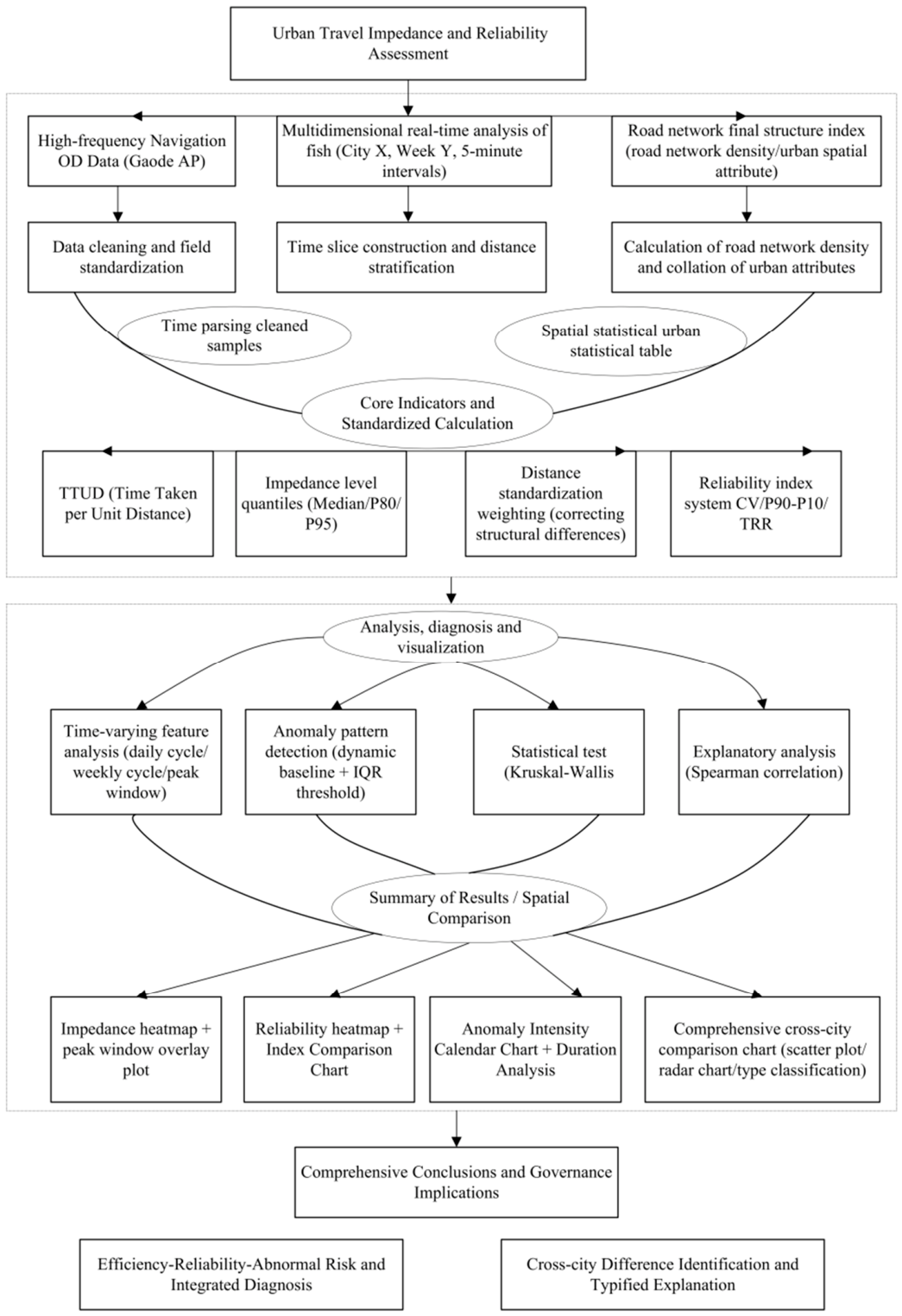
2.1. Overall Framework
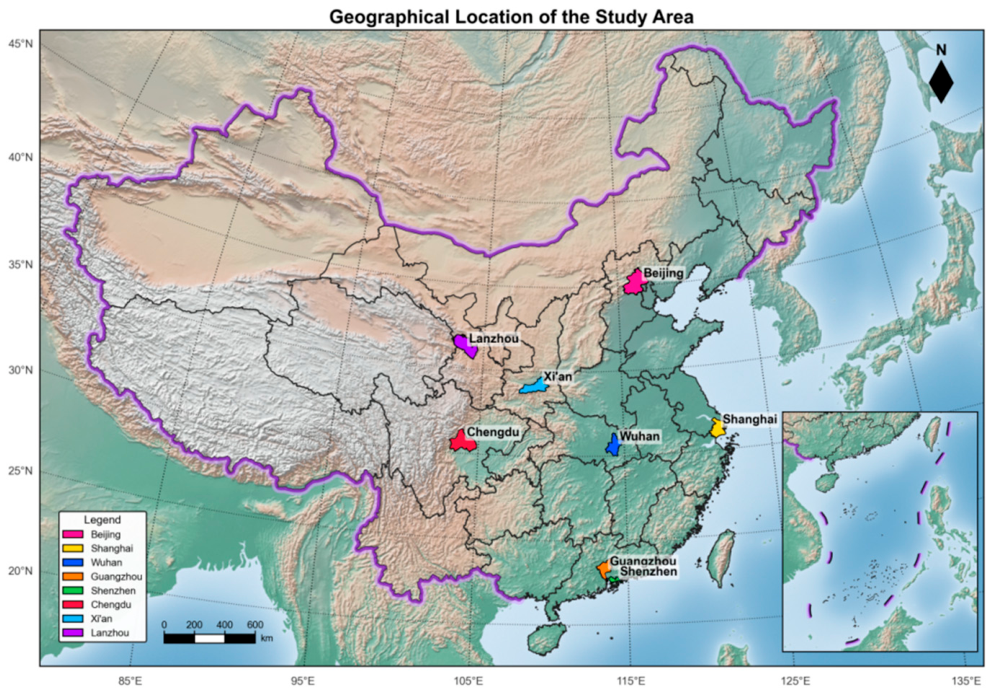
2.2. Study Area and Data Source
2.3. Data Preprocessing and Temporal Slicing
3. Method
3.1. Indicators and Analytical Methods
3.1.1. Travel Time per Unit Distance (TTUD)
3.1.2. Impedance Level Indicators
3.1.3. Peak-Period Window Identification Based on a Robust Adaptive Threshold
3.1.4. Reliability Indicators
3.1.5. Distance-Standardized Weighting
3.2. Analytical Methods
3.2.1. Time-Slice Analysis
3.2.2. Anomaly Detection Method
3.2.3. Statistical Testing
3.2.4. City-Level Correlation Method for Road Network Density and Peak-Period Impedance
4. Results and Analysis
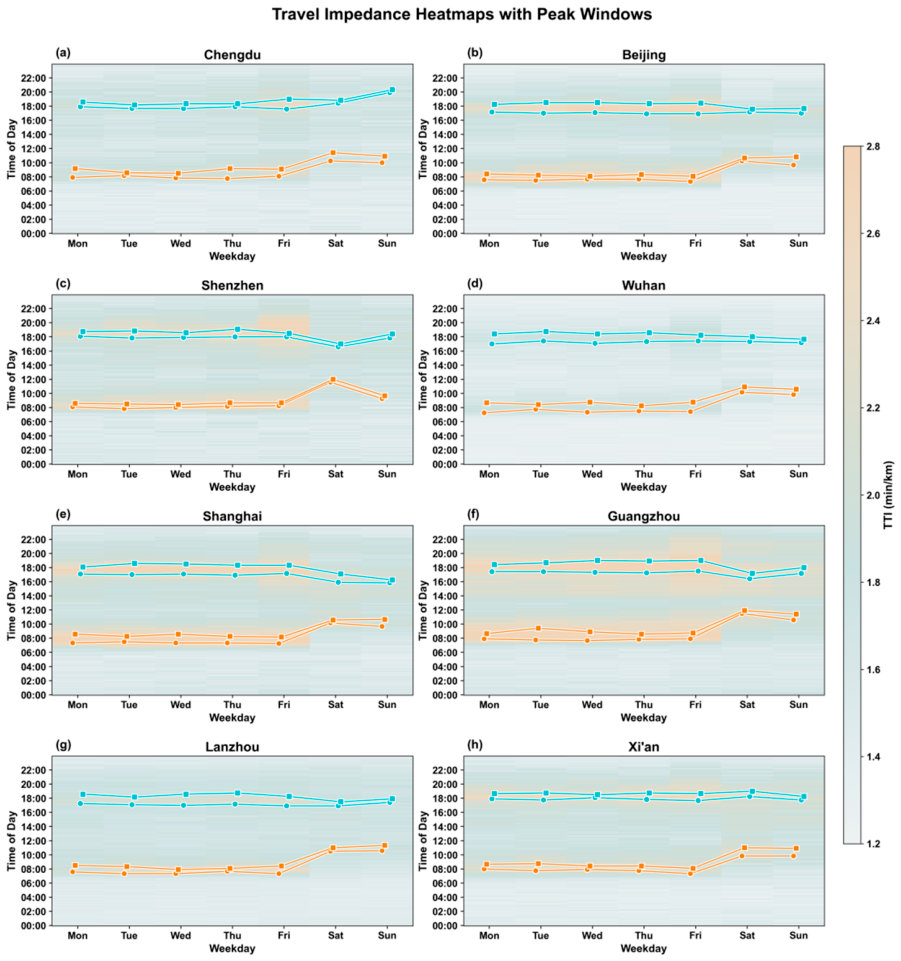
4.1. Travel Impedance Heatmaps and Peak-Period Analysis
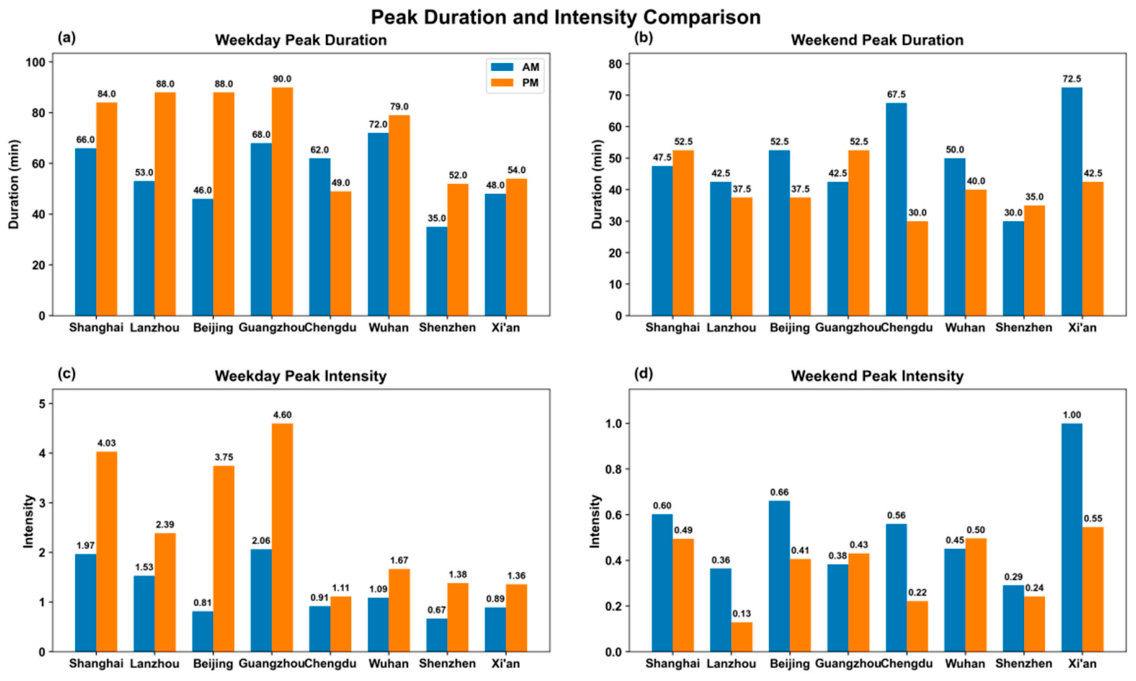
4.2. Peak-Period Identification and Cross-City Comparison
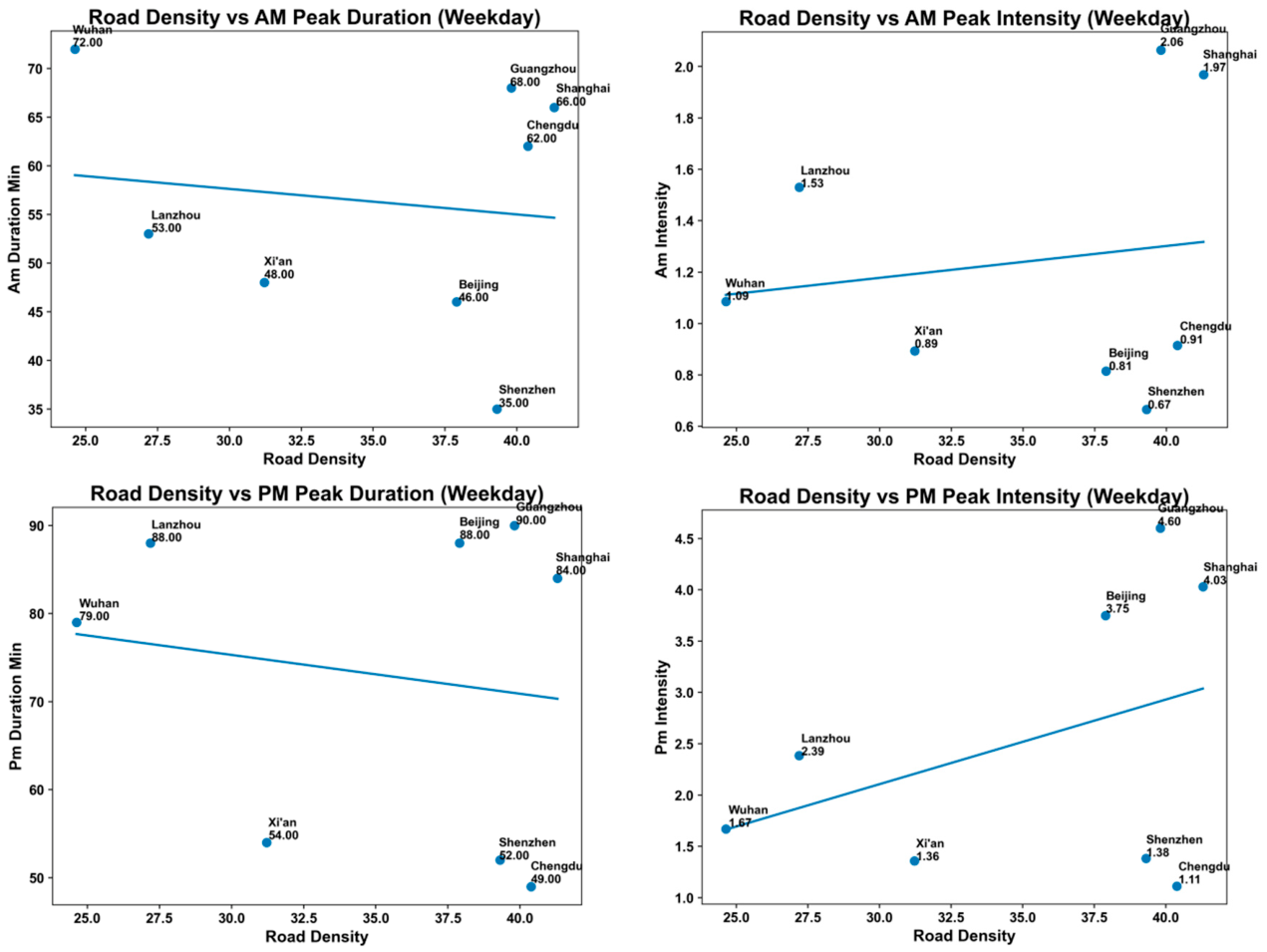
4.3. Explanatory Correlation Analysis Between Road Network Density and Peak-Period Impedance
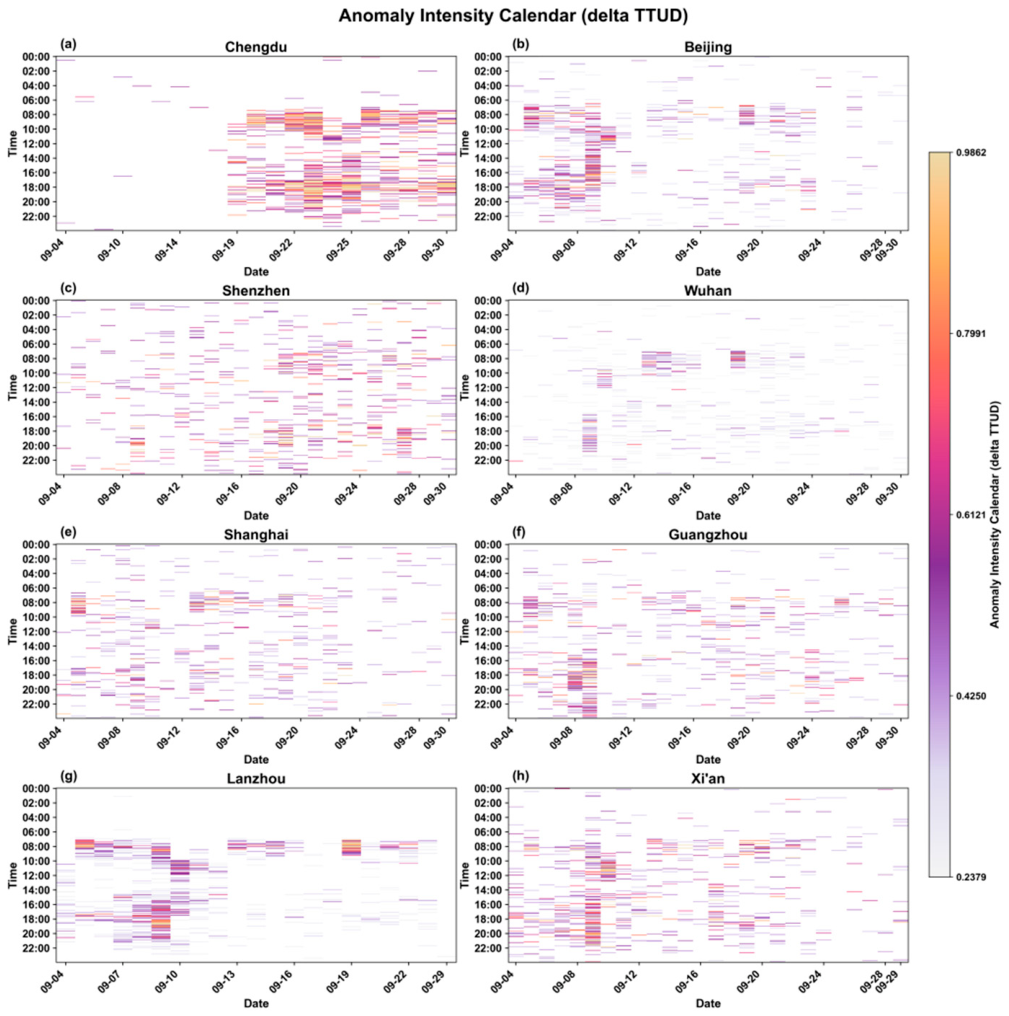
4.4. Anomaly Pattern Analysis
5. Discussion
6. Conclusions
Author Contributions
Funding
Institutional Review Board Statement
Informed Consent Statement
Data Availability Statement
Acknowledgments
Conflicts of Interest
Abbreviations
| OD | Origin–Destination |
| TTUD | Travel Time per Unit Distance |
| CV | Coefficient of Variation |
| TTR | Tail Risk Ratio |
| IQR | Interquartile Range |
| API | Application Programming Interface |
Appendix A. Spatial Extent and Sampling Ranges of OD Samples

| City | Longitude Range of OD Samples | Latitude Range of OD Samples | Study Area |
|---|---|---|---|
| Beijing | 116.21–116.53° E | 39.78–40.01° N | Main urban area within the Fifth Ring Road |
| Shanghai | 121.37–121.60° E | 31.13–31.37° N | Main urban area within the Outer Ring Expressway |
| Shenzhen | 113.90–114.12° E | 22.53–22.58° N | Main urban area of Bao’an, Futian, and Nanshan districts |
| Guangzhou | 113.21–113.39° E | 23.06–23.16° N | Main urban area within the Ring Expressway |
| Chengdu | 103.96–104.17° E | 30.57–30.72° N | Main urban area within the Ring Expressway |
| Wuhan | 114.16–114.52° E | 30.44–30.72° N | Main urban area within the Fourth Ring Road |
| Xi’an | 108.81–109.10° E | 34.20–34.36° N | Main urban area within the Third Ring Road |
| Lanzhou | 103.67–103.75° E; 103.82–103.93° E | 36.08–36.12° N; 36.04–36.08° N | Two core sections in the elongated main urban area |
References
- Zang, Z.; Xu, X.; Qu, K.; Chen, R.; Chen, A. Travel time reliability in transportation networks: A review of methodological developments. Transp. Res. Part C Emerg. Technol. 2022, 143, 103866. [Google Scholar] [CrossRef]
- Ding, H.; Zhao, Z.; Wang, S.; Zhang, Y.; Zheng, X.; Lu, X. Quantifying the impact of built environment on traffic congestion: A nonlinear analysis and optimization strategy for sustainable urban planning. Sustain. Cities Soc. 2025, 122, 106249. [Google Scholar] [CrossRef]
- Xu, S.; Sun, C.; Liu, N. Road congestion and air pollution- analysis of spatial and temporal congestion effects. Sci. Total Environ. 2024, 945, 173896. [Google Scholar] [CrossRef] [PubMed]
- Zong, F.; Zeng, M.; Li, Y.-X. Congestion pricing for sustainable urban transportation systems that accounts for carbon emissions and travel habits. Sustain. Cities Soc. 2024, 101, 105198. [Google Scholar] [CrossRef]
- Levy, J.I.; Buonocore, J.J.; Von Stackelberg, K. Evaluation of the public health impacts of traffic congestion: A health risk assessment. Environ. Health 2010, 9, 65. [Google Scholar] [CrossRef]
- Wu, K.; Ding, J.; Lin, J.; Zheng, G.; Sun, Y.; Fang, J.; Xu, T.; Zhu, Y.; Gu, B. Big-data empowered traffic signal control could reduce urban carbon emission. Nat. Commun. 2025, 16, 2013. [Google Scholar] [CrossRef]
- Van Lint, J.; Calvert, S.C. A generic multi-level framework for microscopic traffic simulation—Theory and an example case in modelling driver distraction. Transp. Res. Part B Methodol. 2018, 117, 63–86. [Google Scholar] [CrossRef]
- Zhao, G.; Al-Khasawneh, M.B.; Tuoto, T.; Cirillo, C. Data fusion for travel analysis: Linking travel survey and mobile device location data. Transportation 2025. [Google Scholar] [CrossRef]
- Gong, S.; Saadi, I.; Teller, J.; Cools, M. A comparative analysis of mobile phone data and travel surveys in understanding travel behaviour. Transportation 2025. [Google Scholar] [CrossRef]
- Torrisi, V.; Calabrò, G.; Oliveira, T.D.S.; Inturri, G.; Cavalieri, S.; Ignaccolo, M. Exploring the reliability of Floating Car Data (FCD) through penetration rate prediction in urban contexts. Res. Transp. Bus. Manag. 2026, 64, 101565. [Google Scholar]
- Zhang, C.; Zhou, Y.; Zhang, M.; Wang, B.; Nie, Y. Review and prospect of floating car data research in transportation. J. Traffic Transp. Eng. (Engl. Ed.) 2025, 12, 752–771. [Google Scholar] [CrossRef]
- Nair, D.J.; Gilles, F.; Chand, S.; Saxena, N.; Dixit, V. Characterizing multicity urban traffic conditions using crowdsourced data. PLoS ONE 2019, 14, e0212845. [Google Scholar]
- Muñoz-Villamizar, A.; Solano-Charris, E.L.; AzadDisfany, M.; Reyes-Rubiano, L. Study of urban-traffic congestion based on Google Maps API: The case of Boston. IFAC-Pap. 2021, 54, 211–216. [Google Scholar] [CrossRef]
- Elnaggar, G.R.; Al-Hourani, S.; Abutaha, R. Real-Time Urban Congestion Monitoring in Jeddah, Saudi Arabia, Using the google maps API: A data-driven framework for middle eastern cities. Sustainability 2025, 17, 8194. [Google Scholar] [CrossRef]
- Tiznado-Aitken, I.; Muñoz, J.C.; Hurtubia, R. Public transport accessibility accounting for level of service and competition for urban opportunities: An equity analysis for education in Santiago de Chile. J. Transp. Geogr. 2021, 90, 102919. [Google Scholar] [CrossRef]
- Pot, F.J.; Van Wee, B.; Tillema, T. Perceived accessibility: What it is and why it differs from calculated accessibility measures based on spatial data. J. Transp. Geogr. 2021, 94, 103090. [Google Scholar] [CrossRef]
- Klar, B.; Lee, J.; Long, J.A.; Diab, E. The impacts of accessibility measure choice on public transit project evaluation: A comparative study of cumulative, gravity-based, and hybrid approaches. J. Transp. Geogr. 2023, 106, 103508. [Google Scholar] [CrossRef]
- Verma, R.; Ukkusuri, S.V. What determines travel time and distance decay in spatial interaction and accessibility? J. Transp. Geogr. 2025, 122, 104061. [Google Scholar] [CrossRef]
- Lyman, K.; Bertini, R.L. Using travel time reliability measures to improve regional transportation planning and operations. Transp. Res. Rec. 2008, 2046. [Google Scholar] [CrossRef]
- Chang, J.S. Assessing travel time reliability in transport appraisal. J. Transp. Geogr. 2010, 18, 419–425. [Google Scholar] [CrossRef]
- Zang, Z.; Xu, X.; Yang, C.; Chen, A. A closed-form estimation of the travel time percentile function for characterizing travel time reliability. Transp. Res. Part B Methodol. 2018, 118, 228–247. [Google Scholar] [CrossRef]
- Zang, Z.; Xu, X.; Yang, C.; Chen, A. On the value of distribution tail in the valuation of travel time variability. Transp. Res. Part E Logist. Transp. Rev. 2024, 190, 103695. [Google Scholar] [CrossRef]
- Gore, N.; Arkatkar, S.; Joshi, G.; Antoniou, C. Developing modified congestion index and congestion-based level of service. Transp. Policy 2023, 131, 97–119. [Google Scholar] [CrossRef]
- Javanmard, R.; Lee, J.; Kim, K.; Park, J.; Diab, E. Evaluating the impacts of supply-demand dynamics and distance decay effects on public transit project assessment: A study of healthcare accessibility and inequalities. J. Transp. Geogr. 2024, 116, 103833. [Google Scholar] [CrossRef]
- Alkaabi, K.; Raza, M.; Qasemi, E.; Alderei, H.; Alderei, M.; Almheiri, S. Using crowdsourced traffic data and open-source tools for urban congestion analysis. Transp. Res. Interdiscip. Perspect. 2024, 28, 101261. [Google Scholar]
- Gañan-Cardenas, E.; Rios-Echeverri, D.C.; Ballesteros, J.R.; Branch-Bedoya, J.W. Estimating traffic congestion cost uncertainty using a bootstrap scheme. Transp. Res. Part D Transp. Environ. 2024, 136, 104462. [Google Scholar] [CrossRef]
- Xu, X.; Zheng, Z.; Hu, Z.; Feng, K.; Ma, W. A unified dataset for the city-scale traffic assignment model in 20 US cities. Sci. Data 2024, 11, 325. [Google Scholar] [CrossRef]
- Hu, Z.; Zheng, Z.; Menendez, M.; Ma, W. From global open multi-source data to network-wide traffic flow: A large-scale case study across multiple cities. Commun. Transp. Res. 2025, 5, 100222. [Google Scholar] [CrossRef]
- Stępniak, M.; Rosik, P. The role of transport and population components in change in accessibility: The influence of the distance decay parameter. Netw. Spat. Econ. 2018, 18, 291–312. [Google Scholar] [CrossRef]
- Zhao, Z.; Tang, L.; Ren, C.; Yang, X.; Kan, Z.; Li, Q. Diagnosing urban traffic anomalies by integrating geographic knowledge and tensor theory. GISci. Remote Sens. 2024, 61, 2290347. [Google Scholar] [CrossRef]
- Hojati, A.T.; Ferreira, L.; Washington, S.; Charles, P.; Shobeirinejad, A. Reprint of: Modelling the impact of traffic incidents on travel time reliability. Transp. Res. Part C Emerg. Technol. 2016, 70, 86–97. [Google Scholar] [CrossRef]
- Ren, Z.; Li, X.; Peng, J.; Chen, K.; Tan, Q.; Wu, X.; Shi, C. Graph autoencoder with mirror temporal convolutional networks for traffic anomaly detection. Sci. Rep. 2024, 14, 1247. [Google Scholar] [CrossRef]
- Mao, Y.; Shi, Y.; Lu, B. Detecting urban traffic anomalies using traffic-monitoring data. ISPRS Int. J. Geo-Inf. 2024, 13, 351. [Google Scholar] [CrossRef]
- Yao, K.; Chen, L.; Chen, S. Time-evolving traffic resilience performance forecasting during hazardous weather toward proactive intervention. Reliab. Eng. Syst. Saf. 2025, 253, 110521. [Google Scholar] [CrossRef]
- Ganin, A.A.; Kitsak, M.; Marchese, D.; Keisler, J.M.; Seager, T.; Linkov, I. Resilience and efficiency in transportation networks. Sci. Adv. 2017, 3, e1701079. [Google Scholar] [CrossRef]
- Pan, Y.; Chen, S.; Niu, S.; Ma, Y.; Tang, K. Investigating the impacts of built environment on traffic states incorporating spa-tial heterogeneity. J. Transp. Geogr. 2020, 83, 102663. [Google Scholar] [CrossRef]
- Xiao, D.; Kim, I.; Zheng, N. Does built environment have impact on traffic congestion?—A bootstrap mediation analysis on a case study of Melbourne. Transp. Res. Part A Policy Pract. 2024, 190, 104297. [Google Scholar] [CrossRef]
- Huang, J.; Hu, Y.; Wang, J.; Li, X. A tale of two cities: Jobs–housing balance and urban spatial structures from the perspective of transit commuters. Environ. Plan. B Urban Anal. City Sci. 2021, 48, 1543–1557. [Google Scholar] [CrossRef]
- Woodard, D.; Nogin, G.; Koch, P.; Racz, D.; Goldszmidt, M.; Horvitz, E. Predicting travel time reliability using mobile phone GPS data. Transp. Res. Part C Emerg. Technol. 2017, 75, 30–44. [Google Scholar] [CrossRef]
- Wang, Z.; Ye, J.; Tang, J. Road traffic anomaly monitoring and warning based on DeepWalk algorithm. Transp. Saf. Environ. 2023, 5, tdac049. [Google Scholar] [CrossRef]
- Bao, Z.; Ou, Y.; Chen, S.; Wang, T. Land use impacts on traffic congestion patterns: A tale of a northwestern Chinese city. Land 2022, 11, 2295. [Google Scholar] [CrossRef]


| City | Total Sample Size | Average Daily Sample Size | Valid Sample Ratio | Average Distance (km) | Average Travel Time (min) |
|---|---|---|---|---|---|
| Chengdu | 69,988 | 2880 | 1 | 14.03 | 21.71 |
| Shenzhen | 69,982 | 2878 | 1 | 12.37 | 21.39 |
| Guangzhou | 69,997 | 2879 | 1 | 12.97 | 25.85 |
| Wuhan | 69,988 | 2880 | 1 | 26.62 | 38.20 |
| Beijing | 70,020 | 2879 | 1 | 19.65 | 33.22 |
| Shanghai | 70,008 | 2880 | 1 | 17.82 | 32.22 |
| Lanzhou | 69,988 | 2879 | 1 | 21.29 | 34.86 |
| Xi’an | 69,992 | 2880 | 1 | 18.23 | 30.16 |
| Total | 559,963 | 23,035 | 1 | 17.87 | 29.70 |
| Level (TTUD) | Impedance Level |
|---|---|
| Free-flow | |
| Typical | |
| Congested | |
| Extreme congestion |
Disclaimer/Publisher’s Note: The statements, opinions and data contained in all publications are solely those of the individual author(s) and contributor(s) and not of MDPI and/or the editor(s). MDPI and/or the editor(s) disclaim responsibility for any injury to people or property resulting from any ideas, methods, instructions or products referred to in the content. |
© 2026 by the authors. Licensee MDPI, Basel, Switzerland. This article is an open access article distributed under the terms and conditions of the Creative Commons Attribution (CC BY) license.
Share and Cite
He, R.; Li, M.; Peng, L. Time-Varying Characteristics and Reliability of Urban Travel Impedance Based on High-Frequency Navigation OD Data. Sustainability 2026, 18, 5215. https://doi.org/10.3390/su18115215
He R, Li M, Peng L. Time-Varying Characteristics and Reliability of Urban Travel Impedance Based on High-Frequency Navigation OD Data. Sustainability. 2026; 18(11):5215. https://doi.org/10.3390/su18115215
Chicago/Turabian StyleHe, Runsen, Muzi Li, and Li Peng. 2026. "Time-Varying Characteristics and Reliability of Urban Travel Impedance Based on High-Frequency Navigation OD Data" Sustainability 18, no. 11: 5215. https://doi.org/10.3390/su18115215
APA StyleHe, R., Li, M., & Peng, L. (2026). Time-Varying Characteristics and Reliability of Urban Travel Impedance Based on High-Frequency Navigation OD Data. Sustainability, 18(11), 5215. https://doi.org/10.3390/su18115215