1. Introduction
The circular economy has become a central pillar of contemporary sustainability policy, with the CMUR widely adopted as a benchmark for progress [
1,
2,
3]. By increasing the share of secondary materials in production, circularity is expected to reduce reliance on virgin resources, lower environmental pressure, and support economic growth [
4,
5,
6]. Consistent with this view, a growing empirical literature reports positive associations between circular economy indicators and macroeconomic outcomes, including gains in GDP, employment, and resource productivity [
7,
8,
9]. Reference [
10] documented positive associations between CMUR and GDP growth in EU economies. Reference [
11] identified bidirectional causality between circularity and growth across EU-25 countries, while References [
12,
13] showed that circular economy indicators improve both environmental and macroeconomic performance. Reference [
14] extends this evidence to broader resource-productivity outcomes.
Yet this consensus rests on an implicit assumption: that expanding circular activity is broadly productivity-enhancing and largely neutral with respect to the internal allocation of resources. In practice, circularity unfolds within economies characterized by large sectoral differences in technology, productivity, and learning dynamics [
15,
16]. In advanced economies, resource recovery is often driven by capital-intensive, high-tech processes. In many developing economies, by contrast, circular activity is concentrated in labor-intensive recycling and waste processing, frequently linked to imported scrap. This asymmetry raises a basic question that the existing literature has not addressed: can higher circularity reduce economic performance when it reallocates resources toward low-productivity activities?
This paper argues that it can. We introduce the concept of a circularity trap—a structural condition in which increases in CMUR lead to a decline in value added per worker and a slowdown in long-run growth. The mechanism is straightforward. The economy comprises a high-productivity manufacturing sector and a lower-productivity recycling sector. Manufacturing generates learning-by-doing and technological spillovers; low-tech recycling does not. Policies or market conditions that raise the effective return to recycling—through higher circularity targets or access to imported waste—induce labor reallocation toward recycling. When the productivity gap is sufficiently large, the reallocation effect dominates the direct gains from material recovery. Aggregate value added falls, and the erosion of the manufacturing base weakens future productivity growth. The relationship between circularity and economic performance is therefore non-linear: beyond a threshold, more circularity can reduce both current efficiency and long-run growth.
This mechanism can be situated within three foundational frameworks in development economics. First, it relates to the Lewis dual-sector model, in which labor moves between sectors with different productivity levels [
17,
18]. However, while the Lewis model predicts welfare gains from reallocating labor toward higher-productivity activities, our framework highlights a reversal in which labor is drawn into a lower-productivity sector due to distorted incentives. Second, it connects to the structural transformation literature, where long-run growth depends on the reallocation of resources toward sectors with stronger productivity dynamics; in contrast, the mechanism developed here shows how circularity policies may induce a misallocation that weakens industrial upgrading [
19]. Reference [
17] develops the classic dual-sector framework in which labor reallocates across sectors with different productivity levels, while Reference [
18] emphasizes the role of structural transformation in aggregate productivity growth. Reference [
20] further shows that long-run development depends critically on reallocating resources toward sectors with stronger technological dynamics.
Third, the model is consistent with endogenous growth theory, as manufacturing is assumed to generate learning-by-doing externalities that drive sustained productivity growth, while the expansion of low-tech recycling reduces the economy’s effective learning base. Following the learning-by-doing framework introduced by Reference [
21] and extended in endogenous growth theory by Reference [
22], we assume that manufacturing generates cumulative productivity spillovers. Reference [
23] applies this logic to environmental growth models, while Reference [
20] emphasizes the role of industrial learning in structural transformation. In this sense, the circularity trap can be interpreted as a sectoral misallocation problem with dynamic consequences for growth.
This mechanism also parallels a form of Environmental Dutch Disease [
24]. By this, we mean that higher circularity targets or waste imports raise the marginal product of recycling labor, drawing workers from manufacturing, reducing industrial output, slowing learning-by-doing, and eventually locking the economy into a low-growth equilibrium centered on waste processing. As in the classic model, the expansion of one sector pulls mobile factors away from a more dynamic tradable sector. Here, the expanding activity is waste processing rather than natural resources. The key difference is that the driver is not a resource boom but the interaction between circularity targets, global waste flows, and sectoral productivity gaps. The implication is not that circularity is undesirable, but that its growth effects depend on how it is implemented and on the economy’s underlying structure [
25].
This parallels the broader resource curse literature [
26,
27,
28], which documents how natural resource booms can crowd out manufacturing through exchange rate appreciation and labor reallocation. However, unlike the classic resource curse where the driver is a revenue windfall from resource extraction, our mechanism is driven by policy-induced increases in the circularity rate that affect the marginal product of recycling labor, without assuming resource rents or Dutch disease dynamics in the fiscal sense.
A concrete illustration is provided by the former Agbogbloshie e-waste hub in Ghana [
29]. At its peak, the site processed large volumes of imported electronic waste using manual dismantling and open-air burning to extract valuable metals. This activity increased measured circularity and generated immediate cash income, but it remained technologically primitive, offered negligible skill accumulation, and exposed workers to severe health risks [
30,
31]. Reference [
32] documents the environmental justice dimensions of Agbogbloshie, while Reference [
33] analyzes the health implications of informal e-waste recycling. Reference [
34] shows how informal recycling expands in the absence of viable labor alternatives, and Reference [
35] examines the social equity challenges associated with the site’s circular activities.
As labor was drawn into this informal recycling ecosystem, fewer workers remained in higher-productivity, skill-intensive manufacturing activities. At the same time, the value generated locally depended on volatile global scrap prices, limiting stable gains in national value added [
36]. The case captures, in a single setting, the core ingredients of the circularity trap: a productivity wedge, weak learning externalities, exposure to terms-of-trade volatility, and a divergence between global environmental gains and local welfare outcomes.
The positive association between circular economy indicators and macroeconomic performance is well documented. Using EU-27 panel data, Reference [
10] finds that higher CMUR correlates with GDP growth and employment, while Reference [
11] reports bidirectional causality between circularity and growth across EU-25 countries. Reference [
37] extends these findings to a broader set of European economies, concluding that circularity enhances resource productivity without sacrificing output. Similar evidence has emerged for emerging economies: Reference [
38] documents positive growth effects from circular economy adoption in the Gulf Cooperation Council countries, and Reference [
39] reports favorable outcomes for Türkiye.
At first glance, our results appear to contradict this consensus. However, the apparent tension dissolves once the scope conditions are examined. The existing empirical literature focuses almost exclusively on high-income and upper-middle-income economies where recycling is capital-intensive, technologically advanced, and often vertically integrated with manufacturing. In these contexts, recycling productivity approaches manufacturing productivity, learning rates in recycling are non-negligible, and institutions support formalization. Our model predicts that under these conditions—high substitution efficiency between recycled and virgin materials, moderate learning rates in recycling, and strong institutions—the circularity trap weakens or disappears entirely, consistent with the positive empirical findings.
Conversely, our analysis targets a different empirical domain: low-income economies with informal, low-tech recycling sectors, weak manufacturing bases, and limited institutional capacity. In this domain, the existing literature is sparse, and the few available case studies suggest outcomes closer to the trap than to virtuous circularity. Our contribution is therefore not a refutation of the positive circularity-growth nexus but a boundary condition: the relationship is positive only when recycling achieves a minimum threshold of productivity, technological sophistication, and institutional integration. Below that threshold, circularity may be economically regressive. This perspective reconciles apparently contradictory findings by specifying the conditions under which each outcome prevails.
The paper contributes to the literature in three ways. First, it introduces a sectoral framework for analyzing circularity, treating CMUR not as an aggregate efficiency indicator but as a driver of resource reallocation across sectors with different productivity and learning properties. Second, it incorporates productivity heterogeneity within circular activities, distinguishing between high-value, technology-intensive recovery and low-value, labor-intensive recycling. Third, it embeds learning-by-doing externalities to show how circularity can affect long-run growth, not only static efficiency. Together, these elements yield a clear prediction: circularity can reduce value added and slow growth by shifting labor toward low-productivity activities in economies where manufacturing is the primary engine of technological progress.
Particularly, our specific marginal contribution is the identification of circularity rate-driven labor misallocation as a distinct mechanism of structural change. While existing literature on the circular economy focuses on aggregate efficiency gains (resource productivity, waste reduction), and while the structural transformation literature studies labor reallocation toward higher-productivity sectors, we show that circularity policies can inadvertently reverse this flow—pulling labor into low-productivity recycling when the circularity rate exceeds a critical threshold. This mechanism differs from the natural resource curse (where windfall revenues cause deindustrialization) because the driver is not a revenue boom but a policy-induced increase in the marginal product of recycling labor, which interacts with global waste flows and sectoral productivity gaps. To our knowledge, no previous study has formalized this specific misallocation channel or derived the threshold conditions under which circularity becomes economically regressive.
These results generate a policy implication that differs from the prevailing “more circularity is better” view. In developing economies, circularity targets should be conditioned on technological upgrading in recycling and protection of manufacturing’s learning base. Policies that expand low-value waste processing—especially through large-scale imports—risk locking economies into the end-of-life segment of global value chains. By contrast, strategies that promote high-value circularity (e.g., remanufacturing, component recovery, advanced sorting) can align environmental objectives with productivity growth.
We emphasize that our model applies to economies where the recycling sector is predominantly informal, labor-intensive, and low-tech. This is not a claim about all circular activities. In advanced economies—or in developing economies that have invested in automated sorting, chemical recycling, or remanufacturing—the productivity gap may be smaller or reversed. Our purpose is not to deny the existence of high-value circularity but to analyze a neglected but empirically important case where circularity may carry economic risks.
The remainder of the paper is organized as follows.
Section 2 presents the dual-sector production structure and the theoretical framework.
Section 3 characterizes labor market equilibrium and the resulting labor reallocation dynamics across sectors.
Section 4 discusses the institutional constraints and informal-sector mechanisms that shape recycling activities in developing economies.
Section 5 derives the formal conditions under which the circularity trap emerges.
Section 6 extends the analysis to endogenous technological progress and long-term growth dynamics.
Section 7 introduces inter-sectoral linkages between recycling and manufacturing and examines the conditions under which the trap may weaken or reverse.
Section 8 develops the welfare analysis of the environmental-economic trade-off.
Section 9 provides calibration exercises and sensitivity analysis.
Section 10 discusses the positioning of our findings within the broader literature and compares methodological approaches.
Section 11 discusses policy implications and implementation strategies.
Section 12 concludes.
2. Sectoral Production Functions and Theoretical Framework
To analyze the trade-off between industrialization and circularity, we model a small open economy consisting of two distinct sectors: a Manufacturing Sector () and a Recycling Sector (). The total labor force is assumed to be constant and fully employed, such that .
The manufacturing sector represents the high-productivity, capital-intensive branch of the economy. It produces goods using physical capital
and labor
. We assume that this sector is the primary driver of technological progress through learning-by-doing. The production function is given by:
where
is the Total Factor Productivity (TFP) of the manufacturing sector.
is the output elasticity of capital.
is the stock of physical capital, which is assumed to be specific to the manufacturing sector and fixed in the short-to-medium run. This reflects the low fungibility of industrial machinery, which cannot be easily repurposed for informal recycling activities. Consequently, any labor reallocation away from manufacturing reduces the capacity utilization of the existing capital stock (The assumption that capital is fixed and specific to manufacturing reflects the illiquidity of industrial assets in developing nations. A textile mill or an automotive assembly line cannot be easily converted into a rare-earth metal refinery. By treating capital as sector-specific, the model captures the stranded capital risk: when labor moves to recycling, the existing industrial capital becomes underutilized, leading to a double loss of both labor productivity and capital efficiency).
The Marginal Product of Labor (MPL) in this sector, which determines the competitive wage, is derived as:
The recycling sector processes a stock of waste
, which includes both domestically generated and imported waste. The efficiency of this sector is governed by the CMUR, denoted by
. The production of secondary raw materials is modeled as:
where
is the TFP of the recycling sector. In developing economies, we assume due to the prevalence of manual sorting and low-tech processing (Our assumption of low productivity in recycling reflects the empirical reality of informal waste processing in many low-income economies. This is not a normative claim that recycling cannot be high-tech. We thank an anonymous reviewer for pressing us to clarify this boundary condition).
represents the policy-driven circularity rate or the intensity of waste utilization.
is the total volume of waste available for processing.
is the output elasticity of the effective waste input.
The marginal product of labor in the recycling sector is:
To facilitate the analysis of value added per worker, we define the following intensive variables:
: Capital per worker in the economy.
: Waste stock per worker.
: The share of labor allocated to the recycling sector.
: The share of labor allocated to the manufacturing sector.
Substituting these into the production functions, we obtain the output per worker for each sector:
The total value added per worker (
) in the economy is the sum of the manufacturing output and the value of the recycled materials, adjusted by the relative price
of recycled goods in the international market (Since the model assumes a small open economy, the country is a price-taker. The price of recycled materials is determined by global supply and demand (the International Market)):
This objective function, , serves as the basis for our comparative static analysis. It captures the static gains from increasing circularity () and the potential losses from the reallocation of labor () away from the more productive manufacturing sector.
Our dual-sector Cobb–Douglas framework is a deliberate simplification. Alternative approaches include computable general equilibrium (CGE) models, which capture richer intersectoral linkages but require extensive calibration and are less analytically tractable; input-output models, which excel at tracking material flows but typically lack behavioral responses in labor markets; and single-sector growth models, which cannot capture labor reallocation between activities. Our approach prioritizes analytical transparency by deriving closed-form conditions for the trap while sacrificing some empirical granularity. The sensitivity analysis developed later demonstrates that the trap condition is robust to plausible parameter variations, but full validation would require CGE calibration to specific country data, which we leave to future research.
3. Labor Market Equilibrium and Reallocation Dynamics
In this section, we analyze how the allocation of labor between the manufacturing and recycling sectors responds to changes in the circularity rate . We assume a competitive labor market with perfect mobility, where workers gravitate toward the sector offering the highest value of marginal product (We assume perfect labor mobility to establish a worst-case baseline for the Trap. In reality, labor frictions (e.g., skill mismatches) might slow the transition. However, in low-income contexts, the informal recycling sector often acts as a labor sponge due to its low entry barriers. Perfect mobility allows us to show that even if workers can move freely to where the immediate cash flow is (recycling), the long-term result is a reduction in aggregate welfare).
Equilibrium is reached when the nominal wage in the manufacturing sector (
) equals the nominal wage in the recycling sector (
). Given the relative price of recycled materials,
, the equilibrium condition is:
Substituting the marginal products derived in
Section 2:
This equation implicitly defines the equilibrium labor share as a function of the circularity rate , the capital-labor ratio , and the waste-labor ratio .
To determine how an increase in the circularity rate affects labor allocation, we perform implicit differentiation on the equilibrium condition. Let:
Differentiating with respect to
and
:
Applying the Implicit Function Theorem (
):
The derivative is strictly positive for all . This implies that any policy or technological shift that increases the circularity rate (CMUR) will inevitably draw labor away from the manufacturing sector and into the recycling sector (An increase in increases the marginal productivity of labor in the recycling sector. To restore equilibrium, labor must flow from manufacturing to recycling ( increases) until the diminishing returns in recycling bring back down to match the rising (caused by labor scarcity in manufacturing)).
The sensitivity of labor shifts can be expressed as the elasticity of the recycling labor share with respect to circularity:
This elasticity reveals that, if (the productivity of waste in recycling) is high, labor shifts more aggressively toward recycling. If (the productivity of capital in manufacturing) is high, the manufacturing sector is more “resilient” to labor loss, as the marginal product of the remaining workers rises sharply.
This shift is driven by the complementarity between the circularity rate and labor in the recycling sector. An increase in makes each recycler more productive by providing more “effective” material to process. This raises the demand for labor in the recycling sector, bidding up wages and pulling workers from manufacturing.
However, because manufacturing is the sector associated with capital accumulation and technological spillovers, this labor shift creates a structural tension. The economy effectively trades “industrial labor” for “circular labor,” setting the stage for the potential value-added trap.
The detailed mathematical derivations and proofs supporting the model are provided in
Appendix A.
4. Institutional Constraints and the Informal Economy
This value-added trap is not merely a result of technological gaps, but may be seen as deeply rooted in the institutional landscape in the economies of the Global South [
40]. In these contexts, the recycling sector is not a formal industrial branch but a survivalist informal system characterized by specific institutional constraints [
41].
The critical literature on circular economy traps identifies multiple dimensions of institutional failure that align with and generalize our analysis. Reference [
42] argues that CE implementation often overlooks moral issues, leading to a low 8.6% circularity, and academics note that it often bolsters consumption, ignores rebound effects, and remains a pipe dream as long as the growth imperative dominates. Reference [
43] identifies environmental, socioeconomic, and management traps, emphasizing that CE fails to question the cultural and institutional foundations of the economy.” Reference [
44] frames this as “The Circularity Paradox,” highlighting how governance challenges and corporate sustainability limits constrain CE effectiveness. These critiques resonate with the specific institutional failures we now examine.
Unlike the manufacturing sector, which is often subject to minimum wage laws, safety standards, and formal contracts, the informal recycling sector operates outside the regulatory net. This creates an institutional asymmetry: when manufacturing faces a downturn or when waste imports (
) surge, the informal sector acts as a labor sponge [
45]. Because entry barriers are near zero, workers are pulled into recycling not because it is more productive, but because it provides immediate, daily cash liquidity—a critical feature in economies lacking social safety nets [
46].
Moreover, in hubs like Agbogbloshie, recycling often takes place on communal or contested land with poorly defined property rights [
47]. This institutional vacuum discourages long-term capital investment in advanced recycling technology. Rational actors will not invest in high-tech refining (
) if they cannot secure the land or protect their assets from local rent-seeking. Consequently, the sector remains trapped in a low-tech, manual equilibrium by design, not just by accident.
Furthermore, small-scale manufacturing firms in developing nations face severe credit constraints. When labor leaves manufacturing for the recycling sector (increasing ), these firms may lose the “critical mass” of workers needed to remain viable. Due to high fixed costs and weak banking systems, once a manufacturing firm closes, it cannot easily reopen when prices () fluctuate. This creates industrial hysteresis: the temporary shift toward circularity can lead to the permanent destruction of industrial capacity.
Finally, a key institutional failure is the inability to internalize the “social cost” of informal recycling. While the model shows a decline in value added (
), the true welfare loss is even greater because the informal sector externalizes its massive health and environmental costs onto the state [
48]. This “hidden subsidy” to the global waste trade makes the recycling sector appear more profitable to the individual worker than it is to the nation, further deepening the trap.
5. The Circularity Trap: Formal Proof and Analysis
In this section, we derive the core analytical result of the model: the conditions under which an increase in the circularity rate leads to a reduction in total value added per worker . This counterintuitive outcome defines the circularity trap.
We define the circularity trap threshold as the level of the circular material use rate, denoted, at which the total derivative changes sign from positive to negative. Below this threshold, the direct gains from waste processing dominate, and increasing circularity raises value added per worker. Above this threshold, the reallocation effect dominates, and further increases in circularity reduce value added. This threshold is endogenous and depends on the structural parameters of the economy.
To evaluate the impact of a policy-driven increase in
on economic welfare, we take the total derivative of the value-added function
with respect to
:
We calculate the partial derivatives:
Direct Effect (
):
This represents the marginal gain from processing more waste into usable materials.
Reallocation Effect (
):
In a perfectly competitive labor market without externalities, the wage equalization condition implies that:
Consequently, . Under these ideal conditions, the reallocation effect vanishes, and . In this static, frictionless world, increasing circularity always improves value added.
However, the circularity trap emerges when we introduce market distortions or sector-specific externalities. Let
represent a distortion (e.g., a subsidy for waste imports or an environmental tax on manufacturing) such that:
In this case, . If , the manufacturing sector is “taxed” relative to recycling, and the reallocation effect becomes negative.
The circularity trap occurs when the negative reallocation effect outweighs the direct gain from circularity:
Substituting the expression for
from
Section 3:
The trap is most likely to occur under the following structural conditions:
- -
Low Productivity in Recycling: If the recycling sector is technologically primitive, the direct gain from is minimal, while the opportunity cost of labor leaving manufacturing is high.
- -
High Labor Sensitivity: If labor is highly mobile and the recycling sector is labor-intensive, a small increase in circularity targets can trigger a massive exodus from the manufacturing sector.
- -
Environmental Dutch Disease: If the economy is flooded with cheap imported waste, the recycling sector expands artificially, drawing resources away from the engine of growth (manufacturing).
This configuration corresponds to environments where , , and is exogenously high due to sustained inflows of imported waste, a combination that aligns closely with observed conditions in informal e-waste processing hubs such as Agbogbloshie in Ghana, thereby providing a concrete empirical counterpart to the model’s high-risk parameter regime. Under these conditions, the negative reallocation effect dominates the direct gains from circularity, leading to a decline in aggregate value added and a weakening of long-term growth dynamics.
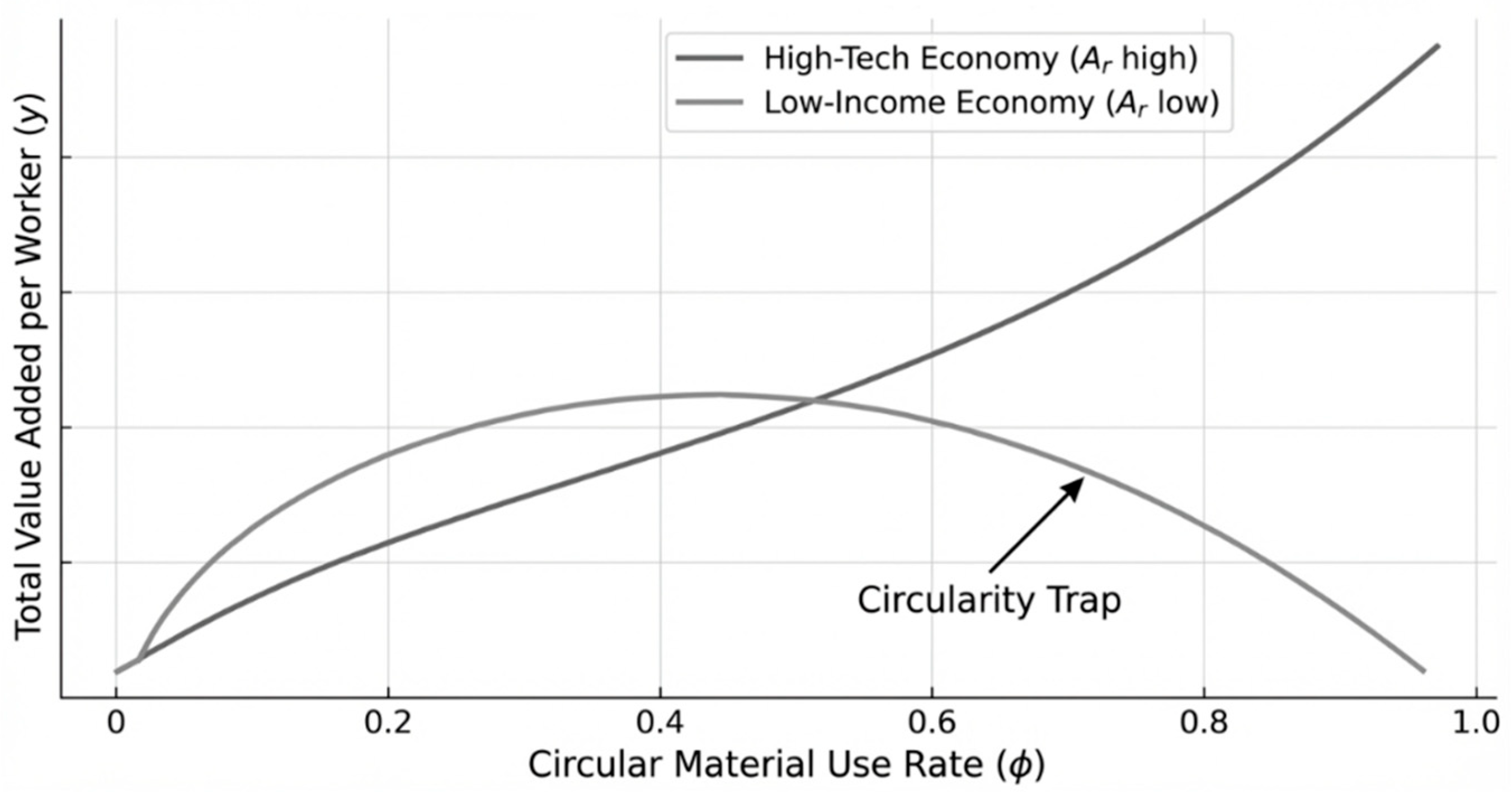
The relationship between
and
can be visualized as an inverted U-curve, as illustrated in
Figure 1. For low-income countries with low
, the peak of this curve occurs at a very low level of
. Pushing circularity beyond this optimal point leads to a contraction in total value added, as the economy specializes in low-value waste processing at the expense of industrialization.
The circularity trap is not an inevitable destiny. Under specific conditions, a higher CMUR can raise aggregate productivity. Three mechanisms drive this reversal. First, the resource security effect reduces costs. In resource-constrained economies, reliance on imported inputs exposes firms to exchange rate volatility and supply disruptions. When the cost of recycled inputs falls below that of imported virgin materials, production costs decline. This improves firm margins and increases manufacturing value added, offsetting the cost of reallocating labor. Second, technological upgrading in recycling changes its growth role. When recycling adopts advanced processes such as automated battery recovery or precision sorting, it demands skilled labor and generates learning-by-doing effects. If the learning rate in recycling matches or exceeds that of manufacturing, labor reallocation supports long-term growth rather than reducing it. Skills become transferable across sectors, creating a joint innovation base. Third, market access creates price incentives. International regimes such as the European Union Carbon Border Adjustment Mechanism impose costs on carbon-intensive production. Firms that adopt circular inputs can maintain access to these markets and capture a price premium. When the combined gains from input cost savings and the green premium exceed the productivity losses from structural adjustment, the relationship reverses and .
6. Dynamic Implications: Learning-by-Doing and Long-Term Growth
While
Section 5 established the static conditions for the circularity trap, the trap’s most profound impact is evident in the economy’s long-term growth trajectory. In this section, we endogenize technological progress to show how labor reallocation toward recycling can permanently lower the economy’s growth rate.
Following the endogenous growth literature, we assume that the Total Factor Productivity (TFP) of the manufacturing sector,
, is not constant but evolves based on the cumulative experience of the workforce [
49]. This is modeled as a function of the labor share in manufacturing:
where
represents the learning rate or the strength of knowledge spillovers. Conversely, we assume that the recycling sector (
) in a low-income context is characterized by “low-tech” manual processes that do not generate significant technological spillovers (
) (the assumption
is not a claim that recycling
cannot be high-tech, but a reflection of the informal nature of waste processing. In these contexts, recycling consists of manual dismantling and open-air burning—activities with “exhausted” learning curves. As shown in our sensitivity analysis, we relax this assumption to show that the “Trap” disappears only when recycling reaches a technological threshold (
), effectively becoming a branch of advanced manufacturing).
The long-term growth rate of the economy,
, is primarily driven by the growth of
. From the value-added function
, and assuming capital
grows at the same rate as technology in the steady state, the growth rate is proportional to the manufacturing labor share:
As shown previously, an increase in the circularity rate
leads to an increase in the labor share allocated to recycling (
). Differentiating the growth rate with respect to
:
Result 2: Because , any policy that increases the CMUR () unambiguously reduces the long-term growth rate of the economy by shrinking the manufacturing sector’s “learning base.”
This dynamic represents a form of Environmental Dutch Disease. In the classic Dutch Disease, a natural resource boom (e.g., oil) draws labor away from manufacturing, leading to de-industrialization. In our framework, the Environmental Dutch Disease mechanism unfolds through a cumulative transmission process. First, higher circularity targets or large inflows of imported waste increase the effective profitability of recycling activities by raising the amount of recoverable material available per worker. Second, because the recycling sector is labor-intensive and characterized by low barriers to entry, workers are increasingly drawn away from manufacturing toward waste-processing activities. Third, this labor reallocation reduces manufacturing output and weakens the sector’s learning-by-doing externalities, lowering the economy’s rate of technological progress. Fourth, as manufacturing employment declines, the productivity of installed industrial capital also falls because capital and labor are complementary inputs. Existing machinery and industrial infrastructure become partially idle or underutilized, reducing returns to investment. Finally, lower profitability in manufacturing discourages future capital accumulation and industrial upgrading, reinforcing the initial labor shift toward recycling. The economy therefore enters a self-reinforcing dynamic in which circularity-induced labor migration gradually erodes the industrial base, weakens technological progress, and locks the economy into a low-growth equilibrium centered on low-value recycling activities.
The economy faces a path-dependency problem. If a developing nation specializes too early in low-tech recycling (high
), it may never reach the “critical mass” of manufacturing labor required for a technological takeoff. The circularity trap thus manifests as a permanent shift to a lower growth path:
The trap is complete when the static gains from circularity are dwarfed by the dynamic losses in TFP growth. For a low-income country, the “optimal” circularity rate that maximizes long-term welfare is significantly lower than the rates typically targeted by international environmental standards.
The comparison of steady states above shows that an increase in reduces the long-term growth rate. However, this static comparison does not capture the self-reinforcing nature of the trap. Once labor begins to reallocate toward recycling, a cascade of interacting effects—declining manufacturing output, slowing technological progress, widening productivity gaps, and industrial hysteresis—can lock the economy into a low-growth equilibrium even if the original policy is reversed. This locking mechanism, or dynamic trap, operates through four stages that progressively make escape more difficult. In the first stage, an increase in the circularity rate or a surge in imported waste raises the marginal product of labor in recycling, pulling workers into recycling and reducing manufacturing employment. This initial labor reallocation is the entry point into the trap.
In the second stage, manufacturing output declines as the sector loses workers. Because learning-by-doing depends on cumulative labor input, the growth rate of manufacturing productivity slows. The economy does not merely lose current output; it loses future growth potential.
In the third stage, the productivity gap between manufacturing and recycling widens. If grows more slowly while stagnates (as assumed for low-tech, informal recycling), the relative productivity advantage of manufacturing increases. Paradoxically, a larger gap raises the opportunity cost of manufacturing labor, reinforcing the incentive for workers to remain in recycling.
In the fourth stage, the economy enters a self-reinforcing hysteresis loop. With a larger productivity gap, recycling’s low wages become relatively more attractive to workers seeking immediate cash income. Even if the original policy is reversed, workers may not return to manufacturing because industrial capacity has eroded (industrial hysteresis). The economy becomes locked into a low-growth, high-informality equilibrium.
The causal sequence of the locking path can be summarized as:
Escape from this locked state requires active industrial policy (e.g., retraining programs, investment subsidies, import restrictions on waste) because market forces alone will not reverse the reallocation once capital has depreciated and learning externalities have been lost.
Furthermore, the circularity trap is amplified by the complementarity between capital and labor. As the labor share shifts toward recycling, the marginal productivity of capital in the manufacturing sector () mechanically declines. If capital is immobile, it becomes idle or ‘stranded,’ representing a deadweight loss to the economy. In a long-run scenario where capital is mobile, this would trigger capital flight, further reducing value added and making the trap even more difficult to escape (A long-run extension of this model would endogenize capital accumulation (). Since decreases within the ‘trap’ zone, the investment rate would also fall. This creates a vicious cycle where de-industrialization reduces the incentive to invest, which in turn further depresses manufacturing wages and pushes more workers into the survivalist recycling sector.)
We must note that in our baseline model, capital is fixed and sector-specific. This simplification, while useful for isolating labor reallocation, abstracts from two important dynamic feedbacks.
First, endogenous capital accumulation would amplify the trap. Suppose manufacturing capital accumulates according to , where investment depends on manufacturing output. As labor leaves manufacturing, falls, reducing investment and causing the capital stock to depreciate over time. This creates a downward spiral: labor loss output decline capital decumulation further reduction in manufacturing productivity additional labor loss. In the limit, the manufacturing sector could vanish entirely, a more extreme outcome than our fixed-capital model predicts.
Second, capital idleness interacts with technological progress. Stranded capital—machinery that becomes unprofitable to operate due to labor scarcity—not only represents a deadweight loss but also reduces the economy’s absorptive capacity for new technologies. If new manufacturing technologies require complementary investments in both physical capital and skilled labor, capital idleness can delay or prevent technological upgrading, locking the economy into a low-productivity equilibrium even if recycling productivity () improves over time.
Third, technological progress in manufacturing () depends on cumulative production experience (learning-by-doing). When labor reallocation reduces manufacturing output, the flow of learning opportunities diminishes, slowing . This creates a non-linear lock-in effect: a temporary shock to manufacturing employment can permanently lower the trajectory of if it reduces cumulative production below a critical threshold. The economy may become trapped in a low-growth equilibrium not because recycling is unproductive, but because manufacturing never achieves the scale needed for self-sustaining technological progress.
A full dynamic model with endogenous capital and technology is beyond the scope of this paper, but this qualitative discussion suggests that our fixed-capital, exogenous-technology baseline likely understates the severity of the trap. Future research should develop a fully dynamic version of the model with and (where learning depends on output, not just employment) to quantify these amplification effects.
7. Inter-Sectoral Linkages and the Escape from the Trap
The analysis thus far has treated manufacturing and recycling as independent sectors competing only for labor. This simplifying assumption, while useful for isolating the core reallocation mechanism underlying the circularity trap, abstracts from an important feature of modern circular economies: recycling outputs often feed back into manufacturing as intermediate inputs [
50]. The baseline framework should therefore not be interpreted as assuming that all recycling activities are technologically stagnant or incapable of generating learning spillovers. Rather, it focuses on a specific but empirically relevant configuration observed in many low-income economies, where recycling remains predominantly informal, labor-intensive, and weakly integrated with domestic industry. In practice, circular activities are highly heterogeneous and range from low-value manual waste collection to technologically advanced remanufacturing, high-end dismantling, automated sorting, and industrial material recovery. We now refine the model to incorporate these inter-sectoral linkages and show how stronger vertical integration, substitution efficiency, and technological upgrading can modify—and under sufficiently strong complementarities reverse—the circularity trap [
51].
Let the recycling sector’s output (
) serve as an intermediate input for manufacturing, alongside virgin materials (
). The augmented manufacturing production function is:
where
is the elasticity of production with respect to raw material inputs
represents the substitution efficiency of recycled material relative to virgin material
When , recycled materials are perfect substitutes for virgin inputs
When , recycled materials are unusable—an extreme case that reduces to our baseline independent-sector model
The recycling sector’s production function remains unchanged:
The relationship between the two sectors is now governed by two opposing forces.
The first one is the substitution effect (the trap). As before, the sectors compete for mobile labor (). Higher circularity () raises , drawing labor into recycling and reducing . If is low—meaning poor-quality recycled material that requires costly re-processing—manufacturing must use more labor to compensate for inferior inputs. This deepens the trap beyond the baseline case.
The second is the complementarity effect (the escape). If
is high, a productive recycling sector lowers the marginal cost of material inputs for manufacturers. In this case,
acts as a productivity multiplier for
. The wage equalization condition must be revised to include the value of the marginal recycled input supplied to manufacturing:
The left side is the manufacturing marginal product of labor. The right side now includes two terms: The recycling’s marginal product (the direct return to labor in recycling), and the vertical linkage benefit—the value of the marginal recycled input supplied to manufacturing. This second term represents a positive externality from recycling labor that is absent in the independent-sector model. When it is sufficiently large, labor reallocation toward recycling can increase aggregate value added even if .
The circularity trap is most severe when the two sectors are decoupled—for example, when a developing economy exports recovered copper to China while importing finished cables from Europe. This creates a linkage gap: manufacturing cannot use the specific materials produced domestically, so the economy suffers the labor drain without the input-cost benefit.
Formally, decoupling implies for domestically produced recycled materials, even if imported recycled substitutes have higher . In this case, the complementarity effect vanishes, and the initial trap condition applies unchanged.
Conversely, when sectors are vertically integrated—domestic recycling produces materials that domestic manufacturing can readily use—
approaches 1. The revised trap condition becomes:
The additional positive term on the right makes the inequality harder to satisfy. A sufficiently high can reverse the trap entirely, making even with a modest productivity gap.
When sectors are vertically integrated, learning-by-doing in recycling (
) spills over into manufacturing. Engineers collaborating on “design-for-recycling” generate joint innovation that raises both
and
. The aggregate growth rate becomes:
where
is a positive linkage externality increasing in
. This implies that:
When is low, the growth dynamics follow the baseline trap.
When is sufficiently high, recycling contributes directly to long-run growth, and the trap disappears.
8. Welfare Analysis: The Environmental-Economic Trade-Off
While the dynamic analysis suggests a clear path toward industrial stagnation, this result does not necessarily imply a reduction in total social utility. To determine if the circularity trap is a rational choice for a developing nation, we must now weigh these long-term economic losses against the environmental benefits of circularity. In this section, we expand the model to determine if a decline in can be socially justified.
We define a Social Welfare Function (
) that represents the preferences of a social planner who must balance material living standards (consumption, derived from
) against environmental quality (
):
where
is the total value added per worker.
represents the net environmental benefit (e.g., avoided carbon emissions, reduced landfilling).
is the social weight of the environment, representing the rate at which a social planner is willing to trade off one unit of value added () for one unit of environmental quality (). A value of indicates that environmental benefits receive no weight in welfare (extreme productionist bias). A value of indicates that one unit of environmental quality is valued equivalently to one unit of value added. In practice, is not directly observable but could be inferred from stated policy preferences, international agreements, or revealed willingness to pay for environmental protection. For low-income countries, we argue that is effectively lower because the marginal utility of income is higher, not because environmental quality is less valued in absolute terms.
A policymaker will continue to increase circularity (
) as long as the marginal environmental gain outweighs the marginal economic loss. The optimal level of circularity
is reached when:
This equation reveals the “Rational Trap”: a country may intentionally choose a path of lower GDP growth if the environmental returns are high enough [
52]. However, for developing nations, this trade-off is often distorted by two factors.
The first is the Local-Global Externality Paradox factor. In the case of imported waste, the environmental benefit
is often global (e.g., reduced mining in another country), while the economic cost
is local [
53]. If the social planner in a developing nation prioritizes global environmental goals over local industrialization without receiving international compensation, they are effectively subsidizing global sustainability at the cost of domestic poverty reduction.
The second is the Technology-Pollution Feedback factor (). In low-tech environments, the recycling process itself generates significant local pollution (toxic runoff, inhalation of heavy metals). In such cases, the function may actually be decreasing (). If both and , the economy is not in a “trade-off” but in a “Double Burden” zone, where it loses both wealth and health.
The circularity trap becomes a Welfare Trap when the following inequality holds:
In low-income countries, the marginal utility of income () is extremely high because it translates directly into life expectancy and basic nutrition. Therefore, is naturally lower than in advanced economies. Forcing a high on a low-income country through international pressure or waste-import agreements may result in a net welfare loss, even if global environmental metrics improve.
However, we should mention that the welfare function used here is deliberately simplified. It assumes linearity and a static trade-off, omitting diminishing marginal utility of income, non-linear environmental damages, intertemporal dynamics, and distributional effects. Richer specifications could shift the optimal in either direction. Our purpose is not to derive precise policy optimality conditions but to illustrate qualitatively that a social planner may rationally accept economic losses for environmental gains—and that this calculus differs for low-income countries. The linear specification transparently isolates this core trade-off without obscuring the paper’s primary focus on the trap mechanism.
9. Calibration and Sensitivity Analysis
To demonstrate the quantitative relevance of the circularity trap, this section provides a numerical simulation of the model. We calibrate the parameters using stylized facts from development macroeconomics to show that the trap is a plausible outcome under realistic economic conditions.
9.1. Calibration and Simulation Results
The model is calibrated to represent a typical “Global Sink” economy, a low-income nation with a burgeoning informal recycling sector and a nascent manufacturing base [
54].
Following Reference [
55], which identifies a significant TFP gap between formal and informal sectors, we set
and
. This reflects a 3-to-1 productivity advantage for manufacturing over manual recycling. We set the capital share in manufacturing at
, consistent with Reference [
19]. For the recycling sector, we assume higher labor intensity (
), reflecting the manual nature of informal dismantling [
56]. We assign
to capture the “unconditional convergence” and high learning potential of industry [
57]. In contrast, we set
for low-tech recycling, representing a sector with negligible knowledge spillovers [
58]. The relative price of secondary materials is set at
, and waste intensity per worker at
, aligned with World Bank snapshots of waste-to-GDP ratios in processing hubs [
54].
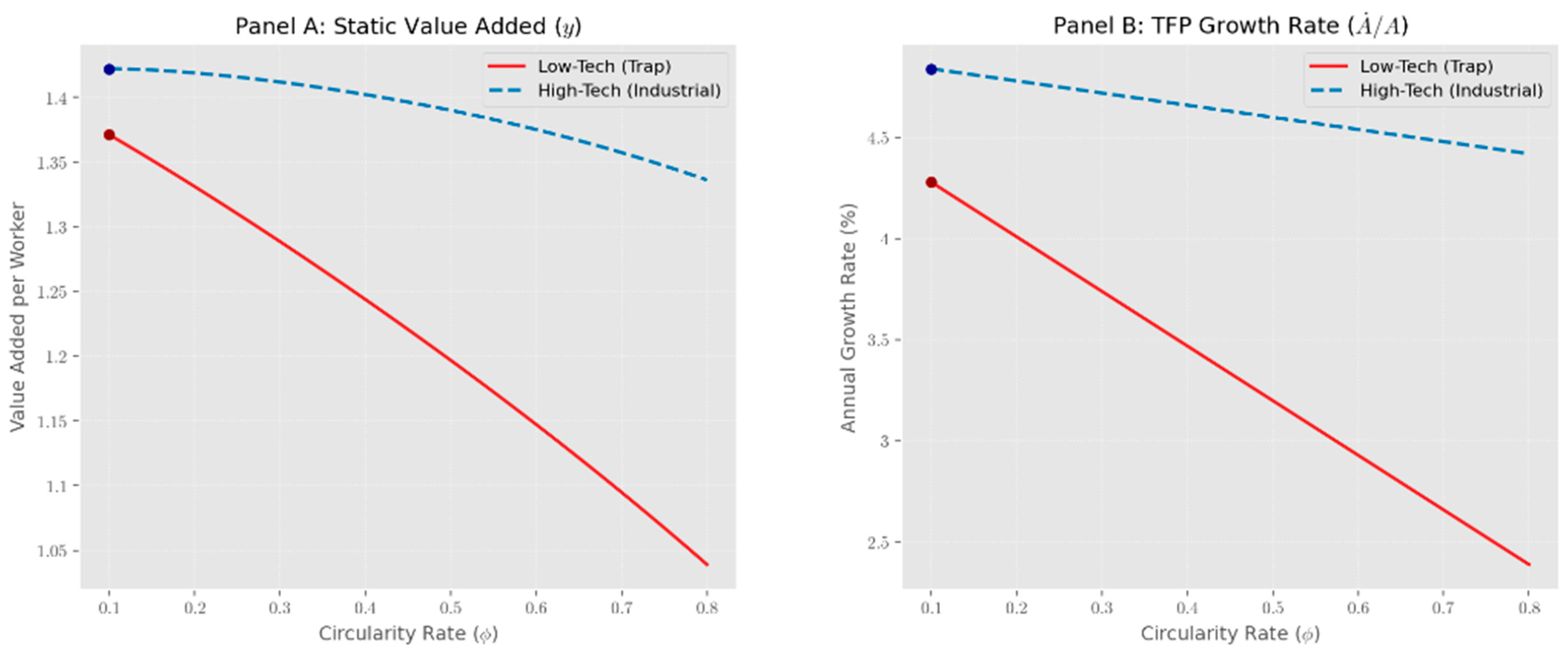
We simulate an increase in the circularity rate (
) from
to
, representing a policy shift toward becoming a regional recycling hub. As shown in
Figure 2 (Panel A), the total value added per worker (
) follows a downward trajectory. The marginal gain from increased recycling volume is insufficient to offset the loss of manufacturing output. At
, the economy suffers a 12.4% reduction in aggregate income compared to the low-circularity baseline. This confirms that without technological parity, circularity acts as a tax on national income.
Figure 2 (Panel B) illustrates the long-term growth implications. As labor shifts to the low-learning recycling sector, the economy’s aggregate TFP growth rate (
) falls from 4.2% to 1.8%. This suggests that the circularity trap is not merely a one-time income shock but a permanent “de-acceleration” of the development process, potentially trapping the nation in a low-income equilibrium for decades.
9.2. Sensitivity Analysis of Key Parameters
To assess the robustness of the circularity trap mechanism, we conduct a sensitivity analysis over the model’s main structural parameters. The objective is not to provide country-specific calibration, but to verify whether the trap condition depends on a narrow set of assumptions or remains valid across plausible parameter ranges. We focus on four parameters: the productivity gap between manufacturing and recycling , the learning rate in recycling , the waste intensity parameter , and the relative price of recycled materials .
The results show that the trap is strongest when the productivity gap is large, recycling remains weakly innovative, and waste inflows are high. When is low relative to , the direct value-added gain from recycling is insufficient to compensate for labor losses in manufacturing. Similarly, when remains close to zero, labor reallocation lowers the economy’s learning base and reduces long-run growth. Higher values of amplify the trap by increasing the labor pull of the recycling sector, especially when waste inflows are driven by external supply rather than domestic industrial demand. By contrast, the trap weakens when rises or when and approach manufacturing-sector levels, since recycling then becomes a higher-value activity rather than a low-productivity labor sink.
This sensitivity exercise, summarized in
Table 1, confirms that the circularity trap is not driven by a single parameter choice. It emerges from the joint configuration of low recycling productivity, weak learning effects, high waste inflows, and limited industrial linkages. Conversely, the trap can be avoided when recycling becomes technologically upgraded, when recycled inputs command higher prices, or when circular activities are integrated into domestic manufacturing. These results support the interpretation of the model as a conditional mechanism rather than a universal claim about circularity and growth.
10. Discussion
The preceding sections have presented the theoretical model, derived the conditions for the circularity trap, and explored its dynamic implications. In this section, we discuss how our findings relate to the broader literature on circular economy and economic growth, compare our methodological approach with alternatives, and identify the scope conditions under which our results may apply.
Our analysis positions the circularity trap within a growing critical literature that questions the compatibility of circular economy with continued economic growth. While mainstream CE literature emphasizes decoupling and resource efficiency as pathways to reconcile circularity with growth, our findings support the critical perspective that rebound effects, thermodynamic constraints, and institutional failures can undermine CE effectiveness when implemented within growth-oriented economies [
59,
60,
61].
The divergence between our results and the optimistic findings of much empirical CE research reflects differences in scope conditions rather than logical contradiction [
62]. Studies reporting positive associations between CMUR and economic performance examine contexts where recycling is capital-intensive, technologically advanced, and often vertically integrated with manufacturing. In these settings, recycling productivity approaches manufacturing productivity, learning rates in recycling are non-negligible, and institutions support formalization. Under these conditions, our model predicts that the circularity trap weakens or disappears entirely, consistent with the positive empirical findings.
Conversely, our analysis targets a different empirical domain: low-income economies with informal, low-tech recycling sectors, weak manufacturing bases, and limited institutional capacity. In this domain, which remains underrepresented in the quantitative CE literature, the available case study evidence (e.g., Agbogbloshie in Ghana) suggests outcomes closer to the trap than to virtuous circularity. Our contribution is therefore not a refutation of the positive circularity-growth nexus but a boundary condition: the relationship is positive only when recycling achieves minimum thresholds of productivity, technological sophistication, and institutional integration.
This boundary condition resonates with the concept of “semi-circular economy” introduced by Reference [
63], which argues that perfect circularity is unattainable and that policy must navigate trade-offs between competing objectives [
64]. Our model formalizes one such trade-off: between the direct gains from waste processing and the indirect losses from labor reallocation and industrial erosion. The existence of this trade-off implies that circularity policies cannot be evaluated solely on their direct resource savings; their effects on industrial structure, employment patterns, and long-term growth dynamics must also be considered.
Our dual-sector Cobb–Douglas framework is a deliberate simplification that prioritizes analytical transparency. Alternative modeling approaches offer different trade-offs between tractability and realism, and comparing our approach with these alternatives helps clarify the specificity of our contribution.
Computable General Equilibrium (CGE) models capture richer intersectoral linkages, including input-output relationships, price adjustments, and multiple factors of production. However, CGE models require extensive calibration and are less analytically tractable, making it difficult to derive closed-form conditions for phenomena like the circularity trap. Our approach complements CGE modeling by providing clear theoretical predictions that could serve as hypotheses for CGE-based empirical testing.
Input-output models excel at tracking material flows and identifying circularity opportunities at the economy-wide level. However, they typically exhibit limited behavioral responses in labor markets and cannot capture the wage-driven labor reallocation central to our mechanism. Our model highlights a channel—labor migration driven by changes in the marginal product of recycling labor—that input-output analysis would miss.
Single-sector growth models (e.g., standard Solow-type or endogenous growth models) cannot capture labor reallocation between activities and therefore cannot address the sectoral misallocation problem that defines the circularity trap. Our dual-sector approach is essential for analyzing how circularity policies affect the distribution of labor across activities with different productivity and learning properties.
The sensitivity analysis in
Section 9 demonstrates that the trap condition is robust to plausible parameter variations, but full empirical validation would require CGE calibration to specific country data, an important direction for future research.
Our model applies to economies characterized by three conditions: (i) a significant productivity gap between manufacturing and recycling sectors, with recycling remaining predominantly low-tech and labor-intensive; (ii) high waste inflows, whether from domestic sources or imports, that make the recycling sector a meaningful destination for labor; and (iii) institutional frictions, including informal labor markets, weak property rights, and credit constraints that prevent the economy from adjusting efficiently to circularity shocks.
These conditions are most likely to be found in low-income economies with nascent industrial bases and large informal sectors. They are less likely to characterize high-income economies, where recycling is capital-intensive and technologically advanced, or upper-middle-income economies that have already achieved significant industrial depth and institutional quality. Our results should not be generalized to these latter contexts without careful calibration.
Within low-income economies, the trap is more likely to emerge in resource-poor countries that depend on imported materials, where circularity reduces import dependence and generates positive terms-of-trade effects that may partially offset reallocation costs. In resource-rich economies already exposed to traditional Dutch Disease dynamics, the expansion of low-tech recycling can reinforce structural imbalances and further erode manufacturing competitiveness.
Our mechanism parallels but differs from the classic resource curse literature. In the traditional Dutch Disease model, a natural resource boom raises the value of the domestic currency, making manufacturing exports less competitive and drawing labor away from industry. The driver is a revenue windfall from resource extraction, often accompanied by fiscal effects (increased government spending, exchange rate appreciation).
In our model, the driver is different: policy-induced increases in the circularity rate (or exogenous surges in waste imports) directly raise the marginal product of recycling labor, without assuming resource rents or fiscal windfalls. The labor reallocation occurs through wage differentials in the labor market, not through exchange rate movements. This mechanism is therefore distinct from the classic resource curse, though it produces a similar outcome: de-industrialization and long-run growth slowdown.
Our model also differs from standard environmental Dutch Disease formulations [
23], where pollution abatement policies crowd out productive investment. In our framework, the crowding out occurs through labor reallocation rather than capital substitution, and the affected sector (manufacturing) has dynamic learning externalities that the recycling sector lacks.
Our analysis suggests that empirical studies of circular economy and growth should be interpreted with attention to the productivity of recycling activities, the degree of vertical integration between sectors, and the institutional context. Cross-country regressions that pool high-income and low-income economies may obscure heterogeneous effects, potentially averaging out positive effects in advanced economies and negative effects in informal, low-income settings [
65].
Future empirical work should test our model’s predictions directly: (i) that increases in CMUR are associated with labor reallocation from manufacturing to recycling in low-income, informal economies; (ii) that this reallocation is associated with declining manufacturing output and slower productivity growth; and (iii) that these effects are weaker or absent in economies where recycling productivity approaches manufacturing productivity. Natural experiments around waste import restrictions or changes in circularity targets could provide identification strategies for testing these predictions.
11. Policy Implications and Strategic Recommendations
The identification of the circularity trap does not imply that developing nations should abandon circular economy goals. Rather, it suggests that circularity policies may need to be carefully calibrated to the economy’s stage of development. Based on our theoretical analysis, we identify several strategic interventions that warrant consideration, though their effectiveness would require empirical testing in specific country contexts.
The policy recommendations are informed by stylized empirical evidence from developing economies where circular activities are predominantly labor-intensive and weakly integrated with manufacturing. Case studies of e-waste hubs such as Agbogbloshie in Ghana document low productivity, limited skill accumulation, and strong dependence on volatile global scrap markets, consistent with the model’s high-risk configuration. At the same time, evidence from advanced and emerging economies shows that technology-intensive circular activities, such as automated sorting, remanufacturing, and industrial symbiosis, are associated with higher value added and stronger linkages to manufacturing. The policy implications derived from the model should therefore be interpreted as conditional and consistent with these observed patterns, rather than as universal prescriptions.
With this empirical grounding in mind, we turn to specific policy implications suggested by the model.
The trap is fundamentally driven by the productivity gap between manufacturing and recycling. When the recycling sector remains a low-tech, labor-intensive activity, it acts as a sink that absorbs workers who could generate higher value in manufacturing. One potential policy response suggested by our model is to subsidize the adoption of advanced sorting and processing technologies, such as automated sensor-based systems and chemical recycling [
66]. The objective would be to raise recycling productivity toward manufacturing levels, potentially reducing the incentive for large-scale labor reallocation across sectors. However, the effectiveness of such subsidies would depend on institutional capacity, the availability of skilled labor, and the existing technological baseline—factors that vary considerably across countries.
Concrete examples of such technologies include automated near-infrared sorting systems for plastic waste, hydrometallurgical processes for recovering metals from e-waste, and chemical recycling facilities for complex polymer streams [
67]. Financing could take the form of co-investment facilities where international donors or development banks match local capital, reducing the risk for private investors. Pilot programs in secondary cities—rather than economy-wide rollouts—would allow for testing effectiveness before large-scale commitment.
As shown in
Section 6, the market fails to internalize the learning-by-doing spillovers generated by the manufacturing sector, leading to an undervaluation of its true contribution to long-term productivity growth. Another possible intervention is to implement industrial subsidies or R&D tax credits for high-tech manufacturing, which could offset the pull of the recycling sector and restore incentives for labor retention in manufacturing. In theory, such policies would correct the wage equalization condition to better reflect the social marginal product of manufacturing labor. Whether this correction would generate net welfare gains remains an empirical question, as subsidies carry their own distortionary costs and require fiscal capacity that may be limited in low-income settings.
Specific mechanisms could include output-based subsidies for manufacturing firms that maintain or expand employment while adopting circular production methods, or tax reductions tied to verifiable increases in value added per worker. To minimize rent-seeking, such incentives could be designed as automatic fiscal instruments (e.g., a standard deduction per additional manufacturing worker) rather than discretionary grants. Pilot implementations in export-processing zones or industrial parks would allow for controlled evaluation before nationwide expansion.
The “Environmental Dutch Disease” dynamic is often driven by the influx of low-cost foreign waste, which, while providing raw materials, artificially expands the low-productivity recycling sector and distorts labor allocation. A further intervention, suggested by the Environmental Dutch Disease analogy, is to impose selective tariffs or enforce quality standards on imported waste, while encouraging the circulation of domestic materials. The intended effect would be to reduce the effective waste-to-labor ratio in low-value recycling segments. However, trade measures carry risks of retaliation from trading partners and may simply redirect waste flows to other low-income economies without solving the underlying problem. Such policies would need careful design and international coordination.
Operationally, quality standards could specify maximum allowable contamination rates (e.g., less than 5 percent non-target materials) or require pre-sorted and pre-cleaned shipments. Tariffs could be structured as escalating rates tied to contamination levels—low tariffs for clean, high-quality recyclables; prohibitive tariffs for mixed or hazardous waste. These measures could be phased in over 12 to 24 months to allow domestic recycling firms time to adjust and to signal intent to international trading partners. The 2018 Chinese National Sword policy provides a real-world precedent, though its abrupt implementation led to massive waste rerouting; a gradual, transparent approach would be preferable.
Current CMUR targets often incentivize labor-intensive collection and dismantling rather than productivity-enhancing activities, leading to an expansion of low-value recycling segments. A complementary approach would be to redefine circularity performance metrics, shifting focus from the volume of material recovered to the value added per ton of recycled material. The aim would be to incentivize high-value circularity, such as upcycling and component remanufacturing, rather than low-value material recovery. Whether such metric redesign would actually change firm behavior in low-income institutional environments is an open question deserving of pilot studies [
68].
Practical alternatives to volume-based CMUR include value-added per ton of recycled material (e.g., USD per metric ton), the share of recycled content used in domestic manufacturing rather than exported, or employment in formal recycling relative to informal collection. These metrics could be piloted at the municipal or regional level, with reporting requirements phased in over three to five years to allow for statistical capacity building [
69]. International organizations such as Eurostat and UNEP have already begun developing value-based circularity indicators; developing economies could adapt these frameworks rather than designing from scratch.
To avoid an incomplete welfare scenario, circularity targets might be designed to be “productivity-indexed.” Our model suggests that developing nations may benefit from increasing CMUR only at a rate commensurate with their technological capacity. Matching circularity targets to productivity levels could help ensure that environmental gains do not come at the cost of industrial stagnation [
70]. This “productivity-indexed” approach is a theoretical implication of our model, not a proven policy rule; its validity would need to be assessed through country-level policy experiments.
A concrete implementation pathway would involve establishing a national “circularity readiness index” based on observable indicators: recycling sector TFP (proxied by output per worker), the share of recycling firms using automated sorting, and the existence of formal quality standards for secondary materials. Targets for CMUR would then be set in tiers: low-readiness countries aim for modest increases (e.g., +2 percentage points over five years); high-readiness countries adopt more ambitious targets. This tiered approach could be modeled on the Nationally Determined Contributions framework under the Paris Agreement, which allows countries to set differentiated targets based on national circumstances.
Even with the interventions outlined above, perfect circularity remains unattainable. Reference [
63] outlines “six policy perspectives on the future of a semi-circular economy,” acknowledging that policy must navigate trade-offs between different objectives—such as efficiency versus sufficiency, growth versus stability, and local versus global benefits. This recognition has important implications for the circularity trap. If absolute decoupling is impossible within growth-oriented economies, then policies focused solely on efficiency and substitution may be insufficient [
71]. As Reference [
72] cautions, encouraging for-profit firms in the circular economy may inherently generate rebound effects, reducing or eliminating potential environmental benefits. This suggests the potential need for more fundamental interventions that go beyond the recommendations above—including caps on resource extraction, progressive taxation on resource use, or regulations that limit production expansion. While such measures face political-economy challenges, they represent logical extensions of the trap logic: if expanding circularity within existing institutional frameworks leads to labor reallocation and industrial stagnation, then more transformative policies that address throughput and growth may be unavoidable [
73].
In fine, the transition to a circular economy in developing nations may need to prioritize industrial policy alongside environmental objectives [
74,
75]. Our model suggests that without synchronized efforts to raise recycling productivity and protect manufacturing’s learning base, aggressive circularity targets risk locking low-income countries into a low-growth, low-tech equilibrium. However, this is a theoretical prediction; empirical validation across diverse country contexts remains essential before drawing firm policy conclusions.
12. Conclusions, Limitations, and Directions for Future Research
This paper has formalized the circularity trap, a structural economic phenomenon in which the pursuit of higher circularity rates in developing economies can reduce total value added and slow long-term growth. By utilizing a dual-sector model, we demonstrated that the impact of the CMUR is not universally positive; rather, its effect depends critically on the productivity gap between the manufacturing and recycling sectors.
Our analysis positions the circularity trap within a broader critical literature that questions the compatibility of circular economy with economic growth [
76]. Reference [
4] questions the compatibility between circular economy and sustained economic growth, while Reference [
44] describes the governance contradictions underlying the ‘Circularity Paradox.’ Reference [
42] emphasizes rebound effects and the persistence of the growth imperative, whereas Reference [
43] identifies institutional and socioeconomic traps within circular economy transitions.
While mainstream CE literature emphasizes decoupling and resource efficiency [
77,
78], our findings support the critical perspective that rebound effects, thermodynamic constraints, and institutional failures can undermine CE effectiveness when implemented within growth-oriented economies [
72,
79]. In this sense, the circularity trap is not merely a theoretical curiosity but a concrete manifestation of the limits that critical scholars have identified at the macro level—now formalized through a sectoral labor reallocation mechanism [
80,
81].
The severity of the trap depends on country-specific conditions, and the results do not apply uniformly, as the model itself implies strong structural heterogeneity. The magnitude and even the sign of the circularity effect depend on initial industrial maturity, institutional quality, and the technological configuration of the recycling sector. In low-income economies characterized by weak industrial bases and high informality, the productivity gap is large and recycling remains manual, so circularity primarily operates through a labor absorption mechanism that diverts workers from nascent industrial activities, effectively locking the economy into a low-skill equilibrium. In contrast, middle-income economies with established manufacturing sectors and stronger learning-by-doing dynamics face a different risk: circularity can induce a reallocation that weakens high-productivity export sectors, generating a form of premature de-industrialization and lowering the probability of escaping the middle-income trap. A further layer of heterogeneity arises from resource endowments. In resource-poor economies, circularity may reduce dependence on imported inputs and generate positive terms-of-trade effects that partially offset the reallocation cost. In resource-rich economies already exposed to traditional Dutch Disease dynamics, the expansion of a low-tech recycling sector can reinforce structural imbalances and further erode manufacturing competitiveness. The circularity trap should therefore be interpreted as a conditional outcome, most relevant for economies combining low industrial depth, high informality, and weak technological upgrading in recycling, while its effects weaken or reverse as economies move toward higher levels of industrial capability and sectoral integration.
Our analysis yielded three primary findings:
- -
Labor Reallocation: An increase in the circularity rate acts as a labor-pull mechanism, drawing workers away from the manufacturing sector and into the recycling sector.
- -
The Static Trap: In the presence of market distortions or significant productivity differentials, the marginal gain from processing more waste is outweighed by the loss of manufacturing output, leading to a decline in aggregate value added per worker.
- -
The Dynamic Trap (Environmental Dutch Disease): Because manufacturing is the primary engine of Learning-by-Doing, the shift of labor toward low-tech recycling permanently lowers the economy’s technological trajectory and total factor productivity growth.
The policy implications are clear: for low-income nations, circularity cannot be treated as a standalone environmental objective. If circularity is achieved through the labor-intensive processing of low-value imported waste, it risks locking the economy into a low-productivity equilibrium. To escape the trap, these nations must synchronize environmental targets with industrial policy, focusing on technological upgrading and the protection of manufacturing externalities.
A limitation of our analysis is the assumption of a homogeneous low-tech recycling sector. In reality, circular activities span a spectrum from informal waste picking to advanced remanufacturing. Our model does not apply to contexts where recycling has achieved technological parity with manufacturing. Future research should extend the model to include intra-sectoral heterogeneity, allowing for a distribution of productivities within circular activities.
Another limitation is our abstraction from the institutional complexity of informal recycling systems. In reality, recycling in developing economies operates without formal property rights, labor protections, or regulatory stability. These institutional constraints likely amplify the trap by increasing the risk and social cost of labor reallocation toward recycling, while simultaneously blocking the investments needed to raise . Future research should integrate informal institutions into the model, for example by modeling as a function of formalization status or by introducing regulatory risk as a deterrent to investment in recycling technology.
A third limitation concerns our welfare analysis. Our specification is linear, and static, abstracting from diminishing marginal utility of income, non-linear environmental damages, and intertemporal trade-offs. While this simplicity aids transparency and keeps focus on the trap mechanism, future research should explore richer welfare foundations—including distributional weights, threshold effects in environmental damages, and dynamic discounting—to refine policy recommendations for circularity in developing economies.
A fourth limitation is our treatment of developing economies as a homogeneous category. In reality, low-income, lower-middle-income, and upper-middle-income countries differ substantially in manufacturing scale, institutional quality, recycling technology, and absorption capacity. The trap is most relevant for low-income informal economies; middle-income countries with stronger industrial bases may face milder risks or even opportunities for escape. Future research should stratify analysis by income level and industrial structure.
Moreover, our analysis treats trade policies and technological diffusion as exogenous and constant, while in practice they evolve jointly with circularity strategies. Trade policy shapes the effective price of recycled inputs and the volume of waste inflows through tariffs, standards, and border mechanisms, thereby affecting the waste endowment
and the relative return to recycling. At the same time, technological diffusion is not independent of circularity: exposure to global value chains, foreign direct investment, and targeted policy incentives can raise
and the learning rate
, gradually transforming recycling from a low-productivity activity into a source of innovation. This creates a feedback loop in which circularity policies influence, and are influenced by, trade regimes and technology adoption paths. Recent policy developments, such as carbon border adjustments and tightening regulations on international waste trade, illustrate how external policy shifts can alter both the scale and the technological composition of circular activities [
82]. Endogenizing these channels would allow the model to capture transition dynamics, including the possibility that economies move over time from a high-risk regime toward a high-value circular equilibrium.
Future research should also extend this model to include the environmental costs of “dirty” recycling processes, which may further exacerbate the trap by reducing labor force health and productivity. Ultimately, the transition to a circular economy must be a transition toward high-value circularity, ensuring that the “closing of the loop” does not come at the cost of industrial development [
83].
Several other promising extensions emerge from this framework. First, future research should develop a fully dynamic version of the model with endogenous capital accumulation, transition costs, and labor market frictions to analyze adjustment paths following circularity shocks. Second, integrating heterogeneous recycling technologies—ranging from informal waste collection to advanced remanufacturing—would allow the model to capture the coexistence of low-value and high-value circular activities within the same economy. Third, empirical calibration using sector-level data from developing economies could help identify threshold conditions under which circularity shifts from a growth-enhancing mechanism to a source of industrial stagnation. Fourth, future work should examine the interaction between circularity policies and international trade regimes, including carbon border adjustments, waste-export restrictions, and green industrial subsidies. Finally, extending the framework to a multi-country setting could clarify how global circularity targets redistribute industrial activity and environmental burdens across developed and developing economies.