1. Introduction
With the intensification of global climate change, climate risk has evolved from a macro environmental issue to a core variable that cannot be ignored in the micro corporate finance field, posing a fundamental challenge to global sustainability. The existing literature generally summarizes such shocks as Physical Risk and Transition Risk [
1]. Physical risks cause direct damage to corporate assets and supply chains through extreme weather, significantly increasing default probability [
2,
3], while transition risk arises from the tightening of low-carbon policies, leading to a significant increase in the financing constraints of enterprises with high emissions [
4]. Under the background of China’s “dual carbon” target, listed companies in high-emission industries—the primary battlefield for environmental sustainability—are at the center of the dual pressure of institutional regulation and market expectation. However, our empirical evidence suggests that in the face of escalating climate pressure, enterprises do not always choose substantive green transformation. Instead, many pivot toward strategic measures to protect their valuation, making the relationship between multi-dimensional climate risk and corporate greenwashing a critical impediment to achieving long-term sustainable development.
The research in this paper is rooted in Legitimacy Theory and Upper Echelons Theory [
5,
6]. According to the legitimacy theory, when facing negative environmental shocks, enterprises tend to modify their image by increasing the complexity and frequency of environmental information disclosure to maintain their “social contract” [
7,
8]. This study extends this logic by identifying a “defensive greenwashing” mechanism: as climate risks exceed a firm’s endurance threshold, the marginal cost of symbolic signaling becomes substantially lower than the marginal cost of radical industrial innovation [
9]. Furthermore, the Upper Echelons Theory suggests that such strategic responses are filtered through executive psychology [
10]. We specifically examine how CEO risk preference acts as a catalyst in this process, potentially amplifying regulatory arbitrage behaviors in high-emission sectors where the stakes of a sustainability transition are highest [
11].
Despite these theoretical foundations, several critical research gaps remain in the existing literature. First, while the impact of environmental regulation is documented, most studies assume a linear response, failing to account for the “threshold effects” where extreme climate shocks trigger aggressive defensive shifts in high-emission industries—a domain where traditional econometrics often struggle with high-dimensional confounding [
12]. Second, there is a lack of evidence regarding the “Capability Paradox” in sustainability governance, specifically how firms with significant resource slack and digital maturity might use these advantages to widen the monitoring gap rather than closing it [
13,
14]. Finally, the micro-level interplay between executive psychology and climate-driven strategic decoupling remains under-explored, particularly regarding how policy-induced transition risks influence “information arbitrage” differently than physical disasters.
Methodologically, this paper addresses these gaps by employing a Debiased Machine Learning (DML) framework [
15]. By utilizing DML and Causal Forest analysis [
16], we are able to capture the “threshold-trigger” effect of climate shocks and provide a more robust estimation of heterogeneous treatment effects. This approach allows us to uncover the aforementioned paradox: firms with higher digital maturity and resource slack may instead leverage their technical prowess to “calibrate” environmental narratives more sophisticatedly, thereby obstructing true sustainability transition.
The contributions of this study are three-fold. First, we enrich the literature on the economic consequences of climate risk by providing empirical evidence of its non-linear impact on greenwashing within China’s high-emission industries, highlighting the systemic risks this poses to green asset pricing. Second, by integrating CEO risk preference into the DML framework, we offer a micro-behavioral explanation for the failure of climate policies in certain organizational contexts [
17]. Finally, we contribute to the sustainability discourse by revealing how digitalization and resource slack can paradoxically facilitate strategic deception, providing critical insights for policymakers to transition from “disclosure-based” to “performance-linked” sustainability oversight [
18].
The remainder of this paper is organized as follows:
Section 2 reviews the relevant literature;
Section 3 describes the data, variables, and the Debiased Machine Learning methodology;
Section 4 presents the empirical results and mechanism analysis;
Section 5 provides the discussion; and
Section 6 concludes with policy implications and limitations.
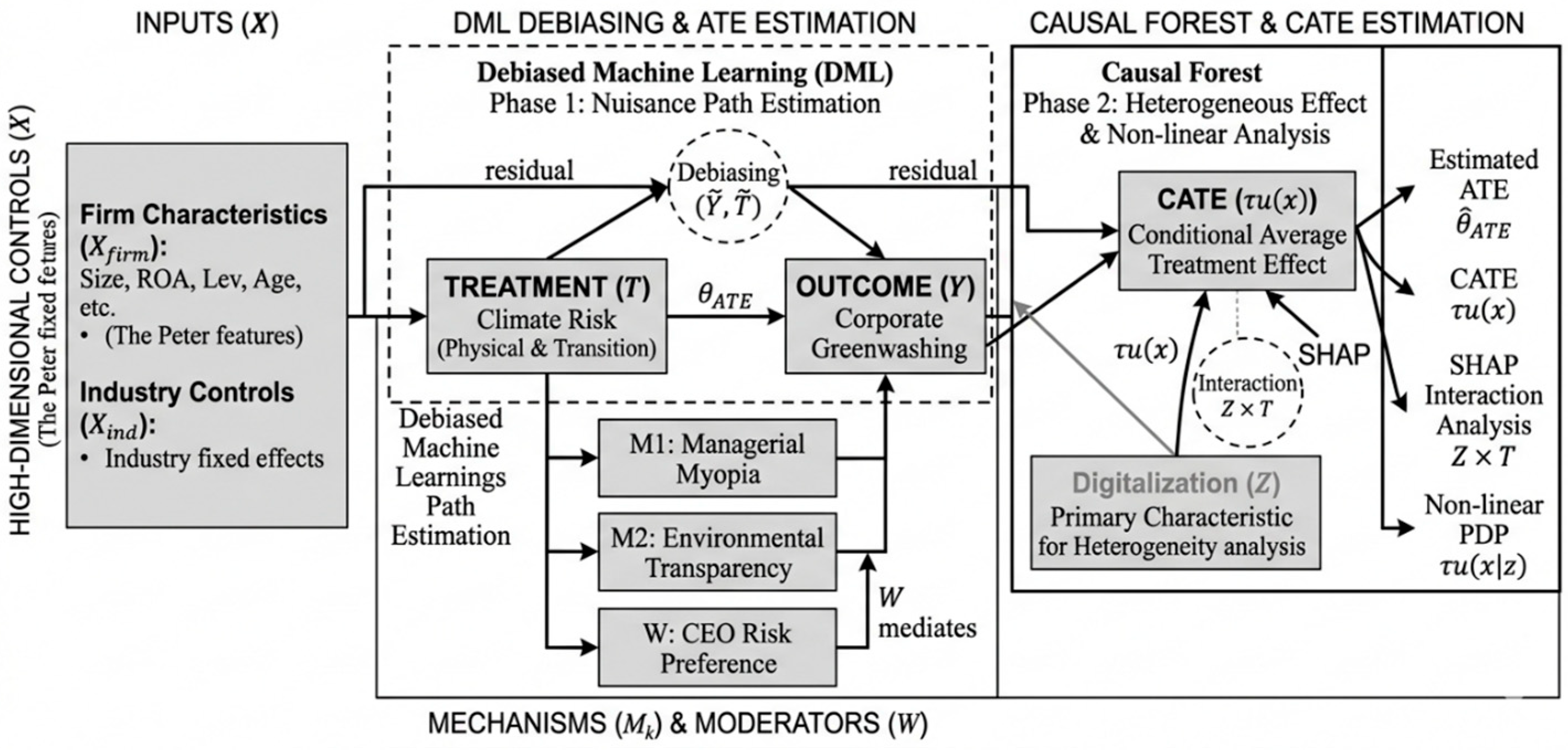
Figure 1 presents the empirical framework.
3. Materials and Methods
A Debiased Machine Learning (or Double Machine Learning, DML) framework [
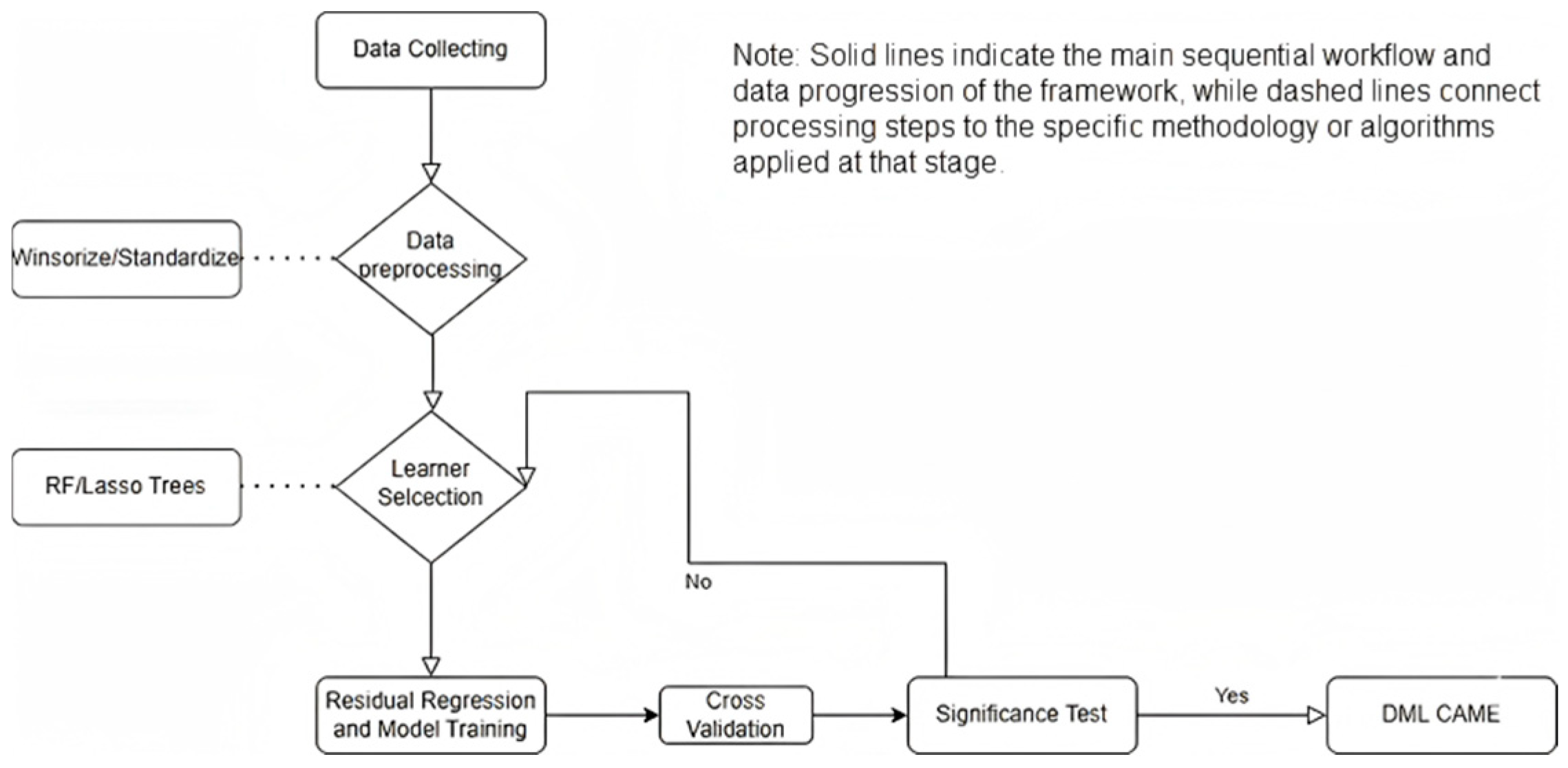
15] is suggested in this section. The working flow of Debiased Machine Learning is depicted in
Figure 2. Data collection, data preprocessing, learner selection, residual regression and model training, cross validation, significance test, and CAME estimations are the seven processes in the procedure.
3.1. Data Collecting
Our initial sample spans Chinese A-share listed enterprises operating in high-emission industries from 2009 to 2024. The target industries are designated based on the Key Energy-Consuming Industries Directory promulgated by the Ministry of Ecology and Environment of China, capturing eight carbon-intensive sectors: power, steel, building materials, nonferrous metals, chemicals, petrochemicals, papermaking, and aviation.
Firm-level financial indicators, internal governance structures, and executive socio-demographic profiles are obtained from the China Stock Market Accounting Research (CSMAR) database. To robustly capture the tension between firms’ ecological commitments and operational realities, we construct multi-dimensional metrics for environmental performance: symbolic corporate greenwashing (
GW_score) and substantive eco-efficiency (
Real_Eff). Following standard data-cleaning conventions, we exclude: (i) Special Treatment (ST and *ST) firms due to imminent financial distress (see
Supplementary Information S5.3 for full sample results), and (ii) observations with missing structural information. All continuous variables are winsorized at the 1st and 99th percentiles to eliminate outlier distortions, yielding a final unbalanced panel of 4395 firm-year observations for the core DML analysis.
3.2. Climate Risk
3.2.1. Physical Risk
Physical risk measures the objective exposure level of an enterprise’s operational location to extreme weather conditions, such as extreme high temperatures, floods, droughts, and typhoons. This paper manually collects the latitude and longitude coordinates of the office addresses of A-share high-emission enterprises and performs spatial matching with a high-resolution historical database of extreme disasters from the China Meteorological Data Network.
Specifically, this study constructs a physical risk exposure index based on the attenuation of geographical distance. For the physical risk faced by enterprise i in year t, the calculation formula is as follows:
where
represents the sum of disaster k in year t (such as rainfall deviation, typhoon level, or the number of hot days) [
56], the intensity has been standardized;
is the spherical distance between enterprise i and the center of disaster k;
is the preset distance threshold and is set as 200 km, which is approximately the radius covering prefecture-level cities or neighboring cities within the same province. Within this distance, climate disasters (such as typhoons and extreme heavy rains) not only damage the factory assets of enterprises, but also significantly impact the local supply chain, logistics and power supply. This is the most significant radius where physical risks come into play; and
is the weight coefficient for different types of disasters. This indicator achieves the transition from perceiving risks to objective exposure and more accurately captures exogenous shocks determined by geographical location [
44,
57]. The robustness checks by changing the threshold are reported in
Supplementary Information S5.3.
3.2.2. Transition Risk
Transition risks reflect the pressure and legal constraints faced by enterprises regarding low-carbon policies. This paper employs text mining methods to extract keywords related to climate policies from the Management Discussion and Analysis (MD&A) sections of enterprise annual reports, thereby measuring the sensitivity of management to the external regulatory environment. The definition is as follows:
The keyword library for transition risk encompasses specific regulatory terms such as “carbon peak,” “emission quotas,” “green taxation,” and “energy structure adjustment.” Unlike the geographical nature of physical risks, transition risk focuses on the objective regulatory compulsion that constrains an enterprise’s strategic decisions, such as greenwashing or substantive transformation. To ensure the validity of this measure and mitigate confounding effects from textual verbosity or general industry trends, we employ a Relative Textual Density (RTD) approach. First, to avoid “false alarms,” we conduct manual and corpus-based cleaning to eliminate sentences that merely describe generic industry prospects or provide boilerplate compliance statements. Second, we define the raw risk intensity as the frequency of these refined keywords normalized by the total number of sentences in the MD&A section. This sentence-level density is more robust than word-count normalization, as it effectively isolates specific information from the “filler-word” strategies or redundant linguistic styles often used by management. Finally, we perform an Industry-Year Median Adjustment by subtracting the concurrent industry median from each firm-year observation. This procedure effectively filters out macro-level policy shocks—such as the 2020 “Dual Carbon” target announcement—that would otherwise cause a systemic rise in keyword frequency across all firms. The resulting
indicator accurately captures the incremental transformational pressure an enterprise faces relative to its peers. To verify this indicator’s effectiveness,
Table 1 reports the correlation analysis between our measure and the intensity of actual macro-environmental regulations at the provincial level.
The results show that the enterprise transformation risk calculated in this study is significantly positively correlated with the actual number of low-carbon policies implemented by each province at the 1% level (with a correlation coefficient of 0.345). This strongly proves that the risk perception mentioned by the management in the MD&A is not ‘empty talk’, but truly reflects the external policy pressure and compliance costs faced by the enterprise. This consistency lays a reliable measurement foundation for the subsequent research of this paper on the impact of climate risks on greenwashing behavior.’
3.3. CEO Risk Preference
This study believes that executives’ attitude towards risk will inevitably be mapped into their behavioral decisions [
58], and then affect the operating results of the company. Referring to the previous literature [
59,
60], this study selects the following six financial indicators from the five dimensions of asset structure, solvency, profit structure, profit distribution and cash flow, and uses principal component analysis (PCA) to extract the principal components reflecting the risk preference level of executives. In addition, a CEO behavior and personal characteristics is added to the analysis to further recognize the impact of behavior traits and CEO background [
54,
61,
62,
63,
64]. To address the potential reverse causality issue, this paper uses a one-period lagged variable of CEO risk preference in the baseline regression:
For detailed features, please refer to
Supplementary Information S1. To eliminate the excessive dependence of the PCA comprehensive index on a single original variable, this paper conducted a sensitivity test using the Leave-one-variable-out method. Specifically, we successively removed one variable from
, and then re-performed principal component analysis using the remaining 6 variables. The results (
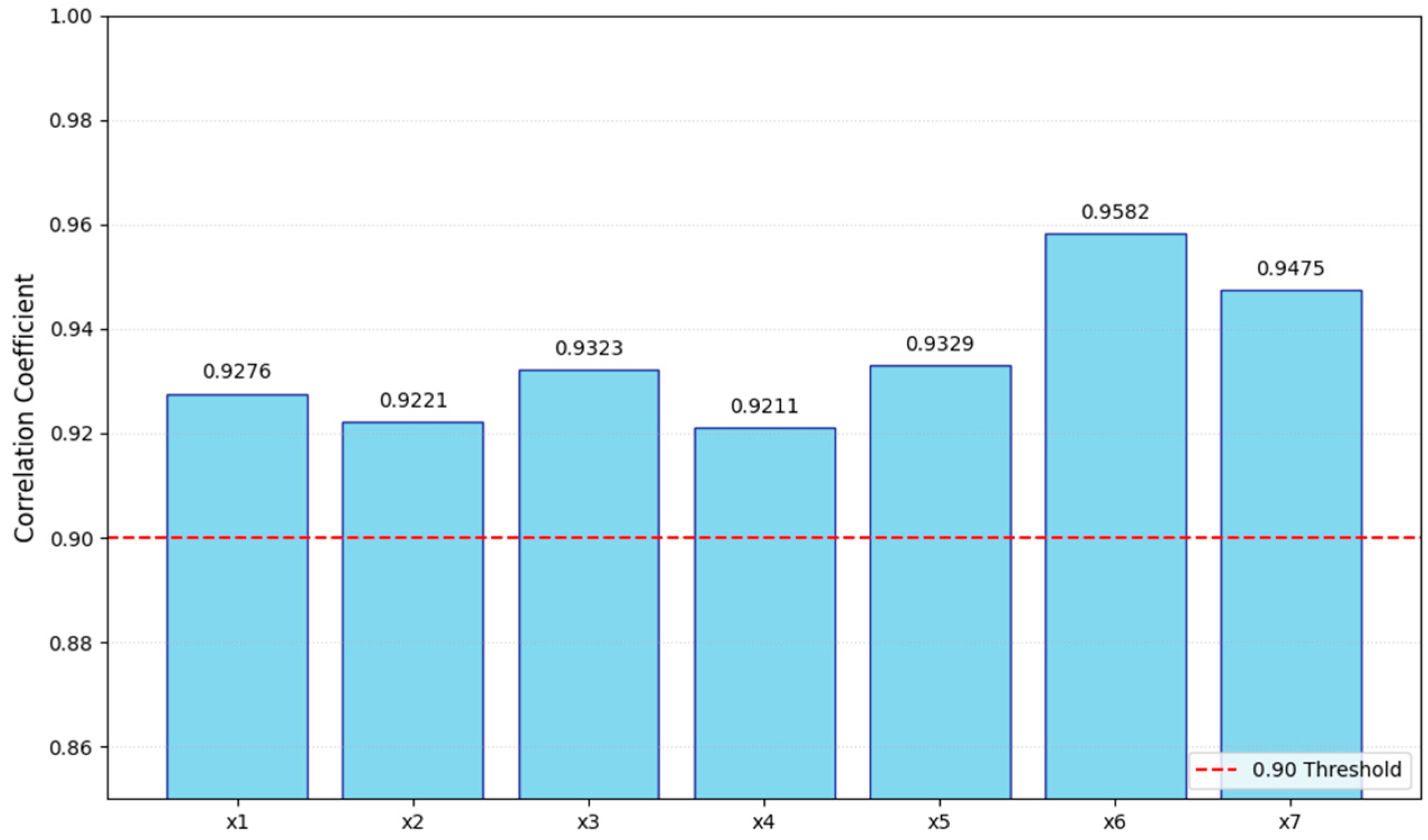
Figure 3) show that the correlation coefficient between the new principal component scores obtained after removing any one variable and the benchmark scores is all higher than 0.90. This strongly proves that the CEO risk preference index constructed in this paper has extremely strong internal consistency. Its measurement results are not disturbed by abnormal fluctuations of specific single indicators (such as the debt ratio or the CEO’s background), thus ensuring the robustness of the empirical conclusion. To avoid mechanical multicollinearity, we exclude
from covariates when CEO risk preference is considered in the model.
3.4. Real Pollution Control Efficiency
This paper employs the Slack-Based Measure [
65] that takes into account undesirable outputs to calculate the pollution control efficiency of enterprises in reducing pollution emissions while maintaining economic output. The efficiency is calculated as:
3.5. Greenwash
According to previous definition [
31], greenwashing refers to the act of enterprises making false or misleading statements about their environmental protection commitments. To accurately quantify this behavior, this paper constructs two-dimensional indicators: Symbolic disclosure level (
) and the substantive performance level (
) following relative studies [
66,
67]:
where Symbolic disclosure level (
) uses the Bloomberg environmental disclosure score. This score specifically assesses the detail of information disclosed by enterprises in their ESG reports, representing the “verbal commitment” of the enterprises. And the substantive performance level (
) is measured by the Wind environmental score. This score places greater emphasis on the actual pollution discharge indicators, environmental violation records, and substantive emission reduction achievements of the enterprises, representing their “actual actions”.
In order to eliminate the influence of different rating systems on the dimension, this paper standardizes the above two scores at the “annual-industry” level. and represent the average and standard deviation of the corresponding scores within the same year and the same industry, respectively.
Furthermore, in order to verify the robustness of the conclusion, this paper also conducted alternative tests in the following sections by using a binary greenwashing identification variable (
DGW) constructed based on “annual report keyword frequency” and “administrative penalty records”. Firstly, we need to separately evaluate the oral “green propaganda” (
Oral) and the actual environmental performance (
Actual) of the enterprises [
68,
69]. We constructed a term set related to the degree of greenness or the environment, including terms such as “green”, “environmental protection”, “low carbon”, and “environment”. Then, for each enterprise’s annual observation data, we analyzed the frequency of these terms appearing in the management and disclosure sections of the annual reports. For
Oral, when the frequency of occurrence in the observation data is higher than the median of the same industry in the same period, the value is 1; otherwise, it is 0. For the
Actual value, when the enterprise’s annual observation data is subject to environmental administrative penalties, the value is 1; otherwise, it is 0. In summary, the calculation method of the proxy variable for “green whitewashing” (
DGW) of the enterprise is as follows:
3.6. Mechanisms: CEO Myopia and Disclosure Opacity
To overcome the potential measurement bias in the text analysis method, this paper adopts the CEO compensation duration (
Duration) as a proxy variable for short-sighted behavior [
70]. This indicator measures the degree to which the interests of the management are tied to the long-term value of the company by calculating the weighted average of the expiration times of various components (base salary, bonus, restricted stocks, options) in the CEO’s compensation package:
where
represents the expected salary cash flow for the CEO in the t-th year. T represents the unlocking or exercise period for each component of the compensation. Among them, the basic salary and the annual bonus’ duration is set to 0 (to be paid in the same year, representing extremely short-term incentives). For restricted stocks and stock options, the weighted time is calculated based on the specific annual vesting plans of each type.
This paper measures the opacity of enterprise information disclosure using Analyst Forecast Dispersion. a metric widely recognized in the previous literature as a reliable proxy for the informational environment quality [
71,
72]. The underlying economic intuition is that professional analysts act as sophisticated information intermediaries; when a firm’s disclosures are transparent and predictable, analysts are more likely to reach a consensus on its future performance. Conversely, as climate-related transition risks escalate, they introduce substantial uncertainty regarding asset valuation and regulatory compliance costs, which “shrouds” the firm’s true economic state. We define and calculate
as the standard deviation of earnings-per-share (EPS) forecasts for firm i in year t, scaled by the absolute value of the mean forecast to ensure cross-sectional comparability:
where j denotes the individual analysts providing forecasts for the target firm. A higher
Opacity value indicates a greater degree of disagreement among market experts, reflecting a more “noisy” or “opaque” information environment. By adopting this market-based measure rather than a self-reported disclosure index, we capture the realized informational friction resulting from climate shocks.
3.7. Covariates
Following previous studies [
25,
32,
47,
73], this study adds 33 different firm features and covariates for DML. See
Supplementary Information S3 for detailed variable definitions and summary statistics.
3.8. Residual Regression and DML Model Training
The fundamental principle of Debiased Machine Learning is “orthogonalized residual regression,” which reduces the impact of initial-stage estimation errors on causal inference after computing the conditional expectation functions [
15]. For a detailed explanation of the specific learners employed in the DML framework, please refer to
Supplementary Information S4. The first step in this estimation procedure is residualization:
The residuals
and
represent the dependent variable and the treatment variable after removing the influence of the covariate
, capturing the parts of change in
Y and
D that cannot be explained by
X. Then the model is implemented with OLS regression:
where ATE is denote by the coefficient
. In addition, to avoid overfitting, K-Fold cross-validation (K = 5) is used for sample hierarchical training and prediction residual construction. First, Divide the population sample set
D into
K parts:
Next, the first
k compromise uses all training machine learning algorithms to provide predictions based on
in addition to
:
That is, the predicted value of
for each sample is given by a model trained without its own subsamples, ensuring that the predictions are unbiased. Therefore, the average prediction error of the entire K-fold cross-validation can be written as:
where L is the loss function. In addition, this study employs the causal forest framework [
16], which enables the estimation of Conditional Average Marginal Effects (CAME) for each individual firm. This approach allows for a granular exploration of how the treatment effect of climate risk on greenwashing behavior varies across diverse firm characteristics. By capturing such individual-level heterogeneity, the model identifies the specific conditions under which enterprises are more predisposed to strategic disclosure in response to environmental shocks.
The target of interest for each firm is:
The implementation of the causal forest in this research follows classical framework [
74] and begins with the honest splitting of samples, where the observations are divided into distinct training and estimation subsets to effectively mitigate the risk of overfitting. Within each generated causal tree, node splitting is performed by identifying the specific variables that best distinguish differences in the Conditional Maximum Effect. The model then achieves stable estimation through forest aggregation, which involves calculating the average treatment effect across a multitude of individual trees. The resulting output encompasses the Conditional Average Marginal Effect (CAME) at the individual level, alongside the mean, median, and overall distribution of the CAME. Furthermore, the model identifies significant variations in variable heterogeneity after performing a sample grouping based on the median values. The final CAME derived from the causal forest estimation is formulated as follows:
4. Results
4.1. DML Settings
4.1.1. Hyperparameter Settings
To avoid estimation bias arising from potential misspecification of the first-stage nuisance models, we adopt the Debiased Machine Learning (DML) framework [
15]. We simultaneously employ two complementary learners—Random Forest (RF) and Lasso—to estimate the conditional expectation functions E[Y|X] and E[T|X]. RF captures potential interaction effects and non-linear relationships among high-dimensional covariates, while Lasso performs variable selection and sparse modeling via L1 regularization, making it well suited for screening high-dimensional control variables. The simultaneous use of RF and Lasso is strategic: RF is uniquely positioned to capture the non-linear and interactive influences of CEO risk preference on greenwashing behaviors, while Lasso provides interpretable variable selection for a wide range of provincial-level macro-controls.
For RF, we use GridSearchCV with 5-fold cross-validation to tune the hyperparameters. Following the recommendations related literature [
75], we search: n_estimators in {300, 500, 1000} to ensure convergence; max_depth in {5, 7, 10} to prevent overfitting; and min_samples_leaf in {5, 10, 20} to enhance generalization. The scoring metric is cross-validated R
2. The optimal hyperparameters are max_depth = 7, min_samples_leaf = 10, and n_estimators = 500. For Lasso, we rely on the built-in 5-fold cross-validation of the LassoCV class to automatically select the regularization parameter alpha. This procedure minimizes the cross-validated prediction error and avoids subjective bias in manual alpha tuning.
Before DML estimation, we apply the double-selection method [
76]. Specifically, we take the union of covariates retained by Lasso when regressing each outcome variable Y and each treatment variable T on X, and use this union as the final covariate set. This alleviates concerns about over-control and collider bias arising from high-dimensional controls.
For sample splitting, we adopt the standard K = 5-fold cross-fitting strategy. This choice balances the reduction of overfitting bias with computational efficiency. Standard cross-fitting mitigates the variability of the estimated causal parameter that may result from random sample splits, while avoiding the heavy computational burden of a larger number of folds. Because a single random split could still affect estimation efficiency, we repeat the cross-fitting procedure 10 times (n_rep = 10) and report the average estimate, thereby improving the stability of the estimator and its standard errors.
To control for unobserved heterogeneity across industries and over time, we further include industry and year fixed effects as additional binary covariates in the covariate set. These fixed effects are treated as ordinary control variables and are absorbed into the nuisance functions E[Y|X] and E[T|X] during the first-stage estimation. The orthogonalization step then partials out the influence of both the continuous controls and the fixed effects, ensuring that the estimated causal parameters are identified from within-industry and within-year variation after removing time-invariant industry characteristics and common time shocks. To account for potentially correlated shocks within firms over time, we employ cluster-robust standard errors at the firm level across all repetitions of the DML procedure.
Table 2 summarizes the configurations of the two learners and their hyperparameter settings. Hyperparameter tuning results based on different model settings and learners are reported in
Supplementary Information S5.
4.1.2. Covariates Selection
To address the potential issues of over-control and collider bias arising from high-dimensional control variables, we adopt the Double Selection method [
76] and conduct variable screening prior to DML estimation. Specifically, for each treatment variable (
Physical_Risk,
Transition_Risk) and each outcome variable (
GW_score,
Real_Eff), we employ Lasso regression with a regularization parameter alpha = 0.01 to select variables with non-zero coefficients from the 33 initial control variables. The choice of alpha = 0.01 reflects a conservative screening strategy, allowing Lasso to retain a broader set of potentially relevant variables and thereby avoiding the omission of important confounders.
Table 3 reports the Lasso selection results for each target variable, as well as the final union set. The results indicate that 19 variables are retained when the target is
GW_score, 13 variables are retained for
Real_Eff, and 22 variables are retained for each of the climate risk variables (
Physical_Risk and
Transition_Risk). The variation in selected variables across target variables suggests that different outcomes and treatments are driven by different sets of covariates. For example,
Real_Eff retains only 13 variables, implying that its actual emission reduction efficiency is mainly explained by a few core financial and governance indicators (e.g.,
ROA,
cash flow,
quick ratio,
growth rate,
board size). In contrast, the climate risk variables retain a larger set of covariates (22 variables each), indicating that climate risk is influenced by a broader range of financial and governance characteristics.
Taking the union of the four Lasso selection results yields a final set of 29 variables—only 4 of the original 33 covariates are excluded by all models. This nearly complete union selection strategy leverages the advantage of Lasso in removing noise variables from individual regressions, while the union operation prevents the omission of potentially important covariates that may be relevant only for specific target variables. Another benefit of retaining almost all variables is that in the first stage of DML, the learners (Random Forest and Lasso) can still exploit the full set of original information, while the double-selection step mainly serves to exclude clearly irrelevant variables. As a result, the approach controls dimensionality while maintaining inclusiveness for potential confounders. All covariates are predetermined (measured before the outcome and treatment) to avoid post-treatment bias, and the double-selection union approach retains confounders conservatively.
Overall, our variable selection strategy satisfies the robustness requirements of high-dimensional control without excessively reducing the covariate set, thereby providing a sufficiently rich conditioning set for the subsequent DML estimation. The detailed variables selected is reported in
Supplementary Information S6.
4.1.3. Orthogonality Diagnostics
Table 4 reports the orthogonal diagnostic results and cross-validation R
2 of the first-stage conditional expectation function under each outcome variable, treatment variable, and learner combination. The main findings are as follows:
First, the absolute values of the residual correlation coefficients ρ for all combinations are all less than 0.1, and the corresponding p-values are all greater than 0.10 (ranging from 0.16 to 0.91). The non-significant correlation between the residuals suggests that, after partialling out the influence of high-dimensional observed characteristics, no simple linear association remains between the residualized treatment and outcome variables. This alignment with the expectations of the DML first-stage ‘orthogonalization’ ensures that the identified causal parameter is immune to biases arising from omitted covariates or functional misspecification. Therefore, the setting of the conditional expectation function E[Y∣X] and E[T∣X] is reasonable, and the orthogonality condition is satisfied, which lays the foundation for subsequent unbiased causal inference.
Second, the cross-validation R2 of the first-stage model for E[Y∣X] and E[T∣X] is all positive and of a certain magnitude. For the outcome variable GW_score (greenwashing index), the CV R2 ranges from 0.154 (Lasso and Transition_Risk combination) to 0.298 (RF and Physical_Risk combination); for Real_Eff (real pollution control efficiency), the CV R2 reaches a maximum of 0.705 (Lasso). These positive values indicate that the selected control variables and the learner can effectively explain the variation in the outcome variable and the treatment variable. Although DML does not require the first-stage model to have very high prediction accuracy, the moderate R2 values further confirm the effectiveness of the anonymous model (nuisance models) and the rationality of the orthogonalization step. The variation in R2 across different models reflects the heterogeneous predictive power of financial covariates on substantive efficiency versus strategic disclosure behaviors.
Thirdly, the orthogonal diagnostic results are highly consistent across the two learners (RF and Lasso) and the two climate risk indicators. The orthogonality condition is satisfied under all settings, and the predictive performance shows good stability. In summary, these diagnostic tests confirm the appropriateness of our DML setup and provide support for the causal estimation results reported in
Table 4.
4.2. DML Main Results
Table 5 presents the estimated associations between climate risks and corporate greenwashing as well as real emission efficiency under the DML framework. While DML helps to control for high-dimensional confounding, the results should be interpreted with the usual caution regarding causal inference from observational data.
For the continuous greenwashing score (GW_score), both physical and transition risks exhibit positive and statistically significant coefficients across the two learners. Specifically, the coefficients for physical risk are 0.7115 (t = 2.906) under RF and 0.3884 (t = 8.455) under Lasso; those for transition risk are 0.8204 (t = 3.035) and 0.4037 (t = 6.611). The binary greenwashing indicator (DGW) yields consistently positive and significant results (all t-values > 5.0). These findings suggest that firms facing higher climate risks tend to engage in more symbolic environmental disclosure or “greenwashing”. The pattern is consistent with a defensive greenwashing motivation, whereby firms may resort to strategic disclosure in response to climate pressures rather than undertaking substantive green transformation. In particular, the differences between the RF and Lasso estimation results imply that the impact of climate risks on greenwashing may exhibit nonlinear characteristics: when the risk pressure is low, the strategic responses of enterprises are relatively weak; but once the risk exceeds a certain threshold, the behavior of greenwashing may rapidly intensify. The consistently higher coefficients observed under the RF learner compared to Lasso (e.g., 0.7115 vs. 0.3884 for Physical Risk) suggest that climate-induced greenwashing is not a simple linear process. Rather, it may involve threshold effects or complex interactions with CEO traits, where the motivation to greenwash escalates exponentially once risk pressures surpass critical corporate endurance levels.
The reported “Residual R
2” values are small (ranging from 0.01 to 0.11), which is typical for DML regressions. Nevertheless, the consistently significant coefficients and the orthogonality diagnostics (see
Table 4) support the reliability of the estimates.
Taken together, the DML analysis reveals a robust positive statistical association between climate risks and corporate greenwashing, while no such association is found for real emission efficiency. Crucially, across all DML specifications and alternative measures (SBM vs. CCR-DEA, see
Supplementary Information S5.3), we find no statistical evidence that climate risks promote substantive green transformation (
Real_Eff). This decoupling of symbolic disclosure from actual performance provides empirical support for the ‘Defensive Greenwashing’ hypothesis. While the lack of a significant impact on
Real_Eff could also reflect operational rigidities or resource constraints in the short term, its coexistence with significantly increased symbolic disclosure suggests a tendency toward strategic signaling rather than fundamental reconfiguration. However, a persistent strategic behavior of greenwash is identified by System GMM (See
Supplementary Information S9 for details).
4.3. Moderating Role of CEO Risk Preferences
To further explore the potential heterogeneity in how climate risks relate to corporate behavior, this paper employs a lagged CEO risk preference (at t − 1) as a moderating feature within the Causal Forest DML framework. By employing the lagged (t − 1) CEO risk preference as the moderating feature, we mitigate simultaneity bias and ensure that the captured heterogeneity reflects the modulation effect of pre-existing psychological traits on subsequent climate-related decision-making, rather than a synchronized reaction to the same economic shock.
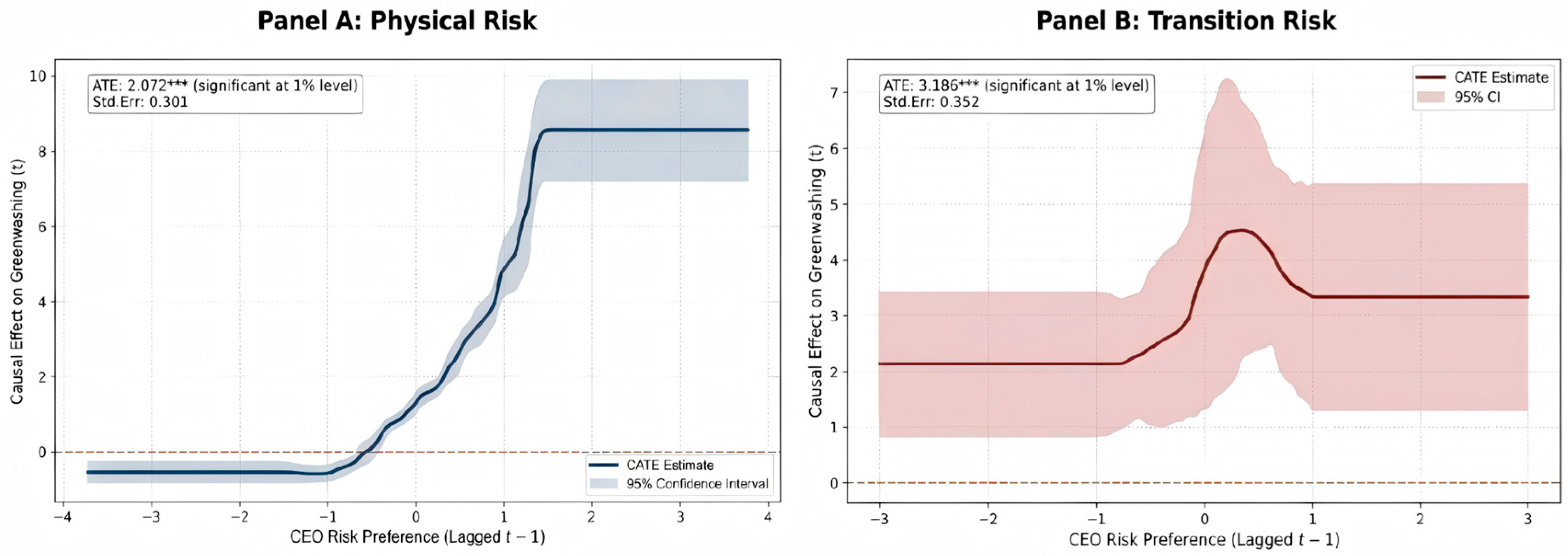
Figure 4 illustrates the estimated Conditional Average Treatment Effect (CATE), revealing non-linear patterns that suggest a complex interplay between managerial style and risk exposure. In Panel A (Physical Risk), the results indicate that the association between physical risk and greenwashing is relatively suppressed when the lagged CEO risk preference is low. Notably, a non-linear transition appears as the risk preference moves into the positive domain, where the estimated treatment effect exhibits a step-wise increase. This pattern suggests a “threshold-trigger” mechanism: managerial risk tolerance may act as a catalyst that amplifies the corporate tendency to use symbolic disclosure as a buffer against physical disasters, but this amplification only becomes prominent after a specific psychological threshold is crossed. The ATE of 2.072 (
p < 0.01) provides empirical support for the statistical significance of this observed heterogeneity. In Panel B (Transition Risk), the CATE estimates display a distinct asymmetric structure with a more pronounced sensitivity compared to physical risk. While transition-related pressures show a limited relationship with greenwashing among risk-averse managers, the link intensifies markedly as the lagged risk preference turns positive. The CATE curve for transition risk exhibits an inverted U-shaped tendency at high levels of risk preference, suggesting a saturation point. This implies that while risk-seeking managers are more prone to strategic greenwashing, there may be a ‘self-constraint’ mechanism or a fear of heightened regulatory scrutiny (reputation cost) that prevents greenwashing from escalating indefinitely, even under extreme risk-taking orientations. The larger ATE for transition risk (3.186, Std.Err: 0.952) compared to physical risk (2.072, Std.Err: 0.301) suggests that the corporate strategic response to policy-induced shocks is more volatile and sensitive to managerial styles than the response to tangible physical disasters.
4.4. Mechanism Channels
After identifying the main effect and the moderating role of managerial style, this paper employs a moderated mediation framework to explore the potential channels through which climate risk is associated with corporate greenwashing behavior. Using segmented regression under the DML framework and causal forest-based estimation, this study identifies two plausible mechanisms that appear to be regulated by CEO risk preference: the induction of managerial myopia and the amplification of information opacity.
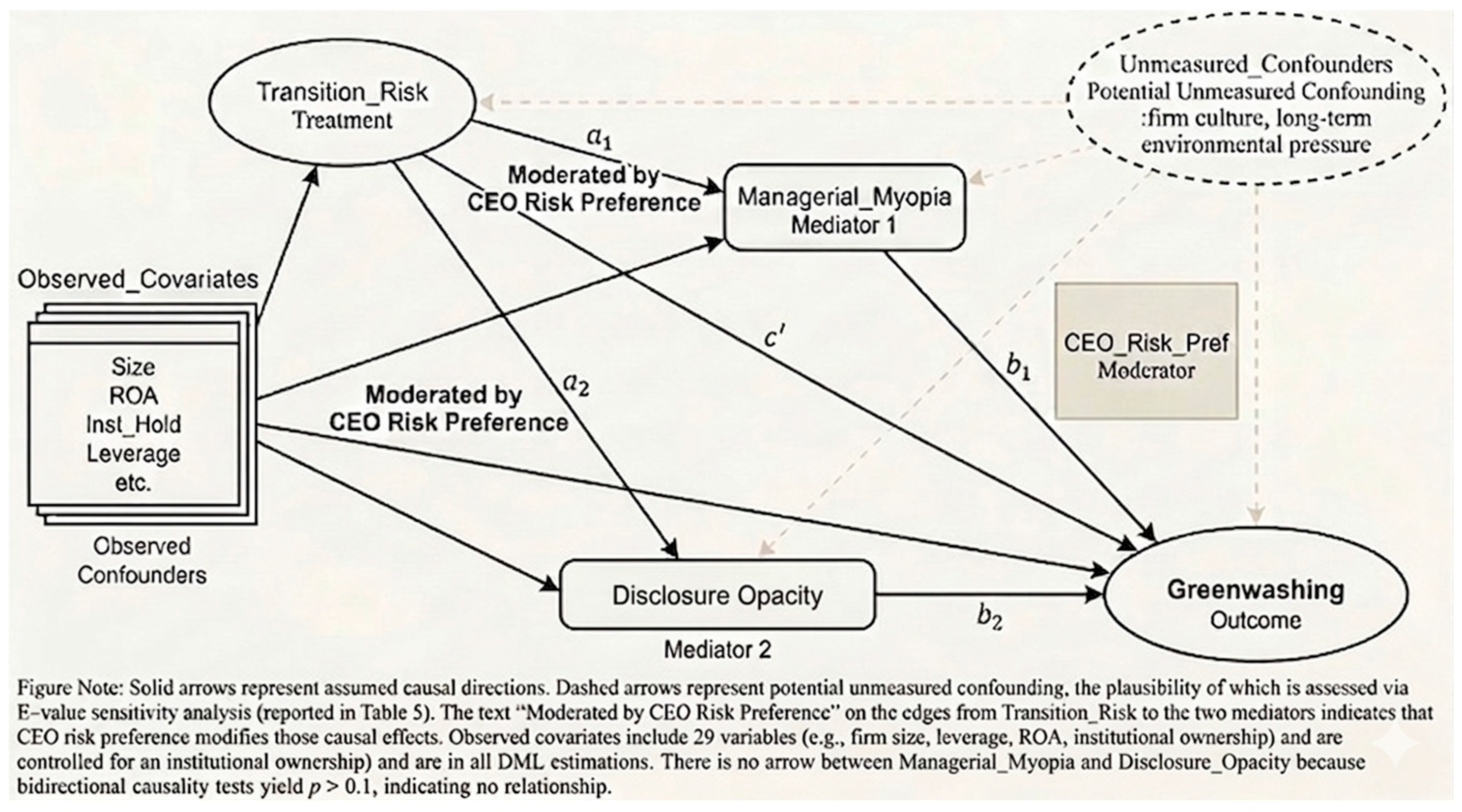
In this analysis, the focus shifts to transition risks. This choice is grounded in the observed divergence of strategic motivations under different climate pressures. While physical risks typically manifest as uncontrollable external forces causing tangible asset damage, transition risks—arising from policy shifts and technological paradigms—form a complex institutional pressure. Such pressure may enter the decision-making function more directly, suggesting a potential strategic trade-off between long-term sustainability and immediate valuation survival. To assess the internal validity of these channels, we map our assumptions using a Directed Acyclic Graph (DAG) (see
Figure 5).
Regarding the Managerial Myopia Channel,
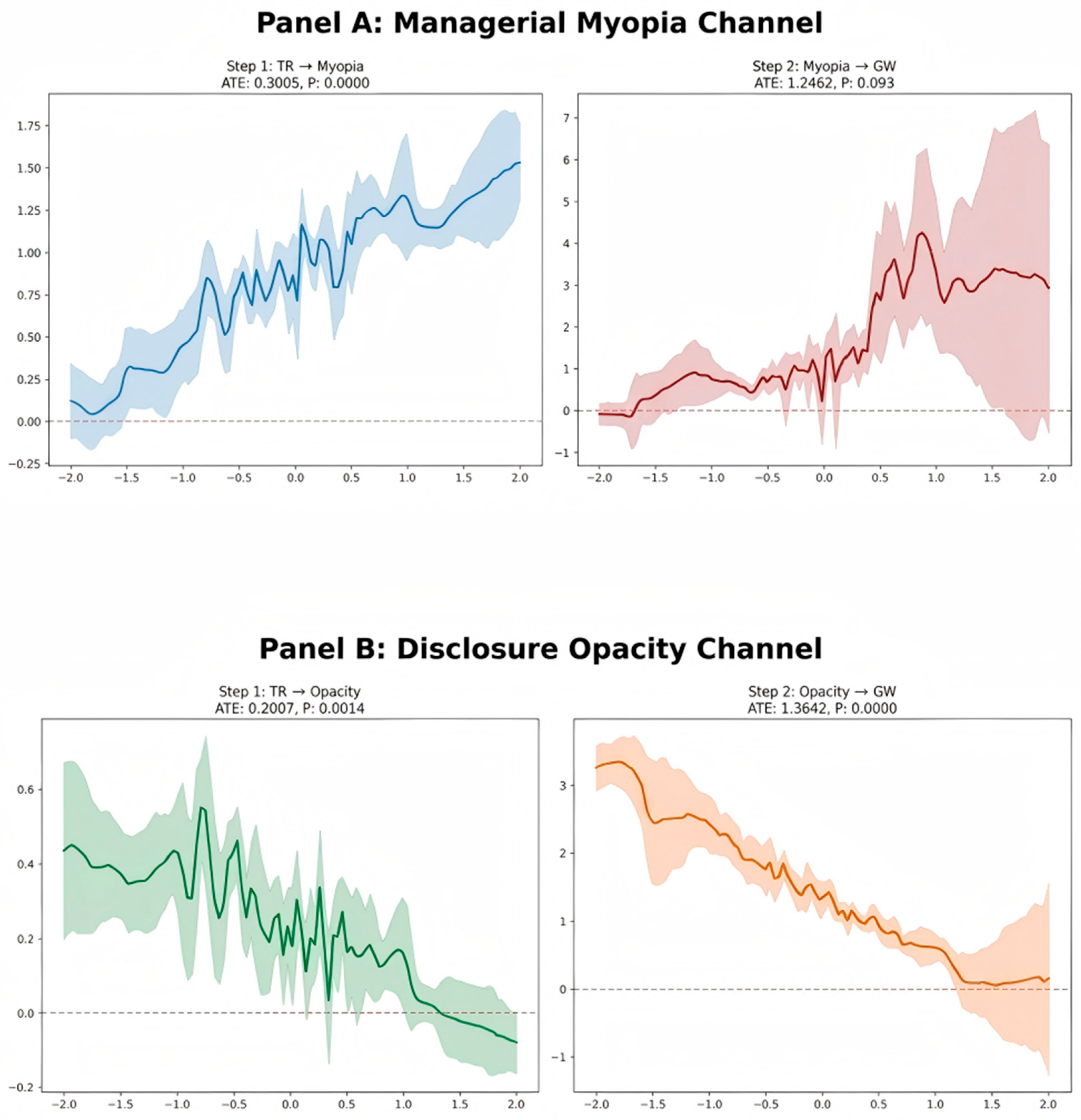
Table 6 reports a significant positive association between transition risk and myopia
= 0.3005, t = 3.538) and between myopia and greenwashing
= 1.2463, t = 6.690). This is further elucidated in Panel A of
Figure 6, where the Step 1 plot demonstrates a monotonic relationship. Notably, the Step 2 plot reveals that the marginal link between myopia and greenwashing is not uniform; instead, it exhibits a sharp upward “jump” once short-termism crosses a critical threshold. This suggests that the indirect association of 0.3745 reported in
Table 6 may be predominantly driven by firms under acute psychological strain.
Simultaneously, for the Information Opacity Channel,
Table 6 provides evidence that transition risk is associated with increased
opacity = 0.2007, t = 8.037), which in turn facilitates intensified greenwashing (
= 1.3642, t = 2.625). As
transparency is steadily eroded (Step 1), firms may face fewer informational constraints, making deceptive signaling a more accessible strategic outlet (Step 2). The indirect effect of 0.2738 characterizes this channel as a consistent “informational shroud” that may enable firms to capture green premiums while evading effective scrutiny.
Figure 6 employs non-parametric DML estimations to unveil these distinct trajectories. In Panel A, the widening confidence intervals at higher risk levels depict a heterogeneous decision-making landscape: faced with similar regulatory pressures, some management teams maintain resilience while others appear to succumb to existential anxiety. The “non-linear leap” in Step 2 reflects what could be interpreted as a state of “desperate gambling”: when psychological pressure reaches a breaking point, greenwashing may cease to be a subtle adjustment and instead become a “last-resort” manipulation.
In contrast, Panel B depicts a process of “incremental erosion.” As transition risk intensifies, analyst disagreement expands at a nearly constant rate, reflecting how climate policy complexity may act as a thickening “fog.” The robust, linear correlation in Step 2 suggests that every incremental loss in transparency is converted into expanded “strategic space” for greenwashing. While the myopia channel represents an “acute stress response,” the opacity channel functions more like “institutional arbitrage,” where firms may capitalize on a deteriorating informational environment.
To account for potential sequential ignorability violations, we incorporate E-value sensitivity analysis (
Table 6). The calculated E-values (3.459 for
myopia; 2.118 for
opacity) indicate that any unobserved confounder would require a substantial risk ratio to invalidate these findings—a scenario that is less probable given our extensive control for 29 firm-specific covariates and the temporal precedence established in
Supplementary Information S7.
4.5. Heterogeneity Analysis Based on Causal Forest
4.5.1. Features Contribution
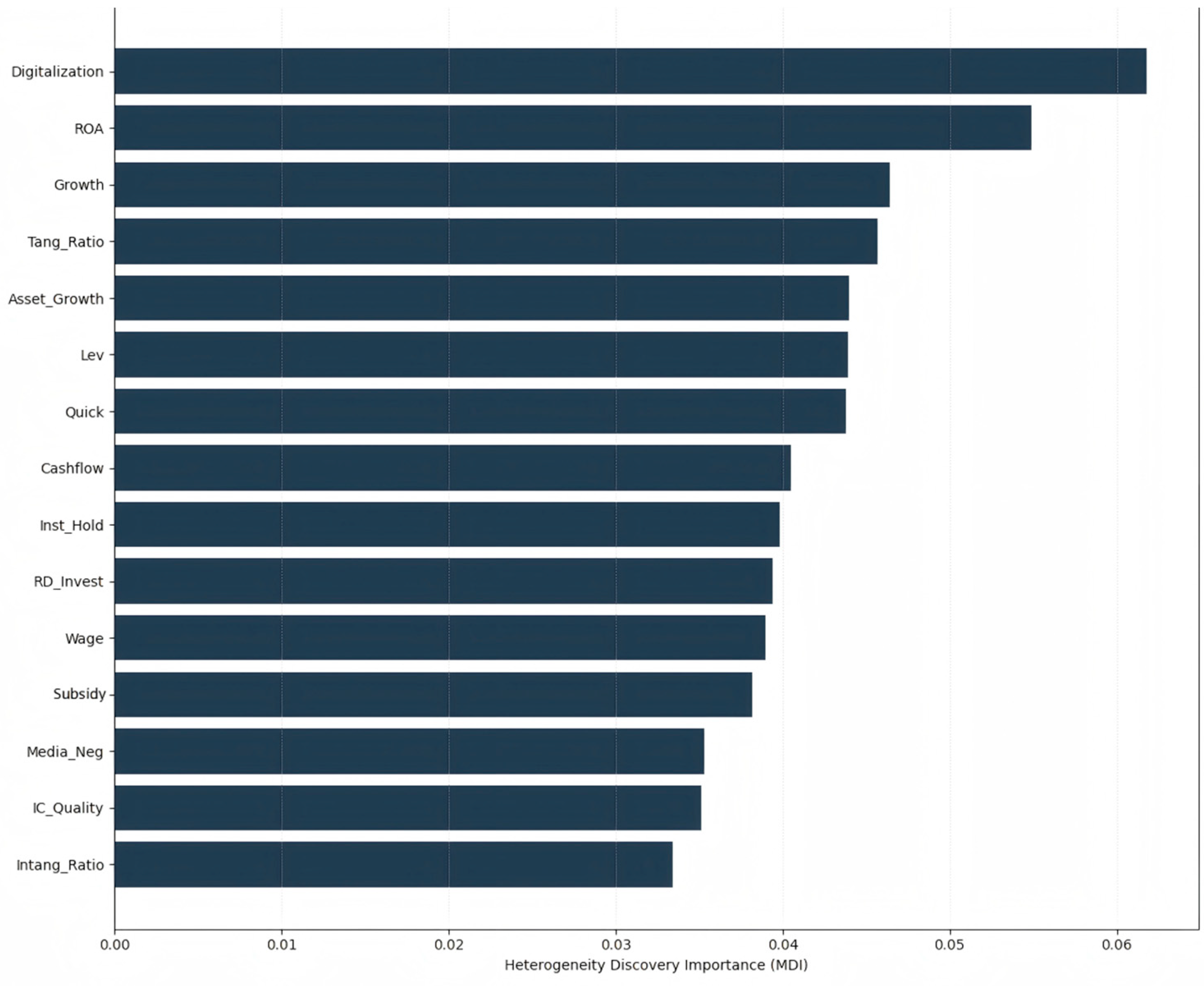
To delineate the boundaries and conditional factors governing the “symbolic vs. substantial” response gap, this study employs the Causal Forest algorithm [
16] to calculate the Heterogeneity Discovery Importance (MDI) of covariates (see
Figure 7). To enhance the robustness of our findings and address potential high-dimensional confounding, we implement a Double Selection procedure. Among the 33 candidate covariates, 29 were retained based on their predictive power for both climate risk exposure and disclosure indicators.
Figure 7 presents the MDI scores, revealing which firm-level characteristics are most closely associated with the variations in the Conditional Average Marginal Effects (CAME). The results suggest that
Digitalization ranks as the most significant factor in explaining heterogeneity. This finding is consistent with the information opacity mechanism: a high level of digitalization is associated with increased disclosure complexity, which may lead to diminished clarity in environmental reporting when firms face external financing incentives.
Following Digitalization, financial indicators such as ROA, Growth, and Tang_Ratio emerge as important moderators. The high ranking of financial stability metrics suggests that for firms with constrained liquidity, the costs of climate transition may be more significant, potentially correlating with a tendency to prioritize symbolic reporting over substantive changes. Furthermore, the role of Subsidy and RD_Invest suggests that resource constraints may influence how firms navigate transition pressures. In summary, the MDI ranking indicates that corporate responses to climate risk are multi-dimensional, reflecting an interplay between digital capabilities, financial conditions, and the firm’s oversight environment.
4.5.2. Heterogeneous Marginal Effect Trends
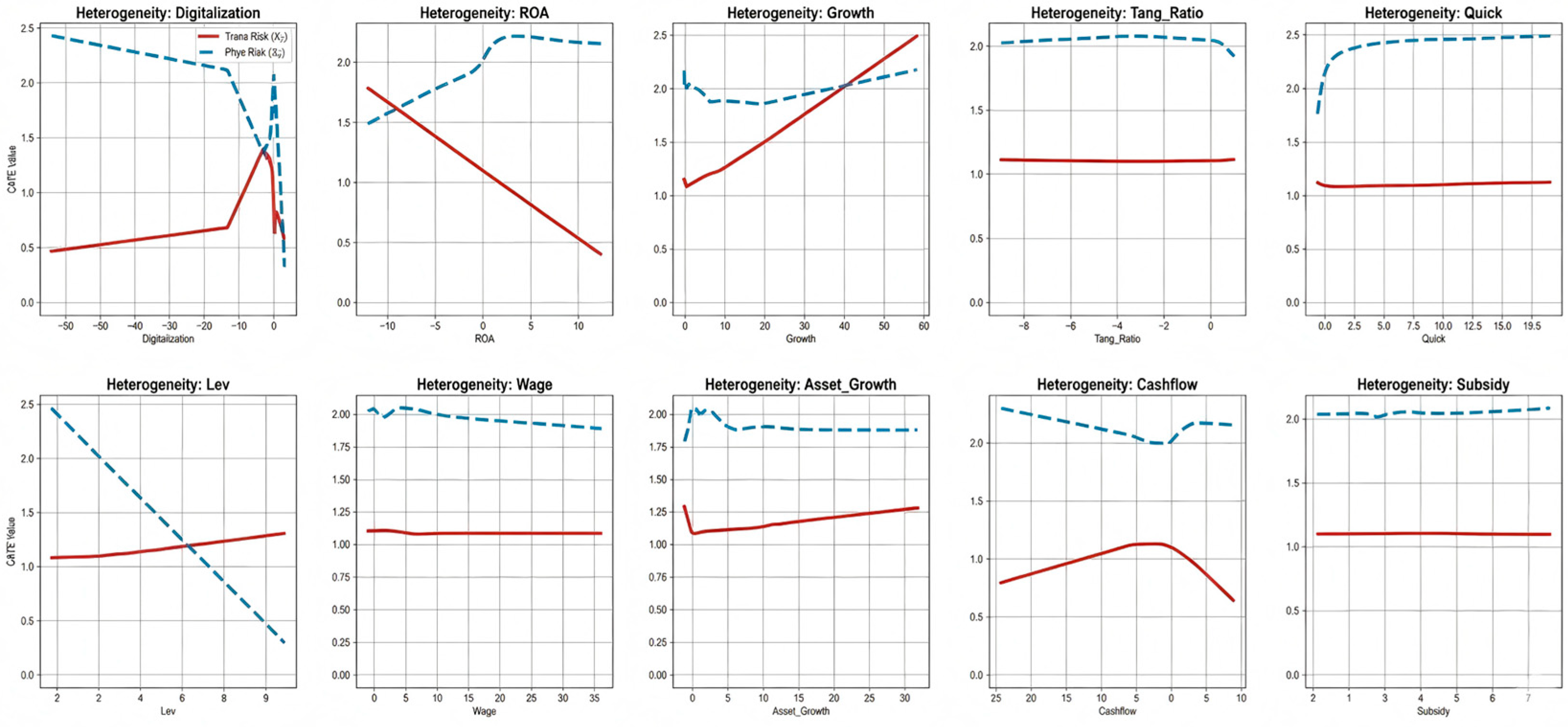
Figure 8 presents the heterogeneous marginal effects estimated via the generalized random forest algorithm. To enhance reliability, the estimation incorporates the Honest Inference framework alongside Out-of-Bag (OOB) predictions. This procedure ensures that the marginal effect for each observation is generated using a subsample not utilized during the training phase, addressing potential concerns regarding over-fitting. In this visualization, the red solid line represents the predicted conditional marginal effect of transition risk, the blue dashed line represents that of physical risk, and the vertical axis captures the estimated tendency toward symbolic disclosure.
The results for Digitalization reveal a distinct divergence in corporate responses. In the Digitalization subgraph, as digital maturity increases, the marginal effect of transition risks exhibits a non-linear upward shift, while the impact of physical risks demonstrates a downward trend. This divergence is consistent with the hypothesis that digital transformation is associated with a greater capacity for adjusting disclosure in response to policy-driven transition pressures. The heightened sensitivity of the transition risk curve may reflect the role of digital tools in managing complex environmental narratives under regulatory stress, rather than purely substantive improvements.
The trends for profitability (ROA) and growth potential (Growth) align with differing response patterns based on financial health. For transition risk, the ROA subgraph shows a clear negative slope: as profitability improves, the estimated tendency toward symbolic disclosure significantly weakens. This suggests that firms with lower financial performance show a higher correlation with such behaviors, potentially reflecting a low-cost response to climate-induced financial pressure. In contrast, the Growth subgraph exhibits an upward trajectory for transition risk, indicating that firms in rapid expansion phases—which may face higher pressure to maintain a “green” market image—are more likely to exhibit symbolic responses when sensing policy shifts.
The analysis of financial constraints and Subsidy further refines the micro-landscape. The downward slope in the Leverage (Lev) subgraph for physical risk suggests that highly leveraged firms may exhibit different response patterns, possibly due to heightened monitoring that limits disclosure flexibility. Additionally, the relative stability across Subsidy and Tang_Ratio suggests that these responses are more sensitive to internal financial and digital profiles than to external governmental support.
In summary, the heterogeneous responses captured in
Figure 8 indicate that symbolic environmental disclosure is associated with a complex interplay of digital capabilities, financial health (
ROA), and market expansion needs (
Growth).
4.5.3. SHAP Analysis
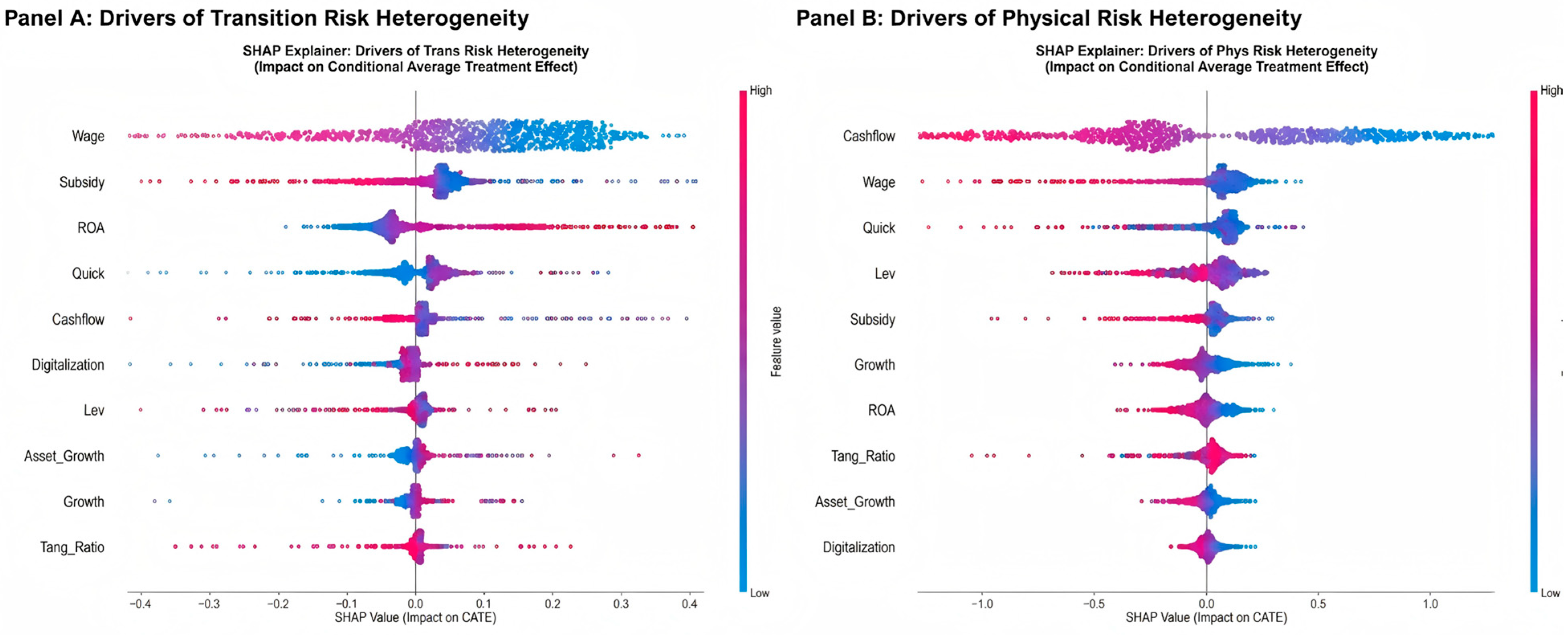
After characterizing the global marginal trends, this study employs SHapley Additive exPlanations (SHAP) to decompose the predicted heterogeneity at the granular sample level. While the marginal trend plots (
Figure 8) visualize the structural functional forms, the SHAP scatter plots (
Figure 9) provide a granular validation by illustrating the contribution of each specific observation to the estimated effects.
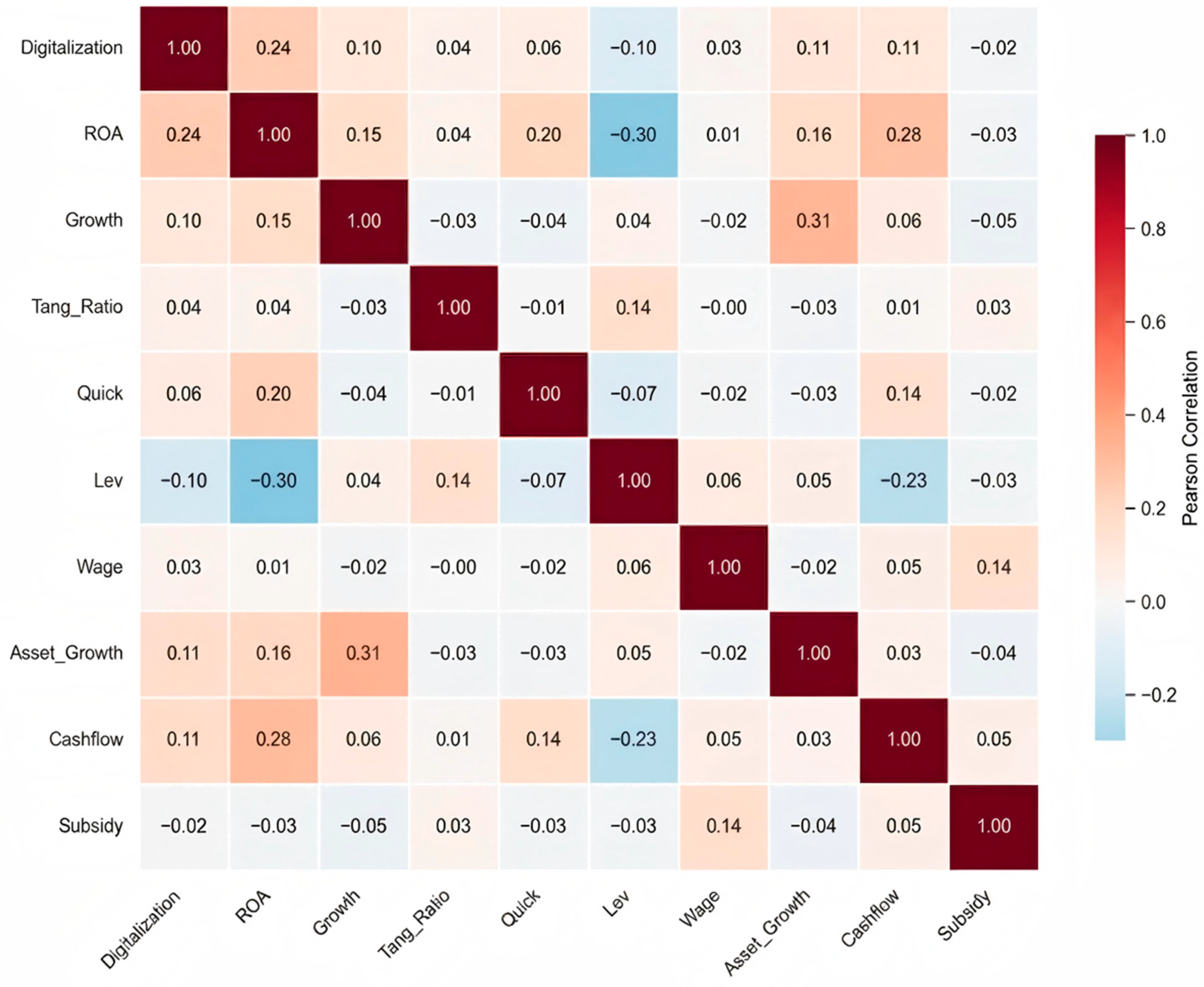
To ensure the statistical reliability of these decompositions, we first address potential concerns regarding feature correlations. As illustrated in the Pearson correlation matrix (
Figure 10), the pairwise correlations among the ten variables are generally low-to-moderate, with all coefficients remaining below 0.6. Furthermore, we employ a SHAP explainer that accounts for the conditional dependence of features, ensuring that each covariate’s contribution reflects its role within the observed joint distribution rather than unrealistic feature combinations.
Panel A of
Figure 9 (Transition Risk) identifies
Wage and
Subsidy as prominent factors associated with response divergence, followed by
ROA. Observations with lower wage levels and poorer profitability (low
ROA) are predominantly concentrated in the positive SHAP region. This suggests that firms characterized by higher labor costs or financial constraints exhibit a higher estimated tendency toward symbolic disclosure when facing transition pressures. Notably, Digitalization exhibits a distinct pattern where high feature values concentrate in the positive SHAP interval. This is consistent with the hypothesis that digital tools, in certain contexts, may be associated with more complex disclosure adjustments rather than immediate substantive efficiency gains.
Panel B of
Figure 9 (Physical Risk) reveals that
Cashflow and
Wage are closely linked to the heterogeneity, reflecting a mechanism potentially related to financial profiles. Observations with low cashflow are densely packed in the positive SHAP region, with an impact magnitude exceeding that of other governance variables. This indicates that liquidity stress is associated with a higher frequency of symbolic disclosures, possibly acting as a buffer against the perceived financial risks of physical shocks. The relative stability across dimensions like
Tang_Ratio and
Subsidy further suggests that the response to physical risk is more closely aligned with internal financial conditions than with institutional support or asset structure.
In conclusion, the alignment between the global patterns (
Figure 8) and the local contributions (
Figure 9) demonstrates the robustness of our findings. The heterogeneity in corporate climate responses reflects systematic patterns associated with digital capabilities, financial conditions, and resource constraints, rather than isolated outliers.
4.5.4. Firm Profiling: Who Are the Greenwashers
After completing the heterogeneity analysis, this study constructs representative profiles of enterprises exhibiting distinct estimated responses to climate risk. To enhance statistical reliability and mitigate potential over-fitting, we implement a split-sample validation protocol. The DML framework is trained on an 80% hold-out set, while the firm profiling and mean-difference tests are conducted exclusively on the remaining 20% independent testing set (N = 879). Observations in the testing set are categorized into a High Sensitivity Group and a Low Sensitivity Group based on their Conditional Average Marginal Effect (CAME) values.
As reported in
Table 7, firms in the High Sensitivity Group exhibit characteristics consistent with high resource availability and digital maturity. In the dimensions of
Digitalization and
ROA, the high-sensitivity group shows significantly higher mean values (differences of 0.1275 and 0.4559, respectively;
p < 0.01). This is consistent with the hypothesis that firms with higher information-processing capabilities and financial slack may have a greater capacity for complex environmental reporting. Furthermore, this group demonstrates robust financial flexibility, characterized by significantly higher quick ratios and cashflow (Diff = 0.2371,
p < 0.01), coupled with lower leverage and wage burdens. This suggests that the tendency toward symbolic disclosure is more pronounced among financially healthy firms, which may utilize their resource positions to manage market perceptions under climate-related transition pressures.
To further validate that these profiling results reflect structural patterns rather than statistical noise, we conduct a placebo grouping test (
Table 8). By randomly assigning sensitivity labels, we observe a systematic collapse of statistical significance across all ten dimensions. The T-values, which were significant in the primary classification, vanish in the placebo set, supporting the robustness of our sensitivity-based stratification.
In summary, this section identifies the typical profile of a firm with a higher estimated propensity for symbolic environmental responses: high digital maturity, strong liquidity, and lower labor-cost pressure. These findings suggest that under certain conditions, enterprises may leverage their technical and financial positions to prioritize signaling-based disclosure, reflecting a potential gap between reported commitments and substantive green competitiveness.
4.6. Endogeneity Problems and Robustness Checks
Based on the IV-DML results reported in
Table 9, we construct two time-varying instrumental variables to address potential endogeneity. For transition risk, the instrument is the interaction between the one-year lagged Climate Policy Uncertainty Index (
CPU_lg1) and a firm-specific Sensitivity Index. For physical risk, we employ the interaction between the one-year lagged extreme event frequency (
EVO_lg1) and the same Sensitivity Index. This index, derived via PCA from 29 base-period characteristics, captures persistent heterogeneity in firms’ responsiveness while allowing for firm-year variation through interaction with aggregate shocks.
The first-stage results confirm strong relevance: the CPU_lg1×Sensitivity Index interaction is positively associated with transition risk (coef = 0.3103, t = 3.667), and the EVO_lg1×Sensitivity Index interaction is associated with physical risk (coef = 0.2653, t = 4.294). The Kleibergen-Paap Wald F-statistics (26.88 and 37.16) exceed the Stock-Yogo critical value of 10, rejecting weak instrument concerns. In the second-stage IV-DML estimation, the coefficients for physical risk (0.4038, t = 3.389) and transition risk (0.3006, t = 4.358) remain positive and significant at the 1% level. Notably, the control function residuals enter the second stage insignificantly, supporting the exclusion restriction.
Complementing the IV analysis, we performed a series of robustness checks detailed in
Supplementary Information S5. The ablation study (
Table S5) demonstrates that the full DML + RF framework is essential, as simpler OLS or non-cross-fitted models suffer from either linear bias or overfitting. Furthermore, results remain stable across alternative physical risk thresholds (50 km, 100 km), exponential decay functions, and when using environmental penalties as an alternative measure for transition risk (
Table S7). These extensive tests alleviate concerns that the results are artifacts of arbitrary modeling choices or measurement bias.
5. Discussion
5.1. The “Threshold-Trigger” Mechanism: Why Climate Risks Drive Non-Linear Defensive Greenwashing
The DML results (
Table 5) reveal a positive association between climate risks and symbolic disclosure while highlighting a notable methodological divergence: the coefficients estimated via Random Forest (RF) are consistently higher than those from Lasso (e.g., 0.7115 vs. 0.3884 for physical risk). In terms of economic significance, considering the standardized variables, a one-standard-deviation increase in physical risk is associated with a 0.7115 unit increase in the
GW_score under the RF specification. Given that the baseline (mean)
GW_score in our sample is approximately 0.148, this represents a substantial relative escalation in greenwashing intensity.
This discrepancy suggests that the relationship between climate shocks and corporate disclosure is characterized by non-linearities that linear models fail to capture. For high-emission enterprises, the response to climate pressures appears more pronounced as risk levels intensify. This “threshold effect” implies that policy interventions based on linear assumptions may significantly underestimate the surge in symbolic signaling when climate risks cross critical corporate endurance levels. The observed gap between reporting intensity and substantive efficiency (Real_Eff) reflects a decoupling where disclosure serves as a signaling buffer to maintain legitimacy amidst rising decarbonization costs.
From a modeling perspective, the gap in estimated effects between RF and Lasso underscores the importance of accounting for complexity in high-emission sectors. These results suggest that as climate shocks increase, firms may find it more feasible to adjust their narratives than to undergo immediate, high-cost technological overhauls. This decoupling implies a potential risk of capital misallocation, as linear models may underestimate the extent of symbolic signaling. Such findings suggest the need for more nuanced green asset pricing models to better account for the varying nature of corporate climate responses during the low-carbon transition.
5.2. Managerial Risk-Taking: The Psychological “Accelerator” of Regulatory Arbitrage
The economic responses to climate shocks are contingent upon executive characteristics. Our GRF analysis indicates that CEO risk preference functions as a significant moderator, with the effect for transition risk (3.186) being notably higher than that for physical risk (2.072). This implies that for every one-standard-deviation shift in a CEO’s risk-taking propensity, the firm’s sensitivity to transition-related regulatory shocks increases by more than three times the baseline response.
For firms led by high-risk-preference executives, stringent climate policies—such as the tightening of the Carbon ETS—are associated with a more pronounced tendency toward symbolic disclosure. This pattern suggests that such firms seek to manage the perceived costs of compliance through “regulatory arbitrage,” favoring narrative adjustments over the high capital expenditure (CapEx) required for substantive carbon reduction.
However, the observed diminishing marginal effects at extreme risk-preference levels may indicate a potential boundary condition. This could reflect the influence of external monitoring mechanisms—such as the oversight of ESG-conscious institutional investors—which may impose a latent constraint on the extent of symbolic reporting. For high-emission industries, these results imply that while executive risk profiles are associated with variations in climate disclosure, the capital market’s monitoring environment remains a critical factor in shaping corporate reporting behavior.
5.3. The Capability Paradox: Digitalization and the Efficiency of Deception
The SHAP decomposition (
Figure 9) and firm profiling (
Table 7) highlight a “Capability-Response Gap”. Firms with high digital maturity and financial liquidity exhibit a more pronounced tendency toward symbolic disclosure rather than substantive transition. Economically, this is driven by the fact that the “marginal cost of signaling” (e.g., refining ESG reports via digital tools) is substantially lower than the “marginal cost of radical innovation” (e.g., implementing CCS technology).
This incentive structure presents a major challenge for policymakers: First, information asymmetry: Digital tools, while intended for efficiency, may be leveraged to increase disclosure complexity, making it harder for regulators to verify substantive performance. Moreover, capital misallocation: If firms with high digital capabilities secure “green premiums” through symbolic disclosure, they may lower their financing costs despite a lack of real emission reductions. Lastly, policy intervention: To counter this, oversight must shift from “disclosure-based” to “performance-linked” mechanisms. If a 1-SD increase in risk leads to a huge increase in greenwashing among the most “capable” firms, the public cost of verifying transition claims rises exponentially, necessitating targeted audits for digitally mature leaders in high-polluting sectors.
In terms of economic significance, this pattern suggests a potential friction in the allocation of green capital within high-emission industry. The SHAP values (
Figure 9) and MDI rankings (
Figure 7) indicate that digitalization is a primary determinant of the variance in corporate responses. The resulting information environment implies that firms with high digital capabilities may be more effective at securing “green premiums,” potentially lowering their cost of financing despite their actual environmental footprint.
5.4. Boundary Conditions and Generalizability
While this study focuses on Chinese renewable energy and high-emission enterprises, the findings offer broader implications for the global low-carbon transition, albeit with specific boundary conditions: First, emerging market context. The “Capability Paradox”—where high digital maturity facilitates symbolic signaling—is particularly relevant for emerging markets. In these settings, the rapid adoption of digital tools often outpaces the development of independent environmental verification infrastructure, lowering the relative cost of strategic disclosure. Second, regulatory maturity. A key boundary condition is the stringency of the legal environment. In jurisdictions with robust anti-greenwashing litigation and mature carbon auditing (e.g., the EU), the “defensive greenwashing” observed here might be mitigated by higher legal and reputational costs. Last, future research. Due to data constraints, a direct cross-country comparison was not feasible in this study. Future research should leverage international datasets to examine how different corporate governance norms and climate policy stringency moderate the impact of physical and transition risks on the decoupling of disclosure from substantive performance.
6. Conclusions and Policy Recommendations
6.1. Conclusions
This study investigates the relationship between multi-dimensional climate risks and corporate environmental disclosure behavior within China’s high-emission industries from 2009 to 2024. By utilizing a Double Machine Learning (DML) framework and Generalized Random Forest analysis, we address high-dimensional confounding—a critical factor in heavy industries with complex production linkages—to provide a more robust estimation of these associations. The empirical findings suggest several key insights:
First, both physical and transition climate risks are positively associated with an increase in symbolic greenwashing behavior. In high-emission sectors, where structural decarbonization and energy system overhauls require massive, irreversible capital expenditure, heightened climate pressure is associated with a tendency toward defensive reporting adjustments. Faced with significant transition costs and stringent environmental mandates, these firms may utilize expanded disclosure as a strategic buffer to manage legitimacy pressures and mitigate the perceived impact of climate shocks on their market valuation. Notably, the lack of significant improvement in substantive emission-reduction efficiency suggests a potential decoupling between reporting intensity and actual environmental performance.
Second, the association between climate risk and symbolic disclosure exhibits substantial heterogeneity. Specifically, firms led by CEOs with a higher risk-taking propensity and those with greater “resource slack” (e.g., higher liquidity and digital maturity) exhibit a more pronounced tendency toward this response gap. In the context of heavy industry, this pattern is consistent with an economic trade-off: firms may prioritize managing the immediate information environment to navigate the high marginal costs associated with radical green innovation, such as CCUS technology or hydrogen smelting.
Notably, our analysis reveals a “digitalization-response gap” that is particularly acute in high-emission samples. While digital transformation is a potential catalyst for operational efficiency, it may also provide carbon-intensive firms with the technical capacity to manage environmental narratives with greater complexity. This increased disclosure sophistication may inadvertently widen the “monitoring gap” for regulators in sectors where actual emissions are costly to verify. These results remain robust across various alternative specifications, validation tests, and identification strategies.
Overall, the findings suggest that for high-emission industries, climate-related pressures may lead to a divergence between symbolic signaling and substantive action. This underscores the importance of developing more stringent, performance-linked oversight mechanisms to ensure that climate governance promotes genuine industrial decarbonization rather than strategic information adjustments.
6.2. Policy Recommendations
Based on the empirical evidence, this study proposes the following policy interventions to transition from “symbolic compliance” to “substantive transformation”:
First, implement “performance-linked” green financing for high emission industry. Transition from disclosure-based incentives to performance-linked financing. For high-emission firms, capital access and interest rates should be pegged to verified reductions in carbon intensity and energy-saving efficiency, rather than the presence of “green keywords” in annual reports.
Second, bridge the “digital monitoring gap”: Regulators should deploy AI-driven audit tools to detect “textual calibration” in digitally mature firms. Given that these firms possess the resources for sophisticated manipulation, oversight must move toward real-time, IoT-based monitoring of physical emission points to close the gap between digital narratives and industrial reality.
Third, mandate standardized transition path disclosures: To counter the “Capability Paradox,” policymakers should require high-emission firms to disclose specific, stage-based technical pathways (e.g., equipment upgrade schedules). This increases the “marginal cost of deception” by making vague, symbolic claims easier to debunk.
6.3. Limitations
Despite the methodological rigor provided by the DML framework, this study has the following limitations:
Endogeneity Challenges: Although instrumental variable (IV) strategies were employed, the reliance on observational data means that unobserved time-varying confounders cannot be entirely ruled out. Future research could utilize exogenous policy shocks or natural experiments to further strengthen the causal identification of “defensive greenwashing.”
Generalizability and Context: The findings are situated within the specific institutional and regulatory environment of China’s high-emission industries. The relationship between climate risk and greenwashing may vary across countries with different levels of ESG market maturity and regulatory stringency, warranting further cross-national comparative studies to verify the boundary conditions.