Article

Exploring the Linkages Between Climate Change, Food Security, Economic Growth, and Migration in Selected Countries


1
Department of Economics, Hasan Kalyoncu University, 27010 Gaziantep, Türkiye
2
Department of Political Science and International Relations, Hasan Kalyoncu University, 27010 Gaziantep, Türkiye
3
Department of Business Administration, Hasan Kalyoncu University, 27010 Gaziantep, Türkiye
*
Author to whom correspondence should be addressed.
Sustainability 2026, 18(10), 5135; https://doi.org/10.3390/su18105135
Submission received: 6 March 2026 / Revised: 6 May 2026 / Accepted: 14 May 2026 / Published: 20 May 2026
(This article belongs to the Section Social Ecology and Sustainability)

Abstract

This study explores the relationships among climate change, food security, economic growth, and migration in the nine countries with the lowest rankings on the Notre Dame Global Adaptation Initiative (ND-GAIN) Index. It identifies the most vulnerable countries to climate change and the least prepared, using panel data from 1999 to 2022. The results show a bidirectional causal relationship between climate change and food security. Climate change worsens food insecurity by reducing agricultural productivity, which in turn drives up food prices. Conversely, agricultural policies aimed at increasing production can contribute to climate change if implemented unsustainably. A bidirectional causal relationship has been identified between climate change, food security, and migration. Finally, a bidirectional causal relationship has also been determined between economic growth, climate change, and migration. Changes in economic growth affect sectors, the labor market, and overall well-being, which in turn influence migration decisions. All these findings provide policymakers with valuable guidance for developing sustainable strategies that consider climate change, effectively manage migration, and prioritize food security. The findings indicate that climate change, food security, economic growth, and migration cannot be addressed in isolation; therefore, a holistic policy approach should be adopted.

1. Introduction

Migration is a profound phenomenon that goes beyond simply moving people; it occurs voluntarily or involuntarily, individually or in groups, and is driven by a range of push and pull factors, with significant political, economic, and social effects. The factors determining population movements are numerous and multifaceted. Among these, climate change, defined as global or regional shifts in Earth’s climate and considered one of the “borderless” global environmental threats, is increasingly recognized as a contributing factor to migration. Extreme weather events driven by climate change, along with food and water shortages, reduce productivity, especially in agriculture- and natural resource-based economies—thereby negatively affecting economic growth. This situation leads to a decline in livelihoods and an increase in unemployment; consequently, people seek new opportunities and are driven to migrate [1,2]. Furthermore, the impacts of climate change vary by country. In regions with low economic growth and high climate risks, migration ceases to be an adaptation strategy and becomes a fight for survival.
The complex and interconnected structure between climate change, food security, economic growth, and migration can be explained by the concept of ‘polycrisis,’ introduced into the literature in the 1990s by French sociologist Edgar Morin. He argues that the world faces not just one critical problem but many interconnected issues that form a complex system. For example, climate change leads to rising temperatures and disrupts rainfall patterns, reducing agricultural productivity and threatening food security [3]. Decreased food security results in slower economic growth and lower incomes, especially in countries reliant on agriculture [4]. People experiencing income loss are often forced to migrate in search of better living conditions [5]. Therefore, climate-change-induced food insecurity can trigger migration by undermining economic growth. Collectively, this network of crises demonstrates that we are currently experiencing a period that tests the statement made by Columbia University historian Adam Tooze [6] in his article “Welcome to the World of the Polycrisis”, published in the Financial Times: “In the polycrisis, the shocks are disparate, but they interact so that the whole is even more overwhelming than the sum of the parts”.
Climate change, widely seen as an existential threat to humanity, affects nearly every country worldwide. However, researchers at Notre Dame state that people living in the least developed countries are ten times more likely to be affected by climate disasters each year than those in wealthy countries. This finding shows that although climate change is a global issue, its impacts are not felt equally across all nations. Environmental damage in less developed countries harms food security, economic development, and population migration. The study focuses on a sample of countries ranked lowest on the Notre Dame Global Adaptation Index (ND-GAIN), which are highly climate-vulnerable and have low capacity to adapt. Using panel data from nine selected countries (Chad, Central African Republic, Eritrea, Congo Dem. Rep., Guinea-Bissau, Afghanistan, Mali, Sierra Leone, Madagascar), we examine the long-term dynamic relationships between climate change, food security, economic growth, and migration.
This is the first study to analyze the relationships between these four variables within this group of countries. Firstly, these variables are directly linked to the Sustainable Development Goals. It is expected that identifying interdependent relationships among them will provide a roadmap to achieve these goals. It is significant in the need to address crises not in isolation but from a holistic perspective. Furthermore, the analysis is conducted for countries with high climate vulnerability and low adaptation capacity. It is crucial to develop robust, sustainable strategies to eliminate vulnerabilities in these countries, which are among the least developed. This is because these countries are feeling the impacts more acutely. The countries most affected by this process are those with limited institutional capacity, a fragile economic structure, and a low capacity to adapt to climate shocks. In these countries, climate dependence in agricultural production, inadequate infrastructure, and weak social protection mechanisms are further exacerbating food insecurity and increasing the risk of social instability. The greatest impact, however, is felt by economically vulnerable communities with limited migration opportunities. It is therefore of critical importance that food security, security, and migration issues are addressed holistically. Climate change poses a multi-dimensional threat that not only exacerbates the food crisis but also heightens social tensions and increases the risk of conflict. Climate-related disasters both hinder access to food and undermine economic and social stability. This creates a self-perpetuating vicious cycle between the climate crisis and conflicts.
This study is distinctive in examining variables that simultaneously function as both causes and consequences, while also analyzing their reciprocal and previously established interrelationships. Previous studies reveal not only environmental impacts but also social and economic dimensions of climate change. This knowledge helps policymakers develop more comprehensive and integrated strategies to achieve sustainable development goals, especially SDG 2 (Zero Hunger), SDG 8 (Decent Work and Economic Growth), and SDG 13 (Climate Action). Furthermore, considering the chain effects between economic growth and food security ensures that migration is viewed as an adaptation mechanism rather than a crisis [7]. This approach enables the implementation of measures to reduce climate risks, protect livelihoods, and promote stability.
Despite these insights, a notable gap remains in panel data studies that systematically examine the long-term and dynamic relationships among climate change, food security, economic growth, and migration. When previous studies are examined, it is evident that there is limited research addressing the relationship between the relevant variables. In this study, the linkage between these variables is analyzed using a sample of countries ranked lowest on the Notre Dame Global Adaptation Index (ND-GAIN), which are highly climate-vulnerable and have low adaptation capacity. Considering all these factors, this study is expected to make a valuable contribution to existing literature both theoretically and empirically. Moreover, a key contribution of this study lies in its analysis of the relationships among these variables—previously examined predominantly within a theoretical polycrisis framework—using next-generation econometric methods.
In the introduction of this study, the existing relationships among these variables are examined from a theoretical perspective. The article includes a thorough literature review on climate change, food security, economic growth, and migration. The subsequent sections describe the model, data set, and research methods. The final sections present the findings, discussion, and conclusion, followed by policy recommendations.
In this study, the countries were selected based on the Notre Dame Global Adaptation Initiative (2023) report. According to the ND-GAIN rankings, countries ranked 178th to 187th were included in the analysis. Sudan was excluded due to the lack of reliable data for the other variables in the model. This limitation also reflects an inherent disadvantage of panel data sets [8].
These countries share a common characteristic: according to the Notre Dame Global Adaptation Initiative, they rank among the lowest globally and are among the most vulnerable to climate change. With the exception of Afghanistan, most of these countries are located on the African continent. Their common features include economies largely dependent on agriculture and livestock, low-income levels, inadequate education and health indicators, limited institutional capacity, weak infrastructure, and insufficient adaptive capacity. As a result, they are more vulnerable to the adverse effects of climate change and face significant constraints in adapting to these impacts.
Furthermore, these countries are exposed to multiple risks, including conflict, drought, and floods. Therefore, they constitute one of the most at-risk groups of countries, where high vulnerability and low adaptive capacity coexist [9].
The primary reason for selecting the 1999–2022 period in this study is that both data availability and data quality are more consistent and comparable over this timeframe. In particular, the regular and reliable availability of data for the Notre Dame Global Adaptation Initiative and other variables used in the study from these years onward played a decisive role in determining the analysis period as 1999–2022.

2. Literature Review

This chapter reviews the current literature on (1) climate change and migration, (2) climate change and food security, (3) food security and migration, (4) food security and economic growth, and (5) economic growth and migration.

2.1. Climate Change and Migration

Climate change is one of the most urgent global issues of the 21st century. Interacting with various political, socio-economic, and cultural factors, climate change plays a significant role in shaping population movements. For this reason, it is attracting increasing attention from researchers [10]. A series of empirical studies is shedding light on the relationship between climate change and migration. A significant portion of the research argues that climate change causes spatial transformations [11]; in this context, the term ‘climate refugees’ is used in the literature. Climate refugees are defined by Biermann and Boas [12] as individuals who are forced to leave their homes due to sudden or gradual changes in their natural environment, resulting from three main effects of climate change: rising sea levels, extreme weather events, and drought/water scarcity. Myers [13] describes climate refugees as a new phenomenon emerging worldwide and a growing issue of the 21st century, warning that approximately 200 million people could face displacement as the effects of climate change worsen. According to Myers [13], climate refugees are people who can no longer secure a safe livelihood in their own lands due to drought, soil erosion, desertification, deforestation, and other environmental problems, as well as related issues such as population pressure and deep poverty.
Missirian and Schlenker [14] studied how weather fluctuations in 103 source countries between 2000 and 2014 affected asylum applications to the European Union. They found that deviations from the optimal mid-range temperature (~20 °C) increased asylum applications in a non-linear manner. These findings suggest that if temperatures continue to rise, asylum applications are likely to grow. Bohra-Mishra, Oppenheimer, and Hsiang [15], in a study using data from 7185 households tracked over 15 years in Indonesia, found that changes in temperature and precipitation significantly affect permanent migration. The findings indicate that when temperatures exceed 25 °C, the likelihood of migration increases, with precipitation having a similar but weaker effect. In another study, Berlemann and Tran [16] examined the impact of climate change on migration in Vietnam, concluding that droughts trigger temporary migration, floods lead to permanent migration, and typhoons have no effect on migration. In their study exploring the relationship between short- and long-term temperature changes and internal migration in the US, Mullins and Bharadwaj [17] state that long-term temperature changes influence migration, whereas short-term temperature fluctuations do not. Trinh and Munro [18] also investigate the migration intentions of farmers living in the Mekong Delta in Vietnam, one of the regions most severely impacted by climate change globally. The study’s results show that all variables—drought severity, flood frequency, income changes due to migration, migration networks, neighbors’ preferences, and crop selection constraints—positively affect migration decisions, with drought having the greatest impact.
Biermann and Boas [12] highlight that climate change poses a threat, triggering the largest refugee crisis in human history, and that throughout this century, millions of people, primarily in Africa and Asia, may be forced to leave their homes and seek refuge elsewhere. Similarly, Rigaud et al. [19] argue that by 2050, more than 143 million people, about 2.8% of the total population in the three regions, which are expected to make up 55% of the developing world’s population, will be compelled to relocate within their own countries due to climate change. The study emphasizes that the poorest and most climate-vulnerable regions will bear the most significant burden. Suhrke [20] argues that environmental degradation can lead to both internal and external migration. This situation is prevalent in African countries, which are among the most vulnerable to climate change. Stern [21] also notes that poor countries are the first and most affected by climate change, given the potential dangers, costs, and opportunities of uncontrolled climate change. Yang (2025) [10] emphasizes that as environmental changes intensify and existing vulnerabilities deepen, people living in more fragile regions and communities are expected to migrate in search of safer, more sustainable living conditions.
Almulhim et al. [22] report that climate-related stressors in countries of the Global South have displaced and deeply affected millions of people, leading to both internal and cross-border migration. Cuong et al. [23] examine the relationship between climatic events and residents’ migration decisions on Hatiya Island. The results show that climate events on Hatiya, migration distance, and income differences influence residents’ migration decisions. Furthermore, extreme, sudden, and slow environmental changes are less likely to trigger migration than moderate ones. However, as the income gap between Hatiya and the potential destination widens, the likelihood of migration rises. Zander, Richerzhagen, and Garnett [24] found that most people living in rural areas of Indonesia, Malaysia, and the Philippines return home after floods, earthquakes, or other sudden disasters. In contrast, slow-onset hazards like heat waves can lead to permanent migration, as they typically cause more planned movements. For example, while people in Australia respond to sudden hazards with temporary migration, slow-onset hazards such as heatwaves, sea-level rise, environmental degradation, and pollution can significantly affect long-term mobility [25].
Unlike the studies mentioned earlier, some research suggests that the link between climate change and migration is weak. For example, Gray [26] investigates how land ownership and environmental factors influence migration in the province of Loja, situated in the southern Ecuadorian Andes, which features poor agricultural land and high migration rates. He argues that environmental factors are significant for internal migration, but harsh environmental conditions do not always lead to increased external migration. Moreover, Gray and Wise [27] show that climate change affects migration differently across countries. Results indicate that in Uganda, migration tends to rise with temperature anomalies. Conversely, in Kenya and Burkina Faso, this trend appears to be decreasing, whereas in Nigeria and Senegal, migration does not show a consistent link to temperature.
On the other hand, a series of studies examines the effects of migration on climate change. In their study analyzing the impact of interprovincial migration on emissions in China from 2002 to 2012, Gao et al. [28] found that trade-related migration alters the spatial distribution of carbon transfers. They argue that intense population migration alters production and consumption activities, thereby redistributing CO2 emissions across regions. The main reason for this rise is that larger cities have higher energy demand compared to smaller ones. In their study on the impact of interprovincial migration in China on emissions, Bu et al. [29] highlight that emissions increased in provinces receiving migrants due to higher urban consumption and investment. They also note that indirect carbon emissions caused by migration have a greater influence than direct carbon emissions. Morris [30], on the other hand, analyzes the expected effects of international migration-driven population changes on countries’ emission targets. The study finds a positive correlation between population size and overall emissions. Finally, Abbas et al. [31] stress that skilled labor migration helps reduce emissions in home countries.

2.2. Climate Change and Food Security

Agriculture is the sector in which the negative impacts of climate change are most strongly felt, and these effects are expected to continue [32]. Unusually high or low rainfall and temperatures have a greater impact on the agricultural sector than on other sectors, resulting in substantial crop yield losses. This leads to food insecurity and worsens access to food, especially for poor populations in developing countries. Moreover, reduced agricultural production due to climate change lowers the incomes of those working in the sector, hampers their ability to meet basic needs, and negatively affects food access across society [33]. In this context, climate change is becoming an increasingly important concern because of its potential to directly or indirectly influence our standard of living and quality of life. Therefore, this section reviews studies that analyze how climate change affects food security, either overall or by specific regions.
Wheeler and von Braun [34] point out that climate change could hinder progress toward a world without hunger. They highlight that climate variability and change could increase food insecurity in regions already vulnerable to hunger and malnutrition. Similarly, Ahmed et al. [35] suggest climate change is threatening food security and negatively impacting the country’s progress toward achieving its sustainable development goals, particularly the goals of ending poverty and ending hunger. Zougmoré et al. [36] contend also that climate change will continue to produce wide-ranging effects on the agricultural sector. The study emphasizes that poor and marginalized groups in Sub-Saharan Africa, who rely on agriculture for their livelihoods and have limited adaptive capacity, will be disproportionately affected. According to Tamako, Tamago, and Thamaga-Chitja [37], Sub-Saharan Africa faces various climate risks, including rapid and unpredictable changes in rainfall and temperature patterns. This situation may result in rising food prices and greater food insecurity. Zainal et al. [38] used the Ricardian model to calculate the marginal effects of changes in temperature and rainfall to estimate the impact of climate change on palm oil production in the Peninsular, Sabah, and Sarawak regions of Malaysia. The results showed that increases in temperature and rainfall negatively affected palm oil production across all regions and reduced net income. They also showed that the downward trend in palm oil production will continue in 2029, and that the Peninsular region will be more affected by climate change, and its production will decrease further.
In his study, Solaymani [33] analyzes the short-term and long-term effects of potential changes in rainfall and temperature on food availability and access, two key dimensions of food security in Malaysia. The findings indicate that simultaneous changes in rainfall and temperature, both in the short and long term, restrict Malaysia’s economic performance. Additionally, rainfall–temperature variability in both periods adversely affects food availability and access, leading to reduced agricultural production, inflationary pressures on commodity prices, and lower household incomes. Furthermore, the results show that shocks from climate variability reduce consumption and welfare across all household groups, especially in rural areas. Li et al. [39] found that climate change affects crop production differently across regions in China and argued that measures appropriate to local conditions should be taken to ensure the country’s food security, and that a climate monitoring system should be established. Meanwhile, Poudel and Kotani [40] empirically analyzed the effects of climate variability on agricultural yields and fluctuations using data on rice, wheat, and climate variables from central Nepal. The results show that increases in both temperature and precipitation variability generally have adverse effects on agricultural production. Akinbile et al. [41] investigated the impact of changes in meteorological parameters on fluctuations in rice yield. The results reveal significant decreases in rice yield.
Climate change is often seen as a cause of food insecurity, but the ways existing systems exacerbate climate change to secure food supplies are often overlooked [42]. In reality, agriculture is not only affected by climate change; it also plays a significant role in emitting greenhouse gases—both directly and indirectly—such as carbon dioxide, methane, and nitrous oxide. Human-caused greenhouse gas emissions each year, categorized as “agriculture, forestry, and other land use” (AFOLU) in IPCC reports, mainly come from deforestation, livestock farming, and soil and nutrient management. These emissions are estimated to make up about 21% of the world’s total greenhouse gas emissions [43].

2.3. Food Security and Migration

In 2024, over 294 million people in 53 countries faced severe food insecurity. Afghanistan, Sudan, the Syrian Arab Republic, and Yemen are among the countries with both the highest total number of people affected and the highest share of their populations affected. Additionally, the number of people experiencing severe food insecurity has tripled from 2016 to 2024 [43]. This trend clearly warns that the goal of Zero Hunger by 2030 is at serious risk. Current data indicate that a large portion of forcibly displaced people worldwide (95% of all displaced persons and 48% of refugees and asylum seekers) are located in countries or regions facing food crises. Findings from 15 countries where data on acute food insecurity are available for both the local population and displaced individuals show that displaced persons and returnees face higher rates of food insecurity than the local population. In 2024, the number of forcibly displaced persons in regions experiencing food crises reached 95.8 million [44], primarily due to a sharp rise in conflict-driven internal displacement.
On the other hand, there is a substantial body of literature demonstrating that climate-driven food crises are a significant factor in triggering migration. Arid and semi-arid regions, in particular, serve as critical laboratories for observing how environmental change induces migration. In these areas, irregular precipitation patterns, chronic water scarcity, severe droughts, soil degradation, and declining agricultural productivity exacerbate increases in food prices, hunger, and overall vulnerability. This trajectory adversely affects local livelihoods, thereby deepening poverty.
As noted by Açci et al. [45], climate change represents a critical global challenge with far-reaching consequences, particularly for the agricultural sector. Rising temperatures and the increasing frequency of extreme weather events reduce agricultural productivity, leading to higher food prices and intensifying poverty. Agriculture occupies a unique position among economic sectors in terms of its exposure to climate change, with climatic shifts likely to contribute to rising food prices. According to their analysis, climate change directly affects agricultural productivity by altering weather conditions, which constitute a fundamental input in agricultural production.
In a similar vein, Açci et al. [45] highlight that climate change generates multidimensional and mutually reinforcing effects on poverty, food security, and economic vulnerability, particularly exacerbating these challenges in developing countries. Furthermore, Frimpong [46] argues that the impacts of climate change on agriculture and food security are especially pronounced in fragile regions such as West Africa, where economic growth is closely linked to agricultural productivity.
Changes in temperature and precipitation driven by climate change reduce agricultural productivity, thereby undermining food security and increasing food prices. This situation disproportionately affects low-income populations, deepening food insecurity and exacerbating poverty. Indeed, the 2007–2008 crisis demonstrated that least developed countries with weak food security policies are more vulnerable to such shocks [46]. Similarly, Joachim von Braun and Timothy Wheeler [34] emphasize that food security is under severe threat, particularly in fragile regions.
Moreover, Kurukulasuriya and Robert Mendelsohn [47] examine the impact of climate change on agricultural land in Africa. Drawing on farm-level data obtained from a survey of more than 9500 farmers across 11 countries, the authors employ regression analysis to assess annual net revenues in relation to climate and other variables. Their findings indicate that prevailing climatic conditions significantly influence farm net incomes across the African continent.
In this context, climate change disrupts agricultural production, leading to food insecurity, which in turn catalyzes migration. As Bohra-Mishra, Oppenheimer, and Hsiang [15] point out, when climate change makes living conditions difficult or completely uninhabitable in some regions, individuals may respond by migrating to other areas. In this context, migration is a vital response to climate change. Tuholske et al. [48] demonstrate that the agricultural pathway constitutes a plausible mechanism for explaining climate-induced migration. According to this perspective, the adverse impacts of climate change on food production undermine livelihoods, thereby triggering migration from rural areas either internally or across national borders. Similarly, Falco et al. [49] argue that climate change affects food security by damaging crops and causing livestock diseases or mortality, which in turn negatively impacts livelihoods. Depending on the severity of these effects, such conditions may prompt either livelihood diversification or rural-to-urban migration as a survival strategy. In this context, as highlighted by Tuholske et al. [48], migration emerges as an adaptive mechanism through which individuals respond to the impacts of climate change and seek to strengthen their livelihoods.
Duda, Fasse, and Grote [50] investigate the impact of rural-to-urban migration on food security, using Tanzania as a case study. A 2013 survey of 900 rural households in Tanzania’s Dodoma and Morogoro regions found that migration is more common in poorer areas facing food insecurity, such as Dodoma. Additionally, migration worsens food security for rural households. This is explained by the decline in productivity resulting from reduced agricultural labor due to migration, coupled with insufficient remittance compensation. Smith and Floro [51] indicate that food insecurity is a key factor influencing both migration intentions and preparedness for migration. As food insecurity worsens, migration intentions tend to rise steadily; however, the chances of preparing for migration tend to decline. These relationships also differ significantly by gender and by the country’s per capita gross national income level.

2.4. Food Security and Economic Growth

Food security and economic growth are interconnected processes [52,53]. Studies indicate that food security contributes positively to economic growth. For example, Manap and Ismail [54] used the Generalized Method of Moments (GMM) and found that food security positively influences economic growth, with this effect being particularly strong in the arid regions of developing countries. It is concluded that improvements in food security help promote economic growth by increasing life expectancy and employment, thus reducing poverty. Erokhin and Gao [28], employing ARDL and Yamamoto causality tests across 45 developing countries, found that rising food prices threaten food security in less-developed nations, whereas in upper-middle-income countries, issues stem from changes in food trade and exchange rates. Frimpong et al. [45] examine the relationships among climate change, economic growth, food security, and agricultural expansion in West African countries from 1990 to 2020 using the panel ARDL method. Their study, covering 14 countries, highlights the positive, statistically significant impact of higher agricultural value added and food production on economic growth.
Khalifa [55] investigates how climate change, agricultural productivity, and food security influence economic growth in Tunisia using the ARDL method. Analyzing data from 1990 to 2022, the study finds that agricultural value added and food security have a positive and significant impact on economic growth. In contrast, temperature changes and annual rainfall negatively affect it by reducing agricultural output. This highlights that temperature fluctuations and rainfall harm both agricultural production and economic growth. The causality tests show a one-way causal relationship from economic growth to food security, from crop production to temperature changes, and from agricultural value added to economic growth.
In addition to the positive influence of food security on economic growth, economic growth also benefits food security. As the economy expands, individuals, especially the poor, tend to see higher incomes and improved welfare, which help them access food more easily and reduce their vulnerability to economic pressures [56]. In this context, Suryanta et al. [56] analyze the impact of climate change on food security in Central Java from 2018 to 2020 using fixed-effect (FE) and random-effect (RE) models. They find that climate change significantly affects food security, whereas rainfall and economic growth have no notable impact. Akinwale and Grobler [57] highlight in their study that traditional farming methods in Africa are unsustainable and emphasize the need for technological and research innovations in agriculture to address this issue. They explore the relationship between food security, economic growth, and agricultural technology and research innovations in Nigeria from 1980 to 2018. Using Johansen cointegration and causality tests, the study concludes that economic growth supports long-term food security and promotes the spread of agricultural research and technology.
There are also studies suggesting that economic growth has both positive and negative effects on food security. For example, Ntiamoah et al. [58] explore the impact of carbon emissions, economic growth, population, trade openness, and agricultural employment on food security in East Africa for the period 1990–2020 using FMOLS and DOLS methods. Their findings reveal a positive long-term relationship between economic growth and food security, with other variables also contributing positively. In another study focusing on sub-Saharan African countries, Gnedeka and Wonyra [59] conclude that trade openness, institutional quality, remittances, human capital, the agricultural sector, and economic growth contribute to increased food security between 2004 and 2018. Similarly, Ceesay and Ndiaye [60] examine the relationships among climate change, food security, agriculture, population growth, and economic growth in The Gambia from 1971 to 2020, using the ARDL and error-correction model (ECM). Their analysis indicates a positive correlation between food security and the agricultural sector. However, they also find that increased economic growth can lead to lower food production and decreased productivity due to reduced budget allocation to agriculture. Consequently, it is concluded that economic growth may decrease food security.
Several studies examining the relationship between economic growth and agricultural production indicate that increased economic activity is accompanied by greater mechanization and the intensified use of chemical inputs in agriculture. While these developments may enhance productivity in the short term, they tend to contribute to environmental degradation in the long run [61]. Similarly, Özbay [62] finds that, in the long term, industrialization, economic growth, and CO2 emissions have statistically significant positive effects on agricultural production. Although rising CO2 emissions may lead to a temporary increase in agricultural output, this effect is not considered sustainable. Therefore, it is argued that the relationship between climate change and economic growth should be evaluated in a balanced manner, particularly within the context of the agricultural sector [46].

2.5. Economic Growth and Migration

There is a complex relationship between migration and economic growth. Migration can have both positive and negative effects on the economy, such as improvements in human capital, the labor force, and financial systems [63], as well as challenges, including infrastructure strain, income inequality, and social tensions. Specifically, the positive or negative economic, social, and environmental impacts of migrant populations on host countries are among the topics scholars discuss [64,65]. For instance, Boubtane et al. [66] analyze the relationship between migration and economic growth in 22 OECD countries that experienced significant migration during their study period, using the dynamic panel data approach, specifically the SYS-GMM estimator. Their analysis, based on GDP, the saving rate, tertiary enrollment, and the working-age population, shows that migrant human capital positively influences GDP per capita. Oliinyk et al. [67] also argue that highly skilled labor migration boosts economic growth and national competitiveness. In a study focused on Turkey, Assegaf [68] finds that the number of international students has increased since 2013 and that high-skilled migration positively impacts the economy. Kwilinski et al. [64] investigate how economic, ecological, and social factors influence migration in EU countries from 2000 to 2018. Their findings indicate unidirectional causal links between CO2 emissions and migration, and between migration and economic growth.
In another study, Kwilinski et al. [64] define international migration as a complex process influenced by numerous economic, social, political, and ecological factors that affect the distribution of migration across countries. Migrants often seek better economic opportunities abroad than in their home countries. Therefore, fast-growing or rich countries are beautiful to migrants. By filling labor-market gaps in their host countries, migrants increase productivity, consumption, and tax revenue; they can also contribute to the development of their home country through remittance [65]. Evaluating migration from another perspective, state that a highly skilled young labor force seeks to migrate to other countries due to abundant economic opportunities. In fact, population aging is a phenomenon observed in countries that emigrate, and migration is also shown to have adverse effects on economic growth. According to Ngoc et al. [69], Vietnam is among the fastest-growing countries in Southeast Asia over the past few years. In this context, the study examines the relationship between the country’s economic growth from 2000 to 2023 and variables such as CO2 emissions, foreign direct investment, and migration, using both fixed-effects and random-effects models. As a result, foreign direct investment inflows into Vietnam play a significant role in shaping the country’s economic structure; consequently, migration and population growth have a positive impact on economic growth. Skeldon [70] states that countries with low mortality rates and low fertility, which have been increasing in recent years, will experience a decline in economic growth, or even negative growth, if they do not receive immigration.
On the other hand, increased resource use by host countries may lead to socio-economic issues, as it can place greater pressure on the public sector [71,72]. In this context, Bashier and Siam [73] analyze how guest migrants affect economic growth in Jordan, which follows an open-door policy due to locals migrating to Gulf countries, during 1990–2012. Consequently, both local and capital have positive effects on economic growth, whereas guest migrants have no significant impact. This is likely because most immigrants work in the low-productivity service sector. Rayevnyeva et al. [74] investigate the effect of Ukrainian immigrants on Poland’s economy. They find that economic growth reduces migration, while net migration worsens the productivity of the active population and hampers economic growth.
A study by Akanbi et al. [75] examining the adverse effects of migration on economic growth found that migration does not have a positive impact on human development and economic growth in 19 sub-Saharan African countries during 1990–2013. It also emphasizes that migration does not contribute to human development, particularly in sub-Saharan African countries, because of the prevalence of low-skilled migrants. Kozlovskiy et al. [63] analyze factors influencing migration in selected EU countries and the relationship between net migration and economic growth from 2014 to 2021 using regression analysis. They conclude that a linear relationship exists between these two variables. Migration plays a vital role in Poland’s economic growth. It is concluded that immigration benefits this country due to its high living standards, opportunities for language learning, ease of adaptation, and smoother immigration processes compared to other European nations. It is also noted that war is one of the factors affecting migration, with net migration from Ukraine to Poland increasing due to the Ukraine-Russia war. In this context, Akın et al. [76] examine the relationships among external migration, economic growth, and emissions using a causality analysis across G7 countries. The study indicates that external migration will likely rise due to environmental disasters and pollution, establishing a one-way causal relationship between external migration, economic growth, and emissions. Additionally, it highlights the causal link from economic growth to foreign migration.
Mtiraoui [71] explores different forms of migration intensity, including labor migration, forced displacement, and refugee movements, in the MENA region from 1990 to 2020. The study finds that migration negatively impacts economic growth, while economic growth tends to decrease migration. Al Mosharrafa et al. [77] analyze the relationship between the migrant labor force, remittances, and economic growth in Bangladesh from 1976 to 2021. They reveal that migrant remittances benefit the country’s welfare. Similarly, Khan [78] examines 61 developing countries and finds that between 1995 and 2020, migrant remittances significantly influenced the education and health sectors, positively impacting economic development. Studies on Nigeria also show that remittances from international migration boost the country’s economic growth [79,80].
It is important to recognize that the relationship between migration and economic growth is reciprocal. While migration can have positive or negative effects on economic growth, economic growth also influences migration decisions. In fact, Giang et al. [81] studied how inter-provincial economic growth and governance affect migration in Vietnam, showing that migrants tend to move to higher-income provinces and to non-agricultural sectors. Additionally, public services and procedures play a key role in migration decisions; improving transparency, reducing corruption, and increasing accountability are also effective strategies for attracting migrants to the country.

3. Data Set and Methodology

This study examines the relationship between climate change, food security, economic growth, and migration from 1999 to 2022 for the last nine countries (Chad, Central African Republic, Eritrea, Congo Dem. Rep., Guinea-Bissau, Afghanistan, Mali, Sierra Leone, Madagascar) listed in the Notre Dame Global Adjustment Initiative (ND-GAIN Country Index). Nine countries with the lowest ranking on the ND-GAIN index, and for which data were available, were selected. Changes in temperature and precipitation driven by climate change reduce agricultural productivity, thereby weakening food security and increasing food prices. This situation disproportionately affects low-income populations, deepening food insecurity and exacerbating poverty. Indeed, the 2007–2008 crisis demonstrated that least developed countries with weak food security policies are more vulnerable to such shocks [44]. These countries are generally highly vulnerable to climate change with limited adaptation capacity. They also face significant food security challenges, high poverty levels, and economic vulnerability. Moreover, the primary driver of migration in these countries is food insecurity caused by climate change. High economic vulnerability in low-income nations prompts migration, often due to declines in agricultural production and the depletion of natural resources. In this context, these factors influenced the selection of variables and the sample for this study, which explores the links between climate change, migration, food security, and economic growth.
In this study, the variables are selected based on data availability and established empirical approaches in the literature. Climate change is proxied by CO2 emissions (excluding LULUCF), a key indicator of anthropogenic impact. This approach is consistent with the Intergovernmental Panel on Climate Change [2], which identifies greenhouse gas emissions as the primary driver of global warming, and it is widely adopted in the literature.
Food security is measured using the food production index, which reflects the “availability” dimension—particularly critical in low-income and agriculture-dependent economies. This measurement aligns with the decisive role of agricultural production in food supply, as well as with related empirical studies [82].
The migration variable is represented by net migration due to data constraints regarding forced and internal migration. This indicator, provided by the World Bank, is widely used in macro-level analyses as it offers a standardized measure of cross-country population movements and adequately captures overall migration pressure [83].
Economic growth is measured by GDP (constant US$), which reflects a country’s economic capacity, and is transformed using a logarithm to facilitate analysis of growth dynamics. This approach is frequently employed in the literature, particularly when growth rate data are limited and when examining scale effects in economic activity [84].
The variables included in the model were chosen based on previous research and theoretical understanding. Variables that are closely and complexly related to each other were used. Climate-induced shocks pose a significant threat to food security by reducing agricultural production. Insufficient food resources lead to lower supply and higher food prices, jeopardizing access to food and potentially triggering migration. The variables used in the study are summarized in Table 1. Sadiddin et al., Tuholske et al., and Smith and Floro [51,85,86] also studied the link between food security and migration. Economic growth is crucial in fighting climate change and ensuring food security. Świetlik [87], Fernandes & Samputra, Manap and Ismail, and Ceesay and Ndiaye [53,60,88] examined the relationship between climate change and economic growth in their research on food security and economic development. The link between migration and economic growth is also quite complicated. People may be forced to move to different areas to find better living conditions or to survive. Ngoc et al. (2024), Bashier and Siam (2014), and Akanbi et al. [69,73,75] also analyzed this relationship. Climate change affects migration both directly and indirectly. Therefore, climate change worsens food insecurity, and economic inequality encourages human migration. Climate change-induced migration can harm economic growth by reducing agricultural productivity and worsening livelihoods. Analyzing the complex relationships among these four variables provides a more thorough understanding of the socio-economic impacts of climate change. Additionally, the findings from this study provide valuable insights for countries that are highly vulnerable and rely heavily on agriculture.
The analytical model’s specification is provided below, with the equation built using variables from the official World Bank database and natural logarithms.
lnmigit = B0 + B1foodit + B2lnGDPit + B3lnCO2it + uit
Since the presence of horizontal cross-sectional dependence should be assessed before conducting unit root and cointegration tests in empirical studies, this study applies a horizontal cross-sectional dependence test to examine dependence among variables. The result of the horizontal cross-section dependence test varies with time and cross-sectional dimension. Accordingly, the Breusch-Pagan (1980) [89] LM test, the Pesaran [90] LMCD test, and the Pesaran, Ullah, and Yamagata [91] LMadj test are used to assess horizontal cross-section dependence. In this study, since T > N (N: 9, T: 24), the results of the CD test developed by Pesaran [90] are used. Descriptive statistics, correlation matrix, and selection of the optimal lag length are shown in Table 2.
Descriptive statistics show that the distribution characteristics of the variables differ. The lnCO2 variable exhibits high volatility, positive skewness, and leptokurtic distribution characteristics, while the food, lnGDP, and lnmig variables show a more symmetrical structure. According to the Jarque–Bera test results, the lnCO2 and lnGDP series do not follow a normal distribution, whereas the assumption of normality cannot be rejected for the food and lnmig variables. Although some variables did not satisfy the assumption of normality, they were included in the analyses because the econometric methods used were not sensitive to this assumption and/or the sample size was sufficient [92,93].
The results of the correlation matrix indicate that there is no excessive linear dependence between the variables and that the econometric model can be estimated reliably.
The results of the correlation matrix indicate that there are generally low to moderate linear relationships between the variables. A positive and relatively strong correlation of 0.684 was found between economic growth and emissions. This finding is consistent with the literature suggesting that carbon emissions increase as economic growth rises.
Whilst a positive and weak-to-moderate relationship of 0.334 was found between economic growth and food security, the correlation between economic growth and migration stands at 0.261, which is low. This indicates that the migration variable is only weakly associated with economic growth.
The fact that the emissions variable exhibits a positive correlation with migration (0.320) and food security (0.342) suggests that environmental degradation may be linked to both production and migration dynamics. Conversely, the negative and weak relationship between migration and food security (−0.125) indicates that there is no direct, strong linear link between migration and food production. Overall, the fact that the correlation coefficients remain below the 0.80 threshold indicates that there is no serious multicollinearity problem in the model.
The Akaike Information Criterion (AIC), Schwarz Information Criterion (SC), Hannan-Quinn (HQ), Final Prediction Error (FPE), and Likelihood Ratio (LR) criteria were used to determine the appropriate lag length for the VAR model. Upon examination of the findings, it is observed that the LR, FPE, AIC and HQ criteria suggest a lag length of 2, whereas the SC indicates a lag length of 1.
As it is generally accepted in the literature that the AIC and FPE criteria provide more flexible results, particularly with small sample sizes, and better capture the dynamic structure, the lag length of 2—which most criteria indicated—was determined to be optimal for the model. Accordingly, the VAR (2) model was used in the analyses. This study concluded that the appropriate lag length, based on the results of the test, is 2 (according to the AIC, SC and HQ information criteria).
H0: 
There is no cross-sectional dependence.
H1: 
There is cross-sectional dependence.
When the test statistic is less than 0.05, the null hypothesis (H0) is rejected at the 5% significance level, indicating cross-sectional dependence among the units comprising the panel [93]. Table 3 presents the results of horizontal cross-section dependence. Accordingly, since the CD test probability value is significant (p < 0.10), the H0 hypothesis is rejected. Therefore, it is concluded that there is horizontal cross-section dependence between the variables.
The delta test is used to determine whether the slope coefficients are homogeneous or heterogeneous. Developed by Pesaran and Yamagata [91], the Delta Test assesses the homogeneity of slope coefficients. In this model, which builds on the homogeneity test introduced by Swamy [94], Westerlund’s DH Cointegration test yields different results depending on whether the slope coefficients are assumed homogeneous or heterogeneous. If the slope coefficients are homogeneous, panel statistics are utilized; otherwise, group-specific statistics are employed.
When analyzing the results table from the slope homogeneity test, the null hypothesis Ho, which states that “the coefficients between units are homogeneous,” is rejected because the p-value is not significant. Therefore, it is concluded that slope coefficients are heterogeneous.
Following the checks for horizontal cross-section dependence and the delta test, unit root tests are conducted. These tests are essential for ensuring the accuracy and reliability of the results derived from econometric analyses. In this context, performing a unit root test is a vital step in econometric studies to determine whether the datasets exhibit a time trend. Based on the outcomes of the previous horizontal cross-section dependence tests, second-generation unit root tests should be used. In this study, the CIPS (Cross-Sectionally Augmented IPS) test, a second-generation unit root test, is applied. The results of the CIPS unit root test are shown in Table 4.
The results of the unit root test are presented in Table 5. According to the unit root test results, the variable is shown in the table. In the CIPS unit root test, a decision about the series’ stationarity is made by comparing the results with the critical values developed by Pesaran [90], which depend on T and N. Since the calculated CIPS statistic exceeds the critical value, the null hypothesis Ho, that the series is non-stationary, is rejected. Therefore, it is concluded that the variables are stationary in first differences. Because all variables are stationary in first differences, as indicated by the unit root test, the Westerlund DH Cointegration test is used to determine the long-term relationship among the variables.
First-generation panel cointegration tests, Kao (1999) and Pedroni [95,96], along with second-generation panel cointegration tests, such as the Error Correction Model (ECM) cointegration test developed by Westerlund [97] and the Durbin-Hausman cointegration test developed by Westerlund [98], are used to identify the long-run relationship between variables. In the DH test, the dependent variable in the cointegration model must not be stationary in levels. The independent variable can be either stationary in levels or stationary after first differencing. In this study, the Durbin-Hausman (DH) cointegration test, developed by Westerlund [98], is employed.
The results of the Durbin-Hausman (DH) test by Westerlund [88] are presented in Table 6. This cointegration test accounts for horizontal cross-section dependence. The panel statistic (DH_p) indicates whether the coefficients across the panel are similar. The group statistic (DH_g) is used when the coefficients vary. Here, due to heterogeneity, we rely on DH_g’s statistics and p-values. Although the p-value of the DH_g statistic is slightly above the 10% significance level, it does not reach conventional thresholds for statistical significance. Therefore, the null hypothesis of no cointegration cannot be rejected, consistent with Westerlund [98] and standard econometric practice in panel data analysis [99].
Based on the long-run relationship identified using the Westerlund cointegration test, the long-run coefficients were estimated using additional estimation methods. In this context, the Fully Modified Ordinary Least Squares (FMOLS) and Dynamic Ordinary Least Squares (DOLS) estimators were used. These methods provide consistent and reliable estimates of long-run coefficients by addressing endogeneity and autocorrelation in cointegrated panel models [95,96].
Table 7 presents the results of the FMOLS and DOLS coefficient estimations. When the results of Fully Modified Ordinary Least Squares and Dynamic Ordinary Least Squares are evaluated together, the economic growth variable is found to have a negative and statistically significant effect on migration in both models. This finding indicates that economic growth reduces migration in the long term. The results for the food security variable demonstrate model sensitivity: whilst a weakly significant positive effect is found in the FMOLS model, no significance is detected in the DOLS results. Climate change, however, is not statistically significant in either model. Overall, the findings suggest that economic growth is the primary determinant of migration, whilst the effects of food and environmental variables are limited and model-dependent.
Following the cointegration analysis, the causality relationship between variables is examined using the Panel VECM Test. The fact that the error correction term is statistically significant in the VECM framework indicates that the relevant dependent variable responds to deviations from its long-run equilibrium. This suggests a long-run causal relationship from the other variables in the system to the variable in question.
Panel VECM results are presented in Table 8. According to the results of the Wald test conducted within the VECM framework, no statistically significant causal relationship was found between the variables in the short term. However, a causal relationship was identified from the climate change variable to the migration variable. Furthermore, a bidirectional causal relationship was identified between food security and economic growth. These findings suggest that the interaction between the variables is more pronounced in the long term rather than the short term.
Table 9, which presents the causality test results, indicates reciprocal causality between food security and climate change. When interpreted, this finding suggests that climate-related pressures may affect agricultural production, thereby weakening food supply. Conversely, changes in the food production index may also influence emission dynamics pressures by exerting pressure on land use and natural resources. This indicates that in these countries, climate change disrupts food supply chains by reducing agricultural productivity and undermining food security. The decline in food security may, in turn, increase vulnerability to climate change due to overuse of farmland, deforestation, and depletion of water resources. This finding is consistent with Wheeler and von Braun, Lee et al., Solaymani, and Tamako, Dumıtrescu et al., and Thamaga-Chitja [33,34,37,100,101].
A bidirectional causal relationship has been found between climate change and migration. However, it should be noted that the net migration data provided here does not distinguish between voluntary, forced, or internal migration. Consequently, the findings suggest that climate change pressures may influence migration flows, whilst migration patterns may also be linked to emissions dynamics through economic and environmental conditions. This shows that climate-induced migration in fragile states primarily involves forced displacement, raising the risk of social and economic instability. Therefore, climate adaptation policies should focus not only on reducing environmental damage but also on handling the social and economic effects of climate-driven migration. Additionally, this finding aligns with the research of Suhrke, Beine and Parsons, Missirian and Schlenker, Berlemann and Tran, Trinh and Munro, Mullins and Bharadwaj, Bohra-Mishra, Oppenheimer, and Hsiang, Iriti and Vitalini, and Kılıçarslan [14,15,16,17,18,20,102].
The bidirectional causal relationship between economic growth and migration indicates that growth often varies unevenly, especially in fragile economies, and that disparities in regional development can significantly shape migration patterns. However, it should be borne in mind that GDP levels do not directly reflect growth rates or distributional fragility. This is supported by the findings of Kozlovskiy et al., Mtiraoui, Boubtane et al., Bashier and Siam, Akanbi et al., Kozlovskiy et al., Ngoc et al. [63,66,69,71,73,75].
A mutual causal relationship exists between food security and economic growth, making them key elements of sustainable development. This situation highlights the strong link between food supply and economic activity in the context of sustainable development, particularly in vulnerable countries. However, it should not be forgotten that food security is measured solely by supply. Therefore, this underscores the importance of creating economic growth policies that support food security, especially in fragile countries. In line with the present study, the findings of Lee et al. and Manap and Ismail [53,101] also endorse this view.
Finally, a bidirectional causal relationship has also been identified between food security and migration. This finding suggests that changes in food supply can influence living conditions and, in turn, shape migration decisions. However, it should be noted that the indicators used do not capture all dimensions of food security or distinguish between different types of migration. This result shows that food insecurity affects population relocation decisions by worsening living conditions, especially in rural areas and in countries where agriculture is a primary livelihood. As a result, inadequate food supply, price swings, and declining nutritional health cause people to migrate both within and across borders. This finding agrees with the results reported by Smith and Floro, Mamba et al., Duda et al., and Crush [49,50,103,104].
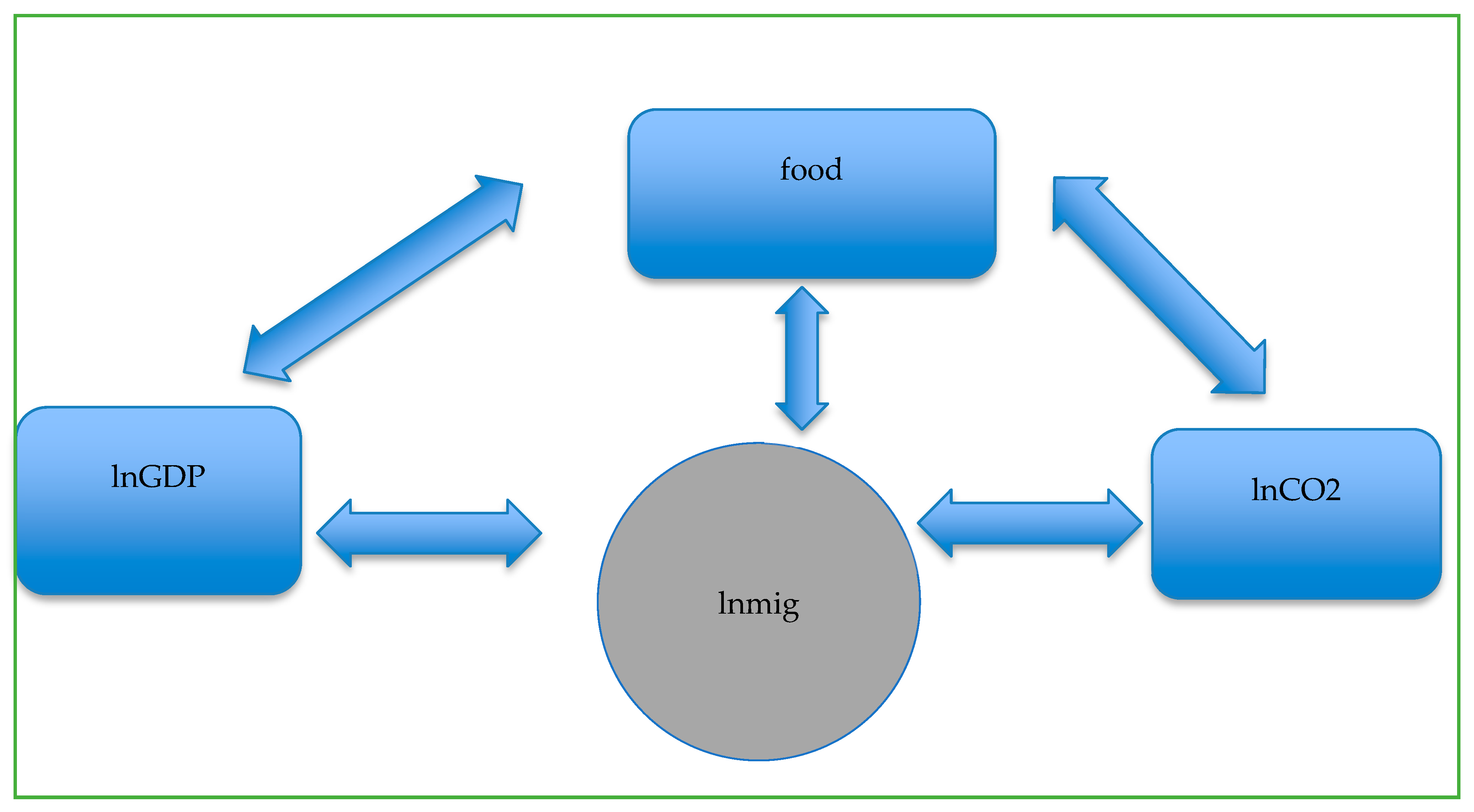
The summary of short and long-term Panel VECM Causality Relationships has been shown in Table 10.
The Figure 1 above outlines the causal relationships among the variables in Table 7. Accordingly, there are unidirectional causal relationships between economic growth (GDP), the climate change indicator (CO2 emissions), food security (food production index), and migration (net migration). Furthermore, there are bidirectional relationships between food security, economic growth, and climate change indicators. These relationships should be assessed within the framework of the dimensions represented by the proxy variables used. It shows a one-way causal link between economic growth, climate change, food security, and migration. Additionally, a two-way relationship exists between food security, economic growth, and climate change.

4. Conclusions and Policy Recommendations

Rapid economic growth—particularly when driven by fossil fuel consumption—leads to increased greenhouse gas emissions. The demand for carbon-intensive energy in industry and transportation accelerates climate change (the pressure of climate change). This phenomenon is especially pronounced in underdeveloped and developing countries, where growth-oriented policies often prioritize carbon-intensive energy sources over clean energy alternatives.
Climate change results in rising temperatures, irregular precipitation patterns, droughts, and extreme weather events. These climate-related disruptions negatively affect agricultural production processes. Declining agricultural productivity leads to crop losses, which in turn drive up food prices. As access to food becomes increasingly difficult, food crises emerge, further deepening poverty. This process ultimately compels individuals to migrate as a survival strategy, a pattern that is more commonly observed in fragile, underdeveloped, and low-income countries.
Today, climate change is one of the most critical security concerns worldwide. As more states increasingly recognize climate change as a security threat, it is increasingly seen as an urgent issue, and policies are being developed to tackle this challenge. Additionally, since climate change is both a national and a global issue, it remains a key item on international political agendas, making multi-actor governance essential for its resolution. Because temperature shifts on Earth trigger numerous interconnected events, climate change should be viewed as the origin of multidimensional problems and potential crises, not merely temperature fluctuations. This study illustrates a bidirectional link between climate change, food security, economic growth, and migration. It shows that these factors significantly influence migration. A causal relationship is found between migration and other variables. This study reveals bidirectional relationships among climate change pressures (CO2 emissions), food supply (food production index), economic growth (GDP), and migration (net migration). However, these relationships are limited to the dimensions captured by the proxy variables.
In the countries examined in this study, the pressures of climate change, fluctuations in food supply, and shifts in economic growth emerge as key determinants of population movements, pointing to the dynamics of multiple crises. Furthermore, the bidirectional causality between food supply and economic growth indicates that these two factors influence each other. Consequently, policies aimed at strengthening the food supply may support economic growth, whilst economic improvements may also positively impact the food supply. Environmental pressures from climate change, food insecurity, and economic fluctuations are the main drivers of population movements in the studied countries, leading to a polycrisis. Additionally, the presence of mutual causality between food security and economic growth indicates that the two factors are interconnected and influence one another. Therefore, policies focused on improving food security will support economic growth, and economic growth will, in turn, enhance food security. These findings emphasize the importance of policymakers developing climate adaptation strategies, boosting agricultural productivity, and implementing sustainable economic policies simultaneously to reduce migration, maintain socioeconomic stability, and avoid polycrisis. The results highlight countries with high climate vulnerability. Future research can examine food insecurity and climate change in economically vulnerable countries, areas where these issues overlap. Such holistic approaches can help to alleviate migration pressures, maintain socio-economic stability, and mitigate the risks of multiple crises. The findings highlight countries that are particularly vulnerable to climate change. Future research could examine in greater detail the intersections between the pressures of climate change and food supply in economically vulnerable countries. The scope of the study could also be expanded to include the geopolitical risks that have emerged worldwide in recent years.
The findings of the study reveal that the relationships among climate change, food security, economic growth, and migration exhibit a holistic structure characterized by mutual interactions and feedback mechanisms. In particular, the bidirectional causality identified between climate change and food security indicates that environmental and agricultural processes shape one another simultaneously. Overall, the findings suggest that the relationships among climate change pressures, food supply, economic growth, and migration exhibit a holistic structure characterized by mutual interactions and feedback mechanisms. In particular, the bidirectional causality between climate change pressures and food supply indicates that environmental and agricultural processes shape one another simultaneously.
Moreover, the bidirectional causality from climate change and food security to migration demonstrates that these vulnerabilities are key drivers of migration dynamics. At the same time, the causality detected from economic growth to both climate change and migration suggests that the growth process plays a decisive role in generating environmental pressures and influencing population movements. Furthermore, the causal links identified between climate change pressures and migration, as well as those between food supply and migration, demonstrate that these vulnerabilities are key determinants of migration dynamics. At the same time, the identified causality between economic growth and both climate change pressures and migration highlights the decisive role of growth processes in shaping environmental pressures and population movements. However, it should be noted that GDP levels do not directly reflect growth rates and distributional vulnerabilities.
Accordingly, it is concluded that addressing these variables in isolation would be insufficient and that effective policy design requires adopting integrated, multidimensional approaches.
These findings indicate that adaptation strategies to mitigate the adverse effects of climate variability must be implemented urgently. Recommended measures include adopting climate-smart agricultural practices, such as efficient irrigation systems, resilient crop varieties, and sustainable soil management. Investments in sustainable agriculture and strengthened food systems are critical to enhancing economic resilience and stability [55].

4.1. Policy Recommendations

In the literature, several policy recommendations for adapting to climate change have been emphasized, including diversifying agricultural production, promoting environmentally friendly production and consumption patterns, and developing climate-based modeling approaches [105,106]. Furthermore, it is highlighted that less-developed countries have limited adaptive capacity, underscoring the importance of targeted adaptation policies. The protection of water resources and the promotion of sustainability within the agricultural sector are also identified as key priorities [107].
In the absence of sustainable economic growth, climate-friendly production, and measures that support food security, a polycrisis becomes inevitable. Therefore, effective solutions must be developed through a holistic approach. Accordingly, (i) International organizations and governments should encourage the development of climate-resilient crop varieties and the adoption and dissemination of climate-friendly production practices within the framework of global food security. These practices contribute to reducing the threats posed by climate change and support sustainability.
(ii) Building on this point, international organizations and states should actively incorporate considerations of both internal and international migration into their food security policies.
(iii) Policymakers should adopt early warning systems and modeling techniques and methodologies to develop strategies that analyze potential risks and projections, strengthen institutional capacity, and address migration-related mobility from a holistic perspective, in order to effectively manage climate change-induced migration.
(iv) Governments should support food security by effectively implementing water and land management policies, increasing resource efficiency, and promoting sustainable agricultural practices.
(v) Finally, current institutions, organizations, and funding systems are ill-prepared to handle the upcoming climate change-driven migration crisis. This requires a new government framework.
Based on the findings, the proposed policy recommendations should comprise complementary, systemic interventions that generate broader impacts. In this context, the widespread adoption of climate-friendly agricultural practices and the development of resilience-enhancing strategies against climate-induced shocks will both strengthen food security and help ensure socioeconomic stability by reducing migration pressures.

4.2. Theoretical Contribution

The theoretical contribution of this study lies in its examination of the relationships among economic growth, climate change, food security, and migration—an area that has been largely overlooked in the existing literature. This gap stems from the lack of comprehensive, detailed analyses that address the complex causal linkages among these factors. In particular, there remains a notable absence of integrative studies that holistically assess the impact of economic growth on migration through the mediating roles of climate change and food security.
Furthermore, the analysis is conducted within the context of nine countries that rank lowest in the Notre Dame Global Adaptation Initiative. These countries are especially significant as they represent the most climate-vulnerable contexts, providing a setting in which the interactions among the examined variables can be observed most clearly. The findings of this study are expected to offer valuable guidance to policymakers—particularly in more fragile countries—on designing policies and programs to foster sustainable economic growth, promote climate-sensitive agricultural practices, improve migration governance, reduce poverty, and strengthen societal resilience.
From a theoretical perspective, the study contributes to the literature by demonstrating that the impacts of climate change vary across countries. However, the primary limitations of the study include the restriction of the dataset to 2019 and its exclusive focus on the least developed countries. Future research is therefore encouraged to employ broader datasets, incorporate different country groups, and utilize more advanced modeling techniques to achieve more comprehensive analyses.
Finally, a more detailed examination of climate change indicators at both regional and country levels would enable a more accurate understanding of their effects on agricultural production and food prices. Such comprehensive analyses would, in turn, contribute to the development of more targeted and effective policy interventions [44].

4.3. Limitations

This study has several limitations. First, because data access restrictions prevented Sudan from being included, the analysis is based on nine countries rather than the top 10 in the ND-GAIN index.
The analysis covers the period from 1999 to 2022. It is important to note that structural changes, policy reforms, and extraordinary events outside this timeframe are not included in the model.
Specific indicators represent variables such as climate change, food security, economic growth, and migration. However, it is important to recognize that these indicators might not encompass all facets of the issue.
The small sample size could impact the model’s statistical power and predictive accuracy.
Furthermore, variations in measurement methods and definitions across international organizations can create comparability issues.

4.4. Future Research

Future studies could integrate inflation as a variable into the model to examine interactions among climate change, agricultural production, food prices, inflation, economic growth, and migration. Based on these findings, the impact of food price-induced migration can be observed through its effects on purchasing power.
The impact of increasing renewable energy investments in the agricultural sector on reducing climate vulnerability can be investigated. This includes integrating renewable energy investments into a model to empirically observe the relationship between these factors. Furthermore, examining these factors on a country-by-country basis allows for comparison of policies regarding climate vulnerability.
One variable that can be integrated into the model in this study is foreign trade. The countries included in the analysis are highly climate-vulnerable, and their agricultural production is more sensitive to climate change, exposing them to food security challenges. Developing foreign trade and diversifying exports in these countries may reduce vulnerability, improve food security, increase economic growth and welfare, and consequently help reduce migration. In this respect, integrating the foreign trade variable into the model can enable a more comprehensive evaluation of the relationships among climate vulnerability, food security, economic growth, and migration.
The urbanization variable can be included in the model. In particular, the fact that most of the countries studied are African and that rural-to-urban migration is increasing in these countries will add depth to the subject by enabling an examination of the dynamics of resource use, food demand, and food insecurity.

Author Contributions

E.S.: conceptualization, supervision, review and editing; Z.K.: data curation, investigation, formal analysis, validation; P.A.: project administration, visualization, writing—review and editing, validation; E.D.: formal analysis, writing—original draft; B.Ö.: software, writing—original draft; Z.Ö.: methodology, drafting. All authors have read and agreed to the published version of the manuscript.

Funding

This research received no external funding.

Institutional Review Board Statement

Not applicable.

Informed Consent Statement

Not applicable.

Data Availability Statement

The raw data supporting the conclusions of this article will be made available by the authors on request.

Conflicts of Interest

The authors declare no conflicts of interest.

References

  1. Dell, M.; Jones, B.F.; Olken, B.A. Temperature shocks and economic growth: Evidence from the last half century. Am. Econ. J. Macroecon. 2012, 4, 66–95. [Google Scholar] [CrossRef]
  2. Birkmann, J.; Liwenga, E.; Pandey, R.; Boyd, E.; Djalante, R.; Gemenne, F.; Leal Filho, W.; Pinho, P.F.; Stringer, L.; Wrathall, D. Poverty, livelihoods and sustainable development. In Climate Change 2022: Impacts, Adaptation and Vulnerability. Contribution of Working Group II to the Sixth Assessment Report of the Intergovernmental Panel on Climate Change; Pörtner, H.-O., Roberts, D.C., Tignor, M., Poloczanska, E.S., Mintenbeck, K., Alegría, A., Craig, M., Langsdorf, S., Löschke, S., Möller, V., et al., Eds.; Cambridge University Press: Cambridge, UK, 2022; pp. 1171–1274. [Google Scholar] [CrossRef]
  3. Porter, J.R.; Xie, L.; Challinor, A.J.; Cochrane, K.; Howden, S.M.; Iqbal, M.M.; Lobell, D.B.; Travasso, M.I. Food security and food production systems. In Climate Change 2014: Impacts, Adaptation, and Vulnerability. Part A: Global and Sectoral Aspects; Field, C.B., Barros, V.R., Dokken, D.J., Mach, K.J., Mastrandrea, M.D., Bilir, T.E., Chatterjee, M., Ebi, K.L., Estrada, Y.O., Genova, R.C., et al., Eds.; Cambridge University Press: Cambridge, UK, 2014; pp. 485–533. [Google Scholar]
  4. Liu, J.; Yang, H.; Gosling, S.N.; Kummu, M.; Flörke, M.; Pfister, S.; Hanasaki, N.; Wada, Y.; Zhang, X.; Zheng, C.; et al. Water scarcity assessments in the past, present, and future. Earth’s Future 2017, 5, 545–559. [Google Scholar] [CrossRef] [PubMed]
  5. Black, R.; Bennett, S.R.G.; Thomas, S.M.; Beddington, J.R. Climate change: Migration as adaptation. Nature 2011, 478, 447–449. [Google Scholar] [CrossRef]
  6. Tooze, A. Welcome to the World of the Polycrisis. Financial Times. Available online: https://www.ft.com/content/498398e7-11b1-494b-9cd3-6d669dc3de33 (accessed on 10 February 2026).
  7. Adger, W.N.; Nigel, W.A.; Black, R.; Geddes, A.; Thomas, D.S.G. Focus on environmental risks and migration: Causes and consequences. Environ. Res. Lett. 2015, 10, 060201. [Google Scholar] [CrossRef]
  8. Baltagi, B.H. Econometric Analysis of Panel Data, 4th ed.; Wiley: Hoboken, NJ, USA, 2008. [Google Scholar]
  9. Notre Dame Global Adaptation Initiative. 2023. Available online: https://gain.nd.edu/our-work/country-index/ (accessed on 25 May 2025).
  10. Yang, X.; Chen, D.; Wahab, I.; Burman, A. Evidence of climate and economic drivers affecting migration in an unequal and warming world. Commun. Earth Environ. 2025, 6, 782. [Google Scholar] [CrossRef]
  11. Beyer, R.M.; Schewe, J.; Abel, G.J. Modeling climate migration: Dead ends and new avenues. Front. Clim. 2023, 5, 1212649. [Google Scholar] [CrossRef]
  12. Biermann, F.; Boas, I.J.C. Preparing for a warmer world: Towards a global governance system to protect climate refugees. Glob. Environ. Politics 2010, 10, 60–88. [Google Scholar] [CrossRef]
  13. Myers, N. Environmental refugees: A growing phenomenon of the 21st century. Philos. Trans. R. Soc. London. Ser. B Biol. Sci. 2002, 357, 609–613. [Google Scholar] [CrossRef]
  14. Missirian, A.; Schlenker, W. Asylum applications respond to temperature fluctuations. Science 2017, 358, 1610–1614. [Google Scholar] [CrossRef]
  15. Bohra-Mishra, P.; Oppenheimer, M.; Hsiang, S.M. Nonlinear permanent migration response to climatic variations but minimal response to disasters. Proc. Natl. Acad. Sci. USA 2014, 111, 9780–9785. [Google Scholar] [CrossRef] [PubMed]
  16. Berlemann, M.; Tran, T.X. Climate-related hazards and internal migration empirical evidence for rural Vietnam. Econ. Disasters Clim. Change 2020, 4, 385–409. [Google Scholar] [CrossRef]
  17. Mullins, J.T.; Bharadwaj, P. Weather, Climate, and Migration in the United States; No. w28614; National Bureau of Economic Research: Cambridge, MA, USA, 2021; Available online: http://www.nber.org/papers/w28614 (accessed on 11 September 2024).
  18. Trinh, T.T.; Munro, A. Climate change and migration decisions: A choice experiment from the Mekong Delta, Vietnam. Ecol. Econ. 2024, 224, 2–12. [Google Scholar] [CrossRef]
  19. Rigaud, K.K.; De Sherbinin, A.M.; Jones, B.; Bergmann, J.; Clement, V.; Ober, K.; Schewe, J.; Adamo, S.B.; McCusker, B.; Heuser, S.; et al. Groundswell: Preparing for Internal Climate Migration; World Bank: Washington, DC, USA, 2018. [Google Scholar] [CrossRef]
  20. Suhrke, A. Environmental degradation and population flows. J. Int. Aff. 1994, 47, 473–496. [Google Scholar]
  21. Stern Review: The Economics of Climate Change. 2006. Available online: http://mudancasclimaticas.cptec.inpe.br/~rmclima/pdfs/destaques/sternreview_report_complete.pdf (accessed on 26 March 2025).
  22. Almulhim, A.I.; Alverio, G.N.; Sharifi, A.; Shaw, R.; Huq, S.; Mahmud, M.J.; Ahmad, S.; Abubakar, I.R. Climate-induced migration in the Global South: An in depth analysis. npj Clim. Action 2024, 3, 47. [Google Scholar] [CrossRef]
  23. Cuong, O.Q.; Suza, M.; Savelli, A.; Nelson, K.M. Exploring the relationship between climate change events and migration decisions: Evidence from a choice experiment in Bangladesh. Int. J. Disaster Risk Reduct. 2024, 113, 104831. [Google Scholar] [CrossRef]
  24. Zander, K.K.; Richerzhagen, C.; Garnett, S.T. Human mobility intentions in response to heat in urban South East Asia. Glob. Environ. Change 2019, 56, 18–28. [Google Scholar] [CrossRef]
  25. Zander, K.K.; Wilson, T.; Garnett, S.T. Understanding the role of natural hazards in internal labour mobility in Australia. Weather Clim. Extrem. 2020, 29, 100261. [Google Scholar] [CrossRef]
  26. Gray, C.L. Environment, land, and rural out-migration in the southern Ecuadorian Andes. World Dev. 2009, 37, 457–468. [Google Scholar] [CrossRef]
  27. Gray, C.; Wise, E. Country-specific effects of climate variability on human migration. Clim. Change 2016, 135, 555–568. [Google Scholar] [CrossRef]
  28. Gao, C.; Tao, S.; He, Y.; Su, B.; Sun, M.; Mensah, I.A. Effect of population migration on spatial carbon emission transfers in China. Energy Policy 2021, 156, 112450. [Google Scholar] [CrossRef]
  29. Bu, Y.; Wang, E.; Möst, D.; Lieberwirth, M. How population migration affects carbon emissions in China: Factual and counterfactual scenario analysis. Technol. Forecast. Soc. Change 2022, 184, 122023. [Google Scholar] [CrossRef]
  30. Morris, D.W. On the effect of international human migration on nations’ abilities to attain CO2 emission-reduction targets. PLoS ONE 2021, 16, e0258087. [Google Scholar] [CrossRef]
  31. Abbas, S.; Nejati, M.; Taleghani, F. Impact of skilled labour migration on energy, environment and economic growth in home and host countries: A computable general equilibrium analysis. OPEC Energy Rev. 2024, 48, 78–95. [Google Scholar] [CrossRef]
  32. Mendelsohn, R. The impact of climate change on agriculture in developing countries. J. Nat. Resour. Policy Res. 2009, 1, 5–19. [Google Scholar] [CrossRef]
  33. Solaymani, S. Impacts of climate change on food security and agriculture sector in Malaysia. Environ. Dev. Sustain. 2018, 20, 1575–1596. [Google Scholar] [CrossRef]
  34. Wheeler, T. Chapter 11. Climate change impacts on food systems and implications for climate-compatible food policies. In Climate Change and Food Systems: Global Assessments and Implications for Food Security and Trade; Food and Agriculture Organization of the United Nations: Rome, Italy, 2015; pp. 315–336. Available online: https://centaur.reading.ac.uk/id/eprint/40648 (accessed on 2 June 2025).
  35. Ahmed, N.; Areche, F.O.; Cotrina Cabello, G.G.; Córdova Trujillo, P.D.; Sheikh, A.A.; Abiad, M.G. Intensifying effects of climate change in food loss: A threat to food security in Turkey. Sustainability 2023, 15, 350. [Google Scholar] [CrossRef]
  36. Zougmoré, R.; Partey, S.; Ouédraogo, M.; Omitoyin, B.; Thomas, T.; Ayantunde, A.; Ericksen, P.; Said, M.; Jalloh, A. Toward climate-smart agriculture in West Africa: A review of climate change impacts, adaptation strategies and policy developments for the livestock, fishery and crop production sectors. Agric. Food Secur. 2016, 5, 26. [Google Scholar] [CrossRef]
  37. Tamako, N.; Thamaga-Chitja, J.M. Does social capital play a role in climate change adaptation among smallholder farmers for improving food security and livelihoods? J. Fam. Ecol. Consum. Sci.=Tydskr. Gesinsekologie Verbruikerswetenskappe 2017, 2017, 16–27. [Google Scholar]
  38. Zainal, Z.; Shamsudin, M.N.; Abidin Mohamed, Z.; Adam, S.U. Economic impact of climate change on the Malaysian palm oil production. Trends Appl. Sci. Res. 2012, 7, 872–880. [Google Scholar] [CrossRef]
  39. Li, C.; Mao, X.; Zheng, M.; Han, M. Adapting Seasonal Rice Cultivation Strategies for Food Security in Response to Climate Change Impacts. Sustainability 2024, 16, 6748. [Google Scholar] [CrossRef]
  40. Poudel, S.; Kotani, K. Climatic impacts on crop yield and its variability in Nepal: Do they vary across seasons and altitudes? Clim. Change 2013, 116, 327–355. [Google Scholar] [CrossRef]
  41. Akinbile, C.O.; Akinlade, G.M.; Abolude, A.T. Trend analysis in climatic variables and impacts on rice yield in Nigeria. J. Water Clim. Change 2015, 6, 534–543. [Google Scholar] [CrossRef]
  42. Islam, M.S.; Wong, A.T. Climate change and food in/security: A critical nexus. Environments 2017, 4, 38. [Google Scholar] [CrossRef]
  43. Food Agriculture Organization of the United Nations (FAO). The State of Food Agriculture: Climate Change Agriculture Food Security; FAO: Rome, Italy, 2016; Available online: https://openknowledge.fao.org/server/api/core/bitstreams/07bc7c6e-72e5-488d-b2f7-3c1499d098fb/content (accessed on 12 May 2025).
  44. Global Report on Food Crises 2025. 2025. Available online: https://www.fightfoodcrises.net/sites/default/files/resources/files/GRFC2025-full.pdf (accessed on 12 May 2025).
  45. Açci, Y.; Uçar, E.; Uçar, M.; Açci, R.C. Evaluating the relationship between climate change, food prices, and poverty: Empirical evidence from underdeveloped countries. Environ. Dev. Sustain. 2025, 27, 28061–28085. [Google Scholar] [CrossRef]
  46. Frimpong, T.D.; Atchadé, M.N.; Tona Landu, T. Assessing the impact of CO2 emissions, food security and agriculture expansion on economic growth: A panel ARDL analysis. Discov. Sustain. 2024, 5, 424. [Google Scholar] [CrossRef]
  47. Kurukulasuriya, P.; Mendelsohn, R. A Ricardian analysis of the impact of climate change on African cropland. Afr. J. Agric. Resour. Econ. 2008, 2, 23. [Google Scholar] [CrossRef]
  48. Tuholske, C.; Caylor, K.; Funk, C.; Verdin, A.; Sweeney, S.; Grace, K.; Peterson, P.; Evans, T. Global urban population exposure to extreme heat. Proc. Natl. Acad. Sci. USA 2021, 118, e2024792118. [Google Scholar] [CrossRef]
  49. Falco, C.; Donzelli, F.; Olper, A. Climate change, agriculture and migration: A survey. Sustainability 2018, 10, 1405. [Google Scholar] [CrossRef]
  50. Duda, I.; Fasse, A.; Grote, U. Drivers of rural-urban migration and impact on food security in rural Tanzania. Food Secur. 2018, 10, 785–798. [Google Scholar] [CrossRef]
  51. Smith, M.D.; Floro, M.S. Food insecurity, gender, and international migration in low- and middle-income countries. Food Policy 2020, 91, 101837. [Google Scholar] [CrossRef]
  52. Wheeler, T.; von Braun, J. Climate change impacts on global food security. Science 2013, 341, 508–513. [Google Scholar] [CrossRef]
  53. Timmer, P. Agriculture and pro-poor growth: An Asian perspective. Asian J. Agric. Dev. 2008, 5, 1–39. [Google Scholar] [CrossRef]
  54. Manap, N.M.A.; Ismail, N.W. Food security and economic growth. Int. J. Mod. Trends Soc. Sci. 2019, 2, 108–118. [Google Scholar] [CrossRef]
  55. Khalifa, J. The Impacts of Climate Change, Agricultural Productivity, and Food Security on Economic Growth in Tunisia: Evidence from an Econometrics Analysis. Res. World Agric. Econ. 2025, 6, 577–599. [Google Scholar] [CrossRef]
  56. Suryanta, B.; Patunru, A.A. Determinants of foreign direct investment in Indonesia. Glob. J. Emerg. Mark. Econ. 2023, 15, 109–131. [Google Scholar] [CrossRef]
  57. Akinwale, Y.O.; Grobler, W.C. Research and technology innovation, food security and economic growth in Nigeria: Implications for agripreneurs and policymakers. Afr. J. Food Agric. Nutr. Dev. 2023, 23, 23220–23237. [Google Scholar] [CrossRef]
  58. Ntiamoah, E.B.; Chandio, A.A.; Yeboah, E.N.; Twumasi, M.A.; Siaw, A.; Li, D. How do carbon emissions, economic growth, population growth, trade openness and employment influence food security? Recent evidence from the East Africa. Environ. Sci. Pollut. Res. 2023, 30, 51844–51860. [Google Scholar] [CrossRef]
  59. Gnedeka, K.T.; Wonyra, K.O. New evidence in the relationship between trade openness and food security in Sub-Saharan Africa. Agric. Food Secur. 2023, 12, 31. [Google Scholar] [CrossRef]
  60. Ceesay, E.K.; Ndiaye, M.B.O. Climate change, food security and economic growth nexus in the Gambia: Evidence from an econometrics analysis. Res. Glob. 2022, 5, 100089. [Google Scholar] [CrossRef]
  61. Bayraç, H.N.; Doğan, E. Türkiye’de teknoloji ithalati ve ekonomik büyümenin sürdürülebilirliği. Akad. Bakış Uluslararası Hakemli Sos. Bilim. Derg. 2016, 57, 19–37. [Google Scholar]
  62. Özbay, Ü. Türkiye’de sanayileşme, CO2 emisyonu, ekonomik büyüme ve tarımsal üretim ilişkisi: Ampirik bir uygulama. Tarım Ekon. Derg. 2023, 29, 79–91. [Google Scholar] [CrossRef]
  63. Kozlovskiy, S.; Kulinich, T.; Vechirko, I.; Lavrov, R.; Zayukov, I.; Mazur, H. Relationship between net migration and economic development of European countries: Empirical conclusions. Probl. Perspect. Manag. 2024, 22, 605–618. [Google Scholar] [CrossRef]
  64. Kwilinski, A.; Lyulyov, O.; Pimonenko, T.; Dzwigol, H.; Abazov, R.; Pudryk, D. International migration drivers: Economic, environmental, social, and political effects. Sustainability 2022, 14, 6413. [Google Scholar] [CrossRef]
  65. Buterin, V.; Fajdetić, B.; Mrvčić, M. Impact of migration and population aging on economic growth in the Republic of Croatia. Ekon. Vjesn. Rev. Contemp. Entrep. Bus. Econ. Issues 2022, 35, 151–164. [Google Scholar] [CrossRef]
  66. Boubtane, E.; Dumont, J.C.; Rault, C. Immigration and economic growth in the OECD countries 1986–2006. Oxf. Econ. Pap. 2016, 68, 340–360. [Google Scholar] [CrossRef]
  67. Oliinyk, O.; Bilan, Y.; Mishchuk, H.; Akimov, O.; Vasa, L. The impact of migration of highly skilled workers on the country’s competitiveness and economic growth. Montenegrin J. Econ. 2021, 17, 7–19. [Google Scholar] [CrossRef]
  68. Assegaf, N.A. Migration and economic development in Turkey. Akdeniz Havzası Afr. Medeni. Derg. 2021, 3, 66–78. [Google Scholar]
  69. Ngoc, N.B.; Xuan, V.N. Nexus between carbon dioxide emissions, population, migration, foreign direct investment, and gross domestic product: New evidence in the context of Vietnam. J. Open Innov. Technol. Mark. Complex. 2024, 10, 100281. [Google Scholar] [CrossRef]
  70. Skeldon, R. Migration, climate change and the futures of global population redistribution. N. Z. Econ. Pap. 2025, 59, 41–45. [Google Scholar] [CrossRef]
  71. Mtiraoui, A. Interaction between migration and economic growth through unemployment in the context of political instability in the MENA Region. Int. J. Econ. Financ. Issues 2024, 14, 204–215. [Google Scholar] [CrossRef]
  72. Brunow, S.; Nijkamp, P.; Poot, J. The impact of international migration on economic growth in the global economy. In Handbook of the Economics of International Migration; Chiswick, B.R., Miller, P.W., Eds.; North-Holland: Amsterdam, The Netherlands, 2015; Volume 1, pp. 1027–1075. [Google Scholar] [CrossRef]
  73. Bashier, A.A.; Siam, A.J. Immigration and economic growth in Jordan: FMOLS approach. Int. J. Humanit. Soc. Sci. Educ. 2014, 1, 85–92. [Google Scholar]
  74. Rayevnyeva, O.; Stryzhychenko, K.; Matúšová, S. Impact of migration processes on GDP. Eng. Proc. 2023, 39, 86. [Google Scholar] [CrossRef]
  75. Akanbi, O.A. Impact of migration on economic growth and human development: Case of Sub-Saharan African countries. Int. J. Soc. Econ. 2017, 44, 683–695. [Google Scholar] [CrossRef]
  76. Akın, F.; Dinçer, S.; Özdemir, M.G. G-7 Ülkelerinde Göç, Karbon Emisyonu ve Ekonomik Büyüme İlişkisi: Dumitrescu-Hurlin Panel Nedensellik Analizi. Akad. Araştırmalar Çalışmalar Derg. (AKAD) 2024, 16, 36–50. [Google Scholar] [CrossRef]
  77. Al Mosharrafa, R.; Sahabuddin, M.; Saha, N. Migrant workforces, foreign remittance, and economic growth nexus in an emerging country. J. Int. Migr. Integr. 2024, 25, 2321–2337. [Google Scholar] [CrossRef]
  78. Khan, M.A. The impact of migrant remittances on economic development: Empirical evidence from the developing world. J. Soc. Econ. Dev. 2024, 27, 323–351. [Google Scholar] [CrossRef]
  79. Destiny, U.N.; Chinagorom, A.E.; Ojiego-Okoro, C.W.; Chidmma, C. International migration and economic growth in Africa: The Nigerian experience. Afr. J. Politics Adm. Stud. 2021, 14, 243–260. [Google Scholar]
  80. Nwokoro, A.N. Globalization, migration, and economic growth in Nigeria. Lapai J. Econ. 2024, 8, 165–174. [Google Scholar] [CrossRef]
  81. Giang, L.T.; Nguyen, C.V.; Nguyen, H.Q. The impacts of economic growth and governance on migration: Evidence from Vietnam. Eur. J. Dev. Res. 2020, 32, 1195–1229. [Google Scholar] [CrossRef]
  82. Awokuse, T.O.; Xie, R. Does Agriculture Really Matter for Economic Growth in Developing Countries? Can. J. Agric. Econ./Rev. Can. Agroécon. 2015, 63, 77–99. [Google Scholar] [CrossRef]
  83. Cai, R.; Feng, S.; Oppenheimer, M.; Pytlikova, M. Climate variability and international migration: The importance of the agricultural linkage. J. Environ. Econ. Manag. 2016, 79, 135–151. [Google Scholar] [CrossRef]
  84. Shahbaz, M.; Hye, Q.M.A.; Tiwari, A.K.; Leitão, N.C. Economic growth, energy consumption, financial development, international trade and CO2 emissions in Indonesia. Renew. Sustain. Energy Rev. 2013, 25, 109–121. [Google Scholar] [CrossRef]
  85. Sadiddin, A.; Cattaneo, A.; Cirillo, M.; Miller, M. Food insecurity as a determinant of international migration: Evidence from Sub-Saharan Africa. Food Secur. 2019, 11, 515–530. [Google Scholar] [CrossRef]
  86. Tuholske, C.; Di Landro, M.A.; Anderson, W.; van Duijne, R.J.; de Sherbinin, A. A framework to link climate change, food security, and migration: Unpacking the agricultural pathway. Popul. Environ. 2024, 46, 8. [Google Scholar] [CrossRef]
  87. Świetlik, K. Economic growth versus the issue of food security in selected regions and countries worldwide. Probl. Agric. Econ. 2018, 3, 127–149. [Google Scholar] [CrossRef]
  88. Fernandes, M.; Samputra, P.L. Exploring linkages between food security and economic growth: A Systematic mapping literature review. Potravin. Slovak J. Food Sci. 2022, 16, 206–218. [Google Scholar] [CrossRef] [PubMed]
  89. Breusch, T.S.; Pagan, A.R. The Lagrange multiplier test and its applications to model specification tests in econometrics. Rev. Econ. Stud. 1980, 47, 239–253. [Google Scholar] [CrossRef]
  90. Pesaran, M.H. A simple panel unit root test in the presence of cross-section dependence. J. Appl. Econom. 2007, 2, 265–312. [Google Scholar] [CrossRef]
  91. Pesaran, M.H.; Ullah, A.; Yamagata, T. A bias-adjusted LM test of error cross-section independence. Econom. J. 2008, 11, 105–127. [Google Scholar] [CrossRef]
  92. Jeffrey, M. Wooldridge. In Econometric Analysis of Cross-Section and Panel Data, 2nd ed.; MIT Press: Cambridge, MA, USA, 2010. [Google Scholar]
  93. William, H. Greene. In Econometric Analysis, 7th ed.; Pearson: London, UK, 2012. [Google Scholar]
  94. Swamy, P.A.W.B. Efficient Inference in a Random Coefficient Regression Model. Econometrica 1970, 38, 311–323. [Google Scholar] [CrossRef]
  95. Kao, C. Spurious regression and residual-based tests for cointegration in panel data. J. Econom. 1999, 90, 1–44. [Google Scholar] [CrossRef]
  96. Pedroni, P. Panel cointegration: Asymptotic and finite sample properties of pooled time series tests with an application to the PPP hypothesis. Econom. Theory 2004, 20, 597–625. [Google Scholar] [CrossRef]
  97. Westerlund, J. Testing for error correction in panel data. Oxf. Bull. Econ. Stat. 2007, 69, 709–748. [Google Scholar] [CrossRef]
  98. Westerlund, J. Panel cointegration tests of the fisher effect. J. Appl. Econom. 2008, 23, 193–233. [Google Scholar] [CrossRef]
  99. Baltagi, B.H. Econometric Analysis of Panel Data, 5th ed.; Wiley: Hoboken, NJ, USA, 2013. [Google Scholar]
  100. Dumıtrescu, E.I.; Hurlın, C. Testing for Granger noncausality in heterogeneous panels. Econ. Model. 2012, 29, 1450–1460. [Google Scholar] [CrossRef]
  101. Lee, C.C.; Zeng, M.; Luo, K. How does climate change affect food security? Evidence from China. Environ. Impact Assess. Rev. 2024, 104, 107324. [Google Scholar] [CrossRef]
  102. Beine, M.; Parsons, C.R. Climatic factors as determinants of international migration: Redux. CESifo Econ. Stud. 2017, 63, 386–402. [Google Scholar] [CrossRef]
  103. Mamba, S.F.; Ncube, M.; Ndlovu, S.; Ndlovu, N.; Moyo, F.; Dube, Z.L.; Nkala, P.; Ncube, V.; Mathe, T.; Murai, T.; et al. Climate-induced displacement and migration: Implications on poverty and household food security in Southern Africa. J. Asian Afr. Stud. 2026, 61, 1485–1497. [Google Scholar] [CrossRef]
  104. Crush, J. Linking food security, migration and development. Int. Migr. 2013, 51, 61–75. [Google Scholar] [CrossRef]
  105. Boccia, F.; Sarno, V. Socially responsible food behavior: Perspectives from empirical evaluations. Food Res. Int. 2019, 121, 91–96. [Google Scholar] [CrossRef] [PubMed]
  106. Nelson, G.C.; van der Mensbrugghe, D.; Ahammad, H.; Blanc, E.; Calvin, K.; Hasegawa, T.; Havlik, P.; Heyhoe, E.; Kyle, P.; Lotze-Campen, H.; et al. Agriculture and climate change in global scenarios: Why don’t the models agree. Agric. Econ. 2014, 45, 85–101. [Google Scholar] [CrossRef]
  107. Sovacool, B.K.; Burke, M.; Baker, L.; Kotikalapudi, C.K.; Wlokas, H. New frontiers and conceptual frameworks for energy justice. Energy Policy 2017, 105, 677–691. [Google Scholar] [CrossRef]
Figure 1. Schematic representation of relationships.
Sustainability 18 05135 g001
Table 1. Variables.
Table 1. Variables.
VariableDescriptionDescription UsageSource
MigrationNet migrationlnmigWorld Bank
Food SecurityFood production index (2014–2016 = 100)foodWorld Bank
Climate ChangeCarbon dioxide (CO2) emissions (total) excluding LULUCF (Mt CO2e)lnCO2World Bank
Economic GrowthGDP (constant 2015 US$)lnGDPWorld Bank
Table 2. (a) Descriptive statistics. (b) Correlation matrix. (c) Selection of the optimal lag length.
(a)
lnCO2FoodlnGDPlnmig
Mean2.02307686.3830722.427519.740915
Median1.14075090.3950022.617959.841994
Maximum11.40870147.990024.9099113.84115
Minimum0.15070029.2000019.785105.874931
Std. Dev.2.23559825.255151.1513401.711474
Skewness1.765489−0.074836−0.2797320.047056
Kurtosis5.7854082.3788502.2697812.281028
161.81043.2658346.7697494.206221
Jarque–Bera0.0000000.1953590.0338820.122076
(b)
lnGDPMIGFOODlnCO2
lnGDP1.0000.2610.3340.684
MIG0.2611.000−0.1250.320
FOOD0.334−0.1251.0000.342
lnCO20.6840.3200.3421.000
(c)
LagLogLLRFPEAICSCHQ
0−1490.563NA4079.78019.6653119.7448819.69763
1−741.40891449.0220.26371810.0185410.41642 *10.18017
2−706.145966.35011 *0.204768 *9.765078 *10.4812610.05602 *
3−695.636919.220480.2203579.83732710.8718110.25757
4−690.97498.2810720.2563439.98651211.3393010.53606
5−680.688417.730740.27728610.0616911.7327810.74054
Note: * Indicates the lag length recommended by the relevant criterion in the analysis output.
Table 3. Horizontal Cross-Section Dependence Test Results.
LMCDLMCDLMadj
lnCO2204.233
(0.0000) *
23.550
(0.0000) *
−3.059
(0.0001) *
18.019
(0.0000) *
lnmig91.384
(0.0000) *
8.470
(0.0000) *
−3.128
(0.0001) *
3.341
(0.0000) *
food174.817
(0.0000) *
19.619
(0.0000) *
−3.290
(0.0001) *
7.645
(0.0000) *
lnGDP137.354
(0.000) *
14.613
(0.0000) *
−1.931
(0.0270) **
14.763
(0.0000) *
Note: *, ** denote significance at 1%, 5% level.
Table 4. Delta Test.
t-Stat.Value
Delta−2.3080.990
Delta adj.−2.5810.995
Table 5. CIPS Unit Root Test.
I(0)I(1)
Variable(s)ConstantConstant + TrendConstantConstant + Trend
lnCO2−4.00−4.230−6.080 *−5.887 *
lnmig−2.717−2.662−4.517 **−4.420 **
food−2.717−2.662−3.847 ***−3.564 ***
lnGDP−3.28−3.541−5.972 *−5.976 *
Note: Peseran [90], at the 90% confidence level (since t:24, n:9), according to Table 2b, the critical value for the model with a constant is −4.11(%1) *, −3.36(%5) **, −3.97(%10) *** and for the model with a constant + trend, according to Table 2c. the critical value for the model with a constant is −4.67(%1) *, −3.87(%5) **, −3.49(%10) ***.
Table 6. Westerlund [98] DH Cointegration Test Results.
Test StatisticsAsymptotic p-Value
DH_g−1.2490.106
DH_p−0.8770.190
Table 7. FMOLS/DOLS Coefficient Predictor.
VariableFMOLS CoefficientFMOLS p-ValueDOLS CoefficientDOLS p-Value
GDP−0.72470.0004 ***−2.59040.0314 **
FOOD0.00800.0567 *0.02680.1718
CO20.03700.44600.16140.5421
Note: *, **, *** denote significance at 1%, 5%, 10% level.
Table 8. Panel VECM Short-Term Causality Relationship.
lngdplnmigFoodlnCO2
lnmig2.33
(0.5062)
4.976
(0.1735)
3.78
(0.285)
food6.915
(0.0746) ***
2.182
(0.535)
0.127
(0.9884)
lnCO25.310
(0.150)
6.627
(0.084) **
1.109
(0.774)
lngdp 4.791
(0.187)
6.055
(0.108) ***
0.780
(0.854)
Note: In the short-term relationship chart, **, *** represents 5%, 10% confidence level.
Table 9. Panel VECM Long-Term Causality Relationship.
Dependent VariableECTt Stat.
d(lngdp) *−0.001304−4.44505
d(mıg)−0.001886−0.69712
d(food) *−0.039760−1.97743
d(lnCO2)0.0002620.17831
Note: The significance of the error correction coefficient was assessed using the t-statistic, which is compared to ±1.96, the critical value for a 5% significance level. * represents 1% confidence level.
Table 10. Panel VECM Causality Relationships.
Short-Term RelationshipLong-Term Relationship
lngdplnmigFoodlnCO2ECTt Stat.Prob.
lnmig2.33
(0.5062)
4.976
(0.1735)
3.78
(0.285)
−0.00184−0.697120.00029
food6.915
(0.0746) ***
2.182
(0.535)
0.127
(0.9884)
−0.03976−1.977430.02011
lnCO25.310
(0.150)
6.627
(0.084) **
1.109
(0.774)
−0.0397600.178310.00147
lngdp 4.791
(0.187)
6.055
(0.108) ***
0.780
(0.854)
−0.001304−4.445050.00029
Note: In the short-term relationship table, **, *** represents 5%, 10% confidence level. The significance of the error correction coefficient was evaluated via the t-statistic compared to ±1.96, the critical value for a 5% significance level.
Disclaimer/Publisher’s Note: The statements, opinions and data contained in all publications are solely those of the individual author(s) and contributor(s) and not of MDPI and/or the editor(s). MDPI and/or the editor(s) disclaim responsibility for any injury to people or property resulting from any ideas, methods, instructions or products referred to in the content.