1. Introduction
Ports play a central role in global supply chains, acting as critical nodes for trade, logistics, and regional economic development. In recent decades, port authorities have faced increasing pressure to improve not only their economic performance, but also their social and environmental performance, in line with evolving sustainability agendas and regulatory frameworks. As a result, port governance has shifted from a predominantly operational and economic perspective to a multidimensional approach in which economic efficiency, labor structures, environmental management, and institutional arrangements interact in complex ways [
1,
2,
3,
4,
5].
In the literature, port efficiency and performance have been commonly analyzed using quantitative approaches such as linear regressions, efficiency frontiers, and Data Envelopment Analysis (DEA), focusing on inputs such as labor, capital, and infrastructure, and on outcomes associated with traffic or financial performance. Although these works have provided relevant comparative references, they tend to assume linear relationships between variables and tend to analyse the dimensions of governance in isolation, which limits their ability to capture interactions, conditional effects and non-linear relationships typical of heterogeneous port systems [
6,
7,
8,
9,
10].
In parallel, a growing body of research has shown that port performance rarely responds to a single factor (such as size or volume of traffic), but emerges from specific combinations of governance-related dimensions, including institutional capacity, labor organization, and environmental management practices, in line with previous studies on port governance that adopt a multidimensional perspective [
2,
4,
5]. From this perspective, economic efficiency should be understood as the result of the interaction between economic, social and environmental dimensions, rather than as a purely financial or operational result. However, much of these studies still employ linear or additive analytical frameworks, making it difficult to identify factor configurations, compensatory mechanisms, and alternative trajectories that may lead to similar levels of performance [
11,
12,
13,
14,
15,
16].
More recently, machine learning techniques have begun to be incorporated into the analysis of transport, logistics, and infrastructure due to their ability to model complex, nonlinear relationships without imposing restrictive functional assumptions.
In particular, Random Forest algorithms combine strong predictive performance with a high degree of robustness when dealing with relatively small and heterogeneous datasets, without requiring restrictive functional assumptions. In addition, they are capable of capturing non-linear interactions between variables while maintaining a relatively low risk of overfitting due to their ensemble structure [
17].
Compared to alternative machine learning approaches, such as gradient boosting methods (e.g., XGBoost) or neural networks, Random Forest provides a more balanced trade-off between predictive performance and interpretability. While these alternative methods may achieve high accuracy, they often operate as black-box models, limiting the extraction of interpretable decision rules [
17,
18]. This aspect is particularly relevant in governance contexts, where transparency and the ability to translate results into actionable insights are essential. Therefore, Random Forest is selected as a suitable methodological approach for identifying governance-related configurations associated with different efficiency levels [
19,
20].
However, the application of explainable machine learning approaches to the analysis of port governance and economic efficiency remains limited, especially in national port systems. Most studies prioritize predictive accuracy, offering poor interpretability and restricting the possibility of translating the results into governance strategies and public policy recommendations. Consequently, there is still a lack of empirical evidence showing how non-linear and multidimensional interactions between governance indicators shape port economic efficiency, and how these configurations differ between port authorities with different organizational characteristics [
16,
21].
This gap can be situated within the broader theoretical debate on port governance and multidimensional performance, where recent studies emphasize the need to move beyond linear and additive approaches towards configurational and non-linear perspectives capable of capturing complex interactions between governance dimensions.
In this context, this study analyzes the economic efficiency of Spanish Port Authorities through a classification model based on Random Forest that integrates economic, social and environmental indicators. Efficiency is approximated by the E_02 indicator (EBITDA per tonne), discretised into three ordinal levels (low, medium and high) in order to allow comparison between authorities of different sizes and volumes of activity.
The choice of the dependent variable E_02 (EBITDA per tonne) is based on its ability to capture the relationship between financial performance and port activity. EBITDA per tonne is used as a proxy for economic efficiency, as it reflects the capacity of Port Authorities to generate operational value relative to traffic levels, allowing comparability across heterogeneous ports.
The Spanish port system constitutes a particularly relevant case study due to its extensive coastline and the large number of Port Authorities operating within a coordinated yet heterogeneous institutional setting.
This relevance is further reinforced by the high degree of heterogeneity within the Spanish port system. With 28 Port Authorities operating along one of the longest coastlines in Europe, ports differ substantially in terms of size, specialization, territorial context, and operational conditions. Moreover, although they are coordinated under a common institutional framework, Port Authorities operate in a context of partial competition rather than full collaboration, which leads to diverse governance strategies and performance outcomes [
22].
In this context, the objective of research is not to derive port-specific conclusions, but to identify generalizable patterns that can support decision-making and strategic planning across a structurally diverse system. Consequently, some of the analytical and conceptual approaches adopted in this study are intentionally defined at a general level, in order to capture common governance-related dynamics across heterogeneous port environments.
Although the system is formally articulated under Puertos del Estado, Port Authorities differ substantially in terms of scale, activity profile, territorial context, and management practices, which makes the Spanish case especially suitable for comparative governance analysis [
22]. This relevance is further reinforced by the current strategic debate on the evolution of port governance models in Spain and by the availability of annual sustainability reports issued by Port Authorities, which provide a broad and comparable set of indicators that can be used for planning, management, and policy-oriented analysis.
The choice of the dependent variable E_02 is based on its integrative nature within the framework of port governance. As a scale-adjusted measure of operating result, EBITDA per tonne reflects the ability of each Port Authority to transform port activity into economic performance. At the same time, this indicator indirectly incorporates decisions and conditioning factors from different dimensions of governance: the economic dimension, through efficiency in the use of assets and the cost structure; the social dimension, through the organization of work, employment levels and job stability; and the environmental dimension, through investments and expenses associated with energy efficiency, emission control and management of environmental impacts. In this sense, E_02 is not interpreted only as a financial result, but as a synthetic measure of economic performance resulting from the interaction between economic, social and environmental policies.
Based on this approach, the study aims to answer a central question: to what extent the economic efficiency of Port Authorities depends on port size or, on the contrary, on specific combinations of social, environmental and economic factors. More specifically, the objective of the article is to empirically characterize port economic efficiency as a multidimensional and non-linear phenomenon by applying an explainable machine learning model based on Random Forest. In addition, the study aims to identify and interpret governance-related profiles associated with low, medium, and high levels of efficiency, and to assess whether these configurations provide a more robust explanation than traditional single-factor approaches such as port size.
2. State of the Art
2.1. Classical Approaches to Port Efficiency and Performance
The evaluation of port efficiency and performance has historically been dominated by quantitative approaches derived from neoclassical economics and operations research, such as linear regressions, stochastic frontier analysis, and Data Envelopment Analysis (DEA). These studies have modelled efficiency as a relationship between inputs (labour, capital, infrastructure) and outcomes (traffic, productivity or financial performance), providing comparable indicators of productivity and technical efficiency between ports [
6,
7,
8].
Within this trend, efficiency is usually interpreted as a function of size, traffic volume or installed capacity, under the implicit assumption of stable and linear relationships between explanatory variables and results. Although these approaches have generated important empirical references, several authors have pointed out their limitations in capturing institutional heterogeneity, contextual differences, and the role of governance structures [
9,
10]. In this context, the organizational, social and environmental dimensions tend to be treated as exogenous or directly excluded factors, offering a partial representation of the real dynamics of port performance.
As port systems have been integrated into broader regulatory and sustainability frameworks, the explanatory capacity of purely economic or operational indicators has been increasingly questioned, opening the door to more comprehensive approaches that incorporate non-financial dimensions into efficiency analysis. From a theoretical perspective, this shift reflects a growing recognition of port performance as a multidimensional and context-dependent phenomenon, which cannot be fully captured through linear and single-factor approaches.
2.2. Governance, Sustainability, and Multidimensional Performance in Ports
A second line of research emphasizes port governance as a multidimensional phenomenon in which economic performance is closely linked to institutional arrangements, work organization, and environmental management. From this perspective, efficiency cannot be understood without considering coordination between actors, transparency, institutional capacity, and regulatory compliance [
2,
4,
5].
Conceptually, port governance can be approached from different but complementary perspectives. Institutional governance emphasizes the allocation of responsibilities, autonomy, regulatory capacity, and the relationship between port authorities and higher-level coordinating bodies [
23]. Stakeholder-oriented governance focuses on coordination, transparency, accountability, and the interaction between public authorities, private operators, workers, local communities, and other affected actors. Sustainability-oriented governance extends this view by examining how economic, social, and environmental objectives are integrated into decision-making processes.
In this study, labor organization and environmental management are not considered governance concepts in a strict sense. Rather, they are interpreted as observable domains through which governance is operationalized in port systems. Labor-related variables reflect how institutional and managerial arrangements shape workforce stability, organizational capacity, and internal coordination. Environmental variables reflect how port authorities translate regulatory obligations and sustainability strategies into concrete management practices. Therefore, these dimensions are used as empirical expressions of governance-related capacity, rather than as isolated social or environmental indicators [
22].
In this context, sustainability is understood as a multidimensional concept that integrates environmental, social, and economic dimensions within governance processes, rather than being limited to environmental performance alone [
24,
25,
26].
Beyond this dimensional understanding, sustainability is approached here as a governance principle that influences how port authorities define priorities, allocate resources, and balance competing objectives. In port systems, sustainability involves more than reducing environmental impacts; it also requires maintaining economic viability, ensuring social legitimacy, strengthening institutional resilience, and aligning short-term operational decisions with long-term transition goals. Therefore, sustainability is interpreted as a strategic governance framework through which environmental, social, and economic objectives are negotiated and integrated into port performance [
8].
Numerous studies have shown that environmental management practices (such as emission reduction, pollution control, and environmental disclosure) are linked to both reputational and economic performance of ports [
11,
12,
13]. However, many of these studies tend to analyse these dimensions in isolation, with limited attention to how they interact with organizational and institutional factors within broader governance frameworks [
14,
15,
16].
Similarly, labor-related variables associated with governance, particularly labour structures and workforce organisation, have been identified as relevant factors in port performance. Job stability, skill levels and organisational balance between functional areas can strengthen institutional capacity and improve the effectiveness of governance processes [
15,
16]. Overall, the literature converges on the idea that port efficiency is not the result of isolated variables, but of configurations of economic, social, and environmental factors.
These different perspectives also imply distinct ways of interpreting port performance. Institutional approaches tend to emphasize regulatory structures and the allocation of decision-making authority, often focusing on efficiency from a structural or organizational standpoint. In contrast, stakeholder-oriented approaches highlight the role of coordination, transparency, and legitimacy in shaping performance outcomes. Sustainability-oriented governance frameworks extend this perspective by integrating environmental and social objectives as core components of performance, rather than as external constraints [
27,
28,
29,
30].
Despite this theoretical evolution, much of the empirical literature continues to adopt descriptive or indicator-based approaches, with limited critical comparison between these perspectives. This often results in fragmented interpretations of governance, where economic, social, and environmental dimensions are analysed separately rather than as interacting components of a broader governance system.
Despite the growing recognition of governance as a multidimensional concept, much of the literature remains largely descriptive, focusing on the identification of individual factors rather than on critically comparing alternative governance approaches or examining their interactions. As a result, there is still limited understanding of how different governance models generate distinct performance outcomes, particularly in complex and heterogeneous port systems.
However, much of this work continues to rely on linear or additive analytical frameworks, which makes it difficult to identify interaction effects, countervailing mechanisms, and alternative trajectories by which different governance configurations can lead to similar performance outcomes. Consequently, although the multidimensional nature of efficiency is recognized, there is still limited evidence on how these dimensions combine in a non-linear way in real port governance contexts.
From a theoretical perspective, this suggests that port performance should be understood as a configurational and context-dependent phenomenon, where governance operates through interacting institutional, social, environmental, and economic dimensions rather than through isolated variables. This interpretation avoids reducing port governance to a single theoretical perspective and reinforces the need to analyse how different governance logics interact in shaping performance outcomes.
More specifically, the study adopts a configurational governance perspective, in which efficiency emerges from the interaction of institutional, environmental, and organizational dimensions rather than from isolated determinants.
In the case of the Spanish port system, governance is structured under a Landlord model coordinated by Puertos del Estado, in which Port Authorities operate with managerial autonomy while adhering to a common regulatory and strategic framework. This hybrid structure contrasts with more centralized governance models, where decision-making is concentrated at the national level, as well as with more decentralized systems, where ports operate with greater independence but less coordination [
28].
This institutional configuration generates a combination of standardization and heterogeneity, as Spanish ports differ significantly in size, specialization, and territorial context while remaining subject to common regulatory principles. As a result, governance-related variables must be interpreted within this dual framework of coordination and competition [
22].
Compared to other international contexts, where governance structures may be more uniform or more fragmented, the Spanish system provides a particularly suitable setting for analyzing how different governance configurations emerge within a shared institutional environment. This allows the identification of patterns that are not solely driven by structural differences between countries, but by internal variations in governance practices.
This internal heterogeneity, combined with a shared institutional framework, makes the Spanish port system particularly suitable for identifying generalizable governance patterns across diverse port contexts.
2.3. Machine Learning and Explainable AI in Port and Transport Research
While existing studies recognize the multidimensional nature of port performance, they often rely on linear or additive approaches, providing limited insight into how governance dimensions interact in practice, which reinforces the need for configurational and non-linear analytical frameworks.
Given the limitations of traditional methods, recent studies in transport, logistics, and infrastructure have begun to adopt machine learning techniques to analyze complex systems characterized by nonlinearity and high-dimensional interactions [
17,
18]. These approaches allow relationships to be modelled without imposing predefined functional forms, which is particularly suitable for governance and sustainability analysis.
Among these techniques, tree-based algorithms, such as Random Forest, stand out for their robustness, their ability to handle heterogeneous data, and their ability to identify interactions between variables [
19]. In addition, they can be complemented with interpretability tools, importance of variables and representative decision trees, which facilitate the understanding of the results and their translation into public policy recommendations.
In this regard, recent literature underscores the relevance of explainable artificial intelligence (XAI) in sustainability assessment and decision-making in the public sector, highlighting that interpretability is a key requirement for turning analytical results into actionable strategies [
20,
21]. However, in the area of port governance, the application of explainable machine learning is still in its infancy. Most studies prioritize predictive accuracy, providing a limited understanding of how governance variables interact to shape economic efficiency [
16,
22,
23,
24,
25,
26].
This recent strand of research has expanded notably in 2024–2026, particularly in studies addressing interpretable decision-support tools for sustainability, infrastructure governance, and complex transport systems, reinforcing the relevance of explainable approaches in applied governance contexts [
19,
25].
This reinforces the relevance of approaches capable of capturing complex and non-linear relationships in governance contexts [
27,
29,
30,
31,
32,
33].
2.4. Research Gap and Contribution
Overall, the literature shows an evolution from one-dimensional efficiency analyses to multidimensional governance approaches. However, two main gaps remain. First, there is a paucity of empirical studies that explicitly model the non-linear and configurational nature of the relationship between governance and economic efficiency in ports. Second, despite the increasing use of machine learning techniques, there are few approaches that combine predictive capability with interpretability, generating transparent decision rules that are directly applicable to port management, especially in national port systems.
This study addresses both gaps by applying a classification model based on Random Forest to analyse the economic efficiency of Spanish Port Authorities based on an integrated set of economic, social and environmental indicators. By emphasizing interpretability by extracting a representative decision tree, the research is not limited to predicting outcomes, but identifies characteristic governance profiles associated with different levels of efficiency. In this way, it is explicitly connected to the literature on port governance and sustainability, and provides empirical evidence that allows us to understand how different configurations of social, environmental and economic factors translate into differentiated economic results.
Accordingly, this study does not treat governance merely as a contextual label, but as an explanatory lens through which different combinations of economic, social, and environmental conditions can lead to differentiated efficiency outcomes.
3. Materials and Methods
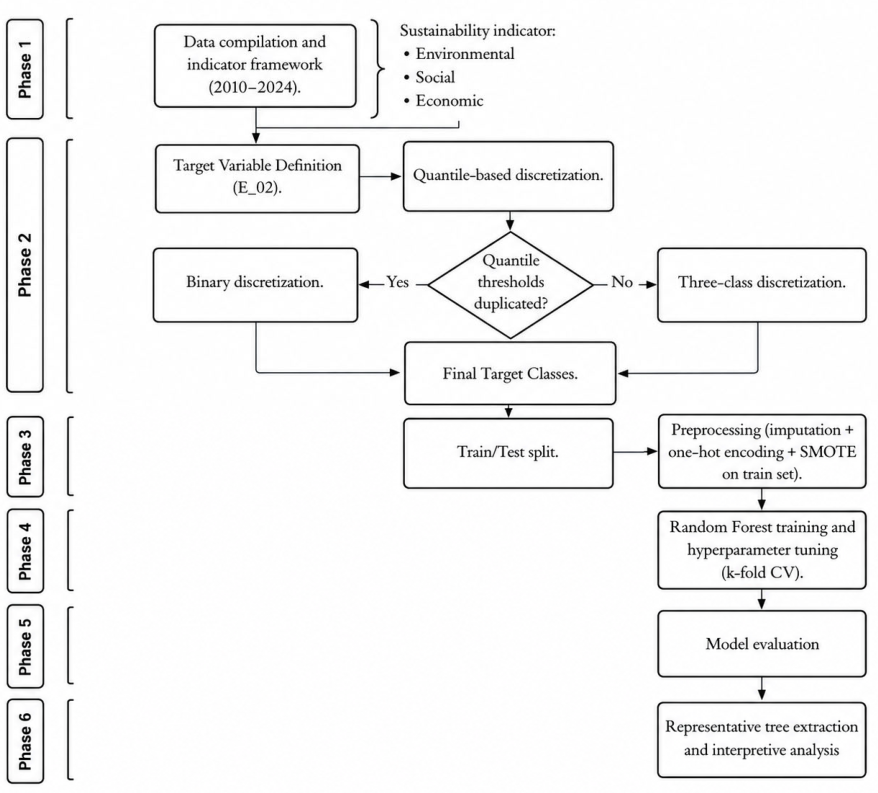
This chapter presents the phases followed in the research.
Figure 1 provides a general overview of the methodological workflow, while
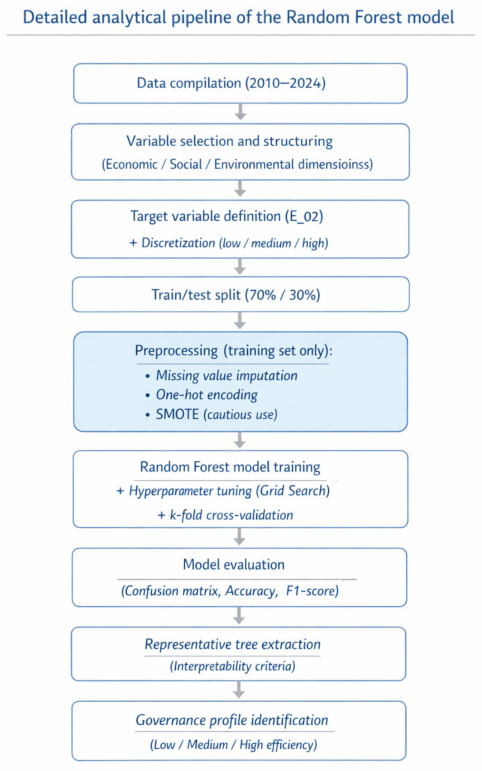
Figure 2 offers a more detailed representation of the analytical pipeline, including preprocessing steps, model training, and interpretability procedures.
To complement the general overview presented in
Figure 1,
Figure 2 provides a detailed representation of the analytical pipeline, including preprocessing steps, model training, and interpretability procedures.
The construction of the database and the selection of variables follow a structured approach previously developed in related research, ensuring consistency in the definition and interpretation of economic, social, and environmental dimensions.
3.1. Phase 1: Data Compilation and Indicator Framework (2010–2024)
The data used in this study come from an original database compiled from statistical information and annual sustainability reports published by the Spanish Port Authorities for the period 2010–2024.
The unit of analysis in the dataset corresponds to Port Authority–year observations, covering annual records for Spanish Port Authorities over the 2010–2024 period.
These reports provide a broad and relatively comparable set of economic, social, and environmental indicators, which makes them a useful empirical basis for governance-oriented analysis.
The set of variables was organised within a framework of sustainability indicators structured around three fundamental dimensions for port governance: economic, social and environmental.
In this study, these indicators are structured into economic, social, and environmental dimensions and are interpreted as governance-related dimensions, as they reflect how Port Authorities manage resources, labor structures, and environmental impacts within their institutional context.
The database used in this study is based on a structured selection process starting from an initial set of 103 indicators derived from sustainability reports and official sources related to Spanish Port Authorities. From this initial pool, 17 key indicators were selected based on their relevance and data availability, and further disaggregated into a total of 60 variables. These variables were grouped into three main dimensions: economic, social, and environmental, allowing a multidimensional representation of port governance.
These indicators are interpreted as governance-related dimensions, as they reflect how Port Authorities manage economic performance, labor structures, and environmental impacts within their institutional context.
Table 1 presents a representative subset of the variables included in the analysis, showing their codes, descriptions, and dimensional classification. The full set of variables was derived from the sustainability reports of Spanish Port Authorities and structured into economic, social, and environmental dimensions. To avoid overloading the main text, the table focuses on the most representative variables used to interpret the decision tree.
3.2. Phase 2: Definition of the Target Variable and Quantile-Based Discretization
The dependent variable selected was E_02 (EBITDA per tonne), originally continuous in nature. This indicator was adopted as a proxy for economic efficiency, as it relates the operating result to the physical volume of activity, allowing comparisons between Port Authorities of different sizes and reflecting the efficiency with which economic value is generated from port activity.
Given the objective of identifying differentiated efficiency profiles and supporting an interpretable classification framework, quantile-based discretization was applied. The E_02 variable was discretized into three ordinal categories (low, medium and high efficiency) using tertiles. This approach facilitates the extraction of decision rules and the identification of characteristic combinations of economic, social and environmental governance indicators associated with each level of efficiency.
However, this indicator is not intended to represent the full complexity of economic efficiency, but rather to provide a consistent and comparable proxy within a multidimensional governance framework.
The discretization of the dependent variable into three categories (low, medium, and high efficiency) allows the identification of differentiated performance profiles, facilitating a configurational analysis of governance-related dimensions.
A verification stage was included to detect possible thresholds of duplicate quantiles. Although binary discretization was considered as an alternative option, the final dataset allowed the three classes to be maintained, obtaining a practically balanced distribution (66 observations of low efficiency, 64 of medium efficiency and 66 of high efficiency).
3.3. Phase 3: Training/Testing and Preprocessing Division (Imputation + Encoding + SMOTE)
For model validation, the dataset was divided into 70% for training and 30% for test, using a stratified partition whenever the size of the classes allowed it.
Missing values were detected in both numerical and categorical variables. These values were not eliminated, but were processed using a pre-processing chain in order to prevent information leakage into the test set. The pre-processing was carried out as follows:
Numerical variables were imputed using the median.
Categorical variables were imputed using mode.
Categorical variables were transformed using One-Hot Encoding.
Given the near-balanced class distribution obtained after discretization, the use of data balancing techniques was approached cautiously. SMOTE was applied exclusively within the training pipeline as a precautionary measure to improve model robustness and prevent potential bias during the learning process, while avoiding any data leakage into the test set. The independent test set always preserves the original class distribution.
3.4. Phase 4: Random Forest Training and Hyperparameter Tuning (k-Fold Cross-Validation)
The model was implemented in Python 3.11 using Scikit-learn and the imbalanced-learn library to manage the imbalance between classes. A Random Forest classifier was used, initially configured with class_weight = “balanced”. The Gini index was selected as a partition criterion for its computational efficiency.
The selection of hyperparameters was carried out using Grid Search, evaluating the following parameters:
Number of trees (n_estimators): 100 and 200.
Maximum Tree Depth (max_depth): None, 10, and 20.
Minimum number of samples required to split a node (min_samples_split): 2 and 5.
Minimum number of samples in leaf nodes (min_samples_leaf): 1 and 2.
The optimal combination of hyperparameters obtained was:
Number of trees (n_estimators): 200.
Maximum Tree Depth (max_depth): None.
Minimum number of samples to split a node (min_samples_split): 5.
Minimum number of samples in leaf nodes (min_samples_leaf): 1.
During the fit, k-fold cross-validation with k = 3 was applied to the training set, using accuracy as an optimization metric. Although higher values of k are commonly used in cross-validation procedures, the choice of k = 3 was determined by the size and structure of the dataset, which is based on Port Authority–year observations. Using a larger number of folds would have reduced the number of observations available in each training subset, potentially affecting the stability of the model. Therefore, k = 3 was selected as a balance between validation robustness and data availability.
Cross-validation and model parameter tuning were applied to ensure the robustness of the model and to mitigate potential overfitting given the sample size.
A key contribution of this study is therefore not only to capture non-linearity, but also to reveal equifinal governance-related pathways, showing that different combinations of economic, social, and environmental conditions may lead to similar efficiency levels.
3.5. Phase 5: Model Evaluation
The final performance of the model was evaluated on the independent test set (30%) using the confusion matrix, global accuracy and metrics by class (accuracy, recall and F1-score), which allowed the analysis of the behavior of the model in each category of economic efficiency (low, medium and high).
3.6. Phase 6: Representative Tree Extraction and Interpretive Analysis
Since the Random Forest algorithm generates a broad set of decision trees, an objective criterion was established to select a representative tree for interpretive purposes, avoiding an arbitrary choice. First, the individual performance of the trees of the set on the training set was evaluated, identifying those with the greatest classification capacity. Then, among the trees with the best performance, those whose structure had an intermediate depth and a limited number of nodes were selected, in order to balance explanatory capacity and interpretability.
In addition, the structural coherence of the candidate trees with the overall behavior of the model was analyzed. In particular, it was found that the main partition variables and dominant criteria identified at the forest level (through the measures of variable importance and the most frequent division patterns) appeared consistently at the top nodes of the candidate trees. The tree finally selected was chosen for its structural clarity and for explicitly reproducing these dominant patterns.
In this way, the tree presented is not considered an isolated case, but an interpretable representation of the predominant decision logic learned by the Random Forest, constituting the basis for the analysis of the efficiency profiles related to governance developed in this study.
More specifically, the selection was based on three criteria: (i) high individual classification performance within the ensemble, (ii) consistency of the main split variables with the overall variable importance rankings of the Random Forest, and (iii) a level of structural simplicity (in terms of depth and number of nodes) that ensures interpretability without losing representativeness.
4. Results
The results of the classification model based on Random Forest applied to the variable E_02, discretized into three levels of economic efficiency (low, medium, high) are presented below.
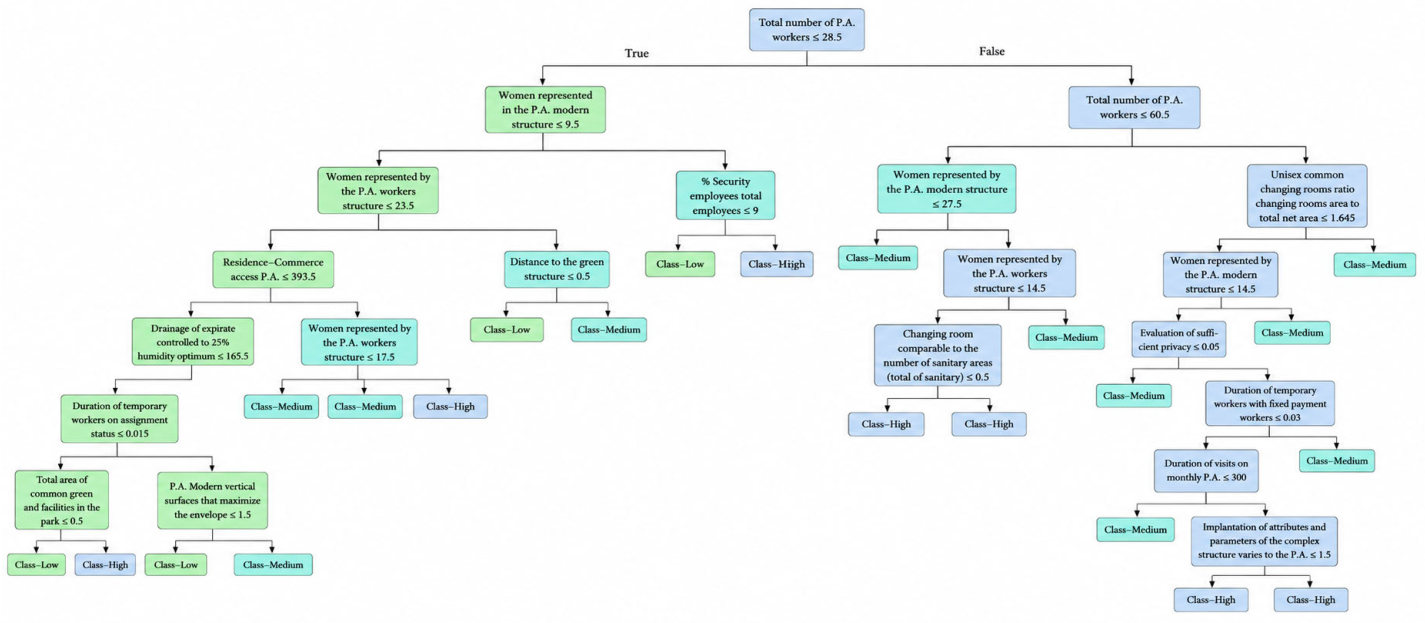
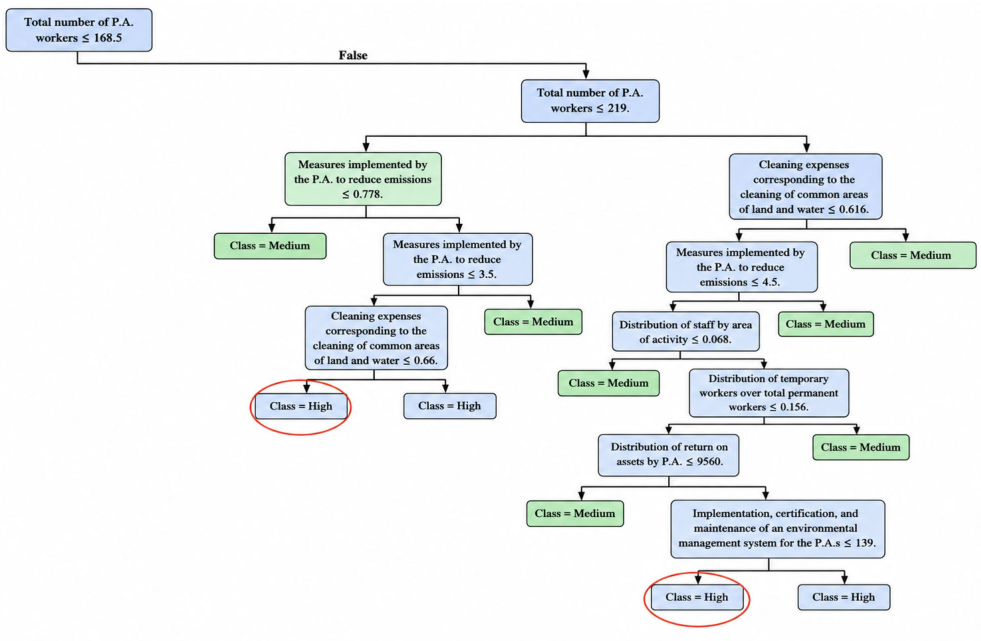
The figure represents the direct output of the classification model, preserving the exact structure and decision rules learned by the algorithm (
Figure 3).
The classification tree selected and presented in
Figure 2 shows the existence of differentiated profiles of Port Authorities, characterized by specific combinations of social, environmental and economic factors. The results show that economic efficiency does not depend on a single determinant, but emerges from governance configurations in which multiple dimensions interact.
More specifically, each efficiency profile identified in the analysis corresponds to terminal nodes in the classification tree, defined by specific combinations of split variables and threshold conditions. These node conditions provide the basis for interpreting how different governance-related factors interact to produce distinct efficiency outcomes.
In particular, the upper-level splits of the tree highlight that environmental and labor-related variables act as early differentiating conditions, indicating that efficiency outcomes are shaped by governance-related combinations rather than by scale or traffic variables alone.
In this context, governance profiles are understood as recurrent configurations of economic, social, and environmental dimensions that characterize different patterns of port management and are associated with specific levels of economic efficiency.
From these configurations, three major port profiles are identified, associated with low, medium and high levels of economic efficiency. These profiles make it possible to synthesize the main patterns detected by the model and to extract clear messages about what characterizes some Port Authorities compared to others.
4.1. Low Efficiency Profile: Weak Governance and Limited Integration of Sustainability
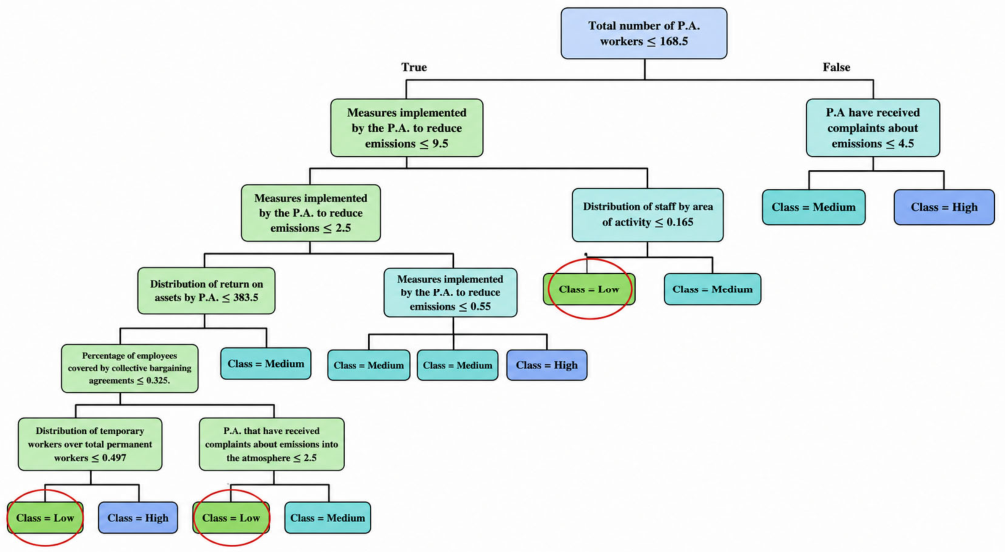
This profile is primarily associated with terminal nodes in the classification tree characterized by specific threshold conditions in environmental and labor-related variables. In particular, low values in environmental performance indicators and weaker labor-related structures appear as key split conditions leading to low efficiency classifications.
The first profile identified corresponds to Port Authorities with low economic efficiency, which are consistently associated with reduced or less structured workforces and, especially, weaknesses in the environmental dimension. There is a lower implementation of emission reduction measures, a greater presence of emitting sources and a higher incidence of environmental complaints.
In addition to these limitations, in many cases there is a more fragile labour organisation, characterised by greater temporary employment, less coverage of collective agreements or a concentration of staff in a reduced number of functional areas. From an economic point of view, this profile presents worse results in terms of return on assets, reflecting a limited capacity to transform available resources into economic performance.
This configuration and behavior of the variables allows us to establish a profile of port authorities with weak governance and limited integration of sustainability, where environmental and social deficiencies reinforce economic constraints and hinder the improvement of performance (
Figure 4).
4.2. Average Efficiency Profile: Ports in Transition and Incomplete Strategies
In the classification tree, this profile corresponds to intermediate branches where no single dimension dominates, but rather partial combinations of environmental, social, and economic variables define the outcome.
The second profile groups the Port Authorities with average economic efficiency, characterised by significant internal heterogeneity. This intermediate level does not respond to a single pattern, but reflects transition situations in which there is partial progress in some dimensions, but without sufficient coherence between them.
On the one hand, the existence of smaller ports that achieve average levels of efficiency through certain environmental improvements or better staff organisation is identified, partially compensating for their structural limitations. In contrast, other larger ports are also identified that, despite having advantages in terms of scale, are unable to transform them into high efficiency due to environmental or labor strategies that are only partially developed.
This profile can be defined as ports in transition, where there are internal trade-offs that allow avoiding clearly low results, but without achieving high levels of efficiency due to the lack of full integration between the environmental, social and economic dimensions.
4.3. High-Efficiency Profile: Integrated Governance and Mutual Reinforcement of Dimensions
This profile is associated with terminal nodes characterized by favorable combinations of environmental, social, and economic variables, where higher levels of environmental performance and balanced labor structures appear as key splitting conditions leading to high efficiency classifications.
The third profile corresponds to Port Authorities with high economic efficiency and is systematically associated with coherent and consistent combinations of governance factors. These ports have an active environmental management, reflected in a greater implementation of emission reduction measures, a lower presence of emitting sources, a lower incidence of environmental complaints and greater efforts in cleaning and control.
Likewise, more balanced and stable labor structures are observed, together with better economic indicators, especially in terms of asset utilization. In smaller ports, high efficiency appears as a trade-off strategy, where active and targeted governance makes it possible to overcome scale constraints. In larger ports, this profile reflects a more mature governance model, in which scale is combined with strong environmental policies and a coherent labour organisation.
This profile can be formulated as that of ports with integrated governance, in which the environmental, social and economic dimensions do not act in isolation, but reinforce each other to generate high levels of efficiency (
Figure 5).
4.4. Model Evaluating Using the Confusion Matrix
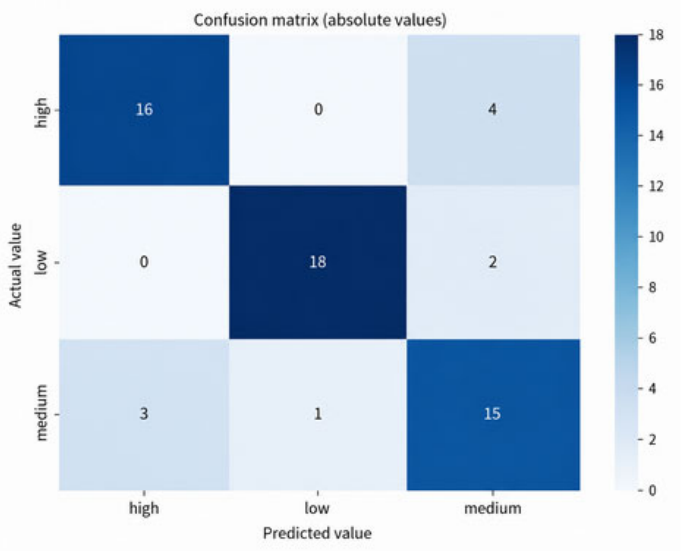
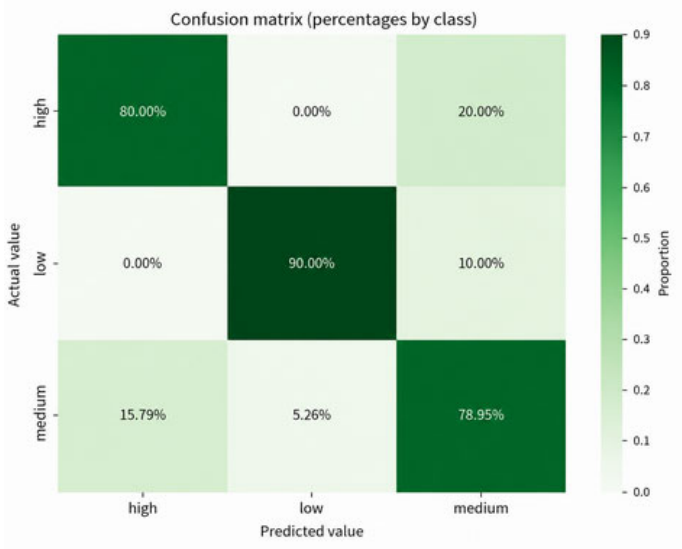
The predictive performance of the classification model was evaluated using confounding matrices in absolute values and percentages (
Figure 6 and
Figure 7). The main diagonal of the matrices shows a high proportion of correctly classified cases in the three efficiency levels, indicating a satisfactory overall performance of the model.
The results reveal a particularly robust classification for the medium and high efficiency classes, while the low efficiency class presents a greater dispersion, reflecting the internal heterogeneity of Port Authorities with weaker governance configurations. The consistency between the decision structure of the representative tree and the quantitative evaluation metrics confirms that the model not only achieves adequate predictive accuracy, but also generates stable and interpretable decision rules, supporting its suitability for governance-oriented analyses.
The confusion matrices indicate that misclassification is mainly concentrated between adjacent categories (low and medium, or medium and high efficiency), while extreme cases are more accurately identified. This suggests that the model captures well-defined governance configurations at the extremes, whereas intermediate profiles tend to overlap. From a governance perspective, this reflects the existence of transitional configurations where combinations of variables do not clearly correspond to a single efficiency category.
The model is interpreted by analyzing variable importance and combinations of features associated with different efficiency levels, allowing the identification of governance-related profiles rather than isolated relationships.
5. Discussion
5.1. Port Efficiency as a Configurational Phenomenon of Governance
The results of this study confirm that port economic efficiency cannot be explained by isolated variables or structural factors such as size or organisational scale. In line with recent work on port governance, efficiency emerges from specific combinations of economic, social, and environmental factors. This evidence reinforces a configurational interpretation of governance, according to which different institutional, organizational, and environmental arrangements can lead to similar performance outcomes [
1,
2,
14].
In contrast to classical approaches that assume linear and additive relationships between variables [
6,
7,
8,
9,
10], our results show that the effects of each dimension depend on the context and its interaction with other policies. In this way, the study contributes to the theoretical debate by providing empirical evidence of the multidimensional and non-linear nature of port efficiency, supporting frameworks that conceive ports as complex systems of governance [
4,
5,
22].
This is theoretically relevant because it supports a configurational view of port governance, in which different institutional and managerial arrangements may generate equivalent performance outcomes, moving beyond linear and single-factor explanations.
This also reflects the presence of equifinality in port governance, where different configurations of institutional, environmental, and organizational conditions may lead to similar performance outcomes.
In this regard, the structure of the representative tree is also informative, as the initial splits are not driven exclusively by scale-related factors, but by combinations of environmental and organizational variables, reinforcing the interpretation of efficiency as a governance-related outcome.
These findings not only align with existing literature emphasizing the multidimensional nature of port performance, but also extend it by providing empirical evidence of how these dimensions interact in a non-linear and configurational manner, rather than acting as independent determinants.
5.2. Low Efficiency Profile: Fragmented Governance and Environmental and Labour Weaknesses
The first profile identified is characterized by low economic efficiency associated with simultaneous weaknesses in the environmental and social dimensions. The low implementation of emission reduction measures, the presence of emitting sources and the high levels of environmental complaints, combined with fragile labour structures, reproduce a pattern of fragmented governance.
This result coincides with studies that show that poor environmental management generates economic disadvantages through regulatory pressures, reputational impacts, and operational inefficiencies [
11,
16,
23,
24]. Likewise, the coexistence of these weaknesses with problems in the organization of work reinforces the literature that indicates that deficits in labor governance amplify economic constraints, especially in contexts of lower institutional capacity [
3,
11].
From a theoretical perspective, this profile supports the idea that sustainability is not a “complement” to performance, but a structural condition for the generation of economic value. In practical terms, it suggests that Port Authorities with this pattern require integrated interventions that simultaneously strengthen environmental management and work organization, avoiding partial strategies focused only on the economic dimension.
This finding also provides a more nuanced interpretation of previous studies, suggesting that environmental and labor deficiencies do not operate independently, but tend to reinforce each other within weak governance contexts. This contrasts with approaches that analyse these dimensions separately, highlighting the importance of integrated governance frameworks.
5.3. Average Efficiency Profile: Transition, Internal Trade-Offs and Incomplete Governance
The second profile corresponds to Port Authorities with medium efficiency, characterised by heterogeneous configurations in which partial improvements in one dimension compensate for deficiencies in others. This pattern reflects situations of transition, where there are advances in environmental policies or in labor organization that allow avoiding clearly low results, but without achieving sufficient coherence between dimensions.
This finding is in dialogue with the literature that maintains that size or installed capacity does not guarantee better performance in the absence of coherent governance strategies [
1,
8]. It also provides empirical evidence on the existence of compensatory mechanisms between dimensions, an aspect little explored in studies based on linear models.
From a management point of view, this profile suggests that isolated improvements (for example, environmental investments without organizational reforms, or economic efficiency without advances in sustainability) can generate intermediate results, but they hardly lead to high-performance trajectories. This reinforces the need for integrated policies that avoid fragmentation of governance.
This result contributes to the literature by providing empirical evidence of transitional governance configurations, where partial improvements in individual dimensions do not necessarily translate into high performance outcomes. It also highlights the limitations of approaches that assume linear improvements in efficiency as a function of isolated variables.
5.4. High Efficiency Profile: Integrated Governance and Sustainability as a Competitive Advantage
The third profile is associated with Port Authorities with high economic efficiency and is characterised by coherent and mutually reinforcing strategies in the environmental, social and economic dimensions. This result is fully consistent with studies highlighting the benefits of integrated sustainability-oriented governance for long-term port performance [
4,
9,
12].
Unlike approaches that conceive sustainability as an additional cost, our results show that the ports with the best levels of efficiency are precisely those in which sound environmental policies, balanced labor structures, and efficient economic management reinforce each other. In this way, the study provides empirical evidence in favor of theoretical frameworks that link sustainability and competitiveness, and shows that there are multiple trajectories towards high efficiency as long as the different dimensions of governance are aligned.
In practical terms, this profile suggests that sustainability can operate as a strategic asset. For the Port Authorities, this implies that investments in environmental management, job quality and economic planning should not be understood as independent objectives, but as components of the same performance strategy.
5.5. Implications for Public Policies, Port Management and Sustainability
From a public policy and port governance perspective, the results support the need for regulatory frameworks that promote integrated governance approaches, avoiding sectoral policies that artificially separate the economic, social, and environmental dimensions.
The association between low efficiency and environmental and labour weaknesses reinforces the importance of linking port competitiveness objectives with standards of environmental sustainability and job quality.
In the field of port management, the study suggests that improving performance does not depend solely on infrastructure investments or traffic growth, but on coherence between environmental policies, work organization and asset use. The identification of intermediate profiles indicates that partial strategies generate limited results, while integrated configurations allow high levels of efficiency to be achieved.
From the perspective of sustainability, the findings show that economic efficiency and sustainability are not opposing objectives, but rather interdependent dimensions of port governance. In line with the sustainable development agenda, the work provides evidence that the integration of environmental and social policies into port strategy can strengthen competitiveness in the long term.
5.6. Methodological Value, Interpretability and Support for Decision-Making
Finally, the coherence between the predictive performance of the model and the structure of the representative tree confirms that the Random Forest approach employed not only offers a robust classification, but also generates stable and interpretable decision rules. This balance between accuracy and interpretability is especially relevant in governance contexts, where public decision-makers require transparent analytical tools to inform strategic decisions.
From this perspective, explainable artificial intelligence is not only a methodological innovation, but a means of translating the complexity of port systems into operational knowledge. By identifying governance configurations associated with different levels of efficiency, the model provides an empirical basis for designing sustainability-oriented policies and strategies, reinforcing the role of advanced analytics in supporting informed and accountable port management.
These findings are consistent with previous studies that emphasize the multidimensional nature of port performance, particularly those highlighting the role of environmental management and institutional factors. However, unlike approaches that prioritize scale or traffic volume as primary determinants, the results of this study suggest that governance-related configurations play a more decisive role in explaining efficiency outcomes. This reinforces the relevance of non-linear and configurational approaches in port performance analysis.
For instance, the prominence of environmental complaint indicators in the classification tree aligns with studies that link environmental performance to regulatory pressure and reputational effects, although the results also suggest that these factors operate in combination with labor and organizational conditions rather than in isolation.
It is important to note that the relationships identified in this study should be interpreted as associative rather than causal. The Random Forest model captures patterns of co-occurrence between variables, but does not establish causal direction. In this regard, reverse causality cannot be ruled out, as ports with higher economic performance may have greater financial capacity to invest in environmental management and labor stability. Therefore, the results should be understood as identifying governance-related configurations associated with efficiency, rather than as evidence of direct causal effects.
6. Conclusions
This paper analyzes the economic efficiency of Spanish Port Authorities through an explainable machine learning approach based on the E_02 indicator (EBITDA per tonne), providing implications for both port governance theory and sustainability-oriented management. The interpretation of the classification tree allows us to go beyond the predictive capacity of the model and extract structural patterns on the relationship between economic, social and environmental dimensions.
From a theoretical perspective, the results reaffirm a central line of the literature on port governance and sustainability: economic performance cannot be explained solely on the basis of variables of scale, volume or organisational size. Efficiency does not depend on a single factor, but emerges from specific configurations of environmental, social and economic dimensions. In this sense, the findings do not introduce a break with existing approaches, but rather confirm them empirically from the Spanish case and through a methodology different from traditional linear models, reinforcing the interpretation of port performance as a multidimensional and non-linear phenomenon.
The main contribution of the study lies not so much in identifying which dimensions matter (an aspect widely documented in the literatura) as in showing how they are combined. The results highlight the existence of multiple trajectories towards similar levels of efficiency, materialized in different configurations of environmental policies, work organization and economic management. This finding provides empirical support for configurational approaches that conceive ports as complex systems in which different combinations of capacities can generate equivalent performances.
More specifically, the contribution lies in showing that explainable machine learning can uncover equifinal governance-related pathways, making visible how different combinations of dimensions may produce comparable efficiency outcomes.
From a practical perspective, the structure of the decision tree provides actionable insights for port authorities. For instance, the presence of favorable environmental performance indicators combined with stable labor conditions appears as a key prerequisite for achieving high efficiency classifications. This suggests that improving environmental management practices and strengthening workforce stability may represent effective pathways for transitioning from intermediate to higher efficiency levels.
From a managerial perspective, the results reinforce the evidence that environmental and social dimensions are structural components of port performance. The recurrence of indicators associated with emissions, polluting sources and environmental complaints at the upper levels of the model shows that environmental management is not an accessory component of governance, but a key determinant of efficiency. In addition, the relevance of social variables highlights that work organization, job stability and institutional capacity are essential elements for achieving efficient outcomes. Consequently, strategies focused exclusively on infrastructure or traffic growth are insufficient if they are not accompanied by policies in environmental sustainability, human resource management and institutional strengthening. The profiles identified allow efficiency to be interpreted as a dynamic balance between economic, social and environmental objectives, rather than as a purely financial result.
From a public policy and port governance perspective, the results support the need for regulatory frameworks that promote integrated governance approaches, avoiding sectoral policies that artificially separate the economic, social and environmental dimensions. This approach is consistent with sustainable port development frameworks and with governance models oriented towards the ecological transition, where economic competitiveness depends on the effective integration of sustainability dimensions.
Finally, the use of explainable artificial intelligence demonstrates its usefulness not only as a predictive tool, but also as an analytical instrument for the study of port governance. The identification of interpretable decision rules and configurations associated with different efficiency levels provides an empirical basis to support evidence-based decision-making in governance contexts. In this way, the work contributes both to the theoretical understanding of the relationship between governance and economic performance and to the design of more integrated, transparent and sustainability-oriented management strategies.
This study has several limitations that need to be recognized. First, the analysis is restricted to the Spanish port system, which limits the generalization of the results to other institutional or geographical contexts. Secondly, the size of the sample, conditioned by the number of Port Authorities available, may limit the identification of less frequent patterns. Finally, the cross-sectional nature of the analysis does not allow capturing temporal dynamics in the evolution of port efficiency and governance.
Regarding the transferability of the results, the governance profiles identified in the Spanish port system may provide useful insights for other port systems operating under similar institutional frameworks, particularly those following landlord models with decentralized Port Authorities and centralized coordination. However, their applicability to other governance regimes may be limited, as differences in regulatory structures, labor systems, and environmental policies can significantly affect the interaction between variables. Therefore, the results should be interpreted as context-dependent and as a basis for comparative analysis rather than direct generalization.
Additionally, the results are based on predictive modeling and should not be interpreted as causal relationships, as potential reverse causality between economic performance and governance variables cannot be excluded.
In addition, although the dataset covers the period 2010–2024, the validation strategy relies on a random train/test split rather than a time-ordered split, which may be less conservative in the presence of temporal dependencies.
Furthermore, the use of EBITDA per tonne as a proxy for economic efficiency simplifies a multidimensional concept, and future research could incorporate additional performance indicators to provide a more comprehensive assessment.
Future research could extend this approach by applying the model to port systems in other European or international contexts, allowing for comparative analyses. Likewise, the incorporation of time series data would allow dynamic changes in economic efficiency and governance strategies to be assessed. Finally, combining classification models with other machine learning techniques could further improve the identification of complex patterns in sustainable port performance [
22,
23,
24,
25,
26].
Future research could further strengthen the analysis by implementing time-aware validation strategies that better reflect the temporal evolution of port governance and performance.
Future research could extend this approach by applying the model to other European port systems with comparable governance structures, such as those of the Netherlands, Italy, or the United Kingdom, enabling comparative analysis. In addition, incorporating longitudinal data would allow the identification of temporal dynamics in governance configurations and their impact on economic efficiency over time.




 ,
,