Article

The Moderating Role of Collaboration on Innovation and Eco-Innovation Obstacles: Evidence from Latin American Firms

by
Rodrigo Ortiz-Henriquez
1,
Grace Tamayo-Galarza
2,3,
Katherine Mansilla-Obando
4 and
Iván Rueda-Fierro
3,*
1
Faculty of Economy and Business, Universidad Alberto Hurtado, Santiago 8340575, Chile
2
School of Public Economics and Strategic Sectors, Instituto de Altos Estudios Nacionales, Quito 170135, Ecuador
3
Faculty of Economics and Business Management, Pontificia Universidad Católica del Ecuador, Quito 170525, Ecuador
4
Department of Engineering Sciences, Universidad Andrés Bello, Santiago 7500971, Chile
*
Author to whom correspondence should be addressed.
Sustainability 2026, 18(10), 5122; https://doi.org/10.3390/su18105122
Submission received: 29 January 2026 / Revised: 11 March 2026 / Accepted: 23 March 2026 / Published: 19 May 2026

Abstract

The climate emergency in Latin America and the Caribbean (LAC) has transformed sustainability from an aspirational goal into a strategic imperative, particularly in the context of decoupling economic growth from natural capital depletion. This research analyzes eco-innovation within the frameworks of the National Innovation System (NIS), open innovation, and absorptive capacity, with the objective of examining the moderating role of collaboration in overcoming financial, knowledge, and market-related obstacles to innovative behavior. Employing a quantitative methodology using firm-level microdata from the Latin American Harmonized Innovation Surveys (LAIS) between 2007 and 2017, this study focuses on eco-innovative outcomes specifically linked to reductions in energy and material consumption. By estimating models that assess the role of technical cooperation and public policy support, this study seeks to determine whether collaborative strategies operate as an effective buffer against uncertainty and the limitations of local innovation systems. Expanding the scope of previous analyses centered on a single country, this work provides a regional perspective that underscores institutional and sectoral disparities in emerging contexts. Ultimately, this research examines how integrating an environmental purpose into corporate strategy and strengthening absorptive capacity enable LAC firms to transform ecological pressures into sustainable competitive advantages, mitigating the barriers that traditionally hinder technological progress in the region.

1. Introduction

In recent decades, the pace of economic development in Latin America and the Caribbean (LAC) has brought the region to an environmental crossroad that can no longer be ignored. What was once an aspirational goal is now a strategic imperative. However, the current reality is concerning; according to [1], only 23% of the Sustainable Development Goal (SDG) targets are currently being met in the region. This figure underscores the critical difficulty of decoupling economic growth from the depletion of natural capital [2]. In this context, eco-innovation emerges as the definitive driver of change. Nevertheless, corporate concern remains insufficient; recent studies indicate that only 44% of Latin American firms actively monitor their socio-environmental impacts [3], reinforcing the need to transition toward management models that optimize resources such as energy and material consumption [4,5]. Given that LAC is one of the areas most vulnerable to climate change, it is crucial to understand how the business sector can stop viewing ecological pressures as a burden and instead transform them into competitive advantages that ensure their long-term market presence [6,7]. Furthermore, evidence from the region shows that integrating an environmental purpose into corporate strategy drives not only the decision to invest in innovative activities but also the probability of developing technological eco-innovation [8].
To analyze this phenomenon, it is essential to understand the environment in which firms operate. The concept of the National Innovation System (NIS) provides a useful framework for organizing and fostering innovation efforts [9]. The NIS literature acknowledges that innovation is a complex process involving various actors and factors within a nation, rather than just individual firms. Freeman [10] notes that the State acts as the central articulator among these different agents. Complementing this view, Lundvall [11] states that the innovation system is composed of elements and relationships that interact in the production, diffusion, and use of new and economically useful knowledge. As a social process, innovation arises from relationships between firms, universities, public agencies, and other agents. Within these relationships, the central activity is learning, where elements either mutually reinforce each other or, conversely, form constellations that block such processes [12].
However, the Latin American context often presents fragmented innovation systems, which forces firms to seek resources beyond their organizational boundaries. According to open innovation theory, collaboration with external actors, such as suppliers, customers, and Research and Development (R&D) institutions, allows firms to access technologies that complement their internal processes [13,14]. Nevertheless, for external collaboration to be effective, firms must develop their absorptive capacity. Cohen and Levinthal [15] define this capacity as a firm’s ability to recognize the value of new external information, assimilate it, and apply it for commercial purposes. They argue that the development of absorptive capacity is path-dependent and that investment in internal R&D is crucial for building the prior knowledge base necessary to leverage external knowledge [15].
Although these mechanisms exist, firms in LAC continue to face substantial barriers, such as financial restrictions, a lack of qualified personnel, and market uncertainty [2,16]. Firms must analyze these barriers, as D’Este et al. [17] indicate that each type of barrier produces a distinct effect on innovative behavior. In the region, evidence suggests that the drivers of eco-innovation are not always regulatory but are instead dominated by cost efficiency and “market pull” [7]. Moreover, Ortiz and Fernández [18] indicate that knowledge, cooperation, market, demand, and regulatory obstacles prove to be as important as financial ones associated with innovation inputs and outputs. Therefore, understanding the interaction among absorptive capacity, collaboration, and the perception of various obstacles is vital to explaining eco-innovative performance, particularly within the context of Latin American economies.
Consequently, the objective of this research is to analyze the phenomenon of eco-innovation based on the NIS, open innovation theory, and absorptive capacity. Specifically, it seeks to determine how collaboration moderates the perception of obstacles regarding the innovation outcomes of firms that perform eco-innovation compared to other types of innovation. We ask: What is the role of collaboration in the development of eco-innovation aimed at reducing energy and material consumption? And how do absorptive capacity and perceived barriers influence this process? This study seeks to elucidate whether collaborative strategies act as an effective buffer against the financial and knowledge obstacles affecting Latin American firms [7,19].
To this end, this research provides a regional perspective that expands the scope of previous analyses typically centered on a single country. Utilizing firm-level microdata from the Latin American Harmonized Innovation Surveys (LAIS) database (2007–2017) across 10 Latin American countries, we isolate specific eco-innovation outcomes related to reductions in energy and material consumption. Furthermore, a key empirical novelty of this study lies in filtering the sample to focus exclusively on ‘potentially innovative’ companies, those that perform at least one type of innovation and perceive at least one obstacle as highly important, thereby eliminating the selection bias inherent in firms that do not report obstacles simply due to a lack of innovative intent. This approach allows for more precise isolation of the effects of collaboration mechanisms and absorptive capacity in an emerging economy context.
The document is structured as follows: following this introduction, the theoretical framework is presented along with the development of the hypotheses grounded in the described theories. Next, the materials and methods are detailed, followed by the results of the empirical analysis. Finally, the discussion and conclusions of this study are presented.

2. Theoretical Framework and Hypothesis Development

2.1. Definitions of Innovation and Eco-Innovation

According to the Organization for Economic Co-operation and Development (OECD) guidelines, innovation is defined as the introduction of a new or significantly improved product (good or service), process, marketing method, or organizational method within a firm’s internal practices [20]. Traditionally, these efforts were designed to drive competitiveness; however, the current climate crisis has forced a transition toward eco-innovation. Unlike traditional innovation, eco-innovation is distinguished by its explicit outcome: the reduction in environmental risk and the optimization of resource use, such as energy or materials, throughout the life cycle, regardless of whether this effect was intended [4,5,20].
It is fundamental to understand that this concept is not limited to “end-of-pipe” technologies, which merely mitigate damage already caused. Instead, it encompasses systemic changes, technological or otherwise, designed to decouple economic progress from the depletion of natural capital [2]. Unlike Europe, where eco-innovation is typically driven by strict regulation (regulatory push), in Latin America, the drivers are heterogeneous and dominated by cost efficiency and market pressure (market pull) given that regulation is often institutionally weak or perceived as ineffective [7,19,21] for evidence from Chile, see [22]. However, despite its conceptual clarity, the implementation of eco-innovation remains highly constrained by firm-level and systemic barriers, particularly in emerging economies.

2.2. Perspectives on the NIS in Latin America and Emerging Contexts

While the Resource-Based View (RBV) suggests that eco-innovation depends on tangible and intangible internal capabilities [23], corporate behavior does not occur in a vacuum. To analyze this phenomenon in Latin America, it is imperative to adopt the NIS perspective, understanding innovation not as an isolated act, but as an interactive and socially embedded learning process where firms co-evolve with other companies and institutions [10,11].
However, applying this framework to emerging economies requires a critical lens. Weerasinghe et al. [9] argue that NISs in developing countries are often “fragmented” or “immature”. These contexts are characterized by a weak articulation of the Triple Helix: government, university, and industry. This systemic failure, where attempts are often made to replicate European models while ignoring local logics of technological adoption [12,24], forces firms to operate under a logic of survival. This study advances the debate by conceptualizing open innovation not only as a strategic option, but also as a survival mechanism and adaptive response to the region’s “fragmented” or “immature’ National Innovation Systems” (NISs). We demonstrate that, in these contexts, networks act as a supplement to the system’s deficiencies, allowing firms to innovate despite the environment, albeit with clear limitations regarding financial and institutional shortcomings.
Classic theory posits that eco-innovation is driven by three forces: technology push (internal capabilities and operational efficiency) [21,25], market pull (demand from conscious consumers) [26], and regulatory push. The latter is traditionally seen as the differentiating factor for correcting the “double externality” [25,27]. Nevertheless, the Latin American scenario challenges this universality. Unlike developed economies, where regulation is a primary trigger according to the Porter Hypothesis [28], in our region, the normative impulse shows heterogeneous results due to institutional fragility [7,16].
This inconsistency forces companies to rely on internal motivations or market pressures, seeking economic incentives and reputational benefits to justify investment [19]. It is revealing that instruments such as the R&D Tax Incentive Law in Chile (Law 20,241) show marginal utilization, suggesting that internal capabilities carry significantly more weight than external pressures in this context [7].
Recent research suggests that although government funding can nurture the sustainable purpose of firms, its impact on resource efficiency remains inconclusive [8]. In the region’s industrial clusters, this gap is evident: state policies are often misaligned with real competitiveness needs, leading to scarce cooperation [14]. Furthermore, regulatory design faces a tension between fostering local capabilities and attracting investment. The Chilean case is emblematic: in 2012, its R&D tax incentive law was modified to remove the requirement for exclusivity with local centers to attract multinationals. While this increased foreign participation, it weakened collaboration with the local ecosystem [24].
Consequently, while leadership in advanced economies stems from internal R&D, Latin American firms operate predominantly as “innovation adopters”. The acquisition of external knowledge, the renewal of machinery, and strategic cooperation are not mere options, but essential survival mechanisms for overcoming the financial and knowledge barriers inherent to the region [22,24,29]. Given the weakness of the regulatory push and the lack of stable knowledge flows [7], external collaboration becomes a critical resource.
In this study, we analyze eco-innovation not only as an internal resource allocation but as an adaptive response to supplement the deficiencies of an NIS still under development, where networks with suppliers, customers, and competitors act as the necessary support to navigate the uncertainty of green technologies [14,29]. This systemic fragmentation provides a relevant context to analyze how firms rely on collaboration to cope with innovation obstacles.

2.3. Obstacles as Deterring vs. Revealed Barriers in Innovation and Eco-Innovation

To understand eco-innovative performance, it is vital to acknowledge that obstacles do not act in isolation; they are interconnected in configurations where financial, knowledge, and market barriers mutually reinforce each other. Beyond this complementarity, empirical studies reveal a more complex dynamic, distinguishing between deterring barriers and revealed barriers [17,30].
Deterring barriers act as an entry wall that discourages initial investment, preventing the firm from committing to innovation projects from their genesis [17]. A typical example in the region is market uncertainty, where the lack of a clear market for “green” products or the dominance of incumbents prevents firms from committing to eco-innovation projects. Conversely, revealed barriers are difficulties that emerge precisely during the execution process, that is, the firm becomes aware of them because it is innovating. For instance, a firm already developing a new energy reduction process may perceive a lack of qualified personnel or high implementation costs with greater intensity, obstacles that were not as evident before starting the process. As argued by Galia and Legros [31] and Mohnen and Rosa [32], the act of innovating is, in itself, a problem-generating process: the more ambitious the project, the more obstacles are discovered.
This phenomenon explains the counterintuitive findings in surveys such as the CIS (Europe) or LAIS (Latin America), where the most innovative firms report a higher perception of obstacles than their non-innovative counterparts [33,34]. Under this logic, the perception of obstacles becomes an indicator of learning-by-doing, where the firm “reveals” technical and operational complexity as it advances toward the knowledge frontier [17,35].
In eco-innovation, this distinction is critical. Firms that achieve tangible results have managed to bypass deterring barriers but are likely to report high levels of revealed barriers (costs, technology) as part of their adaptation [36]. These obstacles do not act in isolation; they mutually reinforce each other in configurations that block technological development [31,37].
The literature demonstrates the existence of complementarities among obstacles: barriers are not independent. Financial, knowledge, market, and regulatory obstacles are interconnected. Mohnen and Röller [37] and Galia and Legros [31] show that the presence of one obstacle increases the probability or severity of others. For example, a lack of financing prevents hiring qualified personnel (knowledge), which, in turn, hinders the identification of partners for cooperation (networks) or understanding customer needs (market). Castillo and Vonortas [36] identify two large clusters of interaction in emerging manufacturing: one combining financial, knowledge, and demand constraints, and another linking regulatory barriers with internal resistance to change. The convergence of these groups significantly reduces both the probability of innovating and the intensity of commercial results.
Faced with these systemic failures, firms cannot rely exclusively on their internal base. External collaboration (open innovation) emerges as a vital compensatory mechanism, allowing firms to access complementary resources, share risks, and mitigate human capital gaps [14,29]. However, the effectiveness of this collaboration is mediated by the firms’ absorptive capacity [15], understood as the ability to recognize, assimilate, and apply external knowledge, and the type of obstacle faced. While collaboration is effective for overcoming deterring barriers in immature innovation systems, its impact on commercial success is more diffuse [36], especially in environments of high uncertainty. This study’s hypotheses are detailed below.
  • Financial Obstacles
Historically considered the primary barrier, these include a lack of internal funds and restricted access to credit [35,38]. Although Cohen and Levinthal’s [15] theory suggests that innovation requires sustained investment in R&D, in resource-scarce contexts (RBV), learning costs become prohibitive. In LAC, the financial impact is severe, particularly for Small and Medium Enterprises (SMEs) [39]. However, for intensive innovators, these costs transform into revealed learning barriers [17].
Regarding collaboration, although in theory it should dilute risks, in practice, it entails transaction and coordination costs that can nullify direct financial relief in the short term [40]. Canêdo-Pinheiro et al. [41], using LAIS data (Chile, Ecuador, El Salvador, Paraguay, Peru, Uruguay), find that while these barriers correlate with cooperation, the effect disappears in large firms. Ferraro et al. [42] reinforce that networking does not resolve structural liquidity constraints without robust public support. Therefore, assuming that the lack of financing is a structural constraint and that collaboration generates management costs, we propose:
H1. 
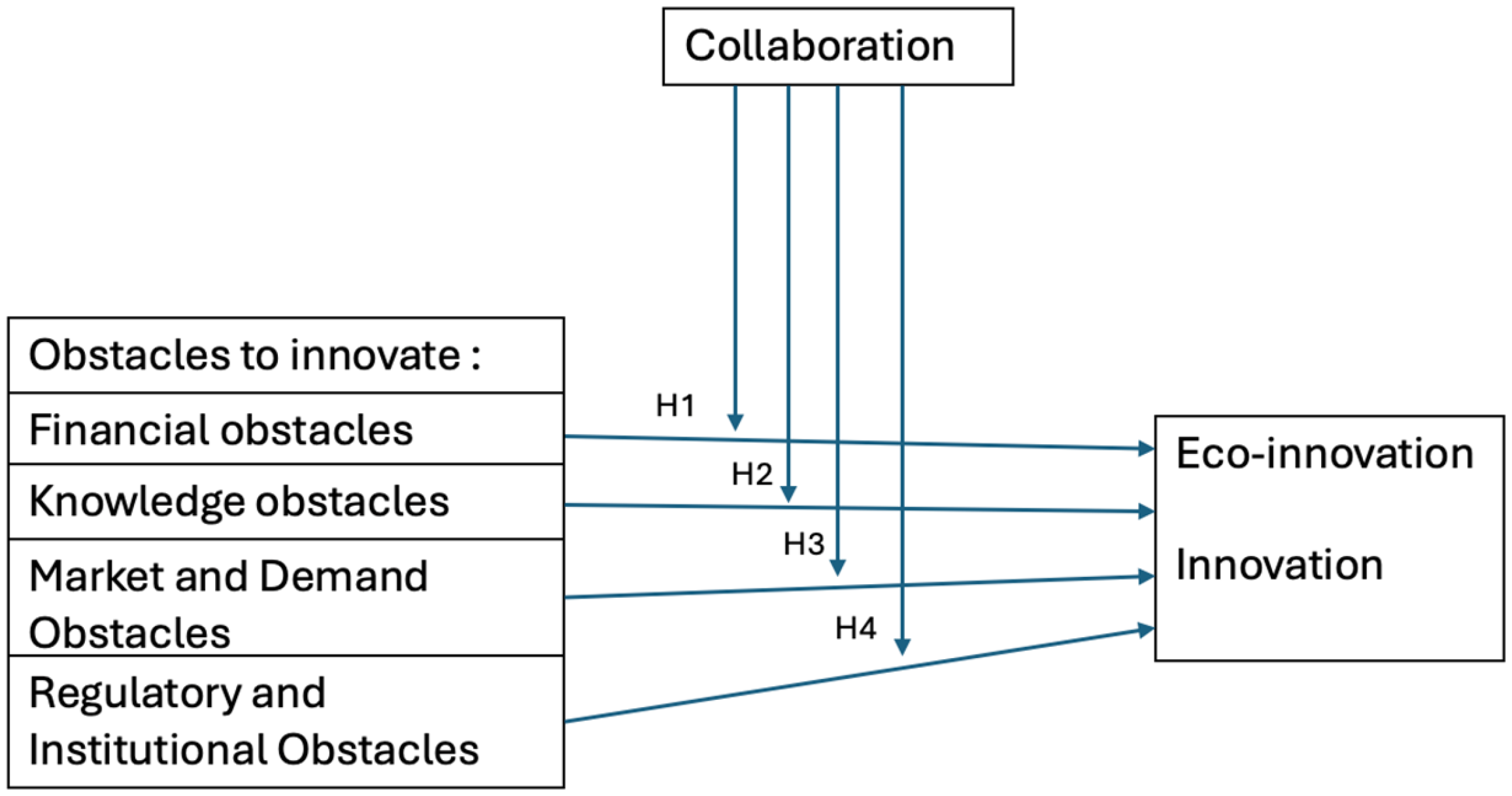
Firms perceive financial obstacles as revealed regarding innovation and eco-innovation outcomes, which are not moderated by collaboration.
  • Knowledge and Capability Obstacles
These refer to the lack of qualified personnel and weakness in technological assimilation [31,43]. In eco-innovation, given its higher technical complexity, the “knowledge gap” is pronounced [2]. For Zahra and George [44], exposure to diverse sources of knowledge increases potential absorptive capacity. Here, collaboration with research institutions functions as a coping strategy that supplements the lack of internal talent, providing access to specialized know-how.
Canêdo-Pinheiro et al. [41] and Muscio et al. [45] demonstrate that these obstacles foster cooperation to complement capabilities. Collaboration is expected to reduce the impact of the barrier by outsourcing the search for technical solutions.
H2. 
Firms perceive knowledge obstacles as revealed regarding innovation outcomes, which are negatively moderated by collaboration.
  • Market and Demand Obstacles
Factors such as uncertainty regarding green demand or the dominance of incumbents are critical determinants of innovation failure [38]. In emerging economies, where sustainable products are often incipient niches, perceived risk is high [36]. However, vertical collaboration with customers and suppliers mitigates this uncertainty by acting as a bridge of legitimacy and validating product acceptance [46]. For instance, by co-creating solutions with clients to ensure product fit or collaborating with suppliers to certify the sustainable origin of inputs, firms can position themselves in premium segments, overcoming the barrier of commoditized mass markets [45]. This interactive process allows firms to share information on technological trends and consumer preferences, effectively reducing the information asymmetry that often characterizes the weak “market pull” in the region. Therefore, collaboration is expected to reduce information asymmetry with the market:
H3. 
Firms perceive market obstacles as deterring regarding innovation outcomes, which are positively moderated by collaboration.
  • Regulatory and Institutional Obstacles
These encompass legislation, norms, standards, and bureaucracy. Although the Porter Hypothesis suggests that strict regulation induces innovation [28,47], in LAC, regulations are often perceived as an administrative burden or a bureaucratic barrier [31,37].
Political instability and lax enforcement weaken the regulatory signal [7]. In this vein, collaboration allows firms to share the costs of regulatory compliance and transition from reactive to proactive strategies, facilitating navigation of the legal framework [45,46]. Prokop et al. [46] point out that eco-innovation is driven by stakeholder and regulatory pressure, and that business model innovation mediates this relationship. Consequently, collaboration is assumed to facilitate efficient regulatory compliance:
H4. 
Firms perceive regulatory obstacles as deterring regarding innovation outcomes, which are negatively moderated by collaboration.
Figure 1 summarizes the hypotheses.

3. Materials and Methods

3.1. Data

The database used to test the hypotheses is based on company-level data from the service and manufacturing sectors of the Harmonized LAIS, compiled by the Inter-American Development Bank [48]. This database has been widely used in comparative studies between Latin American countries [49,50,51].
The database includes 30 innovation surveys (EI) conducted between 2007 and 2017 for ten countries, with a total of 119,900 observations: Argentina, Chile, Colombia, the Dominican Republic, Ecuador, El Salvador, Panama, Paraguay, Peru, and Uruguay (see Table 1 for more details by country). The microdata for Colombia and Chile collect biennial information on innovation activities, while the other countries have a triennial observation period.

3.2. Dependent Variables

To test the hypotheses, models are constructed for innovation outcomes: eco-innovation, product, process, marketing, organizational, and innovation. In addition, a level of innovation is constructed as a proxy for innovation intensity, which cannot be measured directly, as innovative sales, which are commonly used, are not available [18,52].
Given that these are different countries and we want to be as accurate as possible in our definitions, Table A1 details the considerations for each variable associated with innovation outcomes. Thus, innovation is a dummy variable equal to 1 if any of the innovations (product, process, marketing, and organizational) are carried out. Eco-innovation is a dummy variable equal to 1 if the company carries out eco-friendly activities (see Table A1) and implements some type of innovation (product, process). One limitation of this measure is that it is self-reported by companies in various surveys; however, it is a metric used to measure corporate eco-innovation [22]. The level of innovation is the sum of all questions for each type of innovation (product, process, marketing, and organizational). Product, process, marketing, and organizational innovation are dummy variables that take the value 1 if any of the actions listed in Table A1 are carried out.

3.3. Independent Variables

The main independent variable is collaboration, which considers whether the company engages in the three types of collaboration (collaboration in general, collaboration with R&D institutions, and collaboration with other firms). In other words, it is a metric of high collaboration, which has not been addressed until now in the literature on collaboration [49,51,53]. This metric allows for a better understanding of the intensity of companies’ integration into knowledge and cooperation networks, which is relevant when analyzing the moderating role of this collaboration in the face of obstacles to innovation. Rather than working separately, the aim is to capture those companies that actively participate in multiple collaborations.
Perceived barriers to innovation: financial barriers [54], knowledge barriers [55], market barriers [56], and regulatory barriers [52] are considered. Given the large number of countries, as with the dependent variables, the details for each obstacle to innovation are shown in Table A2. Each obstacle is a binary variable equal to 1 if at least one of the different obstacles to innovation is perceived (Table A2).
Considering the bias caused by companies that do not innovate and do not perceive obstacles, given that they have no intention of doing so [35], we work only with potentially innovative companies, considering those that carry out at least one type of innovation and perceive at least one obstacle as highly important [17,38]. The sample is thus reduced from 119,900 to 71,783, maintaining 59.86%.

3.4. Controls

The controls used are those commonly found in the literature on barriers to innovation (Table A3): age of the firm (Age) [41], age squared of the firm to capture the non-linearity of age (Age squared) [41], company size separated by SMEs [49,57] and large companies [57], whether public support for innovation has been used (Public support) [49,53], and the number of workers in the R&D department relative to the total number of workers (R&D Personnel). The odds ratios, which reflect changes across the entire scale of the variable, although in practice, the observed variations may be much smaller [49,53], are also considered a proxy for the percentage of foreign ownership (foreign capital) [41].

3.5. Model

The following models are used to test the hypotheses:
I n n o v a t i o n   r e s u l t i = β i 0 + β i 1 × C o l l a b o r a t i o n + β i j × O b s t a c l e i j + β i j × C o l l a b o r a t i o n × O b s t a c l e i j + β i k C o n t r o l s + μ c + λ t + δ s + ε i
where the subscript i corresponds to innovation results (ecological, product, process, organizational, marketing, level of innovation, and innovation). The subscript j corresponds to each type of obstacle (financial, knowledge, market, and regulation), and, finally, the subscript k corresponds to the controls considered. ε i is the unobservable heterogeneity. Country ( μ c ), sector ( δ s ), and year fixed effects ( λ t ) [49] are also considered.
Since all variables are binary except for the level of innovation, logit models are performed independently, reporting the odds ratio. The odds ratio represents the probability of success or having an event, p, to the probability of failure or not having an event (1 − p) [58]. In the case of the level of innovation, a linear model is estimated by ordinary least squares.
Since there is endogeneity between the number of workers in the R&D department and the total number of workers and the different innovation outcomes, additional estimates are made. For binary variables, a new specification is estimated using STATA’s V.19 eprobit command, considering the type of financing as R&D Personnel instruments, separating it into bank financing and other financing [58]. On the other hand, for the innovation-level variable, a two-stage least squares estimation is performed. The same instruments are used in both specifications. This is based on the idea that financial constraints limit innovation inputs and are not a direct determinant of innovation outcomes once the observable characteristics of the firm are controlled for [18].

4. Results

Table 2 shows the descriptive statistics for the entire sample and potentially innovative companies (relevant sample). A significant bias is observed in all types of innovation when considering the entire sample, evidence of the need to apply these filters in this type of study on companies, eliminating those that do not intend to innovate [35,38,50]. The results indicate that 51.15% of companies engage in eco-innovation and, on average, carry out 2.3 results of innovation. This shows a low level of innovation. However, process innovation (35.66%) and product innovation (34.03%) are the most common types of innovation carried out by companies in Latin American countries. In terms of collaboration, only 8.22% of companies collaborate, and the most important obstacle perceived by companies is financial, at 46.43%, while the least perceived is market, at 31.94%. In addition, it is noteworthy that only 16.72% of companies are large, with all the rest being SMEs.
In all models, it can be seen that collaboration has a positive effect on innovation outcomes (Table 3 and Table 4). This indicates that regardless of the type of innovation, collaboration is a determining factor for companies to innovate, impacting all types of innovations considered.

4.1. Financial Obstacles

Table 3 shows that in the eco-innovation model (column 1), cost barriers have an odds ratio of 1.101 *, indicating that companies that perceive high financial barriers are more likely to engage in eco-innovation, consistent with the literature on barriers-as-revealed-constraints (innovative firms are precisely those that “discover” the barriers). In other words, companies experience these types of barriers, but they innovate anyway [17,54]. Collaborative interaction (1.034) is not statistically significant, suggesting that in eco-innovation, collaboration does not significantly amplify or weaken the effect of cost barriers. For product innovation, on the other hand (column 2), the moderating effect changes the original relationship of the obstacle alone, i.e., companies that collaborate and perceive the cost obstacle are less likely to innovate in products. The results are in line with H1. These results are robust when controlling for endogeneity (Table 4).

4.2. Knowledge Barriers

When considering the knowledge barrier, eco-innovation has an odds ratio of 0.011 *** (Table 4, column 1), again indicating a revealing pattern: eco-innovative firms are precisely those that report greater cognitive, technological, and informational constraints. However, the interaction with collaboration is negative and significant (−0.033 **), implying that collaboration mitigates the positive effect of these obstacles on eco-innovation. This also occurs for level, technological innovations, and process innovation. In substantive terms, this suggests that when firms collaborate intensively, knowledge problems cease to be so decisive in explaining the probability of eco-innovation [55]. This pattern is particularly interesting because it differentiates eco-innovation from other types (for example, in process innovation, moderation is less consistent); thus, collaboration plays a particularly relevant compensatory role in the face of cognitive barriers to eco-innovation. The results are in line with H2.

4.3. Market Barriers

In eco-innovation, market barriers have an odds ratio of −0.039 *** (Table 4, column 1), meaning they act as real (dissuasive) barriers because they reduce the probability of eco-innovation, unlike what we see with costs and knowledge. This is entirely consistent with theory: uncertainty of demand, small market size, or lack of perceived need are obstacles that do discourage the adoption of environmental innovations [56]. However, the interaction with collaboration is positive and highly significant (0.041 ***), showing that collaboration partially reverses this negative effect. In interpretive terms, collaboration allows firms to overcome market problems—for example, through access to customers, legitimacy, dissemination of information, or reduction in uncertainty—which is particularly critical in the case of eco-innovation compared to other forms of innovation. The results are in line with H3.

4.4. Regulatory Barriers

For eco-innovation, regulatory barriers have an odds ratio of −0.042 *** (Table 4, column 1), indicating that they act as real barriers that significantly reduce the probability of eco-innovation. This is consistent with the institutional literature: unstable regulatory frameworks, low institutional quality, bureaucracy, or regulatory uncertainty have a greater impact on environmental innovations, which tend to be more sensitive to the regulatory environment [18,52]. The interaction with collaboration is negative and significant (−0.045 ***), showing that collaboration does not mitigate the negative effect of the institutional environment. Thus, collaboration does not function as an adaptive mechanism in the face of institutional failures, which is particularly relevant for explaining eco-innovation in Latin American contexts. The results are in line with H4.

5. Discussion

The primary objective of this study was to examine the moderating role of collaboration on the obstacles faced by Latin American firms in developing innovation and eco-innovation through the lens of NISs and absorptive capacity. The findings underscore the inherent complexity of innovating within emerging economies: while collaboration serves as a positive overall driver, its efficacy as a compensatory mechanism varies significantly depending on the specific barrier encountered by the firm. This exposes the structural fractures of innovation systems across the region, with the following highlights:
The role of collaboration in financial obstacles: A pivotal finding is that financial obstacles function as “revealed barriers” (showing a positive relationship with eco-innovation), corroborating the propositions of D’Este et al. [17]. Eco-innovative firms are acutely aware of high costs precisely because they are actively investing. However, contrary to classical theory suggesting that collaboration reduces costs by sharing risks [40], our results indicate that the interaction between collaboration and financial obstacles is non-significant. This finding challenges the notion that networking represents a universal panacea for resource scarcity. Consistent with Ferraro et al. [42] and Canêdo-Pinheiro et al. [41], we observe that financial constraints in Latin America are structural. Furthermore, it must be noted that collaboration, including outsourcing, is not cost-free; the transaction and coordination efforts required to manage external partnerships involve significant time and administrative costs that can weaken its role. In this context, the management of the alliance may consume the very resources it intended to supplement, effectively negating direct financial relief in the short term. This suggests that, in the absence of robust public support and direct funding, networking alone is insufficient to overcome capital barriers in the region, thereby validating hypothesis H1.
The success of open innovation in overcoming knowledge obstacles: Collaboration proves most potent in mitigating knowledge-related barriers. Much like financial obstacles, these function as revealed barriers; however, the negative interaction identified indicates that collaboration significantly attenuates the weight of this obstacle. This provides robust validation for absorptive capacity and open innovation theories within immature NIS contexts. Faced with a shortage of advanced human capital and the high technological complexity of eco-innovation [2], firms utilize cooperation as an effective coping strategy. This result aligns with the work of Muscio et al. [45] and Álvarez et al. [53], confirming that alliances allow Latin American firms to “import” the specialized know-how they cannot generate internally, thus transforming a cognitive weakness into an interactive learning opportunity.
The role of collaboration in market obstacles: A critical contribution of this study lies in the contrast observed regarding market obstacles. Unlike the aforementioned barriers, these act as deterring barriers (reducing the probability of innovation), which is consistent with the high uncertainty of green demand in the region. Nonetheless, collaboration reverses this negative effect (positive interaction). This suggests that vertical collaboration (with customers and suppliers) facilitates not only technology transfer but also the commercial validation of eco-innovation, thereby reducing information asymmetry. In agreement with Prokop et al. [46] and Castillo and Vonortas [36], our data indicate that collaboration enables firms to navigate market uncertainty and identify value niches, activating the “market pull” mechanism that is often weak in emerging economies. Collaboration, therefore, serves as a bridge of legitimacy toward the market.
The ineffectiveness of collaboration against regulatory obstacles: Finally, the most concerning result pertains to the regulatory environment. Regulatory obstacles act as formidable deterring barriers, contradicting the optimistic version of the Porter Hypothesis, which views regulation as a stimulus. More critically, collaboration does not mitigate this negative effect; in fact, the negative interaction suggests an institutional environment so adverse that even cooperation networks fail to buffer it. This finding supports the vision of Weerasinghe et al. [9] regarding “fragmented” NISs. In Latin America, regulation is perceived as bureaucracy and a compliance cost (deterring) rather than a strategic incentive. Unlike the observations in Agriculture 4.0 by Muscio et al. [45], where collaboration facilitated compliance, our broader results suggest that institutional instability and the disconnection of public policies [36] create an “institutional void” that private collaborative strategies cannot remedy.
Therefore, this study demonstrates that in LAC, collaboration is a highly effective mechanism for knowledge transfer and market validation (overcoming technical and commercial gaps) but is insufficient to address structural financial failures and institutional regulatory weaknesses. This implies that firms are succeeding in eco-innovating despite the system, utilizing networks to compensate for deficiencies in human capital and market signals, yet they remain vulnerable to liquidity shortages and inefficient normative frameworks.

6. Conclusions

In conclusion, eco-innovation should not be understood solely as an outcome driven by firms’ internal capabilities, but rather as a largely adaptive response to weak organizational environments and fragmented innovation systems. The empirical evidence presented reveals the presence of structural limitations, showing that neither absorptive capacity nor interorganizational cooperation can effectively offset financial constraints or regulatory instability. Specifically, our findings advance open innovation theory by demonstrating that its effectiveness as a barrier buffer is strictly conditioned by the nature of the systemic failure. While collaboration is potent for overcoming cognitive and commercial gaps, acting as an interactive coping strategy and a bridge of legitimacy, it remains insufficient against structural financial failures and institutional voids, thus defining the limits of absorptive capacity and cooperation in high-uncertainty environments. As a result, a persistent gap emerges between sustainability goals and the actual conditions required to achieve them, particularly in emerging economies.
From a sustainability perspective, this research highlights that the transition towards a low-carbon development model cannot rely exclusively on isolated firm-level efforts, but instead requires coherent public policies, a robust and stable regulatory framework, and green financing systems that support and complement private action. Within this context, Latin American firms are demonstrating a notable capacity for environmental innovation despite adverse conditions, leveraging collaborative networks to reduce uncertainty, strengthen their capabilities, and enhance sustainable competitiveness.
One limitation of the analysis relates to the potential endogeneity of collaboration. Although the endogeneity of R&D personnel is considered using instrumental variables, the company’s decision to collaborate may be endogenous to innovation. Thus, companies that are strongly innovation-oriented may also be more likely to collaborate than to innovate. This could lead to causality problems or selection bias. However, the objective of this study is not to analyze the direct causal effect of collaboration on innovation outcomes, but rather the moderating role of collaboration in the relationship between obstacles and innovation outcomes. Thus, the results are interpreted as empirical associations that are consistent with the proposed theory. Future research may consider this by having clearer longitudinal data or additional identification strategies that allow this possible endogeneity to be addressed directly.

Author Contributions

Conceptualization, R.O.-H., G.T.-G., K.M.-O. and I.R.-F.; Methodology, R.O.-H.; Validation, R.O.-H., K.M.-O. and I.R.-F.; Formal analysis, R.O.-H. and K.M.-O.; Writing—original draft, R.O.-H., K.M.-O.; Writing—review & editing, R.O.-H., G.T.-G., K.M.-O. and I.R.-F.; Project administration, I.R.-F. All authors have read and agreed to the published version of the manuscript.

Funding

This research received no external funding.

Institutional Review Board Statement

Not applicable.

Informed Consent Statement

Not applicable.

Data Availability Statement

The data supporting the findings of this study are openly available via Dropbox at the following link: https://www.dropbox.com/scl/fo/0h1kl9pbs9ck1mjpc3lme/AN2KFokErjONguMLE2x8IRE/Datos?rlkey=0obhfulrl1r86qjddyhs6s3fg&dl=0, accessed on 1 November 2025.

Conflicts of Interest

The authors declare no conflict of interest.

Appendix A

Table A1. Definition of innovation results; dependent variables.
Eco: Reduction as an Innovation EffectProduct InnovationProcess InnovationOrganizational InnovationMarketing Innovation
Energy consumptionNew goodMethods of productionNew business practices for the organization of processesAt least one innovation in packaging
Environmental impacts and/or improvement in health and safetyNew serviceLogistics and deliveryNew methods for organizational responsibilities and decision-makingAt least one innovation in product promotion
Unit labor costsNew productProcess supporting activitiesNew methods for organizing external relations with other firms or public institutionsNew methods of distributing or placing products on the market
Consumption of materialsImproved goodNew processAt least one organizational innovationNew pricing methods for goods or services
Consumption of materials and energyImproved serviceImproved process At least one marketing innovation
Unit production costsImproved productProcess innovation
Good innovation
Service innovation
Product innovation
Table A2. Definition of obstacles to innovation.
FinancialKnowledgeMarketRegulation
Lack of internal financialLack of qualified employees in the firmDemand uncertaintyIssues with the IPR system
Lack of external financialLack of qualified employees in the countrySmall market sizeLack of STI public policies
High cost of trainingLack of market informationMarket structureLack of government incentives
High costLack of technology informationFirm did not need to innovateThe organizational rigidity within the firm
Long period of expected returnDifficulty to find cooperation partners The difficulty to protect innovations
Low expected returnTechnical risk Regulation
Lack of infrastructure Sectoral technological dynamic
Other obstacles
Table A3. Definition of variables and controls.
VariableDefinitionSource
Dependent variablesEco-innovationDummy = 1 if it performs reduction as an innovation effect from Table A1 and performs process or product innovation, 0 otherwise.[22]
Product innovationDummy = 1 if product innovation defined in Table A1 is carried out, 0 otherwise.[22]
Process innovationDummy = 1 if process innovation defined in Table A1 is carried out, 0 otherwise.[22]
Organizational innovationDummy = 1 if organizational innovation defined in Table A1 is carried out, 0 otherwise.[18]
Marketing innovationDummy = 1 if marketing innovation defined in Table A1 is carried out, 0 otherwise.[18]
InnovationDummy = 1 if at least one type of innovation (product, process, organizational, or marketing) is carried out, 0 otherwise.[18]
Level of innovationIt is the sum of product, process, marketing, and organizational innovation.[18]
Independent variablesFinancial obstacleDummy = 1 if at least one financial obstacle listed in Table A2 is observed, 0 otherwise.[18]
Knowledge obstacleDummy = 1 if at least one knowledge obstacle listed in Table A2 is observed, 0 otherwise.[18]
Market obstacleDummy = 1 if at least one market obstacle listed in Table A2 is observed, 0 otherwise.[18]
Regulation obstacleDummy = 1 if at least one regulation obstacle listed in Table A2 is observed, 0 otherwise.[18]
Collaboration in generalDummy = 1 if the firm collaborates with local organizations, 0 otherwise[51,53]
Collaboration with R&D institutionsDummy = 1 if the firm collaborates local universities and public and private R&D centers, 0 otherwise[49,51,53]
Collaboration with other firmsDummy = 1 if the firm collaborates with local clients, suppliers, competitors, and other firms, 0 otherwise[49,51,53]
CollaborationDummy = 1 if the firm collaborates in general, with R&D institutions and other firms, 0 otherwise[49,51,53]
ControlsAge (log)log(2026 − Year of beginning of activities + 1)[41]
Age squared (log)Square of the logarithm of the age[41]
SMEsDummy = 1 if the firm has between 10 and 249 employees in any year, 0 otherwise[57]
LargeDummy = 1 if the firm has more than 249 employees in any year[57]
Public supportDummy = 1 if the firm has used public support for innovation, 0 otherwise[49,53]
R&D PersonnelPercentage of people employed in the R&D department compared to the total number of employees[49,53]
Foreign capitalDummy = 1 if the firm has foreign capital (>median%) in year 1, 2 or 3, 0 otherwise[41]
Bank financingDummy = 1 if part of the innovation expenditures were funded by banks, 0 otherwise[38]
Other financingDummy = 1 if part of the innovation expenditures were funded by other sources, 0 otherwise[38]

References

  1. ECLAC. The 2030 Agenda for Sustainable Development in Latin America and the Caribbean: Progress and Challenges; Economic Commission for Latin America and the Caribbean: Santiago, Chile, 2025. [Google Scholar]
  2. Grazzi, M.; Sasso, S.; Kemp, R. A Conceptual Framework to Measure Green Innovation in Latin America and the Caribbean; Discussion Paper No. IDB-DP-730; Inter-American Development Bank: New York, NY, USA, 2019. [Google Scholar]
  3. EGADE Business School. Corporate Sustainability in Latin America: Executive Report; EGADE Business School: Monterrey, Mexico, 2025. [Google Scholar]
  4. Kemp, R.; Pearson, P. Final Report MEI Project About Measuring Eco-Innovation; Maastricht Economic and Social Research Institute on Innovation and Technology (UNU-MERIT): Maastricht, The Netherlands, 2007. [Google Scholar]
  5. Barriga Medina, H.; Guevara, R.; Campoverde, R.E.; Paredes-Aguirre, M.I. Eco-Innovation and firm performance: Evidence from South America. Sustainability 2022, 14, 9579. [Google Scholar] [CrossRef]
  6. Tegethoff, T.; Santa, R.; Bucheli, J.M.; Cabrera, B.; Scavarda, A. Sustainable development through eco-innovation: A focus on small and medium enterprises in Colombia. PLoS ONE 2025, 20, e0316620. [Google Scholar] [CrossRef] [PubMed]
  7. Campos-Requena, I.; Rivera, D.; Fernández, F.J.; Vásquez-Lavin, F.; Ponce Oliva, R.D. Eco-Innovation: Drivers and obstacles for agriculture firms in a developing country. Bus. Strategy Environ. 2025, 35, 3247–3264. [Google Scholar] [CrossRef]
  8. Mansilla-Obando, K.; Bravo-Ortega, C.; Egana-delSol, P. Unlocking eco-innovation potential: An integrated approach to sustainability. Sustain. Dev. 2025, 33, 885–902. [Google Scholar] [CrossRef]
  9. Weerasinghe, R.N.; Jayawardane, A.K.W.; Huang, Q. Critical inquiry on national innovation system: Does NIS fit with developing countries? Sustain. Technol. Entrep. 2024, 3, 100052. [Google Scholar] [CrossRef]
  10. Freeman, C. Technology Policy and Economic Performance: Lessons from Japan; Pinter Publishers: London, UK, 1987. [Google Scholar]
  11. Lundvall, B.-Å. National Systems of Innovation: Towards a Theory of Innovation and Interactive Learning; Pinter Publishers: London, UK, 1992. [Google Scholar]
  12. Lundvall, B.-Å. National innovation systems—Analytical concept and development tool. Ind. Innov. 2007, 14, 95–119. [Google Scholar] [CrossRef]
  13. Chesbrough, H. Open Business Models: How to Thrive in the New Innovation Landscape; Harvard Business School Press: Boston, MA, USA, 2006. [Google Scholar]
  14. Mercado-Caruso, N.; Segarra-Oña, M.; Ovallos-Gazabon, D.; Peiró-Signes, A. Identifying endogenous and exogenous indicators to measure eco-innovation within clusters. Sustainability 2020, 12, 6088. [Google Scholar] [CrossRef]
  15. Cohen, W.M.; Levinthal, D.A. Absorptive capacity: A new perspective on learning and innovation. Adm. Sci. Q. 1990, 35, 128–152. [Google Scholar] [CrossRef]
  16. Álvarez, R.; González, A. Obstacles to Green Innovation: Evidence from Chilean Firms (SDT 550); Universidad de Chile, Facultad de Economía y Negocios: Santiago, Chile, 2023. [Google Scholar]
  17. D’Este, P.; Iammarino, S.; Savona, M.; von Tunzelmann, N. What hampers innovation? Revealed barriers versus deterring barriers. Res. Policy 2012, 41, 482–488. [Google Scholar] [CrossRef]
  18. Ortiz, R.; Fernández, S. Business perception of obstacles to innovate: Evidence from Chile with pseudo-panel data analysis. Res. Int. Bus. Financ. 2022, 59, 101563. [Google Scholar] [CrossRef]
  19. Núñez, E.; Leiva, J.C.; Mora-Esquivel, R. Innovation, green management and SME performance: Evidence from Latin American manufacturing firms. J. Econ. Financ. Adm. Sci. 2025. [Google Scholar] [CrossRef]
  20. OECD/Eurostat. Oslo Manual 2018: Guidelines for Collecting, Reporting and Using Data on Innovation, 4th ed.; OECD Publishing: Paris, France, 2018. [Google Scholar] [CrossRef]
  21. Díaz-García, C.; González-Moreno, Á.; Sáez-Martínez, F.J. Eco-innovation: Insights from a literature review. Innov. Manag. Policy Pract. 2015, 17, 6–23. [Google Scholar] [CrossRef]
  22. Fernández, S.; Torrecillas, C.; Labra, R.E. Drivers of eco-innovation in developing countries: The case of Chilean firms. Technol. Forecast. Soc. Change 2021, 170, 120902. [Google Scholar] [CrossRef]
  23. Barney, J. Firm resources and sustained competitive advantage. J. Manag. 1991, 17, 99–120. [Google Scholar] [CrossRef]
  24. Guimón, J.; Chaminade, C.; Maggi, C.; Salazar-Elena, J.C. Policies to attract R&D-related FDI in small emerging countries: Aligning incentives with local linkages and absorptive capacities in Chile. J. Int. Manag. 2017, 24, 165–178. [Google Scholar]
  25. Horbach, J.; Rammer, C.; Rennings, K. Determinants of eco-innovations by type of environmental impact—The role of regulatory push/pull, technology push and market pull. Ecol. Econ. 2012, 78, 112–122. [Google Scholar] [CrossRef]
  26. Kesidou, E.; Demirel, P. On the drivers of eco-innovations: Empirical evidence from the UK. Res. Policy 2012, 41, 862–870. [Google Scholar] [CrossRef]
  27. Rennings, K. Redefining innovation—Eco-innovation research and the contribution from ecological economics. Ecol. Econ. 2000, 32, 319–332. [Google Scholar] [CrossRef]
  28. Porter, M.E.; van der Linde, C. Toward a new conception of the environment–competitiveness relationship. J. Econ. Perspect. 1995, 9, 97–118. [Google Scholar] [CrossRef]
  29. Pacheco, D.A.J.; ten Caten, C.S.; Jung, C.F.; Ribeiro, J.L.D.; Navas, H.V.G.; Cruz-Machado, V.A. Eco-innovation determinants in manufacturing SMEs: Systematic review and research directions. J. Clean. Prod. 2017, 142, 2277–2287. [Google Scholar] [CrossRef]
  30. Arza, V.; López, E. Obstacles affecting innovation in small and medium enterprises: Quantitative analysis of the Argentinean manufacturing sector. Res. Policy 2021, 50, 104324. [Google Scholar] [CrossRef]
  31. Galia, F.; Legros, D. Complementarities between obstacles to innovation: Evidence from France. Res. Policy 2004, 33, 1185–1199. [Google Scholar] [CrossRef]
  32. Mohnen, P.; Rosa, J. Barriers to innovation in service industries in Canada. In Institutions and Systems in the Geography of Innovation; Feldman, M.P., Massard, N., Eds.; Kluwer Academic Publishers: Dordrecht, The Netherlands, 2002; pp. 231–250. [Google Scholar]
  33. Baldwin, J.; Lin, Z. Impediments to advanced technology adoption for Canadian manufacturers. Res. Policy 2002, 31, 1–18. [Google Scholar] [CrossRef]
  34. Iammarino, S.; Sanna-Randaccio, F.; Savona, M. The perception of obstacles to innovation. Foreign multinationals and domestic firms in Italy. Rev. D’economie Ind. 2009, 125, 75–104. [Google Scholar]
  35. Savignac, F. Impact of financial constraints on innovation: What can be learned from a direct measure? Econ. Innov. New Technol. 2008, 17, 553–569. [Google Scholar] [CrossRef]
  36. Castillo, J.C.; Vonortas, N.S. Are social innovation practices relevant for the deployment of Green-oriented projects? Firm-level evidence from Chile. In Proceedings of the Conferencia LALICS 2025, Rio de Janeiro, Brazil, 10–12 September 2025. [Google Scholar]
  37. Mohnen, P.; Röller, L.-H. Complementarities in innovation policy. Eur. Econ. Rev. 2005, 49, 1431–1450. [Google Scholar] [CrossRef]
  38. Pellegrino, G.; Savona, M. No money, no honey? Financial versus knowledge and demand constraints on innovation. Res. Policy 2017, 46, 510–521. [Google Scholar] [CrossRef]
  39. Alvarez, R.; Crespi, G.A. Heterogeneous effects of financial constraints on innovation: Evidence from Chile. Sci. Public Policy 2015, 42, 711–724. [Google Scholar] [CrossRef]
  40. Enkel, E.; Gassmann, O.; Chesbrough, H. Open R&D and open innovation: Exploring the phenomenon. RD Manag. 2009, 39, 311–316. [Google Scholar]
  41. Canêdo-Pinheiro, M.; Lage de Sousa, F.; Cabral, B. Interplay between innovation barriers and cooperation in Latin America: Lessons for public policy. Econ. Innov. New Technol. 2026, 1–28. [Google Scholar] [CrossRef]
  42. Ferraro, G.; Passaro, R.; Quinto, I.; Thomas, A. The process supporting the emergence of the environmental innovation capabilities within small businesses: An empirical investigation. Bus. Strategy Environ. 2025, 34, 1027–1042. [Google Scholar] [CrossRef]
  43. Amara, N.; D’Este, P.; Landry, R.; Doloreux, D. Impacts of obstacles on innovation patterns in KIBS firms. J. Bus. Res. 2016, 69, 4065–4073. [Google Scholar] [CrossRef]
  44. Zahra, S.A.; George, G. Absorptive capacity: A review, reconceptualization, and extension. Acad. Manag. Rev. 2002, 27, 185–203. [Google Scholar] [CrossRef]
  45. Muscio, A.; Maghssudipour, A.; Wang, Y. Digital Transformation for Eco-Innovation: Evidence From Agriculture 4.0 Adoption in Wine Firms. Bus. Strategy Environ. 2025. [Google Scholar] [CrossRef]
  46. Prokop, V.; Carraresi, L.; Karman, A.; Rehman, F.U.; Ibl, M. Tracing the Reverse Relationship Among Environmental Benefits, Business Model Innovation, and Eco-Innovation: Does Cooperation Matter? Bus. Strategy Environ. 2025, 34, 2378–2404. [Google Scholar] [CrossRef]
  47. Ambec, S.; Lanoie, P. Does it pay to be green? A systematic overview. Acad. Manag. Perspect. 2008, 22, 45–62. [Google Scholar] [CrossRef]
  48. Crespi, G.; Guillard, C.; Salazar, M.; Vargas, F. Harmonized Latin American Innovation Surveys Database (LAIS): Firm-Level Microdata for the Study of Innovation; Inter-American Development Bank (IDB): Washington, DC, USA, 2022. [Google Scholar]
  49. Albis, N.; Álvarez, I.; Castillo, Y.; Santos-Pavez, K. University-industry linkages through the lens of national innovation systems in Latin America. Ind. Innov. 2025, 1–22. [Google Scholar] [CrossRef]
  50. Chavez, C. Latin American firm cooperation payoff evidence. Int. Trade J. 2024, 38, 490–519. [Google Scholar] [CrossRef]
  51. Plata, C. Innovation investment and performance: The moderating role of university collaborations. J. Manag. Hist. 2025, 31, 204–227. [Google Scholar] [CrossRef]
  52. Zahler, A.; Goya, D.; Caamaño, M. The primacy of demand and financial obstacles in hindering innovation. Technol. Forecast. Soc. Change 2022, 174, 121199. [Google Scholar] [CrossRef]
  53. Álvarez, I.; Albis, N.; Moraes, D.; Mora, H. Collaboration in innovation between foreign-owned firms and local organizations in Latin America: A comparative analysis. Ind. Innov. 2023. [Google Scholar] [CrossRef]
  54. Mohnen, P.; Palm, F.C.; Van Der Loeff, S.S.; Tiwari, A. Financial constraints and other obstacles: Are they a threat to innovation activity? De Econ. 2008, 156, 201–214. [Google Scholar] [CrossRef]
  55. De Fuentes, C.; Santiago, F.; Temel, S. Perception of innovation barriers by successful and unsuccessful innovators in emerging economies. J. Technol. Transf. 2020, 45, 1283–1307. [Google Scholar] [CrossRef]
  56. Antonioli, D.; Marzucchi, A.; Savona, M. Pain shared, pain halved? Cooperation as a coping strategy for innovation barriers. J. Technol. Transf. 2017, 42, 841–864. [Google Scholar] [CrossRef]
  57. Tacsir, E.; Pereira, M.; Favata, F.; Leone, J. Competition and distance to the technological frontier as determinants of innovation: A multilevel analysis for Latin America. In IDB Working Paper Series; No. IDB-WP-01466; Inter-American Development Bank: Washington, DC, USA, 2024. [Google Scholar] [CrossRef]
  58. Fernandez, V. The finance of innovation in Latin America. Int. Rev. Financ. Anal. 2017, 53, 37–47. [Google Scholar] [CrossRef]
Figure 1. Theoretical model and summary of hypotheses.
Sustainability 18 05122 g001
Table 1. Observations by country and waves.
CountryWaveReference PeriodNumber of Observations
Argentina20132010–20123691
20172014–20163944
Chile20092007–20084443
20112009–20103653
20132011–20124614
20152013–20145620
20172015–20165876
Colombia20092007–20087683
20102008–20093662
20112009–20108643
20122010–20115038
20132011–20129137
20142012–20135848
20152013–20148835
20162014–20158056
20172015–20167947
Dominican Republic20102007–2009532
Ecuador20132009–20112815
20152012–20146275
El Salvador20132010–2012574
Panama20092006–2008709
20142011–2013665
Paraguay20132009–2011477
20162012–2014573
Peru20122010–20121124
20152013–20151452
Uruguay20072004–20061760
20102007–20091946
20132010–20121814
20162013–20152494
Total 119,900
Notes: source: Crespi et al., 2022 [48].
Table 2. Descriptive statistics of all variables.
VariablesAll SampleRelevant Sample
MeanStd. Dev.MeanStd. Dev.
DependentEco-innovation (%)29.1345.4351.1549.99
Product innovation (%)20.3740.2834.0347.38
Process innovation (%)21.3540.9835.6647.90
Organizational innovation (%)15.7036.3826.2243.98
Marketing innovation (%)11.5731.9819.3239.48
Level of innovation1.372.642.303.09
Innovate (%)34.9647.6858.3949.29
IndependentCollaboration (%)4.9421.688.2227.46
Financial obstacle (%)27.8044.8046.4349.87
Knowledge obstacle (%)26.9144.3544.9549.74
Market obstacle (%)19.1239.3331.9446.63
Regulation obstacle (%)20.5740.4234.3647.49
ControlsAge (log)1.321.681.961.71
Age squared (log)4.596.046.806.29
SMEs (%)13.4034.0616.7237.32
Large (%)74.5043.5873.1044.35
Public support (%)2.7816.444.6321.02
R&D Personnel (%)0.734.801.145.91
Foreign capital (%)3.2517.734.6921.15
Table 3. Regression model results for innovation results: odds ratio.
Variables (1)(2)(3)(4)(5)(6)(7)
Collaboration7.906 ***3.544 ***3.320 ***2.497 ***2.280 ***7.714 ***2.070 ***
(0.700)(0.175)(0.156)(0.107)(0.102)(0.644)(0.053)
Financial obstacle1.101 ***1.147 ***1.105 ***1.0281.0261.0010.180 ***
(0.026)(0.027)(0.024)(0.024)(0.027)(0.023)(0.025)
Financial obstacle × Collaboration1.0340.876 *0.9121.0370.9341.381 **0.001
(0.118)(0.069)(0.068)(0.073)(0.069)(0.207)(0.087)
Knowledge obstacle1.153 ***1.191 ***1.213 ***1.111 ***1.119 ***1.099 ***0.285 ***
(0.029)(0.030)(0.029)(0.028)(0.031)(0.026)(0.027)
Knowledge obstacle × Collaboration0.751 **0.8770.719 ***0.9750.9660.836−0.178 *
(0.090)(0.074)(0.058)(0.074)(0.077)(0.130)(0.094)
Market obstacle0.688 ***0.877 ***0.738 ***0.858 ***0.934 ***0.718 ***−0.361 ***
(0.015)(0.020)(0.016)(0.019)(0.024)(0.016)(0.024)
Market obstacle × Collaboration1.453 ***1.265 ***1.410 ***1.232 ***1.292 ***1.957 ***0.494 ***
(0.169)(0.103)(0.107)(0.088)(0.097)(0.311)(0.089)
Regulation obstacle0.679 ***0.950 **0.855 ***0.953 *0.9730.700 ***−0.097 ***
(0.018)(0.024)(0.021)(0.025)(0.029)(0.018)(0.028)
Regulation obstacle × Collaboration0.713 ***1.0450.9320.9881.0260.785−0.488 ***
(0.083)(0.086)(0.073)(0.073)(0.079)(0.119)(0.092)
Age (log)0.747 **0.650 ***0.703 ***0.714 **0.655 ***0.702 ***−0.736 ***
(0.101)(0.095)(0.096)(0.100)(0.099)(0.095)(0.155)
Age squared (log)1.049 **1.082 ***1.072 ***1.060 ***1.077 ***1.066 ***0.138 ***
(0.021)(0.023)(0.022)(0.022)(0.024)(0.021)(0.023)
SMEs2.162 ***1.963 ***2.118 ***2.483 ***1.802 ***2.321 ***0.736 ***
(0.079)(0.080)(0.080)(0.104)(0.080)(0.078)(0.035)
Large4.009 ***3.425 ***3.539 ***3.712 ***2.594 ***4.478 ***1.525 ***
(0.175)(0.155)(0.150)(0.171)(0.128)(0.183)(0.043)
Public support6.521 ***3.369 ***2.705 ***2.111 ***1.889 ***12.033 ***1.422 ***
(0.451)(0.152)(0.113)(0.083)(0.079)(0.976)(0.049)
R&D Personnel314.660 ***440.500 ***8.618 ***6.723 ***7.896 ***1113.156 ***3.945 ***
(93.536)(104.574)(1.317)(0.984)(1.174)(373.506)(0.174)
Foreign capital1.244 ***1.327 ***1.227 ***1.128 ***1.0401.269 ***0.427 ***
(0.054)(0.059)(0.051)(0.047)(0.049)(0.054)(0.049)
Constant0.301 ***0.377 ***0.169 ***0.117 ***0.177 ***0.452 ***1.520 ***
(0.077)(0.049)(0.020)(0.015)(0.026)(0.053)(0.133)
Observations62,99771,77971,77971,77971,77971,77971,779
Wald chi222,82916,71211,1496266573522,742
Pseudo R20.2620.1820.1190.07590.08140.2330.277
Notes: Standard errors in parentheses, *** p < 0.01, ** p < 0.05, * p < 0.1. Dependent variables: (1) eco-innovation, (2) product innovation, (3) process innovation, (4) organizational innovation, (5) marketing innovation, (6) innovation, and (7) level of innovation. All models are estimated independently.
Table 4. Regression model results for innovation results: endogeneity-controlled.
Variables(1)(2)(3)(4)(5)(6)(7)
Collaboration0.214 ***0.221 ***0.155 ***0.352 ***0.362 ***0.150 ***0.877 ***
(0.015)(0.014)(0.012)(0.023)(0.025)(0.010)(0.178)
Financial obstacle0.0030.017 ***0.007 **0.0040.005−0.005 ***0.121 ***
(0.003)(0.004)(0.003)(0.009)(0.011)(0.002)(0.040)
Financial obstacle × Collaboration0.002−0.022−0.0150.017−0.0310.018 *−0.069
(0.012)(0.015)(0.011)(0.029)(0.034)(0.010)(0.250)
Knowledge obstacle0.011 ***0.028 ***0.023 ***0.037 ***0.046 ***0.005 **0.219 ***
(0.003)(0.005)(0.004)(0.010)(0.012)(0.002)(0.043)
Knowledge obstacle × Collaboration−0.033 **−0.023−0.044 ***−0.005−0.010−0.016−0.432
(0.013)(0.016)(0.012)(0.031)(0.037)(0.011)(0.275)
Market obstacle−0.039 ***−0.022 ***−0.041 ***−0.058 ***−0.027 **−0.025 ***−0.246 ***
(0.003)(0.004)(0.004)(0.009)(0.011)(0.002)(0.038)
Market obstacle × Collaboration0.041 ***0.041 ***0.045 ***0.079 ***0.110 ***0.048 ***0.131
(0.013)(0.015)(0.011)(0.030)(0.035)(0.011)(0.261)
Regulation obstacle−0.042 ***−0.010 **−0.021 ***−0.020 *−0.014−0.029 ***−0.150 ***
(0.004)(0.005)(0.004)(0.010)(0.013)(0.003)(0.041)
Regulation obstacle × Collaboration−0.045 ***0.013−0.009−0.0070.007−0.026 **−0.614 **
(0.013)(0.015)(0.011)(0.030)(0.036)(0.011)(0.260)
Age (log)−0.044 ***−0.094 ***−0.061 ***−0.142 **−0.200 ***−0.039 ***−0.906 ***
(0.016)(0.028)(0.020)(0.057)(0.069)(0.012)(0.170)
Age squared (log)0.007 ***0.017 ***0.012 ***0.025 ***0.035 ***0.007 ***0.185 ***
(0.002)(0.004)(0.003)(0.008)(0.010)(0.002)(0.027)
SMEs0.077 ***0.110 ***0.095 ***0.333 ***0.240 ***0.065 ***0.907 ***
(0.006)(0.009)(0.008)(0.020)(0.020)(0.004)(0.073)
Large0.134 ***0.197 ***0.153 ***0.482 ***0.390 ***0.110 ***2.002 ***
(0.009)(0.013)(0.011)(0.026)(0.025)(0.007)(0.092)
Public support0.185 ***0.198 ***0.114 ***0.272 ***0.265 ***0.168 ***−0.627 **
(0.012)(0.013)(0.009)(0.020)(0.022)(0.011)(0.257)
R&D Personnel16.824 ***16.983 ***16.734 ***13.305 ***11.663 ***17.152 ***62.490 ***
(0.052)(0.068)(0.063)(0.377)(0.523)(0.048)(6.391)
Foreign capital0.024 ***0.052 ***0.031 ***0.043 **0.0130.020 ***0.389 ***
(0.005)(0.009)(0.006)(0.017)(0.021)(0.004)(0.089)
Constant−0.262 ***−0.382 ***−0.446 ***−1.042 ***−0.984 ***−0.257 ***1.238 ***
(0.030)(0.026)(0.023)(0.058)(0.065)(0.011)(0.210)
Bank financing0.011 ***0.009 ***0.009 ***0.007 ***0.005 ***0.010 ***0.002 **
(0.001)(0.000)(0.001)(0.001)(0.001)(0.000)(0.001)
Other financing0.014 ***0.013 ***0.008 ***0.020 ***0.022 ***0.010 ***0.025 ***
(0.001)(0.001)(0.001)(0.001)(0.001)(0.001)(0.002)
Constant0.009 ***0.009 ***0.010 ***0.009 ***0.009 ***0.009 ***0.010 ***
(0.000)(0.000)(0.000)(0.000)(0.000)(0.000)(0.000)
Country fixed effectsYesYesYesYesYesYesYes
Year fixed effectsYesYesYesYesYesYesYes
Industry fixed effectsYesYesYesYesYesYesYes
var(e.R&D_personnel)0.004 ***0.003 ***0.003 ***0.003 ***0.003 ***0.003 ***
(0.000)(0.000)(0.000)(0.000)(0.000)(0.000)
corr(e.R&D_personnel,y)−0.982 ***−0.948 ***−0.972 ***−0.742 ***−0.633 ***−0.990 ***
(0.002)(0.005)(0.003)(0.024)(0.033)(0.001)
Observations62,99771,77971,77971,77971,77971,77971,779
Notes: Standard errors in parentheses, *** p < 0.01, ** p < 0.05, * p < 0.1. Dependent variables: (1) eco-innovation, (2) product innovation, (3) process innovation, (4) organizational innovation, (5) marketing innovation, (6) innovation, and (7) level of innovation. All models are estimated independently.
Disclaimer/Publisher’s Note: The statements, opinions and data contained in all publications are solely those of the individual author(s) and contributor(s) and not of MDPI and/or the editor(s). MDPI and/or the editor(s) disclaim responsibility for any injury to people or property resulting from any ideas, methods, instructions or products referred to in the content.