Who Can Persist in Innovation? The Impact of Transition Finance on Corporate Green Value from the Perspective of Firm Lifecycle


Abstract
1. Introduction
2. Literature Review and Hypotheses Development
2.1. Literature Review
2.1.1. The Determinants of Corporate Value and Green Value
2.1.2. The Economic Effects of Transition Finance
2.1.3. The Impact of Firm Lifecycle
2.1.4. In Summary
2.2. Hypotheses Development
3. Methodology
3.1. Model Specification
3.2. Variables
3.2.1. Dependent Variable: Corporate Green Value (GREVAL)
3.2.2. Independent Variables: Transition Finance (TRANFIN)
3.2.3. Mechanism Variables: Innovation Persistency (INNPER)
3.2.4. Moderating Variables: Firm Lifecycle Stages
3.2.5. Control Variables
3.3. Data
4. Results and Analysis
4.1. Benchmark Results
4.2. The Robustness Tests
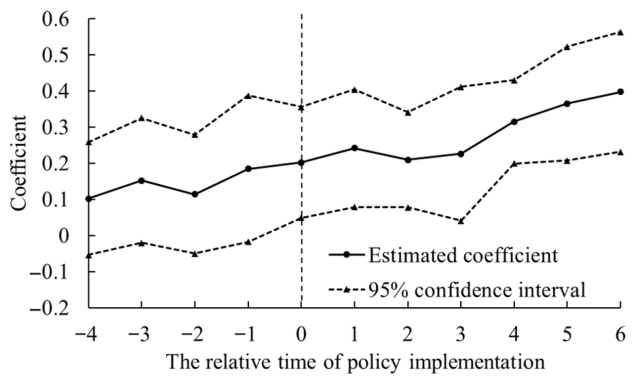
4.2.1. Parallel Trend Test
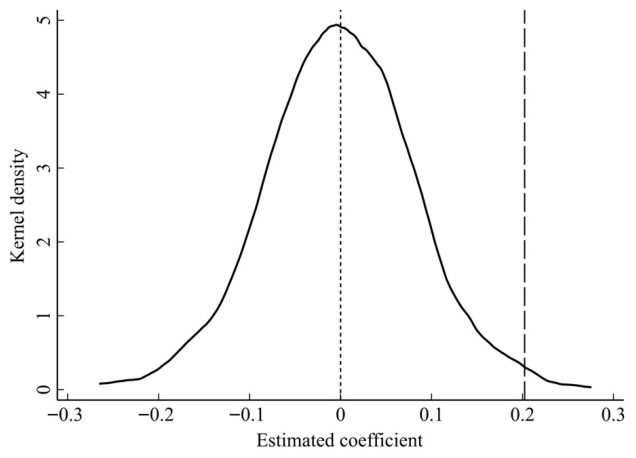
4.2.2. Placebo Test
4.2.3. Instrumental Variable
4.2.4. Double Machine Learning
4.2.5. Alternative Green Value Proxies
- (1)
- Pre-treatment fixed coefficients (GREVAL_fixed). We re-estimate the ESG valuation coefficients λ1 using only pre-treatment data (2011–2015) and hold these coefficients constant for the entire sample period (2011–2022). This approach breaks any feedback loop by ensuring that GREVAL_fixed is not influenced by post-Catalogue changes in ESG market pricing. Specifically, for each industry s, we estimate using observations from 2011–2015 only, then compute: GREVAL_fixedit = × ESGit
- (2)
- Environmental pillar only (GREVAL_E). We use only the environmental (E) pillar score of ESG, rather than the composite ESG score, to construct GREVAL. This isolates the market valuation of environmental performance from governance and social dimensions, providing a more direct measure of green value. The construction follows the same two-step procedure as the baseline GREVAL but replaces the composite ESG score with the E-pillar score.
4.2.6. Controlling for Concurrent Policies
4.3. Heterogeneous Analysis
4.4. Mechanism Analysis
4.5. Discussion
5. Conclusions
Author Contributions
Funding
Institutional Review Board Statement
Informed Consent Statement
Data Availability Statement
Conflicts of Interest
References
- Khan, J.; Wu, F.Y.; Fawad, A. Corporate environmentalism and value creation: Investigating the role of shared independent directors in green technology adoption and financial performance. Corp. Soc. Responsib. Environ. Manag. 2025, 32, 118–137. [Google Scholar] [CrossRef]
- Hasan, M.M.; Nekmahmud, M.; Lu, Y.J.; Ali, M.A. Green business value chain: A systematic review. Sustain. Prod. Consum. 2019, 20, 326–339. [Google Scholar] [CrossRef]
- Yang, T.; Zhou, B. Does transition finance policies persistently fuel green innovation in brown firms? Investigating the roles of ESG rating and bank connection. Pac.-Basin Financ. J. 2025, 90, 102674. [Google Scholar] [CrossRef]
- Flammer, C. Corporate green bonds. J. Financ. Econ. 2021, 142, 499–516. [Google Scholar] [CrossRef]
- Dickinson, V. Cash flow patterns as a proxy for firm life cycle. Account. Rev. 2011, 86, 1964–1994. [Google Scholar] [CrossRef]
- Aghion, P.; Dechezleprêtre, A.; Hémous, D.; Martin, R.; Van Reenen, J. Carbon taxes, path dependency and directed technical change: Evidence from the auto industry. J. Polit. Econ. 2015, 124, 1–51. [Google Scholar] [CrossRef]
- Brown, J.R.; Petersen, B.C. Cash holdings and R&D smoothing. J. Corp. Financ. 2011, 17, 694–709. [Google Scholar]
- Flammer, C. Corporate social responsibility and shareholder reaction: The environmental awareness of investors. Acad. Manag. J. 2013, 56, 758–781. [Google Scholar] [CrossRef]
- Sun, H.; Samad, S.; Rehman, S.U.; Usman, M. Clean and green: The relevance of hotels’ website quality and environmental management initiatives for green customer loyalty. Br. Food J. 2022, 124, 4266–4285. [Google Scholar] [CrossRef]
- Ban, N.; Che, X.; Walker, T.; Xu, S. Does green bond issuance affect firm value? Evidence from China. Glob. Financ. J. 2025, 66, 101124. [Google Scholar] [CrossRef]
- Bakke, T.E.; Black, J.R.; Mahmudi, H.; Michaelides, A. Director networks and firm value. J. Corp. Financ. 2024, 85, 102545. [Google Scholar] [CrossRef]
- Zhang, Y.; Zhang, L. Innovation input on enterprise value: Based on the moderating effect of ownership structure. Emerg. Mark. Financ. Trade 2022, 58, 1078–1088. [Google Scholar] [CrossRef]
- Wang, J.Q.; Manning, D.A.C.; Werner, D. The limited potential of soil and vegetation in urban greenspace for nature-based offsetting of institutional carbon emissions. Soil Use Manag. 2024, 40, e13081. [Google Scholar] [CrossRef]
- Dierickx, I.; Cool, K. Asset stock accumulation and sustainability of competitive advantage. Manag. Sci. 1989, 35, 1504–1511. [Google Scholar] [CrossRef]
- Bedendo, M.; Siming, L. The mitigating effect of bank financing on shareholder value and firm policies following rating downgrades. J. Corp. Financ. 2018, 48, 94–108. [Google Scholar] [CrossRef]
- Gregory, A.; Tharyan, R.; Whittaker, J. Corporate social responsibility and firm value: Disaggregating the effects on cash flow, risk and growth. J. Bus. Ethics 2014, 124, 633–657. [Google Scholar] [CrossRef]
- Gompers, P.; Ishii, J.; Metrick, A. Corporate governance and equity prices. Q. J. Econ. 2003, 118, 107–155. [Google Scholar] [CrossRef]
- Baran, L.; Forst, A. Disproportionate insider control and board of director characteristics. J. Corp. Financ. 2015, 35, 62–80. [Google Scholar] [CrossRef]
- Mao, Y.H.; Hu, N.; Leng, T.C.; Wang, J.L. Digital economy, innovation, and firm value: Evidence from China. Pac.-Basin Financ. J. 2024, 85, 102355. [Google Scholar] [CrossRef]
- Baek, C.; Baek, S.; Glambosky, M. Macroeconomic impact and stock returns’ vulnerability by size, solvency, and financial distress. Financ. Res. Lett. 2024, 59, 104718. [Google Scholar] [CrossRef]
- Ho, R.J.; Lin, C.M.; Huang, C.M.; Lu, C.L. The impact of firm risk on the value of cash holdings: The moderating role of corporate social responsibility. Pac.-Basin Financ. J. 2024, 83, 102270. [Google Scholar] [CrossRef]
- Eccles, R.G.; Ioannou, I.; Serafeim, G. The impact of corporate sustainability on organizational processes and performance. Manag. Sci. 2014, 60, 2835–2857. [Google Scholar] [CrossRef]
- Arian, A.; Naeem, M.A. Climate risk and corporate investment behavior in emerging economies. Emerg. Mark. Rev. 2025, 65, 101257. [Google Scholar] [CrossRef]
- Pan, J.Y.; Bao, H.; Cifuentes-Faura, J.; Zhao, X.H. CEO’s IT background and continuous green innovation of enterprises: Evidence from China. Sustain. Account. Manag. Policy J. 2024, 15, 807–832. [Google Scholar] [CrossRef]
- D’Orazio, P.; Popoyan, L. Fostering green investments and tackling climate-related financial risks: Which role for macroprudential policies? Ecol. Econ. 2019, 160, 25–37. [Google Scholar] [CrossRef]
- Mallucci, E. Natural disasters, climate change, and sovereign risk. J. Int. Econ. 2022, 139, 103672. [Google Scholar] [CrossRef]
- Wang, Y. Greenwashing or green evolution: Can transition finance empower green innovation in carbon-intensive enterprise? Int. Rev. Financ. Anal. 2025, 97, 103826. [Google Scholar] [CrossRef]
- Zhang, C.; Zhou, B. Where should the money go? The green effect of governmental guidance when sustainable finance impacts brown firms. Pac.-Basin Financ. J. 2023, 78, 101961. [Google Scholar] [CrossRef]
- Tang, D.Y.; Zhang, Y.P. Do shareholders benefit from green bonds? J. Corp. Financ. 2020, 61, 101427. [Google Scholar] [CrossRef]
- Sun, J.; Zhai, N.N.; Miao, J.C.; Mu, H.Z.; Li, W.J. Can green finance effectively promote the carbon emission reduction in “local-neighborhood” areas? Empirical evidence from China. Agriculture 2022, 12, 1550. [Google Scholar] [CrossRef]
- Adams, R.; Jeanrenaud, S.; Bessant, J.; Denyer, D.; Overy, P. Sustainability-oriented innovation: A systematic review. Int. J. Manag. Rev. 2016, 18, 180–205. [Google Scholar] [CrossRef]
- Liu, C.; Yang, Y.; Chen, S. How does transition finance influence green innovation of high-polluting and high-energy-consuming enterprises? Evidence from China. Environ. Sci. Pollut. Res. 2024, 31, 8026–8045. [Google Scholar] [CrossRef]
- Gasbarro, D.; Miao, H.; Schwebach, R.G.; Wang, X. Cash holdings and risk-adjusted returns: The role of business strategy, life cycle, and managerial ability. Int. Rev. Financ. Anal. 2025, 105, 104376. [Google Scholar] [CrossRef]
- Habib, A.; Hasan, M.M. Firm life cycle, corporate risk-taking and investor sentiment. Account. Financ. 2017, 57, 465–497. [Google Scholar] [CrossRef]
- Fodor, A.; Lovelace, K.B.; Singal, V.; Tayal, J. Does firm life cycle stage affect investor perceptions? Evidence from earnings announcement reactions. Rev. Account. Stud. 2024, 29, 1039–1096. [Google Scholar] [CrossRef]
- Huian, M.C.; Mironiuc, M.; Curea, M. The nexus between corporate life cycle and earnings management at companies listed on the Bucharest Stock Exchange. Audit Financ. 2024, 22, 162–176. [Google Scholar] [CrossRef]
- Shahzad, F.; Ahmad, M.; Fareed, Z.; Wang, Z. Innovation decisions through firm life cycle: A new evidence from emerging markets. Int. Rev. Econ. Financ. 2022, 78, 51–67. [Google Scholar] [CrossRef]
- Sorensen, J.B.; Stuart, T.E. Aging, obsolescence, and organizational innovation. Adm. Sci. Q. 2000, 45, 81–112. [Google Scholar] [CrossRef]
- Coad, A.; Segarra, A.; Teruel, M. Innovation and firm growth: Does firm age play a role? Res. Policy 2016, 45, 387–400. [Google Scholar] [CrossRef]
- Liao, Z.J.; Xu, L.J.; Zhang, M.N. Green finance policy instrument mix and firms’ environmental innovation: Does firm life-cycle stage matter? Sustain. Dev. 2024, 32, 4535–4544. [Google Scholar] [CrossRef]
- Manso, G. Motivating innovation. J. Financ. 2011, 66, 1823–1860. [Google Scholar] [CrossRef]
- Olson, M.S.; Van Bever, D. Stall Points; Yale University Press: New Haven, CT, USA, 2008. [Google Scholar]
- Waqas, M.; Yahya, F.; Ahmed, A.; Rasool, Y.; Hongbo, L. Unlocking employee’s green behavior in fertilizer industry: The role of green HRM practices and psychological ownership. Int. Food Agribus. Manag. Rev. 2021, 24, 827–843. [Google Scholar] [CrossRef]
- Novik, G.P.; Sommer, M.; Sydnes, M. Managing safety under uncertainty: Integrating organisational resilience and risk management in the explosive remnants of war (ERW) context. J. Saf. Sustain. 2026, 3, 82–92. [Google Scholar] [CrossRef]
- Lee, J.Y.; Kim, M. ESG information extraction with cross-sectoral and multi-source adaptation based on domain-tuned language models. Expert Syst. Appl. 2023, 221, 119726. [Google Scholar] [CrossRef]
- Peters, R.H.; Taylor, L.A. Intangible capital and the investment-q relation. J. Financ. Econ. 2017, 123, 251–272. [Google Scholar] [CrossRef]
- Huang, J.; Hu, P.; Wang, D.D.; Wang, Y.Y. The double signal of ESG reports: Readability, growth, and institutional influence on firm value. Sustainability 2025, 17, 2514. [Google Scholar] [CrossRef]
- Kang, T.; Baek, C.; Lee, J.D. The persistency and volatility of the firm R&D investment: Revisited from the perspective of technological capability. Res. Policy 2017, 46, 1570–1579. [Google Scholar] [CrossRef]
- Zhou, Y. Impact and mechanism analysis of ESG ratings on the efficiency of green technology innovation. Sustainability 2023, 15, 13832. [Google Scholar] [CrossRef]
- Jin, Y.C.; Liu, J.Z.; Xu, Z.J.; Yuan, S.Q.; Li, P.P.; Wang, J.Z. Development status and trend of agricultural robot technology. Int. J. Agric. Biol. Eng. 2021, 14, 1–19. [Google Scholar] [CrossRef]
- Austin, P.C. Balance diagnostics for comparing the distribution of baseline covariates between treatment groups in propensity-score matched samples. Stat. Med. 2009, 28, 3083–3107. [Google Scholar] [CrossRef]
- Dobkin, C.; Finkelstein, A.; Kluender, R.; Notowidigdo, M.J. The economic consequences of hospital admissions. Am. Econ. Rev. 2018, 108, 308–352. [Google Scholar] [CrossRef]
- La Ferrara, E.; Chong, A.; Duryea, S. Soap operas and fertility: Evidence from Brazil. Am. Econ. J. Appl. Econ. 2012, 4, 1–31. [Google Scholar] [CrossRef]
- Petersen, M.A.; Rajan, R.G. Does distance still matter? The information revolution in small business lending. J. Financ. 2002, 57, 2533–2570. [Google Scholar] [CrossRef]
- Nunn, N.; Qian, N. US Food Aid and Civil Conflict. Am. Econ. Rev. 2014, 104, 1630–1666. [Google Scholar] [CrossRef]
- Chernozhukov, V.; Chetverikov, D.; Demirer, M.; Duflo, E.; Hansen, C.; Newey, W.; Robins, J. Double/debiased machine learning for treatment and structural parameters. Econom. J. 2018, 21, C1–C68. [Google Scholar] [CrossRef]
- Yang, Z.; Su, J. Institutional investors and corporate green innovation: Evidence from China. Pac. Econ. Rev. 2024, 29, 230–266. [Google Scholar] [CrossRef]
- Li, X.; Jeon, K. The impact of carbon emissions trading system on corporate innovation performance from the perspective of global value chains. Int. Rev. Econ. Financ. 2026, 108, 105202. [Google Scholar] [CrossRef]
- Li, K.; Shi, J.; Hu, C.; Xue, W. The intelligentization process of agricultural greenhouse: A review of control strategies and modeling techniques. Agriculture 2025, 15, 2135. [Google Scholar] [CrossRef]
- Imai, K.; Keele, L.; Tingley, D. A general approach to causal mediation analysis. Psychol. Methods 2010, 15, 309–334. [Google Scholar] [CrossRef]



| Variable Types | Variable Description | Variables | Obs | Mean | Std. Dev. | Min | Max |
|---|---|---|---|---|---|---|---|
| Dependent variable | Corporate green value | GREVAL | 10,276 | 0.125 | 0.075 | 0.013 | 0.354 |
| Independent variable | Transition finance | TRANFIN | 10,276 | 0.256 | 0.496 | 0 | 1 |
| Mechanism variable | Innovation persistency | INNPER | 9425 | 0.385 | 0.422 | 0 | 1 |
| Moderating variables | Firm lifecycle stages | Mature | 10,276 | 0.415 | 0.490 | 0 | 1 |
| Growth | 10,276 | 0.326 | 0.413 | 0 | 1 | ||
| Control variables | Firm size | SIZ | 10,276 | 22.850 | 1.422 | 19.321 | 26.462 |
| Financial leverage | LEV | 10,276 | 0.445 | 0.211 | 0.056 | 0.975 | |
| Profitability | PRO | 10,276 | 0.042 | 0.066 | −0.215 | 0.239 | |
| Growth opportunities | GRO | 10,124 | 0.165 | 0.360 | −0.584 | 2.418 | |
| Fixed asset intensity | FIX | 10,124 | 0.285 | 0.184 | 0.013 | 0.751 |
| Variables | Treatment Mean | Control Mean | Difference | SMD | t-Statistic | p-Value |
|---|---|---|---|---|---|---|
| SIZ | 22.850 | 22.791 | 0.059 | 0.042 | 0.74 | 0.459 |
| LEV | 0.448 | 0.439 | 0.009 | 0.043 | 0.75 | 0.453 |
| PRO | 0.043 | 0.040 | 0.003 | 0.046 | 0.81 | 0.418 |
| GRO | 0.168 | 0.160 | 0.008 | 0.037 | 0.62 | 0.535 |
| FIX | 0.286 | 0.279 | 0.007 | 0.041 | 0.70 | 0.484 |
| Variables | GREVAL (1) | GREVAL (2) | GREVAL (3) |
|---|---|---|---|
| TRANFIN | 0.257 *** (3.65) | 0.242 *** (3.14) | 0.202 *** (2.97) |
| Control variables | No | Yes | Yes |
| Firm fixed effects | Yes | Yes | Yes |
| Year fixed effects | Yes | Yes | Yes |
| Robust Std. Error. | Yes | Yes | Yes |
| Clustering on firm | No | No | Yes |
| R2 | 0.452 | 0.408 | 0.370 |
| Obs | 10276 | 10276 | 10276 |
| Period (k) | Coefficient | Std. Error | t-Statistic | p-Value | 95% CI |
|---|---|---|---|---|---|
| k = −4 | 0.102 | 0.080 | 1.28 | 0.201 | [−0.054, 0.259] |
| k = −3 | 0.152 | 0.088 | 1.73 | 0.084 | [−0.020, 0.325] |
| k = −2 | 0.114 | 0.084 | 1.36 | 0.174 | [−0.051, 0.279] |
| k = −1 | 0.185 | 0.103 | 1.79 | 0.074 | [−0.018, 0.387] |
| k = 0 | 0.202 | 0.078 | 2.59 | 0.010 | [0.049, 0.356] |
| k = 1 | 0.242 | 0.083 | 2.90 | 0.004 | [0.079, 0.405] |
| k = 2 | 0.210 | 0.067 | 3.12 | 0.002 | [0.078, 0.341] |
| k = 3 | 0.226 | 0.095 | 2.39 | 0.017 | [0.041, 0.411] |
| k = 4 | 0.315 | 0.059 | 5.35 | 0.000 | [0.199, 0.430] |
| k = 5 | 0.365 | 0.080 | 4.55 | 0.000 | [0.208, 0.523] |
| k = 6 | 0.397 | 0.085 | 4.69 | 0.000 | [0.231, 0.563] |
| Instrumental Variable | Double Machine Learning | Alternative Green Value Proxies | |||
|---|---|---|---|---|---|
| Variables | TRANFIN (1) | GREVAL (2) | GREVAL (3) | GREVAL_Fixed (4) | GREVAL_E (5) |
| DIS × CRE | 0.521 ** (2.27) | ||||
| TRANFIN | 0.495 *** (3.54) | 0.170 *** (3.16) | 0.191 ** (2.43) | 0.198 ** (2.51) | |
| Control variables | Yes | Yes | Yes | Yes | Yes |
| Firm fixed effects | Yes | Yes | Yes | Yes | Yes |
| Year fixed effects | Yes | Yes | Yes | Yes | Yes |
| Robust Std. Error. | Yes | Yes | Yes | Yes | Yes |
| Clustering on firm | Yes | Yes | No | Yes | Yes |
| R2 | 0.351 | 0.362 | |||
| F statistic [p value] | 28.35 [0.000] | ||||
| Hansen J statistic [p value] | 12.362 [0.921] | ||||
| Obs | 10,276 | 10,276 | 10,276 | 10,276 | 10,276 |
| Variables | GREVAL (1) | GREVAL (2) | GREVAL (3) | GREVAL (4) |
|---|---|---|---|---|
| TRANFIN | 0.233 *** (3.55) | 0.226 *** (3.27) | 0.221 *** (3.14) | 0.196 *** (2.99) |
| ETS | 0.146 * (1.75) | 0.133 * (1.73) | 0.123 * (1.71) | 0.115 * (1.71) |
| Disclosure | 0.057 (1.23) | 0.063 (1.37) | 0.057 (1.36) | |
| Inst_share | 0.186 ** (1.97) | 0.181 * (1.88) | ||
| GreenZone | 0.302 ** (2.23) | |||
| Control variables | Yes | Yes | Yes | Yes |
| Firm fixed effects | Yes | Yes | Yes | Yes |
| Year fixed effects | Yes | Yes | Yes | Yes |
| Robust Std. Error. | Yes | Yes | Yes | Yes |
| Clustering on firm | Yes | Yes | Yes | Yes |
| R2 | 0.366 | 0.312 | 0.302 | 0.301 |
| Obs | 10,276 | 10,276 | 9892 | 9892 |
| Variables | GREVAL (1) | GREVAL (2) | GREVAL (3) |
|---|---|---|---|
| TRANFIN | 0.195 *** (3.26) | 0.183 *** (3.17) | 0.189 ** (2.24) |
| TRANFIN × Mature | 0.044 *** (3.12) | 0.029 ** (2.31) | |
| TRANFIN × Growth | 0.015 ** (2.03) | 0.013 ** (2.04) | |
| Control variables | Yes | Yes | Yes |
| Firm fixed effects | Yes | Yes | Yes |
| Year fixed effects | Yes | Yes | Yes |
| Robust Std. Error. | Yes | Yes | Yes |
| Clustering on firm | Yes | Yes | Yes |
| R2 | 0.354 | 0.282 | 0.275 |
| Obs | 10,276 | 10,276 | 10,276 |
| Variables | GREVAL (1) | INNPER (2) |
|---|---|---|
| TRANFIN | 0.186 ** (2.07) | 0.367 ** (2.29) |
| INNPER | 0.475 *** (3.33) | |
| TRANFIN × Mature | 0.030 ** (2.31) | 0.046 *** (2.77) |
| TRANFIN × Growth | 0.015 ** (1.99) | 0.020 ** (2.23) |
| INNPER × Mature | 0.057 *** (2.83) | |
| INNPER × Growth | 0.022 ** (2.30) | |
| Control variables | Yes | Yes |
| Firm fixed effects | Yes | Yes |
| Year fixed effects | Yes | Yes |
| Robust Std. Error. | Yes | Yes |
| Clustering on firm | Yes | Yes |
| R2 | 0.217 | 0.248 |
| Obs | 10,276 | 10,276 |
| Specification | INNPER Definition | TRANFIN → INNPER | INNPER → GREVAL |
|---|---|---|---|
| Panel A: Alternative thresholds (binary measure) | |||
| (1) | ±3% bandwidth | 0.428 ** (2.51) | 0.448 *** (3.21) |
| (2) | ±10% bandwidth | 0.312 ** (2.08) | 0.491 *** (3.45) |
| Panel B: Continuous measure | |||
| (3) | Inverse of CV of R&D | 0.283 ** (2.24) | 0.412 *** (3.18) |
| Estimate | |
|---|---|
| ACME (average causal mediation effect) | 0.084 ** |
| ADE (average direct effect) | 0.118 ** |
| Total effect | 0.202 *** |
| Proportion mediated | 0.416 |
| Sensitivity parameter ρ (ACME = 0 threshold) | 0.51 |
Disclaimer/Publisher’s Note: The statements, opinions and data contained in all publications are solely those of the individual author(s) and contributor(s) and not of MDPI and/or the editor(s). MDPI and/or the editor(s) disclaim responsibility for any injury to people or property resulting from any ideas, methods, instructions or products referred to in the content. |
© 2026 by the authors. Licensee MDPI, Basel, Switzerland. This article is an open access article distributed under the terms and conditions of the Creative Commons Attribution (CC BY) license.
Share and Cite
Zhu, L.; Jiang, W.; Liu, Y. Who Can Persist in Innovation? The Impact of Transition Finance on Corporate Green Value from the Perspective of Firm Lifecycle. Sustainability 2026, 18, 5124. https://doi.org/10.3390/su18105124
Zhu L, Jiang W, Liu Y. Who Can Persist in Innovation? The Impact of Transition Finance on Corporate Green Value from the Perspective of Firm Lifecycle. Sustainability. 2026; 18(10):5124. https://doi.org/10.3390/su18105124
Chicago/Turabian StyleZhu, Li, Wenqi Jiang, and Yuqi Liu. 2026. "Who Can Persist in Innovation? The Impact of Transition Finance on Corporate Green Value from the Perspective of Firm Lifecycle" Sustainability 18, no. 10: 5124. https://doi.org/10.3390/su18105124
APA StyleZhu, L., Jiang, W., & Liu, Y. (2026). Who Can Persist in Innovation? The Impact of Transition Finance on Corporate Green Value from the Perspective of Firm Lifecycle. Sustainability, 18(10), 5124. https://doi.org/10.3390/su18105124