1. Introduction
In response to the unprecedented environmental challenges of recent decades, the world has pursued an important economic shift toward sustainability. In the financial context, this attention to sustainability has led to the integration of ESG (i.e., environmental, social, and governance) principles into corporate and investment strategies, fueling the spread of so-called “ESG investments.” These investments target companies that are environmentally and socially responsible, “virtuous” firms that actively address their impact on the environment, economy, and society. Originally introduced in the 1980s, ESG investments have increased in importance in recent years. By 2022, ESG assets under management had exceeded
$30 trillion, a globally growing trend [
1]. While institutional investors have historically driven the ESG trend [
2,
3], retail investors play an increasingly influential role in supporting sustainable development.
Sustainable investment decisions are thus increasingly relevant, yet the psychological mechanisms underlying retail investors’ adoption of ESG products remain insufficiently understood. Consequently, the introduction of ESG investments on the market has prompted a reconsideration of the motivations behind investors’ choices. Standard economic theory posits that investment decisions are driven solely by economic and financial considerations [
4]. In contrast, ESG investing has introduced a different logic where financial returns are pursued alongside ethical and social objectives [
2,
3,
5]. This logic aligns investment strategies with broader values by combining sustainable objectives and financial performance with personal beliefs and societal values. Instead of focusing only on balancing risk and return, it embraces a values-driven approach to investing [
6,
7,
8]. The integration of non-financial concerns and monetary gains in ESG assets is widely acknowledged by both practitioners and academics. The complexity behind these extra-financial concerns warrants particular attention [
9]. Notably, research has shown that ESG-oriented investors fundamentally differ from conventional investors, exhibiting distinct behavior and decision-making patterns [
10,
11]. Responsible investors tend to adopt longer investment horizons, evaluate the long-term value of companies they invest in [
12,
13], and display a stronger moral intensity than traditional investors [
14]. While financial performance remains important, sustainable investors consider both financial and nonfinancial benefits, with a strong emphasis on ethical considerations [
6,
15]. Despite this growing interest, the underlying motivations for sustainable asset allocation remain underexplored [
16,
17].
Understanding the motivations behind investors’ choices is therefore pivotal for guiding sustainable decisions [
18]. In this context, economic psychology provides valuable insights into the decision-making processes investors engage in when building their portfolios. It is well established that investors often behave less rationally than traditional economic theories assume. In the context of ESG investments, specifically, a clear intention-action gap exists: while many retail investors express a strong interest in ESG investments, only a small percentage actually hold ESG assets. This gap is particularly evident in the Italian context. A 2021 survey conducted by GlobeScan revealed that 74% of Italian retail investors expressed interest in selecting socially and environmentally responsible companies [
19]. However, only 44% actually adopted ESG considerations when investing, albeit this represented an increase from 34% in 2003. This suggests a widespread inclination among Italian investors to align their portfolios with personal values and ethical considerations. However, this inclination does not always translate into actual investment behavior. Why does this disconnect exist between interest in ESG investing and actually engaging in ESG investment? More broadly, what motives underlie decisions to engage or not engage in ESG investment? The present study aims to address these questions and, relatedly, shed light on how a greater level of ESG investment can be promoted.
2. The Present Study: Aims, Theoretical Underpinnings and Contribution
The primary objective of our study is to bridge economic psychology and sustainable finance by investigating the drivers of ESG investment choices, with a specific focus on the Italian market. The novelty of the present study lies in three key contributions.
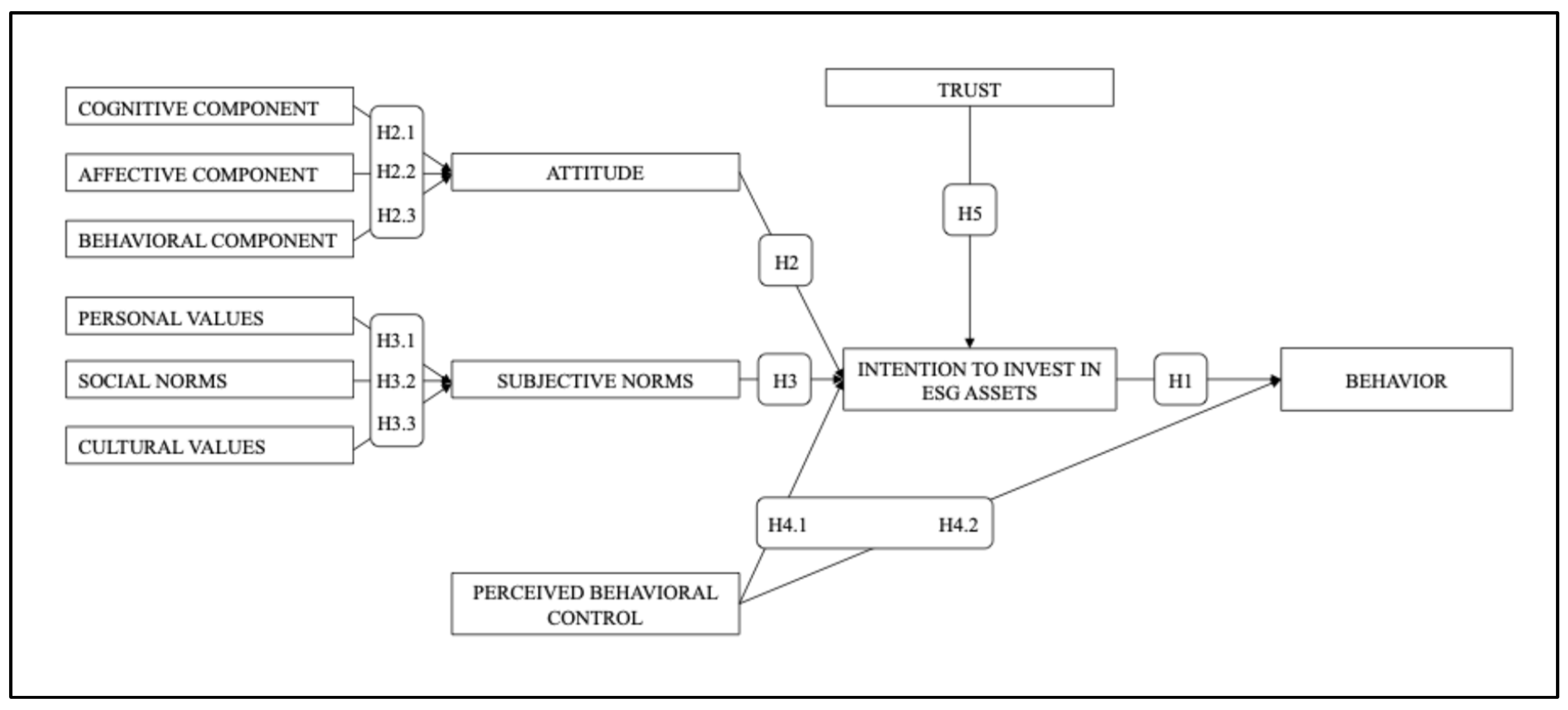
First, to explain the determinants of ESG investment decisions, the theory of planned behavior (from now on, referred to as “TPB”) is adopted as the overarching conceptual framework. This theory was deemed suitable for conceptualizing ESG investment decisions because it can take into account the multiplicity of factors involved in the decision-making process. In fact, according to the TPB, behavior is primarily predicted by behavioral intentions, which in turn depend on three core antecedents: attitudes (one’s positive or negative evaluation of an object or event), subjective norms (internalized social expectations and pressures), and perceived behavioral control (the individual’s belief in their ability to perform a behavior and obtain the desired outcomes). Intention, in turn, is considered the most immediate antecedent of behavior, influencing the likelihood of action. The TPB has been widely applied in both empirical and descriptive research to investigate the antecedents of behavioral intention across various domains [
20], including financial decision making [
21]. A substantial body of research has also confirmed the relevance of applying the model to examine ESG investment intentions [
5,
17,
22,
23,
24,
25]. However, prior applications of the TPB to ESG investment behavior present several limitations, particularly in terms of model comprehensiveness and generalizability of results. For example, Palacios-González and Chamorro-Mera [
25] applied only part of the TPB framework, while other studies failed to explore the link between intentions and actual behavior [
5,
23,
25]. Furthermore, some research has focused on specific investment contexts, such as pension funds [
24], rather than on investment funds more broadly. Several studies also had non-representative samples [
5,
23,
24,
25] or excluded retail investors, instead involving fund managers, dealers’ representatives [
22], or prospective investors [
23]. Furthermore, most empirical studies have been conducted in Asian countries, such as India [
26,
27,
28], China [
29,
30], or Malaysia [
22,
31], thus leaving European settings substantially underexplored. In addition to these empirical gaps, ESG investing shows some characteristics that justify a more nuanced operationalization of the TPB predictors. In fact, ESG assets are not only assessed based on instrumental financial concerns, but also involve affective and moral evaluations. Additionally, normative influence in the realm of investments does not originate from a single source, as decisions might be driven simultaneously by internalized values, social networks, and cultural background [
32,
33]. Previous studies also accounted for the role of perceived effectiveness in determining both sustainable behavior [
34,
35,
36] and investment intention [
37,
38].
Second, while in the original TPB framework intention is predicted exclusively by attitudes, subjective norms, and perceived behavioral control, Hagger and Chatzisarantis [
39] suggested that the core components of the TPB alone can only partially explain intentions, whose residual variance might depend on additional variables outside the TPB. Also, Ajzen [
40] recognized the flexibility of the framework, and proposed its expansion in order to better comprehend certain behavior. In particular, in decision contexts characterized by uncertainty and complexity, additional variables may be required to capture intention formation more accurately. In the investment domain, trust is widely recognized as a critical factor shaping retail investors’ behavior [
41]. Considering the limited transparency surrounding ESG ratings, evaluation criteria, and investors’ difficulty in verifying sustainability claims, trust might play a significant role. It is worth noting that findings do not always converge in this domain, either confirming the influence of trust over ESG investment intentions [
17,
42,
43], or reporting non-significant effects [
11,
44]. These mixed findings suggest that trust may play a contingent role and should be tested explicitly within an ESG-focused TPB model. Moreover, while researchers have proposed extensions to the TPB, such as incorporating personal values or risk propensity [
31], the role of trust in ESG investment decisions has yet to be tested. Accordingly, the present research integrates trust as an additional predictor of ESG investment intentions in order to capture the importance of credibility perceptions in a market characterized by informational opacity.
Finally, research on this topic within Italy remains scarce, and findings from this study can support the endorsement of sustainable investment practices among retail investors by both private and public financial institutions.
To summarize, this study contributes to the ESG literature by shedding light on the psychological drivers underlying sustainable investment choices. In particular, the application of the TPB in the context of ESG investment remains limited, particularly regarding the role of trust and the unique contribution of each TPB component in determining ESG investment intentions. This study advances the analysis of how ESG investment decisions are made by exploring the contributions of the components of the TPB, including the tripartite division of attitudes into behavioral, cognitive, and affective dimensions. Beyond its academic value, the research offers practical insights into the factors that promote or hinder ESG investing. Understanding these drivers is essential for developing strategies that foster favorable attitudes toward sustainable investment and, ultimately, increase the adoption of ESG assets over traditional investments [
17]. The ultimate goal is to develop initiatives that effectively motivate investors to choose ESG options, thereby aligning individual investment behavior with broader sustainability objectives.
The paper is structured as follows. The next section introduces the theoretical framework based on the TPB and outlines the main hypotheses. This is followed by the
Section 4, describing the procedure and sample characteristics, as well as the measures and data analyses used to test the hypotheses. The
Section 5 reports the influence of the four key variables (attitudes, subjective norms, perceived behavioral control, and trust) separately as well as for the integrated model including all four key determinants of investors’ intention to invest in ESG funds. The
Section 6 summarizes the significance of the findings with regard to the research questions and hypotheses. Finally, the paper concludes with a discussion of the limitations of the study, directions for future research, and practical implications.
4. Methodology
4.1. Procedure and Sample
The research was conducted in September–October 2024 through a questionnaire distributed with CAWI (Computer Assisted Web Interviewing) methodology with the support of a professional consumers’ panel provider. The questionnaire was completed by a sample of 505 adult Italian investors. A stratified quota sampling strategy was implemented to ensure that the sample reflected the demographic composition of the Italian retail investor population in terms of gender, age, and education. To count as an investor, the respondent had to declare ownership of at least one type of investment product, such as bonds, stocks, ETFs, funds, or cryptocurrencies. Within the sample, 67% were men and 33% were women; the majority held a high school diploma (47%), followed by 38% with a college degree and the remaining 15% having completed middle or elementary school. Mean age was 50 years (SD = 13.1; min = 19, max = 84). Among the sample, 27% of respondents held ESG investment products, 27% did not know if they had ESG-related products or not, and the remaining 46% did not report owning ESG assets. The study was conducted in accordance with all principles and rules of the Declaration of Helsinki and was approved by an independent ethics committee at the Università Cattolica del Sacro Cuore in Milan (CERPS). Providing informed consent was mandatory to access the questionnaire and participate in the study.
4.2. Measures
After answering socio-demographic questions (gender, age, education, region, profession), respondents were asked questions about their investment portfolio. Specifically, they provided information regarding the types of financial products they owned, and whether such investments were, at least partially, ESG-related.
ESG investment behavior was operationalized as a binary variable based on investors’ intentional ownership of ESG assets: “yes” responses indicated current ESG assets ownership, while “no” and “I don’t know” were both coded as “no” (coded as 0 = no ESG holdings, 1 = ESG holdings for analysis purposes). The decision to classify ESG assets ownership as a categorical variable was guided by the theoretical framework, aimed at distinguishing between investors who explicitly reported holding ESG investment products and all other respondents. Since individuals who reported “I don’t know” supposedly cannot have made an intentional ESG investment decision, they were conceptually aligned with the absence of intentional ESG investment. Additionally, this recoding improved model stability and interpretability, as uncertain respondents cannot be reliably classified as ESG investors.
ESG investment intention was measured using a single item inspired by Apostolakis et al. [
24]: “Imagine that in the next 6 months you will have the opportunity to make new financial investments. How likely is it that you will invest your money in sustainable investment products?” on a scale from 1 (=very unlikely) to 7 (=very likely). As for the cognitive aspects of attitudes, beliefs and opinions on ESG assets, they were measured with three items inspired by [
77] (e.g., “Sustainable investment products are riskier than conventional ones”) on a 7-point Likert scale (α = 0.61). Internal consistency was assessed using Cronbach’s α and, where appropriate, McDonald’s ω, which is particularly suitable for multi-item latent constructs. Despite moderate reliability, likely due to the limited item count [
78], this measure was retained for theoretical coherence [
79]. The behavioral component was measured through four ad hoc items (α = 0.91) assessing information-seeking behavior (e.g., “I am the kind of person who seeks information on ESG investments”) on a scale from 1 (=completely disagree) to 7 (=completely agree). The attitude’s affective component was measured using a semantic differential scale adapted from Apostolakis et al. [
24] with four items (e.g., “To me, investing in sustainable financial products is useless–useful”) on a scale from 1 to 5 (α = 0.86). As concerns subjective norms, personal norms were measured using a modified version of the six-item Green Scale developed by Haws et al. [
67] (e.g., “In investment decisions, it is important to choose companies that are mindful of their impact on the planet”), which demonstrated excellent reliability (α = 0.94), and a modified version of the Common Good scale developed by Castiglioni et al. [
80] (e.g., “If I had to choose sustainable investments, I would do it mostly to help meet the needs of society”). This eight-item scale yielded two factors with good reliability: accessibility and personal gain (ω = 0.92; ω = 0.90). The four items employed to measure social norms (α = 0.92) were inspired by the studies conducted on ESG investments by Apostolakis et al. and Raut et al. [
24,
27] (e.g., “People who are important to me think it is admirable to choose sustainable investment products”). For both personal values and social norms, participants responded on a 7-point agreement scale. Cultural norms were measured using part of the Italian version of the Portrait Values Questionnaire-Revised [
81,
82], specifically addressing the measurement of two core values (
security, ω = 0.91;
universalism, ω = 0.92) through 12 items on a scale from 1 (=this person is not at all similar to me) to 6 (=this person is very similar to me). Last, perceived behavioral control and trust were measured following the approach of Robba et al. [
17]. Perceived behavioral control was measured with five items, which participants responded to on a 7-point Likert scale (e.g., “By investing in socially responsible products, every investor can have a positive impact on the environment”; α = 0.94). Trust was measured with four items reflecting the level of investors’ trust in four core ESG actors or measures, namely companies, financial institutions, certifications, and ratings (e.g., “I am confident that socially responsible products include only those companies concerned about environmental and social sustainability”; α = 0.92).
4.3. Data Analysis
To address the research questions, a structural equation modeling (SEM) approach was employed. The dataset and analysis script used for this study are publicly available on the Open Science Framework (URL accessed on 22 September 2025
https://osf.io/r7vp3/). First, descriptive statistics (means, standard deviations, ranges, skewness, kurtosis) and intercorrelations among all study variables were computed and are reported in
Table 1 and
Supplementary Materials Table S1, respectively. There was no missing data to be handled. Then, confirmatory factor analyses (CFAs) verified the adequacy of the measurement structures for all latent constructs (See
Supplementary Materials). Subsequently, we estimated four separate individual SEMs assessing the individual predictive strength of Attitude, Subjective Norms, Perceived Behavioral Control, and Trust on Intention and Behavior. In this way, we estimated individual SEMs that included both the measurement structure and structural paths to Intention and Behavior. For Attitudes and Subjective Norms, this approach allowed us to assess not only whether subdimensions adequately reflect their respective second-order constructs (measurement question), but also whether these constructs predict behavioral outcomes when examined in isolation (predictive validity question). Subsequently, a full SEM simultaneously examined the combined effects of all predictors within the TPB framework. All measurement models were evaluated through CFAs using robust indices from the MLR estimator and conventional fit thresholds (CFI ≥ 0.90, TLI ≥ 0.90, RMSEA ≤ 0.08, SRMR ≤ 0.08; [
83]) to assess the measurement model adequacy for SEM analyses.
Attitude was specified as a second-order latent factor reflecting three first-order components (affective, behavioral, cognitive) using a reflective specification (Attitude =~ Affective + Behavioral + Cognitive). In reflective models, the construct is theorized to cause its indicators [
73], meaning that an individual’s overall attitude toward ESG investments manifests in affective, behavioral, and cognitive responses. The CFA indicated an acceptable overall fit (robust CFI = 0.946, TLI = 0.928, RMSEA = 0.085, SRMR = 0.059).
Subjective norms were modeled as a second-order latent construct with personal, social, and cultural dimensions also specified reflectively (Norms =~ Personal + Social + Cultural). The CFA demonstrated excellent fit (robust CFI = 0.962, TLI = 0.958, RMSEA = 0.048, SRMR = 0.058).
Perceived behavioral control was modeled as a latent construct represented solely by the Perceived Efficacy factor. This specification ensured consistency with the TPB while maintaining parsimony. The CFA demonstrated excellent fit (robust CFI = 0.998, TLI = 0.996, SRMR = 0.008, RMSEA = 0.044).
Trust was modeled as a latent construct reflected by four items. The CFA showed good fit (robust CFI = 0.995, TLI = 0.987, RMSEA = 0.085, SRMR = 0.009), supporting its unidimensionality and suitability as an exogenous predictor of Intention.
ESG behavior was modeled as a binary dependent variable using a linear probability model via MLR estimation, appropriate for nominal binary outcomes in lavaan’s SEM framework.
This approach treats the binary outcome as continuous in the regression framework. While it does not account for the bounded nature of probabilities or potential heteroskedasticity with binary data, it provides valid directional estimates for testing hypothesized relationships, which was our primary analytical goal. Path coefficients should be interpreted as changes in probability rather than as unbounded continuous outcomes.
Overall, the models demonstrated acceptable fit, supporting their inclusion in subsequent SEM analyses where measurement and structural components were estimated jointly. Detailed CFA results, including discussion of specific cases, assessments of individual first-order factors, and specific model considerations, are provided in the
Supplementary Material.
All SEMs were estimated using robust maximum likelihood (MLR) and evaluated using standard fit indices (CFI, TLI, RMSEA, SRMR). We examined standardized path coefficients, and variance explained (R2) in Intention and Behavior.
The four individual models were structured as follows:
Attitude Model: Attitude → Intention → Behavior
Subjective Norms Model: Norms → Intention → Behavior
Perceived Behavioral Control Model: PBC → Intention → Behavior
Trust Model: Trust → Intention → Behavior.
All models included a path from Intention to Behavior, consistent with the TPB. Indirect effects between each latent predictor and Behavior were computed to account for each construct’s isolated contribution to Intention and downstream influence on Behavior, in line with the TPB.
Prior to estimating the full model, relevant SEM assumptions were assessed. Multivariate outliers were identified using Mahalanobis distance computed across all SEM indicator variables (k = 49). Using a chi-square critical value of 85.35 (df = 49,
p < 0.001), 36 cases (7.1% of the sample) exceeded the critical threshold. These cases were retained because they represented valid response patterns rather than data entry errors, consistent with standard practice in survey-based SEM research. To assess potential common method variance resulting from same-source self-report data, we conducted Harman’s single-factor test. An exploratory factor analysis with all SEM indicator variables loaded onto a single factor revealed that the first factor accounted for 36.03% of the variance, below the 50% threshold commonly used to indicate problematic common method bias [
84,
85]. This suggests that common method variance is unlikely to substantially bias our results. Consistent with this result, a single-factor CFA model demonstrated substantially poorer fit (CFI = 0.571, RMSEA = 0.120, SRMR = 0.104) than the hypothesized multi-factor measurement model (CFI = 0.940, RMSEA = 0.046, SRMR = 0.060), further indicating that common method variance is unlikely to threaten the validity of the findings. Multicollinearity was evaluated using variance inflation factors (VIF) calculated from latent variable scores. For predictors of intention, VIF values were: Attitude = 10.11, Norms = 15.26, PBC = 7.89, and Trust = 2.09. While Attitude and Norms exceeded the threshold of 10 [
86], PBC and Trust remained within acceptable ranges. The hierarchical specification of Attitude and Norms as second-order latent constructs (with first-order components mediating between indicators and higher-order factors) addresses measurement-level multicollinearity by partitioning variance within constructs and reducing item-level redundancy. However, this does not eliminate the substantive correlation among the latent constructs themselves, which reflects the conceptual overlap inherent in the TPB [
40]. The four individual models described above confirmed each construct’s predictive validity in isolation before joint estimation. For predictors of behavior (Intention and PBC) in the full model, VIF values were 1.32 for both, indicating no multicollinearity concerns. Residual correlations ranged from −0.28 to 0.27, within acceptable bounds for SEM analyses. Given the high intercorrelations among TBP constructs, coefficients from the full model should not be interpreted as fully independent effects. To address this, we complement the joint full model with individual models to assess each construct’s predictive validity separately.
In the full SEM, in order to maintain parsimony and reflect the primary theoretical focus on Intention as the proximal predictor of Behavior, only direct paths were specified. Attitude and Norms were modeled as second-order latent constructs, Perceived Behavioral Control as a single-factor latent variable, and Trust as an independent latent construct. A direct path from Perceived Behavioral Control to Behavior was additionally specified, as commonly recommended in TPB literature. This stepwise estimation of individual models allowed us to assess the unique contribution of each construct in predicting intention and behavior, while the full SEM captured their combined influence.
5. Results
Table 1 presents descriptive statistics for all study variables. All continuous variables demonstrated adequate variance (
SD > 0.50) and acceptable distribution properties (|skewness| ≤ 1, |kurtosis| ≤ 1.74), supporting the use of maximum likelihood estimation in SEM analyses. Intercorrelations among variables are presented in
Supplementary Materials Table S1.
We first present the results of the structural equation models (SEMs), starting with individual models examining each latent predictor of ESG investment intention separately. Subsequently, we report the full structural model including all predictors simultaneously. Model fit indices, standardized path coefficients, and explained variance (
R2) are presented in
Table 2. A path diagram illustrates the full SEM structure.
Each latent factor (Attitude, Norms, PBC, and Trust) was tested individually as a predictor of Intention, with Intention predicting ESG investment behavior. All models demonstrated good fit (CFI ≥ 0.93, RMSEA ≤ 0.08). Each factor showed a significant positive effect on Intention, with standardized path coefficients ranging from 0.42 to 0.74. The proportion of variance explained in Intention ranged from 18% to 55% across models (see
Table 2).
In all four individual models, ESG investment behavior was predicted exclusively by Intention. Accordingly, the variance explained in ESG behavior was consistent across models (R2 = 0.058, or 5.8%), reflecting the stable downstream influence of Intention.
Although not central to the research aim, we also computed indirect effects of each latent predictor on behavior via Intention. All indirect effects were statistically significant (
p < 0.001), contributing to the total explained variance in Behavior and complementing the direct Intention → Behavior pathway. Detailed results are reported in
Supplementary Materials.
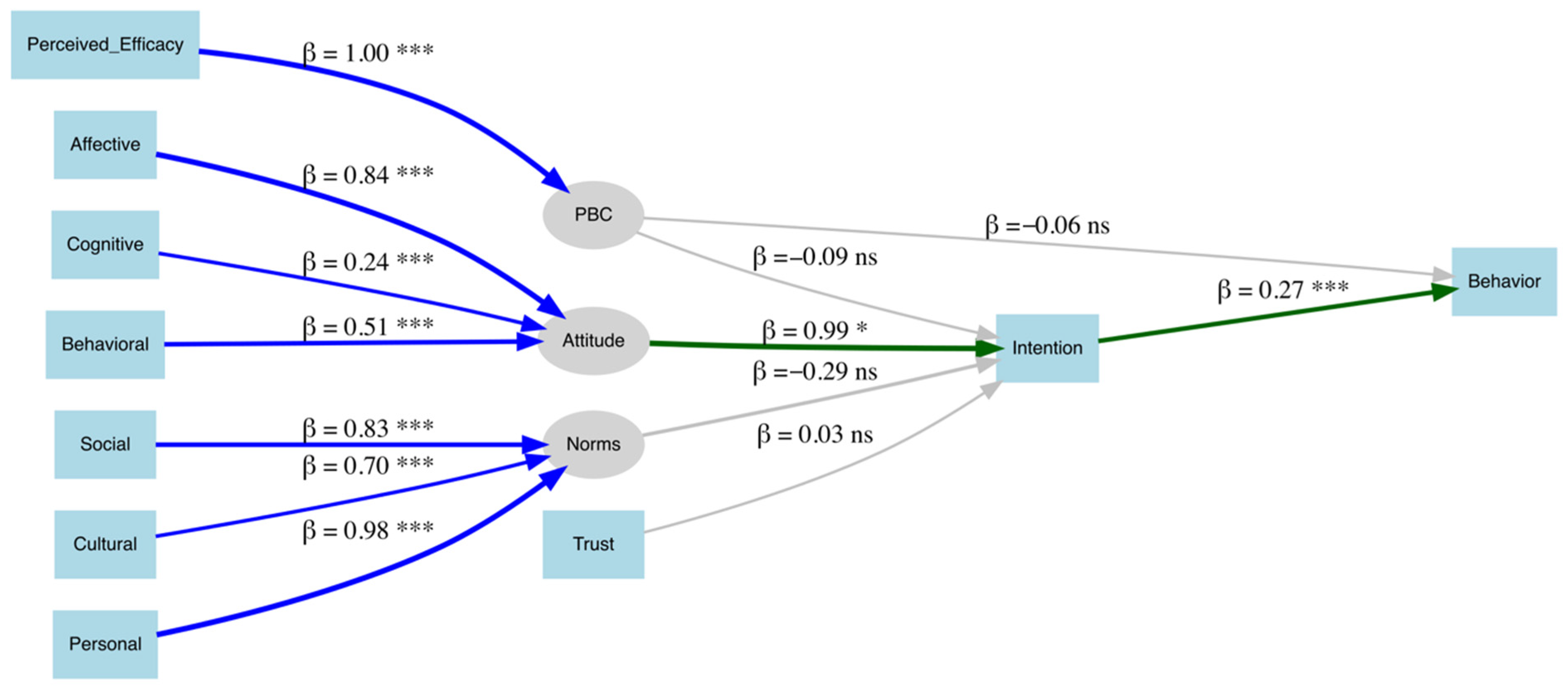
Following the analysis of the individual models, a full structural equation model (
Figure 2) was estimated to evaluate how Attitude, Norms, PBC, and Trust jointly predicted Intention, as well as how Intention and PBC predicted ESG investment behavior. This comprehensive model provides insight into each construct’s relative contribution when considered jointly.
The model demonstrated acceptable fit indices (robust CFI = 0.943, TLI = 0.939, RMSEA = 0.043, SRMR = 0.068). It explained 50.8% of the variance in Intention to invest and 6.1% of the variance in ESG investment behavior.
Among the four predictors, only Attitude remained a significant predictor of Intention (β = 0.99, p = 0.03) when all constructs were included in the model. Norms, PBC, and Trust did not show statistically significant effects.
The magnitude of the Attitude coefficient should be interpreted with caution, as high multicollinearity implies that parameter estimates reflect the allocation of shared variance rather than independent contributions.
Latent correlations among the predictors were strong and statistically significant. Attitude was strongly correlated with Norms (r = 0.878, p < 0.001) and PBC (r = 0.805, p < 0.001); Norms and PBC were also strongly correlated (r = 0.880, p < 0.001). Trust showed moderate to strong correlations with Attitude (r = 0.616), Norms (r = 0.567), and PBC (r = 0.619), all significant at p < 0.001.
6. Discussion
The present study provided evidence of the role of psychological factors in explaining investors’ propensity to opt for ESG investments. Indeed, results provided support for H1 and H2, confirming the influence of attitudes on intention and the path from intention to behavior. However, the connection involving subjective norms (H3), perceived behavioral control (H4), and trust (H5) seems to be far more complex.
Taken separately, each latent factor in the model showed a significant positive effect on the intention to invest in ESG assets, with attitudes accounting for the highest proportion of explained variance, and trust in investment-related institutions contributing the least. Among the components of attitudes, the affective component showed the highest factor loading, while the behavioral and cognitive dimensions showed lower loadings, suggesting differential salience in shaping overall attitudes toward ESG investments. Subjective norms were similarly shaped by personal, social, and cultural dimensions included in the model, each contributing comparably to the latent construct. Perceived behavioral control, while significant, played a more marginal role in explaining intention to invest in ESG assets compared to attitudes and subjective norms. Trust was modeled as a distinct latent construct, as it falls outside the original TPB framework and was introduced as a theoretically independent predictor of intention.
Despite the significant contribution of each factor in the independent models, in the full SEM only attitudes maintained a significant impact on the intention to opt for ESG assets, whereas subjective norms, perceived behavioral control, and trust did not. Given the high correlations among predictors, however, the interpretation should be cautious: the coefficients should not be treated as stable estimates of independent effects, nor as a basis for ranking the relative importance of the involved constructs. Accordingly, we rely primarily on the individual models to evaluate the predictive role of each factor. The full model, instead, captures how shared motivational variance is distributed across theoretically related constructs. Within this framework, the prominence of attitudes reflects their central role within this shared variance structure, rather than a clearly separable causal dominance.
Consistent with this interpretation, attitudes were positively associated with individuals’ intention to invest in ESG assets in the full model, with a very high standard coefficient (β = 0.99). However, this coefficient should be interpreted cautiously, as it likely reflects both the substantive relevance of attitudes and statistical suppression dynamics that arise when highly correlated predictors are estimated jointly. Although subjective norms, perceived behavioral control, and trust each showed significant effects in individual models, their unique contributions were not significant when modeled jointly. Therefore, all four constructs emerge as meaningful predictors when examined separately, whereas the joint model mainly indicates substantial overlap in the motivational variance they explain. The high intercorrelations among TPB constructs (r > 0.80) are partially theoretically expected, as attitudes, norms, and control beliefs represent conceptually overlapping facets of behavioral motivation [
40]. Thus, rather than concluding that attitudes are independently dominant, our findings suggest that attitudinal evaluations may represent the construct in which much of this shared motivational variance is expressed. This interpretation is in line with the literature on ESG assets, supporting the view that positive attitudes toward ESG investing increase investors’ willingness to allocate funds to ESG assets [
16,
27,
31,
87,
88].
However, the contributing role of other psychological factors, such as perceived performance of assets and social influence, should not be ignored [
87,
88]. The individual models indicate that attitudes, subjective norms, perceived behavioral control, and trust each carry meaningful predictive information, even though their effects are difficult to disentangle when considered jointly. Furthermore, by unpacking the tri-dimensional nature of attitudes, the present study adds a more nuanced understanding of the underlying factors behind ESG investments. The affective component showed the highest factor loading, with cognitive and behavioral components showing lower loadings. This pattern suggests that the affective component may play a particularly salient role in shaping overall attitudes toward ESG investing, though we did not conduct statistical comparisons to test whether these differences were significant, as such tests were beyond the scope of our hypotheses. The prominence of affective responses suggests that the propensity to invest in ESG assets is often guided by the emotional resonance involved in this kind of decision rather than by the beliefs of the benefits derived from the investment or by a rational informed decision-making process. This finding resonates with the literature proposing that financial decision-making is not only a matter of logical and calculated reasoning: emotional states such as fear and excitement can guide behavioral inclinations and, possibly, cloud judgment when dealing with financial decisions [
60,
89]. ESG assets, specifically, are strongly driven by internal forces that push investors to opt for the investment that feels right rather than the investment that is financially optimal [
6,
14,
15]. The weaker influence of cognitive and behavioral attitudinal components does not imply that those factors are completely irrelevant. Our findings suggest that, when investigating ESG investing decisions, it is necessary to take into consideration the emotional appeal of these kinds of assets, involving not only performance metrics and rational arguments, but also anchoring to emotional reasons, such as moral satisfaction and the possibility to express one’s identity.
As concerns subjective norms, it is important to highlight that all three components of norms contributed to the model, suggesting that ESG investments are driven by a broad array of normative pressures, including personal values, social norms, and cultural factors. Nevertheless, subjective norms failed to emerge as a significant predictor of intention in the full model, while in the TPB model subjective norms typically contribute to determining behavior intention. Notably, the sign reversal observed for subjective norms in the full model compared to the individual model is consistent with suppression effects under multicollinearity and should not be interpreted as a substantive negative relationship. A possible explanation for this deviation from expectations lies in the nature of ESG investments. Although the discourse around ESG assets is gaining prominence, the debate on their utility in supporting the planet and society is still debated. Opinions regarding ESG assets are diverse, with some people defending their positive role in driving a real, deep change in the realm of investments, while others express skepticism regarding their capacity to induce a concrete shift in environmental and social policy instead of being only an effect of greenwashing dynamics [
90,
91,
92]. Consequently, the normative pressures to opt for ESG assets are not homogeneous in the investment sector, possibly limiting the influence of external social pressure on retail investors’ decisions. Furthermore, money is widely considered a taboo topic that people often avoid discussing [
93,
94], which may lead investors to seldom share information or opinions about their investment strategies within their social circles.
The above considerations can be useful in further exploration of the role of perceived behavioral control, here conceptualized as investors’ perception of the actual positive impact they can have by investing in ESG assets rather than in traditional ones. Like subjective norms, perceived behavioral control did not have a significant impact on investment intentions in the full model. This finding aligns with those of some previous research on ESG investments, which has provided inconclusive evidence regarding the influence of perceived behavioral control on intentions and behaviors related to ESG assets [
22]. Furthermore, since the present study focused on individual investors, it is crucial to consider the pivotal role of financial advisors, as well as the differing profiles of expert and novice investors. As concerns financial advisors, research confirms that they are key in shaping most retail investors’ decisions [
95] and that they often express skepticism about the real effects of ESG investments, mainly due to a lack of transparency and information [
96,
97]. If financial advisors themselves are not fully convinced of the effectiveness of ESG investments, it is plausible that retail investors’ perceptions of their efficacy are also weakened, thereby diminishing the role of perceived behavioral control in shaping ESG investment intentions. Additionally, investors widely vary in terms of financial knowledge and competence. Expert and novice investors differ in their investing strategies, susceptibility to decision-making biases, and reliance on emotional versus informational cues [
98]. Therefore, it is possible that, at least for novice investors, perceived efficacy in sustainable investing is overshadowed by more emotionally and morally salient drivers, which are factors that are often easier for retail investors to understand and rely on. It is thus plausible that control beliefs play a more significant role among expert investors, who tend to prioritize informational content over emotional appeal.
As concerns trust, its inclusion in the model was driven by the findings in previous studies suggesting that confidence in financial institutions, regulatory bodies, and certifications plays a significant role in investing decisions. Contrary to expectations, in the present study, trust was the weakest predictor of behavioral intention. This pattern was especially evident in the individual models, whereas the full model does not allow for strong conclusions regarding the relative weight of trust compared with the other predictors. This finding contributes to the debate on the role of trust in this field. One possible explanation is that investors rely more heavily on internal convictions than on promises of external institutions, which might be perceived as unfamiliar and distant. Preferences for ESG assets emerged elsewhere as an expression of moral identity and ethical drivers, rather than resulting from institutional endorsement [
47]. At the same time, there is widespread skepticism around ESG assets [
99], as mentioned above. Awareness of the inconsistencies in ESG ratings and evaluations might therefore induce investors to not adopt trust as a leading criterion in ESG-related decisions. Finally, it is worth discussing the limited explanatory power of intention in predicting intentional investing behavior. Although the magnitude of this relation is perfectly in line with previous work on sustainable and ethical investments [
22,
30], this finding suggests that other factors should not be underestimated when explaining ESG investment decisions. In fact, if it is true that psychological factors are key to comprehending this kind of investment, this does not exclude the influence of drivers of a different nature, such as financial return and expectations. Overall, the findings of the present study confirm the complexity surrounding ESG investments, and the need to integrate the psychological and economic perspectives to comprehensively understand the nuanced nature of sustainable investment decisions.
7. Limitations and Future Research
This study highlights the need for developing validated, ESG-specific measures to more accurately assess attitudes, subjective norms, and perceived behavioral control related to sustainable investment intentions. Sustainable investors represent a unique population within financial psychology, as their decision-making is often shaped by both prospective financial returns and ethical values. While we relied on established measures from prior research and adapted them to the ESG context, future studies should invest in the development and validation of instruments tailored specifically to ESG investing. This would allow for a more nuanced understanding of cognitive and affective attitudes, as well as social and personal normative factors and perceived behavioral control aspects that influence sustainable investment behavior.
Here, perceived efficacy was used as the sole indicator of the perceived behavioral control construct, a core but partial dimension of PBC. This decision was driven by the key role played by perceived effectiveness in driving sustainable behavior [
71,
72,
73], as explained in
Section 3.4. However, this constitutes a potential limitation, as perceived behavioral control is a multifaceted construct that extends beyond perceived effectiveness to include individuals’ perceived capabilities and access to opportunities [
40,
100]. Future research examining ESG investment intentions and behaviors should consider including a broader set of indicators of perceived behavioral control to better capture the complexity of this construct. Additionally, modeling perceived behavioral control as a single-indicator latent variable, while consistent with theoretical definitions of perceived effectiveness, introduced a degree of asymmetry in the SEM measurement model. Other second-order constructs, such as attitudes and subjective norms, were represented with multiple observed indicators, allowing for a more robust estimation of latent variance. Although the model fit remained very good, future researchers should consider including additional indicators of perceived behavioral control to ensure greater measurement equivalence and structural comparability across latent constructs.
The cognitive attitudes subscale showed lower internal consistency (α = 0.61) than the affective and behavioral components. Although this falls below the conventional 0.70 threshold, lower alpha values are not uncommon for short scales with few items (k = 3), as coefficient alpha tends to underestimate reliability when item counts are limited [
101,
102]. Importantly, all attitude components were modeled as latent variables within the SEM framework rather than as summed composites, thereby explicitly accounting for measurement error. This approach mitigates concerns about differential reliability. Nevertheless, the lower reliability of the cognitive subscale may have influenced the hierarchical attitude structure, with cognitive attitudes showing the weakest loading relative to affective and behavioral components. Accordingly, we cannot fully exclude the possibility that the stronger effect of affective and behavioral attitudes partially reflects superior measurement quality rather than solely substantive psychological primacy. Future research should employ longer and more reliable cognitive attitude measures to better disentangle measurement quality from substantive effects within the tripartite attitude framework.
The high intercorrelations among TPB constructs limit the precise estimation of the independent effects of subjective norms and perceived behavioral control beyond attitudes in the integrated model. As reflected in the VIF values for Attitude and Norms, this pattern partly stems from the conceptual overlap inherent in the TPB [
86], rather than solely from statistical instability. Although the hierarchical second-order specification reduces measurement-level redundancy, it cannot eliminate substantive correlations among theoretically related constructs. Notably, each predictor demonstrated significant effects when estimated separately, confirming their substantive relevance. However, within the joint model, attitudes absorb much of the shared motivational variance, making it difficult to disentangle whether norms and control beliefs exert fully independent effects or operate in conjunction with attitudes. A similar interpretive caution applies to Trust, which showed substantial predictive validity when examined independently but became non-significant in the joint model. This pattern likely reflects shared variance with the highly correlated TPB constructs rather than substantive irrelevance. Such suppression effects are common when theoretically related predictors are modeled simultaneously. Future studies employing experimental manipulations that independently vary these factors, or longitudinal designs examining their temporal dynamics, would be better positioned to disentangle their unique contributions.
ESG investment intention was measured using a single item, which does not allow for the estimation of measurement error and may lead to less precise, and potentially inflated, structural coefficients involving this construct; future research should adopt multi-item measures to enable a more robust assessment of intention as a latent variable.
ESG behavior was modeled as binary using a linear probability model via MLR estimation. While this approach does not enforce bounded probabilities [0, 1], it was appropriate for our structural modeling goals focused on testing directional relationships. Coefficients from the linear probability model should be interpreted as approximations of marginal probability differences; logit or probit estimation would yield more precise probability estimates. Future research could employ either binary-specific methods for enhanced precision or differentiating among intentional investment and non-intentional investment decisions. This latter distinction might be particularly interesting to acknowledge the role of distinct determinants, including non-psychological ones such as financial advisors’ guidance.
Future research should aim to recruit a larger sample of ESG investors to better assess whether determinants such as perceived behavioral control and trust differ meaningfully in importance across different types of investors. In the present study, the sample was designed to reflect the Italian investment context, where ESG investment products are gradually gaining traction but are not yet mainstream. According to a 2024 survey by CONSOB, 20% of Italian retail financial investors reported holding sustainable investments, indicating that while ESG-related products are gaining visibility, they are still not widely adopted in the Italian market [
103]. While this contextually grounded approach enhances the ecological validity of the study, it also presents a limitation: only 27% of our sample reported owning ESG investments at the time of the survey, and an additional 27% of investors were unsure about the nature of their investments—potentially indicating that they are somewhat disengaged from management of their investments. While the proportion of ESG investors in the sample reflects the current market context, this distribution may have modestly limited the statistical power to detect some relationships within the structural equation model. It is also worth noting that SEM techniques are sensitive to the distribution and variance of dependent variables; lower behavioral variance can potentially influence the magnitude of regression coefficients or place greater emphasis on intention-related predictors. Nevertheless, the overall model fit remained adequate, and the findings provide meaningful insights into the psychological mechanisms underlying ESG investment behavior. Future studies would benefit from researchers ensuring sufficient variability in ESG investment behavior to more accurately model its psychological and structural determinants.
Additionally, future research should aim to replicate these findings across different national contexts to assess whether the psychological drivers of ESG investment behavior, such as attitudes, norms, perceived behavioral control, and trust, differ by country. A key reason for this lies in the varying levels of institutional trust across countries [
104,
105], which can significantly influence individuals’ confidence in ESG products, regulatory frameworks, and financial systems. Since sustainable investing often relies on transparent governance, credible disclosures, and institutional endorsement, differing degrees of trust in institutions may lead to notable cross-country variation in ESG investment intentions and behaviors.
8. Theoretical and Practical Implications
This research advances the understanding of ESG investment intentions from a theoretical perspective in several key ways. By testing a full theory of planned behavior (TPB) model integrated with the construct of trust, this study addresses a significant gap in the literature, where ESG investment intentions have often been investigated using only partial or fragmented models [
5,
23,
25]. The model’s integration of all TPB components alongside trust offers a more holistic framework for understanding the psychological antecedents of sustainable investment behavior.
Highlighting the role of attitudes, particularly their affective and behavioral components, represents an additional contribution of the present study. Notably, the affective (e.g., perceiving ESG investments as meaningful and desirable) and behavioral (e.g., active information-seeking) components accounted for more variance in attitudes than the cognitive dimension (e.g., beliefs about risk and returns). This pattern supports the tripartite model of attitudes [
32,
52,
106] and provides empirical evidence that emotional and behavioral attitudes play a central role in shaping ESG-related intentions. These findings also suggest that sustainable investors may differ meaningfully from traditional investors in how they form and act on attitudinal evaluations.
This research also contributes to a rethinking of financial rationality in ESG contexts. The greater influence of the affective and behavioral components of attitudes than the cognitive component challenges traditional finance models that assume decision-making is primarily based on rational evaluation of risk and return. In particular, the especially strong influence of the affective component suggests that emotional responses and value-driven motivations may be more decisive than analytical considerations in shaping sustainable investment intentions. These findings underscore the importance of expanding behavioral finance theories to account for emotionally charged, ethically anchored, and identity-relevant drivers of financial behavior, especially in domains like ESG investing where moral and affective considerations are central.
Besides its theoretical contribution, this study has several practical implications. Understanding ESG investment intentions and behaviors has practical implications for ESG communication strategies, as well as for financial education and advisory services. The finding that affective and behavioral attitudes play a central role in shaping ESG investment intentions offers concrete guidance for improving how ESG investment opportunities are communicated and supported in practice.
Importantly, the results from the individual structural models indicate that attitudes, subjective norms, perceived behavioral control, and trust each significantly influence ESG investment intentions when assessed in isolation. This suggests that initiatives aimed at promoting sustainable investing should not overlook the contributions of normative influences, perceived efficacy, and institutional trust. Communication and educational strategies that incorporate social approval cues foster a sense of individual impact and reinforce trust in ESG-related institutions; additionally, certifications may support intention formation across a broader range of investor profiles. These factors may be particularly important for individuals in the early stages of engagement with ESG investing or in contexts where emotional and behavioral attitudes are not yet fully developed. A multifaceted approach that addresses these complementary psychological drivers can therefore provide more inclusive and effective pathways for fostering ESG investment behavior.
Communication strategies led by financial institutions, asset managers, and policymakers should move beyond conventional messaging focused solely on rational benefits, such as risk mitigation or long-term financial performance. Instead, effective ESG communication should also engage with the emotional and ethical dimensions of investment decision-making. This includes emphasizing the societal impact of ESG choices, their alignment with personal values, and their potential to express a socially responsible identity. Emotionally engaging narratives, personal testimonials, and value-based storytelling can enhance the emotional resonance of ESG campaigns. In parallel, practical tools, such as interactive ESG fund comparison platforms or behavioral prompts that encourage deeper exploration, can stimulate the kind of active information-seeking behavior identified in this study as one of the key predictors of ESG investment intentions.
Finally, financial education programs and advisory services should reflect these psychological insights. Educational initiatives should not only inform individuals about ESG fund performance but also equip them with the skills and confidence to critically assess sustainability claims and navigate ESG-related information. Financial advisors, in turn, can tailor their messaging to align with clients’ personal values, emotional motivations, and social influences, helping investors see ESG products as both financially sound and personally meaningful. By acknowledging and integrating the psychological foundations of sustainable investing, such strategies may help bridge the persistent intention–action gap in ESG investment behavior.



 ,
,