Article

Exploring ‘(Non-)Discrimination’ in Charging Infrastructure Sharing
Institute of Climate Protection, Energy and Mobility (IKEM), Alte Jakobstr. 85–86, 10179 Berlin, Germany
*
Author to whom correspondence should be addressed.
Sustainability 2026, 18(10), 5117; https://doi.org/10.3390/su18105117
Submission received: 2 February 2026 / Revised: 30 April 2026 / Accepted: 13 May 2026 / Published: 19 May 2026
(This article belongs to the Section Sustainable Transportation)

Abstract

In the context of charging infrastructure for electric vehicles, “non-discriminatory access” is a fundamental principle that ensures equal and fair access to public charging facilities for users, electricity suppliers, and service providers. The overarching goals of non-discriminatory access are to promote competition in the electric mobility market, improve user-friendliness and acceptance of electric vehicles, and serve as a key enabler for the successful transition to electric mobility. Emerging digital and technological innovations, including smart load management and interoperable billing platforms, are reshaping charging practices. In this context, inter-organisational EVCI sharing is gaining relevance as a means to enhance efficiency, reduce costs, and mitigate disparities in infrastructure availability. While numerous actor-specific challenges and opportunities are examined within the framework of the FAMOUS project, this article develops a matrix based on qualitative interviews, a requirements analysis, and a semi-systematic literature review of the term “non-discrimination”. The matrix is applied in two contexts: first, to public EVCI sharing in Germany and, second, to inter-organisational EVCI sharing within the FAMOUS project. In doing so, the matrix is tested, showing potential areas of discrimination. As such, the paper contributes to the still under-researched field of just mobility transitions and the expansion of charging infrastructure.

1. Introduction

Electric Vehicle Charging Infrastructure (EVCI) is seen as key to leveraging the adoption of electric vehicles (EVs) in a society. With proper coordination, EVCI expansion could help cut carbon emissions significantly from both passenger cars and commercial vehicles [1,2,3]. The increasing electrification of commercial vehicles [4] like buses [5], trucks [6,7], or taxis [8] introduces new infrastructure demands. These vehicles often require high-power charging stations and more frequent access due to high utilisation rates and long operating hours. Furthermore, electric buses and trucks require dedicated charging depots or strategically placed charging stations that can accommodate large vehicles along their route [4,5] while taxis and ride-sharing fleets benefit from a network of rapid charging hubs in urban centres [9]. The development of a comprehensive charging infrastructure in Germany increasingly requires differentiated business models that address both public and private charging needs. Parallel to publicly accessible charging stations, private companies and fleet operators are investing in charging solutions such as depot, workplace, and employee charging, to meet operational and load management requirements. Emerging digital and technological innovations, including smart load management and interoperable billing platforms, are reshaping charging practices and improving the utilisation of existing capacity.
Where the initial phase of infrastructure expansion was largely centralised and state-driven—characterised by municipal initiatives and publicly funded pilot projects—the current trajectory reflects a shift towards a more decentralised, market-oriented approach. In this context, asset sharing and, in particular, inter-organisational EVCI sharing are gaining relevance as a means to enhance efficiency, reduce capital costs, and potentially mitigate regional disparities in infrastructure availability. Inter-organisational EVCI sharing refers to the provision of private charging infrastructure by companies for use by other companies. By allowing third parties to access charging points during periods of low internal demand, it aims to improve the utilisation and economic efficiency of existing infrastructure and accelerate return on investment. Such coordinated use can also facilitate better planning of charging sessions and contribute indirectly to grid stability and peak load management. This poses new challenges for policy and regulation, calling for frameworks that balance private investment incentives with public goals of accessibility, grid integration, and social equity.
While charging infrastructure is increasingly discussed as a key component of the energy and mobility transition, the potential of infrastructure sharing—particularly in an inter-organisational context—is rarely examined, and even less so through the lens of fairness, inclusion, and non-discrimination—even though collaborative structures are increasingly prominent.
The expansion of EVs and their charging infrastructure (CI) accordingly is not only a technological endeavour, but a systemic one, resulting in the restructuring of mobility networks, (urban) spaces, and business models, e.g., [10,11,12,13]. As such, it can be conceptualised as a socio-technical transition, defined as “deep structural changes in systems […] that involve long-term and complex reconfigurations of landscapes with technologies, policy, infrastructure, scientific knowledge, and social and cultural practices.” [14] (p. 2). However, socio-technical transitions and social justice have often been treated separately. Recent work aims to combine the two. Jenkins et al. [15] propose a framework to integrate justice principles into socio-technical transition studies, while Sareen and Haarstad [16] advocate for an approach that combines social justice research with socio-technical transition theories to better address equity concerns. In response, new strands have emerged, such as ‘just mobility transition’ [17], which places social justice at the core of transition processes. The just mobility transition focuses on ensuring equitable access to transport while reducing environmental impacts. As of now, the body of literature is largely limited to either local use cases of urban planning, e.g., [18,19,20] or global perspectives on production chains [20]. A study by Soares and Glaser [21] focuses on exclusion in mobility, yet only examines experiences of marginalised communities. As Wang and Lo [22] argue, there is more need for empirical studies grounded in practice, with greater attention given to power dynamics.
This paper addresses this gap by proposing a non-discrimination matrix (NDM) as a diagnostic tool for assessing and self-assessing levels and dimensions of discrimination in emerging actor networks and relationships in the context of EVCI sharing and expansion. Against the background of platform-based coordination mechanisms, existing research has highlighted how reservation systems, data access arrangements, and user-group differentiation may contribute to asymmetric power relations between actors. While these dynamics are highly relevant for charging infrastructure sharing, a comprehensive analysis of platform power is not the primary focus of this article; power asymmetries are only addressed selectively in this article.
We adopt a just mobility transition perspective and investigate the concept of “non-discriminatory access” in EVCI sharing. The concept provides an analytical entry point into issues of fairness, transparency, and (platform) power in charging infrastructure governance, which are particularly relevant in the context of European Union (EU) transport and energy regulation as well as international policy discussions. The NDM helps to identify potential discrimination risks rather than issuing normative judgements.
Based on a semi-systematic literature review across the fields of non-discrimination as a standalone concept and in connection to EVCI sharing, a comprehensive matrix of non-discrimination aspects for EVCI expansion was derived, through which relevant discourses on non-discrimination in general and in the field of charging infrastructure were identified. Building on this, the different practical meanings and interpretations of non-discrimination were further distilled through 23 semi-structured interviews with key stakeholders from the local electromobility sector, conducted as part of an in-depth case study on a pioneering project in Hamburg (FAMOUS), complementing the desk-based research. Subsequently, the non-discrimination matrix (NDM) is applied to both the FAMOUS case study and to the broader context of public charging infrastructure. This approach enables a nuanced assessment of current practices and regulatory challenges, linking theoretical perspectives on just mobility transition with empirical evidence from policy and practice. It aims to provide an assessment tool to identify technological, social, and economic forms of discrimination risks in shared EVCI. As such, it can be applied directly by actors engaged with operational and organisational questions in charging infrastructure sharing (e.g., project managers, municipal mobility departments) to assess or self-assess levels and dimensions of discrimination. In this way, it can help foster the establishment of a more sustainable and fair transition towards electromobility.

1.1. Charging Infrastructure Sharing

Recent research highlights the growing relevance of shared EVCI to improve resource efficiency and overcome local charging bottlenecks, particularly in urban areas. One emerging concept is Private Charging Pile Sharing (PCPS), which potentially helps to increase the utilisation of existing infrastructure while reducing deployment costs [23,24]. However, behavioural and privacy-related factors significantly affect user participation. Huang et al. [25] identify a “sharing paradox,” where EVCI owners express a desire to share their chargers but simultaneously harbour strong privacy concerns. Organisational approaches to sharing are also gaining traction. Melander and Wallström [26] analysed green horizontal networks for shared freight vehicle charging and observed that such collaborations potentially yield economic (e.g., cost sharing, reducing investment costs) and environmental (e.g., increasing utilisation, reducing material usage) benefits. The authors differentiate between four business models for EVCI sharing: (1) sharing existing privately owned infrastructure, (2) jointly building new infrastructure, (3) jointly building new infrastructure at a shared customer’s site, and (4) organising sharing through a third party. Nevertheless, the formation of these networks depends heavily on economic and environmental incentives and mutual trust among participating firms. Xu et al. [27] employ evolutionary game theory to explore the conditions under which sharing models become stable and economically viable. At the systems level, Trinko et al. [28] advocate for “charging-as-a-service” solutions that integrate transport and electricity systems, emphasising not only techno-economic benefits but also broader societal gains. Furthermore, Erfani et al. [29] propose crowdfunding as a strategy to ensure more equitable access to shared charging infrastructure, thereby addressing fairness and inclusiveness in infrastructure planning.
The overview of existing literature on EVCI sharing demonstrates that innovations have the potential to optimise the use of assets and enhance network resilience [26,28] while also contributing to more equitable access [29]. This aligns with broader goals of sustainability, such as resource efficiency, reduced environmental impact, and just transformation. However, the realisation of these benefits is not guaranteed. The success of EVCI sharing depends heavily on governance structures, legal frameworks, and access rules that regulate participation [25,28]. Without explicit safeguards, EVCI sharing risks reinforcing existing disparities or introducing new entry barriers, e.g., where infrastructure is controlled by only a few actors, or in (rural) areas where it is limited, or through socio-economic inequalities that affect access to and ownership of EVs. Carlton and Sultana [30] (p. 348) describe this challenge as follows: “The main question of this transition then is likely not whether EVs will overtake conventional fuel vehicle sales and predominate across communities, but rather an infrastructural one: will every community have the infrastructure that they need to benefit from the economic and environmental advantages of EVs, or will some communities get left behind in this transition?”
These findings underscore the importance of integrating regulatory, social, and technical perspectives in the design and implementation of shared EVCI systems. As De Vos [31] (p. 3) points out: “the effects of AVs, EVs and shared micromobility on social and human sustainability are largely unknown. […] future transport studies should not only focus on the effects of new technologies and policies on environmental sustainability, but also on economic, and especially social and human, sustainability.”
As EVCI sharing models grow in scale and sophistication, new actor networks emerge with new dependencies as well as potential exclusion mechanisms. In particular, inter-organisational arrangements challenge assumptions about non-discriminatory access and equal treatment. In such settings, power asymmetries may arise where certain actors gain structural advantages through control over infrastructure, contractual arrangements, or coordination mechanisms, potentially shaping access conditions without explicit exclusion. While companies may have legitimate reasons [32] for limiting access—for instance, to secure smooth operations or competitive advantage—from a just mobility transition perspective, sustainable use of infrastructure and equitable distribution of mobility resources are objectives that should already be anticipated and safeguarded during the transformation process itself, rather than being treated as secondary or subsequent concerns. For public EVCI in Germany, the national authority [33] conducted a sector analysis, identifying anti-competitive structures, concentration of market power of providers, and potentially unjust price policies. However, as the market is still in an early stage, the authority worries whether interventions can be counterproductive: “Regulatory intervention, on the other hand, especially relating to the providers’ pricing, would be counterproductive from today’s perspective. Such intervention can affect the profitability of private infrastructure installation projects, discourage providers from making offers and even hamper the envisaged charging infrastructure ramp-up” [34] (own translation). Indeed, without a framework to assess and guide EVCI expansion, for which inter-organisational EVCI sharing can be a sustainable contribution, the risk is that sharing practices will develop in ad hoc or discriminatory ways, undermining trust and slowing the transition to a sustainable, just mobility system.

1.2. Project FAMOUS—Inter-Organisational EVCI Sharing

Launched in 2023, FAMOUS develops a digital platform to enable reservation-based sharing of commercial EVCI [35]. The project aims to enhance the economic viability of commercial charging infrastructure through shared use, ultimately facilitating a broader shift towards electrified transport vehicle use in commercial contexts. By allowing external users to make reservations, it aims to improve the planning and predictability of charging processes and, in turn, optimise grid-status forecasts for power-grid operators. The project builds on the idea of coordinated inter-organisational cooperation in charging infrastructure, enabled through a digital reservation platform that allows charge point operators (CPOs) to define and manage different user groups. This approach aims to facilitate inter-organisational charging sharing by providing structured access to premises and assets while meeting the operational requirements of business actors [32]. In FAMOUS, the project partners currently focus on inter-organisational sharing of corporate EVCI located in companies’ depots or premises, addressing sharing types (1) and (4) as defined by Melander and Wallström [26]. In this arrangement, one company makes its privately operated charging assets accessible to other corporate actors. The inter-organisational sharing arrangement is based on cross-company agreements and platform-mediated access. However, during the preparation of the pilot phase, it emerged that trust and spatial proximity played a crucial role in establishing such partnerships, due to numerous legitimate actor-specific constraints [32]. Specifically, numerous legal uncertainties still persist—for example, regarding liability when accessing a company’s premises. In addition, technical solutions for reserving parking and charging slots, and billing the energy consumed, are still lacking [32]. Furthermore, there may be risks for the providing company regarding its own operations when external individuals use the infrastructure (e.g., no-shows, excessive use of infrastructure).

2. Materials and Methods

The study employs a qualitative mixed-methods approach, combining a semi-systematic literature review with semi-structured interviews to develop an NDM serving as an assessment tool for EVCI sharing. The methodology had three goals: first, to map core concepts and theoretical framings of (non-)discrimination relevant to EVCI sharing through a semi-systematic literature review; second, to illuminate how the concept of ‘non-discrimination’ is interpreted and operationalised by practitioners through semi-structured interviews; and third, to develop an assessment tool that is analytically grounded and practically applicable. This makes it possible to integrate insights from both components—theory and practice—in the operationalisation of the NDM.
The literature review targets normative and socio-technical concepts related to non-discrimination in EVCI sharing, recognising that relevant concepts appear under multiple labels. The search terms in Table 1—“discrimination”, “non-discrimination”, “non-discrimination + technology”, “non-discrimination + data”, “accessibility + charging infrastructure”, and “non-discrimination + charging infrastructure (sharing)”—were used to semi-systematically search for relevant studies in Google Scholar. Given the exploratory aim of concept mapping across a broad interdisciplinary field, screening was limited to the first two pages of results per query, which typically capture the most influential and widely cited publications. This approach was used to identify dominant concepts and framings rather than to provide exhaustive coverage. In fields where rapid development was evident, a time filter (the last 5 years) was applied to capture the most recent discourse. The screening was conducted in two stages: (1) title/preview scan and (2) abstract screening. Studies were included if they addressed discrimination, accessibility, inclusion, or related normative concepts in socio-technical contexts. Papers applying the term ‘discrimination’ in purely computational or natural science domains (e.g., signal processing, particle physics) were excluded.
Following screening, 144 publications were included in an inductive, qualitative content analysis [36] of the abstracts, which were used to map recurring concepts, framings of non-discrimination, and theoretical propositions across a broad interdisciplinary literature, rather than to derive exhaustive or evidence-weighted conclusions. Initial categories were derived on an abstract level, then grouped into thematic clusters that captured how different disciplines frame non-discrimination (e.g., rights-based, accessibility-oriented, economic-design, and spatial justice).
Table 1. Search terms, papers, and key messages.
Search TermNumber of PapersKey MessageExamples
“Non-discrimination”20Non-discrimination encompasses both direct and indirect forms across legal, economic, and technological domains, requiring states, corporations, and institutions to implement proactive measures, ethical frameworks, and regulatory oversight to ensure equality. It also highlights the challenges posed by algorithmic decision-making, intersectional inequalities, and inconsistent international standards, underscoring the need for fairness-aware tools, inclusive policies, and legal mechanisms that protect marginalised groups and prevent systemic bias.Moeckli, D. (2017) [37], Edwards, A., & Vandenhole, W. (2007) [38]
“Discrimination”24Discrimination focuses on price discrimination, economic/market discrimination, and social discrimination (race, sex, gender, class, and identity). A large part of the literature focuses on discrimination law.Krueger, A. E. (1963) [39]; Armstrong, M. (2006) [40]; Small, M. L., & Pager, D. (2020) [41]
“Discrimination freedom”24Discrimination centring around freedom of religion/identity/expression and workers’ rights often points towards conflicts between those. Where freedom starts or ends is unclear and depends on what an individual values more (e.g., freedom of expression vs. freedom of religion).Henrard, K. (2012) [42]; Estlund, C. (1997) [43]
“Non-discrimination” AND “technology”7New technologies increase the risk of reinforcing social discrimination through data sourcing and processing (e.g., machine learning), but also carry the potential to mitigate social discrimination through increased freedom of expression (e.g., social media).Benjamin, R. (2019) [44]; Yüksel, S. (2022) [45]
“Non-discrimination” AND “data”8Data mining and automated decision-making can perpetuate discrimination when biased training data are used, emphasising the need for discrimination-aware algorithms, fair data practices, and multidisciplinary approaches to detect, prevent, and mitigate inequities in areas such as employment, credit, and insurance.Cohen, J. E. (2021) [46]; Hagendorff, T. (2019) [47]
“Charging infrastructure sharing”41Sharing electric vehicle (EV) charging infrastructure through models such as joint ownership, third-party management, mobile charging, and vehicle-to-vehicle (V2V) energy exchange can improve utilisation, reduce costs, enhance environmental benefits, and accelerate the electrification of transport. Collaboration among multiple actors, supported by trust, economic incentives, and regulatory frameworks, is crucial for infrastructure sharing and network operation, including integrating renewable energy and grid management. While discrimination is not a central focus, some works note that equitable access to shared charging infrastructure may affect adoption rates among different socio-demographic groups, linking infrastructure availability to potential disparities in EV uptake.Lee, J. H., Chakraborty, D., Hardman, S. J., & Tal, G. (2020) [48]; Melander, L., & Wallström, H. (2023) [26]
“Non-discrimination” AND “charging infrastructure” AND “sharing”20Inequities in access to electric vehicle (EV) charging infrastructure, shaped by income, race and spatial distribution, can exacerbate existing social and environmental disparities, emphasising the need for inclusive planning and equitable policy interventions. Additionally, emerging mobility services and IT-enabled sharing models must be carefully regulated and designed to prevent discriminatory practices, ensuring all communities benefit fairly from technological innovations in transport.Csillak, K., & Kamenz, S. (2023) [49]; Russo, S., Spiller, B., & Wilwerding, R. (2024) [50]
Additionally, qualitative data were collected through semi-structured interviews conducted with 23 stakeholders in October and November 2023, including charging point operators (public and private), electric mobility service providers, and potential end-users such as taxi companies, delivery services, or public transport providers. The analysis is based on a qualitative case study design using expert interviews with key actors in the German EVCI field. The approach is justified by the need to understand complex, context-specific governance arrangements in an emerging infrastructure domain, where detailed empirical evidence from expert perspectives is more valuable than broad-scale survey data at this stage. Interview partners consisted of FAMOUS consortium members, associated partners, and their wider network (Table 2). The primary selection criterion was the relevance of interviewees to the specific governance and implementation context of the FAMOUS project. As the project constitutes a real-world testbed for shared EVCI between municipal, commercial, and research partners, our sampling prioritised actors directly involved in decision-making, operational processes, and regulatory interpretation within this context. The sample was complemented by external interview partners, identified as potential future users or stakeholders of shared EVCI concepts. These interviewees were chosen to ensure that perspectives beyond the core project consortium were represented.
The overarching aim of the interviews was to gain a deeper understanding of the opportunities and obstacles for sharing EVCI depending on each actor’s requirements. Five specific questions regarding discrimination are relevant to this article:
  • What does non-discrimination in the context of EVCI sharing mean to you?
  • How important are considerations regarding the non-discrimination of shared EVCI at present?
  • What obstacles are there?
  • How can non-discrimination be implemented in the context of shared EVCI?
  • Who do you see as responsible for ensuring freedom from discrimination?
The interview guidelines were adapted according to whether an actor owned and operated or used EVCI. The interviews lasted between one and two hours, were recorded and transcribed with Microsoft Teams, and were manually checked for transcription mistakes. Transcription was carried out in a content-oriented manner, following an adaptation of the transcription rules by Selting et al. [51], focusing on the semantic level of the interviews. The multi-step iterative analysis resulted in a set of five overarching clusters: (1) legal, (2) technical, (3) operational, (4) economic, and (5) sustainability- and culture-related factors [32]. The coding process was carried out by two authors using an inductive approach without a formal codebook. After independent coding, the two coders conducted an intercoder check to compare their coding schemes, discuss diverging interpretations, and align on a common set of main codes and categories. When coding ambiguities arose, these were discussed between the authors and resolved by returning to the original interview context.
To illustrate the coding process, we provide an example from one interview. The interview statement (VII) “If you look at the market, you essentially find two roaming platforms in the German market: one is called Hubject, and the other is called E-Clearing-Net. These two systems are not compatible with each other. This means that EMPs use either one or the other roaming platform.” was first coded as “dependence on roaming platform”. During coding, this was grouped under the broader category “lack of interoperability”. The statement was then assigned to the “technological dimension” of the matrix as an “indirect discrimination risk”, because platform architectures and technical interfaces potentially restrict the ability to grant equal access to all market actors. At the same time, the same passage can be read as reflecting an “economic dimension” of indirect discrimination, as platform incompatibility effectively divides the market and gives selected operators preferential access to customer segments, thereby creating unequal competitive conditions. This example illustrates how the NDM is operationalised in practice by translating empirical statements into analytically distinct but potentially overlapping technological and economic indicators, rather than applying fixed or quantitative thresholds.
Finally, the insights from the interviews and literature review were compared to inform the development of the NDM. The model was subsequently validated through discussions with the FAMOUS project stakeholders, ensuring its applicability and relevance. In this study, validation is understood as analytical plausibility, transparency, and usability for practitioners in an emerging field, rather than external benchmarking, comparative testing, or predictive measurement. Feedback from the FAMOUS project stakeholders informed the refinement of dimensions and indicators by assessing their interpretability and practical relevance, rather than serving as an independent or external validation of the framework. This procedure ensures analytical consistency and transparency in the inductive assignment of interview material to NDM dimensions and levels, which is appropriate for the exploratory and diagnostic purposes of the framework.

3. Results

3.1. Literature Discourses on Non-Discrimination

Discrimination is often referred to as the “less favourable treatment of a person on the grounds of age, disability, ethnic origin, race, gender, religion or belief or sexual orientation” (§ 1 General Act on Equal Treatment) [52]. Such treatment is considered discriminatory, particularly when it cannot be justified by objective reasons. To not be discriminated against is a fundamental human right, firmly embedded in major legal frameworks such as the Universal Declaration of Human Rights [53] (Art. 7). Most countries around the world have laws or constitutional provisions that ban discrimination [54]. All legal definitions identify the grounds for discrimination from a social perspective, specifying criteria such as age, disability, ethnic origin, race, gender, religion, or sexual orientation.
Despite the widespread use of the concept across disciplines and spheres, it often lacks a clear definition or explanation of the steps necessary to be free of discrimination. There is, as yet, no universally accepted definition of discrimination [38]. What once originated in neutral differentiation—from the Latin discriminare, “to distinguish, separate, divide”—has since become a morally loaded concept frequently misused in public discourse, making it difficult to adequately capture the full range of issues it encompasses.
While the concept has been studied most closely in the social sciences, e.g., [55,56], a review of the existing literature shows that discussions of ‘discrimination’ have also focused on economic forms, such as price discrimination, e.g., [40,57,58], or market discrimination, e.g., [39,59]. Sometimes, those two disciplines were interlinked under the concept of social discrimination in the work environment, e.g., [43,59,60]. More recent literature (since 2019) focuses on both social and economic discrimination. Social forms of discrimination, such as those based on class, e.g., [61], health, e.g., [62], and immigration status, e.g., [63], are prominently discussed. At the same time, economic discrimination rooted in social inequalities continues to be a significant focus, e.g., [41,64,65]. Sovacool et al. [66] point out that low-carbon transitions can also create new injustices and vulnerabilities that lead to discrimination. Wang and Lo [22] (p. 2) argue: “It is therefore imperative to shift the technology-focused understanding of low-carbon transition to include greater engagement with social justice issues”.
The scope has also expanded to include reflections on the integration of the concept into legal studies, e.g., [67], or on the relation to freedom of speech and expression generally and in new media, e.g., [45,68]. Authors argue that new technologies, especially artificial intelligence, social media, and data mining, pose increasing risks of discrimination, e.g., [44,46,47,69]. Particularly, early 21st-century studies have delved into data mining and the automated classification of data, highlighting both the opportunities and risks associated with these technologies, e.g., [70,71,72,73]. In addition, scholars increasingly point to the emergence of power asymmetries resulting from technological infrastructures themselves, especially where control over data, access conditions, and centralised coordination mechanisms is concentrated among a limited number of actors, shaping inclusion and exclusion dynamics.
The unifying element in all concepts of discrimination is that they pertain to actions, practices, or policies that are based on the (real or perceived) identity of those affected under the premise that this identity is significant, shaping interactions in key contexts [74].
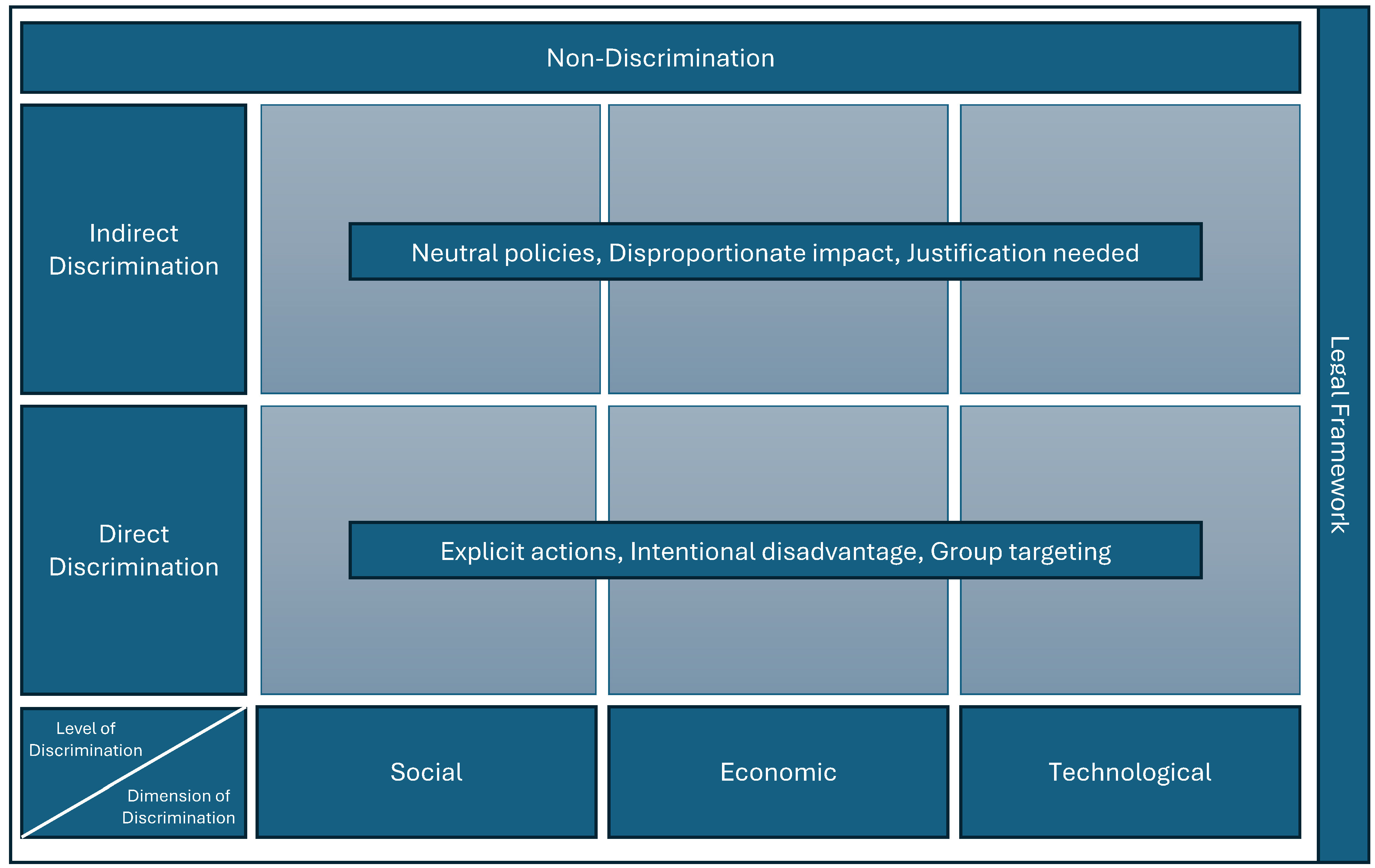
Direct discrimination refers to explicit and intentional actions, practices, or policies that disadvantage individuals or groups on the basis of their membership in a group. It can also occur through seemingly neutral policies that use surrogates to achieve discriminatory aims [75]. For example, a city deciding to place charging stations in urban areas based on traffic flow and population density can seem like a neutral choice based on assumed demand, but residents in lower-income or minority areas may end up facing greater difficulties accessing CI, which in turn perpetuates existing inequalities in EV adoption and usage. Even if the discriminatory motive is unconscious, if the treatment arises from bias or indifference, it may still constitute direct discrimination. Indirect discrimination, on the other hand, occurs when neutral rules, policies, or practices result in disproportionate disadvantages for certain groups, without an explicit intent to discriminate. If the policy cannot be justified and has a disproportionate impact on a salient social group, it may be considered indirect discrimination. These two factors—explicitness and intent—determine direct and indirect discrimination; these two concepts are, in turn, derived from the foundational literature, e.g., [37,75,76].
According to Fibbi et al. [76], recent scholarship has shifted focus towards discrimination based on multiple grounds. The coexistence of dimensions of difference is described as “multiple discrimination or intersectionality” [77] (p. 137). Collins [78] (p. 2) states that different grounds of discrimination do not operate “as unitary, mutually exclusive entities, but as reciprocally constructed phenomena”, resulting in complex inequalities.
In the context of shared public charging infrastructure for electric vehicles, non-discriminatory access ensures equal and fair access to public charging facilities for all users, grid operators, and service providers. For drivers, it guarantees spontaneous, unrestricted use of any CI without prior registration or contractual agreement, enabled through intuitive authentication and payment systems [79]. On the supplier side, electricity providers and service companies must have the opportunity to offer their services at all public charging points. Notably, the “pass-through entitlement” obliges operators to admit any certified grid operator, fostering competition and preventing monopolies (§ 7c Energy Industry Act) [80]. Operationalising non-discriminatory access entails avoiding exclusive access or payment schemes, ensuring transparent pricing and billing, enabling open interfaces between charging stations and backend systems, fostering interoperability, and ultimately creating a user-friendly experience [79,81]. Regulatory authorities are tasked with monitoring compliance to ensure that the principles of non-discrimination are upheld in practice [33].
These principles are reflected in existing European and national legal frameworks. For instance, the EU’s Alternative Fuels Infrastructure Regulation (AFIR) [82] and Germany’s Charging Station Regulation Ladesäulenverordnung (LSV) [83] define obligations in public EVCI concerning non-discriminatory access. Most recently, the revised AFIR (EU) 2023/1804, adopted in September 2023, advances these goals by integrating social factors into the regulatory framework. This is illustrated in sections addressing equitable access (Rec. 32/36/38/67/69/75, Art. 5), fair pricing (Art. 5), and transparent data provision (Art. 20) [82]. However, two critical issues persist. First, the term “non-discrimination” remains legally undefined, creating interpretive ambiguity and enforcement challenges. Second, the regulation applies solely to public EVCI. As per Article 2 (45) AFIR [82], publicly accessible charging points are those charging points that are located at a location or in premises that are accessible to the general public, regardless of whether the charge point is located on public or private land, whether access to the location or premises is subject to restrictions or conditions, and regardless of the conditions of use. A charge point is not publicly accessible if its use is only intended for a limited and specific group of people. This distinction highlights a regulatory blind spot for inter-organisational EVCI sharing, which potentially becomes relevant in both market diffusion and system efficiency. The private infrastructure on which it relies remains largely unregulated. Consequently, the consideration of non-discrimination in this emerging market segment is weakened by legitimate constraints affecting business actors, such as operational efficiency, security, or investment risks [32]. However, it needs to be mentioned that the absence of regulatory safeguards may enable power asymmetries to emerge where access conditions, data flows, or coordination mechanisms are controlled by a small number of central actors, shaping participation opportunities beyond explicit exclusion.

3.2. Practice Discourses on Non-Discrimination in Shared EVCI: Evidence from Interviews

The interview analysis reveals that, in practice, non-discrimination is predominantly framed through technological and economic lenses—especially by charging point operators (CPOs)—with interoperability emerging as the central concern. Respondents repeatedly emphasised compatibility across plugs, interfaces, software, and vehicles (Interviews XIV, XI, and VIII). This technical and economic primacy is also mirrored in the city’s implementation logics: “In Hamburg, […] What is mainly meant by this is non-discrimination towards the EMPs. […] after all, such charging infrastructure is a natural monopoly—and all providers who want to build their business on it can use this charging infrastructure under the same conditions and then design their own products on this basis. Some turn it into a flat rate; others bill per kilowatt hour. And in the context of Hamburg, that is already considered non-discriminatory.” (Interview XVII).
From an operational standpoint, non-discriminatory access is thus often equated with open technical standards and non-exclusive access conditions. As one interviewee succinctly put it: “Non-discrimination means, for me, an ‘offer to all’” (Interview VII). In line with this, a private company that implemented shared charging infrastructure articulated a technology- and access-focused view: “Non-discriminatory basically means that it can be started with any type of regular charging card. And non-discriminatory in the public sense of course also means that you could start it via an app, via SMS and through various other options” (Interview XV). Remarkably, the interviewees—even when discussing non-discrimination from the end-user perspective—continued to emphasise technical aspects as central (Interviews VII, XV). However, these technical aspects implicitly point to social impacts.
In contrast, social dimensions—such as inclusive, barrier-free design—are mentioned considerably less frequently. Only one partner explicitly highlighted accessibility from the perspective of end-users: “Human aspects—meaning that everyone can actually charge—also include physical accessibility. For example, there should be enough space so that wheelchair users can easily get there. Not just a cramped 2 × 2 m bay that no wheelchair user could navigate” (Interview XI). This asymmetry suggests that, within current practitioner discourses, technological interoperability and economic feasibility dominate the meaning-making around non-discrimination, while social accessibility is recognised but not yet mainstreamed.
Across all interviews, stakeholders emphasised legitimate constraints that shape the feasibility of shared EVCI. Taxi stakeholders (Interviews XXI, XXII, and XXIII) require exclusive access at centrally located charging stations (airports, city centres); public bus operators (Interviews XIV, X) fear operational disruption from unfamiliar third parties on depots due to strict schedules, route dependencies, time-critical service obligations, and liability: “So what happens after the barrier? The (individual) drove into the yard, passed the barrier, what happens now? And where can he stand, how long can he stand there? What happens if he damages something? What happens if we damage something on his vehicle? What happens if it parks incorrectly and we are restricted from operating?” (Interview X).
Additionally, Customers may even be required to undergo training and obtain a specific certification to demonstrate their ability to comply. As one interviewee (XIV) highlighted, “And in our case, you would have to read it [code of conduct] and understand it before entering the […] depot. So that also requires a certain amount of education or training for our customers.”
Moreover, some interviewees pointed out that private (shared) infrastructure was considered a complement to public and semi-public options and that the meaning of “non-discriminatory” remains under negotiation in hybrid governance settings. As one respondent emphasised: “I don’t currently see a compelling case to open it up to everyone. That would have to be negotiated in the private sector—for those who want it. But I believe once public entities or similar actors are involved, it’s something entirely different” (Interview XX). Another concluded that “‘Non-discrimination’ is a political concept that still needs to be negotiated” (Interview XVII). At the same time, political and institutional actors retain the capacity to shape these transition pathways by providing information, setting agendas, and addressing challenges. A private company that implemented shared EVCI regretted that it was not accessible to all (Interview XV): “They are semi-public, and there was no obligation for them to be 100% non-discriminatory. I find that regrettable. I didn’t know that beforehand but would have preferred different charging stations.”
Interviewees also anticipated structural changes in charging geographies—from traditional fuel retail patterns towards destination charging embedded in everyday activities and B2B operations. As one puts it, “The gas station landscape will change dramatically over the next 10 years. No one who has ever been to a gas station would describe it as a place of longing […]. Accordingly, […] a large portion will very likely not be viable in their current form. Because it’s much more pleasant: When I’m already driving a car, I prefer to go somewhere like the gym, museum, theatre, cinema, or elsewhere and charge there comfortably” (Interview XIX). This expected shift was echoed for logistics and other business drivers (e.g., Interview XIII, XXI–XXIII).
These accounts demonstrated that, in early market phases, non-discrimination was weighed against operational efficiency, security, and investment risks, and that trust and proximity matter for establishing viable sharing arrangements. These insights substantiate the need for an assessment framework (NDM) that captures technological and economic indicators, while explicitly integrating social accessibility, and that can be calibrated to actor-specific constraints and governance arrangements.

3.3. Operationalising a Non-Discrimination Matrix

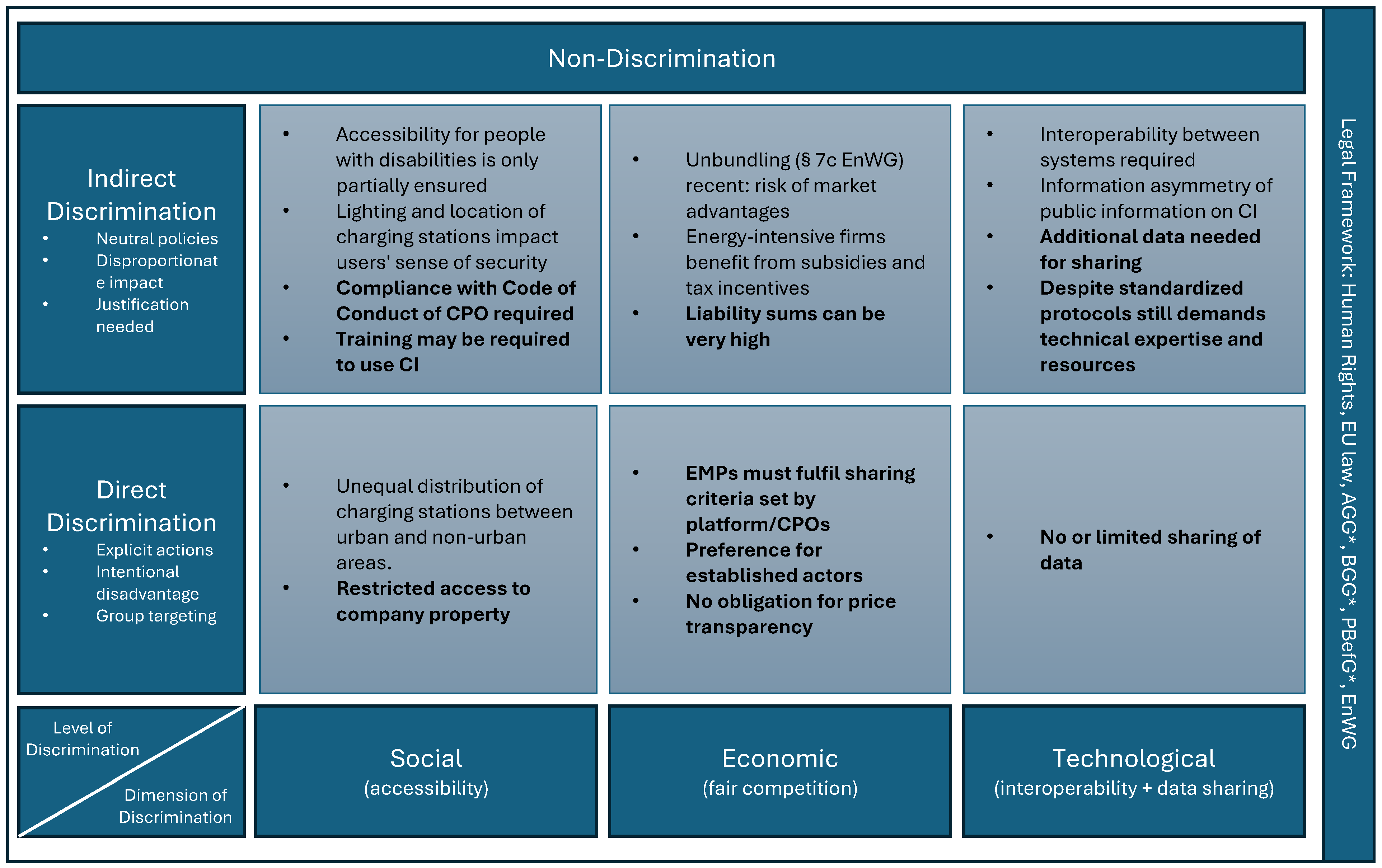
The NDM components were derived from the above literature review and interview analysis, whereby recurring patterns across both data sources were systematically condensed into the final dimensions, levels, and indicators. In this process, arrangements are analytically discussed as discrimination risks where interview evidence or literature points to systematic or structural exclusion effects that extend beyond functional or operational rationales; otherwise, they are treated as legitimate constraints. Importantly, the boundary between legitimate constraints and discrimination risks is not understood as a fixed or objective line, but as socially negotiated and discursively shaped, and therefore subject to change over time and across contexts. The NDM, as well as its application to public EVCI in Germany and to inter-organisational EVCI sharing in the project FAMOUS, was iteratively validated through feedback loops with FAMOUS project partners, resulting in a concise tool for assessing access criteria within actor networks in emerging technology domains. The NDM illustrates the discourses on non-discrimination in the form of two different levels—direct and indirect, as described earlier—as well as three dimensions of discrimination framed within a legal context, as illustrated in Figure 1.
Building on the interdisciplinary literature as well as the interview results, we adopt a working definition of non-discrimination that draws on three complementary dimensions: technological, social, and economic. These dimensions reflect recurring themes in research and practice on infrastructure governance, interoperability, accessibility, and fairness. Importantly, a fully unified definition does not exist—the suggested dimensions overlap and are differentiated for analytical reasons only. For the purpose of the non-discrimination matrix (NDM), all three dimensions are treated as equally relevant and can be operationalised through specific indicators. The list of indicators is intentionally open-ended, reflecting the fact that this is an emerging solution whose future configuration will depend on political, technical, and socio-economic contexts. The proposed indicators serve solely as a guideline. Possible indicators include:
  • Social non-discrimination concerns the inclusivity of infrastructure for diverse user groups. Relevant indicators include physical accessibility (e.g., barrier-free design, access restrictions), user interface design (clarity, language availability), procedural simplicity (e.g., low-complexity authentication steps), and the suitability of infrastructure locations for users with diverse mobility needs, taking into account factors such as spatial deployment, lighting, and whether users are distinguished by location (e.g., urban, rural), gender, age, or health status.
  • Economic non-discrimination captures fairness in pricing structures and financial accessibility. Indicators include price transparency, the availability of non-discriminatory tariff options, proportionality of costs (e.g., avoidance of excessive mark-ups for certain user categories), and the affordability of access across income groups or organisational roles, including funding and subsidies as well as market access (e.g., prevention of monopolies), additional costs, and resources.
  • Technological non-discrimination refers to unbiased access enabled (or restricted) by technical artefacts and standards. Indicators include interoperability of charging and authentication systems, compatibility of hardware and software, data accessibility, and the avoidance of technology-specific exclusion (e.g., proprietary protocols or exclusive roaming arrangements).
The legal framework describes the formal and institutionalised set of rules. In the context of EVCI expansion, the framework is still evolving and subject to ongoing negotiation. However, within a broader EU market and more explicitly within the energy market, rules and institutional frameworks are established, including the principles of fair competition, non-discrimination, and unbundling. Unbundling in the German energy market refers to the legally mandated separation of energy generation/supply and network operation to ensure non-discriminatory grid access and promote competition as regulated in the Energy Industry Act (EnWG). In addition to formal requirements, governance structures may (re)produce power asymmetries that may function as cross-cutting conditions within the NDM, shaping how technological, economic, and social dimension risks manifest.
In practice, this framework enables a systematic examination of each actor and their interrelations to identify potential discrimination risks. By mapping these relationships and applying the NDM criteria, areas in which principles of non-discrimination are already upheld can be pinpointed.

3.4. Applying NDM to Public EVCI in Germany

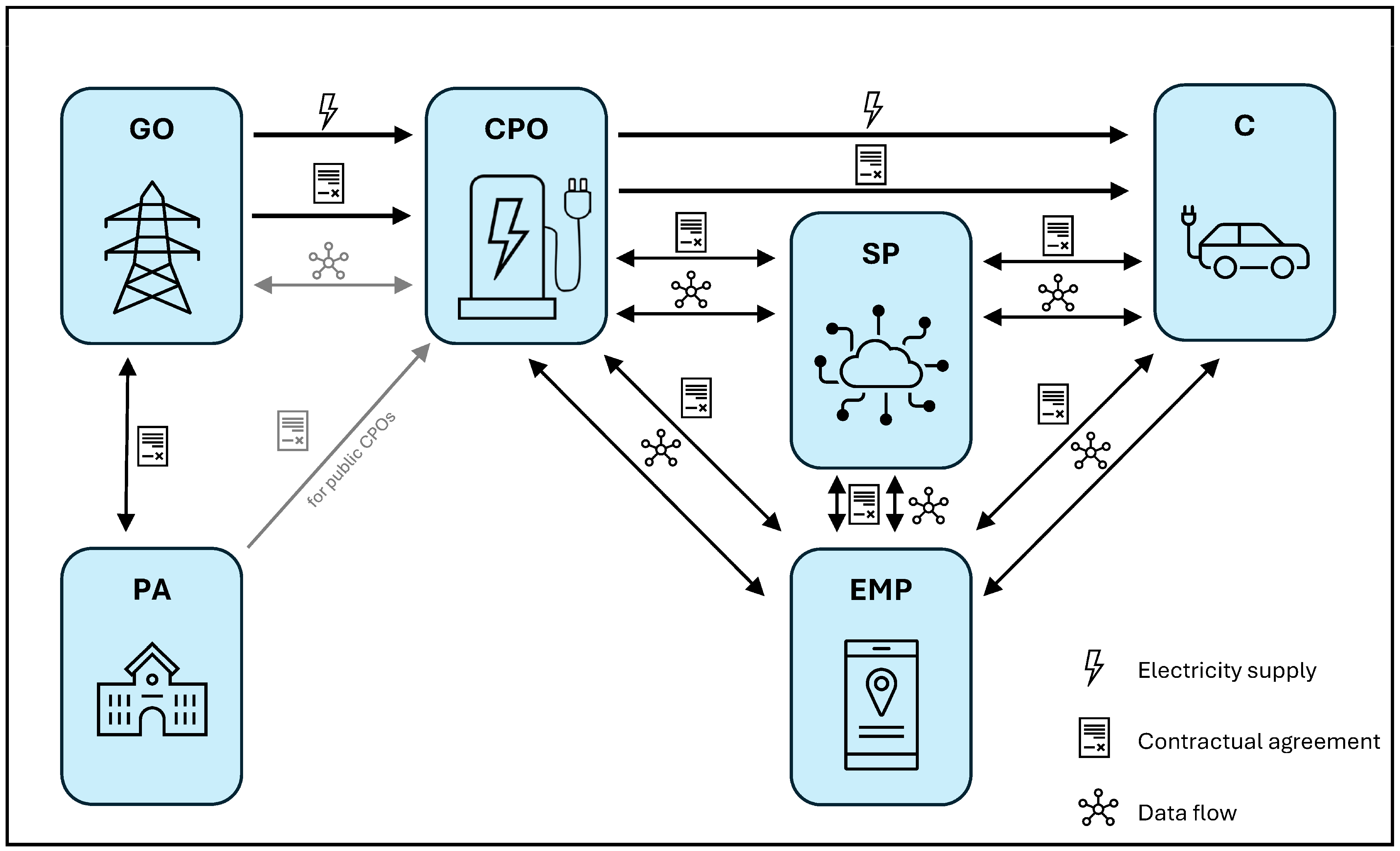
In Germany, public charging infrastructure operates as a public good, backed by a public-service mandate that aims to ensure reliable, non-discriminatory access to charging services. Several key actors interact to provide seamless charging services, as shown in Figure 2. The relevant role definitions below are provided by the German Association of Energy and Water Industries (BDEW) [84] and the findings of this research:
  • Public authorities (PA) tender the planning, expansion, and operation of public charging infrastructure. At the municipal level, they award the concession [80] (§ 19) and determine who is permitted to operate the electricity distribution network.
  • The grid operator (GO) provides the electrical energy required for EV charging. The operator delivers electricity to the charging stations based on contractual agreements, ensuring a consistent energy supply.
  • The charging point operator (CPO) is responsible for the installation, operation, and maintenance of charging stations and manages the charging infrastructure. The CPO does not necessarily own the stations but ensures their functionality and reliability, and grants the EMP access to its charging points.
  • The electro-mobility provider (EMP) acts as the user interface, offering services such as access cards or apps that enable EV users to locate and use charging stations. EMPs handle user billing and support, facilitating the overall charging experience.
  • The roaming platform provider (RPP) (when separate) manages the data roaming and exchange necessary for the EMPs to provide their services.
  • End-users (E-Us) utilise the services provided by the EMP and CPO to charge their electric vehicles. E-Us interact primarily through platforms or tools provided by the EMPs to access charging stations.
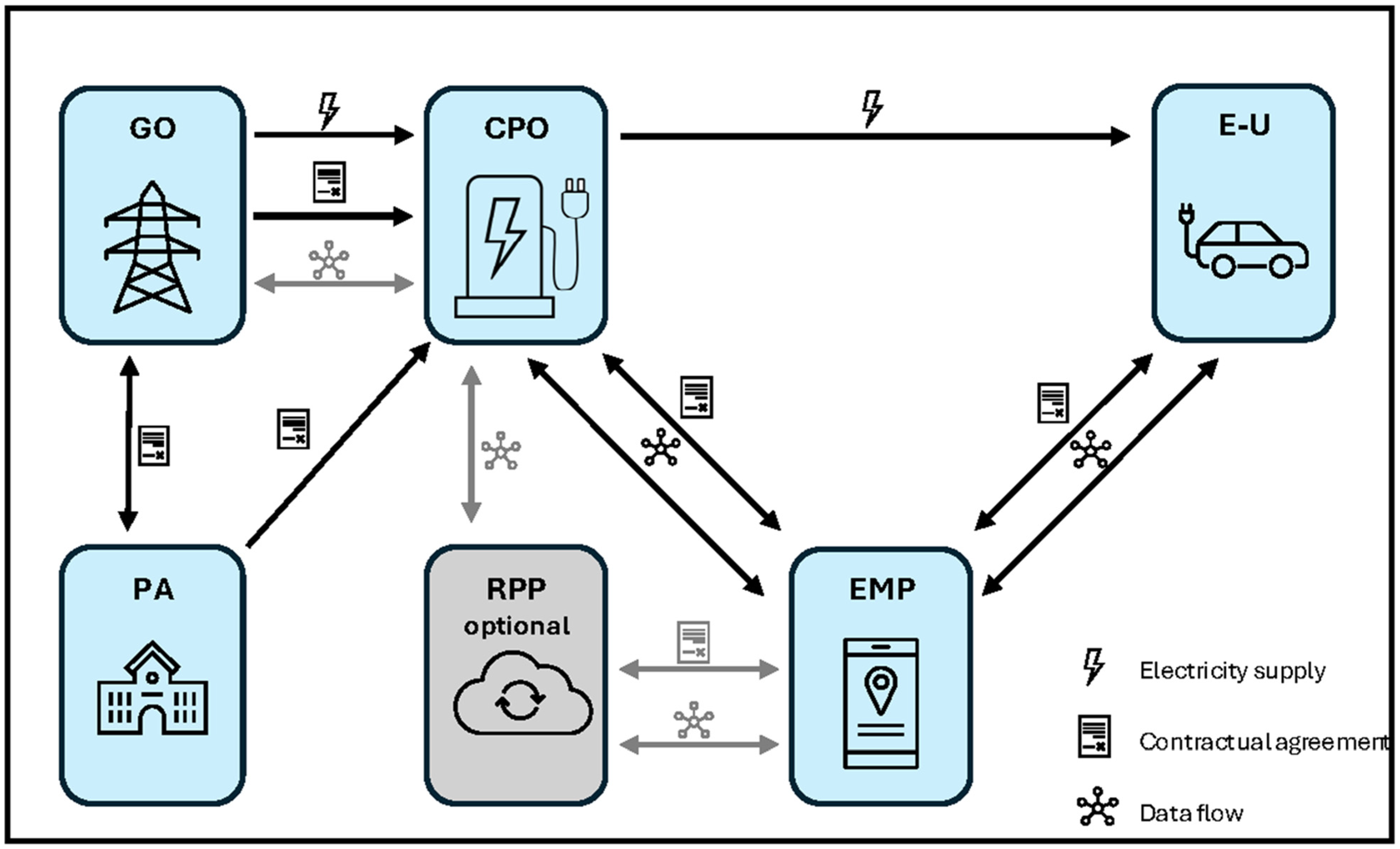
Figure 2. Public charging infrastructure sharing network (own illustration, based on BDEW [84] and own research).
Sustainability 18 05117 g002
Connections between actors can be divided into three categories. First, there are service-level agreements in the form of (ad hoc) contracts between CPO and EMP, as well as between EMP and E-U. Second, data flows inform parties and systems of availability, resource consumption, and billing through open protocols. Third, electricity is supplied during a successful charging process.
In the following, the NDM is applied to investigate the levels and dimensions of discrimination or non-discrimination within the German public EVCI. The following analysis is based on the literature analysis. While the main focus of the interviews was on inter-organisational EVCI sharing, a few findings are corroborated by the interview data and are therefore highlighted accordingly. Despite the AFIR mandating non-discriminatory practices, regulatory ambiguity leaves room for various issues, some stemming from the relationships between actors (Figure 2), others from the characteristics of the physical infrastructure.
Germany has set the goal of installing 1 million public charging points by 2030 as part of the “Master Plan Infrastructure” [79]. As of January 2025, the Federal Network Agency recorded 125,408 standard charge points and 36,278 fast charging points [85]. This expansion has already led to several structural and equity-related challenges, as documented in other studies:
  • Charging point distribution favours urban areas, putting low-income, peri-urban, and rural areas at a disadvantage [86];
  • Public procurement and subsidisation—although justified in light of accelerating deployment—have led to a limited number of larger CPOs, constraining pricing and making market entry difficult [33];
  • Private-sector charger growth outpaces government-subsidised rollout [87];
  • Mandatory app use and contactless payment methods exclude non-smartphone users [88].
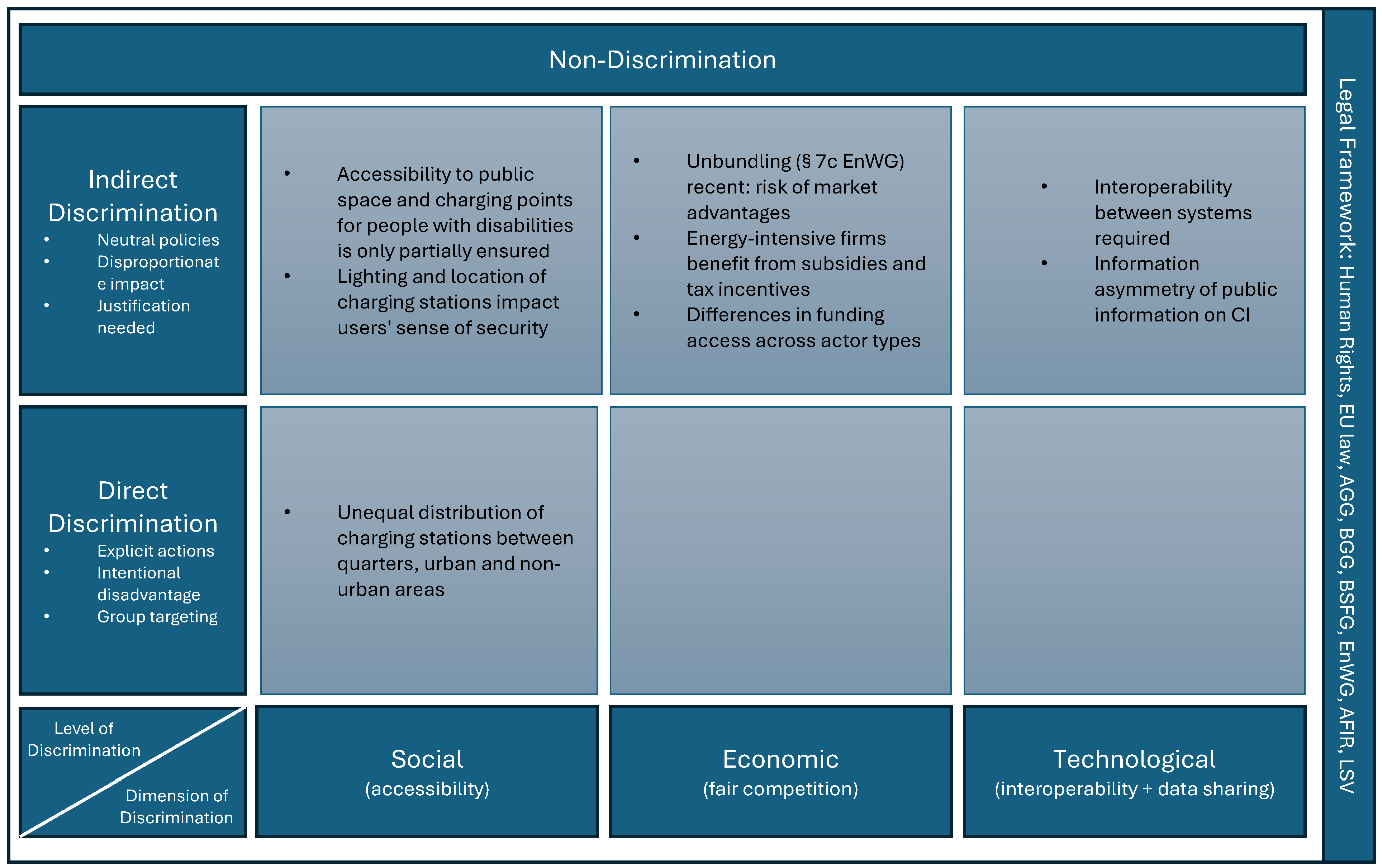
As illustrated in Figure 3, discriminatory aspects range across all dimensions and are mostly on the indirect level. Table 3 applies the non-discrimination matrix (NDM) to the public EVCI context in Germany in a structured manner. Actor relationships are systematically mapped to levels (direct/indirect) and dimensions (social, economic, and technological) of discrimination, while explicitly distinguishing between interview-confirmed observations and analytically inferred risks based on the literature.
Regarding the social dimension, in Germany, accessibility in public spaces is governed by several laws, including the Equal Opportunities for Persons with Disabilities Act (BGG) [89], the Passenger Transportation Act (PBefG) [90], and the Accessibility Enhancement Act (BFSG) [91]. Nonetheless, public space is often still not fully accessible due to elements such as elevated curbs, poorly legible signage, or the absence of acoustic signals. In the context of EV charging, technical requirements for barrier-free access are being developed, but they have not yet been fully implemented, for instance, in terms of standardised solutions for simplified cable handling during the charging process, and in the design of interface height and the surrounding space around charging points. Additionally, many charging stations can only be located or operated via smartphone applications, which disadvantages individuals without access to such devices, even though app-free charging points are increasing as Germany’s public EVCIs have had to support ad hoc-charging since 2024 [82,83]. Another frequently overlooked factor is the lighting and placement of charging stations as pertains to perceived safety. This particularly affects women and other individuals who may feel physically vulnerable in certain environments [49].
A persistent and direct-level risk within the social dimension of discrimination lies in the disproportionate expansion of charging infrastructure in densely populated and socio-economically wealthier areas. This concern was also shared and exemplified by an interview partner [XXI] who pointed out that, e.g., taxi drivers who own their vehicles may face obstacles to switching to EVs when charging stations are not available close to their place of residence. Although some targeted funding programmes were already initiated, such as “Ladeinfrastruktur vor Ort” (Local Charging Infrastructure) or “Öffentlich zugängliche Ladeinfrastruktur für Elektrofahrzeuge in Deutschland” (Publicly Accessible Charging Infrastructure for Electric Vehicles in Germany) by the German Federal Ministry of Transport (BMV), which supports small- and medium-sized enterprises in underserved areas, the resulting tension between sufficient coverage and economic viability can lead to direct discrimination by favouring socio-economically wealthier locations, especially in densely populated areas where private and semi-public charging infrastructure is less available.
In addition, the prolonged charging duration of EVs in comparison to refuelling at gas stations “introduces unique complexities to the fundamental understanding of public charging (PCS) accessibility, raises questions about the ongoing relevance of spatial proximity for different population groups, and highlights the need to consider amenities near PCS that users can access along their daily routines” [92]. As highlighted before, interviewees [XIX, XIII, XXI–XXIII] share the expectation of reshaping charging geographies. As a result, spatial disparities in charging access can risk reinforcing existing socio-economic inequalities in the mobility sector [86,93,94].
Regarding the economic dimension, since 2024 [80] (§ 7 EnWG), GOs are no longer permitted to simultaneously own, develop, manage, or operate electric vehicle charge points. This unbundling (the separation of infrastructure and services) aims (at least in theory) to promote open access to charging infrastructure for multiple service providers and prohibits grid operators from operating chargers as they are the grid provider (normally a monopolist in the city responsible for all grid services, including the connection of chargers to the grid). However, the Bundeskartellamt’s 2024 [33] sector inquiry shows that many local markets remain highly concentrated, with municipal utilities and other incumbents having secured dominant, and as such powerful, positions. Thanks to their early involvement, large grid operators have a significant head start in the charging infrastructure market, allowing them to secure strategic locations, establish customer relationships, and develop proprietary systems. These advantages continue to shape market dynamics even after formal unbundling, as former contractual ties and infrastructure interdependencies persist [12]. The purpose of unbundling, meaning the separation of infrastructure ownership from service provision, is to promote fair and non-discriminatory access to charging infrastructure, especially for independent CPOs. Without this separation, vertically integrated GOs (often municipal monopolies) could prioritise their own charging services or partners when granting grid access, thereby distorting competition. Despite unbundling, municipal utilities that previously operated both the grid and charging points retain a competitive advantage in public tenders by leveraging existing infrastructure, experience with local permitting, and deep knowledge of grid availability. This includes expertise and ownership of technology that is interoperable with other actors in the CI market, as well as easier access to information on CI data, deployment information, and pricing, which in turn points to the economic and technological dimensions of discrimination in the proposed NDM.
Furthermore, access to funding (in Germany) is closely tied to strategic political decisions about which use cases and which actors should receive financial support. Municipalities, for instance, can access programmes typically restricted to public entities, mainly for infrastructure on public grounds. Meanwhile, there are funding schemes exclusively for private companies or individuals, such as home chargers. Indirect discrimination may appear, for instance, when funding is available only under very specific conditions that cannot be fulfilled by all municipalities or actors that would like to apply for funding for the installation of publicly accessible chargers. In Hamburg, for instance, there is a requirement for public on-street chargers that they must exclusively use green electricity—an example of a positive sustainability measure that can be discussed as a potentially exclusionary condition and thus bearing indirect discrimination risks. Municipalities can also secure funding more easily since many programmes require projects to be tied to public contracts, prescribe minimum annual throughput commitments, or be subsidised thanks to providing essential mobility services in the form of public transport [33]. As a result, even in a post-unbundling environment, they can expand both their revenues and market relevance in the e-mobility sector, putting others at a disadvantage.

3.5. Applying NDM to Inter-Organisational EVCI Sharing in the Project FAMOUS

Some of the discrimination issues observed in the public sector are also found (and in certain cases even more pronounced) in inter-organisational EVCI sharing. This is due partly to the fact that the AFIR (2023) and the LSV (2023) do not extend to private EVCI, while the AGG (2023), BGG (2022), and PBefG (2024) apply only to public transport providers. This interpretation is based on legal texts. Interviewees (e.g., XV, XVII) noted that, in the absence of legal frameworks for private or business-to-business EVCI, discriminatory practices can arise more easily when corporate interests and property rights outweigh non-discrimination considerations. As such, the combination of private property with commercial operations introduces additional potential for discriminatory practices, especially in the absence of regulatory boundaries. However, at the same time, most interviewees (e.g., II, X, XI, and XIV) point to legitimate constraints due to operational necessities.
The network, as shown in Figure 4, is based on the interview results and insights from the FAMOUS project [32,35].
The structural difference in inter-organisational charging sharing as relevant to public EVCI sharing in the framework of the FAMOUS project is the introduction of a sharing platform (SP). The following understanding and description of the SP’s role is based on FAMOUS project meetings and the interviews with platform developers, CPOs, and EMPs, several of whom described the platform as a key enabler of a reservation system and inter-organisational sharing.
Table 4 applies the NDM to the inter-organisational sharing case of the FAMOUS project and maps actor relationships to levels (direct/indirect) and dimensions (social, economic, and technological) of discrimination.
The (technical) module is integrated into existing IT systems to connect CPOs, EMPs, and the customer, thus enabling charge point reservation and user group management. It replaces the (optional) RPP, since it enables the EMP and CPO to communicate data with the customer using universal standard protocols. As such, it represents a novelty, expanding the capabilities of existing systems and allowing for an optimised utilisation of charging capacity [35]. Another difference is that the E-U, despite being an individual, is now the affiliate of an enterprise, named “Customer”, making this a business relationship. The introduction of a sharing platform changes relationships and creates new relationships between existing actors. As such, the concentration of coordination functions within the sharing platform—particularly with respect to reservation logic, data flows, and user-group management—may give rise to power asymmetries between actors.
From the perspective of the SP, a company may simultaneously act as a CPO, offering its own chargers to external users, and as a customer, utilising EVCI that is shared by other CPOs. A public mobility provider may supply electricity to their own electric fleet on private premises, which are often restricted-access locations. In cases where this is separate, the CPO provides the customer with a set of rules (code of conduct, traffic rules) regarding safe usage on company property. The EMP remains the service provider for customers but must now communicate additional customer data relevant to coordinating shared access with the platform. The SP manages booking and scheduling on behalf of the CPO, ensuring access to the charging infrastructure. The role of the GO remains largely unchanged, yet may potentially expand if bidirectional or smart charging is introduced, increasing the need for data communication with CPOs and SP to optimise grid stability.
The first year of the project FAMOUS showed that mutual trust plays a pivotal role in inter-organisational sharing of EVCI, since it involves granting external organisations access to company-owned charging assets, often at operational sites or fleet depots. In the absence of established trust, companies are hesitant to open their corporate infrastructure to others, even when economic or environmental benefits are evident. This finding points to what Huang et al. [25] describe as the “sharing paradox” in the context of private EVCI in Chongqing, China. Trust is thus not only a social lubricant but also an element that enables scalable and mutually beneficial private or inter-organisational EVCI sharing models where numerous legitimate constraints persist.
In some cases, platforms may be commercialising what was once private, profiting in the process. For instance, platforms like Airbnb and Uber charge fees for bookings, acting as intermediaries between supply and demand. These platforms, often run by profit-driven corporations, contradict the apparent original anti-capitalist spirit of sharing. Nevertheless, sharing platforms potentially still contribute to more sustainable resource use, which remains a positive outcome overall [95].
In the FAMOUS project, platform governance plays an increasingly important role in shaping access conditions in inter-organisational EVCI sharing. By mediating reservation and scheduling, defining role-specific data access, and segmenting user groups, the sharing platform not only enables coordinated use of private charging assets but may also reproduce existing asymmetries embedded in organisational and technical arrangements. Reservation rules and participation criteria largely reflect CPO-defined operational requirements, while differentiated data visibility and user-group segmentation may advantage actors with greater technical, financial, or organisational capacity. Although these dynamics were not explicitly framed as power asymmetries by interview partners, they represent latent risks that may become more salient as the platform stabilises and scales.
Following the previous discussion, the analysis of inter-organisational EVCI sharing reveals that, while sharing platforms offer potential benefits in terms of resource conservation, cost savings, and self-determined consumption, they may also introduce new discriminatory practices highlighted in Figure 5. This assessment is based on an interpretation of the literature, combined with interview responses from CPOs, EMPs, and the platform operator. In the context of the FAMOUS pilot, potential power asymmetries beyond formal unbundling requirements may emerge primarily from control over technical standards, data access, and operational rule-setting within the shared charging arrangement. For instance, decisions regarding interoperability standards, the configuration of backend and reservation systems, or role-based access to operational data may indirectly shape participation opportunities across involved organisations as the platform evolves. Importantly, such asymmetries were not explicitly articulated by interview partners. This absence reflects both the early experimental phase of FAMOUS and the operational perspective of participating actors, who primarily framed these arrangements as necessary coordination mechanisms rather than as expressions of power. At the same time, potential risks related to asymmetries are acknowledged at the governance level through Hamburg’s overarching requirement of non-discriminatory access. Within this framework, precautionary measures are taken, including the assumption that all EMPs must be able to connect to the FAMOUS platform on equal terms. We therefore interpret power asymmetries in FAMOUS not as empirically observed discrimination, but as analytically inferred risks that may gain relevance as the pilot stabilises and scales.
Privately operated EVCI located on company property is usually inaccessible to anyone not affiliated with the company and often restricted by physical barriers due to operational processes and legal concerns. A commonly heard remark is “We can change very little here. We have these access restrictions at the depot” (Interview XIV). Besides an obligatory code of conduct, Customers may even be required to undergo training: “And in our case, you would have to read [the code of conduct] and understand it before entering the […] depot. So that also requires a certain amount of education or training for our customers” (Interview X).
Thus, individuals not affiliated with a participating company are directly and indirectly excluded from accessing the EVCI, albeit for legitimate reasons: “I don’t think non-discrimination works for us in that sense, but that’s not meant to be negative. It’s actually quite positive that we make something available, but under certain conditions.” (Interview XIV).
In addition to site-specific access requirements, the SP itself can indicate whether certain charge points are accessible or open to external users. However, there is currently no unified standard defining what constitutes “barrier-free” access in the context of inter-organisational EVCI. This means that, while digital visibility may improve, the practical meaning of accessibility remains ambiguous and dependent on individual CPO interpretations.
Beyond legitimate constraints and operational restrictions, inter-organisational dynamics reveal deeper discriminatory patterns. Two distinct forms of discrimination can be observed: first, that exercised by SPs against EMPs and, second, that practiced by large or publicly owned actors against smaller competitors. In the first case, the relationship between SPs and EMPs is shaped by contractual arrangements that require EMPs to comply with specific participation criteria defined within the sharing platform. These criteria were generally developed during the platform’s design phase, in which CPOs played a decisive role in determining the framework conditions. Their focus on maintaining operational security and ensuring uninterrupted business processes directly influenced how access and cooperation would be structured. As a result, the platform reproduces CPO-defined requirements rather than neutralising them, potentially reinforcing existing asymmetries between actors.
The sharing platform does not monitor or standardise bilateral contracts between EMPs and customers. As a result, there is no transparency regarding how much an EMP charges for providing its service or how much a CPO charges one customer compared to another. This creates the possibility of diverging tariff structures, which may advantage certain customers over others (Interview VIII) and further fragment market fairness.
Larger public CPOs generally also received substantial subsidies during the rollout of their EVCI to accelerate service availability. This infrastructure could be used exclusively for internal purposes for the first two years, but this restriction expired thereafter. Thanks to the subsidised and, consequently, lower acquisition costs, these CPOs can offer electricity to sharing customers at reduced rates, enabling the latter to lower their own prices and thereby further reinforcing the advantages of established actors over new market entrants. This interpretation draws on discussions during project meetings, in which it was noted that subsidy-determined cost structures may create competitive advantages. Against this background, questions were raised regarding the conditions under which such infrastructures could potentially be integrated into sharing approaches. At the same time, representatives of these CPOs (interviews X, XIV) emphasised that, due to substantial operational and legal constraints, it is currently considered unlikely that their EVCI can be shared with external customers.
Finally, additional entry barriers arise from CPOs’ operational needs. They determine not only operating hours but also throughput commitments that customers must fulfil, thereby restricting the pool of eligible partners to those with compatible protocols, tools, software, and interfaces. While the FAMOUS platform mitigates some of these barriers by working with universally accepted data protocols (Interview VI), integration into a CPO’s processes may still require additional data collection and technical expertise (Interview VIII).
Alongside technical and operational requirements, financial obligations also impose barriers, particularly on smaller customers. High liability coverage can be required, as damage to EVCI or heavy-duty vehicles, or interruptions to operational business, and can quickly lead to substantial costs. Combined with potential staffing requirements for training, if mandated by the CPO, participation in sharing effectively presupposes sufficient financial resources and, consequently, organisational size. Taken together, these conditions suggest that inter-organisational sharing, while technologically feasible, is unlikely to achieve full accessibility in an inter-organisational context. However, the ecological benefits in terms of a potentially more efficient usage of EVCI and space must also be seen. Still applying the NDM to assess or self-assess levels and dimensions of non-discrimination is seen to be useful by project partners, as reflected, for instance, in Interview VIII: “Yes, I find that interesting. I will bring this up with my development team and go through it column by column, station by station: Here we see us—is that how it should be, or do we need to adjust this?”

4. Discussion and Conclusions

By integrating social, economic, and technical dimensions, the NDM moves beyond simply describing problems to reveal structural forms of exclusion, both hidden and apparent, ranging from unequal access of individuals or market actors to unfair market conditions. A comparison of both contexts shows that similar categories of discrimination risks occur across public and inter-organisational EVCI, but they differ in origin, intensity, and justification. In the public EVCI context, discrimination risks are predominantly indirect and structural, arising from spatial deployment patterns, procurement and subsidy regimes, market concentration, and digital access requirements. These risks persist despite a clear non-discrimination mandate and are mainly shaped by regulatory design and large-scale market dynamics. In contrast, inter-organisational EVCI sharing in FAMOUS exhibits more direct and context-specific exclusion effects, particularly due to property rights, operational safety requirements, liability exposure, and platform-mediated access conditions. While many of these exclusions are explicitly framed and widely accepted as legitimate operational constraints, they nevertheless restrict participation to organisations with sufficient technical, financial, and organisational capacity. Moreover, whereas public EVCI discrimination risks are driven largely by policy and market structures, inter-organisational risks are shaped by platform governance, contractual criteria, and trust-based partner selection, which may reinforce existing asymmetries as systems scale.
The current version of the NDM is primarily suited for actors who directly engage with operational and organisational questions in sharing charging infrastructure. These include, among others, project developers, municipal mobility departments, infrastructure operators, and intermediaries responsible for coordination. For these actor groups, the NDM can support concrete tasks such as (a) assessing discrimination risks in procurement or pilot-project design, (b) evaluating interoperability constraints when integrating partners, (c) identifying accessibility gaps in user-facing processes, or (d) reviewing pricing models for economic fairness. For national or regional policymakers, the NDM may function less as a prescriptive tool and more as an analytical lens to identify regulatory blind spots and design more inclusive frameworks.
Indeed, it identifies specific levels and dimensions of discrimination where regulators, charging point operators, platform developers, and funders can intervene to promote non-discriminatory access. Framed within ongoing debates over just mobility transitions, the NDM addresses the dual challenge of advancing sustainable mobility goals while ensuring that the benefits of electrification accrue more equitably across social groups and market actors. In doing so, it challenges the prevailing tendency to treat justice as an afterthought in innovation processes, instead positioning it as a foundational design criterion.
In contrast to the regulated public CI sector, inter-organisational EVCI sharing operates in a governance vacuum, where the absence of legal oversight potentially leads to informal and exclusionary practices. The practitioner discourse on non-discrimination in shared EVCI is, at the time of the study, anchored in technological interoperability and economic access conditions, with social accessibility present but secondary. The normative ideal of openness is tempered by legitimate operational and risk constraints, particularly in private or inter-organisational contexts, rendering non-discrimination a negotiated, context-dependent notion. However, non-discrimination is also a political and negotiated concept in which practical articulation depends on ownership, risk allocation, financing, and funding schemes, as well as the presence of public actors. Even though numerous legitimate constraints persist for business actors when sharing their EVCI, and during the test phase, on which technical and economic dimensions are focused, the interviewees showed genuine interest in contributing to non-discriminatory access. However, while new tools for coordinated CI sharing, such as the FAMOUS platform, promise efficiency gains through resource optimisation and flexible usage, they may also introduce new forms of discrimination. In private EVCI sharing, direct forms of discrimination, although often necessary or perceived as such, are more common, with techno-economic inequalities standing out. To counteract these challenges, political decision-makers and industry stakeholders themselves can utilise a range of levers. A first step would be to extend, at least partially, the non-discrimination principles of the AFIR to private charging networks. As an incentive, public subsidies and procurement processes could integrate inclusion metrics such as affordability, accessibility, and interoperability. Non-discrimination criteria should be included in funding calls and pilot projects in underrepresented areas or targeted at marginalised groups to address spatial and economic access gaps. Minimum data transparency standards should be mandated to make information about access terms, pricing, and liability rules more transparent.
Sharing platforms, backend operators, CPOs, and EMPs should treat infrastructure design as a social justice issue and not only as a business or programming concern. Using a sharing platform instead of proprietary company software can ensure interoperability and multi-modal access if the platform works with open protocols. There is also the possibility of developing “soft” governance tools such as fairness checklists, audit protocols, and stakeholder charts to improve overall monitoring. Organisations can also promote collective governance models for shared use of CI, including joint liability frameworks and standardised user agreements where possible. Service providers, in coordination with CPOs and EMPs, should provide technical support and modular integration where possible.
The measures, however, should not be limited to the commercial electric mobility actor network alone but also include other interconnected sectors, including renewable energy sharing or mobility modes such as e-bike sharing and mobility-as-a-service platforms. One key sector in this regard is the energy industry, which forms the complementary backbone of CI and is deeply interwoven with mobility through overlapping actors, regulatory frameworks, and digital systems.
It remains debatable whether the relationships between actors in current socio-technical systems can be defined as discrimination or are simply standard business practices. Therefore, socio-technical innovations cannot be left to develop independently. They require appropriate regulation and oversight from all relevant actors to achieve a state of non-discrimination. While such a conclusion may appear utopian, it is nevertheless worthwhile to set it as a goal and strive towards it. Ultimately, the model contributes to strengthening the role of social sciences in techno-economic debates, which is essential for achieving a sustainable transformation.
The operationalisation of non-discrimination and derivation of criteria for the NDM for public and inter-organisational EVCI sharing has demonstrated its value as an analytical lens. While the empirical analysis is grounded in the German regulatory context, the non-discrimination matrix (NDM) is designed as a transferable analytical tool. The underlying dimensions—such as transparency of access rules, interoperability, pricing structures, and organisational coordination—are characteristic of EVCI governance challenges across many European and international contexts. Although specific regulatory frameworks (e.g., consumer protection, electricity market design, and data governance) vary between countries, the mechanisms through which discriminatory outcomes can arise are structurally similar. Therefore, the NDM provides an analytical foundation that can be adapted to different national settings by modifying context-dependent indicators. Future research should apply and test the matrix in other regulatory and organisational environments to validate and further refine its generalizability.

Author Contributions

Conceptualisation: A.W. and A.A.; methodology: A.W.; formal analysis: A.W.; writing—original draft preparation: A.W. and A.A.; writing—review and editing: A.A. and Z.P.; supervision: A.A.; project administration: A.A. and Z.P.; funding acquisition: A.A. All authors have read and agreed to the published version of the manuscript.

Funding

This article presents the results of the authors’ work within work package 1.2 of the FAMOUS project. The FAMOUS project is funded by the Federal Ministry For Economic Affairs and Energy as part of the Elektro-Mobil VI programme under the funding code 01MV23009D.

Institutional Review Board Statement

Not applicable.

Informed Consent Statement

Not applicable.

Data Availability Statement

The database consists of qualitative interviews. Anonymity has been assured to all interview partners.

Acknowledgments

During the preparation of this manuscript, the author(s) used Perplexity AI (2.85.0) for the purposes of text generation and proofreading assistance. The authors have reviewed and edited the output and take full responsibility for the content of this publication.

Conflicts of Interest

The authors declare no conflicts of interest. The funders had no role in the design of the study; in the collection, analyses, or interpretation of data; in the writing of the manuscript; or in the decision to publish the results.

References

  1. Fernández, R.A. Method for assessing the environmental benefit of road transport electrification and its influence on greenhouse gas inventories. J. Clean. Prod. 2019, 218, 476–485. [Google Scholar] [CrossRef]
  2. Jochem, P.; Doll, C.; Fichtner, W. External costs of electric vehicles. Transp. Res. Part D Transp. Environ. 2016, 42, 60–76. [Google Scholar] [CrossRef]
  3. van Vliet, O.; Brouwer, A.S.; Kuramochi, T.; van den Broek, M.; Faaij, A. Energy use, cost and CO2 emissions of electric cars. J. Power Sources 2011, 196, 2298–2310. [Google Scholar] [CrossRef]
  4. Friesen, I.; Trunk, M.; Kiriazis, T.; Vogl, S. Grid Integration of Heavy Commercial Vehicles—An Impulse Paper by the Accompanying Research Elektro-Mobil. 2024. Available online: https://consulting.tuv.com/wp-content/uploads/Impulse-Paper_Grid-Integration-of-Electrified-Commercial-Vehicles.pdf (accessed on 15 January 2026).
  5. He, Y.; Liu, Z.; Song, Z. Joint optimization of electric bus charging infrastructure, vehicle scheduling, and charging management. Transp. Res. Part D Transp. Environ. 2023, 117, 103653. [Google Scholar] [CrossRef]
  6. Fu, J.; Nåbo, A.; Bhatti, H.J. Locating charging infrastructure for freight transport using multiday travel data. Transp. Policy 2024, 152, 21–28. [Google Scholar] [CrossRef]
  7. Kin, B.; Hopman, M.; Quak, H. Different Charging Strategies for Electric Vehicle Fleets in Urban Freight Transport. Sustainability 2021, 13, 13080. [Google Scholar] [CrossRef]
  8. Liu, M.; He, S.Y. E-taxi drivers’ charging behavior: Effects of the built environment, temporal factors, and ridership. J. Transp. Geogr. 2025, 123, 104118. [Google Scholar] [CrossRef]
  9. Shahraki, N.; Cai, H.; Turkay, M.; Xu, M. Optimal locations of electric public charging stations using real world vehicle travel patterns. Transp. Res. Part D Transp. Environ. 2015, 41, 165–176. [Google Scholar] [CrossRef]
  10. Kanger, L.; Geels, F.W.; Sovacool, B.; Schot, J. Technological diffusion as a process of societal embedding: Lessons from historical automobile transitions for future electric mobility. Transp. Res. Part D Transp. Environ. 2019, 71, 47–66. [Google Scholar] [CrossRef]
  11. Hu, H.; Zhao, D.; Zockaie, A.; Ghamami, M. Growth patterns and factors of electric vehicle charging infrastructure for sustainable development. Sustain. Cities Soc. 2025, 126, 106417. [Google Scholar] [CrossRef]
  12. La Monaca, S.; Ryan, L. The state of play in electric vehicle charging services—A review of infrastructure provision, players, and policies. Renew. Sustain. Energy Rev. 2022, 154, 111733. [Google Scholar] [CrossRef]
  13. Unterluggauer, T.; Rich, J.; Andersen, P.B.; Hashemi, S. Electric vehicle charging infrastructure planning for integrated transportation and power distribution networks: A review. eTransportation 2022, 12, 100163. [Google Scholar] [CrossRef]
  14. Newell, P.; Mulvaney, D. The political economy of the ‘just transition’. Geogr. J. 2013, 179, 132–140. [Google Scholar] [CrossRef]
  15. Jenkins, K.; Sovacool, B.K.; McCauley, D. Humanizing sociotechnical transitions through energy justice: An ethical framework for global transformative change. Energy Policy 2018, 117, 66–74. [Google Scholar] [CrossRef]
  16. Sareen, S.; Haarstad, H. Bridging socio-technical and justice aspects of sustainable energy transitions. Appl. Energy 2018, 228, 624–632. [Google Scholar] [CrossRef]
  17. Gerdes, D.; Kirchner, M.; Plöchl, J.; Scherhaufer, P.; Spittler, N.; Klingler, M. Beyond Watts and Wheels: A review of conceptualisations of justice and equity in energy and mobility transition research. SocArXiv 2024. [Google Scholar] [CrossRef]
  18. Ortar, N.; Flipo, A.; Lejoux, P. Towards a new formulation of mobility transition? A contribution to the debate on just transition in rural areas through the case of France. Nor. Geogr. Tidsskr.-Nor. J. Geogr. 2024, 78, 258–269. [Google Scholar] [CrossRef]
  19. Loorbach, D.; Schwanen, T.; Doody, B.J.; Arnfalk, P.; Langeland, O.; Farstad, E. Transition governance for just, sustainable urban mobility: An experimental approach from Rotterdam, the Netherlands. J. Urban Mobil. 2021, 1, 100009. [Google Scholar] [CrossRef]
  20. Prause, L.; Dietz, K. Just mobility futures: Challenges for e-mobility transitions from a global perspective. Futures 2022, 141, 102987. [Google Scholar] [CrossRef]
  21. Soares, B.O.; Glaser, M. Beyond infrastructure: Unpacking the complexity of exclusion and implications for just mobility transitions. J. Transp. Geogr. 2025, 126, 104202. [Google Scholar] [CrossRef]
  22. Wang, X.; Lo, K. Just transition: A conceptual review. Energy Res. Soc. Sci. 2021, 82, 102291. [Google Scholar] [CrossRef]
  23. Hu, X.; Yang, Z.; Sun, J.; Zhang, Y. Sharing economy of electric vehicle private charge posts. Transp. Res. Part B-Methodol. 2021, 152, 258–275. [Google Scholar] [CrossRef]
  24. Cai, J.; Wang, Y. Insights for Sustainable Urban Transport via Private Charging Pile Sharing in the Electric Vehicle Sector. Transp. Res. Rec. 2024, 2679, 1134–1169. [Google Scholar] [CrossRef]
  25. Huang, X.-Y.; Mao, Z.; Lin, Y.; Shi, Q.; Liu, F.; Zhou, F. Sharing or privacy for private electric vehicle charging piles? Evidence from Chongqing. Technol. Forecast. Soc. Change 2024, 203, 123350. [Google Scholar] [CrossRef]
  26. Melander, L.A.; Wallström, H. The benefits of green horizontal networks: Lessons learned from sharing charging infrastructure for electric freight vehicles. Bus. Strategy Environ. 2022, 32, 1835–1846. [Google Scholar] [CrossRef]
  27. Xu, G.; Chen, J.; Yu, D.Z.; Liu, Y. Evolutionary Game Analysis of Electric Vehicle Distribution Entities with Shared Charging Facilities. Mathematics 2024, 12, 3413. [Google Scholar] [CrossRef]
  28. Trinko, D.A.; Horesh, N.; Porter, E.B.; Dunckley, J.F.; Miller, E.; Bradley, T.H. Transportation and electricity systems integration via electric vehicle charging-as-a-service: A review of techno-economic and societal benefits. Renew. Sustain. Energy Rev. 2023, 175, 113180. [Google Scholar] [CrossRef]
  29. Erfani, A.; Cui, Q.; DeCorla-Souza, P. Crowdfunding for Equitable EV Charging Infrastructure. arXiv 2024, arXiv:2406.14295. [Google Scholar] [CrossRef]
  30. Carlton, G.J.; Sultana, S. Electric vehicle charging equity and accessibility: A comprehensive United States policy analysis. Transp. Res. Part D Transp. Environ. 2024, 129, 104123. [Google Scholar] [CrossRef]
  31. De Vos, J. Towards truly sustainable mobility. Transp. Res. Interdiscip. Perspect. 2024, 24, 101039. [Google Scholar] [CrossRef]
  32. Pfeiffer, Z.; Appel, A.; Weber, A.; Al Sabouni, A.; Vladova, G. Technologies, Standards and Business Models for Grid-Friendly Asset Sharing of Charging Infrastructure: Factsheet für das Projekt FAMOUS. 2024. Available online: https://www.ikem.de/publikation/factsheet-fuer-das-projekt-famous/ (accessed on 15 January 2026).
  33. BKartA (Bundeskartellamt). Sektoruntersuchung zur Bereitstellung und Vermarktung Öffentlich Zugänglicher Ladeinfrastruktur für Elektrofahrzeuge. Abschlussbericht. 1 October 2024. Available online: https://www.bundeskartellamt.de/SharedDocs/Publikation/DE/Sektoruntersuchungen/Sektoruntersuchung_Ladesaeulen_Abschlussbericht.html?nn=48888 (accessed on 15 January 2026).
  34. BKartA (Bundeskartellamt). Wettbewerbsschädliche Strukturen Beim Angebot von Ladestrom—Abschlussbericht der Sektoruntersuchung zur E-Ladeinfrastruktur. Pressemitteilung vom 1 October 2024. Available online: https://www.bundeskartellamt.de/SharedDocs/Meldung/DE/Pressemitteilungen/2024/01_10_2024_Ladesaeulen.html (accessed on 15 January 2026).
  35. Meinert, M.; Vladova, G. Entwicklung einer Sharing-Plattform zur koordinierten Auslastungssteigerung von betrieblicher Ladeinfrastruktur. In Hamburger Energieinfrastruktur—Anforderungen, Problemstellungen und Lösungsansätze; Elektrische Energiesysteme; Helmut-Schmidt-Universität Hamburg: Hamburg, Germany, 2025; pp. 13–17. [Google Scholar] [CrossRef]
  36. Mayring, P. Qualitative Content Analysis: Theoretical Foundation, Basic Procedures and Software Solutions. 2014. Available online: https://www.ssoar.info/ssoar/handle/document/39517 (accessed on 15 January 2026).
  37. Moeckli, D. Equality and non-discrimination. In Equality and Non-Discrimination Under International Law; Routledge: Oxfordshire, UK, 2017; pp. 53–70. [Google Scholar]
  38. Edwards, A.; Vandenhole, W. Non-discrimination and equality in the view of the UN human rights treaty bodies. Hum. Rights Law Rev. 2007, 7, 267–269. [Google Scholar] [CrossRef]
  39. Krueger, A.E. The Economics of Discrimination. J. Political Econ. 1963, 71, 481–486. [Google Scholar] [CrossRef]
  40. Armstrong, M. Price Discrimination; Department of Economics, University College London: London, UK, 2006. [Google Scholar]
  41. Small, M.L.; Pager, D. Sociological perspectives on racial discrimination. J. Econ. Perspect. 2020, 34, 49–67. [Google Scholar] [CrossRef]
  42. Henrard, K. Duties of Reasonable Accommodation in Relation to Religion and the European Court of Human Rights: A Closer Look at the Prohibition of Discrimination, the Freedom of Religion and Related Duties of State Neutrality. Erasmus Law Rev. 2012, 5, 59–78. [Google Scholar] [CrossRef]
  43. Estlund, C. Freedom of expression in the workplace and the problem of discriminatory harassment. Tex. Law Rev. 1997, 75, 687–723. [Google Scholar]
  44. Benjamin, R. (Ed.) Introduction: Discriminatory design, liberating imagination. In Captivating Technology: Race, Carceral Technoscience, and Liberatory Imagination in Everyday Life; Duke University Press: Durham, NC, USA, 2019; pp. 1–22. [Google Scholar] [CrossRef]
  45. Yüksel, S. New Technologies through a Human Rights Lens: Reflecting on Personal Autonomy and Non-Discrimination. J. Penal Law Criminol. 2022, 10, 281–305. [Google Scholar] [CrossRef]
  46. Cohen, J.E. Technologies of discrimination. In Teaching Race in Perilous Times; Cohen, J.E., Raynor, S.D., Mack, D.A., Eds.; State University of New York Press: Albany, NY, USA, 2021. [Google Scholar]
  47. Hagendorff, T. From privacy to anti-discrimination in times of machine learning. Ethics Inf. Technol. 2019, 21, 331–343. [Google Scholar] [CrossRef]
  48. Lee, J.H.; Chakraborty, D.; Hardman, S.J.; Tal, G. Exploring electric vehicle charging patterns: Mixed usage of charging infrastructure. Transp. Res. Part D Transp. Environ. 2020, 79, 102249. [Google Scholar] [CrossRef]
  49. Csillak, K.; Kamenz, S. Electric Charging Infrastructure and Gender Equality: An Overview for USER-CHI (H2020 Project). In Open Research Europe 3/47. 2023. Available online: https://open-research-europe.ec.europa.eu/articles/3-47 (accessed on 15 January 2026).
  50. Russo, S.; Spiller, B.; Wilwerding, R. Equity in Electric Vehicle Charging Infrastructure. Resour. Future 2024, 24-14, 1–23. Available online: https://media.rff.org/documents/WP_24-14.pdf (accessed on 15 January 2026).
  51. Selting, M.; Auer, P.; Barden, B.; Bergmann, J.; Couper-Kuhlen, E.; Günther, S.; Meier, C.; Quasthoff, U.; Schlobinski, P.; Uhmann, S. Gesprächsanalytisches Transkriptionssystem (GAT). 1998. Available online: https://www.uni-muenster.de/imperia/md/content/germanistik/lehrende/guenthner_s/gat.pdf (accessed on 12 October 2018).
  52. AGG. Allgemeines Gleichbehandlungsgesetz vom 14. August 2006 (BGBl. I S. 1897), das Zuletzt Durch Artikel 15 des Gesetzes vom 22. Dezember 2023 (BGBl. 2023 I Nr. 414) Geändert Worden Ist. 2023. Available online: https://dejure.org/gesetze/AGG (accessed on 15 January 2026).
  53. UDHR. UN GAOR Res. 217 (III). International Bill of Human Rights. A Universal Declaration of Human Rights Adopted 10 December 1948, 183th plen. mtg. 1948. Available online: https://www.un.org/sites/un2.un.org/files/2021/03/udhr.pdf (accessed on 15 January 2026).
  54. Osin, N.; Porat, D. Legislating Against Discrimination: An International Survey of Anti-Discrimination Norms; Martinus Nijhoff Publishers: Leiden, The Netherlands, 2005. [Google Scholar]
  55. Roberts, C.; Davies, E.; Jupp, T. Language and Discrimination, 1st ed.; Routledge: Oxfordshire, UK, 1993. [Google Scholar] [CrossRef]
  56. Williamson, T. Identity and Discrimination: Reissued and Updated Edition; Blackwell Publishing: Hoboken, NJ, USA, 2013. [Google Scholar]
  57. Stokey, N.L. Intertemporal price discrimination. Q. J. Econ. 1979, 93, 355–371. [Google Scholar] [CrossRef]
  58. Varian, H.R. Chapter 10: Price discrimination. In Handbook of Industrial Organization; Elsevier: Amsterdam, The Netherlands, 1989; Volume 1, pp. 597–654. [Google Scholar] [CrossRef]
  59. Becker, G.S. The Economics of Discrimination; University of Chicago Press: Chicago, IL, USA, 1971. [Google Scholar]
  60. Goldberg, S.B. Discrimination by comparison. Yale Law J. 2011, 120, 690–977. [Google Scholar]
  61. Wang, S. Discrimination and Classification: Applications to Discriminant Analysis (Honours Project). Ph.D. Thesis, Carleton University School of Mathematics and Statistics, Ottawa, ON, Canada, 2020. Available online: https://carleton.ca/math/wp-content/uploads/Shiying-Wang-Honours-Project.pdf (accessed on 15 January 2026).
  62. Williams, D.R.; Lawrence, J.A.; Davis, B.A.; Vu, C. Understanding how discrimination can affect health. Health Serv. Res. 2019, 54, 1374–1388. [Google Scholar] [CrossRef] [PubMed]
  63. Esses, V.M. Prejudice and discrimination toward immigrants. Annu. Rev. Psychol. 2021, 72, 503–531. [Google Scholar] [CrossRef] [PubMed]
  64. Gillis, T.B.; Spiess, J.L. Big Data and Discrimination. Univ. Chic. Law Rev. 2019, 86, 459–488. [Google Scholar]
  65. Lang, K.; Kahn-Lang Spitzer, A. Race discrimination: An economic perspective. J. Econ. Perspect. 2020, 34, 68–89. [Google Scholar] [CrossRef]
  66. Sovacool, B.K.; Martiskainen, M.; Hook, A.; Bake, L. Decarbonization and its discontents: A critical energy justice perspective on four low-carbon transitions. Clim. Change 2019, 155, 581–619. [Google Scholar] [CrossRef]
  67. Fredman, S. Discrimination Law, 3rd ed.; Oxford University Press: Oxford, UK, 2022. [Google Scholar]
  68. Leghari, M.A.; Wasiq, M.F.; Younes, J.; Hassan, B. Global legislation muzzling freedom of speech in the guise of cybersecurity. In Cybersecurity and Artificial Intelligence: Advanced Sciences and Technologies for Security Applications; Jahankhani, H., Bowen, G., Sharif, M.S., Hussien, O., Eds.; Springer: Berlin/Heidelberg, Germany, 2024; pp. 175–190. [Google Scholar] [CrossRef]
  69. Saunders, N. Security, digital border technologies, and immigration admissions: Challenges of and to non-discrimination, liberty and equality. Eur. J. Political Theory 2023, 24, 155–175. [Google Scholar] [CrossRef]
  70. Khattree, R.; Naik, D.N. Multivariate Data Reduction and Discrimination with SAS® Software; SAS Institute Inc.: Cary, NC, USA, 2020. [Google Scholar]
  71. Pedreshi, D.; Ruggieri, S.; Turini, F. Discrimination-aware data mining. In Proceedings of the 14th ACM SIGKDD International Conference on Knowledge Discovery and Data Mining; Association for Computing Machinery: New York, NY, USA, 2008; pp. 560–568. [Google Scholar] [CrossRef]
  72. Hajian, S.; Domingo-Ferrer, J. A methodology for direct and indirect discrimination prevention in data mining. IEEE Trans. Knowl. Data Eng. 2013, 25, 1445–1459. [Google Scholar] [CrossRef]
  73. Romei, A.; Ruggieri, S. A multidisciplinary survey on discrimination analysis. Knowl. Eng. Rev. 2014, 29, 582–638. [Google Scholar] [CrossRef]
  74. Lippert-Rasmussen, K. The badness of discrimination. Ethical Theory Moral Pract. 2006, 9, 167–185. [Google Scholar] [CrossRef]
  75. López, G. Discrimination. In The Stanford Encyclopedia of Philosophy; Zalta, E.N., Ed.; Metaphysics Research Lab, Stanford University: Stanford, CA, USA, 2020; Available online: https://plato.stanford.edu/entries/discrimination/ (accessed on 15 January 2026).
  76. Fibbi, R.; Midtbøen, A.H.; Simon, P. Theories of discrimination. In Migration and Discrimination; IMISCOE Research Series; Springer: Berlin/Heidelberg, Germany, 2021; pp. 21–41. [Google Scholar] [CrossRef]
  77. Khaitan, T. A Theory of Discrimination Law; Oxford University Press: Oxford, UK, 2015. [Google Scholar]
  78. Collins, P.H. Intersectionality’s definitional dilemmas. Annu. Rev. Sociol. 2015, 41, 1–20. [Google Scholar] [CrossRef]
  79. BMDV—Bundesministerium für Digitales und Verkehr. Masterplan Ladeinfrastruktur 2.0. Bundesministerium für Digitales und Verkehr. 2022. Available online: https://bmdv.bund.de/SharedDocs/DE/Anlage/G/masterplan-ladeinfrastruktur-2.pdf?__blob=publicationFile (accessed on 15 January 2026).
  80. EnWG. Energiewirtschaftsgesetz vom 7. Juli 2005 (BGBl. I S. 1970, 3621), das Zuletzt Durch Artikel 5 des Gesetzes vom 29. März 2026 (BGBl. 2026 I Nr. 84) Geändert Worden Ist. 2026. Available online: https://www.gesetze-im-internet.de/enwg_2005/BJNR197010005.html (accessed on 1 April 2026).
  81. DKE—Deutsche Kommission Elektrotechnik Elektronik Informationstechnik in DIN und VDE. Technischer Leitfaden Ladeinfrastruktur Elektromobilität—Version 4.1; VDE: Frankfurt am Main, Germany, 2023; Available online: https://www.vde.com/resource/blob/988408/87ed1f99814536d66c99797a4545ad5d/technischer-leitfaden-ladeinfrastruktur-elektromobilitaet---version-4-data.pdf (accessed on 15 January 2026).
  82. AFIR. Regulation (EU) 2023/1804 of the European Parliament and of the Council of 13 September 2023 on the Deployment of Alternative Fuels Infrastructure, and Repealing Directive 2014/94/EU. 2023. Available online: https://eur-lex.europa.eu/legal-content/EN/TXT/PDF/?uri=CELEX:32023R1804 (accessed on 15 January 2026).
  83. LSV. Ladesäulenverordnung vom 9. März 2016 (BGBl. I S. 457), die Zuletzt Durch Artikel 1 der Verordnung vom 17. Juni 2023 (BGBl. 2023 I Nr. 156) Geändert Worden ist. 2023. Available online: https://www.recht.bund.de/eli/bund/bgbl-1/2023/156 (accessed on 15 January 2026).
  84. BDEW—Bundesverband der Energie- und Wasserwirtschaft e.V. Elektromobilität Definition der Ladeinfrastruktur Marktrollen. Published 8 October 2020. Available online: https://www.bdew.de/media/documents/201008_PG-LIS_Definitionen_Marktrollen_neu.pdf (accessed on 15 January 2026).
  85. Bundesnetzagentur. E-Mobilität: Öffentliche Ladeinfrastruktur. 1 February 2025. Available online: https://www.bundesnetzagentur.de/DE/Fachthemen/ElektrizitaetundGas/E-Mobilitaet/start.html (accessed on 15 January 2026).
  86. Hopkins, E.C.; Potoglou, D.; Orford, S.; Cipcigan, L. Can the equitable roll out of electric vehicle charging infrastructure be achieved? Renew. Sustain. Energy Rev. 2023, 182, 113398. [Google Scholar] [CrossRef]
  87. NLL—Nationale Leitstelle Ladeinfrastruktur, NOW GmbH (Hrsg.). ö-LIS-Report: Bestand und Entwicklung der Öffentlich Zugänglichen Ladeinfrastruktur in Deutschland, December 2024–February 2025; Available online: https://nationale-leitstelle.de/wp-content/uploads/2025/03/oelis-report-2024-dez-2025-feb.pdf (accessed on 15 January 2026).
  88. Alyavina, E.; Nikitas, A.; Njoya, E.T. Mobility as a service (MaaS): A thematic map of challenges and opportunities. Res. Transp. Bus. Manag. 2022, 43, 100783. [Google Scholar] [CrossRef]
  89. BGG. Behindertengleichstellungsgesetz vom 27 April 2002 (BGBl. I S. 1467, 1468), das Zuletzt Durch Artikel 7 des Gesetzes vom 23 May 2022 (BGBl. I S. 760) Geändert Worden Ist. 2022. Available online: https://www.gesetze-im-internet.de/bgg/BJNR146800002.html (accessed on 15 January 2026).
  90. PbefG. Personenbeförderungsgesetz in der Fassung der Bekanntmachung vom 8 August 1990 (BGBl. I S. 1690), das Zuletzt Durch Artikel 2 des Gesetzes vom 23 February 2026 (BGBl. 2026 I Nr. 47) Geändert Worden Ist. Available online: https://www.gesetze-im-internet.de/pbefg/BJNR002410961.html (accessed on 15 March 2026).
  91. BFSG. Barrierefreiheitsstärkungsgesetz vom 16. Juli 2021 (BGBl. I S. 2970), das Zuletzt Durch Artikel 32 des Gesetzes vom 6. Mai 2024 (BGBl. 2024 I Nr. 149) Geändert Worden Ist. 2024. Available online: https://www.gesetze-im-internet.de/bfsg/BJNR297010021.html (accessed on 15 January 2026).
  92. Qian, X.; Gazmeh, H.; Small, M.L.; Wang, Q.; Guo, Y. The accessibility and inaccessibility of urban public charging station. Res. Sq. 2025; preprint. [CrossRef]
  93. Hardinghaus, M.; Blümel, H.; Seidel, C. Charging infrastructure implementation for EVs—The case of Berlin. Transp. Res. Procedia 2016, 14, 2594–2603. [Google Scholar] [CrossRef]
  94. Bhatt, R.; Giang, A.; Javed, B.; Kandlikar, M. Equitable charging infrastructure for electric vehicles: Access and experience. Prog. Energy 2024, 6, 033006. [Google Scholar] [CrossRef]
  95. Forschungsstelle für Energiewirtschaft e.V. (FfE). Beitragsreihe Elektromobilität: Privates und öffentliches Laden; Fraunhofer UMSICHT: Oberhausen, Germany, 2020; Available online: https://www.ffe.de/veroeffentlichungen/beitragsreihe-elektromobilitaet-privates-und-oeffentliches-laden/ (accessed on 15 January 2026).
Figure 1. Non-discrimination matrix (authors’ own data and illustration).
Sustainability 18 05117 g001
Figure 3. Levels and dimensions of discrimination in the context of public EVCI in Germany (own illustration, based on own data).
Sustainability 18 05117 g003
Figure 4. Inter-organisational charging infrastructure sharing network (own illustration, based on own data).
Sustainability 18 05117 g004
Figure 5. Levels and dimensions of discrimination in the context of inter-organisational EVCI sharing [* apply only to public transport providers](own illustration, based on own data).
Sustainability 18 05117 g005
Table 2. Interview partner.
IDInterview PartnerRole in FAMOUSActor Group in EVCI
IPublic–private companyPartnerProject manager
IIStationary car-sharing providerPartnerCPO/potential user
IIIService and software providerPartnerEMP
IVIndustry associationAssociated partnerInterest group
VEnergy supply company, service provider & grid operatorAssociated partnerCPO
VIUrban electricity supplierPartnerFAMOUS platform provider
VIIUrban electricity supplierPartnerFAMOUS platform provider
VIIIUrban electricity supplierPartnerFAMOUS platform provider
IXEnergy supply companyAssociated partnerEnergy supplier
XPublic transport operatorAssociated partnerCPO/potential user
XIShared mobility operatorAssociated partnerPotential CPO/potential user
XIIShared mobility operatorAssociated partnerPotential CPO/potential user
XIIIPark & ride operatorAssociated partnerPotential location operator/potential CPO
XIVPublic transport providerAssociated partnerPotential CPO/potential user
XVPrivate companyExternOwner of charging infrastructure/potential CPO
XVIGrid planning engineering firmExternPlanning services
XVIICPOExternCPO for public charging
XVIIILogistic service provider; parcel delivery serviceExternPotential user/CPO
XIXReal estate companyExternPotential location partner/CPO
XXSuper market chainExternPotential location partner
XXITaxi service providerExternPotential user
XXIITaxi service providerExternPotential user
XXIIITaxi service providerExternPotential user
Table 3. Condensed assessment—public EVCI sharing (Germany).
Actor RelationshipLevelDimensionCore Discrimination/Non-Discrimination RiskEvidence
PA–E-UDirectSocialSpatial concentration of chargers in dense, wealthy areas disadvantages low-income, peri-urban, and rural users.Literature; interviews
PA–CPOIndirectEconomicPublic tenders and subsidies favour large, established CPOs and constrain market entry.Literature
PA–CPOIndirectEcon./Tech.Tender conditions (throughput, green power) may exclude actors unable to meet specific criteria.Literature
GO–CPOIndirectEcon./Tech.Post-unbundling, former grid operators retain advantages (infrastructure, data, and local knowledge).Literature
CPO–E-UIndirectSocialInsufficient physical accessibility and lighting affect safety.Literature
CPO–E-UIndirectTechnologicalApp-based access and digital interfaces exclude non-smartphone users despite ad hoc rules.Literature
PA–Funding recipientsIndirectEconomicFunding schemes may privilege public and administratively strong actors.Literature
E-U–Charging locationDirectSocialLonger charging times increase relevance of spatial proximity and amenities, potentially reinforcing mobility inequalities.Literature; interviews
Table 4. Condensed assessment—inter-organisational EVCI sharing (FAMOUS).
Actor RelationshipLevelDimensionCore Discrimination/Non-Discrimination RiskEvidence
CPO–CustomerDirectSocialRestricted depot access, security rules, and physical barriers exclude non-affiliated users (legitimate constraints).Interviews, Project Workshops
CPO–CustomerDirectSocialMandatory codes of conduct and training requirements favour larger organisations.Interviews, Project Workshops
CPO–CustomerIndirectEconomicHigh liability and insurance requirements disadvantage smaller customers.Interviews, Project Workshops
SP–CustomerIndirectSoc./Tech.Platform visibility of access without shared “barrier-free” standard leaves accessibility ambiguous.Interviews, Project Workshops
SP–EMPDirectEcon./Tech.Platform participation criteria shaped by CPOs may reinforce asymmetries between EMPs.Interviews, Project Workshops
SP–EMPIndirectEconomicPlatform does not standardise tariffs, enabling price differentiation between customers.Interviews, Project Workshops
SP–CPO/EMPIndirectTechnologicalIntegration requires compatible IT, data sharing, and expertise, raising entry barriers.Interviews, Project Workshops
CPO–CPOIndirectEconomicEarly subsidies enable large/public CPOs to offer lower prices once sharing opens.Interviews, Literature
SP–CPO/CustomerIndirectEconomicPlatform may commercialise formerly private assets, shifting value to intermediaries.Literature
GO–SP/CPOIndirectTechnologicalSmart/bidirectional charging may increase data dependencies and coordination barriers.Interviews
Customer–non-affiliated E-UDirect & IndirectSocialInter-organisational sharing may exclude non-affiliated individuals by design.Interviews
Disclaimer/Publisher’s Note: The statements, opinions and data contained in all publications are solely those of the individual author(s) and contributor(s) and not of MDPI and/or the editor(s). MDPI and/or the editor(s) disclaim responsibility for any injury to people or property resulting from any ideas, methods, instructions or products referred to in the content.