Article

Assessing Circularity Readiness in Data-Scarce Contexts: A Regional Framework for Environmental Resource Sectors in Vietnam

1
Laboratory of Sustainable Development in Natural Resources and Environment, Institute for Advanced Study in Technology, Ton Duc Thang University, No. 19 Nguyen Huu Tho Street, Tan Hung Ward, Ho Chi Minh City 700000, Vietnam
2
Faculty of Environment and Labour Safety, Ton Duc Thang University, No. 19 Nguyen Huu Tho Street, Tan Hung Ward, Ho Chi Minh City 700000, Vietnam
3
Institute of Innovation, Science and Sustainability, Federation University Australia, Ballarat, VIC 3350, Australia
4
Faculty of Economics and Business Administration, Hanoi University of Mining and Geology, 18 Pho Vien, Dong Ngac Ward, Hanoi 100000, Vietnam
5
Innovations for Sustainable and Responsible Mining (ISRM) Research Group, Hanoi University of Mining and Geology, 18 Pho Vien, Dong Ngac Ward, Hanoi 100000, Vietnam
6
Basic Economics Department, Faculty of Economics and Business Administration, Hanoi University of Mining and Geology, 18 Pho Vien, Dong Ngac Ward, Hanoi 100000, Vietnam
7
Faculty of Basic Sciences, Hanoi University of Mining and Geology, 18 Pho Vien, Dong Ngac Ward, Hanoi 100000, Vietnam
8
Department of Management, Faculty of Business Administration, University of Transport Technology, Thanh Xuan Ward, Hanoi 100000, Vietnam
*
Author to whom correspondence should be addressed.
Sustainability 2026, 18(10), 5116; https://doi.org/10.3390/su18105116
Submission received: 27 March 2026 / Revised: 7 May 2026 / Accepted: 14 May 2026 / Published: 19 May 2026
(This article belongs to the Section Environmental Sustainability and Applications)

Abstract

Transitioning to a circular economy (CE) is now a strategic priority for countries to decouple economic growth from environmental degradation. However, in developing contexts, the readiness of environmental resource sectors to adopt CE principles is unknown due to a lack of data and uneven institutional capacity. This study presents the first regional baseline assessment of circularity readiness in Vietnam’s environmental resource sectors, focusing on land, mining, water and waste. A five-dimensional readiness framework (policy, resource management, innovation, business, awareness) was developed and applied across Vietnam’s six ecological–economic regions. A Delphi process with 12 experts was conducted in three rounds to capture and refine expert judgments, supplemented by triangulated proxy indicators (e.g., plastic recycling rates, wastewater treatment coverage). Readiness scores were aggregated at dimension and regional levels and analyzed using radar charts, heatmaps and hierarchical clustering. Results showed significant regional disparities. The Southeast (SE) and Red River Delta (RRD) have high readiness due to clearer policy frameworks, stronger institutions and more dynamic business ecosystems. The Northern Midlands and Mountains (NMM) and Central Highlands (CH) have low readiness due to infrastructural gaps, weak innovation and limited public engagement. The Mekong Delta (MD) and North Central Coast (NCC) have medium readiness, reflecting partial progress but uneven implementation. The study made three contributions: (1) a new context-specific framework for CE readiness in environmental resource sectors; (2) the value of expert-based, proxy-informed methods in data-scarce contexts; and (3) a policy roadmap for different regional readiness levels. Findings suggest that the CE should be integrated into resource planning, regional observatories should be established and CE-related research and development (R&D) should receive investment. Future research should move towards standardized quantitative indicators and predictive models to track how readiness changes under policy interventions.

1. Introduction

The circular economy (CE) has become a foundation for sustainable development, an alternative to the linear model of “take–make–dispose”. Based on principles such as designing out waste, keeping materials in use and regenerating natural systems [1], the CE has gained global attention. For developing countries, the CE is not only an environmental imperative but also an economic opportunity to increase efficiency, reduce dependence on virgin resources and build resilience to global shocks [2,3].
In recent years, Vietnam has made significant progress in integrating CE principles into national development agendas. The issuance of Decision 687/QĐ-TTg in 2022 approving the national scheme for the CE is a big step [4]. The more recent National Action Plan for Circular Economy Implementation by 2035, promulgated under Decision 222/QĐ-TTg in January 2025, shows policy commitment to the CE [5]. Compared to other ASEAN countries like Thailand and Indonesia, Vietnam is still at an early stage of implementing CE policies [6]. However, the level of readiness to implement CE practices varies widely across regions and sectors. Unlike more advanced economies, Vietnam faces challenges in data availability, technological capacity, policy enforcement and institutional alignment—especially at the sub-national level [7,8].
This complexity is more pronounced in environmental resource sectors which are critical to both economic growth and environmental degradation. Sectors such as mineral extraction, water management, land use and solid waste are not only resource-intensive but also spatially differentiated in terms of governance capacity, infrastructure and industrial development. In mining, CE strategies such as closed-loop processing, in situ reuse and mine waste valorization are being explored [9]. In the water sector, reuse of treated wastewater and regeneration of resource loops is being researched in the CE [10,11]. Similarly, waste-to-resource models and resource efficiency strategies in solid waste management are well documented in the CE literature [12]. But as of now, the readiness of individual regions to adopt such transformations is unknown. Previous circular economy readiness assessments have focused on national-level benchmarking or used frameworks designed for high-income countries (see Table 1). Many of these frameworks use standardized quantitative indicators which are not applicable at the sub-national level [13]. They overlook regional heterogeneity and sectoral specificity critical for implementation in countries like Vietnam. Although newer readiness models [14] include more dimensions, they are still based on data-rich contexts. Most readiness assessments rely heavily on quantitative metrics which are often unavailable or inconsistent at the provincial level—especially in environmental resource sectors [15,16].
While existing macro-level frameworks heavily focus on national benchmarking in data-rich environments, there is a critical gap regarding sub-national and sector-sensitive CE readiness assessments in developing contexts. This study directly addresses this gap by proposing a highly adaptable framework and providing the first regionally grounded assessment of circularity readiness in Vietnam’s environmental resource sectors. Using a hybrid approach that combines expert-based scoring, a structured Delphi method and triangulated qualitative data from publicly available sources, we assess readiness across six ecological–economic regions in Vietnam. The assessment is based on a five-dimensional framework—policy, resource management, innovation, business ecosystem and public awareness.
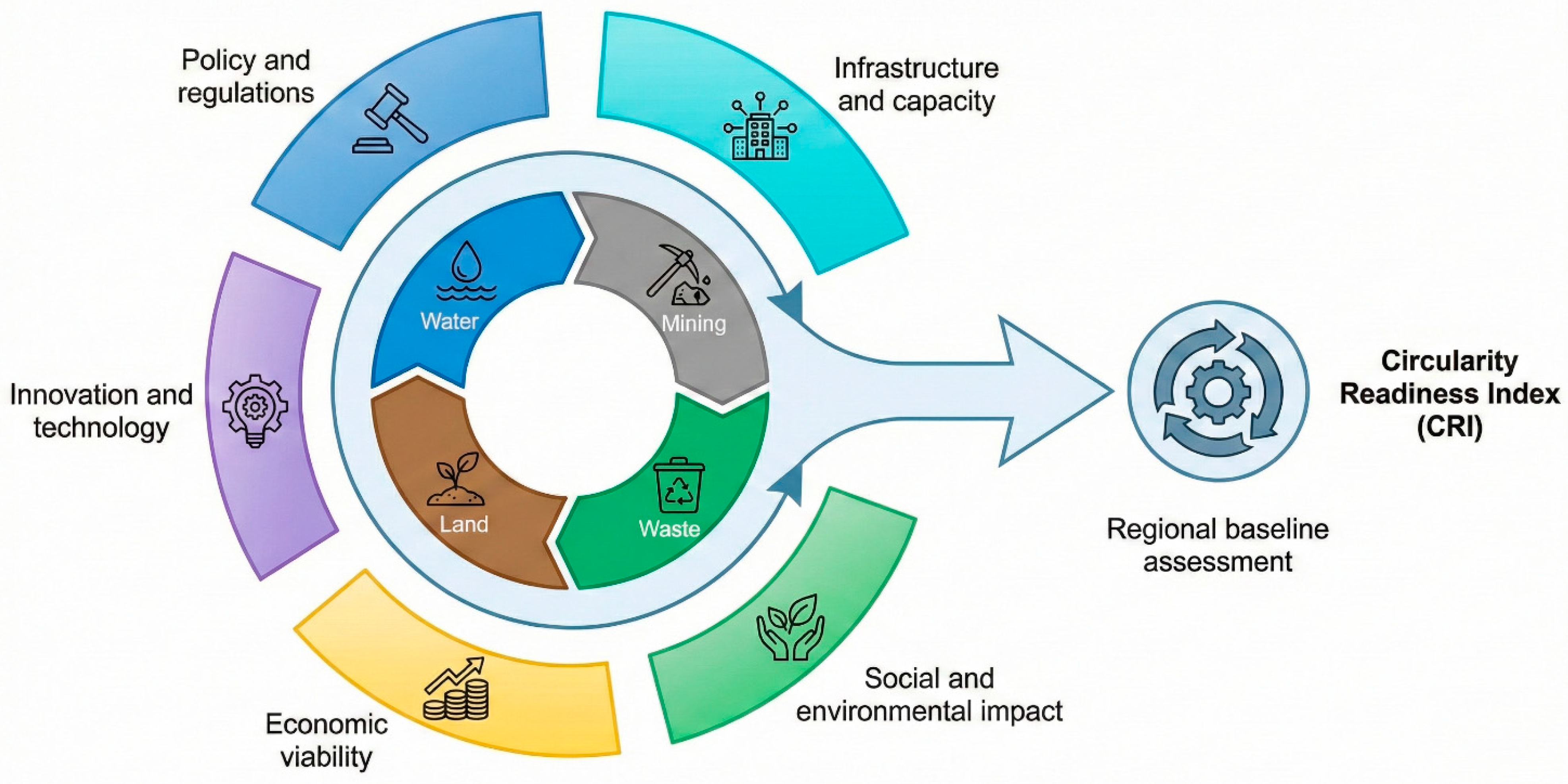
By providing a regional baseline, this study allows for comparative analysis across territories and informs targeted interventions and capacity-building strategies aligned with Vietnam’s national CE ambitions. Moreover, this research provides a practical methodological framework for readiness assessment in data-scarce environments which can be applied to other developing countries pursuing localized CE transitions. Figure 1 shows the five assessment dimensions and the linkage between institutional, technical and community-based readiness components across sectors.

2. Literature Review

2.1. Circular Economy and Readiness Assessment

The circular economy (CE) has been gaining momentum globally over the past decade as a way to achieve sustainable development [17]. According to the MacArthur Foundation [18], the CE is “an industrial system that is restorative or regenerative by design,” based on three principles: design out waste and pollution, keep products and materials in use and regenerate natural systems. The United Nations Environment Programme [19] sees the CE as a strategic approach to sustainable consumption and production (SCP) especially for developing countries where resource depletion, pollution and inefficiencies hinder long-term growth. Recent studies have also highlighted the importance of readiness as a condition for CE adoption in emerging economies particularly in Asia–Pacific [20,21].
In contrast to the conventional, linear “take–make–dispose” economy [22], the CE seeks to decouple economic growth from resource use by closing material loops and minimizing environmental externalities [23,24]. This model emphasizes a systemic shift in design, production, and consumption systems toward circular flows of materials, energy, and information [25]. While many CE strategies have focused on packaging, textiles, and consumer goods, its principles are equally (if not more) relevant in environmental resource sectors with high material throughput and long-term ecological impacts, such as mining and land use [9].
Specifically, land use, mineral extraction, water resources and solid waste management are key areas for CE implementation in developing contexts. In land use CE approaches restore degraded land and allocate space sustainably, linking biodiversity and ecosystem services to circular flows [26,27,28]. In mining the CE is about waste reuse, secondary material recovery and mine rehabilitation, where established practices and new CE models show opportunities for resource efficiency [29,30]. In water management the CE promotes wastewater reuse, stormwater harvesting and closed-loop industrial systems, with new approaches being developed for developing regions [31,32]. And in waste the CE is about upstream waste reduction, material recovery and formalization of recycling chains, so informal systems can be integrated into more efficient waste-to-resource models [12,33].
Despite the growing interest in the CE, implementation is still patchy, especially in areas where the institutional and infrastructural conditions are fragmented [34]. So readiness is key—defined here as the extent to which a system, sector or region has the technical, institutional and socio-economic capacity to put circular economy principles into practice [35]. Readiness is not just about CE policies; it is also about the availability of infrastructure, innovation capacity, public engagement and coherent governance [15,25].
In other words, readiness is a precondition for CE success [15,36]. Without it, CE strategies risk becoming aspirational rhetoric with little operational traction. For instance, a province may adopt CE goals, but if local industries lack technical solutions or if waste management systems remain fragmented, the transition will stall [37]. This is particularly true in environmental resource sectors, where transitions require coordination among multiple stakeholders, across long timeframes, and in diverse ecological contexts [38].
Consequently, assessing circularity readiness is increasingly seen as a critical step for CE planning and implementation. While global-level frameworks exist, few provide tools to assess readiness at sub-national levels or across resource sectors in a way that reflects the diversity of local conditions, especially in developing countries such as Vietnam [13,39]. Recent studies have begun to explore readiness in the Global South, including India and China, but these largely focus on national-level benchmarking rather than sectoral or regional transitions [40,41,42]. Very few have applied readiness assessment to environmental resource sectors, and to our knowledge, none exist for Vietnam.
The selection of these five dimensions is deeply rooted in the sustainability transition literature, particularly the Multi-Level Perspective (MLP) [43] and Technological Innovation Systems (TIS) frameworks [44]. From an MLP standpoint, the policy and business dimensions reflect the macro-level landscape pressures and regime shifts required to destabilize linear economic models [45]. Meanwhile, innovation and resource management represent the meso- and micro-level niche developments where novel circular technologies and practices are tested and scaled [43]. Finally, awareness captures the socio-cultural embedding and stakeholder engagement that literature identifies as critical for sustaining long-term transition pathways [46]. By integrating these dimensions, the framework bridges systemic transition theories with practical, sector-specific operationalization [47].

2.2. Existing Frameworks and Limitations

In recent years several global initiatives have developed frameworks and tools to measure circular economy (CE) progress and readiness. The most well known are the Circularity Gap Report (CGR) by Circle Economy, which does an annual diagnosis of global and national circularity [48]; the EU Circular Economy Monitoring Framework (EU CE MF) by the European Commission to track progress on production, consumption, waste, secondary raw materials and competitiveness [49]; and the Readiness Assessment Toolkit by the United Nations Economic and Social Commission for Asia and the Pacific [50].
Each of these frameworks provides valuable insights on how circularity can be measured and supported but also show important limitations—especially for developing countries and environmental resource sectors where data scarcity, institutional fragmentation and regional heterogeneity are major challenges.
The Circularity Gap Report (CGR) measures the global and national circularity gap—the proportion of resources recycled vs. consumed [48]. While it provides useful macro level diagnostics, it does not offer guidance for sub-national or sectoral implementation, especially in resource-intensive sectors like mining or land use where data is fragmented.
The EU Circular Economy Monitoring Framework (EU CE MF) is one of the most advanced systems globally, tracking circularity progress across themes like production, consumption, waste, secondary raw materials and competitiveness [49]. However, it is designed for EU-level data infrastructure, relies heavily on harmonized environmental statistics and is not easily transferable to countries with weaker institutional or statistical capacities. Moreover, it does not take into account regional disparities within countries or the readiness of specific sectors to transition.
In contrast the ESCAP Readiness Toolkit takes a more flexible and qualitative approach, focusing on enabling conditions such as policy frameworks, stakeholder engagement, data availability and institutional mechanisms [50]. This makes it more suitable for the Asia–Pacific region, including countries like Vietnam. However, it lacks quantitative scoring and does not have sectoral disaggregation, especially in environmental resource sectors.
Overall, while these frameworks are useful references, they lack regional granularity and sectoral specificity—two key factors for countries like Vietnam where circularity transitions must happen in very diverse socio-economic and ecological contexts. Table 1 summarizes the characteristics of existing CE readiness frameworks. This shows that we need a context-specific framework that combines qualitative expert-based methods with proxy indicators tailored to Vietnam’s environmental resource sectors.

3. Methodology

3.1. Framework for Circularity Readiness

To assess circular economy (CE) readiness in Vietnam’s environmental resource sectors, this study proposes a multi-dimensional framework that captures the systemic nature of readiness across institutional, technical, economic and social domains, as shown in Figure 1. This proposed framework complements existing macro-level tools, such as the EU CE Monitoring Framework and the ESCAP Readiness Toolkit, by adapting their generic principles into a localized matrix. Specifically, it makes these frameworks more applicable to sub-national tiers, resource-intensive sectors (e.g., mining, land, water, waste), and data-scarce environments in Vietnam where standardized quantitative statistics are often fragmented. Drawing from existing CE evaluation models (e.g., UNEP, ESCAP, EU CE MF) and adapted to the reality of data-scarce developing contexts, the framework consists of five key dimensions, each representing a critical condition for operationalizing CE:
(1) Policy and institutional readiness
This dimension represents institutional readiness and assesses the existence, coherence and enforcement of CE-related policies and governance structures. It looks at whether national or sub-national authorities have developed CE strategies, integrated CE into environmental planning (e.g., land, water, mining) and established mechanisms for monitoring and enforcement.
(2) Resource management practices
This dimension represents operational readiness and captures the actual practices and infrastructure related to the circular use of environmental resources. It includes indicators such as waste segregation, wastewater reuse, land rehabilitation and byproduct recovery in the mining sector. It reflects the degree to which circular principles are already being practiced or supported in reality.
(3) Innovation and technical capacity
Representing technological readiness, this dimension evaluates the availability and diffusion of innovative technologies and data systems, which are essential for CE implementation. This dimension evaluates the presence of R&D investment, digital infrastructure (e.g., GIS, monitoring systems), CE-related startups and institutional capacity for technological transfer and scaling.
(4) Business and economic ecosystem
The fourth dimension focuses on market readiness, evaluating the role of private sector actors and market mechanisms in enabling or constraining circular practices. It looks at the presence of circular business models, green investment mechanisms, CE-oriented value chains and support services such as CE finance and certification systems.
(5) Public awareness and community engagement
Representing social readiness, this dimension evaluates the level of CE literacy among citizens, inclusion of CE in education and community programs and civil society participation in CE initiatives, particularly in waste sorting and recycling.
The framework is designed to be flexible enough to accommodate both qualitative expert-based scoring and proxy quantitative indicators, allowing for context-specific adaptation depending on data availability. Importantly, while applied here to the specific case of Vietnam, this framework is inherently transferable and adaptable to other developing-country contexts where CE transitions must be evaluated under conditions of limited data availability and strong regional heterogeneity.
To firmly anchor this framework in the realities of environmental resource sectors, each dimension is designed to address specific systemic bottlenecks. For instance, policy targets the lack of inter-sectoral coordination across resource domains; resource management directly addresses operational deficits such as the lack of mining waste reuse and inadequate wastewater treatment coverage; innovation tackles the critical need to deploy digital tools (e.g., GIS and sensor networks) in resource monitoring; business confronts the dominance of linear economic models by incentivizing circular supply chains; and awareness mitigates the barrier of low public engagement and green skill shortages.

3.2. Indicator Selection and Scoring Logic

To implement the 5-dimensional framework in Section 3.1, we identified 18 qualitative indicators that cover the readiness of environmental resource sectors to adopt circular economy principles across Vietnam’s 6 ecological–economic regions. Each dimension has 3–4 indicators, selected based on their relevance to the national CE context, ability to reflect enabling conditions and availability of qualitative or proxy data to support expert evaluation.
The selection was based on a review of international CE frameworks (e.g., EU CE MF, ESCAP Toolkit), Vietnamese CE policy documents (e.g., Decision 687/QĐ-TTg) and recent studies on sectoral circularity in developing contexts. Indicators were designed to be context-specific to be applicable across regions with different levels of industrialization, data availability and governance maturity.
Each indicator was assessed using a standardized 5-point qualitative scale, where:
  • 1 = Very low readiness;
  • 2 = Low;
  • 3 = Moderate;
  • 4 = High;
  • 5 = Very high readiness.
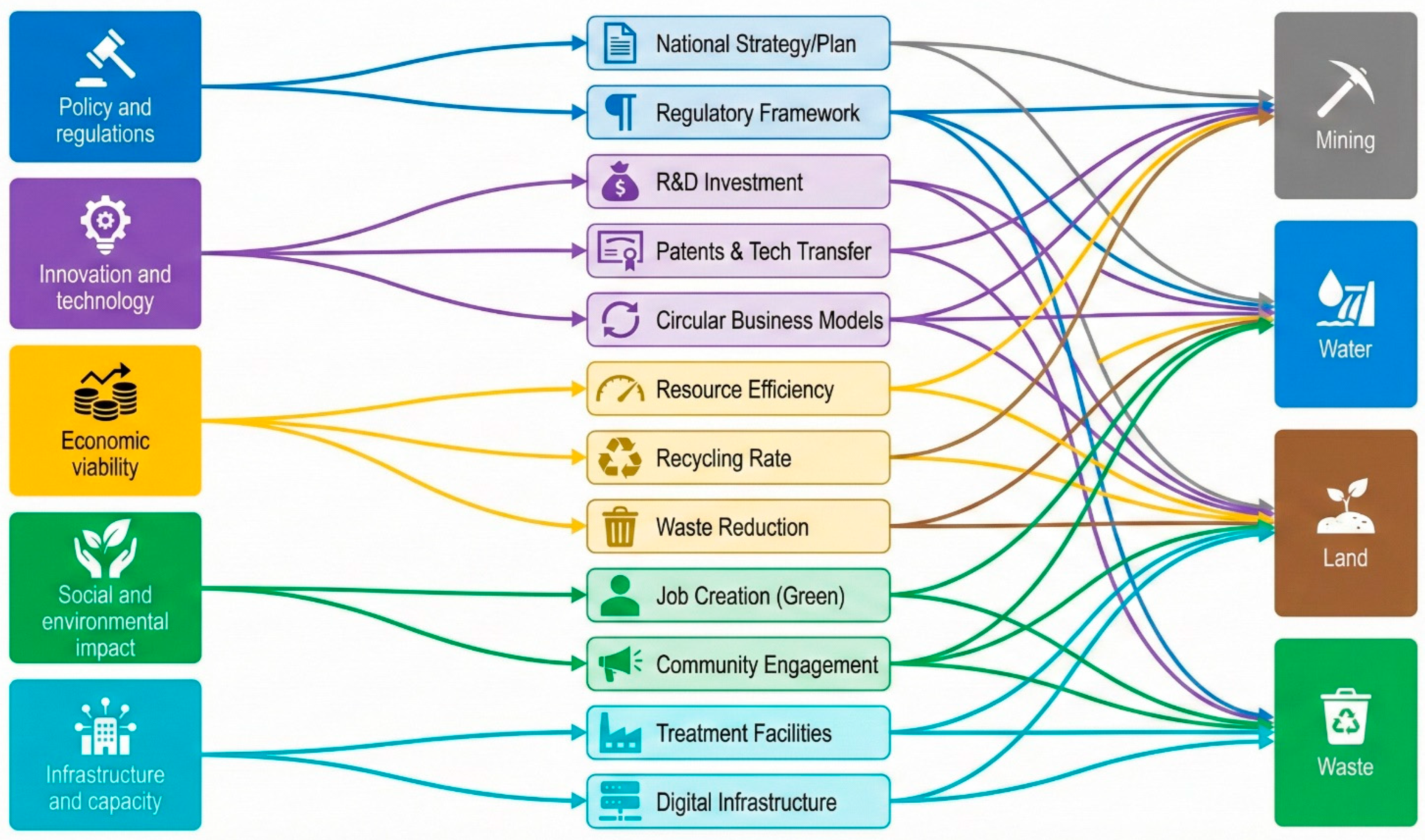
Scoring was guided by clearly defined criteria, as listed in Table 2, and supported by expert judgment in combination with triangulated proxy data derived from official statistics and publicly available reports (as detailed in Section 3.5). Figure 2 interprets the indicator framework matrix for connecting dimensions, indicators, and resource sectors.
Figure 2 provides a visual synthesis of the multi-dimensional assessment framework employed in this study, illustrating the intricate interplay between enabling environments, measurable metrics, and target resource sectors. Unlike linear assessment models, this matrix demonstrates a complex, system-wide connectivity. It reveals how foundational dimensions, such as policy and regulations and economic viability, exert cross-cutting influence through overarching indicators like national strategy and resource efficiency, impacting all four sectors simultaneously. Conversely, dimensions like innovation and technology drive targeted interventions through specific metrics such as R&D investment and digital infrastructure. This holistic mapping ensures that the readiness assessment goes beyond physical material flows to capture the critical institutional, technological, and socio-economic scaffolding required for a systemic circular transition.

3.3. Regional Scope and Classification

Vietnam has strong regional diversity in terms of geography, socio-economic development, infrastructure, environmental pressures and institutional capacity. These differences affect how environmental resource sectors work, and by extension how CE transitions will unfold across the country.
To ensure the readiness assessment captures this diversity, we use the 6-region ecological–economic classification commonly used by the General Statistics Office (GSO) of Vietnam and applied in national development planning. This classification balances territorial resolution and analytical tractability, allowing for meaningful inter-regional comparison without over-fragmentation.
The 6 regions in this study are:
(1) Red River Delta (RRD)—includes Hanoi and several fast-urbanizing provinces with strong industrial bases and relatively advanced environmental infrastructure.
(2) Southeast (SE)—home to Ho Chi Minh City and major manufacturing hubs such as Dong Nai and Binh Duong; high industrial concentration and pilot CE projects.
(3) Mekong Delta (MD)—dominated by agriculture and aquaculture, facing increasing water-related challenges and environmental vulnerabilities.
(4) North Central and Central Coast (NCC)—mix of coastal provinces with mining, tourism and emerging urban centers.
(5) Northern Midlands and Mountains (NMM)—largely rural and mountainous region, rich in natural resources but with lower infrastructure and institutional readiness.
(6) Central Highlands (CH)—known for intensive agriculture and bauxite mining; faces ecological pressures and institutional capacity gaps.
These regions were used as the primary units of analysis for scoring circularity readiness across all 5 framework dimensions. Each region was scored by the expert panel independently, allowing for a consistent and comparable assessment process.
Administrative boundaries do not always reflect functional or ecological realities, but this regional classification provides a practical and policy-relevant lens to assess CE readiness, especially in sectors such as mining, land, water and waste which often have strong regional variation.
To support future tracking and potential composite index development, region-level scores were stored and structured to allow for disaggregation by dimension, indicator and sectoral focus.

3.4. Expert Evaluation and Data Triangulation

Sub-national CE statistics remain uneven in Vietnam, particularly for environmental resource sectors where monitoring systems are fragmented across agencies and provinces. In this context, the study employed a modified Delphi expert elicitation to obtain a structured, comparable readiness profile across six regions and five readiness dimensions. Unlike the classical Delphi method, which typically begins with a completely open first round to generate items from expert opinion de novo, our modified approach started from a pre-structured framework and predefined indicator set derived from the literature and policy documents. Experts were not asked to generate indicators from scratch, but rather to evaluate, refine, and score this structured assessment instrument. Delphi was selected because it enables systematic aggregation of informed judgment when direct measurement is incomplete, while still allowing transparency through iterative feedback and convergence reporting [38,54,55].

3.4.1. Expert Panel Design and Adequacy

The panel consisted of 11 experts (n = 11) recruited through purposive sampling to capture the three actor groups most directly involved in CE implementation and governance: academia, public administration, and private-sector practice. Panel selection followed three criteria: (i) demonstrated involvement in CE-related initiatives, policy work, or sectoral implementation; (ii) professional knowledge relevant to at least one of the four resource domains (land, mining, water, waste); and (iii) familiarity with regional conditions through work experience, project implementation, or policy coordination beyond a single province. Table 3 and Table 4 report panel composition by role and sectoral expertise.
Given the national scale of the topic, the authors do not treat the panel as a statistically representative sample. Instead, the panel is positioned as a knowledge-intensive group appropriate for diagnostic readiness assessment under data constraints. This positioning is consistent with Delphi applications in sustainability and policy settings where the objective is to identify structured consensus (and justified divergence) among domain experts rather than estimate population parameters [38,54].
It is important to note that experts were recruited for their cross-regional competence rather than as exclusive representatives of a single region. The ‘primary region exposure’ listed indicates familiarity, not voting weight. Therefore, the uneven distribution of primary regional exposure (e.g., one expert for MD versus three for RRD) reflects the knowledge-intensive nature of this national panel rather than a quota-based regional sample.
The panel intentionally balanced governance, academic, and practitioner perspectives, and ensured coverage of all six regions and the four environmental resource domains. Cross-cutting CE governance expertise was included to reflect the policy–institutional nature of readiness assessment.

3.4.2. Delphi Procedure and Convergence Logic

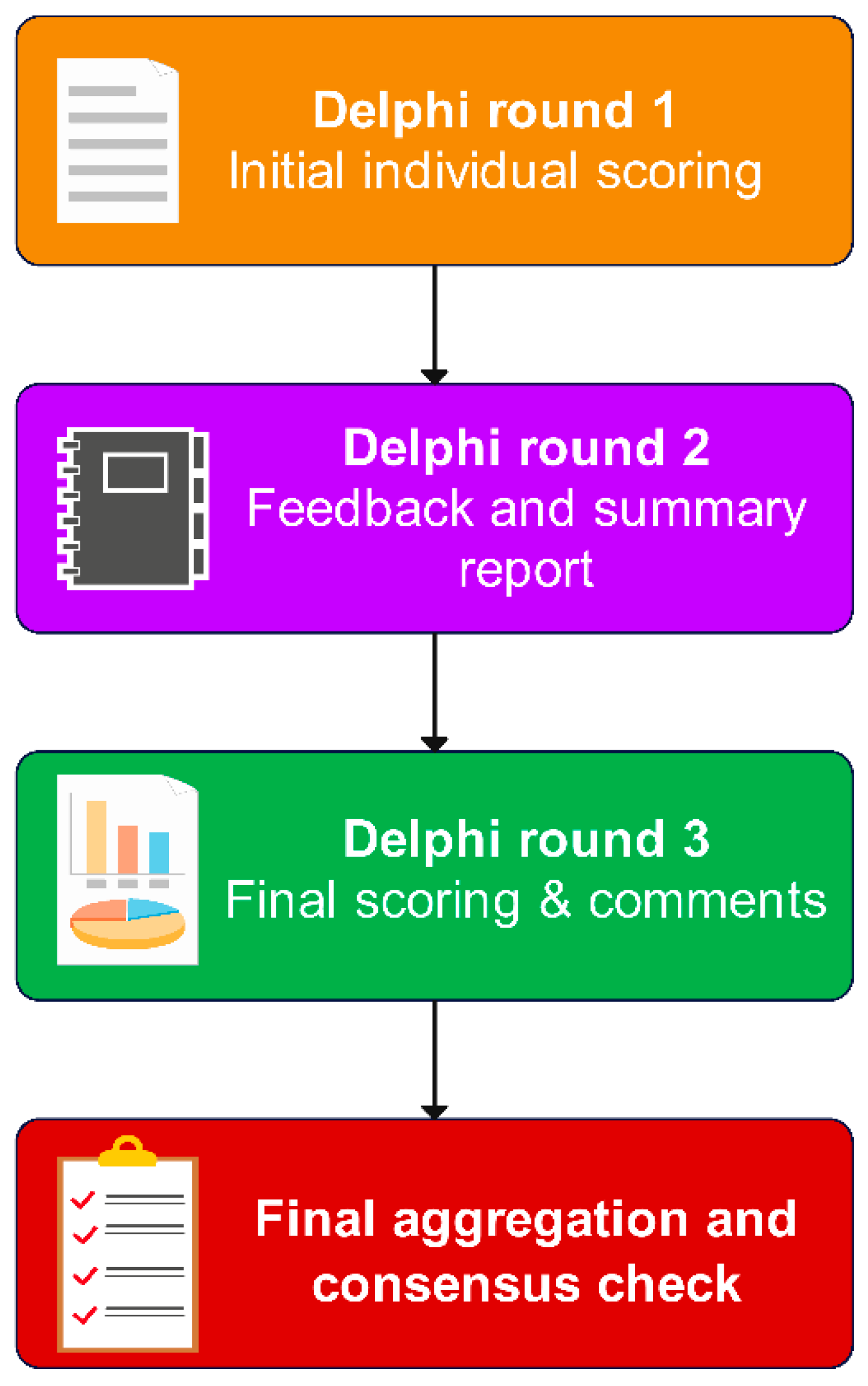
The Delphi procedure was implemented in three iterative rounds (Figure 3), using the indicator definitions and scoring anchors provided in Table 2.
Round 1 (independent scoring): Experts independently scored 15 indicators across all six regions using a 1–5 scale.
Round 2 (feedback and rescore): Experts received anonymized score summaries (mean and dispersion statistics) and short clarification notes for indicators that showed high dispersion. Experts were then invited to revise scores where they considered group patterns informative.
Round 3 (final scoring): A final rescore was collected after structured discussion (virtual workshop and/or written feedback). The objective was not forced unanimity, but convergence where appropriate and explicit documentation of contextual reasons for persistent divergence.
Consensus improvement was evaluated not through formal statistical significance tests, but by observing the stability of the central tendency (mean) and the narrowing of dispersion (standard deviation) across rounds. The substantive interpretation of these convergence metrics is detailed in the results section.
To ensure full replicability, a practical threshold of a standard deviation (SD) > 1.0 after Round 3 was used to formally identify and label justified divergence, indicating areas where local contextual differences persistently outweighed group consensus.

3.4.3. Bias Risks and Mitigation Measures

Recognizing known Delphi limitations (e.g., dominance, anchoring, and contextual bias), several mitigation measures were applied: (i) independent Round 1 scoring to reduce early anchoring; (ii) anonymized feedback in Round 2 to prevent reputational effects; (iii) consistent scoring rules and anchors in Table 2 to reduce interpretive drift; and (iv) explicit retention of justified divergence where local contextual conditions plausibly differ across regions. The authors treat the resulting scores as expert-informed readiness diagnostics rather than objective performance measures.

3.4.4. Triangulation with Public Information (Contextual Benchmarking)

To reduce the risk that readiness patterns reflect perception alone, the Delphi exercise was triangulated with publicly available sources relevant to CE enabling conditions, including international datasets (e.g., World Bank), government plans and reports, and global CE monitoring references (Table 5). Importantly, these sources were used as contextual benchmarks during indicator clarification and interpretation; they were not used to “validate” or mechanically adjust expert scores as if they were measured regional statistics. The study therefore differentiates between (i) elicited readiness scores as the primary output and (ii) proxy indicators as contextual evidence that supports interpretation and highlights data gaps for future work.

3.5. Scoring and Aggregation

The final readiness dataset is based on Round 3 scores. For each indicator I, region r, and expert e, a score s e , i , r 1 , 2 , 3 , 4 , 5 was provided following Table 2. Indicator-level regional scores were calculated as the arithmetic mean across experts:
s ¯ i , r = 1 n e = 1 n s e , i , r w i t h   n = 11
Dispersion was summarized using standard deviation (and, where needed, interquartile range as a robust check).
Dimension scores were computed as the mean of the indicators assigned to each dimension. With 15 indicators and five dimensions, each dimension contains three indicators:
D k , r = 1 m k i k s ¯ i , r
where m k = 3 for each dimension, k Policy , Resource   management , Innovation , Business , Awareness .
The composite readiness score for each region was calculated as the unweighted mean of the five-dimension scores:
C r = 1 5 k = 1 5 D k , r
Unweighted aggregation was selected because the objective is baseline diagnostics and because defensible national weighting schemes for CE readiness dimensions are not yet established for Vietnam’s resource sectors.
To support policy-relevant interpretation while avoiding ambiguous category boundaries, readiness levels were defined using fixed cutoffs that reflect the 1–5 semantic anchors and the observed score distribution in this dataset:
High readiness: C r   3.80
Medium readiness: 3.00 < C r <   3.80
Low readiness: C r   <   3.00
These thresholds were not intended as statistically estimated breakpoints, but rather as descriptive, heuristic, and policy-oriented boundaries. They reflect the semantic interpretation of the 1–5 scale and the observed distribution of the dataset, allowing for clear distinctions between stronger, intermediate, and weaker readiness profiles without implying universal statistical thresholds.
While an unweighted aggregation was deliberately employed in this study to establish a neutral diagnostic baseline in a data-scarce context, future applications could benefit from exploring weighted alternatives. Methods such as the Analytic Hierarchy Process (AHP) or entropy-based weighting could be applied to assign varying levels of importance to different dimensions. For instance, in the early stages of a circular transition, expert-assigned weights might prioritize foundational dimensions like policy and infrastructure over awareness. However, as demonstrated in sensitivity analysis (Section 3.6), the regional typologies identified in this study remained robust regardless of the weighting scheme applied, confirming that the unweighted approach provides a reliable initial baseline without introducing subjective weighting bias.

3.6. Robustness and Sensitivity Checks

Because readiness scores are elicited from expert judgment, the study includes robustness checks to assess stability against (i) individual expert influence and (ii) aggregation choices. Two sensitivity routines were performed:
(i) Leave-one-expert-out stability. Composite scores were recalculated 11 times, each time excluding one expert. Stability was evaluated by the maximum absolute change in composite scores and whether regional ranking changed under exclusion. Regions with unstable ranks were flagged for cautious interpretation.
(ii) Alternative aggregation schemes. To test whether conclusions depend on equal weighting, the composite score was recalculated under two alternative schemes: (a) dimension weights proportional to perceived implementation leverage (policy and resource management emphasized), and (b) equal-indicator weighting (equivalent to the base case here, but retained for transparency). Results were compared using rank correlation and cluster stability.
The sensitivity analysis confirmed that the regional ordering remained highly stable. Specifically, Spearman’s rank correlation coefficient remained very high ρ 0.94 across all alternative weighting tests, quantifying the robustness of the high- and low-readiness groupings. The high-readiness grouping of SE and RRD, as well as the low-readiness grouping of NMM and CH, remained completely unchanged under alternative weighting assumptions, thereby supporting the robustness of the main findings.
These checks do not convert the Delphi method into objective measurement; instead, they provide transparency on how much conclusions depend on modeling choices, which is critical for responsible policy interpretation in data-scarce settings.

3.7. Ethical Considerations

Expert participation was voluntary and based on informed consent. To minimize social pressure and reputational bias, individual scores were anonymized during feedback rounds and are not reported at an identifiable level. The study reports aggregated results only (means and dispersion), and any contextual statements are presented without attribution to specific individuals or organizations. Potential conflicts of interest were assessed during recruitment; experts were asked to declare whether they had direct commercial interests that could materially benefit from a specific regional readiness narrative. No personal data beyond professional role categories were stored.

4. Results

4.1. Regional Scores by Dimension

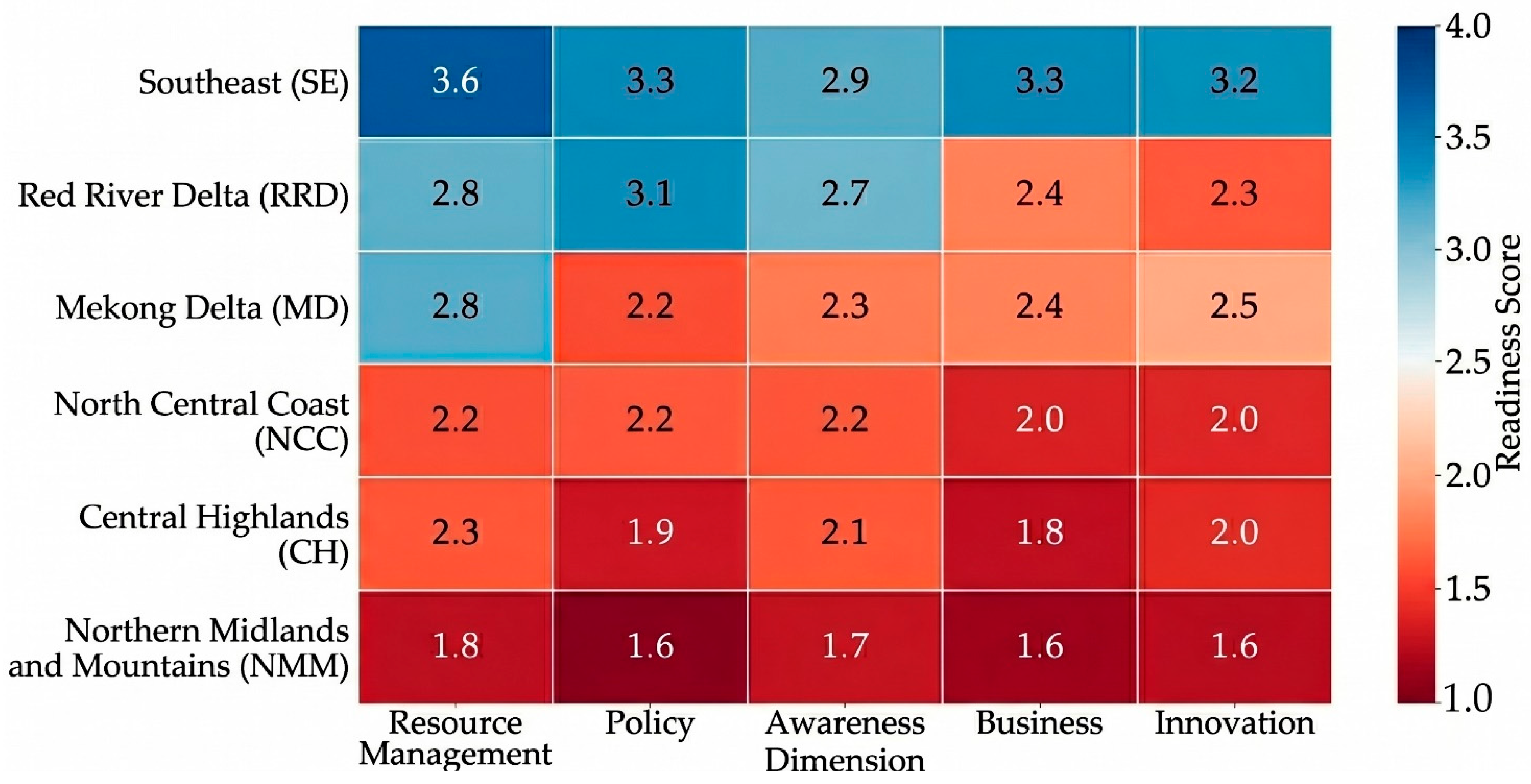
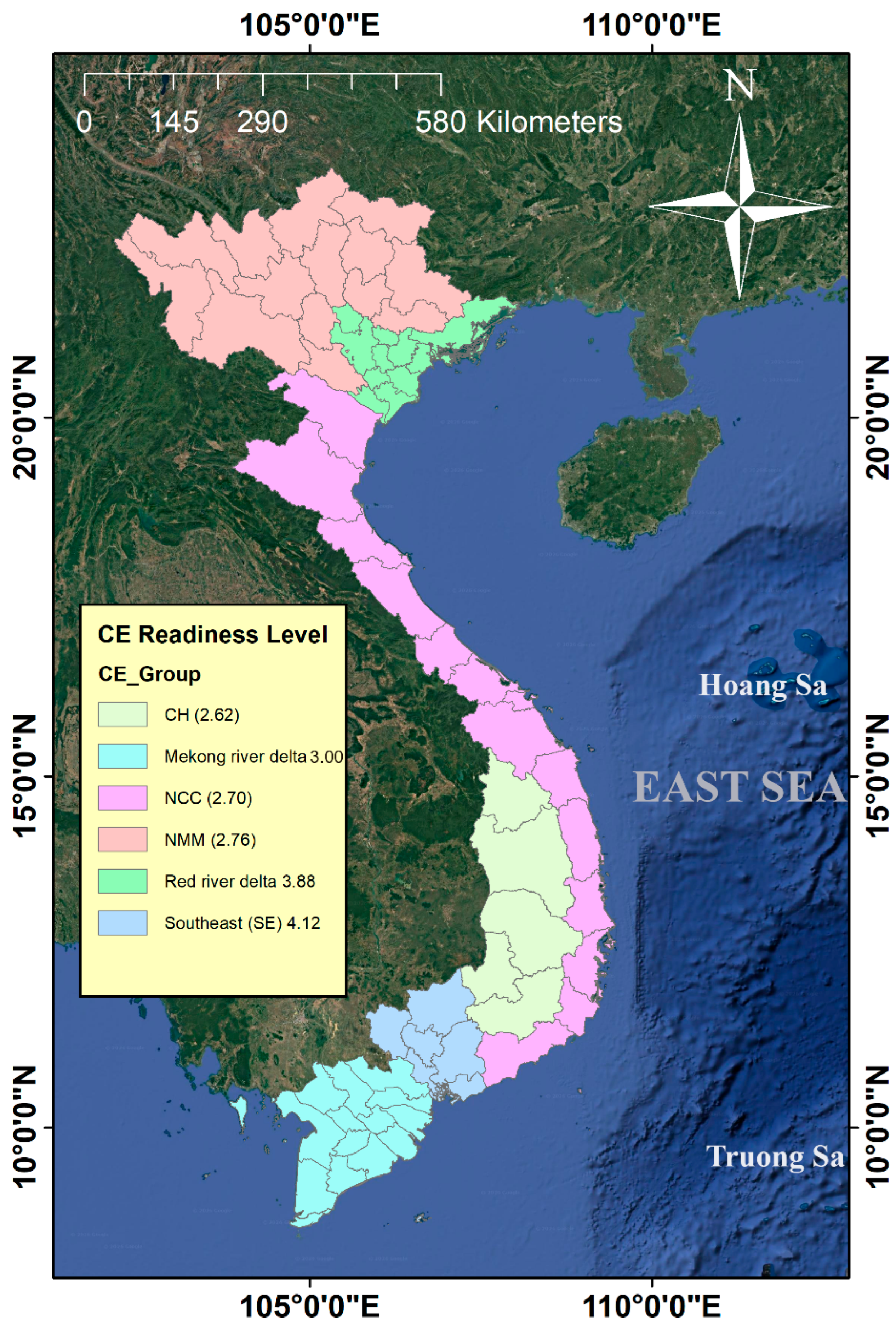
Before detailing the specific indicator scores, the overall empirical pattern clearly demonstrates a structural divide in circularity readiness across Vietnam. High-readiness hubs are concentrated in industrialized and highly urbanized regions, whereas resource-rich but infrastructure-poor regions face systemic barriers across all dimensions. In particular, the aggregated expert scores, calibrated with triangulated proxy indicators, reveal substantial variation in circularity readiness across Vietnam’s six ecological–economic regions (Figure 4 and Table 6). The SE and RRD regions exhibit the highest overall readiness, driven primarily by stronger policy frameworks, more advanced resource management systems, and dynamic business ecosystems. By contrast, the NMM and CH lag behind, reflecting weaker institutional capacity, limited innovation, and lower public awareness of CE practices.
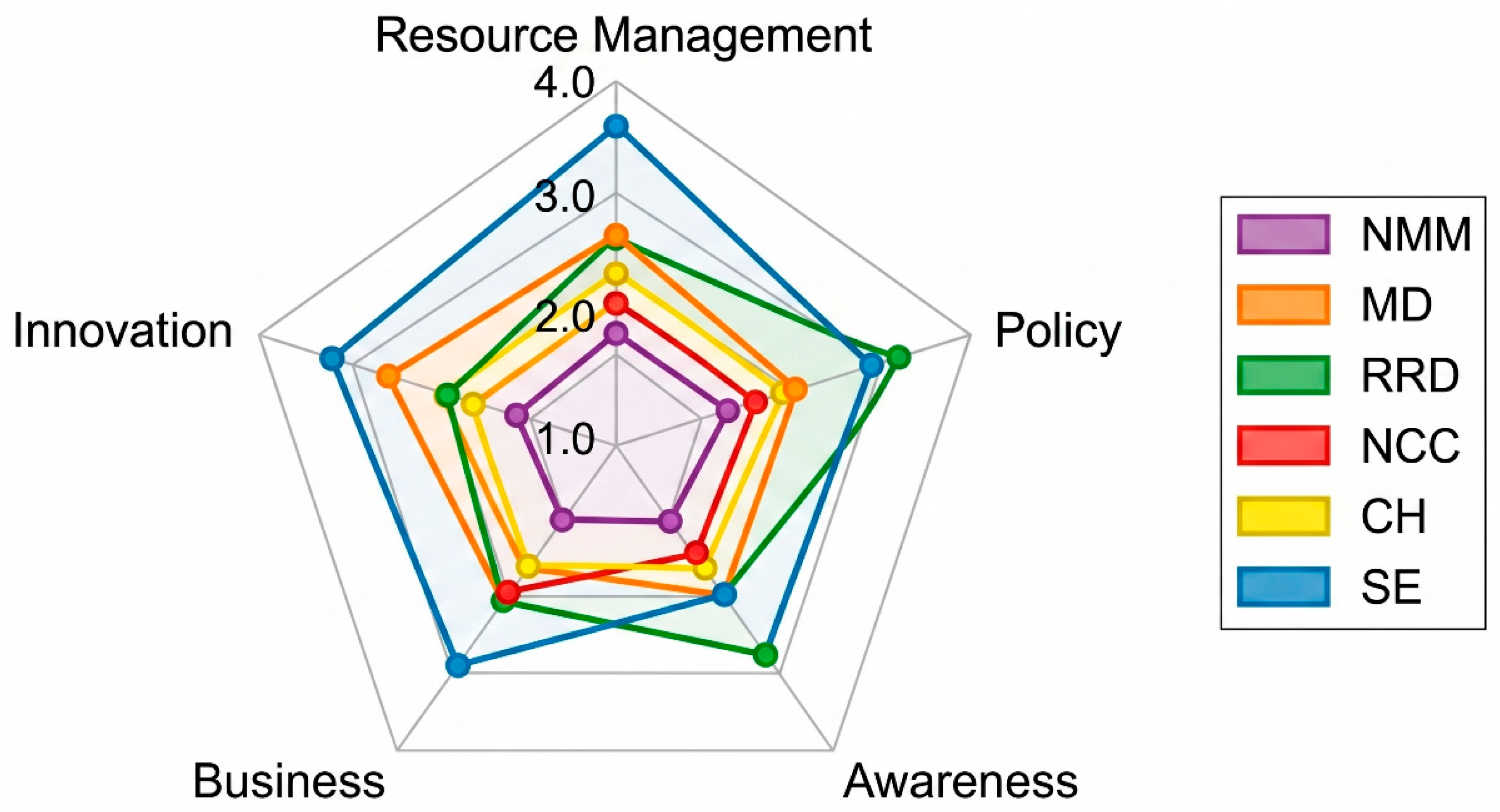
Figure 5 shows the comparative radar chart of the six regions across the five dimensions. The SE and RRD have balanced high scores across all dimensions, while the NMM and CH have flat profiles indicating systemic gaps in innovation capacity and community engagement. The MD and NCC are in between with moderate scores constrained by institutional and technical limitations.
The heatmap of regional scores (Figure 6) provides another view, showing cross-regional contrasts. The SE and RRD are in the top-scoring range (darker shaded), while the NMM and CH are in lighter shades, confirming their lag in readiness. This also shows where the performance gaps are most acute—e.g., innovation and public awareness in the NMM and CH, resource management in the MD.
Overall, the findings suggest that Vietnam’s readiness for the CE in environmental resource sectors is unevenly distributed, with regional disparities reflecting differences in urbanization, industrial development, governance, and community engagement. High-performing regions (SE, RRD) are better positioned to act as catalysts for CE adoption, while low-performing regions (NMM, CH) will require targeted policy support and capacity-building programs to catch up. It should be noted that these data were collected before 1 July 2025 in Vietnam.
While the baseline readiness scores reflect regional aggregates, qualitative Delphi feedback highlighted distinct sector-specific patterns within these territories:
- SE: Demonstrates particular strength in waste recovery systems and a robust business ecosystem for circular models.
- RRD: Shows stronger policy and institutional integration, acting as a hub for inter-agency coordination.
- MD: Faces acute constraints related to water management and infrastructural readiness amid climate vulnerabilities.
- NCC: Constrained by uneven infrastructural readiness, requiring a balance between resource extraction and sustainable coastal development.
- CH: Critical gaps remain in mining rehabilitation (e.g., bauxite tailings management) and foundational institutional capacity.
- NMM: Lags significantly in environmental monitoring and basic institutional capacity for resource sectors.

4.2. Triangulation with Quantitative Proxy Indicators

Although this study is based on qualitative expert-based assessments, some quantitative proxies were added to strengthen the readiness scoring and provide empirical anchors. These indicators capture observable aspects of resource circularity in Vietnam and while the coverage is limited, they can be used as benchmarks for comparison across regions.
Table 7 shows three data-based indicators from international and national sources. The first two indicators, plastic recycling rates and wastewater treatment coverage, are from the World Bank [51,52]. The third indicator, informal recycling activity, is from the Circulate Initiative which highlights the importance of community- and market-driven recycling networks in Vietnam.
Table 7’s proxies are a useful quantitative anchor for expert-based scoring but should be used with caution. They are not official, sub-national statistics but rather national baselines adjusted for known differences in industrialization, urbanization and infrastructure. This is consistent with CE readiness assessments in other developing countries where sub-national data is scarce or non-existent.
The combination of proxy data and expert judgment provides a balanced and context-specific assessment but also highlights the need for systematic sub-national data collection and monitoring frameworks in Vietnam. Having reliable, disaggregated data on waste management, resource reuse and CE-related business activities would allow future studies to move from proxy-based assessments to more quantitative analysis.

4.3. Expert Consensus

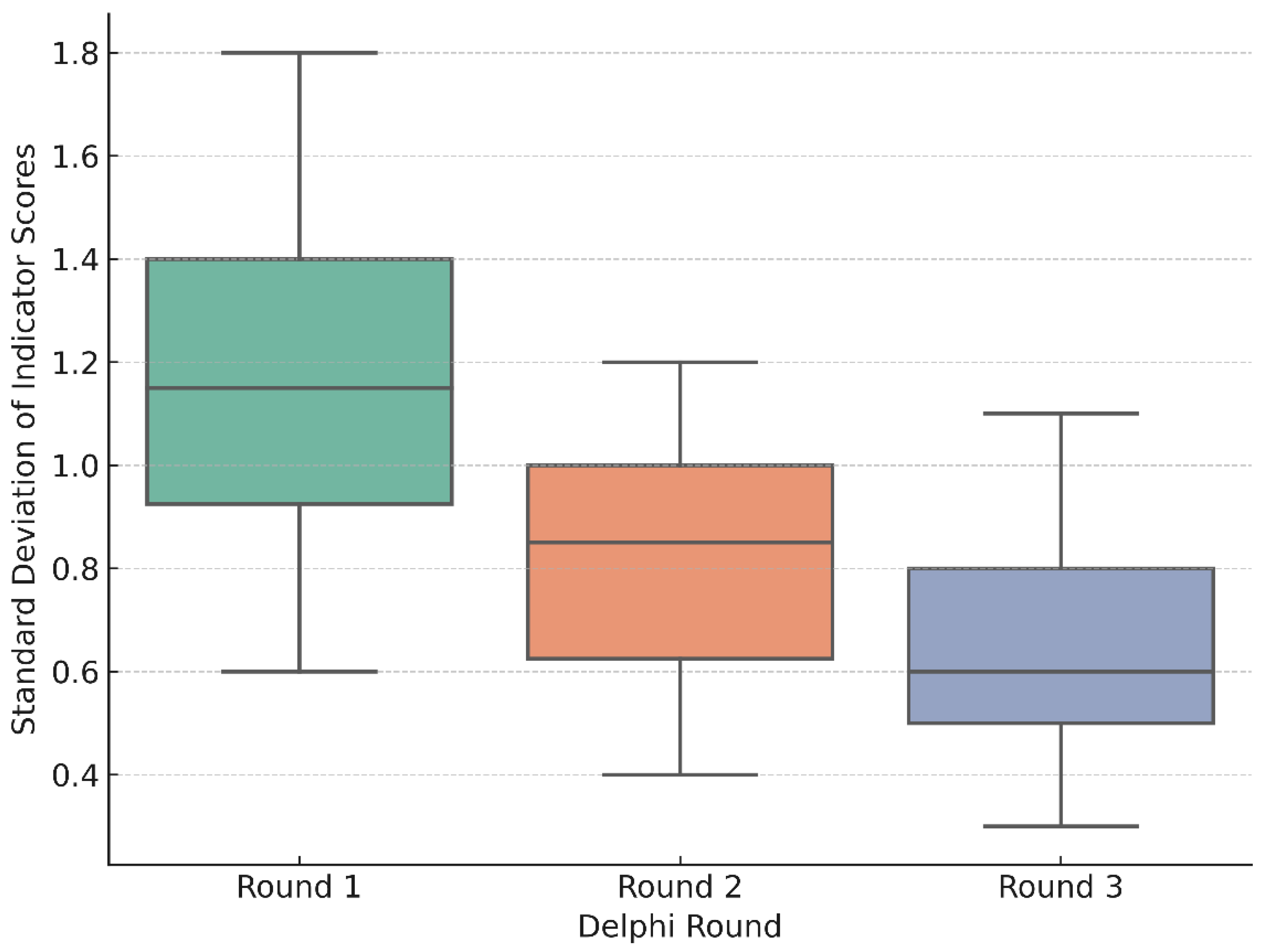
The Delphi process employed in this study aimed not only to capture expert judgment but also to improve the reliability of scores through iterative feedback and convergence. Variability in expert scoring decreased substantially between Rounds 1 and 3, indicating that the structured process was successful in achieving greater alignment across different stakeholder perspectives.
Figure 7 illustrates the distribution of score variability across all indicators and regions. In Round 1, dispersion was relatively high, reflecting the diversity of perspectives among academics, policymakers, and business representatives. By Round 3, variability had narrowed considerably, with most indicators clustering around the interquartile range of ±0.5 from the mean. Table 8 shows the Delphi round summary and consensus improvement.
As shown in Table 8, the Delphi method was effective in reducing divergence. It should be noted that the object of analysis in this section is the dispersion of scores (standard deviation), not the readiness levels themselves, to specifically evaluate the quality and stability of expert agreement. Table 8 summarizes this dispersion numerically across rounds, while Figure 7 provides a distributional visualization. Furthermore, the metric of % Indicators with SD > 1.0 was used purely as a descriptive heuristic to indicate relatively high disagreement on the 1–5 scale, not as a formal inferential threshold. Future studies could employ Relative Standard Deviation (RSD) and variance-based analysis for a more scale-sensitive comparison of convergence between rounds. However, a few indicators (e.g., awareness in the NMM and CH) retained higher variability, reflecting real differences in local contexts and information availability. Instead of forcing consensus, these divergences were retained with qualitative justifications to preserve the contextual richness of expert perspectives.
To illustrate this convergence at the indicator level, Table 9 provides the mean and standard deviation changes for selected indicators from Round 1 to Round 3, showing successful consensus improvement for policy and resource indicators alongside justified divergence for awareness.

4.4. Regional Typologies

Beyond individual scores, clustering analysis was used to identify typologies of regions with similar readiness profiles. This approach enables grouping of regions into broader categories, highlighting shared strengths and weaknesses that may benefit from common policy interventions.
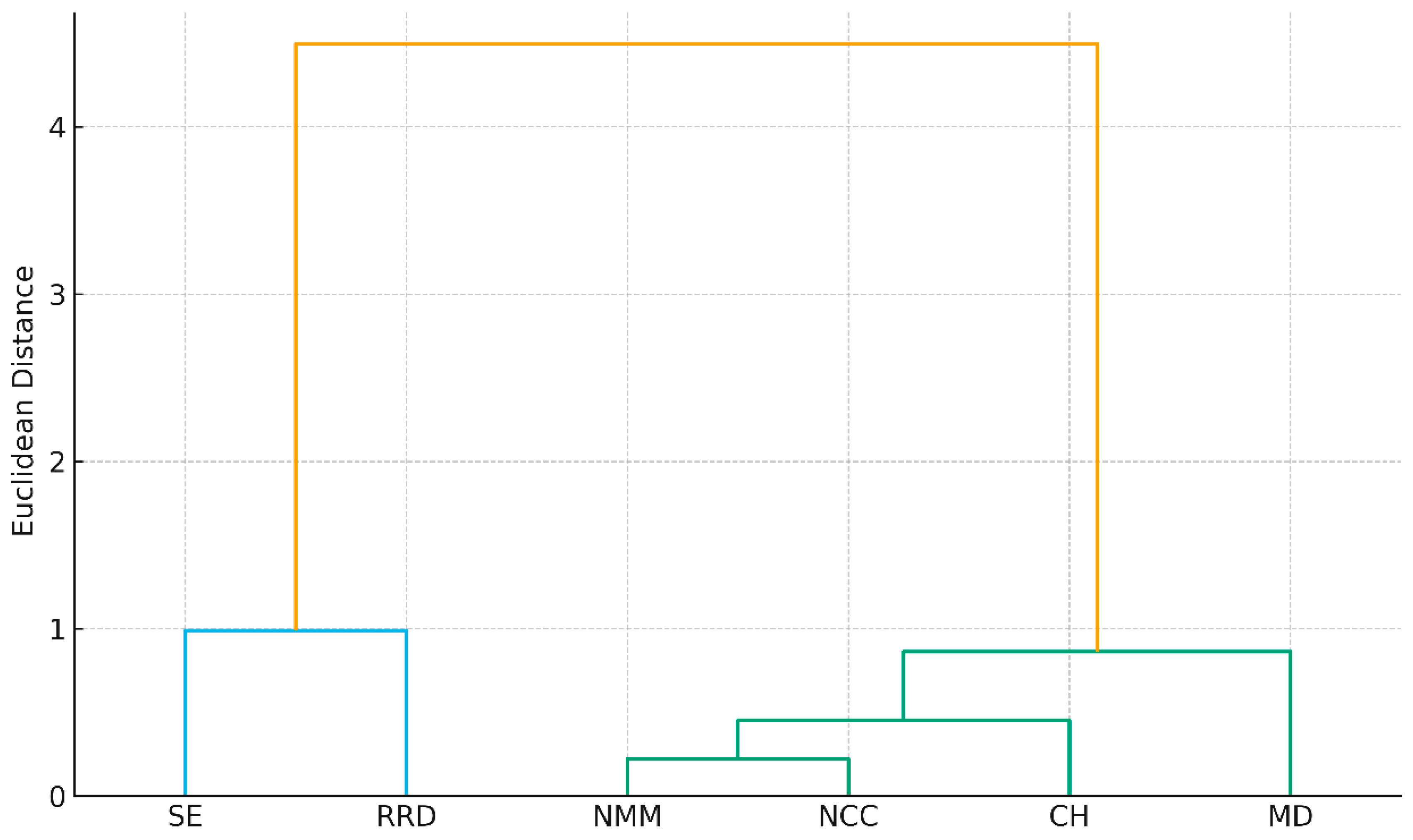
The dendrogram (Figure 8) shows three distinct clusters of readiness:
Cluster 1 (High readiness): The SE and RRD, characterized by stronger institutional frameworks, higher innovation activity, and more mature business ecosystems.
Cluster 2 (Medium readiness): The MD and NCC, where institutional structures exist but are constrained by infrastructural limitations and uneven awareness.
Cluster 3 (Low readiness): The Northern Midlands and Mountains (NMM) and CH, with systemic weaknesses across all five dimensions, particularly innovation and community engagement.
These typologies suggest differentiated pathways for policy and investment. High-readiness regions can act as CE pilots and demonstration hubs, medium-readiness regions may require targeted infrastructural upgrades, while low-readiness regions need foundational capacity-building and awareness-raising efforts before large-scale CE adoption is feasible.

5. Discussion

5.1. Interpretation of Regional Readiness Profiles

This study shows significant regional disparities in circularity readiness across Vietnam’s environmental resource sectors. The SE and RRD are the most ready with composite readiness scores above 3.8. This is due to well-articulated policy frameworks, stronger institutional capacity and a business ecosystem that is more responsive to circular economy (CE) opportunities [52,56]. In these regions, higher levels of industrialization and urbanization have led to regulatory innovation and private sector engagement, making them natural demonstration sites for CE implementation. This is similar to Jiangsu Province in China and Bangkok Metropolitan Region in Thailand which have leveraged industrial concentration and policy clarity to drive CE initiatives in their respective countries.
The NMM and CH have the lowest readiness scores. These regions are characterized by infrastructural gaps, a lack of disaggregated data and weaker community participation in CE initiatives [57,58,59]. In particular, the absence of robust wastewater treatment systems, limited reuse of mining byproducts and low awareness among businesses and citizens hinder their transition potential. For example, bauxite mining in the Central Highlands still generates red mud problems, while artisanal mining in the Northern Midlands lacks formal waste treatment, exacerbating environmental risks. These systemic weaknesses mean that foundational capacity-building is needed before advanced CE models can be introduced.
The results also confirm the importance of institutions, businesses and public awareness in shaping readiness [18,60]. While infrastructure and technology matter, policy clarity, enforcement mechanisms and business incentives seem to be decisive. For example, the SE and RRD have government-led strategies (e.g., CE pilot action plans) and market-driven initiatives (e.g., recycling enterprises, ISO certified firms). The NMM and CH lack not only infrastructural capacity but also institutional inertia and limited stakeholder engagement, making it harder to mainstream CE principles. This highlights the absence of financial instruments such as green bonds or CE credit schemes which are underdeveloped in Vietnam compared to OECD economies. Methodologically, this study shows the value of expert-based approaches in data-scarce contexts. The Delphi process, triangulated with proxy indicators, allowed for a systematic and transparent readiness assessment despite the lack of regional statistics [38,55]. This demonstrates the flexibility and robustness of qualitative–quantitative integration, which can be applied to other developing countries where official CE datasets are fragmented. However, reliance on expert judgment also has biases and proxy indicators simplify local complexities. Future research should triangulate with firm-level surveys and remote sensing data to reduce these limitations. Moreover, the use of proxies highlights the need to develop standardized and transparent regional-level data systems in Vietnam.
Looking forward, several policy implications arise. First, the CE should be mainstreamed into regional resource planning frameworks so that land, mining, water and waste strategies include circular principles. Second, targeted investments are needed to build CE-related infrastructure in lagging regions, particularly in wastewater treatment and resource recovery. Third, community participation and awareness must be increased through education programs and local initiatives, especially in rural and mountainous areas where informal recycling is already playing a crucial role. Fourth, Vietnam should develop a transparent and publicly accessible CE monitoring system which will not only improve future assessments but also attract investment and international cooperation [61,62]. These policy directions are aligned with Vietnam’s Green Growth Strategy (2021–2030), Resolution 57-NQ/TW on science, technology and innovation, and the National Action Plan on Circular Economy (2025), which means there is strong national-level commitment that needs to be translated into regional action.
In summary, the study provides a diagnostic baseline and a strategic direction for Vietnam’s CE transition. By combining expert judgment with proxy data, it offers practical insights while highlighting the structural reforms needed for a truly inclusive and regionally balanced circular economy.

5.2. Limitations and Future Research

This study provides a diagnostic baseline rather than an empirically verified performance benchmark. Three limitations should be noted. First, the Delphi panel is knowledge-intensive but small (n = 11); results are therefore best interpreted as structured expert judgment rather than statistically representative estimates. Furthermore, despite measures such as anonymized feedback across rounds, the Delphi process may still be susceptible to potential conformity bias, where outlier expert opinions might converge toward the group mean due to psychological pressure rather than genuine agreement. Second, the proxy indicators used for triangulation (Table 8) are contextual references, and in several cases they are national-level measures that cannot substitute for measured regional statistics. Third, although the framework targets environmental resource sectors, sector-wise regional disaggregation (land vs. mining vs. water vs. waste) remains limited by data availability and expert burden; future work should implement a sector-by-region matrix once consistent provincial datasets and sectoral monitoring protocols become available.
Additionally, there is an uneven distribution of primary regional exposure among the experts (e.g., fewer representatives for the MD and CH regions compared to the RRD), which is an inherent limitation of purposive sampling, even though experts evaluated all regions based on cross-regional competence.
A clear next step is to empirically validate these diagnostic scores using firm-level surveys to assess business and innovation readiness, alongside remote sensing and geospatial data to improve land and mining-related indicators. Furthermore, future research should establish transparent data pipelines and focus on the longitudinal tracking of readiness changes over time as new CE-related policies and investments are systematically implemented across provinces.

6. Policy Implications

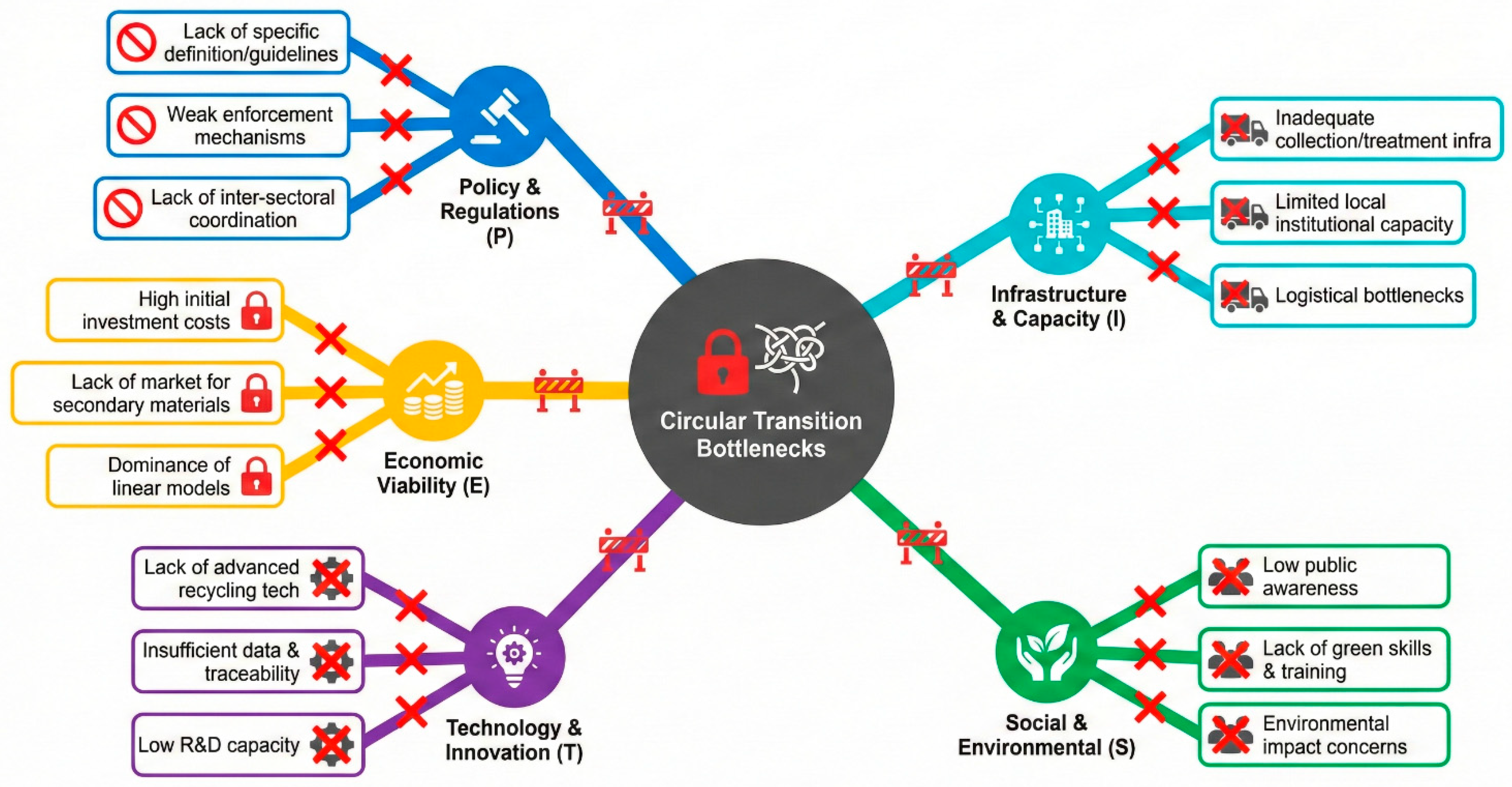
Based on the analysis, the transition to a circular economy in Vietnam faces a complex landscape of structural barriers across all five dimensions, particularly in lower-readiness regions. These bottlenecks, ranging from incomplete legal frameworks to gaps in technological infrastructure (as illustrated in Figure 9), must be systematically addressed to unlock circular potential.
As visually synthesized in Figure 9, the obstacles to circularity in Vietnam are not isolated incidents but rather a systemic web of interconnected bottlenecks spanning all five critical dimensions. The network map highlights that while economic hurdles such as high initial investment costs and the dominance of linear models are prominent, they are compounded by institutional voids, specifically the lack of specific guidelines and weak enforcement mechanisms under the policy dimension. Furthermore, the transition is severely hampered by foundational gaps in the hard ecosystem (e.g., inadequate collection/treatment infrastructure and low R&D capacity) and the soft ecosystem (e.g., low public awareness and the lack of green skills). This intricate landscape of barriers underscores the necessity for the holistic, multi-tiered policy interventions detailed in the subsequent sections.
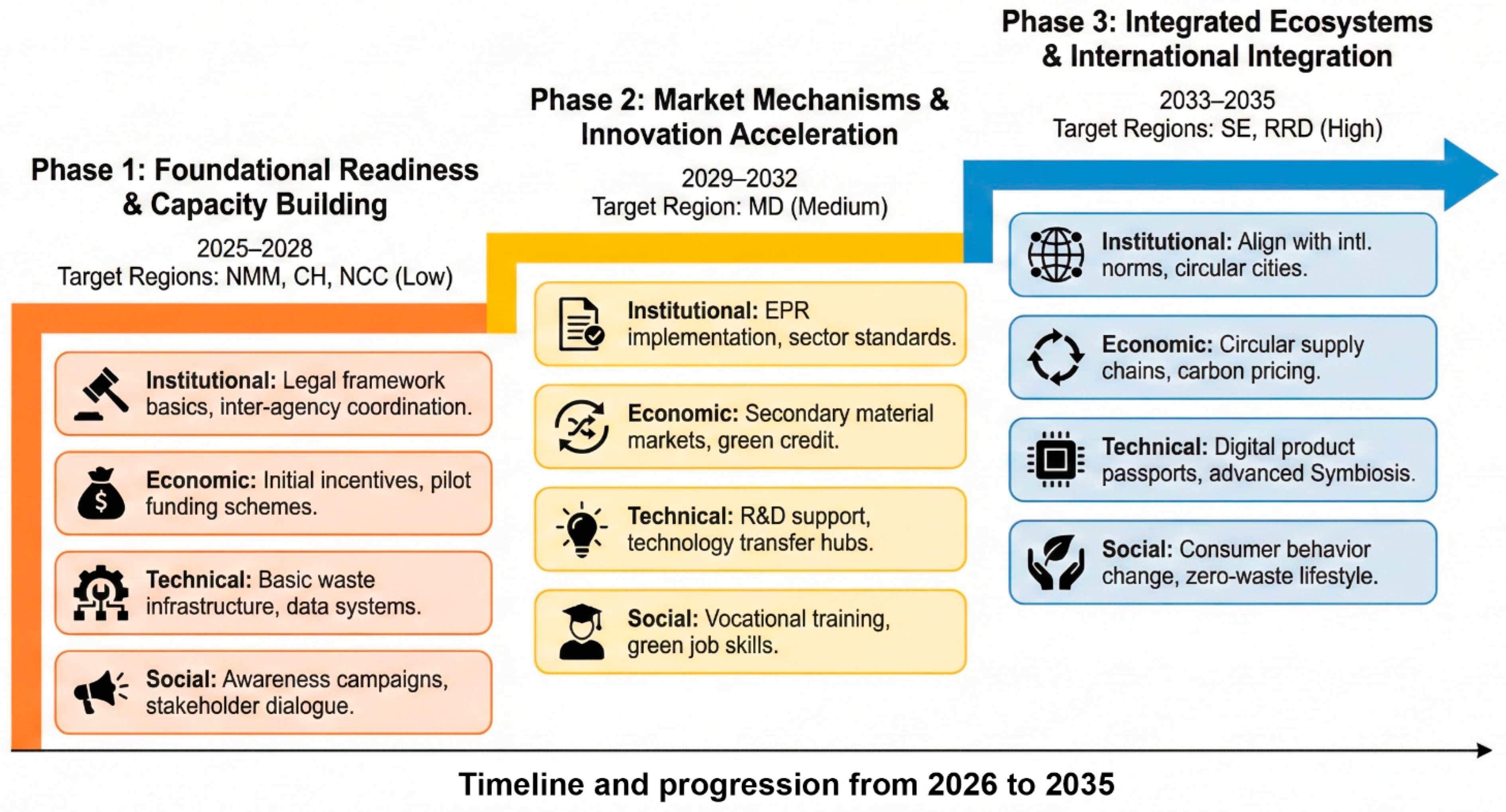
This study shows that Vietnam needs differentiated and region-specific interventions to transition to a circular economy (CE) in environmental resource sectors. Given the big differences across the six regions, policy responses cannot be a “one-size-fits-all” but must reflect each region’s structure, institutional maturity and socio-economic context. This is in line with Vietnam’s Green Growth Strategy (2021–2030), Resolution 57-NQ/TW on science, technology and innovation, and the recently approved National Action Plan on Circular Economy (2025) which all emphasize differentiated regional implementation. Table 10 presents the roadmap of interventions by readiness level, and Figure 10 presents the policy intervention roadmap for the circularity transition in Vietnam (2026–2035).
As delineated in Figure 10, the proposed roadmap outlines a strategic, evolutionary trajectory for Vietnam’s circular transition over the next decade. Recognizing the significant disparities identified in this study, the framework adopts a tiered approach where policy interventions are sequenced based on regional maturity rather than a uniform national application. The progression moves from building foundational hard and soft infrastructure in lower-readiness regions (Phase 1), to establishing market-based mechanisms such as EPR in transitional regions (Phase 2), and finally to fostering advanced, innovation-driven ecosystems integrated with global standards in high-readiness hubs (Phase 3).
To operationalize the implementation logic of the National Action Plan (Decision 222/QĐ-TTg, 2025), targeted interventions must be sequenced based on regional maturity. For low-readiness regions, interventions should focus on targeted Extended Producer Responsibility (EPR) pilot programs and waste valorization for the mining sector. Medium-readiness regions would benefit from wastewater reuse demonstration programs and the establishment of localized CE learning hubs. For high-readiness regions, the focus should shift to establishing digital monitoring hubs, regional CE observatories, and advanced corporate reporting systems aligned with global standards.
Besides readiness-level interventions, several cross-cutting measures must be integrated into Vietnam’s development agenda, structured around immediate enabling actions and long-term structural interventions.
For short-term enabling actions, it is necessary to launch localized awareness and pilot projects, including immediate efforts to prioritize grassroots awareness campaigns and small-scale CE demonstration pilots (e.g., community-based waste segregation and local wastewater reuse models), establishing a foundational level of public engagement and local technical capacity before scaling up.
For long-term structural interventions, there are three further actions, including:
(1) Integrate the CE into resource and provincial planning:
- Circularity principles should be systematically included in land-use plans, mining sector strategies, water resource management frameworks and provincial development plans.
- This will ensure the CE is not a parallel agenda but a mainstream element of resource governance.
- Effective integration requires cross-ministerial coordination between MONRE, MoIT, MPI and MoF and provincial People’s Committees to ensure coherent implementation and monitoring.
(2) Establish regional CE observatories:
- Regional observatories can track CE indicators, disseminate best practices and facilitate peer learning across provinces.
- These observatories should link with universities, local government agencies and private sector networks to provide evidence-based policy advice.
- They can draw lessons from the OECD’s CE in Cities and Regions initiative and EU Circular Hubs which have successfully facilitated multi-stakeholder knowledge sharing.
(3) Increase R&D budget for circular technologies:
- Investment in research and development should focus on CE technologies relevant to Vietnam’s resource sectors, including waste valorization in mining, wastewater treatment innovations and land restoration technologies.
- Aligning R&D support with national science and technology strategies will help scale up innovations from pilot projects to full industrial adoption.
- Funding sources can be national science and technology programs (e.g., NAFOSTED), international mechanisms such as GEF and climate-related ODA flows.

7. Conclusions

This study provides the first systematic framework for assessing circular economy (CE) readiness in Vietnam’s environmental resource sectors, along five dimensions: policy, resource management, innovation, business, and awareness. By combining expert-based Delphi evaluation with triangulated proxy data, the study gives a context-specific yet methodologically sound baseline for regional CE readiness. Unlike previous assessments which were national or consumer-oriented, this study looks at the specific challenges of environmental resource sectors (land, water, mining, waste) where circularity is under-explored.
The main findings are:
- New framework: We developed a five-dimensional readiness framework for Vietnam’s resource-intensive sectors, a practical tool for assessing circularity at the sub-national level.
- Methodological innovation: Using qualitative expert scoring and real proxy data (e.g., plastic recycling, wastewater treatment) we show a way to assess readiness in data-poor contexts, increasing robustness and applicability.
- Regional unevenness: Results show big differences, as the SE and RRD are ready, and the NMM and CH are far behind, so regional-specific interventions are needed rather than a national approach.
- Policy implication: The findings highlight the need to embed the CE in resource and provincial planning, set up regional observatories and prioritize R&D investment in CE technologies for the mining, water and waste sectors.
- Future research directions: Subsequent studies should develop a set of quantitative CE indicators at the regional level and design models to track how readiness evolves under different policy scenarios.
By providing a regional baseline study, this research contributes academically and practically to Vietnam’s CE transition, and offers lessons for other developing countries in the Global South facing similar challenges of limited data, strong regional heterogeneity and urgent sustainability transitions.


Author Contributions

Conceptualization, X.-N.B. and M.K.; methodology, X.-N.B. and M.K.; software, X.-N.B. and M.K.; validation, N.N., D.A.V., T.M.H.L. and A.H.N.; formal analysis, X.-N.B. and M.K.; investigation, X.-N.B.; resources, X.-N.B. and N.N.; data curation, X.-N.B., D.A.V., T.M.H.L. and N.N.; writing—original draft preparation, X.-N.B., M.K., N.N., D.A.V., A.H.N. and T.M.H.L.; writing—review and editing, X.-N.B. and M.K.; visualization, X.-N.B. and M.K.; supervision, X.-N.B.; project administration, X.-N.B.; funding acquisition, X.-N.B. All authors have read and agreed to the published version of the manuscript.

Funding

This research received no external funding.

Institutional Review Board Statement

Ethical review and approval were waived for this study due to its nature: it involved anonymous expert surveys and professional technical evaluations that did not collect sensitive personal data or pose any risk to participants. Under local institutional guidelines in Vietnam (Circular No. 04/2020/TT-BYT), formal IRB approval is not required for this type of anonymous expert survey.

Informed Consent Statement

Informed consent was obtained from all subjects involved in the study.

Data Availability Statement

The data presented in this study are available on request from the corresponding author. The data will be shared if a reasonable request is made for academic or research verification purposes.

Conflicts of Interest

The authors declare no conflict of interest.

Abbreviations

SESoutheast
RRDRed River Delta
MDMekong Delta
NCCNorth Central Coast
CHCentral Highlands
NMMNorthern Midlands and Mountains
OECDOrganisation for Economic Co-operation and Development
MONREMinistry of Natural Resources and Environment
MoITMinistry of Industry and Trade
MoFMinistry of Finance
MPIMinistry of Planning and Investment
NAFOSTEDNational Foundation for Science and Technology Development
ODAOfficial Development Assistance
GEFGlobal Environment Facility

References

  1. Robinson, J.; Cole, R.J. Theoretical underpinnings of regenerative sustainability. Build. Res. Inf. 2015, 43, 133–143. [Google Scholar] [CrossRef]
  2. Scheel, C.; Aguiñaga, E.; Bello, B. Decoupling economic development from the consumption of finite resources using circular economy. A model for developing countries. Sustainability 2020, 12, 1291. [Google Scholar] [CrossRef]
  3. Kennedy, S.; Linnenluecke, M.K. Circular economy and resilience: A research agenda. Bus. Strategy Environ. 2022, 31, 2754–2765. [Google Scholar] [CrossRef]
  4. Government of Vietnam. Decision No. 687/QD-TTg Dated June 07, 2022 on Approving the Scheme for Circular Economy Development in Vietnam; Prime Minister Office, Ed.; Government of Vietnam: Hanoi, Vietnam, 2022.
  5. Government of Vietnam. Decision No. 222/QĐ-TTg Dated 23 January 2025 Introducing the National Action Plan for Circular Economy Implementation by 2035; Prime Minister Office, Ed.; Government of Vietnam: Hanoi, Vietnam, 2025.
  6. Javed, T.; Said, F.; Zainal, D.; Jalil, A.A. Circular economy implementation status of selected ASEAN countries. Sage Open 2024, 14, 21582440231216261. [Google Scholar] [CrossRef]
  7. Van Manh, L.; Huyen, P.A. The Circular Economy in Viet Nam. In Viet Nam 2045: Development Issues and Challenges; Kimura, F., The Viet Nam 2045 Team, Eds.; Economic Research Institute for ASEAN and East Asia (ERIA): Jakarta, Indonesia, 2023; pp. 499–552. [Google Scholar]
  8. Herrador, M.; Dat, T.T.; Truong, D.D.; Hoa, L.T.; Łobacz, K. The unique case study of circular economy in Vietnam remarking recycling craft villages. SAGE Open 2023, 13, 21582440231199939. [Google Scholar] [CrossRef]
  9. Born, K. Adoption of circular economy practices in the mining sector: Evidence from Chile. Resour. Policy 2025, 102, 105514. [Google Scholar] [CrossRef]
  10. Fernandes, E.; Cunha Marques, R. Review of water reuse from a circular economy perspective. Water 2023, 15, 848. [Google Scholar] [CrossRef]
  11. Irandoost, E.; Ghorbanpour, A.; Jamkhaneh, H.B.; Ghasemi, P.; Tirkolaee, E.B. Sustainable-Circular Water Resources Management in the Mining Industry using System Dynamics Modeling. Water Resour. Ind. 2025, 34, 100313. [Google Scholar] [CrossRef]
  12. Elroi, H.; Zbigniew, G.; Agnieszka, W.-C.; Piotr, S. Enhancing waste resource efficiency: Circular economy for sustainability and energy conversion. Front. Environ. Sci. 2023, 11, 1303792. [Google Scholar] [CrossRef]
  13. OECD. An International Review of National and Subnational Circular Economy Monitoring Frameworks: Lessons and Ways Forward for Italy; OECD Regional Development Papers No. 74; OECD: Paris, France, 2024. [Google Scholar]
  14. Holden, N.M. A readiness level framework for sustainable circular bioeconomy. EFB Bioeconomy J. 2022, 2, 100031. [Google Scholar] [CrossRef]
  15. Demko-Rihter, J.; Sassanelli, C.; Pantelic, M.; Anisic, Z. A framework to assess manufacturers’ circular economy readiness level in developing countries: An application case in a Serbian packaging company. Sustainability 2023, 15, 6982. [Google Scholar] [CrossRef]
  16. Cantelmi, R.; Di Gravio, G.; Patriarca, R. Reviewing qualitative research approaches in the context of critical infrastructure resilience. Environ. Syst. Decis. 2021, 41, 341–376. [Google Scholar] [CrossRef] [PubMed]
  17. Geissdoerfer, M.; Savaget, P.; Bocken, N.M.P.; Hultink, E.J. The Circular Economy—A new sustainability paradigm? J. Clean. Prod. 2017, 143, 757–768. [Google Scholar] [CrossRef]
  18. MacArthur, E. Towards the circular economy. J. Ind. Ecol. 2013, 2, 23–44. [Google Scholar]
  19. Beaton, C.; Perera, O.; Arden-Clarke, C.; Farah, A.Z.; Polsterer, N. Global Outlook on Sustainable Consumption and Production (SCP) Policies: Taking Action Together. Executive Summary; UNEP: Paris, France, 2012. [Google Scholar]
  20. Kirchherr, J.; Reike, D.; Hekkert, M. Conceptualizing the circular economy: An analysis of 114 definitions. Resour. Conserv. Recycl. 2017, 127, 221–232. [Google Scholar] [CrossRef]
  21. Xie, S.; Zhang, J.; Li, X.; Xia, X.; Chen, Z. The effect of agricultural insurance participation on rural households’ economic resilience to natural disasters: Evidence from China. J. Clean. Prod. 2024, 434, 140123. [Google Scholar] [CrossRef]
  22. Stahel, W.R. The Circular Economy: A User’s Guide; Routledge: Oxfordshire, UK, 2019. [Google Scholar]
  23. Korhonen, J.; Honkasalo, A.; Seppälä, J. Circular economy: The concept and its limitations. Ecol. Econ. 2018, 143, 37–46. [Google Scholar] [CrossRef]
  24. Ghisellini, P.; Cialani, C.; Ulgiati, S. A review on circular economy: The expected transition to a balanced interplay of environmental and economic systems. J. Clean. Prod. 2016, 114, 11–32. [Google Scholar] [CrossRef]
  25. Suárez-Eiroa, B.; Fernández, E.; Méndez-Martínez, G.; Soto-Oñate, D. Operational principles of circular economy for sustainable development: Linking theory and practice. J. Clean. Prod. 2019, 214, 952–961. [Google Scholar] [CrossRef]
  26. Macarthur, E. The Nature imperative: How the Circular Economy Tackles Biodiversity Loss; Ellen Macarthur Foundation: Cowes, UK, 2021. [Google Scholar]
  27. Oberč, B.P.; de Jong, R.; Demozzi, T.; Battioni, B. Towards a Circular Economy That Begins and Ends in Nature; UCN: Gland, Switzerland, 2022. [Google Scholar]
  28. Preuß, T.; Verbücheln, M. (Eds.) Towards Circular flow Land Use Management: The CircUse Compendium; Deutsches Institut für Urbanistik gGmbH: Berlin, Germany, 2013. [Google Scholar]
  29. Lottermoser, B.G. Recycling, reuse and rehabilitation of mine wastes. Elements 2011, 7, 405–410. [Google Scholar] [CrossRef]
  30. Antony Jose, S.; Calhoun, J.; Renteria, O.B.; Mercado, P.; Nakajima, S.; Hope, C.N.; Sotelo, M.; Menezes, P.L. Promoting a circular economy in mining practices. Sustainability 2024, 16, 11016. [Google Scholar] [CrossRef]
  31. Vinayagam, V.; Sikarwar, D.; Das, S.; Pugazhendhi, A. Envisioning the innovative approaches to achieve circular economy in the water and wastewater sector. Environ. Res. 2024, 241, 117663. [Google Scholar] [CrossRef]
  32. Farfán Chilicaus, G.C.; Cruz Salinas, L.E.; Silva León, P.M.; Lizarzaburu Aguinaga, D.A.; Vera Zelada, P.; Vera Zelada, L.A.; Luque Luque, E.O.; Licapa Redolfo, R.; Ramos Farroñán, E.V. Circular Economy and Water Sustainability: Systematic Review of Water Management Technologies and Strategies (2018–2024). Sustainability 2025, 17, 6544. [Google Scholar] [CrossRef]
  33. Kalmykova, Y.; Sadagopan, M.; Rosado, L. Circular economy—From review of theories and practices to development of implementation tools. Resour. Conserv. Recycl. 2018, 135, 190–201. [Google Scholar] [CrossRef]
  34. Kirchherr, J.; Piscicelli, L.; Bour, R.; Kostense-Smit, E.; Muller, J.; Huibrechtse-Truijens, A.; Hekkert, M. Barriers to the circular economy: Evidence from the European Union (EU). Ecol. Econ. 2018, 150, 264–272. [Google Scholar] [CrossRef]
  35. Purushothaman, R.; Alamelu, R.; Sudha, M. Bridging the Circular Economy Knowledge Gap in SMEs: A Systematic Review of Adoption Barriers, Implementation Strategies, and Theoretical Insights. Circ. Econ. Sustain. 2025, 5, 5455–5474. [Google Scholar] [CrossRef]
  36. Sassanelli, C.; Rosa, P.; Rocca, R.; Terzi, S. Circular economy performance assessment methods: A systematic literature review. J. Clean. Prod. 2019, 229, 440–453. [Google Scholar] [CrossRef]
  37. Kurniawan, T.A.; Liang, X.; O’Callaghan, E.; Goh, H.; Othman, M.H.D.; Avtar, R.; Kusworo, T.D. Transformation of solid waste management in China: Moving towards sustainability through digitalization-based circular economy. Sustainability 2022, 14, 2374. [Google Scholar] [CrossRef]
  38. Okoli, C.; Pawlowski, S.D. The Delphi method as a research tool: An example, design considerations and applications. Inf. Manag. 2004, 42, 15–29. [Google Scholar] [CrossRef]
  39. Moraga, G.; Huysveld, S.; Mathieux, F.; Blengini, G.A.; Alaerts, L.; Van Acker, K.; de Meester, S.; Dewulf, J. Circular economy indicators: What do they measure? Resour. Conserv. Recycl. 2019, 146, 452–461. [Google Scholar] [CrossRef] [PubMed]
  40. Rajayya, A.; Nair, R.; Karthiayani, V.P. India’s Transition to a Circular Economy Towards Fulfilling Agenda 2030: A Critical Review. Sustainability 2025, 17, 2667. [Google Scholar] [CrossRef]
  41. Mohan, J.; Mohanty, C.R.C.; Cross, J.S.; Khajuria, A. Mapping 3R and circular economy policy implementation in Asia and the Pacific. Circ. Econ. Sustain. 2024, 4, 671–692. [Google Scholar] [CrossRef]
  42. Li, H.; Wei, X.; Gao, X. Objectives setting and instruments selection of circular economy policy in China’s mining industry: A textual analysis. Resour. Policy 2021, 74, 102410. [Google Scholar] [CrossRef]
  43. Ermolaeva, Y.V. A Multi-Level Perspective Analysis of Green Construction Development in Russian Cities. Chang. Soc. Personal. 2025, 9, 961–986. [Google Scholar] [CrossRef]
  44. Teixeira, R.L.P. Assessment of Green Steel Production Technologies: Feasibility, Scalability, and Economic Viability. Rev. Gestão Soc. Ambient. 2025, 19, e011601. [Google Scholar] [CrossRef]
  45. Persson, B.M.; Andersson, J.; Forsberg, P.B. Exploring Pathways for Change: A Practice-Oriented Integration of Foresight and Sustainability Transitions. Futures Foresight Sci. 2025, 7, e209. [Google Scholar] [CrossRef]
  46. Ellermann, A.; Özerol, G.; Kruijf, J.V.; Flores, C.C.; Laukka, V.; Stein, U.; Sojamo, S.; Collins, R. Innovations for Stakeholder Engagement in Water Governance: A Systematic Literature Review From a Sustainability Transition Perspective. Environ. Policy Gov. 2026. early view. [Google Scholar] [CrossRef]
  47. Espuny, M.; Reis, J.S.d.M.; Giupponi, E.C.B.; Rocha, A.B.T.; Costa, A.C.F.; Poltronieri, C.F.; Oliveira, O.J.d. The Role of the Triple Helix Model in Promoting the Circular Economy: Government-Led Integration Strategies and Practical Application. Recycling 2025, 10, 50. [Google Scholar] [CrossRef]
  48. Fernández, M.D.V.; Robles, J.; Tolentino, M.; Andrade, S.M. Analysis of the Degree of Implementation of the Circular Economy in Europe and Spain. Cogent Bus. Manag. 2025, 12, 2499668. [Google Scholar] [CrossRef]
  49. Hushko, S.; Bai, O. EU Metrics for the Circular Economy in Light of Modern Business Practices. Econ. Tech. Eng. 2025, 5, 170–179. [Google Scholar] [CrossRef]
  50. Chulakumara, W.M.S.; Thushara, S. Assessing Circular Economy Readiness Factors: Empirical Insights from a Developing Nation. J. Bus. Technol. 2024, 8, 69–88. [Google Scholar] [CrossRef]
  51. World Bank. World Development Indicators: Environment and Natural Resources—Recycling and Material Use Database; World Bank: Washington, DC, USA, 2019. [Google Scholar]
  52. World Bank. World Development Indicators: Environment and Natural Resources—Wastewater Treatment (% of Total Generated); World Bank: Washington, DC, USA, 2021. [Google Scholar]
  53. International Organization for Standardization (ISO). Environmental Management Systems—Requirements with Guidance for Use (ISO Standard No. 14001:2015); ISO: Geneva, Switzerland, 2015. [Google Scholar]
  54. Rowe, G.; Wright, G. The Delphi technique as a forecasting tool: Issues and analysis. Int. J. Forecast. 1999, 15, 353–375. [Google Scholar] [CrossRef]
  55. Turoff, M.; Linstone, H.A. The Delphi Method: Techniques and Applications; Addison-Wesley Publishing: Boston, MA, USA, 1975. [Google Scholar]
  56. Government of Vietnam. Decision No. 1658/QD-TTg Dated October 01, 2021 on Approval for National Green Growth Strategy for 2021–2030 Period, with a Vision by 2050; Government of Vietnam: Hanoi, Vietnam, 2021.
  57. Ministry of Natural Resources and Environment (MONRE). Vietnam National Environmental Report for 2021. 2021. Available online: https://hepa.gov.vn/bao-cao-hien-trang-moi-truong-quoc-gia-2021/ (accessed on 26 March 2026).
  58. Asian Development Bank. Economic Forecasts for Viet Nam. 2025. Available online: https://www.adb.org/where-we-work/viet-nam/economy (accessed on 26 March 2026).
  59. Asian Development Bank; Climate Bonds Initiative. Green Infrastructure Investment Opportunities: Vietnam 2019 Report; Climate Bonds Initiative: London, UK, 2020. [Google Scholar]
  60. UNESCAP. The Secrets to Unlocking the Next Frontier for a Circular Economy in the Asia-Pacific Region; UNESCAP: Bangkok, Thailand, 2024. [Google Scholar]
  61. UNESCAP. Closing the Loop on Plastic Waste in Southeast Asia: Urban Case Studies; UNESCAP: Bangkok, Thailand, 2020. [Google Scholar]
  62. Organisation for Economic Co-operation and Development. The Circular Economy in Cities and Regions: Synthesis Report; OECD Publishing: Paris, France, 2020. [Google Scholar]
Figure 1. The proposed framework for circularity readiness assessment.
Sustainability 18 05116 g001
Figure 2. Indicator framework matrix for connecting dimensions, indicators, and resource sectors.
Sustainability 18 05116 g002
Figure 3. Delphi process for expert-based scoring.
Sustainability 18 05116 g003
Figure 4. Geospatial readiness map of circularity by region in Vietnam.
Sustainability 18 05116 g004
Figure 5. Regional readiness radar chart.
Sustainability 18 05116 g005
Figure 6. Heatmap of regional readiness scores.
Sustainability 18 05116 g006
Figure 7. Boxplot of score variability across experts.
Sustainability 18 05116 g007
Figure 8. Dendrogram of regional readiness profiles.
Sustainability 18 05116 g008
Figure 9. The barrier landscape: network map of bottlenecks impeding circularity transition in Vietnam.
Sustainability 18 05116 g009
Figure 10. The policy intervention roadmap for circularity transition in Vietnam (2026–2035).
Sustainability 18 05116 g010
Table 1. Comparison of global CE readiness frameworks.
FrameworkScopeSector-SpecificRegional GranularityNotes
Circularity Gap Report (CGR)Global/nationalNoNoFocused on material flow quantification; lacks implementation detail
EU CE Monitoring FrameworkEU-wide (28 member states)LimitedLimitedRobust indicator set, but not designed for sub-national application
ESCAP CE Readiness ToolkitAsia–PacificGenericSome flexibilityQualitative tool; suitable for policy-level diagnostics
Table 2. Indicators, definitions and scoring rules.
CodeIndicatorDimensionDescriptionScoring Logic (1–5)Source
P1Presence of CE-related policy or strategy at provincial levelPolicyExistence of formal CE plans, guidelines, or pilot programs1 = none; 5 = fully adopted and integratedDecision 687/QĐ-TTg; local plans
P2Policy integration across resource sectorsPolicyWhether CE is reflected in sectoral plans (land, mining, water, waste)1 = not mentioned; 5 = fully mainstreamed in ≥3 sectorsProvincial reports
P3Enforcement and institutional support mechanismsPolicyExistence of CE monitoring units or inter-agency coordination1 = absent; 5 = dedicated, active institutionsMONRE, provincial DoNRE
R1Plastic recycling rate (estimated)Resource managementEstimated percentage of plastic waste recycled formally1 = <20%; 5 = >50%[51]
R2Urban wastewater treatment coverageResource management% of wastewater collected and treated1 = <10%; 5 = >60%[52]
R3Mining waste reuse or land rehabilitationResource managementExistence of reuse or land restoration practices in mining1 = none; 5 = widespread across major minesDoI, environmental reports
I1R&D investment in CE-related technologiesInnovationBudget or projects supporting CE innovation1 = none; 5 = >1% GDP or ≥3 CE R&D projectsGSO, local reports
I2CE-related startups or innovation centersInnovationActive CE-focused enterprises or innovation hubs1 = none; 5 = >10 enterprises or 2 hubsNIC, local innovation centers
I3Use of digital tools (GIS, sensors) in resource monitoringInnovationDeployment of digital systems in water, mining, or waste1 = none; 5 = widespread use in ≥2 sectorsMONRE, smart province reports
B1Existence of CE-aligned businessesBusinessNumber or share of firms applying CE models1 = none; 5 = >20% of firms in key sectorsVCCI, local business registry
B2Access to CE finance or green investment schemesBusinessAvailability of dedicated financial support for CE1 = none; 5 = multiple ongoing programsMOF, banks, GCF
B3Participation in CE certifications or standards (e.g., [53])BusinessAdoption of environmental/circular standards1 = none; 5 = >30% of firms certifiedMOIT, certifying bodies
A1CE awareness in populationAwareness% of population aware of CE or sustainability concepts1 = <10%; 5 = >60% (based on surveys)Custom surveys or SDG reports
A2Integration of CE/3R into schools or universitiesAwarenessInclusion in curriculum or student activities1 = none; 5 = systematic inclusionMOET, provincial DoET
A3Community participation in CE (e.g., composting, recycling)AwarenessDegree of grassroots engagement1 = absent; 5 = broad, active participationNGO reports, community pilots
Table 3. Composition of the Delphi expert panel (n = 11) and coverage across sectors and regions.
Expert IDStakeholder GroupAffiliation Type (Anonymized)Primary Sector Expertise *Secondary Sector ExpertisePrimary Region Exposure **Multi-Region ExposureYears of ExperienceCE-Related Role (Examples)Delphi Participation
EXP01AcademiaUniversity/research groupMiningWasteNMMNational18CE research, mine rehabilitation, industrial symbiosisR1–R2–R3
EXP02GovernmentCentral ministry/national agencyPolicy & governanceWasteRRDNational20Policy drafting, CE roadmap/program coordinationR1–R2–R3
EXP03IndustryLarge enterprise/industrial operatorWasteWaterSESE + RRD15Recycling chain, EPR/waste operationsR1–R2–R3
EXP04AcademiaUniversity/research centerWaterLandNCCNCC + RRD12SCP/CE research, water reuse, infrastructureR1–R2–R3
EXP05GovernmentProvincial department (e.g., DoNRE)LandPolicy & governanceMDMD + NCC16Provincial planning, land rehabilitation, CE integrationR1–R2–R3
EXP06IndustrySME/service providerMiningPolicy & governanceNMMNMM + CH10Tailings/waste valorization, cleaner mining solutionsR1–R2–R3
EXP07AcademiaUniversity/instituteWastePolicy & governanceRRDNational14Waste system design, informal sector interfaceR1–R2–R3
EXP08GovernmentProvincial agency/public utilityWaterWasteCHCH + SE17Wastewater treatment, reuse feasibility, utility operationsR1–R2–R3
EXP09IndustrySector association/consultancy unitPolicy & governanceLandSENational22CE advisory, market mechanisms, certification/financeR1–R2–R3
EXP10GovernmentRegional planning/coordination unitLandWaterNCCNCC + MD13Regional planning, resource governance coordinationR1–R2–R3
EXP11AcademiaUniversity/labPolicy & governanceInnovation/techRRDNational9Digital monitoring, CE indicators, data systemsR1–R2–R3
* Primary sector expertise should be mapped to the paper’s scope, land/mining/water/waste, and you may use policy and governance as cross-cutting. ** Primary region exposure uses the paper’s 6-region classification: RRD, SE, MD, NCC, NMM, CH.
Table 4. Panel coverage summary.
By stakeholder group
GroupCount (n)Share
Academia436%
Government (central + provincial)545%
Industry/practitioners218%
Total11100%
By sector expertise (primary)
Sector (primary)Count (n)-
Policy & governance (cross-cutting)3-
Waste2-
Water2-
Land2-
Mining2-
Total11-
By region exposure (primary)
RegionCount (n)-
RRD3-
SE2-
MD1-
NCC2-
NMM2-
CH1-
Total11-
Table 5. Proxy data sources used.
IndicatorProxy Data UsedSourceContextual Benchmarking
Innovation indexVietnam Innovation Index 2023World Intellectual Property OrganizationBenchmarked against GRDP
Waste treatment% waste processed via CE methodsMONRE Reports 2022Province avg
ISO14001 coverageNumber of certified firms per 10,000 businessesVietnam CE Monitoring DashboardDirect use
Table 6. Readiness scores per region.
RegionPolicyResource ManagementInnovationBusinessAwarenessCompositeReadiness Level
RRD4.23.93.53.74.13.88High
SE4.04.14.34.24.04.12High
MD3.13.02.82.93.23.00Medium
NCC2.82.72.52.62.92.70Low
Northern Midlands & Mountains (NMM)2.92.82.62.72.82.76Low
CH2.72.92.42.52.62.62Low
Table 7. Selected quantitative proxies supporting qualitative scores.
IndicatorSERRDMDNCCNMMCHSource
Plastic recycling (%)403030252020World Bank [51]
Wastewater treated (%)403515201010World Bank [52]
Informal recycling (%)607050505050Circulate initiative
Note: Values are proxy estimates derived from national-level statistics [48,51,52], serving purely as contextual benchmarks reflecting regional industrial and infrastructural characteristics. They are intended to assist in the interpretation of qualitative expert scoring, rather than functioning as precise quantitative measurements.
Table 8. Delphi round summary and consensus improvement.
Delphi RoundMean Std. Dev. Across IndicatorsRange of SD (Min–Max)% Indicators with SD > 1.0Notes
Round 11.120.6–1.872%High variability, divergent perspectives
Round 20.840.4–1.348%Feedback summary reduced outliers
Round 30.670.3–1.122%Substantial convergence achieved
Std. Dev. and SD is the standard deviation.
Table 9. Delphi score convergence.
Indicator CodeDescriptionMean (R1)SD (R1)Mean (R3)SD (R3)Consensus Improved
POL1Existence of CE legal framework3.251.304.000.50
RES2Water reuse in industrial zones2.701.153.300.70
AWR3CE awareness among local officials2.101.402.401.25✗ (Justified divergence)
Table 10. Roadmap of interventions by readiness level.
Readiness LevelStrategic ActionPriority Stakeholders
Low- Strengthen CE awareness campaigns; launch small-scale pilot projects in waste, water, and land sectors; build basic monitoring capacity.
- Leverage provincial development funds and state budget allocations for capacity-building.
Local governments, NGOs, community groups.
Medium- Establish innovation hubs and CE learning centers; provide targeted R&D support; scale up demonstration projects in mining and wastewater reuse.
- Utilize targeted R&D matching grants and ODA funding for water infrastructure.
Ministry of Industry and Trade (MoIT), Department of Natural Resources and Environment (DoNRE), provincial authorities.
High- Mobilize finance for CE investment; integrate CE indicators into regional reporting systems; incentivize CE-aligned business models through green finance and fiscal tools.
- Incentivize CE-aligned business models through green credit schemes, green bonds, and preferential tax instruments.
Central government, Ministry of Finance (MoF), business associations.
Disclaimer/Publisher’s Note: The statements, opinions and data contained in all publications are solely those of the individual author(s) and contributor(s) and not of MDPI and/or the editor(s). MDPI and/or the editor(s) disclaim responsibility for any injury to people or property resulting from any ideas, methods, instructions or products referred to in the content.